BeaudoinSkill Boosting Conversations: Cultivating socio-emotional intelligenceMarie-Nathalie Beaudoin, Ph.D.John F. Kennedy University andBay Area Family Therapy Training Associates
Does a problem with a child automatically means a lack of knowledge and skills?
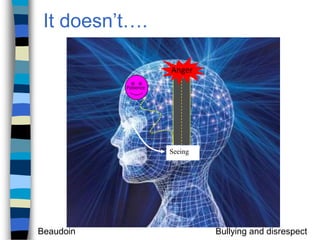
It doesn’t….AngerPatienceSeeing
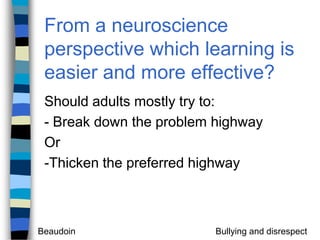
From a neuroscience perspective which learning is easier and more effective?Should adults mostly try to:- Break down the problem highwayOr-Thicken the preferred highway
From a neuroscience perspective, the brain’s utmost complex encoding occurs when the information discussed is:1. exciting (unusual, interesting)2. relevant (applies directly to personal life)3. associated with positive affect (pride, joy)
Is it even possible to discuss problem related material in a way that makes it exciting to the young person, relevant and triggers positive affect?YES!!!!
It is possible!Instead of dwelling on times when a young person was impatient, you can instead focus extensively on times when he or she experienced the temptation to be patientYou can BOOST the desired skill
If the neural pathway for the skill is rarely activated, then how can we find a skill to boost?The best way to discover those hidden and poorly articulated skills, is through conversations on successes.
Defining a successAn experience of maintaining integrity in the face of a potential challenge. Occurs when young people’s desires or needs could have resulted in unpleasant experience but haven’t or have in a controlled way
Factors to consider in a success:1. outcome:             -problem solved         -problem not solved 2. process:           -constructive         -mix between constructive and not         -mostly destructive
Take the story of SamSam is a 3rd grade student disliked by most for his mean comments and gestures.  He is in particular openly at war with an assertive girl who stands up to him.One day, students were supposed to write a comment on each other’s “planet project” poster board.  Sam refused to write any comment on the board of his well-known class enemy.
Sam: I’m angry, Eva wrote a mean comment about my planet project.MN: What did she write?Sam (angry): She wrote “Whaaaat??” like it was a crappy project, everyone knows we’re enemiesMN:  So what did you do?Sam: I asked her why she wrote that but she just shrugged and walked away.MN: She shrugged and walked away? Was that upsetting?Sam: Yeah, I thought of saying something mean but I didn’t.MN (curious): You didn’t say anything mean?Sam: No, and then I thought of writing something really really mean on her project...but I didn’t…
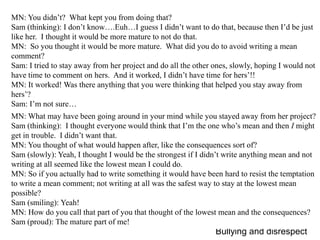
MN: You didn’t?  What kept you from doing that?Sam (thinking): I don’t know….Euh…I guess I didn’t want to do that, because then I’d be just like her.  I thought it would be more mature to not do that.MN:  So you thought it would be more mature.  What did you do to avoid writing a mean comment?Sam: I tried to stay away from her project and do all the other ones, slowly, hoping I would not have time to comment on hers.  And it worked, I didn’t have time for hers’!!MN: It worked! Was there anything that you were thinking that helped you stay away from hers’?Sam: I’m not sure…MN: What may have been going around in your mind while you stayed away from her project?Sam (thinking):  I thought everyone would think that I’m the one who’s mean and then I might get in trouble.  I didn’t want that.MN: You thought of what would happen after, like the consequences sort of?Sam (slowly): Yeah, I thought I would be the strongest if I didn’t write anything mean and not writing at all seemed like the lowest mean I could do.MN: So if you actually had to write something it would have been hard to resist the temptation to write a mean comment; not writing at all was the safest way to stay at the lowest mean possible?Sam (smiling): Yeah!MN: How do you call that part of you that thought of the lowest mean and the consequences?Sam (proud): The mature part of me!
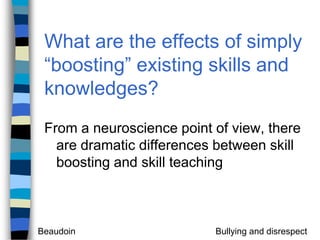
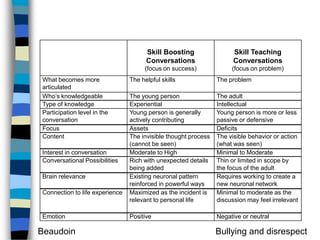
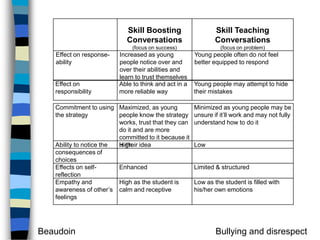
What are the effects of simply “boosting” existing skills and knowledges?From a neuroscience point of view, there are dramatic differences between skill boosting and skill teaching
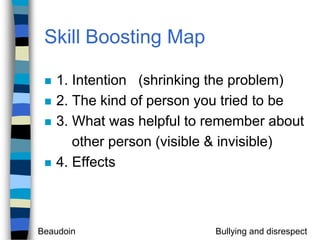
Skill Boosting Map1. Intention   (shrinking the problem)2. The kind of person you tried to be3. What was helpful to remember about           other person (visible & invisible)4. Effects
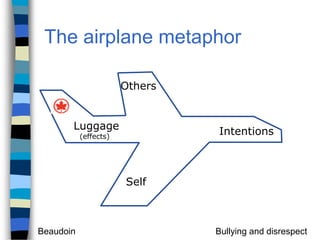
The airplane metaphor Others Luggage(effects)IntentionsSelf
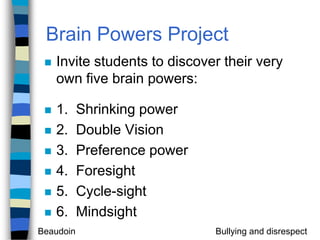
Brain Powers ProjectInvite students to discover their very own five brain powers:1.  Shrinking power2.  Double Vision3.  Preference power4.  Foresight5.  Cycle-sight6.  Mindsight
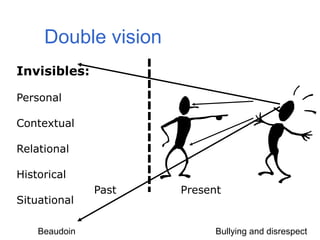
Double visionInvisibles:PersonalContextualRelationalHistoricalSituational     Past	           Present
Different types of “Invisibles”Personal (related to age or physical limit)Relational (shared past experiences)Contextual (current life of the person)Historical    (distant past)Situational   (specific circumstance)
How is the Brain Powers project facilitated?1. Works with students’ real and lived experiences that they choose to share    (success slips, class discussions)2. Humor, entertaining activities    (props, costumes, skits, invisible ink)3.  Cultivate a class culture of calm, appreciation and tolerance
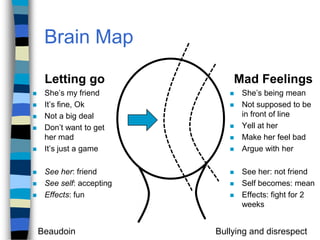
Brain MapLetting goShe’s my friendIt’s fine, OkNot a big dealDon’t want to get her madIt’s just a gameSee her: friendSee self: acceptingEffects: funMad FeelingsShe’s being meanNot supposed to be in front of lineYell at herMake her feel badArgue with herSee her: not friendSelf becomes: meanEffects: fight for 2 weeks
Accumulative effects1. Enhanced self-awareness & ability for reflection 2. Perception of others in multi-facetted way which makes empathy possible3. Ability to choose from a vaster repertoire of responses and make  informed decisions based on values4. Intrinsic motivation
For more:The SKiLL-ionaire in Every Child:  Boosting Children’s Socio-Emotional Intelligence Using the Latest in Brain Research (2010). Goshawk Publ.Responding to the culture of Bullying & Disrespect: New Perspectives on Compassion, Collaboration and Responsibility (2009).  Corwin Press.
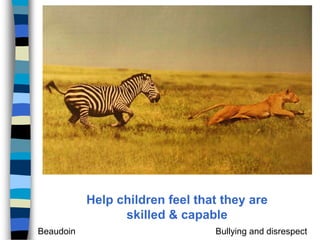
Help children feel that they are skilled & capable

Brain powers presentation for website

  • 1.
    BeaudoinSkill Boosting Conversations:Cultivating socio-emotional intelligenceMarie-Nathalie Beaudoin, Ph.D.John F. Kennedy University andBay Area Family Therapy Training Associates
  • 2.
    Does a problemwith a child automatically means a lack of knowledge and skills?
  • 3.
  • 4.
    From a neuroscienceperspective which learning is easier and more effective?Should adults mostly try to:- Break down the problem highwayOr-Thicken the preferred highway
  • 5.
    From a neuroscienceperspective, the brain’s utmost complex encoding occurs when the information discussed is:1. exciting (unusual, interesting)2. relevant (applies directly to personal life)3. associated with positive affect (pride, joy)
  • 6.
    Is it evenpossible to discuss problem related material in a way that makes it exciting to the young person, relevant and triggers positive affect?YES!!!!
  • 7.
    It is possible!Insteadof dwelling on times when a young person was impatient, you can instead focus extensively on times when he or she experienced the temptation to be patientYou can BOOST the desired skill
  • 8.
    If the neuralpathway for the skill is rarely activated, then how can we find a skill to boost?The best way to discover those hidden and poorly articulated skills, is through conversations on successes.
  • 9.
    Defining a successAnexperience of maintaining integrity in the face of a potential challenge. Occurs when young people’s desires or needs could have resulted in unpleasant experience but haven’t or have in a controlled way
  • 10.
    Factors to considerin a success:1. outcome: -problem solved -problem not solved 2. process: -constructive -mix between constructive and not -mostly destructive
  • 11.
    Take the storyof SamSam is a 3rd grade student disliked by most for his mean comments and gestures. He is in particular openly at war with an assertive girl who stands up to him.One day, students were supposed to write a comment on each other’s “planet project” poster board. Sam refused to write any comment on the board of his well-known class enemy.
  • 12.
    Sam: I’m angry,Eva wrote a mean comment about my planet project.MN: What did she write?Sam (angry): She wrote “Whaaaat??” like it was a crappy project, everyone knows we’re enemiesMN: So what did you do?Sam: I asked her why she wrote that but she just shrugged and walked away.MN: She shrugged and walked away? Was that upsetting?Sam: Yeah, I thought of saying something mean but I didn’t.MN (curious): You didn’t say anything mean?Sam: No, and then I thought of writing something really really mean on her project...but I didn’t…
  • 13.
    MN: You didn’t? What kept you from doing that?Sam (thinking): I don’t know….Euh…I guess I didn’t want to do that, because then I’d be just like her. I thought it would be more mature to not do that.MN: So you thought it would be more mature. What did you do to avoid writing a mean comment?Sam: I tried to stay away from her project and do all the other ones, slowly, hoping I would not have time to comment on hers. And it worked, I didn’t have time for hers’!!MN: It worked! Was there anything that you were thinking that helped you stay away from hers’?Sam: I’m not sure…MN: What may have been going around in your mind while you stayed away from her project?Sam (thinking): I thought everyone would think that I’m the one who’s mean and then I might get in trouble. I didn’t want that.MN: You thought of what would happen after, like the consequences sort of?Sam (slowly): Yeah, I thought I would be the strongest if I didn’t write anything mean and not writing at all seemed like the lowest mean I could do.MN: So if you actually had to write something it would have been hard to resist the temptation to write a mean comment; not writing at all was the safest way to stay at the lowest mean possible?Sam (smiling): Yeah!MN: How do you call that part of you that thought of the lowest mean and the consequences?Sam (proud): The mature part of me!
  • 14.
    What are theeffects of simply “boosting” existing skills and knowledges?From a neuroscience point of view, there are dramatic differences between skill boosting and skill teaching
  • 17.
    Skill Boosting Map1.Intention (shrinking the problem)2. The kind of person you tried to be3. What was helpful to remember about other person (visible & invisible)4. Effects
  • 18.
    The airplane metaphorOthers Luggage(effects)IntentionsSelf
  • 19.
    Brain Powers ProjectInvitestudents to discover their very own five brain powers:1. Shrinking power2. Double Vision3. Preference power4. Foresight5. Cycle-sight6. Mindsight
  • 20.
  • 21.
    Different types of“Invisibles”Personal (related to age or physical limit)Relational (shared past experiences)Contextual (current life of the person)Historical (distant past)Situational (specific circumstance)
  • 22.
    How is theBrain Powers project facilitated?1. Works with students’ real and lived experiences that they choose to share (success slips, class discussions)2. Humor, entertaining activities (props, costumes, skits, invisible ink)3. Cultivate a class culture of calm, appreciation and tolerance
  • 23.
    Brain MapLetting goShe’smy friendIt’s fine, OkNot a big dealDon’t want to get her madIt’s just a gameSee her: friendSee self: acceptingEffects: funMad FeelingsShe’s being meanNot supposed to be in front of lineYell at herMake her feel badArgue with herSee her: not friendSelf becomes: meanEffects: fight for 2 weeks
  • 24.
    Accumulative effects1. Enhancedself-awareness & ability for reflection 2. Perception of others in multi-facetted way which makes empathy possible3. Ability to choose from a vaster repertoire of responses and make informed decisions based on values4. Intrinsic motivation
  • 25.
    For more:The SKiLL-ionairein Every Child: Boosting Children’s Socio-Emotional Intelligence Using the Latest in Brain Research (2010). Goshawk Publ.Responding to the culture of Bullying & Disrespect: New Perspectives on Compassion, Collaboration and Responsibility (2009). Corwin Press.
  • 26.
    Help children feelthat they are skilled & capable