Cognitive Biases
What you should know & What
can you do about it?
3/26/2014 1Footer Text
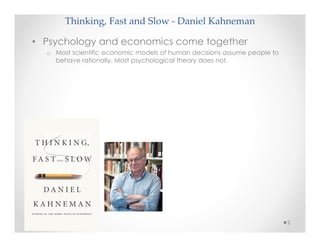
Thinking, Fast and Slow - Daniel Kahneman
• Psychology and economics come together
o Most scientific economic models of human decisions assume people to
behave rationally. Most psychological theory does not.
2
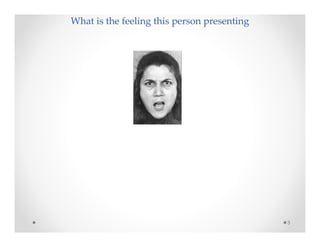
What is the feeling this person presenting
3
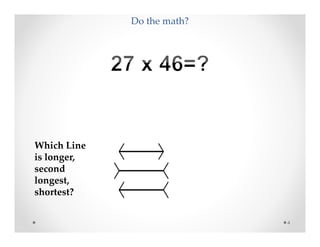
Do the math?
4
Which Line
is longer,
second
longest,
shortest?
System 1 and System 2
• System 1, is our fast, automatic, impulsive, intuitive
and largely unconscious mode.
• It is System 1 that detects hostility in a voice and
effortlessly completes the phrase “bread and. . . . ”
• System 2, in Kahneman’s scheme, is our slow,
deliberate, capable of reasoning, cautious,
analytical and consciously effortful mode of
reasoning about the world.
• It is System 2 that swings into action when we have
to fill out a tax form or park a car in a narrow space.
• System 2 is lazy and any work it has to do it will try
not to.
5
Do the math?
6
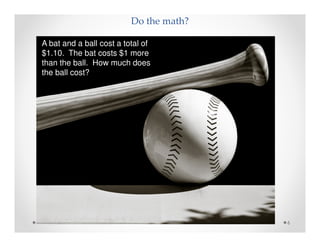
A bat and a ball cost a total of
$1.10. The bat costs $1 more
than the ball. How much does
the ball cost?
Count number of passes white team makes
7
Priming Effect
• Ideomotor effect - influencing of an action by the
idea
• Florida Example
8
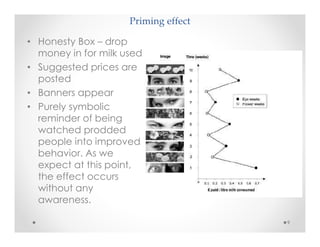
Priming effect
9
• Honesty Box – drop
money in for milk used
• Suggested prices are
posted
• Banners appear
• Purely symbolic
reminder of being
watched prodded
people into improved
behavior. As we
expect at this point,
the effect occurs
without any
awareness.
Cognitive Strain
10
• You make less mistakes when you’re forced to
read small print or make your mind work.
• Cognitive strain, whatever its source, mobilizes
System 2, which is more likely to reject the
intuitive answer suggested by System 1.
• Ego Depletion – Effort of will or self-control is
tiring; if you have had to force yourself to do
something, you are less willing or less able to
exert self-control when the next challenge
comes around.
Anchoring
11
Was Gandhi more or less than 144
years old when he died?
How old was Gandhi when he died?
Anchoring
12
• Anchoring Effect - occurs when people
consider a particular value for an unknown
quantity before estimating that quantity.
• We have a tendency to be influenced by
irrelevant numbers
• Buying something that’s negotiable? Be
careful!
Sunk Cost Fallacy
13
• Sunk Cost - The decision to invest additional
resources in a losing account, when better
investments are available
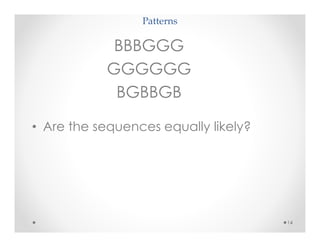
Patterns
14
BBBGGG
GGGGGG
BGBBGB
• Are the sequences equally likely?
Availability of Info / Bad Events / Rare Events
15
• A salient event that attracts your attention will
be easily retrieved from memory and more
relevant to your decision making.
• Availability heuristic - mental shortcut that
occurs when people make judgments about
the probability of events by how easy it is to
think of examples
• If you can think of it, it must be important
• How is information shown?
Planning Fallacy / Optimistic Bias / Predicting the Future
16
• The planning fallacy is the tendency to
overestimate benefits and underestimate costs,
impelling people to take on risky projects.
o In 2002, American kitchen remodeling was expected on average
to cost $18,658, but actually cost $38,769
• You can explain the past therefore you can
predict the future
Prospect Theory / Loss Aversion
17
• You are offered a gamble on the toss of a coin.
If the coin shows tails, you lose $100. If the coin
shows heads, you win $150. Do you take it?
Conclusion
18
• It’s very hard to change your mind / Flexibility in
thinking
• If you don’t examine
(impressions/feelings/inclinations) they will
become beliefs
• When can you trust intuition?

Bp thinkingfastslow (2)

  • 1.
    Cognitive Biases What youshould know & What can you do about it? 3/26/2014 1Footer Text
  • 2.
    Thinking, Fast andSlow - Daniel Kahneman • Psychology and economics come together o Most scientific economic models of human decisions assume people to behave rationally. Most psychological theory does not. 2
  • 3.
    What is thefeeling this person presenting 3
  • 4.
    Do the math? 4 WhichLine is longer, second longest, shortest?
  • 5.
    System 1 andSystem 2 • System 1, is our fast, automatic, impulsive, intuitive and largely unconscious mode. • It is System 1 that detects hostility in a voice and effortlessly completes the phrase “bread and. . . . ” • System 2, in Kahneman’s scheme, is our slow, deliberate, capable of reasoning, cautious, analytical and consciously effortful mode of reasoning about the world. • It is System 2 that swings into action when we have to fill out a tax form or park a car in a narrow space. • System 2 is lazy and any work it has to do it will try not to. 5
  • 6.
    Do the math? 6 Abat and a ball cost a total of $1.10. The bat costs $1 more than the ball. How much does the ball cost?
  • 7.
    Count number ofpasses white team makes 7
  • 8.
    Priming Effect • Ideomotoreffect - influencing of an action by the idea • Florida Example 8
  • 9.
    Priming effect 9 • HonestyBox – drop money in for milk used • Suggested prices are posted • Banners appear • Purely symbolic reminder of being watched prodded people into improved behavior. As we expect at this point, the effect occurs without any awareness.
  • 10.
    Cognitive Strain 10 • Youmake less mistakes when you’re forced to read small print or make your mind work. • Cognitive strain, whatever its source, mobilizes System 2, which is more likely to reject the intuitive answer suggested by System 1. • Ego Depletion – Effort of will or self-control is tiring; if you have had to force yourself to do something, you are less willing or less able to exert self-control when the next challenge comes around.
  • 11.
    Anchoring 11 Was Gandhi moreor less than 144 years old when he died? How old was Gandhi when he died?
  • 12.
    Anchoring 12 • Anchoring Effect- occurs when people consider a particular value for an unknown quantity before estimating that quantity. • We have a tendency to be influenced by irrelevant numbers • Buying something that’s negotiable? Be careful!
  • 13.
    Sunk Cost Fallacy 13 •Sunk Cost - The decision to invest additional resources in a losing account, when better investments are available
  • 14.
  • 15.
    Availability of Info/ Bad Events / Rare Events 15 • A salient event that attracts your attention will be easily retrieved from memory and more relevant to your decision making. • Availability heuristic - mental shortcut that occurs when people make judgments about the probability of events by how easy it is to think of examples • If you can think of it, it must be important • How is information shown?
  • 16.
    Planning Fallacy /Optimistic Bias / Predicting the Future 16 • The planning fallacy is the tendency to overestimate benefits and underestimate costs, impelling people to take on risky projects. o In 2002, American kitchen remodeling was expected on average to cost $18,658, but actually cost $38,769 • You can explain the past therefore you can predict the future
  • 17.
    Prospect Theory /Loss Aversion 17 • You are offered a gamble on the toss of a coin. If the coin shows tails, you lose $100. If the coin shows heads, you win $150. Do you take it?
  • 18.
    Conclusion 18 • It’s veryhard to change your mind / Flexibility in thinking • If you don’t examine (impressions/feelings/inclinations) they will become beliefs • When can you trust intuition?