www.igminresearch.com 873
Mathematics
BIOLOGY GROUP 2995-8067
ISSN
Abstract
Many applications in science, engineering, and modern technology require the solution of boundary value problems for genuine three-dimensional
objects. These objects often are of or can be approximated by, an ellipsoidal shape, where the three ellipsoidal semiaxes correspond to three independent
degrees of freedom. The triaxial ellipsoid represents the sphere of any anisotropic space and for this reason, it appears naturally in many scienti ic
disciplines. Consequently, despite the complications of the ellipsoidal geometry and mainly its analysis, based on the theory of ellipsoidal harmonics, a lot
of progress has been made in the solution of ellipsoidal boundary value problems, due to its general applicability. In this mini-review, we aim to present
to the scienti ic community the main achievements towards the investigation of three such physical problems of medical, engineering and technological
signi icance, those comprising intense research in (a) electroencephalography (EEG) and magnetoencephalography (MEG), (b) creeping hydrodynamics
(Stokes low) and (c) identi ication of metallic impenetrable bodies, either embedded within the Earth’s conductive subsurface or located into a lossless air
environment. In this context, special expertise and particular skills are needed in solving open boundary value problems that incorporate the ellipsoidal
geometry and the related harmonic analysis, revealing the fact that there still exists the necessity of involving with these issues.
Boundary Value Problems in
Ellipsoidal Geometry and
Applications
Panayiotis Vafeas*
Department of Chemical Engineering, University of Patras, 26504 Patras, Greece
*Correspondence: Panayiotis Vafeas, Department of Chemical Engineering, University
of Patras, 26504 Patras, Greece, Email: vafeas@chemeng.upatras.gr
Review Article
Article Information
Submitted: October 16, 2024
Approved: October 28, 2024
Published: October 29, 2024
How to cite this article: Vafeas P. Boundary Value
Problems in Ellipsoidal Geometry and Applications. IgMin
Res. October 29, 2024; 2(10): 873-879. IgMin ID: igmin263;
DOI: 10.61927/igmin263; Available at: igmin.link/p263
Copyright: © 2024 Vafeas P. This is an open access article
distributed under the Creative Commons Attribution
License, which permits unrestricted use, distribution, and
reproduction in any medium, provided the original work is
properly cited.
Keywords: Ellipsoidal geometry and analysis;
Electroencephalography (EEG); Magnetoencephalography
(MEG); Stokes creeping low; Metallic bodies in conductive
and lossless media
elliptic integrals. As a result of these complications, there exist
ellipsoidal problems in physics, engineering, and modern
technology areas remain unsolved, even though many of them
have been dealt with satisfactorily. As far as the complete
theoretical progress in the ield is concerned, it is worth
mentioning that much work has been done in both analytical
[6] and computational [7] levels.
The ellipsoidal geometry provides the most general
environment for the study of the anisotropy of the three-
dimensional space. Indeed, a scaling of a sphere leads to an
ellipsoid, and a particular scaling of an ellipsoid reconstructs
the sphere. Consequently, the ellipsoid represents the
sphere of any anisotropic space. This generic feature of
the ellipsoid explains the ubiquitous nature of ellipsoidal
boundary value problems. Bearing in mind this feature, the
novelty of any general treatment of the ellipsoidal harmonics
and their reductions provides the perfect environment for
the construction of several ready-to-use formulae, which
can be used in a wide range of applications. Regarding the
development of reduction techniques, let us note that this is
an important task since, this is not only a means of checking
the correctness of the ellipsoidal results, but also provides
Introduction
The ellipsoidal coordinates with its analytical counterparts
[1-4] provide the most general system for which the Laplace
equationisseparable.Inthisconnection,effortsfor indingand
studying the ellipsoidal harmonics have a long and illustrious
history, which spans more than one and a half centuries. The
existence, completeness, and orthogonality of the ellipsoidal
harmonics were inally proved in 1927 by Moglich in a
manuscript 125 pages long. Although the basic theory of
ellipsoidal harmonics was completed during the decade of
1930, it is only in the last few years that basic quantitative
questions concerning the form of the ellipsoidal harmonics
and of the Lamé products were answered, while some of them
remain unanswered. The internal ellipsoidal harmonics of
degrees 0,1,2 and 3 can be written in closed form. However,
the harmonics of degree greater than 3 contain constants,
which satisfy polynomial equations of degree more than 5
and Galois theory implies that such roots cannot be found
explicitly. Though, speci ic forms for ellipsoidal harmonics
of degrees 5,6, and 7 have been recently discovered [5].
Furthermore, none of the external ellipsoidal harmonics can
be written in closed form, since they are expressed through
October 29, 2024 - Volume 2 Issue 10
DOI: 10.61927/igmin263
2995-8067
ISSN
874
BIOLOGY
an opportunity to study the transition process from the 3D
ellipsoidal environment to the 2D spheroidal and 1D spherical
cases.
The purely ellipsoidal expressions are not easy to handle,
thus the results are given in the more tractable form, where
Cartesian coordinates are used for the interior harmonics
and the standard elliptic integrals are used in the exterior
Lamé products. Of course, the harmonic character of the
expressions is retained and a mixed Cartesian and ellipsoidal
form is obtained. Many relations involving the constants of the
ellipsoidal harmonics, as well as relations among the elliptic
integrals, are obtained to bring the formulae into their inal
useful form. The particular way that the elliptic integrals are
related is utilized to ind useful expressions transforming the
Cartesian to the ellipsoidal system and vice versa, wherein
this task demands long and tedious analytical calculations.
The reduction of ellipsoidal results to corresponding spherical
ones is not a straightforward task because the usual limiting
rules (such as L’ Hospital rules, etc.) fail. This is because
the focal set of the ellipsoidal system is a two-dimensional
manifold, i.e., a focal ellipse, while that for the prolate spheroid
is a one-dimensional manifold, i.e., a focal segment, and that for
the sphere is the center itself (0D manifold). Based on several
existing reduction formulae, speci ic terms can be grouped
and appropriate algebraic manipulations can be performed
before the limits are taken.
Most of the works concerning important applications
in science and modern technology are mainly based on
spherical, spheroidal geometry, and other geometries.
In this concept, we refer for instance to some selected
researches from the literature in the three basic physical
areas of consideration, those being Electroencephalography
(EEG) and Magnetoencephalography (MEG) (e.g., see [8-
10] for forward problems, [11-14] for inverse problems and
[15-18] for head shape variations), Stokes creeping low
hydrodynamics (e.g., see [19,20] for spherical lows [21,22],
for spheroidal lows and [23-25] for circular cylindrical lows)
and identi ication of metallic bodies in either conductive or
lossless media (e.g., see [26-29] for scattering from complete
isotropic bodies and [30-33] for scattering from bodies of
different geometry). In this mini-review, we demonstrate the
applicability of the analytical results on ellipsoidal harmonics
(supplemented by the appropriate numerical calculations) via
the introduction of pioneer works, to show that they become
effective for solving real-life problems within the frame of
the aforementioned physical areas, while any reader can be
initiated to solve open problems in the ellipsoidal regime.
We emphasize the fact that the coherence between the three
aforementioned physical areas is based on the existence of
solid bodies (the human head for EEG and MEG, the particles
for Stokes creeping hydrodynamic low, and the voluminous
metallic objects for scattering in conductive and lossless
media), which can be geometrically represented by a genuine
ellipsoid. Furthermore, in the forthcoming paragraphs, we
present works that incorporate the appropriately developed
mathematical and numerical techniques, which allow us to
implement the reduction from the 3D ellipsoidal to the 2D
spheroidal and the 1D spherical cases.
Electroencephalography (EEG) and Magnetoencephalo-
graphy (MEG)
Thestudyofelectromagneticphenomena[34,35]thatoccur
within the human brain concerns the interdisciplinary ield
of electromagnetism in biotechnology, which extends from
the theoretical branch of mathematics to the more practical
area of physics and medicine. Among the most widely used
noninvasive methods for studying electromagnetic human
brain activity, EEG and MEG [36,37] stand as the most famous
and applicable techniques nowadays. On one hand, EEG is
the method, according to which the electrochemical activity
of the brain is mapped on an electroencephalogram. Therein,
the data of EEG are electric potentials registered on the head
surface by properly placed electrodes. The electrochemical
source generates the externally measured electric potential,
which can be calculated provided by a given source and this
procedure determines the forward EEG problem. Therein,
the interpretation of the EEG data to locate the geometrical
and physical characteristics of the source inside the brain
identi ies the known inverse EEG problem. On the other
hand, MEG is the determination of the neuronal current
in the brain from measurements outside the brain of the
magnetic ield generated by the current. The magnetic ield
is measured by the so-called Super Quantum Interference
Device (SQUID), where such devices exists in several brain
imaging laboratories. Furthermore, it is notable that MEG
is the only existing imaging technique capable of real-time
reconstruction. However, MEG is still not widely used due
to its poor spatial resolution, however much work has been
done towards the improvement of the existing reconstruction
techniques with a signi icant impact on brain imaging.
ThephysiologicalbasisofEEGandMEGisthefollowing.The
mainfunctionalunitsofthebrainarecertainhighlyspecialized
cells that are called neurons. For higher mental processes the
most important part of the brain is its outermost layer, called
the cerebral cortex, which contains at least 1010
neurons.
When neurons are active they produce small currents, whose
basis is the change in the concentration of certain ions (ionic
currents). The low of current in the neural system produces
an electric ield and a weak magnetic ield. The measurement
of the electric ield on the head’s surface is called EEG, while
the measurement of the magnetic ield outside the brain
and the estimation of the current density distribution that
produces this ield is called MEG. Under the assumption that
the space occupied by the brain is approximately a sphere,
October 29, 2024 - Volume 2 Issue 10
DOI: 10.61927/igmin263
2995-8067
ISSN
875
BIOLOGY
the part of the current, which can be reconstructed from the
measurements, is precisely calculated by inverting the so-
called Geselowitz equation. This part consists of only certain
moments of one of the two functions specifying the tangential
part of the current. The other function, specifying the radial
part of the current, is completely arbitrary. However, it is also
shown that with the assumption of energy minimization, the
current can be reconstructed uniquely. An analogous problem
is also investigated under the assumption that the current is
a dipole. During the last decade, the already ample literature
on EEG and MEG research in the spherical and spheroidal
geometry has been enriched and extended with several works
by using more realistic models for the brain [38-40] (see, also,
explicit works on EEG [41-44] and MEG [45-47]), which is
approximated by an ellipsoid and it is also surrounded by the
cerebrospinal luid, the bulk, and the skin.
Stokes creeping flow
In engineering-type analyses, it is not usually necessary to
have detailed solutions of the low ield over the entire swarm
of particles, since such solutions are cumbersome to use. Thus,
thetechniqueofcellmodelsisadopted,wherethemathematical
treatment of each problem is based on the assumption that a
three-dimensional assemblage may be considered to consist
of several identical unit cells. Each of these cells contains a
particle, surrounded by a luid envelope and containing a
volume of luid suf icient to make the fractional void volume in
the cell equal to that in the entire assemblage. The most widely
used and general model considers that the particle is moving
and the luid is stationary, imposing the so-called Happel-type
boundary conditions. Here, it is introduced the low Reynolds
number low of a swarm of particles in an otherwise quiescent
Newtonian luid, that moves with constant uniform velocity in
an arbitrary direction and rotates with an arbitrary constant
angularvelocity,inheritingthethree-dimensionalnatureofthe
phenomenon. Particle-in-cell models for Stokes low through
a homogeneous swarm of particles are of substantial practical
interest because they provide a relatively simple platform
for the analytical or semi-analytical solution of heat and
mass transport problems. For many low problems involving
small particles, spherical and spheroidal geometry provide a
good approximation. However, more realistic models involve
particles of arbitrary shape, whereas it is almost impossible
to take advantage of symmetry. Hence, modern research is
concentrated on ellipsoidal geometry, which provides the
most widely used framework for representing small particles
of arbitrary, non-axisymmetric (3D) shape that are embedded
within a luid that lows according to Stokes law.
In recent days, a complete solution of low through a swarm
of particles is possible with powerful numerical methods,
which, however, involve the use of elaborate computer codes.
Hence, there exists a continuous need for analytical methods,
which capture the essential features of the transport process
and provide insight into the associated physical processes, so,
under this particular frame, particle-in-cell low models have
been extensively investigated. The cases of axisymmetric
shapes (sphere or spheroid) have been extensively
investigated and analytical solutions in closed forms have
been obtained either directly or using speci ic techniques. On
the other hand, the usefulness of representation theory has
been demonstrated by solving three-dimensional sphere-
in-cell and spheroid-in-cell Happel models. The spherical
approach for such axisymmetric problems has been adopted
since 1949 and several complete analytical solutions have
been obtained, while later on researchers investigated a
2D spheroid-in-cell instead of a sphere-in-cell model, by
introducing a novel method of semi-separation of variables,
which is based on an appropriate inite-dimensional spectral
decomposition of the operator of motion. These spherical and
spheroidal solutions have been validated through the solution
of 3D boundary value problems in spherical and spheroidal
coordinates, demonstrating the practical ef iciency of the
differential representations theory. To solve generalized
Stokes low problems in ellipsoidal geometry [48,49], an
ellipsoid-in-cell model with Happel-type boundary conditions
is assumed, wherein the 3D boundary value problem is solved
with the aid of the Papkovich - Neuber complete differential
representation of the low ields for Stokes low.
Metallic bodies in conductive and lossless media
In recent days, the general theory of electromagnetism and
scattering [50,51] has been used for retrieving an anomaly of
some sort, such as metallic bodies, from three-dimensional
magnetic ields, which are measured along a borehole with the
aid of a low-frequency time-harmonic source. These bodies
are considered scatterers and they are usually embedded in
either a conductive medium, such as Earth’s subsurface, or
a lossless environment, such as air and vacuum cavities. By
deciphering the obtained data, one can infer information
regarding the orientation, size, shape, and electromagnetic
parameters of the anomalies, which comprises the inverse
problem [52], as long as the direct one of calculating the
implicated electric and magnetic ields is readily solved.
There exist several proposed methodologies in the quite
recent bibliography [53-57], which provide us with effective
techniques to deal with such problems. Nevertheless, beyond
this frame, the necessity of closed-form compact solutions, to
assist a possible inversion scheme, was inevitable. It is to this
end that the low-frequency theory signi icantly improved the
already existing models towards the identi ication of metallic
bodies. Given this aspect, the current investigation concerns
the interaction of an arbitrarily orientated, time-harmonic,
magnetic dipole with perfectly conducting bodies, which are
embedded in homogeneous conductive or lossless media. A
rigorous low-frequency expansion of electromagnetic ield in
October 29, 2024 - Volume 2 Issue 10
DOI: 10.61927/igmin263
2995-8067
ISSN
876
BIOLOGY
positive integral powers of the wavenumber of the exterior
medium is constructed and, then the problem is mapped to
the solution of the equations of Laplace and Poisson in three-
dimensional ields using harmonic functions to represent
the electromagnetic ields. It is readily veri ied numerically
that the irst four terms are suf icient to provide with great
accuracy both the electric and the magnetic ields.
Under the interest of devising simple mathematical and
numerical tools to bring insight to the ield by solving with
reasonable accuracy the direct and the inverse problems, it
is important to be capable of solving such situations for as
much general geometry of the body as possible. As with these
earlier topics, these problems in spherical and spheroidal
geometry have been treated extensively, as shown previously.
Consequently, the need to solve the same boundary value
problems in the low-frequency spectrum, as they are
described earlier, but in ellipsoidal coordinates, raised
signi icantly [58-60]. In such works, a single voluminous
anomaly is investigated, described as a triaxial ellipsoid of
arbitrary semi-axis orientations, whose conductivity is in inite
and which is embedded in a homogeneous medium, which is
isotropic, non-magnetic and either conductive or lossless. A
magnetic dipole is operated at a given circular frequency at
a certain location and radiates primary magnetic and electric
ields. It induces secondary magnetic and electric ields,
whose magnetic components are either sought or collected
along a single line passing outside the body. The formation
of the ellipsoidal electromagnetic ields is based on the low-
frequency expansion of the incident and the scattered ields
in positive integral powers of the wavenumber of the exterior
medium. The calculations are restricted to the irst three
terms of the relevant expansion, being veri ied analytically
and numerically that they provide suf icient accuracy for the
entire solution. More speci ically, the magnetic ield of the
third order (the corresponding electric ield is equal to zero)
is not expected to have a signi icant contribution, while the
magnetic ield of the irst order is identically equal to zero
since there does not exist the corresponding incident (primary
ield). Thus, the scattering problem is transformed into a
succession, one at each of the remaining orders, of possibly
coupled boundary value problems satisfying second-order
partial differential equations with proper perfectly re lecting
boundary conditions at the body surface. Once the direct
problem is solved, it is the solution to the inverse problem
for the identi ication of metallic three-dimensional ellipsoidal
objects.
Application examples
This section is devoted to the presentation of concrete
application examples that demonstrate the practical
implementation of the proposed methods, like real-world
applications in the currently investigated ields. Such as EEG
and MEG, Stokes hydrodynamic low, and electromagnetic
scattering. Towards this direction, we choose three
representative scienti ic works and we brie ly summarize
an important numerical demonstration for each case under
consideration.
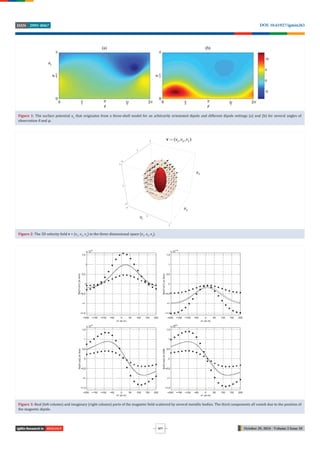
Referring to [17], we begin with the introduction of a
multilayer model of the brain, in the context of the direct EEG
problem, where all the associated boundaries that con ine the
conductive areas of the cerebrum, the cerebrospinal luid, the
skull, and the skin are considered as smooth surfaces, while
the three-shell head system is assumed to be surrounded by
the non-conductive air. The main purpose of this analysis is the
evaluation of the impact of the electric excitation of the human
brain, which is represented by the bipolar current action of a
single equivalent dipole source in the inner conductor, on the
electric activity on the surface of the human head (Figure 1).
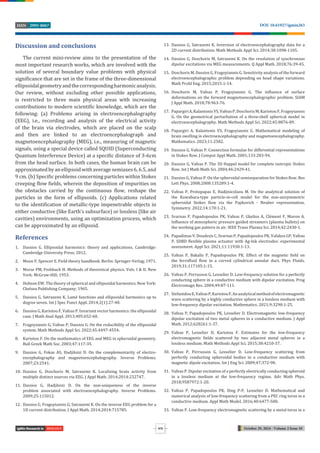
In the sequel, referring to [22], a methodology for dealing
with the problem of Stokes low through a swarm of particles
with Kuwabara-type boundary conditions is developed. The
conducted research is based on the reliable particle-in-cell
technique by which the creeping low through the swarm
of the particles is modeled as low within a luid envelope
that surrounds a single solid particle and attains a ictitious
boundary expressing this way the disturbance to low that
causes the rest of the particles of the assemblage and the
volume of the luid envelope matches to the luid volume
fraction of the swarm. Hence, given the Kuwabara model
that assumes an arbitrarily moving luid around a motionless
particle, the non-slip low condition on the surface of the
inner surface is supplemented by the boundary conditions
on the outer surface, i.e. zero normal velocity component and
vorticity. Due to the non-axisymmetric nature of the physical
problem, the velocity ield attains a three-dimensional
behavior around the particle, providing an arbitrary luid
motion (Figure 2).
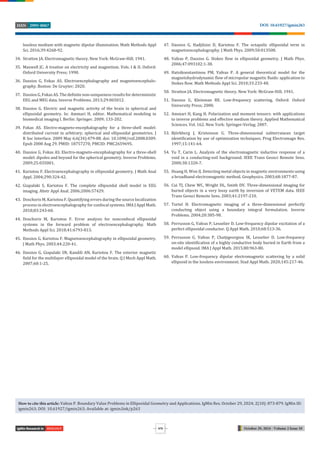
Finally, referring to [59], a strict low-frequency
approximation of the ields that are scattered by an
impenetrable metallic body under the in luence of a vertical
magnetic dipole source enables the development of a reliable
scheme of identi ication of an orebody in the less conductive
Earth from data measured on-site. A few in-phase (real)
and quadrature (imaginary) three-component ield data
are enough to achieve a rather robust inversion with a low-
complexity inversion algorithm. The approach has the bene it
that the assumed body geometry caters to a wide range
of orientations, sizes, and shapes. Also, the low-frequency
approximation methodology yields both real and imaginary
ield contributions, which are necessary to achieve proper
body identi ication, being assumed perfectly electrically
conducting (Figure 3).
October 29, 2024 - Volume 2 Issue 10
DOI: 10.61927/igmin263
2995-8067
ISSN
877
BIOLOGY
Figure 1: The surface potential ue
that originates from a three-shell model for an arbitrarily orientated dipole and different dipole settings (a) and (b) for several angles of
observation θ and φ.
Figure 2: The 3D velocity ield v = (v1
, v2
, v3
) in the three-dimensional space (x1
, x2
, x3
).
Figure 3: Real (left column) and imaginary (right column) parts of the magnetic ield scattered by several metallic bodies. The third components all vanish due to the position of
the magnetic dipole.
October 29, 2024 - Volume 2 Issue 10
DOI: 10.61927/igmin263
2995-8067
ISSN
878
BIOLOGY
Discussion and conclusions
The current mini-review aims to the presentation of the
most important research works, which are involved with the
solution of several boundary value problems with physical
signi icance that are set in the frame of the three-dimensional
ellipsoidalgeometryandthecorrespondingharmonicanalysis.
Our review, without excluding other possible applications,
is restricted to three main physical areas with increasing
contributions to modern scienti ic knowledge, which are the
following: (a) Problems arising in electroencephalography
(EEG), i.e., recording and analysis of the electrical activity
of the brain via electrodes, which are placed on the scalp
and then are linked to an electroencephalograph and
magnetoencephalography (MEG), i.e., measuring of magnetic
signals, using a special device called SQUID (Superconducting
Quantum Interference Device) at a speci ic distance of 3-6cm
from the head surface. In both cases, the human brain can be
approximated by an ellipsoid with average semiaxes 6, 6.5, and
9 cm. (b) Speci ic problems concerning particles within Stokes
creeping low ields, wherein the deposition of impurities on
the obstacles carried by the continuous low, reshape the
particles in the form of ellipsoids. (c) Applications related
to the identi ication of metallic-type impenetrable objects in
either conductive (like Earth’s subsurface) or lossless (like air
cavities) environments, using an optimization process, which
can be approximated by an ellipsoid.
References
1. Dassios G. Ellipsoidal harmonics: theory and applications. Cambridge:
Cambridge University Press; 2012.
2. Moon P, Spencer E. Field theory handbook. Berlin: Springer-Verlag; 1971.
3. Morse PM, Feshbach H. Methods of theoretical physics. Vols. I & II. New
York: McGraw-Hill; 1953.
4. Hobson EW. The theory of spherical and ellipsoidal harmonics. New York:
Chelsea Publishing Company; 1965.
5. Dassios G, Satrazemi K. Lamé functions and ellipsoidal harmonics up to
degree seven. Int J Spec Funct Appl. 2014;2(1):27-40.
6. Dassios G, Kariotou F, Vafeas P. Invariant vector harmonics: the ellipsoidal
case. J Math Anal Appl. 2013;405:652-60.
7. Fragoyiannis G, Vafeas P, Dassios G. On the reducibility of the ellipsoidal
system. Math Methods Appl Sci. 2022;45:4497-4554.
8. Kariotou F. On the mathematics of EEG and MEG in spheroidal geometry.
Bull Greek Math Soc. 2003;47:117-35.
9. Dassios G, Fokas AS, Hadjiloizi D. On the complementarity of electro-
encephalography and magnetoencephalography. Inverse Problems.
2007;23:2541.
10. Dassios G, Doschoris M, Satrazemi K. Localizing brain activity from
multiple distinct sources via EEG. J Appl Math. 2014;2014:232747.
11. Dassios G, Hadjiloizi D. On the non-uniqueness of the inverse
problem associated with electroencephalography. Inverse Problems.
2009;25:115012.
12. Dassios G, Fragoyiannis G, Satrazemi K. On the inverse EEG problem for a
1D current distribution. J Appl Math. 2014;2014:715785.
13. Dassios G, Satrazemi K. Inversion of electroencephalography data for a
2D current distribution. Math Methods Appl Sci. 2014;38:1098-1105.
14. Dassios G, Doschoris M, Satrazemi K. On the resolution of synchronous
dipolar excitations via MEG measurements. Q Appl Math. 2018;76:39-45.
15. Doschoris M, Dassios G, Fragoyiannis G. Sensitivity analysis of the forward
electroencephalographic problem depending on head shape variations.
Math Probl Eng. 2015;2015:1-14.
16. Doschoris M, Vafeas P, Fragoyiannis G. The in luence of surface
deformations on the forward magnetoencephalographic problem. SIAM
J Appl Math. 2018;78:963-76.
17. PapargiriA,KalantonisVS,VafeasP,DoschorisM,KariotouF,Fragoyiannis
G. On the geometrical perturbation of a three-shell spherical model in
electroencephalography. Math Methods Appl Sci. 2022;45:8876-89.
18. Papargiri A, Kalantonis VS, Fragoyiannis G. Mathematical modeling of
brain swelling in electroencephalography and magnetoencephalography.
Mathematics. 2023;11:2582.
19. Dassios G, Vafeas P. Connection formulae for differential representations
in Stokes low. J Comput Appl Math. 2001;133:283-94.
20. Dassios G, Vafeas P. The 3D Happel model for complete isotropic Stokes
low. Int J Math Math Sci. 2004;46:2429-41.
21. Dassios G, Vafeas P. On the spheroidal semiseparation for Stokes low. Res
Lett Phys. 2008;2008:135289:1-4.
22. Vafeas P, Protopapas E, Hadjinicolaou M. On the analytical solution of
the Kuwabara-type particle-in-cell model for the non-axisymmetric
spheroidal Stokes low via the Papkovich - Neuber representation.
Symmetry. 2022;14:170:1-21.
23. Svarnas P, Papadopoulos PK, Vafeas P, Gkelios A, Clément F, Mavon A.
In luence of atmospheric pressure guided streamers (plasma bullets) on
the working gas pattern in air. IEEE Trans Plasma Sci. 2014;42:2430-1.
24. Papadimas V, Doudesis C, Svarnas P, Papadopoulos PK, Vafakos GP, Vafeas
P. SDBD lexible plasma actuator with Ag-Ink electrodes: experimental
assessment. Appl Sci. 2021;11:11930:1-13.
25. Vafeas P, Bakalis P, Papadopoulos PK. Effect of the magnetic ield on
the ferro luid low in a curved cylindrical annular duct. Phys Fluids.
2019;31:117105:1-15.
26. Vafeas P, Perrusson G, Lesselier D. Low-frequency solution for a perfectly
conducting sphere in a conductive medium with dipolar excitation. Prog
Electromagn Res. 2004;49:87-111.
27. StefanidouE,VafeasP,KariotouF.Ananalyticalmethodofelectromagnetic
wave scattering by a highly conductive sphere in a lossless medium with
low-frequency dipolar excitation. Mathematics. 2021;9:3290:1-25.
28. Vafeas P, Papadopoulos PK, Lesselier D. Electromagnetic low-frequency
dipolar excitation of two metal spheres in a conductive medium. J Appl
Math. 2012;628261:1-37.
29. Vafeas P, Lesselier D, Kariotou F. Estimates for the low-frequency
electromagnetic ields scattered by two adjacent metal spheres in a
lossless medium. Math Methods Appl Sci. 2015;38:4210-37.
30. Vafeas P, Perrusson G, Lesselier D. Low-frequency scattering from
perfectly conducting spheroidal bodies in a conductive medium with
magnetic dipole excitation. Int J Eng Sci. 2009;47:372-90.
31. Vafeas P. Dipolar excitation of a perfectly electrically conducting spheroid
in a lossless medium at the low-frequency regime. Adv Math Phys.
2018;9587972:1-20.
32. Vafeas P, Papadopoulos PK, Ding P-P, Lesselier D. Mathematical and
numerical analysis of low-frequency scattering from a PEC ring torus in a
conductive medium. Appl Math Model. 2016;40:6477-500.
33. Vafeas P. Low-frequency electromagnetic scattering by a metal torus in a
October 29, 2024 - Volume 2 Issue 10
DOI: 10.61927/igmin263
2995-8067
ISSN
879
BIOLOGY
lossless medium with magnetic dipolar illumination. Math Methods Appl
Sci. 2016;39:4268-92.
34. Stratton JA. Electromagnetic theory. New York: McGraw-Hill; 1941.
35. Maxwell JC. A treatise on electricity and magnetism. Vols. I & II. Oxford:
Oxford University Press; 1998.
36. Dassios G, Fokas AS. Electroencephalography and magnetoencephalo-
graphy. Boston: De Gruyter; 2020.
37. Dassios G, Fokas AS. The de inite non-uniqueness results for deterministic
EEG and MEG data. Inverse Problems. 2013;29:065012.
38. Dassios G. Electric and magnetic activity of the brain in spherical and
ellipsoidal geometry. In: Ammari H, editor. Mathematical modeling in
biomedical imaging I. Berlin: Springer. 2009; 133-202.
39. Fokas AS. Electro-magneto-encephalography for a three-shell model:
distributed current in arbitrary, spherical and ellipsoidal geometries. J
R Soc Interface. 2009 May 6;6(34):479-88. doi: 10.1098/rsif.2008.0309.
Epub 2008 Aug 29. PMID: 18757270; PMCID: PMC2659695.
40. Dassios G, Fokas AS. Electro-magneto-encephalography for a three-shell
model: dipoles and beyond for the spherical geometry. Inverse Problems.
2009;25:035001.
41. Kariotou F. Electroencephalography in ellipsoidal geometry. J Math Anal
Appl. 2004;290:324-42.
42. Giapalaki S, Kariotou F. The complete ellipsoidal shell model in EEG
imaging. Abstr Appl Anal. 2006;2006:57429.
43. Doschoris M, Kariotou F. Quantifying errors during the source localization
process in electroencephalography for confocal systems. IMA J Appl Math.
2018;83:243-60.
44. Doschoris M, Kariotou F. Error analysis for nonconfocal ellipsoidal
systems in the forward problem of electroencephalography. Math
Methods Appl Sci. 2018;41:6793-813.
45. Dassios G, Kariotou F. Magnetoencephalography in ellipsoidal geometry.
J Math Phys. 2003;44:220-41.
46. Dassios G, Giapalaki SN, Kandili AN, Kariotou F. The exterior magnetic
ield for the multilayer ellipsoidal model of the brain. Q J Mech Appl Math.
2007;60:1-25.
47. Dassios G, Hadjiloizi D, Kariotou F. The octapolic ellipsoidal term in
magnetoencephalography. J Math Phys. 2009;50:013508.
48. Vafeas P, Dassios G. Stokes low in ellipsoidal geometry. J Math Phys.
2006;47:093102:1-38.
49. Hatzikonstantinou PM, Vafeas P. A general theoretical model for the
magnetohydrodynamic low of micropolar magnetic luids: application to
Stokes low. Math Methods Appl Sci. 2010;33:233-48.
50. Stratton JA. Electromagnetic theory. New York: McGraw-Hill; 1941.
51. Dassios G, Kleinman RE. Low-frequency scattering. Oxford: Oxford
University Press; 2000.
52. Ammari H, Kang H. Polarization and moment tensors: with applications
to inverse problems and effective medium theory. Applied Mathematical
Sciences. Vol. 162. New York: Springer-Verlag; 2007.
53. Björkberg J, Kristenson G. Three-dimensional subterranean target
identi ication by use of optimization techniques. Prog Electromagn Res.
1997;15:141-64.
54. Yu T, Carin L. Analysis of the electromagnetic inductive response of a
void in a conducting-soil background. IEEE Trans Geosci Remote Sens.
2000;38:1320-7.
55. Huang H, Won IJ. Detecting metal objects in magnetic environments using
a broadband electromagnetic method. Geophysics. 2003;68:1877-87.
56. Cui TJ, Chew WC, Wright DL, Smith DV. Three-dimensional imaging for
buried objects in a very lossy earth by inversion of VETEM data. IEEE
Trans Geosci Remote Sens. 2003;41:2197-210.
57. Tortel H. Electromagnetic imaging of a three-dimensional perfectly
conducting object using a boundary integral formulation. Inverse
Problems. 2004;20:385-98.
58. Perrusson G, Vafeas P, Lesselier D. Low-frequency dipolar excitation of a
perfect ellipsoidal conductor. Q Appl Math. 2010;68:513-36.
59. Perrusson G, Vafeas P, Chatjigeorgiou IK, Lesselier D. Low-frequency
on-site identi ication of a highly conductive body buried in Earth from a
model ellipsoid. IMA J Appl Math. 2015;80:963-80.
60. Vafeas P. Low-frequency dipolar electromagnetic scattering by a solid
ellipsoid in the lossless environment. Stud Appl Math. 2020;145:217-46.
How to cite this article: Vafeas P. Boundary Value Problems in Ellipsoidal Geometry and Applications. IgMin Res. October 29, 2024; 2(10): 873-879. IgMin ID:
igmin263; DOI: 10.61927/igmin263; Available at: igmin.link/p263
INSTRUCTIONS FOR AUTHORS APC
IgMin Research | STEM, a Multidisciplinary Open Access Journal, welcomes original contributions
from researchers in Science, Technology, Engineering, and Medicine (STEM). Submission
guidelines are available at www.igminresearch.com, emphasizing adherence to ethical
standards and comprehensive author guidelines. Manuscripts should be submitted online to
submission@igminresearch.us.
For book and educational material reviews, send them to STEM, IgMin Research, at
support@igminresearch.us. The Copyright Clearance Centre’s Rights link program manages article
permission requests via the journal’s website (https://www.igminresearch.com). Inquiries about
Rights link can be directed to info@igminresearch.us or by calling +1 (860) 967-3839.
https://www.igminresearch.com/pages/publish-now/author-guidelines
In addressing Article Processing Charges (APCs), IgMin Research: STEM recognizes their signi icance
in facilitating open access and global collaboration. The APC structure is designed for affordability and
transparency, re lecting the commitment to breaking inancial barriers and making scienti ic research
accessible to all.
IgMin Research - STEM | A Multidisciplinary Open Access Journal fosters cross-disciplinary
communication and collaboration, aiming to address global challenges. Authors gain increased exposure
and readership, connecting with researchers from various disciplines. The commitment to open access
ensures global availability of published research. Join IgMin Research - STEM at the forefront of scienti ic
progress.
https://www.igminresearch.com/pages/publish-now/apc
WHY WITH US
IgMin Research | STEM employs a rigorous peer-review process, ensuring the publication of high-quality research spanning STEM disciplines. The journal offers a global platform for researchers to share
groundbreaking indings, promoting scienti ic advancement.
JOURNAL INFORMATION
Journal Full Title: IgMin Research-STEM | A Multidisciplinary Open Access Journal
Journal NLM Abbreviation: IgMin Res
Journal Website Link: https://www.igminresearch.com
Category: Multidisciplinary
Subject Areas: Science, Technology, Engineering, and Medicine
Topics Summation: 173
Organized by: IgMin Publications Inc.
Regularity: Monthly
Review Type: Double Blind
Publication Time: 14 Days
GoogleScholar: https://www.igminresearch.com/gs
Plagiarism software: iThenticate
Language: English
Collecting capability: Worldwide
License: Open Access by IgMin Research is
licensed under a Creative Commons Attribution 4.0
International License. Based on a work at IgMin
Publications Inc.
Online Manuscript Submission:
https://www.igminresearch.com/submission or can be
mailed to submission@igminresearch.us

Boundary Value Problems in Ellipsoidal Geometry and Applications

  • 1.
    www.igminresearch.com 873 Mathematics BIOLOGY GROUP2995-8067 ISSN Abstract Many applications in science, engineering, and modern technology require the solution of boundary value problems for genuine three-dimensional objects. These objects often are of or can be approximated by, an ellipsoidal shape, where the three ellipsoidal semiaxes correspond to three independent degrees of freedom. The triaxial ellipsoid represents the sphere of any anisotropic space and for this reason, it appears naturally in many scienti ic disciplines. Consequently, despite the complications of the ellipsoidal geometry and mainly its analysis, based on the theory of ellipsoidal harmonics, a lot of progress has been made in the solution of ellipsoidal boundary value problems, due to its general applicability. In this mini-review, we aim to present to the scienti ic community the main achievements towards the investigation of three such physical problems of medical, engineering and technological signi icance, those comprising intense research in (a) electroencephalography (EEG) and magnetoencephalography (MEG), (b) creeping hydrodynamics (Stokes low) and (c) identi ication of metallic impenetrable bodies, either embedded within the Earth’s conductive subsurface or located into a lossless air environment. In this context, special expertise and particular skills are needed in solving open boundary value problems that incorporate the ellipsoidal geometry and the related harmonic analysis, revealing the fact that there still exists the necessity of involving with these issues. Boundary Value Problems in Ellipsoidal Geometry and Applications Panayiotis Vafeas* Department of Chemical Engineering, University of Patras, 26504 Patras, Greece *Correspondence: Panayiotis Vafeas, Department of Chemical Engineering, University of Patras, 26504 Patras, Greece, Email: vafeas@chemeng.upatras.gr Review Article Article Information Submitted: October 16, 2024 Approved: October 28, 2024 Published: October 29, 2024 How to cite this article: Vafeas P. Boundary Value Problems in Ellipsoidal Geometry and Applications. IgMin Res. October 29, 2024; 2(10): 873-879. IgMin ID: igmin263; DOI: 10.61927/igmin263; Available at: igmin.link/p263 Copyright: © 2024 Vafeas P. This is an open access article distributed under the Creative Commons Attribution License, which permits unrestricted use, distribution, and reproduction in any medium, provided the original work is properly cited. Keywords: Ellipsoidal geometry and analysis; Electroencephalography (EEG); Magnetoencephalography (MEG); Stokes creeping low; Metallic bodies in conductive and lossless media elliptic integrals. As a result of these complications, there exist ellipsoidal problems in physics, engineering, and modern technology areas remain unsolved, even though many of them have been dealt with satisfactorily. As far as the complete theoretical progress in the ield is concerned, it is worth mentioning that much work has been done in both analytical [6] and computational [7] levels. The ellipsoidal geometry provides the most general environment for the study of the anisotropy of the three- dimensional space. Indeed, a scaling of a sphere leads to an ellipsoid, and a particular scaling of an ellipsoid reconstructs the sphere. Consequently, the ellipsoid represents the sphere of any anisotropic space. This generic feature of the ellipsoid explains the ubiquitous nature of ellipsoidal boundary value problems. Bearing in mind this feature, the novelty of any general treatment of the ellipsoidal harmonics and their reductions provides the perfect environment for the construction of several ready-to-use formulae, which can be used in a wide range of applications. Regarding the development of reduction techniques, let us note that this is an important task since, this is not only a means of checking the correctness of the ellipsoidal results, but also provides Introduction The ellipsoidal coordinates with its analytical counterparts [1-4] provide the most general system for which the Laplace equationisseparable.Inthisconnection,effortsfor indingand studying the ellipsoidal harmonics have a long and illustrious history, which spans more than one and a half centuries. The existence, completeness, and orthogonality of the ellipsoidal harmonics were inally proved in 1927 by Moglich in a manuscript 125 pages long. Although the basic theory of ellipsoidal harmonics was completed during the decade of 1930, it is only in the last few years that basic quantitative questions concerning the form of the ellipsoidal harmonics and of the Lamé products were answered, while some of them remain unanswered. The internal ellipsoidal harmonics of degrees 0,1,2 and 3 can be written in closed form. However, the harmonics of degree greater than 3 contain constants, which satisfy polynomial equations of degree more than 5 and Galois theory implies that such roots cannot be found explicitly. Though, speci ic forms for ellipsoidal harmonics of degrees 5,6, and 7 have been recently discovered [5]. Furthermore, none of the external ellipsoidal harmonics can be written in closed form, since they are expressed through
  • 2.
    October 29, 2024- Volume 2 Issue 10 DOI: 10.61927/igmin263 2995-8067 ISSN 874 BIOLOGY an opportunity to study the transition process from the 3D ellipsoidal environment to the 2D spheroidal and 1D spherical cases. The purely ellipsoidal expressions are not easy to handle, thus the results are given in the more tractable form, where Cartesian coordinates are used for the interior harmonics and the standard elliptic integrals are used in the exterior Lamé products. Of course, the harmonic character of the expressions is retained and a mixed Cartesian and ellipsoidal form is obtained. Many relations involving the constants of the ellipsoidal harmonics, as well as relations among the elliptic integrals, are obtained to bring the formulae into their inal useful form. The particular way that the elliptic integrals are related is utilized to ind useful expressions transforming the Cartesian to the ellipsoidal system and vice versa, wherein this task demands long and tedious analytical calculations. The reduction of ellipsoidal results to corresponding spherical ones is not a straightforward task because the usual limiting rules (such as L’ Hospital rules, etc.) fail. This is because the focal set of the ellipsoidal system is a two-dimensional manifold, i.e., a focal ellipse, while that for the prolate spheroid is a one-dimensional manifold, i.e., a focal segment, and that for the sphere is the center itself (0D manifold). Based on several existing reduction formulae, speci ic terms can be grouped and appropriate algebraic manipulations can be performed before the limits are taken. Most of the works concerning important applications in science and modern technology are mainly based on spherical, spheroidal geometry, and other geometries. In this concept, we refer for instance to some selected researches from the literature in the three basic physical areas of consideration, those being Electroencephalography (EEG) and Magnetoencephalography (MEG) (e.g., see [8- 10] for forward problems, [11-14] for inverse problems and [15-18] for head shape variations), Stokes creeping low hydrodynamics (e.g., see [19,20] for spherical lows [21,22], for spheroidal lows and [23-25] for circular cylindrical lows) and identi ication of metallic bodies in either conductive or lossless media (e.g., see [26-29] for scattering from complete isotropic bodies and [30-33] for scattering from bodies of different geometry). In this mini-review, we demonstrate the applicability of the analytical results on ellipsoidal harmonics (supplemented by the appropriate numerical calculations) via the introduction of pioneer works, to show that they become effective for solving real-life problems within the frame of the aforementioned physical areas, while any reader can be initiated to solve open problems in the ellipsoidal regime. We emphasize the fact that the coherence between the three aforementioned physical areas is based on the existence of solid bodies (the human head for EEG and MEG, the particles for Stokes creeping hydrodynamic low, and the voluminous metallic objects for scattering in conductive and lossless media), which can be geometrically represented by a genuine ellipsoid. Furthermore, in the forthcoming paragraphs, we present works that incorporate the appropriately developed mathematical and numerical techniques, which allow us to implement the reduction from the 3D ellipsoidal to the 2D spheroidal and the 1D spherical cases. Electroencephalography (EEG) and Magnetoencephalo- graphy (MEG) Thestudyofelectromagneticphenomena[34,35]thatoccur within the human brain concerns the interdisciplinary ield of electromagnetism in biotechnology, which extends from the theoretical branch of mathematics to the more practical area of physics and medicine. Among the most widely used noninvasive methods for studying electromagnetic human brain activity, EEG and MEG [36,37] stand as the most famous and applicable techniques nowadays. On one hand, EEG is the method, according to which the electrochemical activity of the brain is mapped on an electroencephalogram. Therein, the data of EEG are electric potentials registered on the head surface by properly placed electrodes. The electrochemical source generates the externally measured electric potential, which can be calculated provided by a given source and this procedure determines the forward EEG problem. Therein, the interpretation of the EEG data to locate the geometrical and physical characteristics of the source inside the brain identi ies the known inverse EEG problem. On the other hand, MEG is the determination of the neuronal current in the brain from measurements outside the brain of the magnetic ield generated by the current. The magnetic ield is measured by the so-called Super Quantum Interference Device (SQUID), where such devices exists in several brain imaging laboratories. Furthermore, it is notable that MEG is the only existing imaging technique capable of real-time reconstruction. However, MEG is still not widely used due to its poor spatial resolution, however much work has been done towards the improvement of the existing reconstruction techniques with a signi icant impact on brain imaging. ThephysiologicalbasisofEEGandMEGisthefollowing.The mainfunctionalunitsofthebrainarecertainhighlyspecialized cells that are called neurons. For higher mental processes the most important part of the brain is its outermost layer, called the cerebral cortex, which contains at least 1010 neurons. When neurons are active they produce small currents, whose basis is the change in the concentration of certain ions (ionic currents). The low of current in the neural system produces an electric ield and a weak magnetic ield. The measurement of the electric ield on the head’s surface is called EEG, while the measurement of the magnetic ield outside the brain and the estimation of the current density distribution that produces this ield is called MEG. Under the assumption that the space occupied by the brain is approximately a sphere,
  • 3.
    October 29, 2024- Volume 2 Issue 10 DOI: 10.61927/igmin263 2995-8067 ISSN 875 BIOLOGY the part of the current, which can be reconstructed from the measurements, is precisely calculated by inverting the so- called Geselowitz equation. This part consists of only certain moments of one of the two functions specifying the tangential part of the current. The other function, specifying the radial part of the current, is completely arbitrary. However, it is also shown that with the assumption of energy minimization, the current can be reconstructed uniquely. An analogous problem is also investigated under the assumption that the current is a dipole. During the last decade, the already ample literature on EEG and MEG research in the spherical and spheroidal geometry has been enriched and extended with several works by using more realistic models for the brain [38-40] (see, also, explicit works on EEG [41-44] and MEG [45-47]), which is approximated by an ellipsoid and it is also surrounded by the cerebrospinal luid, the bulk, and the skin. Stokes creeping flow In engineering-type analyses, it is not usually necessary to have detailed solutions of the low ield over the entire swarm of particles, since such solutions are cumbersome to use. Thus, thetechniqueofcellmodelsisadopted,wherethemathematical treatment of each problem is based on the assumption that a three-dimensional assemblage may be considered to consist of several identical unit cells. Each of these cells contains a particle, surrounded by a luid envelope and containing a volume of luid suf icient to make the fractional void volume in the cell equal to that in the entire assemblage. The most widely used and general model considers that the particle is moving and the luid is stationary, imposing the so-called Happel-type boundary conditions. Here, it is introduced the low Reynolds number low of a swarm of particles in an otherwise quiescent Newtonian luid, that moves with constant uniform velocity in an arbitrary direction and rotates with an arbitrary constant angularvelocity,inheritingthethree-dimensionalnatureofthe phenomenon. Particle-in-cell models for Stokes low through a homogeneous swarm of particles are of substantial practical interest because they provide a relatively simple platform for the analytical or semi-analytical solution of heat and mass transport problems. For many low problems involving small particles, spherical and spheroidal geometry provide a good approximation. However, more realistic models involve particles of arbitrary shape, whereas it is almost impossible to take advantage of symmetry. Hence, modern research is concentrated on ellipsoidal geometry, which provides the most widely used framework for representing small particles of arbitrary, non-axisymmetric (3D) shape that are embedded within a luid that lows according to Stokes law. In recent days, a complete solution of low through a swarm of particles is possible with powerful numerical methods, which, however, involve the use of elaborate computer codes. Hence, there exists a continuous need for analytical methods, which capture the essential features of the transport process and provide insight into the associated physical processes, so, under this particular frame, particle-in-cell low models have been extensively investigated. The cases of axisymmetric shapes (sphere or spheroid) have been extensively investigated and analytical solutions in closed forms have been obtained either directly or using speci ic techniques. On the other hand, the usefulness of representation theory has been demonstrated by solving three-dimensional sphere- in-cell and spheroid-in-cell Happel models. The spherical approach for such axisymmetric problems has been adopted since 1949 and several complete analytical solutions have been obtained, while later on researchers investigated a 2D spheroid-in-cell instead of a sphere-in-cell model, by introducing a novel method of semi-separation of variables, which is based on an appropriate inite-dimensional spectral decomposition of the operator of motion. These spherical and spheroidal solutions have been validated through the solution of 3D boundary value problems in spherical and spheroidal coordinates, demonstrating the practical ef iciency of the differential representations theory. To solve generalized Stokes low problems in ellipsoidal geometry [48,49], an ellipsoid-in-cell model with Happel-type boundary conditions is assumed, wherein the 3D boundary value problem is solved with the aid of the Papkovich - Neuber complete differential representation of the low ields for Stokes low. Metallic bodies in conductive and lossless media In recent days, the general theory of electromagnetism and scattering [50,51] has been used for retrieving an anomaly of some sort, such as metallic bodies, from three-dimensional magnetic ields, which are measured along a borehole with the aid of a low-frequency time-harmonic source. These bodies are considered scatterers and they are usually embedded in either a conductive medium, such as Earth’s subsurface, or a lossless environment, such as air and vacuum cavities. By deciphering the obtained data, one can infer information regarding the orientation, size, shape, and electromagnetic parameters of the anomalies, which comprises the inverse problem [52], as long as the direct one of calculating the implicated electric and magnetic ields is readily solved. There exist several proposed methodologies in the quite recent bibliography [53-57], which provide us with effective techniques to deal with such problems. Nevertheless, beyond this frame, the necessity of closed-form compact solutions, to assist a possible inversion scheme, was inevitable. It is to this end that the low-frequency theory signi icantly improved the already existing models towards the identi ication of metallic bodies. Given this aspect, the current investigation concerns the interaction of an arbitrarily orientated, time-harmonic, magnetic dipole with perfectly conducting bodies, which are embedded in homogeneous conductive or lossless media. A rigorous low-frequency expansion of electromagnetic ield in
  • 4.
    October 29, 2024- Volume 2 Issue 10 DOI: 10.61927/igmin263 2995-8067 ISSN 876 BIOLOGY positive integral powers of the wavenumber of the exterior medium is constructed and, then the problem is mapped to the solution of the equations of Laplace and Poisson in three- dimensional ields using harmonic functions to represent the electromagnetic ields. It is readily veri ied numerically that the irst four terms are suf icient to provide with great accuracy both the electric and the magnetic ields. Under the interest of devising simple mathematical and numerical tools to bring insight to the ield by solving with reasonable accuracy the direct and the inverse problems, it is important to be capable of solving such situations for as much general geometry of the body as possible. As with these earlier topics, these problems in spherical and spheroidal geometry have been treated extensively, as shown previously. Consequently, the need to solve the same boundary value problems in the low-frequency spectrum, as they are described earlier, but in ellipsoidal coordinates, raised signi icantly [58-60]. In such works, a single voluminous anomaly is investigated, described as a triaxial ellipsoid of arbitrary semi-axis orientations, whose conductivity is in inite and which is embedded in a homogeneous medium, which is isotropic, non-magnetic and either conductive or lossless. A magnetic dipole is operated at a given circular frequency at a certain location and radiates primary magnetic and electric ields. It induces secondary magnetic and electric ields, whose magnetic components are either sought or collected along a single line passing outside the body. The formation of the ellipsoidal electromagnetic ields is based on the low- frequency expansion of the incident and the scattered ields in positive integral powers of the wavenumber of the exterior medium. The calculations are restricted to the irst three terms of the relevant expansion, being veri ied analytically and numerically that they provide suf icient accuracy for the entire solution. More speci ically, the magnetic ield of the third order (the corresponding electric ield is equal to zero) is not expected to have a signi icant contribution, while the magnetic ield of the irst order is identically equal to zero since there does not exist the corresponding incident (primary ield). Thus, the scattering problem is transformed into a succession, one at each of the remaining orders, of possibly coupled boundary value problems satisfying second-order partial differential equations with proper perfectly re lecting boundary conditions at the body surface. Once the direct problem is solved, it is the solution to the inverse problem for the identi ication of metallic three-dimensional ellipsoidal objects. Application examples This section is devoted to the presentation of concrete application examples that demonstrate the practical implementation of the proposed methods, like real-world applications in the currently investigated ields. Such as EEG and MEG, Stokes hydrodynamic low, and electromagnetic scattering. Towards this direction, we choose three representative scienti ic works and we brie ly summarize an important numerical demonstration for each case under consideration. Referring to [17], we begin with the introduction of a multilayer model of the brain, in the context of the direct EEG problem, where all the associated boundaries that con ine the conductive areas of the cerebrum, the cerebrospinal luid, the skull, and the skin are considered as smooth surfaces, while the three-shell head system is assumed to be surrounded by the non-conductive air. The main purpose of this analysis is the evaluation of the impact of the electric excitation of the human brain, which is represented by the bipolar current action of a single equivalent dipole source in the inner conductor, on the electric activity on the surface of the human head (Figure 1). In the sequel, referring to [22], a methodology for dealing with the problem of Stokes low through a swarm of particles with Kuwabara-type boundary conditions is developed. The conducted research is based on the reliable particle-in-cell technique by which the creeping low through the swarm of the particles is modeled as low within a luid envelope that surrounds a single solid particle and attains a ictitious boundary expressing this way the disturbance to low that causes the rest of the particles of the assemblage and the volume of the luid envelope matches to the luid volume fraction of the swarm. Hence, given the Kuwabara model that assumes an arbitrarily moving luid around a motionless particle, the non-slip low condition on the surface of the inner surface is supplemented by the boundary conditions on the outer surface, i.e. zero normal velocity component and vorticity. Due to the non-axisymmetric nature of the physical problem, the velocity ield attains a three-dimensional behavior around the particle, providing an arbitrary luid motion (Figure 2). Finally, referring to [59], a strict low-frequency approximation of the ields that are scattered by an impenetrable metallic body under the in luence of a vertical magnetic dipole source enables the development of a reliable scheme of identi ication of an orebody in the less conductive Earth from data measured on-site. A few in-phase (real) and quadrature (imaginary) three-component ield data are enough to achieve a rather robust inversion with a low- complexity inversion algorithm. The approach has the bene it that the assumed body geometry caters to a wide range of orientations, sizes, and shapes. Also, the low-frequency approximation methodology yields both real and imaginary ield contributions, which are necessary to achieve proper body identi ication, being assumed perfectly electrically conducting (Figure 3).
  • 5.
    October 29, 2024- Volume 2 Issue 10 DOI: 10.61927/igmin263 2995-8067 ISSN 877 BIOLOGY Figure 1: The surface potential ue that originates from a three-shell model for an arbitrarily orientated dipole and different dipole settings (a) and (b) for several angles of observation θ and φ. Figure 2: The 3D velocity ield v = (v1 , v2 , v3 ) in the three-dimensional space (x1 , x2 , x3 ). Figure 3: Real (left column) and imaginary (right column) parts of the magnetic ield scattered by several metallic bodies. The third components all vanish due to the position of the magnetic dipole.
  • 6.
    October 29, 2024- Volume 2 Issue 10 DOI: 10.61927/igmin263 2995-8067 ISSN 878 BIOLOGY Discussion and conclusions The current mini-review aims to the presentation of the most important research works, which are involved with the solution of several boundary value problems with physical signi icance that are set in the frame of the three-dimensional ellipsoidalgeometryandthecorrespondingharmonicanalysis. Our review, without excluding other possible applications, is restricted to three main physical areas with increasing contributions to modern scienti ic knowledge, which are the following: (a) Problems arising in electroencephalography (EEG), i.e., recording and analysis of the electrical activity of the brain via electrodes, which are placed on the scalp and then are linked to an electroencephalograph and magnetoencephalography (MEG), i.e., measuring of magnetic signals, using a special device called SQUID (Superconducting Quantum Interference Device) at a speci ic distance of 3-6cm from the head surface. In both cases, the human brain can be approximated by an ellipsoid with average semiaxes 6, 6.5, and 9 cm. (b) Speci ic problems concerning particles within Stokes creeping low ields, wherein the deposition of impurities on the obstacles carried by the continuous low, reshape the particles in the form of ellipsoids. (c) Applications related to the identi ication of metallic-type impenetrable objects in either conductive (like Earth’s subsurface) or lossless (like air cavities) environments, using an optimization process, which can be approximated by an ellipsoid. References 1. Dassios G. Ellipsoidal harmonics: theory and applications. Cambridge: Cambridge University Press; 2012. 2. Moon P, Spencer E. Field theory handbook. Berlin: Springer-Verlag; 1971. 3. Morse PM, Feshbach H. Methods of theoretical physics. Vols. I & II. New York: McGraw-Hill; 1953. 4. Hobson EW. The theory of spherical and ellipsoidal harmonics. New York: Chelsea Publishing Company; 1965. 5. Dassios G, Satrazemi K. Lamé functions and ellipsoidal harmonics up to degree seven. Int J Spec Funct Appl. 2014;2(1):27-40. 6. Dassios G, Kariotou F, Vafeas P. Invariant vector harmonics: the ellipsoidal case. J Math Anal Appl. 2013;405:652-60. 7. Fragoyiannis G, Vafeas P, Dassios G. On the reducibility of the ellipsoidal system. Math Methods Appl Sci. 2022;45:4497-4554. 8. Kariotou F. On the mathematics of EEG and MEG in spheroidal geometry. Bull Greek Math Soc. 2003;47:117-35. 9. Dassios G, Fokas AS, Hadjiloizi D. On the complementarity of electro- encephalography and magnetoencephalography. Inverse Problems. 2007;23:2541. 10. Dassios G, Doschoris M, Satrazemi K. Localizing brain activity from multiple distinct sources via EEG. J Appl Math. 2014;2014:232747. 11. Dassios G, Hadjiloizi D. On the non-uniqueness of the inverse problem associated with electroencephalography. Inverse Problems. 2009;25:115012. 12. Dassios G, Fragoyiannis G, Satrazemi K. On the inverse EEG problem for a 1D current distribution. J Appl Math. 2014;2014:715785. 13. Dassios G, Satrazemi K. Inversion of electroencephalography data for a 2D current distribution. Math Methods Appl Sci. 2014;38:1098-1105. 14. Dassios G, Doschoris M, Satrazemi K. On the resolution of synchronous dipolar excitations via MEG measurements. Q Appl Math. 2018;76:39-45. 15. Doschoris M, Dassios G, Fragoyiannis G. Sensitivity analysis of the forward electroencephalographic problem depending on head shape variations. Math Probl Eng. 2015;2015:1-14. 16. Doschoris M, Vafeas P, Fragoyiannis G. The in luence of surface deformations on the forward magnetoencephalographic problem. SIAM J Appl Math. 2018;78:963-76. 17. PapargiriA,KalantonisVS,VafeasP,DoschorisM,KariotouF,Fragoyiannis G. On the geometrical perturbation of a three-shell spherical model in electroencephalography. Math Methods Appl Sci. 2022;45:8876-89. 18. Papargiri A, Kalantonis VS, Fragoyiannis G. Mathematical modeling of brain swelling in electroencephalography and magnetoencephalography. Mathematics. 2023;11:2582. 19. Dassios G, Vafeas P. Connection formulae for differential representations in Stokes low. J Comput Appl Math. 2001;133:283-94. 20. Dassios G, Vafeas P. The 3D Happel model for complete isotropic Stokes low. Int J Math Math Sci. 2004;46:2429-41. 21. Dassios G, Vafeas P. On the spheroidal semiseparation for Stokes low. Res Lett Phys. 2008;2008:135289:1-4. 22. Vafeas P, Protopapas E, Hadjinicolaou M. On the analytical solution of the Kuwabara-type particle-in-cell model for the non-axisymmetric spheroidal Stokes low via the Papkovich - Neuber representation. Symmetry. 2022;14:170:1-21. 23. Svarnas P, Papadopoulos PK, Vafeas P, Gkelios A, Clément F, Mavon A. In luence of atmospheric pressure guided streamers (plasma bullets) on the working gas pattern in air. IEEE Trans Plasma Sci. 2014;42:2430-1. 24. Papadimas V, Doudesis C, Svarnas P, Papadopoulos PK, Vafakos GP, Vafeas P. SDBD lexible plasma actuator with Ag-Ink electrodes: experimental assessment. Appl Sci. 2021;11:11930:1-13. 25. Vafeas P, Bakalis P, Papadopoulos PK. Effect of the magnetic ield on the ferro luid low in a curved cylindrical annular duct. Phys Fluids. 2019;31:117105:1-15. 26. Vafeas P, Perrusson G, Lesselier D. Low-frequency solution for a perfectly conducting sphere in a conductive medium with dipolar excitation. Prog Electromagn Res. 2004;49:87-111. 27. StefanidouE,VafeasP,KariotouF.Ananalyticalmethodofelectromagnetic wave scattering by a highly conductive sphere in a lossless medium with low-frequency dipolar excitation. Mathematics. 2021;9:3290:1-25. 28. Vafeas P, Papadopoulos PK, Lesselier D. Electromagnetic low-frequency dipolar excitation of two metal spheres in a conductive medium. J Appl Math. 2012;628261:1-37. 29. Vafeas P, Lesselier D, Kariotou F. Estimates for the low-frequency electromagnetic ields scattered by two adjacent metal spheres in a lossless medium. Math Methods Appl Sci. 2015;38:4210-37. 30. Vafeas P, Perrusson G, Lesselier D. Low-frequency scattering from perfectly conducting spheroidal bodies in a conductive medium with magnetic dipole excitation. Int J Eng Sci. 2009;47:372-90. 31. Vafeas P. Dipolar excitation of a perfectly electrically conducting spheroid in a lossless medium at the low-frequency regime. Adv Math Phys. 2018;9587972:1-20. 32. Vafeas P, Papadopoulos PK, Ding P-P, Lesselier D. Mathematical and numerical analysis of low-frequency scattering from a PEC ring torus in a conductive medium. Appl Math Model. 2016;40:6477-500. 33. Vafeas P. Low-frequency electromagnetic scattering by a metal torus in a
  • 7.
    October 29, 2024- Volume 2 Issue 10 DOI: 10.61927/igmin263 2995-8067 ISSN 879 BIOLOGY lossless medium with magnetic dipolar illumination. Math Methods Appl Sci. 2016;39:4268-92. 34. Stratton JA. Electromagnetic theory. New York: McGraw-Hill; 1941. 35. Maxwell JC. A treatise on electricity and magnetism. Vols. I & II. Oxford: Oxford University Press; 1998. 36. Dassios G, Fokas AS. Electroencephalography and magnetoencephalo- graphy. Boston: De Gruyter; 2020. 37. Dassios G, Fokas AS. The de inite non-uniqueness results for deterministic EEG and MEG data. Inverse Problems. 2013;29:065012. 38. Dassios G. Electric and magnetic activity of the brain in spherical and ellipsoidal geometry. In: Ammari H, editor. Mathematical modeling in biomedical imaging I. Berlin: Springer. 2009; 133-202. 39. Fokas AS. Electro-magneto-encephalography for a three-shell model: distributed current in arbitrary, spherical and ellipsoidal geometries. J R Soc Interface. 2009 May 6;6(34):479-88. doi: 10.1098/rsif.2008.0309. Epub 2008 Aug 29. PMID: 18757270; PMCID: PMC2659695. 40. Dassios G, Fokas AS. Electro-magneto-encephalography for a three-shell model: dipoles and beyond for the spherical geometry. Inverse Problems. 2009;25:035001. 41. Kariotou F. Electroencephalography in ellipsoidal geometry. J Math Anal Appl. 2004;290:324-42. 42. Giapalaki S, Kariotou F. The complete ellipsoidal shell model in EEG imaging. Abstr Appl Anal. 2006;2006:57429. 43. Doschoris M, Kariotou F. Quantifying errors during the source localization process in electroencephalography for confocal systems. IMA J Appl Math. 2018;83:243-60. 44. Doschoris M, Kariotou F. Error analysis for nonconfocal ellipsoidal systems in the forward problem of electroencephalography. Math Methods Appl Sci. 2018;41:6793-813. 45. Dassios G, Kariotou F. Magnetoencephalography in ellipsoidal geometry. J Math Phys. 2003;44:220-41. 46. Dassios G, Giapalaki SN, Kandili AN, Kariotou F. The exterior magnetic ield for the multilayer ellipsoidal model of the brain. Q J Mech Appl Math. 2007;60:1-25. 47. Dassios G, Hadjiloizi D, Kariotou F. The octapolic ellipsoidal term in magnetoencephalography. J Math Phys. 2009;50:013508. 48. Vafeas P, Dassios G. Stokes low in ellipsoidal geometry. J Math Phys. 2006;47:093102:1-38. 49. Hatzikonstantinou PM, Vafeas P. A general theoretical model for the magnetohydrodynamic low of micropolar magnetic luids: application to Stokes low. Math Methods Appl Sci. 2010;33:233-48. 50. Stratton JA. Electromagnetic theory. New York: McGraw-Hill; 1941. 51. Dassios G, Kleinman RE. Low-frequency scattering. Oxford: Oxford University Press; 2000. 52. Ammari H, Kang H. Polarization and moment tensors: with applications to inverse problems and effective medium theory. Applied Mathematical Sciences. Vol. 162. New York: Springer-Verlag; 2007. 53. Björkberg J, Kristenson G. Three-dimensional subterranean target identi ication by use of optimization techniques. Prog Electromagn Res. 1997;15:141-64. 54. Yu T, Carin L. Analysis of the electromagnetic inductive response of a void in a conducting-soil background. IEEE Trans Geosci Remote Sens. 2000;38:1320-7. 55. Huang H, Won IJ. Detecting metal objects in magnetic environments using a broadband electromagnetic method. Geophysics. 2003;68:1877-87. 56. Cui TJ, Chew WC, Wright DL, Smith DV. Three-dimensional imaging for buried objects in a very lossy earth by inversion of VETEM data. IEEE Trans Geosci Remote Sens. 2003;41:2197-210. 57. Tortel H. Electromagnetic imaging of a three-dimensional perfectly conducting object using a boundary integral formulation. Inverse Problems. 2004;20:385-98. 58. Perrusson G, Vafeas P, Lesselier D. Low-frequency dipolar excitation of a perfect ellipsoidal conductor. Q Appl Math. 2010;68:513-36. 59. Perrusson G, Vafeas P, Chatjigeorgiou IK, Lesselier D. Low-frequency on-site identi ication of a highly conductive body buried in Earth from a model ellipsoid. IMA J Appl Math. 2015;80:963-80. 60. Vafeas P. Low-frequency dipolar electromagnetic scattering by a solid ellipsoid in the lossless environment. Stud Appl Math. 2020;145:217-46. How to cite this article: Vafeas P. Boundary Value Problems in Ellipsoidal Geometry and Applications. IgMin Res. October 29, 2024; 2(10): 873-879. IgMin ID: igmin263; DOI: 10.61927/igmin263; Available at: igmin.link/p263
  • 8.
    INSTRUCTIONS FOR AUTHORSAPC IgMin Research | STEM, a Multidisciplinary Open Access Journal, welcomes original contributions from researchers in Science, Technology, Engineering, and Medicine (STEM). Submission guidelines are available at www.igminresearch.com, emphasizing adherence to ethical standards and comprehensive author guidelines. Manuscripts should be submitted online to submission@igminresearch.us. For book and educational material reviews, send them to STEM, IgMin Research, at support@igminresearch.us. The Copyright Clearance Centre’s Rights link program manages article permission requests via the journal’s website (https://www.igminresearch.com). Inquiries about Rights link can be directed to info@igminresearch.us or by calling +1 (860) 967-3839. https://www.igminresearch.com/pages/publish-now/author-guidelines In addressing Article Processing Charges (APCs), IgMin Research: STEM recognizes their signi icance in facilitating open access and global collaboration. The APC structure is designed for affordability and transparency, re lecting the commitment to breaking inancial barriers and making scienti ic research accessible to all. IgMin Research - STEM | A Multidisciplinary Open Access Journal fosters cross-disciplinary communication and collaboration, aiming to address global challenges. Authors gain increased exposure and readership, connecting with researchers from various disciplines. The commitment to open access ensures global availability of published research. Join IgMin Research - STEM at the forefront of scienti ic progress. https://www.igminresearch.com/pages/publish-now/apc WHY WITH US IgMin Research | STEM employs a rigorous peer-review process, ensuring the publication of high-quality research spanning STEM disciplines. The journal offers a global platform for researchers to share groundbreaking indings, promoting scienti ic advancement. JOURNAL INFORMATION Journal Full Title: IgMin Research-STEM | A Multidisciplinary Open Access Journal Journal NLM Abbreviation: IgMin Res Journal Website Link: https://www.igminresearch.com Category: Multidisciplinary Subject Areas: Science, Technology, Engineering, and Medicine Topics Summation: 173 Organized by: IgMin Publications Inc. Regularity: Monthly Review Type: Double Blind Publication Time: 14 Days GoogleScholar: https://www.igminresearch.com/gs Plagiarism software: iThenticate Language: English Collecting capability: Worldwide License: Open Access by IgMin Research is licensed under a Creative Commons Attribution 4.0 International License. Based on a work at IgMin Publications Inc. Online Manuscript Submission: https://www.igminresearch.com/submission or can be mailed to submission@igminresearch.us