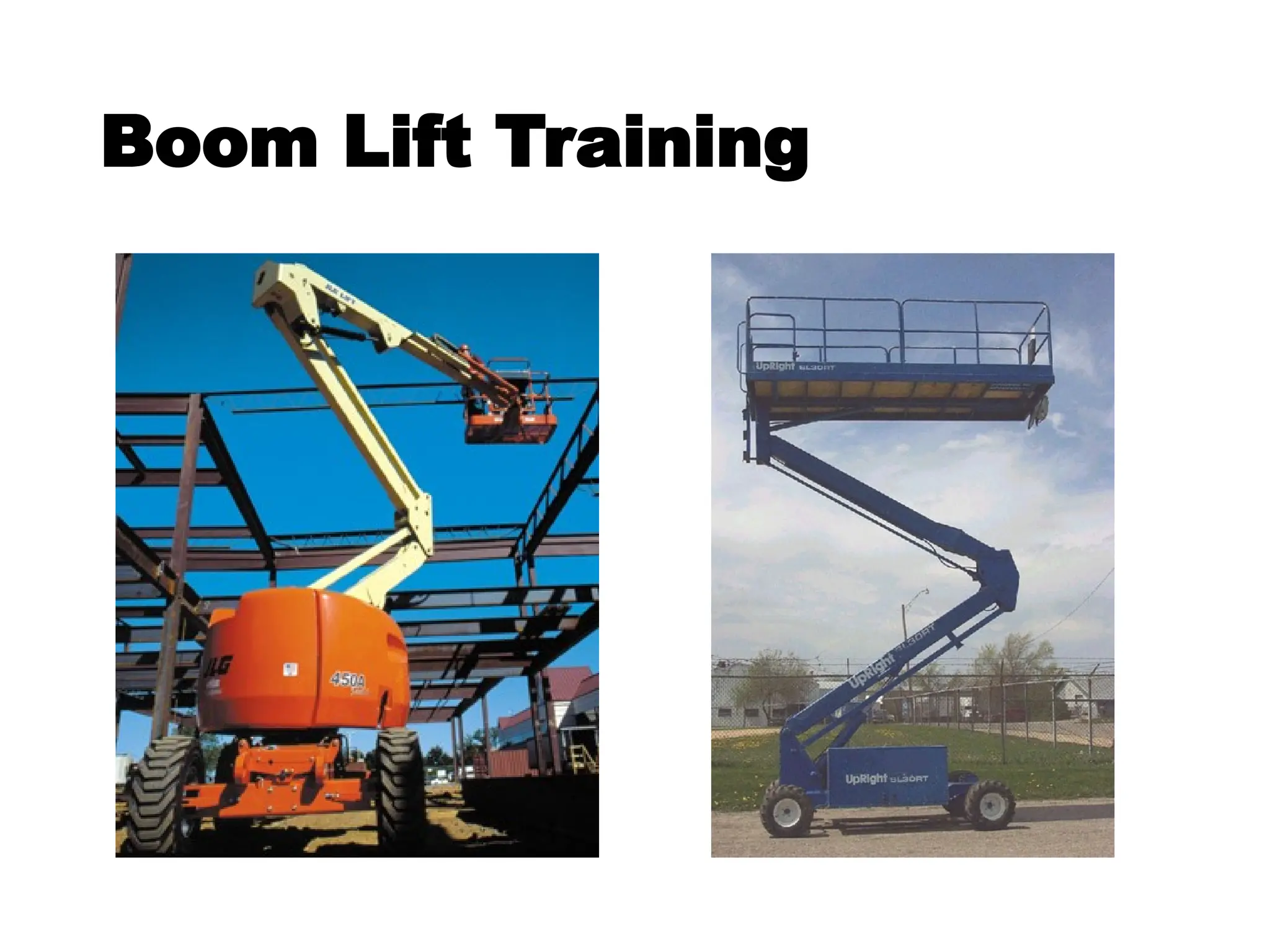
Boom Lift Training
Course Objectives
In this training you will be guided through:
•Regulations and where they come from
•Pre-shift Inspections – Job site Inspections
•Types of Aerial Lifts
•Stability and Capacity
•Practical (hands 0n).
Boom Lift training
• About 26 construction workers die each year from using boom lifts.
• More than half of the deaths involve boom-supported lifts, such as
bucket trucks and cherry pickers. Most others involve scissor lifts.
• Electrocutions, falls, and tip-overs cause most of the deaths.
Other Causes of Injuries
• Include being caught between the lift bucket or guardrail and object (such
as steel beams or joists) and being struck by falling objects.
• A worker can also be catapulted out of a bucket, if the boom or bucket is
struck by something.
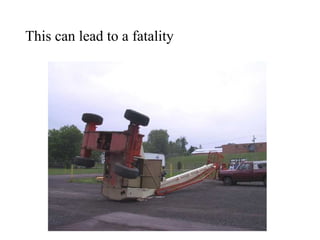
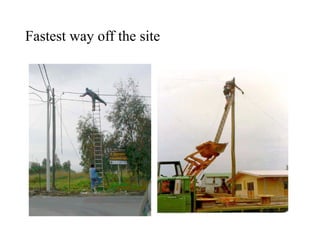
This can lead to a fatality
Fastest way off the site
Industrial Standards
• OSHA refers to the following industry standards in relation to aerial lifts:
• The American National Standards Institute (ANSI)
• The Scaffold Industry Association (SIA)
Applicable Standards are:
• ANSI/SIA- A92.5: Boom Supported Elevating Work Platforms
• ANSI/SIA- A92.6: Self Propelled Elevating Work Platforms
Manufacturer’s Instructions
•The wording in regulations and industry standards
contains many references to operating and maintenance
instructions supplied by the manufacturers.
•As an operator, the importance of becoming familiar with
the location and contents of your equipment
manufacturer’s operating manual is vital!
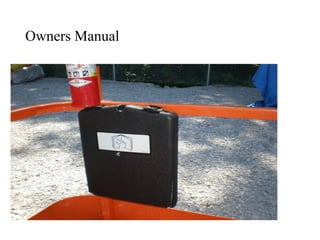
Owners Manual
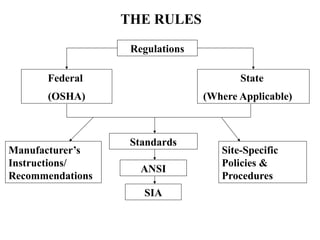
THE RULES
Regulations
State
(Where Applicable)
Federal
(OSHA)
Standards
ANSI
SIA
Site-Specific
Policies &
Procedures
Manufacturer’s
Instructions/
Recommendations
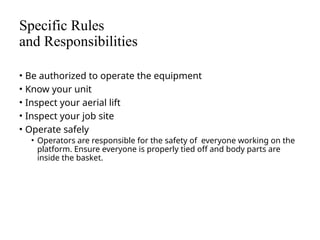
Specific Rules
and Responsibilities
• Be authorized to operate the equipment
• Know your unit
• Inspect your aerial lift
• Inspect your job site
• Operate safely
• Operators are responsible for the safety of everyone working on the
platform. Ensure everyone is properly tied off and body parts are
inside the basket.
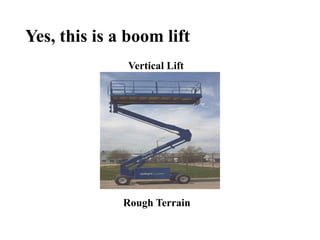
Yes, this is a boom lift
Vertical Lift
Rough Terrain
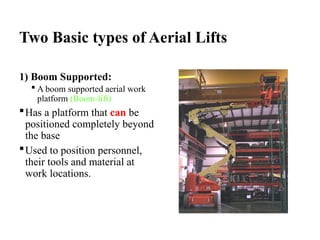
Two Basic types of Aerial Lifts
1) Boom Supported:
 A boom supported aerial work
platform (Boom-lift)
Has a platform that can be
positioned completely beyond
the base
Used to position personnel,
their tools and material at
work locations.
Types of Boom-lifts
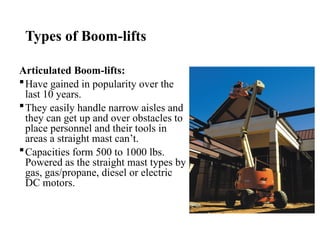
Articulated Boom-lifts:
Have gained in popularity over the
last 10 years.
They easily handle narrow aisles and
they can get up and over obstacles to
place personnel and their tools in
areas a straight mast can’t.
Capacities form 500 to 1000 lbs.
Powered as the straight mast types by
gas, gas/propane, diesel or electric
DC motors.
Required Components
1) A manufacturer’s operating manual.
2) Manual of Responsibilities
3) Operational Ground Controls
4) Emergency Stop Controls
5) Slope Warning Device
6) Max Load Capacity on Platform
7) Certificate of Annual Inspection
8) Manufacturer’s Anchor Points
9) Operational Controls (“hold to run” type)
10) An Auxiliary/Manual Lowering System (Power Loss)
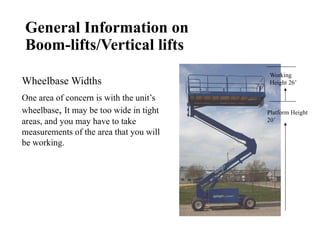
General Information on
Boom-lifts/Vertical lifts
Platform Height
20’
Working
Height 26’
Wheelbase Widths
One area of concern is with the unit’s
wheelbase, It may be too wide in tight
areas, and you may have to take
measurements of the area that you will
be working.
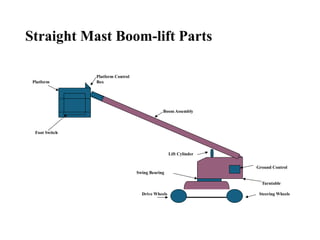
Straight Mast Boom-lift Parts
Foot Switch
Platform
Platform Control
Box
Boom Assembly
Lift Cylinder
Ground Control
Drive Wheels Steering Wheels
Turntable
Swing Bearing
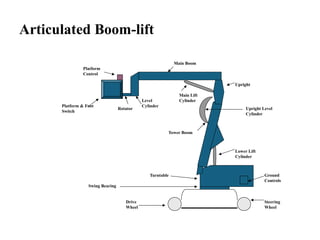
Articulated Boom-lift
Platform & Foot
Switch
Platform
Control
Rotator
Level
Cylinder
Main Boom
Main Lift
Cylinder
Upright
Tower Boom
Lower Lift
Cylinder
Ground
Controls
Steering
Wheel
Drive
Wheel
Turntable
Swing Bearing
Upright Level
Cylinder
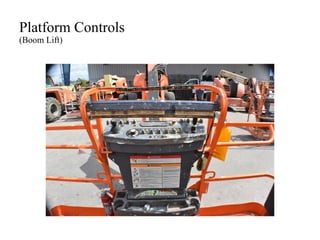
Platform Controls
(Boom Lift)
Inspections
•Regulations require that several types of inspections
be performed when operating aerial lifts. These
inspections break down into the following
classifications:
• Frequent
• Annual
• Pre-start
• Workplace
Inspections
•Frequent:
• In service for 3 months or 150 operating hours.
• Out of service for a period longer than 3 months
• Purchased used, unless documentation of current
inspections is available
• This inspection must be performed by a person who is qualified as
a mechanic on the specific make and model of aerial lift.
Annual
•Must occur annually by a person who is qualified as
a mechanic on the specific make and model of aerial
lift.
• Significantly more in depth than a frequent inspection and
involves testing more critical components required by the
manufacturer.
Pre-Start / Pre-Use
• You must perform a pre-start inspection of your aerial lift at the
following times:
• At the start of the shift
• Before use each day
Includes checking for:
Obvious visible damage
Loose, Missing, broken, and damaged parts
Proper operation of all powered systems
Leaks of any kind
The manufacturer’s operating and maintenance manuals.
The appropriate ANSI/SIA manual of Responsibilities
Other items related to the integrity and safe operation of the unit
Remember: Most
users are not
mechanics so they
must look for the
obvious
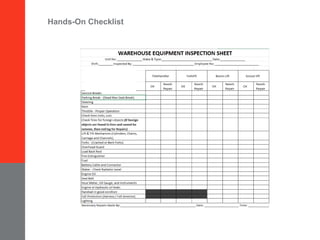
Hands-On Checklist
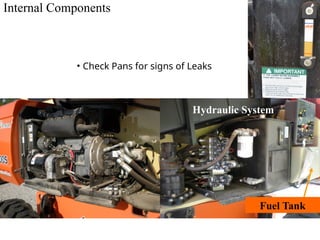
Internal Components
• Check Pans for signs of Leaks
Hydraulic System
Fuel Tank
Inspections
Make sure that the aerial lift is in an
area that is safe and appropriate for
conducting a pre-use inspection.
Remember, if you uncover anything during your
inspection that you believe presents a significant risk of
injury, lock out and tag the unit as unusable and report
your findings to your supervisor or employee
representative.
Workplace Inspection
•Along with the pre-use inspection you are also
required to conduct a workplace inspection of the
area in which you intend to use the equipment.
Inspect your area for:
Drop-offs or holes
Bumps and floor/ground obstructions
Debris
Overhead obstructions/energized power lines
Hazardous locations
Ground surfaces and support conditions
Pedestrian/vehicle traffic
Wind and weather conditions
Pre-Operational Inspection Form and
Boom-lift Components
•The instructor will review the inspection sheet
during the practical portion of the course.
•On the following slides we will find the main parts
of the Boom-lift, their locations and purposes. They
are the BASE SECTION, ELEVATING SECTION,
AND PLATFORM SECTION.
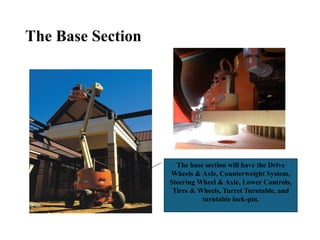
The Base Section
The base section will have the Drive
Wheels & Axle, Counterweight System,
Steering Wheel & Axle, Lower Controls,
Tires & Wheels, Turret Turntable, and
turntable lock-pin.
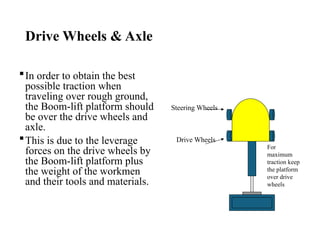
Drive Wheels & Axle
In order to obtain the best
possible traction when
traveling over rough ground,
the Boom-lift platform should
be over the drive wheels and
axle.
This is due to the leverage
forces on the drive wheels by
the Boom-lift platform plus
the weight of the workmen
and their tools and materials.
Steering Wheels
Drive Wheels
For
maximum
traction keep
the platform
over drive
wheels
Tires
Tires are available with different types of tread
design and fill agent.
 Traction Tread- characterized by a deep, directional tread for rough terrain
applications.
 Farm Implement- designed to ride on top of typical surfaces found in the
agricultural industry.
 Slab application/Solid- Designed for use on hard, flat surfaces available in
white/grey “non-marking” varieties
Fill Agents
• Pneumatic
• Filled with compressed air that must be maintained at a specific pressure
recommended by the manufacturer
• Nitrogen
• Will not react with other elements and therefore will not contribute to
oxidation (rusting) or support combustion (fire). They also last longer
and maintain their pressure longer than regular pneumatics.
• Liquid-filled
• Commonly referred to as ballast or hydrofill, these tires are filled with a
liquid compound (calcium chloride and water). This compound weighs
approximately 3.5 times more than water and will not freeze in low
temps.
Calcium chloride is a hazardous material that presents a bodily
and environmental hazards. Handling tires w/ CaCL must be
conducted by trained and qualified personnel.
Fill Agents
• Foam-Filled
• These are tires that are filled with a foamy, liquid compound that once
added, solidifies over one to three days. This foam is available in various
weights and densities.
• Urethane-Filled
• Other solid tires are filled with urethane, a derivative of rubber.
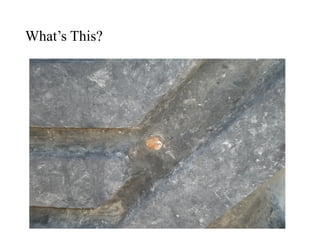
•Foam and Urethane filled tires will not go flat when
punctured, which is a significant design advantage
over air and liquid-filled types.
What’s This?
Do’s And Don’ts Of Boom-lift
Operation
•Do limit travel speed according to conditions of
ground surface, congestion of worksite, visibility,
slope, grade, location of personnel, or any other
factors causing hazards of collision or injury to
personnel.
•Do maintain a clear view of the path of travel when
elevated.
Do’s And Don’ts Of Boom-lift
Operation
• Do maintain a safe distance from obstacles, debris, drop-offs,
holes, depressions, ramps, and other possible hazards when
elevated.
• Don’t stunt drive or horseplay.
• Do shut down the Boom-lift/Scissorlift if any malfunction is
suspected, report the malfunction immediately and lockout
the Boom-lift.
• Don’t use planks, ladders or other devices on the Boom-lift
platform in order to achieve any additional height or reach.
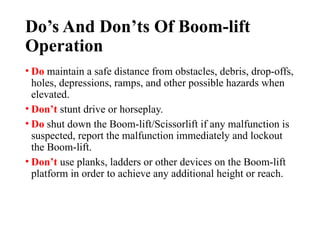
Boom-lift Operating Procedure
Do not travel on a grade
with the platform in an
elevated position.
Why is this important
and what could happen?
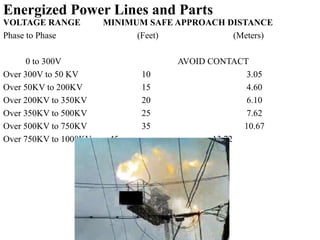
Energized Power Lines and Parts
It is mandatory that the operator of the Boom-lift
ensures that the minimum safe approach distances
(M.S.A.D.) to energized power lines and parts is
maintained during the entire operation of the boom-
lift.
Operators must assume all electrical parts and
wiring are ENERGIZED unless proven otherwise.
Energized Power Lines and Parts
VOLTAGE RANGE MINIMUM SAFE APPROACH DISTANCE
Phase to Phase (Feet) (Meters)
0 to 300V AVOID CONTACT
Over 300V to 50 KV 10 3.05
Over 50KV to 200KV 15 4.60
Over 200KV to 350KV 20 6.10
Over 350KV to 500KV 25 7.62
Over 500KV to 750KV 35 10.67
Over 750KV to 1000KV 45 13.72
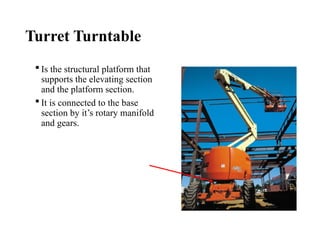
Turret Turntable
 Is the structural platform that
supports the elevating section
and the platform section.
 It is connected to the base
section by it’s rotary manifold
and gears.
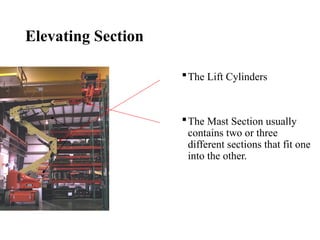
Elevating Section
The Lift Cylinders
The Mast Section usually
contains two or three
different sections that fit one
into the other.
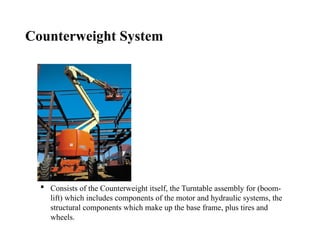
Counterweight System
 Consists of the Counterweight itself, the Turntable assembly for (boom-
lift) which includes components of the motor and hydraulic systems, the
structural components which make up the base frame, plus tires and
wheels.
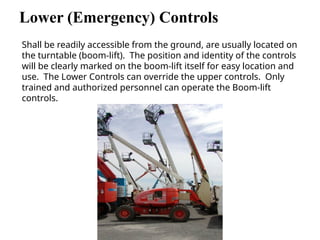
Lower (Emergency) Controls
Shall be readily accessible from the ground, are usually located on
the turntable (boom-lift). The position and identity of the controls
will be clearly marked on the boom-lift itself for easy location and
use. The Lower Controls can override the upper controls. Only
trained and authorized personnel can operate the Boom-lift
controls.
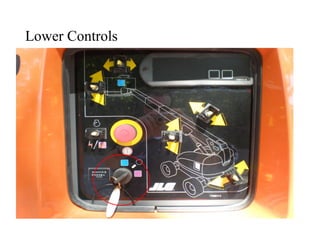
Lower Controls
Important Note
The lower controls should only be used during the following
conditions:
1. During pre-shift checkout functions of lower controls.
2. To override the upper controls to gain access to the
Boom-lift operator in the event of an emergency.
3. Only after you have been given permission to operate a
Boom-lift function by the Boom-lift operator.
4. By a qualified mechanic during repairs or performing
maintenance of the Boom-lift.
Platform
Boom-lift
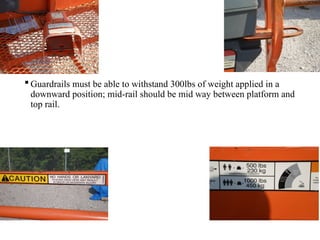
 Guardrails must be able to withstand 300lbs of weight applied in a
downward position; mid-rail should be mid way between platform and
top rail.
Platform Safety
Always know the weight of your load.
Never try to lift or load the platform in excess of the
capacity indicated on the platform
Stay within the Boom-lift operating limits.
Foot control for Boom-lifts must operate free and
not stick or bind.
Stability and Capacity Characteristics
• The capabilities and limitations of your aerial lift in relation
to stability and capacity are easy to remain within when you
understand how the factors involved affect the operation of
the unit.
• These factors are:
• Leverage
• Center of Gravity
• Motion
• Unit Configuration
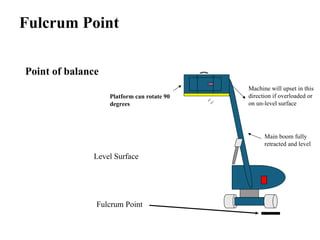
Fulcrum Point
Point of balance
Fulcrum Point
Platform can rotate 90
degrees
Machine will upset in this
direction if overloaded or
on un-level surface
Main boom fully
retracted and level
Level Surface
Fulcrum Point
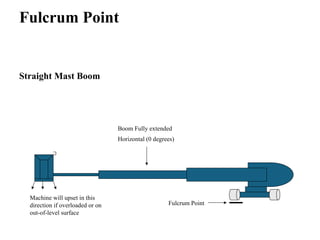
Straight Mast Boom
Fulcrum Point
Machine will upset in this
direction if overloaded or on
out-of-level surface
Boom Fully extended
Horizontal (0 degrees)
Fulcrum Point
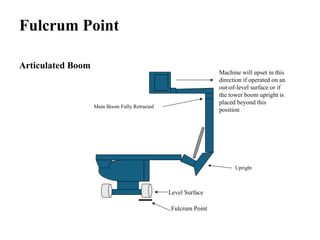
Articulated Boom
Fulcrum Point
Upright
Machine will upset in this
direction if operated on an
out-of-level surface or if
the tower boom upright is
placed beyond this
position
Main Boom Fully Retracted
Level Surface
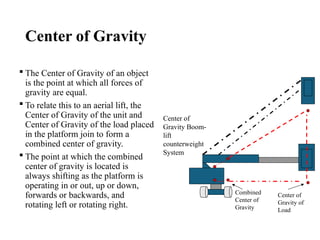
Center of Gravity
 The Center of Gravity of an object
is the point at which all forces of
gravity are equal.
 To relate this to an aerial lift, the
Center of Gravity of the unit and
Center of Gravity of the load placed
in the platform join to form a
combined center of gravity.
 The point at which the combined
center of gravity is located is
always shifting as the platform is
operating in or out, up or down,
forwards or backwards, and
rotating left or rotating right.
Center of
Gravity Boom-
lift
counterweight
System
Combined
Center of
Gravity
Center of
Gravity of
Load
Motion
•When you put your aerial lift into motion, certain
dynamic forces act on the Center of Gravity as the
unit’s weight distribution shifts. In fact, if you think
of the Center of Gravity as representing the weight
of the unit, it must remain within the area between
the wheels in order for the unit to remain upright. If
for any reason the Center of Gravity is forced
outside this defined area, the machine will tip over.
What affects the Center of Gravity?
• Actions such as:
• Stopping
• Turning
• Moving Forward
• Reversing
* All act on the Center of Gravity and affect stability. The more sudden , severe or
abrupt the action is, the more adverse an effect it will have on stability.
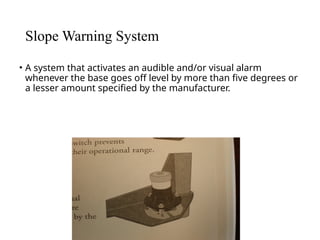
Slope Warning System
• A system that activates an audible and/or visual alarm
whenever the base goes off level by more than five degrees or
a lesser amount specified by the manufacturer.
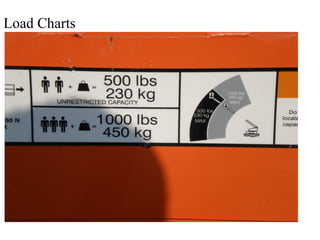
Load Charts
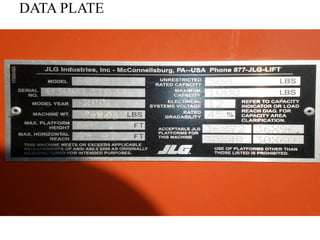
DATA PLATE
Side slopes & Grade
Boom-lift are generally intended to be used on a flat level
surface.
When traveling over a long distance it is advisable to lock
the turntable (if it equipped with one).
Keep the boom mast retracted and keep the operator platform
at or below the horizontal position with the ground.
The Boom-lift should not be driven on grades or sideslopes
exceeding those specified on caution placards or indicated on
Operations Manual.
Information on Different Fuels
Propane (LPG) and Batteries
Typical fuels used to power Boom-lifts are gasoline and
diesel.
Additional sources that have become increasingly popular
are Propane and Battery.
DISCUSS:
What advantages do propane and battery power offer that
gasoline and diesel do not??
Common Sense Safety Practices
When Working With Fuels
• Never fill the fuel tank of a Boom-lift with the engine
running.
• Never smoke or have the Boom-lift near an open flame when
filling the fuel tank.
• If fuel is spilled, Clean it up immediately and report it to
Safety. A COP Environmental Spill form may need to be
generated.
• Never mistakenly put fuel into the hydraulic tank.
Propane
Unlike other fuels, propane is a gas stored under pressure in a
liquid form. This pressure works to our advantage. For
instance, a fuel pump is not needed to move propane to the
engine. In the event the fuel system develops a leak, a flame
or spark could ignite a leak, if that happens, a fire or an
explosion could result.
Changing/Charging/Adding
a Fuel Source
• In some areas the handling of certain fuels may require
specific training and certification beyond the scope of this
training program.
• Safe fueling generally comes down to observing three things:
• 1. Make sure the unit is shutdown and secure.
• 2. Make sure you're wearing the required PPE.
• 3. Make sure your familiar with the manufacturers instructions
regarding safe fueling procedures, including the type and grade of
fuel used and the location of the fuel filler spout.
* Working with batteries requires a higher level of PPE.
Batteries Chemicals
• Lead
• Antimony
• Lead Peroxide
• Sulfuric Acid
 Hydrogen vapor is produced during the charging process; for this reason,
there must be adequate ventilation in the battery charging area. If the
operator has come into contact with battery acid, He/she must rinse the area
immediately and report to the clinic.
 ALWAYS REFER TO THE OPERATION & MAINTENANCE MANUAL TO
VERIFY THE LOCATION OF THE CHARGER UNIT AND THE PROPER
RECHARGING PROCEDURES FOR YOUR AERIAL LIFT WORK PLATFORM
Parking and Shutdown
• Whenever possible, park the unit on firm, level ground.
• Retract and lower all boom/platform sections.
• Shutdown the main power source (engine/battery)
• Remove key(s).
• Lock all access panels/filler caps.
• Chock the wheels if the unit is left on a grade.
• Switch main power source selector to off position and lock
Now time for a quiz: True or False
Safety training test Boom Lift
1. Safety bypass key must remain in the equipment at all times.
2. Operators are responsible for the safety of everyone working on the platform. Ensure everyone is properly
tied off and body parts are inside the basket.
3. Boom Lift must be inspected before each shift, and it must be documented.
4. If any item on the checklist needs repair the boom lift cannot be used.
5. Travelling with the boom in the air on unleveled ground is acceptable.

Boom Lift Safety operator training .pptx

  • 1.
  • 2.
    Course Objectives In thistraining you will be guided through: •Regulations and where they come from •Pre-shift Inspections – Job site Inspections •Types of Aerial Lifts •Stability and Capacity •Practical (hands 0n).
  • 3.
    Boom Lift training •About 26 construction workers die each year from using boom lifts. • More than half of the deaths involve boom-supported lifts, such as bucket trucks and cherry pickers. Most others involve scissor lifts. • Electrocutions, falls, and tip-overs cause most of the deaths.
  • 4.
    Other Causes ofInjuries • Include being caught between the lift bucket or guardrail and object (such as steel beams or joists) and being struck by falling objects. • A worker can also be catapulted out of a bucket, if the boom or bucket is struck by something.
  • 5.
    This can leadto a fatality
  • 6.
  • 7.
    Industrial Standards • OSHArefers to the following industry standards in relation to aerial lifts: • The American National Standards Institute (ANSI) • The Scaffold Industry Association (SIA) Applicable Standards are: • ANSI/SIA- A92.5: Boom Supported Elevating Work Platforms • ANSI/SIA- A92.6: Self Propelled Elevating Work Platforms
  • 8.
    Manufacturer’s Instructions •The wordingin regulations and industry standards contains many references to operating and maintenance instructions supplied by the manufacturers. •As an operator, the importance of becoming familiar with the location and contents of your equipment manufacturer’s operating manual is vital!
  • 9.
  • 10.
  • 11.
    Specific Rules and Responsibilities •Be authorized to operate the equipment • Know your unit • Inspect your aerial lift • Inspect your job site • Operate safely • Operators are responsible for the safety of everyone working on the platform. Ensure everyone is properly tied off and body parts are inside the basket.
  • 12.
    Yes, this isa boom lift Vertical Lift Rough Terrain
  • 13.
    Two Basic typesof Aerial Lifts 1) Boom Supported:  A boom supported aerial work platform (Boom-lift) Has a platform that can be positioned completely beyond the base Used to position personnel, their tools and material at work locations.
  • 14.
    Types of Boom-lifts ArticulatedBoom-lifts: Have gained in popularity over the last 10 years. They easily handle narrow aisles and they can get up and over obstacles to place personnel and their tools in areas a straight mast can’t. Capacities form 500 to 1000 lbs. Powered as the straight mast types by gas, gas/propane, diesel or electric DC motors.
  • 15.
    Required Components 1) Amanufacturer’s operating manual. 2) Manual of Responsibilities 3) Operational Ground Controls 4) Emergency Stop Controls 5) Slope Warning Device 6) Max Load Capacity on Platform 7) Certificate of Annual Inspection 8) Manufacturer’s Anchor Points 9) Operational Controls (“hold to run” type) 10) An Auxiliary/Manual Lowering System (Power Loss)
  • 16.
    General Information on Boom-lifts/Verticallifts Platform Height 20’ Working Height 26’ Wheelbase Widths One area of concern is with the unit’s wheelbase, It may be too wide in tight areas, and you may have to take measurements of the area that you will be working.
  • 17.
    Straight Mast Boom-liftParts Foot Switch Platform Platform Control Box Boom Assembly Lift Cylinder Ground Control Drive Wheels Steering Wheels Turntable Swing Bearing
  • 18.
    Articulated Boom-lift Platform &Foot Switch Platform Control Rotator Level Cylinder Main Boom Main Lift Cylinder Upright Tower Boom Lower Lift Cylinder Ground Controls Steering Wheel Drive Wheel Turntable Swing Bearing Upright Level Cylinder
  • 19.
  • 20.
    Inspections •Regulations require thatseveral types of inspections be performed when operating aerial lifts. These inspections break down into the following classifications: • Frequent • Annual • Pre-start • Workplace
  • 21.
    Inspections •Frequent: • In servicefor 3 months or 150 operating hours. • Out of service for a period longer than 3 months • Purchased used, unless documentation of current inspections is available • This inspection must be performed by a person who is qualified as a mechanic on the specific make and model of aerial lift.
  • 22.
    Annual •Must occur annuallyby a person who is qualified as a mechanic on the specific make and model of aerial lift. • Significantly more in depth than a frequent inspection and involves testing more critical components required by the manufacturer.
  • 23.
    Pre-Start / Pre-Use •You must perform a pre-start inspection of your aerial lift at the following times: • At the start of the shift • Before use each day Includes checking for: Obvious visible damage Loose, Missing, broken, and damaged parts Proper operation of all powered systems Leaks of any kind The manufacturer’s operating and maintenance manuals. The appropriate ANSI/SIA manual of Responsibilities Other items related to the integrity and safe operation of the unit Remember: Most users are not mechanics so they must look for the obvious
  • 24.
  • 25.
    Internal Components • CheckPans for signs of Leaks Hydraulic System Fuel Tank
  • 26.
    Inspections Make sure thatthe aerial lift is in an area that is safe and appropriate for conducting a pre-use inspection. Remember, if you uncover anything during your inspection that you believe presents a significant risk of injury, lock out and tag the unit as unusable and report your findings to your supervisor or employee representative.
  • 27.
    Workplace Inspection •Along withthe pre-use inspection you are also required to conduct a workplace inspection of the area in which you intend to use the equipment. Inspect your area for: Drop-offs or holes Bumps and floor/ground obstructions Debris Overhead obstructions/energized power lines Hazardous locations Ground surfaces and support conditions Pedestrian/vehicle traffic Wind and weather conditions
  • 28.
    Pre-Operational Inspection Formand Boom-lift Components •The instructor will review the inspection sheet during the practical portion of the course. •On the following slides we will find the main parts of the Boom-lift, their locations and purposes. They are the BASE SECTION, ELEVATING SECTION, AND PLATFORM SECTION.
  • 29.
    The Base Section Thebase section will have the Drive Wheels & Axle, Counterweight System, Steering Wheel & Axle, Lower Controls, Tires & Wheels, Turret Turntable, and turntable lock-pin.
  • 30.
    Drive Wheels &Axle In order to obtain the best possible traction when traveling over rough ground, the Boom-lift platform should be over the drive wheels and axle. This is due to the leverage forces on the drive wheels by the Boom-lift platform plus the weight of the workmen and their tools and materials. Steering Wheels Drive Wheels For maximum traction keep the platform over drive wheels
  • 31.
    Tires Tires are availablewith different types of tread design and fill agent.  Traction Tread- characterized by a deep, directional tread for rough terrain applications.  Farm Implement- designed to ride on top of typical surfaces found in the agricultural industry.  Slab application/Solid- Designed for use on hard, flat surfaces available in white/grey “non-marking” varieties
  • 32.
    Fill Agents • Pneumatic •Filled with compressed air that must be maintained at a specific pressure recommended by the manufacturer • Nitrogen • Will not react with other elements and therefore will not contribute to oxidation (rusting) or support combustion (fire). They also last longer and maintain their pressure longer than regular pneumatics. • Liquid-filled • Commonly referred to as ballast or hydrofill, these tires are filled with a liquid compound (calcium chloride and water). This compound weighs approximately 3.5 times more than water and will not freeze in low temps. Calcium chloride is a hazardous material that presents a bodily and environmental hazards. Handling tires w/ CaCL must be conducted by trained and qualified personnel.
  • 33.
    Fill Agents • Foam-Filled •These are tires that are filled with a foamy, liquid compound that once added, solidifies over one to three days. This foam is available in various weights and densities. • Urethane-Filled • Other solid tires are filled with urethane, a derivative of rubber. •Foam and Urethane filled tires will not go flat when punctured, which is a significant design advantage over air and liquid-filled types.
  • 34.
  • 35.
    Do’s And Don’tsOf Boom-lift Operation •Do limit travel speed according to conditions of ground surface, congestion of worksite, visibility, slope, grade, location of personnel, or any other factors causing hazards of collision or injury to personnel. •Do maintain a clear view of the path of travel when elevated.
  • 36.
    Do’s And Don’tsOf Boom-lift Operation • Do maintain a safe distance from obstacles, debris, drop-offs, holes, depressions, ramps, and other possible hazards when elevated. • Don’t stunt drive or horseplay. • Do shut down the Boom-lift/Scissorlift if any malfunction is suspected, report the malfunction immediately and lockout the Boom-lift. • Don’t use planks, ladders or other devices on the Boom-lift platform in order to achieve any additional height or reach.
  • 37.
    Boom-lift Operating Procedure Donot travel on a grade with the platform in an elevated position. Why is this important and what could happen?
  • 38.
    Energized Power Linesand Parts It is mandatory that the operator of the Boom-lift ensures that the minimum safe approach distances (M.S.A.D.) to energized power lines and parts is maintained during the entire operation of the boom- lift. Operators must assume all electrical parts and wiring are ENERGIZED unless proven otherwise.
  • 39.
    Energized Power Linesand Parts VOLTAGE RANGE MINIMUM SAFE APPROACH DISTANCE Phase to Phase (Feet) (Meters) 0 to 300V AVOID CONTACT Over 300V to 50 KV 10 3.05 Over 50KV to 200KV 15 4.60 Over 200KV to 350KV 20 6.10 Over 350KV to 500KV 25 7.62 Over 500KV to 750KV 35 10.67 Over 750KV to 1000KV 45 13.72
  • 40.
    Turret Turntable  Isthe structural platform that supports the elevating section and the platform section.  It is connected to the base section by it’s rotary manifold and gears.
  • 41.
    Elevating Section The LiftCylinders The Mast Section usually contains two or three different sections that fit one into the other.
  • 42.
    Counterweight System  Consistsof the Counterweight itself, the Turntable assembly for (boom- lift) which includes components of the motor and hydraulic systems, the structural components which make up the base frame, plus tires and wheels.
  • 43.
    Lower (Emergency) Controls Shallbe readily accessible from the ground, are usually located on the turntable (boom-lift). The position and identity of the controls will be clearly marked on the boom-lift itself for easy location and use. The Lower Controls can override the upper controls. Only trained and authorized personnel can operate the Boom-lift controls.
  • 44.
  • 45.
    Important Note The lowercontrols should only be used during the following conditions: 1. During pre-shift checkout functions of lower controls. 2. To override the upper controls to gain access to the Boom-lift operator in the event of an emergency. 3. Only after you have been given permission to operate a Boom-lift function by the Boom-lift operator. 4. By a qualified mechanic during repairs or performing maintenance of the Boom-lift.
  • 46.
    Platform Boom-lift  Guardrails mustbe able to withstand 300lbs of weight applied in a downward position; mid-rail should be mid way between platform and top rail.
  • 47.
    Platform Safety Always knowthe weight of your load. Never try to lift or load the platform in excess of the capacity indicated on the platform Stay within the Boom-lift operating limits. Foot control for Boom-lifts must operate free and not stick or bind.
  • 48.
    Stability and CapacityCharacteristics • The capabilities and limitations of your aerial lift in relation to stability and capacity are easy to remain within when you understand how the factors involved affect the operation of the unit. • These factors are: • Leverage • Center of Gravity • Motion • Unit Configuration
  • 49.
    Fulcrum Point Point ofbalance Fulcrum Point Platform can rotate 90 degrees Machine will upset in this direction if overloaded or on un-level surface Main boom fully retracted and level Level Surface
  • 50.
    Fulcrum Point Straight MastBoom Fulcrum Point Machine will upset in this direction if overloaded or on out-of-level surface Boom Fully extended Horizontal (0 degrees)
  • 51.
    Fulcrum Point Articulated Boom FulcrumPoint Upright Machine will upset in this direction if operated on an out-of-level surface or if the tower boom upright is placed beyond this position Main Boom Fully Retracted Level Surface
  • 52.
    Center of Gravity The Center of Gravity of an object is the point at which all forces of gravity are equal.  To relate this to an aerial lift, the Center of Gravity of the unit and Center of Gravity of the load placed in the platform join to form a combined center of gravity.  The point at which the combined center of gravity is located is always shifting as the platform is operating in or out, up or down, forwards or backwards, and rotating left or rotating right. Center of Gravity Boom- lift counterweight System Combined Center of Gravity Center of Gravity of Load
  • 53.
    Motion •When you putyour aerial lift into motion, certain dynamic forces act on the Center of Gravity as the unit’s weight distribution shifts. In fact, if you think of the Center of Gravity as representing the weight of the unit, it must remain within the area between the wheels in order for the unit to remain upright. If for any reason the Center of Gravity is forced outside this defined area, the machine will tip over.
  • 54.
    What affects theCenter of Gravity? • Actions such as: • Stopping • Turning • Moving Forward • Reversing * All act on the Center of Gravity and affect stability. The more sudden , severe or abrupt the action is, the more adverse an effect it will have on stability.
  • 55.
    Slope Warning System •A system that activates an audible and/or visual alarm whenever the base goes off level by more than five degrees or a lesser amount specified by the manufacturer.
  • 56.
  • 57.
  • 58.
    Side slopes &Grade Boom-lift are generally intended to be used on a flat level surface. When traveling over a long distance it is advisable to lock the turntable (if it equipped with one). Keep the boom mast retracted and keep the operator platform at or below the horizontal position with the ground. The Boom-lift should not be driven on grades or sideslopes exceeding those specified on caution placards or indicated on Operations Manual.
  • 59.
    Information on DifferentFuels Propane (LPG) and Batteries Typical fuels used to power Boom-lifts are gasoline and diesel. Additional sources that have become increasingly popular are Propane and Battery. DISCUSS: What advantages do propane and battery power offer that gasoline and diesel do not??
  • 60.
    Common Sense SafetyPractices When Working With Fuels • Never fill the fuel tank of a Boom-lift with the engine running. • Never smoke or have the Boom-lift near an open flame when filling the fuel tank. • If fuel is spilled, Clean it up immediately and report it to Safety. A COP Environmental Spill form may need to be generated. • Never mistakenly put fuel into the hydraulic tank.
  • 61.
    Propane Unlike other fuels,propane is a gas stored under pressure in a liquid form. This pressure works to our advantage. For instance, a fuel pump is not needed to move propane to the engine. In the event the fuel system develops a leak, a flame or spark could ignite a leak, if that happens, a fire or an explosion could result.
  • 62.
    Changing/Charging/Adding a Fuel Source •In some areas the handling of certain fuels may require specific training and certification beyond the scope of this training program. • Safe fueling generally comes down to observing three things: • 1. Make sure the unit is shutdown and secure. • 2. Make sure you're wearing the required PPE. • 3. Make sure your familiar with the manufacturers instructions regarding safe fueling procedures, including the type and grade of fuel used and the location of the fuel filler spout. * Working with batteries requires a higher level of PPE.
  • 63.
    Batteries Chemicals • Lead •Antimony • Lead Peroxide • Sulfuric Acid  Hydrogen vapor is produced during the charging process; for this reason, there must be adequate ventilation in the battery charging area. If the operator has come into contact with battery acid, He/she must rinse the area immediately and report to the clinic.  ALWAYS REFER TO THE OPERATION & MAINTENANCE MANUAL TO VERIFY THE LOCATION OF THE CHARGER UNIT AND THE PROPER RECHARGING PROCEDURES FOR YOUR AERIAL LIFT WORK PLATFORM
  • 64.
    Parking and Shutdown •Whenever possible, park the unit on firm, level ground. • Retract and lower all boom/platform sections. • Shutdown the main power source (engine/battery) • Remove key(s). • Lock all access panels/filler caps. • Chock the wheels if the unit is left on a grade. • Switch main power source selector to off position and lock
  • 65.
    Now time fora quiz: True or False Safety training test Boom Lift 1. Safety bypass key must remain in the equipment at all times. 2. Operators are responsible for the safety of everyone working on the platform. Ensure everyone is properly tied off and body parts are inside the basket. 3. Boom Lift must be inspected before each shift, and it must be documented. 4. If any item on the checklist needs repair the boom lift cannot be used. 5. Travelling with the boom in the air on unleveled ground is acceptable.