BMES Annual Meeting 2011
                                                                     10/15/2011


Hannah Barber
Nanofibrous Texturizing for Prevention of
Bacterial Infection on Biomedical Implants

       Hannah Barber1,4, Mehdi Kargar2, John Haught2,
     Amrinder Nain, Ph.D. 2,3, and Bahareh Behkam, Ph.D. 2,3
  Biological Sciences Department1, Mechanical Engineering Department2, School
          of Biomedical Engineering and Sciences3, Scieneering Program4
                       Virginia Tech, Blacksburg VA
2
                                           Hannah Barber, MicroN BASE   10/15/11


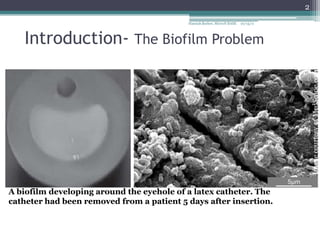
   Introduction- The Biofilm Problem


                                                                                       Image courtesy of MedScape.com
A biofilm developing around the eyehole of a latex catheter. The
catheter had been removed from a patient 5 days after insertion.
3
                                  Hannah Barber, MicroN BASE   10/15/11


Motivation- Catalyst for a Solution
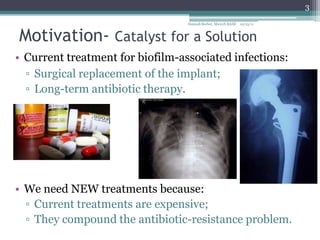
• Current treatment for biofilm-associated infections:
  ▫ Surgical replacement of the implant;
  ▫ Long-term antibiotic therapy.


• We need NEW treatments because:
  ▫ Current treatments are expensive;
  ▫ They compound the antibiotic-resistance problem.
4
Hannah Barber, MicroN BASE   10/15/11
5
                                                              Hannah Barber, MicroN BASE   10/15/11


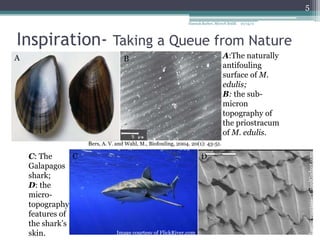
Inspiration- Taking a Queue from Nature
A                                  B                                            A:The naturally
                                                                                antifouling
                                                                                surface of M.
                                                                                edulis;
                                                                                B: the sub-
                                                                                micron
                                                                                topography of
                                                                                the priostracum
                                                                                of M. edulis.
                    Bers, A. V. and Wahl, M., Biofouling, 2004. 20(1): 43-51.

    C: The      C                                                   D


                                                                                                      Image courtesy of medGadget.com
    Galapagos
    shark;
    D: the
    micro-
    topography
    features of
    the shark’s
    skin.                       Image courtesy of FlickRiver.com
6
                            Hannah Barber, MicroN BASE   10/15/11


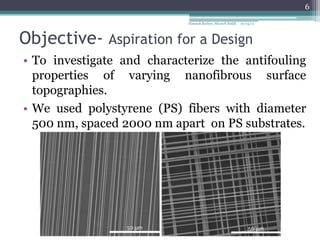
Objective- Aspiration for a Design
• To investigate and characterize the antifouling
  properties of varying nanofibrous surface
  topographies.
• We used polystyrene (PS) fibers with diameter
  500 nm, spaced 2000 nm apart on PS substrates.
7
                                              Hannah Barber, MicroN BASE   10/15/11


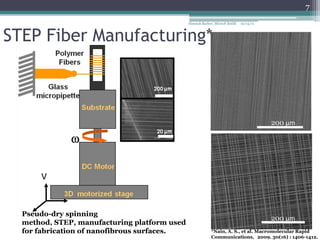
STEP Fiber Manufacturing*


                                                                                      200 µm


  Pseudo-dry spinning
                                                                                      200 µm
  method, STEP, manufacturing platform used
  for fabrication of nanofibrous surfaces.                *Nain, A. S., et al. Macromolecular Rapid
                                                          Communications, 2009. 30(16) : 1406-1412.
8
                                      Hannah Barber, MicroN BASE   10/15/11


Bacterial Assay
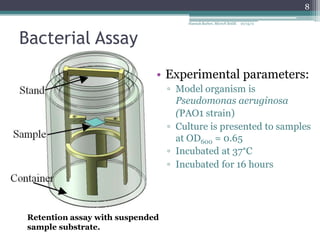
                              • Experimental parameters:
                                  ▫ Model organism is
                                    Pseudomonas aeruginosa
                                    (PAO1 strain)
                                  ▫ Culture is presented to samples
                                    at OD600 = 0.65
                                  ▫ Incubated at 37°C
                                  ▫ Incubated for 16 hours


 Retention assay with suspended
 sample substrate.
9
                                       Hannah Barber, MicroN BASE   10/15/11


       Imaging- Illuminating the Data
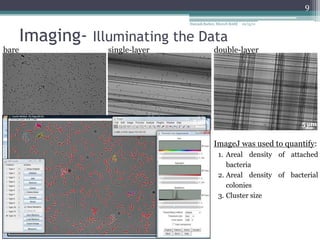
bare                    single-layer                double-layer


                 5 μm                   5 μm                                   5 μm


                                                    ImageJ was used to quantify:
                                                      1. Areal density of attached
                                                         bacteria
                                                      2. Areal density of bacterial
                                                         colonies
                                                      3. Cluster size
10
                                                                            Hannah Barber, MicroN BASE   10/15/11


                  Results- Understanding the Information
                                        Bacterial Attachment
                                 0.05
 areal density (bacteria/µm2)


                                0.045
                                 0.04
                                0.035                                   • Change in bacterial attachment:
                                 0.03
                                0.025
                                                                          ▫ 59% decrease from bare to single
                                 0.02
                                0.015
                                                                          ▫ 62% decrease from bare to double
                                 0.01
                                0.005
                                    0
                                        bare     single   double
                                                                         Bacterial Cluster Formation
• Change in number of clusters:                                    10
                                                                    9
                       ▫ 17% decrease from bare to single           8
                         and to double                              7
                                                                    6                                                        number of
                                                                                                                             clusters
                                                                    5
                                                                    4
• Change in bacteria per cluster:                                   3
                                                                                                                             bacteria per
                                                                                                                             cluster
                       ▫ 21% decrease from bare to single           2
                                                                    1
                       ▫ 24% decrease from bare to double           0
                                                                         bare              single                   double
11
                                    Hannah Barber, MicroN BASE   10/15/11


 Conclusions and Future Work
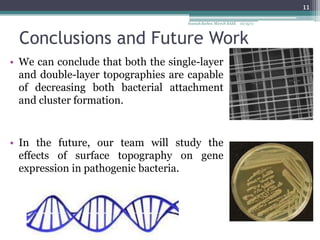
• We can conclude that both the single-layer
  and double-layer topographies are capable
  of decreasing both bacterial attachment
  and cluster formation.


• In the future, our team will study the
  effects of surface topography on gene
  expression in pathogenic bacteria.

Bmes presentation final

  • 1.
    BMES Annual Meeting2011 10/15/2011 Hannah Barber Nanofibrous Texturizing for Prevention of Bacterial Infection on Biomedical Implants Hannah Barber1,4, Mehdi Kargar2, John Haught2, Amrinder Nain, Ph.D. 2,3, and Bahareh Behkam, Ph.D. 2,3 Biological Sciences Department1, Mechanical Engineering Department2, School of Biomedical Engineering and Sciences3, Scieneering Program4 Virginia Tech, Blacksburg VA
  • 2.
    2 Hannah Barber, MicroN BASE 10/15/11 Introduction- The Biofilm Problem Image courtesy of MedScape.com A biofilm developing around the eyehole of a latex catheter. The catheter had been removed from a patient 5 days after insertion.
  • 3.
    3 Hannah Barber, MicroN BASE 10/15/11 Motivation- Catalyst for a Solution • Current treatment for biofilm-associated infections: ▫ Surgical replacement of the implant; ▫ Long-term antibiotic therapy. • We need NEW treatments because: ▫ Current treatments are expensive; ▫ They compound the antibiotic-resistance problem.
  • 4.
  • 5.
    5 Hannah Barber, MicroN BASE 10/15/11 Inspiration- Taking a Queue from Nature A B A:The naturally antifouling surface of M. edulis; B: the sub- micron topography of the priostracum of M. edulis. Bers, A. V. and Wahl, M., Biofouling, 2004. 20(1): 43-51. C: The C D Image courtesy of medGadget.com Galapagos shark; D: the micro- topography features of the shark’s skin. Image courtesy of FlickRiver.com
  • 6.
    6 Hannah Barber, MicroN BASE 10/15/11 Objective- Aspiration for a Design • To investigate and characterize the antifouling properties of varying nanofibrous surface topographies. • We used polystyrene (PS) fibers with diameter 500 nm, spaced 2000 nm apart on PS substrates.
  • 7.
    7 Hannah Barber, MicroN BASE 10/15/11 STEP Fiber Manufacturing* 200 µm Pseudo-dry spinning 200 µm method, STEP, manufacturing platform used for fabrication of nanofibrous surfaces. *Nain, A. S., et al. Macromolecular Rapid Communications, 2009. 30(16) : 1406-1412.
  • 8.
    8 Hannah Barber, MicroN BASE 10/15/11 Bacterial Assay • Experimental parameters: ▫ Model organism is Pseudomonas aeruginosa (PAO1 strain) ▫ Culture is presented to samples at OD600 = 0.65 ▫ Incubated at 37°C ▫ Incubated for 16 hours Retention assay with suspended sample substrate.
  • 9.
    9 Hannah Barber, MicroN BASE 10/15/11 Imaging- Illuminating the Data bare single-layer double-layer 5 μm 5 μm 5 μm ImageJ was used to quantify: 1. Areal density of attached bacteria 2. Areal density of bacterial colonies 3. Cluster size
  • 10.
    10 Hannah Barber, MicroN BASE 10/15/11 Results- Understanding the Information Bacterial Attachment 0.05 areal density (bacteria/µm2) 0.045 0.04 0.035 • Change in bacterial attachment: 0.03 0.025 ▫ 59% decrease from bare to single 0.02 0.015 ▫ 62% decrease from bare to double 0.01 0.005 0 bare single double Bacterial Cluster Formation • Change in number of clusters: 10 9 ▫ 17% decrease from bare to single 8 and to double 7 6 number of clusters 5 4 • Change in bacteria per cluster: 3 bacteria per cluster ▫ 21% decrease from bare to single 2 1 ▫ 24% decrease from bare to double 0 bare single double
  • 11.
    11 Hannah Barber, MicroN BASE 10/15/11 Conclusions and Future Work • We can conclude that both the single-layer and double-layer topographies are capable of decreasing both bacterial attachment and cluster formation. • In the future, our team will study the effects of surface topography on gene expression in pathogenic bacteria.

Editor's Notes