Blue Brain
TEAM MEMBERS…
1. MD. Shahnur Chowdhury Susmoy – 153-15-6387
2. Tushar Kumar Mahata – 161-15-7252
3. Mustafizur Rahman – 161-15-6939
4. Asaduzzaman – 161-15-7621
OUTLINES…
• INTRODUCTION
• WHAT IS BLUE BRAIN
• WHY DO WE NEED BLUE BRAIN?
• BLUE BRAIN PROJECT OBJECTIVES
• FUNCTIONING OF A BRAIN
• BRAIN SIMULATION
• UPLOADING A HUMAN BRAIN
• RESEARCH WORK
• HARDWARE AND SOFTWARE REQUIREMENT
• BLUE BRAIN POWER
• PROS
• CONS
• APPLICATIONS
• FUTURE PERSPECTIVE
• ENDING THOUGHTS
• REFERENCES
INTRODUCTION…
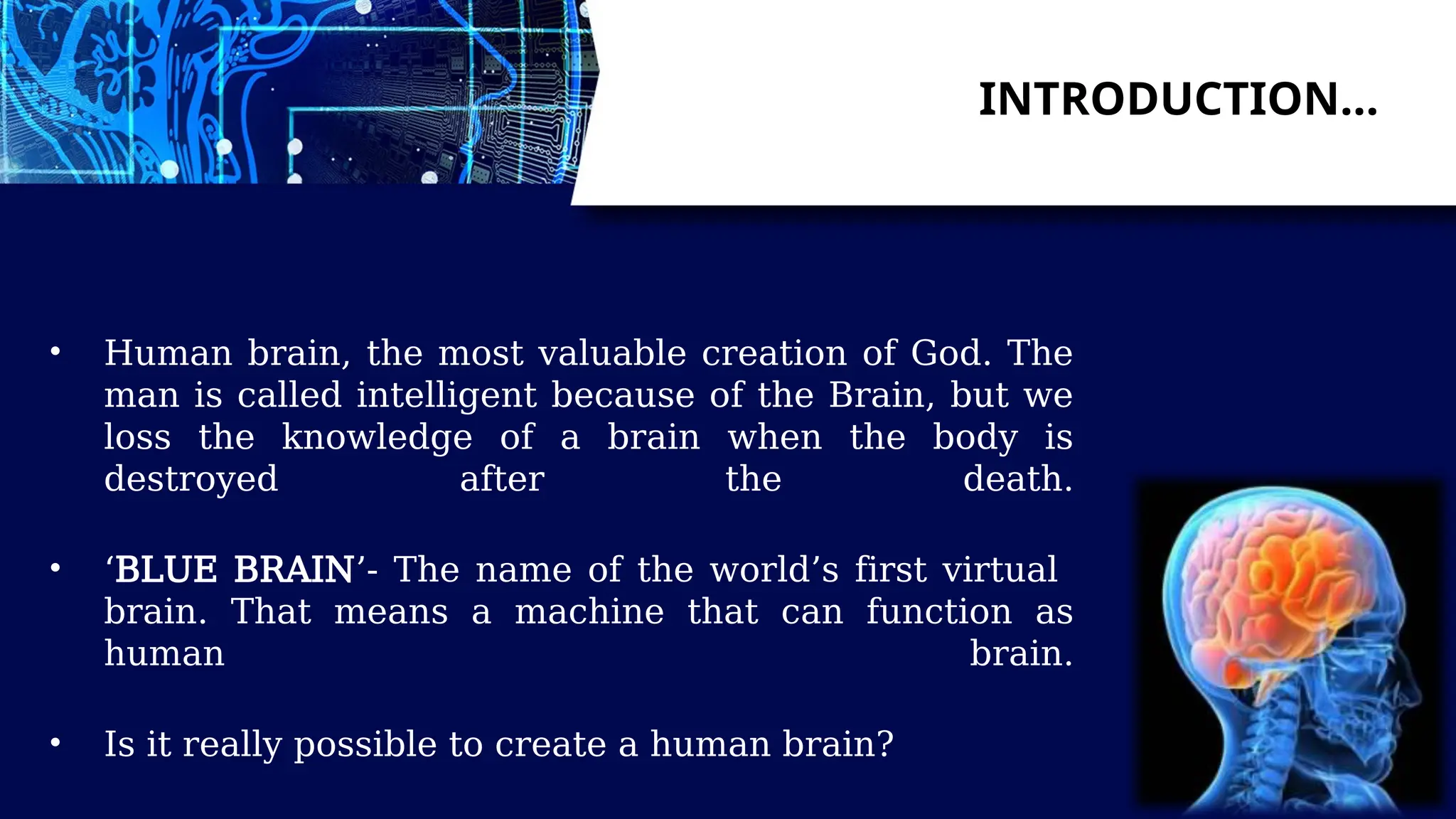
• Human brain, the most valuable creation of God. The
man is called intelligent because of the Brain, but we
loss the knowledge of a brain when the body is
destroyed after the death.
• ‘BLUE BRAIN’- The name of the world’s first virtual
brain. That means a machine that can function as
human brain.
• Is it really possible to create a human brain?
WHAT IS ‘BLUE BRAIN’ …?
• IBM & EPFL is now developing a virtual brain
known as the BLUE BRAIN; an artificial brain
that can think, respond, take decision and
keep anything in memory like a human being.
• It would be the first virtual brain of the world.
• The goal is to reverse engineer the brain into a
computer.
WHY DO WE NEED
BLUE BRAIN…?
• To upload contents of the natural brain into it.
• To keep the intelligence, knowledge and skill of
any person forever.
• To remember things without any efforts.
• Things can be made easy as everything could be
automated.
BLUE BRAIN PROJECTIVE
OBJECTIVES…
• The project will search for insights into how human beings think and remember.
• Scientists think that blue brain could also help to cure the ‘Parkinson’s
Disease’.
• The brain circuitry is in a complex state of flux, the brain rewiring itself every
moment of its existence. If the scientists can crack open the secret of how and why
the brain does it, the knowledge could lead to new breed of supercomputers.
FUNCTIONING OF A BRAIN…
• Sensory Input :-
Receiving input such as sound, image, etc. through sensory cell.
• Interpretation :-
Interpretation of the received input by the brain by defining states
of neurons in the brain.
• Motor Output :-
Receiving of electric responses from the brain to perform any
action.
BRAIN SIMULATION…
Natural Brain Simulated Brain
INPUT: Through the natural neurons. INPUT: Through the silicon chip or
artificial neurons.
INTERPRETATION: By different states
of the neurons in the brain.
INTERPRETATION: By a set of bits in
the set of register.
OUTPUT: Through the natural neurons. OUTPUT: Through the silicon chip .
PROCESSING: Through arithmetic and
logical calculations.
PROCESSING: Through arithmetic and
logical calculation and artificial
intelligence.
MEMORY: Through permanent states of
neurons.
MEMORY: Through secondary memory.
But the question is how the human brain will be up
loaded into it…?
UPLOADING A
HUMAN BRAIN…
• The uploading is possible by the use of small robots known as the nanobots. These
robots are small enough to travel through out our circulatory system.
• Traveling into the spine and brain, they will be able to monitor the activity and
structure of our central nervous system.
• They will be able to provide an interface with computer while we still reside in our
biological form.
• Nanobots could also carefully scan the structure of our brain, providing a
complete readout of the connection.
UPLOADING A
HUMAN BRAIN…
• This information, when entered into a computer, could then continue to
function as us.
• Thus the data stored in the entire brain will be uploaded into the
computer.
RESEARCH WORK…
• IBM developing the “Blue brain”.
• IBM, in partnership with scientists at
Switzerland’s École polytechnique fédérale de
Lausanne (EPFL) Brain and Mind Institute will
begin simulating the brain’s biological
systems.
• Researchers at Microsoft's Media Presence
Lab are developing a "virtual brain," a PC-
based database that holds a record of an
individual's complete life experience.
• "By 2047, almost all information will be in
cyberspace including all knowledge and
creative works, said one of the project’s
leaders, - Gordon Bell.
HARDWARE AND
SOFTWARE REQUIREMENT…
• A super computer.
• Memory with a very large storing capacity.
• Processor with a very high processing power.
• A very wide network.
• A program (written in Linux or C++) to convert the electric impulses from the brain
to input signal, which is to be received by the computer and vice versa.
• Very powerful nanobots to act as the interface between the natural brain and the
computer.
BLUE BRAIN POWER…
• The human brain has 100 billions nerve cells that enable us to adapt quickly to
an immense array of stimuli. Blue brain is a technology that uses “Blue Gene” a
supercomputer capable of processing 228 TFLOPS.
• The main aim of blue brain is to build an software replica or template which
could reveal many existing aspects of the brain circuits ,memory capacity and
how memories are lost.
• The modeling is also able to work out best way to compensate and repair error
circuits .
• The blue brain model can be used to detect and test treatment strategies for
neurological diseases.
PROS…
• Remembering things without any effort.
• Making decision without the presence of a person.
• Even after the death of a man his intelligence can be used.
• Understanding the activities of animals.
• Allowing the deaf to hear via direct nerve stimulation.
CONS…
• We become dependent upon the computer.
• Others may use technical knowledge against us.
• Computer viruses will pose an increasingly critical threat.
• Another fear is found with respect to human cloning.
• A very costly procedure of regaining the memory back.
• If in future surrogates to humans are developed then, there will be
no human interaction and the world will run on computers only.
APPLICATIONS…
• Gathering and testing 100 years of data.
• Cracking the neural code.
• A foundation for molecular modeling of brain function.
• Understanding neocortical information processing.
• A novel tool for drug discovery for brain disorders.
• A global facility.
• A foundation for whole brain simulations.
FUTURE PERSPECTIVE…
• Prosthetic devices to restore vision, hearing or limb control might be
the next step.
• Further in the future, the real dreams would be the realization of the
“brain-in-computer and chip-in-brain” arrangement.
• Creating Surrogates
• Researchers at Microsoft's Media Presence Lab are developing a
"virtual brain”, called ‘MyLifeBits’.
• To make database of human memories.
• By 2047, almost all information will be in cyberspace including all
knowledge and creative works.
ENDING THOUGHTS…
• We will be able to transfer ourselves into computers at some point.
• It will bring both benefits and harm to human society .
• Eventually aim of applying terrific computer power to the simulation of
an entire brain.
• Very soon this technology will be highly accepted whole over the world.
• Blue Gene supercomputers can simulate up to 100 cortical columns, 1
million neurons, and 1 billion synapses at once.
• Despite the sheer complexity, it is predicted that the project will
capable by the year 2023.
REFERENCES…
• “Engineering in Medicine and Biology Society”, 2012. EMBS 2012, 30th Annual
International Conference of the IEEE.
• Henry Markram, “The Blue Brain Project”, Nature Reviews Neuroscience 2013 February.
• “Simulated brain closer to thought” - BBC News, 22 April 2013.
• Human Brain Project: https://www.humanbrainproject.eu/en/
• The Blue Brain Project: http://bluebrainproject.epfl.ch
• Blue Gene: http://www.research.ibm.com/bluegene
• Bluebrain | EPFL: https://www.epfl.ch/research/domains/bluebrain/
• Blue Brain Project: https://en.wikipedia.org/wiki/Blue_Brain_Project
• The Blue Brain Project (GitHub): https://github.com/BlueBrain
ANY QUERIES…..
?????
THANK YOU…

BLUE BRAIN - A Technological Marvel.pptx

  • 1.
  • 2.
    TEAM MEMBERS… 1. MD.Shahnur Chowdhury Susmoy – 153-15-6387 2. Tushar Kumar Mahata – 161-15-7252 3. Mustafizur Rahman – 161-15-6939 4. Asaduzzaman – 161-15-7621
  • 3.
    OUTLINES… • INTRODUCTION • WHATIS BLUE BRAIN • WHY DO WE NEED BLUE BRAIN? • BLUE BRAIN PROJECT OBJECTIVES • FUNCTIONING OF A BRAIN • BRAIN SIMULATION • UPLOADING A HUMAN BRAIN • RESEARCH WORK • HARDWARE AND SOFTWARE REQUIREMENT • BLUE BRAIN POWER • PROS • CONS • APPLICATIONS • FUTURE PERSPECTIVE • ENDING THOUGHTS • REFERENCES
  • 4.
    INTRODUCTION… • Human brain,the most valuable creation of God. The man is called intelligent because of the Brain, but we loss the knowledge of a brain when the body is destroyed after the death. • ‘BLUE BRAIN’- The name of the world’s first virtual brain. That means a machine that can function as human brain. • Is it really possible to create a human brain?
  • 5.
    WHAT IS ‘BLUEBRAIN’ …? • IBM & EPFL is now developing a virtual brain known as the BLUE BRAIN; an artificial brain that can think, respond, take decision and keep anything in memory like a human being. • It would be the first virtual brain of the world. • The goal is to reverse engineer the brain into a computer.
  • 6.
    WHY DO WENEED BLUE BRAIN…? • To upload contents of the natural brain into it. • To keep the intelligence, knowledge and skill of any person forever. • To remember things without any efforts. • Things can be made easy as everything could be automated.
  • 7.
    BLUE BRAIN PROJECTIVE OBJECTIVES… •The project will search for insights into how human beings think and remember. • Scientists think that blue brain could also help to cure the ‘Parkinson’s Disease’. • The brain circuitry is in a complex state of flux, the brain rewiring itself every moment of its existence. If the scientists can crack open the secret of how and why the brain does it, the knowledge could lead to new breed of supercomputers.
  • 8.
    FUNCTIONING OF ABRAIN… • Sensory Input :- Receiving input such as sound, image, etc. through sensory cell. • Interpretation :- Interpretation of the received input by the brain by defining states of neurons in the brain. • Motor Output :- Receiving of electric responses from the brain to perform any action.
  • 9.
    BRAIN SIMULATION… Natural BrainSimulated Brain INPUT: Through the natural neurons. INPUT: Through the silicon chip or artificial neurons. INTERPRETATION: By different states of the neurons in the brain. INTERPRETATION: By a set of bits in the set of register. OUTPUT: Through the natural neurons. OUTPUT: Through the silicon chip . PROCESSING: Through arithmetic and logical calculations. PROCESSING: Through arithmetic and logical calculation and artificial intelligence. MEMORY: Through permanent states of neurons. MEMORY: Through secondary memory. But the question is how the human brain will be up loaded into it…?
  • 10.
    UPLOADING A HUMAN BRAIN… •The uploading is possible by the use of small robots known as the nanobots. These robots are small enough to travel through out our circulatory system. • Traveling into the spine and brain, they will be able to monitor the activity and structure of our central nervous system. • They will be able to provide an interface with computer while we still reside in our biological form. • Nanobots could also carefully scan the structure of our brain, providing a complete readout of the connection.
  • 11.
    UPLOADING A HUMAN BRAIN… •This information, when entered into a computer, could then continue to function as us. • Thus the data stored in the entire brain will be uploaded into the computer.
  • 12.
    RESEARCH WORK… • IBMdeveloping the “Blue brain”. • IBM, in partnership with scientists at Switzerland’s École polytechnique fédérale de Lausanne (EPFL) Brain and Mind Institute will begin simulating the brain’s biological systems. • Researchers at Microsoft's Media Presence Lab are developing a "virtual brain," a PC- based database that holds a record of an individual's complete life experience. • "By 2047, almost all information will be in cyberspace including all knowledge and creative works, said one of the project’s leaders, - Gordon Bell.
  • 13.
    HARDWARE AND SOFTWARE REQUIREMENT… •A super computer. • Memory with a very large storing capacity. • Processor with a very high processing power. • A very wide network. • A program (written in Linux or C++) to convert the electric impulses from the brain to input signal, which is to be received by the computer and vice versa. • Very powerful nanobots to act as the interface between the natural brain and the computer.
  • 14.
    BLUE BRAIN POWER… •The human brain has 100 billions nerve cells that enable us to adapt quickly to an immense array of stimuli. Blue brain is a technology that uses “Blue Gene” a supercomputer capable of processing 228 TFLOPS. • The main aim of blue brain is to build an software replica or template which could reveal many existing aspects of the brain circuits ,memory capacity and how memories are lost. • The modeling is also able to work out best way to compensate and repair error circuits . • The blue brain model can be used to detect and test treatment strategies for neurological diseases.
  • 15.
    PROS… • Remembering thingswithout any effort. • Making decision without the presence of a person. • Even after the death of a man his intelligence can be used. • Understanding the activities of animals. • Allowing the deaf to hear via direct nerve stimulation.
  • 16.
    CONS… • We becomedependent upon the computer. • Others may use technical knowledge against us. • Computer viruses will pose an increasingly critical threat. • Another fear is found with respect to human cloning. • A very costly procedure of regaining the memory back. • If in future surrogates to humans are developed then, there will be no human interaction and the world will run on computers only.
  • 17.
    APPLICATIONS… • Gathering andtesting 100 years of data. • Cracking the neural code. • A foundation for molecular modeling of brain function. • Understanding neocortical information processing. • A novel tool for drug discovery for brain disorders. • A global facility. • A foundation for whole brain simulations.
  • 18.
    FUTURE PERSPECTIVE… • Prostheticdevices to restore vision, hearing or limb control might be the next step. • Further in the future, the real dreams would be the realization of the “brain-in-computer and chip-in-brain” arrangement. • Creating Surrogates • Researchers at Microsoft's Media Presence Lab are developing a "virtual brain”, called ‘MyLifeBits’. • To make database of human memories. • By 2047, almost all information will be in cyberspace including all knowledge and creative works.
  • 19.
    ENDING THOUGHTS… • Wewill be able to transfer ourselves into computers at some point. • It will bring both benefits and harm to human society . • Eventually aim of applying terrific computer power to the simulation of an entire brain. • Very soon this technology will be highly accepted whole over the world. • Blue Gene supercomputers can simulate up to 100 cortical columns, 1 million neurons, and 1 billion synapses at once. • Despite the sheer complexity, it is predicted that the project will capable by the year 2023.
  • 20.
    REFERENCES… • “Engineering inMedicine and Biology Society”, 2012. EMBS 2012, 30th Annual International Conference of the IEEE. • Henry Markram, “The Blue Brain Project”, Nature Reviews Neuroscience 2013 February. • “Simulated brain closer to thought” - BBC News, 22 April 2013. • Human Brain Project: https://www.humanbrainproject.eu/en/ • The Blue Brain Project: http://bluebrainproject.epfl.ch • Blue Gene: http://www.research.ibm.com/bluegene • Bluebrain | EPFL: https://www.epfl.ch/research/domains/bluebrain/ • Blue Brain Project: https://en.wikipedia.org/wiki/Blue_Brain_Project • The Blue Brain Project (GitHub): https://github.com/BlueBrain
  • 21.
  • 22.