Blogging and Education Brad Pendleton
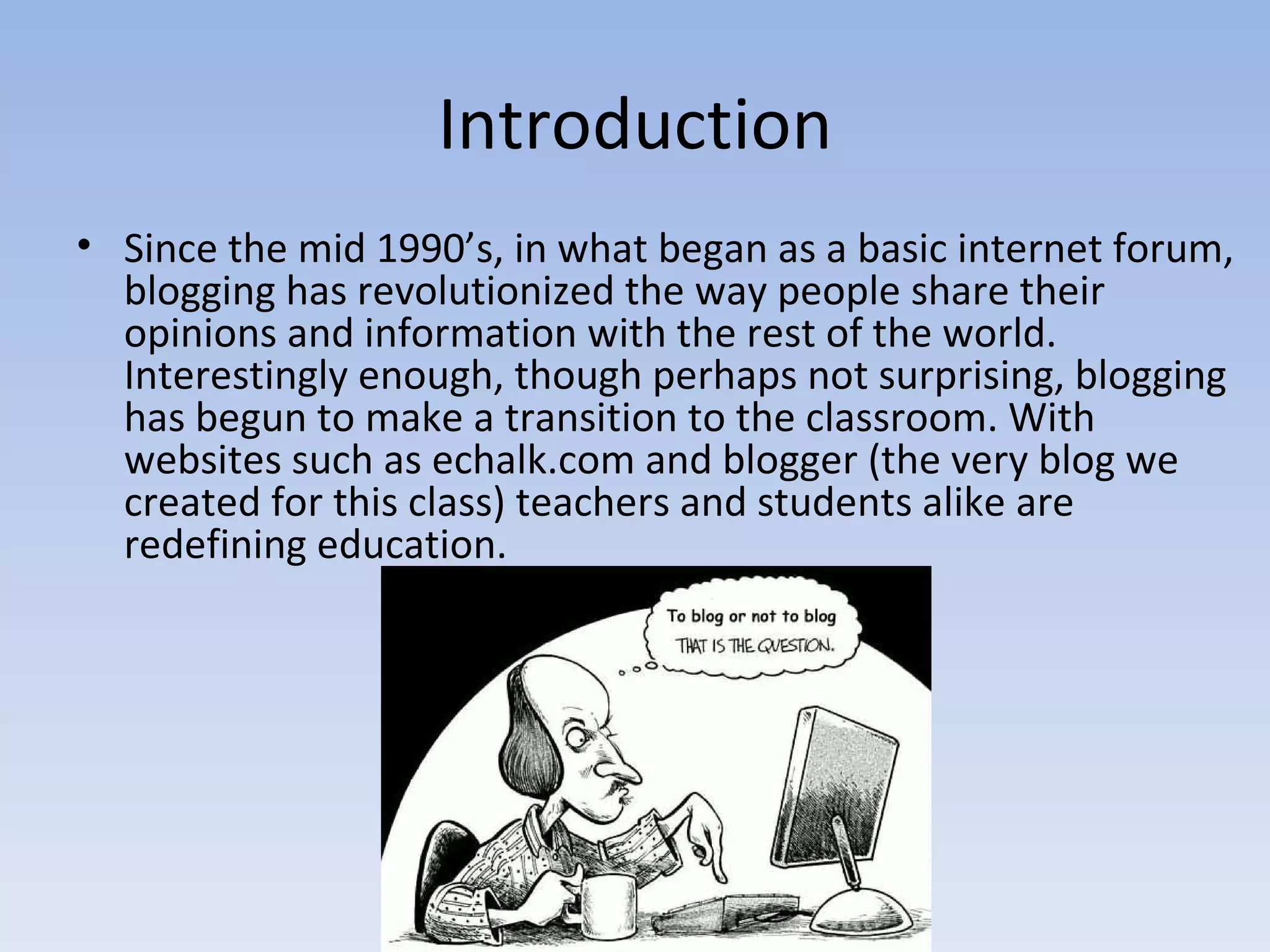
Introduction Since the mid 1990’s, in what began as a basic internet forum, blogging has revolutionized the way people share their opinions and information with the rest of the world. Interestingly enough, though perhaps not surprising, blogging has begun to make a transition to the classroom. With websites such as echalk.com and blogger (the very blog we created for this class) teachers and students alike are redefining education.
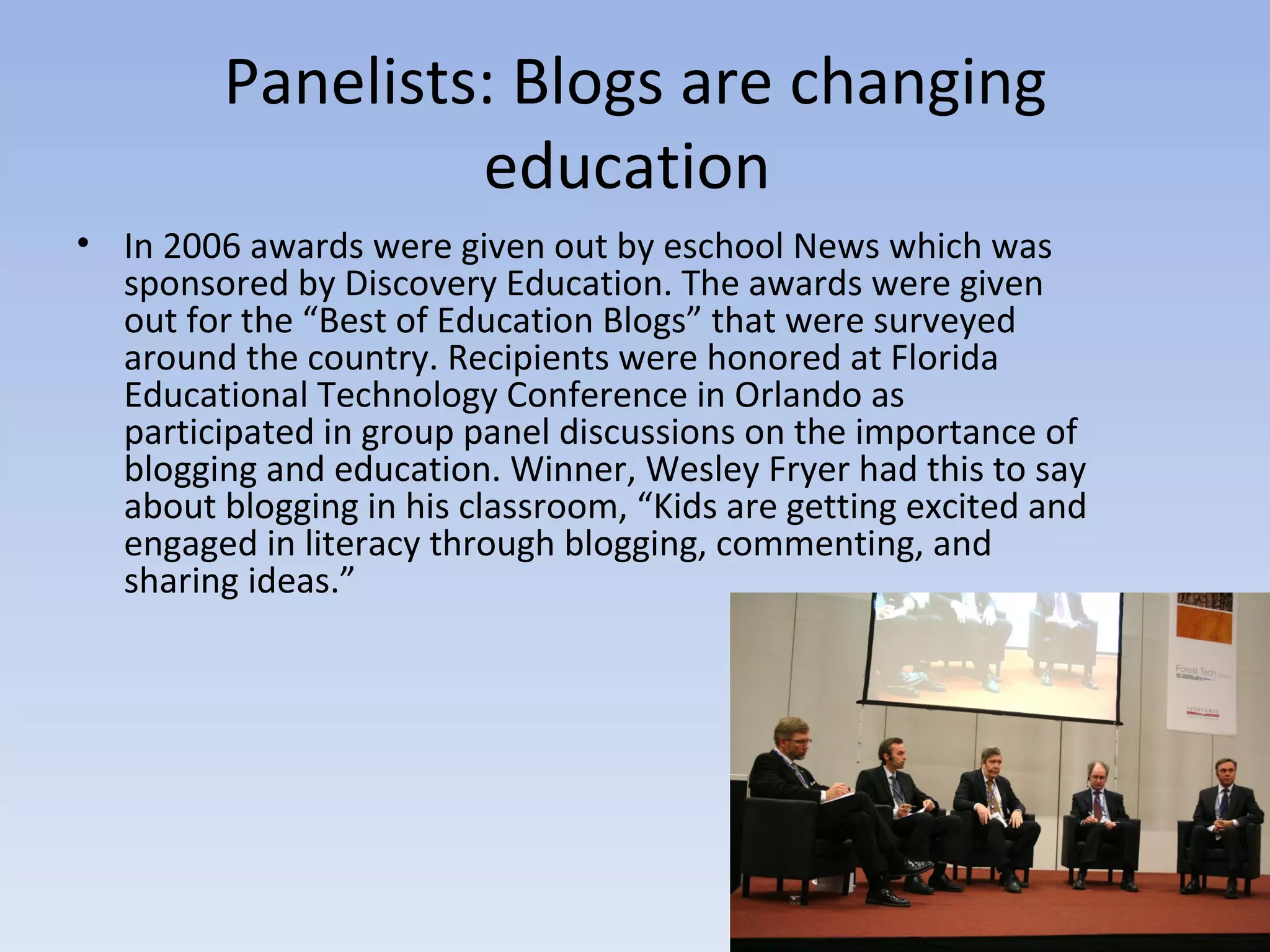
Panelists: Blogs are changing education  In 2006 awards were given out by eschool News which was sponsored by Discovery Education. The awards were given out for the “Best of Education Blogs” that were surveyed around the country. Recipients were honored at Florida Educational Technology Conference in Orlando as participated in group panel discussions on the importance of blogging and education. Winner, Wesley Fryer had this to say about blogging in his classroom, “Kids are getting excited and engaged in literacy through blogging, commenting, and sharing ideas.”
Panelists: Blogs are changing education  The initial conclusion from all this blogging excitement is very positive. Technology has progressed in a way that makes blogging in the classroom very “user friendly”. Sharing ideas with the world today is “so easy,” Fryer said. “Now, it doesn't take anything but a web browser to engage in these conversations”. Children and teenagers alike are getting engaged in ways that were not previously seen, and that can only mean that blogging is having a profoundly analytical effect on today’s youth.
My response I highly agree that blogging is a great benefit to teachers and students alike. I love sharing my opinion (but I’m not necessarily opinionated) and commenting on what other people have to say. I find that when I can really get engaged in a conversation or issue in class, it provides some of the most beneficial learning I could ever experience.
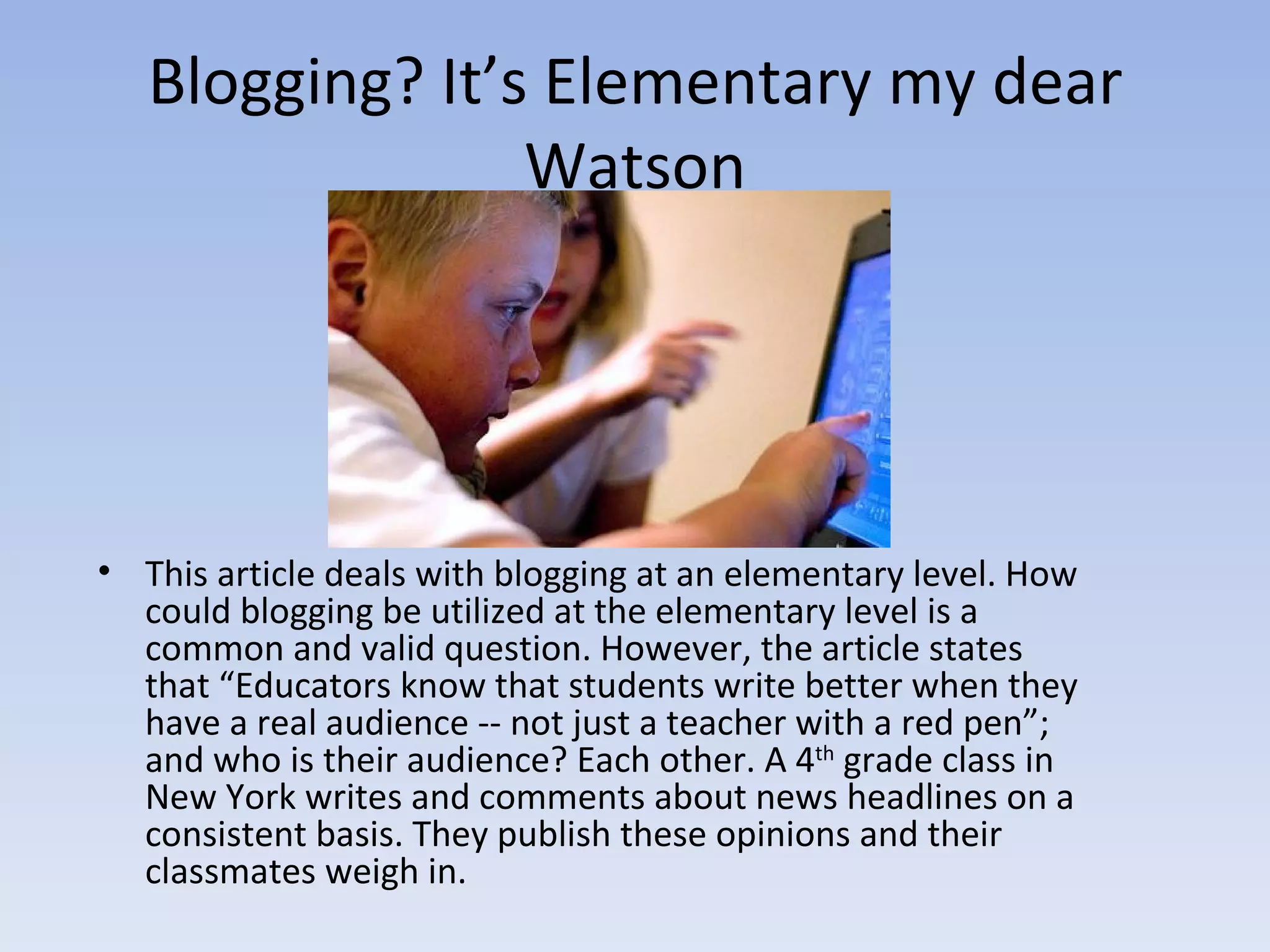
Blogging? It’s Elementary my dear Watson This article deals with blogging at an elementary level. How could blogging be utilized at the elementary level is a common and valid question. However, the article states that “Educators know that students write better when they have a real audience -- not just a teacher with a red pen”; and who is their audience? Each other. A 4 th  grade class in New York writes and comments about news headlines on a consistent basis. They publish these opinions and their classmates weigh in.
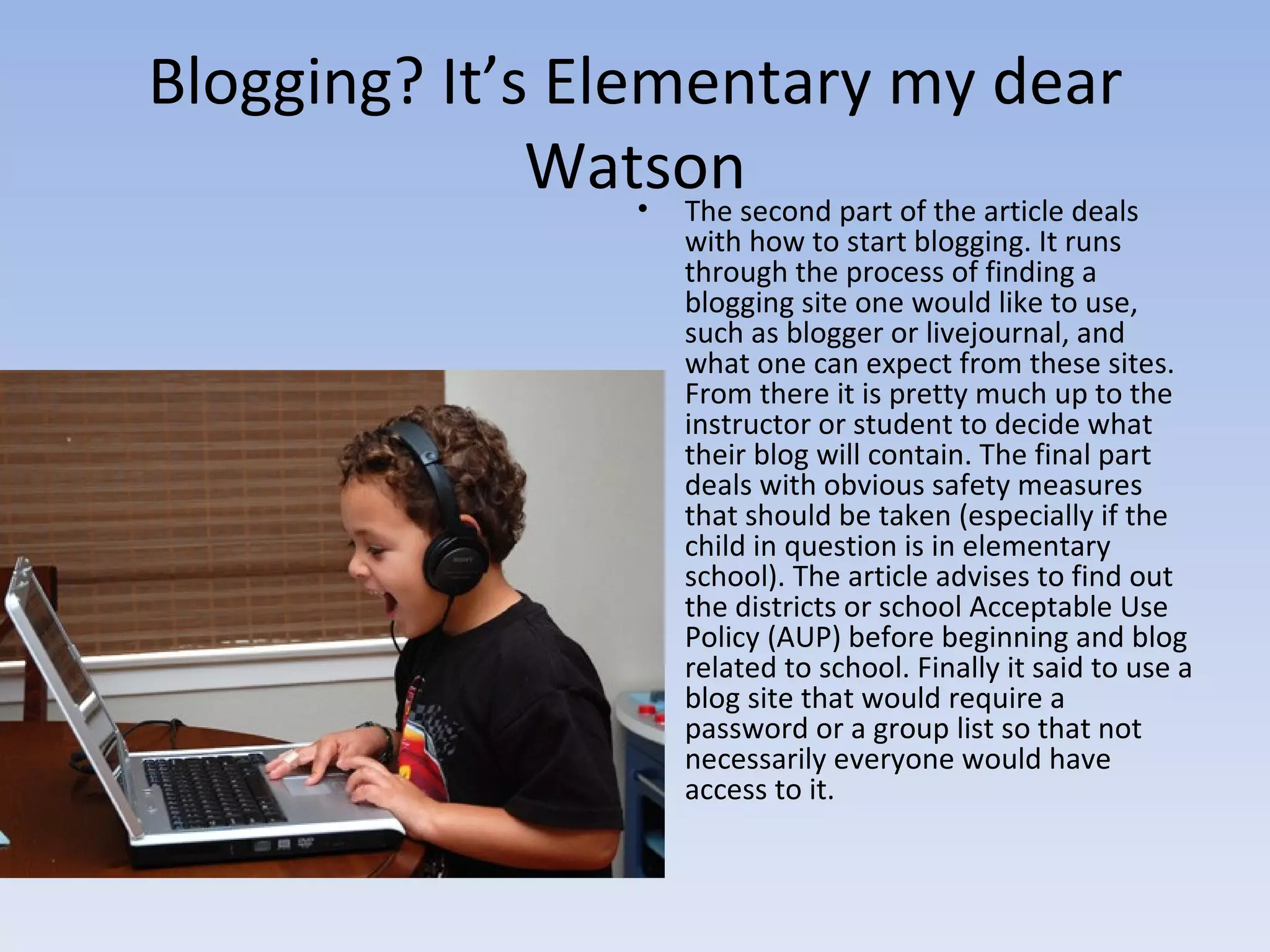
Blogging? It’s Elementary my dear Watson The second part of the article deals with how to start blogging. It runs through the process of finding a blogging site one would like to use, such as blogger or livejournal, and what one can expect from these sites. From there it is pretty much up to the instructor or student to decide what their blog will contain. The final part deals with obvious safety measures that should be taken (especially if the child in question is in elementary school). The article advises to find out the districts or school Acceptable Use Policy (AUP) before beginning and blog related to school. Finally it said to use a blog site that would require a password or a group list so that not necessarily everyone would have access to it.
My response Children are getting more and more tech savvy by the day. Starting a blog in elementary school is a wonderful idea, as it will enhance the technical skills already in place and promote further communication on the student’s part. In elementary school I would have felt much more comfortable having my peers read my written work than my teacher. I think that when the class is your audience and you’re not having to directly stand and speak to them, then a person’s ideas and opinions flow, much more freely.
Conclusion Blogs are an ever increasing resource that promotes thoughtfulness, free expression and the sharing of ideas.
Works Cited Jackson, Lorrie. &quot;Blogging? It's Elementary my dear Watson.&quot;  Educationwold. 13 Apr. 2005. Web. 11 Dec. 2009. <http://www.educationworld.com/a_tech/tech/tech217.shtml>. Pierce, Dennis. &quot;Panelists: Blogs are changing education.&quot; Eschool news. 24 Mar. 2006. Web. 11 Dec. 2009. <http://www.eschoolnews.com/news/top-news/index.cfm?i=36898&CFID=31065358&CFTOKEN=76682083>.

Blogging And Education

  • 1.
    Blogging and EducationBrad Pendleton
  • 2.
    Introduction Since themid 1990’s, in what began as a basic internet forum, blogging has revolutionized the way people share their opinions and information with the rest of the world. Interestingly enough, though perhaps not surprising, blogging has begun to make a transition to the classroom. With websites such as echalk.com and blogger (the very blog we created for this class) teachers and students alike are redefining education.
  • 3.
    Panelists: Blogs arechanging education In 2006 awards were given out by eschool News which was sponsored by Discovery Education. The awards were given out for the “Best of Education Blogs” that were surveyed around the country. Recipients were honored at Florida Educational Technology Conference in Orlando as participated in group panel discussions on the importance of blogging and education. Winner, Wesley Fryer had this to say about blogging in his classroom, “Kids are getting excited and engaged in literacy through blogging, commenting, and sharing ideas.”
  • 4.
    Panelists: Blogs arechanging education The initial conclusion from all this blogging excitement is very positive. Technology has progressed in a way that makes blogging in the classroom very “user friendly”. Sharing ideas with the world today is “so easy,” Fryer said. “Now, it doesn't take anything but a web browser to engage in these conversations”. Children and teenagers alike are getting engaged in ways that were not previously seen, and that can only mean that blogging is having a profoundly analytical effect on today’s youth.
  • 5.
    My response Ihighly agree that blogging is a great benefit to teachers and students alike. I love sharing my opinion (but I’m not necessarily opinionated) and commenting on what other people have to say. I find that when I can really get engaged in a conversation or issue in class, it provides some of the most beneficial learning I could ever experience.
  • 6.
    Blogging? It’s Elementarymy dear Watson This article deals with blogging at an elementary level. How could blogging be utilized at the elementary level is a common and valid question. However, the article states that “Educators know that students write better when they have a real audience -- not just a teacher with a red pen”; and who is their audience? Each other. A 4 th grade class in New York writes and comments about news headlines on a consistent basis. They publish these opinions and their classmates weigh in.
  • 7.
    Blogging? It’s Elementarymy dear Watson The second part of the article deals with how to start blogging. It runs through the process of finding a blogging site one would like to use, such as blogger or livejournal, and what one can expect from these sites. From there it is pretty much up to the instructor or student to decide what their blog will contain. The final part deals with obvious safety measures that should be taken (especially if the child in question is in elementary school). The article advises to find out the districts or school Acceptable Use Policy (AUP) before beginning and blog related to school. Finally it said to use a blog site that would require a password or a group list so that not necessarily everyone would have access to it.
  • 8.
    My response Childrenare getting more and more tech savvy by the day. Starting a blog in elementary school is a wonderful idea, as it will enhance the technical skills already in place and promote further communication on the student’s part. In elementary school I would have felt much more comfortable having my peers read my written work than my teacher. I think that when the class is your audience and you’re not having to directly stand and speak to them, then a person’s ideas and opinions flow, much more freely.
  • 9.
    Conclusion Blogs arean ever increasing resource that promotes thoughtfulness, free expression and the sharing of ideas.
  • 10.
    Works Cited Jackson,Lorrie. &quot;Blogging? It's Elementary my dear Watson.&quot; Educationwold. 13 Apr. 2005. Web. 11 Dec. 2009. <http://www.educationworld.com/a_tech/tech/tech217.shtml>. Pierce, Dennis. &quot;Panelists: Blogs are changing education.&quot; Eschool news. 24 Mar. 2006. Web. 11 Dec. 2009. <http://www.eschoolnews.com/news/top-news/index.cfm?i=36898&CFID=31065358&CFTOKEN=76682083>.