PURVIEW
Fundamental
Blocks
Industrial
Use Cases
Appl in EME
Records
FUNDAMENTAL BLOCKS
BLOCKCHAIN?
A Shared, Immutable Ledger that facilitates the process of Recording
Transactions and Tracking Assets in a Business Network
1st or Genesis Block nth Block
2nd Block 3rd Block
Genesis Block nth Block
2nd Block 3rd Block
Block
Header
n
Txns
(body)
+ Transaction
Shashank
sends ₹50
to Vishul
Consensus
from Nodes
BLOCKCHAIN?
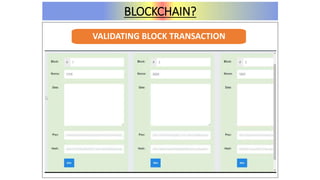
VALIDATING BLOCK TRANSACTION
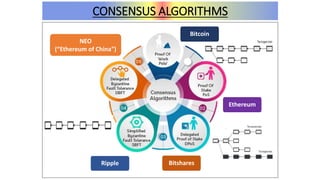
CONSENSUS ALGORITHMS
NEO
(“Ethereum of China”)
Ethereum
Bitshares
Ripple
Bitcoin
PROMISES OFFERED
TRANSPARENCY
TRACEABILITY
REDUCED COST
SPEED
ACCESS CONTROL
NO INTERMEDIARIES
SECURITY
DATA OWNERSHIP
BLOCKCHAIN NETWORKS
>2000 TPS
pBFT, RAFT
Yes
Permissioned
Linux
Foundation
93%
ENTERPRISE GRADE SOLUTIONS
TRANSACTION
SPEED
CONSENSUS
ALGO
SMART
CONTRACTS
LEDGER TYPE
GOVERNANCE
PROVIDERS
WITH
EXPERIENCE
FEATURES
~20 TPS
PoW
Yes
Permissionless
Ethereum
Developers
93%
ETHEREUM
>170 TPS
Pluggable
Algo
Yes
Permissioned
R3
Consortium
60%
CORDA
>1500 TPS
Probabilistic
Voting
No
Permissioned
Ripple Labs
33%
RIPPLE
>100 TPS
Majority
Voting
Yes
Permissioned
Ethereum &
J P Morgan
27%
QUORUM
HYPERLEDGER
FABRIC
HYPERLEDGER FABRIC ARCHITECTURE
SMART CONTRACTS
INDUSTRIAL USE CASES
EDUCATION & TRAINING
Immutable Record Keeping
Transparency
Digital Certification
Student Accountability by Smart
Contracts
File Storage & Knowledge Bank
HEALTHCARE
Patient Data Mgt
Billing & Claims
Clinical Trials & Research
Drug Authentication & Traceability
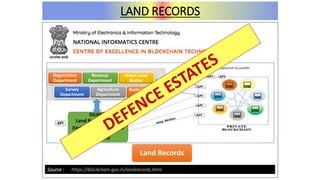
LAND RECORDS
Land Records
Source : https://blockchain.gov.in/landrecords.html
Registration
Department
Agriculture
Department
Urban Local
Bodies
Survey
Department
Revenue
Department
Banks/ Financial
Institutions
DILRMP
Land Record System
(Digital India Land Records
Modernisation
Programme)

blockchain ppt.pptx

Editor's Notes

  • #14 Chaincode 1: Patient Hospital Appointment @HospitalAppointment( ) Public AppointmentRequest(String PatientID, String PhysicianID, String HealthRecord) If Slotavaiable(DateAndTime) GrantAppointment(String PatientID, String PhysicianID, String HealthRecord, Time DateandTime) Return DateandTime Chaincode 2: Patient Check-up and Treatment @CheckupAndTreatment( ) Public Checkup(String PatientID, String HospitalID, String PhysicianID, String HealthRecord) Return PhysicianRecommendations If PhysicianRecommendations contains LabTests ConductLabTests(String Patient, String Hospital, String HealthRecord, String TestType) Return LabTestReport If PhysicianRecommendations contains MedicalProcedure ConductMedicalProcedure(String Patient, String Hospital, String HealthRecord, String Procedure) Chaincode 3: Payment @Payment( ) If PatientID.PaymentType contains Selfpaying SelfPayingPatient(String Patient, String Physician, String HealthRecord, String Cost) Else if PatientID.PaymentType contains Insurance ClaimgInsurance(String Patient, String Physician, String HealthRecord, String InsuranceCost) Chaincode 4: Medical Record Update @MedicalRecordUpdate( ) PatientUpdate(String Patient, String Physician, String HealthRecord, String Condition) PhysicianDecision(String Patient, String Physician, String HealthRecord, String PhysicianNote, Decision)
  • #15 Land records data need to be accurately stored in the blockchain. The existing history of transactions on a piece of land first needs to be inserted into the blockchain after approval by Revenue functionaries in the State. The approved data will be digitally signed and stored. This will be a starting point for any mutation. The certificates issued by the Revenue Department will be stored in the blockchain and can be used by the other agencies like the bank for any of the verification process during a transaction on the land parcel / farmer. The transactions related to change of ownership through sale, loan, mortgage, release of mortgage, crop updation is initiated by other departments. During the initiation of above mentioned transactions, the verification of the details need to be done using the blockchain data. After the approval of transaction in the respective database such as completion of deed registration / approval of loan by the bank, the transaction details should be stored in the blockchain. Specifically, the registration department will fetch details w.r.t a survey number from the blockchain and ensure that the ownership of the land parcel indeed rests with the prospective seller before initiating a sale. After obtaining the signature of the purchaser and seller in the sale deed, the scanned document should be moved in to Blockchain Network to create a block. Once the block is created it cannot be edited or tampered. Likewise the chain of block is created every time the property title is changed from one person to another.