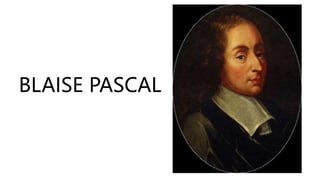
BLAISE PASCAL
As we expand our portrait of the philosophers in this
period, wonder what happened to all the other
philosophers. Take for instance, Blaise Pascal. Pascal,
however is considered to be a modern we wonder
philosopher. Nevertheless, in the light of our present
discussion regarding God’s existence, Pascal's
philosophical approach or his faith is incorporated in
this chapter. According to Pascal's wager, it is
infinitely more rational to believe in God than not to.
If God exists, the "pay off 1s so enormous and there
is no loss if He does not.
Blaise Pascal (1623-1662), the brilliant mathematician, physicist,
inventor, philosopher, and theologian was born in Clermont,
Auvergne, in South-central France. As a mathematician, Pascal's
achievements were astounding. A genius at age nineteen, he
invented the calculating machine. Pascal figured out the
mathematical principles needed to construct a machine that would
do the calculations. This machine was considered to be one of the
genuine achievements of the "new science" that was developing in
the 17th century. It was basically considered as the grandfather of
the computer since the latter is
actually a much extended use of Pascal's principles. In recognition
of this, one of the better-known computer languages is
called PASCAL
. Blaise Pascal (1623-1662), the brilliant mathematician,
physicist, inventor, philosopher, and theologian was born in
Clermont, Auvergne, in South-central France. As a
mathematician, Pascal's achievements were astounding. A
genius at age nineteen, he invented the calculating machine.
Pascal figured out the mathematical principles needed to
construct a machine that would do the calculations. This
machine was considered to be one of the genuine
achievements of the "new science" that was developing in the
17th century. It was basically considered as the grandfather of
the computer since the latter is
actually a much extended use of Pascal's principles. In
recognition of this, one of the better-known computer
languages is
called PASCAL
Pascal was a man of strong passion and his intellectual passion for
truth was reinforced by his passionate dissatisfaction with human
life unless a spiritual explanation could be found. His book, Pensees
(Thoughts), formed in 1660, was considered to have been a
carefully constructed defense of Christianity, a true Apology, setting
forth the reasons that will convince the intellect (Solomon and
Higgins, 1996). His other work was L'Esprit Geometrique, where he
wrote his basic work
on the philosophy of mathematics. Prior to his illness he composed
his Ecrits Sur La Grace (Writing On Grace), De l'Esprit Geometrique
(On The Mathematical Mind) and De l'art de Persuader (On The Art
Of Persuasion). However, in the Pensees,
which was Pascal's unfinished work and was published after his
death, we see the important mathematical ideas that are
interwoven with Pascal's philosophical and theological reflections.
To understand the method that Pascal
employs, the reader must be prepared to
follow the process of the mind of the
intelligent believer. He succeeded in giving
expression to the skepticism of every
human being. For every person who thinks
and lives by thought must have his own
skepticism, that which stops at the
question, that which ends in denial, or that
which leads to faith and which is somehow
integrated into the faith which transcends
it.
In the famous Pensee of wager, Pascal treated
the question of God’s existence as a problem
of rational decision. If God exists, this could
affect both our present lives and possible future
lives. If God does not exist, we are stuck with our
present state of affairs, or misery without God. If
we look at the matter as a gambler and consider
the probabilities involved, Pascal contended that
the prudent person would be on the religious
possibility.
From Pascal, we shall see the "Argument du pari" - the
proof of God from the chances of a wager concerning
the meaning of existence. Pascalian argument in the
strict sense attains only to the gaining on the reality of
God, not to speak about His essence." The reader will
hopefully not become indignant over the almost
cynical rationality with which these things are here
discussed. Again, Pascal gives way to every objection
of skepticism. According to Pascal, the life of man is by
nature such that it forces you to a decision. Even if you
abstain, you still made a decision - that is, not to
decide. The decision, thus, is left up to you.
Thank you!

BLAISE PASCAL. powerpoint presentation..

  • 1.
  • 2.
    As we expandour portrait of the philosophers in this period, wonder what happened to all the other philosophers. Take for instance, Blaise Pascal. Pascal, however is considered to be a modern we wonder philosopher. Nevertheless, in the light of our present discussion regarding God’s existence, Pascal's philosophical approach or his faith is incorporated in this chapter. According to Pascal's wager, it is infinitely more rational to believe in God than not to. If God exists, the "pay off 1s so enormous and there is no loss if He does not.
  • 3.
    Blaise Pascal (1623-1662),the brilliant mathematician, physicist, inventor, philosopher, and theologian was born in Clermont, Auvergne, in South-central France. As a mathematician, Pascal's achievements were astounding. A genius at age nineteen, he invented the calculating machine. Pascal figured out the mathematical principles needed to construct a machine that would do the calculations. This machine was considered to be one of the genuine achievements of the "new science" that was developing in the 17th century. It was basically considered as the grandfather of the computer since the latter is actually a much extended use of Pascal's principles. In recognition of this, one of the better-known computer languages is called PASCAL . Blaise Pascal (1623-1662), the brilliant mathematician, physicist, inventor, philosopher, and theologian was born in Clermont, Auvergne, in South-central France. As a mathematician, Pascal's achievements were astounding. A genius at age nineteen, he invented the calculating machine. Pascal figured out the mathematical principles needed to construct a machine that would do the calculations. This machine was considered to be one of the genuine achievements of the "new science" that was developing in the 17th century. It was basically considered as the grandfather of the computer since the latter is actually a much extended use of Pascal's principles. In recognition of this, one of the better-known computer languages is called PASCAL
  • 4.
    Pascal was aman of strong passion and his intellectual passion for truth was reinforced by his passionate dissatisfaction with human life unless a spiritual explanation could be found. His book, Pensees (Thoughts), formed in 1660, was considered to have been a carefully constructed defense of Christianity, a true Apology, setting forth the reasons that will convince the intellect (Solomon and Higgins, 1996). His other work was L'Esprit Geometrique, where he wrote his basic work on the philosophy of mathematics. Prior to his illness he composed his Ecrits Sur La Grace (Writing On Grace), De l'Esprit Geometrique (On The Mathematical Mind) and De l'art de Persuader (On The Art Of Persuasion). However, in the Pensees, which was Pascal's unfinished work and was published after his death, we see the important mathematical ideas that are interwoven with Pascal's philosophical and theological reflections.
  • 5.
    To understand themethod that Pascal employs, the reader must be prepared to follow the process of the mind of the intelligent believer. He succeeded in giving expression to the skepticism of every human being. For every person who thinks and lives by thought must have his own skepticism, that which stops at the question, that which ends in denial, or that which leads to faith and which is somehow integrated into the faith which transcends it.
  • 6.
    In the famousPensee of wager, Pascal treated the question of God’s existence as a problem of rational decision. If God exists, this could affect both our present lives and possible future lives. If God does not exist, we are stuck with our present state of affairs, or misery without God. If we look at the matter as a gambler and consider the probabilities involved, Pascal contended that the prudent person would be on the religious possibility.
  • 7.
    From Pascal, weshall see the "Argument du pari" - the proof of God from the chances of a wager concerning the meaning of existence. Pascalian argument in the strict sense attains only to the gaining on the reality of God, not to speak about His essence." The reader will hopefully not become indignant over the almost cynical rationality with which these things are here discussed. Again, Pascal gives way to every objection of skepticism. According to Pascal, the life of man is by nature such that it forces you to a decision. Even if you abstain, you still made a decision - that is, not to decide. The decision, thus, is left up to you.
  • 8.