BIOREACTORS FOR
PLANT CELL
SUSPENSION CULTURE
GRACE FELCIYA S.J
FIRST YEAR
M.TECH – BIOPHARMACEUTICAL TECHNOLOGY
18/14/2015
Many thousands of chemicals are produced only in plants.
Only few % of the world’s plant have been scientifically
named and only few compounds have been screened for the
production of novel & useful compounds.
Around 120 drugs are derived from plants.
In western world around 25% of pharmaceuticals are derived
from extraction of plants.
28/14/2015
These compounds are chemically complex and non-
proteins, they have separate metabolic pathway.
Due to less knowledge on the metabolic pathway we
couldn’t enhance the metabolic products.
In order to increase this production, bioprocess was
introduced in plant cell cultures.
Some of the plant products :- dyes, food colours,
flavours, fragrances, insecticides and herbicides
38/14/2015
48/14/2015
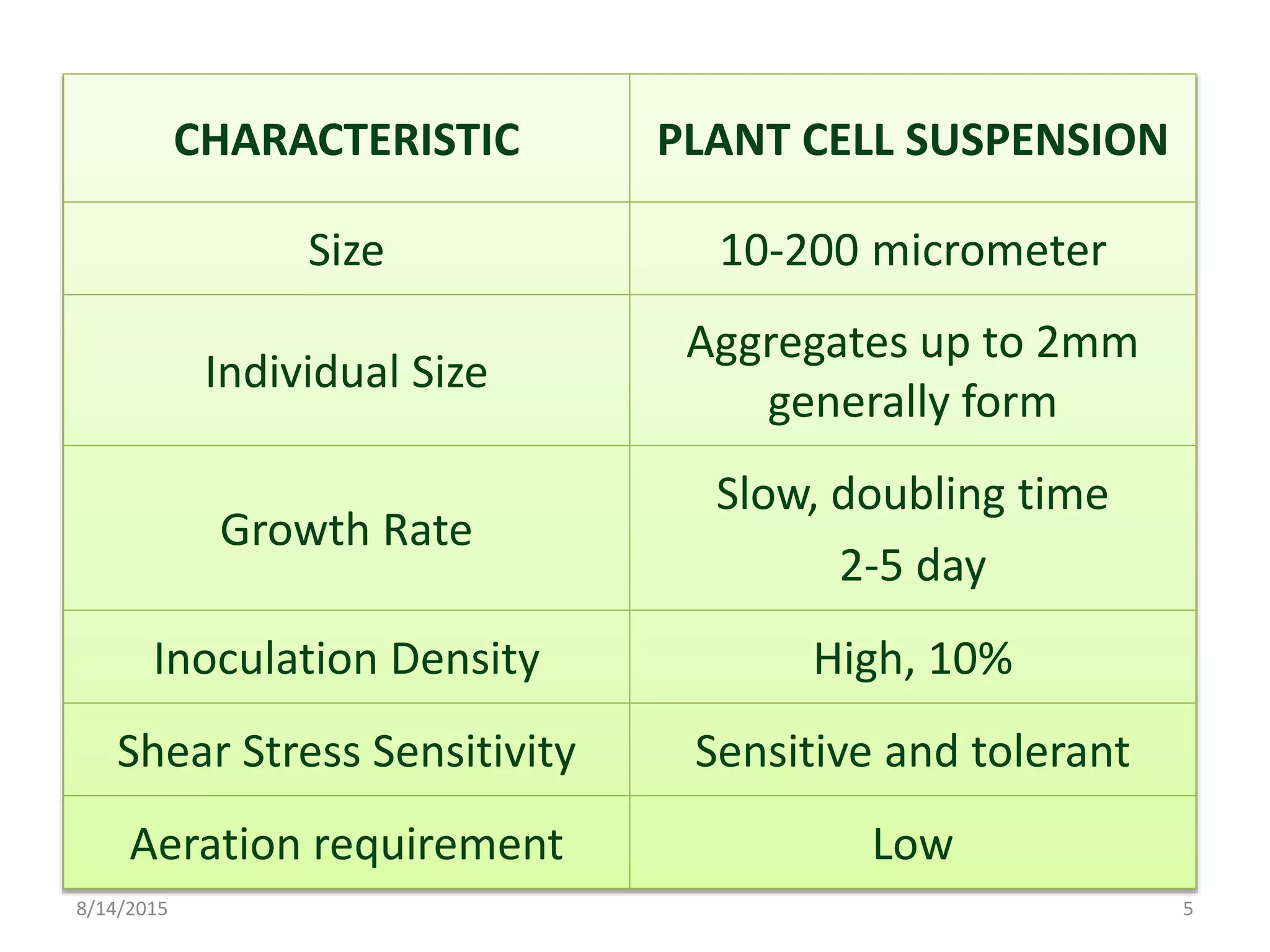
CHARACTERISTIC PLANT CELL SUSPENSION
Size 10-200 micrometer
Individual Size
Aggregates up to 2mm
generally form
Growth Rate
Slow, doubling time
2-5 day
Inoculation Density High, 10%
Shear Stress Sensitivity Sensitive and tolerant
Aeration requirement Low
58/14/2015
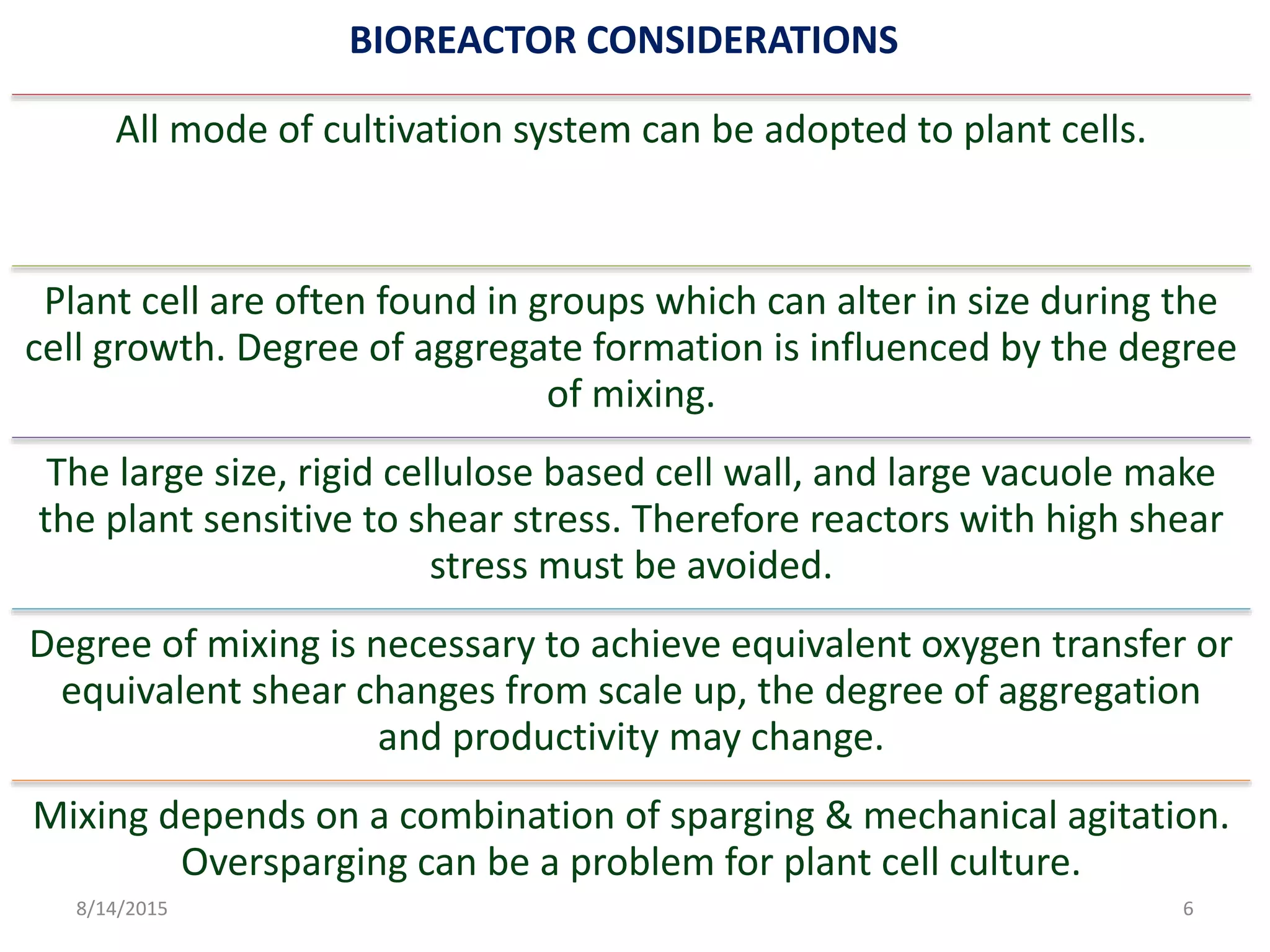
BIOREACTOR CONSIDERATIONS
All mode of cultivation system can be adopted to plant cells.
Plant cell are often found in groups which can alter in size during the
cell growth. Degree of aggregate formation is influenced by the degree
of mixing.
The large size, rigid cellulose based cell wall, and large vacuole make
the plant sensitive to shear stress. Therefore reactors with high shear
stress must be avoided.
Degree of mixing is necessary to achieve equivalent oxygen transfer or
equivalent shear changes from scale up, the degree of aggregation
and productivity may change.
Mixing depends on a combination of sparging & mechanical agitation.
Oversparging can be a problem for plant cell culture.
68/14/2015
BIOREACTOR CONSIDERATION
INDICATIONS
IMPLICATION FOR THE REACTOR
DESIGN
Lower respiration rate Lower O2 transfer rate required
More shear sensitive
Require operations under the low shear
conditions.
Cells often grow as aggregate or clumps
May have mass transfer limitations that
limit the availability of nutrient to cells
within the aggregate .
Degree of aggregation may be important
with regard to secondary metabolism
May be an optimal aggregate sizes for
product synthesis
Volatile compounds may be important for
cell metabolism eg. O2 or ethylene
May need to sparge gas mixtures
78/14/2015
GROWTH RATE
• Low growth rate increase productivity high biomass levels.
• At high cell densities the culture will be viscous and difficult to mix in
airlift bioreactor. However, for its particular nature, viscosity of plant
cell is low, and mixing in airlift Bioreactors is not greatly affected by
biomass up to 40gl-1
• Formation of dead zones where conditions are anoxic and cells settle
out is a problem.
TEMPERATURE
• Plant cell suspensions grow normally at 250C
• With the slow growth rate, heat input and cooling requirements are
minimal. 88/14/2015
IMPELLER
• In microbial BR, impeller is used:
-to mix the culture
-to break up and distribute air bubble to increase oxygen transfer.
(main)
• With plant cell cultures, these roles are reversed owing to low O2
requirements and high settling rates.
• Mixing achieved under the restraint of shear sensitivity of plant cells.
• Due to shear sensitive of the plant cell culture, it is not suitable to use the
impellers.
• Another method that suitable for mixing of plant culture is by using the
airlift method.
98/14/2015
108/14/2015
 Aeration – Agitation bioreactor
 Air driven bioreactor
 Rotating drum bioreactor
 Spin filter bioreactor
 Gaseous phase bioreactor
 Light introducing bioreactor(Photo bioreactor)
118/14/2015
• The aeration-agitation type bioreactors is widely used in small scale
experiments. However, when the culture volume is increased, many
problems arise in scale up, such as.
• 1.increasing mechanical stresses by impeller agitation
• 2.increasing foaming and adhesion of cells on the inner
surface of the bioreactor.
• Despite these problems, a large scale pilot bioreactor (volume 20 kl)
was constructed. It successfully produced both cell mass and
metabolites.
• This bioreactor is therefore the most important type for bioreactor
systems
AERATION- AGITATION BIOREACTOR
128/14/2015
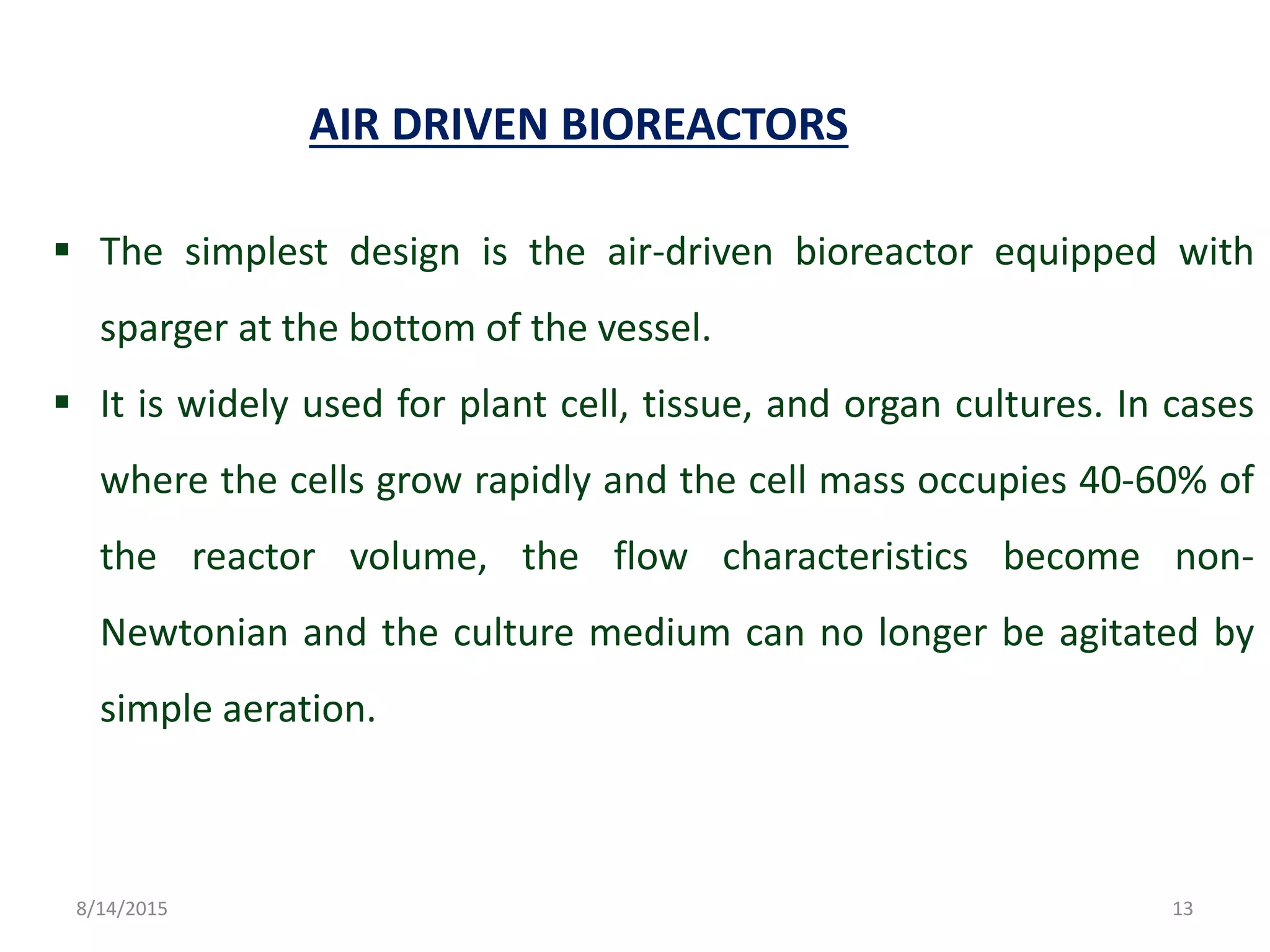
 The simplest design is the air-driven bioreactor equipped with
sparger at the bottom of the vessel.
 It is widely used for plant cell, tissue, and organ cultures. In cases
where the cells grow rapidly and the cell mass occupies 40-60% of
the reactor volume, the flow characteristics become non-
Newtonian and the culture medium can no longer be agitated by
simple aeration.
AIR DRIVEN BIOREACTORS
138/14/2015
 In the early cultivation of plant cells, stirred bioreactors were
used with the impellers run at low speed.
 At 1970s, low shear airlift bioreactor develop.
 This was adopted as the bioreactor of choice.
 However, the use of high gassing rates to achieve good mixing
can have problems:
 Plant cell suspensions sensitive to the level of carbon
dioxide.
 Other essential volatiles such as ethylene can be stripped off
with high aeration rates.
148/14/2015
a)Draft-tube internal loop
configuration
b)Split cylinder device
c)External loop system
Continuous stirred tank reactor
158/14/2015
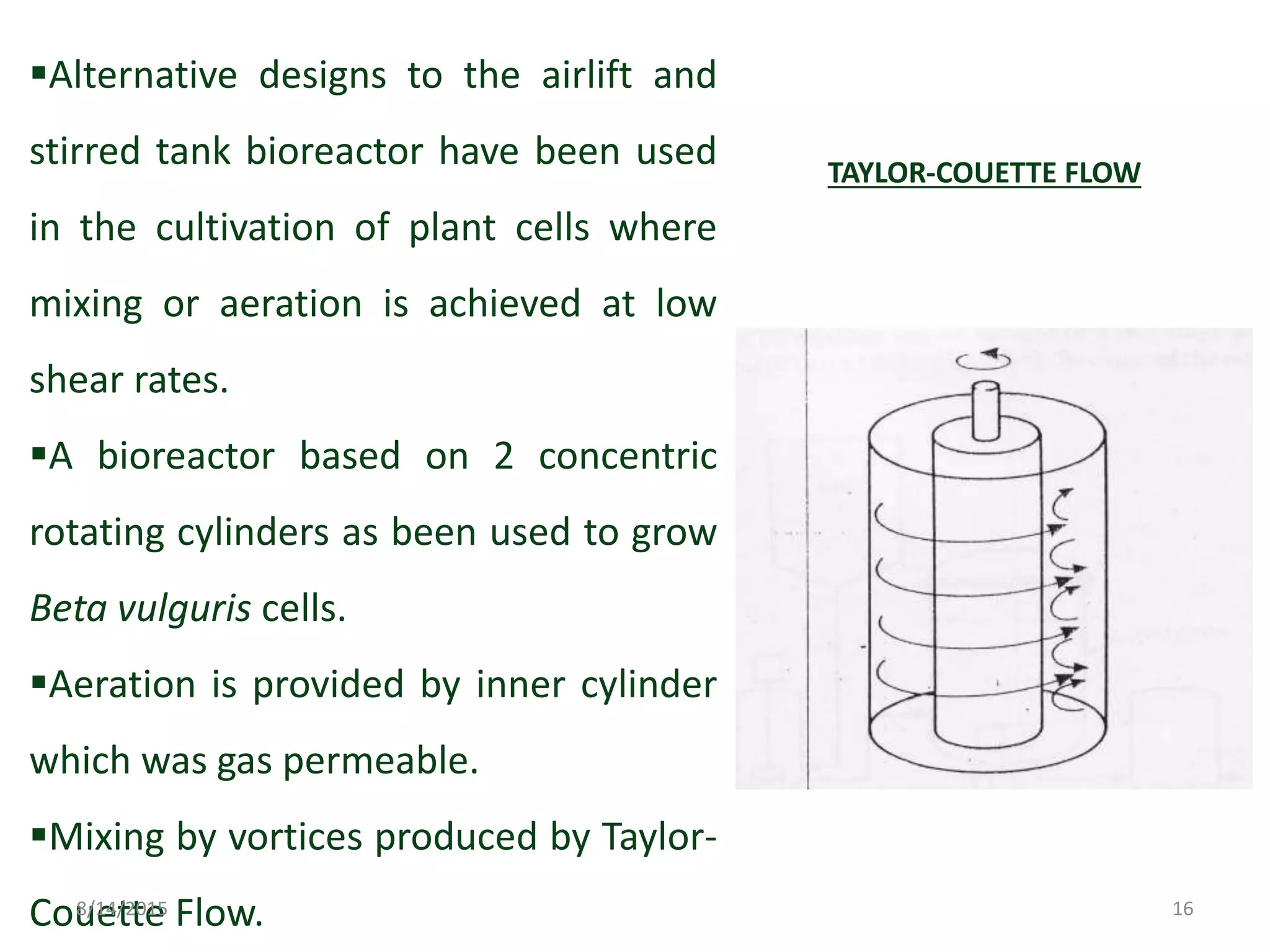
Alternative designs to the airlift and
stirred tank bioreactor have been used
in the cultivation of plant cells where
mixing or aeration is achieved at low
shear rates.
A bioreactor based on 2 concentric
rotating cylinders as been used to grow
Beta vulguris cells.
Aeration is provided by inner cylinder
which was gas permeable.
Mixing by vortices produced by Taylor-
Couette Flow.
TAYLOR-COUETTE FLOW
168/14/2015
BUBBLE COLUMN
• Cylindrical shape
• Axial flow (Eddies)
• Vertical baffle
• Gas is sparged at the base
• Movement of the liquid is caused by the density
differences
178/14/2015
SCHEMATIC DIAGRAM:BUBBLE COLUMN
188/14/2015
198/14/2015
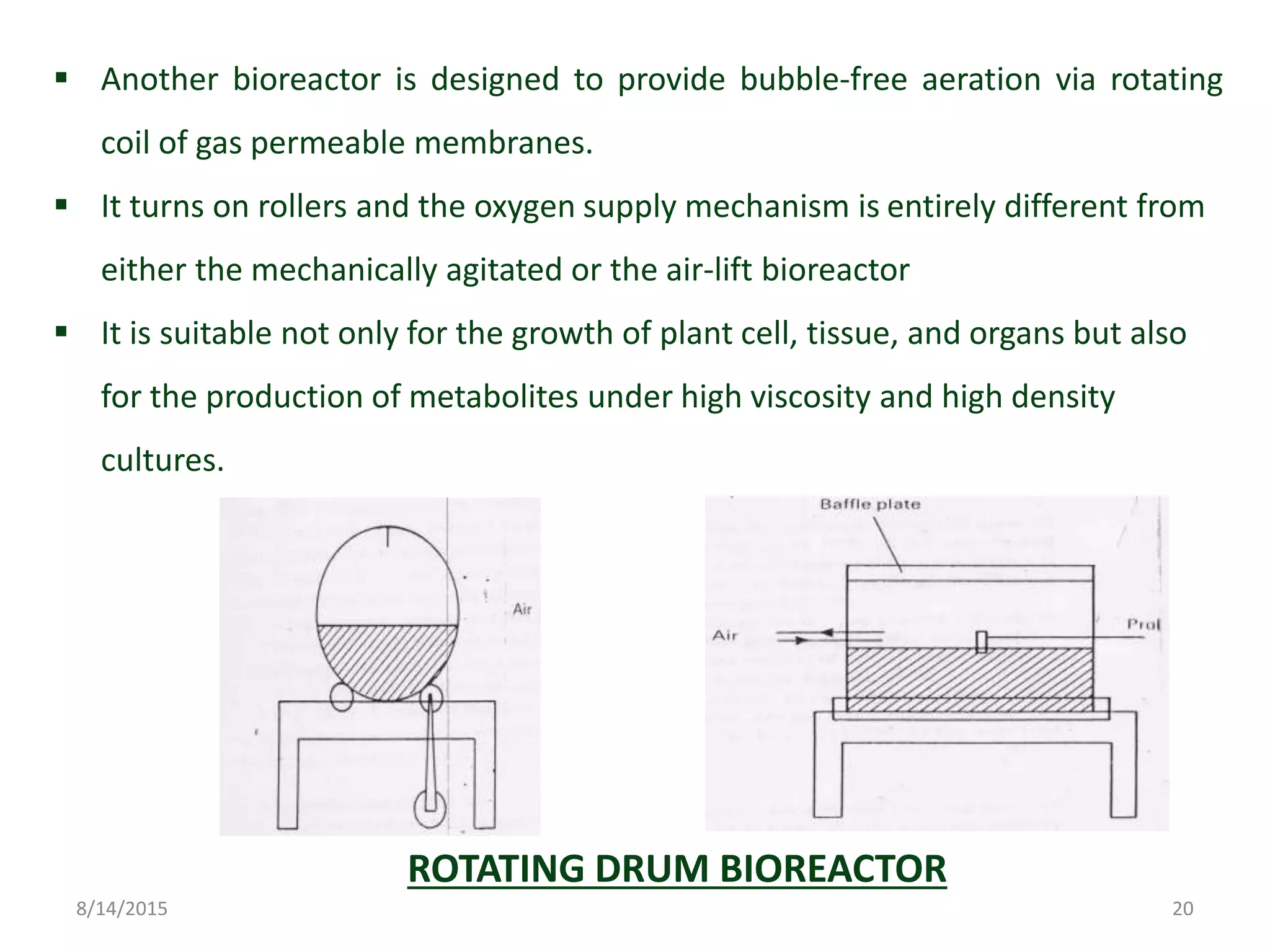
 Another bioreactor is designed to provide bubble-free aeration via rotating
coil of gas permeable membranes.
 It turns on rollers and the oxygen supply mechanism is entirely different from
either the mechanically agitated or the air-lift bioreactor
 It is suitable not only for the growth of plant cell, tissue, and organs but also
for the production of metabolites under high viscosity and high density
cultures.
ROTATING DRUM BIOREACTOR
208/14/2015
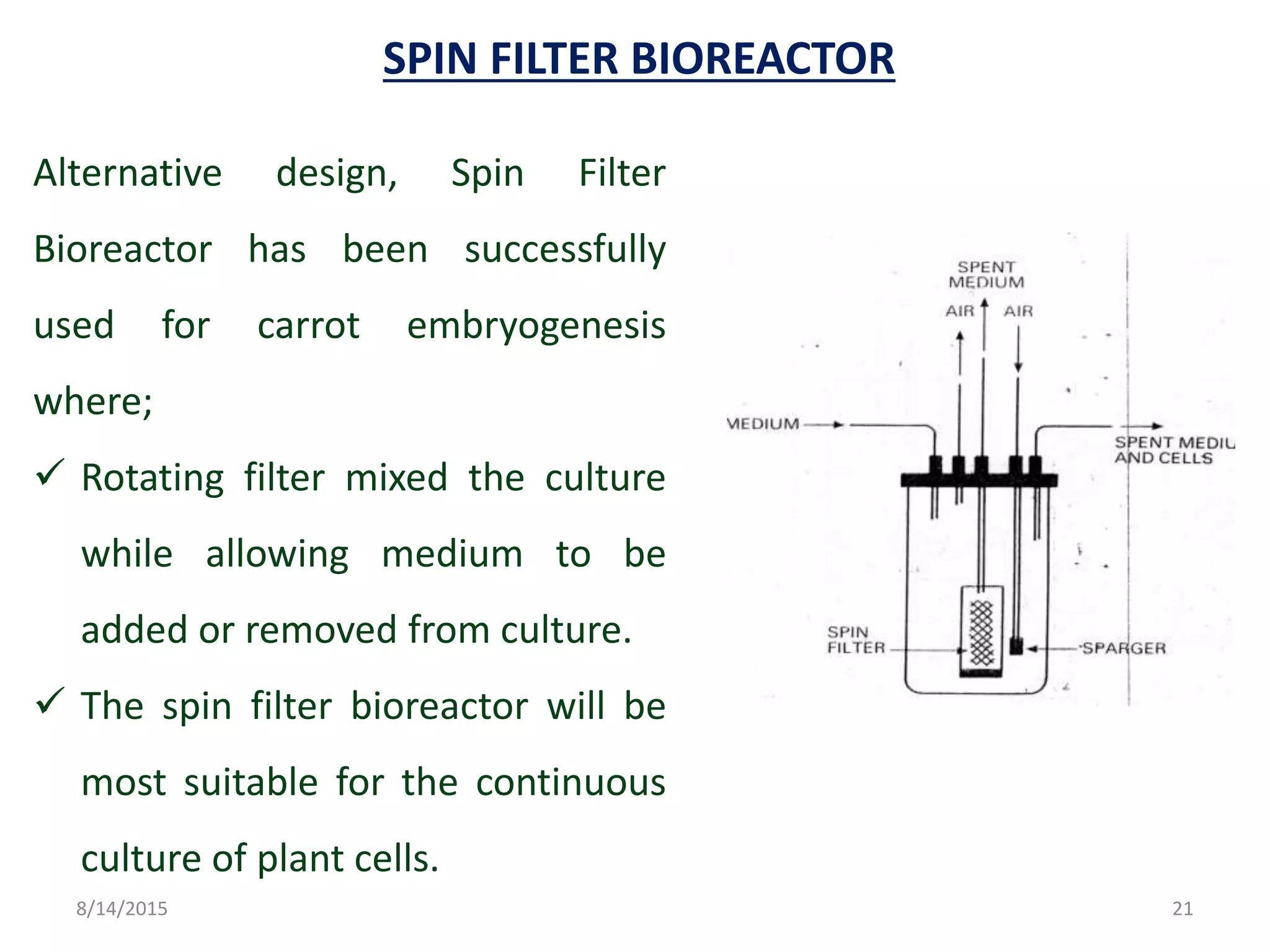
Alternative design, Spin Filter
Bioreactor has been successfully
used for carrot embryogenesis
where;
 Rotating filter mixed the culture
while allowing medium to be
added or removed from culture.
 The spin filter bioreactor will be
most suitable for the continuous
culture of plant cells.
SPIN FILTER BIOREACTOR
218/14/2015
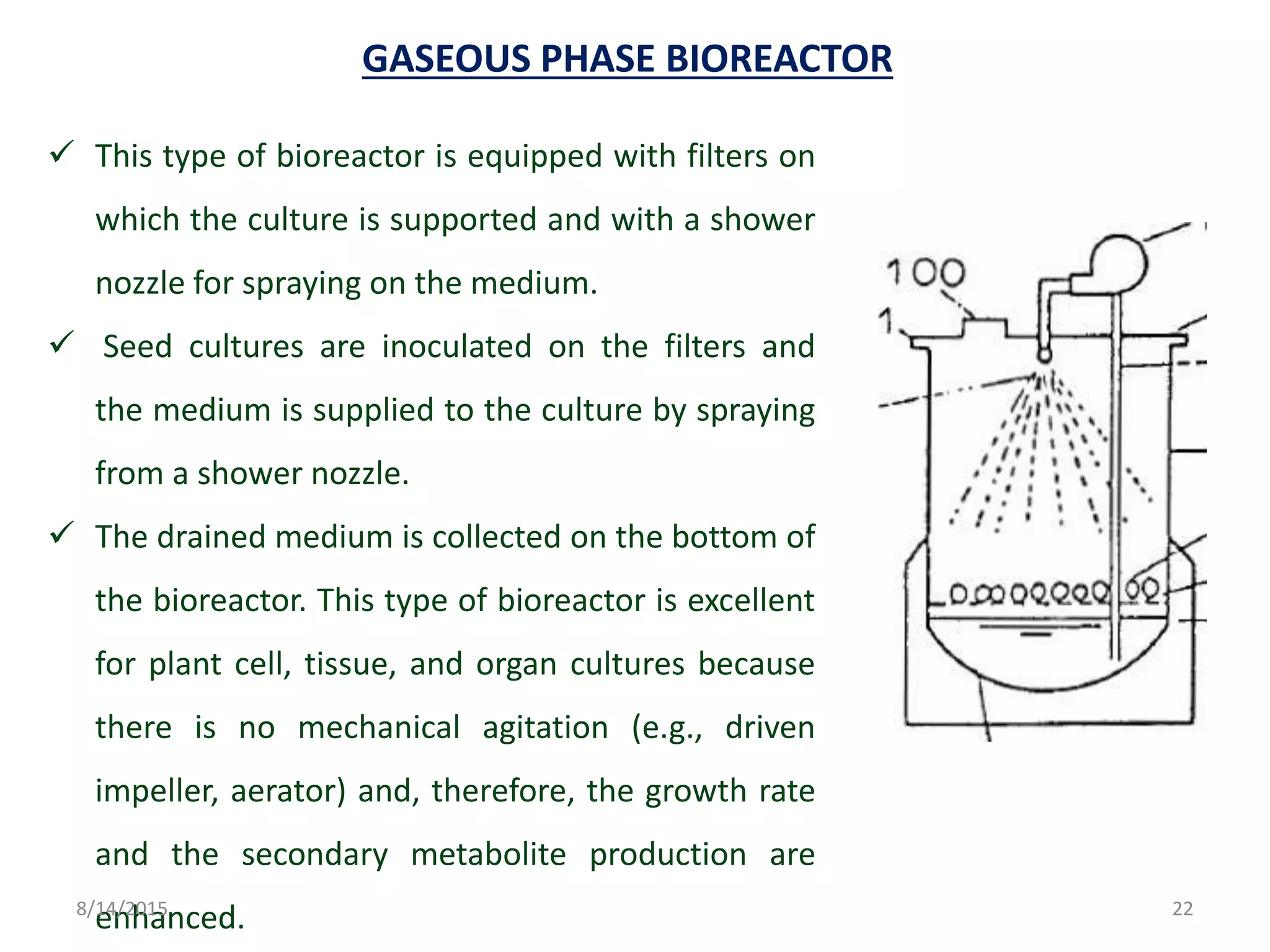
 This type of bioreactor is equipped with filters on
which the culture is supported and with a shower
nozzle for spraying on the medium.
 Seed cultures are inoculated on the filters and
the medium is supplied to the culture by spraying
from a shower nozzle.
 The drained medium is collected on the bottom of
the bioreactor. This type of bioreactor is excellent
for plant cell, tissue, and organ cultures because
there is no mechanical agitation (e.g., driven
impeller, aerator) and, therefore, the growth rate
and the secondary metabolite production are
enhanced.
GASEOUS PHASE BIOREACTOR
228/14/2015
LIGHT INTRODUCING BIOREACTOR/PHOTO BIOREACTOR
Plants are susceptible to light irradiation and as a consequence various
metabolic and/or physiological changes are generated. Some important
reactions are
 Photosynthesis,
 Activation of specific enzymes such as phenylalanine ammonia lyase
(PAL) and to induce the production of flavonoids or anthodyanins
 Photomorphogenesis such as development of leaves
For these reasons introduction of light into the bioreactor is required.
A photo bioreactor is a bioreactor that incorporates a light source to provide
photonic energy input into the reactor.
Photo bioreactors are used for the cultivation of photosynthesizing organisms
(plants, algae, bacteria).
238/14/2015
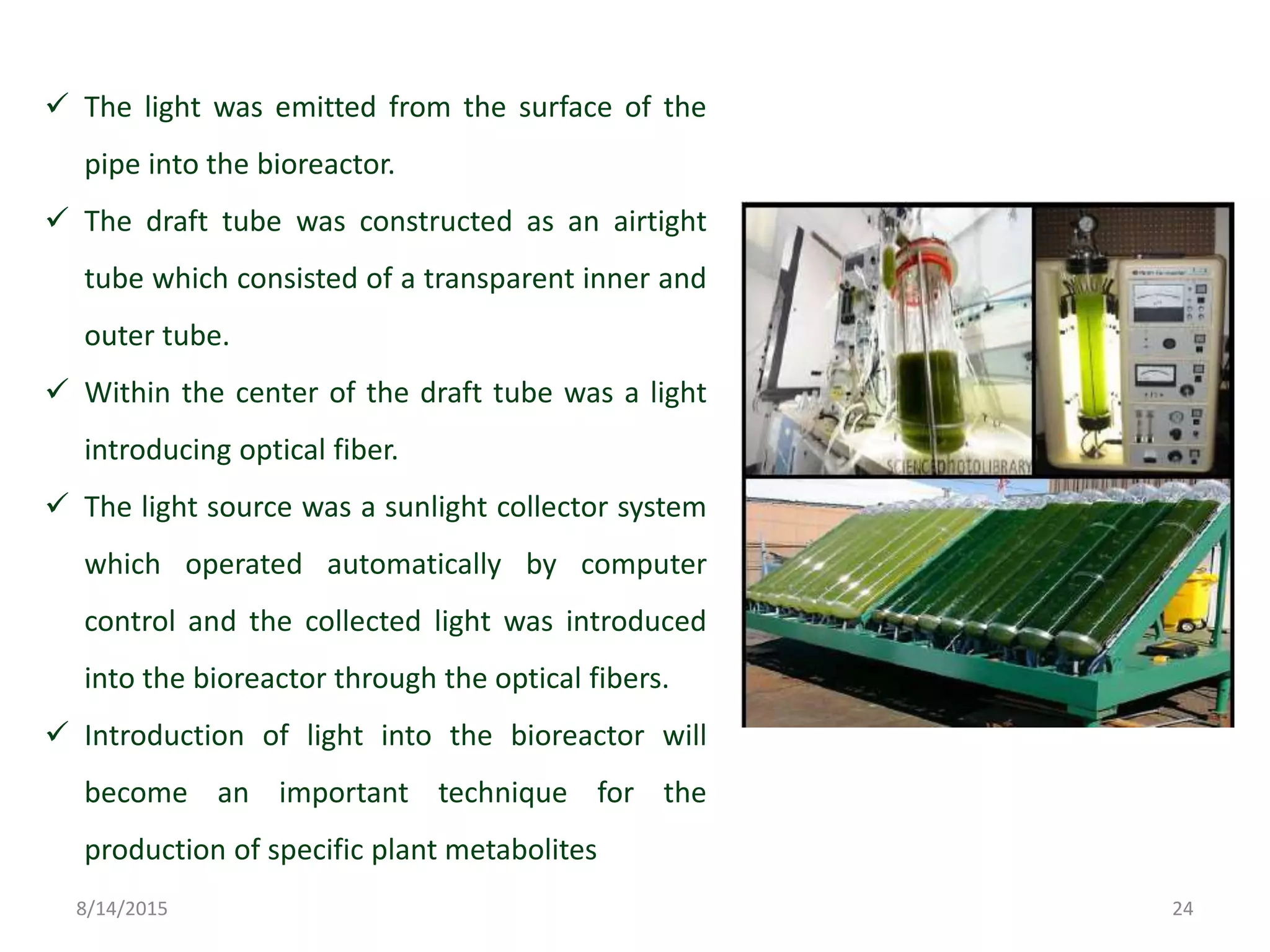
 The light was emitted from the surface of the
pipe into the bioreactor.
 The draft tube was constructed as an airtight
tube which consisted of a transparent inner and
outer tube.
 Within the center of the draft tube was a light
introducing optical fiber.
 The light source was a sunlight collector system
which operated automatically by computer
control and the collected light was introduced
into the bioreactor through the optical fibers.
 Introduction of light into the bioreactor will
become an important technique for the
production of specific plant metabolites
248/14/2015
REFERENCES
“Fermentation and biochemical engineering handbook”
Principles, Process Design, and Equipment Second Edition by
Henry C. Vogel and Celeste L. Todaro.
“Bioprocess Engineering : Basic Concepts”. 2nd Edition., by
Shuler, M.L. and Kargi, F. Prentice- Hall, 2002.
258/14/2015
268/14/2015

Bioreactors for plant cell suspension culture

  • 1.
    BIOREACTORS FOR PLANT CELL SUSPENSIONCULTURE GRACE FELCIYA S.J FIRST YEAR M.TECH – BIOPHARMACEUTICAL TECHNOLOGY 18/14/2015
  • 2.
    Many thousands ofchemicals are produced only in plants. Only few % of the world’s plant have been scientifically named and only few compounds have been screened for the production of novel & useful compounds. Around 120 drugs are derived from plants. In western world around 25% of pharmaceuticals are derived from extraction of plants. 28/14/2015
  • 3.
    These compounds arechemically complex and non- proteins, they have separate metabolic pathway. Due to less knowledge on the metabolic pathway we couldn’t enhance the metabolic products. In order to increase this production, bioprocess was introduced in plant cell cultures. Some of the plant products :- dyes, food colours, flavours, fragrances, insecticides and herbicides 38/14/2015
  • 4.
  • 5.
    CHARACTERISTIC PLANT CELLSUSPENSION Size 10-200 micrometer Individual Size Aggregates up to 2mm generally form Growth Rate Slow, doubling time 2-5 day Inoculation Density High, 10% Shear Stress Sensitivity Sensitive and tolerant Aeration requirement Low 58/14/2015
  • 6.
    BIOREACTOR CONSIDERATIONS All modeof cultivation system can be adopted to plant cells. Plant cell are often found in groups which can alter in size during the cell growth. Degree of aggregate formation is influenced by the degree of mixing. The large size, rigid cellulose based cell wall, and large vacuole make the plant sensitive to shear stress. Therefore reactors with high shear stress must be avoided. Degree of mixing is necessary to achieve equivalent oxygen transfer or equivalent shear changes from scale up, the degree of aggregation and productivity may change. Mixing depends on a combination of sparging & mechanical agitation. Oversparging can be a problem for plant cell culture. 68/14/2015
  • 7.
    BIOREACTOR CONSIDERATION INDICATIONS IMPLICATION FORTHE REACTOR DESIGN Lower respiration rate Lower O2 transfer rate required More shear sensitive Require operations under the low shear conditions. Cells often grow as aggregate or clumps May have mass transfer limitations that limit the availability of nutrient to cells within the aggregate . Degree of aggregation may be important with regard to secondary metabolism May be an optimal aggregate sizes for product synthesis Volatile compounds may be important for cell metabolism eg. O2 or ethylene May need to sparge gas mixtures 78/14/2015
  • 8.
    GROWTH RATE • Lowgrowth rate increase productivity high biomass levels. • At high cell densities the culture will be viscous and difficult to mix in airlift bioreactor. However, for its particular nature, viscosity of plant cell is low, and mixing in airlift Bioreactors is not greatly affected by biomass up to 40gl-1 • Formation of dead zones where conditions are anoxic and cells settle out is a problem. TEMPERATURE • Plant cell suspensions grow normally at 250C • With the slow growth rate, heat input and cooling requirements are minimal. 88/14/2015
  • 9.
    IMPELLER • In microbialBR, impeller is used: -to mix the culture -to break up and distribute air bubble to increase oxygen transfer. (main) • With plant cell cultures, these roles are reversed owing to low O2 requirements and high settling rates. • Mixing achieved under the restraint of shear sensitivity of plant cells. • Due to shear sensitive of the plant cell culture, it is not suitable to use the impellers. • Another method that suitable for mixing of plant culture is by using the airlift method. 98/14/2015
  • 10.
  • 11.
     Aeration –Agitation bioreactor  Air driven bioreactor  Rotating drum bioreactor  Spin filter bioreactor  Gaseous phase bioreactor  Light introducing bioreactor(Photo bioreactor) 118/14/2015
  • 12.
    • The aeration-agitationtype bioreactors is widely used in small scale experiments. However, when the culture volume is increased, many problems arise in scale up, such as. • 1.increasing mechanical stresses by impeller agitation • 2.increasing foaming and adhesion of cells on the inner surface of the bioreactor. • Despite these problems, a large scale pilot bioreactor (volume 20 kl) was constructed. It successfully produced both cell mass and metabolites. • This bioreactor is therefore the most important type for bioreactor systems AERATION- AGITATION BIOREACTOR 128/14/2015
  • 13.
     The simplestdesign is the air-driven bioreactor equipped with sparger at the bottom of the vessel.  It is widely used for plant cell, tissue, and organ cultures. In cases where the cells grow rapidly and the cell mass occupies 40-60% of the reactor volume, the flow characteristics become non- Newtonian and the culture medium can no longer be agitated by simple aeration. AIR DRIVEN BIOREACTORS 138/14/2015
  • 14.
     In theearly cultivation of plant cells, stirred bioreactors were used with the impellers run at low speed.  At 1970s, low shear airlift bioreactor develop.  This was adopted as the bioreactor of choice.  However, the use of high gassing rates to achieve good mixing can have problems:  Plant cell suspensions sensitive to the level of carbon dioxide.  Other essential volatiles such as ethylene can be stripped off with high aeration rates. 148/14/2015
  • 15.
    a)Draft-tube internal loop configuration b)Splitcylinder device c)External loop system Continuous stirred tank reactor 158/14/2015
  • 16.
    Alternative designs tothe airlift and stirred tank bioreactor have been used in the cultivation of plant cells where mixing or aeration is achieved at low shear rates. A bioreactor based on 2 concentric rotating cylinders as been used to grow Beta vulguris cells. Aeration is provided by inner cylinder which was gas permeable. Mixing by vortices produced by Taylor- Couette Flow. TAYLOR-COUETTE FLOW 168/14/2015
  • 17.
    BUBBLE COLUMN • Cylindricalshape • Axial flow (Eddies) • Vertical baffle • Gas is sparged at the base • Movement of the liquid is caused by the density differences 178/14/2015
  • 18.
  • 19.
  • 20.
     Another bioreactoris designed to provide bubble-free aeration via rotating coil of gas permeable membranes.  It turns on rollers and the oxygen supply mechanism is entirely different from either the mechanically agitated or the air-lift bioreactor  It is suitable not only for the growth of plant cell, tissue, and organs but also for the production of metabolites under high viscosity and high density cultures. ROTATING DRUM BIOREACTOR 208/14/2015
  • 21.
    Alternative design, SpinFilter Bioreactor has been successfully used for carrot embryogenesis where;  Rotating filter mixed the culture while allowing medium to be added or removed from culture.  The spin filter bioreactor will be most suitable for the continuous culture of plant cells. SPIN FILTER BIOREACTOR 218/14/2015
  • 22.
     This typeof bioreactor is equipped with filters on which the culture is supported and with a shower nozzle for spraying on the medium.  Seed cultures are inoculated on the filters and the medium is supplied to the culture by spraying from a shower nozzle.  The drained medium is collected on the bottom of the bioreactor. This type of bioreactor is excellent for plant cell, tissue, and organ cultures because there is no mechanical agitation (e.g., driven impeller, aerator) and, therefore, the growth rate and the secondary metabolite production are enhanced. GASEOUS PHASE BIOREACTOR 228/14/2015
  • 23.
    LIGHT INTRODUCING BIOREACTOR/PHOTOBIOREACTOR Plants are susceptible to light irradiation and as a consequence various metabolic and/or physiological changes are generated. Some important reactions are  Photosynthesis,  Activation of specific enzymes such as phenylalanine ammonia lyase (PAL) and to induce the production of flavonoids or anthodyanins  Photomorphogenesis such as development of leaves For these reasons introduction of light into the bioreactor is required. A photo bioreactor is a bioreactor that incorporates a light source to provide photonic energy input into the reactor. Photo bioreactors are used for the cultivation of photosynthesizing organisms (plants, algae, bacteria). 238/14/2015
  • 24.
     The lightwas emitted from the surface of the pipe into the bioreactor.  The draft tube was constructed as an airtight tube which consisted of a transparent inner and outer tube.  Within the center of the draft tube was a light introducing optical fiber.  The light source was a sunlight collector system which operated automatically by computer control and the collected light was introduced into the bioreactor through the optical fibers.  Introduction of light into the bioreactor will become an important technique for the production of specific plant metabolites 248/14/2015
  • 25.
    REFERENCES “Fermentation and biochemicalengineering handbook” Principles, Process Design, and Equipment Second Edition by Henry C. Vogel and Celeste L. Todaro. “Bioprocess Engineering : Basic Concepts”. 2nd Edition., by Shuler, M.L. and Kargi, F. Prentice- Hall, 2002. 258/14/2015
  • 26.