FERMENTERS AND ITS
TYPES
PRESENTED BY: VIPIN KUMAR SHUKLA
ASSISTANT PROFESSOR
DEPARTMENT OF BIOTECHNOLOGY
INTRODUCTION
 Closed container with adequate arrangement for
aeration, agitation, temperature and pH control, and
drain or overflow vent to remove the waste biomass of
cultured microorganisms along-with their products.
 Is a device in which a substrate of low value is utilized
by living cells or enzymes to generate a product of
higher value.
 Extensively used for food processing, fermentation,
waste treatment, etc.
BIOREACTOR
 All bioreactors deal with heterogeneous systems dealing
with two or more phases, e.g., liquid, gas, solid.
 •Therefore, optimal conditions for fermentation necessitate
efficient transfer of mass, heat and momentum from one
phase to the other.
 Generally, 20-25% of Fermenter volume is left unfilled
with medium as “head space” to allow for splashing,
foaming and aeration.
 The Fermenter design varies greatly depending on the type
and the fermentation for which it is used
Continued……
 A bioreactor should provide for the following:
 Agitation (for mixing of cells and medium),
 Aeration (aerobic Fermenter); for O2 supply,
 Regulation of factors like temperature, pH,
pressure, aeration, nutrient feeding, liquid level
etc.,
 Sterilization and maintenance of sterility, and
 Withdrawal of cells/medium (for continuous
Fermenter).
 Modern Fermenter are usually integrated with
computers for efficient process monitoring, data
acquisition, etc.
SIZE OF FERMENTERS(BIOREACTOR):
 The size of Fermenter ranges from 1-2-liter laboratory
Fermenter to 5,00,000 liters or, occasionally, even
more, Fermenter of up to 1.2 million liters have been
used.
 The size of the Fermenter used depends on the process
and how it is operated.
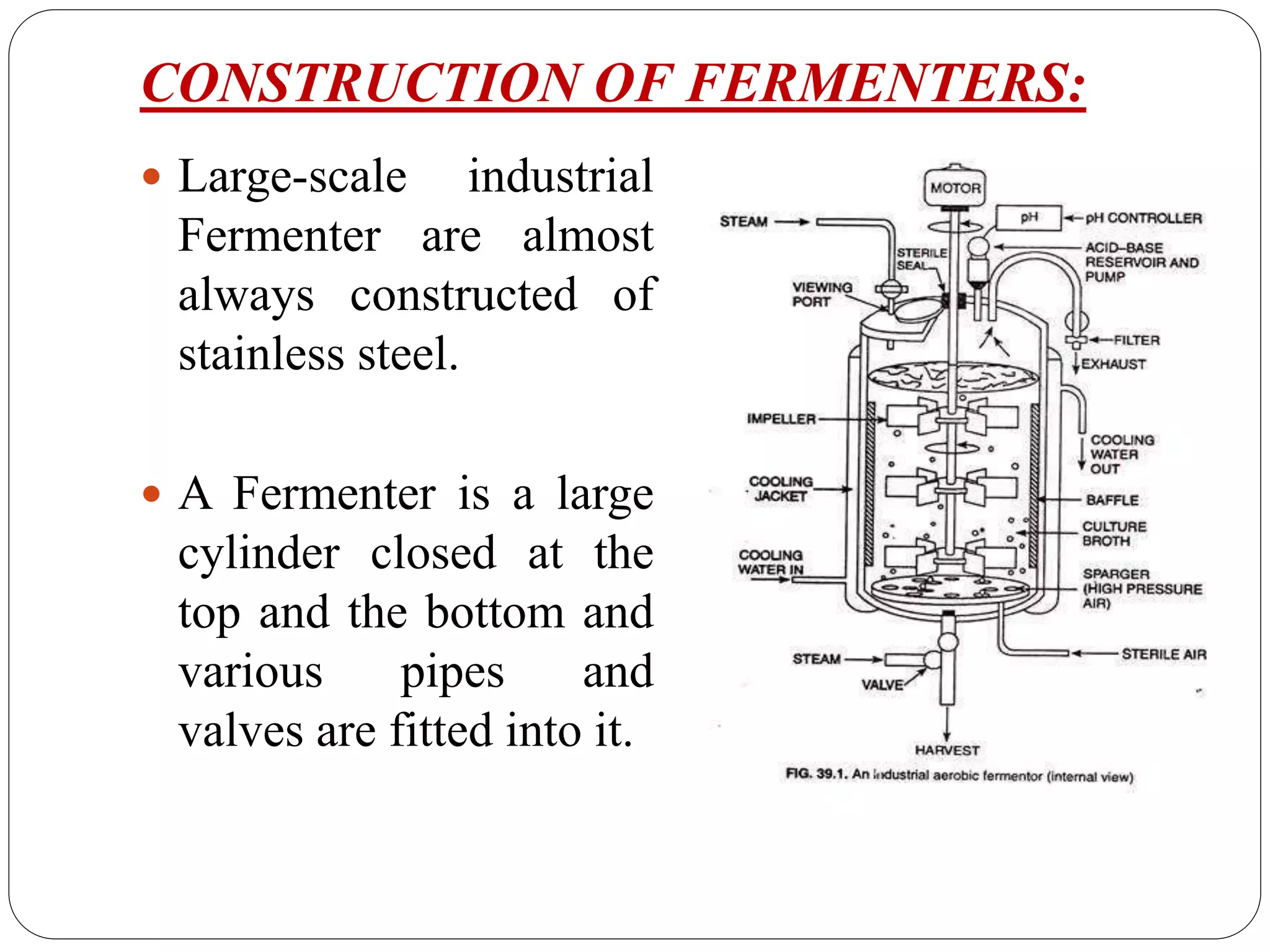
CONSTRUCTION OF FERMENTERS:
 Large-scale industrial
Fermenter are almost
always constructed of
stainless steel.
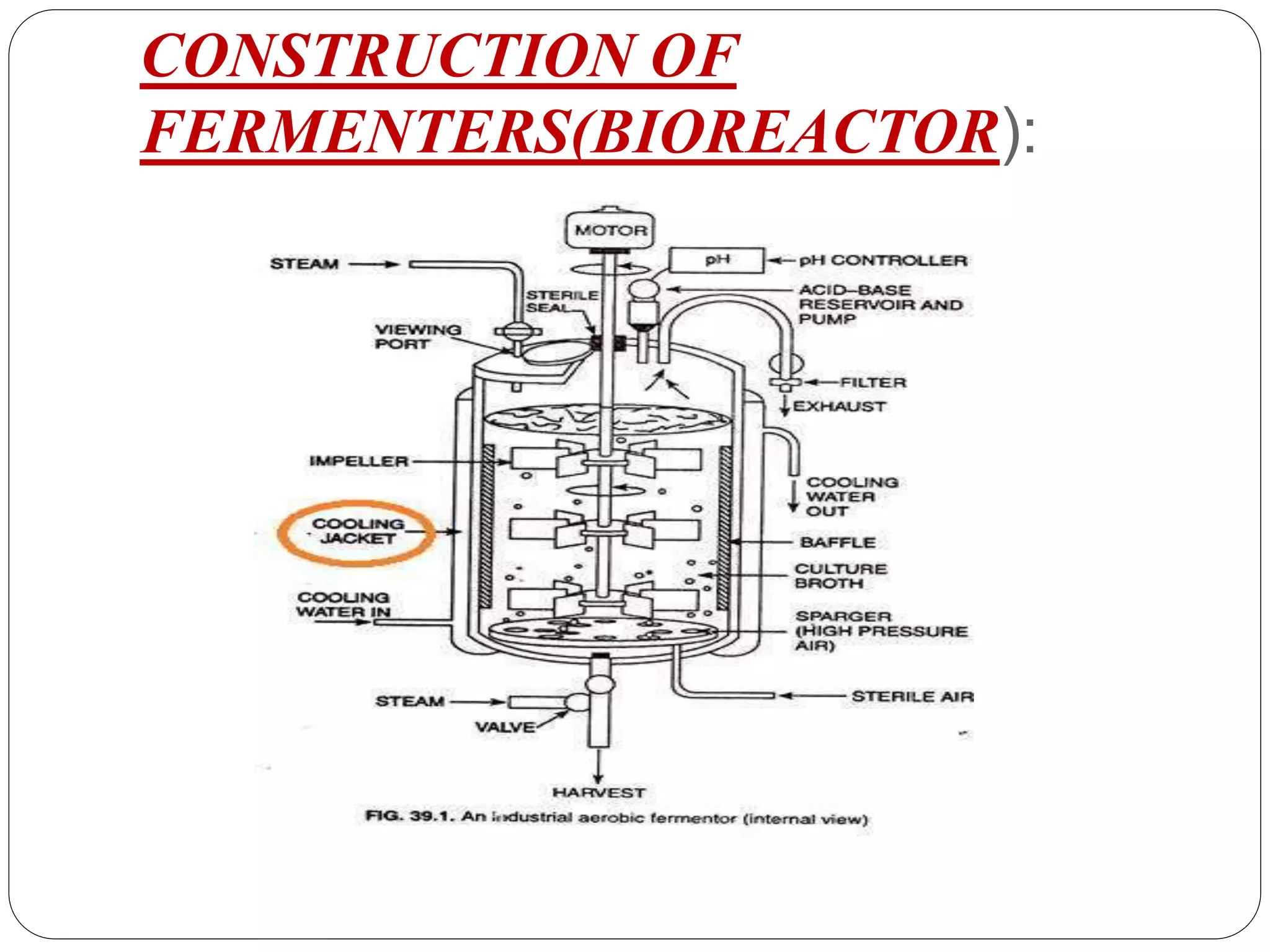
 A Fermenter is a large
cylinder closed at the
top and the bottom and
various pipes and
valves are fitted into it.
CONSTRUCTION OF
FERMENTERS(BIOREACTOR):
 Since most industrial fermentation process is
aerobic, the construction of a typical aerobic
Fermenter is the following:
 Cooling Jacket:
 The Fermenter is fitted externally with a cooling
jacket through which steam (for sterilization) or
cooling water (for cooling) is run.
 Cooling jacket is necessary because sterilization of
the nutrient medium and removal of the heat
generated are obligatory for successful completion
of the fermentation in the Fermenter.
CONSTRUCTION OF
FERMENTERS(BIOREACTOR):
CONSTRUCTION OF
FERMENTERS(BIOREACTOR):
 II. Aeration system:
 Critical part of a Fermenter.
 In a Fermenter with a high microbial population
density, there is a tremendous oxygen demand by
the culture, but oxygen being poorly soluble in
water hardly transfers rapidly throughout the
growth medium.
 Two separate aeration devices are used to
ensure proper aeration in Fermenter.
 I. Sparger (series of holes in a metal ring)
 ii. Impeller(also called agitator) device necessary
for stirring of the Fermenter.
Continued……
 The stirring accomplishes two things:
 I. It mixes the gas bubbles through the liquid culture
medium.
 ii. It mixes the microbial cells through the liquid culture
medium. In this way, the stirring ensures uniform access of
microbial cells to the nutrients.
Continued…..
 III. Baffles:
 The baffles are metal strips normally incorporated into
Fermenter of all sizes to prevent a vortex and to
improve aeration efficiency.
 IV. Controlling Devices for Environmental Factors
 Environmental factors that are frequently controlled
includes temperature, oxygen concentration, pH, cells
mass, levels of key nutrients, and product
concentration.
TYPES OF FERMENTER:
 Following are the types of Fermenter
 Airlift Fermenter:
 Continuous Stirred Tank Bioreactors:
 Photo-Bioreactors:
 Bubble Column Fermenter:
 Fluidized Bed Bioreactors:
 Packed Bed Bioreactors
Airlift Fermenter:
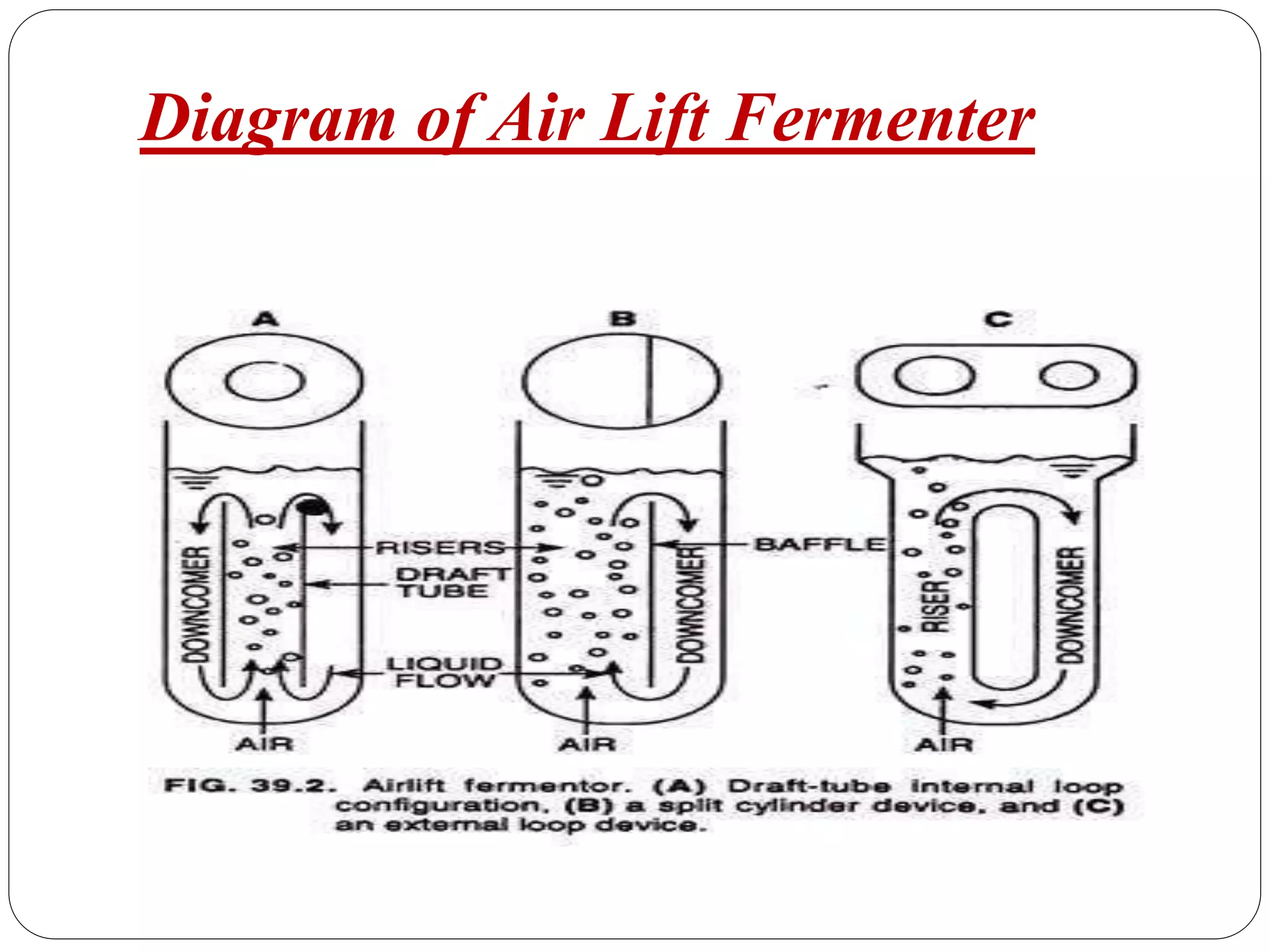
 In airlift Fermenter the liquid culture volume of the
vessel is divided into two interconnected zones by
means of a baffle or draft tube.
 Only one of the two zones is sparged with air or other
gas and this sparged zone is known as the riser.
 The other zone that receives no gas is called down-
comer.
 The bulk density of the gas-liquid dispersion in the
gas-sparged riser tends to be lower than the bulk
density in the down-comer.
 consequently the dispersion flows up in the riser zone
and down-flow occurs in the down-comer.
Diagram of Air Lift Fermenter
Continued……
 Airlift Fermenter are highly energy-efficient.
 They are often used in large-scale manufacture of
biopharmaceutical proteins obtained from fragile animal cells.
 Heat and mass transfer capabilities of airlift reactors are at least
as good as those of other systems.
 Airlift reactors are more effective in suspending solids than are
bubble column Fermenter.
 All performance characteristics of airlift -Fermenter are related
ultimately to the gas injection rate and the resulting rate of liquid
circulation.
Continued……
 The rate of liquid circulation increases with the square
root of the height of the airlift device.
 Because the liquid circulation is driven by the gas
hold-up difference between the riser and the down-
comer.
 Circulation is enhanced if there is little or no gas in the
down-comer.
 All the gas in the down-comer comes from being
entrained in with the liquid as it flows into the down-
comer from the riser near the top of the reactor.
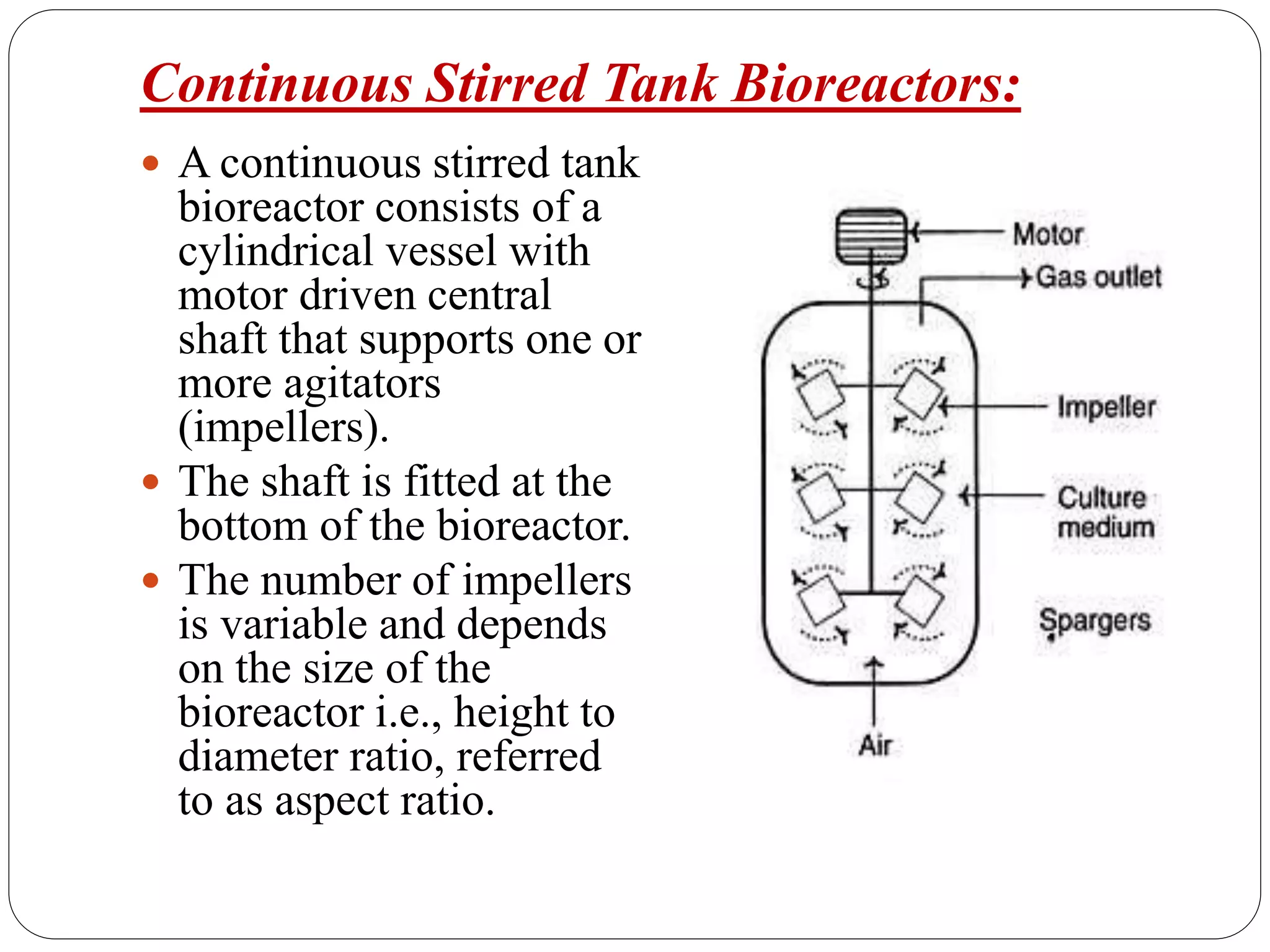
Continuous Stirred Tank Bioreactors:
 A continuous stirred tank
bioreactor consists of a
cylindrical vessel with
motor driven central
shaft that supports one or
more agitators
(impellers).
 The shaft is fitted at the
bottom of the bioreactor.
 The number of impellers
is variable and depends
on the size of the
bioreactor i.e., height to
diameter ratio, referred
to as aspect ratio.
Continued……
 Several types of impellers (Rustom disc, concave bladed, marine
propeller etc.) are in use.
 The air is added to the culture medium under pressure through a device
called sparger.
 The sparger may be a ring with many holes or a tube with a single
orifice.
 The sparger along with impellers (agitators) enables better gas
distribution system throughout the vessel.
 The bubbles generated by sparger are broken down to smaller ones by
impellers and dispersed throughout the medium.
 This enables the creation of a uniform and homogeneous environment
throughout the bioreactor.
Advantages of STRs:
 There are many advantages of STRs.
 The efficient gas transfer to growing cells.
 Good mixing of the contents and flexible
operating conditions, besides the commercial
availability of the bioreactors
Photo-Bioreactors:
 These are the bioreactors specialized for
fermentation that can be carried out either by
exposing to sunlight or artificial illumination.
 Since artificial illumination is expensive, only the
outdoor photo-bioreactors are preferred.
 Certain important compounds are produced by
employing photo-bioreactors e.g., p-carotene,
asthaxanthin.
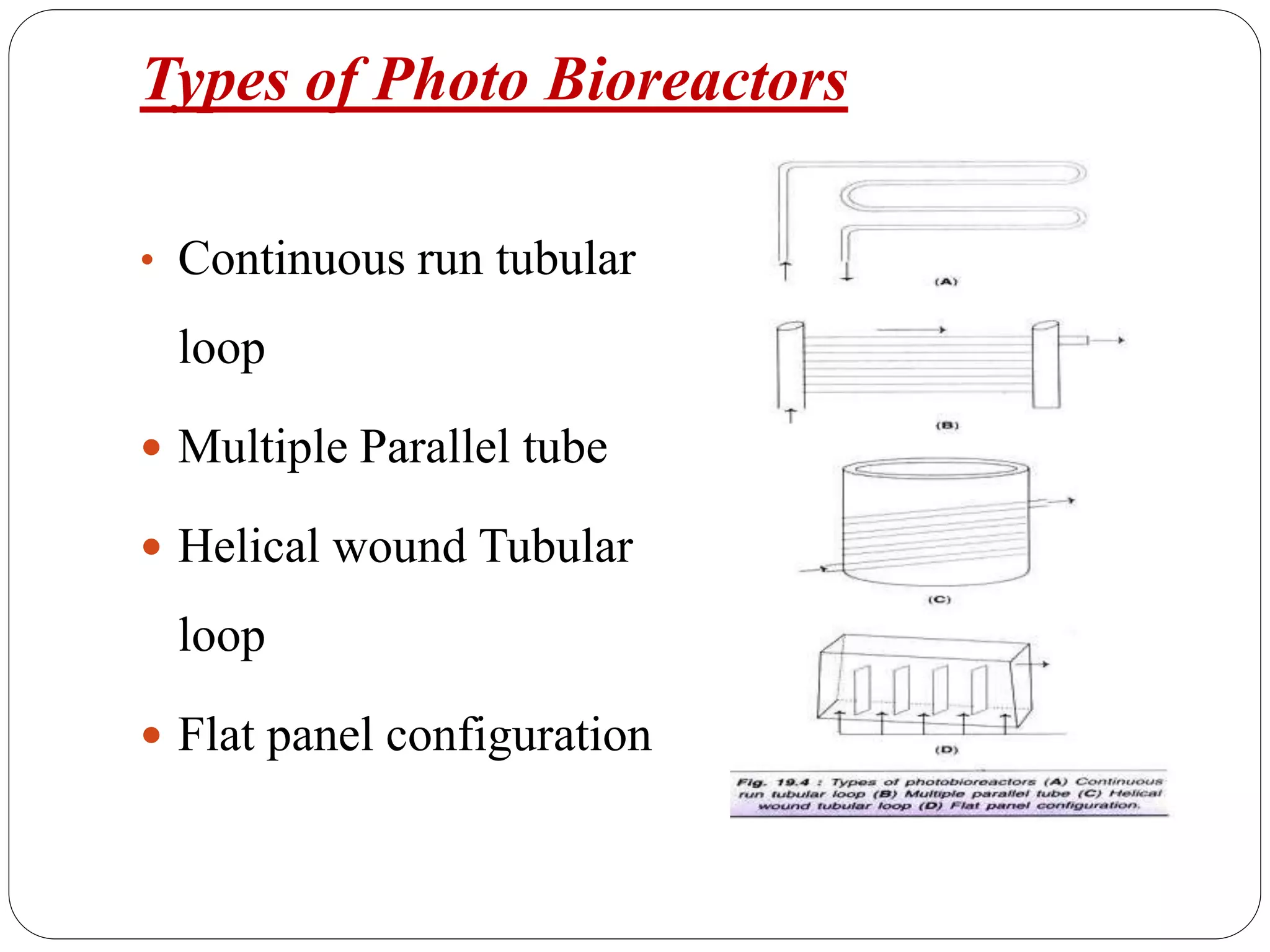
Types of Photo Bioreactors
• Continuous run tubular
loop
 Multiple Parallel tube
 Helical wound Tubular
loop
 Flat panel configuration
Continued……
 They are made up of glass or more commonly transparent
plastic.
 The array of tubes or flat panels constitute light receiving
systems (solar receivers).
 The culture can be circulated through the solar receivers by
methods such as using centrifugal pumps or airlift pumps.
 It is essential that the cells are in continuous circulation without
forming sediments.
 Further adequate penetration of sunlight should be maintained.
 The tubes should also be cooled to prevent rise in temperature
Bubble Column Fermenter
 Bubble column Fermenter is usually cylindrical
with an aspect (height to diameter) ratio of 4-6.
 Gas is sparged at the base of the column through
perforated pipes, perforated plates, or sintered
glass or metal micro-porous spargers.
 O2 transfer, mixing and other performance factors
are influenced mainly by the gas flow rate and the
properties of the fluid.
Continued,…..
 Internal devices such as horizontal perforated
plates, vertical baffles and corrugated sheet
packing's may be placed in the vessel to improve
mass transfer and modify the basic design.
 One exception is the axial mixing performance.
 For a given gas flow rate, the mixing improves
with increasing vessel diameter.
Diagram of Bubble Column Reactor
Fluidized Bed Bioreactors:
 Fluidized bed bioreactor is comparable to bubble
column bioreactor except the top position is
expanded to reduce the velocity of the fluid.
 The design of the fluidized bioreactors (expanded
top and narrow reaction column) is such that the
solids are retained in the reactor while the liquid
flows out.
 These bioreactors are suitable for use to carry out
reactions involving fluid suspended biocatalysts
such as immobilized enzymes, immobilized cells,
and microbial flocs.
Diagram of Fluidized Bed Reactor
Continued…..
 For an efficient operation of fluidized beds, gas is spared to
create a suitable gas-liquid-solid fluid bed.
 It is also necessary to ensure that the suspended solid
particles are not too light or too dense (too light ones may
float whereas to dense ones may settle at the bottom), and
they are in a good suspended state.
 Recycling of the liquid is important to maintain continuous
contact between the reaction contents and biocatalysts.
 This enable good efficiency of bio-processing.
Packed Bed Bioreactors:
 A bed of solid particles, with biocatalysts on or within the matrix
of solids, packed in a column constitutes a packed bed
bioreactor.
 The solids used may be porous or non-porous gels, and they
may be compressible or rigid in nature.
 A nutrient broth flows continuously over the immobilized
biocatalyst.
 The products obtained in the packed bed bioreactor are released
into the fluid and removed.
 While the flow of the fluid can be upward or downward, down
flow under gravity is preferred.
Packed Bead Bio-Reactor
Continued……
 The concentration of the nutrients (and therefore the
products formed) can be increased by increasing the flow
rate of the nutrient broth.
 Because of poor mixing, it is rather difficult to control the
pH of packed bed bioreactors by the addition of acid or
alkali.
 However, these bioreactors are preferred for bio-processing
technology involving product-inhibited reactions.
 The packed bed bioreactors do not allow accumulation of
the products to any significant extent.
Fermenters and its types

Fermenters and its types

  • 1.
    FERMENTERS AND ITS TYPES PRESENTEDBY: VIPIN KUMAR SHUKLA ASSISTANT PROFESSOR DEPARTMENT OF BIOTECHNOLOGY
  • 2.
    INTRODUCTION  Closed containerwith adequate arrangement for aeration, agitation, temperature and pH control, and drain or overflow vent to remove the waste biomass of cultured microorganisms along-with their products.  Is a device in which a substrate of low value is utilized by living cells or enzymes to generate a product of higher value.  Extensively used for food processing, fermentation, waste treatment, etc.
  • 3.
    BIOREACTOR  All bioreactorsdeal with heterogeneous systems dealing with two or more phases, e.g., liquid, gas, solid.  •Therefore, optimal conditions for fermentation necessitate efficient transfer of mass, heat and momentum from one phase to the other.  Generally, 20-25% of Fermenter volume is left unfilled with medium as “head space” to allow for splashing, foaming and aeration.  The Fermenter design varies greatly depending on the type and the fermentation for which it is used
  • 4.
    Continued……  A bioreactorshould provide for the following:  Agitation (for mixing of cells and medium),  Aeration (aerobic Fermenter); for O2 supply,  Regulation of factors like temperature, pH, pressure, aeration, nutrient feeding, liquid level etc.,  Sterilization and maintenance of sterility, and  Withdrawal of cells/medium (for continuous Fermenter).  Modern Fermenter are usually integrated with computers for efficient process monitoring, data acquisition, etc.
  • 5.
    SIZE OF FERMENTERS(BIOREACTOR): The size of Fermenter ranges from 1-2-liter laboratory Fermenter to 5,00,000 liters or, occasionally, even more, Fermenter of up to 1.2 million liters have been used.  The size of the Fermenter used depends on the process and how it is operated.
  • 6.
    CONSTRUCTION OF FERMENTERS: Large-scale industrial Fermenter are almost always constructed of stainless steel.  A Fermenter is a large cylinder closed at the top and the bottom and various pipes and valves are fitted into it.
  • 7.
    CONSTRUCTION OF FERMENTERS(BIOREACTOR):  Sincemost industrial fermentation process is aerobic, the construction of a typical aerobic Fermenter is the following:  Cooling Jacket:  The Fermenter is fitted externally with a cooling jacket through which steam (for sterilization) or cooling water (for cooling) is run.  Cooling jacket is necessary because sterilization of the nutrient medium and removal of the heat generated are obligatory for successful completion of the fermentation in the Fermenter.
  • 8.
  • 9.
    CONSTRUCTION OF FERMENTERS(BIOREACTOR):  II.Aeration system:  Critical part of a Fermenter.  In a Fermenter with a high microbial population density, there is a tremendous oxygen demand by the culture, but oxygen being poorly soluble in water hardly transfers rapidly throughout the growth medium.  Two separate aeration devices are used to ensure proper aeration in Fermenter.  I. Sparger (series of holes in a metal ring)  ii. Impeller(also called agitator) device necessary for stirring of the Fermenter.
  • 10.
    Continued……  The stirringaccomplishes two things:  I. It mixes the gas bubbles through the liquid culture medium.  ii. It mixes the microbial cells through the liquid culture medium. In this way, the stirring ensures uniform access of microbial cells to the nutrients.
  • 11.
    Continued…..  III. Baffles: The baffles are metal strips normally incorporated into Fermenter of all sizes to prevent a vortex and to improve aeration efficiency.  IV. Controlling Devices for Environmental Factors  Environmental factors that are frequently controlled includes temperature, oxygen concentration, pH, cells mass, levels of key nutrients, and product concentration.
  • 12.
    TYPES OF FERMENTER: Following are the types of Fermenter  Airlift Fermenter:  Continuous Stirred Tank Bioreactors:  Photo-Bioreactors:  Bubble Column Fermenter:  Fluidized Bed Bioreactors:  Packed Bed Bioreactors
  • 13.
    Airlift Fermenter:  Inairlift Fermenter the liquid culture volume of the vessel is divided into two interconnected zones by means of a baffle or draft tube.  Only one of the two zones is sparged with air or other gas and this sparged zone is known as the riser.  The other zone that receives no gas is called down- comer.  The bulk density of the gas-liquid dispersion in the gas-sparged riser tends to be lower than the bulk density in the down-comer.  consequently the dispersion flows up in the riser zone and down-flow occurs in the down-comer.
  • 14.
    Diagram of AirLift Fermenter
  • 15.
    Continued……  Airlift Fermenterare highly energy-efficient.  They are often used in large-scale manufacture of biopharmaceutical proteins obtained from fragile animal cells.  Heat and mass transfer capabilities of airlift reactors are at least as good as those of other systems.  Airlift reactors are more effective in suspending solids than are bubble column Fermenter.  All performance characteristics of airlift -Fermenter are related ultimately to the gas injection rate and the resulting rate of liquid circulation.
  • 16.
    Continued……  The rateof liquid circulation increases with the square root of the height of the airlift device.  Because the liquid circulation is driven by the gas hold-up difference between the riser and the down- comer.  Circulation is enhanced if there is little or no gas in the down-comer.  All the gas in the down-comer comes from being entrained in with the liquid as it flows into the down- comer from the riser near the top of the reactor.
  • 17.
    Continuous Stirred TankBioreactors:  A continuous stirred tank bioreactor consists of a cylindrical vessel with motor driven central shaft that supports one or more agitators (impellers).  The shaft is fitted at the bottom of the bioreactor.  The number of impellers is variable and depends on the size of the bioreactor i.e., height to diameter ratio, referred to as aspect ratio.
  • 18.
    Continued……  Several typesof impellers (Rustom disc, concave bladed, marine propeller etc.) are in use.  The air is added to the culture medium under pressure through a device called sparger.  The sparger may be a ring with many holes or a tube with a single orifice.  The sparger along with impellers (agitators) enables better gas distribution system throughout the vessel.  The bubbles generated by sparger are broken down to smaller ones by impellers and dispersed throughout the medium.  This enables the creation of a uniform and homogeneous environment throughout the bioreactor.
  • 19.
    Advantages of STRs: There are many advantages of STRs.  The efficient gas transfer to growing cells.  Good mixing of the contents and flexible operating conditions, besides the commercial availability of the bioreactors
  • 20.
    Photo-Bioreactors:  These arethe bioreactors specialized for fermentation that can be carried out either by exposing to sunlight or artificial illumination.  Since artificial illumination is expensive, only the outdoor photo-bioreactors are preferred.  Certain important compounds are produced by employing photo-bioreactors e.g., p-carotene, asthaxanthin.
  • 21.
    Types of PhotoBioreactors • Continuous run tubular loop  Multiple Parallel tube  Helical wound Tubular loop  Flat panel configuration
  • 22.
    Continued……  They aremade up of glass or more commonly transparent plastic.  The array of tubes or flat panels constitute light receiving systems (solar receivers).  The culture can be circulated through the solar receivers by methods such as using centrifugal pumps or airlift pumps.  It is essential that the cells are in continuous circulation without forming sediments.  Further adequate penetration of sunlight should be maintained.  The tubes should also be cooled to prevent rise in temperature
  • 23.
    Bubble Column Fermenter Bubble column Fermenter is usually cylindrical with an aspect (height to diameter) ratio of 4-6.  Gas is sparged at the base of the column through perforated pipes, perforated plates, or sintered glass or metal micro-porous spargers.  O2 transfer, mixing and other performance factors are influenced mainly by the gas flow rate and the properties of the fluid.
  • 24.
    Continued,…..  Internal devicessuch as horizontal perforated plates, vertical baffles and corrugated sheet packing's may be placed in the vessel to improve mass transfer and modify the basic design.  One exception is the axial mixing performance.  For a given gas flow rate, the mixing improves with increasing vessel diameter.
  • 25.
    Diagram of BubbleColumn Reactor
  • 26.
    Fluidized Bed Bioreactors: Fluidized bed bioreactor is comparable to bubble column bioreactor except the top position is expanded to reduce the velocity of the fluid.  The design of the fluidized bioreactors (expanded top and narrow reaction column) is such that the solids are retained in the reactor while the liquid flows out.  These bioreactors are suitable for use to carry out reactions involving fluid suspended biocatalysts such as immobilized enzymes, immobilized cells, and microbial flocs.
  • 27.
  • 28.
    Continued…..  For anefficient operation of fluidized beds, gas is spared to create a suitable gas-liquid-solid fluid bed.  It is also necessary to ensure that the suspended solid particles are not too light or too dense (too light ones may float whereas to dense ones may settle at the bottom), and they are in a good suspended state.  Recycling of the liquid is important to maintain continuous contact between the reaction contents and biocatalysts.  This enable good efficiency of bio-processing.
  • 29.
    Packed Bed Bioreactors: A bed of solid particles, with biocatalysts on or within the matrix of solids, packed in a column constitutes a packed bed bioreactor.  The solids used may be porous or non-porous gels, and they may be compressible or rigid in nature.  A nutrient broth flows continuously over the immobilized biocatalyst.  The products obtained in the packed bed bioreactor are released into the fluid and removed.  While the flow of the fluid can be upward or downward, down flow under gravity is preferred.
  • 30.
  • 31.
    Continued……  The concentrationof the nutrients (and therefore the products formed) can be increased by increasing the flow rate of the nutrient broth.  Because of poor mixing, it is rather difficult to control the pH of packed bed bioreactors by the addition of acid or alkali.  However, these bioreactors are preferred for bio-processing technology involving product-inhibited reactions.  The packed bed bioreactors do not allow accumulation of the products to any significant extent.