Shahjalal University of Science and Technology
Bioreactor overview
D H SANI
Genetic Engineering & Biotechnology Department
Bioreactor
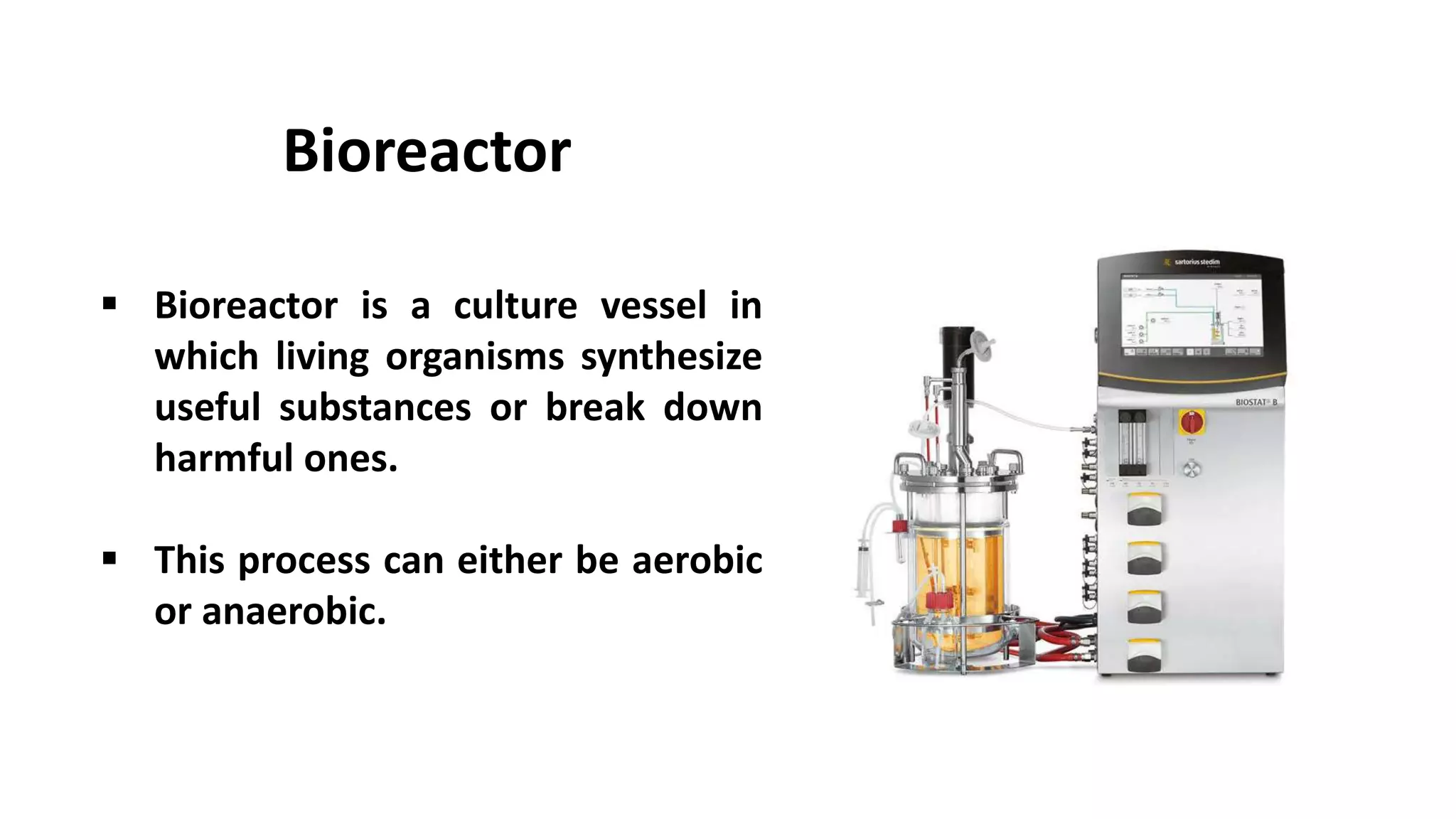
 Bioreactor is a culture vessel in
which living organisms synthesize
useful substances or break down
harmful ones.
 This process can either be aerobic
or anaerobic.
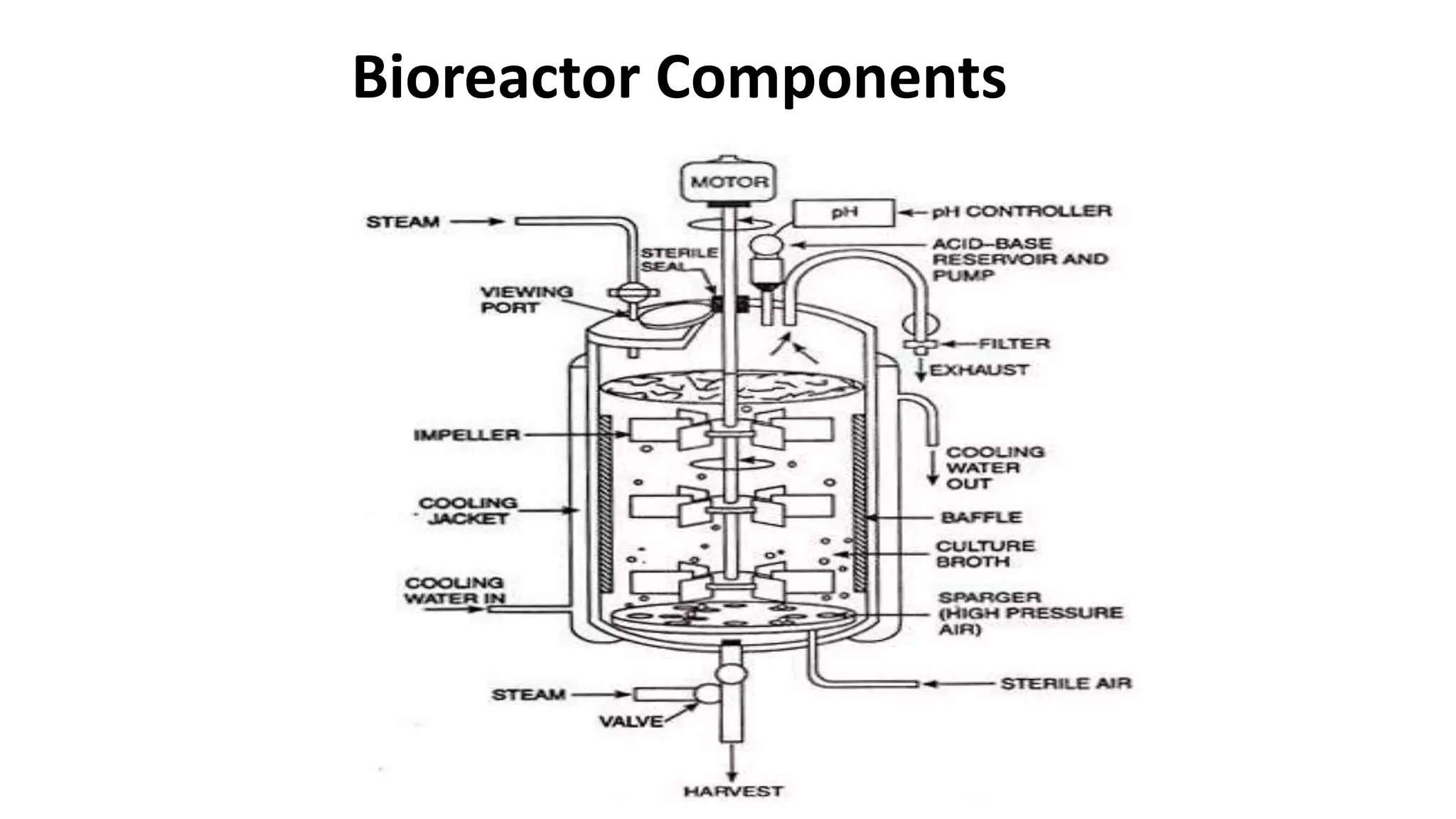
Bioreactor Components
Considerations in designing Bioreactors
• The design must preclude foreign contamination.
• Optimal mixing with low, uniform shear.
• Adequate mass transfer.
• Clearly defined flow conditions.
• Feeding of substrate with prevention of under or overdosing.
• Suspension of solids.
• Gentle heat transfer.
• Compliance with design requirements.
Recent advance in bioreactor design
• Scaffold is necessary for seeding at high cell densities and
homogeneous distribution of cells.
• Scaffold refers to –
Porous Biocompatible Substrate
Provides Support to the Cell
Offers 3D Architecture
• As scaffolds have large, interconnected pores –
cells are distributed quite uniformly during
seeding
medium flow through a construct enhances the mass transfer of
Substrates during cultivation
Requirements for Ideal Bioreactor
Aseptic
Vessel
Adequate
Aeration
and
Agitation
Less
Power
consump
-tion
Controlled
Temperature
and pH
Sampling
facilities
Less
Evaporat
-ion
losses
Minimal
use of
Labor
Internal
Smooth
Surface
Types of Bioreactors
• Continuous Stirred Tank Bioreactor
• Airlift Bioreactor
• Fluidized Bed Bioreactor
• Packed Bed Bioreactor
• Photobioreactor
• Membrane Bioreactor
8
Stirred Tank Bioreactor
Continuous
operation
Good
temperature
control
Easy to clean
The need for
shaft seals and
bearings
Size limitation by
motor size, shaft
length & weight
9
Airlift Bioreactor
Low Energy
requirement
Greater heat-
removal
No mechanical
disruption
No bubbles breaker
Inefficient break the foam
when foaming occurs.
higher pressures needed.
10
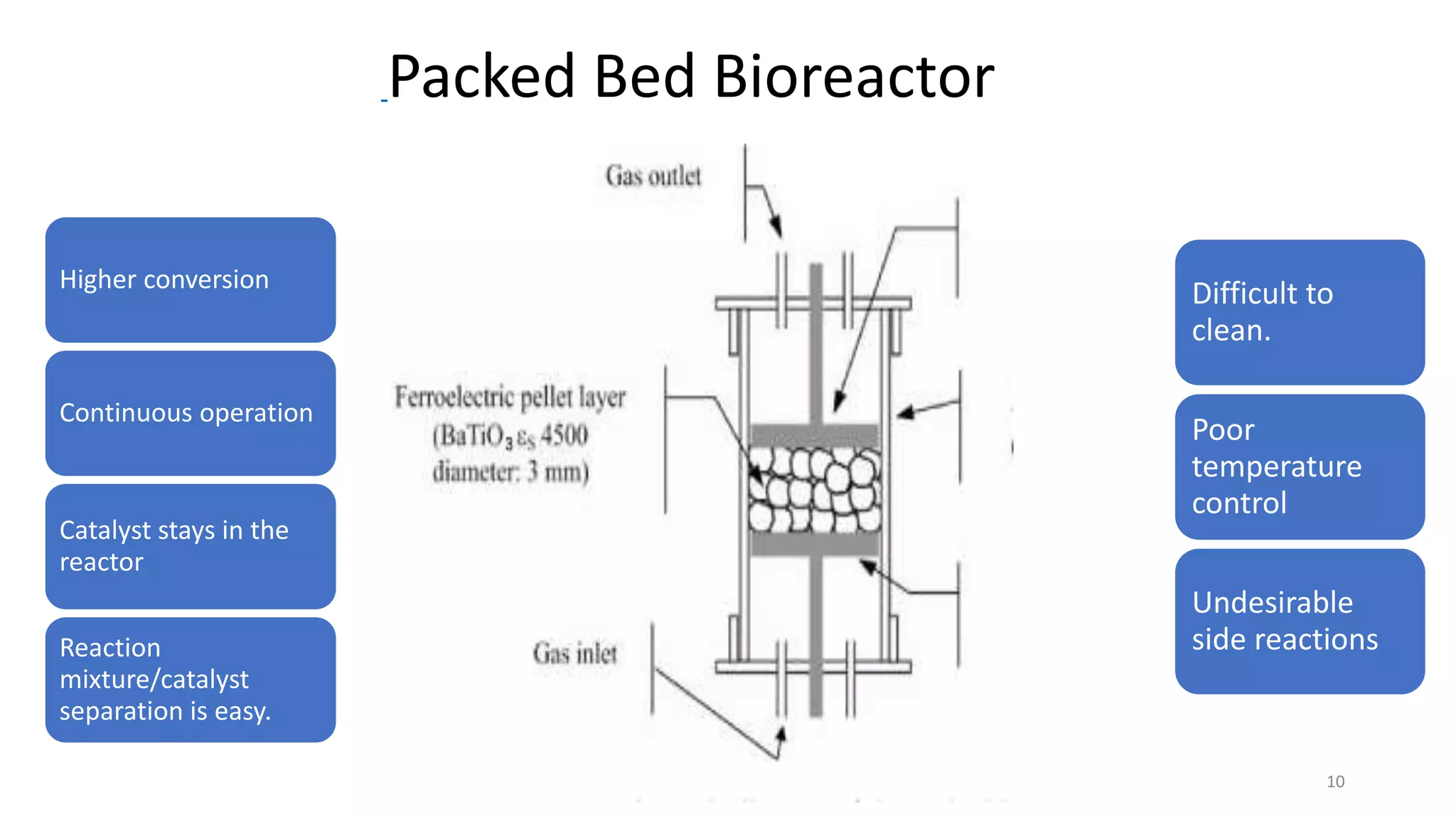
Packed Bed Bioreactor
Higher conversion
Continuous operation
Catalyst stays in the
reactor
Reaction
mixture/catalyst
separation is easy.
Difficult to
clean.
Poor
temperature
control
Undesirable
side reactions
11
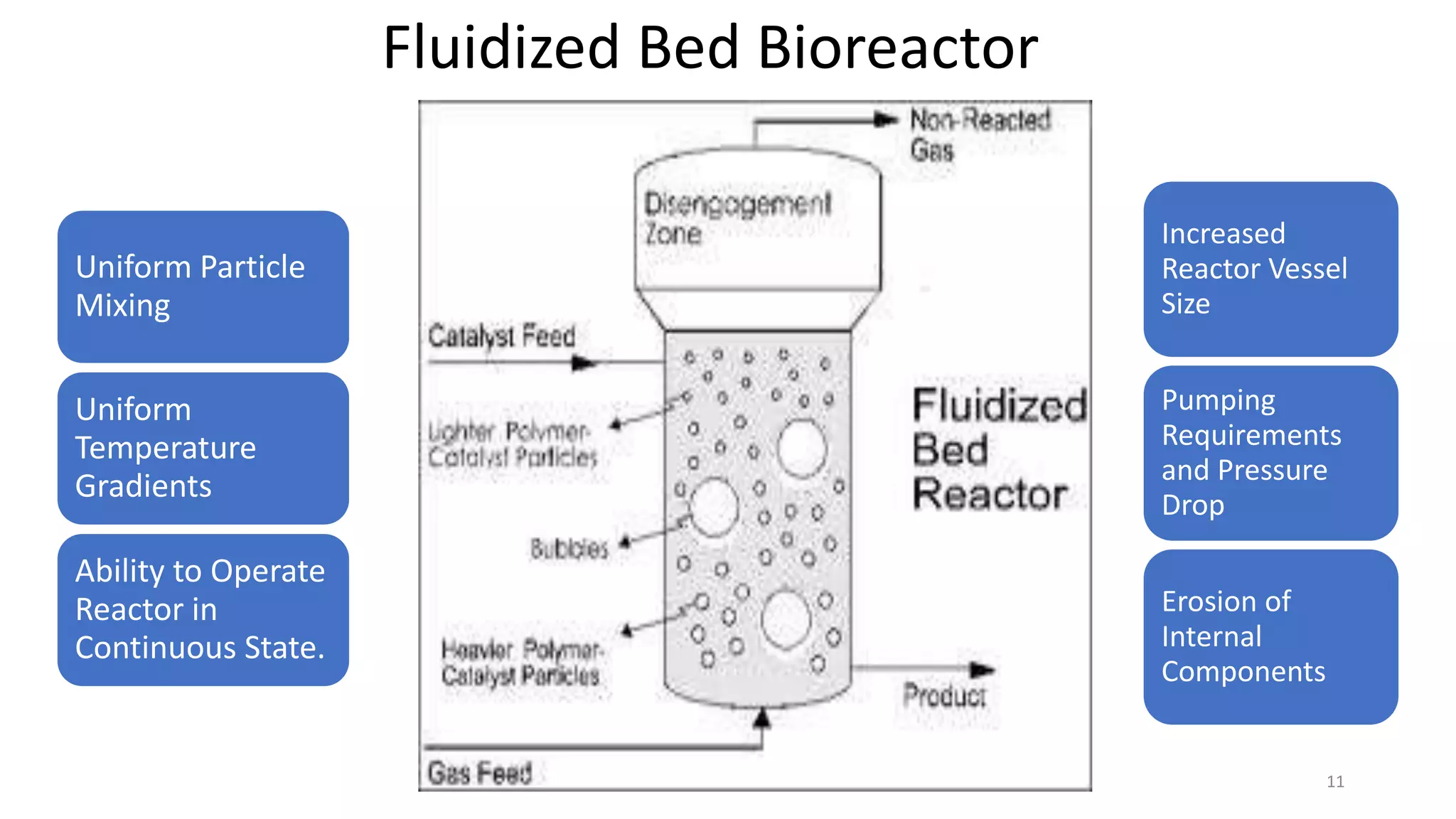
Fluidized Bed Bioreactor
Uniform Particle
Mixing
Uniform
Temperature
Gradients
Ability to Operate
Reactor in
Continuous State.
Increased
Reactor Vessel
Size
Pumping
Requirements
and Pressure
Drop
Erosion of
Internal
Components
12
Photo Bioreactor
Higher productivity.
Large surface-to-
volume ratio.
Better control of gas
transfer
uniform temperature
Capital cost is
very high.
The technical
difficulty in
sterilizing
13
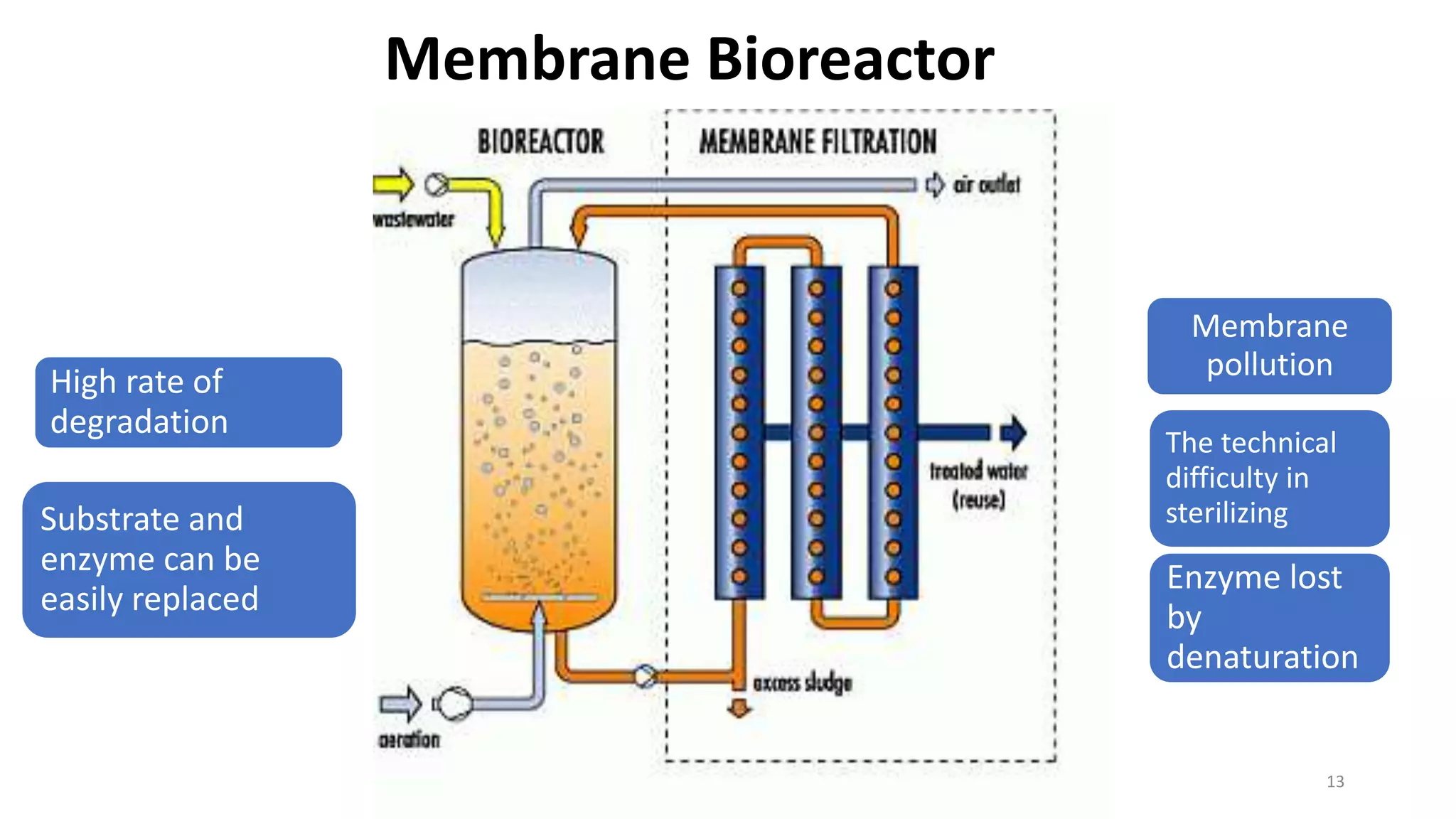
Membrane Bioreactor
Membrane
pollution
Substrate and
enzyme can be
easily replaced
The technical
difficulty in
sterilizing
Enzyme lost
by
denaturation
High rate of
degradation
Parameters of bioreactor
Agitation
• required for homogeneous distribution of cells in nutrient media.
• can be done by –
 magnetic stirrer
 turbine impeller
 marine impeller
• Maximum stirring rates for suspension : 100-150 rpm
Parameters of bioreactor (Cont.)
Aeration
• Aeration is important for microbial growth.
• It can be provided by -
Through bubbling air
By medium perfusion-medium is continuously taken from culture
vessel , passed through oxygenation chamber
(risk of o2 toxicity)
Parameters of bioreactor (Cont.)
Foaming
• Foaming causes adhesion of cell to inner surface of vessel.
• Foaming is caused by –
Excretion of high levels of proteins from microbial culture
High rate Agitation
• Foaming is controlled by a Foam breaker or Anti-foaming agent.
Parameters of bioreactor (Cont.)
Temperature
• Set at the same point as the body temperature of the host from
which the cell obtained.
• Temperature varies in species -
 Cold-blooded vertebrates : 18-25°C
 Mammalian cells : 36-37°C
Parameters of bioreactor (Cont.)
pH
• pH variation changes the microbial growth and foaming pattern.
• Buffer solution is used to control pH.
• Bicarbonate-CO2 buffer is used to –
Keep the pH medium in a range : 7-7.4
Parameters of bioreactor (Cont.)
Viscosity
• viscosity changes with time in any fermentation process.
• Viscosity affects choice of the right impeller.
• viscosity can be determined by using -
Cone and plate viscometers
Coaxial cylinders viscometers
impeller viscometers
Parameters of bioreactor (Cont.)
Sterilization
• Sterilization can be done by various methods.
• Heating -
dry heat : 180 C for 1 hr
moist heat : 121 C for 30 min
• Radiation kills bacteria as well as virus -
X-ray ,UV ray
• Chemicals-
formaldehyde ,H2O2, ethylene oxide
• Filtration-
syringe filter , depth filter, screen filter
Contaminations
in
Bioreactors
Risk of contamination depends on the
process
Some fermentations are more susceptible to contaminations these
include those that
• Utilize nutrient-rich medium
• Contain slow growing organisms
• Take a protracted length of time
• Performed under moderate temperature and pH ranges.
Contamination in fermentation process may
occur due to -
• Contaminated inocula
• Failures in sterilization processes
• Unsterilized fermentation tank itself
• Improper sterilization of fermentation media
• Seals present in fermentation tank
• Mechanical failure
• Improper sterile air supply
For successful fermentation, it is very essential to
ensure -
• Sterility of the media containing the nutrients.
• Sterility of incoming and outgoing air.
• Sterility of the bioreactor.
• Prevention of contamination during fermentation.
Major Functions of a Bioreactor
Provide
operation free
from
contamination
Maintain a
specific
Temperature
Provide
adequate
mixing and
aeration
Control the pH
of the culture
Applications of bioreactor
Genetic Engineering
Cell Therapy
Model System
Viral vaccines
Monoclonal antibodies
Recombinant proteins (glycoprotein)
Cancer Research
Toxicity Testing
Drug Screening and Development
References
• https://www.biotecharticles.com/Biotech-Research-Article/Design-
and-Operational-Key-Factors-of-Bioreactor-1558.html
• http://technologyinscience.blogspot.com/2012/08/different-types-
of-fermentors.html#.WqEbPedxXIU
Questions ???

Bioreactor Overview

  • 1.
    Shahjalal University ofScience and Technology Bioreactor overview D H SANI Genetic Engineering & Biotechnology Department
  • 2.
    Bioreactor  Bioreactor isa culture vessel in which living organisms synthesize useful substances or break down harmful ones.  This process can either be aerobic or anaerobic.
  • 3.
  • 4.
    Considerations in designingBioreactors • The design must preclude foreign contamination. • Optimal mixing with low, uniform shear. • Adequate mass transfer. • Clearly defined flow conditions. • Feeding of substrate with prevention of under or overdosing. • Suspension of solids. • Gentle heat transfer. • Compliance with design requirements.
  • 5.
    Recent advance inbioreactor design • Scaffold is necessary for seeding at high cell densities and homogeneous distribution of cells. • Scaffold refers to – Porous Biocompatible Substrate Provides Support to the Cell Offers 3D Architecture • As scaffolds have large, interconnected pores – cells are distributed quite uniformly during seeding medium flow through a construct enhances the mass transfer of Substrates during cultivation
  • 6.
    Requirements for IdealBioreactor Aseptic Vessel Adequate Aeration and Agitation Less Power consump -tion Controlled Temperature and pH Sampling facilities Less Evaporat -ion losses Minimal use of Labor Internal Smooth Surface
  • 7.
    Types of Bioreactors •Continuous Stirred Tank Bioreactor • Airlift Bioreactor • Fluidized Bed Bioreactor • Packed Bed Bioreactor • Photobioreactor • Membrane Bioreactor
  • 8.
    8 Stirred Tank Bioreactor Continuous operation Good temperature control Easyto clean The need for shaft seals and bearings Size limitation by motor size, shaft length & weight
  • 9.
    9 Airlift Bioreactor Low Energy requirement Greaterheat- removal No mechanical disruption No bubbles breaker Inefficient break the foam when foaming occurs. higher pressures needed.
  • 10.
    10 Packed Bed Bioreactor Higherconversion Continuous operation Catalyst stays in the reactor Reaction mixture/catalyst separation is easy. Difficult to clean. Poor temperature control Undesirable side reactions
  • 11.
    11 Fluidized Bed Bioreactor UniformParticle Mixing Uniform Temperature Gradients Ability to Operate Reactor in Continuous State. Increased Reactor Vessel Size Pumping Requirements and Pressure Drop Erosion of Internal Components
  • 12.
    12 Photo Bioreactor Higher productivity. Largesurface-to- volume ratio. Better control of gas transfer uniform temperature Capital cost is very high. The technical difficulty in sterilizing
  • 13.
    13 Membrane Bioreactor Membrane pollution Substrate and enzymecan be easily replaced The technical difficulty in sterilizing Enzyme lost by denaturation High rate of degradation
  • 14.
    Parameters of bioreactor Agitation •required for homogeneous distribution of cells in nutrient media. • can be done by –  magnetic stirrer  turbine impeller  marine impeller • Maximum stirring rates for suspension : 100-150 rpm
  • 15.
    Parameters of bioreactor(Cont.) Aeration • Aeration is important for microbial growth. • It can be provided by - Through bubbling air By medium perfusion-medium is continuously taken from culture vessel , passed through oxygenation chamber (risk of o2 toxicity)
  • 16.
    Parameters of bioreactor(Cont.) Foaming • Foaming causes adhesion of cell to inner surface of vessel. • Foaming is caused by – Excretion of high levels of proteins from microbial culture High rate Agitation • Foaming is controlled by a Foam breaker or Anti-foaming agent.
  • 17.
    Parameters of bioreactor(Cont.) Temperature • Set at the same point as the body temperature of the host from which the cell obtained. • Temperature varies in species -  Cold-blooded vertebrates : 18-25°C  Mammalian cells : 36-37°C
  • 18.
    Parameters of bioreactor(Cont.) pH • pH variation changes the microbial growth and foaming pattern. • Buffer solution is used to control pH. • Bicarbonate-CO2 buffer is used to – Keep the pH medium in a range : 7-7.4
  • 19.
    Parameters of bioreactor(Cont.) Viscosity • viscosity changes with time in any fermentation process. • Viscosity affects choice of the right impeller. • viscosity can be determined by using - Cone and plate viscometers Coaxial cylinders viscometers impeller viscometers
  • 20.
    Parameters of bioreactor(Cont.) Sterilization • Sterilization can be done by various methods. • Heating - dry heat : 180 C for 1 hr moist heat : 121 C for 30 min • Radiation kills bacteria as well as virus - X-ray ,UV ray • Chemicals- formaldehyde ,H2O2, ethylene oxide • Filtration- syringe filter , depth filter, screen filter
  • 21.
  • 22.
    Risk of contaminationdepends on the process Some fermentations are more susceptible to contaminations these include those that • Utilize nutrient-rich medium • Contain slow growing organisms • Take a protracted length of time • Performed under moderate temperature and pH ranges.
  • 23.
    Contamination in fermentationprocess may occur due to - • Contaminated inocula • Failures in sterilization processes • Unsterilized fermentation tank itself • Improper sterilization of fermentation media • Seals present in fermentation tank • Mechanical failure • Improper sterile air supply
  • 24.
    For successful fermentation,it is very essential to ensure - • Sterility of the media containing the nutrients. • Sterility of incoming and outgoing air. • Sterility of the bioreactor. • Prevention of contamination during fermentation.
  • 25.
    Major Functions ofa Bioreactor Provide operation free from contamination Maintain a specific Temperature Provide adequate mixing and aeration Control the pH of the culture
  • 26.
    Applications of bioreactor GeneticEngineering Cell Therapy Model System Viral vaccines Monoclonal antibodies Recombinant proteins (glycoprotein) Cancer Research Toxicity Testing Drug Screening and Development
  • 27.
  • 28.

Editor's Notes

  • #4 BafflePrevent the effects of vibration. increases fluid velocity and the effective heat transfer. sparger is to supply oxygen to the growing cells. impeller is a rotor used to increase the pressure and flow of a fluid. homogenization, suspension of solids, dispersion of gas-liquid mixtures, aeration of liquid and heat exchange. cooling jacketMaintain low temperatures improving quality.
  • #5  ability to be sterilized; simple construction; simple measuring, scale up; flexibility; long term stability etc.