‫د‬
/
‫احمد‬ ‫مصطفى‬ ‫هالة‬
‫الطبيعي‬ ‫العالج‬ ‫كلية‬
‫األولى‬ ‫الفرقة‬
‫الطبية‬ ‫الحيوية‬ ‫الفيزياء‬
Medical Biophysics
‫الفيزياء‬
CHAPTER FOUR
Elasticity
CHAPTER (4)
Lesson Objectives:
By the end of this chapter, a
student will be able to :
1-Explain the Stress &Strain
2-Define the Mechanical Tests
3-Use Hooks Low
4-Classify Elastic coefficients .
Biomechanics
Elasticity.
It is the ability of a substance to restore its
original shape and size after deformation.
Elastic materials.
Materials that restore its original shape and size
after deformation .
Inelastic materials.
Materials that cannot restore its original shape
and size after deformation
λ = Stress/Strain
Where:
λ (lambda) is the elastic modulus
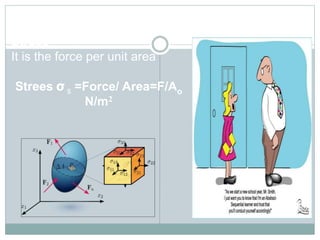
Stress
It is the force per unit area
Strees σ s =Force/ Area=F/Ao
N/m2
The Types of stress.
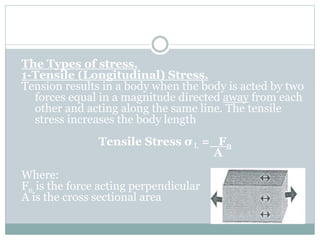
1-Tensile (Longitudinal) Stress.
Tension results in a body when the body is acted by two
forces equal in a magnitude directed away from each
other and acting along the same line. The tensile
stress increases the body length
Tensile Stress σ L = Fn
A
Where:
Fn is the force acting perpendicular
A is the cross sectional area
2:Compression Stress.
Compression Stress in a body when the
body is acted by two forces equal in a
magnitude directed toward from
each other and acting along the
same line .The compression stress
decreases the body length.
Compression Stress σ V = Fn
A
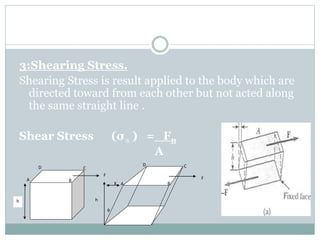
3:Shearing Stress.
Shearing Stress is result applied to the body which are
directed toward from each other but not acted along
the same straight line .
Shear Stress (σ s ) = Fn
A
h
A B
C
D
F
F
X
h

A B
C
D
4:Complex Stress.
Complex Stress exist at the same time acted on the
body.
4:Strain.
It is the deformation produced in a body as a result
of stress.
The Types of strain.
1:Longitudinal strain.
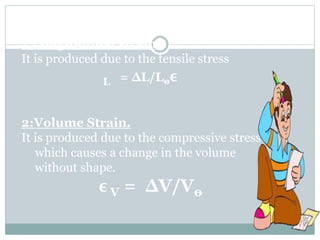
It is produced due to the tensile stress
ϵ
L = ∆L/L0
2:Volume Strain.
It is produced due to the compressive stress
which causes a change in the volume
without shape.
ϵ V = ∆V/V0
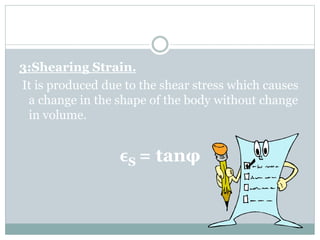
3:Shearing Strain.
It is produced due to the shear stress which causes
a change in the shape of the body without change
in volume.
ϵS = tanφ
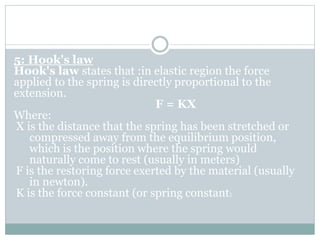
5: Hook's law
Hook's law states that :in elastic region the force
applied to the spring is directly proportional to the
extension.
F = KX
Where:
X is the distance that the spring has been stretched or
compressed away from the equilibrium position,
which is the position where the spring would
naturally come to rest (usually in meters)
F is the restoring force exerted by the material (usually
in newton).
K is the force constant (or spring constant).
‫ثم‬
‫ت‬َ‫س‬َ‫ق‬
ُ‫ب‬‫و‬ُ‫ل‬ُ‫ق‬
‫ُم‬‫ك‬
‫ن‬ِّ‫م‬
‫ع‬َ‫ب‬
ِّ‫د‬
َ‫ك‬ِّ‫ل‬َ‫ذ‬
َ‫ى‬ِّ‫ه‬َ‫ف‬
‫ال‬َ‫ك‬
ِّ‫ة‬َ‫ار‬َ‫ج‬ ِّ‫ح‬
َ‫أ‬
‫و‬
‫َد‬‫ش‬َ‫أ‬
‫ة‬َ‫و‬‫س‬َ‫ق‬
َ‫و‬
‫ن‬ِّ‫إ‬
َ‫ن‬ِّ‫م‬
ِّ‫ة‬َ‫ار‬َ‫ج‬ ِّ‫ح‬‫ال‬
‫ا‬َ‫م‬َ‫ل‬
َ‫ي‬
ُ‫ر‬‫ج‬َ‫ف‬َ‫ت‬
ُ‫ه‬‫ن‬ِّ‫م‬
ُ‫ار‬َ‫ه‬‫ن‬َ‫األ‬
‫ن‬ِّ‫إ‬َ‫و‬
ِّ‫م‬
‫ا‬َ‫ه‬‫ن‬
‫ا‬َ‫م‬َ‫ل‬
ُ‫ق‬‫ق‬‫ش‬َ‫ي‬
َ‫ي‬َ‫ف‬
ُ‫ج‬ُ‫ر‬‫خ‬
ُ‫ه‬‫ن‬ِّ‫م‬
‫ا‬
ُ‫ء‬‫آ‬َ‫م‬‫ل‬
‫ن‬ِّ‫إ‬َ‫و‬
‫ا‬َ‫ه‬‫ن‬ِّ‫م‬
َ‫م‬َ‫ل‬
‫ا‬
ُ‫ط‬ِّ‫ب‬‫ه‬َ‫ي‬
‫ن‬ِّ‫م‬
ِّ‫ة‬َ‫ي‬‫ش‬َ‫خ‬
ِّ‫ّللا‬
َ‫و‬
‫ا‬َ‫م‬
ُ‫ّللا‬
ِّ‫ب‬
‫ل‬ِّ‫ف‬‫ا‬َ‫غ‬
‫ا‬‫َم‬‫ع‬
َ‫ون‬ُ‫ل‬َ‫م‬‫ع‬َ‫ت‬
)
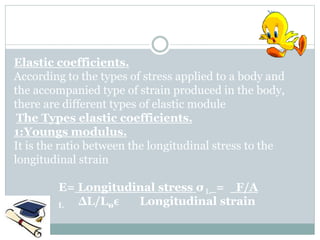
Elastic coefficients.
According to the types of stress applied to a body and
the accompanied type of strain produced in the body,
there are different types of elastic module
The Types elastic coefficients.
1:Youngs modulus.
It is the ratio between the longitudinal stress to the
longitudinal strain
E= Longitudinal stress σ L = F/A
Longitudinal strain
ϵ
L ∆L/L0
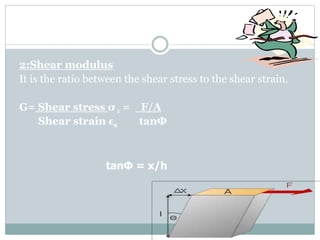
2:Shear modulus
It is the ratio between the shear stress to the shear strain.
G= Shear stress σ s = F/A
Shear strain ϵs tanΦ
tanΦ = x/h
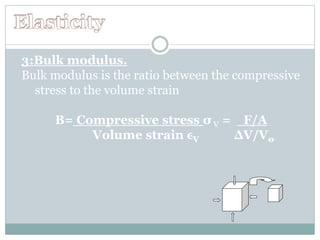
3:Bulk modulus.
Bulk modulus is the ratio between the compressive
stress to the volume strain
B= Compressive stress σ V = F/A
Volume strain ϵV ∆V/V0
7: Mechanical Tests
In order to study mechanical properties of
materials, there are different mechanical
methods or test should be followed .These
are :
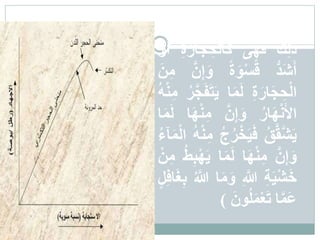
1-The stress – strain test
2-The fatigue
3-The hardness
4-The creep test
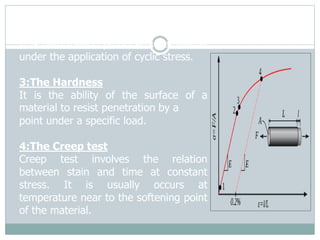
1-The stress –strain test
Stress strain test involves relation between the
stress and strain from which a stress strain
curve is obtained
A:The proportional limit A
The proportional limit A is the stress at which the
material still obey Hooks law
B:The elastic limit B
Elastic limit is the maximum stress
C:The Yield strengthC
The Yield strengthC is the stress at which the
material behaves plastically.
D:The ultimate strength D
The ultimate strength D is the maximum stress
that a material can with stand just before
fracture or rupture.
2:The Fatigue
It is deformation produced in amaterial
under the application of cyclic stress.
3:The Hardness
It is the ability of the surface of a
material to resist penetration by a
point under a specific load.
4:The Creep test
Creep test involves the relation
between stain and time at constant
stress. It is usually occurs at
temperature near to the softening point
of the material.
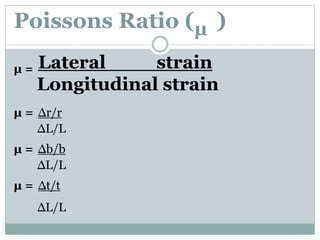
Poissons Ratio (µ )
µ = Lateral strain
Longitudinal strain
µ = ∆r/r
∆L/L
µ = ∆b/b
∆L/L
µ = ∆t/t
∆L/L
1-Wire 12.5 m long is stretched to a length
12.58 m
A) What is the strain of the stretched wire?
B) If the wire is copper whose Young's
modulus (E) =120x109 N/m2 ,what is the
stress required to produce this strain?
C) If the cross sectional area of the wire is
4x10⁻⁵ m2 ,what is the tension stretched
wire?
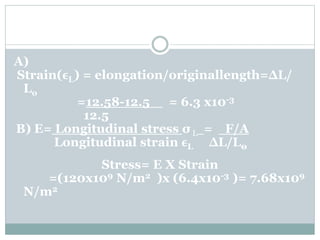
A)
Strain(ϵL) = elongation/originallength=ΔL/
Lo
=12.58-12.5 = 6.3 x10⁻³
12.5
B) E= Longitudinal stress σ L = F/A
Longitudinal strain ϵL ∆L/L0
Stress= E X Strain
=(120x109 N/m2 )x (6.4x10⁻³ )= 7.68x10⁹
N/m2
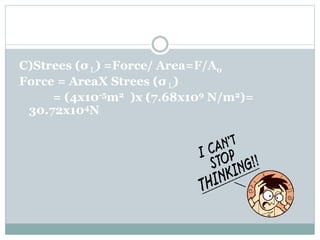
C)Strees (σ L) =Force/ Area=F/Ao
Force = AreaX Strees (σ L)
= (4x10⁻⁵m2 )x (7.68x10⁹ N/m2)=
30.72x10⁴N
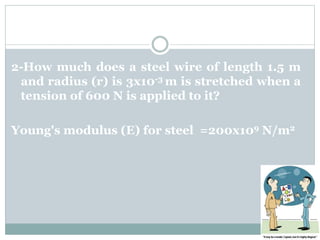
2-How much does a steel wire of length 1.5 m
and radius (r) is 3x10⁻³ m is stretched when a
tension of 600 N is applied to it?
Young's modulus (E) for steel =200x109 N/m2
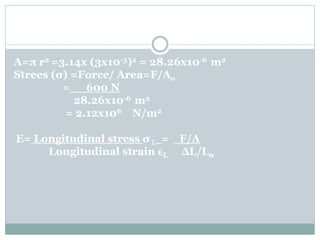
A=π r2 =3.14x (3x10-3)2 = 28.26x10⁻⁶ m2
Strees (σ) =Force/ Area=F/Ao
= 600 N
28.26x10⁻⁶ m2
= 2.12x10⁶ N/m2
E= Longitudinal stress σ L = F/A
Longitudinal strain ϵL ∆L/L0
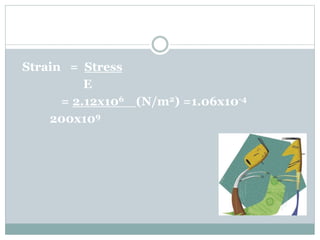
Strain = Stress
E
= 2.12x10⁶ (N/m2) =1.06x10⁻⁴
200x109
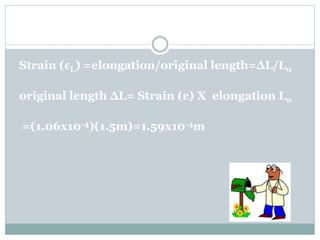
Strain (ϵL) =elongation/original length=ΔL/Lo
original length ΔL= Strain (ε) X elongation Lo
=(1.06x10⁻⁴)(1.5m)=1.59x10⁻⁴m
biophysics.ppt

biophysics.ppt