Biomedical Engineering
Mikayla Jensen
About Me
 Graduated from Jordan High School in Sandy
 Attended the University of Utah
 Bachelor’s Degree in Biomedical Engineering
 Minor in Chemistry
 Master’s Degree in Bioengineering
 Emphasis in Biomaterials and Therapeutics
 Internship at Bard Access Systems (now owned by BD Medical)
 Currently a Quality Engineer at ICU Medical
 We manufacture various medical products focusing on IV products, critical care
catheters/monitoring systems, and oncology products
What is Biomedical Engineering?
 Intersection of two disciplines
 Life Sciences
 Biology, Physiology, Medical
 Engineering
 Design & Innovation
 Purpose: To create engineering approaches that allow one
to study, analyze, diagnose, and develop new therapies to
treat disease and heal damaged tissues and organ
systems.
Classes to take in Preparation
 Almost anything in MATH and SCIENCE
 Biology, anatomy, physiology, and other life sciences courses
 Will help with development of understanding of the problems that need to
be fixed and the environment your solutions will be used in
 Physics, Chemistry, Math (Calculus & Statistics), Computer Science
 Will help you understand how to solve the problems
 The importance of these classes will depend on which emphasis you want
to go into
 Technical writing courses
Educational Requirements for
Biomedical Engineering
 Only programs in Utah are at University of Utah and Utah
State University (BYU has an emphasis in Bioengineering
under their Mechanical Engineering degree)
 All the following information is based off the
Bioengineering department at the University of Utah
Educational Requirements for
Biomedical Engineering
Prerequisites for application to program
Educational Requirements for
Biomedical Engineering
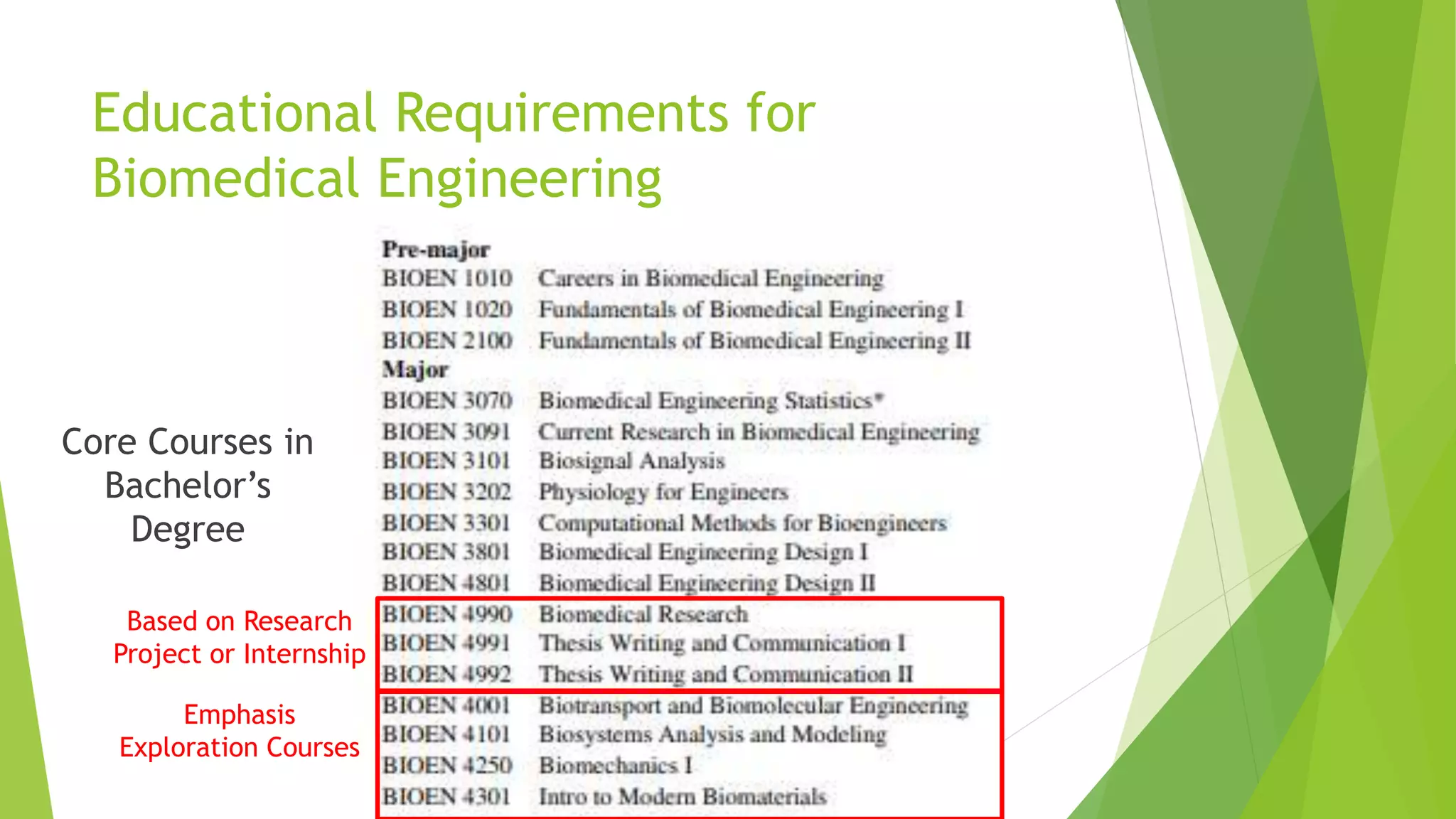
Core Courses in
Bachelor’s
Degree
Emphasis
Exploration Courses
Based on Research
Project or Internship
Educational Requirements for
Biomedical Engineering
Choose 5 elective courses, they suggest you pick an area of
emphasis but you can explore if you would like to!
Career Outcomes
 Two main paths for graduates
 Industry
 Medical Devices, Pharmaceutical, or Therapeutics Companies
 Companies that manufacture devices or treatments for patients to use in clinical settings
 Start-ups vs Large Companies
 Research
 Will likely have to have a PhD
 Researching new and innovative ideas to current medical problems
 Laboratory work, animal studies, & clinical trials
 Likely will not have clinical applications for years (FDA has a very long testing and approval process)
Salary/Income Range
Industry
 As a new graduate going into industry (in Utah) with no experience and a
bachelor’s degree in biomedical engineering, the average income you can
expect would be around $60,000
 A master’s will increase that by about $5,000 and a PhD by about $10,000
 Based on personal, peer, & advisor experience as well as University generated
reports where students are asked to report their salaries after graduation
 A senior engineer can reasonably expect to earn over $100,000 a year towards
the middle or end of their career
 Going into management in industry can produce much higher salaries, often in
the mid to high 100,000s (you will need a master’s degree at least, either
Engineering or an MBA)
Salary/Income Range
Research
 PhD programs pay a stipend of around $20,000 to $30,000 a year when working
in a professor’s lab
 Salaries range widely based on what type of research you end up in
 Professors in Bioengineering at the University of Utah make between $100,000
and $350,000
 These jobs are not very plentiful and take years of post-graduate work
 There are also an increasing amount of research jobs in industry, but still not
very many
Working Schedule
 Most of the jobs with this degree are within normal business hours
 Some manufacturing engineering positions will have shift work based on
manufacturing operational hours, but this is more common in other
engineering disciplines (but still not that common)
 Often have lots of flexibility on working hours
 Most engineers at my company work their 8 hours sometime between 6am
and 6pm
 Most jobs are full time
 Contract Engineers work months long contracts for short term projects
Job Market
 Like most healthcare industries, medical devices, pharmaceuticals,
and therapeutics will always be needed, even as the economy changes
 Industry jobs are stable and most projections will tell you that the
number of job openings are ever increasing
 Your skills in industry will often be transferrable to other engineering
industries as you gain experience
 Most research jobs are based in academia, so the job market will be
very similar to what it is now
Ethical Issues
Research
 Animal Testing
 Rats are used most often, but large animal models like pigs, horses,
sheep, etc are needed for FDA submissions before human clinical trials
will be allowed
 Stem Cells
 Embryonic – Bush administration banned – ok again starting with Obama
 Newer stem cell types with less ethical issues:
 MSCs (Mesenchymal Stem Cells) - from bone marrow, can differentiate into
less types of cells: bone, fat, and muscle.
 Cord Blood Stem Cells – extracted from umbilical cord after birth of a baby
 iPSCs (Induced Pluripotent Stem Cells)
 Stem cells that are created from adult cells.
 Shinya Yamanaka found 4 genes that control differentiation of a stem cell into an
adult cell and by controlling those genes, you can reverse the cell from an adult cell
to a stem cell
Ethical Issues
Industry
 Balancing Business needs with Safety of the Patient/Customer
 These businesses need to make money! You will feel pressure to release
product into the market
 As Engineers who help design and produce product, you need to keep the
patient safety in mind
 Quality Engineers in particular need to be “advocates for the patients”
 Don’t release product if you aren’t confident that patients will be safe using it
What do I do as a Quality Engineer?
 The Salt Lake Plant is a fully operational manufacturing plant where millions
of products are produced daily
 My main responsibility is Validations on Molding and Automation Equipment
and Product Designs
 When we make changes, we have to make sure it does not affect the quality of the
products and will still be safe for patients to use!
 What kind of changes? product design, material composition, material supplier,
new machines, new parts in a machine, and so many more!
 I make testing plans, write protocols and reports, and do data analysis
 Testing shelf life of components: real time or accelerated aging and then
testing to make sure product still functions
 Helping to gather stability data for FDA or international submissions
 And so much more!
Questions?

Biomedical engineering presentation

  • 1.
  • 2.
    About Me  Graduatedfrom Jordan High School in Sandy  Attended the University of Utah  Bachelor’s Degree in Biomedical Engineering  Minor in Chemistry  Master’s Degree in Bioengineering  Emphasis in Biomaterials and Therapeutics  Internship at Bard Access Systems (now owned by BD Medical)  Currently a Quality Engineer at ICU Medical  We manufacture various medical products focusing on IV products, critical care catheters/monitoring systems, and oncology products
  • 3.
    What is BiomedicalEngineering?  Intersection of two disciplines  Life Sciences  Biology, Physiology, Medical  Engineering  Design & Innovation  Purpose: To create engineering approaches that allow one to study, analyze, diagnose, and develop new therapies to treat disease and heal damaged tissues and organ systems.
  • 4.
    Classes to takein Preparation  Almost anything in MATH and SCIENCE  Biology, anatomy, physiology, and other life sciences courses  Will help with development of understanding of the problems that need to be fixed and the environment your solutions will be used in  Physics, Chemistry, Math (Calculus & Statistics), Computer Science  Will help you understand how to solve the problems  The importance of these classes will depend on which emphasis you want to go into  Technical writing courses
  • 5.
    Educational Requirements for BiomedicalEngineering  Only programs in Utah are at University of Utah and Utah State University (BYU has an emphasis in Bioengineering under their Mechanical Engineering degree)  All the following information is based off the Bioengineering department at the University of Utah
  • 6.
    Educational Requirements for BiomedicalEngineering Prerequisites for application to program
  • 7.
    Educational Requirements for BiomedicalEngineering Core Courses in Bachelor’s Degree Emphasis Exploration Courses Based on Research Project or Internship
  • 8.
    Educational Requirements for BiomedicalEngineering Choose 5 elective courses, they suggest you pick an area of emphasis but you can explore if you would like to!
  • 9.
    Career Outcomes  Twomain paths for graduates  Industry  Medical Devices, Pharmaceutical, or Therapeutics Companies  Companies that manufacture devices or treatments for patients to use in clinical settings  Start-ups vs Large Companies  Research  Will likely have to have a PhD  Researching new and innovative ideas to current medical problems  Laboratory work, animal studies, & clinical trials  Likely will not have clinical applications for years (FDA has a very long testing and approval process)
  • 10.
    Salary/Income Range Industry  Asa new graduate going into industry (in Utah) with no experience and a bachelor’s degree in biomedical engineering, the average income you can expect would be around $60,000  A master’s will increase that by about $5,000 and a PhD by about $10,000  Based on personal, peer, & advisor experience as well as University generated reports where students are asked to report their salaries after graduation  A senior engineer can reasonably expect to earn over $100,000 a year towards the middle or end of their career  Going into management in industry can produce much higher salaries, often in the mid to high 100,000s (you will need a master’s degree at least, either Engineering or an MBA)
  • 11.
    Salary/Income Range Research  PhDprograms pay a stipend of around $20,000 to $30,000 a year when working in a professor’s lab  Salaries range widely based on what type of research you end up in  Professors in Bioengineering at the University of Utah make between $100,000 and $350,000  These jobs are not very plentiful and take years of post-graduate work  There are also an increasing amount of research jobs in industry, but still not very many
  • 12.
    Working Schedule  Mostof the jobs with this degree are within normal business hours  Some manufacturing engineering positions will have shift work based on manufacturing operational hours, but this is more common in other engineering disciplines (but still not that common)  Often have lots of flexibility on working hours  Most engineers at my company work their 8 hours sometime between 6am and 6pm  Most jobs are full time  Contract Engineers work months long contracts for short term projects
  • 13.
    Job Market  Likemost healthcare industries, medical devices, pharmaceuticals, and therapeutics will always be needed, even as the economy changes  Industry jobs are stable and most projections will tell you that the number of job openings are ever increasing  Your skills in industry will often be transferrable to other engineering industries as you gain experience  Most research jobs are based in academia, so the job market will be very similar to what it is now
  • 14.
    Ethical Issues Research  AnimalTesting  Rats are used most often, but large animal models like pigs, horses, sheep, etc are needed for FDA submissions before human clinical trials will be allowed  Stem Cells  Embryonic – Bush administration banned – ok again starting with Obama  Newer stem cell types with less ethical issues:  MSCs (Mesenchymal Stem Cells) - from bone marrow, can differentiate into less types of cells: bone, fat, and muscle.  Cord Blood Stem Cells – extracted from umbilical cord after birth of a baby  iPSCs (Induced Pluripotent Stem Cells)  Stem cells that are created from adult cells.  Shinya Yamanaka found 4 genes that control differentiation of a stem cell into an adult cell and by controlling those genes, you can reverse the cell from an adult cell to a stem cell
  • 15.
    Ethical Issues Industry  BalancingBusiness needs with Safety of the Patient/Customer  These businesses need to make money! You will feel pressure to release product into the market  As Engineers who help design and produce product, you need to keep the patient safety in mind  Quality Engineers in particular need to be “advocates for the patients”  Don’t release product if you aren’t confident that patients will be safe using it
  • 16.
    What do Ido as a Quality Engineer?  The Salt Lake Plant is a fully operational manufacturing plant where millions of products are produced daily  My main responsibility is Validations on Molding and Automation Equipment and Product Designs  When we make changes, we have to make sure it does not affect the quality of the products and will still be safe for patients to use!  What kind of changes? product design, material composition, material supplier, new machines, new parts in a machine, and so many more!  I make testing plans, write protocols and reports, and do data analysis  Testing shelf life of components: real time or accelerated aging and then testing to make sure product still functions  Helping to gather stability data for FDA or international submissions  And so much more!
  • 17.