Newer Antibiotics and How
We Should Use Them
Antibacterials
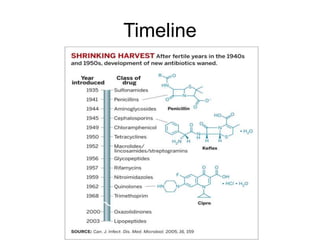
Timeline
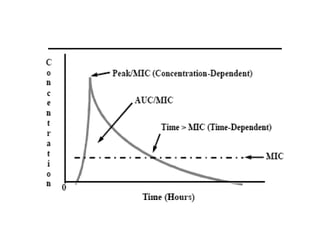
Concentration-Dependent vs. Time-
Dependent Killing
• Time-Dependent (or Conc. Independent)
– Eliminate bacteria only when time during
which drug concentration is greater than MIC
• Concentration-Dependent
– Eliminate bacteria when their concentrations
are above the MIC of the organism
– Post-antibiotic effect
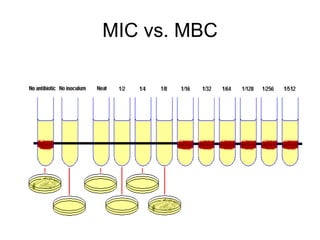
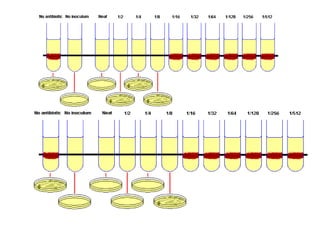
MIC vs. MBC
Bacteriostatic vs. Bactericidal
• Bactericidal: Kill bacteria
• Bacteriostatic: Reversibly inhibit growth
• Continuum
• No rigorous studies exist showing
superiority of one type over another
• However, -cidal agents preferred in
endocarditis, meningitis, neutropenic
hosts, sepsis
• Static: MIC<MBC; Cidal: MIC=MBC
-Static vs. -Cidal
• Bacteriostatic
– Tetracyclines
– Sulphonamides
– Trimethoprim
– Chloramphenicol
– Macrolides
– Linosamides
(clindamycin)
• Bactericidal
– Beta-Lactams
– Daptomycin
– FQs
– Aminoglycosides
– Metronidazole
– TMP/SMX
– Nitrofurantoin
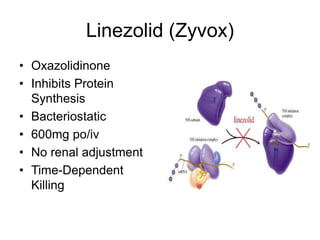
Linezolid (Zyvox)
• Oxazolidinone
• Inhibits Protein
Synthesis
• Bacteriostatic
• 600mg po/iv
• No renal adjustment
• Time-Dependent
Killing
Linezolid Spectrum of Activity
• Clinically important Gram + organisms
– MSSA/MRSA, Coag – Staph, E. faecium and
faecalis, Strep. (bactericidal)
– MTb, MAI
Linezolid: What to use it for
• Complicated skin and soft tissue structure
infections (does not include osteomyelitis)
• Nosocomial Pneumonia (MRSA)
• VRE (including bacteremia)
• DO NOT USE for bacteremias
• **(Osteomyelitis, endocarditis, meningitis,
intraabdominal infections, etc.)—ID
consult
Linezolid: Side Effects
• Relatively well-tolerated with GI symptoms
• Serotonin Syndrome
– Fever, agitation, MS changes, tremors if on
serotonergic agents
– Reversible, nonselective monoamine oxidase inhibitor
• Reversible myelosuppresion
– Thrombocytopenia (47% if >10d or rx)
>>anemia>neutropenia
– Duration of treatment > 2 weeks
• Neuropathy (peripheral, optic, etc.); Lactic
Acidosis, …
Daptomycin
• First in a novel class: cyclic lipopeptides
• Side-lined in 1991 as Phase II trials showd
skeletal muscle toxicity with Q12H dosing
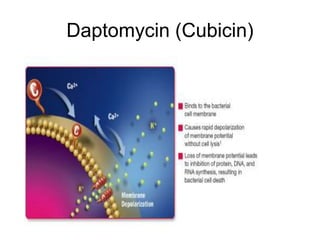
• Binds to cell membranes of Gram + organisms
• Bactericidal
• Concentration-Dependent
• Pregnancy Category B
• 4 to 6 mg/kg iv Q24H (Q48H if CrCl<30 mL/min)
Daptomycin (Cubicin)
Daptomycin: Spectrum of Activity
• Like Glycopeptides, though works on organisms
where vancomycin is not effective
• MSSA/MRSA, E faecalis and faecium, Coag
negative Staph, Strep.
• Resistance emerging: If decreased sens to
vancomycin, greater likelihood of decreased
sens to daptomycin.
• Development of resistance during treatment of
Enterococcal infections
Daptomycin: What to use it for
• Complicated SSTI (4mg/kg)
• S. aureus bacteremia and endocarditis (6mg/kg)
• Osteoarticular infections (but would use higher
dose of 8-10mg/kg and use another agent given
lower bone levels and resistance emergence on
therapy
• Enterococcal infections
• DO NOT USE: Pulmonary infections (inactivated
by surfactant)
Daptomycin: Side Effects
• No increased GI
• Paresthesias, dysesthesias, and peripheral
neuropathies
• No QTc issues
• Muscle toxicity
– Begin 7 days after therapy
– Resolve during therapy or about 3 days after
daptomycin is stopped
– Monitor CK when used with other “muscle toxic”
agents (ie HMG-CoA reductase inhibs)
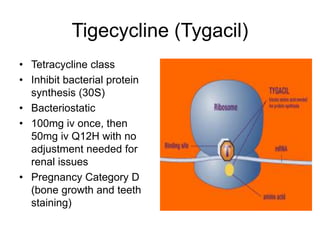
Tigecycline (Tygacil)
• Tetracycline class
• Inhibit bacterial protein
synthesis (30S)
• Bacteriostatic
• 100mg iv once, then
50mg iv Q12H with no
adjustment needed for
renal issues
• Pregnancy Category D
(bone growth and teeth
staining)
Tigecycline: Spectrum of Activity
• Broad range of pathogens
– NO Pseudomonas, Proteus, Morganella, or
Providencia
– Acinetobacter
– MRSA/MSSA, VRE
– Anaerobes
– Resistance by efflux pumps or ribosomal
changes
Tigecycline: What to use it for
• FDA Approved:
• Skin and soft tissue infections
– Intra-Abdominal infections
– Community-acquired pneumonia
– NOT indicated for blood stream infections
• At NBHN, reserved for patients with
resistant GNRod infections (non-
bacteremic)
Tigecycline: Side Effects
• Nausea (35%)
• Vomiting (25%)
• Phlebitis
• Increased LFTs (6%)
• Thrombocytopenia, increased PTT and
INR, eosinophilia
• Headache, somnolence, taste perversion
• Remember: No kids under 8yo
Ertapenem (Invanz)
• Beta-Lactam
• Bind to PCN-binding proteins (PBPs)
• Concentration-Dependent Killing
• Bactericidal
• Long half life of 4h permits QD dosing
• Renal adjustment required
Ertapenem: Spectrum of Activity
• Kinda like ceftriaxone and metronidazole
• Gram + bacteria, Enterobacteriaceae,
MSSA, Anaerobes
• NOT: MRSA, Enterococcus; No
Pseudomonas, Acinetobacter
• Resistance: Alteration in PBPs, Beta
Lactamase production, Efflux pumps,
decreased permeability
Ertapenem: What to use it for
• Intraabdominal infections
• Pneumonia
• Bacteremia
• Bone and soft tissue infections
• Complicated UTIs
• OB/Gyn infections
Doripenem (Doribax)
• Much greater Enterobacteriaceae activity
including Pseudomonas, Acinetobacter
• Lower MICs for GNRs than imipenem or
meropenem
• Resistance to Imipenem does not mean
resistance to Doripenem or meropenem,
or vice versa
• Less beta-lactamase unstable
Carbapenem: Side Effects
• Rash, urticaria, cross-reaction with PCNs,
nausea, immediate hypersensitivity
• Less epileptogenic than imipenem
Polymyxins
• Very old drugs (1947)
• Fell into disuse by 1980 due to nephrotoxicity;
topical and oral use
• Polymyxin B and Polymyxin E (Colistin)
– Polymyxin B (colistemethate) iv
– Colistin for inhalation therapy
• Penetrate into cell membranes and disrupt
• Bactericidal and Concentration-Dependent
• Renal adjustment necessary
• Poor levels in pleura, joint, CSF, biliary tract
Polymyxins: Spectrum of
Activity
• Broad GNR coverage
• Gram +, Gram – cocci, and most
anaerobes are RESISTANT
• Has been used intrathecally and
intraventricularly
• Colistimethate as efficacious as
piperacillin, imipenem, and ciprofloxacin
for treatment of Pseudomonas
Polymyxins: Side Effects
• Dose-Related Reversible Nephrotoxicity
• Dose-Related Reversible Neurotoxicity
manifest as neuromuscular blockade
Telavancin (Vibativ)
• FDA-approved on Sept 11, 2009
• Lipoglycopeptide
• Synthetic derivative of vancomycin
• Bactericidal
• Inhibits cell wall synthesis; bacterial
membrane depolarizer
• Once daily iv (10mg/kg)
• Renal adjustment needed
Telavancin: Spectrum of Activity
and Uses
• MRSA
• Gram positives (but not VRE)
• Uses
– cSSSI
– Nosocomial Pneumonia (with Gram negative
coverage; non-FDA approved)
Telavancin: Side Effects
• Mild taste disturbance (33%)
• Nausea (27%) and Vomiting (14%)
• Insomnia
• Coagulation test interference: PT/INR, PTT,
Factor Xa; BUT NO increased risk of bleeding
• Less common: Headache, Red-man Syndrome,
Nephrotoxicity, Diarrhea, Foamy Urine (13%)
• QTc prolongation in 1.5% (vs. 0.6% in
vancomycin)
Anti-Fungals
Echinocandins
• Caspofungin (Cancidas), Micafungin
(Mycamine), Anidulafungin (Eraxis)
• Inhibit glucan synthesis (in cell wall); like
“PCN of antifungals”
• Pregnancy category C
• No renal adjustment required
Echinocandins: Spectrum of
Activity
• Candida spp of all types (fungicidal)
• Aspergillus spp (fungistatic)
• Anidalufungin likley with fewer drug-drug
interactions
• Micafungin has most data in kids
• Caspofungin was 1st
• Caspofungin vs. Micafungin for invasive
Candidiasis  similar results
Echinocandins: Uses
• Invasive and esophageal candidiasis
– Caspo, Anidal., Mica.
• Prophylaxis in HSCT patients
– Mica.
• Invasive aspergillosis in refractory or
intolerant patients
– Caspo
• Fever and neutropenia
– Caspo
Echinocandins: Side Effects
• Not cytochrome P450 metabolized
• NOT nephrotoxic or hepatotoxic
• Relatively few/minor side effects
Newer Azoles
• Voriconazole (VFend), Posaconazole
(Noxafil)
• Many clinically relevant drug-drug
interactions (P450)
• Voriconazole is available in both iv and po
formulations
• Posaconzole available in suspension
• Both with extensive distribution and
penetration into tissues.
Voriconazole
• Invasive aspergillosis (superior to Ampho
B deoxycholate)
• Invasive fusarium and scedosporum
• Esophageal candidiasis (not licensed)
• NOT FDA approved for fever and
neutropenia and possibly inferior to
liposomal Ampho B
Voriconazole: Side Effects
• Similar to other triazoles, EXCEPT:
• Visual disturbance unique
– 30% reported altered or enhanced light perception for
½ hour 30 mins after dose
– Blurred vision, color vision changes, photophobia
– Rarely results in discontinuation
– Mechanism unknown
• Hallucinations (12 of 72 in one study) within
24hrs
• Photosensitivity, QTc prolongation (rare)
Posaconazole (Noxafil)
• Only available orally and bioavailability affected
by food (fat increases absorption)
• No dose adjustment for renal issues
• “Moderate” number of drug-drug interactions
• Indications:
– Prophylaxis of Invasive fungal infections in high risk
patients
– Oropharyngeal candidiasis
– Molds (Aspergillosis, fusariosis, Coccidi.,
eumycetoma, chromoblastomycosis)
• Side Effects: GI and headache

Newer_Antibioticcccccccccccccccccccs.ppt

  • 1.
    Newer Antibiotics andHow We Should Use Them
  • 2.
  • 3.
  • 4.
    Concentration-Dependent vs. Time- DependentKilling • Time-Dependent (or Conc. Independent) – Eliminate bacteria only when time during which drug concentration is greater than MIC • Concentration-Dependent – Eliminate bacteria when their concentrations are above the MIC of the organism – Post-antibiotic effect
  • 6.
  • 8.
    Bacteriostatic vs. Bactericidal •Bactericidal: Kill bacteria • Bacteriostatic: Reversibly inhibit growth • Continuum • No rigorous studies exist showing superiority of one type over another • However, -cidal agents preferred in endocarditis, meningitis, neutropenic hosts, sepsis • Static: MIC<MBC; Cidal: MIC=MBC
  • 9.
    -Static vs. -Cidal •Bacteriostatic – Tetracyclines – Sulphonamides – Trimethoprim – Chloramphenicol – Macrolides – Linosamides (clindamycin) • Bactericidal – Beta-Lactams – Daptomycin – FQs – Aminoglycosides – Metronidazole – TMP/SMX – Nitrofurantoin
  • 10.
    Linezolid (Zyvox) • Oxazolidinone •Inhibits Protein Synthesis • Bacteriostatic • 600mg po/iv • No renal adjustment • Time-Dependent Killing
  • 11.
    Linezolid Spectrum ofActivity • Clinically important Gram + organisms – MSSA/MRSA, Coag – Staph, E. faecium and faecalis, Strep. (bactericidal) – MTb, MAI
  • 12.
    Linezolid: What touse it for • Complicated skin and soft tissue structure infections (does not include osteomyelitis) • Nosocomial Pneumonia (MRSA) • VRE (including bacteremia) • DO NOT USE for bacteremias • **(Osteomyelitis, endocarditis, meningitis, intraabdominal infections, etc.)—ID consult
  • 13.
    Linezolid: Side Effects •Relatively well-tolerated with GI symptoms • Serotonin Syndrome – Fever, agitation, MS changes, tremors if on serotonergic agents – Reversible, nonselective monoamine oxidase inhibitor • Reversible myelosuppresion – Thrombocytopenia (47% if >10d or rx) >>anemia>neutropenia – Duration of treatment > 2 weeks • Neuropathy (peripheral, optic, etc.); Lactic Acidosis, …
  • 14.
    Daptomycin • First ina novel class: cyclic lipopeptides • Side-lined in 1991 as Phase II trials showd skeletal muscle toxicity with Q12H dosing • Binds to cell membranes of Gram + organisms • Bactericidal • Concentration-Dependent • Pregnancy Category B • 4 to 6 mg/kg iv Q24H (Q48H if CrCl<30 mL/min)
  • 15.
  • 16.
    Daptomycin: Spectrum ofActivity • Like Glycopeptides, though works on organisms where vancomycin is not effective • MSSA/MRSA, E faecalis and faecium, Coag negative Staph, Strep. • Resistance emerging: If decreased sens to vancomycin, greater likelihood of decreased sens to daptomycin. • Development of resistance during treatment of Enterococcal infections
  • 17.
    Daptomycin: What touse it for • Complicated SSTI (4mg/kg) • S. aureus bacteremia and endocarditis (6mg/kg) • Osteoarticular infections (but would use higher dose of 8-10mg/kg and use another agent given lower bone levels and resistance emergence on therapy • Enterococcal infections • DO NOT USE: Pulmonary infections (inactivated by surfactant)
  • 18.
    Daptomycin: Side Effects •No increased GI • Paresthesias, dysesthesias, and peripheral neuropathies • No QTc issues • Muscle toxicity – Begin 7 days after therapy – Resolve during therapy or about 3 days after daptomycin is stopped – Monitor CK when used with other “muscle toxic” agents (ie HMG-CoA reductase inhibs)
  • 19.
    Tigecycline (Tygacil) • Tetracyclineclass • Inhibit bacterial protein synthesis (30S) • Bacteriostatic • 100mg iv once, then 50mg iv Q12H with no adjustment needed for renal issues • Pregnancy Category D (bone growth and teeth staining)
  • 20.
    Tigecycline: Spectrum ofActivity • Broad range of pathogens – NO Pseudomonas, Proteus, Morganella, or Providencia – Acinetobacter – MRSA/MSSA, VRE – Anaerobes – Resistance by efflux pumps or ribosomal changes
  • 21.
    Tigecycline: What touse it for • FDA Approved: • Skin and soft tissue infections – Intra-Abdominal infections – Community-acquired pneumonia – NOT indicated for blood stream infections • At NBHN, reserved for patients with resistant GNRod infections (non- bacteremic)
  • 22.
    Tigecycline: Side Effects •Nausea (35%) • Vomiting (25%) • Phlebitis • Increased LFTs (6%) • Thrombocytopenia, increased PTT and INR, eosinophilia • Headache, somnolence, taste perversion • Remember: No kids under 8yo
  • 23.
    Ertapenem (Invanz) • Beta-Lactam •Bind to PCN-binding proteins (PBPs) • Concentration-Dependent Killing • Bactericidal • Long half life of 4h permits QD dosing • Renal adjustment required
  • 24.
    Ertapenem: Spectrum ofActivity • Kinda like ceftriaxone and metronidazole • Gram + bacteria, Enterobacteriaceae, MSSA, Anaerobes • NOT: MRSA, Enterococcus; No Pseudomonas, Acinetobacter • Resistance: Alteration in PBPs, Beta Lactamase production, Efflux pumps, decreased permeability
  • 25.
    Ertapenem: What touse it for • Intraabdominal infections • Pneumonia • Bacteremia • Bone and soft tissue infections • Complicated UTIs • OB/Gyn infections
  • 26.
    Doripenem (Doribax) • Muchgreater Enterobacteriaceae activity including Pseudomonas, Acinetobacter • Lower MICs for GNRs than imipenem or meropenem • Resistance to Imipenem does not mean resistance to Doripenem or meropenem, or vice versa • Less beta-lactamase unstable
  • 27.
    Carbapenem: Side Effects •Rash, urticaria, cross-reaction with PCNs, nausea, immediate hypersensitivity • Less epileptogenic than imipenem
  • 28.
    Polymyxins • Very olddrugs (1947) • Fell into disuse by 1980 due to nephrotoxicity; topical and oral use • Polymyxin B and Polymyxin E (Colistin) – Polymyxin B (colistemethate) iv – Colistin for inhalation therapy • Penetrate into cell membranes and disrupt • Bactericidal and Concentration-Dependent • Renal adjustment necessary • Poor levels in pleura, joint, CSF, biliary tract
  • 29.
    Polymyxins: Spectrum of Activity •Broad GNR coverage • Gram +, Gram – cocci, and most anaerobes are RESISTANT • Has been used intrathecally and intraventricularly • Colistimethate as efficacious as piperacillin, imipenem, and ciprofloxacin for treatment of Pseudomonas
  • 30.
    Polymyxins: Side Effects •Dose-Related Reversible Nephrotoxicity • Dose-Related Reversible Neurotoxicity manifest as neuromuscular blockade
  • 31.
    Telavancin (Vibativ) • FDA-approvedon Sept 11, 2009 • Lipoglycopeptide • Synthetic derivative of vancomycin • Bactericidal • Inhibits cell wall synthesis; bacterial membrane depolarizer • Once daily iv (10mg/kg) • Renal adjustment needed
  • 32.
    Telavancin: Spectrum ofActivity and Uses • MRSA • Gram positives (but not VRE) • Uses – cSSSI – Nosocomial Pneumonia (with Gram negative coverage; non-FDA approved)
  • 33.
    Telavancin: Side Effects •Mild taste disturbance (33%) • Nausea (27%) and Vomiting (14%) • Insomnia • Coagulation test interference: PT/INR, PTT, Factor Xa; BUT NO increased risk of bleeding • Less common: Headache, Red-man Syndrome, Nephrotoxicity, Diarrhea, Foamy Urine (13%) • QTc prolongation in 1.5% (vs. 0.6% in vancomycin)
  • 34.
  • 35.
    Echinocandins • Caspofungin (Cancidas),Micafungin (Mycamine), Anidulafungin (Eraxis) • Inhibit glucan synthesis (in cell wall); like “PCN of antifungals” • Pregnancy category C • No renal adjustment required
  • 36.
    Echinocandins: Spectrum of Activity •Candida spp of all types (fungicidal) • Aspergillus spp (fungistatic) • Anidalufungin likley with fewer drug-drug interactions • Micafungin has most data in kids • Caspofungin was 1st • Caspofungin vs. Micafungin for invasive Candidiasis  similar results
  • 37.
    Echinocandins: Uses • Invasiveand esophageal candidiasis – Caspo, Anidal., Mica. • Prophylaxis in HSCT patients – Mica. • Invasive aspergillosis in refractory or intolerant patients – Caspo • Fever and neutropenia – Caspo
  • 38.
    Echinocandins: Side Effects •Not cytochrome P450 metabolized • NOT nephrotoxic or hepatotoxic • Relatively few/minor side effects
  • 39.
    Newer Azoles • Voriconazole(VFend), Posaconazole (Noxafil) • Many clinically relevant drug-drug interactions (P450) • Voriconazole is available in both iv and po formulations • Posaconzole available in suspension • Both with extensive distribution and penetration into tissues.
  • 40.
    Voriconazole • Invasive aspergillosis(superior to Ampho B deoxycholate) • Invasive fusarium and scedosporum • Esophageal candidiasis (not licensed) • NOT FDA approved for fever and neutropenia and possibly inferior to liposomal Ampho B
  • 41.
    Voriconazole: Side Effects •Similar to other triazoles, EXCEPT: • Visual disturbance unique – 30% reported altered or enhanced light perception for ½ hour 30 mins after dose – Blurred vision, color vision changes, photophobia – Rarely results in discontinuation – Mechanism unknown • Hallucinations (12 of 72 in one study) within 24hrs • Photosensitivity, QTc prolongation (rare)
  • 42.
    Posaconazole (Noxafil) • Onlyavailable orally and bioavailability affected by food (fat increases absorption) • No dose adjustment for renal issues • “Moderate” number of drug-drug interactions • Indications: – Prophylaxis of Invasive fungal infections in high risk patients – Oropharyngeal candidiasis – Molds (Aspergillosis, fusariosis, Coccidi., eumycetoma, chromoblastomycosis) • Side Effects: GI and headache