Ministry of Science and Education of Russian Federation
Federal state institution of higher professional education
Ulyanovsk State University
Insitute of Medicine, Ecology and Physical culture
E.Sh. Yenikeyev, N.V. Terekhina
LABORATORY MANUAL OF BIOCHEMISTRY
FOR FOREIGN MEDICAL STUDENTS
Part 1
Ulyanovsk - 2015
2
УДК 577.1 (075.8)
ББК 28.072я73
Recommended for publishing by the Methodical Committee and Academic Council
of Ulyanovsk State University
Written and compiled by:
E.Sh. Yenikeyev, Cand.Biol.Sci, Associate Professor
N.V. Terekhina, Cand.Biol.Sci.
Reviewers:
T.P. Gening, Doct.Biol.Sci, Professor
D.A. Kseico, Cand.Biol.Sci, Associate Professor
Yenikeyev, E.Sh.
Laboratory Manual of Biochemistry for foreign medical students
/ E.Sh. Yenikeyev, N.V. Terekhina. – Part 1. – Ulyanovsk : Ulyanovsk
State University, 2015. – 42 р.
This manual is designed according to syllabus of biochemistry for students
of Medical faculty (specialities: general medicine, pediatrics and pharmacology).
It will be a guide to action for students during their practical work.
УДК 577.1 (075.8)
ББК 28.072я73
© Yenikeyev E.Sh., Terekhina N.V., 2015
© Ulyanovsk State University, 2015
3
TABLE OF CONTENTS
PAGE
Preface 4
Rules for working in a biochemical laboratory 5
Laboratory equipment 10
Laboratory technics 14
The format of laboratory report 20
Experimental part 20
References 41
4
PREFACE
Biological chemistry is a fundamental medical discipline.
The knowledge of biochemistry is necessary for any medical student for understanding
of methabolic processes of human in normal and decease state, interpret and use
biochemical data in prognostics and cure. Practical work is an important part of the
discipline. This side of learning give an opportunity for medical student to see the basis
of clinical laboratory activity. Students will become familiar with commonly used
labware and instrumentation of a biochemical laboratory, learn the requirements and
rules for work. Laboratory reports will be required for all experiments.
5
RULES FOR WORKING IN A BIOCHEMICAL LABORATORY
1. Notify your instructor at once in case of any accident or personal injury
to you or your neighbor, even if apparently minor.
2. Wear safety goggles, if necessary.
3. Locate safety equipment. During the first laboratory period familiarize
yourself with the location and operation of the safety features of the
laboratory, including:
• Fire extinguishers
• Fire blanket
• Laboratory first aid kits
4. Know the ways to put out a fire.
a) If it is open fire, such as a large chemical spill on a lab bench, the
correct extinguisher should be used as follows:
Pull the pin.
Point the extinguisher (of dry) or hose (if CO2) at the base of the
fire.
Squeeze the handle while moving the extinguisher back and
forth.
NOTE: Be careful not to spread the fire by getting the nozzle of the
extinguisher too close-- the material being emitted is under
pressure.
b) If it is a small, contained fire, such as in a flask or beaker, cover the
container with a piece of ceramic, cutting off the supply of oxygen to
the fire and thus putting it out.
5. Be careful when using glassware. Cuts and burns are the most
common injuries that occur in chemistry laboratories.
6
6. Wash chemicals from skin.
a) If you receive a chemical burn from a caustic material, i.e. acid or
base, immediately wash the burned area with large quantities of
water. Ask another student to summon the lab instructor.
b) Wash your hands and face quickly and thoroughly whenever they
come into contact with a chemical.
c) Always wash your hands, before leaving the lab since toxic chemicals
may be transferred to the mouth at a later time.
7. Be careful with flames. A lighted gas burner can be a
major fire hazard. a) General Precautions:
1) The burner should be burning only for the period of time in which it
is actually utilized.
2) Before lighting your burner carefully position it on the desk away
from flammable materials, overhanging reagent shelves, flammable
reagents such as acetone, toluene, and alcohol on neighboring desks.
3) Be careful not to extend your arm over a burner while
reaching for something. b) Personal Precautions:
1) Keep long hair tied back so that it cannot fall forward into a flame.
2) Keep beards away from flames.
8. Never point a test tube toward a laboratory neighbor or yourself when:
a) Heating a test tube over a burner.
b) Carrying out a reaction in a test tube.
9. Wear suitable clothing. Wear clothing that will protect you against
spilled chemicals or flaming liquids. Hard-soled, covered footwear must
be worn in the laboratory at all times--no sandals allowed.
10. Assume that a particular reagent is hazardous unless you know for sure it
is not.
a) Never taste a chemical unless specifically directed to do so.
b) If you are instructed to smell a chemical, point the vessel away from
your face and carefully fan the vapors toward your face with your hand
and sniff gently.
7
11. Never fill a pipette by using your mouth.
12. Dilute concentrated acids and bases by pouring the reagent into water
(room temperature or lower) while stirring constantly. Never pour
water into concentrated acids; the heat of solution will cause the water to
boil and the acid to splatter.
13. Use the fume hoods. Any experiment involving the use of or production of
poisonous or irritating gases must be performed in a hood.
14. Read the label. Read the label carefully, read it twice, before taking
anything from a bottle. Many chemicals have similar names, such as
sodium sulfate and sodium sulfite. Using the wrong reagent can spoil an
experiment or can cause a serious accident.
15. Eating, drinking, and smoking are strictly prohibited in the laboratory at
all times because of the possibility of chemicals getting into the mouth or
lungs through contamination. The chief hazard with smoking is fire.
16. Avoid rubbing your eyes unless you know your hands are clean.
17. Do not put hot objects on the desktops. Place hot objects on a wire gauze or
ceramic pad.
18. Never throw lighted matches into a sink. They may ignite a discarded
flammable liquid.
19. Perform only authorized experiments. Unless authorized to do so by the
instructor, a student will be subject to immediate and permanent expulsion
from the lab if:
a) Attempting to conduct unauthorized experiments.
b) Attempting variations of the experiment in the lab manual
Performing unauthorized experiments are dangerous. Students lack the
experience to recognize whether or not the chemicals and techniques are
safe.
8
20. Keep your workspace orderly.
a) Place tall items, such as graduated cylinders, toward the back of the
workbench so they will not be overturned by reaching over them.
b) Clean up all chemical spills, scraps of paper, and glassware
immediately.
c) Keep drawers closed while working and the aisles free of any
obstructions, including chairs. d) Never place coats, books, and other
belongings on the laboratory bench where they will
interfere with the experiment and are likely to be damaged.
21. Clean up your workspace at the end of each laboratory period.
a) Wash and wipe off your desktop.
b) Be sure gas and water are turned off.
22. Avoid using excessive amounts of reagent.
a) Never use more than called for in the experiment.
b) Do not return any excess chemical to the reagent bottle.
c) If you are uncertain how to dispose of an excess of a specific
chemical, consult your instructor.
23. Discard waste chemicals as follows:
a) Non – flammable water – soluble liquids – in Liquid Waste
bottle
b) Chemical solids, contaminated paper, contaminated broken
glassware – in Solid Waste bottle
c) Paper products – in Trash can
d) Organic solvents (exepting acids) – in Organic Waste bottle
e) Glass tubing waste or broken glass – in Broken Glass Wooden Box
24. Always add a reagent slowly--never "dump" in. Two reasons:
a) Some reactions give off a lot of heat, and unless adding slowly, can
become too vigorous and out of control.
9
b) If you make a mistake and choose the wrong chemical, adding
slowly decreases the possibility of causing a serious accident.
25. Treat chemical spills as follows:
a) Alert your lab neighbors and your instructor.
b) Clean up the spill as directed by your lab instructor.
26. Never fill a vessel more than about 70% capacity if you plan to heat it,
unless specifically told to do so.
27. Never work in the lab without the instructor present. This includes setting
up equipment.
28. Maintain a wholesome, businesslike attitude in the lab. Horseplay and
other acts of carelessness are prohibited.
29. Be aware of your lab neighbors' activities; you may be a victim of their
mistakes. If you observe improper techniques or unsafe practices:
a) Advise your neighbor.
b) Advise your instructor if necessary.
30. Observe all specific precautions and modifications mentioned in each
experiment.
31. Do not remove any chemicals from the lab.
32. For reasons of safety, you may not be allowed to attend lab if you are late.
10
LABORATORY EQUIPMENT
Laboratory equipment refers to the various tools and equipment used by
scientists working in a laboratory. They are generally used either perform an
experiment or to take measurements and gather data. Larger or more
sophisticated equipment is generally called a scientific instrument. Laboratory
equipment include tools such as Bunsen burners, and microscopes as well as
specialty equipment such as operant conditioning chambers, spectrophotometers
and calorimeters. Another important type of laboratory equipment is laboratory
glassware such as the beaker or reagent bottle.
Laboratory glassware refers to a variety of equipment, traditionally made of
glass, used for scientific experiments and other work in science, especially in
chemistry, biochemistry and biology laboratories. Some of the equipment is now
made of plastic for cost, ruggedness, and convenience reasons, but glass is still
used for some applications because it is relatively inert. Some kinds of
glassware and laboratory equipment shown below.
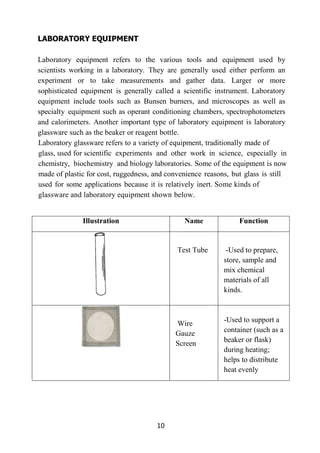
Illustration Name Function
Test Tube -Used to prepare,
store, sample and
mix chemical
materials of all
kinds.
Wire
Gauze
Screen
-Used to support a
container (such as a
beaker or flask)
during heating;
helps to distribute
heat evenly
11
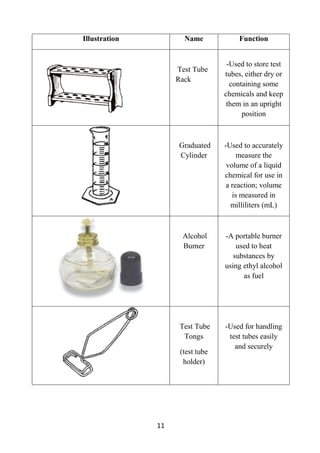
Illustration Name Function
Test Tube
Rack
-Used to store test
tubes, either dry or
containing some
chemicals and keep
them in an upright
position
Graduated
Cylinder
-Used to accurately
measure the
volume of a liquid
chemical for use in
a reaction; volume
is measured in
milliliters (mL)
Alcohol
Burner
-A portable burner
used to heat
substances by
using ethyl alcohol
as fuel
Test Tube
Tongs
(test tube
holder)
-Used for handling
test tubes easily
and securely
12
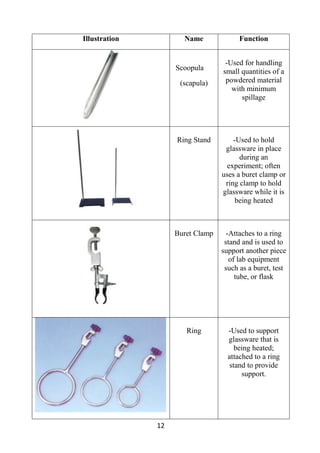
Illustration Name Function
Scoopula
(scapula)
-Used for handling
small quantities of a
powdered material
with minimum
spillage
Ring Stand -Used to hold
glassware in place
during an
experiment; often
uses a buret clamp or
ring clamp to hold
glassware while it is
being heated
Buret Clamp -Attaches to a ring
stand and is used to
support another piece
of lab equipment
such as a buret, test
tube, or flask
Ring -Used to support
glassware that is
being heated;
attached to a ring
stand to provide
support.
13
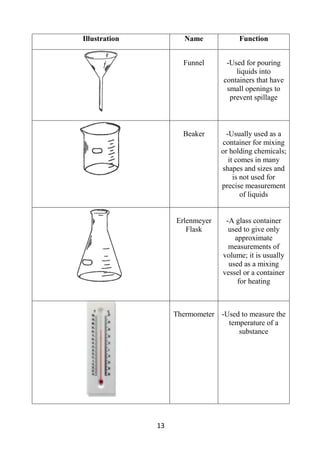
Illustration Name Function
Funnel -Used for pouring
liquids into
containers that have
small openings to
prevent spillage
Beaker -Usually used as a
container for mixing
or holding chemicals;
it comes in many
shapes and sizes and
is not used for
precise measurement
of liquids
Erlenmeyer
Flask
-A glass container
used to give only
approximate
measurements of
volume; it is usually
used as a mixing
vessel or a container
for heating
Thermometer -Used to measure the
temperature of a
substance
14
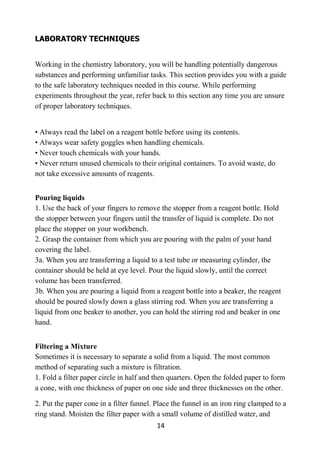
LABORATORY TECHNIQUES
Working in the chemistry laboratory, you will be handling potentially dangerous
substances and performing unfamiliar tasks. This section provides you with a guide
to the safe laboratory techniques needed in this course. While performing
experiments throughout the year, refer back to this section any time you are unsure
of proper laboratory techniques.
• Always read the label on a reagent bottle before using its contents.
• Always wear safety goggles when handling chemicals.
• Never touch chemicals with your hands.
• Never return unused chemicals to their original containers. To avoid waste, do
not take excessive amounts of reagents.
Pouring liquids
1. Use the back of your fingers to remove the stopper from a reagent bottle. Hold
the stopper between your fingers until the transfer of liquid is complete. Do not
place the stopper on your workbench.
2. Grasp the container from which you are pouring with the palm of your hand
covering the label.
3a. When you are transferring a liquid to a test tube or measuring cylinder, the
container should be held at eye level. Pour the liquid slowly, until the correct
volume has been transferred.
3b. When you are pouring a liquid from a reagent bottle into a beaker, the reagent
should be poured slowly down a glass stirring rod. When you are transferring a
liquid from one beaker to another, you can hold the stirring rod and beaker in one
hand.
Filtering a Mixture
Sometimes it is necessary to separate a solid from a liquid. The most common
method of separating such a mixture is filtration.
1. Fold a filter paper circle in half and then quarters. Open the folded paper to form
a cone, with one thickness of paper on one side and three thicknesses on the other.
2. Put the paper cone in a filter funnel. Place the funnel in an iron ring clamped to a
ring stand. Moisten the filter paper with a small volume of distilled water, and
15
gently press the paper against the sides of the funnel to achieve a good fit. (If the
correct size of filter paper has been used, the top edge of the cone will be just
below the rim of the filter funnel.)
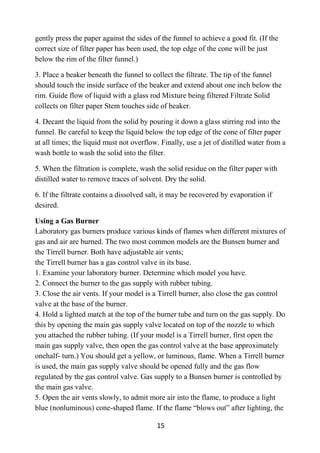
3. Place a beaker beneath the funnel to collect the filtrate. The tip of the funnel
should touch the inside surface of the beaker and extend about one inch below the
rim. Guide flow of liquid with a glass rod Mixture being filtered Filtrate Solid
collects on filter paper Stem touches side of beaker.
4. Decant the liquid from the solid by pouring it down a glass stirring rod into the
funnel. Be careful to keep the liquid below the top edge of the cone of filter paper
at all times; the liquid must not overflow. Finally, use a jet of distilled water from a
wash bottle to wash the solid into the filter.
5. When the filtration is complete, wash the solid residue on the filter paper with
distilled water to remove traces of solvent. Dry the solid.
6. If the filtrate contains a dissolved salt, it may be recovered by evaporation if
desired.
Using a Gas Burner
Laboratory gas burners produce various kinds of flames when different mixtures of
gas and air are burned. The two most common models are the Bunsen burner and
the Tirrell burner. Both have adjustable air vents;
the Tirrell burner has a gas control valve in its base.
1. Examine your laboratory burner. Determine which model you have.
2. Connect the burner to the gas supply with rubber tubing.
3. Close the air vents. If your model is a Tirrell burner, also close the gas control
valve at the base of the burner.
4. Hold a lighted match at the top of the burner tube and turn on the gas supply. Do
this by opening the main gas supply valve located on top of the nozzle to which
you attached the rubber tubing. (If your model is a Tirrell burner, first open the
main gas supply valve, then open the gas control valve at the base approximately
onehalf- turn.) You should get a yellow, or luminous, flame. When a Tirrell burner
is used, the main gas supply valve should be opened fully and the gas flow
regulated by the gas control valve. Gas supply to a Bunsen burner is controlled by
the main gas valve.
5. Open the air vents slowly, to admit more air into the flame, to produce a light
blue (nonluminous) cone-shaped flame. If the flame “blows out” after lighting, the
16
gas supply should be reduced.
6. Adjust the air vents and gas supply to produce the desired size of flame. For
most laboratory work, the blue inner cone of the flame should be about 1 inch high
and free of yellow color. If you want a smaller flame, close the air vent slightly and
reduce the gas supply. You will learn how to control the burner flame by trial and
error.
7. Turn the burner off at the main gas supply valve when done. CAUTION:
Confine long hair and loose clothing when using a gas burner. Do not reach over a
burner. Ensure that flammables are not being used when a burner is lit. Never leave
a lit burner unattended. Know the location of fire extinguishers, the fire blanket,
and safety shower.
Heating Liquids
Heating a Liquid in a Test Tube
The correct procedure for heating liquids in the laboratory is important to
laboratory safety.
1. Adjust your gas burner to produce a gentle blue flame.
2. Fill a test tube one-third full with the liquid to be heated.
3. Grasp the test tube with a test-tube holder, near the upper end of the tube.
4. Hold the test tube in a slanting position in the flame, and gently heat the tube a
short distance below the surface of the liquid.
5. Shake the tube gently as it is being heated, until the liquid boils or reaches the
desired temperature.
CAUTION: Never point the open end of a test tube you are heating either toward
yourself or anyone working nearby. Never heat the bottom of the test tube.
Heating a Liquid in a Beaker
Many laboratory experiments require the use of a hot water or boiling water bath.
This procedure describes how to assemble a water bath.
1. Fasten an iron ring securely to a ring stand so that it is 2–4 cm above the top of a
gas burner placed on the ring stand base.
2. Place a 250-mL beaker one-half-filled with water on a wire gauze resting on the
iron ring.
3. Light your gas burner and adjust it to produce a hot flame.
4. Place the burner beneath the wire gauze. For a slower rate of heating, reduce the
intensity of the burner flame.
CAUTION: Never heat plastic beakers or graduated glassware in a burner flame.
Never let a boiling water bath boil dry; add water to it as necessary.
17
Inserting Glass Tubing
In many experimental procedures, you are required to insert a thermometer or a
length of glass tubing into a hole in a rubber stopper. It is essential that you know
the correct way to do this. Otherwise, serious injury may result.
1. Lubricate the end of the glass tubing with a few drops of water, washing-up
liquid, glycerol, or vegetable oil.
2. Hold the glass tubing close to where it enters the hole in the rubber stopper.
Protect your hands with work gloves or pieces of cloth.
3. Ease the tubing into the hole with a gentle twisting motion. Push the tubing
through the hole as far as is required. Do not use force!
4. Wipe excess lubricating material from the tubing before continuing with the
experiment.
5. If the glass tubing is to be removed from the stopper, it should be done
immediately after the experiment is completed.
CAUTION: The end of the glass tubing should be fire-polished or smoothed with
emery cloth before being inserted into a rubber stopper. Do not try to bend the
glass tubing—it will break. Ensure that the palm of the hand holding the rubber
stopper is not in line with the emerging glass tube.
Measuring Mass
In many experiments you are required to determine the mass of a chemical used or
produced in a reaction. An object’s mass is determined by measuring it on a
balance. When you determine the mass of an object, you are comparing its mass
with a known mass. In the SI, the base unit of mass is the kilogram.
• Check the balance before you start. The balance pan should be empty and clean,
and all masses (or dials) should be set on zero. The balance must be level. Check
the bubble level on the base. See your
teacher if you need assistance with checking your balance.
• Objects to be placed directly on the balance pan must be clean, dry, and at room
temperature. Solid chemicals and liquids must never be put directly on the balance
pan. Liquid samples should be placed in beakers or sealed containers. Solid
chemicals can be conveniently placed in beakers, disposable plastic weighing
boats, or on 10-cm squares made of glossy paper.
• The balance is a precision instrument that must be handled with care. To avoid
18
damaging it, always be sure that the balance is in an arrested position when objects
are placed on or removed from the pan. Always turn all dials slowly.
• Never move or jar either a balance or the balance table.
• If you spill a chemical on or near the balance, clean it up immediately. If in
doubt, inform your teacher. A camel-hair brush is usually provided to wipe minute
traces of solid from the balance pan before you use it.
• Never attempt to measure an object with a mass greater than the maximum
capacity of the balance.
• When you are done, return all the masses to zero, and make sure the balance pan
is clean.
Do not attempt to use a balance until your teacher has demonstrated the proper
technique.
Measuring Volume
Volume measurements are important in many experimental procedures. Sometimes
volume measurements must be accurate; other times they can be approximate.
Most volume measures in the laboratory are made using equipment calibrated in
milliliters. Although some beakers have graduation marks, these marks are
designed only for quick, rough estimates of volume. Accurate volumes must be
measured with pipets, burets, or volumetric flasks.
Using a Graduated Cylinder
Half-fill a 100-mL graduated cylinder with water, and set the cylinder on your
laboratory bench. Examine the surface of the water. Notice how the surface curves
upward where the water contacts the cylinder walls. This
curved surface is called a meniscus.
A volume measurement is always read at the bottom of the meniscus, with your
eye at the same level as the liquid surface. To make the meniscus more visible, you
can place your finger or a dark piece of paper behind and just below the meniscus
while making the reading.
Graduated cylinders are available in many capacities. The 100-mL cylinder is
marked in 1-mL divisions, and volumes can be estimated to the nearest 0.1 mL.
The last digit in these measurements is therefore significant
but uncertain.
Using a Pipet
A pipet is used to accurately measure and deliver volumes of liquids. Two types
are in common use: volumetric pipets and graduated, or measuring, pipets. The use
19
of a volumetric pipet will be described. A volumetric pipet has a single calibration
mark and delivers the volume printed on the bulb of the pipet at the temperature
specified. (A graduated pipet has calibrations along the length of the pipet.)
Volumes can be measured more accurately with a volumetric pipet than with a
graduated pipet.
1. Place the tip of the pipet below the surface of the liquid to be dispensed.
2. Compress a pipet bulb and press the hole in the bulb against the upper end of the
pipet. CAUTION: Never fill a pipet by applying suction with your mouth. Never
push the pipet bulb over the end of the pipet.
3. Slowly release pressure on the bulb so that liquid is drawn into the pipet to a
level about 2 cm above the calibration mark.
4. Remove the bulb and simultaneously place your index finger over the end of the
pipet. If you are right-handed, you should hold the pipet in your right hand and the
pipet bulb in your left.
5. Keep your index finger pressed firmly against the end. Withdraw the pipet from
the liquid, and carefully wipe the outside of the stem with a paper towel.
6. Slowly reduce the pressure on your finger to allow the excess liquid to drain into
a waste receiver, until the bottom of the meniscus is at the calibration mark.
7. Now, deliver the remaining liquid in the pipet into the designated receiver.
When releasing liquid from a volumetric pipet, let it drain completely. Wait 20
seconds, then touch the pipet tip to the side of the flask or surface of the liquid.
This action will remove some, but not all, of the liquid in the tip. The pipet delivers
the stated volume when this procedure is followed. A small amount of liquid
remains in the tip. Do not blow this out into your receiver.
20
THE FORMAT OF A LABORATORY REPORT
TITLE. This should give both the substance or system studied and the method of
physical measurement made, or of property determined.
OBJECT OR PURPOSE. One sentence; may not be necessary if it just duplicates
the title.
PRINCIPLE OF METHOD. Briefly discuss the theory underlying the laboratory
and briefly give the principle of the method, and use this as opportunity to write
down any equations you will use in results and calculations.
PROCEDURE. You may refer to the lab. manual for this, but you should any
modifications to the procedure and indicate possible improvements and sources of
errors or other general problems. Draw diagrams of apparatus setup if required.
RESULTS AND CALCULATIONS. Tabulating usually saves a lot of time and
space. Embed both the graphs and tables in the text. Be sure to make the graphs
readable. For repeated calculations, give one example and one only, in full.
CONCLUSIONS. Your major findings in a few lines.
21
EXPERIMENTAL PART
Experiment № 1.
Quantitative assay of proteins by the biuret method
Principle: The biuret method is based on the ability of protein solutions to change
their color on red - violet due to the interaction with a solution of copper sulfate in
alkaline media. The intensity of coloring is proportional to the protein
concentration in solution.
Material: blood serum.
Reagents: 0.9% solution of NaCl, biuret reagent (0.15 g CuSO4 • 5H2O,
and 0.6 g NaKC4H4O6 • 4H2O (sodium potassium tartrate, or Rochelle salt), was
dissolved in 50 ml of H2O under vigorous stirring, 30 ml 10% solution of NaOH,
and 0.1 g of KI was added; mixture must be dissolved in 100 ml of water).
Instruments and equipment: PEC, micropipettes, tubes, glass rods, 10 mm
cuvettes.
Procedure:
1. Put 0.1 ml of serum in the 1st
tube and add 5 ml of biuret reagent.
2. Put 0.1 ml of 0.9 % solution of NaCl in the 2nd
tube and add 5 ml of biuret
reagent.
3. Stir both test tubes very gently in order to avoid foaming of liquid.
4. Incubate for 30 min at room temperature to let the colors develop.
5. Place colored solutions in different cuvettes (thickness of layer is 1 cm) and
analyze on a photoelectric colorimeter with a green filter (wave length is
540 nm). Use a cuvette with mix of biuret reagent and 0.9 % solution of
NaCl as a test.
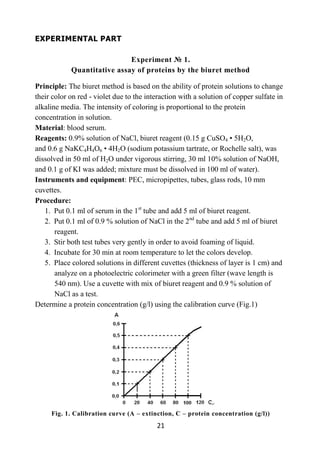
Determine a protein concentration (g/l) using the calibration curve (Fig.1)
Fig. 1. Calibration curve (A – extinction, C – protein concentration (g/l))
22
Note: the total protein in normal serum varies from 65 to 85 g/l.
Write down the results and draw to a conclusion.
Experiment № 2.
Color reactions for amino acids and proteins.
Properties of proteins
Principle: Color reactions on proteins are qualitative reactions caused by presence
of specific chemical groups. Some of these reactions are widely used in
biochemical practice to study the structure and amino acid composition of proteins
and their quantitative determination.
Material: 1% solutions of egg white and gelatin.
Reagents: 10% and 30% solutions of NaOH, 1% solution of CuSO4•5H2O,
1% solution of ninhydrin, 95% solution of acetone, 5% solution of
(CH3COO)2Рb, HNO3 (conc.), 1% solution of C6H7NO3S, 5% solution of HCl,
0.5% solution of NaNO2, 10% solution of Na2CO3.
Instruments and equipment: test tubes, pipettes, funnels, glass rods, paper filters,
glasses 100 and 500 ml, cylinders, alcohol lamps, holders.
Procedure: Part A. Preparation of standard protein solution
Egg protein is a 10% aqueous solution of several proteins and in contrast to the
yolk does not contain large amounts of other organic compounds (lipids and
carbohydrates). Almost 70% of egg protein is egg albumin, which is easily
separated from the globulin fraction by 10-fold dilution of the egg white with
distilled water. In this case, the globulin proteins precipitate fraction and easily
separated from the solution by filtration or centrifugation. Egg albumin remains in
solution.
1. To separate the protein from the yolk gently, make holes in the shell on both
ends and the protein will flow out into a beaker (500 ml). Put 250 ml of distilled
water in the same beaker and mix thoroughly by means of a glass rod.
2. Transfer the solution into a measuring cylinder and add distilled water until the
total volume riches 300 ml. Left the solution for 30 minutes at room temperature to
form a floc of globulins.
3. Drain 15 ml of the resulting suspension through a filter. The filtrate containing
ovalbumin will be used for further work.
23
Part B. Color reaction on proteins
1. The ninhydrin test (on the amino group in α-position).
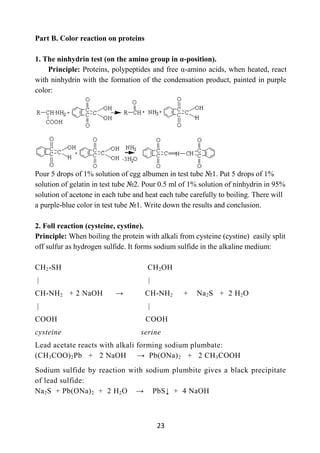
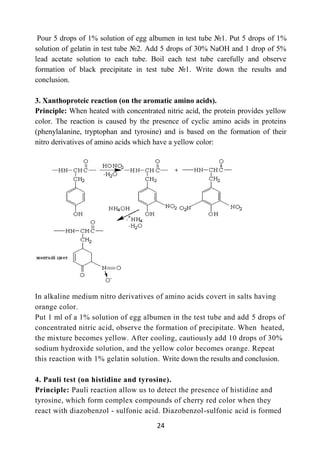
Principle: Proteins, polypeptides and free α-amino acids, when heated, react
with ninhydrin with the formation of the condensation product, painted in purple
color:
Pour 5 drops of 1% solution of egg albumen in test tube №1. Put 5 drops of 1%
solution of gelatin in test tube №2. Pour 0.5 ml of 1% solution of ninhydrin in 95%
solution of acetone in each tube and heat each tube carefully to boiling. There will
a purple-blue color in test tube №1. Write down the results and conclusion.
2. Foll reaction (cysteine, cystine).
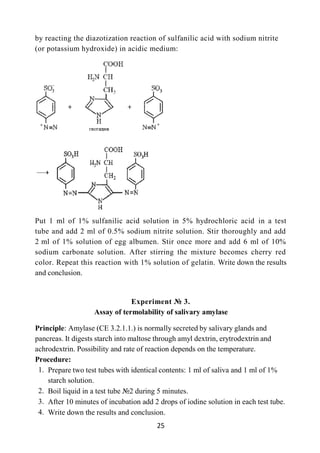
Principle: When boiling the protein with alkali from cysteine (cystine) easily split
off sulfur as hydrogen sulfide. It forms sodium sulfide in the alkaline medium:
СН2-SН СН2ОН
| |
СН-NH2 + 2 NaOH → СН-NH2 + Na2S + 2 Н2О
| |
CООН COOH
cysteine serine
Lead acetate reacts with alkali forming sodium plumbate:
(СН3СОО)2Рb + 2 NaOH → Pb(ONa)2 + 2 CH3COOH
Sodium sulfide by reaction with sodium plumbite gives a black precipitate
of lead sulfide:
Na2S + Pb(ONa)2 + 2 Н2О → PbS↓ + 4 NaOH
24
Pour 5 drops of 1% solution of egg albumen in test tube №1. Put 5 drops of 1%
solution of gelatin in test tube №2. Add 5 drops of 30% NaOH and 1 drop of 5%
lead acetate solution to each tube. Boil each test tube carefully and observe
formation of black precipitate in test tube №1. Write down the results and
conclusion.
3. Xanthoproteic reaction (on the aromatic amino acids).
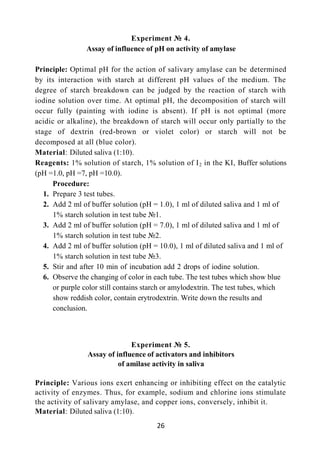
Principle: When heated with concentrated nitric acid, the protein provides yellow
color. The reaction is caused by the presence of cyclic amino acids in proteins
(phenylalanine, tryptophan and tyrosine) and is based on the formation of their
nitro derivatives of amino acids which have a yellow color:
In alkaline medium nitro derivatives of amino acids covert in salts having
orange color.
Put 1 ml of a 1% solution of egg albumen in the test tube and add 5 drops of
concentrated nitric acid, observe the formation of precipitate. When heated,
the mixture becomes yellow. After cooling, cautiously add 10 drops of 30%
sodium hydroxide solution, and the yellow color becomes orange. Repeat
this reaction with 1% gelatin solution. Write down the results and conclusion.
4. Pauli test (on histidine and tyrosine).
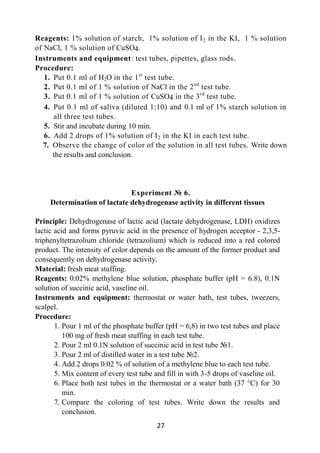
Principle: Pauli reaction allow us to detect the presence of histidine and
tyrosine, which form complex compounds of cherry red color when they
react with diazobenzol - sulfonic acid. Diazobenzol-sulfonic acid is formed
25
by reacting the diazotization reaction of sulfanilic acid with sodium nitrite
(or potassium hydroxide) in acidic medium:
Put 1 ml of 1% sulfanilic acid solution in 5% hydrochloric acid in a test
tube and add 2 ml of 0.5% sodium nitrite solution. Stir thoroughly and add
2 ml of 1% solution of egg albumen. Stir once more and add 6 ml of 10%
sodium carbonate solution. After stirring the mixture becomes cherry red
color. Repeat this reaction with 1% solution of gelatin. Write down the results
and conclusion.
Experiment № 3.
Assay of termolability of salivary amylase
Principle: Amylase (CE 3.2.1.1.) is normally secreted by salivary glands and
pancreas. It digests starch into maltose through amyl dextrin, erytrodextrin and
achrodextrin. Possibility and rate of reaction depends on the temperature.
Procedure:
1. Prepare two test tubes with identical contents: 1 ml of saliva and 1 ml of 1%
starch solution.
2. Boil liquid in a test tube №2 during 5 minutes.
3. After 10 minutes of incubation add 2 drops of iodine solution in each test tube.
4. Write down the results and conclusion.
26
Experiment № 4.
Assay of influence of pH on activity of amylase
Principle: Optimal pH for the action of salivary amylase can be determined
by its interaction with starch at different pH values of the medium. The
degree of starch breakdown can be judged by the reaction of starch with
iodine solution over time. At optimal pH, the decomposition of starch will
occur fully (painting with iodine is absent). If pH is not optimal (more
acidic or alkaline), the breakdown of starch will occur only partially to the
stage of dextrin (red-brown or violet color) or starch will not be
decomposed at all (blue color).
Material: Diluted saliva (1:10).
Reagents: 1% solution of starch, 1% solution of I2 in the KI, Buffer solutions
(pH =1.0, pH =7, pH =10.0).
Procedure:
1. Prepare 3 test tubes.
2. Add 2 ml of buffer solution (pH = 1.0), 1 ml of diluted saliva and 1 ml of
1% starch solution in test tube №1.
3. Add 2 ml of buffer solution (pH = 7.0), 1 ml of diluted saliva and 1 ml of
1% starch solution in test tube №2.
4. Add 2 ml of buffer solution (pH = 10.0), 1 ml of diluted saliva and 1 ml of
1% starch solution in test tube №3.
5. Stir and after 10 min of incubation add 2 drops of iodine solution.
6. Observe the changing of color in each tube. The test tubes which show blue
or purple color still contains starch or amylodextrin. The test tubes, which
show reddish color, contain erytrodextrin. Write down the results and
conclusion.
Experiment № 5.
Assay of influence of activators and inhibitors
of amilase activity in saliva
Principle: Various ions exert enhancing or inhibiting effect on the catalytic
activity of enzymes. Thus, for example, sodium and chlorine ions stimulate
the activity of salivary amylase, and copper ions, conversely, inhibit it.
Material: Diluted saliva (1:10).
27
Reagents: 1% solution of starch, 1% solution of I2 in the KI, 1 % solution
of NaCl, 1 % solution of CuSO4.
Instruments and equipment: test tubes, pipettes, glass rods.
Procedure:
1. Put 0.1 ml of H2O in the 1st
test tube.
2. Put 0.1 ml of 1 % solution of NaCl in the 2nd
test tube.
3. Put 0.1 ml of 1 % solution of CuSO4 in the 3rd
test tube.
4. Put 0.1 ml of saliva (diluted 1:10) and 0.1 ml of 1% starch solution in
all three test tubes.
5. Stir and incubate during 10 min.
6. Add 2 drops of 1% solution of I2 in the KI in each test tube.
7. Observe the change of color of the solution in all test tubes. Write down
the results and conclusion.
Experiment № 6.
Determination of lactate dehydrogenase activity in different tissues
Principle: Dehydrogenase of lactic acid (lactate dehydrogenase, LDH) oxidizes
lactic acid and forms pyruvic acid in the presence of hydrogen acceptor - 2,3,5-
triphenyltetrazolium chloride (tetrazolium) which is reduced into a red colored
product. The intensity of color depends on the amount of the former product and
consequently on dehydrogenase activity.
Material: fresh meat stuffing.
Reagents: 0.02% methylene blue solution, phosphate buffer (pH = 6.8), 0.1N
solution of succinic acid, vaseline oil.
Instruments and equipment: thermostat or water bath, test tubes, tweezers,
scalpel.
Procedure:
1. Pour 1 ml of the phosphate buffer (рН = 6,8) in two test tubes and place
100 mg of fresh meat stuffing in each test tube.
2. Pour 2 ml 0.1N solution of succinic acid in test tube №1.
3. Pour 2 ml of distilled water in a test tube №2.
4. Add 2 drops 0.02 % of solution of a methylene blue to each test tube.
5. Mix content of every test tube and fill in with 3-5 drops of vaseline oil.
6. Place both test tubes in the thermostat or a water bath (37 °C) for 30
min.
7. Compare the coloring of test tubes. Write down the results and
conclusion.
28
Experiment № 7.
Determination of alpha-amylase activity
in blood serum and urine by Caraway’s method
Principle: ɑ -amylase breaks down starch to form products that do not give a color
reaction with iodine. The method is based on the colorimetric determination of
residual starch residue which is painted by iodine.
Material: serum and urine.
Reagents: 1% solution of starch, 1% solution of I2 in the KI, phosphate buffer at
different pH (from 5.5 to 8.0).
Instruments and equipment: PEC, 10 mm cuvettes, thermostat, conical flasks (50
ml), pipettes, filter paper.
Procedure:
1. Pour 2 ml of starch solution in three flasks. Mark flask №1 and №2 as
sample and flask №3 as test.
2. Put all flasks in the thermostat at 37 °C for 5 minutes.
3. Pour 0.1 ml of blood serum in a flask №1 and 0.1 ml of filtered fresh
urine in a flask №2.
4. Stir all flasks and put them on a thermostat for 8 minutes at 37 °C.
5. Add 5 ml of iodine solution in all flasks.
6. Bring the volume of liquid in each flask to 50 ml by adding distilled
water.
7. Determine the optical density of the solutions immediately at the PEC
with a red light filter (λ = 630 - 690 nm) in a cuvettes with thickness of 10
mm (Control - distilled water).
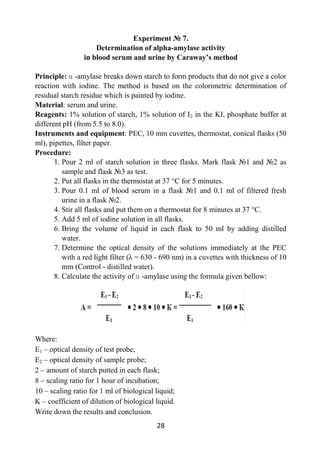
8. Calculate the activity of ɑ -amylase using the formula given bellow:
Where:
E1 – optical density of test probe;
E2 – optical density of sample probe;
2 – amount of starch putted in each flask;
8 – scaling ratio for 1 hour of incubation;
10 – scaling ratio for 1 ml of biological liquid;
K – coefficient of dilution of biological liquid.
Write down the results and conclusion.
29
Experiment № 8.
Qualitative assay of hydrolysis products of baker’s yeast
Principle: Components of nucleic acids can be detected by means of various
qualitative reactions in which a color of the solution is changed.
Material: Baker’s yeast.
Reagents: 10% solution of Н2SO4, Н2SO4 (conc.), 10% and 30% solutions of
NaOH, 1% and 7% solutions of CuSO4•5H2O, NH3•H2O (conc.), 2% ammoniac
silver nitrate solution, 1% alcoholic solution of thimol, 1% solution of
diphenylamine, 0,2% alcoholic solution of α-naphthol, molybdenum reagent
(7,5g (NH4)6Мо7О24 dissolve in 100 ml of 32% solution of HNО3), universal
indicator paper.
Instruments and equipment: electronic balance, flasks, reflux condencer, sand
and water bath, funnel, paper filters, pipettes, test tubes, alcohol burner, holders.
Part A. Preparation of nucleic acids from yeast.
Procedure:
1. Weigh 2.5 g of Baker’s yeast.
2. Put the sample in a flask and add 20 ml of 10% solution of Н2SO4.
3. Close a flask using stopper and connect the reflux condenser. Place a
flask on a sand bath.
4. The duration of hydrolysis after the start of boiling of the liquid is 1 hour.
5. Cool the flask and then filter the liquid through a paper filter.
Part B. Qualitative reactions to constituents of nucleoproteins.
1) The Biuret reaction on the polypeptides.
Procedure:
1. Put 5 drops of hydrolysate in a test tube, add 10 drops of 10% solutions of
NaOH and 1 drop of 1% solution of CuSO4•5H2O.
2. The liquid is painted in pink and purple color. Write down the results and
conclusion.
2) The silver test for purine bases.
Procedure:
1. Pour 10 drops of hydrolysate in a test tube, add several drops of
concentrated ammonia solution as long as the medium becomes alkaline
(check it by the indicator paper).
2. Pour 10 drops of 2% ammonia solution of silver nitrate.
30
3. Wait 3-5 minutes and observe precipitate of compounds of purine bases
(adenine and guanine) with silver ions, painted in light brown color. Write
down the results and conclusion.
3) Molish’s test on a pentose.
Procedure:
1. Pour 10 drops of hydrolysate in a test tube and add 3 drops of 1% of spirit
solution of a thymol.
2. Mix thoroughly.
3. Carefully add 0.5 ml of concentrated Н2SO4 pouring down the test tube’s
sidewall in order to “sublayer” the fluid in it. At the border of structural
constituents, a red-violet-coloured layer is formed, spreading to the entire
solution after gentle mixing. Write down the results and conclusion.
4) Trommer’s test on a ribose and a desoxyribose.
Procedure:
1. Pour 5 drops of hydrolysate in a test tube and add 10 drops of 30%
solution of NaOH and 1-3 drops of 7% solution of CuSO4•5H2O to form a
suspension of copper hydroxide (II).
2. Mix and carefully boil the liquid in a test tube. Observe a yellow
precipitate of copper hydroxide (I) or a red precipitate of copper oxide (I).
Write down the results and conclusion.
5) General reaction to sugars – test with α-naphthol.
Procedure:
1. Collect 5 drops of hydrolysate into a test tube, add 3 drops of 0.2% α-
naphthol alcohol solution and 20 drops of Н2SO4 (conc.).
2. A pink-purple color emerges. Write down the results and conclusion.
6) Molybdenic test on phosphoric acid.
Procedure:
1. Collect 10 drops of a hydrolysate into a test tube, add 20 drops of a
molybdenic reactant and boil. A lemon yellow color emerges.
2. Cool a test tube in a stream of cold water. At the bottom of the test tube
appears crystal lemon-yellow sediment of ammonium phosphomolibdate.
Write down the results and conclusion.
31
Experiment № 9.
Qualitative reactions on vitamins
Material: powder (or solution) of thiamine, solutions of riboflavin and ascorbic
acid, powder of nicotinic acid, cod-liver oil.
Reagents: 1% solution of C6H7NO3S, 5% solution of NaNO2, 10% solution of
Na2CO3, 10% solution of NaOН, 5% solution of K4[Fe(CN)6], HCl (conc.),
H2SO4 (conc.), Zn, 10% solution of СН3СООН, 5% solution of К3Fe(CN)6, 1%
solution of FeCl3, chloroform, aniline reagent (15 parts of С6H5NH2 and 1 part of
H2SO4 (conc.)), 5% solution of copper acetate.
Instruments and equipment: test tubes, pipette holders, a alcohol burner.
1. Diazo reaction to thiamine (B1).
Principle: A solution of thiamine is painted in orange or red when you add to it
diazobenzolsulfate and alkali due to the formation of compounds of thiamine
with diazobenzenesulphonic acid.
Procedure:
1. Pour 5 drops of 1% of solution of C6H7NO3S in a test tube, add 5
drops of 5% of solution of NaNO2. Diazobenzolsulfate is a product of
the reaction.
2. Put a small amount of thiamine powder in the same test tube with
diazobenzolsulfat and add 5-7 drops of 10% solution of Na2CO3.
3. Liquid is painted in orange or red color. Carefully add solution of
soda pouring down the test tube’s sidewall in order to “sublayer” the
fluid in it. At the border of structural constituents, a red-coloured ring
is formed.
2. The reaction of oxidation of thiamine in tiochrom.
Principle: K4[Fe(CN)6] can oxidize thiamine with formation of the yellow
pigment thiochrom.
Procedure:
1. Pour 1 drop of thiamine solution in a test tube, add 5-10 drops of
10% solution of NaOН and 1-2 drops of 5% solution of
K4[Fe(CN)6] and mix.
2. Heat a test tube. The liquid becomes yellow as a result of
conversion of thiamine in tiochrom.
32
3. The reduction of riboflavin (B2).
Procedure:
1. Pour 10 drops of riboflavin suspension in water in a test tube.
2. Add 5 drops of HCl (conc.) and a piece of zinc.
3. Rapid release of hydrogen bubbles begins, and the liquid gradually turns
pink or red, then the color of fluid slowly diappears.
4. A copper probe for nicotinic acid (PP or B5).
Principle: Heating of a mixture of nicotinic acid and copper acetate gives a blue
sediment of copper nicotinate.
Procedure:
1. Dissolve 10 mg of nicotinic acid in 10-20 drops of 10% acetic acid.
2. Heat the tube to boiling and then add an equal volume of 5% solution of
copper acetate.
3. The liquid turns blue and after standing blue sediment appears. Explain
the results and draw a conclusion.
5. Reduction of K3Fe(CN)6 by ascorbic acid.
Principle. Ascorbic acid reduces K3Fe(CN)6 to K4Fe(CN)6. The latter reacts
with FeCl3 to produce a bright blue pigment - Berliner blau.
Procedure:
1. Add into two tubes one drop of 5% solution of K3Fe(CN)6 and one drop
1% solution of FeCl3.
2. Add to the first tube 5-10 drops of an extract from canine rose fruits, into
the second - equal an volume of distilled water.
3. The liquid in the first tube should change to blue and sometimes a blue
sediment of Berliner blau pigment may appear. No changes occur in the
second tube. Explain the results and draw a conclusion.
6. Reaction of vitamin A with the concentrated sulfuric acid.
Principle: The adding of H2SO4 (conc.) to emulsion of cod-liver oil in
chloroform leads to the formation of red - colored compounds. Then the color
changes to red-brown.
Procedure:
1. Pour 1 drop of cod-liver oil and 5 drops of chloroform in a dry test
tube.
2. Mix and add 1 drop H2SO4 (conc.).
33
3. Observe the changing of color. Explain the results and draw a
conclusion.
7. Aniline test on vitamin D.
Principle: The adding of aniline reagent (mix of aniline and HCl (conc.)) to
emulsion of cod-liver oil in chloroform leads to the formation of red - colored
compounds.
Procedure:
1. Pour 1 drop of cod-liver oil and 5 drops of chloroform in a dry test
tube.
2. Mix and add 1 drop of an aniline reagent.
3. Heat the test tube. The yellow emulsion accepts red coloring.
4. Explain the results and draw a conclusion.
Experiment № 10.
Quantitative determination of ascorbic acid in urine
Principle. Ascorbic acid is readily oxidized with a specific dye - 2,6-
dichlorophenol-indophenol with a change in color from blue to pink. Urine is
titrated with a solution of the stain and the quantity of ascorbic acid is determined
taking into account, that 1 ml of dye solution corresponds to 0.1 mg of ascorbic
acid.
Material: urine.
Reagents: acetic acid (conc.), 0.001N solution of 2,6-dichlorophenolindophenol.
Instruments and equipment: conic flasks, burettes, pipettes.
Procedure: Pour into three flasks 5 ml of freshly obtained urine, add 5 drops of
concentrated acetic acid. Titrate each flask with a solution of
dichlorophenolindophenol to a not disappearing blue color. To calculate, determine
the average value of the parameter. In clinical practice the quantity of ascorbic acid
is calculated in a portion of urine and in daily excreted urine.
Explain the results and draw a conclusion.
Clinical and diagnostic significance. In many diseases of digestive system
absorption of vitamins in the intestinal mucosa and transport to blood is impaired
and decomposition of vitamins in the digestive tube is enhanced. This can take
place in patients with ulcers, gastritis, enteritis, cholecystitis, etc.
34
The level of ascorbic acid in blood, urine and in foods is determined in order to
assess the sufficiency of intake of the organism with this vitamin. Normal blood
level of vitamin C in adults is 39.7 – 113.6 μmol/L.
Ascorbic acid and the products of its decomposition are excreted with urine. A
healthy person excretes daily 20 – 30 mg or 113– 170 μmoles of vitamin C.
Intensified decomposition of ascorbic acid occurs in patients with hypoacidic
gastritis, ulcers, enteritis. Excretion of vitamin C below the normal level indicates
on hypovitaminosis C– insufficient intake of the organism with vitamin C .
Vitamin C avitaminosis causes scurvy – a disease, characterized by gingival
bleeding, dry and pale skin, subcutaneous hemorrhages, loosening and falling
teeth, joint pains and slow healing of injuries.
Experiment № 11.
Quantitative determination of ascorbic acid in various foodstuffs
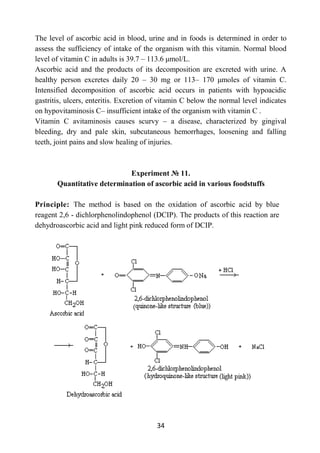
Principle: The method is based on the oxidation of ascorbic acid by blue
reagent 2,6 - dichlorphenolindophenol (DCIP). The products of this reaction are
dehydroascorbic acid and light pink reduced form of DCIP.
35
Material: various foodstuffs (for example, potatoes, carrots, cabbage).
Reagents: 10 % solution of H2SO4, 0.001N solution of 2,6-dichlorphenolindo-
phenol.
Instruments and equipment: test tubes, pipettes, cylinders, funnels,
beakers, conic flasks, burettes, graters, filters (gauze and paper), electronic
balances.
Procedure: Part A. Preparation of extract from plant material
1. Chop 25 g of the selected plant sample by using a grater.
2. Put it in the beaker and pour 15 ml of the distilled water.
3. Filter the extract and mesure his total volume. The received filtrate will be
used in the subsequent analysis.
Procedure: Part B. Quantitative determination of vitamin C
1. Measure out 10 ml of extract in a flask and add 3 drops of 10% H2SO4.
2. Titrate with 0.001N 2,6-dichlorphenolindophenol until the appearance of
pink colour which doesn’t disappear within 30 seconds. If the extract
contains chlorophyll and has green colour, titrate this extract, comparing its
colour with the colour of the same extract stored without titration, because
green colour masks light pink colour. In this case titrate the content of the
flask until the change of the colour of the titrated extract in comparison
with a control sample (without titration). Repeat titration for 3 times.
3. Calculate the average value of the volume of titrating solution and use the
formula given bellow for quantitative determination of ascorbic acid.
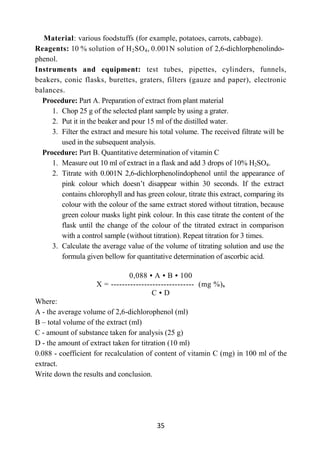
0,088 • А • В • 100
Х = ------------------------------ (mg %),
С • D
Where:
A - the average volume of 2,6-dichlorophenol (ml)
B – total volume of the extract (ml)
C - amount of substance taken for analysis (25 g)
D - the amount of extract taken for titration (10 ml)
0.088 - coefficient for recalculation of content of vitamin C (mg) in 100 ml of the
extract.
Write down the results and conclusion.
36
Experiment № 12.
Quantitative determination of vitamin Р in the different sorts of tea
Principle: The method is based on the ability of vitamin Р to be oxidized by
potassium permanganate. Indigocarmine is used as an indicator. It reacts with
potassium permanganate after the complete oxidation of vitamin P.
Material: black and green tea.
Reagents: 0.02 M solution of KMnO4, indigocarmine.
Insruments and equipment: pipettes, cylinders, funnels, conic flasks, burettes,
electronic balances.
Procedure:
1. Put 250 mg of dry tea in a glass and add 100 ml of boiling water.
2. Infuse 5 min, cool and filter the extract.
3. Place in a flask 2 ml of the extract, add 50 ml of cold distilled water and 5
drops of indigocarmin.
4. Titrate until the appearance of stable yellow colouring. Repeat titration for 3
times, calculate the average volume of titrating solution. It will be
experimental volume of titrating solution.
5. Put 52 ml of cold distilled water in a next flask and add 5 drops of
indigocarmin.
6. Titrate until the appearance of stable yellow colouring. It will be test volume
of titrating solution.
7. Repeat these procedures for all sorts of tea.
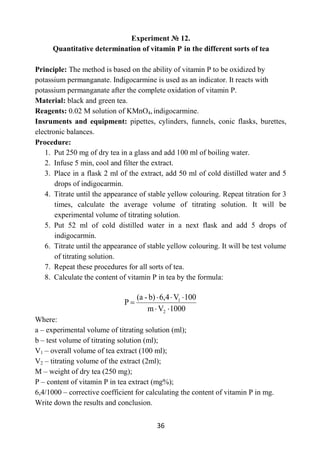
8. Calculate the content of vitamin P in tea by the formula:
1000
V
m
100
V
6,4
b)
-
(a
P
2
1
Where:
a – experimental volume of titrating solution (ml);
b – test volume of titrating solution (ml);
V1 – overall volume of tea extract (100 ml);
V2 – titrating volume of the extract (2ml);
M – weight of dry tea (250 mg);
P – content of vitamin P in tea extract (mg%);
6,4/1000 – corrective coefficient for calculating the content of vitamin P in mg.
Write down the results and conclusion.
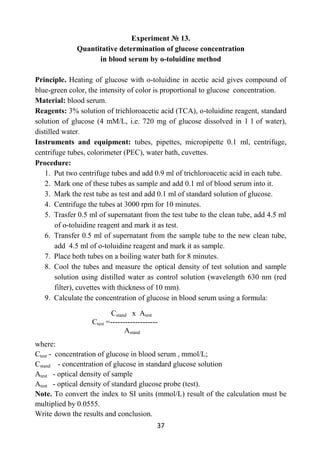
37
Experiment № 13.
Quantitative determination of glucose concentration
in blood serum by o-toluidine method
Principle. Heating of glucose with o-toluidine in acetic acid gives compound of
blue-green color, the intensity of color is proportional to glucose concentration.
Material: blood serum.
Reagents: 3% solution of trichloroacetic acid (TCA), o-toluidine reagent, standard
solution of glucose (4 mM/L, i.e. 720 mg of glucose dissolved in 1 l of water),
distilled water.
Instruments and equipment: tubes, pipettes, micropipette 0.1 ml, centrifuge,
centrifuge tubes, colorimeter (PEC), water bath, cuvettes.
Procedure:
1. Put two centrifuge tubes and add 0.9 ml of trichloroacetic acid in each tube.
2. Mark one of these tubes as sample and add 0.1 ml of blood serum into it.
3. Mark the rest tube as test and add 0.1 ml of standard solution of glucose.
4. Centrifuge the tubes at 3000 rpm for 10 minutes.
5. Trasfer 0.5 ml of supernatant from the test tube to the clean tube, add 4.5 ml
of o-toluidine reagent and mark it as test.
6. Transfer 0.5 ml of supernatant from the sample tube to the new clean tube,
add 4.5 ml of o-toluidine reagent and mark it as sample.
7. Place both tubes on a boiling water bath for 8 minutes.
8. Cool the tubes and measure the optical density of test solution and sample
solution using distilled water as control solution (wavelength 630 nm (red
filter), cuvettes with thickness of 10 mm).
9. Calculate the concentration of glucose in blood serum using a formula:
Cstand x Atest
Ctest =-------------------
Astand
where:
Ctest - concentration of glucose in blood serum , mmol/L;
Cstand - concentration of glucose in standard glucose solution
Atest - optical density of sample
Atest - optical density of standard glucose probe (test).
Note. To convert the index to SI units (mmol/L) result of the calculation must be
multiplied by 0.0555.
Write down the results and conclusion.
38
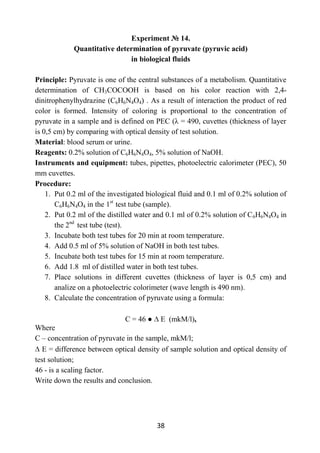
Experiment № 14.
Quantitative determination of pyruvate (pyruvic acid)
in biological fluids
Principle: Pyruvate is one of the central substances of a metabolism. Quantitative
determination of СН3СОСООН is based on his color reaction with 2,4-
dinitrophenylhydrazine (C6H6N4O4) . As a result of interaction the product of red
color is formed. Intensity of coloring is proportional to the concentration of
pyruvate in a sample and is defined on PEC (λ = 490, cuvettes (thickness of layer
is 0,5 cm) by comparing with optical density of test solution.
Material: blood serum or urine.
Reagents: 0.2% solution of C6H6N4O4, 5% solution of NaOH.
Instruments and equipment: tubes, pipettes, photoelectric calorimeter (PEC), 50
mm cuvettes.
Procedure:
1. Put 0.2 ml of the investigated biological fluid and 0.1 ml of 0.2% solution of
C6H6N4O4 in the 1st
test tube (sample).
2. Put 0.2 ml of the distilled water and 0.1 ml of 0.2% solution of C6H6N4O4 in
the 2nd
test tube (test).
3. Incubate both test tubes for 20 min at room temperature.
4. Add 0.5 ml of 5% solution of NaOH in both test tubes.
5. Incubate both test tubes for 15 min at room temperature.
6. Add 1.8 ml of distilled water in both test tubes.
7. Place solutions in different cuvettes (thickness of layer is 0,5 cm) and
analize on a photoelectric colorimeter (wave length is 490 nm).
8. Calculate the concentration of pyruvate using a formula:
С = 46 ● Е (mkM/l),
Where
C – concentration of pyruvate in the sample, mkM/l;
E = difference between optical density of sample solution and optical density of
test solution;
46 - is a scaling factor.
Write down the results and conclusion.
39
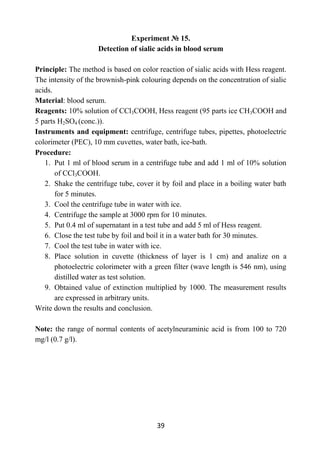
Experiment № 15.
Detection of sialic acids in blood serum
Principle: The method is based on color reaction of sialic acids with Hess reagent.
The intensity of the brownish-pink colouring depends on the concentration of sialic
acids.
Material: blood serum.
Reagents: 10% solution of CCl3СООН, Hess reagent (95 parts ice CH3COOH and
5 parts Н2SО4 (conc.)).
Instruments and equipment: centrifuge, centrifuge tubes, pipettes, photoelectric
colorimeter (PEC), 10 mm cuvettes, water bath, ice-bath.
Procedure:
1. Put 1 ml of blood serum in a centrifuge tube and add 1 ml of 10% solution
of CCl3СООН.
2. Shake the centrifuge tube, cover it by foil and place in a boiling water bath
for 5 minutes.
3. Cool the centrifuge tube in water with ice.
4. Centrifuge the sample at 3000 rpm for 10 minutes.
5. Put 0.4 ml of supernatant in a test tube and add 5 ml of Hess reagent.
6. Close the test tube by foil and boil it in a water bath for 30 minutes.
7. Cool the test tube in water with ice.
8. Place solution in cuvette (thickness of layer is 1 cm) and analize on a
photoelectric colorimeter with a green filter (wave length is 546 nm), using
distilled water as test solution.
9. Obtained value of extinction multiplied by 1000. The measurement results
are expressed in arbitrary units.
Write down the results and conclusion.
Note: the range of normal contents of acetylneuraminic acid is from 100 to 720
mg/l (0.7 g/l).
40
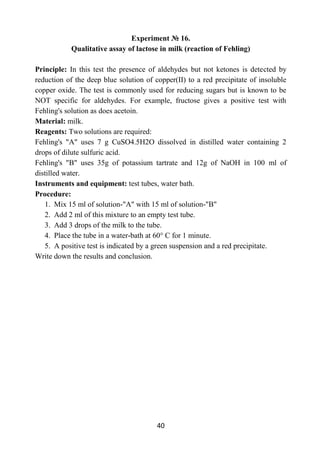
Experiment № 16.
Qualitative assay of lactose in milk (reaction of Fehling)
Principle: In this test the presence of aldehydes but not ketones is detected by
reduction of the deep blue solution of copper(II) to a red precipitate of insoluble
copper oxide. The test is commonly used for reducing sugars but is known to be
NOT specific for aldehydes. For example, fructose gives a positive test with
Fehling's solution as does acetoin.
Material: milk.
Reagents: Two solutions are required:
Fehling's "A" uses 7 g CuSO4.5H2O dissolved in distilled water containing 2
drops of dilute sulfuric acid.
Fehling's "B" uses 35g of potassium tartrate and 12g of NaOH in 100 ml of
distilled water.
Instruments and equipment: test tubes, water bath.
Procedure:
1. Mix 15 ml of solution-"A" with 15 ml of solution-"B"
2. Add 2 ml of this mixture to an empty test tube.
3. Add 3 drops of the milk to the tube.
4. Place the tube in a water-bath at 60° C for 1 minute.
5. A positive test is indicated by a green suspension and a red precipitate.
Write down the results and conclusion.
41
REFERENCES
1. Руководство для лабораторно-практических работ по биологической
химии: Руководство для студентов 1 курса медицинского
факультета специальностей 060101 «Лечебное дело» и 060103
«Педиатрия» // Составители: Еникеев Э.Ш., Терёхина Н.В.–
Ульяновск: УлГУ, 2015. – 45 с.
2. Руководство для лабораторно-практических работ по биологической
химии: Руководство для студентов 2 курса медицинского
факультета специальностей 060101 «Лечебное дело» и 060103
«Педиатрия» // Составители: Еникеев Э.Ш., Терёхина Н.В.–
Ульяновск: УлГУ, 2015. – 46 с.
3. Boyer, Rodney F. Biochemistry laboratory : modern theory and
techniques / Rodney Boyer. — 2nd ed. © 2012, 2006 Pearson Education,
Inc. Pearson Prentice Hall.
4. Dr. Gyanendra Awasthi, Dr. Santosh Kumar, Dr. Ashwani Sanghi, Mr.
Shiv Sharan Singh. Biochemistry Laboratory Manual. International E –
Publication, 2013.
5. Zewail G.S. Safety in Academic Chemistry Laboratories-Accident
Prevention for College and University Students. A Publication of
American Chemical Society Joint Board-Council Committee on
Chemical Safety. 7th Edition-Vol. 1, 2014.
6. Laboratory Safety Regulations. Vanier College, Chemistry Department,
2008.
7. themedicalbiochemistrypage.org
8. study.com
9. www. slideshare.net
10.www. esht.nhs.uk
11.www. fairbornchempage.com
12.biophysics.sbp.ac.at
42
Учебное издание
E.Sh. Yenikeyev, N.V. Terekhina
LABORATORY MANUAL OF BIOCHEMISTRY
FOR FOREIGN MEDICAL STUDENTS
Part 1
Директор Издательского центра Т. В. Филиппова
Печатается в авторской редакции
Подписано в печать 13.11.2015. Формат 60×84/16.
Усл. печ. л. 2,4. Уч.-изд. л. 2,1.
Тираж 150 экз. Заказ № 111 /
Отпечатано с оригинал-макет в Издательском центре
Ульяновского государственного университета
432017, г. Ульяновск, ул. Л. Толстого, 42

Biochemistry.pdf

  • 1.
    Ministry of Scienceand Education of Russian Federation Federal state institution of higher professional education Ulyanovsk State University Insitute of Medicine, Ecology and Physical culture E.Sh. Yenikeyev, N.V. Terekhina LABORATORY MANUAL OF BIOCHEMISTRY FOR FOREIGN MEDICAL STUDENTS Part 1 Ulyanovsk - 2015
  • 2.
    2 УДК 577.1 (075.8) ББК28.072я73 Recommended for publishing by the Methodical Committee and Academic Council of Ulyanovsk State University Written and compiled by: E.Sh. Yenikeyev, Cand.Biol.Sci, Associate Professor N.V. Terekhina, Cand.Biol.Sci. Reviewers: T.P. Gening, Doct.Biol.Sci, Professor D.A. Kseico, Cand.Biol.Sci, Associate Professor Yenikeyev, E.Sh. Laboratory Manual of Biochemistry for foreign medical students / E.Sh. Yenikeyev, N.V. Terekhina. – Part 1. – Ulyanovsk : Ulyanovsk State University, 2015. – 42 р. This manual is designed according to syllabus of biochemistry for students of Medical faculty (specialities: general medicine, pediatrics and pharmacology). It will be a guide to action for students during their practical work. УДК 577.1 (075.8) ББК 28.072я73 © Yenikeyev E.Sh., Terekhina N.V., 2015 © Ulyanovsk State University, 2015
  • 3.
    3 TABLE OF CONTENTS PAGE Preface4 Rules for working in a biochemical laboratory 5 Laboratory equipment 10 Laboratory technics 14 The format of laboratory report 20 Experimental part 20 References 41
  • 4.
    4 PREFACE Biological chemistry isa fundamental medical discipline. The knowledge of biochemistry is necessary for any medical student for understanding of methabolic processes of human in normal and decease state, interpret and use biochemical data in prognostics and cure. Practical work is an important part of the discipline. This side of learning give an opportunity for medical student to see the basis of clinical laboratory activity. Students will become familiar with commonly used labware and instrumentation of a biochemical laboratory, learn the requirements and rules for work. Laboratory reports will be required for all experiments.
  • 5.
    5 RULES FOR WORKINGIN A BIOCHEMICAL LABORATORY 1. Notify your instructor at once in case of any accident or personal injury to you or your neighbor, even if apparently minor. 2. Wear safety goggles, if necessary. 3. Locate safety equipment. During the first laboratory period familiarize yourself with the location and operation of the safety features of the laboratory, including: • Fire extinguishers • Fire blanket • Laboratory first aid kits 4. Know the ways to put out a fire. a) If it is open fire, such as a large chemical spill on a lab bench, the correct extinguisher should be used as follows: Pull the pin. Point the extinguisher (of dry) or hose (if CO2) at the base of the fire. Squeeze the handle while moving the extinguisher back and forth. NOTE: Be careful not to spread the fire by getting the nozzle of the extinguisher too close-- the material being emitted is under pressure. b) If it is a small, contained fire, such as in a flask or beaker, cover the container with a piece of ceramic, cutting off the supply of oxygen to the fire and thus putting it out. 5. Be careful when using glassware. Cuts and burns are the most common injuries that occur in chemistry laboratories.
  • 6.
    6 6. Wash chemicalsfrom skin. a) If you receive a chemical burn from a caustic material, i.e. acid or base, immediately wash the burned area with large quantities of water. Ask another student to summon the lab instructor. b) Wash your hands and face quickly and thoroughly whenever they come into contact with a chemical. c) Always wash your hands, before leaving the lab since toxic chemicals may be transferred to the mouth at a later time. 7. Be careful with flames. A lighted gas burner can be a major fire hazard. a) General Precautions: 1) The burner should be burning only for the period of time in which it is actually utilized. 2) Before lighting your burner carefully position it on the desk away from flammable materials, overhanging reagent shelves, flammable reagents such as acetone, toluene, and alcohol on neighboring desks. 3) Be careful not to extend your arm over a burner while reaching for something. b) Personal Precautions: 1) Keep long hair tied back so that it cannot fall forward into a flame. 2) Keep beards away from flames. 8. Never point a test tube toward a laboratory neighbor or yourself when: a) Heating a test tube over a burner. b) Carrying out a reaction in a test tube. 9. Wear suitable clothing. Wear clothing that will protect you against spilled chemicals or flaming liquids. Hard-soled, covered footwear must be worn in the laboratory at all times--no sandals allowed. 10. Assume that a particular reagent is hazardous unless you know for sure it is not. a) Never taste a chemical unless specifically directed to do so. b) If you are instructed to smell a chemical, point the vessel away from your face and carefully fan the vapors toward your face with your hand and sniff gently.
  • 7.
    7 11. Never filla pipette by using your mouth. 12. Dilute concentrated acids and bases by pouring the reagent into water (room temperature or lower) while stirring constantly. Never pour water into concentrated acids; the heat of solution will cause the water to boil and the acid to splatter. 13. Use the fume hoods. Any experiment involving the use of or production of poisonous or irritating gases must be performed in a hood. 14. Read the label. Read the label carefully, read it twice, before taking anything from a bottle. Many chemicals have similar names, such as sodium sulfate and sodium sulfite. Using the wrong reagent can spoil an experiment or can cause a serious accident. 15. Eating, drinking, and smoking are strictly prohibited in the laboratory at all times because of the possibility of chemicals getting into the mouth or lungs through contamination. The chief hazard with smoking is fire. 16. Avoid rubbing your eyes unless you know your hands are clean. 17. Do not put hot objects on the desktops. Place hot objects on a wire gauze or ceramic pad. 18. Never throw lighted matches into a sink. They may ignite a discarded flammable liquid. 19. Perform only authorized experiments. Unless authorized to do so by the instructor, a student will be subject to immediate and permanent expulsion from the lab if: a) Attempting to conduct unauthorized experiments. b) Attempting variations of the experiment in the lab manual Performing unauthorized experiments are dangerous. Students lack the experience to recognize whether or not the chemicals and techniques are safe.
  • 8.
    8 20. Keep yourworkspace orderly. a) Place tall items, such as graduated cylinders, toward the back of the workbench so they will not be overturned by reaching over them. b) Clean up all chemical spills, scraps of paper, and glassware immediately. c) Keep drawers closed while working and the aisles free of any obstructions, including chairs. d) Never place coats, books, and other belongings on the laboratory bench where they will interfere with the experiment and are likely to be damaged. 21. Clean up your workspace at the end of each laboratory period. a) Wash and wipe off your desktop. b) Be sure gas and water are turned off. 22. Avoid using excessive amounts of reagent. a) Never use more than called for in the experiment. b) Do not return any excess chemical to the reagent bottle. c) If you are uncertain how to dispose of an excess of a specific chemical, consult your instructor. 23. Discard waste chemicals as follows: a) Non – flammable water – soluble liquids – in Liquid Waste bottle b) Chemical solids, contaminated paper, contaminated broken glassware – in Solid Waste bottle c) Paper products – in Trash can d) Organic solvents (exepting acids) – in Organic Waste bottle e) Glass tubing waste or broken glass – in Broken Glass Wooden Box 24. Always add a reagent slowly--never "dump" in. Two reasons: a) Some reactions give off a lot of heat, and unless adding slowly, can become too vigorous and out of control.
  • 9.
    9 b) If youmake a mistake and choose the wrong chemical, adding slowly decreases the possibility of causing a serious accident. 25. Treat chemical spills as follows: a) Alert your lab neighbors and your instructor. b) Clean up the spill as directed by your lab instructor. 26. Never fill a vessel more than about 70% capacity if you plan to heat it, unless specifically told to do so. 27. Never work in the lab without the instructor present. This includes setting up equipment. 28. Maintain a wholesome, businesslike attitude in the lab. Horseplay and other acts of carelessness are prohibited. 29. Be aware of your lab neighbors' activities; you may be a victim of their mistakes. If you observe improper techniques or unsafe practices: a) Advise your neighbor. b) Advise your instructor if necessary. 30. Observe all specific precautions and modifications mentioned in each experiment. 31. Do not remove any chemicals from the lab. 32. For reasons of safety, you may not be allowed to attend lab if you are late.
  • 10.
    10 LABORATORY EQUIPMENT Laboratory equipmentrefers to the various tools and equipment used by scientists working in a laboratory. They are generally used either perform an experiment or to take measurements and gather data. Larger or more sophisticated equipment is generally called a scientific instrument. Laboratory equipment include tools such as Bunsen burners, and microscopes as well as specialty equipment such as operant conditioning chambers, spectrophotometers and calorimeters. Another important type of laboratory equipment is laboratory glassware such as the beaker or reagent bottle. Laboratory glassware refers to a variety of equipment, traditionally made of glass, used for scientific experiments and other work in science, especially in chemistry, biochemistry and biology laboratories. Some of the equipment is now made of plastic for cost, ruggedness, and convenience reasons, but glass is still used for some applications because it is relatively inert. Some kinds of glassware and laboratory equipment shown below. Illustration Name Function Test Tube -Used to prepare, store, sample and mix chemical materials of all kinds. Wire Gauze Screen -Used to support a container (such as a beaker or flask) during heating; helps to distribute heat evenly
  • 11.
    11 Illustration Name Function TestTube Rack -Used to store test tubes, either dry or containing some chemicals and keep them in an upright position Graduated Cylinder -Used to accurately measure the volume of a liquid chemical for use in a reaction; volume is measured in milliliters (mL) Alcohol Burner -A portable burner used to heat substances by using ethyl alcohol as fuel Test Tube Tongs (test tube holder) -Used for handling test tubes easily and securely
  • 12.
    12 Illustration Name Function Scoopula (scapula) -Usedfor handling small quantities of a powdered material with minimum spillage Ring Stand -Used to hold glassware in place during an experiment; often uses a buret clamp or ring clamp to hold glassware while it is being heated Buret Clamp -Attaches to a ring stand and is used to support another piece of lab equipment such as a buret, test tube, or flask Ring -Used to support glassware that is being heated; attached to a ring stand to provide support.
  • 13.
    13 Illustration Name Function Funnel-Used for pouring liquids into containers that have small openings to prevent spillage Beaker -Usually used as a container for mixing or holding chemicals; it comes in many shapes and sizes and is not used for precise measurement of liquids Erlenmeyer Flask -A glass container used to give only approximate measurements of volume; it is usually used as a mixing vessel or a container for heating Thermometer -Used to measure the temperature of a substance
  • 14.
    14 LABORATORY TECHNIQUES Working inthe chemistry laboratory, you will be handling potentially dangerous substances and performing unfamiliar tasks. This section provides you with a guide to the safe laboratory techniques needed in this course. While performing experiments throughout the year, refer back to this section any time you are unsure of proper laboratory techniques. • Always read the label on a reagent bottle before using its contents. • Always wear safety goggles when handling chemicals. • Never touch chemicals with your hands. • Never return unused chemicals to their original containers. To avoid waste, do not take excessive amounts of reagents. Pouring liquids 1. Use the back of your fingers to remove the stopper from a reagent bottle. Hold the stopper between your fingers until the transfer of liquid is complete. Do not place the stopper on your workbench. 2. Grasp the container from which you are pouring with the palm of your hand covering the label. 3a. When you are transferring a liquid to a test tube or measuring cylinder, the container should be held at eye level. Pour the liquid slowly, until the correct volume has been transferred. 3b. When you are pouring a liquid from a reagent bottle into a beaker, the reagent should be poured slowly down a glass stirring rod. When you are transferring a liquid from one beaker to another, you can hold the stirring rod and beaker in one hand. Filtering a Mixture Sometimes it is necessary to separate a solid from a liquid. The most common method of separating such a mixture is filtration. 1. Fold a filter paper circle in half and then quarters. Open the folded paper to form a cone, with one thickness of paper on one side and three thicknesses on the other. 2. Put the paper cone in a filter funnel. Place the funnel in an iron ring clamped to a ring stand. Moisten the filter paper with a small volume of distilled water, and
  • 15.
    15 gently press thepaper against the sides of the funnel to achieve a good fit. (If the correct size of filter paper has been used, the top edge of the cone will be just below the rim of the filter funnel.) 3. Place a beaker beneath the funnel to collect the filtrate. The tip of the funnel should touch the inside surface of the beaker and extend about one inch below the rim. Guide flow of liquid with a glass rod Mixture being filtered Filtrate Solid collects on filter paper Stem touches side of beaker. 4. Decant the liquid from the solid by pouring it down a glass stirring rod into the funnel. Be careful to keep the liquid below the top edge of the cone of filter paper at all times; the liquid must not overflow. Finally, use a jet of distilled water from a wash bottle to wash the solid into the filter. 5. When the filtration is complete, wash the solid residue on the filter paper with distilled water to remove traces of solvent. Dry the solid. 6. If the filtrate contains a dissolved salt, it may be recovered by evaporation if desired. Using a Gas Burner Laboratory gas burners produce various kinds of flames when different mixtures of gas and air are burned. The two most common models are the Bunsen burner and the Tirrell burner. Both have adjustable air vents; the Tirrell burner has a gas control valve in its base. 1. Examine your laboratory burner. Determine which model you have. 2. Connect the burner to the gas supply with rubber tubing. 3. Close the air vents. If your model is a Tirrell burner, also close the gas control valve at the base of the burner. 4. Hold a lighted match at the top of the burner tube and turn on the gas supply. Do this by opening the main gas supply valve located on top of the nozzle to which you attached the rubber tubing. (If your model is a Tirrell burner, first open the main gas supply valve, then open the gas control valve at the base approximately onehalf- turn.) You should get a yellow, or luminous, flame. When a Tirrell burner is used, the main gas supply valve should be opened fully and the gas flow regulated by the gas control valve. Gas supply to a Bunsen burner is controlled by the main gas valve. 5. Open the air vents slowly, to admit more air into the flame, to produce a light blue (nonluminous) cone-shaped flame. If the flame “blows out” after lighting, the
  • 16.
    16 gas supply shouldbe reduced. 6. Adjust the air vents and gas supply to produce the desired size of flame. For most laboratory work, the blue inner cone of the flame should be about 1 inch high and free of yellow color. If you want a smaller flame, close the air vent slightly and reduce the gas supply. You will learn how to control the burner flame by trial and error. 7. Turn the burner off at the main gas supply valve when done. CAUTION: Confine long hair and loose clothing when using a gas burner. Do not reach over a burner. Ensure that flammables are not being used when a burner is lit. Never leave a lit burner unattended. Know the location of fire extinguishers, the fire blanket, and safety shower. Heating Liquids Heating a Liquid in a Test Tube The correct procedure for heating liquids in the laboratory is important to laboratory safety. 1. Adjust your gas burner to produce a gentle blue flame. 2. Fill a test tube one-third full with the liquid to be heated. 3. Grasp the test tube with a test-tube holder, near the upper end of the tube. 4. Hold the test tube in a slanting position in the flame, and gently heat the tube a short distance below the surface of the liquid. 5. Shake the tube gently as it is being heated, until the liquid boils or reaches the desired temperature. CAUTION: Never point the open end of a test tube you are heating either toward yourself or anyone working nearby. Never heat the bottom of the test tube. Heating a Liquid in a Beaker Many laboratory experiments require the use of a hot water or boiling water bath. This procedure describes how to assemble a water bath. 1. Fasten an iron ring securely to a ring stand so that it is 2–4 cm above the top of a gas burner placed on the ring stand base. 2. Place a 250-mL beaker one-half-filled with water on a wire gauze resting on the iron ring. 3. Light your gas burner and adjust it to produce a hot flame. 4. Place the burner beneath the wire gauze. For a slower rate of heating, reduce the intensity of the burner flame. CAUTION: Never heat plastic beakers or graduated glassware in a burner flame. Never let a boiling water bath boil dry; add water to it as necessary.
  • 17.
    17 Inserting Glass Tubing Inmany experimental procedures, you are required to insert a thermometer or a length of glass tubing into a hole in a rubber stopper. It is essential that you know the correct way to do this. Otherwise, serious injury may result. 1. Lubricate the end of the glass tubing with a few drops of water, washing-up liquid, glycerol, or vegetable oil. 2. Hold the glass tubing close to where it enters the hole in the rubber stopper. Protect your hands with work gloves or pieces of cloth. 3. Ease the tubing into the hole with a gentle twisting motion. Push the tubing through the hole as far as is required. Do not use force! 4. Wipe excess lubricating material from the tubing before continuing with the experiment. 5. If the glass tubing is to be removed from the stopper, it should be done immediately after the experiment is completed. CAUTION: The end of the glass tubing should be fire-polished or smoothed with emery cloth before being inserted into a rubber stopper. Do not try to bend the glass tubing—it will break. Ensure that the palm of the hand holding the rubber stopper is not in line with the emerging glass tube. Measuring Mass In many experiments you are required to determine the mass of a chemical used or produced in a reaction. An object’s mass is determined by measuring it on a balance. When you determine the mass of an object, you are comparing its mass with a known mass. In the SI, the base unit of mass is the kilogram. • Check the balance before you start. The balance pan should be empty and clean, and all masses (or dials) should be set on zero. The balance must be level. Check the bubble level on the base. See your teacher if you need assistance with checking your balance. • Objects to be placed directly on the balance pan must be clean, dry, and at room temperature. Solid chemicals and liquids must never be put directly on the balance pan. Liquid samples should be placed in beakers or sealed containers. Solid chemicals can be conveniently placed in beakers, disposable plastic weighing boats, or on 10-cm squares made of glossy paper. • The balance is a precision instrument that must be handled with care. To avoid
  • 18.
    18 damaging it, alwaysbe sure that the balance is in an arrested position when objects are placed on or removed from the pan. Always turn all dials slowly. • Never move or jar either a balance or the balance table. • If you spill a chemical on or near the balance, clean it up immediately. If in doubt, inform your teacher. A camel-hair brush is usually provided to wipe minute traces of solid from the balance pan before you use it. • Never attempt to measure an object with a mass greater than the maximum capacity of the balance. • When you are done, return all the masses to zero, and make sure the balance pan is clean. Do not attempt to use a balance until your teacher has demonstrated the proper technique. Measuring Volume Volume measurements are important in many experimental procedures. Sometimes volume measurements must be accurate; other times they can be approximate. Most volume measures in the laboratory are made using equipment calibrated in milliliters. Although some beakers have graduation marks, these marks are designed only for quick, rough estimates of volume. Accurate volumes must be measured with pipets, burets, or volumetric flasks. Using a Graduated Cylinder Half-fill a 100-mL graduated cylinder with water, and set the cylinder on your laboratory bench. Examine the surface of the water. Notice how the surface curves upward where the water contacts the cylinder walls. This curved surface is called a meniscus. A volume measurement is always read at the bottom of the meniscus, with your eye at the same level as the liquid surface. To make the meniscus more visible, you can place your finger or a dark piece of paper behind and just below the meniscus while making the reading. Graduated cylinders are available in many capacities. The 100-mL cylinder is marked in 1-mL divisions, and volumes can be estimated to the nearest 0.1 mL. The last digit in these measurements is therefore significant but uncertain. Using a Pipet A pipet is used to accurately measure and deliver volumes of liquids. Two types are in common use: volumetric pipets and graduated, or measuring, pipets. The use
  • 19.
    19 of a volumetricpipet will be described. A volumetric pipet has a single calibration mark and delivers the volume printed on the bulb of the pipet at the temperature specified. (A graduated pipet has calibrations along the length of the pipet.) Volumes can be measured more accurately with a volumetric pipet than with a graduated pipet. 1. Place the tip of the pipet below the surface of the liquid to be dispensed. 2. Compress a pipet bulb and press the hole in the bulb against the upper end of the pipet. CAUTION: Never fill a pipet by applying suction with your mouth. Never push the pipet bulb over the end of the pipet. 3. Slowly release pressure on the bulb so that liquid is drawn into the pipet to a level about 2 cm above the calibration mark. 4. Remove the bulb and simultaneously place your index finger over the end of the pipet. If you are right-handed, you should hold the pipet in your right hand and the pipet bulb in your left. 5. Keep your index finger pressed firmly against the end. Withdraw the pipet from the liquid, and carefully wipe the outside of the stem with a paper towel. 6. Slowly reduce the pressure on your finger to allow the excess liquid to drain into a waste receiver, until the bottom of the meniscus is at the calibration mark. 7. Now, deliver the remaining liquid in the pipet into the designated receiver. When releasing liquid from a volumetric pipet, let it drain completely. Wait 20 seconds, then touch the pipet tip to the side of the flask or surface of the liquid. This action will remove some, but not all, of the liquid in the tip. The pipet delivers the stated volume when this procedure is followed. A small amount of liquid remains in the tip. Do not blow this out into your receiver.
  • 20.
    20 THE FORMAT OFA LABORATORY REPORT TITLE. This should give both the substance or system studied and the method of physical measurement made, or of property determined. OBJECT OR PURPOSE. One sentence; may not be necessary if it just duplicates the title. PRINCIPLE OF METHOD. Briefly discuss the theory underlying the laboratory and briefly give the principle of the method, and use this as opportunity to write down any equations you will use in results and calculations. PROCEDURE. You may refer to the lab. manual for this, but you should any modifications to the procedure and indicate possible improvements and sources of errors or other general problems. Draw diagrams of apparatus setup if required. RESULTS AND CALCULATIONS. Tabulating usually saves a lot of time and space. Embed both the graphs and tables in the text. Be sure to make the graphs readable. For repeated calculations, give one example and one only, in full. CONCLUSIONS. Your major findings in a few lines.
  • 21.
    21 EXPERIMENTAL PART Experiment №1. Quantitative assay of proteins by the biuret method Principle: The biuret method is based on the ability of protein solutions to change their color on red - violet due to the interaction with a solution of copper sulfate in alkaline media. The intensity of coloring is proportional to the protein concentration in solution. Material: blood serum. Reagents: 0.9% solution of NaCl, biuret reagent (0.15 g CuSO4 • 5H2O, and 0.6 g NaKC4H4O6 • 4H2O (sodium potassium tartrate, or Rochelle salt), was dissolved in 50 ml of H2O under vigorous stirring, 30 ml 10% solution of NaOH, and 0.1 g of KI was added; mixture must be dissolved in 100 ml of water). Instruments and equipment: PEC, micropipettes, tubes, glass rods, 10 mm cuvettes. Procedure: 1. Put 0.1 ml of serum in the 1st tube and add 5 ml of biuret reagent. 2. Put 0.1 ml of 0.9 % solution of NaCl in the 2nd tube and add 5 ml of biuret reagent. 3. Stir both test tubes very gently in order to avoid foaming of liquid. 4. Incubate for 30 min at room temperature to let the colors develop. 5. Place colored solutions in different cuvettes (thickness of layer is 1 cm) and analyze on a photoelectric colorimeter with a green filter (wave length is 540 nm). Use a cuvette with mix of biuret reagent and 0.9 % solution of NaCl as a test. Determine a protein concentration (g/l) using the calibration curve (Fig.1) Fig. 1. Calibration curve (A – extinction, C – protein concentration (g/l))
  • 22.
    22 Note: the totalprotein in normal serum varies from 65 to 85 g/l. Write down the results and draw to a conclusion. Experiment № 2. Color reactions for amino acids and proteins. Properties of proteins Principle: Color reactions on proteins are qualitative reactions caused by presence of specific chemical groups. Some of these reactions are widely used in biochemical practice to study the structure and amino acid composition of proteins and their quantitative determination. Material: 1% solutions of egg white and gelatin. Reagents: 10% and 30% solutions of NaOH, 1% solution of CuSO4•5H2O, 1% solution of ninhydrin, 95% solution of acetone, 5% solution of (CH3COO)2Рb, HNO3 (conc.), 1% solution of C6H7NO3S, 5% solution of HCl, 0.5% solution of NaNO2, 10% solution of Na2CO3. Instruments and equipment: test tubes, pipettes, funnels, glass rods, paper filters, glasses 100 and 500 ml, cylinders, alcohol lamps, holders. Procedure: Part A. Preparation of standard protein solution Egg protein is a 10% aqueous solution of several proteins and in contrast to the yolk does not contain large amounts of other organic compounds (lipids and carbohydrates). Almost 70% of egg protein is egg albumin, which is easily separated from the globulin fraction by 10-fold dilution of the egg white with distilled water. In this case, the globulin proteins precipitate fraction and easily separated from the solution by filtration or centrifugation. Egg albumin remains in solution. 1. To separate the protein from the yolk gently, make holes in the shell on both ends and the protein will flow out into a beaker (500 ml). Put 250 ml of distilled water in the same beaker and mix thoroughly by means of a glass rod. 2. Transfer the solution into a measuring cylinder and add distilled water until the total volume riches 300 ml. Left the solution for 30 minutes at room temperature to form a floc of globulins. 3. Drain 15 ml of the resulting suspension through a filter. The filtrate containing ovalbumin will be used for further work.
  • 23.
    23 Part B. Colorreaction on proteins 1. The ninhydrin test (on the amino group in α-position). Principle: Proteins, polypeptides and free α-amino acids, when heated, react with ninhydrin with the formation of the condensation product, painted in purple color: Pour 5 drops of 1% solution of egg albumen in test tube №1. Put 5 drops of 1% solution of gelatin in test tube №2. Pour 0.5 ml of 1% solution of ninhydrin in 95% solution of acetone in each tube and heat each tube carefully to boiling. There will a purple-blue color in test tube №1. Write down the results and conclusion. 2. Foll reaction (cysteine, cystine). Principle: When boiling the protein with alkali from cysteine (cystine) easily split off sulfur as hydrogen sulfide. It forms sodium sulfide in the alkaline medium: СН2-SН СН2ОН | | СН-NH2 + 2 NaOH → СН-NH2 + Na2S + 2 Н2О | | CООН COOH cysteine serine Lead acetate reacts with alkali forming sodium plumbate: (СН3СОО)2Рb + 2 NaOH → Pb(ONa)2 + 2 CH3COOH Sodium sulfide by reaction with sodium plumbite gives a black precipitate of lead sulfide: Na2S + Pb(ONa)2 + 2 Н2О → PbS↓ + 4 NaOH
  • 24.
    24 Pour 5 dropsof 1% solution of egg albumen in test tube №1. Put 5 drops of 1% solution of gelatin in test tube №2. Add 5 drops of 30% NaOH and 1 drop of 5% lead acetate solution to each tube. Boil each test tube carefully and observe formation of black precipitate in test tube №1. Write down the results and conclusion. 3. Xanthoproteic reaction (on the aromatic amino acids). Principle: When heated with concentrated nitric acid, the protein provides yellow color. The reaction is caused by the presence of cyclic amino acids in proteins (phenylalanine, tryptophan and tyrosine) and is based on the formation of their nitro derivatives of amino acids which have a yellow color: In alkaline medium nitro derivatives of amino acids covert in salts having orange color. Put 1 ml of a 1% solution of egg albumen in the test tube and add 5 drops of concentrated nitric acid, observe the formation of precipitate. When heated, the mixture becomes yellow. After cooling, cautiously add 10 drops of 30% sodium hydroxide solution, and the yellow color becomes orange. Repeat this reaction with 1% gelatin solution. Write down the results and conclusion. 4. Pauli test (on histidine and tyrosine). Principle: Pauli reaction allow us to detect the presence of histidine and tyrosine, which form complex compounds of cherry red color when they react with diazobenzol - sulfonic acid. Diazobenzol-sulfonic acid is formed
  • 25.
    25 by reacting thediazotization reaction of sulfanilic acid with sodium nitrite (or potassium hydroxide) in acidic medium: Put 1 ml of 1% sulfanilic acid solution in 5% hydrochloric acid in a test tube and add 2 ml of 0.5% sodium nitrite solution. Stir thoroughly and add 2 ml of 1% solution of egg albumen. Stir once more and add 6 ml of 10% sodium carbonate solution. After stirring the mixture becomes cherry red color. Repeat this reaction with 1% solution of gelatin. Write down the results and conclusion. Experiment № 3. Assay of termolability of salivary amylase Principle: Amylase (CE 3.2.1.1.) is normally secreted by salivary glands and pancreas. It digests starch into maltose through amyl dextrin, erytrodextrin and achrodextrin. Possibility and rate of reaction depends on the temperature. Procedure: 1. Prepare two test tubes with identical contents: 1 ml of saliva and 1 ml of 1% starch solution. 2. Boil liquid in a test tube №2 during 5 minutes. 3. After 10 minutes of incubation add 2 drops of iodine solution in each test tube. 4. Write down the results and conclusion.
  • 26.
    26 Experiment № 4. Assayof influence of pH on activity of amylase Principle: Optimal pH for the action of salivary amylase can be determined by its interaction with starch at different pH values of the medium. The degree of starch breakdown can be judged by the reaction of starch with iodine solution over time. At optimal pH, the decomposition of starch will occur fully (painting with iodine is absent). If pH is not optimal (more acidic or alkaline), the breakdown of starch will occur only partially to the stage of dextrin (red-brown or violet color) or starch will not be decomposed at all (blue color). Material: Diluted saliva (1:10). Reagents: 1% solution of starch, 1% solution of I2 in the KI, Buffer solutions (pH =1.0, pH =7, pH =10.0). Procedure: 1. Prepare 3 test tubes. 2. Add 2 ml of buffer solution (pH = 1.0), 1 ml of diluted saliva and 1 ml of 1% starch solution in test tube №1. 3. Add 2 ml of buffer solution (pH = 7.0), 1 ml of diluted saliva and 1 ml of 1% starch solution in test tube №2. 4. Add 2 ml of buffer solution (pH = 10.0), 1 ml of diluted saliva and 1 ml of 1% starch solution in test tube №3. 5. Stir and after 10 min of incubation add 2 drops of iodine solution. 6. Observe the changing of color in each tube. The test tubes which show blue or purple color still contains starch or amylodextrin. The test tubes, which show reddish color, contain erytrodextrin. Write down the results and conclusion. Experiment № 5. Assay of influence of activators and inhibitors of amilase activity in saliva Principle: Various ions exert enhancing or inhibiting effect on the catalytic activity of enzymes. Thus, for example, sodium and chlorine ions stimulate the activity of salivary amylase, and copper ions, conversely, inhibit it. Material: Diluted saliva (1:10).
  • 27.
    27 Reagents: 1% solutionof starch, 1% solution of I2 in the KI, 1 % solution of NaCl, 1 % solution of CuSO4. Instruments and equipment: test tubes, pipettes, glass rods. Procedure: 1. Put 0.1 ml of H2O in the 1st test tube. 2. Put 0.1 ml of 1 % solution of NaCl in the 2nd test tube. 3. Put 0.1 ml of 1 % solution of CuSO4 in the 3rd test tube. 4. Put 0.1 ml of saliva (diluted 1:10) and 0.1 ml of 1% starch solution in all three test tubes. 5. Stir and incubate during 10 min. 6. Add 2 drops of 1% solution of I2 in the KI in each test tube. 7. Observe the change of color of the solution in all test tubes. Write down the results and conclusion. Experiment № 6. Determination of lactate dehydrogenase activity in different tissues Principle: Dehydrogenase of lactic acid (lactate dehydrogenase, LDH) oxidizes lactic acid and forms pyruvic acid in the presence of hydrogen acceptor - 2,3,5- triphenyltetrazolium chloride (tetrazolium) which is reduced into a red colored product. The intensity of color depends on the amount of the former product and consequently on dehydrogenase activity. Material: fresh meat stuffing. Reagents: 0.02% methylene blue solution, phosphate buffer (pH = 6.8), 0.1N solution of succinic acid, vaseline oil. Instruments and equipment: thermostat or water bath, test tubes, tweezers, scalpel. Procedure: 1. Pour 1 ml of the phosphate buffer (рН = 6,8) in two test tubes and place 100 mg of fresh meat stuffing in each test tube. 2. Pour 2 ml 0.1N solution of succinic acid in test tube №1. 3. Pour 2 ml of distilled water in a test tube №2. 4. Add 2 drops 0.02 % of solution of a methylene blue to each test tube. 5. Mix content of every test tube and fill in with 3-5 drops of vaseline oil. 6. Place both test tubes in the thermostat or a water bath (37 °C) for 30 min. 7. Compare the coloring of test tubes. Write down the results and conclusion.
  • 28.
    28 Experiment № 7. Determinationof alpha-amylase activity in blood serum and urine by Caraway’s method Principle: ɑ -amylase breaks down starch to form products that do not give a color reaction with iodine. The method is based on the colorimetric determination of residual starch residue which is painted by iodine. Material: serum and urine. Reagents: 1% solution of starch, 1% solution of I2 in the KI, phosphate buffer at different pH (from 5.5 to 8.0). Instruments and equipment: PEC, 10 mm cuvettes, thermostat, conical flasks (50 ml), pipettes, filter paper. Procedure: 1. Pour 2 ml of starch solution in three flasks. Mark flask №1 and №2 as sample and flask №3 as test. 2. Put all flasks in the thermostat at 37 °C for 5 minutes. 3. Pour 0.1 ml of blood serum in a flask №1 and 0.1 ml of filtered fresh urine in a flask №2. 4. Stir all flasks and put them on a thermostat for 8 minutes at 37 °C. 5. Add 5 ml of iodine solution in all flasks. 6. Bring the volume of liquid in each flask to 50 ml by adding distilled water. 7. Determine the optical density of the solutions immediately at the PEC with a red light filter (λ = 630 - 690 nm) in a cuvettes with thickness of 10 mm (Control - distilled water). 8. Calculate the activity of ɑ -amylase using the formula given bellow: Where: E1 – optical density of test probe; E2 – optical density of sample probe; 2 – amount of starch putted in each flask; 8 – scaling ratio for 1 hour of incubation; 10 – scaling ratio for 1 ml of biological liquid; K – coefficient of dilution of biological liquid. Write down the results and conclusion.
  • 29.
    29 Experiment № 8. Qualitativeassay of hydrolysis products of baker’s yeast Principle: Components of nucleic acids can be detected by means of various qualitative reactions in which a color of the solution is changed. Material: Baker’s yeast. Reagents: 10% solution of Н2SO4, Н2SO4 (conc.), 10% and 30% solutions of NaOH, 1% and 7% solutions of CuSO4•5H2O, NH3•H2O (conc.), 2% ammoniac silver nitrate solution, 1% alcoholic solution of thimol, 1% solution of diphenylamine, 0,2% alcoholic solution of α-naphthol, molybdenum reagent (7,5g (NH4)6Мо7О24 dissolve in 100 ml of 32% solution of HNО3), universal indicator paper. Instruments and equipment: electronic balance, flasks, reflux condencer, sand and water bath, funnel, paper filters, pipettes, test tubes, alcohol burner, holders. Part A. Preparation of nucleic acids from yeast. Procedure: 1. Weigh 2.5 g of Baker’s yeast. 2. Put the sample in a flask and add 20 ml of 10% solution of Н2SO4. 3. Close a flask using stopper and connect the reflux condenser. Place a flask on a sand bath. 4. The duration of hydrolysis after the start of boiling of the liquid is 1 hour. 5. Cool the flask and then filter the liquid through a paper filter. Part B. Qualitative reactions to constituents of nucleoproteins. 1) The Biuret reaction on the polypeptides. Procedure: 1. Put 5 drops of hydrolysate in a test tube, add 10 drops of 10% solutions of NaOH and 1 drop of 1% solution of CuSO4•5H2O. 2. The liquid is painted in pink and purple color. Write down the results and conclusion. 2) The silver test for purine bases. Procedure: 1. Pour 10 drops of hydrolysate in a test tube, add several drops of concentrated ammonia solution as long as the medium becomes alkaline (check it by the indicator paper). 2. Pour 10 drops of 2% ammonia solution of silver nitrate.
  • 30.
    30 3. Wait 3-5minutes and observe precipitate of compounds of purine bases (adenine and guanine) with silver ions, painted in light brown color. Write down the results and conclusion. 3) Molish’s test on a pentose. Procedure: 1. Pour 10 drops of hydrolysate in a test tube and add 3 drops of 1% of spirit solution of a thymol. 2. Mix thoroughly. 3. Carefully add 0.5 ml of concentrated Н2SO4 pouring down the test tube’s sidewall in order to “sublayer” the fluid in it. At the border of structural constituents, a red-violet-coloured layer is formed, spreading to the entire solution after gentle mixing. Write down the results and conclusion. 4) Trommer’s test on a ribose and a desoxyribose. Procedure: 1. Pour 5 drops of hydrolysate in a test tube and add 10 drops of 30% solution of NaOH and 1-3 drops of 7% solution of CuSO4•5H2O to form a suspension of copper hydroxide (II). 2. Mix and carefully boil the liquid in a test tube. Observe a yellow precipitate of copper hydroxide (I) or a red precipitate of copper oxide (I). Write down the results and conclusion. 5) General reaction to sugars – test with α-naphthol. Procedure: 1. Collect 5 drops of hydrolysate into a test tube, add 3 drops of 0.2% α- naphthol alcohol solution and 20 drops of Н2SO4 (conc.). 2. A pink-purple color emerges. Write down the results and conclusion. 6) Molybdenic test on phosphoric acid. Procedure: 1. Collect 10 drops of a hydrolysate into a test tube, add 20 drops of a molybdenic reactant and boil. A lemon yellow color emerges. 2. Cool a test tube in a stream of cold water. At the bottom of the test tube appears crystal lemon-yellow sediment of ammonium phosphomolibdate. Write down the results and conclusion.
  • 31.
    31 Experiment № 9. Qualitativereactions on vitamins Material: powder (or solution) of thiamine, solutions of riboflavin and ascorbic acid, powder of nicotinic acid, cod-liver oil. Reagents: 1% solution of C6H7NO3S, 5% solution of NaNO2, 10% solution of Na2CO3, 10% solution of NaOН, 5% solution of K4[Fe(CN)6], HCl (conc.), H2SO4 (conc.), Zn, 10% solution of СН3СООН, 5% solution of К3Fe(CN)6, 1% solution of FeCl3, chloroform, aniline reagent (15 parts of С6H5NH2 and 1 part of H2SO4 (conc.)), 5% solution of copper acetate. Instruments and equipment: test tubes, pipette holders, a alcohol burner. 1. Diazo reaction to thiamine (B1). Principle: A solution of thiamine is painted in orange or red when you add to it diazobenzolsulfate and alkali due to the formation of compounds of thiamine with diazobenzenesulphonic acid. Procedure: 1. Pour 5 drops of 1% of solution of C6H7NO3S in a test tube, add 5 drops of 5% of solution of NaNO2. Diazobenzolsulfate is a product of the reaction. 2. Put a small amount of thiamine powder in the same test tube with diazobenzolsulfat and add 5-7 drops of 10% solution of Na2CO3. 3. Liquid is painted in orange or red color. Carefully add solution of soda pouring down the test tube’s sidewall in order to “sublayer” the fluid in it. At the border of structural constituents, a red-coloured ring is formed. 2. The reaction of oxidation of thiamine in tiochrom. Principle: K4[Fe(CN)6] can oxidize thiamine with formation of the yellow pigment thiochrom. Procedure: 1. Pour 1 drop of thiamine solution in a test tube, add 5-10 drops of 10% solution of NaOН and 1-2 drops of 5% solution of K4[Fe(CN)6] and mix. 2. Heat a test tube. The liquid becomes yellow as a result of conversion of thiamine in tiochrom.
  • 32.
    32 3. The reductionof riboflavin (B2). Procedure: 1. Pour 10 drops of riboflavin suspension in water in a test tube. 2. Add 5 drops of HCl (conc.) and a piece of zinc. 3. Rapid release of hydrogen bubbles begins, and the liquid gradually turns pink or red, then the color of fluid slowly diappears. 4. A copper probe for nicotinic acid (PP or B5). Principle: Heating of a mixture of nicotinic acid and copper acetate gives a blue sediment of copper nicotinate. Procedure: 1. Dissolve 10 mg of nicotinic acid in 10-20 drops of 10% acetic acid. 2. Heat the tube to boiling and then add an equal volume of 5% solution of copper acetate. 3. The liquid turns blue and after standing blue sediment appears. Explain the results and draw a conclusion. 5. Reduction of K3Fe(CN)6 by ascorbic acid. Principle. Ascorbic acid reduces K3Fe(CN)6 to K4Fe(CN)6. The latter reacts with FeCl3 to produce a bright blue pigment - Berliner blau. Procedure: 1. Add into two tubes one drop of 5% solution of K3Fe(CN)6 and one drop 1% solution of FeCl3. 2. Add to the first tube 5-10 drops of an extract from canine rose fruits, into the second - equal an volume of distilled water. 3. The liquid in the first tube should change to blue and sometimes a blue sediment of Berliner blau pigment may appear. No changes occur in the second tube. Explain the results and draw a conclusion. 6. Reaction of vitamin A with the concentrated sulfuric acid. Principle: The adding of H2SO4 (conc.) to emulsion of cod-liver oil in chloroform leads to the formation of red - colored compounds. Then the color changes to red-brown. Procedure: 1. Pour 1 drop of cod-liver oil and 5 drops of chloroform in a dry test tube. 2. Mix and add 1 drop H2SO4 (conc.).
  • 33.
    33 3. Observe thechanging of color. Explain the results and draw a conclusion. 7. Aniline test on vitamin D. Principle: The adding of aniline reagent (mix of aniline and HCl (conc.)) to emulsion of cod-liver oil in chloroform leads to the formation of red - colored compounds. Procedure: 1. Pour 1 drop of cod-liver oil and 5 drops of chloroform in a dry test tube. 2. Mix and add 1 drop of an aniline reagent. 3. Heat the test tube. The yellow emulsion accepts red coloring. 4. Explain the results and draw a conclusion. Experiment № 10. Quantitative determination of ascorbic acid in urine Principle. Ascorbic acid is readily oxidized with a specific dye - 2,6- dichlorophenol-indophenol with a change in color from blue to pink. Urine is titrated with a solution of the stain and the quantity of ascorbic acid is determined taking into account, that 1 ml of dye solution corresponds to 0.1 mg of ascorbic acid. Material: urine. Reagents: acetic acid (conc.), 0.001N solution of 2,6-dichlorophenolindophenol. Instruments and equipment: conic flasks, burettes, pipettes. Procedure: Pour into three flasks 5 ml of freshly obtained urine, add 5 drops of concentrated acetic acid. Titrate each flask with a solution of dichlorophenolindophenol to a not disappearing blue color. To calculate, determine the average value of the parameter. In clinical practice the quantity of ascorbic acid is calculated in a portion of urine and in daily excreted urine. Explain the results and draw a conclusion. Clinical and diagnostic significance. In many diseases of digestive system absorption of vitamins in the intestinal mucosa and transport to blood is impaired and decomposition of vitamins in the digestive tube is enhanced. This can take place in patients with ulcers, gastritis, enteritis, cholecystitis, etc.
  • 34.
    34 The level ofascorbic acid in blood, urine and in foods is determined in order to assess the sufficiency of intake of the organism with this vitamin. Normal blood level of vitamin C in adults is 39.7 – 113.6 μmol/L. Ascorbic acid and the products of its decomposition are excreted with urine. A healthy person excretes daily 20 – 30 mg or 113– 170 μmoles of vitamin C. Intensified decomposition of ascorbic acid occurs in patients with hypoacidic gastritis, ulcers, enteritis. Excretion of vitamin C below the normal level indicates on hypovitaminosis C– insufficient intake of the organism with vitamin C . Vitamin C avitaminosis causes scurvy – a disease, characterized by gingival bleeding, dry and pale skin, subcutaneous hemorrhages, loosening and falling teeth, joint pains and slow healing of injuries. Experiment № 11. Quantitative determination of ascorbic acid in various foodstuffs Principle: The method is based on the oxidation of ascorbic acid by blue reagent 2,6 - dichlorphenolindophenol (DCIP). The products of this reaction are dehydroascorbic acid and light pink reduced form of DCIP.
  • 35.
    35 Material: various foodstuffs(for example, potatoes, carrots, cabbage). Reagents: 10 % solution of H2SO4, 0.001N solution of 2,6-dichlorphenolindo- phenol. Instruments and equipment: test tubes, pipettes, cylinders, funnels, beakers, conic flasks, burettes, graters, filters (gauze and paper), electronic balances. Procedure: Part A. Preparation of extract from plant material 1. Chop 25 g of the selected plant sample by using a grater. 2. Put it in the beaker and pour 15 ml of the distilled water. 3. Filter the extract and mesure his total volume. The received filtrate will be used in the subsequent analysis. Procedure: Part B. Quantitative determination of vitamin C 1. Measure out 10 ml of extract in a flask and add 3 drops of 10% H2SO4. 2. Titrate with 0.001N 2,6-dichlorphenolindophenol until the appearance of pink colour which doesn’t disappear within 30 seconds. If the extract contains chlorophyll and has green colour, titrate this extract, comparing its colour with the colour of the same extract stored without titration, because green colour masks light pink colour. In this case titrate the content of the flask until the change of the colour of the titrated extract in comparison with a control sample (without titration). Repeat titration for 3 times. 3. Calculate the average value of the volume of titrating solution and use the formula given bellow for quantitative determination of ascorbic acid. 0,088 • А • В • 100 Х = ------------------------------ (mg %), С • D Where: A - the average volume of 2,6-dichlorophenol (ml) B – total volume of the extract (ml) C - amount of substance taken for analysis (25 g) D - the amount of extract taken for titration (10 ml) 0.088 - coefficient for recalculation of content of vitamin C (mg) in 100 ml of the extract. Write down the results and conclusion.
  • 36.
    36 Experiment № 12. Quantitativedetermination of vitamin Р in the different sorts of tea Principle: The method is based on the ability of vitamin Р to be oxidized by potassium permanganate. Indigocarmine is used as an indicator. It reacts with potassium permanganate after the complete oxidation of vitamin P. Material: black and green tea. Reagents: 0.02 M solution of KMnO4, indigocarmine. Insruments and equipment: pipettes, cylinders, funnels, conic flasks, burettes, electronic balances. Procedure: 1. Put 250 mg of dry tea in a glass and add 100 ml of boiling water. 2. Infuse 5 min, cool and filter the extract. 3. Place in a flask 2 ml of the extract, add 50 ml of cold distilled water and 5 drops of indigocarmin. 4. Titrate until the appearance of stable yellow colouring. Repeat titration for 3 times, calculate the average volume of titrating solution. It will be experimental volume of titrating solution. 5. Put 52 ml of cold distilled water in a next flask and add 5 drops of indigocarmin. 6. Titrate until the appearance of stable yellow colouring. It will be test volume of titrating solution. 7. Repeat these procedures for all sorts of tea. 8. Calculate the content of vitamin P in tea by the formula: 1000 V m 100 V 6,4 b) - (a P 2 1 Where: a – experimental volume of titrating solution (ml); b – test volume of titrating solution (ml); V1 – overall volume of tea extract (100 ml); V2 – titrating volume of the extract (2ml); M – weight of dry tea (250 mg); P – content of vitamin P in tea extract (mg%); 6,4/1000 – corrective coefficient for calculating the content of vitamin P in mg. Write down the results and conclusion.
  • 37.
    37 Experiment № 13. Quantitativedetermination of glucose concentration in blood serum by o-toluidine method Principle. Heating of glucose with o-toluidine in acetic acid gives compound of blue-green color, the intensity of color is proportional to glucose concentration. Material: blood serum. Reagents: 3% solution of trichloroacetic acid (TCA), o-toluidine reagent, standard solution of glucose (4 mM/L, i.e. 720 mg of glucose dissolved in 1 l of water), distilled water. Instruments and equipment: tubes, pipettes, micropipette 0.1 ml, centrifuge, centrifuge tubes, colorimeter (PEC), water bath, cuvettes. Procedure: 1. Put two centrifuge tubes and add 0.9 ml of trichloroacetic acid in each tube. 2. Mark one of these tubes as sample and add 0.1 ml of blood serum into it. 3. Mark the rest tube as test and add 0.1 ml of standard solution of glucose. 4. Centrifuge the tubes at 3000 rpm for 10 minutes. 5. Trasfer 0.5 ml of supernatant from the test tube to the clean tube, add 4.5 ml of o-toluidine reagent and mark it as test. 6. Transfer 0.5 ml of supernatant from the sample tube to the new clean tube, add 4.5 ml of o-toluidine reagent and mark it as sample. 7. Place both tubes on a boiling water bath for 8 minutes. 8. Cool the tubes and measure the optical density of test solution and sample solution using distilled water as control solution (wavelength 630 nm (red filter), cuvettes with thickness of 10 mm). 9. Calculate the concentration of glucose in blood serum using a formula: Cstand x Atest Ctest =------------------- Astand where: Ctest - concentration of glucose in blood serum , mmol/L; Cstand - concentration of glucose in standard glucose solution Atest - optical density of sample Atest - optical density of standard glucose probe (test). Note. To convert the index to SI units (mmol/L) result of the calculation must be multiplied by 0.0555. Write down the results and conclusion.
  • 38.
    38 Experiment № 14. Quantitativedetermination of pyruvate (pyruvic acid) in biological fluids Principle: Pyruvate is one of the central substances of a metabolism. Quantitative determination of СН3СОСООН is based on his color reaction with 2,4- dinitrophenylhydrazine (C6H6N4O4) . As a result of interaction the product of red color is formed. Intensity of coloring is proportional to the concentration of pyruvate in a sample and is defined on PEC (λ = 490, cuvettes (thickness of layer is 0,5 cm) by comparing with optical density of test solution. Material: blood serum or urine. Reagents: 0.2% solution of C6H6N4O4, 5% solution of NaOH. Instruments and equipment: tubes, pipettes, photoelectric calorimeter (PEC), 50 mm cuvettes. Procedure: 1. Put 0.2 ml of the investigated biological fluid and 0.1 ml of 0.2% solution of C6H6N4O4 in the 1st test tube (sample). 2. Put 0.2 ml of the distilled water and 0.1 ml of 0.2% solution of C6H6N4O4 in the 2nd test tube (test). 3. Incubate both test tubes for 20 min at room temperature. 4. Add 0.5 ml of 5% solution of NaOH in both test tubes. 5. Incubate both test tubes for 15 min at room temperature. 6. Add 1.8 ml of distilled water in both test tubes. 7. Place solutions in different cuvettes (thickness of layer is 0,5 cm) and analize on a photoelectric colorimeter (wave length is 490 nm). 8. Calculate the concentration of pyruvate using a formula: С = 46 ● Е (mkM/l), Where C – concentration of pyruvate in the sample, mkM/l; E = difference between optical density of sample solution and optical density of test solution; 46 - is a scaling factor. Write down the results and conclusion.
  • 39.
    39 Experiment № 15. Detectionof sialic acids in blood serum Principle: The method is based on color reaction of sialic acids with Hess reagent. The intensity of the brownish-pink colouring depends on the concentration of sialic acids. Material: blood serum. Reagents: 10% solution of CCl3СООН, Hess reagent (95 parts ice CH3COOH and 5 parts Н2SО4 (conc.)). Instruments and equipment: centrifuge, centrifuge tubes, pipettes, photoelectric colorimeter (PEC), 10 mm cuvettes, water bath, ice-bath. Procedure: 1. Put 1 ml of blood serum in a centrifuge tube and add 1 ml of 10% solution of CCl3СООН. 2. Shake the centrifuge tube, cover it by foil and place in a boiling water bath for 5 minutes. 3. Cool the centrifuge tube in water with ice. 4. Centrifuge the sample at 3000 rpm for 10 minutes. 5. Put 0.4 ml of supernatant in a test tube and add 5 ml of Hess reagent. 6. Close the test tube by foil and boil it in a water bath for 30 minutes. 7. Cool the test tube in water with ice. 8. Place solution in cuvette (thickness of layer is 1 cm) and analize on a photoelectric colorimeter with a green filter (wave length is 546 nm), using distilled water as test solution. 9. Obtained value of extinction multiplied by 1000. The measurement results are expressed in arbitrary units. Write down the results and conclusion. Note: the range of normal contents of acetylneuraminic acid is from 100 to 720 mg/l (0.7 g/l).
  • 40.
    40 Experiment № 16. Qualitativeassay of lactose in milk (reaction of Fehling) Principle: In this test the presence of aldehydes but not ketones is detected by reduction of the deep blue solution of copper(II) to a red precipitate of insoluble copper oxide. The test is commonly used for reducing sugars but is known to be NOT specific for aldehydes. For example, fructose gives a positive test with Fehling's solution as does acetoin. Material: milk. Reagents: Two solutions are required: Fehling's "A" uses 7 g CuSO4.5H2O dissolved in distilled water containing 2 drops of dilute sulfuric acid. Fehling's "B" uses 35g of potassium tartrate and 12g of NaOH in 100 ml of distilled water. Instruments and equipment: test tubes, water bath. Procedure: 1. Mix 15 ml of solution-"A" with 15 ml of solution-"B" 2. Add 2 ml of this mixture to an empty test tube. 3. Add 3 drops of the milk to the tube. 4. Place the tube in a water-bath at 60° C for 1 minute. 5. A positive test is indicated by a green suspension and a red precipitate. Write down the results and conclusion.
  • 41.
    41 REFERENCES 1. Руководство длялабораторно-практических работ по биологической химии: Руководство для студентов 1 курса медицинского факультета специальностей 060101 «Лечебное дело» и 060103 «Педиатрия» // Составители: Еникеев Э.Ш., Терёхина Н.В.– Ульяновск: УлГУ, 2015. – 45 с. 2. Руководство для лабораторно-практических работ по биологической химии: Руководство для студентов 2 курса медицинского факультета специальностей 060101 «Лечебное дело» и 060103 «Педиатрия» // Составители: Еникеев Э.Ш., Терёхина Н.В.– Ульяновск: УлГУ, 2015. – 46 с. 3. Boyer, Rodney F. Biochemistry laboratory : modern theory and techniques / Rodney Boyer. — 2nd ed. © 2012, 2006 Pearson Education, Inc. Pearson Prentice Hall. 4. Dr. Gyanendra Awasthi, Dr. Santosh Kumar, Dr. Ashwani Sanghi, Mr. Shiv Sharan Singh. Biochemistry Laboratory Manual. International E – Publication, 2013. 5. Zewail G.S. Safety in Academic Chemistry Laboratories-Accident Prevention for College and University Students. A Publication of American Chemical Society Joint Board-Council Committee on Chemical Safety. 7th Edition-Vol. 1, 2014. 6. Laboratory Safety Regulations. Vanier College, Chemistry Department, 2008. 7. themedicalbiochemistrypage.org 8. study.com 9. www. slideshare.net 10.www. esht.nhs.uk 11.www. fairbornchempage.com 12.biophysics.sbp.ac.at
  • 42.
    42 Учебное издание E.Sh. Yenikeyev,N.V. Terekhina LABORATORY MANUAL OF BIOCHEMISTRY FOR FOREIGN MEDICAL STUDENTS Part 1 Директор Издательского центра Т. В. Филиппова Печатается в авторской редакции Подписано в печать 13.11.2015. Формат 60×84/16. Усл. печ. л. 2,4. Уч.-изд. л. 2,1. Тираж 150 экз. Заказ № 111 / Отпечатано с оригинал-макет в Издательском центре Ульяновского государственного университета 432017, г. Ульяновск, ул. Л. Толстого, 42