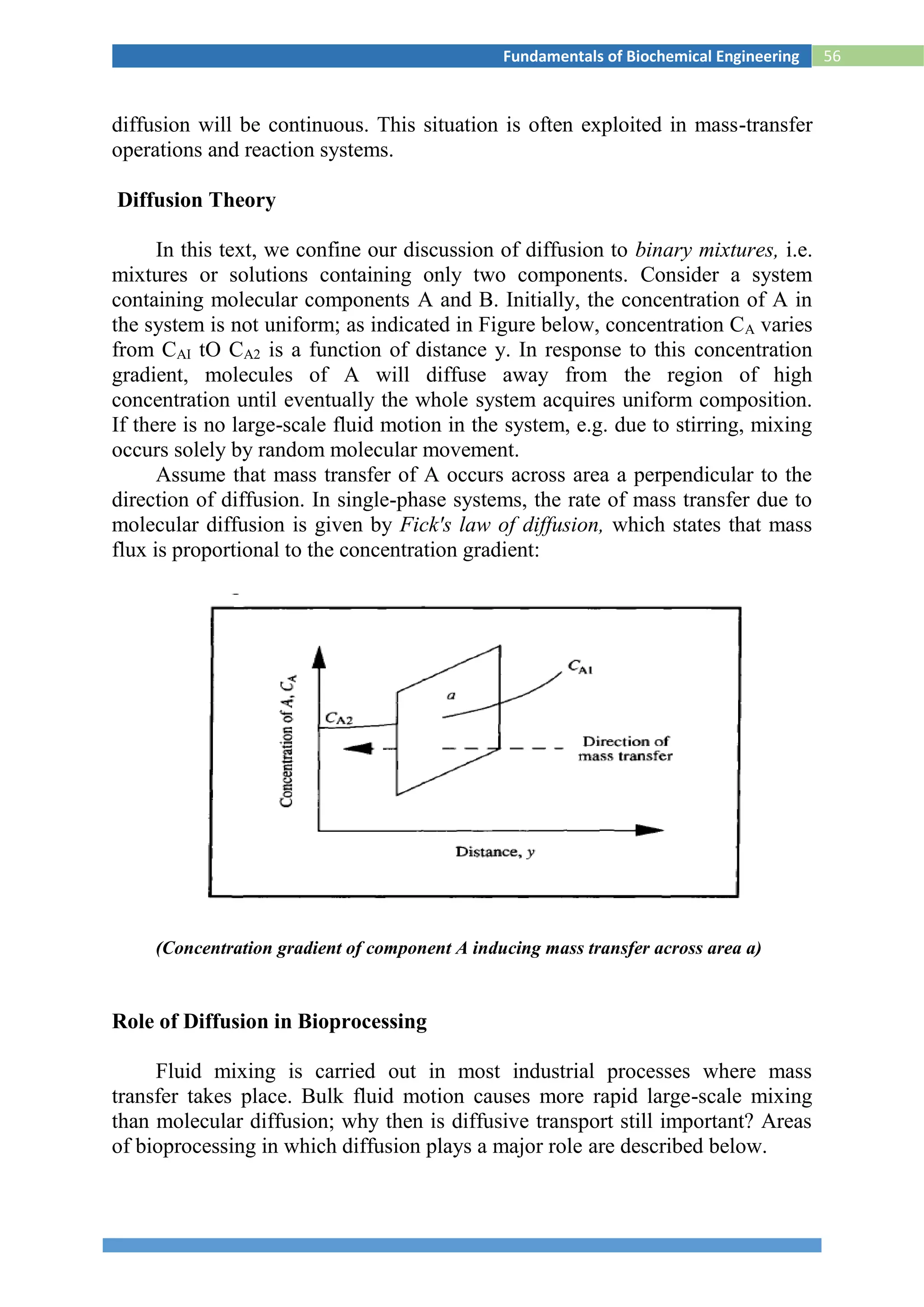
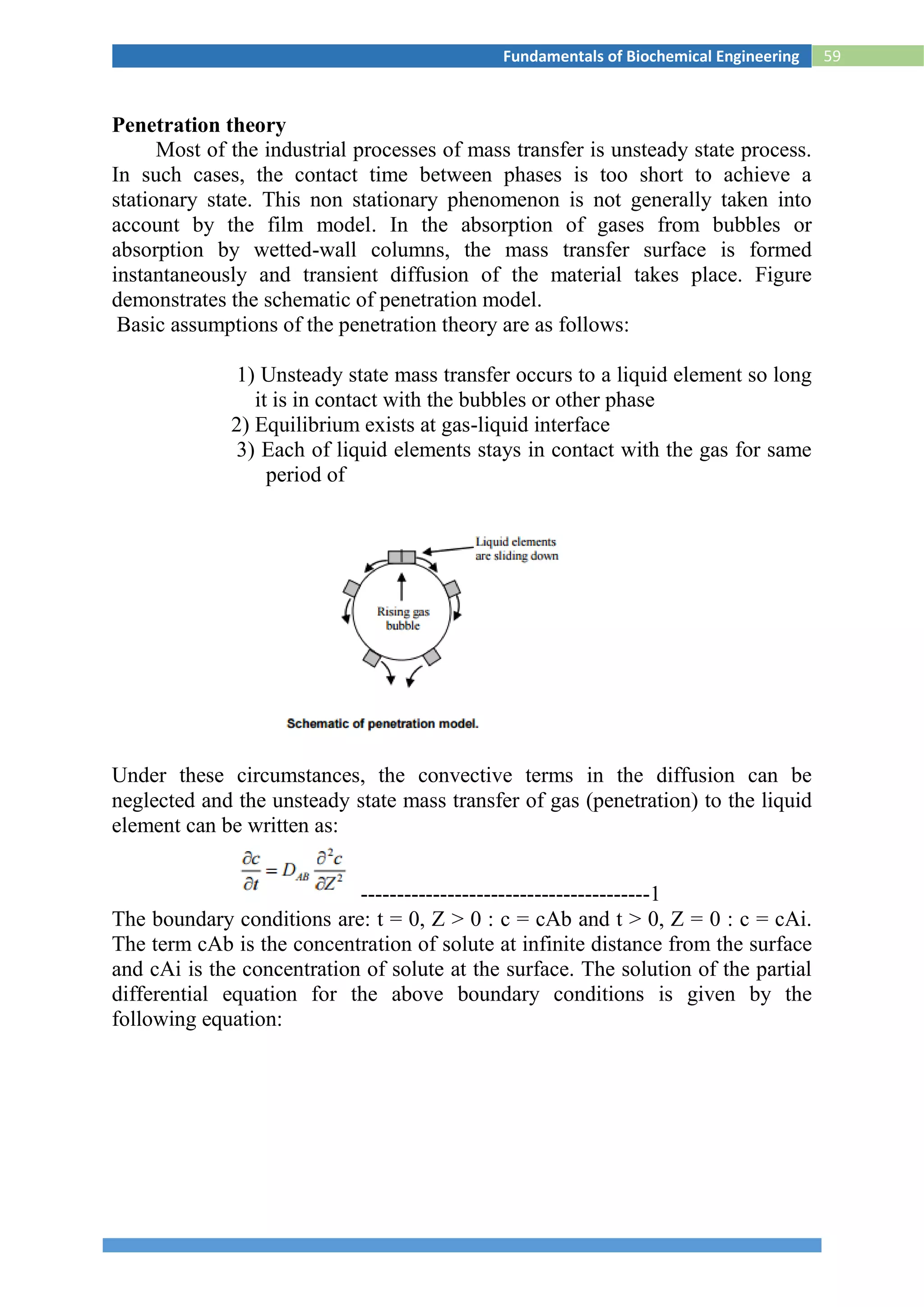
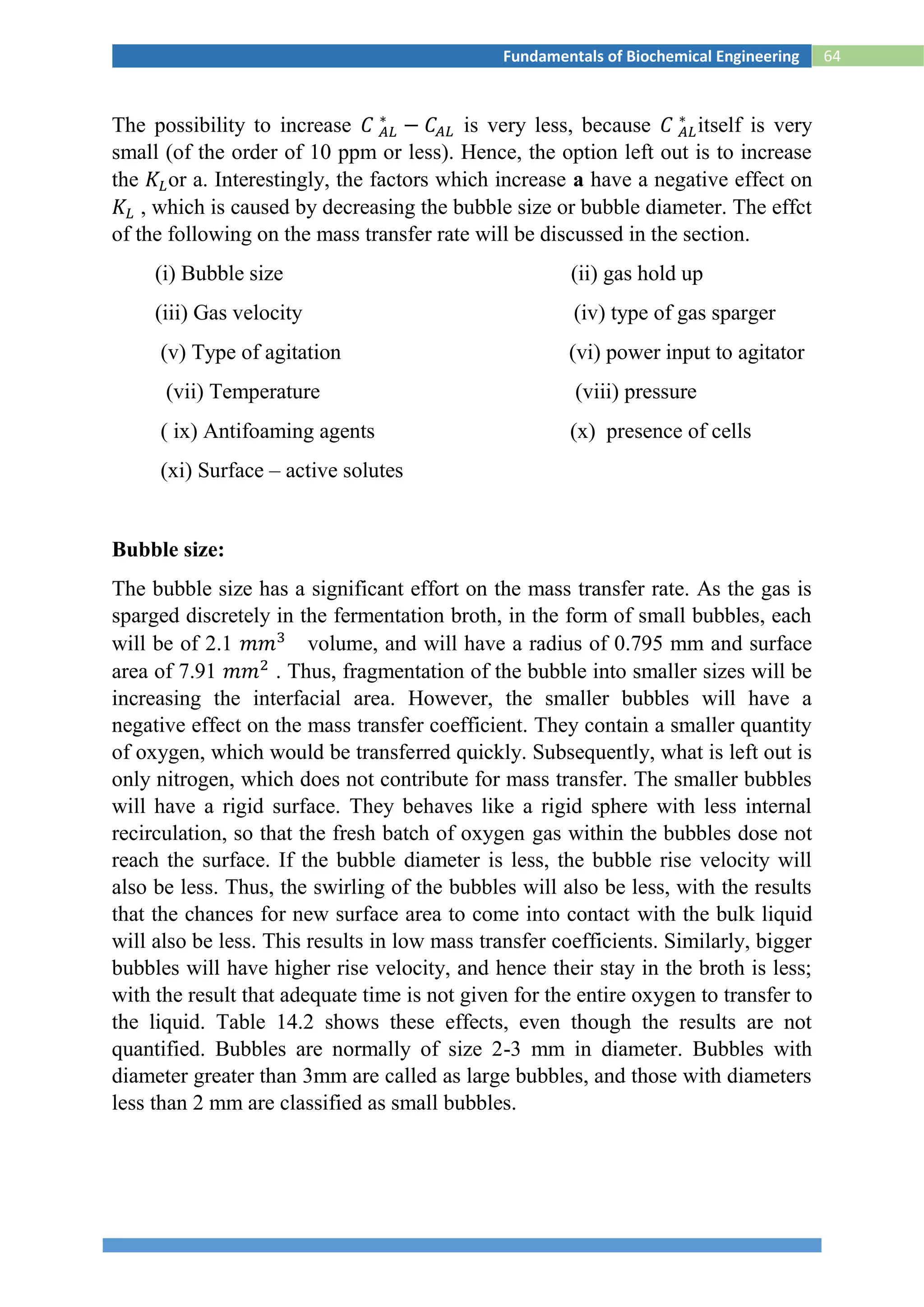
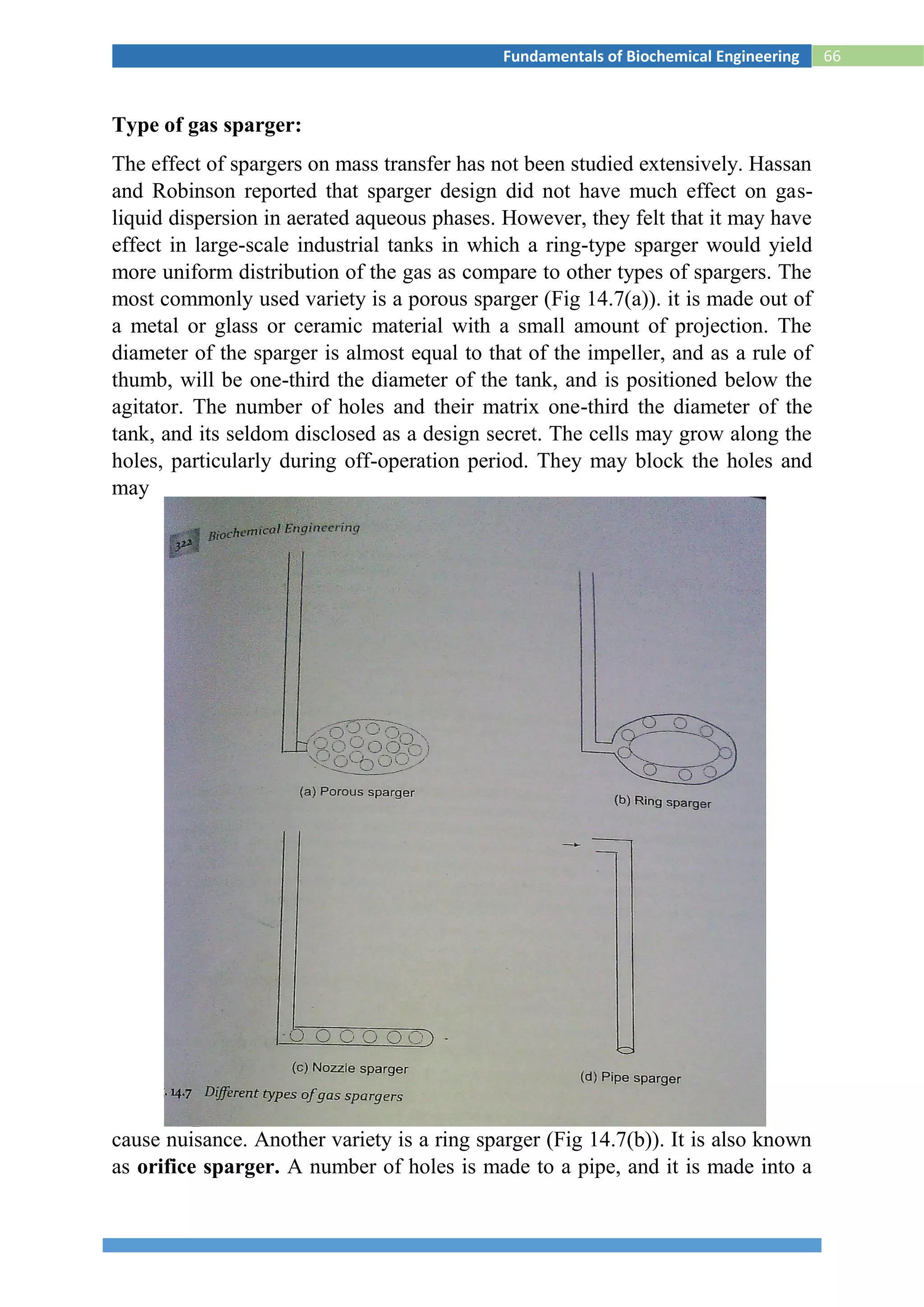
Fundamentals of Biochemical Engineering
Subject code
Chemical Engineering Department
Fundamentals of Biochemical Engineering
Subject code-PCCH 4402
Chemical Engineering Department
7th
Semester
Mrs. Ipsita D. Behera
Asst. Professor
I.G.I.T Sarang
Email: - ipsitadbehera@gmail.com
Fundamentals of Biochemical Engineering
Chemical Engineering Department
Mrs. Ipsita D. Behera
Asst. Professor
I.G.I.T Sarang
era@gmail.com
Disclaimer:
This document does not claim any originality and cannot be used as a substitute
for prescribed textbooks. The information presented here is merely a collection
by the committee faculty members for their respective teaching assignments as
an additional tool for the teaching-learning process. Various sources as
mentioned at the reference of the document as well as freely available material
from internet were consulted for preparing this document. The ownership of the
information lies with the respective authors or institutions. Further, this
document is not intended to be used for commercial purpose and the committee
faculty members are not accountable for any issues, legal or otherwise, arising
out of use of this document. The committee faculty members make no
representations or warranties with respect to the accuracy or completeness of
the contents of this document and specifically disclaim any implied warranties
of merchantability or fitness for a particular purpose.
SYLLABUS
Module I
Overview of microbiology, Aerobic & Anaerobic fermentation
processes, fermenter design, sterilization of microbial medium, kinetics
of microbial growth, enzymes and its kinetics, immobilization of
enzymes, chemostats.
Module II
Transport phenomena in Biochemical Engineering, Heat and Mass
transfer in Bioprocessing, oxygen transfer in fermenter, monitoring and
control of fementation process.
Module III
Downstream processing: - Recovery and Purification of products,
allied unit operation for product recovery, production of biogas and
ethanol, Effluent treatment by biological method
Text book
1. Bailey JB and oillis OR, Biochemical Engineering Fundamentals
2. Aiba S, Biochemical Engineering, Academic press
3. Rao D G, Introduction to Biochemical Engineering, Tata Mc Grow Hill
4.Michael L. Shuler/ Fikret Kargi, Bio Process Engineering , Pearson Education
LESSON PLAN
Class No.
Brief description of the Topic
1. Introduction of FBE
2. Overview of microbiology
3. Application of Microbiology
4. Aerobic & Anaerobic fermentation processes
5. SSF and SmF and applications
6. Fermentation Design
7. Microbial sterilization
8. kinetics of microbial growth
9. Kinetics of microbial growth
10. Problem discussion
11. Problem discussion
12.
Enzyme and its characteristics
13.
Enzyme kinetics
14.
Problem discussion
15. Immobilization of enzymes & applications
16. Chemostats
17. Question Discussion
18. Heat transfer in bioprocessing
19. Mass transfer in bioprocessing
20. Oxygen transfer in fermenter
21. Monitoring and control of fementation process.
22 Question discussion
23 Unit operation for product recovery
24 Effluent Treatment
Physical methods
25 Effluent Treatment
Chemical methods
26 Effluent Treatment Biological methods
27 Production of biogas
28 Production of ethanol
29 Question discussions
30 Semester question discussion
1Fundamentals of Biochemical Engineering
Module-I
INTRODUCTION
Biotechnology is the art and science of converting reactants (substrate) into
useful products by the action of microorganisms or enzymes. Microorganisms
have been honestly serving the mankind. Thus any process in which microbes
or living organisms play a vital role in getting transformation of the feed into
useful products is termed as BIOPROCESSING. For example the way of
converting milk into curds, or fruit juice into wines, or sugar into alcohol.
BIOCHEMICAL ENGINEERING is of more recent origin, since the
biological industries did not recognize the importance of engineering inputs
until the experience of penicillin manufacture.
Microbiology
 (Micro-small, bios-life) is the study of microscopic organism, which are
defined as any living organism i.e. either a single cell(unicellular), a cell
cluster or has no cell at all(a cellular). This includes eukaryotes, such as
fungi and protista and prokaryotes.
 Microbiology is a broad term which includes virology, mycology,
parasitology etc.
 It is the study of microorganisms which are not only microscopic and
exist as single cells, but also that ultramicroscopic organism which are
not cellular and hence cannot exist independently. E.g. viruses
 Microbiology deals with study and functioning of cells, their interaction
with environment, other living organism and man.
 It is studied with respect to two major aspects.
a) As basic biological science
b) As applied biological science
Basic biological science:
It provides a system to understand the nature of life processes, the principle
behind it and the genetics which is involved in the heritance of traits to next
generation.it has several sub streams such as
i) Medical microbiology: Study of pathogenic microorganism, the causes of
diseases and way to eliminate them.
2Fundamentals of Biochemical Engineering
ii) Agricultural microbiology: Study of plant diseases, understanding various
beneficial interactions with plant system like soil fertility, crop-protection and
increasing field.
iii) Environmental microbiology: Study of relationship of microorganisms
with its habitat, pollution effect and its impact on environment from the stand
point of ecology balance and health.
iv) Food and dairy microbiology: Study of microorganisms that produce
various food and dairy products.
Applied biological science:
It deals with study of useful microorganisms as well as that of pathogenic
organism.
i) In dairy and food industry: Food microbiology not only includes the study
of those microbes which provides food to their high protein content but also
includes other those microbes which use our food supply as a source of
nutrients for their growth and result in deterioration of the food by increasing
their number, utilizing nutrients, contributing of flavours by means of
breakdown of food.
ii) Medical microbiology: Microbes causes infections resulting in diseases
among human and animals. On other side they help in creating a “disease free
world”, where people are from pain by this disease.
Application of microbiology
 Microbes in food and dairy industries
 Microbes in production of industrial products
 Microbes in genetic engineering and biotechnology
 Microbes in environmental microbiology
 Microbes in medical microbiology
 Microbes in agriculture
 Microbes in bioterrorism
a. Food and dairy industry:
 Provides food due to high protein content.
 Food nutrient for their growth (deterioration of food), enzymatic changes,
contributing flavour.
 Certain moulds used for manufacturing of food and ingredients of food.
 Some moulds used in production of oriental food, soya sauce etc.
3Fundamentals of Biochemical Engineering
 Used for enzyme making like amylase.
 Yeast: These are used in manufacturing of foods such as bread, beer,
wines, vinegar, surface ripened, and cheese. Some yeasts are grown for
enzymes and food.
 Bacteria: Some pigmented bacteria cause changes in colour on the
surfaces of liquid food. Acetobacteria oxidises ethyl alcohol to acetic
acid. Some bacteria causes ropiness in milk and slimy growth cottage
cheese.
b. Microbes in production of industrial products:
 Enzymes amino acid, vitamins, antibiotics, organic acid and alcohol are
commercially produced by microorganism.
 Primary microbial product: These products are used by microorganism
for their growth. E.g. amino acids, enzymes, vitamins
 Secondary microbial products: Not used by cell for their growth. E.g.
alcohol, antibiotics, organics acids.
 Microbes produce some important amino acids such as glomatic acid,
lysine, and methionine.
c. Microbes in Genetic Engineering and Biotechnology:
 Microbes used for mammalian proteins such as insulin and human growth
factor.
 Making vaccine for microbial and viral genes and induce a new strain of
microbes.
 Vaccine and diagnostic kits also depend on the improved strains of
microorganism.
 Lactic acid as food preservative.
 Acetic acid plays a major role in tanning and textile industry.
 Interferons are produced in animal cell if included by viral infection.
These are used in testing interleukins (which stimulate T-lymphocytes).
 Production of viral, bacterial or protozoan, antigen for protecting against
dysentery, typhoid, bacteria etc.
 N2 fixing bacteria reduce nitrogen gas to ammonia required plant growth.
4Fundamentals of Biochemical Engineering
d. Environmental Microbiology:
 Plays an important role in recycling of biological elements such as
oxygen, carbon, N2, sulphur, and phosphorous.
 Microbes in biochemical cycle: Photosynthesis and chemosynthesis
microorganism convert CO2 into organic carbon. Methane is generated
anaerobically from CO2 and H2 by metheogenic archaea. The organic
forms of N2 are interconverted by metabolic activities of microorganism
which maintain the natural N2 balance.
 Microbes in pollution microbiology: Biological sewage treatment and
self-purification. Both results in mineralisation of organic, pollutants and
in utilisation of dissolved oxygen.
e. Medical Microbiology:
 Vaccination: Small pox, diphtheria, whooping cough.
f. Computer application:
 Optimisation via computer: Computers are used on scale of, to store,
evaluate effects of individual parameters on metabolic behaviour of
culture.
 Control via computer: Control fermentation process.
g. Microbes in agriculture:
 During compost formation by the crop residue like wheat straw, rice
straw, sugar cane bagasse are very difficult to degrade due to presence of
highly resistant lignified tissues. So, breakdown of these complex organic
materials can be done by microbes by a short span.
 Biogas production through anaerobic fermentation is must reverent to
fulfil their energy demand in rural population.
 The productivity of leguminous crop largely depend on efficient and
suitable management of the ecosystem by specific rhizobial association.
 Some bacterial helps in killing a wide range of insects like beetles,
mosquitoes, flies, aunts, termites which is very useful for agricultural
industries
h. Microbes in Bioterrorism: It has been defined as deliberate release of
disease causing germs, microorganism with the intent of killing large
number of people. Accordingly microorganisms are used as weapons of
mass destruction of people and causes small pox, plague, cholera and also
anthrax.
5Fundamentals of Biochemical Engineering
Mode of transmission:
 Air droplets and dust
 Food fruits and vegetables
 Drinking water
6Fundamentals of Biochemical Engineering
FERMENTATION
Fermentation is the word derived from the Latin verb FERVERE (to boil),
which describe the evolution of carbon dioxide bubble in anaerobic conditions
by the action of yeast on fruit juice.
General Requirements of Fermentation Process:-
Since fermentation is a biochemical process brought about by the
intervention of living organisms, it is essential that any fermentation process
should have:
 A microorganism for carrying out the bioconversion.
 A substrate to get converted into useful products.
 Maintenance of fermentation conditions.
 Effluent treatment section.
 A provision for recovery and purification of the products.
 Facilities for packaging and marketing.
Fermentation carried out in the presence of air / O2 is known as aerobic
fermentation, where as in absence of air is called anaerobic fermentation.
Anaerobic Fermentation:-
 Yeast fermentation process to produce alcohol requires a small amount of
aeration for the cells to multiply. After word no air is required.
 On the other hand air is detrimental for the process which will otherwise
oxidise the substrate.
 Most of the anaerobic fermentation produces carbon dioxide gas.
 Many times gas covers the surface and acts as a blanket to prevent the
effect of O2.
 The evolved CO2 will also help in better mixing conditions, which is more
evident in large industrial tanks because of longer pathways for the gas
bubbles to go before they leave the fermenter.
Aerobic Fermentation:-
Sparaging air /O2 is very common phenomenon in fermentation process to
supply O2 for cells to meet their specific O2 demand .Such fermentation process
which are associated with the bubbling of O2 are termed as aerobic
fermentation.
7Fundamentals of Biochemical Engineering
Solid state and submerged fermentation and their Applications
Solid state fermentation:-
SSF is a method of growing microorganisms in an environment of limited
moisture without having free flowing water. The microorganisms grow on a
solid surface which is moistened and which has also got free access to air.
It is also known as “ Koji” fermentation , for the production of soya
products such as tempeh, soya sauce etc. certain metabolites. It has some
advantages that lower manufacturing cost because of the use of crude solid agro
wastes like wheat bran. The solid surface directly comes in contact with the air
and hence the aeration costs are avoided. The other economic advantages are
 Low capita investment and recurring expenditures.
 Low water utilization and hence negligible outflow of water.
 Low energy requirements for the fermentation process because of
absence of agitation.
 Absence of foam formation because of absence of excess water.
 High reproducibility of the result.
 Simple fermentation media.
 Less fermentation space, and les complex plant and machinery.
 Absence of rigorous control techniques.
 Any level of scale of operation.
 Absence of elaborate aeration requirements.
 Ease in controlling bacterial contamination.
 Facilities of using wet and dry fermented solids directly.
 Ease in induction and suppression of spores.
 Lower costs of downstream processing.
Submerged Fermentation:-
In case of submerged fermentation (SmF) the microorganisms and the
substrate are present in the submerged state in the liquid medium, where a large
quantity of solvent is present. This has many advantages over SSF.
 Since the contents are in submerged state in the liquid medium, the
transfer of heat and mass is more efficient, and is amenable for
modelling the process.
 The scaling-up the process is very easy.
8Fundamentals of Biochemical Engineering
Differences between SSF and SmF
Characteristics feature SSF SmF
Condition of microorganisms and
substrate
static Agitated
Status of the substrate Crude Refined
Nature of the microorganism Fungal system ______
Availability of water Limited High
Supply of oxygen By diffusion By bubbling/
sparging
Contact with oxygen Direct Dissolved O2
Requirement of fermentation medium Small Huge
Energy requirement Low High
Study of kinetics Complex Easy
Temp and concentration gradient Steep Smooth
Controlling of reaction Difficult Easy
Chances of bacterial contamination Negligible High
Quantity of liquids to be disposed Low High
Pollution problems Low high
Applications:-
 Citric acid can be produced by both SSF and SmF. Generally, the later
technique is used in industrially. SSF method has not yet become
commercial success because of its labour intensity.
 Soya-based oriental foods like tempeh and soya sauce are produced by
SSF alone.
 Production of Roquefort cheese from sheep milk is a classical example of
SSF.
 Mushroom cultivation is another example of the growth of fungus on
solid medium like paddy straw.
 Fish and meat production are preserved in the form of sausages as
fermented foods.
9Fundamentals of Biochemical Engineering
FERMENTER DESIGN
A fermenter is a type of bioreactor for containing and controlling
microorganisms during a fermentation process.
BASIC FUNCTIONS OF FERMENTERS
The main function of a fermenter is to provide a controlled environment
for growth of a microorganism, or a defined mixture of microorganism, to
obtain a desired product.
(Bioreactors refer to production units of mammalian and plant cell culture)
CRITERIA USED IN DESGINING AND CONSTRUCTING A
FERMENTER-
 Vessel should be capable of being operated aseptically and should be
reliable for long term operation
 Interplay of the transport parameters
 Supply of adequate quantity of oxygen so that cells do not suffer from
inadequacy of oxygen supply
 Adequate aeration and agitation to meet the metabolic requirements of
the microbes
 Adequate amount of mixing should be ensured without causing damage
to the cells
 Vessel geometry should be such that it should facilitate scale-up
 Flexibility in operation of the fermenter for various purposes, so that the
vessel should be suitable for a range of processes
 Low power consumption
 Temperature and pH control
 Low evaporation losses
 Minimal use of labour in operation, harvesting, cleansing and
maintenance
 Proper sampling facility
 Cheapest and best materials should be used
 Adequate service provisions must be available for individual plants.
10Fundamentals of Biochemical Engineering
TYPES OF FERMENTER-
Based on shape it can be classified as-
(i) Tabular &
(ii) Stirred tank
(Cooling coils are provided to maintain constant temperature inside the
bioreactor. It can be operated aseptically for many days and simple in
construction.
Disadvantages-
 high power requirement
 shearing on the organisms caused by vigorous agitation and inhibition
exercised by the product)
(i) Fluidized Bed Bioreactor: - It is more popular in chemical industry
rather new to biochemical industry. These are mostly used in
conjuction with immobilized cells or enzyme system and are operated
continuously.
(ii) Loop or Air Lift Bioreactor: - In the conventional bioreactor, oxygen
is supplied by vigorous agitation of the bioreactor content. The heat is
generated which is a problem in conventional type. In this cooling
becomes simpler due to the position of inner or outer loop.
(iii) Membrane Bioreactor: - These consist of a semipermeable
membrane made up of cellulose acetate or other polymeric materials.
The primary purpose of the membrane is to retain the cells within the
bioreactor, thus increasing their density, while at same time allowing
metabolic products to pass through the membrane.
(iv) Pulsed Column Bioreactor: - It has a column bioreactor generator
connected to the bottom of the column. It can be utilised as an aerobic
bioreactor, enzyme bioreactor or as separation unit.
(v) Bubble Column Bioreactor: - Multistage bubble column bioreactor
are suitable in the equivalent batch process. In this it is possible to
provide different environmental conditions in various stage. It is not
suitable for fungal fermentation due to oxygen demanding system.
(vi) Photo Bioreactor: - For the growth and production of photosynthetic
organisms, a light source is required. In this, there is an important
‘reactant’, the photons which must be absorbed in order to react and
produce products. The design of the light source is critical in the
11Fundamentals of Biochemical Engineering
performance of this type of bioreactor. Example- Annular Reactor. In
this source of radiation is a cylinder with a annular section, which
enclose the lamp completely. The nutrient passing from the product is
removed from the top. It is used for Spirulina(SCP) and other algal
protein production.
(vii) Packed tower Bioreactor: - It consists of cylindrical column packed
with an inert material like wood shavings, twigs, cake, polythene or
sand. Initially, both medium and cells are fed into the top of the
packed bed. Once the cells adhered to the support and were growing
well as a thin film fresh medium is added at the top of the packed bed
and the fermented medium removed from the bottom of the column. It
is used for vinegar production, sewage effluent treatment and enzymes
conversion of penicillin to 6-amino penicillanic acid.
The design of fermenter involves the co-operation between experts in
microbiology, biochemistry, mechanical engineering and economics.
CONSTRUCTION OF FERMENTERS
The criteria considered before selecting materials for construction of a
fermenter are:
(a) The material that have no effect on sterilisation
(b) Its smooth internal finish-discouraging lodging of contamination.
(c) Internal surface should be corrosion resistant.
There are two types of such materials:
(i) Stainless Steel, and
(ii) Glass.
The construction of the fermenter depends upon the following-
(i) Control of Temperature. Since heat is produced by Microbial
Activity and the mechanical agitation, thus it is sometimes necessary
to remove it. On the other hand, in certain processes extra heat is
produced by using thermostatically controlled water bath or by using
internal heating coil or jacket meant for water circulation.
12Fundamentals of Biochemical Engineering
(ii) Aeration and Agitation. The main purpose is to provide oxygen
require to the metabolism of microorganisms. The agitation should
ensure a uniform suspension of microbial cells suspended in nutrient
medium. There are following necessary requirements for this purpose:
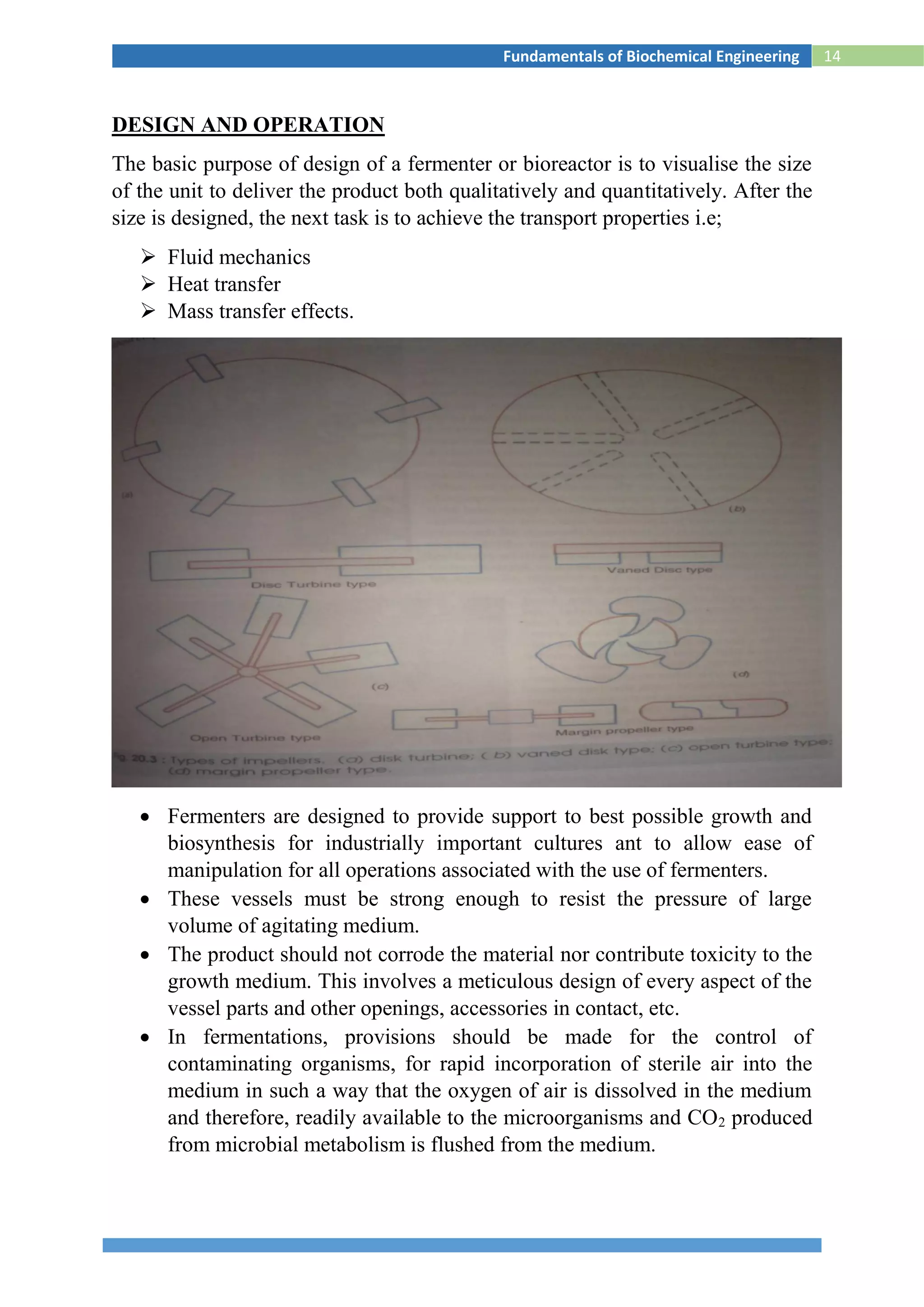
(a) The agitator (impeller) for mixing: The size and position of the
impeller in the vessel depends upon the size of the fermenter.
More than one impeller is needed if adequate aeration agitation is
to be obtained. Ideally, the impeller should be 1/3 or 1/2 of the
vessel diameter (D) above the base of the vessel. The number of
impeller may vary from size to size to the vessel.
(b)Stirrer glands and bearings meant for aseptic sealing: Four
basic types of seals assembly have been used-
 The packed gland seal
 The simple bush seal
 The mechanical seal and
 The magnetic drive.
(c) Baffles for checking the vortex resulting into foaming: The
baffles are incorporated into the agitated into the agitated vessels
to prevent a vortex ant to improve aeration efficiency. They are
metal strips roughly one-tenth of the vessel diameter and attached
radially to the walls.
13Fundamentals of Biochemical Engineering
(d)The sparger (aeration) meant for introducing air into liquid: A
sparger is a device for introducing air into the liquid into a
fermenter. It is important to know whether the sparger is to be
used on its own or with mechanical agitation as it can influence
equipment design to determine initial bubble size.
Three basic types of sparger are:
(i) Porous sparger
(ii) Orifice sparger
(iii) Nozzle sparger
(e) Microbial sensors: It consists of a microorganism immobilized on
a membrane and an electrode. The principle of working is the
change in respiration or the amount of metabolites produced as a
result of the assimilation of substrate by the microorganism. A
wide range of thermophilic microbes have been used for the
manufacturing of microbial sensors as mentioned in the table
below.
Immobilised yeast, Trichosporoncutaneumhas been used to develop
an oxygen probe for BOD estimation in sewage and other water
samples. The BOD sensor includes an oxygen electrode that consists
of a platinum cathode and an aluminium anode bathing in salt KCl
solution and a Teflon membrane. Immobilised yeast cells are crapped
between the pores of a porous membrane and the Teflon sensor can
measure BOD at 3-60/mg/litre. Methanotrohic bacteria is used in
measuring methane as well as oxygen. Similarly, ammonia and nitrate
biosensors consist of immobilised nitrifying bacteria. This is used to
determine ammonia in waste water based on the conversion of nitrate
to N2O by an immobilised denitrifying Agrobacterium sp.The nitrate
biosensor has been used to measure nitrate profiles in biofilm.
APPLICATIONS: Microbial biosensors have several uses in:
 clinical analysis,
 general health care monitoring,
 veterinary and agricultural applications,
 industrial product processing,
 monitoring and control of environment pollution and
 in military and defence for detection of chemical and biological species
used in weapons.
14Fundamentals of Biochemical Engineering
DESIGN AND OPERATION
The basic purpose of design of a fermenter or bioreactor is to visualise the size
of the unit to deliver the product both qualitatively and quantitatively. After the
size is designed, the next task is to achieve the transport properties i.e;
 Fluid mechanics
 Heat transfer
 Mass transfer effects.
 Fermenters are designed to provide support to best possible growth and
biosynthesis for industrially important cultures ant to allow ease of
manipulation for all operations associated with the use of fermenters.
 These vessels must be strong enough to resist the pressure of large
volume of agitating medium.
 The product should not corrode the material nor contribute toxicity to the
growth medium. This involves a meticulous design of every aspect of the
vessel parts and other openings, accessories in contact, etc.
 In fermentations, provisions should be made for the control of
contaminating organisms, for rapid incorporation of sterile air into the
medium in such a way that the oxygen of air is dissolved in the medium
and therefore, readily available to the microorganisms and CO2 produced
from microbial metabolism is flushed from the medium.
15Fundamentals of Biochemical Engineering
 Some stirring devices should be available for mixing the organisms
through the medium so as to avail the nutrients and the oxygen.
 The fermenter has a possibility for the intermittent addition of antifoam
agent.
 Some form of temperature control efficient heat transfer system is also
there for maintaining a constant predetermined temperature in the
fermenter during the growth of organism.
 The pH should be detected.
 Other accessories in the fermenter consist of additional inoculum tank or
seed tank in which inoculum is produced and then added directly to the
fermenter.
Media Design
Any fermentation process proceeds through the action of microorganisms which
perform in the presence of a medium. Hence, proper design of the medium is an
essential component in the design of a fermentation process. Thus, detailed
investigations are needed to identify the most suitable medium for any
fermentation process to proceed.
Medium Requirements
Since the medium is desired to support the functioning of microorganisms, the
requirements of the medium are decided by those of the microorganisms. They
are:
• carbon
• nitrogen
• energy source
• minerals
• other nutrients like vitamins, etc. • oxygen/air for aerobic processes.
• water.
The medium used in a laboratory-scale process, or for that matter even in the
pilot plant-scale level, can be reasonably composed of pure components; but
such a luxury is not affordable in the case of commercial production, where the
cost of production rules the economic viability, and hence the commercial
viability of the process. Thus, for large-scale productions, we look for a
medium, which has the following attributes:
• It should be cheap, and easily available at a consistent cost and quality.
16Fundamentals of Biochemical Engineering
• It should have higher productivity, i.e. it should produce maximum amount of
product per unit of the substrate consumed.
• The rate of formation of the product should be high.
• It should minimize the formation of undesired products.
• Carbon Source
The carbon requirement for the medium is normally provided by molasses,
starches, some cereal grains like maize, tubers like potatoes and cassava,
sucrose, glucose, and lactose. The carbon source also provides the energy
requirements for the medium. By and large, one of the cheapest sources of
carbohydrates which provide the carbon requirement for the medium is
molasses, a byproduct of the sugar industry. Another important source is corn
starch. Malt extract, which is an aqueous extract of the malted barley, is also an
excellent substrate for many fungi, yeast and actinomycetes. The selection of
the carbon source plays a major role in the economics of the processes,
particularly in those casts where the raw material constitutes 60-75% of the cost
of production of the product.
Nitrogen Source
Microorganisms can utilize the nitrogen from organic or inorganic sources.
Ammonia and salts of ammonia (like ammonium sulphate or nitrate) are
common inorganic sources of nitrogen salts which provide both acidic and basic
environments, depending upon the type of the salt. When once the ammonium
ion is consumed. ammonium sulphate creates acidic environment, whereas
ammonium nitrate provides basic environment. Amino acids, proteins or urea
serve as organic sources of nitrogen. Microorganisms are able to grow faster in
the presence of organic nitrogen, and some of them will have an absolute need
for amino acids. Using pure amino acids is often expensive. We may prefer to
use some precursor to the amino acid. For example, metheonine and threonine
are obtained from soyabcan hydrolysate, which are in turn used in the
production of lysine. The following are a few nitrogen sources through proteins
or amino acids:
• corn steep liquor
• soya meal
• soya beans
• groundnut meal
• cotton seed meal
17Fundamentals of Biochemical Engineering
• fish meal
• casein hydrolysate
• slaughter house wastes
• yeast extract, etc
Synthetic media
A synthetic medium is one in which all constituents are specifically defined and
added more or less in pure form. Their composition and concentrations are pre-
defined. Thus, a typical synthetic medium contain-ing inorganic salts, water,
purified sugar and magnesium sulphate. etc. is given in Table 5.5, which is used
for the production of thermostable a-amylase in the laboratory. Composition of
various other laboratory media are available in any manual on microbiology
Minimal medium composition for production of a-amylase in laboratory
 Component Amount
 Soluble starch (g/l) 20.0
 Glucose(g/l) 5.0
 Peptone (g/l) 5.0
 Yeast extract (g/l) 2.5
 K2HPO4 (g/l) 2.0
 MgSO4 • 7H20 (g/l) 1.0
 pH 7.0
 Distilled water (ml) 100.0
Synthetic medium has some specific advantages. Since the chemical structure
and composition of various components of the medium are known, their effect
on the product yield can be assessed by specifically alter-ing one of their
compositions. Thus, the composition of one or several components can be
varied to assess the product yield. This will help in re-designing the medium for
maximum product yield. These studies also help in finding out the metabolic
process route leading to the formation of the desired product. Radioactive
isotopes can be incorporated into one of the components of the medium, which
help us to study the effect of it on the product yield by identifying whether the
radioactive isotopic component is present in the product or not, and if so, to
what extent. Based on these studies, the medium can be designed. The synthetic
media have got various other advantages given as follows:
18Fundamentals of Biochemical Engineering
• It will help in reproducibility of the results from time to time, because the
composition of the medium is well-defined.
• Thc problem of foaming is almost nil since the foaming agents like proteins
and high molecular weight peptides are absent.
• The recovery and purification of the fermentation products are much easier,
since the medium can be designed by avoiding the interfering components.
Sometimes, all the above advantages will be counter-balanced by the single
disadvantage of higher cost of the medium, which destabilizes the economic
viability of the process. However, the synthetic media are generally used in the
developmental stage, i.e. at the R&D stage.
crude medium
Which does not have any of the advantages of the synthetic medium. Their
compositions are not defined. They are available as they are, e.g. soya bean
meal, molasses, corn steep liquor, ammonium sulphate, etc. The main feature of
the crude medium is its economic advantage. It also contains the sources of
carbon and nitrogen in a form that can be easily consumed by the
microorganisms. The crude media are generally used in the industrial scale of
production after perfecting the composition of the medium at the R&D stage.
19Fundamentals of Biochemical Engineering
STERILIZATION
General Introduction:
Sterilization is probably one of the most important operations which
differentiate a biochemical process from a chemical process. The role of an
engineer (or more precisely, biochemical engineer) in the overall process is
probably to provide a ‘contamination free’ environment.
Earlier, most of the processes which have fared well in terms of technical
feasibility at laboratory scale processing faced the formidable problem of
contamination when the scale of operation increased. One of the most classical
examples is penicillin fermentation. The technical and operational problem
faced by the engineers in penicillin fermentation was to design and operate a
deep aerobic fermenter under absolutely contamination free environment with
pure culture, since the environment in the fermenter was also conducive for the
contaminants to grow. In fact, this has ushered in the new era of biochemical
engineering as a distinct discipline in the field of engineering and technology.
As has already been mentioned in Chapter 1, even the mechanical fabrication of
the fermenter should preferably be kept in the hands of engineers who are well-
versed with design and fabrication of fermenters, since otherwise a mechanical
engineer, who is versatile in fabrication of chemical equipment, is likely to
overlook the subtle point of asepsis, which is so vital for biochemical
engineering operations, and not so important for a typical chemical equipment.
Fermentation is a biochemical process of producing metabolic products by
the action of a microorganism or a group of microorganisms on a substrate, in
the presence of nutrients in the medium. Obviously, fermentation proceeds with
the involvement of
 A microorganism
 A medium
 A fermenter
 Nutrients/other additives
 Air in the case of aerobic processes
Thus, a sterile environment is needed for all the above. Otherwise, the
contaminants would dominate the whole scene, and virtually no product will
form, or a contaminated product forms with toxicants. Invasion by a foreign (or
contaminant) organism may result in the following ills of fermentation:
 The foreign organism may contaminate the final product.
 The medium would be consumed unnecessarily to support the growth of
contaminating organisms.
 The contaminated product may outweigh the desired product, it is more
so in the case of continuous fermentation processes.
20Fundamentals of Biochemical Engineering
 The contaminated product may interfere with the recovery of the desired
product, and may render it inaccessible.
 Unsterile air in aerobic fermentations (antibiotic fermentations) may
result in the spoilage of the fermentation product.
To overcome the above difficulties, the only alternative is to have a
contamination-free environment which can be achieved by sterilizing all the
involved parameters as shown below.
METHODS TO AVOID CONTAMINATION IN A FERMENTATION
PROCESS
 Sterilization of the medium
 Employing as pure an inoculum as possible
 Sterilization of the fermenter
 Sterilizing the pipes, valves, bends, etc., which come in contact with
the fermentation process
 Sterilization of all materials to be added to the fermenter
 Sterilization of air
 Disinfecting the fermenter and contact parts with a non-toxic
disinfectant
 Maintaining aseptic conditions in the fermenters during fermentation
 Maintaining optimum or desired PH
which discourages the growth of
certain contaminants or undesired organisms or undesired products
The sterilization of a biochemical process can be achieved by the
application of some lethal agent, viz.
 Heat in the form of steam
 Radiation
 A chemical
 Or by restricting the undesired organisms or spores by some
physical unit operation such as filtration.
Sterilization of Medium:
Media used in industrial fermentations need to be sterilized before being
used, to avoid the contamination of microorganisms which may
 Use the nutrients in the medium
 Change the chemical structure of the nutrients
 Change the PH
 Create more foam in the fermentation which affects the aeration
 Produce metabolic products which affect the growth of fermentation
microorganism
21Fundamentals of Biochemical Engineering
 Alter the oxidation-reduction potential of the medium
 Further convert, degrade or destroy the desired fermentation product
Sterilization is normally done by
 Boiling in water
 Passing live stream
 Autoclaving (subjecting the medium to steam under pressure in a
pressure cooker)
All the above methods are based on thermal treatment. Various techniques
were developed to achieve thermal sterilization of the medium. It should be a
batch or a continuous process or a HTST (High Temperature, Short Time)
process. Sometimes, the cost of sterilization would be prohibitive and
destabilize the process economics. In such situations, the industrial fermentation
are carried out by employing other means, viz.
 Low PH
 Contamination inhibitors (such as Lactic acid)
Synthetic medium do not require much sterilization efforts as compared to
crude media. The synthetic media may require a small amount of heating for
sterilization. The crude media are likely to contain much of the heat-resistant
bacterial spores, and require prolonged heating. However, care must be
exercised to see that the medium does not get cooked due to over-heating, but
still adequate amount of heating must be given to see that the medium is
thoroughly sterilized. This requires a bit of experience. Thermal death studies
need to be made ‘a priori’ to evaluate the sterilization time. Excessive heating
may denature the proteins or caramalize the sugars or encourage thermal
degradation of the components in the nutrient medium by inter-actions (like
sugars reacting with phosphates). If PH is a critical factor during sterilization, it
is advisable to adjust the PH
to neutrality, sterilize the medium and then bring
the PH
of the medium to the original value after the sterilization by addition of
pre-sterilized acid or alkali. If some of the enzymes or nutrients like vitamins
are sensitive to heat sterilization, they are separated initially by passing through
a bacteriological filter; sterilization is carried out, and the separated (filtered)
enzymes/nutrients are added back to the medium. Similarly the volatile
components in the medium may be separated by bacteriological filtration to
avoid/reduce their loss due to thermal sterilization.
Thus, various types of methods/alternatives need to be devised to see that the
active components/nutrients are not lost during heat sterilization, but at the same
time, the containing organisms are destroyed to the maximum possible extent.
22Fundamentals of Biochemical Engineering
Batch Sterilization:
Having understood the principles of sterilization, let us see the two distinct
methods of thermal sterilization. They are:-
1. Batch sterilization
2. Continuous sterilization
As has already been mentioned for batch processes, batch sterilization
process is one in which all the contents are loaded into the sterilizer, steam is
injected to see that the sterilization takes place as per the programme, and later
the contents are discharged for further processing or transferred directly into the
fermenter. The batch sterilization process has some inherent disadvantages. This
procedure is less successful in avoiding the risk of destruction of nutrients while
destroying the contaminants as compared to the continuous sterilization.
However, it has the following advantages:
 The initial costs of investment are lower.
 The chances of contamination after the sterilization is over
are less because the sterilization can be done in the same
vessel or in the fermenter itself.
 Manual control is normally done, and hence the chances of
mechanical failure are less. Media containing high
proportion of solids can be handled easily.
Continuous Sterilization:
In the continuous sterilization process, there will be continuous inflow and
outflow of material. Thus it is best suited if the capacity of the operation is high.
The continuous sterilization has many advantages vis-à-vis the batch
sterilization.
I. The throughputs (capacity) can be higher.
II. The medium quality can be maintained better.
III. The system can be automated for control; hence it avoids
human error during operation
IV. The running costs are less.
V. The sterilization times can be shorter.
VI. This is the only option left out for HTST operation.
VII. The holding capacities of the stream can be less.
VIII. Ease in scaling-up of the process.
The major disadvantage with the continuous operation is the initial cost
investment. It necessitates the use of aseptic transfer system for the sterile broth
to be transported to the sterile broth.
23Fundamentals of Biochemical Engineering
However, if the medium is to be exposed to high temperatures for a short
time (HTST Process) to avoid denaturation of proteins or to avoid destruction of
some of the enzymes, etc., it is not possible in commercial scale operations in
batch sterilization to quickly heat large volumes of the medium in a short time
and to cool it also in short time. HTST is possible only in continuous
sterilization.
Basically there are two methods of continuous sterilization.
1. Continuous plate heat exchange sterilization.
2. Continuous steam injection and flash cooling
sterilization.
In a plate heat exchanger, the incoming unsterile medium is preheated by
heat exchange with the outgoing sterile medium. Subsequently it is heated with
steam in a heat exchanger. It is then passed through the holding section. The
residence time in the holding section is decided by the holding time
requirement, flow rate of the heated medium and length of the holding section.
Heating time and cooling time are considerable, before and after the holding
time.
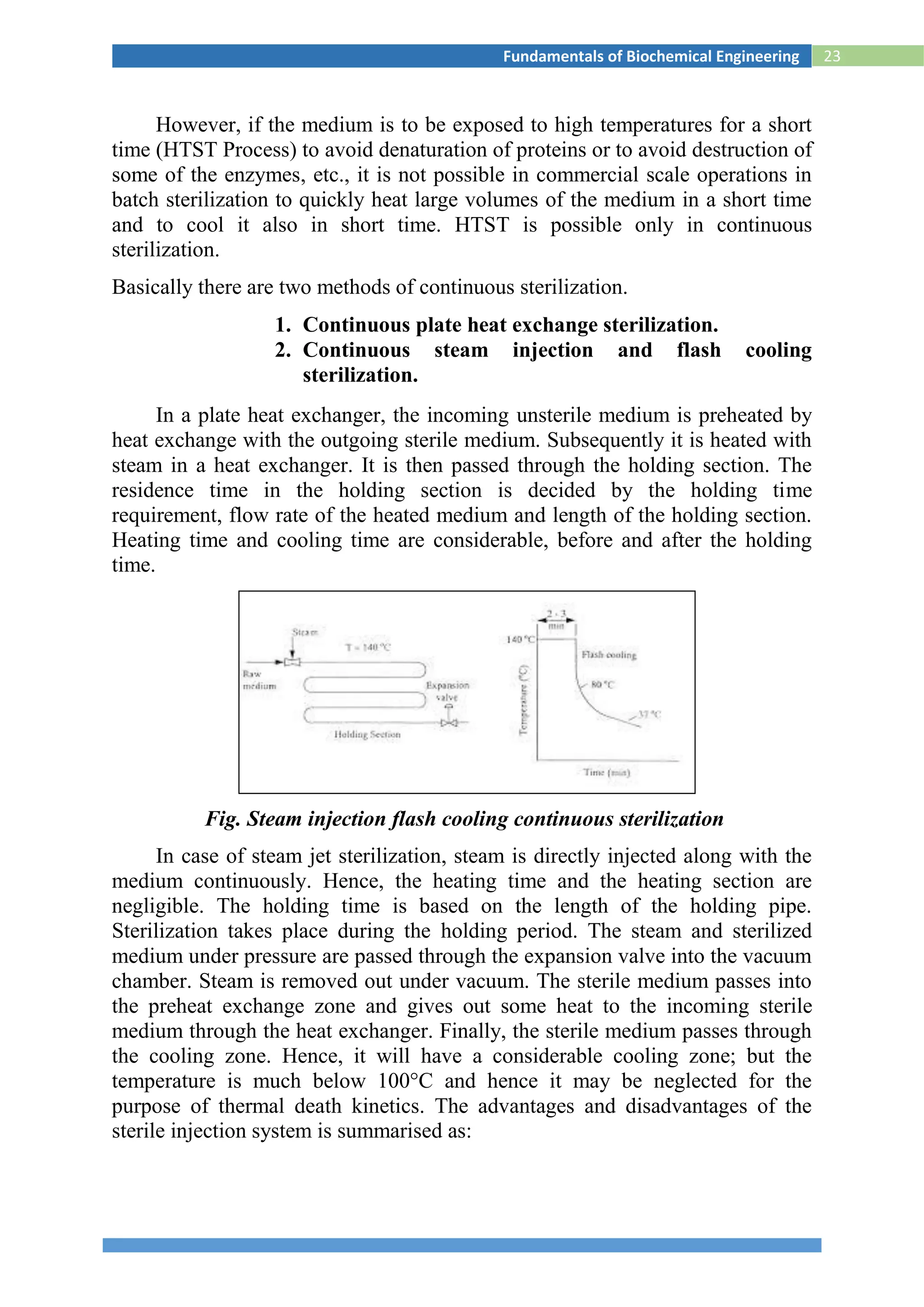
Fig. Steam injection flash cooling continuous sterilization
In case of steam jet sterilization, steam is directly injected along with the
medium continuously. Hence, the heating time and the heating section are
negligible. The holding time is based on the length of the holding pipe.
Sterilization takes place during the holding period. The steam and sterilized
medium under pressure are passed through the expansion valve into the vacuum
chamber. Steam is removed out under vacuum. The sterile medium passes into
the preheat exchange zone and gives out some heat to the incoming sterile
medium through the heat exchanger. Finally, the sterile medium passes through
the cooling zone. Hence, it will have a considerable cooling zone; but the
temperature is much below 100°C and hence it may be neglected for the
purpose of thermal death kinetics. The advantages and disadvantages of the
sterile injection system is summarised as:
24Fundamentals of Biochemical Engineering
Sterilization of Air:
For aerobic fermentation processes on industrial scale, a huge quantity of
air is required, and it is needless to say that the air should be clean and sterile.
Achieving sterility for air is a stupendous task for biochemical engineers.
There is an excellent coverage on air sterilization (Aiba et al., 1965 (c))
which mentions various species and numbers of air-borne microbes. A cubic
meter of air contains approximately 4 x 10³
to 20 x 103
particles with a
maximum possibility of 12 x 103.
However, on an average, we can assume that
air contains 103
to 104
particles/m3
. The average size of the dust particles is
approximately 0.6 microns.
Methods of Air Sterilization:
There are various possible ways to sterilize the air:
 Sterilization by heating
 Use of ultraviolet rays and other electromagnetic waves
 Use of germicidal sprays
 Sterilization by filtration
Even though it is possible to heat the air and sterilize it, normally it is not
economical to heat the air because of its poor thermophysical properties
resulting in lower heat transfer coefficient. Ultraviolet rays in the wavelength
range 2265-3287 Å are effective in killing air-borne microbes. This is one of the
Advantages Disadvantages
 Media containing solids can
be sterilized better.
 Direct contact of the steam
with the medium makes it
necessary that the steam
should be clean and free of
any anti-corrosive agents.
 Capital investment is low.  Foaming may occur during
both heating and cooling.
 It is easy to clean and
maintain the system.
 Heating and cooling periods
are shorter.
 Steam efficiency is very high
as live steam is directly
injected into the medium.
25Fundamentals of Biochemical Engineering
oldest known techniques. Hospital rooms, food factories and fermentation
rooms are equipped with lamps emitting UV rays. However, their reliability to
sterilize large volumes of air in factories is doubtful, even though they are good
to sterilize the air to a reasonable extent in rooms or in small containers.
There will be a significant reduction in air-borne bacteria by spraying of
small amount of germicides, viz. phenol, ethylene oxide or formalin
(formaldehyde). This is also an effective method of disinfecting the air in a
room to a good extent. This method also cannot ensure 100% sterility of air.
The disinfectants are sprayed into the room along with the air recirculation
systems like air-conditions or pedestal fans, etc.
Thus, it can be seen that amongst the various options given above, none of
them was very effective or economical or practicable. Hence, normally air is
sterilized in the process industries by passing it through a filter bed which
separates the spores present in the air. The air filters used for the removal of
microorganisms or spores from the air are of two types:
I. Those filters whose pores are smaller than the size of the
microorganisms to be removed.
II. Those in which the pore size is bigger than the size of the
microorganisms.
In the former category, virtually all the organisms are filtered off and
hence they are called as absolute filters. In the latter category of filters, fibrous
materials such as cotton, glass-wool, slag or steel-wood are used to make filter
beds with bigger gaps or pore openings. They are called as fibrous-type air
filters. Obviously, they cannot assure 100% sterilization of air, no matter
whatever be the length of the filter bed. Comparison of the two filter beds is
shown below:
Absolute air filter Fibrous-type air filter
 The pore size is smaller than
the particle size.
 The gaps between the fibrous
materials are bigger than the
particle size.
 Sterilization efficiency is
100%.
 Sterilization cannot be 100%.
 Pressure drops are high.  Pressure drops are not that high.
 Filter thickness is small.  Filter thickness is more.
 Cost of initial investment is
high.
 Initial investments are low.
 Choking/clogging takes place
very fast.
 Choking and clogging do not
take place that fast.
 Cleaning and replacement are
difficult.
 Cleaning and replacement are
easy.
26Fundamentals of Biochemical Engineering
Kinetics of microbial growth
Kinetics is the study that deals with the speed. The kinetic of reaction, in
general parlance means how fast a reaction is progressing.
Microbial growth:-
Microbial growth is considered for the observation of the living cell
activities. It is important to monitor cell growth and biological and biocatalytic
activities in cell metabolism. A variety of methods are available to predict cell
growth by direct or indirect measurements. Cell dry weight, cell optical density,
cell turbidity, cell respiration, metabolic rate and metabolites are quite suitable
for analysing cell growth, substrate utilisation and product formation. The rate
of cell growth is described in this chapter. Various bioprocesses are modelled
for substrate utilisation and product formation.
Microbial growth is usually studied as a population not an individual.
Individual cells divide in a process called binary fission where two daughter
cells arise from a single cell. The daughter cells are indentical except for the
occassional mutation.
Binary fission requires:
 Cell mass to increase
 chromosome to replicate
 cell wall to be synthesized
 cell to divide into two cells
Cell Growth in Batch Culture
Batch culture is a closed system without any inlet or outlet streams, as
nutrients are prepared in a fixed volume of liquid media. The inocula are
transferred and then the microorganisms gradually grow and replicate. As the
cell propagates, the nutrients are depleted and end products are formed. The
microbial growth is determined by cell dry weight (g.l-1
) and cell optical density
(absorbance at a defined wavelength). A growth curve can be divided into four
phases, as shown in following Figure. As inocula are transferred to the
fermentation media, cell growth starts rapidly in the media. The lag phase
shows almost no apparent cell growth. This is the duration of time represented
for adaptation of microorganisms to the new environment, without much cell
replication and with no sign of growth. The length of the lag phase depends on
the size of the inocula. It is also results from the shock to the environment when
there is no acclimation period. Even high concentrations of nutrients can cause a
27Fundamentals of Biochemical Engineering
long lag phase. It has been observed that growth stimulants and trace metals can
sharply reduce the lag phase.
(Typical batch growth curve of a microbial culture)
Growth Phases
Once there is an appreciable amount of cells and they are growing
very rapidly, the cell number exponentially increases. The optical cell density of
a culture can then be easily detected; that phase is known as the exponential
growth phase. The rate of cell synthesis sharply increases; the linear increase is
shown in the semi-log graph with a constant slope representing a constant rate
of cell population. At this stage carbon sources are utilised and products are
formed. Finally, rapid utilisation of substrate and accumulation of products may
lead to stationary phase where the cell density remains constant. In this phase,
cell may start to die as the cell growth rate balances the death rate. It is well
known that the biocatalytic activities of the cell may gradually decrease as they
age, and finally autolysis may take place. The dead cells and cell metabolites in
the fermentation broth may create toxicity, so deactivating remaining cells. At
this stage, a death phase develops while the cell density drastically drops if the
toxic secondary metabolites are present. The death phase shows an exponential
decrease in the number of living cells in the media while nutrients are depleted.
In fact the changes are detected by monitoring the pH of the media.
Kinetics of Batch Culture
The batch culture is a simple, well-controlled vessel in which the
concentration of nutrients, cells and products vary with time as the growth of
the microorganism proceeds. Material balance in the reactor may assist in
following the biochemical reactions occurring in the media. In batch
fermentation, living cells propagate and many parameters of the media go
28Fundamentals of Biochemical Engineering
through sequential changes with time as the cells grow. The following
parameters are monitored while the batch process continues:
 Cells and cell by-product
 Concentration of nutrients
 Desirable and undesirable products
 Inhibition
 pH, temperature, substrate concentration
The objective of a good process design is to minimise the lag phase period
and maximise the length of exponential growth phase. The substrate balance in
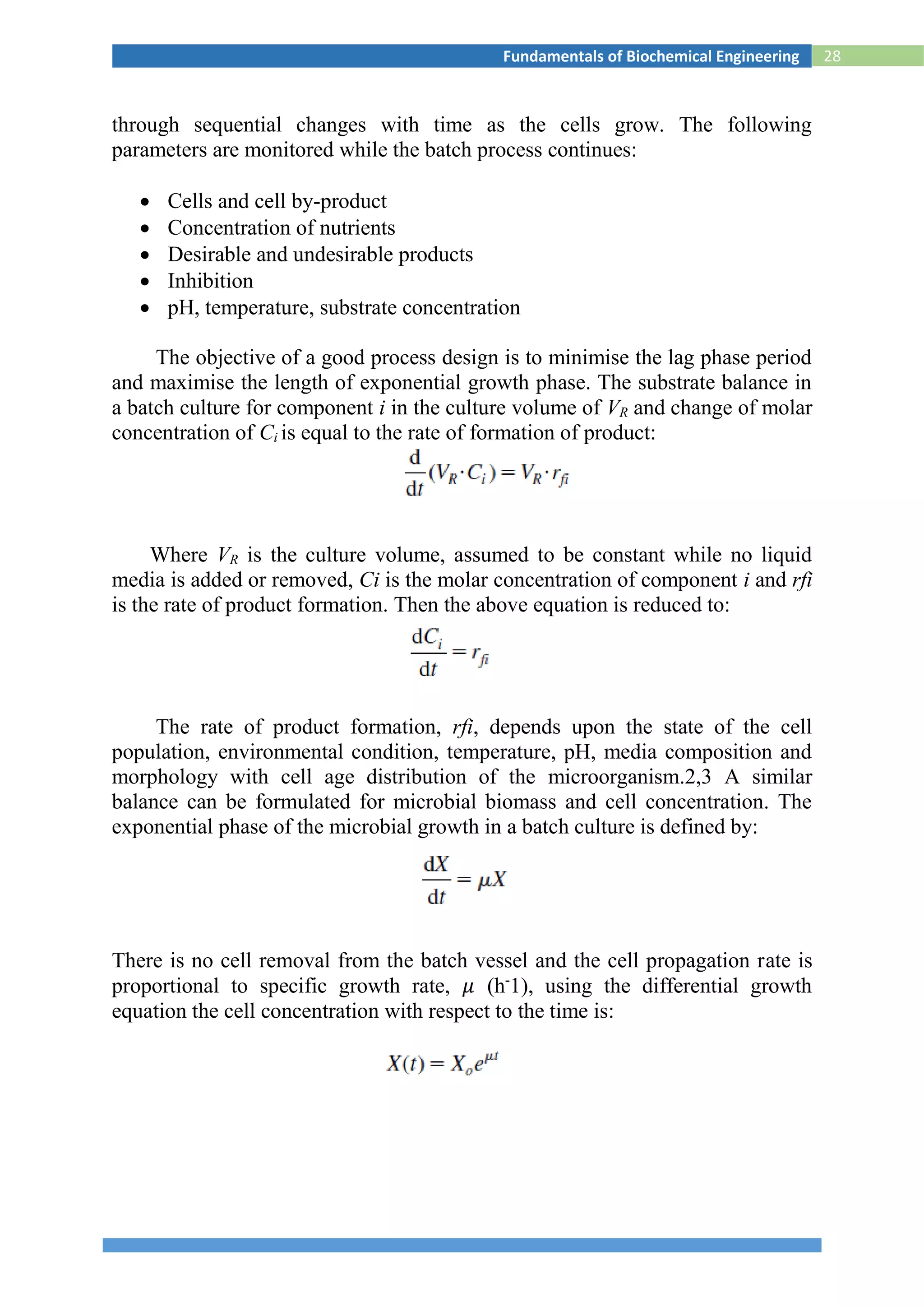
a batch culture for component i in the culture volume of VR and change of molar
concentration of Ci is equal to the rate of formation of product:
Where VR is the culture volume, assumed to be constant while no liquid
media is added or removed, Ci is the molar concentration of component i and rfi
is the rate of product formation. Then the above equation is reduced to:
The rate of product formation, rfi, depends upon the state of the cell
population, environmental condition, temperature, pH, media composition and
morphology with cell age distribution of the microorganism.2,3 A similar
balance can be formulated for microbial biomass and cell concentration. The
exponential phase of the microbial growth in a batch culture is defined by:
There is no cell removal from the batch vessel and the cell propagation rate is
proportional to specific growth rate, 𝜇 (h-
1), using the differential growth
equation the cell concentration with respect to the time is:
29Fundamentals of Biochemical Engineering
GROWTH KINETICS FOR CONTINUOUS CULTURE
The fermentation system can be conducted in a closed system as batch
culture. The batch system growth kinetics and growth curve were explained in
the above sections. The growth curve is the best representation of a batch
system. Disadvantages exist in the batch system such as substrate depletion with
limited nutrients or product inhibition growth curve. The growth environment in
the batch system has to follow all the phases projected in the growth curve.
Besides nutrient depletion, toxic by-products accumulate. Even the composition
of media with exponential growth is continuously changing; therefore it will
never be able to maintain any steady-state condition. The existing limitation and
toxic product inhibition can be removed if the system is an open system and the
growing culture is in a continuous mode of operation. In engineering, such a
system is known as an open system. There would be an inlet medium as fresh
medium is pumped into the culture vessel and the excess cells are washed out
by the effluents, leaving the continuous culture from the fermentation vessel.
The advantages of continuous culture are that the cell density, substrate and
product concentrations remain constant while the culture is diluted with fresh
media. The fresh media is sterilised or filtered and there are no cells in the inlet
stream. If the flow rate of the fresh media gradually increases, the dilution rate
also increases while the retention time decreases. At high flow rate, the culture
is diluted and the cell population decreases; with the maximum flow rate when
all the cells are washed out, the composition of the inlet and outlet conditions
remain about the same. In this condition a washout phenomenon takes place. In
continuous culture, the flow rate is adjusted in such a way that the growth rate
and the cell density remain constant. There are two types of are given below.
(i) Chemostat (growth rate controlled by dilution rate, D, (h-
1)
(ii) Turbidostat (constant cell density that is controlled by the fresh medium)
Chemostat
The nutrients are supplied at a constant flow rate and the cell density is
adjusted with the supplied essential nutrients for growth. In a chemostat, growth
rate is determined by the utilisation of substrates like carbon, nitrogen and
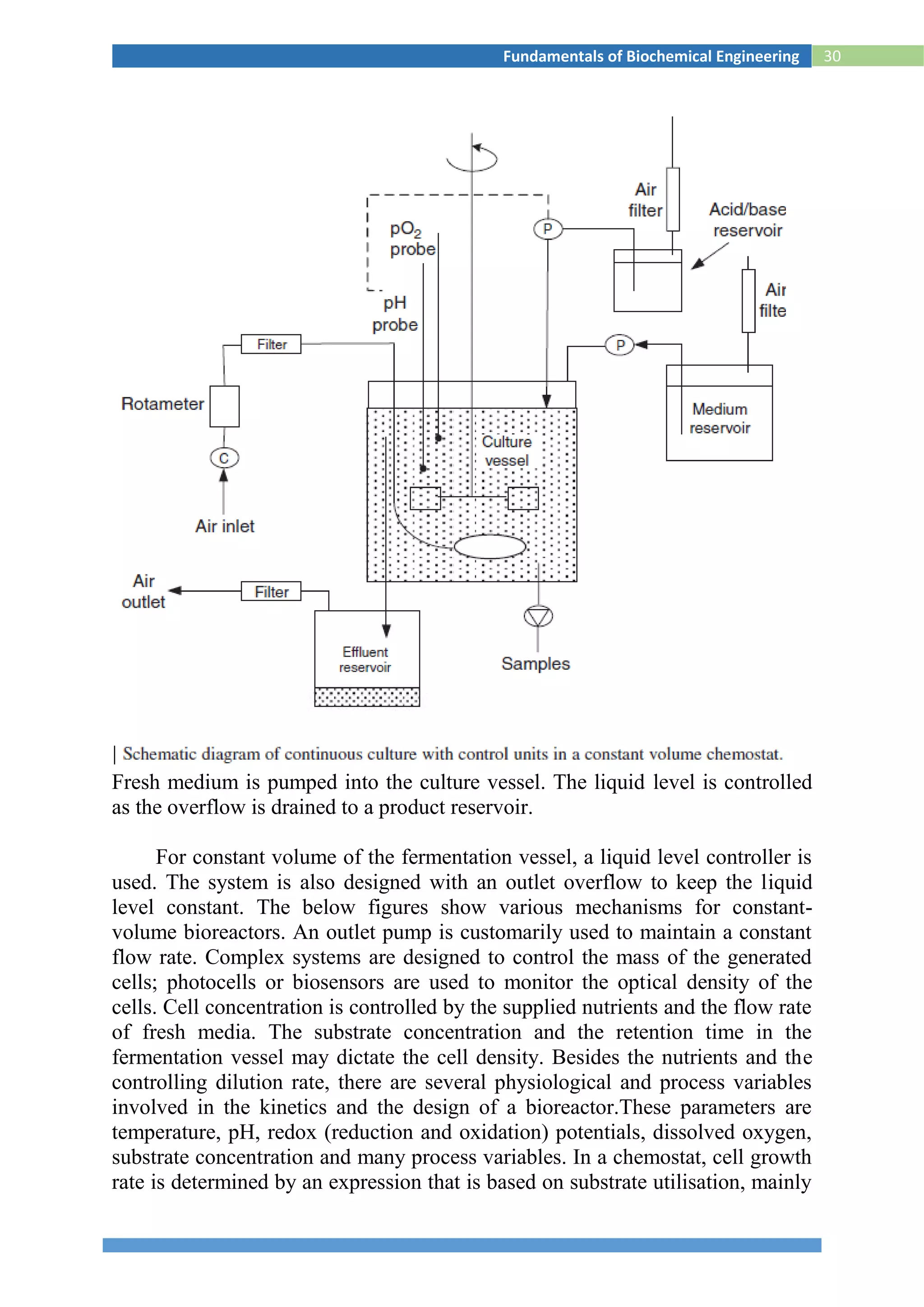
phosphorus. A simple chemostat with feed pump, oxygen probe, aeration and
the pH controlling units is shown in Figure below. The system is equipped with
a gas flow meter. Agitation and aeration provided suitable mass transfer. The
liquid level is controlled with an outlet pump.
30Fundamentals of Biochemical Engineering
Fresh medium is pumped into the culture vessel. The liquid level is controlled
as the overflow is drained to a product reservoir.
For constant volume of the fermentation vessel, a liquid level controller is
used. The system is also designed with an outlet overflow to keep the liquid
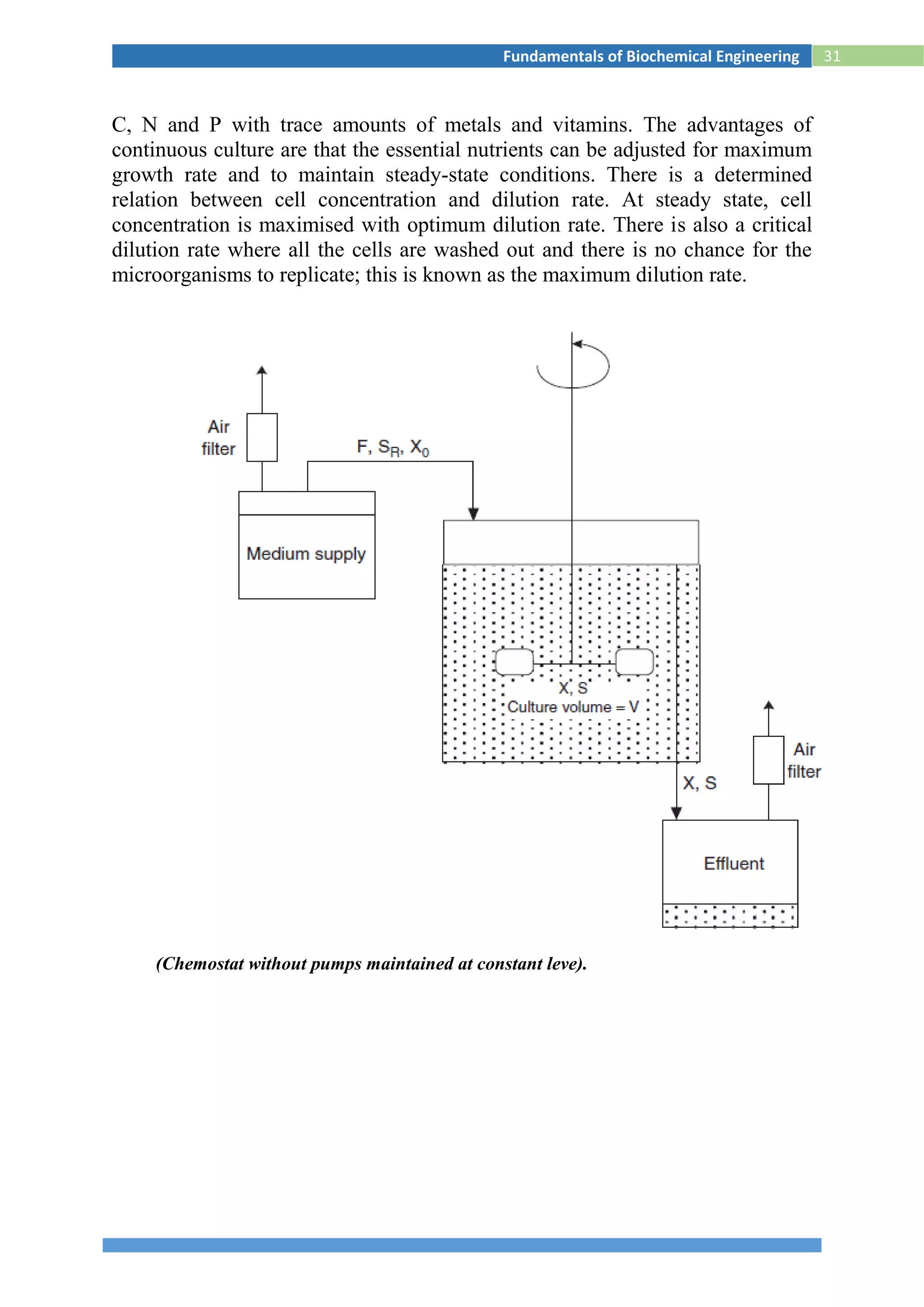
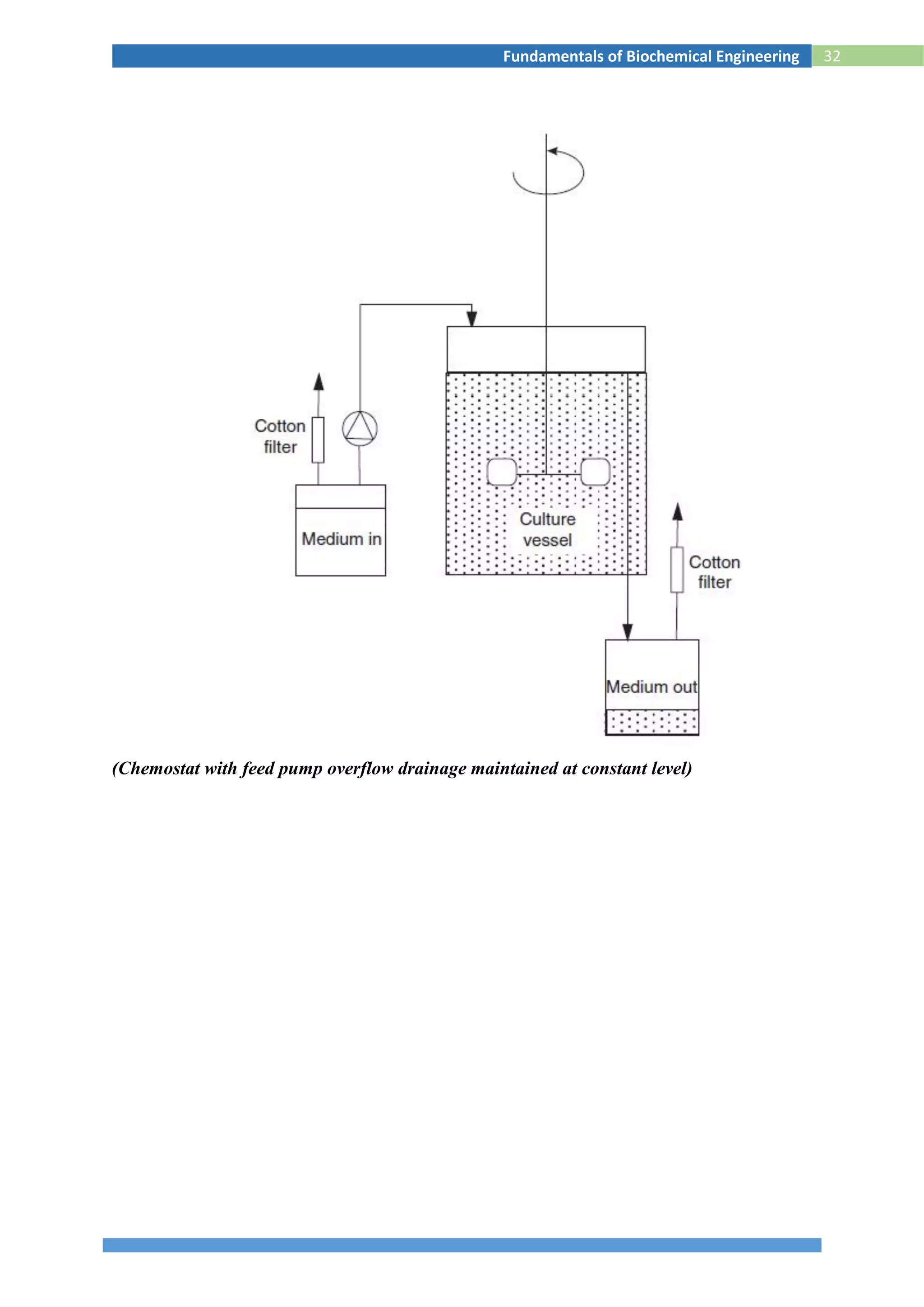
level constant. The below figures show various mechanisms for constant-
volume bioreactors. An outlet pump is customarily used to maintain a constant
flow rate. Complex systems are designed to control the mass of the generated
cells; photocells or biosensors are used to monitor the optical density of the
cells. Cell concentration is controlled by the supplied nutrients and the flow rate
of fresh media. The substrate concentration and the retention time in the
fermentation vessel may dictate the cell density. Besides the nutrients and the
controlling dilution rate, there are several physiological and process variables
involved in the kinetics and the design of a bioreactor.These parameters are
temperature, pH, redox (reduction and oxidation) potentials, dissolved oxygen,
substrate concentration and many process variables. In a chemostat, cell growth
rate is determined by an expression that is based on substrate utilisation, mainly
31Fundamentals of Biochemical Engineering
C, N and P with trace amounts of metals and vitamins. The advantages of
continuous culture are that the essential nutrients can be adjusted for maximum
growth rate and to maintain steady-state conditions. There is a determined
relation between cell concentration and dilution rate. At steady state, cell
concentration is maximised with optimum dilution rate. There is also a critical
dilution rate where all the cells are washed out and there is no chance for the
microorganisms to replicate; this is known as the maximum dilution rate.
(Chemostat without pumps maintained at constant leve).
32Fundamentals of Biochemical Engineering
(Chemostat with feed pump overflow drainage maintained at constant level)
33Fundamentals of Biochemical Engineering
(Chemostat using single medium inlet feed and outlet pumps)
Disadvantages of Batch Culture
There are several disadvantages of batch culture. The nutrient in the
working volume becomes depleted; the other major problem is the limitation
and depletion of the substrate. Since there is no flow stream to take effluent out,
as the system is closed, toxins form there. A disadvantage related to substrate
depletion is that the growth pattern may reach the death phase quickly in an old
culture. The long duration of the batch system for slow growth results in
exhaustion of essential nutrients and an accumulation of metabolites as by-
products. Exhaustion of nutrients and substrate may cause the system to become
retarded. The technical problem resulting in changes to media composition may
directly affect the microbial exponential growth phase. Inhibition is another
factor affecting the bioprocess, which causes the reaction rate shift. As a result,
inhibition may slow down bio-catalytic activities. Product inhibition may block
enzyme activities, and the cells became poisoned by the by-product. One
common disadvantage of the batch process is that one has to carry out a cycle
for production: the product should be sent for downstream processing, then the
system has to be cleaned and recharged with fresh feed, so the process is highly
labour intensive for downtime and cleaning.
34Fundamentals of Biochemical Engineering
Advantages of Continuous Culture
There are several advantages to continuous culture, where all the problems
associated with the batch culture are solved. Firstly, the growth rate is
controlled and the cells are well maintained, since fresh media is replaced by
old culture while the dilution is taking place. As a result, the effect of physical
and chemical parameters on growth and product formation can easily be
examined. The biomass concentration in the cultured broth is well maintained at
a constant dilution rate. The continuous process results in substrate-limited
growth and cell-growth-limiting nutrients. The composition of the medium can
be optimised for maximum productivity; in addition secondary metabolite
production can also be controlled. The growth kinetics and kinetic constants are
accurately determined. The process leads to reproducible results and reliable
data. High productivity per unit volume is achieved. The continuous culture is
less labour-intensive, and less downtime is needed. Finally, steady state growth
can be achieved, even if mixed cultures are implemented.
35Fundamentals of Biochemical Engineering
ENZYMES
Biological reactions occur rapidly due to the presence of natural catalyst
called enzymes. They are biocatalysts present in living matter. Pure enzyme
catalyses the transformation of 10000 to 1000000 moles of substrate per
min/mole of enzyme. Enzymes are biological catalysts used to increase the rate
of biochemical reaction, taking place with living systems, without themselves
undergoing any overall changes.
 Cofactor: the non protein component of an enzyme
 Coenzyme: an enzyme with organic molecule as its cofactor
 Holo enzyme :an active enzyme in cofactor
 Apo enzyme: the in active portion of protein
CLASSIFICATION OF ENZYMES:
1. Nomenclature are usually named in terms of the reactions those are
catalysed. The suffix represents the name of the enzyme “ase”.
2. The enzyme that attacks urea-urease , argenin-arginase. Enzymes are also
named by chemical reactors prolease, lipase, oxidase etc.
3. All the enzymes are classified into two groups: hydrolysing enzyme or
hydrolase, other enzyme or desmolases.
ENZYME SPECIFICITY:
Enzymes as biological catalysts are particularly credited for their
specificity in action. Each enzyme usually catalyses only one particular type of
reactions by selectively lowering the activation energy of only one of the
several possible chemical or biochemical reactions.
TYPES OF SPECIFICITY:
 Depending upon the reaction conditions and specific natures of enzyme;
the enzymatic catalytic processes exhibit different kind of specificity.
1. Absolute specificity
2. Group specificity
3. Stereochemical specificity
4. Product specificity
5. Substrate specificity
36Fundamentals of Biochemical Engineering
 Alcohol dehydrogenase is a group specific enzyme, which catalyses the
oxidation of variety of alcohols. Those enzymes which act on a
particular substrate are known as absolute specific enzymes. Some
enzymes even exhibit stereo specificity i.e. if a substrate exists in two
stereo chemical forms but chemically identical, the enzymes will
specially catalyse one of the isomers. A typical example is oxidation of
L-amino acid to oxo-acid which can take place by enzymatic catalytic
action of L-amino acid oxidase.
ACTIVE SITE:-
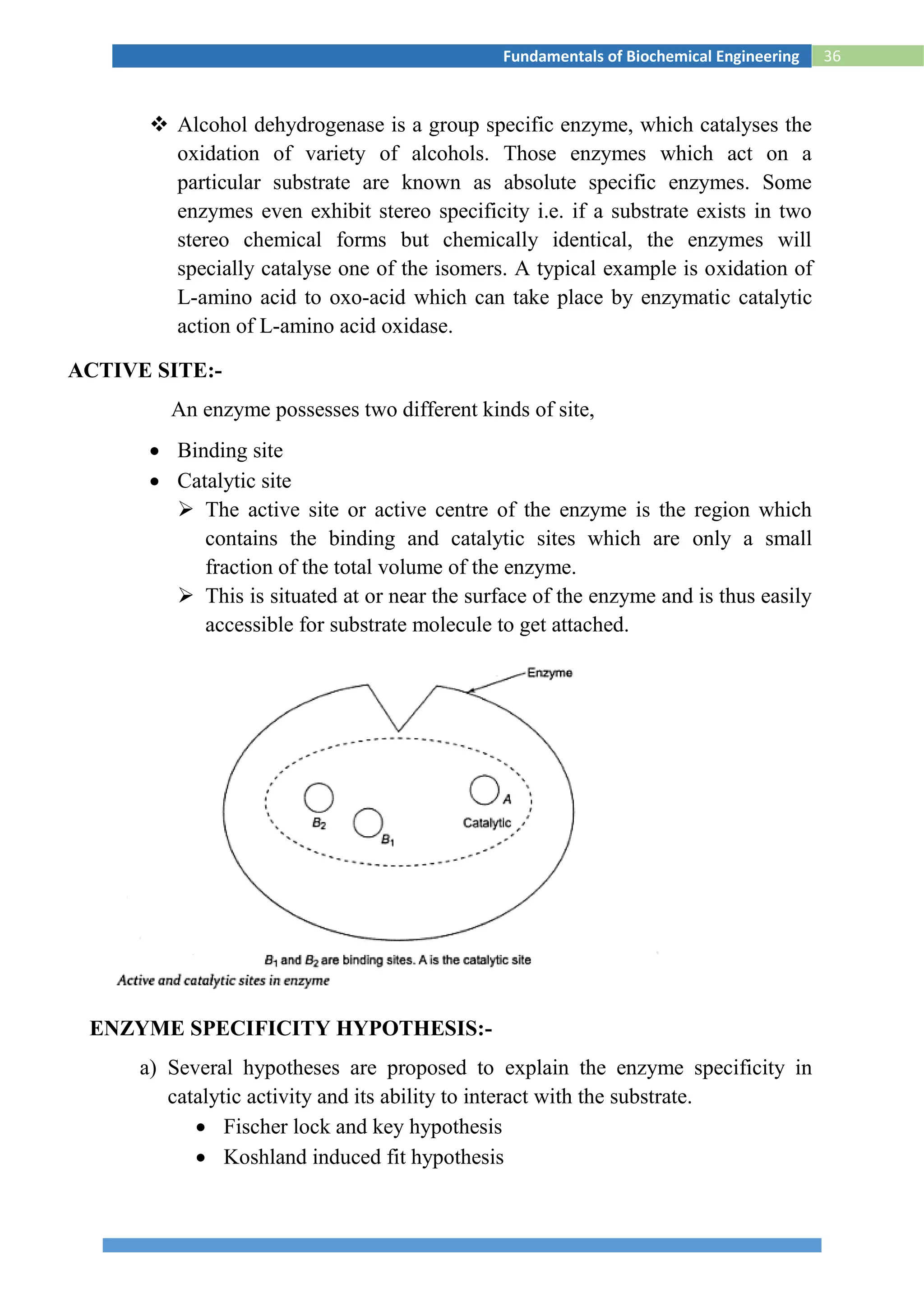
An enzyme possesses two different kinds of site,
 Binding site
 Catalytic site
 The active site or active centre of the enzyme is the region which
contains the binding and catalytic sites which are only a small
fraction of the total volume of the enzyme.
 This is situated at or near the surface of the enzyme and is thus easily
accessible for substrate molecule to get attached.
ENZYME SPECIFICITY HYPOTHESIS:-
a) Several hypotheses are proposed to explain the enzyme specificity in
catalytic activity and its ability to interact with the substrate.
 Fischer lock and key hypothesis
 Koshland induced fit hypothesis
37Fundamentals of Biochemical Engineering
 Hypotheses involving strain and transition state stabilisation.
b) Fischer lock and key hypothesis is probably the first theory gives the
concept of “complementary structural features” between enzyme and the
substrate.
c) The catalytic process is brought about because the substrate fits into the
complementary site on the enzyme just as key fits into the lock, thus the
reaction group of the substrate gets struck with the catalytic site of the
enzyme.
d) Similarly the binding groups attach to the binding sites in the enzyme.
e) The lock-and-key theory has been successful in explaining many features
of enzyme specificity, but one serious drawback with this hypothesis is
that it could not explain some of the conformational changes taking place
in the enzyme when they come in contact with substrate.
f) An enzyme may not be having as an exactly complementary feature that
is compatible to the substrate, but still there are instances when reactions
have taken places; particularly protein which are known for flexibility.
g) X-ray diffraction analysis and some spectroscopic analysis have been
shown differences in structures of the free enzyme and substrate bound
enzyme. This states that structure of the substrate may not be
complementary to the enzyme in its native form, but it is complementary
to the active site in the substrate enzyme-complex.
h) When substrate or enzyme brought together, the binding of the substrate
brings in structural changes in the enzyme so that the catalytic sites in the
enzymes and reacting group in the substrate match each other, like hand
and glove example.
i) The substrate like hand which is rigid and does not change its shape and
enzyme is like a woollen glove which can be wrapped around the hand.
38Fundamentals of Biochemical Engineering
ENZYME KINETICS
The Michaelis-Menten equation is an important equation in biochemistry
and as such it is imperative that you understand the derivation of this equation.
By understanding the derivation, you will have insight into the assumptions that
went into this model, and therefore you will have a better appreciation for the
proper use of this equation as well as the limitations of this model. In the
following sections you will see two different derivations of the Michaelis-
Menten equation. When one is learning a subject for the first time, it often helps
to have the same or similar information presented from alternative perspectives.
One way might be clearer to you whereas the other way might be clearer to
someone else. That is ok! You should familiarize yourself with both
approaches, and then settle on the one that you prefer.
First Derivation. We start with the kinetic mechanism shown in equation
(eq) 1:
----------------1
In eq 1, E is enzyme, S is substrate, ES is the enzyme-substrate complex, and P
is product. This equation includes the assumption that during the early stages of
the reaction so little product is formed that the reverse reaction (product
combining with enzyme and re-forming substrate) can be ignored (hence the
unidirectional arrow under k3). Another assumption is that the concentration of
substrate is much greater than that of total enzyme ([S] >> [Et]), so it can
essentially be treated as a constant.
39Fundamentals of Biochemical Engineering
From General Chemistry we can equate the rate of this process (k3[ES]) to the
change in product concentration as a function of time (d[P]/dt), or, equivalently,
we can designate the rate with an italicized v (v) as follows in eq 2:
-----------------------------------------------------------2
Because the concentration of the enzyme•substrate complex ([ES]) cannot be
measured experimentally, we need an alternative expression for this term.
Because the enzyme that we add to the reaction will either be unbound (E) or
bound (ES) we can express the fraction of bound enzyme as follows in eq 3 :
---------------------------------------------------------3
In eq 3 Et is the concentration of total enzyme, and the other variables are as
definedabove. If we multiply both sides of eq 3 by Et we arrive at eq 4:
-----------------------------------------------------4
If we multiply the numerator and denominator of the right-hand side of eq 4 by
1/[ES], we are, in effect, multiplying by one and we do not change the value of
this expression. When we do this we obtain eq 5:
-------------------------------------------------------5
We have almost achieved our goal of isolating [ES]. Next, we need to come up
with an alternative expression for the ratio [E]/[ES]. We do this by recalling that
a major assumption in enzyme kinetics is the steady-state assumption. Basically,
it says the rate of change of [ES] as a function of time is zero: d[ES]/dt = 0.
Another way to express the steady-state assumption is that the rate of formation
of ES equals the rate of breakdown of ES. We can express this latter statement
mathematically as in eq 6:
------------------------------------------6
The left-hand side of eq 6 expresses the rate of formation of ES (according to eq
1), and the right-hand side expresses the two ways that ES can break down (also
according to eq1). We can rearrange eq 6 to isolate the ratio [E]/[ES]. When we
do we get eq 7:
40Fundamentals of Biochemical Engineering
----------------------------------------------------------7
We now define a new constant, the Michaelis constant (Km), as follows in eq 8:
-------------------------------------------------------8
If we substitute Km back into eq 7 we obtain eq 9:
----------------------------------------------------------9
We now substitute the ratio Km/[S] from eq 9 in place of the ratio [E]/[ES] in eq
5 and we obtain eq 10:
----------------------------------------------------10
If we multiply the numerator and denominator of the right-hand side of eq 10 by
[S], we are, in effect, multiplying by one and we do not change the value of this
expression. When we do this we obtain eq 11:
----------------------------------------11
Now we have achieved our goal of isolating [ES] and we can substitute this
alternative expression of [ES] into eq 2 and obtain eq 12:
----------------------------------12
Next, we imagine what happens to eq 12 when [S] > > Km as follows in eq 13:
--------------------13
The constant kcat in the right-hand most term of eq 13 is used to signify that k3
is considered the catalytic constant. Under such conditions, when [S] is said to
41Fundamentals of Biochemical Engineering
be saturating, the enzyme is functioning as fast as it can and we define k3[Et] (or
kcat[Et]) to be equal to Vmax, the maximum velocity that can be obtained.
Therefore, eq 12 can be rewritten into the familiar form of the Michaelis-
Menten equation (eq 14):
----------------------------------14
Next, we imagine what happens when Km > > [S] as follows in eq 15:
--------------------------------------------15
Since k = Vmax/ Km in eq 15, we refer to Vmax/ Km as an apparent (or pseudo)
first order rate constant. Another way to look at a similar, related concept is to
rewrite eq 14 as follows:
---------------------------------16
Since we are imagining the case where Km > > [S] we neglect [S] in the
denominator and include the assumption that [Et] [E] since at very low [S]
relatively little [ES] should form:
-------------------------------------------------------17
Once again, since k’’ = kcat/Km in eq 17, we refer to kcat/Km as an apparent second
order rate constant. Because kcat/Km is a measure of the rate of the reaction
divided by the term that reflects the steady-state affinity of the enzyme for the
substrate, it is considered an indicator of the catalytic efficiency of the enzyme
and sometimes is called the specificity constant. It also is more relevant to the
physiological situation because in cells, [S] generally is equal to or less than
Km. Is there an upper limit to the value that kcat/Km can approach? Yes, there is
and the following shows how we can determine this limit. To illustrate this limit
we first need to rewrite kcat/Km as follows:
-------------------------------------------------------18
Next, we imagine the case where k3 >> k2:
42Fundamentals of Biochemical Engineering
--------------------------------------------19
So we see that kcat/Km can approach k1 as a limiting value, and k1 is the second-
order rate constant for the productive collision of enzyme and substrate and as
such it is limited by diffusion to about 108
to 109
M-1 s-1. Thus, if we see an
enzyme that has a kcat/Km value in the neighborhood of 108
to109
M-1 s-1we say
that the enzyme has attained “catalytic perfection”. You will see later in the
class that a number of enzymes that catalyze “nearequilibrium” reactions in
metabolic pathways are catalytically perfect. Next, we return to eq 16 and
consider what happens when v = ½ Vmax
Next, we return to eq 16 and consider what happens when v = ½ Vmax:
-------------------------------------20
When we simplify eq 20 we find that Km = [S] (under the above conditions; i.e.,
v = ½Vmax). So, in other words, Km is formally defined as a collection of rate
constants (eq. 8), but it is also equal to the substrate concentration that gives
half-maximal velocity of the enzyme-catalysed reaction.
Before we discuss the second derivation, we will consider what happens when
we take the reciprocal of both sides of eq 14. When we do this we obtain eq 21:
----------------------------------------------21
Eq 21 is in the form of an equation for a straight line (i.e., y = mx + b, with y =
1/v; m =
𝐾𝑚
𝑉𝑚𝑎𝑥
; x =
1
[𝑆]
; and b =
1
𝑉𝑚𝑎𝑥
). When experimental data are plotted using
this transformation the resulting plots are called double-reciprocal plots or
Lineweaver-Burk plots in honor of the researchers who pioneered this method.
The authors of many textbooks extol the virtues of using Lineweaver-Burk
plots to obtain estimates of Vmax and Km. I disagree strongly with this practice
because initial velocity data determined at low substrate concentrations (where
there is inherently more uncertainty since [S] Km) end up being the points in
a Lineweaver-Burk plot that have too much sway in determining the best-fit line
through the data.
43Fundamentals of Biochemical Engineering
IMMOBILIZATION OF ENZYMES
Immobilization of Enzymes:
 The movement of enzymes in a fixed location is restricted by technique
known as immobilization.
 Immobilized enzymes are attached to an insoluble support medium or
enclosed by the support medium which is also known as a “carrier”.
 In some cases the enzyme molecules are cross linked to each other so that
their movement is restricted but their catalytic activities are retained
.Thus immobilization restricts only the movement of enzymes either
completely or to some region.
 Since enzymes are proteins and they are soluble in water, it is difficult to
separate them once the reaction is over for reuse in a batch process.
 To overcome this difficulty enzymes are immobilized on the carrier
material or inside an insoluble matrix by various physical or chemical
method
Immobilization has the following advantages:
 Component enzymes can be reused.
 The cell density or enzyme density in a location can be increased.
 Continuous operation is possible.
 Enzyme stability is improved considerably.
 Product is enzyme free and hence is particularly useful with intra cellular
particles.
 Since this process is continuous, it is easy to incorporate control process.
 Catalytic process route can be controlled more accurately.
 Allows development of multi enzyme reaction system.
 Effluent disposal problems can be considerably reduced.
In view of the above advantages, immobilized enzymes have become a
potential source for industrial and medical use.
Immobilization Methods:
Immobilization techniques can be divided into four main groups; the
division is based on whether the enzymes are entrapped in a limited space or
bound to a carried material.
44Fundamentals of Biochemical Engineering
1. Entrapment or Occlusion:
It is a simple physical process of immobilization. The active enzyme is
entrapped in a matrix of a polymerised gel. Polyacrylamide is generally the
most preferred gel. This method is very simple and can be utilised for most of
the enzymes.
The advantages of this process are:
 Enzymes are not chemically modified.
 Enzyme properties are not altered.
There are certain disadvantages with this method:
 The deactivation of enzymes may takes place during gel formation.
 Enzyme leakage may takes place continuously depending upon the
pore size of the gel.
 Diffusional limitation may pose reduced accessibility for the substrate.
2. Micro Encapsulation:
 In this method the enzyme is entrapped within semipermeable membrane
in the form of microscopic hollow spheres.
IMMOBILIZATION
ENTRAPMENT
MATRIX
ENTRAPMENT
MICRO
ENCAPSULATION
BINDING
ADSORPTION
AND
COVALANT
BONDING
45Fundamentals of Biochemical Engineering
 The entrapping methods do not affect the activity of enzymes. However
the diffusional limitations may restrict the movement of the substance to
the activity site.
 Thus this method of immobilization may not suitable for proteolytic
enzymes or for macro molecule substrate.
 The best advantage of his method is that each enzyme is in much close
contact with the substrate in the surrounding solution.
3. Covalent Attachment:
In this method, the enzyme is attached to the surface by the covalent bond
formation via certain functional groups.The most commonly used functional
groupings of the support material are:
 Amino groups
 Carboxyl groups
 Hydroxyl groups
 Sulphydryl groups
The only restriction imposed by this method is that these functional groups
should not be in the active sites of the enzymes. Certain chemical reagents are
used for activating the functional groupings. They are;
 Cyanogens bromides
 Carbodiimide and
 Glutaraldehyde.
The covalent attachments of enzyme molecules can be simply described as
follows:
|-X+E ->|- E+X
The copolymerisation of enzymes of a reacting monomer of the support
material is also followed for some immobilisation by the covalent attachments.
nM+E→MnE
E
M
M-M
M
│
M
M-M
46Fundamentals of Biochemical Engineering
Some of the water-insoluble support materials are:
Covalent bonding method provides more permanent linkage between the
enzyme and the support material. Covalent bonds can be formed under mild
conditions, and the active site of enzyme must remain free from covalent
attachments. There is still some possibility for loss of activity of the enzyme
during bond formation mainly because of chemical reaction.
4. Adsorption:
 One of the simplest methods for enzyme immobilisation is by adsorption.
Enzymes can be adsorbed physically on a surface-active adsorbent by
weak physical forces such as Vander Waals’ forces or dispersion forces.
 Commonly used adsorbents are: alumina, clay, silica, anion-exchange
resins, CaCO3, C, cation exchange resins, collagen and glass plates.
 For effective immobilisation the surfaces of these support materials may
have to be physically or chemically pretreated.
 Ion-exchange resins DEAE sephadex and carboxy methyl cellulose
(CMC) can also be used as support media.
Drawbacks:
 Since adsorption is non-specific process. Many other substances may
also be attached to the carrier in addition to the immobilised enzyme.
 This method is the loading of enzyme on a unit amount of surface is
always very low and the bonding strength is very weak.
Synthetic
support
materials
Styrene-
based
polymers,
Polipeptides
Maleic
anhydride
polymers
Acrylamide-
based
polymers
47Fundamentals of Biochemical Engineering
Advantages:
 The immobilisation procedure is easy and simple
 The adsorption process is reversible
 Enzymes are not deactivated by adsorption
Properties of Immobilised Enzymes:
 Enzymes are usually immobilised in particle or pellet form; but enzymes
may be attached to, or entrapped within carriers in the form of
membranes, tubes or fibres, based on the requirements of a given
application.
 In view of this, an immobilised enzyme may have different properties as
compared to the same enzyme in a free solution form.
 The method of immobilization and nature of insoluble carrier may have
influence on the enzyme properties.
 The specific activity may reduce in the immobilised enzyme, mainly
because of the new microenvironment as compared to the pure enzyme
the internal and external mass transfer limitations are imposed on the
immobilised systems because of diffusional limitations.
 They will reduce biochemical reaction rate considerably making the
effectiveness factor less than one.
Reactors for Immobilized Enzyme System:
As has been mentioned earlier, the immobilised enzyme systems are
particularly credited for their
1. Amenability to use in continuous system
2. Ease in separation of the immobilised pellets for reuse or recycling.
3. Separation of the enzyme free or cells free products at the end of
reactions.
Thus, immobilised enzyme systems are ideal for use in continuously
operated processes, and hence continuously operated reactors can be used with
advantage. Some of the continuously operated flow reactors in
chemical/biochemical systems are:
A. Continuous stirred tank reactors
B. Plug-flow reactors
C. Packed-bed reactors
D. Fluidised-bed reactors
48Fundamentals of Biochemical Engineering
 All the above reactors have got their own advantages and operational
features. The continuous stirred tank reactors (CSTR) have the advantage
of providing fully mixed conditions so that every time the enzyme pellet
can have an opportunity to have a new environment of the substrate
concentration.
 Except for the disadvantage of the shearing, which may be detrimental to
the shear-sensitive particles, these reactors are very ideal.
 The packed-beds and plug flow reactors almost operated under similar
flow conditions. In either case, there is no movement of the bed, and
hence are ideal for any systems except those in which heat generation and
dissipation are a problem to reckon with.
 The fluidised bed bio-reactors incorporate some of the beneficial features
of both stirred tank and packed bed reactors.
 In this reactor, the upward flow system is ideally suitable for processes in
which the substrate solution is highly viscous.
Enzyme Applications:
There are major 4 broadly classifications.
A. Food and beverage industry including baking and brewery.
B. Pharmaceuticals.
C. Medical applications.
D. Analytical purpose
 Rennet enzymes used in cheese making.
 α-amylase and protease are used in baking industry converts starch to
dextrin and sugar.
 Also hydrolysis of gluten which is a major flour protein.
Clarification of Fruit-Juice:
Pectolytic enzyme is used to clarify the fruit juice and wine to remove
pectin and which causes haze to the juice.
 Some fruit pulp like banana, guava, and need proteolytic enzyme to break
pectin to release the free flowing fruit juice from the fibrous material.
49Fundamentals of Biochemical Engineering
Chill Proofing of Beer:
Beer brewed from cereal grains contain a certain amount of haze
(cloudiness) which needs to be removed. It is done by using enzyme papain.
Tenderization of Meat:
Meat obtained from aged animals need to be tenderised to improve the
texture. It is done by pectolic enzymes like papain or bromelin.
 Lactase is used for hydrolysis of lactose present in skin, milk and whey.
 Also enzymes used in food industries for analytic purpose to measure the
sterility of food.
 Enzymes also used in medicines utilised for diagnosis, therapy and
treatment purposes.
 Basically chirally pure compounds from isomers are used in
pharmaceutical industries.
 In anti-biotic industries penicillin acylase is used for conversion of
penicillin-G to 6-amino penicillin acid.
 Enzyme in immobilised form used in bio-sensors.
 It can sense some of the biological materials either quantitatively and
qualitatively or both. E.g.: glucose oxidase and urease are used.
 Also enzymes can be used in washing powder, bacterial protease used in
washing powder. It is used for removal of blood and other protein stains.
50Fundamentals of Biochemical Engineering
Module-II
HEAT TRANSFER IN BIOPROCESSING
Heat transfer plays an important role in bioprocessing, both for
fermentation and for enzymatic reactions. The temperature effect on
biochemical reaction rates is conveniently represented by the Arrhenius
equation. The fermentation broths are either heated to the desired temperatures
or maintained at a desired lower temperature by heating or cooling the
fermenters, depending upon whether the biochemical reaction is endothermic or
exothermic. Here, we use the term heat transfer which means it is the process of
transfer of heat; it could be for the purpose of heating or vaporizing or cooling
or freezing. The heat transfer mechanism is both same in heating and cooling.
The direction of heat transfer could be; either from the heat source to the body
or from the body to the cooling medium.
Heat-transfer applications in biotechnology:-
HT Operation Remarks
Heating of fermentation broth reactors There are many examples; hydrolysis
of starch to glucose, etc. The reactor is
maintained at 950
c.
Cooling of fermentation broths There are many examples.
Fermentation of molasses to alcohol.
The fermentation is maintained at 35-
370
C.
Sterilisation of media ---
Lyophilisation Preservation of isolated strains by
freezing.
Desolventisation Desolventisation is done to recover the
extracted product.
Simultaneous heat and mass transfer
operations
Drying , crystallization , distillation,
solvent extraction, etc.
Concentrating the substrates product Evaporation, crystallization as in the
case of production of citric acid, etc.
First, let us look into the principles of heat-transfer. Heat moves from a body
at a higher temperature to a body at a lower temperature. Any transfer process is
always proportional to the
 Driving force
 Contact area
51Fundamentals of Biochemical Engineering
In heat-transfer, the driving force is the temperature difference between the
source and sink. Thus,
the rate of heat transfer α (∆T)
α (A)
Where ∆T is the temperature difference, and
A is the contact area.
The above equation can also be written as
Rate process α driving force
α 1/resistance
The constant of proportionality is known as the heat-transfer coefficient,
which we shall discuss later. The heat-transfer process also depends upon
whether the materials are in direct contact or otherwise.
Depending upon whether the material is in direct contact with the heating
source or otherwise, heat is conceived to transfer by any of the following three
fundamental heat-transfer methods;
 Conduction
 Convection
 Radiation
Heat Transfer By Conduction:-
Conduction is the method of heat-transfer in which the heat is transferred
from one body to another with/without direct contact and without the movement
of either the source or the sink. This kind of heat-transfer takes place in solids.
For example, heating of a metallic rod by putting one end in a hot flame and
holding the other end. Initially, the other end is cold .Slowly it gets heated; i.e.,
the heat travels in the rod from one end to the other without the movement of
the rod. How fast the transfer depends upon the nature of the material. Some
materials conduct heat very fast, and are known as conductors; whereas other
materials conduct very slowly or virtually do not conduct any heat, are known
as insulators or non-conductors.
52Fundamentals of Biochemical Engineering
Fourier’
s Law of Heat Conduction:-
It states that rate of heat conduction through a body is directly proportional
to the temperature difference and the area which is perpendicular to the body
and it is inversely proportional to the thickness of the body.
The rate of heat transfer per unit area is given by
q/A α (∆T)
α 1/B
or q/A = k/B(∆T) = (∆T)/(B/k) = ∆T/R
in which q is the rate of heat transfer in kJ/s or kW
k is the thermal conductivity (W/m0
C)
∆T is the temperature difference (0
C)
B is the total thickness of the slab(m)
R is known as the resistance for heat transfer and is equal to (B/k)
R = B/k
Conduction of Slabs in Series:-
Heat insulating walls are usually made by having the insulating materials in
series. Usually, the furnance walls are made up of a series of
 Metallic wall inside
 Silo-cel bricks or asbestos
 Glass-wood or asbestos
The overall temperature difference ∆T is equal to the sum of the individual
temperature differences. Thus,
∆T = ∆TA+∆TB+∆TC
Since the same amount of heat has to transfer through all the slabs,
qA = qB =qc = q
also R = RA+RB+RC
53Fundamentals of Biochemical Engineering
Heat Transfer By Convection:-
Heat transfer in fluids takes place by convection. In convective heat-transfer,
there will be virtually physical movement of layers of the fluid. If we heat water
in a vessel or in a beaker, the temperature at the bottom layers of the fluid will
rise resulting in decreasing its density. This kind of heat transfer is known as
convective heat transfer. If the fluid layers move by means of temperature
difference alone, this kind of convection is known as natural or free convection.
On the contrary, if the movement of layers is facilitated by means of an external
pump, convection is known as forced convection.
The convective heat-transfer rate is also proportional to the temperature
difference and contact area. Thus,
q α ∆T
α A
Combining the above two expression, we can write
q = hA(∆T)
in which h is known as the convective heat-transfer coefficient and has the units
of kJ/(s m2 0
C)
Overall Heat Transfer Coefficient:-
The overall heat-transfer coefficient are also represented by inside overall heat-
transfer coefficient represented by Ui and outside overall heat-transfer
coefficient represented by U0.Thus ,
dq / dA =U(∆T)
U0 = 1/ ((d0/di) (1/hi) + xw/k (d0/dl) + 1/h0)
Design of Heat Exchanger Equipment:-
Design of heat exchanger equipment mainly involves in finding out the heat-
transfer area for affecting a desired amount of heat to be transferred or for
achieving a desired amount of heat to be transferred which we can evaluate
based on the
 Quantity of fluid / fluid flow rate
 Heat capacity (Cp)
 Temperature rise to be achieved
54Fundamentals of Biochemical Engineering
The heat transfer rate calculated by the above equation is equated to
q= mcp(∆T)
q = hA(∆T)
Heat Transfer By Radiation:-
Radiation heat transfer is defined as “the transfer of energy across a system
boundary by means of an electromagnetic mechanism which is caused solely by
a temperature difference”. Radiation heat transfer does not require any medium.
Radiation exchange, occurs most effectively in vacuum.
The total radiation thus intercepted will distributed into reflected, absorbed and
emitted radiations which depends on reflectivity, absorptivity and transmissivity
of the material respectively.
Emissivity:-
The ratio of the total emissive power of a body to that of a black body is called
emissivity.
Kirchhoff’s law:-
This law states that at temperature equilibrium, the ratio of the total radiating
power of a body to its absorptivity is a constant and depends upon the
temperature of the body. Considering any two bodies in temperature
equilibrium with common surroundings, according to the Kirchhoff’s law-
E1/α1= E2/α2
Radiant heat transfer:-
Expression for radiant heat transfer is given as-
Q = σ F (T1
4
-T2
4
)
σ = Stefan-Boltzmann constant
F = view factor
55Fundamentals of Biochemical Engineering
Mass Transfer in Bioprocessing
There are many situations in bioprocessing where concentrations of
compounds are not uniform; we rely on mechanisms of mass transfer to
transport material from regions of high concentration to regions where the
concentration is low. An example is the supply of oxygen in fermenters for
aerobic culture. Concentration of oxygen at the surface of air bubbles is high
compared with the rest of the fluid; this concentration gradient promotes oxygen
transfer from the bubbles into the medium.
Another example of mass transfer is extraction of penicillin from fermentation
liquor using organic solvents such as butyl acetate. When solvent is added to the
broth, the relatively low concentration of penicillin in the organic phase causes
mass transfer of penicillin into the solvent. Solvent extraction is an efficient
downstream-processing technique as it selectively removes the desired product
from the rest of the fermentation fluid.
Mass transfer plays a vital role in many reaction systems. As distance
between the reactants and site of reaction becomes greater, rate of mass transfer
is more likely to influence or control the conversion rate. Taking again the
example of oxygen in aerobic culture, if mass transfer of oxygen from the
bubbles is slow, the rate of cell metabolism will become dependent on the rate
of oxygen supply from the gas phase. Because oxygen is a critical component of
aerobic fermentations and is so sparingly soluble in aqueous solutions, much of
our interest in mass transfer lies with the transfer of oxygen across gas-liquid
interfaces. However, liquid-solid mass transfer can also be important in systems
containing clumps, pellets, flocs or films of cells or enzymes; in these cases,
nutrients in the liquid phase must be transported into the solid before they can
be utilized in reaction. Unless mass transfer is rapid, supply of nutrients will
limit the rate of biological conversion.
In a solid or quiescent fluid, mass transfer occurs as a result of molecular
diffusion. However, most mass-transfer systems contain moving fluid; in
turbulent flow, mass transfer by molecular motion is supplemented by
convective transfer. There is an enormous variety of circumstances in which
convective mass transfer takes place. In this chapter, we will consider the theory
of mass transfer with applications relevant to the bioprocessing industry.
Molecular Diffusion
Molecular diffusion is the movement of component molecules in a mixture
under the influence of a concentration difference in the system. Diffusion of
molecules occurs in the direction required to destroy the concentration gradient.
If the gradient is maintained by constantly supplying material to the region of
high concentration and removing it from the region of low concentration,
56Fundamentals of Biochemical Engineering
diffusion will be continuous. This situation is often exploited in mass-transfer
operations and reaction systems.
Diffusion Theory
In this text, we confine our discussion of diffusion to binary mixtures, i.e.
mixtures or solutions containing only two components. Consider a system
containing molecular components A and B. Initially, the concentration of A in
the system is not uniform; as indicated in Figure below, concentration CA varies
from CAI tO CA2 is a function of distance y. In response to this concentration
gradient, molecules of A will diffuse away from the region of high
concentration until eventually the whole system acquires uniform composition.
If there is no large-scale fluid motion in the system, e.g. due to stirring, mixing
occurs solely by random molecular movement.
Assume that mass transfer of A occurs across area a perpendicular to the
direction of diffusion. In single-phase systems, the rate of mass transfer due to
molecular diffusion is given by Fick's law of diffusion, which states that mass
flux is proportional to the concentration gradient:
(Concentration gradient of component A inducing mass transfer across area a)
Role of Diffusion in Bioprocessing
Fluid mixing is carried out in most industrial processes where mass
transfer takes place. Bulk fluid motion causes more rapid large-scale mixing
than molecular diffusion; why then is diffusive transport still important? Areas
of bioprocessing in which diffusion plays a major role are described below.
57Fundamentals of Biochemical Engineering
(i) Scale of mixing. Turbulence in fluids produces bulk mixing on a scale equal
to the smallest eddy size. Within the smallest eddies, flow is largely streamline
so that further mixing must occur by diffusion of fluid components. Mixing on a
molecular scale therefore relies on diffusion as the final step in the mixing
process.
(ii) Solid-phase reaction. In biological systems, reactions are sometimes
mediated by catalysts in solid form, e.g. clumps, flocs and films of cells and
immobilised-enzyme and -cell particles. When cells or enzyme molecules are
clumped together into a solid particle, substrates must be transported into the
solid before reaction can take place. Mass transfer within solid particles is
usually unassisted by bulk fluid convection; the only mechanism for
intraparticle mass transfer is molecular diffusion. As the reaction proceeds,
diffusion is also responsible for removal of product molecules away from the
site of reaction.
(iii) Mass transfer across a phase boundary. Mass transfer between phases
occurs often in bioprocessing. Oxygen transfer from gas bubbles to
fermentation broth, penicillin recovery from aqueous to organic liquid, and
glucose transfer from liquid medium into mould pellets are typical examples.
When different phases come into contact, fluid velocity near the phase interface
is significantly decreased and diffusion becomes crucial for mass transfer across
the phase interface. This is discussed further in the next section.
Film Theory
The two-film theory is a useful model for mass transfer between phases.
Mass transfer of solute from one phase to another involves transport from the
bulk of one phase to the phase boundary or interface, and then from the
interface to the bulk of the second phase. The film theory is based on the idea
that a fluid film or mass-transfer boundary layer forms wherever there is
contact between two phases.
Let us consider mass transfer of component A across the phase interface
represented in Figure below. Assume that the phases are two immiscible liquids
such as water and chloroform, and that A is initially at higher concentration in
the aqueous phase than in the organic phase. Each phase is well mixed and in
turbulent flow. The concentration of A in the bulk aqueous phase is CAI; the
concentration of A in the bulk organic phase is CA2.
According to the film theory, turbulence in each fluid dies out at the phase
boundary. A thin film of relatively stagnant fluid exists on either side of the
interface; mass transfer through this film is effected solely by molecular
diffusion. The concentration of A changes near the interface as indicated in
Figure. CAI i is the interfacial concentration of A in the aqueous phase; CA2 i is
the interfacial concentration of A in the organic phase. Most of the resistance to
58Fundamentals of Biochemical Engineering
mass transfer resides in the liquid films rather than in the bulk liquid. For
practical purposes it is generally assumed that there is negligible resistance to
transport at the interface itself; this is equivalent to assuming that the phases are
in equilibrium at the plane of contact.
The difference between CA1i and CA2i at the interface accounts for the
possibility that, at equilibrium, A may be more soluble in one phase than in the
other. For example, if A were acetic acid in contact at the interface with both
water and chloroform, the equilibrium concentration in water would be greater
than that in chloroform by a factor of between 5 and 10. CAIi would then be
significantly higher than CA2i.
Even though the bulk liquids in Figure above may be well mixed, diffusion
of component A is crucial in effecting mass transfer because the local fluid
velocities approach zero at the interface. The film theory as described above is
applied extensively in analysis of mass transfer, although it is a greatly
simplified representation. There are other models of mass transfer in fluids
which lead to more realistic mathematical outcomes than the film theory.
Nevertheless, irrespective of how mass transfer is visualised, diffusion is always
an important mechanism of mass transfer close to the interface between fluids.
59Fundamentals of Biochemical Engineering
Penetration theory
Most of the industrial processes of mass transfer is unsteady state process.
In such cases, the contact time between phases is too short to achieve a
stationary state. This non stationary phenomenon is not generally taken into
account by the film model. In the absorption of gases from bubbles or
absorption by wetted-wall columns, the mass transfer surface is formed
instantaneously and transient diffusion of the material takes place. Figure
demonstrates the schematic of penetration model.
Basic assumptions of the penetration theory are as follows:
1) Unsteady state mass transfer occurs to a liquid element so long
it is in contact with the bubbles or other phase
2) Equilibrium exists at gas-liquid interface
3) Each of liquid elements stays in contact with the gas for same
period of
Under these circumstances, the convective terms in the diffusion can be
neglected and the unsteady state mass transfer of gas (penetration) to the liquid
element can be written as:
----------------------------------------1
The boundary conditions are: t = 0, Z > 0 : c = cAb and t > 0, Z = 0 : c = cAi.
The term cAb is the concentration of solute at infinite distance from the surface
and cAi is the concentration of solute at the surface. The solution of the partial
differential equation for the above boundary conditions is given by the
following equation:
60Fundamentals of Biochemical Engineering
------------------------2
--------------------------------------3
Substituting Equation (2) into Equation (3), the rate of mass transfer at time t is
given by the following equation:
------------------------------------------4
Then the mass transfer coefficient is given by
---------------------------------------------------------------5
The average mass transfer coefficient during a time interval tc is then obtained
by integrating Equation (2) as
----------------------------6
So from the above equation, the mass transfer coefficient is proportional to the
square root of the diffusivity. This was first proposed by R. Higbie in 1935 and
the theory is called Higbie’s penetration theory.
61Fundamentals of Biochemical Engineering
Surface Renewal Theory
For the mass transfer in liquid phase, Danckwert (1951) modified the Higbie’s
penetration theory. He stated that a portion of the mass transfer surface is
replaced with a new surface by the motion of eddies near the surface and
proposed the following assumptions:
1) The liquid elements at the interface are being randomly
swapped by fresh elements from bulk
2) At any moment, each of the liquid elements at the surface has
the same probability of being substituted by fresh element
3) Unsteady state mass transfer takes place to an element during its
stay at the interface.
Hence, average molar flux, NA,av
------------------------------------7
Comparing the equations
--------------------8
where s is fraction of the surface renewed in unit time, i.e., the rate of surface
renewal [s-1].
62Fundamentals of Biochemical Engineering
OXYGEN TRANSFER METHODOLOGY IN FERMENTERS
The transfer of gas from a bubble to a liquid medium in which the gas is
dispersed in the form of bubbles is a typical case of gas-liquid mass transfer,
and has been dealt extensively in chemical engineering literature. In fermenters,
the subject is more or less restricted to oxygen transfer into fermentation broths.
In typical chemical reacting systems, the transferred oxygen is consumed in the
chemical reaction, and hence the mass transfer rate is enhanced due to chemical
reaction, `which we call as a classical case of mass transfer with chemical
reaction. Similarly, in aerobic fermentation, the oxygen is consumed by the
microorganisms, and thus the oxygen transfer rate is enhanced.
In this section, we consider the oxygen transfer methodology from air
bubbles in a fermentation liquid broth. It is shown schematically in fig. 14.5.
There are about eight steps involved. The gaseous component has to overcome
these barriers before it reaches the active site in the cell or in the cell cluster for
biochemical reaction to take place. Some of them are limiting and some are not.
They are shown in the table below.
.
63Fundamentals of Biochemical Engineering
Various steps involved in the transport of gas from gas bubbles to the bulk
liquid and to the active site in the cluster.
Step Transfer operation Remarks
1 Transfer of the gaseous component from
the bulk gas (air) to the gas- liquid
interface. .
This step is relatively fast, and no
resistance is involved in it
2 Crossing the gas-liquid interface. Resistance is negligible.
3 Diffusion of gaseous component through
the relatively stagnant liquid film into the
well mixed bulk liquid
The liquid film offers resistance for gas
diffusion, and hence may be rate limiting.
4 Transport of the gaseous component
through the relatively well mixed bulk
liquid.
Resistance is negligible.
5 Diffusion of gaseous component through
the relatively stagnant liquid film
surrounding the Liquid- solid interface.
Resistance is negligible if the liquid-solid
interface surrounds a single cell. In case of
lumps of cells, the resistance is
considerable
6 Transport of the gaseous component
through the liquid-solid interface.
Generally the resistance is negligible
7 Diffusion of gaseous component within
the internals of the cell cluster
Internal mass transfer resistance is
significant and hence may be rate
limiting.
8 Transport within the cell to reach the
active site (cytoplasm) for the
biochemical reaction to take place.
Since the cell is very small in diameter,
distance
travelled are less, and hence the resistance
is negligible.
FACTORS AFFECTING OXYGEN TRANSFER RATE:
Various operating parameters and the physic-chemical properties of the broth
affect the mass transfer rate which we quantify in terms of 𝐾𝐿 a. As has been
mentioned, the mass transfer rate can be increased by increasing the mass
transfer coefficient (𝐾𝐿) or interfacial area (a) or the driving force (𝐶 𝐴𝐿
∗
− 𝐶𝐴𝐿).
64Fundamentals of Biochemical Engineering
The possibility to increase 𝐶 𝐴𝐿
∗
− 𝐶𝐴𝐿 is very less, because 𝐶 𝐴𝐿
∗
itself is very
small (of the order of 10 ppm or less). Hence, the option left out is to increase
the 𝐾𝐿or a. Interestingly, the factors which increase a have a negative effect on
𝐾𝐿 , which is caused by decreasing the bubble size or bubble diameter. The effct
of the following on the mass transfer rate will be discussed in the section.
(i) Bubble size (ii) gas hold up
(iii) Gas velocity (iv) type of gas sparger
(v) Type of agitation (vi) power input to agitator
(vii) Temperature (viii) pressure
( ix) Antifoaming agents (x) presence of cells
(xi) Surface – active solutes
Bubble size:
The bubble size has a significant effort on the mass transfer rate. As the gas is
sparged discretely in the fermentation broth, in the form of small bubbles, each
will be of 2.1 𝑚𝑚3
volume, and will have a radius of 0.795 mm and surface
area of 7.91 𝑚𝑚2
. Thus, fragmentation of the bubble into smaller sizes will be
increasing the interfacial area. However, the smaller bubbles will have a
negative effect on the mass transfer coefficient. They contain a smaller quantity
of oxygen, which would be transferred quickly. Subsequently, what is left out is
only nitrogen, which does not contribute for mass transfer. The smaller bubbles
will have a rigid surface. They behaves like a rigid sphere with less internal
recirculation, so that the fresh batch of oxygen gas within the bubbles dose not
reach the surface. If the bubble diameter is less, the bubble rise velocity will
also be less. Thus, the swirling of the bubbles will also be less, with the results
that the chances for new surface area to come into contact with the bulk liquid
will also be less. This results in low mass transfer coefficients. Similarly, bigger
bubbles will have higher rise velocity, and hence their stay in the broth is less;
with the result that adequate time is not given for the entire oxygen to transfer to
the liquid. Table 14.2 shows these effects, even though the results are not
quantified. Bubbles are normally of size 2-3 mm in diameter. Bubbles with
diameter greater than 3mm are called as large bubbles, and those with diameters
less than 2 mm are classified as small bubbles.
65Fundamentals of Biochemical Engineering
Gas Hold- up:
Gas Hold-up is the volume fraction of the gas held up in the total volume
comprising the liquid and the held-up gas together, i.e.
∈ =
𝑽 𝑮
𝑽 𝑮 + 𝑽 𝑳
+
𝑽 𝑮
𝑽
Thus, higher values of ∈indicates higher amount of gas held up in the system.
Even though ∈ does not speak of the bubble size, generally smaller bubbles stay
for longer times in the liquid broth and contribute for higher ∈ . Thus high ∈
results in higher interfacial area, and hence higher mass transfer rates.
Normally, bioreactors. For example, very small air bubbles will transfer the
oxygen content in them to the liquid broth quickly, and what is remaining is
only nitrogen which does not contribute anything for the performance of to the
mass transfer rates. One of the main reasons for it is that the 𝐾𝐿 values decrease
with decreasing bubble diameters below 2 mm.
Gas velocity:
The superficial gas velocity (𝑢 𝐺) is the linear velocity of the gas obtained by
dividing the volumetric flow rate of the gas with the cross- sectional area of the
vessel. The mass transfer rate increases with 𝑢 𝐺. If the gas flow rate is very
high, it may not allow the solute to dissolve in the liquid, and hence may escape
in the outlet. In agitated vessels, the effect is compounded by the agitator speed
also. Difference gas flow regimes develop. If the gas flow rate is high, and the
stirrer speed is low, the gas does not get dispersed properly. The gas bubbles
rise up just like in a bubble column. The contacting pattern is poor, resulting
interfacial is less, and most of the gas escape unutilized. The situation is called
impeller flooding. i.e. the gas is being supplied to the system at a rate which the
impeller is not able to disperse. To overcome this, either the gas flow rate
should be reduced or the agitator speed is to be increased. If the flow is too low
compared to the agitator speed, then the gas bubbles will be simply
recirculating, and hence the gas hold-up will increase, but mass transfer
coefficient will reduce, with the result that the mass transfer rate will come
down.
66Fundamentals of Biochemical Engineering
Type of gas sparger:
The effect of spargers on mass transfer has not been studied extensively. Hassan
and Robinson reported that sparger design did not have much effect on gas-
liquid dispersion in aerated aqueous phases. However, they felt that it may have
effect in large-scale industrial tanks in which a ring-type sparger would yield
more uniform distribution of the gas as compare to other types of spargers. The
most commonly used variety is a porous sparger (Fig 14.7(a)). it is made out of
a metal or glass or ceramic material with a small amount of projection. The
diameter of the sparger is almost equal to that of the impeller, and as a rule of
thumb, will be one-third the diameter of the tank, and is positioned below the
agitator. The number of holes and their matrix one-third the diameter of the
tank, and its seldom disclosed as a design secret. The cells may grow along the
holes, particularly during off-operation period. They may block the holes and
may
cause nuisance. Another variety is a ring sparger (Fig 14.7(b)). It is also known
as orifice sparger. A number of holes is made to a pipe, and it is made into a
67Fundamentals of Biochemical Engineering
ring. The ring diameter is again comparable to that of the agitator and is kept
below it. This kind of sparger is used in single-cell protein production and in
waste-water treatment. Figure 14.7(c) shows nozzle sparger with the holes along
the length of the sparger. Sometimes the holes are made in the bottom of the
sparger pipe, particularly when the flow rates are low, to effect better mixing
and also to avoid that the gas bubbles directly come under the impeller. Pipe
sparger Figure 14.7(d) is simply a pipe through which gas is sparged. It also can
be used when the gas flow rate are very slow.
Type of Agitator:
Type of agitator and agitator design for effective mixing have been a
subject of a lot of discussion in the chemical engineering and biochemical
engineering literature. Various type of agitation have been designed for mixing
of gas-liquid, liquid-liquid, liquid-solid, gas-liquid-solid systems.
The subject received a lot of attention from the standpoint of gas-liquid
reaction systems, different types of agitator used and the power input
requirements, correlation for power input for gassed and ungassed systems, etc.
Here we restrict out discussion to various types of agitation used. They can be
broadly classified as:
 propeller
 turbine
 Paddle
 vaned discs
 Anchor
 helical screw etc.
Vaned disc or turbine impellers are used for better gas-liquid contacting.
Anchor-type agitators are used for highly viscous liquid and slurries. Helical
and ribbon-type agitators are used for highly viscous semi-solid masses.
Power input to Agitator:
The effect of power input on was shown. The interfacial area varies as 0.4
power of the power input per unit volume (P/V). The power input is also related
to agitator speed through the power number (𝑁𝑃), where
𝑵 𝑷 =
𝑷
𝝆 𝑵𝒊
𝟑
𝒅𝒊
𝟓
68Fundamentals of Biochemical Engineering
Or P = 𝑵 𝑷 𝝆 𝑵𝒊
𝟑
𝒅𝒊
𝟓
The dependence of 𝑲 𝑳 a on 𝑵𝒊was demonstrated by Yagi and Yoshida (1975)
for gas absorption in agitated vessels by Newtonian and non-Newtonian fluids
with a superficial gas velocity of 3.81 × 10⁻³
m/s (Fig. 14.8).
Temperature:
The temperature has both the effects on mass transfer. It increases the
diffusivity of the gas into the liquid and hence increase the value of 𝑲 𝑳.
However, increase in temperature decreases the solubility of the gas, and hence
reduces𝐶 𝐴𝐿
∗
, which in turn reduces the driving force 𝐶 𝐴𝐿
∗
− 𝐶𝐴𝐿 for the mass
transfer. Hence, it is reported that in the temperature is above 400
C, the mass
transfer rate decreases.
Pressure:
Pressure affects the mass transfer by increasing the solubility of the gas in
the liquid phase, which is given by Henry’s law:
𝑷 𝑨𝑮 = 𝑯 × 𝑪 𝑨𝑳
∗
The partial pressure and total pressure of the system are related by
𝑷 𝑨𝑮 = 𝑷 𝑻 × 𝒀 𝑨
Thus, as total pressure PT increases, 𝑷 𝑨𝑮 increases, and hence 𝐶 𝐴𝐿
∗
increases,
which in turn increase the driving force𝐶 𝐴𝐿
∗
− 𝐶𝐴𝐿. Generally, we do not come
across high-pressure system in fermentation processes.
69Fundamentals of Biochemical Engineering
Antifoaming Agents:
Most of the fermentation broths contain proteins which cause foaming.
Thus, foaming is an uninevitable nuisance in fermentation broths, and should be
avoided. Otherwise,
 It may choke the pipelines
 It may choke the measuring instrument lines
 It may harbor unnecessary microorganism to thrive and thrash the
fermentation subsequently
 The choked pipe lines are difficult to be cleaned and may be a potential
source for development of toxins.
Hence, ways and means have been devised to avoid foaming. They are
 Mechanical means
 Adding chemical antifoaming agents.
Of them, the latter is a very common method. Some of the silicon-based
antifoam agents are added, which affect the surface chemistry of the bubbles by
reducing the surface tension. One positive effect of it is that they reduce
coalescence of the smaller bubbles into bigger bubbles. Thus they increase the
interfacial area. However, these surface active agents reduce the mobility of the
gas-liquid interface and reduce the mass transfer coefficient. Thus, the increase
in a is countered by reduction of 𝑲 𝑳, which is larger, with the result that the
overall 𝑲 𝑳 𝒂reduced
Cells:
Oxygen transfer (or mass transfer) in fermentation broths is greatly
influenced by the presence of cells. Their influence on the oxygen transfer can
be described by the following two ways.
(i) Physical influence: They interfere in the break-up and make-up of the
gas bubbles by influencing the surface properties. The cells sometimes get
absorbed at the gas-liquid interface, and cause surface blanketing which
hinders the mass transfer. They also don’t allow smaller bubbles to coalesce
into bigger bubbles. This effect increases the interfacial area. However,
surface-blanketing reduces the mass transfer coefficient.
(ii) Quantitative influence: The cells absorb oxygen during the process which
increase the driving force term𝐶 𝐴𝐿
∗
− 𝐶𝐴𝐿. As the oxygen is absorbed. 𝐶𝐴𝐿 will
be becoming smaller, and the term 𝐶 𝐴𝐿
∗
− 𝐶𝐴𝐿 will be higher. This results in
70Fundamentals of Biochemical Engineering
higher𝑁𝐴. The effect is similar to enhancement of mass transfer due to
chemical reaction, which is frequently described in chemical reaction
engineering literature.
The influence of cells in enhancing the mass transfer rate depend upon
 the type of cells
 morphology of cells
 concentration of cells
However, the information on the above parameters is only qualitative.
The quantitative influence is System-specific.
Surface-active solutes:
The surface active solute, which are hydrophilic in nature, will alter the
surface characteristic of the gas-liquid interface, and do not allow the gas
bubble to coalesce. This results in increased interfacial area. The concentration
of the solute could be very low, but its effect in increasing the surface area
could be large. Since the concentration of solute is very low, they do not affect
the interfacial tension to any appreciable or measurable extent. Calderbank
explained this with a solute like alcohol in water did not allow the air bubbles to
coalesce in the aqueous media. The bubbles form stable raft of bubbles which
maintain their identity without coalescing until they bursted.
71Fundamentals of Biochemical Engineering
MONITORING AND CONTROL OF FERMENTATION PROCESSES
Controlling of process parameters in fermentation operation is one of the
most crucial steps in successful operation of the fermented. Since living
organisms are at job in the fermenter, their ability in terms of their growth,
multiplication, proliferation and performance to bring out a certain biochemical
conversion is dependent upon the environment in the bioreactor. The
environment in the bioreactor is dictated by physical, chemical and biochemical
parameters (Doran, 1995), and is detailed in following diagram.
Controlled operation of fermenter
PHYSICAL CHEMICAL BIOLOGICAL
Monitoring & control of fermenter
Process parameters for control Monitoring parameters
Temperature
Pressure
Viscosity
Liquid level
Foam level
Gas flow rate
Liquid flow rate
Agitator speed
pH
Oxygen concentration
Redox potential
Outlet gas composition
Broth composition
Biomass
composition
Enzyme
concentratio
n
Morphology
Stream flow rate
Acid/alkali input
Gas/liquid flow
rate
Foam breaking
Agitator sped
72Fundamentals of Biochemical Engineering
On-line & Off-line Control
The measurement & control of the parameters can be done on-line or of-line.
On –line measurement is the method of measuring the process parameters
within the proximity while the fermenter is working. For example, the
temperature in a fermenter can be measured with a thermocouple on a digital
indicator while the fermentation process is going on.
 The observed value will be compared with the set/desired value. Accordingly,
the corrective action can be initiated. If the temperature is rising, the steam
value will be adjusted to decrease the flow rate, or electrical input will be
reduced to control the heating.
 Similarly, the dissolved oxygen (DO) concentration can be measured with
a DO analyser & will be compared with the desired value. Based on the set
point & concentration, oxygen concentration will be monitored either by
adjusting the oxygen flow rate or the agitator speed.
Thus, the on-line measurement reduces the time-gap between the measurement
& control, hence is desired.
However, all the process parameters cannot be measured on-line. Then they
will be measured off-line, in which case, the sample is collected from the
fermenter & analysed separately, may be in a separate room. The results of
analysis can be made available after 2-24 hours only.
 For this purpose, the samples will be collected once in every 4-8 hours & sent
for analysis. Since the results of the analysis are available only after sometime,
the corrective measures cannot be implemented immediately.
 There is a time-lag between the measurement & control, i.e. the monitoring is
delayed. Sometime, by the time the corrective measure is implemented, the
environment in the fermenter may also change & need a different type control.
Thus, the off-line measurement is not desired.
 For example, the pH of broth can be measured on-line with a pH measuring
electrode, accordingly acid or alkali can be added to broth to control the pH to
the desired level by operating a solenoid valve connected to either the alkali
tank or alkalinity by titration with a time-lag or delay in monitoring.
73Fundamentals of Biochemical Engineering
Controlling System
The measurement, monitoring &controlling steps involve the following
four basic components, irrespective of whether it is on-line or off-line controlling
operation:
 The process parameter
 The measuring element
 Comparing with the set point
 Corrective measure.
 For example, the cell concentration is needed to be measured. If the cell
concentration is correlated to the viscosity of the broth, the process
parameter s viscosity. The viscosity of the broth will be measured off-line by
usual techniques (by using a viscometer).
 The measured viscosity is compared to the set or desired value. If the
value is higher, it is an indication that the cell concentration is on the higher
side & vice-versa. One method of controlling the cell population is by
adjusting the oxygen flow rate to the broth.
 This can be done either by adjusting the air flow rate or by adjusting the
agitator speed. Usually, the air flow rate is adjusted. This will control the
cell population, which can be gauged by the changes in viscosity of the
broth.
The controlling can be done in the following ways:
1) Manual control
2) Automatic control
3) Computer control
1) Manual control:
 In the case of manual control, the process parameter, after its measurement,
is compared with the desired value (set point). Depending upon whether the
measured value is higher or lower than the set point, the corrective action is
initiated until the measured value matches with the set value.
 For example, in the case of measurement & control of temperature of the
fermentation broth, initially the temperature of the broth is measured with a
thermometer or a temperature indicator.
 The measured value is compared with the set value. If the temperature is
higher, the steam valve supplying steam is adjusted to reduce/stop the steam
supply manually, until the set point is reached.
74Fundamentals of Biochemical Engineering
 Thus, the manual control is subject to errors & delay in operation. It also
depends upon the kill of the operator. The running costs are higher for it, but
the initial capital investment is negligible.
2) Automatic Control:
The automatic controlling systems are better than the manual control systems,
since they avoid human-biased error & skill. The controlling is done by an
instrument. For this purpose, the measuring device should produce a signal or
impulse.
This will be compared with the set value in a loop. Accordingly an output
signal is generated which implements the controlling actions. Now considering
the earlier example of temperature control, the temperature is measured with a
thermocouple which gives impulse in the form of ‘emf’ (electro motive force).
The thermocouple is connected to a temperature controller, which in turn
generates some output which will operate the solenoid valve connected in the
stream line to increase/reduce the temperature depending upon the set value.
The automatic control systems can be of the following four types, depending
upon how the controlling is done:
 On/Off computer
 Proportional controller
 Integral controller
 Derivative controller
75Fundamentals of Biochemical Engineering
76Fundamentals of Biochemical Engineering
Computer Control of Fermentation Systems:
In the last two-three decades, computers have changed the methodology of
controlling process parameters in fermenters. The speed of operations in the
on-line control systems has considerably improved.
The computer with its huge memory capacity (compared to pneumatic &
electronic control systems) has become the nerve centre of the control systems.
A large number of process parameters can be controlled from a signal control
room which is remotely placed, & connected to the fermenter through
softwiring.( Obviously, the fermenter has a larger number of process
parameters to be controlled ). Then the computer is interphased to the
fermenter with an analogous-to-digital (A/D) converter.
All the physiological changes in the fermenter are manifested in the form of
some physical or chemical environmental parameters in on-line experiments
(Hampel, 1979). For example, the changes in cell growth will result in
increase/decrease of dissolved oxygen concentration.
 The DO analyser senses the oxygen concentration in the broth & gives the
form of millivolts, will be compared to the stimulus from the system by the
CPU (central processing unit), & instructions will be issued to the actuator. In
the present case, if the dissolved oxygen concentration is less, the air /oxygen
inlet valve is activated to counter/ correct the error, i.e. the solenoid valve
admitting air/oxygen will be opened more to admit more gas. Thus, the
interfacing can be classified to meet the following objectives:
Operator-computer : instruction
Sensor-computer : input
Computer-operator : information
Computer-actuator : manipulation
Computer-output devices : communication
77Fundamentals of Biochemical Engineering
Biosensor for Fermentation Control
So far, various techniques have described for on-line control of the
fermentation processes. Generally, spectrophotometric or chromatographic
techniques are used the on-line measurements of concentration of the
components. These methods take relatively longer times for responding to the
process change. To overcome these difficulties, biosensors are one useful
alternative. Biosensors are developed as a result of wedding of
enzymes/microbial activity or reactivity with microelectronics
Thus, a biosensor consists of:
 A biological sensing element which is chemically receptive
 A signal transducer which gives the output in the form of a
measurable signal
 The biological sensing element is usually an enzyme or a microorganism or an
antibody. To give physical strength & rigidity to the sensor, the biological
molecule is immobilized on a probe.
 In view of its industrial importance, a good amount of studies was made on the
biosensors. Even textbooks were published on the subject (Hall, 1991).
However, we restrict our discussion for the present to describe only the basic
principles of biosensors.
 The tip of the biosensor is provided with a provided with a biologically
sensitive material like an enzyme. If it comes across a compatible analyte it
would give the output signal indicating positive response.
78Fundamentals of Biochemical Engineering
 The quantity of the signal also depends upon the number of the analytes,
which in turn is proportional to the concentration of the analyte. An
incompatible analyte is not detected or sensed by the tip, hence does not give
any response in the form of a signal output. An incompatible analyte is not
detected or sensed by the tip, and hence does not give any response in the form
of a signal output.
 Since the enzymes are generally expensive & are also unstable to be used
as sensing elements in bioprocess control, some microorganisms, which are
known for the specificity to certain molecules can as well be employed for
recognizing or sensing the biomolecules or analytes.
Such sensor are termed as microbial sensors. For example, a cell membrane
from the acetic bacterium Gluconobacter suboxydans can be used as an
alcohol sensor. Karube & Sode (1989) have described the use of biosensor for
sensing the concentration of:
 Sugars (glucose, fructose & sucrose)
 Alcohol
 Glutamic Acid
 Carbon dioxide
Schuger (2000) observes that a good number of sensors was developed in
this area in the last two decades, but their applications are restricted to mostly
laboratory investigations.
A short analysis time (response time) is a prerequisite for process control
purposes; particularly the response times of the order of few minutes will suit
the purpose of on-line monitoring.
Biosensors can be used for both qualitative & quantitative measurement.
However, their use is more restricted to qualitative testing than quantitative
estimation. Their prohibitive costs restrict their use is more industry. They are
being more used for medical or diagnostic purposes. A continuous research
going on in this area for their industrial application would make them highly
selective, sensitive & reliable, in addition to making them cost-effective, this
would make them suitable as disposable-types sensors.
79Fundamentals of Biochemical Engineering
Parameters for Control
 Various parameters for monitoring & control have been described in the above
Section. Since the fermentation process proceeds with the help of living cells
(microorganisms) or enzymes, it is very important how closely the environment
in the fermenter is controlled/monitored so that the living organisms find
congenial atmosphere for bioconversion of the organic feed or
biotransformation .
 So, it is imperative that the process parameters, like temperature, pH, flow rates,
DO concentration, should be controlled as closely as possible. Deindoerfer
(1960), almost four decades back, observed “There is no reason whatsoever
80Fundamentals of Biochemical Engineering
why batch fermentation should be run at constant temperature, constant pH,
etc., when very likely a controlled variation of these influencing factors might
have improved yields”.
 This observation puts us to rethink our concept of fermenter
controlling/monitoring. This means, it is obvious that some process variable are
critical & some are non-critical, which to be controlled or otherwise.
Critical Parameters
The critical parameters are those which have a direct bearing on the progress
fermentation. It could be by the way of
 Cell growth, or
 Conversion of substrate.
Some process parameters which are important are:
 Temperature
 pH
 DO concentration
 Substrate flow rate
 Air flow rate
 Agitator speed
 Redox potential
Generally, the critical parameters are controlled online to avoid time delay
by automatic methods or by computer-controlled techniques. The time delay in
their control is critical & makes the process run away from control.
Non-critical Parameters
Non-critical parameters are those which need to be controlled, but the time
delay in their controlling does not affect the progress of fermentation process
drastically.
They are:
 Pressure
 Viscosity of the broth
 Liquid level
 Foam control
 Outlet gas composition.
81Fundamentals of Biochemical Engineering
 They are the process parameters which are not directly involved with the
fermentation process.
 They are the outcome of some changes in the process. For example, the
viscosity of the broth increases with the increase in mycelium
production, or the liquid level in the fermenter alters due to some failure
in the inlet feed systems.
 The pressure control does not play much important role in the
biochemical processes, as the pressure fluctuations do not normally
occur. The pressure effects in terms of oxygen (or gas) solubility.
82Fundamentals of Biochemical Engineering
Module-III
PRODUCT RECOVERY
Product recovery in bioprocessing plays a vital role. Sometimes the
product recovery costs may even decide the economic viability of the process
.They vary anywhere between 20-60% of the product cost. In some extreme
cases, the costs may go up to 90% ,as in the case of recombination DNA
fermentation products .
The product recovery operations are also known as downstream processing
steps. They include all the steps we take up after the fermentation step is
completed in the bioreactor. They play a very crucial role because the products
that come out of the bioreactor may consist of the following, in addition to the
metabolic product:
 Microorganisms
 Whole cells
 Cell debris/fragments
 Soluble and insoluble medium products
 Pellets of aggregated proteins
 Undissolved nutrient components, etc.
In view of large number of unnecessary products being present in the
fermented broth, downstream processing steps are important .They may be
broadly classified into
 Initial isolation
 Product recovery
 Purification and concentration
The type of the downstream processing step to be adopted for a particular
fermentation process depends upon the product, its value and the use for which
it is meant. A very costly product to be used for medicinal purposes in small
quantities will be purified and concentrated using very sophisticated
downstream processing steps; Whereas those meant for industrial use in bulk
quantities, may be separated by simple sedimentation initial isolation steps. If
the solids are present in suspension, they will be separated by simple
sedimentation initial isolation steps. If the solids are present in suspension, they
will be separated by simple sedimentation or filtration or configuration. It also
depends upon the location of the product in the presence of cells, viz.
extracellular or intracellular, i.e. whether the product is independently existing
83Fundamentals of Biochemical Engineering
of the cells or the product is trapped inside the cells .In the latter case , We may
have to go for some of the steps for disrupting cells .
The cell distribution techniques may be classified as:
 Physical methods
 Chemical methods
Various unit operations involved in product isolation and purification are
highlighted as step 6 in figure below.
The specific choice of the recovery of the product may be summarized as
follows:
 The location of the product , viz. intracellular or extracellular, and the
heat labile nature of the product
 The quantity of the product in the fermentation broth, I.e. whether it is
available in a concentrated form or in a very dilute form
 The cost of the product
 The minimal acceptable standards of the product
 The impurities present in the fermentation product, and their nature of
interference with the product recovery steps.
Table.1 shows various unit operations in bioprocessing for separation of
different phases based on the fact in which phase the product is available and
in which form (whether soluble or suspended).
REMOVAL OF SUSPENDED SOLIDS
The suspended solids could be microbial cells or some kind of undesirable
solids. In certain cases , like in the case of baker’s yeast, the biomass (the
suspended solids) is the desired product and needs to be separated in a pure dry
form. The following unit operations are used for the separation of solids;
 Filtration
 Sedimentation
 Centrifugation
 Foam separation
 Precipitation
In this section .we describe foam separation and precipitation
84Fundamentals of Biochemical Engineering
Table.1 Various unit operations in bioprocessing for separation of different
phases
SYSTEM TYPE WITH PHASE CHANGE WITHOUT PHASE
CHANGE
Solid-
Liquid
Soluble Drying
Evaporation
Crystallization
Adsorption
Ultra filtration reverse
osmosis
insoluble drying Filtration
Sedimentation
Centrifugation
Liquid-
Liquid
Soluble Distillation
extraction
Chromatography
insoluble Sedimentation
cetrifugation
Solid-
solid
Miscible Cell
distribution(highpressure4
homogenisation,grinding
with abrasives)
immiscible Selective solubilisation Air aspiration
sieving
screening ,
winnowing
Liquid-
Liquid-
solid
Miscible Adsorption
Immiscible Centrifugation
Sedimentation
decanting
FOAM SEPARATION
Foaming is a surface phenomenon and is based on the difference in the
surface activity. It is applicable to such products which have a tendency to form
foams or to those which attach themselves with the foam. Air/gas is usually
blown through the liquid medium containing some kind of foaming agents, viz.
fatty acids or quaternary ammonium salts such as:
85Fundamentals of Biochemical Engineering
 Lauric acid
 Strearly amine
 T-octyl amine
 Ethyl hexadecyl dimethyl ammonium bromide.
 The suspended solids adhere to the foam and raise to the upper layer
along with the foam. Later the foam is separated and discarded.
 If the foam contains some active or useful solids, usually the foam is
broken by applying some mechanical foam-breaking techniques.
 Generally, foaming is used for the removal of impurities.
PRECIPITATION
 It is also a very useful method for recovery. By adding the precipitating
agent, the compounds form the corresponding salts or the suspending
solids which would settle down to the bottom.
 This method is extensively used for product recovery of protein isolates
or protein concentrates from oil seeds.
 In one process of making the groundnut (peanut) protein isolate, the
groundnut seeds are treated with an alkali to extract the protein. Later the
extract is neutralised with an acid to precipitate the groundnut protein.
 It is later isolated, dried and packed for ready to use as a protein source in
baby foods, etc.
SEDIMENTATION
 Sedimentation is a method of separation of solids from liquids or liquid
globules from immiscible liquids.
 The only force acting downwards on a solid particle suspended in a fluid
is the gravitational force. This is opposite in direction to the buoyancy
forces which act upwards.
 The settling velocity is dictated by the difference in the densities of the
particle and fluid (ρp - ρf) and the viscosity of the fluid. In view of the
small values of (ρp - ρf), the settling velocities are usually very small.
 Thus, sedimentation takes a lot of time for the suspensions to settle,
probably of the order of a few days.
 Hence, normally, sedimentation is not used as an effective tool for
product recovery.
86Fundamentals of Biochemical Engineering
 It is generally used in the effluent treatment for separation of the solid
suspensions in the slurries, before the clear liquid is disposed of to the
environment.
Theory of sedimentation:
 A particle falling from rest ina fluid, under gravity, will be having
increasing velocities.
 A stage comes where the drag force on the particle acting in the upward
direction will be equal to gravitational pull.
 Afterwards, the particle attains a maximum constant velocity, which is
known as terminal velocity.
 The terminal velocity depends upon the :
1. Size and shape of the particle
2. Density of the particle
3. Density and viscosity of the fluid
4. The gravitational pull which is usually constant.
The forces acting on a sedimenting particle are shown in fig.S
Fig.S1 various forces acting upon a regimenting particle
The net force acting on the particle is given by (Earle, 1966):
Fs=Vs(g/gc)(ρp–ρf) ---------------------------------i
And the drag force Fd is given by
Fd = CD ρf u2
Ap/2gc -----------------------------------------------------------ii
here CD is the drag coefficient which is obtained by
87Fundamentals of Biochemical Engineering
Stoke’s law in the streamline flow:
CD = 24/ NRe,p
In the above equation
Vp = π/6 dp
3
Ap = π/4 dp
2
NRe,p = ρdpu/µ
 When the particle velocity approaches the terminal velocity or settling
velocity or settling velocity, the net gravitational force and drag force will
be equal.
 Equating equs.(i) and (ii) and substituting for various quantities, we get
an expression for the terminal velocity of the particle.
ut = dp
2
g(ρp – ρf) /18µ
The above equation is useful in process design to find out the minimum surface
area of the thickener or the sedimentation tank.
 If the slurry is held in a cylindrical tank, it exhibits various zones.
Initially the suspension is uniform as shown in fig.S2(a)
 As time progresses, the solids particles start setting down resulting in
clear supernatant liquid on the top. In the intermediate stage (fig.S2 (b)),
almost four zones will be existing. The topmost layer is the clear liquid.
The bottommost layer is the thick solids. Over the thick solids, the slurry
will have a composition which is richer in solids and poorer in liquid.
Above this, there will be a layer which has the composition similar to
that of the feed slurry. Slowly these zones vanish, and ultimately we find
only two zones (fig.S2(c)), the upper layer is a clear liquid and the bottom
layer is thick solids which may be removed.
88Fundamentals of Biochemical Engineering
Fig.S2 Settling of solids in a batch sedimentation process
 The design equations are arrived at to find the minimum area of a
continuous thickener or sedimentation tank, so that the solids (or the
sludge) are withdrawn from the bottom continuously and the clear liquid
can be decanted from the top. For a continuous thickener, the rate of
sedimentation can be equated to the counter-flow velocity of the rising
fluid (Earle, 1996).
uu = [(F - L) rs ]/ Aρf --------------------------------------iii
Where uu is the upward velocity of flow of liquid, which is also equal to
the settling velocity of the particle (ut); F is the ratio of liquid to the solids
in the feed and L is that in that in the exit stream; and rs is the mass feed
rate of the slurry.
Equation (iii) is obtained by simple mass balance. It can be used to
calculate the minimum area (A) of the sedimentation tank (or thickener).
A = [(F - L) rs] / ut ρf ----------------------------iv
The above equation can be used to evaluate the minimum cross-sectional
area of the thickener, provided we know the average particle size dp,
which is the major drawback. The sedimentation slurry may not have all
particles of same diameter, In which case, we may have to find out the
mean particle size by averaging out various particle sizes and their mass
fractions, which is also a difficult task. Mostly, the sedimentation
operations are highly time-consuming. It takes a lot of time for the solids
to settle.
89Fundamentals of Biochemical Engineering
CENTRIFUGATION
Centrifugation is an alternative method when the filtration is ineffective,
such as in the case of small particles. Centrifugation requires more expensive
equipment than filtration and typically cannot be scaled to the same capacity as
filtration equipment.
Two basic types of large-scale centrifuges are the tubular and the disk
centrifuge as shown schematically in Figure below. The tubular centrifuge
consists of a hollow cylindrical rotating element in a stationary casing. The
suspension is usually fed through the bottom and clarified liquid is removed
from the top leaving the solid deposit on the bowl's wall. The accumulated
solids are recovered manually from the bowl. A typical tubular centrifuge has a
bowl of 2 to 5 in. In diameter and 9 to 30 in. in height with maximum rotating
speed of 15,000 to 50,000 rpm.
The disk centrifuge is the type of centrifuge used most often for
bioseparations. It has the advantage of continuous operation. It consists of a
short, wide bowl 8 to 20 in. in diameter that turns on a vertical axis. The closely
spaced cone-shaped discs in the bowl decrease the distance that a suspended
particle has to be moved to be captured on the surface and increases the
collection efficiencies. In operation, feed liquid enters the bowl at the bottom,
flows into the channels and upward past the disks. Solid particles are thrown
outward and the clear liquid flows toward the centre of the bowl and is
discharged through an annular slit. The collected solids can be removed
intermittently or continuously.
When a suspension is allowed to stand, the particles will settle slowly under the
influence of gravity due to the density difference between the solid and
surrounding fluid, a process known as sedimentation. The velocity of a particle
increases as it falls and reaches a constant velocity (known as terminal velocity)
at which
Weight force - Buoyancy force = Drag force
90Fundamentals of Biochemical Engineering
The expression for the terminal velocity can be derived from the balance of the
forces acting on a particle as,
----------------------------- v
Which is applicable when the Reynolds number is less than 1.Which is always
the case for biological solutes. In the case of a sedimentation process, the
acceleration term in Eq. (v) is equal to the acceleration due to gravity. Due to
the small difference in density between the cells and the broth, simple settling
can take a long time unless cells are large or the cells form a large aggregate.
Under the centrifugal force, the acceleration term in Eq. (v) becomes
Where the angular velocity and r is the radial distance from the centre of a
centrifuge to a particle. Therefore, the increase in acceleration by the centrifugal
force speeds up the settling process.
After having seen the theory of centrifugation, we will describe some of the
common centrifuges used in bioprocessing.
Tubular blow centrifuge:-
Tubular bowl centrifuge, also popular knows as tubular centrifuge, is commonly
used in biochemical operation for the separation of immiscible phase of
1. Heavy liquid-light liquid
2. Solids-liquid
3. Heavy liquid-light liquid-solids
 According to the type of operation, some adjustments are made in the
internal arrangement for the separation of two liquid phase or liquid-solid
phase.
 Generally, it is used for separation of two liquid phases which are
immiscible and have relative differences in densities.
 The two liquid phases are known as light-liquid phase and heavy-liquid
phase.
 This centrifuge can be used for slurries containing up to 10% solids of
0.1-200 microns size.
 It consists of a tall and narrow blow of 10-15 cm diameters, rotating at a
speed of 15,000 rpm.
91Fundamentals of Biochemical Engineering
 The laboratory centrifuges (with a blow capacity of 200 cm3
) can operate
up to 50,000rpm with an air turbine to produce 62,000 g.
 The feed enters through a nozzle at the bottom into the tubular blow,
which rotates at very high speed.
 The feed liquid mixture is subjects to centrifugal force.
 Accordingly, the two phases slowly separate out.
 Heavy liquid is thrown away from the centre and the lighter liquid
concentrates at the centre of the rotating blow.
 The two phases slowly rise up in the blow.
 An adjustable ring at the top separates both the phases, which discharge
from the outlets provided at the top.
 If the solids are present, they will be setting at the bottom and slowly rise
up away from the centre.
 The solids are removed intermittently by flushing water through a nozzle
provided for the purpose.
Tubular bowl centrifuge
92Fundamentals of Biochemical Engineering
 One of the major disadvantages with the tubular blow centrifuge is that it
is not efficient for solid separation or for heavy loads of solids.
 Particularly, it does not work effectively with three phases (solid-liquid-
liquid).
DISC-BLOW CENTRIFUGE:-
 The disc-blow centrifuge (also known as disk centrifuge) consists of an
outer blow in which a large number of discs are stacked in series one over
the other, with a small clearance of 3 mm.
 In fact, they are not discs; they are actually thin cones made up of a
metallic sheet and having two holes on either side almost at the central
portions.
 The conical discs are so placed that the holes on both sides come in the
same position.
 The blow is usually of 20-50 cm in diameter and rotates at high speed.
 The slurry is feed from the centre through a feed nozzle which is
stationary.
 The feed comes and falls at the centre of the discs which are rotating at
high speed along with the blow.
 Due to centrifugal force, the heavier liquid separates from the lighter
liquid and flows away to the periphery through the holes in the discs.
 The solids, if any, will be collected at the bottom along the periphery of
the blow.
 The lighter liquid reaches to the centre and rises up.
 This is discharged through the outlet.
 The heavy liquid also rises to the top along the periphery of the blow and
discharges through the outlet.
93Fundamentals of Biochemical Engineering
Disc bowl centrifuge
 If the solids are little in quantity, they are discharged at end of the
centrifugation.
 In the nozzle discharge centrifuge, there is a provision for the removal of
solids intermittently.
 Through the nozzle, a jet of liquid is introduced.
 The force of the jet is sufficient enough to lift the whole stack of discs.
 The stack of discs becomes very light during centrifugation.
 The liquid jet washes the solids and discharges through the bottom outlet.
 This centrifuge is also used mainly for separating the liquid phases.
 One of the most classical applications of disc centrifuge is separation of
cream from milk.
BASKET CENTRIFUGE:-
 The basket centrifuge (also known as top suspended basket centrifuge) is
generally used for separating solids of good concentration of liquids.
 The baskets are of different diameter (75-120 cm) and depths (45-75 cm).
 The basket has a large number of perforations.
 It rotates at speeds up to 4000 rpm.
94Fundamentals of Biochemical Engineering
 The perforated basket is held in position and rotated by a motor from top
(in which case it is called as suspended basket centrifuge) or from the
bottom.
 The latter case and the feed is fed from the top.
 The moment the feed falls at the centre of the centrifuge from the top into
the rotating blow, it gets centrifuged.
 The solids which are denser will move towards the walls of the
centrifuge, the liquid collects at the centre at the bottom, from particles
are smaller in size, sometimes a filter medium is used.
 The filter medium could be simply a filter cloth.
 An adjustable loader knife is used sometimes to scrape the solids from the
filter medium.
 The scraped solids are washed with water or solvent through the wash
inlet.
 The wash inlet sprinkles water on the cake, which serves two purpose
(i) To wash off the cake from the traces of the fermentation fluid
(ii) To discharge the cake from the centrifuge.
 The solids cake is discharge intermittently at bottom along with the wash
water.
 If the desired product is in the form of solids, as biomass in the case of
production of baker’s yeast, we may only wash the solids, but we do not
scrape intermittently.
 We shall collect the washed cake only after the centrifuge is stopped after
complete centrifugation.
Basket centrifuge
95Fundamentals of Biochemical Engineering
FILTRATION
Filtration is a physical method of separation of suspended particles of any size
from the liquid medium. Here, the only criterion is that the particle size should
be larger than the molecular size of the liquid, which is always true. It is a very
effective and convenient method of separating the suspended solids from the
slurries. In this method of separation, either the solids or the liquid or both could
be the desired products.
The liquid along with the suspended solids will be transferred on to a filter
medium. The filter medium will retain all the particles which are bigger than the
size of its aperture, and will pass on all the liquid medium along with some of
the very fine suspended solid particles. All the materials remaining on the filter
medium is known as residue or filter cake, and all the material passing through
(the filter medium) is known as filtrate. The filter medium, usually known as
filter cloth, is kept on a perforated screen to provide mechanical support to the
filter aid. As the filtration process continues, more and more solids build up, the
filtration efficiency will also improve, that is to say that still finer particles can
be retained in the residue and the filtrate can be more clear of the solids. Thus,
filtration efficiency will improve, but the filtration rate will reduce.
96Fundamentals of Biochemical Engineering
Initially, when there is no thickness of the filter cake, the filtration efficiency is
the least. To overcome this, we add initially some filter aid which does not
interfere or react with the filtering slurry. It could be cellulose or diatomaceous
earth or any inert chemical (such as supercel). However, it is to be noted that the
addition of filter aid is purely optional. It is normally added when the residue is
not the desired component. If the residue is the desired product and if we wish
that the residue should not be contaminated with the filter aid, we may allow
initially the filtration to proceed for sometime until a good amount of filter bed
builds up, and the filtrate that has passed through during this period will be
recycled. If the filtrate is the desired product, then the filter aid can be safely
used.
Since a large number of industrial products are to be separated by filtration
method, a good number of variety of industrial filters has been developed. In all
these cases, the fluid passes through the filter bed and the filter medium by
means of pressure differential across the medium. The pressure differential
could be achieved by applying pressure on the upstream side of the filter
medium or by applying vacuum on the downstream side. Based on the industrial
need, they could be operated on continuous or semi-continuous manner. In a
semi-batch (semi-continuous)manner, the slurry flows continuously, the filtrate
comes out continuously, but the residue can be taken only immediately. In a
continuous operation, the slurry is fed continuously, both the residue and the
filtrate are discharged continuously. It will be stopped only once in a while to
clean the filter medium, when the filter medium pores are blocked.
Filters are divided into three main categories as follows:
 Cake filters
 Clarifying filters
 Cross-flow filters.
Slurries with high solid concentration are operated in cake filters. The cake
build-up is more, and offers the desired resistance for the flow and thereby
allows the solids to be retained on the filter medium as filter cake. Very dilute
liquids are passed through the clarifying filters. They are more used for
clarification purposes like clarified fruit juices, etc. The cross flow filters are
used for concentrating the solutions by using filtration techniques. They are so
named because the slurry flows on the filter medium in a cross flow direction.
In this type of filtration, a clear demarcation is not made as residue and filtrate.
The filtration process is essentially meant for concentrating a slurry, i.e. the feed
97Fundamentals of Biochemical Engineering
contains dilute solids, and after filtration, the feed leaves the filtration unit in the
form of concentrated slurry, as in the case of ultrafiltration.
FILTRATION EQUIPMENT
Plate-and-frame filter press
This is one of the most widely used filter presses in the industry in view of its
versatility and ease of operation. It is normally operated under pressure. The
operation of it is similar to the one described schematically in Fig. 17.1, where
we have a filter medium on which the slurry with the suspended solids is fed to
the filter press. The filtration rate is proportional to the filter area and is
restricted. Instead of having only one filter medium, we can have more of them
in a consecutive manner, so that the filtration area increases many times, and
accordingly the filtration rate also increases. Such an arrangement is shown in
Fig. below.
The plate-and-frame filter press consists of a set of square plates separated by
hollow frames to make compartments. The plates are 6-50 mm thick and the
frames are 6-200 mm thick. The plates are covered with filter medium. The
plates and frames are vertically stacked and tightly held in position by a screw
or hydraulic ram. The plates will have a small projection all along the
98Fundamentals of Biochemical Engineering
circumference, which sits into the depression provided in the frame. Thus,
perfect compartments are made in the frame portions. The slurry is introduced
into each plate and frame portion. The slurry channel is made in such a way that
it enters every frame chamber, passes through the filter medium, and the
clarified filtrate is passed through the grooves or cavities provided on the frame
into the filtrate outlet channel. After the assembly is made with the filter
medium in position, and all the plates and frames are stacked tightly by
tightening the hydraulic ram or the screw, the filter press is ready for operation.
The assembled plate-and-frame filter press is shown in Fig. The slurry is
pumped through the press by using a pump at a pressure of 3-10 atm. As the
filtration continues, the solids accumulate on the filter cloths. As time passes,
they may even jam the filter cloths, with the result that the filtrate flow comes
down drastically. It is the time for stopping the filtration process. Dismantle the
filter press, and scrape the solids from the filter cloth. Sometimes, before
dismantling itself, the solids (residue) are washed with hot water or steam by
injecting it in the other direction. The scraped solids are collected in bins and
transported to the central collection zone. If the residue is the desired product,
the solids are dried and packed. If the filtrate is the desired product and solids
are not required, the residue is discarded.
Pressure leaf filter press:
It is also similar to the plate-and-frame filter press, with an additional advantage
of operating it under high pressures. It consists of a number of filter leaves
stacked horizontally (or vertically) in a retractable rack. The filter leaves
assembly is put in a horizontal cylindrical drum, into which the slurry is
pumped under high pressure. The slurry passes through the filter leaves and
discharges out through a filtrate discharge manifold.
99Fundamentals of Biochemical Engineering
Continuous rotary vacuum filter press:
It is a continuous filtration unit in which both the residue and filtrate will be
obtained continuously. Problems associated with the choking of the filter bed
are not present in this filter. It operates under vacuum unlike the other fibres.
Obviously, the mechanical problems associated with the maintaining vacuum
cannot be avoided.
It consists of a large circular hollow drum of about 50-100cm width and having
a diameter of 2-3m. The slurry flows continuously into which a segment of the
filter press is dipped. The drum is provided with the filter medium all along the
rim, and rotates continuously at 0.1-2rpm speed with vacuum inside. When the
drum dips into the slurry in the trough, the slurry is sucked because of the
vacuum, and is filtered. The solids remain on the surface of the drum, while the
filtrate is sucked into the drum which is separately discharged through a valve at
the axis.
100Fundamentals of Biochemical Engineering
There can also be a provision for washing of the cake when it comes on to the
top position. The solids are collected by scraping with a doctor blade into a tray
from which the contents are discharged.
Some filters will have provision for consecutively applying vacuum to some
portion of the drum, later it is blown with dry air from inside. This will help dry
the solids. The screen slightly bloats, which helps crack the residue cake, and
can be easily scraped for collecting the solids. During the process of pressuring
and blowing from inside, there will not be any vacuum applied to the drum and
hence there will not be any filtration during this period.
The drum is normally submerged into the trough to an extent of 30%, and in
some cases, when washing of the cake is not desired, it may go up to 60-70%.
The cake thickness in the industrial filters varies from 3 to 40 mm, depending
upon the solid content and nature of solids in the feed slurry.
CELL DISRUPTION
 After the fermentation process is successfully completed, it is necessary
to separate the product from solids (usually cell).
 This is an important step in the downstream processing side.
 We generally resort to classical solid-liquid separation techniques like
filtration or centrifugation.
 This is possible only if the product is extracellular (i.e. the product is not
held up by the cell), as in the case of production of alcohol or citric acid,
etc.
101Fundamentals of Biochemical Engineering
 Thus, the solid-liquid separation techniques can be directly applied for
the recovery of the product, if it is excreted from the cell.
 Some of the enzymes and recombinant proteins are held by the
microorganisms (which we call as intracellular product).
 Generally, the microorganisms are protected by tough cell walls, which
need to be disruption techniques described in detail in the literature .
 There is a large number of such method available, but only a very few
can be practiced at industrial scale.
MECHANICAL METHODS:-
(i) high-speed agitation
(ii) grinding with abrasives
(iii) high pressure pumping
NON-MECHANICAL METHODS:-
(i) osmotic shock
(ii) treatment with solvent and detergents
(iii) freezing and thawing
(iv) Enzymatic digestion of cell walls.
MECHANICAL METHODS OF CELL DISRUPTION:-
 High-pressure homogenization is one of the most widely used techniques
in mechanical methods at industrial scale in view of the availability of
equipment.
 The feed as a cell suspension enters from one side, and it is pressurized in
the homogenizer with a pressure value which is operated with a high-
pressure pump.
 The value forces the cell suspension through an orifice which develops
very high pressure of the order of 550 atm.
 While passing through this high –pressure system, the cell get disrupted
and release the product.
 The released products are isolated from the cell debris by using usual
solid-liquid separation techniques.
102Fundamentals of Biochemical Engineering
NON-MECHANICAL METHODS OF CELL DISRUPTION:-
 The non-mechanical methods of cell disruption include chemical and
biological methods.
 Osmotic shock treatment is caused by sudden change in salt
concentration.
 This will cause the cell disruption.
 This technique was used for extraction of luciferase from photobacterium
fischeri.
 Detergents are also used for disrupting the cells.
 The chemical detergents like quaternary ammonium compounds and
sodium lauryl sulphates will damage the lipoproteins of the cell walls
(membrane) and release the intracellular product.
 Sudden freezing and thawing will also cause cell disruption, because the
freezing casues the ice crystals to form, which melt on thawing, and break
the cell walls.
 Some enzymes are also used to hydrolyse specific bonds in cell walls.
 Lysozyme and enzyme extracts from leucocytes have such enzymatic
activity.
CHROMATOGRAPHY
Chromatography is a method of separation of components based on their
relative adsorption and desorption capacities on an absorbent. Obviously, the
system calls for a suitable
 Adsorbent
 Eluant
By and large, the absorption-desorption can be characterised by their molecular
weights. The low molecular weight compounds elute faster than the high
molecular weight compounds. The process is similar to separation using air
aspiration technique. Suppose there is a mixture of materials of different
densities. If they are all suspended freely and a breeze of air is over them,
materials of low density will move to farther distances as compared to the
materials of high density. This is how the solids can be separated.
In a chromatography separation process, we use a polar adsorbent, viz.
 a silica gel
 alumina
103Fundamentals of Biochemical Engineering
 diatomaceous earth
 Charcoal, etc.
The adsorbent is taken in a column and is suitably wetted with a solvent. Later
the mixture to be separated is added at the top of the column, and is loosely
plugged with cotton at both the top and bottom. The arrangement is shown in
fig. A suitable solvent, known as the eluant, is added at the top, either
continuously or until filling up to the top of the column. The eluant starts
moving through the column. The mixture is adsorbed on the silica gel. Slowly
the eluant starts desorbing the compounds from the adsorbent. The least
desorbed or low molecular weight compound C will come down along with the
solvent (eluant) and get collected separately along with the eluant. Now the
eluant is removed by distillation, and the pure compounds A, B and C can be
separately collected. This method is popularly known as column
chromatography.
Figure-A
This chromatographic separation technique is highly involved and time-
consuming. This is a high resolution technique, and hence is selectively used
for:
 recovery of high-purity pharmaceuticals and therapeutics
 purification of proteins
 purification of peptides
 purification of amino acids
104Fundamentals of Biochemical Engineering
 purification of nucleic acids
 purification of alkaloids
 purification of vitamins
 purification of steroids, etc.
One of the classical applications of chromatography is gas chromatography
(GC), which is used as an analytical equipment of identifying the compounds
rather than as a separation technique. In gas chromatography, a suitable
adsorbent is taken in a thin (capillary) long column and maintained at high
temperature. The eluant is a neutral gas. The mixture to be identified is injected
in microliter quantities into the hot column. Separation takes place in the
column, and the separated compounds come to the outlet, where a suitable
detector is installed. The detector detects the compounds and gives separate
peaks for different compounds. The output, in the form of peaks, is known as
chromatograms.
For the separation of mixtures into their individual components, the following
types of chromatographic techniques are available:
 adsorption chromatography
 ion-exchange chromatography
 gel filtration chromatography
 affinity chromatography.
105Fundamentals of Biochemical Engineering
PRODUCTION OF BIOGAS
Many developing countries are encouraging for the installation of biogas plant
to out the demand of fuel. India is one of the pioneer countries in biogas
technology. It is estimated that five cattle generate dung to produce 2m3
plant to
meet the demand of cooking and lighting of a family of 4-5 people.
Benefits of Biogas Plant
Biogas is mainly use for cooking and lighting purpose. Also it is used in internal
combustion engines to power pumps and electric generators. Sludge is used as
fertilizer .The most economical benefits are minimising environmental pollution
and meeting the demand of energy for various purpose.
Feed Stock Material
 There are two sources of biomass that is from animal and plant.
Biomass obtained from plant is aquatic and terrestrial in origin.
Biomass obtained from animals include cattle dung, fishery waste etc.
Besides these, agricultural waste like dumped wheat grain provides good
source of biomass production.
106Fundamentals of Biochemical Engineering
Mechanism
 Anaerobic digestion is carried out in an air-tight cylinder tank which
is called digester.
 It is made up of concrete, cement, steel.
 The digester has a side opening into which material for digestion are
incorporated. Above the digester a cylindrical container lies to
collect the gas.
 For first stage of gobar gas formation it takes 50 days to produce
sufficient amount of gas which is used for house hold.
 Basically digesters are built inside the soil to provide insulation to
the digester.
 In cold climate, digester can be heated.
 Anaerobic digestion is accomplished in three stages
1) Solubilisation
2) acidogenesis
3) methonogenesis
107Fundamentals of Biochemical Engineering
Solubilisation
 It is the initial stage, when feed stock in solarised by water and enzymes.
 Complex polymers are hydrolysed in organic acid and alcohol is
hydrolysed by hydrolytic methanogenic bacteria which is mostly
anaerobic in nature.
Acidogenesis
 In this stage, two types of bacteria are used.
1) Facultative anaerobic
2) Hydrogen producing bacteria
 These two bacterial converts the simple organic matter via oxidation
and reduction to acetate, hydrogen, carbon dioxide.
 These substances are served as food for microorganism up to large
extent.
 By obligate hydrogen producing acidogenic bacteria, fatty acid is
converted in to acetate, hydrogen, carbon dioxide.
 Another group of acidogenic bacteria produces acetate from hydrogen
and carbon dioxide via acidogenic hydrolysis.
Methanogenic
 Last stage of anaerobic digestion, where acetate and hydrogen, carbon
dioxide, water, other substance.
Primary reaction:
CO +4H₂→CO₂ +H₂
Secondary reaction:
CO₂ +4H₂→CH₄ +H₂O
Methane formation:
4CH3OH→ 3CH₄ +CO₂ + 2H₂O
4HCOOH→ CH₄ + 3CO₂ + 2H₂O
CH3COOH→12CH₄ + 12CO₂
108Fundamentals of Biochemical Engineering
Factor Affecting Methane formation
Following are the factors affecting methane formation.
(i) Slurry: - proper solubilisation of organic materials (the ratio between
the solid and water) should be 1:1 when it is house hold type.
(ii) Seeding: - In the beginning, seeding of slurry with small amount of
sludge of another digester activates methane evolution sludge contains
acetogenic and methanogenic bacteria.
(iii) PH:- For production of sufficient amount of methane , optimum PH of
digester should be maintained between 6-8, as acidic medium lowers
down the methane formation.
(iv) Temperature:- reduction in temperature reduces methane formation ,
because of inhibition in growth of methanogens. In case of mesophilic
digestion, temperature should be between 50 to 600
C.
(v) Carbon-Nitrogen ratio: - Improper C: N ratio lowers methane
formation. Maximum digestion occurs when C: N ratio is 30: 1.
(vi) Creation of anaerobic conditions: - It is obvious that methane
formation takes place in strictly anaerobic conditions, therefore, the
digesters are buried in soil.
(vii) Addition of algae: - On addition of algae, zygogonium species,
doubles the rate of formation of biogas from cow dung.
109Fundamentals of Biochemical Engineering
ETHANOL PROUDUCTION
 Yeast is preferred organism for production of ethanol in industrial scale.
 Different species can be utilized depending on the composition of raw
materials used.
Ex: s. cerevisiae for hextose ,
Kluyveromyces fragilis for lactose
candida species for pentose.
 Then other micro-organism Zymomonas mobils and pashysolen species used
in ethanol production but in industrial application it is not used.
 There are some thermophilics microorganisms helps in ethanol production
but including ethanol they produce some by-products.
RAW MATERIALS:
 It consists up to 70% of the cost of production of ethanol production. So
selection of raw material plays an important role in process economy.
 The selected raw material should be readily available in fermentation
plant.
 For this purpose, different countries use different raw material for ethanol
production. Ex: corn is used in USA, Brazil-sugar cane.
 Along with the raw material sugar compounds in the form of sweet
serum, juices sweet molasses are used.
 Other raw materials used are grain, fruit, vegetable wood, biomass which
should be hydrolysed before fermentation process.
C₂H₁₂O₆ →2C₂H₅OH + 2CO₂
BATCH PROCESS:
 Convection ethanol fermentation operates in batch mode under
aseptic condition.
 Mechanically agitated stainless steel reactor is used for this
purpose.
 A reactor is filled with nutrient medium up to 70% of its total
volume of the total volume.
 The required temp and PH is maintained after this the total system
is allowed for sterilisation.
110Fundamentals of Biochemical Engineering
 After the sterilization it is cooled to required fermentation
condition.
 Redox potential should be maintained at -100 MV by reducing
agent like sodium sulphate.
 Sterile yeast culture is prepared and used for inoculation of reactor.
 Batch fermentation requires 30-40 hours for its completion.
 At the end of batch fermentation reactor contents are separated and
these are go for filtration or centrifugation.
 Further liquid broth is allowed to separation of ethanol by
distillation.
OPTIMUM CONDITION:
 Temp: (30-50)0
c & (50-60)0
c for thermophilic organisms
PH : 4-6
 Oxygen content for anaerobic condition: (.05-.1)mm Hg
 Traces elements: NH₄Cl, MgSO₄, CaCl₂ etc.
CONTINIOUS PROCESS:
 A mechanical agitated stainless steel fermenter is used for this purpose.
 After fermentation is completed the effluent is centrifuged for yeast
111Fundamentals of Biochemical Engineering
separation.
 A part of separated yeast is recycled back to fermenter.
 The liquid medium containing more amount of medium is fed back to
fermenter.
 The stream coming from the bottom of distillation column contains
maximum amount of ethanol feed to the stillage stripper.
 Ethanol coming from stillage stripper recycled back to distillation
column.
ADVANTAGE OF CONTINIOUS PROCESS:
 90% of the sugar can be converted to alcohol.
 Time required is 21 hours.
 Under optimum condition, 95% of conversion can be done in 10 hours.
 Sterilise and aseptic condition is maintained to avoid contamination.
Effluent treatment by biological method
Most of the organic effluents are treated biologically using microorganisms to
utilise the organic matter in the effluent. In the process, the microorganisms
produce some useful products/gases which can be used as fuels. The biological
methods are broadly classified as:
 Anaerobic process
 Aerobic process
The type of fermentation depends upon the fermentable solute load. If the
fermentable solute load is between 1and 3 %, anaerobic fermentation process
economical and is frequently used. If the solute load is below 1%, one of the
aerobic fermentation methods can be applied and if the load is above 3%, it
may be better to go for natural slow drying of the solid in yards/farms, and
dried solids can be used as cattle feed-poultry-feed. Alternatively, the effluent
waste solid material can be digested using blue- green algae for production of
biomass, which in turn can be used as fish feed.
Anaerobic Fermentation
The anaerobic fermentation method is one of the classical and economical
methods to digest the process effluents to produce methane gas using methano
bacterium. This popularity known as biogas generation unit or biogas plants.
This process includes
 Biogas generation
 Bioconversation using micro algae
112Fundamentals of Biochemical Engineering
 Suspended solids separation techniques
1. Settling tank
2. Clarifier.
Settling tank:
These are used especially when the suspended solid concentration is more than
5000mg/l during rainy seasons in the natural river waters. Here the settling
tanks are used within surface loading of 50-80m3
/m2
per day with detention
time of 1h.As the concentration of suspended solids is generally high, 90% of
the suspended solids are removed in this process.
Clarifier:
This clarifies the water from suspended solids in primary treatment of water and
waste waters from approx 1000mg/l. The efficiency of this process depends on
the addition of the coagulant and pH adjustments with preferably 5% dilute lime
solution. The surface loading for sizing of the unit in water treatment is in the
range 24-40m3
/m2
per day. However when the same unit is used as clarifier in
sewage treatment or in the waste water treatment, it is called primary clarifier.
113Fundamentals of Biochemical Engineering
QUESTIONS
FUNDAMENTALS OF BIOCHEMICAL ENGINEERING
Q1. What are the basic differences between upstream and downstream
processing?
Answer: The fermentation process is divided into two stages- upstream and
downstream.
The upstream process deals with the following-
i) Inoculum preparation which involves screening and selection of production
strain, genetic modification if required and preparation of pure culture at lab
scale.
ii) Media development and optimisation of growth parameters at lab scale
iii) Scale up of entire process i.e both inoculum and media preparation
iv) Inoculation
The downstream processing deals with the following:
Post harvest product recovery- clarification, concentration, purification,
Polishing and formulation till packaging of the desired product.
Q2. How solid state fermentation is different from submerged
fermentation?
Answer: Submerged Culture Method - In this process, the organism is grown
in a liquid medium which is vigorously aerated and agitated in large tanks
called fermentors. The fermentor could be either an open tank or a closed tank
and may be a batch type or a continuous type and are generally made of non-
corrosive type of metal or glass lined or of wood.
Solid State Fermentation - In such fermentations, microbial growth and
product formation occur at the surface of solid substrates. Examples of such
fermentations are mushroom cultivation, mold ripened cheeses, starter cultures,
etc. According to the physical state, solid state fermentations are divided into
two groups:
i)low moisture solids fermented without or with occasional/continuous
agitation,
ii) suspended solids fermented in packed columns, through which liquid is
circulated. The fungi used for solid state fermentations are usually obligate
aerobes.
Solid state fermentations on large scale use stationary or rotary trays.
Temperature and humidity controlled air is circulated through the stacked
solids. Less frequently, rotary drum type fermenters have been used.
114Fundamentals of Biochemical Engineering
3Q. What are the basic strategies of down stream processing?
Answer: The basic strategy for downstream processing is as follows:
Separation of insolubles (cells, debris, precipitates etc)
Extraction (removal of molecules that are dissimilar to product , removal of
water
Purification (removal of molecules similar to product)
Polishing (packing in a form easy to transport, handle and give stability to
product.
Q4.What are the different techniques one can adopt for separation of
insoluble after
fermentation?
Answer: The first step in DSP is the separation of solids, usually cells, from
the liquid medium. This is generally achieved as follows:
Filtration. It is used for the separation of filamentous fungi and filamentous
bacteria, e.g., streptomycetes, and often for yeast flocks. The various
techniques of filtration employed are, surface filtration, depth filtration,
centrifugal filtration, cross flow filtration, and rotary drum vacuum filtration.
Centrifugation. It may be used to separate bacteria and usually protein
precipitates. But difficulties arise due to small differences in the densities of the
particles and the medium. In addition, equipment cost, power consumption,
temperature, etc. are the other disadvantages.
Flocculation and Floatation. Flocculation, i.e., sticking together of cells, can
be induced by inorganic salts, mineral hydrocolloids are organic
polyelectrolytes. Since sedimentation rate of a particle increases with size,
flocculated cells can be recovered by centrifugation.
In cases, where flocculation is not effective, very fine gas bubbles can be
created by sparging. The gas bubbles adsorb to and surround the cells, raising
them to the surface of medium in form of foam (floatation); long chain fatty
acids or amines promote stable foam formation.
The cells collected in the foam are readily recovered. Flocculation and
floatation are used for the most efficient recovery of microbial biomass in some
single cell protein production systems.
Q.5. Differentiate between ion exchange and gel filtration
chromatography?
Answer: Ion exchange chromatography works on the principle of separation of
molecule on the basis of charge or the ionic interaction while in gel filtration
chromatography, separate the targeted molecule on molecular size basis,
thesolid phase matrix have a defined porosity due to which large molecule are
unable to enter the pores and eluted out while smaller ones are retained.
Questions
115Fundamentals of Biochemical Engineering
1. Describe how enzymes are classified.
2. What are various chemical theories that describe the functioning of enzymes
as biocatalysts?
3. What is meant by enzyme specificity? What are various types of enzyme
specificity?
4. Describe the Fischer lock-and-key hypothesis for enzyme specificity.
5. Describe the Koshland induced-fit hypothesis for enzyme specificity.
6. What is meant by immobilization of enzymes? Describe different methods of
immobilization.
7. What type of bioreactors do you suggest for immobilized enzyme systems?
8. What are various industrial applications of enzymes?
9. What are the applications of enzymes in food and beverage industries?
10. What arc the medical application of enzymes?
Model-1
1. Answer the following questions : 2 x 10
(a) What is enzyme specificity? What are various types of enzyme
specificity?
(b) What are the various applications of heat transfer in bioprocessing?
(c) Why sterilization is required for bioprocessing?
(d) What are the different methods of cell disruption?
(e) What do you mean by critical and non-critical parameters for a
fermentation process?
(f) What are the general requirements of fermentation process?
(g) Describe the effects of gas velocity on mass transfer rate in
fermentation broths?
(h) Compare the absolute air filter and fibrous type air filter for
sterilization of air?
(i) Find the g- number of a centrifuge with an effective radius of 10cm
and rotating at a speed of 30rps.
(j) Describe the growth associated and non-growth associated product
116Fundamentals of Biochemical Engineering
formation in fermentation process.
2. (a) Briefly explain different methods of continuous sterilization? 06
(b) What are the advantages and disadvantages of continuous
sterilization?
04
3. (a) Derived Michaelis- Menten equation for enzyme kinetics from first
principle?
05
(b) What is Lineweaver –Burk plot and Languir plot and how it can be
used to calculate Michaelis-Menten contant?
05
4. (a)
(b)
What are the different methods of controlling fermentation process
condition? Describe them briefly.
Write some applications of mass transfer in bioprocessing?
07
03
5. (a) What is solid state and submerged fermentation and give some
applications of both.
06
(b) Describe about synthetic medium and crude medium. 04
6. (a) Describe the process of oxygen transfer methodology from the air
bubble to the cell or cluster of cells in fermentation broths.
06
(b) What are the various factors affecting oxygen transfer rate in
fermentation process.
04
7. What are the various effluent treatment methods? Describe them
briefly.
10
8. Write short notes on any TWO: 5 x 2
(a) Activated sludge treatment
(b) Immobilization of enzyme
117Fundamentals of Biochemical Engineering
(c) Plate-and-frame filter press
(d) Chromatography
-------------------
Model-2
1. Answer the following questions : 2 x
10
(a) Define the term conversion, yield and selectivity for an ideal bioreactor.
(b) Describe substrate-inhibited and product-inhibited cell growth.
(c) What are the different methods of air sterilization?
(d) What do you mean by Ostwald ripening?
(e) What is an enzyme? Give some industrial applications of enzyme.
(f) Define ∑ factor for a centrifuge.
(g) Define the term flocculation and coagulation.
(h) Mention the complexities that found in kinetic study of a biochemical
reaction?
(i) In case of penetration theory and surface renewal theory, what is the
relation between mass transfer coefficient and diffusivity?
(j) Define the term reflectivity and transmissivity.
2. (a)
(b)
Briefly explain the modern applications of biotechnology.
Describe the five kingdoms classification of microorganism proposed by
Whittaker.
05
05
118Fundamentals of Biochemical Engineering
3. (a)
(b)
What are the various parameters that can be control for the successful
operation of a fermentor?
Briefly explain what are factors affecting oxygen transfer rate in
fermentation process.
06
04
4. Explain in details the production of biogas and what are the factors
affecting methane formation.
10
5. The following data have been obtained for two different initial enzyme
concentrations for an enzyme-catalyzed reaction.
v([E0]=0.015g/l)
(g/l-min)
1.1
4
0.8
7
0.70 0.59 0.50 0.44 0.39 0.35
[S]
(g/l)
20.
0
10.
0
6.7 5.0 4.0 3.3 2.9 2.5
v([E0]=0.00875g/l)
(g/l-min)
0.6
7
0.5
1
0.41 0.34 0.29
i)Find Km
119Fundamentals of Biochemical Engineering
ii)Find Vm for [E0]=0.015 g/l and [E0]=0.00875 g/l
iii)Find K2 10
6. (a)
(b)
What are the general requirements of a fermentation process?
Explain in details the design and construction of a fermentor.
03
07
7. (a) Briefly explain the enzyme specificity hypothesis. 05
(b) Explain different methods of air sterilization.
05
8. Write short notes on any TWO: 5 x 2
(a) Tubular bowl cenrtifuge
(b) Trickling filter
(c) vaccines
(d) Chromatography
120Fundamentals of Biochemical Engineering
References
1. D.G Rao, Introduction to biochemical engineering by (Book)
2. Michael L. Shuler/ Fikret Kargi, Bio Process Engineering , Pearson
Education. (Book)
4. D.K Maheswari and R.C Dubbey , Microbiology.(Book)

Bio chemical engg notes

  • 1.
    Fundamentals of BiochemicalEngineering Subject code Chemical Engineering Department Fundamentals of Biochemical Engineering Subject code-PCCH 4402 Chemical Engineering Department 7th Semester Mrs. Ipsita D. Behera Asst. Professor I.G.I.T Sarang Email: - ipsitadbehera@gmail.com Fundamentals of Biochemical Engineering Chemical Engineering Department Mrs. Ipsita D. Behera Asst. Professor I.G.I.T Sarang era@gmail.com
  • 2.
    Disclaimer: This document doesnot claim any originality and cannot be used as a substitute for prescribed textbooks. The information presented here is merely a collection by the committee faculty members for their respective teaching assignments as an additional tool for the teaching-learning process. Various sources as mentioned at the reference of the document as well as freely available material from internet were consulted for preparing this document. The ownership of the information lies with the respective authors or institutions. Further, this document is not intended to be used for commercial purpose and the committee faculty members are not accountable for any issues, legal or otherwise, arising out of use of this document. The committee faculty members make no representations or warranties with respect to the accuracy or completeness of the contents of this document and specifically disclaim any implied warranties of merchantability or fitness for a particular purpose.
  • 3.
    SYLLABUS Module I Overview ofmicrobiology, Aerobic & Anaerobic fermentation processes, fermenter design, sterilization of microbial medium, kinetics of microbial growth, enzymes and its kinetics, immobilization of enzymes, chemostats. Module II Transport phenomena in Biochemical Engineering, Heat and Mass transfer in Bioprocessing, oxygen transfer in fermenter, monitoring and control of fementation process. Module III Downstream processing: - Recovery and Purification of products, allied unit operation for product recovery, production of biogas and ethanol, Effluent treatment by biological method Text book 1. Bailey JB and oillis OR, Biochemical Engineering Fundamentals 2. Aiba S, Biochemical Engineering, Academic press 3. Rao D G, Introduction to Biochemical Engineering, Tata Mc Grow Hill 4.Michael L. Shuler/ Fikret Kargi, Bio Process Engineering , Pearson Education
  • 4.
    LESSON PLAN Class No. Briefdescription of the Topic 1. Introduction of FBE 2. Overview of microbiology 3. Application of Microbiology 4. Aerobic & Anaerobic fermentation processes 5. SSF and SmF and applications 6. Fermentation Design 7. Microbial sterilization 8. kinetics of microbial growth 9. Kinetics of microbial growth 10. Problem discussion 11. Problem discussion 12. Enzyme and its characteristics 13. Enzyme kinetics 14. Problem discussion 15. Immobilization of enzymes & applications 16. Chemostats 17. Question Discussion 18. Heat transfer in bioprocessing 19. Mass transfer in bioprocessing 20. Oxygen transfer in fermenter 21. Monitoring and control of fementation process.
  • 5.
    22 Question discussion 23Unit operation for product recovery 24 Effluent Treatment Physical methods 25 Effluent Treatment Chemical methods 26 Effluent Treatment Biological methods 27 Production of biogas 28 Production of ethanol 29 Question discussions 30 Semester question discussion
  • 6.
    1Fundamentals of BiochemicalEngineering Module-I INTRODUCTION Biotechnology is the art and science of converting reactants (substrate) into useful products by the action of microorganisms or enzymes. Microorganisms have been honestly serving the mankind. Thus any process in which microbes or living organisms play a vital role in getting transformation of the feed into useful products is termed as BIOPROCESSING. For example the way of converting milk into curds, or fruit juice into wines, or sugar into alcohol. BIOCHEMICAL ENGINEERING is of more recent origin, since the biological industries did not recognize the importance of engineering inputs until the experience of penicillin manufacture. Microbiology  (Micro-small, bios-life) is the study of microscopic organism, which are defined as any living organism i.e. either a single cell(unicellular), a cell cluster or has no cell at all(a cellular). This includes eukaryotes, such as fungi and protista and prokaryotes.  Microbiology is a broad term which includes virology, mycology, parasitology etc.  It is the study of microorganisms which are not only microscopic and exist as single cells, but also that ultramicroscopic organism which are not cellular and hence cannot exist independently. E.g. viruses  Microbiology deals with study and functioning of cells, their interaction with environment, other living organism and man.  It is studied with respect to two major aspects. a) As basic biological science b) As applied biological science Basic biological science: It provides a system to understand the nature of life processes, the principle behind it and the genetics which is involved in the heritance of traits to next generation.it has several sub streams such as i) Medical microbiology: Study of pathogenic microorganism, the causes of diseases and way to eliminate them.
  • 7.
    2Fundamentals of BiochemicalEngineering ii) Agricultural microbiology: Study of plant diseases, understanding various beneficial interactions with plant system like soil fertility, crop-protection and increasing field. iii) Environmental microbiology: Study of relationship of microorganisms with its habitat, pollution effect and its impact on environment from the stand point of ecology balance and health. iv) Food and dairy microbiology: Study of microorganisms that produce various food and dairy products. Applied biological science: It deals with study of useful microorganisms as well as that of pathogenic organism. i) In dairy and food industry: Food microbiology not only includes the study of those microbes which provides food to their high protein content but also includes other those microbes which use our food supply as a source of nutrients for their growth and result in deterioration of the food by increasing their number, utilizing nutrients, contributing of flavours by means of breakdown of food. ii) Medical microbiology: Microbes causes infections resulting in diseases among human and animals. On other side they help in creating a “disease free world”, where people are from pain by this disease. Application of microbiology  Microbes in food and dairy industries  Microbes in production of industrial products  Microbes in genetic engineering and biotechnology  Microbes in environmental microbiology  Microbes in medical microbiology  Microbes in agriculture  Microbes in bioterrorism a. Food and dairy industry:  Provides food due to high protein content.  Food nutrient for their growth (deterioration of food), enzymatic changes, contributing flavour.  Certain moulds used for manufacturing of food and ingredients of food.  Some moulds used in production of oriental food, soya sauce etc.
  • 8.
    3Fundamentals of BiochemicalEngineering  Used for enzyme making like amylase.  Yeast: These are used in manufacturing of foods such as bread, beer, wines, vinegar, surface ripened, and cheese. Some yeasts are grown for enzymes and food.  Bacteria: Some pigmented bacteria cause changes in colour on the surfaces of liquid food. Acetobacteria oxidises ethyl alcohol to acetic acid. Some bacteria causes ropiness in milk and slimy growth cottage cheese. b. Microbes in production of industrial products:  Enzymes amino acid, vitamins, antibiotics, organic acid and alcohol are commercially produced by microorganism.  Primary microbial product: These products are used by microorganism for their growth. E.g. amino acids, enzymes, vitamins  Secondary microbial products: Not used by cell for their growth. E.g. alcohol, antibiotics, organics acids.  Microbes produce some important amino acids such as glomatic acid, lysine, and methionine. c. Microbes in Genetic Engineering and Biotechnology:  Microbes used for mammalian proteins such as insulin and human growth factor.  Making vaccine for microbial and viral genes and induce a new strain of microbes.  Vaccine and diagnostic kits also depend on the improved strains of microorganism.  Lactic acid as food preservative.  Acetic acid plays a major role in tanning and textile industry.  Interferons are produced in animal cell if included by viral infection. These are used in testing interleukins (which stimulate T-lymphocytes).  Production of viral, bacterial or protozoan, antigen for protecting against dysentery, typhoid, bacteria etc.  N2 fixing bacteria reduce nitrogen gas to ammonia required plant growth.
  • 9.
    4Fundamentals of BiochemicalEngineering d. Environmental Microbiology:  Plays an important role in recycling of biological elements such as oxygen, carbon, N2, sulphur, and phosphorous.  Microbes in biochemical cycle: Photosynthesis and chemosynthesis microorganism convert CO2 into organic carbon. Methane is generated anaerobically from CO2 and H2 by metheogenic archaea. The organic forms of N2 are interconverted by metabolic activities of microorganism which maintain the natural N2 balance.  Microbes in pollution microbiology: Biological sewage treatment and self-purification. Both results in mineralisation of organic, pollutants and in utilisation of dissolved oxygen. e. Medical Microbiology:  Vaccination: Small pox, diphtheria, whooping cough. f. Computer application:  Optimisation via computer: Computers are used on scale of, to store, evaluate effects of individual parameters on metabolic behaviour of culture.  Control via computer: Control fermentation process. g. Microbes in agriculture:  During compost formation by the crop residue like wheat straw, rice straw, sugar cane bagasse are very difficult to degrade due to presence of highly resistant lignified tissues. So, breakdown of these complex organic materials can be done by microbes by a short span.  Biogas production through anaerobic fermentation is must reverent to fulfil their energy demand in rural population.  The productivity of leguminous crop largely depend on efficient and suitable management of the ecosystem by specific rhizobial association.  Some bacterial helps in killing a wide range of insects like beetles, mosquitoes, flies, aunts, termites which is very useful for agricultural industries h. Microbes in Bioterrorism: It has been defined as deliberate release of disease causing germs, microorganism with the intent of killing large number of people. Accordingly microorganisms are used as weapons of mass destruction of people and causes small pox, plague, cholera and also anthrax.
  • 10.
    5Fundamentals of BiochemicalEngineering Mode of transmission:  Air droplets and dust  Food fruits and vegetables  Drinking water
  • 11.
    6Fundamentals of BiochemicalEngineering FERMENTATION Fermentation is the word derived from the Latin verb FERVERE (to boil), which describe the evolution of carbon dioxide bubble in anaerobic conditions by the action of yeast on fruit juice. General Requirements of Fermentation Process:- Since fermentation is a biochemical process brought about by the intervention of living organisms, it is essential that any fermentation process should have:  A microorganism for carrying out the bioconversion.  A substrate to get converted into useful products.  Maintenance of fermentation conditions.  Effluent treatment section.  A provision for recovery and purification of the products.  Facilities for packaging and marketing. Fermentation carried out in the presence of air / O2 is known as aerobic fermentation, where as in absence of air is called anaerobic fermentation. Anaerobic Fermentation:-  Yeast fermentation process to produce alcohol requires a small amount of aeration for the cells to multiply. After word no air is required.  On the other hand air is detrimental for the process which will otherwise oxidise the substrate.  Most of the anaerobic fermentation produces carbon dioxide gas.  Many times gas covers the surface and acts as a blanket to prevent the effect of O2.  The evolved CO2 will also help in better mixing conditions, which is more evident in large industrial tanks because of longer pathways for the gas bubbles to go before they leave the fermenter. Aerobic Fermentation:- Sparaging air /O2 is very common phenomenon in fermentation process to supply O2 for cells to meet their specific O2 demand .Such fermentation process which are associated with the bubbling of O2 are termed as aerobic fermentation.
  • 12.
    7Fundamentals of BiochemicalEngineering Solid state and submerged fermentation and their Applications Solid state fermentation:- SSF is a method of growing microorganisms in an environment of limited moisture without having free flowing water. The microorganisms grow on a solid surface which is moistened and which has also got free access to air. It is also known as “ Koji” fermentation , for the production of soya products such as tempeh, soya sauce etc. certain metabolites. It has some advantages that lower manufacturing cost because of the use of crude solid agro wastes like wheat bran. The solid surface directly comes in contact with the air and hence the aeration costs are avoided. The other economic advantages are  Low capita investment and recurring expenditures.  Low water utilization and hence negligible outflow of water.  Low energy requirements for the fermentation process because of absence of agitation.  Absence of foam formation because of absence of excess water.  High reproducibility of the result.  Simple fermentation media.  Less fermentation space, and les complex plant and machinery.  Absence of rigorous control techniques.  Any level of scale of operation.  Absence of elaborate aeration requirements.  Ease in controlling bacterial contamination.  Facilities of using wet and dry fermented solids directly.  Ease in induction and suppression of spores.  Lower costs of downstream processing. Submerged Fermentation:- In case of submerged fermentation (SmF) the microorganisms and the substrate are present in the submerged state in the liquid medium, where a large quantity of solvent is present. This has many advantages over SSF.  Since the contents are in submerged state in the liquid medium, the transfer of heat and mass is more efficient, and is amenable for modelling the process.  The scaling-up the process is very easy.
  • 13.
    8Fundamentals of BiochemicalEngineering Differences between SSF and SmF Characteristics feature SSF SmF Condition of microorganisms and substrate static Agitated Status of the substrate Crude Refined Nature of the microorganism Fungal system ______ Availability of water Limited High Supply of oxygen By diffusion By bubbling/ sparging Contact with oxygen Direct Dissolved O2 Requirement of fermentation medium Small Huge Energy requirement Low High Study of kinetics Complex Easy Temp and concentration gradient Steep Smooth Controlling of reaction Difficult Easy Chances of bacterial contamination Negligible High Quantity of liquids to be disposed Low High Pollution problems Low high Applications:-  Citric acid can be produced by both SSF and SmF. Generally, the later technique is used in industrially. SSF method has not yet become commercial success because of its labour intensity.  Soya-based oriental foods like tempeh and soya sauce are produced by SSF alone.  Production of Roquefort cheese from sheep milk is a classical example of SSF.  Mushroom cultivation is another example of the growth of fungus on solid medium like paddy straw.  Fish and meat production are preserved in the form of sausages as fermented foods.
  • 14.
    9Fundamentals of BiochemicalEngineering FERMENTER DESIGN A fermenter is a type of bioreactor for containing and controlling microorganisms during a fermentation process. BASIC FUNCTIONS OF FERMENTERS The main function of a fermenter is to provide a controlled environment for growth of a microorganism, or a defined mixture of microorganism, to obtain a desired product. (Bioreactors refer to production units of mammalian and plant cell culture) CRITERIA USED IN DESGINING AND CONSTRUCTING A FERMENTER-  Vessel should be capable of being operated aseptically and should be reliable for long term operation  Interplay of the transport parameters  Supply of adequate quantity of oxygen so that cells do not suffer from inadequacy of oxygen supply  Adequate aeration and agitation to meet the metabolic requirements of the microbes  Adequate amount of mixing should be ensured without causing damage to the cells  Vessel geometry should be such that it should facilitate scale-up  Flexibility in operation of the fermenter for various purposes, so that the vessel should be suitable for a range of processes  Low power consumption  Temperature and pH control  Low evaporation losses  Minimal use of labour in operation, harvesting, cleansing and maintenance  Proper sampling facility  Cheapest and best materials should be used  Adequate service provisions must be available for individual plants.
  • 15.
    10Fundamentals of BiochemicalEngineering TYPES OF FERMENTER- Based on shape it can be classified as- (i) Tabular & (ii) Stirred tank (Cooling coils are provided to maintain constant temperature inside the bioreactor. It can be operated aseptically for many days and simple in construction. Disadvantages-  high power requirement  shearing on the organisms caused by vigorous agitation and inhibition exercised by the product) (i) Fluidized Bed Bioreactor: - It is more popular in chemical industry rather new to biochemical industry. These are mostly used in conjuction with immobilized cells or enzyme system and are operated continuously. (ii) Loop or Air Lift Bioreactor: - In the conventional bioreactor, oxygen is supplied by vigorous agitation of the bioreactor content. The heat is generated which is a problem in conventional type. In this cooling becomes simpler due to the position of inner or outer loop. (iii) Membrane Bioreactor: - These consist of a semipermeable membrane made up of cellulose acetate or other polymeric materials. The primary purpose of the membrane is to retain the cells within the bioreactor, thus increasing their density, while at same time allowing metabolic products to pass through the membrane. (iv) Pulsed Column Bioreactor: - It has a column bioreactor generator connected to the bottom of the column. It can be utilised as an aerobic bioreactor, enzyme bioreactor or as separation unit. (v) Bubble Column Bioreactor: - Multistage bubble column bioreactor are suitable in the equivalent batch process. In this it is possible to provide different environmental conditions in various stage. It is not suitable for fungal fermentation due to oxygen demanding system. (vi) Photo Bioreactor: - For the growth and production of photosynthetic organisms, a light source is required. In this, there is an important ‘reactant’, the photons which must be absorbed in order to react and produce products. The design of the light source is critical in the
  • 16.
    11Fundamentals of BiochemicalEngineering performance of this type of bioreactor. Example- Annular Reactor. In this source of radiation is a cylinder with a annular section, which enclose the lamp completely. The nutrient passing from the product is removed from the top. It is used for Spirulina(SCP) and other algal protein production. (vii) Packed tower Bioreactor: - It consists of cylindrical column packed with an inert material like wood shavings, twigs, cake, polythene or sand. Initially, both medium and cells are fed into the top of the packed bed. Once the cells adhered to the support and were growing well as a thin film fresh medium is added at the top of the packed bed and the fermented medium removed from the bottom of the column. It is used for vinegar production, sewage effluent treatment and enzymes conversion of penicillin to 6-amino penicillanic acid. The design of fermenter involves the co-operation between experts in microbiology, biochemistry, mechanical engineering and economics. CONSTRUCTION OF FERMENTERS The criteria considered before selecting materials for construction of a fermenter are: (a) The material that have no effect on sterilisation (b) Its smooth internal finish-discouraging lodging of contamination. (c) Internal surface should be corrosion resistant. There are two types of such materials: (i) Stainless Steel, and (ii) Glass. The construction of the fermenter depends upon the following- (i) Control of Temperature. Since heat is produced by Microbial Activity and the mechanical agitation, thus it is sometimes necessary to remove it. On the other hand, in certain processes extra heat is produced by using thermostatically controlled water bath or by using internal heating coil or jacket meant for water circulation.
  • 17.
    12Fundamentals of BiochemicalEngineering (ii) Aeration and Agitation. The main purpose is to provide oxygen require to the metabolism of microorganisms. The agitation should ensure a uniform suspension of microbial cells suspended in nutrient medium. There are following necessary requirements for this purpose: (a) The agitator (impeller) for mixing: The size and position of the impeller in the vessel depends upon the size of the fermenter. More than one impeller is needed if adequate aeration agitation is to be obtained. Ideally, the impeller should be 1/3 or 1/2 of the vessel diameter (D) above the base of the vessel. The number of impeller may vary from size to size to the vessel. (b)Stirrer glands and bearings meant for aseptic sealing: Four basic types of seals assembly have been used-  The packed gland seal  The simple bush seal  The mechanical seal and  The magnetic drive. (c) Baffles for checking the vortex resulting into foaming: The baffles are incorporated into the agitated into the agitated vessels to prevent a vortex ant to improve aeration efficiency. They are metal strips roughly one-tenth of the vessel diameter and attached radially to the walls.
  • 18.
    13Fundamentals of BiochemicalEngineering (d)The sparger (aeration) meant for introducing air into liquid: A sparger is a device for introducing air into the liquid into a fermenter. It is important to know whether the sparger is to be used on its own or with mechanical agitation as it can influence equipment design to determine initial bubble size. Three basic types of sparger are: (i) Porous sparger (ii) Orifice sparger (iii) Nozzle sparger (e) Microbial sensors: It consists of a microorganism immobilized on a membrane and an electrode. The principle of working is the change in respiration or the amount of metabolites produced as a result of the assimilation of substrate by the microorganism. A wide range of thermophilic microbes have been used for the manufacturing of microbial sensors as mentioned in the table below. Immobilised yeast, Trichosporoncutaneumhas been used to develop an oxygen probe for BOD estimation in sewage and other water samples. The BOD sensor includes an oxygen electrode that consists of a platinum cathode and an aluminium anode bathing in salt KCl solution and a Teflon membrane. Immobilised yeast cells are crapped between the pores of a porous membrane and the Teflon sensor can measure BOD at 3-60/mg/litre. Methanotrohic bacteria is used in measuring methane as well as oxygen. Similarly, ammonia and nitrate biosensors consist of immobilised nitrifying bacteria. This is used to determine ammonia in waste water based on the conversion of nitrate to N2O by an immobilised denitrifying Agrobacterium sp.The nitrate biosensor has been used to measure nitrate profiles in biofilm. APPLICATIONS: Microbial biosensors have several uses in:  clinical analysis,  general health care monitoring,  veterinary and agricultural applications,  industrial product processing,  monitoring and control of environment pollution and  in military and defence for detection of chemical and biological species used in weapons.
  • 19.
    14Fundamentals of BiochemicalEngineering DESIGN AND OPERATION The basic purpose of design of a fermenter or bioreactor is to visualise the size of the unit to deliver the product both qualitatively and quantitatively. After the size is designed, the next task is to achieve the transport properties i.e;  Fluid mechanics  Heat transfer  Mass transfer effects.  Fermenters are designed to provide support to best possible growth and biosynthesis for industrially important cultures ant to allow ease of manipulation for all operations associated with the use of fermenters.  These vessels must be strong enough to resist the pressure of large volume of agitating medium.  The product should not corrode the material nor contribute toxicity to the growth medium. This involves a meticulous design of every aspect of the vessel parts and other openings, accessories in contact, etc.  In fermentations, provisions should be made for the control of contaminating organisms, for rapid incorporation of sterile air into the medium in such a way that the oxygen of air is dissolved in the medium and therefore, readily available to the microorganisms and CO2 produced from microbial metabolism is flushed from the medium.
  • 20.
    15Fundamentals of BiochemicalEngineering  Some stirring devices should be available for mixing the organisms through the medium so as to avail the nutrients and the oxygen.  The fermenter has a possibility for the intermittent addition of antifoam agent.  Some form of temperature control efficient heat transfer system is also there for maintaining a constant predetermined temperature in the fermenter during the growth of organism.  The pH should be detected.  Other accessories in the fermenter consist of additional inoculum tank or seed tank in which inoculum is produced and then added directly to the fermenter. Media Design Any fermentation process proceeds through the action of microorganisms which perform in the presence of a medium. Hence, proper design of the medium is an essential component in the design of a fermentation process. Thus, detailed investigations are needed to identify the most suitable medium for any fermentation process to proceed. Medium Requirements Since the medium is desired to support the functioning of microorganisms, the requirements of the medium are decided by those of the microorganisms. They are: • carbon • nitrogen • energy source • minerals • other nutrients like vitamins, etc. • oxygen/air for aerobic processes. • water. The medium used in a laboratory-scale process, or for that matter even in the pilot plant-scale level, can be reasonably composed of pure components; but such a luxury is not affordable in the case of commercial production, where the cost of production rules the economic viability, and hence the commercial viability of the process. Thus, for large-scale productions, we look for a medium, which has the following attributes: • It should be cheap, and easily available at a consistent cost and quality.
  • 21.
    16Fundamentals of BiochemicalEngineering • It should have higher productivity, i.e. it should produce maximum amount of product per unit of the substrate consumed. • The rate of formation of the product should be high. • It should minimize the formation of undesired products. • Carbon Source The carbon requirement for the medium is normally provided by molasses, starches, some cereal grains like maize, tubers like potatoes and cassava, sucrose, glucose, and lactose. The carbon source also provides the energy requirements for the medium. By and large, one of the cheapest sources of carbohydrates which provide the carbon requirement for the medium is molasses, a byproduct of the sugar industry. Another important source is corn starch. Malt extract, which is an aqueous extract of the malted barley, is also an excellent substrate for many fungi, yeast and actinomycetes. The selection of the carbon source plays a major role in the economics of the processes, particularly in those casts where the raw material constitutes 60-75% of the cost of production of the product. Nitrogen Source Microorganisms can utilize the nitrogen from organic or inorganic sources. Ammonia and salts of ammonia (like ammonium sulphate or nitrate) are common inorganic sources of nitrogen salts which provide both acidic and basic environments, depending upon the type of the salt. When once the ammonium ion is consumed. ammonium sulphate creates acidic environment, whereas ammonium nitrate provides basic environment. Amino acids, proteins or urea serve as organic sources of nitrogen. Microorganisms are able to grow faster in the presence of organic nitrogen, and some of them will have an absolute need for amino acids. Using pure amino acids is often expensive. We may prefer to use some precursor to the amino acid. For example, metheonine and threonine are obtained from soyabcan hydrolysate, which are in turn used in the production of lysine. The following are a few nitrogen sources through proteins or amino acids: • corn steep liquor • soya meal • soya beans • groundnut meal • cotton seed meal
  • 22.
    17Fundamentals of BiochemicalEngineering • fish meal • casein hydrolysate • slaughter house wastes • yeast extract, etc Synthetic media A synthetic medium is one in which all constituents are specifically defined and added more or less in pure form. Their composition and concentrations are pre- defined. Thus, a typical synthetic medium contain-ing inorganic salts, water, purified sugar and magnesium sulphate. etc. is given in Table 5.5, which is used for the production of thermostable a-amylase in the laboratory. Composition of various other laboratory media are available in any manual on microbiology Minimal medium composition for production of a-amylase in laboratory  Component Amount  Soluble starch (g/l) 20.0  Glucose(g/l) 5.0  Peptone (g/l) 5.0  Yeast extract (g/l) 2.5  K2HPO4 (g/l) 2.0  MgSO4 • 7H20 (g/l) 1.0  pH 7.0  Distilled water (ml) 100.0 Synthetic medium has some specific advantages. Since the chemical structure and composition of various components of the medium are known, their effect on the product yield can be assessed by specifically alter-ing one of their compositions. Thus, the composition of one or several components can be varied to assess the product yield. This will help in re-designing the medium for maximum product yield. These studies also help in finding out the metabolic process route leading to the formation of the desired product. Radioactive isotopes can be incorporated into one of the components of the medium, which help us to study the effect of it on the product yield by identifying whether the radioactive isotopic component is present in the product or not, and if so, to what extent. Based on these studies, the medium can be designed. The synthetic media have got various other advantages given as follows:
  • 23.
    18Fundamentals of BiochemicalEngineering • It will help in reproducibility of the results from time to time, because the composition of the medium is well-defined. • Thc problem of foaming is almost nil since the foaming agents like proteins and high molecular weight peptides are absent. • The recovery and purification of the fermentation products are much easier, since the medium can be designed by avoiding the interfering components. Sometimes, all the above advantages will be counter-balanced by the single disadvantage of higher cost of the medium, which destabilizes the economic viability of the process. However, the synthetic media are generally used in the developmental stage, i.e. at the R&D stage. crude medium Which does not have any of the advantages of the synthetic medium. Their compositions are not defined. They are available as they are, e.g. soya bean meal, molasses, corn steep liquor, ammonium sulphate, etc. The main feature of the crude medium is its economic advantage. It also contains the sources of carbon and nitrogen in a form that can be easily consumed by the microorganisms. The crude media are generally used in the industrial scale of production after perfecting the composition of the medium at the R&D stage.
  • 24.
    19Fundamentals of BiochemicalEngineering STERILIZATION General Introduction: Sterilization is probably one of the most important operations which differentiate a biochemical process from a chemical process. The role of an engineer (or more precisely, biochemical engineer) in the overall process is probably to provide a ‘contamination free’ environment. Earlier, most of the processes which have fared well in terms of technical feasibility at laboratory scale processing faced the formidable problem of contamination when the scale of operation increased. One of the most classical examples is penicillin fermentation. The technical and operational problem faced by the engineers in penicillin fermentation was to design and operate a deep aerobic fermenter under absolutely contamination free environment with pure culture, since the environment in the fermenter was also conducive for the contaminants to grow. In fact, this has ushered in the new era of biochemical engineering as a distinct discipline in the field of engineering and technology. As has already been mentioned in Chapter 1, even the mechanical fabrication of the fermenter should preferably be kept in the hands of engineers who are well- versed with design and fabrication of fermenters, since otherwise a mechanical engineer, who is versatile in fabrication of chemical equipment, is likely to overlook the subtle point of asepsis, which is so vital for biochemical engineering operations, and not so important for a typical chemical equipment. Fermentation is a biochemical process of producing metabolic products by the action of a microorganism or a group of microorganisms on a substrate, in the presence of nutrients in the medium. Obviously, fermentation proceeds with the involvement of  A microorganism  A medium  A fermenter  Nutrients/other additives  Air in the case of aerobic processes Thus, a sterile environment is needed for all the above. Otherwise, the contaminants would dominate the whole scene, and virtually no product will form, or a contaminated product forms with toxicants. Invasion by a foreign (or contaminant) organism may result in the following ills of fermentation:  The foreign organism may contaminate the final product.  The medium would be consumed unnecessarily to support the growth of contaminating organisms.  The contaminated product may outweigh the desired product, it is more so in the case of continuous fermentation processes.
  • 25.
    20Fundamentals of BiochemicalEngineering  The contaminated product may interfere with the recovery of the desired product, and may render it inaccessible.  Unsterile air in aerobic fermentations (antibiotic fermentations) may result in the spoilage of the fermentation product. To overcome the above difficulties, the only alternative is to have a contamination-free environment which can be achieved by sterilizing all the involved parameters as shown below. METHODS TO AVOID CONTAMINATION IN A FERMENTATION PROCESS  Sterilization of the medium  Employing as pure an inoculum as possible  Sterilization of the fermenter  Sterilizing the pipes, valves, bends, etc., which come in contact with the fermentation process  Sterilization of all materials to be added to the fermenter  Sterilization of air  Disinfecting the fermenter and contact parts with a non-toxic disinfectant  Maintaining aseptic conditions in the fermenters during fermentation  Maintaining optimum or desired PH which discourages the growth of certain contaminants or undesired organisms or undesired products The sterilization of a biochemical process can be achieved by the application of some lethal agent, viz.  Heat in the form of steam  Radiation  A chemical  Or by restricting the undesired organisms or spores by some physical unit operation such as filtration. Sterilization of Medium: Media used in industrial fermentations need to be sterilized before being used, to avoid the contamination of microorganisms which may  Use the nutrients in the medium  Change the chemical structure of the nutrients  Change the PH  Create more foam in the fermentation which affects the aeration  Produce metabolic products which affect the growth of fermentation microorganism
  • 26.
    21Fundamentals of BiochemicalEngineering  Alter the oxidation-reduction potential of the medium  Further convert, degrade or destroy the desired fermentation product Sterilization is normally done by  Boiling in water  Passing live stream  Autoclaving (subjecting the medium to steam under pressure in a pressure cooker) All the above methods are based on thermal treatment. Various techniques were developed to achieve thermal sterilization of the medium. It should be a batch or a continuous process or a HTST (High Temperature, Short Time) process. Sometimes, the cost of sterilization would be prohibitive and destabilize the process economics. In such situations, the industrial fermentation are carried out by employing other means, viz.  Low PH  Contamination inhibitors (such as Lactic acid) Synthetic medium do not require much sterilization efforts as compared to crude media. The synthetic media may require a small amount of heating for sterilization. The crude media are likely to contain much of the heat-resistant bacterial spores, and require prolonged heating. However, care must be exercised to see that the medium does not get cooked due to over-heating, but still adequate amount of heating must be given to see that the medium is thoroughly sterilized. This requires a bit of experience. Thermal death studies need to be made ‘a priori’ to evaluate the sterilization time. Excessive heating may denature the proteins or caramalize the sugars or encourage thermal degradation of the components in the nutrient medium by inter-actions (like sugars reacting with phosphates). If PH is a critical factor during sterilization, it is advisable to adjust the PH to neutrality, sterilize the medium and then bring the PH of the medium to the original value after the sterilization by addition of pre-sterilized acid or alkali. If some of the enzymes or nutrients like vitamins are sensitive to heat sterilization, they are separated initially by passing through a bacteriological filter; sterilization is carried out, and the separated (filtered) enzymes/nutrients are added back to the medium. Similarly the volatile components in the medium may be separated by bacteriological filtration to avoid/reduce their loss due to thermal sterilization. Thus, various types of methods/alternatives need to be devised to see that the active components/nutrients are not lost during heat sterilization, but at the same time, the containing organisms are destroyed to the maximum possible extent.
  • 27.
    22Fundamentals of BiochemicalEngineering Batch Sterilization: Having understood the principles of sterilization, let us see the two distinct methods of thermal sterilization. They are:- 1. Batch sterilization 2. Continuous sterilization As has already been mentioned for batch processes, batch sterilization process is one in which all the contents are loaded into the sterilizer, steam is injected to see that the sterilization takes place as per the programme, and later the contents are discharged for further processing or transferred directly into the fermenter. The batch sterilization process has some inherent disadvantages. This procedure is less successful in avoiding the risk of destruction of nutrients while destroying the contaminants as compared to the continuous sterilization. However, it has the following advantages:  The initial costs of investment are lower.  The chances of contamination after the sterilization is over are less because the sterilization can be done in the same vessel or in the fermenter itself.  Manual control is normally done, and hence the chances of mechanical failure are less. Media containing high proportion of solids can be handled easily. Continuous Sterilization: In the continuous sterilization process, there will be continuous inflow and outflow of material. Thus it is best suited if the capacity of the operation is high. The continuous sterilization has many advantages vis-à-vis the batch sterilization. I. The throughputs (capacity) can be higher. II. The medium quality can be maintained better. III. The system can be automated for control; hence it avoids human error during operation IV. The running costs are less. V. The sterilization times can be shorter. VI. This is the only option left out for HTST operation. VII. The holding capacities of the stream can be less. VIII. Ease in scaling-up of the process. The major disadvantage with the continuous operation is the initial cost investment. It necessitates the use of aseptic transfer system for the sterile broth to be transported to the sterile broth.
  • 28.
    23Fundamentals of BiochemicalEngineering However, if the medium is to be exposed to high temperatures for a short time (HTST Process) to avoid denaturation of proteins or to avoid destruction of some of the enzymes, etc., it is not possible in commercial scale operations in batch sterilization to quickly heat large volumes of the medium in a short time and to cool it also in short time. HTST is possible only in continuous sterilization. Basically there are two methods of continuous sterilization. 1. Continuous plate heat exchange sterilization. 2. Continuous steam injection and flash cooling sterilization. In a plate heat exchanger, the incoming unsterile medium is preheated by heat exchange with the outgoing sterile medium. Subsequently it is heated with steam in a heat exchanger. It is then passed through the holding section. The residence time in the holding section is decided by the holding time requirement, flow rate of the heated medium and length of the holding section. Heating time and cooling time are considerable, before and after the holding time. Fig. Steam injection flash cooling continuous sterilization In case of steam jet sterilization, steam is directly injected along with the medium continuously. Hence, the heating time and the heating section are negligible. The holding time is based on the length of the holding pipe. Sterilization takes place during the holding period. The steam and sterilized medium under pressure are passed through the expansion valve into the vacuum chamber. Steam is removed out under vacuum. The sterile medium passes into the preheat exchange zone and gives out some heat to the incoming sterile medium through the heat exchanger. Finally, the sterile medium passes through the cooling zone. Hence, it will have a considerable cooling zone; but the temperature is much below 100°C and hence it may be neglected for the purpose of thermal death kinetics. The advantages and disadvantages of the sterile injection system is summarised as:
  • 29.
    24Fundamentals of BiochemicalEngineering Sterilization of Air: For aerobic fermentation processes on industrial scale, a huge quantity of air is required, and it is needless to say that the air should be clean and sterile. Achieving sterility for air is a stupendous task for biochemical engineers. There is an excellent coverage on air sterilization (Aiba et al., 1965 (c)) which mentions various species and numbers of air-borne microbes. A cubic meter of air contains approximately 4 x 10³ to 20 x 103 particles with a maximum possibility of 12 x 103. However, on an average, we can assume that air contains 103 to 104 particles/m3 . The average size of the dust particles is approximately 0.6 microns. Methods of Air Sterilization: There are various possible ways to sterilize the air:  Sterilization by heating  Use of ultraviolet rays and other electromagnetic waves  Use of germicidal sprays  Sterilization by filtration Even though it is possible to heat the air and sterilize it, normally it is not economical to heat the air because of its poor thermophysical properties resulting in lower heat transfer coefficient. Ultraviolet rays in the wavelength range 2265-3287 Å are effective in killing air-borne microbes. This is one of the Advantages Disadvantages  Media containing solids can be sterilized better.  Direct contact of the steam with the medium makes it necessary that the steam should be clean and free of any anti-corrosive agents.  Capital investment is low.  Foaming may occur during both heating and cooling.  It is easy to clean and maintain the system.  Heating and cooling periods are shorter.  Steam efficiency is very high as live steam is directly injected into the medium.
  • 30.
    25Fundamentals of BiochemicalEngineering oldest known techniques. Hospital rooms, food factories and fermentation rooms are equipped with lamps emitting UV rays. However, their reliability to sterilize large volumes of air in factories is doubtful, even though they are good to sterilize the air to a reasonable extent in rooms or in small containers. There will be a significant reduction in air-borne bacteria by spraying of small amount of germicides, viz. phenol, ethylene oxide or formalin (formaldehyde). This is also an effective method of disinfecting the air in a room to a good extent. This method also cannot ensure 100% sterility of air. The disinfectants are sprayed into the room along with the air recirculation systems like air-conditions or pedestal fans, etc. Thus, it can be seen that amongst the various options given above, none of them was very effective or economical or practicable. Hence, normally air is sterilized in the process industries by passing it through a filter bed which separates the spores present in the air. The air filters used for the removal of microorganisms or spores from the air are of two types: I. Those filters whose pores are smaller than the size of the microorganisms to be removed. II. Those in which the pore size is bigger than the size of the microorganisms. In the former category, virtually all the organisms are filtered off and hence they are called as absolute filters. In the latter category of filters, fibrous materials such as cotton, glass-wool, slag or steel-wood are used to make filter beds with bigger gaps or pore openings. They are called as fibrous-type air filters. Obviously, they cannot assure 100% sterilization of air, no matter whatever be the length of the filter bed. Comparison of the two filter beds is shown below: Absolute air filter Fibrous-type air filter  The pore size is smaller than the particle size.  The gaps between the fibrous materials are bigger than the particle size.  Sterilization efficiency is 100%.  Sterilization cannot be 100%.  Pressure drops are high.  Pressure drops are not that high.  Filter thickness is small.  Filter thickness is more.  Cost of initial investment is high.  Initial investments are low.  Choking/clogging takes place very fast.  Choking and clogging do not take place that fast.  Cleaning and replacement are difficult.  Cleaning and replacement are easy.
  • 31.
    26Fundamentals of BiochemicalEngineering Kinetics of microbial growth Kinetics is the study that deals with the speed. The kinetic of reaction, in general parlance means how fast a reaction is progressing. Microbial growth:- Microbial growth is considered for the observation of the living cell activities. It is important to monitor cell growth and biological and biocatalytic activities in cell metabolism. A variety of methods are available to predict cell growth by direct or indirect measurements. Cell dry weight, cell optical density, cell turbidity, cell respiration, metabolic rate and metabolites are quite suitable for analysing cell growth, substrate utilisation and product formation. The rate of cell growth is described in this chapter. Various bioprocesses are modelled for substrate utilisation and product formation. Microbial growth is usually studied as a population not an individual. Individual cells divide in a process called binary fission where two daughter cells arise from a single cell. The daughter cells are indentical except for the occassional mutation. Binary fission requires:  Cell mass to increase  chromosome to replicate  cell wall to be synthesized  cell to divide into two cells Cell Growth in Batch Culture Batch culture is a closed system without any inlet or outlet streams, as nutrients are prepared in a fixed volume of liquid media. The inocula are transferred and then the microorganisms gradually grow and replicate. As the cell propagates, the nutrients are depleted and end products are formed. The microbial growth is determined by cell dry weight (g.l-1 ) and cell optical density (absorbance at a defined wavelength). A growth curve can be divided into four phases, as shown in following Figure. As inocula are transferred to the fermentation media, cell growth starts rapidly in the media. The lag phase shows almost no apparent cell growth. This is the duration of time represented for adaptation of microorganisms to the new environment, without much cell replication and with no sign of growth. The length of the lag phase depends on the size of the inocula. It is also results from the shock to the environment when there is no acclimation period. Even high concentrations of nutrients can cause a
  • 32.
    27Fundamentals of BiochemicalEngineering long lag phase. It has been observed that growth stimulants and trace metals can sharply reduce the lag phase. (Typical batch growth curve of a microbial culture) Growth Phases Once there is an appreciable amount of cells and they are growing very rapidly, the cell number exponentially increases. The optical cell density of a culture can then be easily detected; that phase is known as the exponential growth phase. The rate of cell synthesis sharply increases; the linear increase is shown in the semi-log graph with a constant slope representing a constant rate of cell population. At this stage carbon sources are utilised and products are formed. Finally, rapid utilisation of substrate and accumulation of products may lead to stationary phase where the cell density remains constant. In this phase, cell may start to die as the cell growth rate balances the death rate. It is well known that the biocatalytic activities of the cell may gradually decrease as they age, and finally autolysis may take place. The dead cells and cell metabolites in the fermentation broth may create toxicity, so deactivating remaining cells. At this stage, a death phase develops while the cell density drastically drops if the toxic secondary metabolites are present. The death phase shows an exponential decrease in the number of living cells in the media while nutrients are depleted. In fact the changes are detected by monitoring the pH of the media. Kinetics of Batch Culture The batch culture is a simple, well-controlled vessel in which the concentration of nutrients, cells and products vary with time as the growth of the microorganism proceeds. Material balance in the reactor may assist in following the biochemical reactions occurring in the media. In batch fermentation, living cells propagate and many parameters of the media go
  • 33.
    28Fundamentals of BiochemicalEngineering through sequential changes with time as the cells grow. The following parameters are monitored while the batch process continues:  Cells and cell by-product  Concentration of nutrients  Desirable and undesirable products  Inhibition  pH, temperature, substrate concentration The objective of a good process design is to minimise the lag phase period and maximise the length of exponential growth phase. The substrate balance in a batch culture for component i in the culture volume of VR and change of molar concentration of Ci is equal to the rate of formation of product: Where VR is the culture volume, assumed to be constant while no liquid media is added or removed, Ci is the molar concentration of component i and rfi is the rate of product formation. Then the above equation is reduced to: The rate of product formation, rfi, depends upon the state of the cell population, environmental condition, temperature, pH, media composition and morphology with cell age distribution of the microorganism.2,3 A similar balance can be formulated for microbial biomass and cell concentration. The exponential phase of the microbial growth in a batch culture is defined by: There is no cell removal from the batch vessel and the cell propagation rate is proportional to specific growth rate, 𝜇 (h- 1), using the differential growth equation the cell concentration with respect to the time is:
  • 34.
    29Fundamentals of BiochemicalEngineering GROWTH KINETICS FOR CONTINUOUS CULTURE The fermentation system can be conducted in a closed system as batch culture. The batch system growth kinetics and growth curve were explained in the above sections. The growth curve is the best representation of a batch system. Disadvantages exist in the batch system such as substrate depletion with limited nutrients or product inhibition growth curve. The growth environment in the batch system has to follow all the phases projected in the growth curve. Besides nutrient depletion, toxic by-products accumulate. Even the composition of media with exponential growth is continuously changing; therefore it will never be able to maintain any steady-state condition. The existing limitation and toxic product inhibition can be removed if the system is an open system and the growing culture is in a continuous mode of operation. In engineering, such a system is known as an open system. There would be an inlet medium as fresh medium is pumped into the culture vessel and the excess cells are washed out by the effluents, leaving the continuous culture from the fermentation vessel. The advantages of continuous culture are that the cell density, substrate and product concentrations remain constant while the culture is diluted with fresh media. The fresh media is sterilised or filtered and there are no cells in the inlet stream. If the flow rate of the fresh media gradually increases, the dilution rate also increases while the retention time decreases. At high flow rate, the culture is diluted and the cell population decreases; with the maximum flow rate when all the cells are washed out, the composition of the inlet and outlet conditions remain about the same. In this condition a washout phenomenon takes place. In continuous culture, the flow rate is adjusted in such a way that the growth rate and the cell density remain constant. There are two types of are given below. (i) Chemostat (growth rate controlled by dilution rate, D, (h- 1) (ii) Turbidostat (constant cell density that is controlled by the fresh medium) Chemostat The nutrients are supplied at a constant flow rate and the cell density is adjusted with the supplied essential nutrients for growth. In a chemostat, growth rate is determined by the utilisation of substrates like carbon, nitrogen and phosphorus. A simple chemostat with feed pump, oxygen probe, aeration and the pH controlling units is shown in Figure below. The system is equipped with a gas flow meter. Agitation and aeration provided suitable mass transfer. The liquid level is controlled with an outlet pump.
  • 35.
    30Fundamentals of BiochemicalEngineering Fresh medium is pumped into the culture vessel. The liquid level is controlled as the overflow is drained to a product reservoir. For constant volume of the fermentation vessel, a liquid level controller is used. The system is also designed with an outlet overflow to keep the liquid level constant. The below figures show various mechanisms for constant- volume bioreactors. An outlet pump is customarily used to maintain a constant flow rate. Complex systems are designed to control the mass of the generated cells; photocells or biosensors are used to monitor the optical density of the cells. Cell concentration is controlled by the supplied nutrients and the flow rate of fresh media. The substrate concentration and the retention time in the fermentation vessel may dictate the cell density. Besides the nutrients and the controlling dilution rate, there are several physiological and process variables involved in the kinetics and the design of a bioreactor.These parameters are temperature, pH, redox (reduction and oxidation) potentials, dissolved oxygen, substrate concentration and many process variables. In a chemostat, cell growth rate is determined by an expression that is based on substrate utilisation, mainly
  • 36.
    31Fundamentals of BiochemicalEngineering C, N and P with trace amounts of metals and vitamins. The advantages of continuous culture are that the essential nutrients can be adjusted for maximum growth rate and to maintain steady-state conditions. There is a determined relation between cell concentration and dilution rate. At steady state, cell concentration is maximised with optimum dilution rate. There is also a critical dilution rate where all the cells are washed out and there is no chance for the microorganisms to replicate; this is known as the maximum dilution rate. (Chemostat without pumps maintained at constant leve).
  • 37.
    32Fundamentals of BiochemicalEngineering (Chemostat with feed pump overflow drainage maintained at constant level)
  • 38.
    33Fundamentals of BiochemicalEngineering (Chemostat using single medium inlet feed and outlet pumps) Disadvantages of Batch Culture There are several disadvantages of batch culture. The nutrient in the working volume becomes depleted; the other major problem is the limitation and depletion of the substrate. Since there is no flow stream to take effluent out, as the system is closed, toxins form there. A disadvantage related to substrate depletion is that the growth pattern may reach the death phase quickly in an old culture. The long duration of the batch system for slow growth results in exhaustion of essential nutrients and an accumulation of metabolites as by- products. Exhaustion of nutrients and substrate may cause the system to become retarded. The technical problem resulting in changes to media composition may directly affect the microbial exponential growth phase. Inhibition is another factor affecting the bioprocess, which causes the reaction rate shift. As a result, inhibition may slow down bio-catalytic activities. Product inhibition may block enzyme activities, and the cells became poisoned by the by-product. One common disadvantage of the batch process is that one has to carry out a cycle for production: the product should be sent for downstream processing, then the system has to be cleaned and recharged with fresh feed, so the process is highly labour intensive for downtime and cleaning.
  • 39.
    34Fundamentals of BiochemicalEngineering Advantages of Continuous Culture There are several advantages to continuous culture, where all the problems associated with the batch culture are solved. Firstly, the growth rate is controlled and the cells are well maintained, since fresh media is replaced by old culture while the dilution is taking place. As a result, the effect of physical and chemical parameters on growth and product formation can easily be examined. The biomass concentration in the cultured broth is well maintained at a constant dilution rate. The continuous process results in substrate-limited growth and cell-growth-limiting nutrients. The composition of the medium can be optimised for maximum productivity; in addition secondary metabolite production can also be controlled. The growth kinetics and kinetic constants are accurately determined. The process leads to reproducible results and reliable data. High productivity per unit volume is achieved. The continuous culture is less labour-intensive, and less downtime is needed. Finally, steady state growth can be achieved, even if mixed cultures are implemented.
  • 40.
    35Fundamentals of BiochemicalEngineering ENZYMES Biological reactions occur rapidly due to the presence of natural catalyst called enzymes. They are biocatalysts present in living matter. Pure enzyme catalyses the transformation of 10000 to 1000000 moles of substrate per min/mole of enzyme. Enzymes are biological catalysts used to increase the rate of biochemical reaction, taking place with living systems, without themselves undergoing any overall changes.  Cofactor: the non protein component of an enzyme  Coenzyme: an enzyme with organic molecule as its cofactor  Holo enzyme :an active enzyme in cofactor  Apo enzyme: the in active portion of protein CLASSIFICATION OF ENZYMES: 1. Nomenclature are usually named in terms of the reactions those are catalysed. The suffix represents the name of the enzyme “ase”. 2. The enzyme that attacks urea-urease , argenin-arginase. Enzymes are also named by chemical reactors prolease, lipase, oxidase etc. 3. All the enzymes are classified into two groups: hydrolysing enzyme or hydrolase, other enzyme or desmolases. ENZYME SPECIFICITY: Enzymes as biological catalysts are particularly credited for their specificity in action. Each enzyme usually catalyses only one particular type of reactions by selectively lowering the activation energy of only one of the several possible chemical or biochemical reactions. TYPES OF SPECIFICITY:  Depending upon the reaction conditions and specific natures of enzyme; the enzymatic catalytic processes exhibit different kind of specificity. 1. Absolute specificity 2. Group specificity 3. Stereochemical specificity 4. Product specificity 5. Substrate specificity
  • 41.
    36Fundamentals of BiochemicalEngineering  Alcohol dehydrogenase is a group specific enzyme, which catalyses the oxidation of variety of alcohols. Those enzymes which act on a particular substrate are known as absolute specific enzymes. Some enzymes even exhibit stereo specificity i.e. if a substrate exists in two stereo chemical forms but chemically identical, the enzymes will specially catalyse one of the isomers. A typical example is oxidation of L-amino acid to oxo-acid which can take place by enzymatic catalytic action of L-amino acid oxidase. ACTIVE SITE:- An enzyme possesses two different kinds of site,  Binding site  Catalytic site  The active site or active centre of the enzyme is the region which contains the binding and catalytic sites which are only a small fraction of the total volume of the enzyme.  This is situated at or near the surface of the enzyme and is thus easily accessible for substrate molecule to get attached. ENZYME SPECIFICITY HYPOTHESIS:- a) Several hypotheses are proposed to explain the enzyme specificity in catalytic activity and its ability to interact with the substrate.  Fischer lock and key hypothesis  Koshland induced fit hypothesis
  • 42.
    37Fundamentals of BiochemicalEngineering  Hypotheses involving strain and transition state stabilisation. b) Fischer lock and key hypothesis is probably the first theory gives the concept of “complementary structural features” between enzyme and the substrate. c) The catalytic process is brought about because the substrate fits into the complementary site on the enzyme just as key fits into the lock, thus the reaction group of the substrate gets struck with the catalytic site of the enzyme. d) Similarly the binding groups attach to the binding sites in the enzyme. e) The lock-and-key theory has been successful in explaining many features of enzyme specificity, but one serious drawback with this hypothesis is that it could not explain some of the conformational changes taking place in the enzyme when they come in contact with substrate. f) An enzyme may not be having as an exactly complementary feature that is compatible to the substrate, but still there are instances when reactions have taken places; particularly protein which are known for flexibility. g) X-ray diffraction analysis and some spectroscopic analysis have been shown differences in structures of the free enzyme and substrate bound enzyme. This states that structure of the substrate may not be complementary to the enzyme in its native form, but it is complementary to the active site in the substrate enzyme-complex. h) When substrate or enzyme brought together, the binding of the substrate brings in structural changes in the enzyme so that the catalytic sites in the enzymes and reacting group in the substrate match each other, like hand and glove example. i) The substrate like hand which is rigid and does not change its shape and enzyme is like a woollen glove which can be wrapped around the hand.
  • 43.
    38Fundamentals of BiochemicalEngineering ENZYME KINETICS The Michaelis-Menten equation is an important equation in biochemistry and as such it is imperative that you understand the derivation of this equation. By understanding the derivation, you will have insight into the assumptions that went into this model, and therefore you will have a better appreciation for the proper use of this equation as well as the limitations of this model. In the following sections you will see two different derivations of the Michaelis- Menten equation. When one is learning a subject for the first time, it often helps to have the same or similar information presented from alternative perspectives. One way might be clearer to you whereas the other way might be clearer to someone else. That is ok! You should familiarize yourself with both approaches, and then settle on the one that you prefer. First Derivation. We start with the kinetic mechanism shown in equation (eq) 1: ----------------1 In eq 1, E is enzyme, S is substrate, ES is the enzyme-substrate complex, and P is product. This equation includes the assumption that during the early stages of the reaction so little product is formed that the reverse reaction (product combining with enzyme and re-forming substrate) can be ignored (hence the unidirectional arrow under k3). Another assumption is that the concentration of substrate is much greater than that of total enzyme ([S] >> [Et]), so it can essentially be treated as a constant.
  • 44.
    39Fundamentals of BiochemicalEngineering From General Chemistry we can equate the rate of this process (k3[ES]) to the change in product concentration as a function of time (d[P]/dt), or, equivalently, we can designate the rate with an italicized v (v) as follows in eq 2: -----------------------------------------------------------2 Because the concentration of the enzyme•substrate complex ([ES]) cannot be measured experimentally, we need an alternative expression for this term. Because the enzyme that we add to the reaction will either be unbound (E) or bound (ES) we can express the fraction of bound enzyme as follows in eq 3 : ---------------------------------------------------------3 In eq 3 Et is the concentration of total enzyme, and the other variables are as definedabove. If we multiply both sides of eq 3 by Et we arrive at eq 4: -----------------------------------------------------4 If we multiply the numerator and denominator of the right-hand side of eq 4 by 1/[ES], we are, in effect, multiplying by one and we do not change the value of this expression. When we do this we obtain eq 5: -------------------------------------------------------5 We have almost achieved our goal of isolating [ES]. Next, we need to come up with an alternative expression for the ratio [E]/[ES]. We do this by recalling that a major assumption in enzyme kinetics is the steady-state assumption. Basically, it says the rate of change of [ES] as a function of time is zero: d[ES]/dt = 0. Another way to express the steady-state assumption is that the rate of formation of ES equals the rate of breakdown of ES. We can express this latter statement mathematically as in eq 6: ------------------------------------------6 The left-hand side of eq 6 expresses the rate of formation of ES (according to eq 1), and the right-hand side expresses the two ways that ES can break down (also according to eq1). We can rearrange eq 6 to isolate the ratio [E]/[ES]. When we do we get eq 7:
  • 45.
    40Fundamentals of BiochemicalEngineering ----------------------------------------------------------7 We now define a new constant, the Michaelis constant (Km), as follows in eq 8: -------------------------------------------------------8 If we substitute Km back into eq 7 we obtain eq 9: ----------------------------------------------------------9 We now substitute the ratio Km/[S] from eq 9 in place of the ratio [E]/[ES] in eq 5 and we obtain eq 10: ----------------------------------------------------10 If we multiply the numerator and denominator of the right-hand side of eq 10 by [S], we are, in effect, multiplying by one and we do not change the value of this expression. When we do this we obtain eq 11: ----------------------------------------11 Now we have achieved our goal of isolating [ES] and we can substitute this alternative expression of [ES] into eq 2 and obtain eq 12: ----------------------------------12 Next, we imagine what happens to eq 12 when [S] > > Km as follows in eq 13: --------------------13 The constant kcat in the right-hand most term of eq 13 is used to signify that k3 is considered the catalytic constant. Under such conditions, when [S] is said to
  • 46.
    41Fundamentals of BiochemicalEngineering be saturating, the enzyme is functioning as fast as it can and we define k3[Et] (or kcat[Et]) to be equal to Vmax, the maximum velocity that can be obtained. Therefore, eq 12 can be rewritten into the familiar form of the Michaelis- Menten equation (eq 14): ----------------------------------14 Next, we imagine what happens when Km > > [S] as follows in eq 15: --------------------------------------------15 Since k = Vmax/ Km in eq 15, we refer to Vmax/ Km as an apparent (or pseudo) first order rate constant. Another way to look at a similar, related concept is to rewrite eq 14 as follows: ---------------------------------16 Since we are imagining the case where Km > > [S] we neglect [S] in the denominator and include the assumption that [Et] [E] since at very low [S] relatively little [ES] should form: -------------------------------------------------------17 Once again, since k’’ = kcat/Km in eq 17, we refer to kcat/Km as an apparent second order rate constant. Because kcat/Km is a measure of the rate of the reaction divided by the term that reflects the steady-state affinity of the enzyme for the substrate, it is considered an indicator of the catalytic efficiency of the enzyme and sometimes is called the specificity constant. It also is more relevant to the physiological situation because in cells, [S] generally is equal to or less than Km. Is there an upper limit to the value that kcat/Km can approach? Yes, there is and the following shows how we can determine this limit. To illustrate this limit we first need to rewrite kcat/Km as follows: -------------------------------------------------------18 Next, we imagine the case where k3 >> k2:
  • 47.
    42Fundamentals of BiochemicalEngineering --------------------------------------------19 So we see that kcat/Km can approach k1 as a limiting value, and k1 is the second- order rate constant for the productive collision of enzyme and substrate and as such it is limited by diffusion to about 108 to 109 M-1 s-1. Thus, if we see an enzyme that has a kcat/Km value in the neighborhood of 108 to109 M-1 s-1we say that the enzyme has attained “catalytic perfection”. You will see later in the class that a number of enzymes that catalyze “nearequilibrium” reactions in metabolic pathways are catalytically perfect. Next, we return to eq 16 and consider what happens when v = ½ Vmax Next, we return to eq 16 and consider what happens when v = ½ Vmax: -------------------------------------20 When we simplify eq 20 we find that Km = [S] (under the above conditions; i.e., v = ½Vmax). So, in other words, Km is formally defined as a collection of rate constants (eq. 8), but it is also equal to the substrate concentration that gives half-maximal velocity of the enzyme-catalysed reaction. Before we discuss the second derivation, we will consider what happens when we take the reciprocal of both sides of eq 14. When we do this we obtain eq 21: ----------------------------------------------21 Eq 21 is in the form of an equation for a straight line (i.e., y = mx + b, with y = 1/v; m = 𝐾𝑚 𝑉𝑚𝑎𝑥 ; x = 1 [𝑆] ; and b = 1 𝑉𝑚𝑎𝑥 ). When experimental data are plotted using this transformation the resulting plots are called double-reciprocal plots or Lineweaver-Burk plots in honor of the researchers who pioneered this method. The authors of many textbooks extol the virtues of using Lineweaver-Burk plots to obtain estimates of Vmax and Km. I disagree strongly with this practice because initial velocity data determined at low substrate concentrations (where there is inherently more uncertainty since [S] Km) end up being the points in a Lineweaver-Burk plot that have too much sway in determining the best-fit line through the data.
  • 48.
    43Fundamentals of BiochemicalEngineering IMMOBILIZATION OF ENZYMES Immobilization of Enzymes:  The movement of enzymes in a fixed location is restricted by technique known as immobilization.  Immobilized enzymes are attached to an insoluble support medium or enclosed by the support medium which is also known as a “carrier”.  In some cases the enzyme molecules are cross linked to each other so that their movement is restricted but their catalytic activities are retained .Thus immobilization restricts only the movement of enzymes either completely or to some region.  Since enzymes are proteins and they are soluble in water, it is difficult to separate them once the reaction is over for reuse in a batch process.  To overcome this difficulty enzymes are immobilized on the carrier material or inside an insoluble matrix by various physical or chemical method Immobilization has the following advantages:  Component enzymes can be reused.  The cell density or enzyme density in a location can be increased.  Continuous operation is possible.  Enzyme stability is improved considerably.  Product is enzyme free and hence is particularly useful with intra cellular particles.  Since this process is continuous, it is easy to incorporate control process.  Catalytic process route can be controlled more accurately.  Allows development of multi enzyme reaction system.  Effluent disposal problems can be considerably reduced. In view of the above advantages, immobilized enzymes have become a potential source for industrial and medical use. Immobilization Methods: Immobilization techniques can be divided into four main groups; the division is based on whether the enzymes are entrapped in a limited space or bound to a carried material.
  • 49.
    44Fundamentals of BiochemicalEngineering 1. Entrapment or Occlusion: It is a simple physical process of immobilization. The active enzyme is entrapped in a matrix of a polymerised gel. Polyacrylamide is generally the most preferred gel. This method is very simple and can be utilised for most of the enzymes. The advantages of this process are:  Enzymes are not chemically modified.  Enzyme properties are not altered. There are certain disadvantages with this method:  The deactivation of enzymes may takes place during gel formation.  Enzyme leakage may takes place continuously depending upon the pore size of the gel.  Diffusional limitation may pose reduced accessibility for the substrate. 2. Micro Encapsulation:  In this method the enzyme is entrapped within semipermeable membrane in the form of microscopic hollow spheres. IMMOBILIZATION ENTRAPMENT MATRIX ENTRAPMENT MICRO ENCAPSULATION BINDING ADSORPTION AND COVALANT BONDING
  • 50.
    45Fundamentals of BiochemicalEngineering  The entrapping methods do not affect the activity of enzymes. However the diffusional limitations may restrict the movement of the substance to the activity site.  Thus this method of immobilization may not suitable for proteolytic enzymes or for macro molecule substrate.  The best advantage of his method is that each enzyme is in much close contact with the substrate in the surrounding solution. 3. Covalent Attachment: In this method, the enzyme is attached to the surface by the covalent bond formation via certain functional groups.The most commonly used functional groupings of the support material are:  Amino groups  Carboxyl groups  Hydroxyl groups  Sulphydryl groups The only restriction imposed by this method is that these functional groups should not be in the active sites of the enzymes. Certain chemical reagents are used for activating the functional groupings. They are;  Cyanogens bromides  Carbodiimide and  Glutaraldehyde. The covalent attachments of enzyme molecules can be simply described as follows: |-X+E ->|- E+X The copolymerisation of enzymes of a reacting monomer of the support material is also followed for some immobilisation by the covalent attachments. nM+E→MnE E M M-M M │ M M-M
  • 51.
    46Fundamentals of BiochemicalEngineering Some of the water-insoluble support materials are: Covalent bonding method provides more permanent linkage between the enzyme and the support material. Covalent bonds can be formed under mild conditions, and the active site of enzyme must remain free from covalent attachments. There is still some possibility for loss of activity of the enzyme during bond formation mainly because of chemical reaction. 4. Adsorption:  One of the simplest methods for enzyme immobilisation is by adsorption. Enzymes can be adsorbed physically on a surface-active adsorbent by weak physical forces such as Vander Waals’ forces or dispersion forces.  Commonly used adsorbents are: alumina, clay, silica, anion-exchange resins, CaCO3, C, cation exchange resins, collagen and glass plates.  For effective immobilisation the surfaces of these support materials may have to be physically or chemically pretreated.  Ion-exchange resins DEAE sephadex and carboxy methyl cellulose (CMC) can also be used as support media. Drawbacks:  Since adsorption is non-specific process. Many other substances may also be attached to the carrier in addition to the immobilised enzyme.  This method is the loading of enzyme on a unit amount of surface is always very low and the bonding strength is very weak. Synthetic support materials Styrene- based polymers, Polipeptides Maleic anhydride polymers Acrylamide- based polymers
  • 52.
    47Fundamentals of BiochemicalEngineering Advantages:  The immobilisation procedure is easy and simple  The adsorption process is reversible  Enzymes are not deactivated by adsorption Properties of Immobilised Enzymes:  Enzymes are usually immobilised in particle or pellet form; but enzymes may be attached to, or entrapped within carriers in the form of membranes, tubes or fibres, based on the requirements of a given application.  In view of this, an immobilised enzyme may have different properties as compared to the same enzyme in a free solution form.  The method of immobilization and nature of insoluble carrier may have influence on the enzyme properties.  The specific activity may reduce in the immobilised enzyme, mainly because of the new microenvironment as compared to the pure enzyme the internal and external mass transfer limitations are imposed on the immobilised systems because of diffusional limitations.  They will reduce biochemical reaction rate considerably making the effectiveness factor less than one. Reactors for Immobilized Enzyme System: As has been mentioned earlier, the immobilised enzyme systems are particularly credited for their 1. Amenability to use in continuous system 2. Ease in separation of the immobilised pellets for reuse or recycling. 3. Separation of the enzyme free or cells free products at the end of reactions. Thus, immobilised enzyme systems are ideal for use in continuously operated processes, and hence continuously operated reactors can be used with advantage. Some of the continuously operated flow reactors in chemical/biochemical systems are: A. Continuous stirred tank reactors B. Plug-flow reactors C. Packed-bed reactors D. Fluidised-bed reactors
  • 53.
    48Fundamentals of BiochemicalEngineering  All the above reactors have got their own advantages and operational features. The continuous stirred tank reactors (CSTR) have the advantage of providing fully mixed conditions so that every time the enzyme pellet can have an opportunity to have a new environment of the substrate concentration.  Except for the disadvantage of the shearing, which may be detrimental to the shear-sensitive particles, these reactors are very ideal.  The packed-beds and plug flow reactors almost operated under similar flow conditions. In either case, there is no movement of the bed, and hence are ideal for any systems except those in which heat generation and dissipation are a problem to reckon with.  The fluidised bed bio-reactors incorporate some of the beneficial features of both stirred tank and packed bed reactors.  In this reactor, the upward flow system is ideally suitable for processes in which the substrate solution is highly viscous. Enzyme Applications: There are major 4 broadly classifications. A. Food and beverage industry including baking and brewery. B. Pharmaceuticals. C. Medical applications. D. Analytical purpose  Rennet enzymes used in cheese making.  α-amylase and protease are used in baking industry converts starch to dextrin and sugar.  Also hydrolysis of gluten which is a major flour protein. Clarification of Fruit-Juice: Pectolytic enzyme is used to clarify the fruit juice and wine to remove pectin and which causes haze to the juice.  Some fruit pulp like banana, guava, and need proteolytic enzyme to break pectin to release the free flowing fruit juice from the fibrous material.
  • 54.
    49Fundamentals of BiochemicalEngineering Chill Proofing of Beer: Beer brewed from cereal grains contain a certain amount of haze (cloudiness) which needs to be removed. It is done by using enzyme papain. Tenderization of Meat: Meat obtained from aged animals need to be tenderised to improve the texture. It is done by pectolic enzymes like papain or bromelin.  Lactase is used for hydrolysis of lactose present in skin, milk and whey.  Also enzymes used in food industries for analytic purpose to measure the sterility of food.  Enzymes also used in medicines utilised for diagnosis, therapy and treatment purposes.  Basically chirally pure compounds from isomers are used in pharmaceutical industries.  In anti-biotic industries penicillin acylase is used for conversion of penicillin-G to 6-amino penicillin acid.  Enzyme in immobilised form used in bio-sensors.  It can sense some of the biological materials either quantitatively and qualitatively or both. E.g.: glucose oxidase and urease are used.  Also enzymes can be used in washing powder, bacterial protease used in washing powder. It is used for removal of blood and other protein stains.
  • 55.
    50Fundamentals of BiochemicalEngineering Module-II HEAT TRANSFER IN BIOPROCESSING Heat transfer plays an important role in bioprocessing, both for fermentation and for enzymatic reactions. The temperature effect on biochemical reaction rates is conveniently represented by the Arrhenius equation. The fermentation broths are either heated to the desired temperatures or maintained at a desired lower temperature by heating or cooling the fermenters, depending upon whether the biochemical reaction is endothermic or exothermic. Here, we use the term heat transfer which means it is the process of transfer of heat; it could be for the purpose of heating or vaporizing or cooling or freezing. The heat transfer mechanism is both same in heating and cooling. The direction of heat transfer could be; either from the heat source to the body or from the body to the cooling medium. Heat-transfer applications in biotechnology:- HT Operation Remarks Heating of fermentation broth reactors There are many examples; hydrolysis of starch to glucose, etc. The reactor is maintained at 950 c. Cooling of fermentation broths There are many examples. Fermentation of molasses to alcohol. The fermentation is maintained at 35- 370 C. Sterilisation of media --- Lyophilisation Preservation of isolated strains by freezing. Desolventisation Desolventisation is done to recover the extracted product. Simultaneous heat and mass transfer operations Drying , crystallization , distillation, solvent extraction, etc. Concentrating the substrates product Evaporation, crystallization as in the case of production of citric acid, etc. First, let us look into the principles of heat-transfer. Heat moves from a body at a higher temperature to a body at a lower temperature. Any transfer process is always proportional to the  Driving force  Contact area
  • 56.
    51Fundamentals of BiochemicalEngineering In heat-transfer, the driving force is the temperature difference between the source and sink. Thus, the rate of heat transfer α (∆T) α (A) Where ∆T is the temperature difference, and A is the contact area. The above equation can also be written as Rate process α driving force α 1/resistance The constant of proportionality is known as the heat-transfer coefficient, which we shall discuss later. The heat-transfer process also depends upon whether the materials are in direct contact or otherwise. Depending upon whether the material is in direct contact with the heating source or otherwise, heat is conceived to transfer by any of the following three fundamental heat-transfer methods;  Conduction  Convection  Radiation Heat Transfer By Conduction:- Conduction is the method of heat-transfer in which the heat is transferred from one body to another with/without direct contact and without the movement of either the source or the sink. This kind of heat-transfer takes place in solids. For example, heating of a metallic rod by putting one end in a hot flame and holding the other end. Initially, the other end is cold .Slowly it gets heated; i.e., the heat travels in the rod from one end to the other without the movement of the rod. How fast the transfer depends upon the nature of the material. Some materials conduct heat very fast, and are known as conductors; whereas other materials conduct very slowly or virtually do not conduct any heat, are known as insulators or non-conductors.
  • 57.
    52Fundamentals of BiochemicalEngineering Fourier’ s Law of Heat Conduction:- It states that rate of heat conduction through a body is directly proportional to the temperature difference and the area which is perpendicular to the body and it is inversely proportional to the thickness of the body. The rate of heat transfer per unit area is given by q/A α (∆T) α 1/B or q/A = k/B(∆T) = (∆T)/(B/k) = ∆T/R in which q is the rate of heat transfer in kJ/s or kW k is the thermal conductivity (W/m0 C) ∆T is the temperature difference (0 C) B is the total thickness of the slab(m) R is known as the resistance for heat transfer and is equal to (B/k) R = B/k Conduction of Slabs in Series:- Heat insulating walls are usually made by having the insulating materials in series. Usually, the furnance walls are made up of a series of  Metallic wall inside  Silo-cel bricks or asbestos  Glass-wood or asbestos The overall temperature difference ∆T is equal to the sum of the individual temperature differences. Thus, ∆T = ∆TA+∆TB+∆TC Since the same amount of heat has to transfer through all the slabs, qA = qB =qc = q also R = RA+RB+RC
  • 58.
    53Fundamentals of BiochemicalEngineering Heat Transfer By Convection:- Heat transfer in fluids takes place by convection. In convective heat-transfer, there will be virtually physical movement of layers of the fluid. If we heat water in a vessel or in a beaker, the temperature at the bottom layers of the fluid will rise resulting in decreasing its density. This kind of heat transfer is known as convective heat transfer. If the fluid layers move by means of temperature difference alone, this kind of convection is known as natural or free convection. On the contrary, if the movement of layers is facilitated by means of an external pump, convection is known as forced convection. The convective heat-transfer rate is also proportional to the temperature difference and contact area. Thus, q α ∆T α A Combining the above two expression, we can write q = hA(∆T) in which h is known as the convective heat-transfer coefficient and has the units of kJ/(s m2 0 C) Overall Heat Transfer Coefficient:- The overall heat-transfer coefficient are also represented by inside overall heat- transfer coefficient represented by Ui and outside overall heat-transfer coefficient represented by U0.Thus , dq / dA =U(∆T) U0 = 1/ ((d0/di) (1/hi) + xw/k (d0/dl) + 1/h0) Design of Heat Exchanger Equipment:- Design of heat exchanger equipment mainly involves in finding out the heat- transfer area for affecting a desired amount of heat to be transferred or for achieving a desired amount of heat to be transferred which we can evaluate based on the  Quantity of fluid / fluid flow rate  Heat capacity (Cp)  Temperature rise to be achieved
  • 59.
    54Fundamentals of BiochemicalEngineering The heat transfer rate calculated by the above equation is equated to q= mcp(∆T) q = hA(∆T) Heat Transfer By Radiation:- Radiation heat transfer is defined as “the transfer of energy across a system boundary by means of an electromagnetic mechanism which is caused solely by a temperature difference”. Radiation heat transfer does not require any medium. Radiation exchange, occurs most effectively in vacuum. The total radiation thus intercepted will distributed into reflected, absorbed and emitted radiations which depends on reflectivity, absorptivity and transmissivity of the material respectively. Emissivity:- The ratio of the total emissive power of a body to that of a black body is called emissivity. Kirchhoff’s law:- This law states that at temperature equilibrium, the ratio of the total radiating power of a body to its absorptivity is a constant and depends upon the temperature of the body. Considering any two bodies in temperature equilibrium with common surroundings, according to the Kirchhoff’s law- E1/α1= E2/α2 Radiant heat transfer:- Expression for radiant heat transfer is given as- Q = σ F (T1 4 -T2 4 ) σ = Stefan-Boltzmann constant F = view factor
  • 60.
    55Fundamentals of BiochemicalEngineering Mass Transfer in Bioprocessing There are many situations in bioprocessing where concentrations of compounds are not uniform; we rely on mechanisms of mass transfer to transport material from regions of high concentration to regions where the concentration is low. An example is the supply of oxygen in fermenters for aerobic culture. Concentration of oxygen at the surface of air bubbles is high compared with the rest of the fluid; this concentration gradient promotes oxygen transfer from the bubbles into the medium. Another example of mass transfer is extraction of penicillin from fermentation liquor using organic solvents such as butyl acetate. When solvent is added to the broth, the relatively low concentration of penicillin in the organic phase causes mass transfer of penicillin into the solvent. Solvent extraction is an efficient downstream-processing technique as it selectively removes the desired product from the rest of the fermentation fluid. Mass transfer plays a vital role in many reaction systems. As distance between the reactants and site of reaction becomes greater, rate of mass transfer is more likely to influence or control the conversion rate. Taking again the example of oxygen in aerobic culture, if mass transfer of oxygen from the bubbles is slow, the rate of cell metabolism will become dependent on the rate of oxygen supply from the gas phase. Because oxygen is a critical component of aerobic fermentations and is so sparingly soluble in aqueous solutions, much of our interest in mass transfer lies with the transfer of oxygen across gas-liquid interfaces. However, liquid-solid mass transfer can also be important in systems containing clumps, pellets, flocs or films of cells or enzymes; in these cases, nutrients in the liquid phase must be transported into the solid before they can be utilized in reaction. Unless mass transfer is rapid, supply of nutrients will limit the rate of biological conversion. In a solid or quiescent fluid, mass transfer occurs as a result of molecular diffusion. However, most mass-transfer systems contain moving fluid; in turbulent flow, mass transfer by molecular motion is supplemented by convective transfer. There is an enormous variety of circumstances in which convective mass transfer takes place. In this chapter, we will consider the theory of mass transfer with applications relevant to the bioprocessing industry. Molecular Diffusion Molecular diffusion is the movement of component molecules in a mixture under the influence of a concentration difference in the system. Diffusion of molecules occurs in the direction required to destroy the concentration gradient. If the gradient is maintained by constantly supplying material to the region of high concentration and removing it from the region of low concentration,
  • 61.
    56Fundamentals of BiochemicalEngineering diffusion will be continuous. This situation is often exploited in mass-transfer operations and reaction systems. Diffusion Theory In this text, we confine our discussion of diffusion to binary mixtures, i.e. mixtures or solutions containing only two components. Consider a system containing molecular components A and B. Initially, the concentration of A in the system is not uniform; as indicated in Figure below, concentration CA varies from CAI tO CA2 is a function of distance y. In response to this concentration gradient, molecules of A will diffuse away from the region of high concentration until eventually the whole system acquires uniform composition. If there is no large-scale fluid motion in the system, e.g. due to stirring, mixing occurs solely by random molecular movement. Assume that mass transfer of A occurs across area a perpendicular to the direction of diffusion. In single-phase systems, the rate of mass transfer due to molecular diffusion is given by Fick's law of diffusion, which states that mass flux is proportional to the concentration gradient: (Concentration gradient of component A inducing mass transfer across area a) Role of Diffusion in Bioprocessing Fluid mixing is carried out in most industrial processes where mass transfer takes place. Bulk fluid motion causes more rapid large-scale mixing than molecular diffusion; why then is diffusive transport still important? Areas of bioprocessing in which diffusion plays a major role are described below.
  • 62.
    57Fundamentals of BiochemicalEngineering (i) Scale of mixing. Turbulence in fluids produces bulk mixing on a scale equal to the smallest eddy size. Within the smallest eddies, flow is largely streamline so that further mixing must occur by diffusion of fluid components. Mixing on a molecular scale therefore relies on diffusion as the final step in the mixing process. (ii) Solid-phase reaction. In biological systems, reactions are sometimes mediated by catalysts in solid form, e.g. clumps, flocs and films of cells and immobilised-enzyme and -cell particles. When cells or enzyme molecules are clumped together into a solid particle, substrates must be transported into the solid before reaction can take place. Mass transfer within solid particles is usually unassisted by bulk fluid convection; the only mechanism for intraparticle mass transfer is molecular diffusion. As the reaction proceeds, diffusion is also responsible for removal of product molecules away from the site of reaction. (iii) Mass transfer across a phase boundary. Mass transfer between phases occurs often in bioprocessing. Oxygen transfer from gas bubbles to fermentation broth, penicillin recovery from aqueous to organic liquid, and glucose transfer from liquid medium into mould pellets are typical examples. When different phases come into contact, fluid velocity near the phase interface is significantly decreased and diffusion becomes crucial for mass transfer across the phase interface. This is discussed further in the next section. Film Theory The two-film theory is a useful model for mass transfer between phases. Mass transfer of solute from one phase to another involves transport from the bulk of one phase to the phase boundary or interface, and then from the interface to the bulk of the second phase. The film theory is based on the idea that a fluid film or mass-transfer boundary layer forms wherever there is contact between two phases. Let us consider mass transfer of component A across the phase interface represented in Figure below. Assume that the phases are two immiscible liquids such as water and chloroform, and that A is initially at higher concentration in the aqueous phase than in the organic phase. Each phase is well mixed and in turbulent flow. The concentration of A in the bulk aqueous phase is CAI; the concentration of A in the bulk organic phase is CA2. According to the film theory, turbulence in each fluid dies out at the phase boundary. A thin film of relatively stagnant fluid exists on either side of the interface; mass transfer through this film is effected solely by molecular diffusion. The concentration of A changes near the interface as indicated in Figure. CAI i is the interfacial concentration of A in the aqueous phase; CA2 i is the interfacial concentration of A in the organic phase. Most of the resistance to
  • 63.
    58Fundamentals of BiochemicalEngineering mass transfer resides in the liquid films rather than in the bulk liquid. For practical purposes it is generally assumed that there is negligible resistance to transport at the interface itself; this is equivalent to assuming that the phases are in equilibrium at the plane of contact. The difference between CA1i and CA2i at the interface accounts for the possibility that, at equilibrium, A may be more soluble in one phase than in the other. For example, if A were acetic acid in contact at the interface with both water and chloroform, the equilibrium concentration in water would be greater than that in chloroform by a factor of between 5 and 10. CAIi would then be significantly higher than CA2i. Even though the bulk liquids in Figure above may be well mixed, diffusion of component A is crucial in effecting mass transfer because the local fluid velocities approach zero at the interface. The film theory as described above is applied extensively in analysis of mass transfer, although it is a greatly simplified representation. There are other models of mass transfer in fluids which lead to more realistic mathematical outcomes than the film theory. Nevertheless, irrespective of how mass transfer is visualised, diffusion is always an important mechanism of mass transfer close to the interface between fluids.
  • 64.
    59Fundamentals of BiochemicalEngineering Penetration theory Most of the industrial processes of mass transfer is unsteady state process. In such cases, the contact time between phases is too short to achieve a stationary state. This non stationary phenomenon is not generally taken into account by the film model. In the absorption of gases from bubbles or absorption by wetted-wall columns, the mass transfer surface is formed instantaneously and transient diffusion of the material takes place. Figure demonstrates the schematic of penetration model. Basic assumptions of the penetration theory are as follows: 1) Unsteady state mass transfer occurs to a liquid element so long it is in contact with the bubbles or other phase 2) Equilibrium exists at gas-liquid interface 3) Each of liquid elements stays in contact with the gas for same period of Under these circumstances, the convective terms in the diffusion can be neglected and the unsteady state mass transfer of gas (penetration) to the liquid element can be written as: ----------------------------------------1 The boundary conditions are: t = 0, Z > 0 : c = cAb and t > 0, Z = 0 : c = cAi. The term cAb is the concentration of solute at infinite distance from the surface and cAi is the concentration of solute at the surface. The solution of the partial differential equation for the above boundary conditions is given by the following equation:
  • 65.
    60Fundamentals of BiochemicalEngineering ------------------------2 --------------------------------------3 Substituting Equation (2) into Equation (3), the rate of mass transfer at time t is given by the following equation: ------------------------------------------4 Then the mass transfer coefficient is given by ---------------------------------------------------------------5 The average mass transfer coefficient during a time interval tc is then obtained by integrating Equation (2) as ----------------------------6 So from the above equation, the mass transfer coefficient is proportional to the square root of the diffusivity. This was first proposed by R. Higbie in 1935 and the theory is called Higbie’s penetration theory.
  • 66.
    61Fundamentals of BiochemicalEngineering Surface Renewal Theory For the mass transfer in liquid phase, Danckwert (1951) modified the Higbie’s penetration theory. He stated that a portion of the mass transfer surface is replaced with a new surface by the motion of eddies near the surface and proposed the following assumptions: 1) The liquid elements at the interface are being randomly swapped by fresh elements from bulk 2) At any moment, each of the liquid elements at the surface has the same probability of being substituted by fresh element 3) Unsteady state mass transfer takes place to an element during its stay at the interface. Hence, average molar flux, NA,av ------------------------------------7 Comparing the equations --------------------8 where s is fraction of the surface renewed in unit time, i.e., the rate of surface renewal [s-1].
  • 67.
    62Fundamentals of BiochemicalEngineering OXYGEN TRANSFER METHODOLOGY IN FERMENTERS The transfer of gas from a bubble to a liquid medium in which the gas is dispersed in the form of bubbles is a typical case of gas-liquid mass transfer, and has been dealt extensively in chemical engineering literature. In fermenters, the subject is more or less restricted to oxygen transfer into fermentation broths. In typical chemical reacting systems, the transferred oxygen is consumed in the chemical reaction, and hence the mass transfer rate is enhanced due to chemical reaction, `which we call as a classical case of mass transfer with chemical reaction. Similarly, in aerobic fermentation, the oxygen is consumed by the microorganisms, and thus the oxygen transfer rate is enhanced. In this section, we consider the oxygen transfer methodology from air bubbles in a fermentation liquid broth. It is shown schematically in fig. 14.5. There are about eight steps involved. The gaseous component has to overcome these barriers before it reaches the active site in the cell or in the cell cluster for biochemical reaction to take place. Some of them are limiting and some are not. They are shown in the table below. .
  • 68.
    63Fundamentals of BiochemicalEngineering Various steps involved in the transport of gas from gas bubbles to the bulk liquid and to the active site in the cluster. Step Transfer operation Remarks 1 Transfer of the gaseous component from the bulk gas (air) to the gas- liquid interface. . This step is relatively fast, and no resistance is involved in it 2 Crossing the gas-liquid interface. Resistance is negligible. 3 Diffusion of gaseous component through the relatively stagnant liquid film into the well mixed bulk liquid The liquid film offers resistance for gas diffusion, and hence may be rate limiting. 4 Transport of the gaseous component through the relatively well mixed bulk liquid. Resistance is negligible. 5 Diffusion of gaseous component through the relatively stagnant liquid film surrounding the Liquid- solid interface. Resistance is negligible if the liquid-solid interface surrounds a single cell. In case of lumps of cells, the resistance is considerable 6 Transport of the gaseous component through the liquid-solid interface. Generally the resistance is negligible 7 Diffusion of gaseous component within the internals of the cell cluster Internal mass transfer resistance is significant and hence may be rate limiting. 8 Transport within the cell to reach the active site (cytoplasm) for the biochemical reaction to take place. Since the cell is very small in diameter, distance travelled are less, and hence the resistance is negligible. FACTORS AFFECTING OXYGEN TRANSFER RATE: Various operating parameters and the physic-chemical properties of the broth affect the mass transfer rate which we quantify in terms of 𝐾𝐿 a. As has been mentioned, the mass transfer rate can be increased by increasing the mass transfer coefficient (𝐾𝐿) or interfacial area (a) or the driving force (𝐶 𝐴𝐿 ∗ − 𝐶𝐴𝐿).
  • 69.
    64Fundamentals of BiochemicalEngineering The possibility to increase 𝐶 𝐴𝐿 ∗ − 𝐶𝐴𝐿 is very less, because 𝐶 𝐴𝐿 ∗ itself is very small (of the order of 10 ppm or less). Hence, the option left out is to increase the 𝐾𝐿or a. Interestingly, the factors which increase a have a negative effect on 𝐾𝐿 , which is caused by decreasing the bubble size or bubble diameter. The effct of the following on the mass transfer rate will be discussed in the section. (i) Bubble size (ii) gas hold up (iii) Gas velocity (iv) type of gas sparger (v) Type of agitation (vi) power input to agitator (vii) Temperature (viii) pressure ( ix) Antifoaming agents (x) presence of cells (xi) Surface – active solutes Bubble size: The bubble size has a significant effort on the mass transfer rate. As the gas is sparged discretely in the fermentation broth, in the form of small bubbles, each will be of 2.1 𝑚𝑚3 volume, and will have a radius of 0.795 mm and surface area of 7.91 𝑚𝑚2 . Thus, fragmentation of the bubble into smaller sizes will be increasing the interfacial area. However, the smaller bubbles will have a negative effect on the mass transfer coefficient. They contain a smaller quantity of oxygen, which would be transferred quickly. Subsequently, what is left out is only nitrogen, which does not contribute for mass transfer. The smaller bubbles will have a rigid surface. They behaves like a rigid sphere with less internal recirculation, so that the fresh batch of oxygen gas within the bubbles dose not reach the surface. If the bubble diameter is less, the bubble rise velocity will also be less. Thus, the swirling of the bubbles will also be less, with the results that the chances for new surface area to come into contact with the bulk liquid will also be less. This results in low mass transfer coefficients. Similarly, bigger bubbles will have higher rise velocity, and hence their stay in the broth is less; with the result that adequate time is not given for the entire oxygen to transfer to the liquid. Table 14.2 shows these effects, even though the results are not quantified. Bubbles are normally of size 2-3 mm in diameter. Bubbles with diameter greater than 3mm are called as large bubbles, and those with diameters less than 2 mm are classified as small bubbles.
  • 70.
    65Fundamentals of BiochemicalEngineering Gas Hold- up: Gas Hold-up is the volume fraction of the gas held up in the total volume comprising the liquid and the held-up gas together, i.e. ∈ = 𝑽 𝑮 𝑽 𝑮 + 𝑽 𝑳 + 𝑽 𝑮 𝑽 Thus, higher values of ∈indicates higher amount of gas held up in the system. Even though ∈ does not speak of the bubble size, generally smaller bubbles stay for longer times in the liquid broth and contribute for higher ∈ . Thus high ∈ results in higher interfacial area, and hence higher mass transfer rates. Normally, bioreactors. For example, very small air bubbles will transfer the oxygen content in them to the liquid broth quickly, and what is remaining is only nitrogen which does not contribute anything for the performance of to the mass transfer rates. One of the main reasons for it is that the 𝐾𝐿 values decrease with decreasing bubble diameters below 2 mm. Gas velocity: The superficial gas velocity (𝑢 𝐺) is the linear velocity of the gas obtained by dividing the volumetric flow rate of the gas with the cross- sectional area of the vessel. The mass transfer rate increases with 𝑢 𝐺. If the gas flow rate is very high, it may not allow the solute to dissolve in the liquid, and hence may escape in the outlet. In agitated vessels, the effect is compounded by the agitator speed also. Difference gas flow regimes develop. If the gas flow rate is high, and the stirrer speed is low, the gas does not get dispersed properly. The gas bubbles rise up just like in a bubble column. The contacting pattern is poor, resulting interfacial is less, and most of the gas escape unutilized. The situation is called impeller flooding. i.e. the gas is being supplied to the system at a rate which the impeller is not able to disperse. To overcome this, either the gas flow rate should be reduced or the agitator speed is to be increased. If the flow is too low compared to the agitator speed, then the gas bubbles will be simply recirculating, and hence the gas hold-up will increase, but mass transfer coefficient will reduce, with the result that the mass transfer rate will come down.
  • 71.
    66Fundamentals of BiochemicalEngineering Type of gas sparger: The effect of spargers on mass transfer has not been studied extensively. Hassan and Robinson reported that sparger design did not have much effect on gas- liquid dispersion in aerated aqueous phases. However, they felt that it may have effect in large-scale industrial tanks in which a ring-type sparger would yield more uniform distribution of the gas as compare to other types of spargers. The most commonly used variety is a porous sparger (Fig 14.7(a)). it is made out of a metal or glass or ceramic material with a small amount of projection. The diameter of the sparger is almost equal to that of the impeller, and as a rule of thumb, will be one-third the diameter of the tank, and is positioned below the agitator. The number of holes and their matrix one-third the diameter of the tank, and its seldom disclosed as a design secret. The cells may grow along the holes, particularly during off-operation period. They may block the holes and may cause nuisance. Another variety is a ring sparger (Fig 14.7(b)). It is also known as orifice sparger. A number of holes is made to a pipe, and it is made into a
  • 72.
    67Fundamentals of BiochemicalEngineering ring. The ring diameter is again comparable to that of the agitator and is kept below it. This kind of sparger is used in single-cell protein production and in waste-water treatment. Figure 14.7(c) shows nozzle sparger with the holes along the length of the sparger. Sometimes the holes are made in the bottom of the sparger pipe, particularly when the flow rates are low, to effect better mixing and also to avoid that the gas bubbles directly come under the impeller. Pipe sparger Figure 14.7(d) is simply a pipe through which gas is sparged. It also can be used when the gas flow rate are very slow. Type of Agitator: Type of agitator and agitator design for effective mixing have been a subject of a lot of discussion in the chemical engineering and biochemical engineering literature. Various type of agitation have been designed for mixing of gas-liquid, liquid-liquid, liquid-solid, gas-liquid-solid systems. The subject received a lot of attention from the standpoint of gas-liquid reaction systems, different types of agitator used and the power input requirements, correlation for power input for gassed and ungassed systems, etc. Here we restrict out discussion to various types of agitation used. They can be broadly classified as:  propeller  turbine  Paddle  vaned discs  Anchor  helical screw etc. Vaned disc or turbine impellers are used for better gas-liquid contacting. Anchor-type agitators are used for highly viscous liquid and slurries. Helical and ribbon-type agitators are used for highly viscous semi-solid masses. Power input to Agitator: The effect of power input on was shown. The interfacial area varies as 0.4 power of the power input per unit volume (P/V). The power input is also related to agitator speed through the power number (𝑁𝑃), where 𝑵 𝑷 = 𝑷 𝝆 𝑵𝒊 𝟑 𝒅𝒊 𝟓
  • 73.
    68Fundamentals of BiochemicalEngineering Or P = 𝑵 𝑷 𝝆 𝑵𝒊 𝟑 𝒅𝒊 𝟓 The dependence of 𝑲 𝑳 a on 𝑵𝒊was demonstrated by Yagi and Yoshida (1975) for gas absorption in agitated vessels by Newtonian and non-Newtonian fluids with a superficial gas velocity of 3.81 × 10⁻³ m/s (Fig. 14.8). Temperature: The temperature has both the effects on mass transfer. It increases the diffusivity of the gas into the liquid and hence increase the value of 𝑲 𝑳. However, increase in temperature decreases the solubility of the gas, and hence reduces𝐶 𝐴𝐿 ∗ , which in turn reduces the driving force 𝐶 𝐴𝐿 ∗ − 𝐶𝐴𝐿 for the mass transfer. Hence, it is reported that in the temperature is above 400 C, the mass transfer rate decreases. Pressure: Pressure affects the mass transfer by increasing the solubility of the gas in the liquid phase, which is given by Henry’s law: 𝑷 𝑨𝑮 = 𝑯 × 𝑪 𝑨𝑳 ∗ The partial pressure and total pressure of the system are related by 𝑷 𝑨𝑮 = 𝑷 𝑻 × 𝒀 𝑨 Thus, as total pressure PT increases, 𝑷 𝑨𝑮 increases, and hence 𝐶 𝐴𝐿 ∗ increases, which in turn increase the driving force𝐶 𝐴𝐿 ∗ − 𝐶𝐴𝐿. Generally, we do not come across high-pressure system in fermentation processes.
  • 74.
    69Fundamentals of BiochemicalEngineering Antifoaming Agents: Most of the fermentation broths contain proteins which cause foaming. Thus, foaming is an uninevitable nuisance in fermentation broths, and should be avoided. Otherwise,  It may choke the pipelines  It may choke the measuring instrument lines  It may harbor unnecessary microorganism to thrive and thrash the fermentation subsequently  The choked pipe lines are difficult to be cleaned and may be a potential source for development of toxins. Hence, ways and means have been devised to avoid foaming. They are  Mechanical means  Adding chemical antifoaming agents. Of them, the latter is a very common method. Some of the silicon-based antifoam agents are added, which affect the surface chemistry of the bubbles by reducing the surface tension. One positive effect of it is that they reduce coalescence of the smaller bubbles into bigger bubbles. Thus they increase the interfacial area. However, these surface active agents reduce the mobility of the gas-liquid interface and reduce the mass transfer coefficient. Thus, the increase in a is countered by reduction of 𝑲 𝑳, which is larger, with the result that the overall 𝑲 𝑳 𝒂reduced Cells: Oxygen transfer (or mass transfer) in fermentation broths is greatly influenced by the presence of cells. Their influence on the oxygen transfer can be described by the following two ways. (i) Physical influence: They interfere in the break-up and make-up of the gas bubbles by influencing the surface properties. The cells sometimes get absorbed at the gas-liquid interface, and cause surface blanketing which hinders the mass transfer. They also don’t allow smaller bubbles to coalesce into bigger bubbles. This effect increases the interfacial area. However, surface-blanketing reduces the mass transfer coefficient. (ii) Quantitative influence: The cells absorb oxygen during the process which increase the driving force term𝐶 𝐴𝐿 ∗ − 𝐶𝐴𝐿. As the oxygen is absorbed. 𝐶𝐴𝐿 will be becoming smaller, and the term 𝐶 𝐴𝐿 ∗ − 𝐶𝐴𝐿 will be higher. This results in
  • 75.
    70Fundamentals of BiochemicalEngineering higher𝑁𝐴. The effect is similar to enhancement of mass transfer due to chemical reaction, which is frequently described in chemical reaction engineering literature. The influence of cells in enhancing the mass transfer rate depend upon  the type of cells  morphology of cells  concentration of cells However, the information on the above parameters is only qualitative. The quantitative influence is System-specific. Surface-active solutes: The surface active solute, which are hydrophilic in nature, will alter the surface characteristic of the gas-liquid interface, and do not allow the gas bubble to coalesce. This results in increased interfacial area. The concentration of the solute could be very low, but its effect in increasing the surface area could be large. Since the concentration of solute is very low, they do not affect the interfacial tension to any appreciable or measurable extent. Calderbank explained this with a solute like alcohol in water did not allow the air bubbles to coalesce in the aqueous media. The bubbles form stable raft of bubbles which maintain their identity without coalescing until they bursted.
  • 76.
    71Fundamentals of BiochemicalEngineering MONITORING AND CONTROL OF FERMENTATION PROCESSES Controlling of process parameters in fermentation operation is one of the most crucial steps in successful operation of the fermented. Since living organisms are at job in the fermenter, their ability in terms of their growth, multiplication, proliferation and performance to bring out a certain biochemical conversion is dependent upon the environment in the bioreactor. The environment in the bioreactor is dictated by physical, chemical and biochemical parameters (Doran, 1995), and is detailed in following diagram. Controlled operation of fermenter PHYSICAL CHEMICAL BIOLOGICAL Monitoring & control of fermenter Process parameters for control Monitoring parameters Temperature Pressure Viscosity Liquid level Foam level Gas flow rate Liquid flow rate Agitator speed pH Oxygen concentration Redox potential Outlet gas composition Broth composition Biomass composition Enzyme concentratio n Morphology Stream flow rate Acid/alkali input Gas/liquid flow rate Foam breaking Agitator sped
  • 77.
    72Fundamentals of BiochemicalEngineering On-line & Off-line Control The measurement & control of the parameters can be done on-line or of-line. On –line measurement is the method of measuring the process parameters within the proximity while the fermenter is working. For example, the temperature in a fermenter can be measured with a thermocouple on a digital indicator while the fermentation process is going on.  The observed value will be compared with the set/desired value. Accordingly, the corrective action can be initiated. If the temperature is rising, the steam value will be adjusted to decrease the flow rate, or electrical input will be reduced to control the heating.  Similarly, the dissolved oxygen (DO) concentration can be measured with a DO analyser & will be compared with the desired value. Based on the set point & concentration, oxygen concentration will be monitored either by adjusting the oxygen flow rate or the agitator speed. Thus, the on-line measurement reduces the time-gap between the measurement & control, hence is desired. However, all the process parameters cannot be measured on-line. Then they will be measured off-line, in which case, the sample is collected from the fermenter & analysed separately, may be in a separate room. The results of analysis can be made available after 2-24 hours only.  For this purpose, the samples will be collected once in every 4-8 hours & sent for analysis. Since the results of the analysis are available only after sometime, the corrective measures cannot be implemented immediately.  There is a time-lag between the measurement & control, i.e. the monitoring is delayed. Sometime, by the time the corrective measure is implemented, the environment in the fermenter may also change & need a different type control. Thus, the off-line measurement is not desired.  For example, the pH of broth can be measured on-line with a pH measuring electrode, accordingly acid or alkali can be added to broth to control the pH to the desired level by operating a solenoid valve connected to either the alkali tank or alkalinity by titration with a time-lag or delay in monitoring.
  • 78.
    73Fundamentals of BiochemicalEngineering Controlling System The measurement, monitoring &controlling steps involve the following four basic components, irrespective of whether it is on-line or off-line controlling operation:  The process parameter  The measuring element  Comparing with the set point  Corrective measure.  For example, the cell concentration is needed to be measured. If the cell concentration is correlated to the viscosity of the broth, the process parameter s viscosity. The viscosity of the broth will be measured off-line by usual techniques (by using a viscometer).  The measured viscosity is compared to the set or desired value. If the value is higher, it is an indication that the cell concentration is on the higher side & vice-versa. One method of controlling the cell population is by adjusting the oxygen flow rate to the broth.  This can be done either by adjusting the air flow rate or by adjusting the agitator speed. Usually, the air flow rate is adjusted. This will control the cell population, which can be gauged by the changes in viscosity of the broth. The controlling can be done in the following ways: 1) Manual control 2) Automatic control 3) Computer control 1) Manual control:  In the case of manual control, the process parameter, after its measurement, is compared with the desired value (set point). Depending upon whether the measured value is higher or lower than the set point, the corrective action is initiated until the measured value matches with the set value.  For example, in the case of measurement & control of temperature of the fermentation broth, initially the temperature of the broth is measured with a thermometer or a temperature indicator.  The measured value is compared with the set value. If the temperature is higher, the steam valve supplying steam is adjusted to reduce/stop the steam supply manually, until the set point is reached.
  • 79.
    74Fundamentals of BiochemicalEngineering  Thus, the manual control is subject to errors & delay in operation. It also depends upon the kill of the operator. The running costs are higher for it, but the initial capital investment is negligible. 2) Automatic Control: The automatic controlling systems are better than the manual control systems, since they avoid human-biased error & skill. The controlling is done by an instrument. For this purpose, the measuring device should produce a signal or impulse. This will be compared with the set value in a loop. Accordingly an output signal is generated which implements the controlling actions. Now considering the earlier example of temperature control, the temperature is measured with a thermocouple which gives impulse in the form of ‘emf’ (electro motive force). The thermocouple is connected to a temperature controller, which in turn generates some output which will operate the solenoid valve connected in the stream line to increase/reduce the temperature depending upon the set value. The automatic control systems can be of the following four types, depending upon how the controlling is done:  On/Off computer  Proportional controller  Integral controller  Derivative controller
  • 80.
  • 81.
    76Fundamentals of BiochemicalEngineering Computer Control of Fermentation Systems: In the last two-three decades, computers have changed the methodology of controlling process parameters in fermenters. The speed of operations in the on-line control systems has considerably improved. The computer with its huge memory capacity (compared to pneumatic & electronic control systems) has become the nerve centre of the control systems. A large number of process parameters can be controlled from a signal control room which is remotely placed, & connected to the fermenter through softwiring.( Obviously, the fermenter has a larger number of process parameters to be controlled ). Then the computer is interphased to the fermenter with an analogous-to-digital (A/D) converter. All the physiological changes in the fermenter are manifested in the form of some physical or chemical environmental parameters in on-line experiments (Hampel, 1979). For example, the changes in cell growth will result in increase/decrease of dissolved oxygen concentration.  The DO analyser senses the oxygen concentration in the broth & gives the form of millivolts, will be compared to the stimulus from the system by the CPU (central processing unit), & instructions will be issued to the actuator. In the present case, if the dissolved oxygen concentration is less, the air /oxygen inlet valve is activated to counter/ correct the error, i.e. the solenoid valve admitting air/oxygen will be opened more to admit more gas. Thus, the interfacing can be classified to meet the following objectives: Operator-computer : instruction Sensor-computer : input Computer-operator : information Computer-actuator : manipulation Computer-output devices : communication
  • 82.
    77Fundamentals of BiochemicalEngineering Biosensor for Fermentation Control So far, various techniques have described for on-line control of the fermentation processes. Generally, spectrophotometric or chromatographic techniques are used the on-line measurements of concentration of the components. These methods take relatively longer times for responding to the process change. To overcome these difficulties, biosensors are one useful alternative. Biosensors are developed as a result of wedding of enzymes/microbial activity or reactivity with microelectronics Thus, a biosensor consists of:  A biological sensing element which is chemically receptive  A signal transducer which gives the output in the form of a measurable signal  The biological sensing element is usually an enzyme or a microorganism or an antibody. To give physical strength & rigidity to the sensor, the biological molecule is immobilized on a probe.  In view of its industrial importance, a good amount of studies was made on the biosensors. Even textbooks were published on the subject (Hall, 1991). However, we restrict our discussion for the present to describe only the basic principles of biosensors.  The tip of the biosensor is provided with a provided with a biologically sensitive material like an enzyme. If it comes across a compatible analyte it would give the output signal indicating positive response.
  • 83.
    78Fundamentals of BiochemicalEngineering  The quantity of the signal also depends upon the number of the analytes, which in turn is proportional to the concentration of the analyte. An incompatible analyte is not detected or sensed by the tip, hence does not give any response in the form of a signal output. An incompatible analyte is not detected or sensed by the tip, and hence does not give any response in the form of a signal output.  Since the enzymes are generally expensive & are also unstable to be used as sensing elements in bioprocess control, some microorganisms, which are known for the specificity to certain molecules can as well be employed for recognizing or sensing the biomolecules or analytes. Such sensor are termed as microbial sensors. For example, a cell membrane from the acetic bacterium Gluconobacter suboxydans can be used as an alcohol sensor. Karube & Sode (1989) have described the use of biosensor for sensing the concentration of:  Sugars (glucose, fructose & sucrose)  Alcohol  Glutamic Acid  Carbon dioxide Schuger (2000) observes that a good number of sensors was developed in this area in the last two decades, but their applications are restricted to mostly laboratory investigations. A short analysis time (response time) is a prerequisite for process control purposes; particularly the response times of the order of few minutes will suit the purpose of on-line monitoring. Biosensors can be used for both qualitative & quantitative measurement. However, their use is more restricted to qualitative testing than quantitative estimation. Their prohibitive costs restrict their use is more industry. They are being more used for medical or diagnostic purposes. A continuous research going on in this area for their industrial application would make them highly selective, sensitive & reliable, in addition to making them cost-effective, this would make them suitable as disposable-types sensors.
  • 84.
    79Fundamentals of BiochemicalEngineering Parameters for Control  Various parameters for monitoring & control have been described in the above Section. Since the fermentation process proceeds with the help of living cells (microorganisms) or enzymes, it is very important how closely the environment in the fermenter is controlled/monitored so that the living organisms find congenial atmosphere for bioconversion of the organic feed or biotransformation .  So, it is imperative that the process parameters, like temperature, pH, flow rates, DO concentration, should be controlled as closely as possible. Deindoerfer (1960), almost four decades back, observed “There is no reason whatsoever
  • 85.
    80Fundamentals of BiochemicalEngineering why batch fermentation should be run at constant temperature, constant pH, etc., when very likely a controlled variation of these influencing factors might have improved yields”.  This observation puts us to rethink our concept of fermenter controlling/monitoring. This means, it is obvious that some process variable are critical & some are non-critical, which to be controlled or otherwise. Critical Parameters The critical parameters are those which have a direct bearing on the progress fermentation. It could be by the way of  Cell growth, or  Conversion of substrate. Some process parameters which are important are:  Temperature  pH  DO concentration  Substrate flow rate  Air flow rate  Agitator speed  Redox potential Generally, the critical parameters are controlled online to avoid time delay by automatic methods or by computer-controlled techniques. The time delay in their control is critical & makes the process run away from control. Non-critical Parameters Non-critical parameters are those which need to be controlled, but the time delay in their controlling does not affect the progress of fermentation process drastically. They are:  Pressure  Viscosity of the broth  Liquid level  Foam control  Outlet gas composition.
  • 86.
    81Fundamentals of BiochemicalEngineering  They are the process parameters which are not directly involved with the fermentation process.  They are the outcome of some changes in the process. For example, the viscosity of the broth increases with the increase in mycelium production, or the liquid level in the fermenter alters due to some failure in the inlet feed systems.  The pressure control does not play much important role in the biochemical processes, as the pressure fluctuations do not normally occur. The pressure effects in terms of oxygen (or gas) solubility.
  • 87.
    82Fundamentals of BiochemicalEngineering Module-III PRODUCT RECOVERY Product recovery in bioprocessing plays a vital role. Sometimes the product recovery costs may even decide the economic viability of the process .They vary anywhere between 20-60% of the product cost. In some extreme cases, the costs may go up to 90% ,as in the case of recombination DNA fermentation products . The product recovery operations are also known as downstream processing steps. They include all the steps we take up after the fermentation step is completed in the bioreactor. They play a very crucial role because the products that come out of the bioreactor may consist of the following, in addition to the metabolic product:  Microorganisms  Whole cells  Cell debris/fragments  Soluble and insoluble medium products  Pellets of aggregated proteins  Undissolved nutrient components, etc. In view of large number of unnecessary products being present in the fermented broth, downstream processing steps are important .They may be broadly classified into  Initial isolation  Product recovery  Purification and concentration The type of the downstream processing step to be adopted for a particular fermentation process depends upon the product, its value and the use for which it is meant. A very costly product to be used for medicinal purposes in small quantities will be purified and concentrated using very sophisticated downstream processing steps; Whereas those meant for industrial use in bulk quantities, may be separated by simple sedimentation initial isolation steps. If the solids are present in suspension, they will be separated by simple sedimentation initial isolation steps. If the solids are present in suspension, they will be separated by simple sedimentation or filtration or configuration. It also depends upon the location of the product in the presence of cells, viz. extracellular or intracellular, i.e. whether the product is independently existing
  • 88.
    83Fundamentals of BiochemicalEngineering of the cells or the product is trapped inside the cells .In the latter case , We may have to go for some of the steps for disrupting cells . The cell distribution techniques may be classified as:  Physical methods  Chemical methods Various unit operations involved in product isolation and purification are highlighted as step 6 in figure below. The specific choice of the recovery of the product may be summarized as follows:  The location of the product , viz. intracellular or extracellular, and the heat labile nature of the product  The quantity of the product in the fermentation broth, I.e. whether it is available in a concentrated form or in a very dilute form  The cost of the product  The minimal acceptable standards of the product  The impurities present in the fermentation product, and their nature of interference with the product recovery steps. Table.1 shows various unit operations in bioprocessing for separation of different phases based on the fact in which phase the product is available and in which form (whether soluble or suspended). REMOVAL OF SUSPENDED SOLIDS The suspended solids could be microbial cells or some kind of undesirable solids. In certain cases , like in the case of baker’s yeast, the biomass (the suspended solids) is the desired product and needs to be separated in a pure dry form. The following unit operations are used for the separation of solids;  Filtration  Sedimentation  Centrifugation  Foam separation  Precipitation In this section .we describe foam separation and precipitation
  • 89.
    84Fundamentals of BiochemicalEngineering Table.1 Various unit operations in bioprocessing for separation of different phases SYSTEM TYPE WITH PHASE CHANGE WITHOUT PHASE CHANGE Solid- Liquid Soluble Drying Evaporation Crystallization Adsorption Ultra filtration reverse osmosis insoluble drying Filtration Sedimentation Centrifugation Liquid- Liquid Soluble Distillation extraction Chromatography insoluble Sedimentation cetrifugation Solid- solid Miscible Cell distribution(highpressure4 homogenisation,grinding with abrasives) immiscible Selective solubilisation Air aspiration sieving screening , winnowing Liquid- Liquid- solid Miscible Adsorption Immiscible Centrifugation Sedimentation decanting FOAM SEPARATION Foaming is a surface phenomenon and is based on the difference in the surface activity. It is applicable to such products which have a tendency to form foams or to those which attach themselves with the foam. Air/gas is usually blown through the liquid medium containing some kind of foaming agents, viz. fatty acids or quaternary ammonium salts such as:
  • 90.
    85Fundamentals of BiochemicalEngineering  Lauric acid  Strearly amine  T-octyl amine  Ethyl hexadecyl dimethyl ammonium bromide.  The suspended solids adhere to the foam and raise to the upper layer along with the foam. Later the foam is separated and discarded.  If the foam contains some active or useful solids, usually the foam is broken by applying some mechanical foam-breaking techniques.  Generally, foaming is used for the removal of impurities. PRECIPITATION  It is also a very useful method for recovery. By adding the precipitating agent, the compounds form the corresponding salts or the suspending solids which would settle down to the bottom.  This method is extensively used for product recovery of protein isolates or protein concentrates from oil seeds.  In one process of making the groundnut (peanut) protein isolate, the groundnut seeds are treated with an alkali to extract the protein. Later the extract is neutralised with an acid to precipitate the groundnut protein.  It is later isolated, dried and packed for ready to use as a protein source in baby foods, etc. SEDIMENTATION  Sedimentation is a method of separation of solids from liquids or liquid globules from immiscible liquids.  The only force acting downwards on a solid particle suspended in a fluid is the gravitational force. This is opposite in direction to the buoyancy forces which act upwards.  The settling velocity is dictated by the difference in the densities of the particle and fluid (ρp - ρf) and the viscosity of the fluid. In view of the small values of (ρp - ρf), the settling velocities are usually very small.  Thus, sedimentation takes a lot of time for the suspensions to settle, probably of the order of a few days.  Hence, normally, sedimentation is not used as an effective tool for product recovery.
  • 91.
    86Fundamentals of BiochemicalEngineering  It is generally used in the effluent treatment for separation of the solid suspensions in the slurries, before the clear liquid is disposed of to the environment. Theory of sedimentation:  A particle falling from rest ina fluid, under gravity, will be having increasing velocities.  A stage comes where the drag force on the particle acting in the upward direction will be equal to gravitational pull.  Afterwards, the particle attains a maximum constant velocity, which is known as terminal velocity.  The terminal velocity depends upon the : 1. Size and shape of the particle 2. Density of the particle 3. Density and viscosity of the fluid 4. The gravitational pull which is usually constant. The forces acting on a sedimenting particle are shown in fig.S Fig.S1 various forces acting upon a regimenting particle The net force acting on the particle is given by (Earle, 1966): Fs=Vs(g/gc)(ρp–ρf) ---------------------------------i And the drag force Fd is given by Fd = CD ρf u2 Ap/2gc -----------------------------------------------------------ii here CD is the drag coefficient which is obtained by
  • 92.
    87Fundamentals of BiochemicalEngineering Stoke’s law in the streamline flow: CD = 24/ NRe,p In the above equation Vp = π/6 dp 3 Ap = π/4 dp 2 NRe,p = ρdpu/µ  When the particle velocity approaches the terminal velocity or settling velocity or settling velocity, the net gravitational force and drag force will be equal.  Equating equs.(i) and (ii) and substituting for various quantities, we get an expression for the terminal velocity of the particle. ut = dp 2 g(ρp – ρf) /18µ The above equation is useful in process design to find out the minimum surface area of the thickener or the sedimentation tank.  If the slurry is held in a cylindrical tank, it exhibits various zones. Initially the suspension is uniform as shown in fig.S2(a)  As time progresses, the solids particles start setting down resulting in clear supernatant liquid on the top. In the intermediate stage (fig.S2 (b)), almost four zones will be existing. The topmost layer is the clear liquid. The bottommost layer is the thick solids. Over the thick solids, the slurry will have a composition which is richer in solids and poorer in liquid. Above this, there will be a layer which has the composition similar to that of the feed slurry. Slowly these zones vanish, and ultimately we find only two zones (fig.S2(c)), the upper layer is a clear liquid and the bottom layer is thick solids which may be removed.
  • 93.
    88Fundamentals of BiochemicalEngineering Fig.S2 Settling of solids in a batch sedimentation process  The design equations are arrived at to find the minimum area of a continuous thickener or sedimentation tank, so that the solids (or the sludge) are withdrawn from the bottom continuously and the clear liquid can be decanted from the top. For a continuous thickener, the rate of sedimentation can be equated to the counter-flow velocity of the rising fluid (Earle, 1996). uu = [(F - L) rs ]/ Aρf --------------------------------------iii Where uu is the upward velocity of flow of liquid, which is also equal to the settling velocity of the particle (ut); F is the ratio of liquid to the solids in the feed and L is that in that in the exit stream; and rs is the mass feed rate of the slurry. Equation (iii) is obtained by simple mass balance. It can be used to calculate the minimum area (A) of the sedimentation tank (or thickener). A = [(F - L) rs] / ut ρf ----------------------------iv The above equation can be used to evaluate the minimum cross-sectional area of the thickener, provided we know the average particle size dp, which is the major drawback. The sedimentation slurry may not have all particles of same diameter, In which case, we may have to find out the mean particle size by averaging out various particle sizes and their mass fractions, which is also a difficult task. Mostly, the sedimentation operations are highly time-consuming. It takes a lot of time for the solids to settle.
  • 94.
    89Fundamentals of BiochemicalEngineering CENTRIFUGATION Centrifugation is an alternative method when the filtration is ineffective, such as in the case of small particles. Centrifugation requires more expensive equipment than filtration and typically cannot be scaled to the same capacity as filtration equipment. Two basic types of large-scale centrifuges are the tubular and the disk centrifuge as shown schematically in Figure below. The tubular centrifuge consists of a hollow cylindrical rotating element in a stationary casing. The suspension is usually fed through the bottom and clarified liquid is removed from the top leaving the solid deposit on the bowl's wall. The accumulated solids are recovered manually from the bowl. A typical tubular centrifuge has a bowl of 2 to 5 in. In diameter and 9 to 30 in. in height with maximum rotating speed of 15,000 to 50,000 rpm. The disk centrifuge is the type of centrifuge used most often for bioseparations. It has the advantage of continuous operation. It consists of a short, wide bowl 8 to 20 in. in diameter that turns on a vertical axis. The closely spaced cone-shaped discs in the bowl decrease the distance that a suspended particle has to be moved to be captured on the surface and increases the collection efficiencies. In operation, feed liquid enters the bowl at the bottom, flows into the channels and upward past the disks. Solid particles are thrown outward and the clear liquid flows toward the centre of the bowl and is discharged through an annular slit. The collected solids can be removed intermittently or continuously. When a suspension is allowed to stand, the particles will settle slowly under the influence of gravity due to the density difference between the solid and surrounding fluid, a process known as sedimentation. The velocity of a particle increases as it falls and reaches a constant velocity (known as terminal velocity) at which Weight force - Buoyancy force = Drag force
  • 95.
    90Fundamentals of BiochemicalEngineering The expression for the terminal velocity can be derived from the balance of the forces acting on a particle as, ----------------------------- v Which is applicable when the Reynolds number is less than 1.Which is always the case for biological solutes. In the case of a sedimentation process, the acceleration term in Eq. (v) is equal to the acceleration due to gravity. Due to the small difference in density between the cells and the broth, simple settling can take a long time unless cells are large or the cells form a large aggregate. Under the centrifugal force, the acceleration term in Eq. (v) becomes Where the angular velocity and r is the radial distance from the centre of a centrifuge to a particle. Therefore, the increase in acceleration by the centrifugal force speeds up the settling process. After having seen the theory of centrifugation, we will describe some of the common centrifuges used in bioprocessing. Tubular blow centrifuge:- Tubular bowl centrifuge, also popular knows as tubular centrifuge, is commonly used in biochemical operation for the separation of immiscible phase of 1. Heavy liquid-light liquid 2. Solids-liquid 3. Heavy liquid-light liquid-solids  According to the type of operation, some adjustments are made in the internal arrangement for the separation of two liquid phase or liquid-solid phase.  Generally, it is used for separation of two liquid phases which are immiscible and have relative differences in densities.  The two liquid phases are known as light-liquid phase and heavy-liquid phase.  This centrifuge can be used for slurries containing up to 10% solids of 0.1-200 microns size.  It consists of a tall and narrow blow of 10-15 cm diameters, rotating at a speed of 15,000 rpm.
  • 96.
    91Fundamentals of BiochemicalEngineering  The laboratory centrifuges (with a blow capacity of 200 cm3 ) can operate up to 50,000rpm with an air turbine to produce 62,000 g.  The feed enters through a nozzle at the bottom into the tubular blow, which rotates at very high speed.  The feed liquid mixture is subjects to centrifugal force.  Accordingly, the two phases slowly separate out.  Heavy liquid is thrown away from the centre and the lighter liquid concentrates at the centre of the rotating blow.  The two phases slowly rise up in the blow.  An adjustable ring at the top separates both the phases, which discharge from the outlets provided at the top.  If the solids are present, they will be setting at the bottom and slowly rise up away from the centre.  The solids are removed intermittently by flushing water through a nozzle provided for the purpose. Tubular bowl centrifuge
  • 97.
    92Fundamentals of BiochemicalEngineering  One of the major disadvantages with the tubular blow centrifuge is that it is not efficient for solid separation or for heavy loads of solids.  Particularly, it does not work effectively with three phases (solid-liquid- liquid). DISC-BLOW CENTRIFUGE:-  The disc-blow centrifuge (also known as disk centrifuge) consists of an outer blow in which a large number of discs are stacked in series one over the other, with a small clearance of 3 mm.  In fact, they are not discs; they are actually thin cones made up of a metallic sheet and having two holes on either side almost at the central portions.  The conical discs are so placed that the holes on both sides come in the same position.  The blow is usually of 20-50 cm in diameter and rotates at high speed.  The slurry is feed from the centre through a feed nozzle which is stationary.  The feed comes and falls at the centre of the discs which are rotating at high speed along with the blow.  Due to centrifugal force, the heavier liquid separates from the lighter liquid and flows away to the periphery through the holes in the discs.  The solids, if any, will be collected at the bottom along the periphery of the blow.  The lighter liquid reaches to the centre and rises up.  This is discharged through the outlet.  The heavy liquid also rises to the top along the periphery of the blow and discharges through the outlet.
  • 98.
    93Fundamentals of BiochemicalEngineering Disc bowl centrifuge  If the solids are little in quantity, they are discharged at end of the centrifugation.  In the nozzle discharge centrifuge, there is a provision for the removal of solids intermittently.  Through the nozzle, a jet of liquid is introduced.  The force of the jet is sufficient enough to lift the whole stack of discs.  The stack of discs becomes very light during centrifugation.  The liquid jet washes the solids and discharges through the bottom outlet.  This centrifuge is also used mainly for separating the liquid phases.  One of the most classical applications of disc centrifuge is separation of cream from milk. BASKET CENTRIFUGE:-  The basket centrifuge (also known as top suspended basket centrifuge) is generally used for separating solids of good concentration of liquids.  The baskets are of different diameter (75-120 cm) and depths (45-75 cm).  The basket has a large number of perforations.  It rotates at speeds up to 4000 rpm.
  • 99.
    94Fundamentals of BiochemicalEngineering  The perforated basket is held in position and rotated by a motor from top (in which case it is called as suspended basket centrifuge) or from the bottom.  The latter case and the feed is fed from the top.  The moment the feed falls at the centre of the centrifuge from the top into the rotating blow, it gets centrifuged.  The solids which are denser will move towards the walls of the centrifuge, the liquid collects at the centre at the bottom, from particles are smaller in size, sometimes a filter medium is used.  The filter medium could be simply a filter cloth.  An adjustable loader knife is used sometimes to scrape the solids from the filter medium.  The scraped solids are washed with water or solvent through the wash inlet.  The wash inlet sprinkles water on the cake, which serves two purpose (i) To wash off the cake from the traces of the fermentation fluid (ii) To discharge the cake from the centrifuge.  The solids cake is discharge intermittently at bottom along with the wash water.  If the desired product is in the form of solids, as biomass in the case of production of baker’s yeast, we may only wash the solids, but we do not scrape intermittently.  We shall collect the washed cake only after the centrifuge is stopped after complete centrifugation. Basket centrifuge
  • 100.
    95Fundamentals of BiochemicalEngineering FILTRATION Filtration is a physical method of separation of suspended particles of any size from the liquid medium. Here, the only criterion is that the particle size should be larger than the molecular size of the liquid, which is always true. It is a very effective and convenient method of separating the suspended solids from the slurries. In this method of separation, either the solids or the liquid or both could be the desired products. The liquid along with the suspended solids will be transferred on to a filter medium. The filter medium will retain all the particles which are bigger than the size of its aperture, and will pass on all the liquid medium along with some of the very fine suspended solid particles. All the materials remaining on the filter medium is known as residue or filter cake, and all the material passing through (the filter medium) is known as filtrate. The filter medium, usually known as filter cloth, is kept on a perforated screen to provide mechanical support to the filter aid. As the filtration process continues, more and more solids build up, the filtration efficiency will also improve, that is to say that still finer particles can be retained in the residue and the filtrate can be more clear of the solids. Thus, filtration efficiency will improve, but the filtration rate will reduce.
  • 101.
    96Fundamentals of BiochemicalEngineering Initially, when there is no thickness of the filter cake, the filtration efficiency is the least. To overcome this, we add initially some filter aid which does not interfere or react with the filtering slurry. It could be cellulose or diatomaceous earth or any inert chemical (such as supercel). However, it is to be noted that the addition of filter aid is purely optional. It is normally added when the residue is not the desired component. If the residue is the desired product and if we wish that the residue should not be contaminated with the filter aid, we may allow initially the filtration to proceed for sometime until a good amount of filter bed builds up, and the filtrate that has passed through during this period will be recycled. If the filtrate is the desired product, then the filter aid can be safely used. Since a large number of industrial products are to be separated by filtration method, a good number of variety of industrial filters has been developed. In all these cases, the fluid passes through the filter bed and the filter medium by means of pressure differential across the medium. The pressure differential could be achieved by applying pressure on the upstream side of the filter medium or by applying vacuum on the downstream side. Based on the industrial need, they could be operated on continuous or semi-continuous manner. In a semi-batch (semi-continuous)manner, the slurry flows continuously, the filtrate comes out continuously, but the residue can be taken only immediately. In a continuous operation, the slurry is fed continuously, both the residue and the filtrate are discharged continuously. It will be stopped only once in a while to clean the filter medium, when the filter medium pores are blocked. Filters are divided into three main categories as follows:  Cake filters  Clarifying filters  Cross-flow filters. Slurries with high solid concentration are operated in cake filters. The cake build-up is more, and offers the desired resistance for the flow and thereby allows the solids to be retained on the filter medium as filter cake. Very dilute liquids are passed through the clarifying filters. They are more used for clarification purposes like clarified fruit juices, etc. The cross flow filters are used for concentrating the solutions by using filtration techniques. They are so named because the slurry flows on the filter medium in a cross flow direction. In this type of filtration, a clear demarcation is not made as residue and filtrate. The filtration process is essentially meant for concentrating a slurry, i.e. the feed
  • 102.
    97Fundamentals of BiochemicalEngineering contains dilute solids, and after filtration, the feed leaves the filtration unit in the form of concentrated slurry, as in the case of ultrafiltration. FILTRATION EQUIPMENT Plate-and-frame filter press This is one of the most widely used filter presses in the industry in view of its versatility and ease of operation. It is normally operated under pressure. The operation of it is similar to the one described schematically in Fig. 17.1, where we have a filter medium on which the slurry with the suspended solids is fed to the filter press. The filtration rate is proportional to the filter area and is restricted. Instead of having only one filter medium, we can have more of them in a consecutive manner, so that the filtration area increases many times, and accordingly the filtration rate also increases. Such an arrangement is shown in Fig. below. The plate-and-frame filter press consists of a set of square plates separated by hollow frames to make compartments. The plates are 6-50 mm thick and the frames are 6-200 mm thick. The plates are covered with filter medium. The plates and frames are vertically stacked and tightly held in position by a screw or hydraulic ram. The plates will have a small projection all along the
  • 103.
    98Fundamentals of BiochemicalEngineering circumference, which sits into the depression provided in the frame. Thus, perfect compartments are made in the frame portions. The slurry is introduced into each plate and frame portion. The slurry channel is made in such a way that it enters every frame chamber, passes through the filter medium, and the clarified filtrate is passed through the grooves or cavities provided on the frame into the filtrate outlet channel. After the assembly is made with the filter medium in position, and all the plates and frames are stacked tightly by tightening the hydraulic ram or the screw, the filter press is ready for operation. The assembled plate-and-frame filter press is shown in Fig. The slurry is pumped through the press by using a pump at a pressure of 3-10 atm. As the filtration continues, the solids accumulate on the filter cloths. As time passes, they may even jam the filter cloths, with the result that the filtrate flow comes down drastically. It is the time for stopping the filtration process. Dismantle the filter press, and scrape the solids from the filter cloth. Sometimes, before dismantling itself, the solids (residue) are washed with hot water or steam by injecting it in the other direction. The scraped solids are collected in bins and transported to the central collection zone. If the residue is the desired product, the solids are dried and packed. If the filtrate is the desired product and solids are not required, the residue is discarded. Pressure leaf filter press: It is also similar to the plate-and-frame filter press, with an additional advantage of operating it under high pressures. It consists of a number of filter leaves stacked horizontally (or vertically) in a retractable rack. The filter leaves assembly is put in a horizontal cylindrical drum, into which the slurry is pumped under high pressure. The slurry passes through the filter leaves and discharges out through a filtrate discharge manifold.
  • 104.
    99Fundamentals of BiochemicalEngineering Continuous rotary vacuum filter press: It is a continuous filtration unit in which both the residue and filtrate will be obtained continuously. Problems associated with the choking of the filter bed are not present in this filter. It operates under vacuum unlike the other fibres. Obviously, the mechanical problems associated with the maintaining vacuum cannot be avoided. It consists of a large circular hollow drum of about 50-100cm width and having a diameter of 2-3m. The slurry flows continuously into which a segment of the filter press is dipped. The drum is provided with the filter medium all along the rim, and rotates continuously at 0.1-2rpm speed with vacuum inside. When the drum dips into the slurry in the trough, the slurry is sucked because of the vacuum, and is filtered. The solids remain on the surface of the drum, while the filtrate is sucked into the drum which is separately discharged through a valve at the axis.
  • 105.
    100Fundamentals of BiochemicalEngineering There can also be a provision for washing of the cake when it comes on to the top position. The solids are collected by scraping with a doctor blade into a tray from which the contents are discharged. Some filters will have provision for consecutively applying vacuum to some portion of the drum, later it is blown with dry air from inside. This will help dry the solids. The screen slightly bloats, which helps crack the residue cake, and can be easily scraped for collecting the solids. During the process of pressuring and blowing from inside, there will not be any vacuum applied to the drum and hence there will not be any filtration during this period. The drum is normally submerged into the trough to an extent of 30%, and in some cases, when washing of the cake is not desired, it may go up to 60-70%. The cake thickness in the industrial filters varies from 3 to 40 mm, depending upon the solid content and nature of solids in the feed slurry. CELL DISRUPTION  After the fermentation process is successfully completed, it is necessary to separate the product from solids (usually cell).  This is an important step in the downstream processing side.  We generally resort to classical solid-liquid separation techniques like filtration or centrifugation.  This is possible only if the product is extracellular (i.e. the product is not held up by the cell), as in the case of production of alcohol or citric acid, etc.
  • 106.
    101Fundamentals of BiochemicalEngineering  Thus, the solid-liquid separation techniques can be directly applied for the recovery of the product, if it is excreted from the cell.  Some of the enzymes and recombinant proteins are held by the microorganisms (which we call as intracellular product).  Generally, the microorganisms are protected by tough cell walls, which need to be disruption techniques described in detail in the literature .  There is a large number of such method available, but only a very few can be practiced at industrial scale. MECHANICAL METHODS:- (i) high-speed agitation (ii) grinding with abrasives (iii) high pressure pumping NON-MECHANICAL METHODS:- (i) osmotic shock (ii) treatment with solvent and detergents (iii) freezing and thawing (iv) Enzymatic digestion of cell walls. MECHANICAL METHODS OF CELL DISRUPTION:-  High-pressure homogenization is one of the most widely used techniques in mechanical methods at industrial scale in view of the availability of equipment.  The feed as a cell suspension enters from one side, and it is pressurized in the homogenizer with a pressure value which is operated with a high- pressure pump.  The value forces the cell suspension through an orifice which develops very high pressure of the order of 550 atm.  While passing through this high –pressure system, the cell get disrupted and release the product.  The released products are isolated from the cell debris by using usual solid-liquid separation techniques.
  • 107.
    102Fundamentals of BiochemicalEngineering NON-MECHANICAL METHODS OF CELL DISRUPTION:-  The non-mechanical methods of cell disruption include chemical and biological methods.  Osmotic shock treatment is caused by sudden change in salt concentration.  This will cause the cell disruption.  This technique was used for extraction of luciferase from photobacterium fischeri.  Detergents are also used for disrupting the cells.  The chemical detergents like quaternary ammonium compounds and sodium lauryl sulphates will damage the lipoproteins of the cell walls (membrane) and release the intracellular product.  Sudden freezing and thawing will also cause cell disruption, because the freezing casues the ice crystals to form, which melt on thawing, and break the cell walls.  Some enzymes are also used to hydrolyse specific bonds in cell walls.  Lysozyme and enzyme extracts from leucocytes have such enzymatic activity. CHROMATOGRAPHY Chromatography is a method of separation of components based on their relative adsorption and desorption capacities on an absorbent. Obviously, the system calls for a suitable  Adsorbent  Eluant By and large, the absorption-desorption can be characterised by their molecular weights. The low molecular weight compounds elute faster than the high molecular weight compounds. The process is similar to separation using air aspiration technique. Suppose there is a mixture of materials of different densities. If they are all suspended freely and a breeze of air is over them, materials of low density will move to farther distances as compared to the materials of high density. This is how the solids can be separated. In a chromatography separation process, we use a polar adsorbent, viz.  a silica gel  alumina
  • 108.
    103Fundamentals of BiochemicalEngineering  diatomaceous earth  Charcoal, etc. The adsorbent is taken in a column and is suitably wetted with a solvent. Later the mixture to be separated is added at the top of the column, and is loosely plugged with cotton at both the top and bottom. The arrangement is shown in fig. A suitable solvent, known as the eluant, is added at the top, either continuously or until filling up to the top of the column. The eluant starts moving through the column. The mixture is adsorbed on the silica gel. Slowly the eluant starts desorbing the compounds from the adsorbent. The least desorbed or low molecular weight compound C will come down along with the solvent (eluant) and get collected separately along with the eluant. Now the eluant is removed by distillation, and the pure compounds A, B and C can be separately collected. This method is popularly known as column chromatography. Figure-A This chromatographic separation technique is highly involved and time- consuming. This is a high resolution technique, and hence is selectively used for:  recovery of high-purity pharmaceuticals and therapeutics  purification of proteins  purification of peptides  purification of amino acids
  • 109.
    104Fundamentals of BiochemicalEngineering  purification of nucleic acids  purification of alkaloids  purification of vitamins  purification of steroids, etc. One of the classical applications of chromatography is gas chromatography (GC), which is used as an analytical equipment of identifying the compounds rather than as a separation technique. In gas chromatography, a suitable adsorbent is taken in a thin (capillary) long column and maintained at high temperature. The eluant is a neutral gas. The mixture to be identified is injected in microliter quantities into the hot column. Separation takes place in the column, and the separated compounds come to the outlet, where a suitable detector is installed. The detector detects the compounds and gives separate peaks for different compounds. The output, in the form of peaks, is known as chromatograms. For the separation of mixtures into their individual components, the following types of chromatographic techniques are available:  adsorption chromatography  ion-exchange chromatography  gel filtration chromatography  affinity chromatography.
  • 110.
    105Fundamentals of BiochemicalEngineering PRODUCTION OF BIOGAS Many developing countries are encouraging for the installation of biogas plant to out the demand of fuel. India is one of the pioneer countries in biogas technology. It is estimated that five cattle generate dung to produce 2m3 plant to meet the demand of cooking and lighting of a family of 4-5 people. Benefits of Biogas Plant Biogas is mainly use for cooking and lighting purpose. Also it is used in internal combustion engines to power pumps and electric generators. Sludge is used as fertilizer .The most economical benefits are minimising environmental pollution and meeting the demand of energy for various purpose. Feed Stock Material  There are two sources of biomass that is from animal and plant. Biomass obtained from plant is aquatic and terrestrial in origin. Biomass obtained from animals include cattle dung, fishery waste etc. Besides these, agricultural waste like dumped wheat grain provides good source of biomass production.
  • 111.
    106Fundamentals of BiochemicalEngineering Mechanism  Anaerobic digestion is carried out in an air-tight cylinder tank which is called digester.  It is made up of concrete, cement, steel.  The digester has a side opening into which material for digestion are incorporated. Above the digester a cylindrical container lies to collect the gas.  For first stage of gobar gas formation it takes 50 days to produce sufficient amount of gas which is used for house hold.  Basically digesters are built inside the soil to provide insulation to the digester.  In cold climate, digester can be heated.  Anaerobic digestion is accomplished in three stages 1) Solubilisation 2) acidogenesis 3) methonogenesis
  • 112.
    107Fundamentals of BiochemicalEngineering Solubilisation  It is the initial stage, when feed stock in solarised by water and enzymes.  Complex polymers are hydrolysed in organic acid and alcohol is hydrolysed by hydrolytic methanogenic bacteria which is mostly anaerobic in nature. Acidogenesis  In this stage, two types of bacteria are used. 1) Facultative anaerobic 2) Hydrogen producing bacteria  These two bacterial converts the simple organic matter via oxidation and reduction to acetate, hydrogen, carbon dioxide.  These substances are served as food for microorganism up to large extent.  By obligate hydrogen producing acidogenic bacteria, fatty acid is converted in to acetate, hydrogen, carbon dioxide.  Another group of acidogenic bacteria produces acetate from hydrogen and carbon dioxide via acidogenic hydrolysis. Methanogenic  Last stage of anaerobic digestion, where acetate and hydrogen, carbon dioxide, water, other substance. Primary reaction: CO +4H₂→CO₂ +H₂ Secondary reaction: CO₂ +4H₂→CH₄ +H₂O Methane formation: 4CH3OH→ 3CH₄ +CO₂ + 2H₂O 4HCOOH→ CH₄ + 3CO₂ + 2H₂O CH3COOH→12CH₄ + 12CO₂
  • 113.
    108Fundamentals of BiochemicalEngineering Factor Affecting Methane formation Following are the factors affecting methane formation. (i) Slurry: - proper solubilisation of organic materials (the ratio between the solid and water) should be 1:1 when it is house hold type. (ii) Seeding: - In the beginning, seeding of slurry with small amount of sludge of another digester activates methane evolution sludge contains acetogenic and methanogenic bacteria. (iii) PH:- For production of sufficient amount of methane , optimum PH of digester should be maintained between 6-8, as acidic medium lowers down the methane formation. (iv) Temperature:- reduction in temperature reduces methane formation , because of inhibition in growth of methanogens. In case of mesophilic digestion, temperature should be between 50 to 600 C. (v) Carbon-Nitrogen ratio: - Improper C: N ratio lowers methane formation. Maximum digestion occurs when C: N ratio is 30: 1. (vi) Creation of anaerobic conditions: - It is obvious that methane formation takes place in strictly anaerobic conditions, therefore, the digesters are buried in soil. (vii) Addition of algae: - On addition of algae, zygogonium species, doubles the rate of formation of biogas from cow dung.
  • 114.
    109Fundamentals of BiochemicalEngineering ETHANOL PROUDUCTION  Yeast is preferred organism for production of ethanol in industrial scale.  Different species can be utilized depending on the composition of raw materials used. Ex: s. cerevisiae for hextose , Kluyveromyces fragilis for lactose candida species for pentose.  Then other micro-organism Zymomonas mobils and pashysolen species used in ethanol production but in industrial application it is not used.  There are some thermophilics microorganisms helps in ethanol production but including ethanol they produce some by-products. RAW MATERIALS:  It consists up to 70% of the cost of production of ethanol production. So selection of raw material plays an important role in process economy.  The selected raw material should be readily available in fermentation plant.  For this purpose, different countries use different raw material for ethanol production. Ex: corn is used in USA, Brazil-sugar cane.  Along with the raw material sugar compounds in the form of sweet serum, juices sweet molasses are used.  Other raw materials used are grain, fruit, vegetable wood, biomass which should be hydrolysed before fermentation process. C₂H₁₂O₆ →2C₂H₅OH + 2CO₂ BATCH PROCESS:  Convection ethanol fermentation operates in batch mode under aseptic condition.  Mechanically agitated stainless steel reactor is used for this purpose.  A reactor is filled with nutrient medium up to 70% of its total volume of the total volume.  The required temp and PH is maintained after this the total system is allowed for sterilisation.
  • 115.
    110Fundamentals of BiochemicalEngineering  After the sterilization it is cooled to required fermentation condition.  Redox potential should be maintained at -100 MV by reducing agent like sodium sulphate.  Sterile yeast culture is prepared and used for inoculation of reactor.  Batch fermentation requires 30-40 hours for its completion.  At the end of batch fermentation reactor contents are separated and these are go for filtration or centrifugation.  Further liquid broth is allowed to separation of ethanol by distillation. OPTIMUM CONDITION:  Temp: (30-50)0 c & (50-60)0 c for thermophilic organisms PH : 4-6  Oxygen content for anaerobic condition: (.05-.1)mm Hg  Traces elements: NH₄Cl, MgSO₄, CaCl₂ etc. CONTINIOUS PROCESS:  A mechanical agitated stainless steel fermenter is used for this purpose.  After fermentation is completed the effluent is centrifuged for yeast
  • 116.
    111Fundamentals of BiochemicalEngineering separation.  A part of separated yeast is recycled back to fermenter.  The liquid medium containing more amount of medium is fed back to fermenter.  The stream coming from the bottom of distillation column contains maximum amount of ethanol feed to the stillage stripper.  Ethanol coming from stillage stripper recycled back to distillation column. ADVANTAGE OF CONTINIOUS PROCESS:  90% of the sugar can be converted to alcohol.  Time required is 21 hours.  Under optimum condition, 95% of conversion can be done in 10 hours.  Sterilise and aseptic condition is maintained to avoid contamination. Effluent treatment by biological method Most of the organic effluents are treated biologically using microorganisms to utilise the organic matter in the effluent. In the process, the microorganisms produce some useful products/gases which can be used as fuels. The biological methods are broadly classified as:  Anaerobic process  Aerobic process The type of fermentation depends upon the fermentable solute load. If the fermentable solute load is between 1and 3 %, anaerobic fermentation process economical and is frequently used. If the solute load is below 1%, one of the aerobic fermentation methods can be applied and if the load is above 3%, it may be better to go for natural slow drying of the solid in yards/farms, and dried solids can be used as cattle feed-poultry-feed. Alternatively, the effluent waste solid material can be digested using blue- green algae for production of biomass, which in turn can be used as fish feed. Anaerobic Fermentation The anaerobic fermentation method is one of the classical and economical methods to digest the process effluents to produce methane gas using methano bacterium. This popularity known as biogas generation unit or biogas plants. This process includes  Biogas generation  Bioconversation using micro algae
  • 117.
    112Fundamentals of BiochemicalEngineering  Suspended solids separation techniques 1. Settling tank 2. Clarifier. Settling tank: These are used especially when the suspended solid concentration is more than 5000mg/l during rainy seasons in the natural river waters. Here the settling tanks are used within surface loading of 50-80m3 /m2 per day with detention time of 1h.As the concentration of suspended solids is generally high, 90% of the suspended solids are removed in this process. Clarifier: This clarifies the water from suspended solids in primary treatment of water and waste waters from approx 1000mg/l. The efficiency of this process depends on the addition of the coagulant and pH adjustments with preferably 5% dilute lime solution. The surface loading for sizing of the unit in water treatment is in the range 24-40m3 /m2 per day. However when the same unit is used as clarifier in sewage treatment or in the waste water treatment, it is called primary clarifier.
  • 118.
    113Fundamentals of BiochemicalEngineering QUESTIONS FUNDAMENTALS OF BIOCHEMICAL ENGINEERING Q1. What are the basic differences between upstream and downstream processing? Answer: The fermentation process is divided into two stages- upstream and downstream. The upstream process deals with the following- i) Inoculum preparation which involves screening and selection of production strain, genetic modification if required and preparation of pure culture at lab scale. ii) Media development and optimisation of growth parameters at lab scale iii) Scale up of entire process i.e both inoculum and media preparation iv) Inoculation The downstream processing deals with the following: Post harvest product recovery- clarification, concentration, purification, Polishing and formulation till packaging of the desired product. Q2. How solid state fermentation is different from submerged fermentation? Answer: Submerged Culture Method - In this process, the organism is grown in a liquid medium which is vigorously aerated and agitated in large tanks called fermentors. The fermentor could be either an open tank or a closed tank and may be a batch type or a continuous type and are generally made of non- corrosive type of metal or glass lined or of wood. Solid State Fermentation - In such fermentations, microbial growth and product formation occur at the surface of solid substrates. Examples of such fermentations are mushroom cultivation, mold ripened cheeses, starter cultures, etc. According to the physical state, solid state fermentations are divided into two groups: i)low moisture solids fermented without or with occasional/continuous agitation, ii) suspended solids fermented in packed columns, through which liquid is circulated. The fungi used for solid state fermentations are usually obligate aerobes. Solid state fermentations on large scale use stationary or rotary trays. Temperature and humidity controlled air is circulated through the stacked solids. Less frequently, rotary drum type fermenters have been used.
  • 119.
    114Fundamentals of BiochemicalEngineering 3Q. What are the basic strategies of down stream processing? Answer: The basic strategy for downstream processing is as follows: Separation of insolubles (cells, debris, precipitates etc) Extraction (removal of molecules that are dissimilar to product , removal of water Purification (removal of molecules similar to product) Polishing (packing in a form easy to transport, handle and give stability to product. Q4.What are the different techniques one can adopt for separation of insoluble after fermentation? Answer: The first step in DSP is the separation of solids, usually cells, from the liquid medium. This is generally achieved as follows: Filtration. It is used for the separation of filamentous fungi and filamentous bacteria, e.g., streptomycetes, and often for yeast flocks. The various techniques of filtration employed are, surface filtration, depth filtration, centrifugal filtration, cross flow filtration, and rotary drum vacuum filtration. Centrifugation. It may be used to separate bacteria and usually protein precipitates. But difficulties arise due to small differences in the densities of the particles and the medium. In addition, equipment cost, power consumption, temperature, etc. are the other disadvantages. Flocculation and Floatation. Flocculation, i.e., sticking together of cells, can be induced by inorganic salts, mineral hydrocolloids are organic polyelectrolytes. Since sedimentation rate of a particle increases with size, flocculated cells can be recovered by centrifugation. In cases, where flocculation is not effective, very fine gas bubbles can be created by sparging. The gas bubbles adsorb to and surround the cells, raising them to the surface of medium in form of foam (floatation); long chain fatty acids or amines promote stable foam formation. The cells collected in the foam are readily recovered. Flocculation and floatation are used for the most efficient recovery of microbial biomass in some single cell protein production systems. Q.5. Differentiate between ion exchange and gel filtration chromatography? Answer: Ion exchange chromatography works on the principle of separation of molecule on the basis of charge or the ionic interaction while in gel filtration chromatography, separate the targeted molecule on molecular size basis, thesolid phase matrix have a defined porosity due to which large molecule are unable to enter the pores and eluted out while smaller ones are retained. Questions
  • 120.
    115Fundamentals of BiochemicalEngineering 1. Describe how enzymes are classified. 2. What are various chemical theories that describe the functioning of enzymes as biocatalysts? 3. What is meant by enzyme specificity? What are various types of enzyme specificity? 4. Describe the Fischer lock-and-key hypothesis for enzyme specificity. 5. Describe the Koshland induced-fit hypothesis for enzyme specificity. 6. What is meant by immobilization of enzymes? Describe different methods of immobilization. 7. What type of bioreactors do you suggest for immobilized enzyme systems? 8. What are various industrial applications of enzymes? 9. What are the applications of enzymes in food and beverage industries? 10. What arc the medical application of enzymes? Model-1 1. Answer the following questions : 2 x 10 (a) What is enzyme specificity? What are various types of enzyme specificity? (b) What are the various applications of heat transfer in bioprocessing? (c) Why sterilization is required for bioprocessing? (d) What are the different methods of cell disruption? (e) What do you mean by critical and non-critical parameters for a fermentation process? (f) What are the general requirements of fermentation process? (g) Describe the effects of gas velocity on mass transfer rate in fermentation broths? (h) Compare the absolute air filter and fibrous type air filter for sterilization of air? (i) Find the g- number of a centrifuge with an effective radius of 10cm and rotating at a speed of 30rps. (j) Describe the growth associated and non-growth associated product
  • 121.
    116Fundamentals of BiochemicalEngineering formation in fermentation process. 2. (a) Briefly explain different methods of continuous sterilization? 06 (b) What are the advantages and disadvantages of continuous sterilization? 04 3. (a) Derived Michaelis- Menten equation for enzyme kinetics from first principle? 05 (b) What is Lineweaver –Burk plot and Languir plot and how it can be used to calculate Michaelis-Menten contant? 05 4. (a) (b) What are the different methods of controlling fermentation process condition? Describe them briefly. Write some applications of mass transfer in bioprocessing? 07 03 5. (a) What is solid state and submerged fermentation and give some applications of both. 06 (b) Describe about synthetic medium and crude medium. 04 6. (a) Describe the process of oxygen transfer methodology from the air bubble to the cell or cluster of cells in fermentation broths. 06 (b) What are the various factors affecting oxygen transfer rate in fermentation process. 04 7. What are the various effluent treatment methods? Describe them briefly. 10 8. Write short notes on any TWO: 5 x 2 (a) Activated sludge treatment (b) Immobilization of enzyme
  • 122.
    117Fundamentals of BiochemicalEngineering (c) Plate-and-frame filter press (d) Chromatography ------------------- Model-2 1. Answer the following questions : 2 x 10 (a) Define the term conversion, yield and selectivity for an ideal bioreactor. (b) Describe substrate-inhibited and product-inhibited cell growth. (c) What are the different methods of air sterilization? (d) What do you mean by Ostwald ripening? (e) What is an enzyme? Give some industrial applications of enzyme. (f) Define ∑ factor for a centrifuge. (g) Define the term flocculation and coagulation. (h) Mention the complexities that found in kinetic study of a biochemical reaction? (i) In case of penetration theory and surface renewal theory, what is the relation between mass transfer coefficient and diffusivity? (j) Define the term reflectivity and transmissivity. 2. (a) (b) Briefly explain the modern applications of biotechnology. Describe the five kingdoms classification of microorganism proposed by Whittaker. 05 05
  • 123.
    118Fundamentals of BiochemicalEngineering 3. (a) (b) What are the various parameters that can be control for the successful operation of a fermentor? Briefly explain what are factors affecting oxygen transfer rate in fermentation process. 06 04 4. Explain in details the production of biogas and what are the factors affecting methane formation. 10 5. The following data have been obtained for two different initial enzyme concentrations for an enzyme-catalyzed reaction. v([E0]=0.015g/l) (g/l-min) 1.1 4 0.8 7 0.70 0.59 0.50 0.44 0.39 0.35 [S] (g/l) 20. 0 10. 0 6.7 5.0 4.0 3.3 2.9 2.5 v([E0]=0.00875g/l) (g/l-min) 0.6 7 0.5 1 0.41 0.34 0.29 i)Find Km
  • 124.
    119Fundamentals of BiochemicalEngineering ii)Find Vm for [E0]=0.015 g/l and [E0]=0.00875 g/l iii)Find K2 10 6. (a) (b) What are the general requirements of a fermentation process? Explain in details the design and construction of a fermentor. 03 07 7. (a) Briefly explain the enzyme specificity hypothesis. 05 (b) Explain different methods of air sterilization. 05 8. Write short notes on any TWO: 5 x 2 (a) Tubular bowl cenrtifuge (b) Trickling filter (c) vaccines (d) Chromatography
  • 125.
    120Fundamentals of BiochemicalEngineering References 1. D.G Rao, Introduction to biochemical engineering by (Book) 2. Michael L. Shuler/ Fikret Kargi, Bio Process Engineering , Pearson Education. (Book) 4. D.K Maheswari and R.C Dubbey , Microbiology.(Book)