Big Java Early Objects 5th Edition Horstmann Solutions Manual
Big Java Early Objects 5th Edition Horstmann Solutions Manual
Big Java Early Objects 5th Edition Horstmann Solutions Manual
Big Java Early Objects 5th Edition Horstmann Solutions Manual
Big Java Early Objects 5th Edition Horstmann Solutions Manual
1.
Big Java EarlyObjects 5th Edition Horstmann
Solutions Manual download
https://testbankdeal.com/product/big-java-early-objects-5th-
edition-horstmann-solutions-manual/
Find test banks or solution manuals at testbankdeal.com today!
2.
We have selectedsome products that you may be interested in
Click the link to download now or visit testbankdeal.com
for more options!.
Big Java Early Objects 5th Edition Horstmann Test Bank
https://testbankdeal.com/product/big-java-early-objects-5th-edition-
horstmann-test-bank/
Big Java Late Objects 1st Edition Horstmann Solutions
Manual
https://testbankdeal.com/product/big-java-late-objects-1st-edition-
horstmann-solutions-manual/
Starting Out with Java Early Objects 6th Edition Gaddis
Solutions Manual
https://testbankdeal.com/product/starting-out-with-java-early-
objects-6th-edition-gaddis-solutions-manual/
Essential Mathematics 4th Edition Lial Solutions Manual
https://testbankdeal.com/product/essential-mathematics-4th-edition-
lial-solutions-manual/
3.
Conceptual Integrated Science2nd Edition Hewitt Solutions
Manual
https://testbankdeal.com/product/conceptual-integrated-science-2nd-
edition-hewitt-solutions-manual/
Information Systems Today Managing in the Digital World
6th Edition Valacich Solutions Manual
https://testbankdeal.com/product/information-systems-today-managing-
in-the-digital-world-6th-edition-valacich-solutions-manual/
Essentials of MIS 10th Edition Laudon Test Bank
https://testbankdeal.com/product/essentials-of-mis-10th-edition-
laudon-test-bank/
ASTRO2 2nd Edition Seeds Test Bank
https://testbankdeal.com/product/astro2-2nd-edition-seeds-test-bank/
Communication in Business International Edition 8th
Edition Ober Test Bank
https://testbankdeal.com/product/communication-in-business-
international-edition-8th-edition-ober-test-bank/
1
Lab Questions
Chapter 10:Interfaces
Essay questions
1.1 It is often the case that two or more classes share a common set of methods. For
programming purposes we might wish to treat the objects of those classes in a similar way by
invoking some of their common routines.
For example, the Dog and Cat classes listed below agree on the void method speak. Because
Dog and Cat objects have the ability to “speak,” it is natural to think of putting both types of
objects in an ArrayList and invoking speak on every object in the list. Is this possible?
Certainly we could create an ArrayList of Dog that would hold all the Dog objects, but can we
then add a Cat object to an ArrayList of Dog?
Try running the main program below as it is written. Run it a second time after uncommenting
the line that instantiates a Cat object and tries to add it to the ArrayList.
import java.util.*;
public class AnimalRunner
{
public static void main(String[] args)
{
ArrayList<Dog> dogcatList = new ArrayList<Dog>();
dogcatList.add(new Dog("Fred"));
// dogcatList.add(new Cat("Wanda"));
}
}
-------------------
public class Dog
{
private String name;
public Dog(String name)
{
this.name = name;
}
public void speak()
{
System.out.println("Woof! Woof!");
}
public String toString()
{
return "Dog: " + name;
}
}
6.
2
-------------------
public class Cat
{
privateString name;
public Cat(String name)
{
this.name = name;
}
public void speak()
{
System.out.println("Meow! Meow!");
}
public String toString()
{
return "Cat: " + name;
}
}
Our experiment to add Cat objects to an ArrayList of Dog objects failed. Perhaps we should try
using the original Java ArrayList without generics? Try running the code below as it is written
along with the Dog and Cat classes defined above. Run it a second time after uncommenting the
line that invokes speak.
import java.util.*;
public class AnimalRunner
{
public static void main(String[] args)
{
ArrayList dogcatList = new ArrayList();
dogcatList.add(new Dog("Fred"));
// dogList.add(new Cat("Wanda"));
for (Object obj : dogcatList)
{
// obj.speak();
}
}
}
The experiment shows that we are now able to add Dog and Cat objects to the ArrayList, but
there is a compile error on the line obj.speak because obj is an Object reference variable and
the class Object doesn’t contain a speak method. We need a reference variable that can refer to
Dog and Cat objects and which also allows us to invoke speak. The solution to the problem uses
interfaces.
First create an interface called Speakable that contains a void speak() method signature. Be
sure to modify the Dog and Cat classes to indicate that they implement the Speakable interface.
For example, in the case of the Dog class, we will code public class Dog implements
Speakable. Be sure to make a similar change in the declaration of the Cat class.
7.
3
The term Speakablecan be used to create Speakable references. Using generics, create an
ArrayList of Speakable objects in the main method. Modify the for loop so that it iterates
over Speakable objects. Try adding the Dog and Cat objects and invoking the speak method on
each object. Does this work?
Ans:
public interface Speakable
{
void speak();
}
------------------------
import java.util.*;
public class AnimalRunner
{
public static void main(String[] args)
{
ArrayList<Speakable> dogcatList = new ArrayList<Speakable>();
dogcatList.add(new Dog("Fred"));
dogcatList.add(new Cat("Wanda"));
for (Speakable obj : dogcatList)
{
obj.speak();
}
}
}
------------------------
public class Dog implements Speakable
{
private String name;
public Dog(String name)
{
this.name = name;
}
public void speak()
{
System.out.println("Woof! Woof!");
}
public String toString()
{
return "Dog: " + name;
}
}
------------------------
public class Cat implements Speakable
{
private String name;
8.
4
public Cat(String name)
{
this.name= name;
}
public void speak()
{
System.out.println("Meow! Meow!");
}
public String toString()
{
return "Cat: " + name;
}
}
Title: Lab 10.1.1 Using an interface to share methods
Section Reference 1: 10.1 Using Interfaces for Algorithm Reuse
Difficulty: Easy
1.2 Compile and execute the code listed below as it is written. Run it a second time after
uncommenting the line obj.speak();.
public class AnimalRunner
{
public static void main(String[] args)
{
Dog d1 = new Dog("Fred");
d1.speak();
Object obj = new Dog("Connie");
// obj.speak();
}
}
The uncommented line causes a compile error because obj is an Object reference variable and
class Object doesn’t contain a speak() method. This is the case, in spite of the fact that obj
refers to a Dog object and that class Dog has a speak() method. For safety, the Java compiler
limits the methods that can be called using a reference variable to only those methods that belong
to the class that was used to create the reference variable. So obj can only invoke Object
methods.
Use the following method to make Connie speak: Create a second Dog reference variable d2.
Cast obj to a Dog and assign the new reference to d2. Now invoke speak on d2. What happens
if you create a Cat object and try to cast it to a Dog?
Ans:
public class AnimalRunner
{
public static void main(String[] args)
9.
5
{
Dog d1 =new Dog("Fred");
d1.speak();
Object obj = new Dog("Connie");
Dog d2 = (Dog) obj;
d2.speak();
}
}
If you cast a Cat to a Dog, the compiler signals an “inconvertible types” error when the object
being cast is not a member of the class which is the target of the cast.
Title: Lab 10.1.2 Casting class objects
Section Reference 1: 10.2 Working with Interfaced Variables
Difficulty: Easy
2.1. The Comparable interface is a commonly used interface in Java. Look up the Comparable
interface in the API documentation.
If you wanted to modify the BankAccount class so that it implements the Comparable interface,
what method(s) do you need to implement?
Give the method signature(s), that is, the return type(s), the method name(s), and the method
parameter(s) needed.
Ans:
int compareTo(T o)
Title: Lab 10.2.1 What methods do you need to add to BankAccount to implement Comparable?
Section Reference 1: 10.1 Using Interfaces for Algorithm Reuse
Difficulty: Easy
2.2. The compareTo method compares two parameters, the implicit and explicit parameter. The
call
a.compareTo(b)
returns
a positive integer if a is larger than b
a negative integer if a is smaller than b
0 if a and b are the same
10.
6
Implement the compareTomethod of the BankAccount class so that it compares the balances of
the accounts. Some of the code has been provided for you:
public class BankAccount implements Comparable<BankAccount>
{
private double balance;
. . .
/**
Compares two bank accounts.
@param other the other BankAccount
@return 1 if this bank account has a greater balance than the other one,
-1 if this bank account is has a smaller balance than the other one,
and 0 if both bank accounts have the same balance
*/
public int compareTo(BankAccount other)
{
. . .
}
}
Ans:
/**
Compares two bank accounts.
@param other the other BankAccount
@return 1 if this bank account has a greater balance than the other one,
-1 if this bank account is has a smaller balance than the other one,
and 0 if both bank accounts have the same balance
*/
public int compareTo(BankAccount other)
{
if (balance > other.getBalance())
return 1;
else if (balance < other.getBalance())
return -1;
else
return 0;
}
Title: Lab 10.2.2 Implement compareTo for BankAccount
Section Reference 1: 10.1 Using Interfaces for Algorithm Reuse
Difficulty: Medium
2.3. The sort method of the Collections class can sort a list of objects whose classes
implement the Comparable interface.
Here is the outline of the required code.
11.
7
import java.util.ArrayList;
import java.util.Collections;
.. .
// Put bank accounts into a list
ArrayList<BankAccount> list = new ArrayList<BankAccount>();
list.add(ba1);
list.add(ba2);
list.add(ba3);
// Call the library sort method
Collections.sort(list);
// Print out the sorted list
for (int i = 0; i < list.size(); i++)
{
BankAccount b = list.get(i);
System.out.println(b.getBalance());
}
Using this outline, write a test program that sorts a list of five bank accounts.
Ans:
import java.util.ArrayList;
import java.util.Collections;
public class SortTester
{
public static void main(String[] args)
{
BankAccount ba1 = new BankAccount(100);
BankAccount ba2 = new BankAccount(1000);
BankAccount ba3 = new BankAccount(300);
BankAccount ba4 = new BankAccount(800);
BankAccount ba5 = new BankAccount(550);
// Put bank accounts into a list
ArrayList<BankAccount> list = new ArrayList<BankAccount>();
list.add(ba1);
list.add(ba2);
list.add(ba3);
list.add(ba4);
list.add(ba5);
// Call the library sort method
Collections.sort(list);
// Print out the sorted list
for (int i = 0; i < list.size(); i++)
{
BankAccount b = list.get(i);
System.out.print(b.getBalance() + " ");
}
System.out.println();
System.out.println("Expected: 100 300 550 800 1000");
}
12.
8
}
Title: Lab 10.2.3Sorting bank accounts
Section Reference 1: 10.1 Using Interfaces for Algorithm Reuse
Difficulty: Easy
2.4. Change your compareTo method by switching the positive and negative return values.
Recompile and run the test program again. What is the outcome of executing your test program?
Explain the changed output.
Ans:
/**
Compares two bank accounts.
@param other the other BankAccount
@return -1 if this bank account has a greater balance than the other one,
1 if this bank account is has a smaller balance than the other one,
and 0 if both bank accounts have the same balance
*/
public int compareTo(BankAccount other)
{
if (balance > other.getBalance())
return -1;
else if (balance < other.getBalance())
return 1;
else
return 0;
}
The list is now sorted in descending order:
1000.0 800.0 550.0 300.0 100.0
Title: Lab 10.2.4 Modifying the sorting criterion in compareTo
Section Reference 1: 10.1 Using Interfaces for Algorithm Reuse
Difficulty: Medium
3.1. Consider the following program that sorts Rectangle objects:
public class SortDemo
{
public static void main(String[] args)
{
Rectangle rect1 = new Rectangle(5, 10, 20, 30);
Rectangle rect2 = new Rectangle(10, 20, 30, 15);
Rectangle rect3 = new Rectangle(20, 30, 45, 10);
// Put the rectangles into a list
13.
9
ArrayList<Rectangle> list =new ArrayList<Rectangle>();
list.add(rect1);
list.add(rect2);
list.add(rect3);
// Call the library sort method
Collections.sort(list);
// Print out the sorted list
for (int i = 0; i < list.size(); i++)
{
Rectangle r = list.get(i);
System.out.println(r.getWidth() + " " + r.getHeight());
}
}
}
When you compile the program, you will get an error message. What is the error message? What
is the reason for the error message?
Ans:
We get an error because Rectangle does not implement Comparable:
CollectionsTester2.java [20:1] cannot find symbol
symbol : method sort(java.util.ArrayList<java.awt.Rectangle>)
location: class java.util.Collections
Collections.sort(list);
^
1 error
Errors compiling SortDemo.
Title: Lab 10.3.1 Why can't you sort rectangles?
Section Reference 1: 10.4 Using Interfaces for Callbacks
Difficulty: Easy
3.2. Unfortunately, you cannot modify the Rectangle class so that it implements the
Comparable interface. The Rectangle class is part of the standard library, and you cannot
modify library classes.
Fortunately, there is a second sort method that you can use to sort a list of objects of any class,
even if the class doesn't implement the Comparable interface.
Comparator<T> comp = . . .;
// for example, Comparator<Rectangle> comp = new RectangleComparator();
Collections.sort(list, comp);
Comparator is an interface. Therefore, comp must be constructed as an object of some class that
implements the Comparator interface.
14.
10
What method(s) mustthat class implement? (Hint: Look up the Comparator interface in the API
documentation.)
Ans:
int compare(T o1, T o2)
Title: Lab 10.3.2 What methods are required to implement Comparator?
Section Reference 1: 10.4 Using Interfaces for Callbacks
Difficulty: Easy
3.3. Implement a class RectangleComparator whose compare method compares two
rectangles.
The method should return:
a positive integer if the area of the first rectangle is larger than the area of the second
rectangle
a negative integer if the area of the first rectangle is smaller than the area of the second
rectangle
0 if the two rectangles have the same area
Part of the code has been provided for you below:
import java.util.Comparator;
import java.awt.Rectangle;
public class RectangleComparator implements Comparator<Rectangle>
{
/**
Compares two Rectangle objects.
@param r1 the first rectangle
@param r2 the second rectangle
@return 1 if the area of the first rectangle is larger than the area of
the second rectangle, -1 if the area of the first rectangle is
smaller than the area of the second rectangle or 0 if the two
rectangles have the same area
*/
public int compare(Rectangle r1, Rectangle r2)
{
. . .
}
}
Ans:
import java.util.Comparator;
import java.awt.Rectangle;
public class RectangleComparator implements Comparator<Rectangle>
{
11
/**
Compares two Rectangleobjects.
@param r1 the first rectangle
@param r2 the second rectangle
@return 1 if the area of the first rectangle is larger than the area of
the second rectangle, -1 if the area of the first rectangle is
smaller than the area of the second rectangle or 0 if the two
rectangles have the same area
*/
public int compare(Rectangle r1, Rectangle r2)
{
if (r1.getHeight() * r1.getWidth() > r2.getHeight() * r2.getWidth())
return 1;
else if (r1.getHeight() * r1.getWidth() < r2.getHeight() * r2.getWidth())
return -1;
else
return 0;
}
}
Title: Lab 10.3.3 Implement a Rectangle comparator
Section Reference 1: 10.4 Using Interfaces for Callbacks
Difficulty: Medium
3.4. Write a test program that adds the three rectangles below to a list, constructs a rectangle
comparator, sorts the list, and prints the sorted list and the expected values.
Rectangle rect1 = new Rectangle(5, 10, 20, 30);
Rectangle rect2 = new Rectangle(10, 20, 30, 15);
Rectangle rect3 = new Rectangle(20, 30, 45, 10);
What is your test program?
Ans:
import java.util.ArrayList;
import java.util.Collections;
import java.awt.Rectangle;
import java.util.Comparator;
public class RectangleSortTester
{
public static void main(String[] args)
{
Rectangle rect1 = new Rectangle(5, 10, 20, 30);
Rectangle rect2 = new Rectangle(10, 20, 30, 15);
Rectangle rect3 = new Rectangle(20, 30, 45, 10);
// Put the rectangles into a list
ArrayList<Rectangle> list = new ArrayList<Rectangle>();
list.add(rect1);
list.add(rect2);
list.add(rect3);
17.
12
// Call thelibrary sort method
Comparator<Rectangle> comp = new RectangleComparator();
Collections.sort(list, comp);
// Print out the sorted list
for (int i = 0; i < list.size(); i++)
{
Rectangle r = (Rectangle) list.get(i);
System.out.print(r.getWidth() + " " + r.getHeight() + " ");
}
System.out.println();
System.out.println("Expected: 30 15 45 10 20 30");
}
}
Title: Lab 10.3.4 Testing the rectangle comparator
Section Reference 1: 10.4 Using Interfaces for Callbacks
Difficulty: Medium
3.5. A very specialized class, such as the RectangleComparator, can be defined inside the
method that uses it.
Reorganize your program so that the RectangleComparator class is defined inside the main
method of your test class.
What is your main method now?
Ans:
import java.util.ArrayList;
import java.util.Collections;
import java.awt.Rectangle;
import java.util.Comparator;
public class RectangleSortTester2
{
public static void main(String[] args)
{
class RectangleComparator implements Comparator<Rectangle>
{
/**
Compares two Rectangle objects.
@param r1 the first rectangle
@param r2 the second rectangle
@return 1 if the area of the first rectangle is larger than the area of
the second rectangle, -1 if the area of the first rectangle is
smaller than the area of the second rectangle, or 0 if the two
rectangles have the same area
*/
public int compare(Rectangle r1, Rectangle r2)
18.
13
{
if (r1.getHeight() *r1.getWidth() > r2.getHeight() * r2.getWidth())
return 1;
else if (r1.getHeight() * r1.getWidth() < r2.getHeight() * r2.getWidth())
return -1;
else
return 0;
}
}
Rectangle rect1 = new Rectangle(5, 10, 20, 30);
Rectangle rect2 = new Rectangle(10, 20, 30, 15);
Rectangle rect3 = new Rectangle(20, 30, 45, 10);
// Put the rectangles into a list
ArrayList<Rectangle> list = new ArrayList<Rectangle>();
list.add(rect1);
list.add(rect2);
list.add(rect3);
// Call the library sort method
Comparator<Rectangle> comp = new RectangleComparator();
Collections.sort(list, comp);
// Print out the sorted list
for (int i = 0; i < list.size(); i++)
{
Rectangle r = (Rectangle) list.get(i);
System.out.print(r.getWidth() + " " + r.getHeight() + " ");
}
System.out.println();
System.out.println("Expected: 30 15 45 10 20 30");
}
}
Title: Lab 10.3.5 Making Rectangle comparator an inner class
Section Reference 1: 10.5 Inner Classes
Difficulty: Medium
4. There are at least two good reasons why you might choose to build a class as an inner class
inside of another containing class:
1) The inner class will never be used to instantiate objects outside of the containing class, so we
are effectively hiding the inner class from other classes.
2) The inner class needs access to data that is defined inside the containing class. In this case,
the inner class is positioned in the scope of the shared variables of the containing class. As a
result the containing class variables don’t need to be passed to the inner class. This is
particularly handy if lots of information must be shared, as is often the case for listener classes in
a graphics application.
19.
14
There is onegood reason not to build inner classes: Inner classes break the object-oriented
notion of “data hiding” – the idea that class variables are private and are only accessible by
public accessor and mutator methods in the same class. When we build inner classes we should
remember that we are breaking an important object-oriented design principle and we should have
a compelling reason to design in this way.
In this problem we will gain some experience working with inner classes. The Person class
below contains an inner class called Memory in which we can store String objects that represent
events in the life of a Person object. We have decided that class Memory will never be used
outside of Person and that the Person class contains data that is needed by the Memory class.
Here is the code.
import java.util.*;
public class Person
{
private String name;
private int age;
private Memory mem;
public Person(String name, int age)
{
this.name = name;
this.age = age;
mem = new Memory();
}
public String toString()
{
return "Name: " + name + 'n' +
"Age: " + age + 'n';
}
public String getName()
{
return name;
}
public int getAge()
{
return age;
}
public void tellAll()
{
mem.dumpMemory();
}
public void rememberAnEvent(String s)
{
mem.addLifeData(s);
}
// Start of inner class Memory
20.
15
private class Memory
{
ArrayList<String>lifeData;
private Memory()
{
lifeData = new ArrayList<String>();
lifeData.add("Name: " + name);
lifeData.add("Age: " + age);
}
public void addLifeData(String datum)
{
lifeData.add(datum);
}
public void dumpMemory()
{
for (String s: lifeData)
{
System.out.println(s);
}
}
}
}
Here is a driver for the Person class.
public class PersonRunner
{
public static void main(String[] args)
{
Person aperson = new Person("Bob", 33);
aperson.tellAll();
aperson.rememberAnEvent("I was born in 1970.");
aperson.rememberAnEvent("I finished school in 2003.");
aperson.tellAll();
}
}
Notice that the private data in Person includes instance variables name and age. Look inside the
inner class Memory and notice that name and age are referenced directly in the Memory
constructor without invoking an accessor method. This is only possible because the Memory
constructor is in the scope of name and age.
In order to understand the effects of an inner class, remove class Memory from Person and make
it a standalone class. Make all the changes that are needed in each class to make the new design
work.
Ans:
import java.util.*;
public class Person
{
deserved. It isfull of those Latin constructions Milton loved—“on
faith and changed gods complain” for fidem mutatosque deos flebit,
“always vacant” for semper vacuam, “unwonted shall admire” for
emirabitur insolens, etc.—which are nowhere more out of place
than in a translation from the Latin. Some, indeed, claim that they
carry with them and impart a certain flavor of the original to those
unacquainted with it; but this seems to us a view at once fallacious
and superficial. The office of translation into any language is surely
to reproduce the original in the idiom of that language as nearly as
may be; and though the theory, like all theories, may be pressed to
an excess—as we think Mr. Morris has pressed it, for example, in his
translation of the Æneid—better that than such deformities as
“Always vacant, always amiable
Hopes thee.”
It is the suggestion not of Horace but of Milton here that is
pleasant; it is because Milton’s natural English style is a highly
Latinized and involved style that these oddities of his translation
strike us less than in another. Sometimes, too, oddly enough for so
good a scholar, he falls short of the full sense of his original. Potenti
maris deo, the commentators tell us, means, not “the stern god of
sea,” but “the god potent over the sea”; and “plain in thy neatness”
for simplex munditiis misses the entire significance of the latter
word, which implies something of grace and beauty. “Plain in thy
neatness” suggests rather “Priscilla the Puritan maiden” than Pyrrha
of the dull-gold hair. Ben Jonson’s
“Give me a look, give me a face
That makes simplicity a grace,”
hits Horace’s meaning exactly, and certainly far more poetically.
Indeed, we often find in original English poetry much apter
23.
renderings than thetranslators give us. Prof. Conington knew this
when he went to Shakspeare for “fancy free” as an equivalent for
this very word vacuam we have been talking of—a perfect
equivalent of its association did not make it a little un-Horatian—
and to Matthew Arnold’s “salt, unplumbed, estranging sea” for the
very best version we have seen of that most puzzling phrase (i. 3),
“oceano dissociabili.”
This is, perhaps, a digression; but as we set out for a ramble, we
have no apologies to make. Conington’s version, in the same metre
as Milton’s, only rhyming the alternate lines, is not all so good as
“fancy free,” though it gains from its rhyme a certain lightness
lacking in that of Milton’s:
“What slender youth besprinkled with perfume
Courts you on roses in some grotto’s shade,
Fair Pyrrha? Say for whom
Your yellow hair you braid.
“So true, so simple! Ah! how oft shall he
Lament that faith can fail, that gods can change,
Viewing the rough black sea
With eyes to tempests strange,” etc.
So true, so simple! We are not much nearer to simplex munditiis
than before. Martin is not here at his best, and Francis is unusually
successful: “dress’d with careless art” and “consecrate the pictured
storm” are felicities he does not always attain. Prout is chiefly
noticeable for yielding to the almost irresistible temptation of a false
beacon in intentata nites:
“I the false light forswear,
A shipwreck’d mariner”;
24.
and Leigh Hunt’s,though but a paraphrase, is surely a very happy
one:
“For whom are bound thy tresses bright
With unconcern so exquisite?”
and
“Though now the sunshine hour beguiles
His bark along thy golden smiles,
Trusting to see thee for his play
For ever keep smooth holiday,”
admirably elude, if they do not meet, the difficulties of the Latin.
But in none of these, nor in any other rendering we have seen, is
there any trace of that nuance of sarcasm or polite banter we seem
to taste in the original. The only American version we remember to
have met with is not in this respect more successful:
25.
“In thy grotto’scool recesses,
Dripping perfumes, lapped in roses,
Say what lissome youth reposes,
Pyrrha, wooing thy embrace?
Braid’st for whom those tawny tresses,
Simple in thy grace?
“Ah! how oft averted heaven
Will he weep, and thy dissembling.
And, poor novice, view with trembling
O’er the erewhile tranquil deep,
By the angry tempest driven,
Billowy tumult sweep;
“Now who in thy smile endearing
Basks, with foolish fondness hoping
To his love thou’lt e’er be open,
To his wooing ever kind,
Knowing not the fitful veering
Of the faithless wind?
“Hapless they rash troth who plight thee!
On the sacred wall my votive
Picture, set with pious motive,
Shows I hung in Neptune’s fane
My wet garments to the mighty
Monarch of the main.”
It may be said that this sly spirit of badinage which lurks, or to
us, at least, seems to lurk, in the shadows of the lighter odes, like
some tricksy Faun peering and disappearing through the thickets of
Lucretilis, it is impossible to seize; that when we try it “the
stateliness of the language” interposes itself like a wall, and we find
ourselves becoming vulgar where Horace is playful, flippant where
Horace is light. Doubtless this is so; what then? Because it is an
impossibility, shall any loyal Horatian balk at it? It is just because of
these impossibilities that translations are always in order, and will,
to a certain extent, always be in demand. Translations of other
poets pall; it is conceivable that a version of Virgil might be
26.
produced which humanskill could not better. But no such thing
being conceivable of Horace, every fresh version is a whet to
curiosity and emulation; each separate ode hides its own agreeable
secret, every epithet has its own individual surprise. Let there be no
talk, then, of impossibilities; for our own part, to paraphrase what
Hallam says of Lycidas, we look upon the ability to translate such
odes as the Ad Pyrrham, so as to demonstrate their impossibility, a
good test of a man’s capacity to translate Horace at all.
Another nice consideration for the translator of Horace is in
respect of metre. Undoubtedly the translator who can retain the
metrical movement of his original has gained so much towards
reproducing his general effect. But with Horace this attempt may as
well be abandoned at once. The Alcaic and the Sapphic stanza,
much less the Asclepiad or the Archilochian, have never yet been,
and for obvious reasons never will be, naturalized in our English
verse, though poor Percival thought differently, and added one
more to a life of failures. Tennyson, in his ode to Milton,
“Whose guardian-angels, Muriel, Abdiel,
Starred from Jehovah’s gorgeous armory,
Tow’r, as the deep-domed empyrean
Rings to the roar of an angel onset,”
gives us, perhaps, as good Alcaics as we have any right to look for
in English (though “gōrgĕoŭs” is not a very gorgeous dactyl); yet
how different from the Horatian cadence:
“Æquam memento rebus in arduis
Servare mentem, non secus in bonis
Ab insolenti temperatam
Lætitia, moriture Delli.”[78]
27.
As for Sapphics,whether we take Canning’s Knife Grinder for our
model or Mr. Swinburne’s
“All the night sleep came not upon my eyelids,
Shed not dew, nor shook nor unclosed a feather,
Yet with lips shut close, and with eyes of iron,
Stood and beheld me,”
we are not much nearer to Horace’s melody:
“Scandit æratas vitiosa naves
Cura, nec turmas equitum relinquit
Ocior cervis, et agente nimbos
Ocior Euro.”[79]
But, at least, following that rule of compensation with which all
good translators are familiar, some attempt may be made to
suggest the metrical variety and richness of the Odes by a
corresponding variety and grace in the English measures of the
translation. It is here that the modern translators excel; indeed, it
may be said that only within the last hundred years have translators
had this adjunct at their command, for it is only during that period
that English poets have begun to comprehend and master fully the
resources and possibilities of English metre. Not that the earlier
poets were at all deficient in the metrical sense; that their ears
were not quick to catch the finest delicacies of verbal harmony. Not
to mention a host of minor bards who knew how to marry “perfect
music unto noble words,” Milton’s lyrics are melody itself. There is
scarcely a more tunable couplet in the language than his
“Sweetest Shakspeare, fancy’s child,
Warbles his native woodnotes wild.”
28.
The open vowelsand liquid consonants fairly sing themselves.
Nor was it for lack of experiment that they failed of
“Untwisting all the chains that tie
The hidden soul of harmony”
in words, as Shelley and Tennyson and Swinburne learned to do
later. The attempt to naturalize the classical metres, for example,
began at a very early period of our literary history, and many
learned treatises were written to prove them your only proper
vehicle for English poetry. Perhaps it was the ill-success of these
efforts that made our poets so long shy of wandering in their
metres away from the beaten track and the simplest forms. Up to
the time of Campbell we may say that the iambus and the trochee
reigned supreme in English verse; the anapest and the dactyl, of
which such effective use has been made by the later poets, were
either unknown or contemned. Suckling’s Session of the Poets, the
metrical intention of which appears to be anapestic, shows what
desperate work even the best lyrists could make when they strayed
after strange metrical gods.[80]
It may be said, then, that until within a comparatively recent
period Horace could not be properly translated into English verse at
all. English verse was not yet ready to receive so noble a guest.
Compare Martin’s or Conington’s versions with one of the earlier
translations, and the truth of this, we think, will be apparent at
once. Creech, indeed, seems to have had a dim notion of the truth,
and his version shows a perceptible striving for metrical effect, at
least in the arrangement of his stanza; but Creech had too little of
the poetical faculty to make the effort with taste or success. Francis
for the most part is content with the orthodox measures, and
Father Prout was perhaps first to bring to the work this essential
accomplishment of the Horatian translator. Prout’s metrical
inventions are bold, and often elegant; and his versions, though
free, are always spirited, and often singularly felicitous. Among the
29.
most striking ofhis metres is the one he employs for the Solvitur
acris hiems (Carm. i. iv.):
“Now Venus loves to group
Her merry troop
Of maidens,
Who, while the moon peeps out,
Dance with the Graces round about
Their queen in cadence;
While far ’mid fire and noise
Vulcan his forge employs,
Where Cyclops grim aloft their ponderous sledges poise.”
A paraphrase that, not a translation; but not even Horace could find
it in his heart to gainsay so graceful a paraphrase. Another effective
metrical arrangement which shows off well Prout’s astonishing
copiousness of rhyme is that of the Quum tu Lydia (i. 13):
“But where meet (thrice fortunate!)
Kindred hearts and suitable,
Strife comes ne’er importunate,
Love remains immutable;
On to the close they glide ‘mid scenes Elysian,
Through life’s delightful vision.”
Mr. Martin is here somewhat closer and not less skilful in handling
his metre:
“Oh! trebly blest, and blest for ever,
Are they whom true affection binds,
In whom no doubts or janglings sever
The union of their constant minds;
But life in blended current flows
Serene and sunny to the close.”
30.
Compare with theseFrancis, who is scarcely more literal than
Prout, and not so literal as Martin:
“Thrice happy they whom love unites
In equal rapture and sincere delights,
Unbroken by complaints or strife
Even to the latest hours of life.”
Is not the advantage in point of poetry altogether on the side of
the moderns, and is it not largely due to their superior mastery of
rhythm? The passage, it may be said, has been paraphrased by
Moore in the lines,
“There’s a bliss beyond all that the minstrel has told,
When two that are linked in one heavenly tie,
With heart never changing and brow never cold,
Love on through all ills, and love on till they die.”
Both Mr. Martin and Prof. Conington have given close and
successful attention to this part of their task. But it was left for Lord
Lytton to attempt something like a systematic imitation of the
Horatian metres. His plan, as set forth in his preface, “was in the
first instance to attempt a close imitation of the ancient measure—
the scansion being, of course (as in English or German hexameters
and pentameters), by accent, not quantity—and then to make such
modifications of flow and cadence as seemed to me best to
harmonize the rhythm to the English ear, while preserving as much
as possible that which has been called the type of the original.”
Something of this kind, no doubt, Milton had in view in the measure
he took for his Ad Pyrrham, and which the Wartons and Professor
Conington adapted to the same purpose after him, the latter,
however, adding the embellishment or, as Milton himself had called
it, the “barbarous jingle” of rhyme. Milton’s measure (well known as
31.
that of Collins’“Ode to Evening”), which consists of two unrhymed
iambic pentameters, followed by two unrhymed iambic trimeters—
or, to be “more English and less nice,” of two ordinary blank-verses
followed by two three-foot verses—resembles Horace’s metre,
which the grammarians would tell us is the third Asclepiadian
strophe, “rather,” says Prof. Conington, “in the length of the
respective lines than in any similarity of the cadences.” Lord Lytton
attempted something more, and with only partial success, though
the task, it must be owned, was not an easy one. Horace, in the
Odes and Epodes, uses eighteen different varieties of metre,
ranging from the grave sadness of what is called the first
Archilochian strophe, the lovely measure in which one of the
loveliest of all the Odes is written (iv. 7)—
“Diffugere nives; redeunt jam gramina campis
Arboribusque comæ,”[81]
to the quick sharpness of the first iambic strophe in which the poet
mauls the unsavory Mævius. And not only this, but each of these
metres is used by Horace to express widely differing moods of
feeling. Thus, the same measure which in the beautiful lament for
Quinctilius breathes the tenderest spirit of grief and resignation,
serves equally well to guy Tibullus on his luckless loves, to sound
“stern alarums” to the absent Cæsar, or to bid Virgil or Varius to
“delightful meetings.” The Sapphic rises to the lofty height of the
Carmen Seculare or stoops to chide a serving-boy for his super-
serviceable zeal; is equally at home with an invocation to the gods
or an invitation to dinner; while the Alcaic—what subject is there
that in Horace’s hands the Alcaic cannot be made to sing?
This flexibility of the Latin metres Lord Lytton has recognized,
and sought to meet by a corresponding variation of his own,
“according as the prevalent spirit of the ode demanded lively and
sportive or serious and dignified expression.” Thus, for the Alcaic
stanza he employs “two different forms of rhythm”; one as in i. 9:
32.
“See how whitein the deep fallen snow stands Soracte;
Laboring forests no longer can bear up their burden;
And the rush of the rivers is locked,
Halting mute in the gripe of the frost”;
the other as in i. 34:
“Worshipper rare and niggard of the gods,
While led astray, in the Fool’s wisdom versed,
Now back I shift the sail,
Forced in the courses left behind to steer,”
or, with a slight modification, as in i. 35:
“Goddess who o’er thine own loved Antium reignest,
Present to lift Man, weighted with his sorrows
Down to life’s last degree,
Or change his haughtiest triumphs into graves.”
For the Sapphic, likewise, he has two varieties; for the statelier
odes three lines of blank-verse and what may be called an English
Adonic; for “the lighter odes a more sportive and tripping measure.”
Thus, for iv. 2 he gives us:
“Julus, he who would with Pindar vie
Soars, with Dædalian art, on waxen wings,
And, falling, gives his name unto the bright
Deeps of an ocean”;
for iii. 14 a nearer approach to the Knife Grinder jingle:
33.
“Nothing cools fieryspirits like a gray hair;
In every quarrel ’tis your sure peacemaker:
In my hot youth, when Plancus was the consul,
I was less patient.”
Lord Lytton’s experiment is full of interest to Horatians—as,
indeed, what translation is not?—even the worst, even the Rev. Mr.
Sewell’s, may be of use in teaching the translator how not to do it—
and his failures, which are many, are scarcely less instructive than
his successes, which seem to us fewer than for so bold an essay
could be wished; but both alike are suggestive of many possibilities.
It is in the lighter odes that he is least satisfactory, and we doubt if
these can be done full justice to without the aid of rhyme. Horace’s
grace of form in these is so delicate and exquisite that it taxes all
the resources and embellishments of our English verse to give any
adequate idea of it. Take, as an illustration of Lord Lytton’s method,
and as giving, perhaps, the measure of his success, his version of
that delicious little landscape, Ad Fontem Blandusiæ (iii. 13):
34.
“Fount of Blandusia,more lucid than crystal,
Worthy of honeyed wine, not without flowers,
I will give thee to-morrow a kid
Whose front, with the budded horn swelling.
“Predicts to his future life Venus and battles;
Vainly! The lymph of thy cold running waters
He shall tinge with the red of his blood,
Fated child of the frolicsome people!
“The scorch of the Dogstar’s fell season forbears thee;
Ever friendly to grant the sweet boon of thy coolness
To the wild flocks that wander around,
And the oxen that reek from the harrow.
“I will give thee high rank and renown among fountains,
When I sing of the ilex o’erspreading the hollows,
Of rocks whence in musical fall
Leap thy garrulous silvery waters.”
This is better because more literal than Joseph Warton’s
unrhymed version in the Miltonian stanza, with which it may be
compared:
35.
“Ye waves thatgushing fall with purest streams,
Blandusian fount! to whom the products sweet
Of richest wines belong,
And fairest flowers of spring,
To thee a chosen victim will I slay—
A kid who, glowing in lascivious youth,
Just blooms with budding horn,
And, with vain thought elate,
Yet destines future war; but, ah! too soon
His reeking blood with crimson shall enrich
Thy pure, translucent flood
And tinge thy crystal clear.
Thy sweet recess the sun in midday hour
Can ne’er invade; thy streams the labor’d ox
Refresh with cooling draughts
And glad the wand’ring herds.
Thy name shall shine, with endless honors graced,
While in my shell I sing the nodding oak
That o’er thy cavern deep
Waves his embowering head.”
It would almost seem as if the author of this version had taken
pains to rub out every Horatian characteristic. The pretty touch of
the loquaces lymphæ is thus omitted, unless the first line be meant
to do duty for it, while by such padding as “chosen victim” and
“endless honors” Horace’s sixteen lines are diluted into twenty—a
danger to which the unrhymed translator, constantly seeking by
inversions and paraphrases to cover the baldness of his medium, is
peculiarly liable. Whatever may be said to the contrary, rhyme
compels conciseness, and helps to point quite as often as it entices
to expansion. Prof. Conington’s version, in the same metre as
Warton’s, but rhymed in alternate lines, will be found greatly
superior to it, and is perhaps, on the whole, the best we have seen
—better even than Mr. Martin’s, who cannot get his Latin into less
than twenty-four octosyllabic lines. Instead of giving either, let us
see if all that is essential in Horace cannot be given in the same
number of lines of what is known as the Tennysonian stanza, which
36.
is somewhat lesscapacious than the Alcaics of the original, though,
by a certain pensive grace, peculiarly fitted to render the sentiment
of this delightful ode:
“Blandusian fount, as crystal clear,
Of garlands worthy and of wine,
A kid to-morrow shall be thine,
Whose swelling brows, just budding, bear
“The horns that presage love and strife;
How vainly! For his crimson blood
Shall stain the silver of thy flood
With all the herd’s most wanton life.
“The burning Dogstar’s noontide beam
Knows not thy secret nook; the ox
Parched from the plough, the fielding flocks,
Lap grateful coolness from thy stream.
“Thee, too, ‘mid storied founts my lay
Shall shrine: thy bending holm I’ll sing,
Shading the grottoed rocks whence spring
Thy laughing waters far away.”
Though terseness and fidelity are two of the chief merits claimed
by the advocates of the unrhymed measures, it is just here that
they oftenest fail; and Lord Lytton is no exception. Space permits us
to give but few instances. “Trodden by all, and only trodden once,”
is Lord Lytton’s version of calcanda semel, i. 28—seven English
words for two Latin, and the sense then but vaguely given at best.
Feriuntque summos Fulgura montes is in like manner diluted into
“The spots on earth most stricken by the lightning
Are its high places.”
37.
Awkwardness of style,too, is a much more frequent characteristic
of Lord Lytton’s renderings than we should look for either from his
own command of style or the freedom which disuse of rhyme is
claimed to ensure. For instance, in ii. 2:
“Him shall uplift, and on no waxen pinions,
Fame, the survivor,”
might surely have been bettered; and in the same ode a line in the
stanza already quoted above, Latius regnes avidum domando
Spiritum, is translated, “Wider thy realm a greedy soul subjected,”
which would be scarcely intelligible without the Latin. “Bosom more
seen through than glass” is by no means the neatest possible
equivalent for per lucidior vitro, and such expressions as “closed
gates of Janus vacant of a war,” “lest thou owe a mock,” “but me
more have stricken with rapture,” are scarcely English.
Nevertheless, with all its faults and shortcomings, Lord Lytton’s
essay is in some respects the most interesting translation of Horace
that has yet appeared, and may pioneer the way to more fortunate
results in the same direction. It has, at least, the raison d’être
which Mr. Matthew Arnold denies to such translations as Wright’s
and Sotheby’s Homer; it has a distinct and novel method of its own,
and does not simply repeat the method and renew the faults and
virtues of any predecessor. The American edition, it is worthy of
remark, is printed in the old-fashioned way, with the Latin text to
face the English—an innovation, or, more properly, a renovation,
which will no doubt be welcome to lovers of the Venusian, whose
love has outlived their memory, and who, though loyal to the spirit
of our poet, are no longer so familiar with his letter as in the days,
the far-off sunny days, when Horace was the heaviest task that life
had yet laid upon us.
We have dwelt upon this subject at somewhat greater length
than we intended; for to us it is full of a fascination we should be
38.
glad to hopewe had made our readers in some sort share. But it
has also a practical side which the most fanatical opponent of the
classics, the most zealous upholder of utilitarian education, must
recognize and admit. As a means of training in English composition,
as an aid to discover the resources of our own tongue, there is no
better practice than translating Horace into English verse, with due
attention to his epithets. That, perhaps, may serve in some degree
to reconcile the practical mind to his retention in the modern
curriculum, even though Homer be kicked out of doors and Virgil
sent flying through the window; for a practical man is none the
worse equipped for business in being able to say what he means in
“good set phrase.” To be sure it does not ask the pen of an Addison
to write an order for a “hnd. trces. lard,” but we dare say if Mr.
Richard Grant White were called upon to make out a bill of lading,
he would do it none the worse for knowing all about the English
language that is worth knowing, if not more than is worth telling.
There are mysteries in our English speech that the Complete Letter-
Writer, or even the “editorials” of the daily newspaper, do not quite
explore, and some of these our old friend Horace may help us to
find out. Fas est ab hoste doceri.
40.
THE LITTLE CHAPELAT MONAMULLIN.
CONCLUSION.
Father Maurice sped upon his journey to Moynalty Castle. The
dinner hour was eight o’clock, but he had delayed so long with his
guest that it took the little pony her “level best” to do the seven
miles within the necessary time.
“Av we wor wanst beyant the Mouladharb berrin’ groun’ I wudn’t
care a thraneen; but sorra a step the little pony’ll pass it afther
dark,” observed Murty Mulligan, bestowing a liberal supply of whip
upon the astonished nag, whose habit it was to proceed upon her
travels at her own sweet will, innocent of lash, spur, or admonition.
“Tut, tut! Nonsense, Murty! Push on.”
“It’s thruth I’m tellin’ yer riverince. We’re at it. See that, now—
curse of Crummell on her! she won’t put wan foot afore the other,”
adding, in a whisper full of consternation: “Mebbe she sees ould
Casey, that was berried a Munda. He was a terrible naygur—”
“Jump down and take her head,” said the priest.
“Be the powers! I’ll have for to carry her, av we want to raich the
castle to-night.”
Father Maurice dismounted, as did Murty, and, by coaxing and
blandishment of every description, endeavored to induce the pony
to proceed; but the animal, with its ears cocked, and trembling in
every limb, refused to budge an inch.
“Och, wirra, wirra! we’re bet intirely. It’s Missis Delaney he sees,
that died av the horrors this day month,” growled Mulligan.
“Silence, you jackass!” cried Father Maurice, “and help me to
blindfold the pony.”
41.
This ruse eventuallysucceeded, and they spun merrily along the
road, the terrified animal clattering onwards at racing speed.
“This pace is dangerous, Murty,” said the priest.
“Sorra a lie in it, yer riverince.”
“Pull in.”
“I can’t hould her. She’s me hands cut aff, bad cess to her!”
“Is the road straight?”
“Barrin’ a few turns, it’s straight enough, sir.”
The words had hardly escaped his lips when the wheel attached
to the side of the car upon which the priest was sitting came into
contact with a pile of stones, the car was tilted upwards and over,
Father Maurice shot into a thorn hedge, and Murty Mulligan landed
up to his neck in a ditch full of foul and muddy water, while the
pony, suddenly freed from its load, and after biting the dust, quietly
turned round to gaze at the havoc it had made.
“Are ye kilt, yer riverince? For I’m murdhered intirely, an’ me
illigant Sunda’ shuit ruined complately. Och, wirra, wirra! how can I
face the castle wud me duds consaled in mud? How can I uphould
Monamullin, an’ me worse nor a scarecrow? Glory be to God! we’re
safe anyhow, an’ no bones bruck. O ye varmint!” shaking his fist at
the unconscious cause of this disaster, “its meself that’ll sarve ye
out for this. Won’t I wallop ye, ye murdherin’ thief, whin I catch a
hould of ye!”
“Hold your nonsense, Murty. How near are we to the castle?”
“Sorra a know I know, yer riverince; the knowledgeableness is
shuk out o’ me intirely.”
“The shafts are broken.”
“Av course th’ are.”
“Here, help me to shove the car over to the ditch and pile the
cushions under this hedge. God be praised! neither of us is even
42.
scratched.”
A carriage withblazing lamps came along.
“Hi! hi! hi!” roared Murty, “we’re wracked here. Lind us a hand!
We’re desthroyed be a villain av a pony that seen a ghost, an’ we
goin’ to dine at Moynalty Castle.”
The carriage belonged to Mr. Bodkin, the senior member for the
county, who was only too delighted to act the Good Samaritan; and
as he, with his wife and daughter, was bound for the castle, which
still lay two miles distant, the meeting proved in every respect a
fortunate one.
The worthy priest was received by his host and hostess with the
most flattering courtesy, and by Miss Julia Jyvecote as though he
formed part and parcel of her personal property. He took Mrs.
Jyvecote into dinner, and said grace both before and after.
Father Maurice was positively startled with the splendor and
exquisite taste of the surroundings. The room in which they dined—
not the dinner-room, but a delightful little snuggery, where the
anecdote was the property of the table, and the mot did not require
to be handed from plate to plate like an entrée—was richly
decorated in the Pompeiian style, with walls of a pale gray, while
the hangings were of a soft amber relieved by red brown. The
dinner was simply perfect, the entourages in the shape of cut glass,
flowers, and fruit—veritable poems—while the quiet simplicity and
easy elegance lent an indescribable charm which fell upon the
simple priest like a potent spell.
Every effort that good breeding combined with generous
hospitality could make was called into requisition in order to render
the timid, blushing clergyman perfectly at home; and so happily did
this action on the part of his entertainers succeed that before the
lapse of a few moments he felt as though he had lived amongst
them for years.
Mrs. Jyvecote promised to send him flowers for the altar, and
Julia to work an altar-cloth for him.
43.
“I must goover and pay you a visit, father,” she said. “I am one
of your parishioners, although I go to Mass at Thonelagheera.”
“I wish you would, my dear child; but I have no inducements to
offer you, although at present perhaps I have.” And he narrated the
arrival of the guest to whom Mrs. Clancy was playing the rôle of
châtelaine during his absence.
“Why, this is quite a romance, Father Maurice. I must see your
artist coûte que coûte, and shall drive over next week.”
But fate determined that she should drive over the next day.
When, upon the following morning, Father Maurice came to
examine the condition of his pony, he found both the knees barked
and the luckless animal unfit to travel.
“We couldn’t walk her home, Murty, could we?” he asked of his
factotum.
“Och, the poor crayture couldn’t stir a step wudout tears comin’
to her eyes. Me heart is bleedin’ for her this minnit,” replied the wily
Mulligan, sagaciously perceiving that so long as the pony remained
at the castle he should abide with her; and as his reception in the
servants’ hall had been of the same flattering description as that of
his master up-stairs, he resolved to continue in such delightful
quarters as long as he possibly could.
“Poor Rosy!” he cried, affectionately scratching the pony’s
forehead, “shure it’s yerself that wud dance on yer head for his
riverince, av ye wor able; but yer bet up, poor little wumman, an’
it’s rest ye want for a cupple o’ days, anyhow.”
When Father Maurice mentioned the predicament he found
himself in, Mrs. Jyvecote instantly proposed sending him home in
the carriage, since he could not be induced to prolong his stay; but
Julia insisted upon driving him herself to Monamullin in her basket
phaeton; and so, laden with flowers, hot-house pines, grapes, a
hamper of grouse and a brace of hares, and under solemn promise
to make another visit at no distant date, Father Maurice turned
44.
homewards under the“whip” of his newly-found and exceedingly
charming parishioner.
As they jogged along by the sad sea-wave she told him the
entrancing history of her conversion—of her meeting with Cardinal
Manning at a garden party at Holland House, and of a casual
conversation which led to so much.
Father Maurice felt as if he had a white-robed angel by his side,
and revelled in the absorbing narrative until the phaeton stopped at
the cottage gate. The pony was duly stabled, and, while the priest
set forth to attend to a sick-call, Miss Jyvecote proceeded to the
chapel, where she encountered his artist guest.
Brown started, despite himself, when Father Maurice mentioned
her name.
“A parishioner of mine, Mr. Brown.”
“I—I saw you in the church just now,” muttered the artist. “It’s an
awfully seedy—I mean it’s a very quiet little place.”
“I could pray more fervently in a church like that than in the
Madeleine,” she replied in a soft, silvery voice.
“The Madeleine is too rowy, too many chairs creaking, too many
swells, and all that sort of thing, you know.”
Insensibly the drawl of society had come upon him, and the
slanginess of expression which passes current in Mayfair and
Belgravia.
“Miss Jyvecote is going to brighten me up, Mr. Brown; she is
going to work me an altar-cloth,” exclaimed the delighted priest.
“And I am going to paint you an altar-picture, a copy of Raphael’s
Virgin and Child—that is, if you will kindly accept it,” he added,
blushing to the roots of his hair.
“Oh! how charming, how generous,” cried Miss Jyvecote.
“My dear Mr. Brown,” said Father Maurice, crossing the room and
taking his guest by the hand, “I am deeply, deeply sensible of the
45.
kindly, the noblespirit which actuates you to make this offer; but
you are a young man, with a grand future before you, with God’s
help, and by and by, when you have leisure, perhaps you will get a
stiff letter from me calling on you to fulfil your promise. You’ll find
me a very tough customer to deal with, I assure you.”
“He thinks I cannot afford it,” said Brown to himself; “and how
delicately he has refused me!”
The entrance of Mrs. Clancy with a smoking dish of salmon
cutlets turned the tide of the conversation, and in a few moments
the artist found himself with Miss Jyvecote discussing the Royal
Academy pictures of the last season, glorifying Millais, extolling
Holman Hunt, raving over Leslie and Herbert, and ringing the
changes over the pearly grays, changeful opals, amaranths, and
primrose of Leighton. From London to the salon is easy transition,
and from thence to the galleries of Dresden, Munich, and Florence.
She had visited all, and to a purpose. He had lingered within their
enchanting walls until every canvas became more or less a friend.
There was a wonderful charm in this meeting. To Brown Miss
Jyvecote was a listener freshly intelligent, naïvely sensible. To her
the clever critiques of this high-bred yet humble artist savored of a
romance written but unreal. It is scarcely necessary to say that
when people drop thus upon a subject so charming, so
inexhaustible, so refreshing the old Scytheman is utterly
disregarded, and the sun was already sinking towards the west
when Miss Jyvecote’s phaeton came to the gate.
“Have you any of your sketches here, Mr. Brown?” she asked, as
she drew on her yellow dogskin driving-gloves.
“Only a few that I dashed off on my walk hither from Castlebar.”
They were glorious little bits of weather-worn granite, brilliant
with gray, green, and orange lichens; luminous green seas and
black rocks basking in the sunlight; fern-crowned inlets and cliffs
glittering with bright wild flowers. She gushed over them. What girl
does not gush over the sketches of a tall, handsome, earnest artist?
46.
“Oh! if Imight dare to ask you for one of them, Mr. Brown.”
“Take all,” he said.
She would not hear of this.
“They are your working-drawings, Mr. Brown?” selecting one,
possibly the least valuable.
“Will you not require an escort, Miss Jyvecote, on your lonely
drive?”
“Escort! No. In the first place, I shall probably not meet a human
being; and, in the next, I should only meet a friend were I to
encounter any one. I fear my prolonged visit has spoiled your work
for to-day, Mr. Brown.”
“My work! You will hardly guess what I am pledged to do and the
work I am about to commence. It is nothing less than a copy of the
picture of Daniel O’Connell which hangs over the mantel-piece. It is
for Mrs. Clancy, who is to adorn her kitchen wall with it.”
“Surely you are not in earnest?”
“Hélas! I am always in earnest, and so is Mrs. Clancy,” he added,
laughingly narrating that worthy lady’s anxiety with reference to the
artistic adornment of the back door.
“May we not hope to have the pleasure of seeing you at
Moynalty? Father Maurice has promised us a visit. I’m sure my
father will call and—”
“Pray do not trouble him. I never visit, and, as my stay here is
only one of sufferance, I know not the moment I may be evicted by
my ruthless landlord.”
“You should make an exception in our favor, Mr. Brown. We can
show you a Claude, a doubtful Murillo, and a charming Meissonier.
Our flowers, too, are worth coming to see—that is, they are
wonderful for Connemara. Father Maurice, you must ask Mr. Brown
to come over with you on Monday.”
47.
“Of course, mydear child, of course. He’ll be enchanted with the
castle. You’ll come, of course, Mr. Brown?” turning to our hero,
who, however, remained silent, although brimming over with words
he dared not speak.
“Then it’s au revoir, messieurs!” gaily exclaimed Miss Jyvecote, as
she whirled rapidly away.
It would have surprised some of the artist’s London friends could
they have peeped behind the scenes of his thoughts and gazed at
them as naturalists do at working bees. It would have astonished
them to hear him mutter as he watched the receding vehicle: “This
is just the one fresh, fair, unspotted, and perfect girl it has been my
lot to meet. Such a girl as this would cause the worst of us to turn
virtuous and eschew cakes and ale.”
Mr. Brown had confided in one man ere dropping out of Vanity
Fair. To this individual he now addressed himself, requesting of him
to “drop down to O’Connor’s, the swell ecclesiastical stained-glass
man in Berners Street, Oxford Street, and order a set of Stations of
the Cross. You don’t know what they mean, old fellow, but the
O’Connors will understand you. Let them be first class and glowing
in the reds, yellows, blues, and greens of the new French school of
colors. I don’t mind the price. Above all things let them have
especially handsome frames of the Via Dolorosa pattern.” The letter
went on to tell Mr. Dudley Poynter of his doings and the calm throb
of the heart of his daily life. “There is not much champagne in it,
Dudley, but there is a body that ne’er was dreamed of in your
philosophy, or in that of the wild, mad wags of the smoking-room
clique.”
Mr. Brown completed his copy of the Liberator, to the intense
admiration of Father Maurice and the ecstasy of Mrs. Clancy. The
worthy priest would not permit its being hung in the kitchen,
though, but gave it the place of honor in the snug little sitting-
room. It is needless to say that the entire population of Monamullin,
including the cabin curs—who were now on terms of the closest
48.
intimacy with theartist—turned in after last Mass to have a look at
the “picther o’ Dan.”
“Be me conscience! but it’s Dan himself—sorra a wan else,” cried
one.
“I was at Tara, an’ it’s just as if he was givin’ Drizzlyeye [Disraeli]
that welt about his notorious ancesthor, the impinitent thief on the
crass,” observed another.
“Faix, it’s alive, it is. Look at the mouth, reddy for to say ‘Repale.’”
“There’s an eye!”
“Thrue for ye; there’s more fire in it than in ould Finnegan’s
chimbly this minit.”
“Troth, it’s as dhroll as a pet pup’s.”
“Stan’ out o’ that, Mr. O’Leary, or ye’ll get a crack av his fist.”
“Three cheers for the painther, boys!”
These and kindred comments flung a radiated pleasure into the
inner heart of the artist—that sanctum which as yet was green and
fresh and limpid—while the eulogies, however quaintly and coarsely
served up, bore the delicious fragrance which praise ever carries
with it like a subtle perfume.
49.
“The love ofpraise, howe’er concealed by art,
Reigns more or less, and glows in every heart.”
Mr. Brown was enamored of his new existence—possibly with the
child passion for toyland; but the passion endured, nevertheless,
strengthening with each successive sunrise and maturing with every
gloaming. An invitation, accompanied by a card, had arrived by
special messenger for the artist, requesting the favor of his
company, et cætera, et cætera, to which that gentleman responded
in a polite negative, assigning no particular reason, but indulging in
vague generalities. He had thought a good deal of Miss Jyvecote,
and sat dreaming about her by the sea, his hands clasped around
his knees and his beloved meerschaum stuck in his mouth—sat
dreaming, and fighting against his dreams—fights in which fancy
ever got the uppermost of the rude and real. A longing crept up out
of the depths of his heart to see her once again, and to travel in the
sunlighted path of her thoughts. One thing he was firmly resolved
upon—not to leave Monamullin without another interview; though
how this was to be brought about he did not very well see. Yes, he
would see her just once more, and then stamp the whole thing out
of his mind. He had been hit before, and had come smilingly out of
the valley of desolation, and so he should again, although this was
so utterly unlike his former experiences.
Father Maurice was charmed with his guest. He had never
encountered anything like him—so bright, so genial, so cultured, so
humble and submissive, and so anxious to oblige.
“Imagine,” said he in cataloguing his virtues to Larry Muldoon
—“imagine his asking me to let him ring the bell for five o’clock
Mass, and he a Protestant!”
The priest and his guest had long talks together, the latter
drawing out his host—digging for the golden ore of a charming
erudition, which lay so deep, but which “was all there.” Night after
50.
night did FatherMaurice unfold from germ to bud, from bud to
flower, from flower to fruit the grand truths of the unerring faith in
which he was a day-laborer, the young artist drinking in the sublime
teachings with that supreme attention which descends like an
aureole. Father Maurice was, as it were, but engaged in thinking
aloud, yet his thoughts fell like rain-drops, refreshing, grateful, and
abiding.
The good priest, although burning with curiosity with regard to
the antecedents of his guest, was too thorough a gentleman, had
too great respect for the laws of broken bread and tasted salt, to
ask so much as a single question. A waif from the great ocean of
humanity had drifted into this little haven, and it should be
protected until the ruthless current would again seize it to whirl it
outwards and onwards. Miss Jyvecote betrayed her disappointment
in various artless ways when Father Maurice arrived at the castle
without the artist. “I’m sorry you didn’t fetch him along bon gré mal
gré, father,” said Mrs. Jyvecote, “as papa goes to Yorkshire next
week, and Juey can talk of no person but Mr. Brown.”
Miss Jyvecote blushed rosy red as she exclaimed: “What
nonsense, mamma! You have been speaking a good deal more
about him than I have. You rave over his sketch.”
“I think it immense.” Mrs. Jyvecote affected art, and talked from
the pages of the Art Journal by the yard. “His aerial perspective is
full of filmy tone, and his near foreground is admirably run in, while
his sense of color would appear to me to be supreme.”
“Come, until I show you where I have hung it,” exclaimed Miss
Juey, leading the priest up a winding stair into a turret chamber
fitted up with that exquisite taste which a refined girl evolves like
an atmosphere.
“You have really hung my guest most artistically. And such a
frame! Where on earth did you get it?”
“I—I sent to Dublin for it—to Lesage’s, in Sackville Street.”
51.
“I have nopatience with the fellow for not coming over to see
this joyous place,” said the priest, “and I really can’t understand his
refusal.”
Miss Juey couldn’t understand it either, but held her peace.
According to Murty Mulligan’s veterinary opinion, the pony was
still unfit to travel.
“It’s meself that’s watchin’ her like a magpie forninst a
marrabone; but she is dawny still, the crayture! an’ it wud be a sin
for to ax her to thravel for a cupple o’ days more, anyhow, your
riverince.”
“Why, her knees are quite well, Murty.”
“But she’s wake, sir—as wake as Mrs. Clancy’s tay on the third
wettin’—an’ I’m afeard for to thrust her; more betoken, yer
riverince”—in a low, confidential tone—“she’s gettin’ a bellyful av
the finest oats in the barony, that will stand to her bravely while
she’s raisin’ her winther coat.”
Mr. Brown asked Father Maurice a considerable number of
questions anent his visit, and was particularly anxious in reference
to the departure of Mr. Jyvecote.
“He told me himself that he would leave Westport to-morrow by
the night train for Dublin, in order to catch the early boat that
leaves Kingston for Holyhead.”
Upon the following morning the artist, slinging his knapsack
across his back, started in the direction of the Glendhanarrahsheen
valley.
“I want to make a few sketches of the coast scenery about May
Point,” he observed.
“There is better scenery in the Foil Dhuv, about two miles farther
on; and, bless my heart! you’ll be quite close to Moynalty Castle,
and why not go in and see their pictures, your own especially, in
such a grand gilt Dublin frame?”
52.
Simple priest! Artfulartist!
It was a delightful morning that was shining over Monamullin as
the artist quitted it en route to—May Point, of course. The sea, like
a great sleeping monster, lay winking at the sun, and but one
solitary ship was visible away in the waste—a brown speck in a
flood of golden haze. If young gentlemen would only put the single
“why?” to themselves in starting upon such expeditions, it might
save them many a heartache; but they will not. Any other query but
this one. What a talisman that small word in every effort of our
lives!
Brown felt unaccountably joyous and brave, charmed with the
present, and metaphorically snapping his fingers at the future. A
morning walk by the deep and dark blue ocean summons forth this
sensation. You bound upon air; champagne fills your veins; all the
ills the flesh is heir to are forgotten, all the phantoms of care and
sorrow are laid “a full fifty fathom by the lead.”
It is a glorious seed-time, when every thought bears luscious
fruit.
He travels merrily onward, now humming a barcarolle, now
whistling a fragment of a bouffe, until he reaches the gloomy defile
known as the Valley of Glendhanarrahsheen. A turn of the sylvan
sanded road brings him in sight of the lordly turrets of Moynalty;
another turn, and lo! he comes upon no less a personage than Miss
Jyvecote, who, with her married sister, a Mrs. Travers, are driving in
the direction whence he had come. Juey was Jehu, and almost
pulled the ponies upon their haunches on perceiving our hero.
“This is a condescension, Mr. Brown,” she said, presenting him to
her sister. “Will you take a seat?”
“Thanks, no; I am about to ascend that mountain yonder,”
pointing vaguely in the direction of the range known as the Twelve
Pins.
“Then we shall expect you to luncheon at two o’clock.”
53.
“I’m afraid not.I purpose returning by the other road.”
“What road? There is no other road.”
“Across country.”
“Then you do not intend honoring us with a visit?” Her tone was
vexed, if not haughty.
Now, he had quitted Monamullin with no other intention than that
of proceeding straight to the castle, and yet he replies in the
negative. Let those better versed in the mysteries of the human
heart than I am analyze his motives. I shall not endeavor to do so.
“Don’t you think you are acting rather shabbily?” she said,
preparing to resume her drive.
He laughed.
“Au plaisir, then!” And with a stately salutation, courteous enough
but nothing more, she swept onwards.
He watched the phaeton go whirling along the white road and
disappear round a huge fern-covered boulder, and his vexation with
himself grew intolerable.
“What an ass, what a brute I have been! What could I have been
thinking about? Was I asleep or mad? Invited to the house, I
actually refuse to pay the stereotyped visit. Why a counter-jumper
would know better. How charming she looked! And that delicious
blush when she met me! She seemed really pleased, too. What can
she think of me? My chance is gone.”
He seated himself on the stump of a felled tree in his favorite
attitude, having lighted his pipe.
“Might I thrubble yer honner for a thrifle o’ light or a bit of a
match?” asked a passing peasant.
“With pleasure; take a dozen!”
The man looked puzzled; he had never seen wax vestas till now.
“They look mighty dawny, yer honner.”
54.
Welcome to ourwebsite – the perfect destination for book lovers and
knowledge seekers. We believe that every book holds a new world,
offering opportunities for learning, discovery, and personal growth.
That’s why we are dedicated to bringing you a diverse collection of
books, ranging from classic literature and specialized publications to
self-development guides and children's books.
More than just a book-buying platform, we strive to be a bridge
connecting you with timeless cultural and intellectual values. With an
elegant, user-friendly interface and a smart search system, you can
quickly find the books that best suit your interests. Additionally,
our special promotions and home delivery services help you save time
and fully enjoy the joy of reading.
Join us on a journey of knowledge exploration, passion nurturing, and
personal growth every day!
testbankdeal.com




![1
Lab Questions
Chapter 10: Interfaces
Essay questions
1.1 It is often the case that two or more classes share a common set of methods. For
programming purposes we might wish to treat the objects of those classes in a similar way by
invoking some of their common routines.
For example, the Dog and Cat classes listed below agree on the void method speak. Because
Dog and Cat objects have the ability to “speak,” it is natural to think of putting both types of
objects in an ArrayList and invoking speak on every object in the list. Is this possible?
Certainly we could create an ArrayList of Dog that would hold all the Dog objects, but can we
then add a Cat object to an ArrayList of Dog?
Try running the main program below as it is written. Run it a second time after uncommenting
the line that instantiates a Cat object and tries to add it to the ArrayList.
import java.util.*;
public class AnimalRunner
{
public static void main(String[] args)
{
ArrayList<Dog> dogcatList = new ArrayList<Dog>();
dogcatList.add(new Dog("Fred"));
// dogcatList.add(new Cat("Wanda"));
}
}
-------------------
public class Dog
{
private String name;
public Dog(String name)
{
this.name = name;
}
public void speak()
{
System.out.println("Woof! Woof!");
}
public String toString()
{
return "Dog: " + name;
}
}](https://image.slidesharecdn.com/568-250502152628-f34fd5ae/85/Big-Java-Early-Objects-5th-Edition-Horstmann-Solutions-Manual-5-320.jpg)
![2
-------------------
public class Cat
{
private String name;
public Cat(String name)
{
this.name = name;
}
public void speak()
{
System.out.println("Meow! Meow!");
}
public String toString()
{
return "Cat: " + name;
}
}
Our experiment to add Cat objects to an ArrayList of Dog objects failed. Perhaps we should try
using the original Java ArrayList without generics? Try running the code below as it is written
along with the Dog and Cat classes defined above. Run it a second time after uncommenting the
line that invokes speak.
import java.util.*;
public class AnimalRunner
{
public static void main(String[] args)
{
ArrayList dogcatList = new ArrayList();
dogcatList.add(new Dog("Fred"));
// dogList.add(new Cat("Wanda"));
for (Object obj : dogcatList)
{
// obj.speak();
}
}
}
The experiment shows that we are now able to add Dog and Cat objects to the ArrayList, but
there is a compile error on the line obj.speak because obj is an Object reference variable and
the class Object doesn’t contain a speak method. We need a reference variable that can refer to
Dog and Cat objects and which also allows us to invoke speak. The solution to the problem uses
interfaces.
First create an interface called Speakable that contains a void speak() method signature. Be
sure to modify the Dog and Cat classes to indicate that they implement the Speakable interface.
For example, in the case of the Dog class, we will code public class Dog implements
Speakable. Be sure to make a similar change in the declaration of the Cat class.](https://image.slidesharecdn.com/568-250502152628-f34fd5ae/85/Big-Java-Early-Objects-5th-Edition-Horstmann-Solutions-Manual-6-320.jpg)
![3
The term Speakable can be used to create Speakable references. Using generics, create an
ArrayList of Speakable objects in the main method. Modify the for loop so that it iterates
over Speakable objects. Try adding the Dog and Cat objects and invoking the speak method on
each object. Does this work?
Ans:
public interface Speakable
{
void speak();
}
------------------------
import java.util.*;
public class AnimalRunner
{
public static void main(String[] args)
{
ArrayList<Speakable> dogcatList = new ArrayList<Speakable>();
dogcatList.add(new Dog("Fred"));
dogcatList.add(new Cat("Wanda"));
for (Speakable obj : dogcatList)
{
obj.speak();
}
}
}
------------------------
public class Dog implements Speakable
{
private String name;
public Dog(String name)
{
this.name = name;
}
public void speak()
{
System.out.println("Woof! Woof!");
}
public String toString()
{
return "Dog: " + name;
}
}
------------------------
public class Cat implements Speakable
{
private String name;](https://image.slidesharecdn.com/568-250502152628-f34fd5ae/85/Big-Java-Early-Objects-5th-Edition-Horstmann-Solutions-Manual-7-320.jpg)
![4
public Cat(String name)
{
this.name = name;
}
public void speak()
{
System.out.println("Meow! Meow!");
}
public String toString()
{
return "Cat: " + name;
}
}
Title: Lab 10.1.1 Using an interface to share methods
Section Reference 1: 10.1 Using Interfaces for Algorithm Reuse
Difficulty: Easy
1.2 Compile and execute the code listed below as it is written. Run it a second time after
uncommenting the line obj.speak();.
public class AnimalRunner
{
public static void main(String[] args)
{
Dog d1 = new Dog("Fred");
d1.speak();
Object obj = new Dog("Connie");
// obj.speak();
}
}
The uncommented line causes a compile error because obj is an Object reference variable and
class Object doesn’t contain a speak() method. This is the case, in spite of the fact that obj
refers to a Dog object and that class Dog has a speak() method. For safety, the Java compiler
limits the methods that can be called using a reference variable to only those methods that belong
to the class that was used to create the reference variable. So obj can only invoke Object
methods.
Use the following method to make Connie speak: Create a second Dog reference variable d2.
Cast obj to a Dog and assign the new reference to d2. Now invoke speak on d2. What happens
if you create a Cat object and try to cast it to a Dog?
Ans:
public class AnimalRunner
{
public static void main(String[] args)](https://image.slidesharecdn.com/568-250502152628-f34fd5ae/85/Big-Java-Early-Objects-5th-Edition-Horstmann-Solutions-Manual-8-320.jpg)
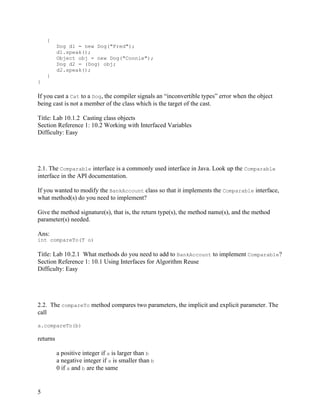
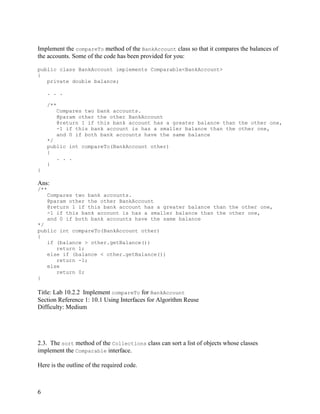
![7
import java.util.ArrayList;
import java.util.Collections;
. . .
// Put bank accounts into a list
ArrayList<BankAccount> list = new ArrayList<BankAccount>();
list.add(ba1);
list.add(ba2);
list.add(ba3);
// Call the library sort method
Collections.sort(list);
// Print out the sorted list
for (int i = 0; i < list.size(); i++)
{
BankAccount b = list.get(i);
System.out.println(b.getBalance());
}
Using this outline, write a test program that sorts a list of five bank accounts.
Ans:
import java.util.ArrayList;
import java.util.Collections;
public class SortTester
{
public static void main(String[] args)
{
BankAccount ba1 = new BankAccount(100);
BankAccount ba2 = new BankAccount(1000);
BankAccount ba3 = new BankAccount(300);
BankAccount ba4 = new BankAccount(800);
BankAccount ba5 = new BankAccount(550);
// Put bank accounts into a list
ArrayList<BankAccount> list = new ArrayList<BankAccount>();
list.add(ba1);
list.add(ba2);
list.add(ba3);
list.add(ba4);
list.add(ba5);
// Call the library sort method
Collections.sort(list);
// Print out the sorted list
for (int i = 0; i < list.size(); i++)
{
BankAccount b = list.get(i);
System.out.print(b.getBalance() + " ");
}
System.out.println();
System.out.println("Expected: 100 300 550 800 1000");
}](https://image.slidesharecdn.com/568-250502152628-f34fd5ae/85/Big-Java-Early-Objects-5th-Edition-Horstmann-Solutions-Manual-11-320.jpg)
![8
}
Title: Lab 10.2.3 Sorting bank accounts
Section Reference 1: 10.1 Using Interfaces for Algorithm Reuse
Difficulty: Easy
2.4. Change your compareTo method by switching the positive and negative return values.
Recompile and run the test program again. What is the outcome of executing your test program?
Explain the changed output.
Ans:
/**
Compares two bank accounts.
@param other the other BankAccount
@return -1 if this bank account has a greater balance than the other one,
1 if this bank account is has a smaller balance than the other one,
and 0 if both bank accounts have the same balance
*/
public int compareTo(BankAccount other)
{
if (balance > other.getBalance())
return -1;
else if (balance < other.getBalance())
return 1;
else
return 0;
}
The list is now sorted in descending order:
1000.0 800.0 550.0 300.0 100.0
Title: Lab 10.2.4 Modifying the sorting criterion in compareTo
Section Reference 1: 10.1 Using Interfaces for Algorithm Reuse
Difficulty: Medium
3.1. Consider the following program that sorts Rectangle objects:
public class SortDemo
{
public static void main(String[] args)
{
Rectangle rect1 = new Rectangle(5, 10, 20, 30);
Rectangle rect2 = new Rectangle(10, 20, 30, 15);
Rectangle rect3 = new Rectangle(20, 30, 45, 10);
// Put the rectangles into a list](https://image.slidesharecdn.com/568-250502152628-f34fd5ae/85/Big-Java-Early-Objects-5th-Edition-Horstmann-Solutions-Manual-12-320.jpg)
![9
ArrayList<Rectangle> list = new ArrayList<Rectangle>();
list.add(rect1);
list.add(rect2);
list.add(rect3);
// Call the library sort method
Collections.sort(list);
// Print out the sorted list
for (int i = 0; i < list.size(); i++)
{
Rectangle r = list.get(i);
System.out.println(r.getWidth() + " " + r.getHeight());
}
}
}
When you compile the program, you will get an error message. What is the error message? What
is the reason for the error message?
Ans:
We get an error because Rectangle does not implement Comparable:
CollectionsTester2.java [20:1] cannot find symbol
symbol : method sort(java.util.ArrayList<java.awt.Rectangle>)
location: class java.util.Collections
Collections.sort(list);
^
1 error
Errors compiling SortDemo.
Title: Lab 10.3.1 Why can't you sort rectangles?
Section Reference 1: 10.4 Using Interfaces for Callbacks
Difficulty: Easy
3.2. Unfortunately, you cannot modify the Rectangle class so that it implements the
Comparable interface. The Rectangle class is part of the standard library, and you cannot
modify library classes.
Fortunately, there is a second sort method that you can use to sort a list of objects of any class,
even if the class doesn't implement the Comparable interface.
Comparator<T> comp = . . .;
// for example, Comparator<Rectangle> comp = new RectangleComparator();
Collections.sort(list, comp);
Comparator is an interface. Therefore, comp must be constructed as an object of some class that
implements the Comparator interface.](https://image.slidesharecdn.com/568-250502152628-f34fd5ae/85/Big-Java-Early-Objects-5th-Edition-Horstmann-Solutions-Manual-13-320.jpg)
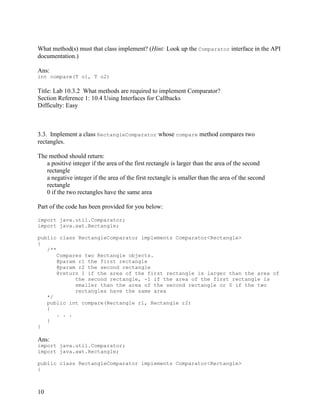

![11
/**
Compares two Rectangle objects.
@param r1 the first rectangle
@param r2 the second rectangle
@return 1 if the area of the first rectangle is larger than the area of
the second rectangle, -1 if the area of the first rectangle is
smaller than the area of the second rectangle or 0 if the two
rectangles have the same area
*/
public int compare(Rectangle r1, Rectangle r2)
{
if (r1.getHeight() * r1.getWidth() > r2.getHeight() * r2.getWidth())
return 1;
else if (r1.getHeight() * r1.getWidth() < r2.getHeight() * r2.getWidth())
return -1;
else
return 0;
}
}
Title: Lab 10.3.3 Implement a Rectangle comparator
Section Reference 1: 10.4 Using Interfaces for Callbacks
Difficulty: Medium
3.4. Write a test program that adds the three rectangles below to a list, constructs a rectangle
comparator, sorts the list, and prints the sorted list and the expected values.
Rectangle rect1 = new Rectangle(5, 10, 20, 30);
Rectangle rect2 = new Rectangle(10, 20, 30, 15);
Rectangle rect3 = new Rectangle(20, 30, 45, 10);
What is your test program?
Ans:
import java.util.ArrayList;
import java.util.Collections;
import java.awt.Rectangle;
import java.util.Comparator;
public class RectangleSortTester
{
public static void main(String[] args)
{
Rectangle rect1 = new Rectangle(5, 10, 20, 30);
Rectangle rect2 = new Rectangle(10, 20, 30, 15);
Rectangle rect3 = new Rectangle(20, 30, 45, 10);
// Put the rectangles into a list
ArrayList<Rectangle> list = new ArrayList<Rectangle>();
list.add(rect1);
list.add(rect2);
list.add(rect3);](https://image.slidesharecdn.com/568-250502152628-f34fd5ae/85/Big-Java-Early-Objects-5th-Edition-Horstmann-Solutions-Manual-16-320.jpg)
![12
// Call the library sort method
Comparator<Rectangle> comp = new RectangleComparator();
Collections.sort(list, comp);
// Print out the sorted list
for (int i = 0; i < list.size(); i++)
{
Rectangle r = (Rectangle) list.get(i);
System.out.print(r.getWidth() + " " + r.getHeight() + " ");
}
System.out.println();
System.out.println("Expected: 30 15 45 10 20 30");
}
}
Title: Lab 10.3.4 Testing the rectangle comparator
Section Reference 1: 10.4 Using Interfaces for Callbacks
Difficulty: Medium
3.5. A very specialized class, such as the RectangleComparator, can be defined inside the
method that uses it.
Reorganize your program so that the RectangleComparator class is defined inside the main
method of your test class.
What is your main method now?
Ans:
import java.util.ArrayList;
import java.util.Collections;
import java.awt.Rectangle;
import java.util.Comparator;
public class RectangleSortTester2
{
public static void main(String[] args)
{
class RectangleComparator implements Comparator<Rectangle>
{
/**
Compares two Rectangle objects.
@param r1 the first rectangle
@param r2 the second rectangle
@return 1 if the area of the first rectangle is larger than the area of
the second rectangle, -1 if the area of the first rectangle is
smaller than the area of the second rectangle, or 0 if the two
rectangles have the same area
*/
public int compare(Rectangle r1, Rectangle r2)](https://image.slidesharecdn.com/568-250502152628-f34fd5ae/85/Big-Java-Early-Objects-5th-Edition-Horstmann-Solutions-Manual-17-320.jpg)
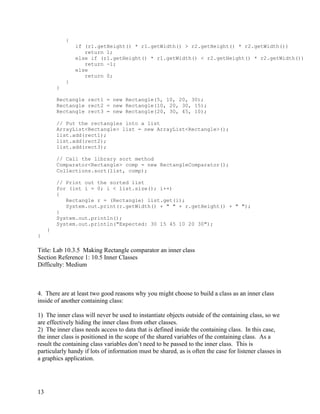
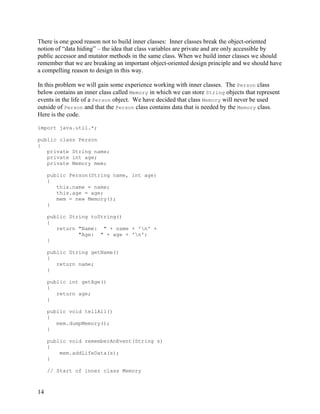
![15
private class Memory
{
ArrayList<String> lifeData;
private Memory()
{
lifeData = new ArrayList<String>();
lifeData.add("Name: " + name);
lifeData.add("Age: " + age);
}
public void addLifeData(String datum)
{
lifeData.add(datum);
}
public void dumpMemory()
{
for (String s: lifeData)
{
System.out.println(s);
}
}
}
}
Here is a driver for the Person class.
public class PersonRunner
{
public static void main(String[] args)
{
Person aperson = new Person("Bob", 33);
aperson.tellAll();
aperson.rememberAnEvent("I was born in 1970.");
aperson.rememberAnEvent("I finished school in 2003.");
aperson.tellAll();
}
}
Notice that the private data in Person includes instance variables name and age. Look inside the
inner class Memory and notice that name and age are referenced directly in the Memory
constructor without invoking an accessor method. This is only possible because the Memory
constructor is in the scope of name and age.
In order to understand the effects of an inner class, remove class Memory from Person and make
it a standalone class. Make all the changes that are needed in each class to make the new design
work.
Ans:
import java.util.*;
public class Person
{](https://image.slidesharecdn.com/568-250502152628-f34fd5ae/85/Big-Java-Early-Objects-5th-Edition-Horstmann-Solutions-Manual-20-320.jpg)

![produced which human skill could not better. But no such thing
being conceivable of Horace, every fresh version is a whet to
curiosity and emulation; each separate ode hides its own agreeable
secret, every epithet has its own individual surprise. Let there be no
talk, then, of impossibilities; for our own part, to paraphrase what
Hallam says of Lycidas, we look upon the ability to translate such
odes as the Ad Pyrrham, so as to demonstrate their impossibility, a
good test of a man’s capacity to translate Horace at all.
Another nice consideration for the translator of Horace is in
respect of metre. Undoubtedly the translator who can retain the
metrical movement of his original has gained so much towards
reproducing his general effect. But with Horace this attempt may as
well be abandoned at once. The Alcaic and the Sapphic stanza,
much less the Asclepiad or the Archilochian, have never yet been,
and for obvious reasons never will be, naturalized in our English
verse, though poor Percival thought differently, and added one
more to a life of failures. Tennyson, in his ode to Milton,
“Whose guardian-angels, Muriel, Abdiel,
Starred from Jehovah’s gorgeous armory,
Tow’r, as the deep-domed empyrean
Rings to the roar of an angel onset,”
gives us, perhaps, as good Alcaics as we have any right to look for
in English (though “gōrgĕoŭs” is not a very gorgeous dactyl); yet
how different from the Horatian cadence:
“Æquam memento rebus in arduis
Servare mentem, non secus in bonis
Ab insolenti temperatam
Lætitia, moriture Delli.”[78]](https://image.slidesharecdn.com/568-250502152628-f34fd5ae/85/Big-Java-Early-Objects-5th-Edition-Horstmann-Solutions-Manual-26-320.jpg)
![As for Sapphics, whether we take Canning’s Knife Grinder for our
model or Mr. Swinburne’s
“All the night sleep came not upon my eyelids,
Shed not dew, nor shook nor unclosed a feather,
Yet with lips shut close, and with eyes of iron,
Stood and beheld me,”
we are not much nearer to Horace’s melody:
“Scandit æratas vitiosa naves
Cura, nec turmas equitum relinquit
Ocior cervis, et agente nimbos
Ocior Euro.”[79]
But, at least, following that rule of compensation with which all
good translators are familiar, some attempt may be made to
suggest the metrical variety and richness of the Odes by a
corresponding variety and grace in the English measures of the
translation. It is here that the modern translators excel; indeed, it
may be said that only within the last hundred years have translators
had this adjunct at their command, for it is only during that period
that English poets have begun to comprehend and master fully the
resources and possibilities of English metre. Not that the earlier
poets were at all deficient in the metrical sense; that their ears
were not quick to catch the finest delicacies of verbal harmony. Not
to mention a host of minor bards who knew how to marry “perfect
music unto noble words,” Milton’s lyrics are melody itself. There is
scarcely a more tunable couplet in the language than his
“Sweetest Shakspeare, fancy’s child,
Warbles his native woodnotes wild.”](https://image.slidesharecdn.com/568-250502152628-f34fd5ae/85/Big-Java-Early-Objects-5th-Edition-Horstmann-Solutions-Manual-27-320.jpg)
![The open vowels and liquid consonants fairly sing themselves.
Nor was it for lack of experiment that they failed of
“Untwisting all the chains that tie
The hidden soul of harmony”
in words, as Shelley and Tennyson and Swinburne learned to do
later. The attempt to naturalize the classical metres, for example,
began at a very early period of our literary history, and many
learned treatises were written to prove them your only proper
vehicle for English poetry. Perhaps it was the ill-success of these
efforts that made our poets so long shy of wandering in their
metres away from the beaten track and the simplest forms. Up to
the time of Campbell we may say that the iambus and the trochee
reigned supreme in English verse; the anapest and the dactyl, of
which such effective use has been made by the later poets, were
either unknown or contemned. Suckling’s Session of the Poets, the
metrical intention of which appears to be anapestic, shows what
desperate work even the best lyrists could make when they strayed
after strange metrical gods.[80]
It may be said, then, that until within a comparatively recent
period Horace could not be properly translated into English verse at
all. English verse was not yet ready to receive so noble a guest.
Compare Martin’s or Conington’s versions with one of the earlier
translations, and the truth of this, we think, will be apparent at
once. Creech, indeed, seems to have had a dim notion of the truth,
and his version shows a perceptible striving for metrical effect, at
least in the arrangement of his stanza; but Creech had too little of
the poetical faculty to make the effort with taste or success. Francis
for the most part is content with the orthodox measures, and
Father Prout was perhaps first to bring to the work this essential
accomplishment of the Horatian translator. Prout’s metrical
inventions are bold, and often elegant; and his versions, though
free, are always spirited, and often singularly felicitous. Among the](https://image.slidesharecdn.com/568-250502152628-f34fd5ae/85/Big-Java-Early-Objects-5th-Edition-Horstmann-Solutions-Manual-28-320.jpg)
![that of Collins’ “Ode to Evening”), which consists of two unrhymed
iambic pentameters, followed by two unrhymed iambic trimeters—
or, to be “more English and less nice,” of two ordinary blank-verses
followed by two three-foot verses—resembles Horace’s metre,
which the grammarians would tell us is the third Asclepiadian
strophe, “rather,” says Prof. Conington, “in the length of the
respective lines than in any similarity of the cadences.” Lord Lytton
attempted something more, and with only partial success, though
the task, it must be owned, was not an easy one. Horace, in the
Odes and Epodes, uses eighteen different varieties of metre,
ranging from the grave sadness of what is called the first
Archilochian strophe, the lovely measure in which one of the
loveliest of all the Odes is written (iv. 7)—
“Diffugere nives; redeunt jam gramina campis
Arboribusque comæ,”[81]
to the quick sharpness of the first iambic strophe in which the poet
mauls the unsavory Mævius. And not only this, but each of these
metres is used by Horace to express widely differing moods of
feeling. Thus, the same measure which in the beautiful lament for
Quinctilius breathes the tenderest spirit of grief and resignation,
serves equally well to guy Tibullus on his luckless loves, to sound
“stern alarums” to the absent Cæsar, or to bid Virgil or Varius to
“delightful meetings.” The Sapphic rises to the lofty height of the
Carmen Seculare or stoops to chide a serving-boy for his super-
serviceable zeal; is equally at home with an invocation to the gods
or an invitation to dinner; while the Alcaic—what subject is there
that in Horace’s hands the Alcaic cannot be made to sing?
This flexibility of the Latin metres Lord Lytton has recognized,
and sought to meet by a corresponding variation of his own,
“according as the prevalent spirit of the ode demanded lively and
sportive or serious and dignified expression.” Thus, for the Alcaic
stanza he employs “two different forms of rhythm”; one as in i. 9:](https://image.slidesharecdn.com/568-250502152628-f34fd5ae/85/Big-Java-Early-Objects-5th-Edition-Horstmann-Solutions-Manual-31-320.jpg)
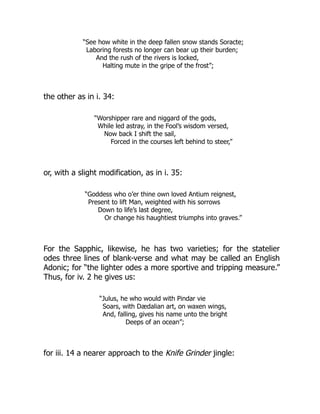
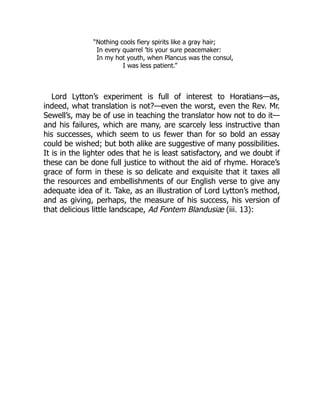
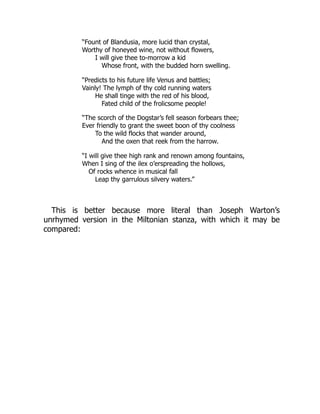
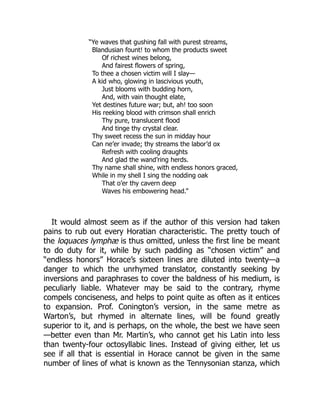

![intimacy with the artist—turned in after last Mass to have a look at
the “picther o’ Dan.”
“Be me conscience! but it’s Dan himself—sorra a wan else,” cried
one.
“I was at Tara, an’ it’s just as if he was givin’ Drizzlyeye [Disraeli]
that welt about his notorious ancesthor, the impinitent thief on the
crass,” observed another.
“Faix, it’s alive, it is. Look at the mouth, reddy for to say ‘Repale.’”
“There’s an eye!”
“Thrue for ye; there’s more fire in it than in ould Finnegan’s
chimbly this minit.”
“Troth, it’s as dhroll as a pet pup’s.”
“Stan’ out o’ that, Mr. O’Leary, or ye’ll get a crack av his fist.”
“Three cheers for the painther, boys!”
These and kindred comments flung a radiated pleasure into the
inner heart of the artist—that sanctum which as yet was green and
fresh and limpid—while the eulogies, however quaintly and coarsely
served up, bore the delicious fragrance which praise ever carries
with it like a subtle perfume.](https://image.slidesharecdn.com/568-250502152628-f34fd5ae/85/Big-Java-Early-Objects-5th-Edition-Horstmann-Solutions-Manual-48-320.jpg)


![Java 8 Puzzlers [as presented at OSCON 2016]](https://cdn.slidesharecdn.com/ss_thumbnails/java8puzzlersoscon2016-160522043417-thumbnail.jpg?width=640&height=640&fit=bounds)


