
Big Data
Presenting a Historical Knowledge Breakthrough at UC B
Variant Data
Hugh Ching
Chien Yi Lee
Post-Science Institute
August 2015
NEXT
1
Two Advantages of Computers over Humans
Speed
Size
2
Speed
The computer
has
demonstrated its speed advantage.
3
How Does Computer Demonstrate Size?
Big Data.
(Referring to the ability of the
computer to handle an unlimited
amount of information)
4
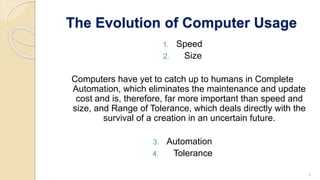
The Evolution of Computer Usage
1. Speed
2. Size
Computers have yet to catch up to humans in Complete
Automation, which eliminates the maintenance and update
cost and is, therefore, far more important than speed and
size, and Range of Tolerance, which deals directly with the
survival of a creation in an uncertain future.
3. Automation
4. Tolerance
5
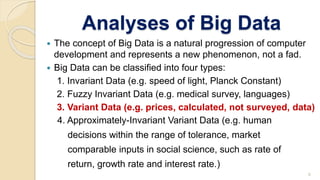
Analyses of Big Data
 The concept of Big Data is a natural progression of computer
development and represents a new phenomenon, not a fad.
 Big Data can be classified into four types:
1. Invariant Data (e.g. speed of light, Planck Constant)
2. Fuzzy Invariant Data (e.g. medical survey, languages)
3. Variant Data (e.g. prices, calculated, not surveyed, data)
4. Approximately-Invariant Variant Data (e.g. human
decisions within the range of tolerance, market
comparable inputs in social science, such as rate of
return, growth rate and interest rate.)
6
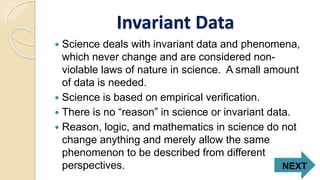
Invariant Data
 Science deals with invariant data and phenomena,
which never change and are considered non-
violable laws of nature in science. A small amount
of data is needed.
 Science is based on empirical verification.
 There is no “reason” in science or invariant data.
 Reason, logic, and mathematics in science do not
change anything and merely allow the same
phenomenon to be described from different
perspectives. NEXT
7
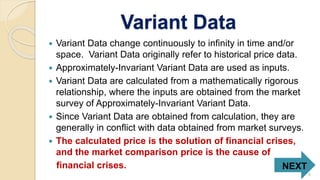
Variant Data
 Variant Data change continuously to infinity in time and/or
space. Variant Data originally refer to historical price data.
 Approximately-Invariant Variant Data are used as inputs.
 Variant Data are calculated from a mathematically rigorous
relationship, where the inputs are obtained from the market
survey of Approximately-Invariant Variant Data.
 Since Variant Data are obtained from calculation, they are
generally in conflict with data obtained from market surveys.
 The calculated price is the solution of financial crises,
and the market comparison price is the cause of
financial crises. NEXT
8
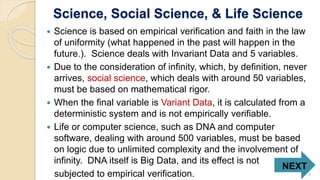
Science, Social Science, & Life Science
 Science is based on empirical verification and faith in the law
of uniformity (what happened in the past will happen in the
future.). Science deals with Invariant Data and 5 variables.
 Due to the consideration of infinity, which, by definition, never
arrives, social science, which deals with around 50 variables,
must be based on mathematical rigor.
 When the final variable is Variant Data, it is calculated from a
deterministic system and is not empirically verifiable.
 Life or computer science, such as DNA and computer
software, dealing with around 500 variables, must be based
on logic due to unlimited complexity and the involvement of
infinity. DNA itself is Big Data, and its effect is not
subjected to empirical verification.
NEXT
9
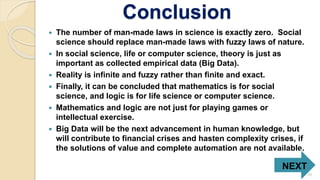
Conclusion
 The number of man-made laws in science is exactly zero. Social
science should replace man-made laws with fuzzy laws of nature.
 In social science, life or computer science, theory is just as
important as collected empirical data (Big Data).
 Reality is infinite and fuzzy rather than finite and exact.
 Finally, it can be concluded that mathematics is for social
science, and logic is for life science or computer science.
 Mathematics and logic are not just for playing games or
intellectual exercise.
 Big Data will be the next advancement in human knowledge, but
will contribute to financial crises and hasten complexity crises, if
the solutions of value and complete automation are not available.
NEXT
10
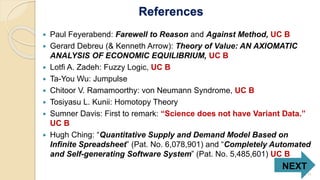
References
 Paul Feyerabend: Farewell to Reason and Against Method, UC B
 Gerard Debreu (& Kenneth Arrow): Theory of Value: AN AXIOMATIC
ANALYSIS OF ECONOMIC EQUILIBRIUM, UC B
 Lotfi A. Zadeh: Fuzzy Logic, UC B
 Ta-You Wu: Jumpulse
 Chitoor V. Ramamoorthy: von Neumann Syndrome, UC B
 Tosiyasu L. Kunii: Homotopy Theory
 Sumner Davis: First to remark: “Science does not have Variant Data.”
UC B
 Hugh Ching: “Quantitative Supply and Demand Model Based on
Infinite Spreadsheet” (Pat. No. 6,078,901) and “Completely Automated
and Self-generating Software System” (Pat. No. 5,485,601) UC B
NEXT
11
Thank You.
Chien Yi Lee
Presented at UC Berkeley August 26, 2015
Unfinished work to be continued…
12

Big Data--Variant Data Concept

  • 1.
    Big Data Presenting aHistorical Knowledge Breakthrough at UC B Variant Data Hugh Ching Chien Yi Lee Post-Science Institute August 2015 NEXT 1
  • 2.
    Two Advantages ofComputers over Humans Speed Size 2
  • 3.
  • 4.
    How Does ComputerDemonstrate Size? Big Data. (Referring to the ability of the computer to handle an unlimited amount of information) 4
  • 5.
    The Evolution ofComputer Usage 1. Speed 2. Size Computers have yet to catch up to humans in Complete Automation, which eliminates the maintenance and update cost and is, therefore, far more important than speed and size, and Range of Tolerance, which deals directly with the survival of a creation in an uncertain future. 3. Automation 4. Tolerance 5
  • 6.
    Analyses of BigData  The concept of Big Data is a natural progression of computer development and represents a new phenomenon, not a fad.  Big Data can be classified into four types: 1. Invariant Data (e.g. speed of light, Planck Constant) 2. Fuzzy Invariant Data (e.g. medical survey, languages) 3. Variant Data (e.g. prices, calculated, not surveyed, data) 4. Approximately-Invariant Variant Data (e.g. human decisions within the range of tolerance, market comparable inputs in social science, such as rate of return, growth rate and interest rate.) 6
  • 7.
    Invariant Data  Sciencedeals with invariant data and phenomena, which never change and are considered non- violable laws of nature in science. A small amount of data is needed.  Science is based on empirical verification.  There is no “reason” in science or invariant data.  Reason, logic, and mathematics in science do not change anything and merely allow the same phenomenon to be described from different perspectives. NEXT 7
  • 8.
    Variant Data  VariantData change continuously to infinity in time and/or space. Variant Data originally refer to historical price data.  Approximately-Invariant Variant Data are used as inputs.  Variant Data are calculated from a mathematically rigorous relationship, where the inputs are obtained from the market survey of Approximately-Invariant Variant Data.  Since Variant Data are obtained from calculation, they are generally in conflict with data obtained from market surveys.  The calculated price is the solution of financial crises, and the market comparison price is the cause of financial crises. NEXT 8
  • 9.
    Science, Social Science,& Life Science  Science is based on empirical verification and faith in the law of uniformity (what happened in the past will happen in the future.). Science deals with Invariant Data and 5 variables.  Due to the consideration of infinity, which, by definition, never arrives, social science, which deals with around 50 variables, must be based on mathematical rigor.  When the final variable is Variant Data, it is calculated from a deterministic system and is not empirically verifiable.  Life or computer science, such as DNA and computer software, dealing with around 500 variables, must be based on logic due to unlimited complexity and the involvement of infinity. DNA itself is Big Data, and its effect is not subjected to empirical verification. NEXT 9
  • 10.
    Conclusion  The numberof man-made laws in science is exactly zero. Social science should replace man-made laws with fuzzy laws of nature.  In social science, life or computer science, theory is just as important as collected empirical data (Big Data).  Reality is infinite and fuzzy rather than finite and exact.  Finally, it can be concluded that mathematics is for social science, and logic is for life science or computer science.  Mathematics and logic are not just for playing games or intellectual exercise.  Big Data will be the next advancement in human knowledge, but will contribute to financial crises and hasten complexity crises, if the solutions of value and complete automation are not available. NEXT 10
  • 11.
    References  Paul Feyerabend:Farewell to Reason and Against Method, UC B  Gerard Debreu (& Kenneth Arrow): Theory of Value: AN AXIOMATIC ANALYSIS OF ECONOMIC EQUILIBRIUM, UC B  Lotfi A. Zadeh: Fuzzy Logic, UC B  Ta-You Wu: Jumpulse  Chitoor V. Ramamoorthy: von Neumann Syndrome, UC B  Tosiyasu L. Kunii: Homotopy Theory  Sumner Davis: First to remark: “Science does not have Variant Data.” UC B  Hugh Ching: “Quantitative Supply and Demand Model Based on Infinite Spreadsheet” (Pat. No. 6,078,901) and “Completely Automated and Self-generating Software System” (Pat. No. 5,485,601) UC B NEXT 11
  • 12.
    Thank You. Chien YiLee Presented at UC Berkeley August 26, 2015 Unfinished work to be continued… 12