General Management Course
A.A. 2014/2015
Digital Transformation –
Big Data
Matteo Cristofaro General Management Course
2
 Digital Darwinism;
 Digital transformation;
 What is Big Data?;
 Sources;
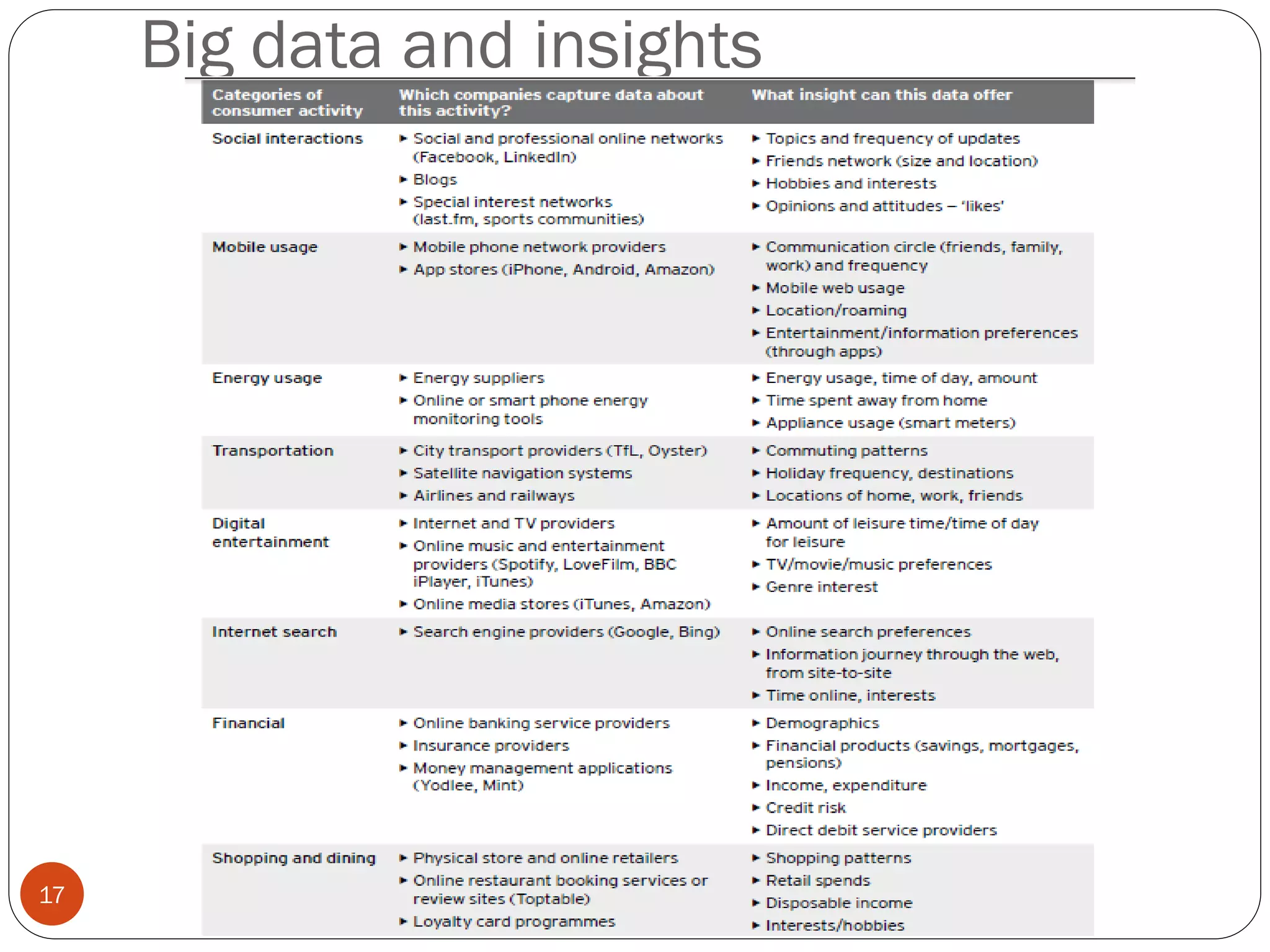
 Big Data and insights;
 Ethics in Big Data;
 Analyzing Big Data;
 Culture-Staffing-Processes-Governance framework;
 Analytics funcion;
 References.
Summary
Digital Darwinism
3
We are now in the middle of the third industrial revolution, driven
by the omnipresent digitalization.
For this reason, it is again all about a fight for survival, which
companies successful for centuries such as mailorder houses and
publishing houses have lost their dominant positions.
It thus becomes apparent that it is no longer about size, it is not
necessarily about speed, and it is not only about the extent of
conforming or strength. Today, it is more about “The survival of
the smartest!” One should keep in mind what Charles Darwin
stated:
“It is not the strongest of the species that survives,nor the most intelligent
that survives.It is the one that is most adaptable to change”
Matteo Cristofaro General Management Course
4
The most relevant developments could be characterized as the
DiSoLoMo-trend. This trend covers the following
dimensions: digital, social, local and mobile. In the first
instance, the challenges for companies lie in the trend to
digitalized more and more products and services (“digital”).
An additional trend is the increased use of social media.
Based on the trend of digitalisation more and more objects lose
significant constrations cause by their physical appearence
(e.g. books, newspaper, songs, etc.). This development is
called Zero Gravity thinking: objects lose the physical
restrictions they had in the real world when these objects are
transmitted into cyberspace.
Digital transformation (1) - Trends
Matteo Cristofaro General Management Course
5
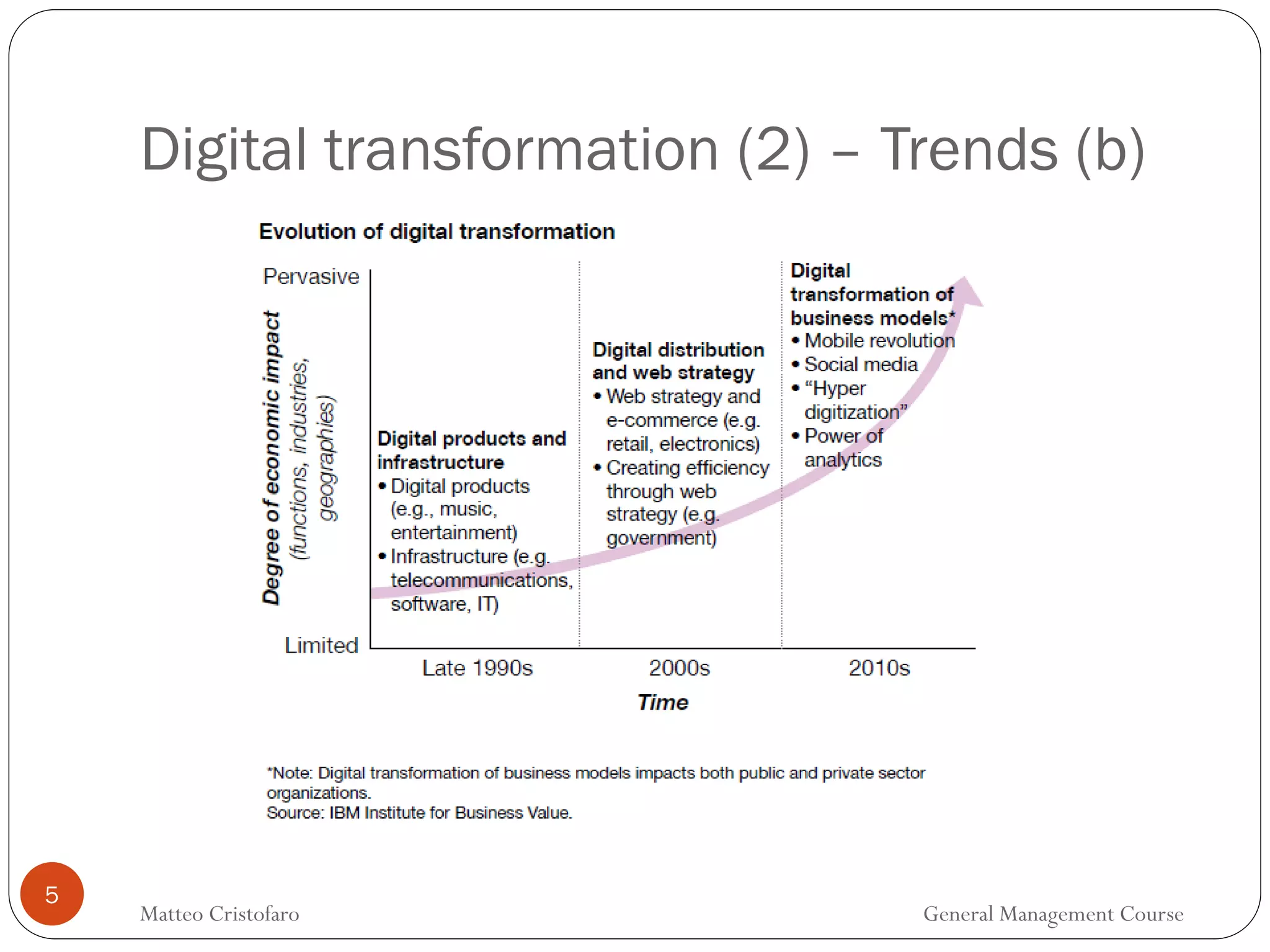
Digital transformation (2) – Trends (b)
Matteo Cristofaro General Management Course
Digital transformation (3) – Mobility
6
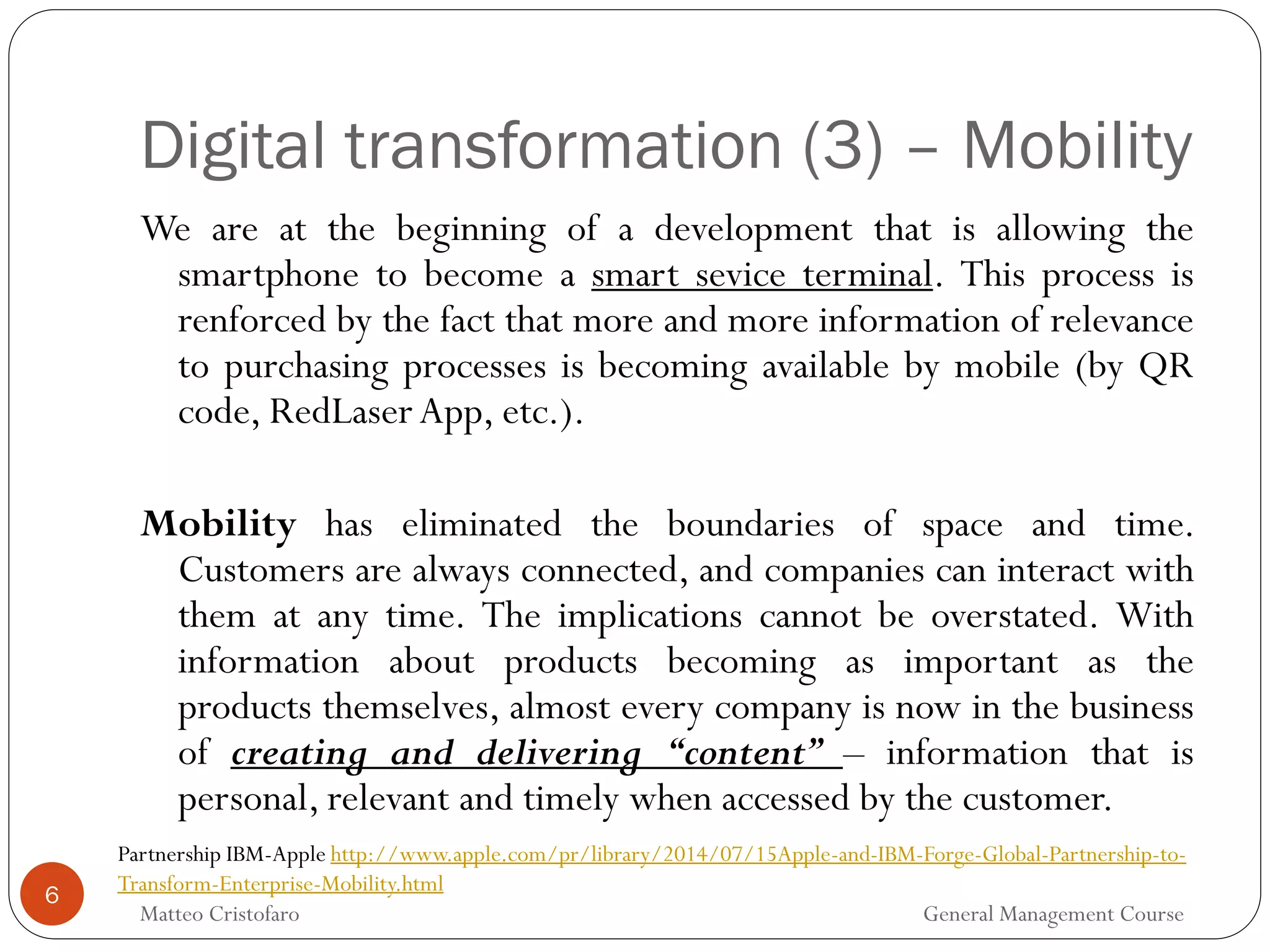
We are at the beginning of a development that is allowing the
smartphone to become a smart sevice terminal. This process is
renforced by the fact that more and more information of relevance
to purchasing processes is becoming available by mobile (by QR
code, RedLaserApp, etc.).
Mobility has eliminated the boundaries of space and time.
Customers are always connected, and companies can interact with
them at any time. The implications cannot be overstated. With
information about products becoming as important as the
products themselves, almost every company is now in the business
of creating and delivering “content” – information that is
personal, relevant and timely when accessed by the customer.
Partnership IBM-Apple http://www.apple.com/pr/library/2014/07/15Apple-and-IBM-Forge-Global-Partnership-to-
Transform-Enterprise-Mobility.html
Matteo Cristofaro General Management Course
7
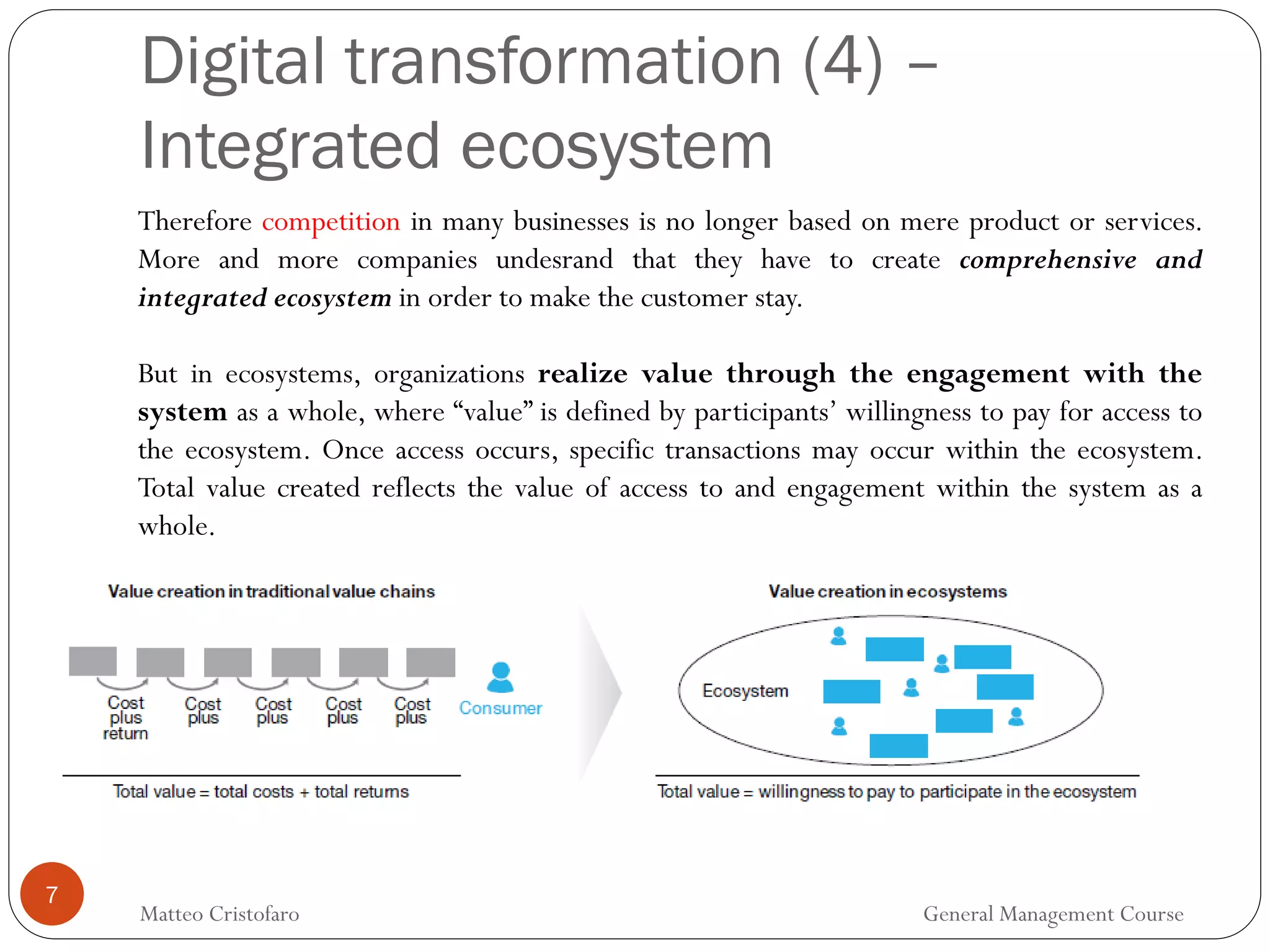
Therefore competition in many businesses is no longer based on mere product or services.
More and more companies undesrand that they have to create comprehensive and
integrated ecosystem in order to make the customer stay.
But in ecosystems, organizations realize value through the engagement with the
system as a whole, where “value” is defined by participants’ willingness to pay for access to
the ecosystem. Once access occurs, specific transactions may occur within the ecosystem.
Total value created reflects the value of access to and engagement within the system as a
whole.
Digital transformation (4) –
Integrated ecosystem
Matteo Cristofaro General Management Course
8
Digital transformation (5) –
elements of digital transformation
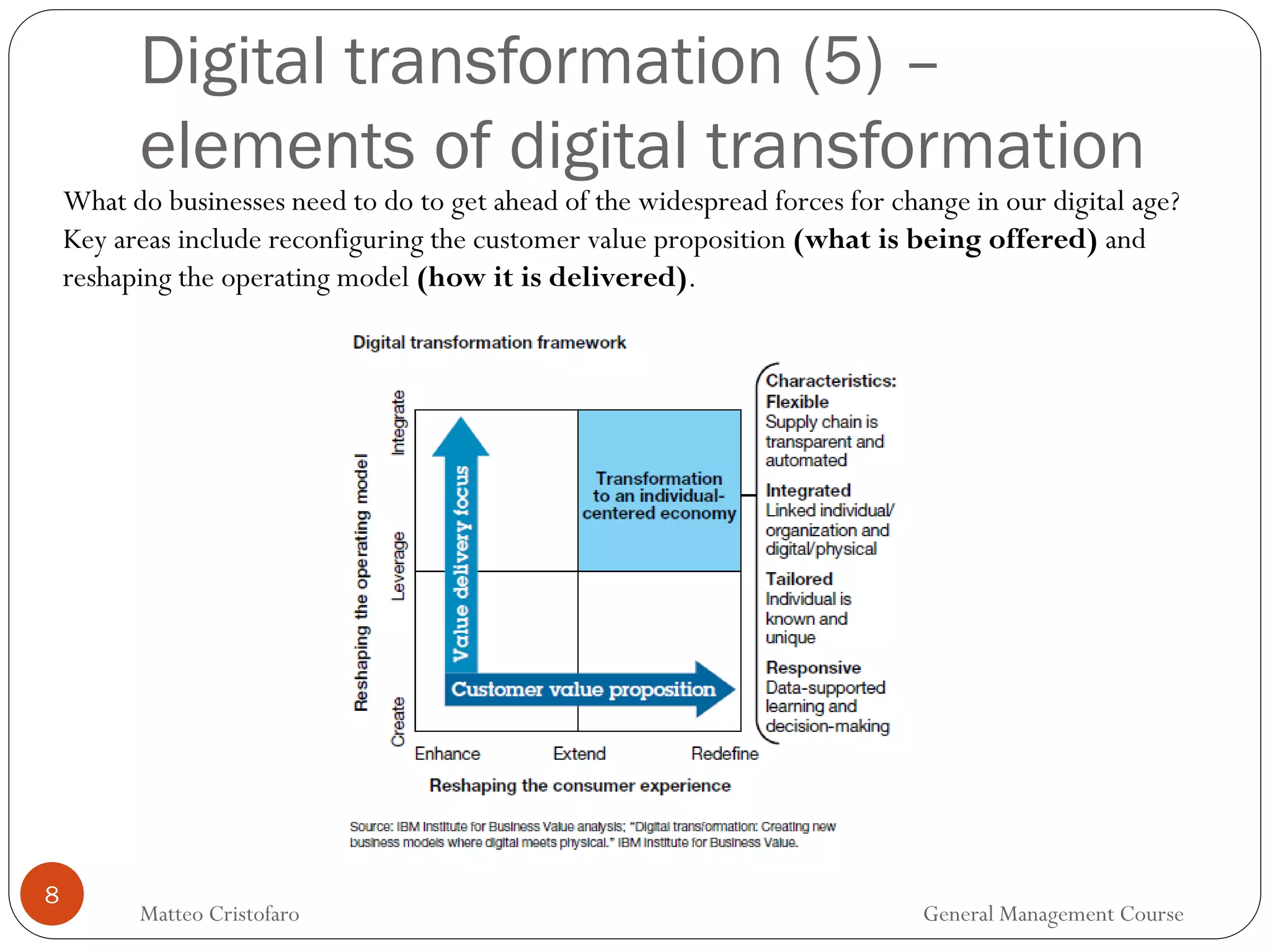
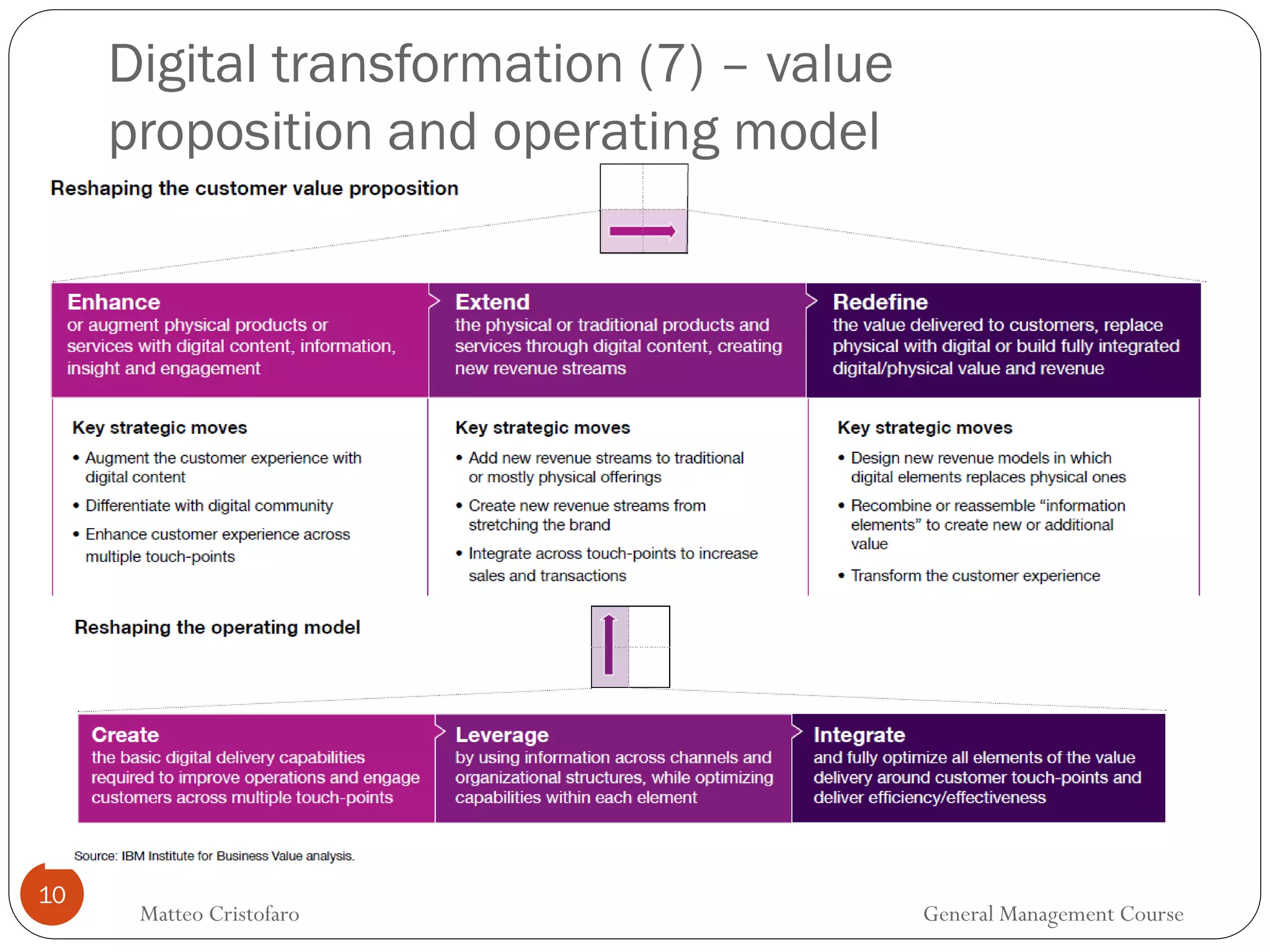
What do businesses need to do to get ahead of the widespread forces for change in our digital age?
Key areas include reconfiguring the customer value proposition (what is being offered) and
reshaping the operating model (how it is delivered).
Matteo Cristofaro General Management Course
9
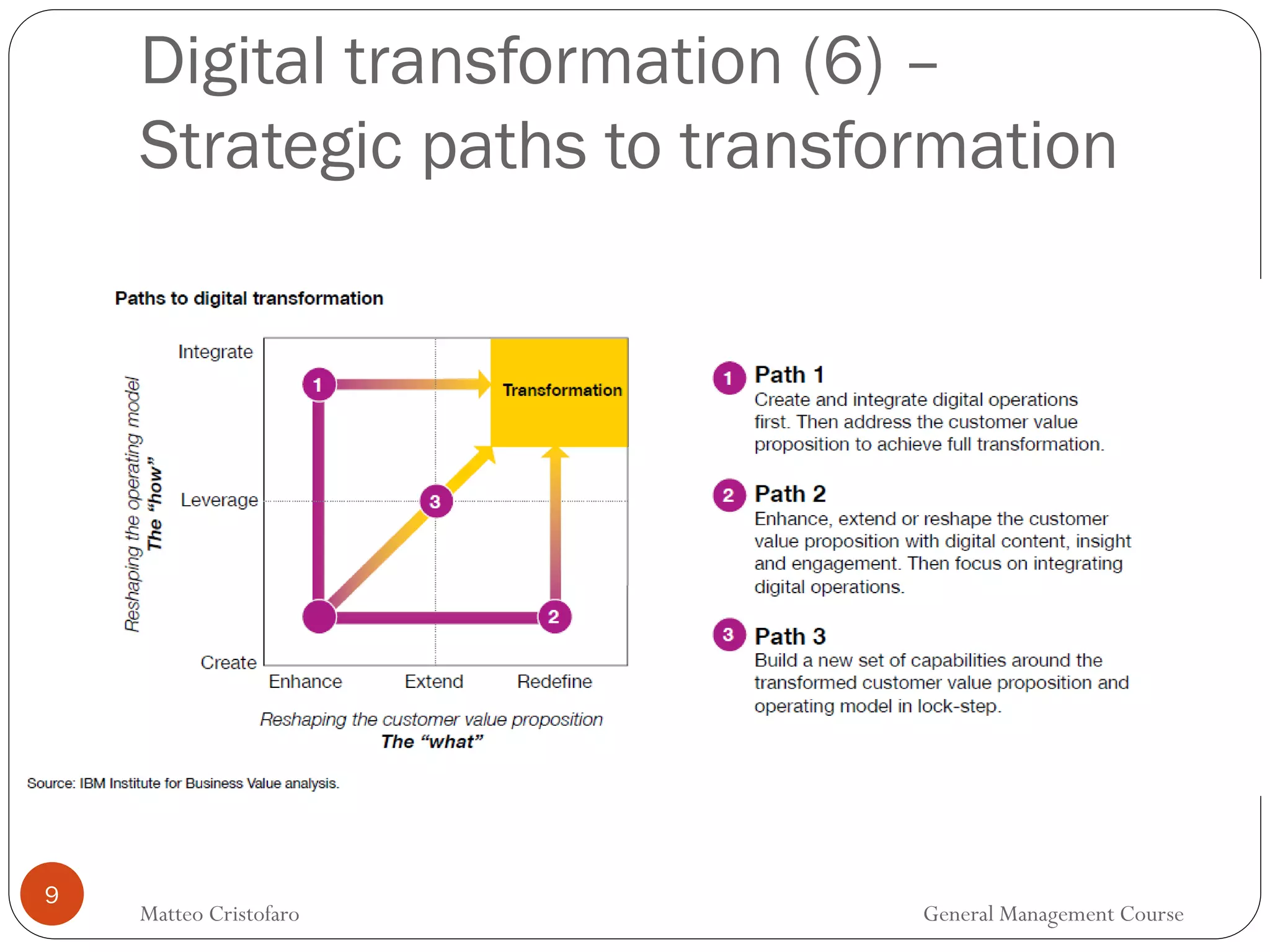
Digital transformation (6) –
Strategic paths to transformation
Matteo Cristofaro General Management Course
10
Digital transformation (7) – value
proposition and operating model
Matteo Cristofaro General Management Course
11
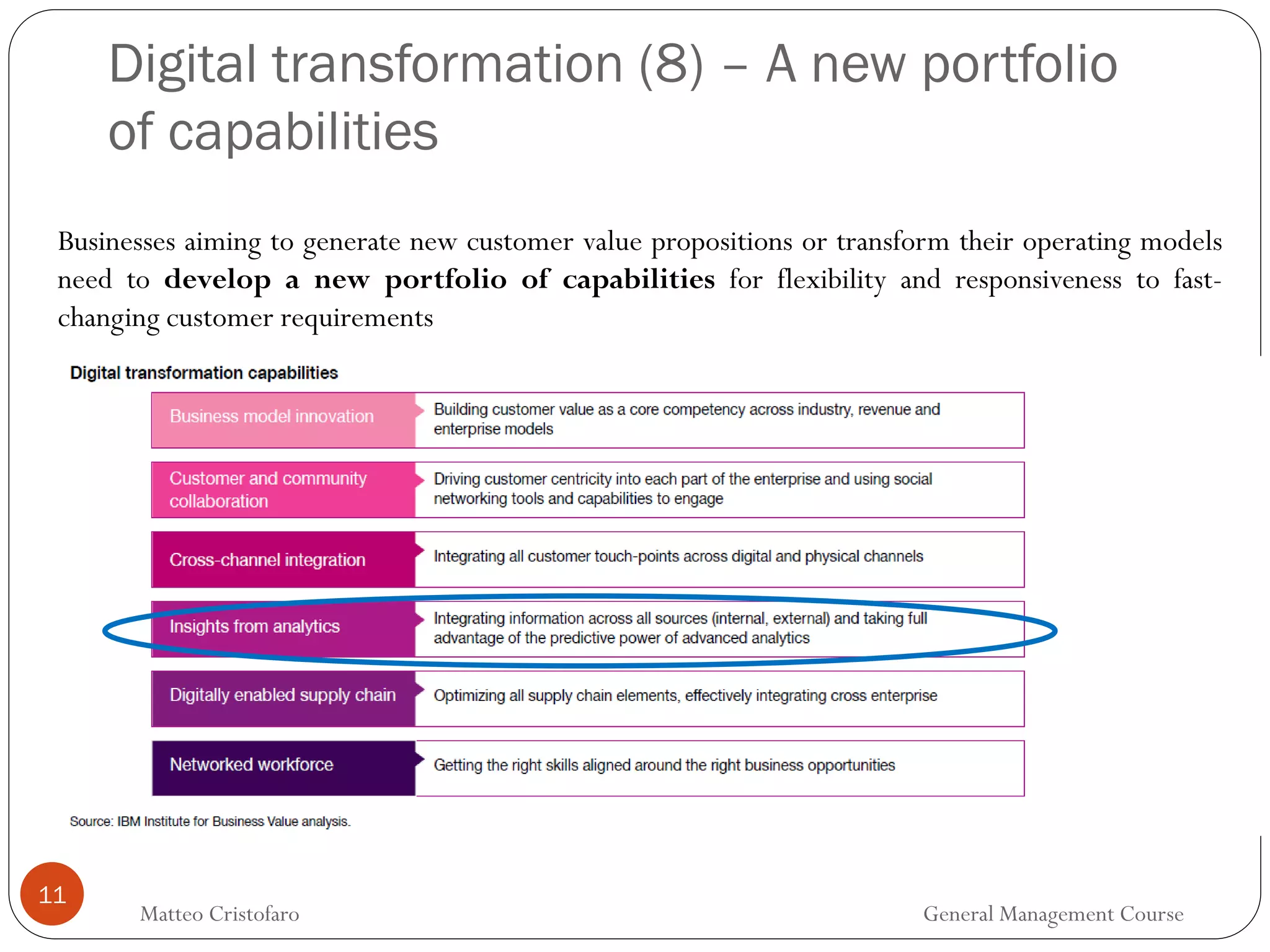
Businesses aiming to generate new customer value propositions or transform their operating models
need to develop a new portfolio of capabilities for flexibility and responsiveness to fast-
changing customer requirements
Digital transformation (8) – A new portfolio
of capabilities
Matteo Cristofaro General Management Course
What is Big Data? (1)
12
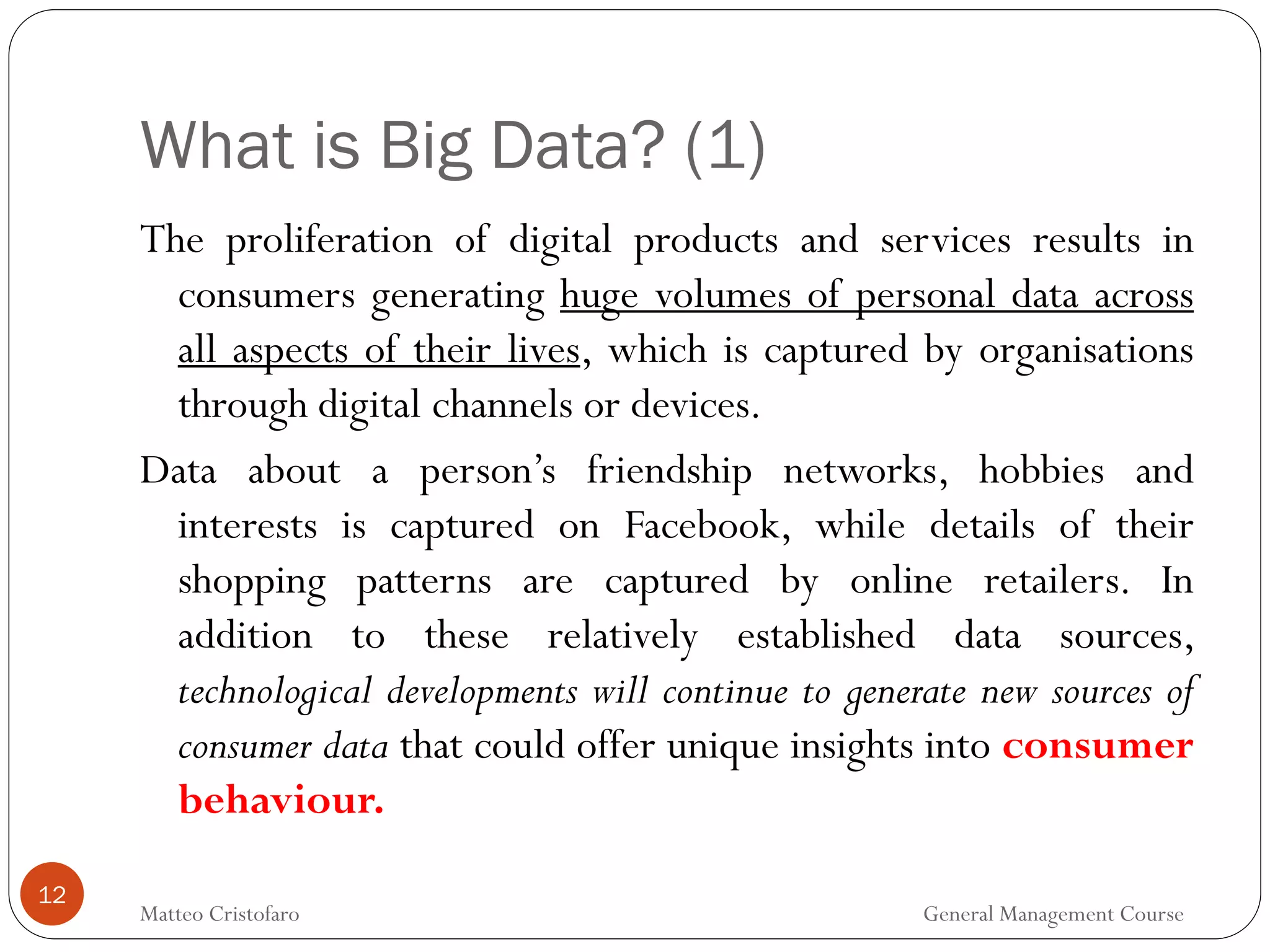
The proliferation of digital products and services results in
consumers generating huge volumes of personal data across
all aspects of their lives, which is captured by organisations
through digital channels or devices.
Data about a person’s friendship networks, hobbies and
interests is captured on Facebook, while details of their
shopping patterns are captured by online retailers. In
addition to these relatively established data sources,
technological developments will continue to generate new sources of
consumer data that could offer unique insights into consumer
behaviour.
Matteo Cristofaro General Management Course
What is Big Data? (2)
13
Organizations are exploring how large-volume data can usefully
be deployed to create and capture value for individuals,
businesses, communities, and governments (McKinsey
Global Institute, 2011). big data is fast becoming a tool that
not only analyzes patterns, but can also provide the predictive
likelihood of an event.
The challenge for businesses lies in how to harness, make
sense of, and use this information to generate some form of
competitive advantage. Businesses that can access these
new sources of data, analyse them and convert them into
insight on consumer behaviour, will be able to make
their products and services more relevant to their customers.
Matteo Cristofaro General Management Course
What is Big Data? (Example)
14
 Participant in a Formula 1 car race generates 20 gigabytes of data from
the 150 sensors on the car that can help analyze the technical performance
of its components, but also the driver reactions, pit stop delays, and
communication between crew and driver that contribute to overall
performance.
The emphasis thus moves away from outcomes (win/lose race), to instead
focus on each proximal, contributory element for success or failure
mapped for every second during the race.
 Or…We could analyze the social networks and social engagement
behaviors of individuals by mapping mobility patterns onto physical
layouts of workspaces using sensors, or the frequency of meeting room
usage using remote sensors that track entry and exit patterns, which
could provide information on communication and coordination needs
based on project complexity and approaching deadlines.
Matteo Cristofaro General Management Course
Sources (1)
15
Big data is generated from an increasing plurality of sources:
Internet clicks, mobile transactions, user-generated content, and social media as
well as purposefully generated content through sensor networks or business
transactions such as sales queries and purchase transactions.
These data require the use of powerful computational techniques to unveil trends and
patterns within and between these extremely large socioeconomic datasets. “Big”
is no longer the defining parameter, but, rather, how “smart” it is—that is, the
insights that the volume of data can reasonably provide.
The defining parameter of big data is the fine-grained nature of the data itself,
thereby shifting the focus away from the number of participants to the granular
information about the individual.
Matteo Cristofaro General Management Course
Sources (2)
16
Big data is also a wrapper for different types of granular data. Below, we list five key
sources of high volume data:
 Public data: held by governments, governmental organizations, and local
communities (e.g. energy use).
 Private data: held by private firms, non-profit organizations, and individuals
(e.g. consumer transactions).
 Data exhaust: ambient data that are passively collected, non-core data with
limited or zero value to the original data collection partner these data were
collected for a different purpose, but can be recombined with other data
sources to create new sources of value (e.g. Internet searches)
 Community data: is a distillation of unstructured data—especially text into
dynamic networks that capture social trends (e.g.Twitter feeds).
 Self quantification data: are revealed by the individual through quantifying
personal actions and behaviors (e.g. wristbands that monitor exercise and
movement).
Matteo Cristofaro General Management Course
Big data and insights
17
Ethics in Big Data
18
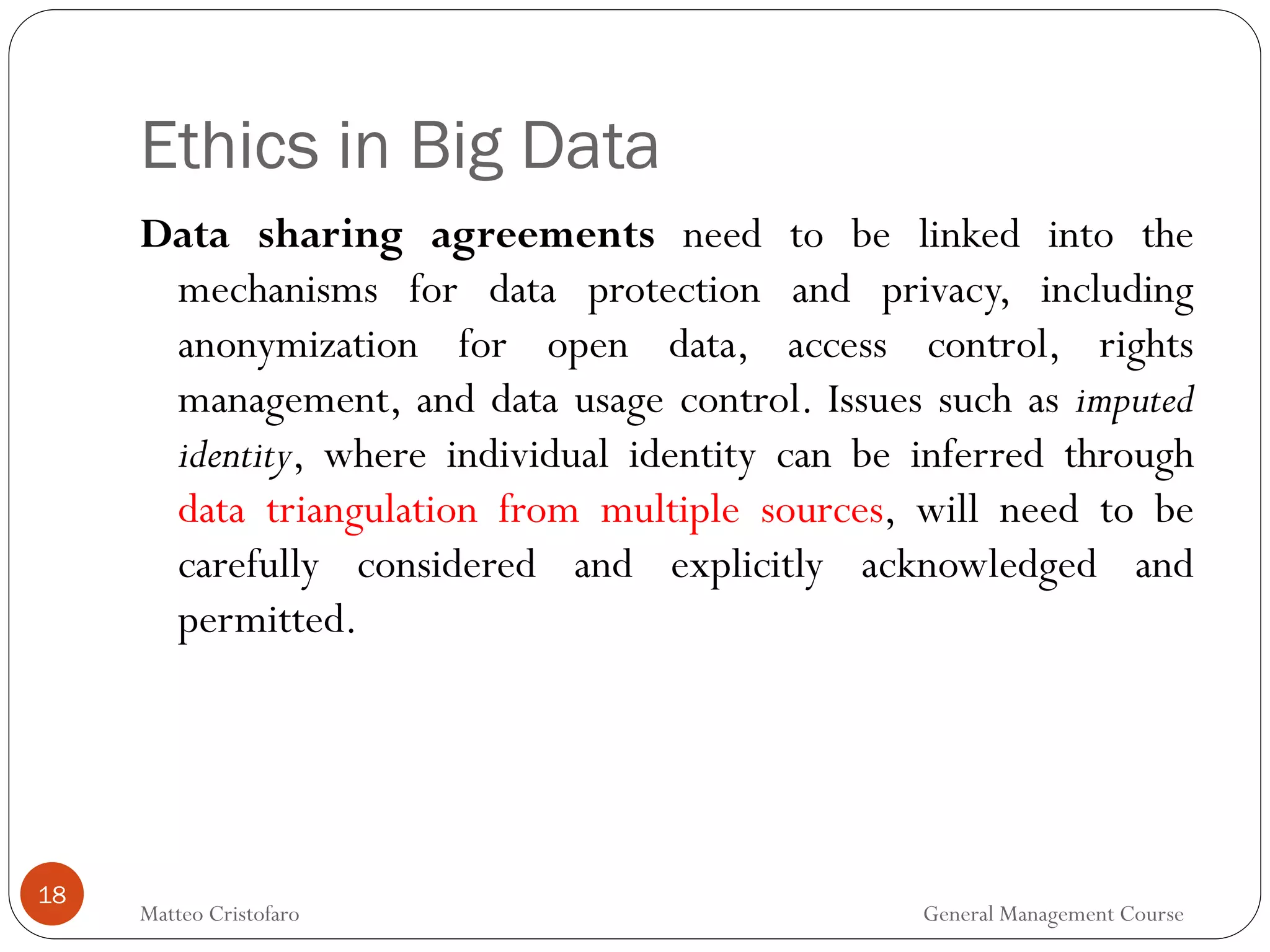
Data sharing agreements need to be linked into the
mechanisms for data protection and privacy, including
anonymization for open data, access control, rights
management, and data usage control. Issues such as imputed
identity, where individual identity can be inferred through
data triangulation from multiple sources, will need to be
carefully considered and explicitly acknowledged and
permitted.
Matteo Cristofaro General Management Course
Analyzing Big Data(1)
19
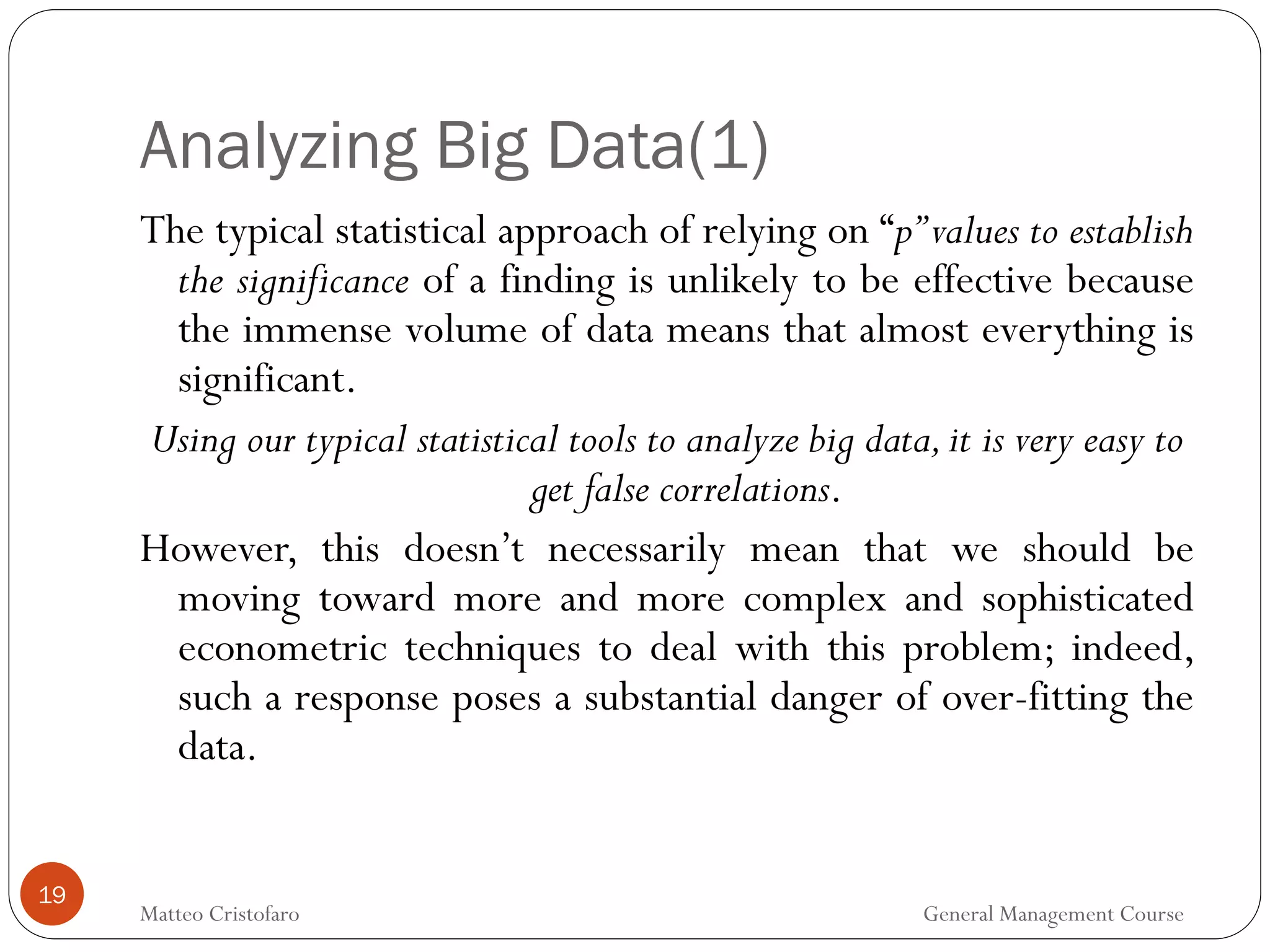
The typical statistical approach of relying on “p”values to establish
the significance of a finding is unlikely to be effective because
the immense volume of data means that almost everything is
significant.
Using our typical statistical tools to analyze big data,it is very easy to
get false correlations.
However, this doesn’t necessarily mean that we should be
moving toward more and more complex and sophisticated
econometric techniques to deal with this problem; indeed,
such a response poses a substantial danger of over-fitting the
data.
Matteo Cristofaro General Management Course
Analyzing Big Data (2)
20
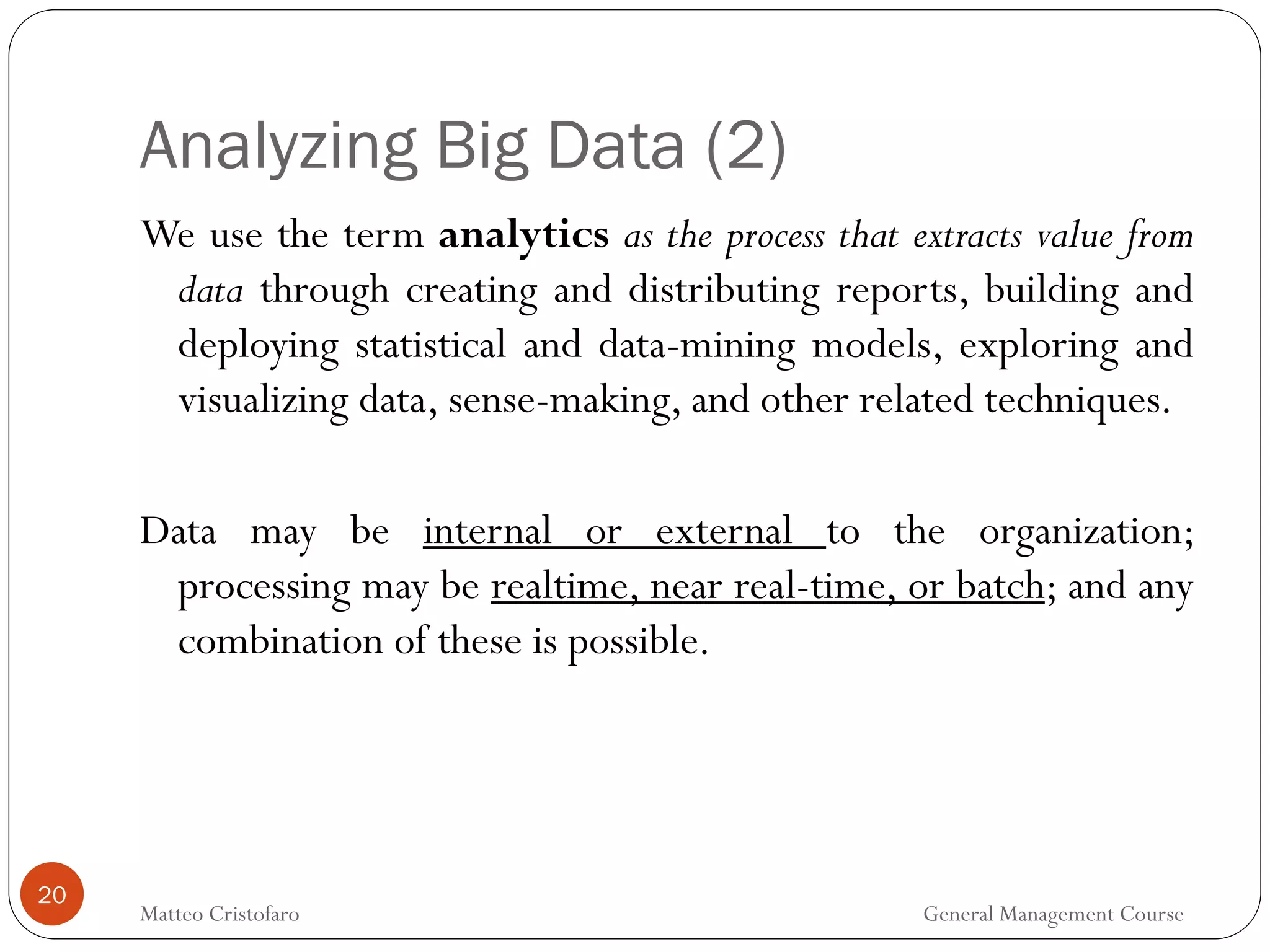
We use the term analytics as the process that extracts value from
data through creating and distributing reports, building and
deploying statistical and data-mining models, exploring and
visualizing data, sense-making, and other related techniques.
Data may be internal or external to the organization;
processing may be realtime, near real-time, or batch; and any
combination of these is possible.
Matteo Cristofaro General Management Course
Analyzing Big Data (3)
21
There is a range of techniques that draw from several disciplines,
including statistics, computer science, applied mathematics, and
economics:
Cluster analysis;Data fusion and integration;Data mining;Genetic
algorithms; Machine learning;Natural language processing; Neural
networks;Network analysis; Signal processing;Spatial analysis;
Simulation;Time series analysis.
The challenge, though, is to shift away from focusing on p values to
focusing, rather, on effect sizes and variance explained. A pitfall of
big data-again, amplified by our commonly used statistical
techniques-lies in focusing too much on aggregates or
averages and too little on outliers.
Matteo Cristofaro General Management Course
Analysing Big Data (4)
22
Once promising leads have been identified, the next challenge of
analyzing big data is to then move beyond identifying
correlational patterns to exploring causality.
Given the unstructured nature of most big data, causality is not built
into their design and the patterns observed are often open to a
wide range of possible causal explanations.
There are two main ways to approach this issue of causality.
1. Recognize the central importance of theory. An intuition about the
causal processes that generated the data can be used to guide the
development of theoretical arguments, grounded in prior
research and pushing beyond it.
2. A complementary way is to then test these theoretical
arguments in subsequent research-ideally, through field
experiments.
Matteo Cristofaro General Management Course
23
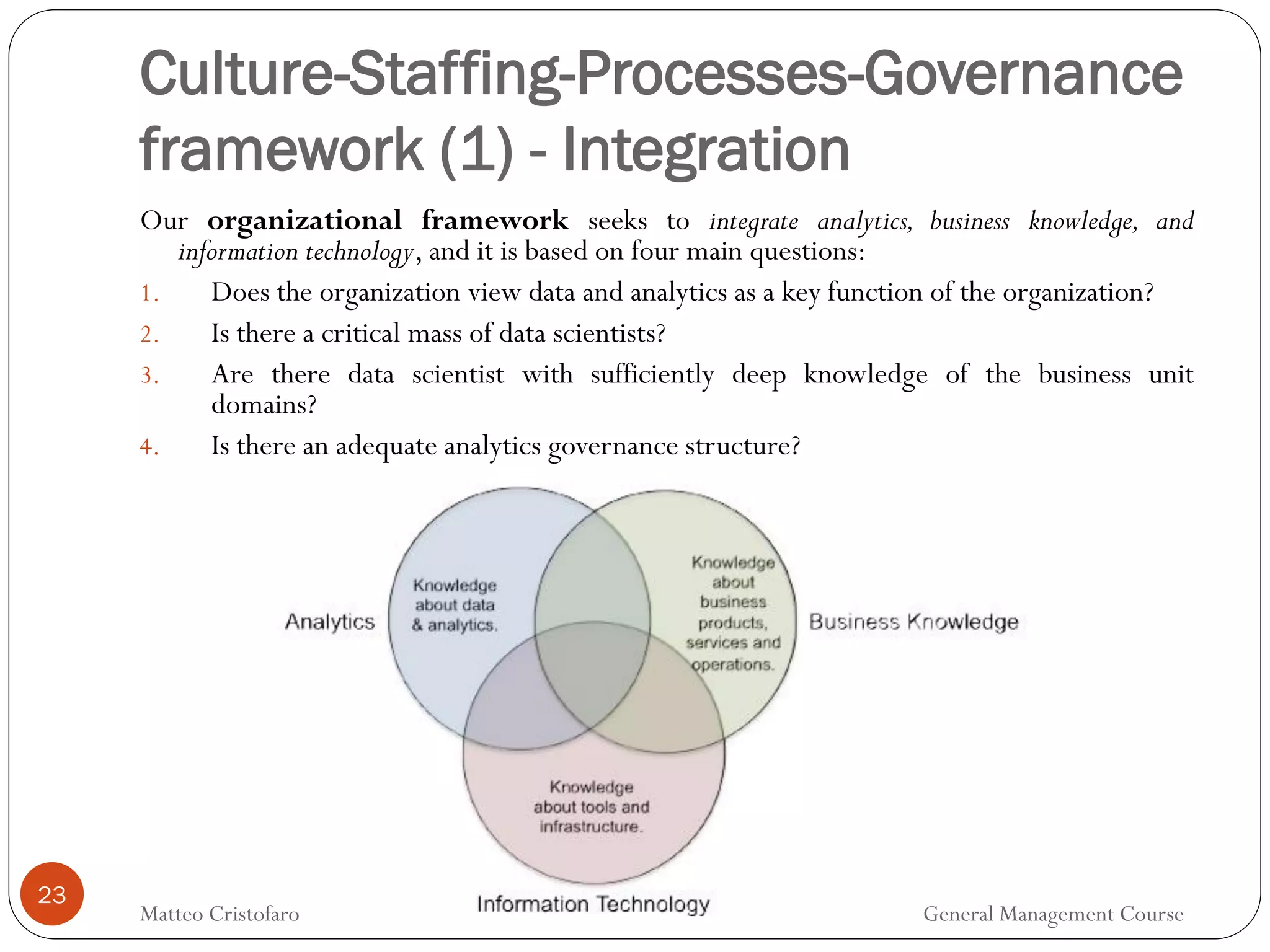
Our organizational framework seeks to integrate analytics, business knowledge, and
information technology, and it is based on four main questions:
1. Does the organization view data and analytics as a key function of the organization?
2. Is there a critical mass of data scientists?
3. Are there data scientist with sufficiently deep knowledge of the business unit
domains?
4. Is there an adequate analytics governance structure?
Culture-Staffing-Processes-Governance
framework (1) - Integration
Matteo Cristofaro General Management Course
24
The CsPg framework orients the organization designer to establishing a
culture for big data and analytics: hiring, training, and organizing a
group of analytics staff; developing the required analytics processes; and
setting up a robust analytics governance structure.
Starting with culture, corporate-level executives must recognize the need to
organize big data and analytics as an organizational function that is given
broad responsibility and authority for data assets and which is analogous
to other major functions in the organization.
Analytics staff must be able to obtain and manage data; build statistical,
predictive, and data-mining models; and deploy those models.
The more sophisticated the analytics processes become,the more opportunities that
can be pursued.
Culture-Staffing-Processes-Governance
framework (2) – Culture and Staff
Matteo Cristofaro General Management Course
25
There are three basic models for locating the analytics function within the organization, all
of which involve well-known tradeoffs between centralization and decentralization.
1. One model centralizes analytics by placing the data scientists in a single unit.
When analytics is centralized, however, the data scientists may be far away from the
business units they are supposed to support. the challenge in such a structure is for the
data scientists to understand the various business units and their needs. In addition,
there is the issue of where the analytics department should report within the
organization.
2. One model decentralize analytics and place a group of data scientists in each
business unit. this approach makes it easier for data scientists to collaborate with their
respective business units and to tailor their models to each unit’s needs. the main
tradeoff is difficulty in achieving critical mass on enterprise-wide problems and
opportunities.
3. One model is a hybrid approach in which a critical mass of data scientists is housed
in a central unit, and the remaining data scientists are distributed
throughout the organization. One common hybrid model is to set up an analytics
or big data “center of excellence” that the distributed data scientists can draw on as
appropriate. another is to centralize the data scientists that interact with the IT
organization, or those that manage the data, or those that deploy the models.
Culture-Staffing-Processes-
Governance framework – 3 Models
Matteo Cristofaro General Management Course
Analytics function (1) – 3 components
26
The analytics function is composed of 1) analytics models, 2) analytics
infrastructure, and 3) analytics operations.
1) A key analytics operation is building models, this is usually done by statisticians,
modelers, or, to use the new name, data scientists. In addition to building
models over data, analytics also includes summarizing data in reports (now
called descriptive analytics), ad hoc querying of data.
2) Analytics infrastructure refers to the software components, software services,
applications, and platforms for managing data, processing data, producing
models, and using models to generate alerts, take actions, and make decisions.
the key processes associated with analytics infrastructure are managing the data
required by the organization and deploying the models and other analytics that
are incorporated into the organization’s products, services, and operations.
3) Analytics operations refers to the various processes that result in the outputs of
models being used to make decisions and to take actions that bring business
value. Analytics operations ensures that the results of models are integrated into
an organization’s products, services, and operations.
Matteo Cristofaro General Management Course
Analytics function (2) – Organizational
effects
27
An organization requires a critical mass of data scientists so that
their expertise as a whole extends across these three analytics
processes.The team as a whole must be able to:
Identify relevant data (both internal and external),manage the data required
for analytics,build the needed analytics models,and deploy the models that
are built into products,services,and internal systems.
Multiple parts of an organization can be involved in analytics
processes, typically, a business unit sponsors the model, an
analytics department builds the model, an IT unit supplies and
manages the data, and an operations unit deploys the model. With
so many diverse pieces of an organization involved, an analytics
governance structure is critical.
Matteo Cristofaro General Management Course
28
Challenges for most organizations since the modeling group
must work with other components of the organization to
identify 1) analytics opportunities, 2) obtain the necessary data,
and 3) deploy the resulting models.
The role of an analytics governance structure is to put
in place an analytics leader with sufficient authority to
overcome these three challenges.
Analytics function (3) – Organizational
effects
Matteo Cristofaro General Management Course
29
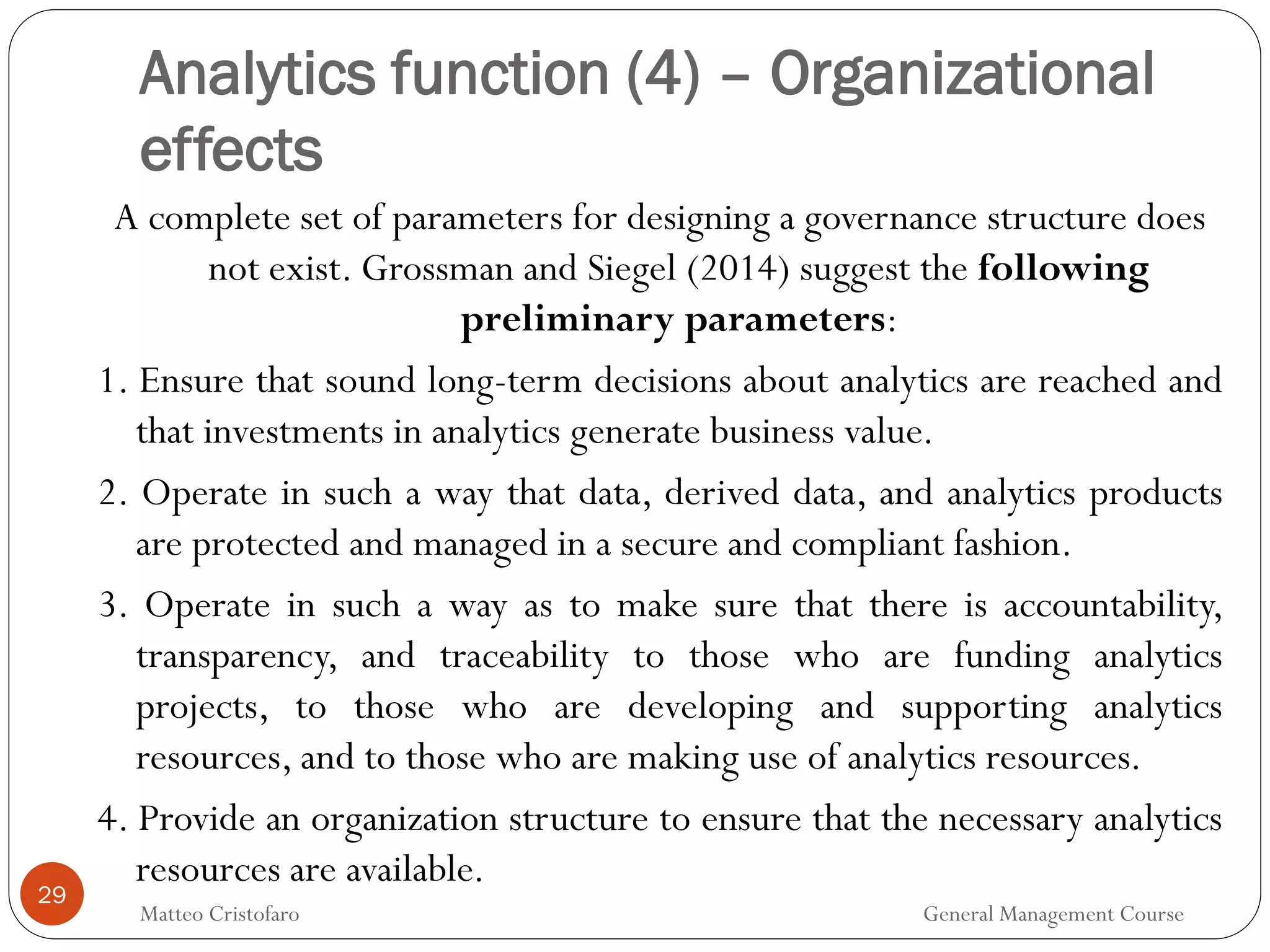
A complete set of parameters for designing a governance structure does
not exist. Grossman and Siegel (2014) suggest the following
preliminary parameters:
1. Ensure that sound long-term decisions about analytics are reached and
that investments in analytics generate business value.
2. Operate in such a way that data, derived data, and analytics products
are protected and managed in a secure and compliant fashion.
3. Operate in such a way as to make sure that there is accountability,
transparency, and traceability to those who are funding analytics
projects, to those who are developing and supporting analytics
resources, and to those who are making use of analytics resources.
4. Provide an organization structure to ensure that the necessary analytics
resources are available.
Analytics function (4) – Organizational
effects
Matteo Cristofaro General Management Course
30
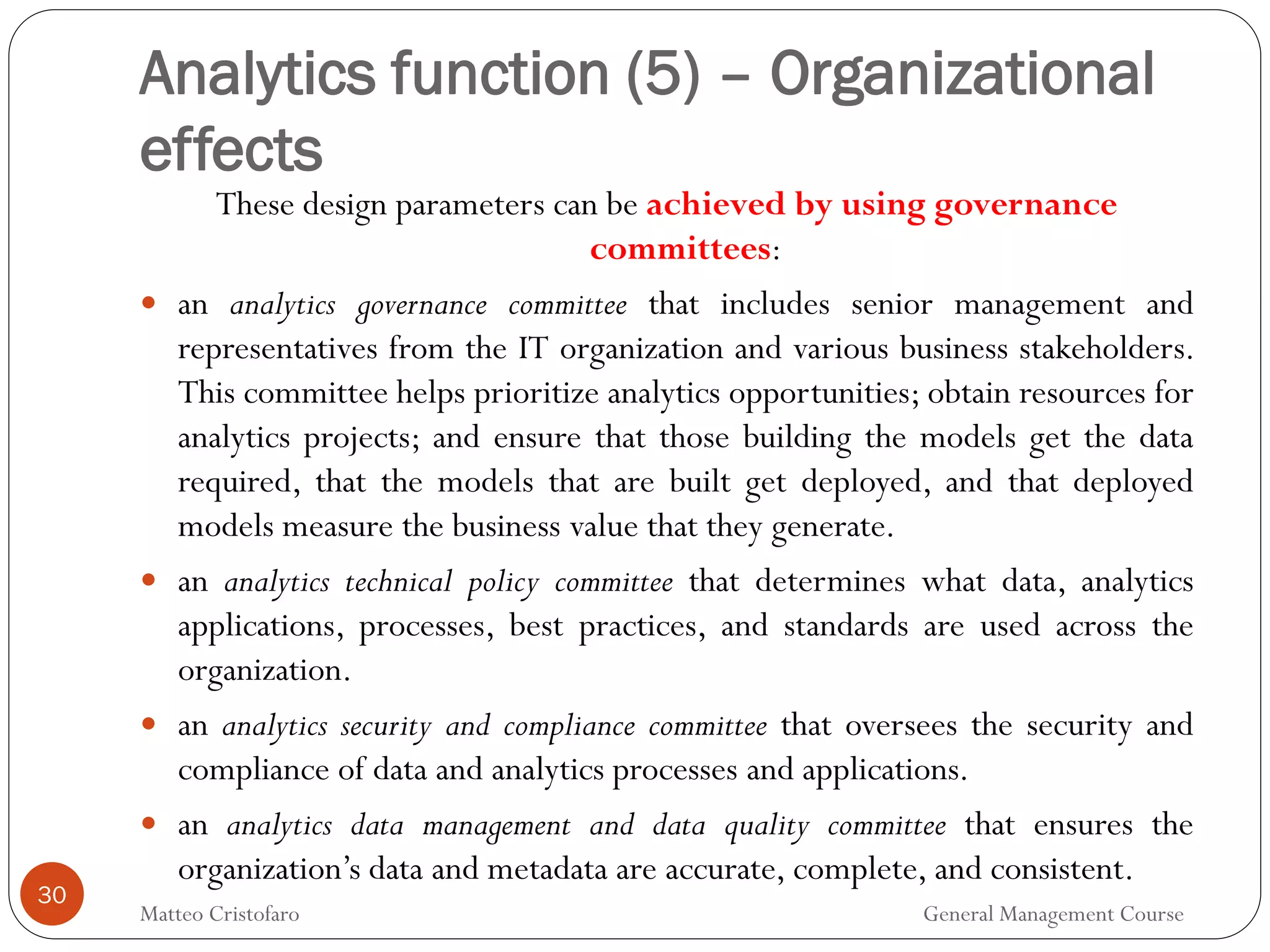
These design parameters can be achieved by using governance
committees:
 an analytics governance committee that includes senior management and
representatives from the IT organization and various business stakeholders.
This committee helps prioritize analytics opportunities; obtain resources for
analytics projects; and ensure that those building the models get the data
required, that the models that are built get deployed, and that deployed
models measure the business value that they generate.
 an analytics technical policy committee that determines what data, analytics
applications, processes, best practices, and standards are used across the
organization.
 an analytics security and compliance committee that oversees the security and
compliance of data and analytics processes and applications.
 an analytics data management and data quality committee that ensures the
organization’s data and metadata are accurate, complete, and consistent.
Analytics function (5) – Organizational
effects
Matteo Cristofaro General Management Course
References
31
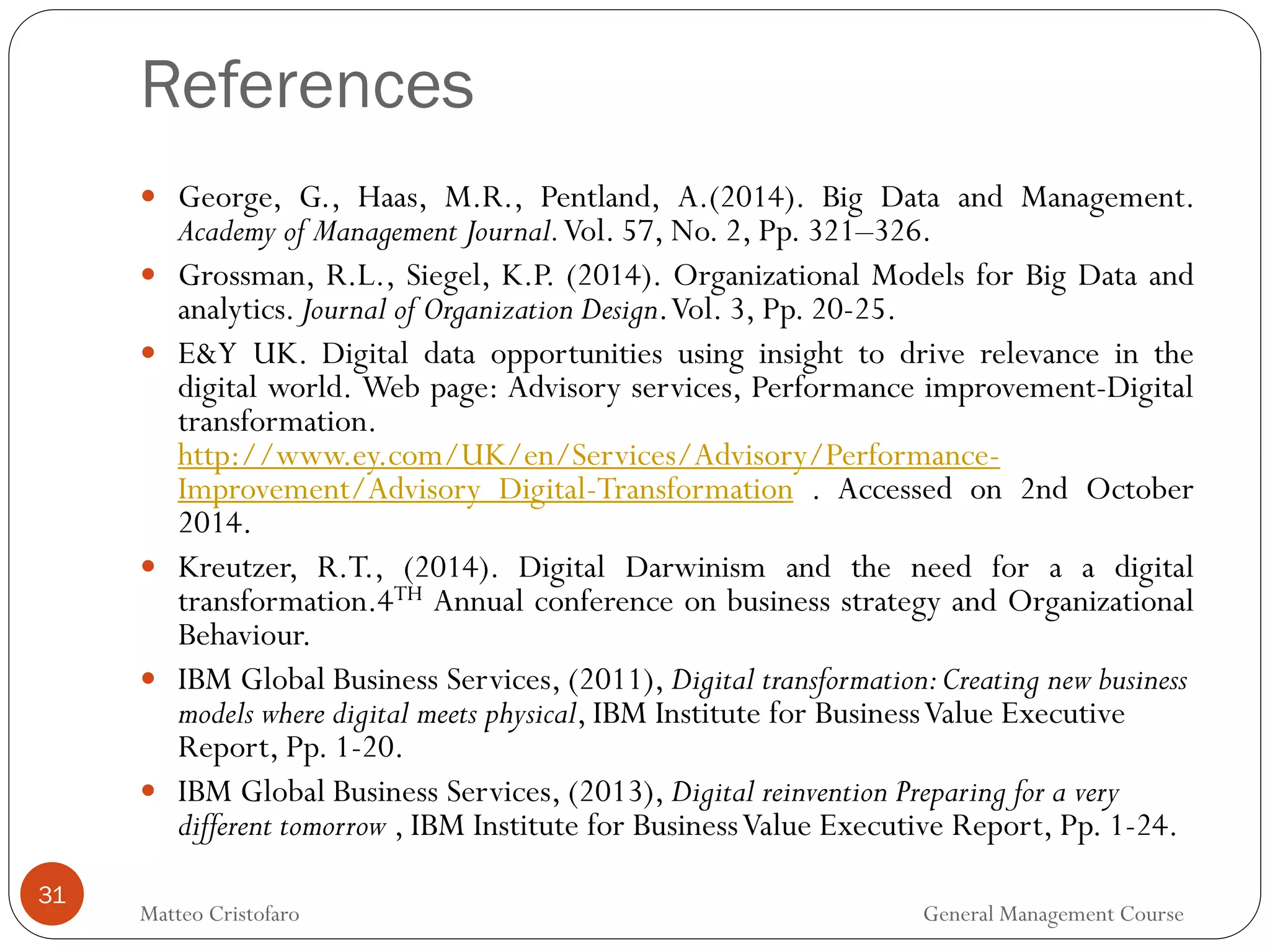
 George, G., Haas, M.R., Pentland, A.(2014). Big Data and Management.
Academy of Management Journal.Vol. 57, No. 2, Pp. 321–326.
 Grossman, R.L., Siegel, K.P. (2014). Organizational Models for Big Data and
analytics. Journal of Organization Design.Vol. 3, Pp. 20-25.
 E&Y UK. Digital data opportunities using insight to drive relevance in the
digital world. Web page: Advisory services, Performance improvement-Digital
transformation.
http://www.ey.com/UK/en/Services/Advisory/Performance-
Improvement/Advisory_Digital-Transformation . Accessed on 2nd October
2014.
 Kreutzer, R.T., (2014). Digital Darwinism and the need for a a digital
transformation.4TH Annual conference on business strategy and Organizational
Behaviour.
 IBM Global Business Services, (2011), Digital transformation:Creating new business
models where digital meets physical, IBM Institute for BusinessValue Executive
Report, Pp. 1-20.
 IBM Global Business Services, (2013), Digital reinvention Preparing for a very
different tomorrow , IBM Institute for BusinessValue Executive Report, Pp. 1-24.
Matteo Cristofaro General Management Course

Big data and digital transformation

  • 1.
    General Management Course A.A.2014/2015 Digital Transformation – Big Data
  • 2.
    Matteo Cristofaro GeneralManagement Course 2  Digital Darwinism;  Digital transformation;  What is Big Data?;  Sources;  Big Data and insights;  Ethics in Big Data;  Analyzing Big Data;  Culture-Staffing-Processes-Governance framework;  Analytics funcion;  References. Summary
  • 3.
    Digital Darwinism 3 We arenow in the middle of the third industrial revolution, driven by the omnipresent digitalization. For this reason, it is again all about a fight for survival, which companies successful for centuries such as mailorder houses and publishing houses have lost their dominant positions. It thus becomes apparent that it is no longer about size, it is not necessarily about speed, and it is not only about the extent of conforming or strength. Today, it is more about “The survival of the smartest!” One should keep in mind what Charles Darwin stated: “It is not the strongest of the species that survives,nor the most intelligent that survives.It is the one that is most adaptable to change” Matteo Cristofaro General Management Course
  • 4.
    4 The most relevantdevelopments could be characterized as the DiSoLoMo-trend. This trend covers the following dimensions: digital, social, local and mobile. In the first instance, the challenges for companies lie in the trend to digitalized more and more products and services (“digital”). An additional trend is the increased use of social media. Based on the trend of digitalisation more and more objects lose significant constrations cause by their physical appearence (e.g. books, newspaper, songs, etc.). This development is called Zero Gravity thinking: objects lose the physical restrictions they had in the real world when these objects are transmitted into cyberspace. Digital transformation (1) - Trends Matteo Cristofaro General Management Course
  • 5.
    5 Digital transformation (2)– Trends (b) Matteo Cristofaro General Management Course
  • 6.
    Digital transformation (3)– Mobility 6 We are at the beginning of a development that is allowing the smartphone to become a smart sevice terminal. This process is renforced by the fact that more and more information of relevance to purchasing processes is becoming available by mobile (by QR code, RedLaserApp, etc.). Mobility has eliminated the boundaries of space and time. Customers are always connected, and companies can interact with them at any time. The implications cannot be overstated. With information about products becoming as important as the products themselves, almost every company is now in the business of creating and delivering “content” – information that is personal, relevant and timely when accessed by the customer. Partnership IBM-Apple http://www.apple.com/pr/library/2014/07/15Apple-and-IBM-Forge-Global-Partnership-to- Transform-Enterprise-Mobility.html Matteo Cristofaro General Management Course
  • 7.
    7 Therefore competition inmany businesses is no longer based on mere product or services. More and more companies undesrand that they have to create comprehensive and integrated ecosystem in order to make the customer stay. But in ecosystems, organizations realize value through the engagement with the system as a whole, where “value” is defined by participants’ willingness to pay for access to the ecosystem. Once access occurs, specific transactions may occur within the ecosystem. Total value created reflects the value of access to and engagement within the system as a whole. Digital transformation (4) – Integrated ecosystem Matteo Cristofaro General Management Course
  • 8.
    8 Digital transformation (5)– elements of digital transformation What do businesses need to do to get ahead of the widespread forces for change in our digital age? Key areas include reconfiguring the customer value proposition (what is being offered) and reshaping the operating model (how it is delivered). Matteo Cristofaro General Management Course
  • 9.
    9 Digital transformation (6)– Strategic paths to transformation Matteo Cristofaro General Management Course
  • 10.
    10 Digital transformation (7)– value proposition and operating model Matteo Cristofaro General Management Course
  • 11.
    11 Businesses aiming togenerate new customer value propositions or transform their operating models need to develop a new portfolio of capabilities for flexibility and responsiveness to fast- changing customer requirements Digital transformation (8) – A new portfolio of capabilities Matteo Cristofaro General Management Course
  • 12.
    What is BigData? (1) 12 The proliferation of digital products and services results in consumers generating huge volumes of personal data across all aspects of their lives, which is captured by organisations through digital channels or devices. Data about a person’s friendship networks, hobbies and interests is captured on Facebook, while details of their shopping patterns are captured by online retailers. In addition to these relatively established data sources, technological developments will continue to generate new sources of consumer data that could offer unique insights into consumer behaviour. Matteo Cristofaro General Management Course
  • 13.
    What is BigData? (2) 13 Organizations are exploring how large-volume data can usefully be deployed to create and capture value for individuals, businesses, communities, and governments (McKinsey Global Institute, 2011). big data is fast becoming a tool that not only analyzes patterns, but can also provide the predictive likelihood of an event. The challenge for businesses lies in how to harness, make sense of, and use this information to generate some form of competitive advantage. Businesses that can access these new sources of data, analyse them and convert them into insight on consumer behaviour, will be able to make their products and services more relevant to their customers. Matteo Cristofaro General Management Course
  • 14.
    What is BigData? (Example) 14  Participant in a Formula 1 car race generates 20 gigabytes of data from the 150 sensors on the car that can help analyze the technical performance of its components, but also the driver reactions, pit stop delays, and communication between crew and driver that contribute to overall performance. The emphasis thus moves away from outcomes (win/lose race), to instead focus on each proximal, contributory element for success or failure mapped for every second during the race.  Or…We could analyze the social networks and social engagement behaviors of individuals by mapping mobility patterns onto physical layouts of workspaces using sensors, or the frequency of meeting room usage using remote sensors that track entry and exit patterns, which could provide information on communication and coordination needs based on project complexity and approaching deadlines. Matteo Cristofaro General Management Course
  • 15.
    Sources (1) 15 Big datais generated from an increasing plurality of sources: Internet clicks, mobile transactions, user-generated content, and social media as well as purposefully generated content through sensor networks or business transactions such as sales queries and purchase transactions. These data require the use of powerful computational techniques to unveil trends and patterns within and between these extremely large socioeconomic datasets. “Big” is no longer the defining parameter, but, rather, how “smart” it is—that is, the insights that the volume of data can reasonably provide. The defining parameter of big data is the fine-grained nature of the data itself, thereby shifting the focus away from the number of participants to the granular information about the individual. Matteo Cristofaro General Management Course
  • 16.
    Sources (2) 16 Big datais also a wrapper for different types of granular data. Below, we list five key sources of high volume data:  Public data: held by governments, governmental organizations, and local communities (e.g. energy use).  Private data: held by private firms, non-profit organizations, and individuals (e.g. consumer transactions).  Data exhaust: ambient data that are passively collected, non-core data with limited or zero value to the original data collection partner these data were collected for a different purpose, but can be recombined with other data sources to create new sources of value (e.g. Internet searches)  Community data: is a distillation of unstructured data—especially text into dynamic networks that capture social trends (e.g.Twitter feeds).  Self quantification data: are revealed by the individual through quantifying personal actions and behaviors (e.g. wristbands that monitor exercise and movement). Matteo Cristofaro General Management Course
  • 17.
    Big data andinsights 17
  • 18.
    Ethics in BigData 18 Data sharing agreements need to be linked into the mechanisms for data protection and privacy, including anonymization for open data, access control, rights management, and data usage control. Issues such as imputed identity, where individual identity can be inferred through data triangulation from multiple sources, will need to be carefully considered and explicitly acknowledged and permitted. Matteo Cristofaro General Management Course
  • 19.
    Analyzing Big Data(1) 19 Thetypical statistical approach of relying on “p”values to establish the significance of a finding is unlikely to be effective because the immense volume of data means that almost everything is significant. Using our typical statistical tools to analyze big data,it is very easy to get false correlations. However, this doesn’t necessarily mean that we should be moving toward more and more complex and sophisticated econometric techniques to deal with this problem; indeed, such a response poses a substantial danger of over-fitting the data. Matteo Cristofaro General Management Course
  • 20.
    Analyzing Big Data(2) 20 We use the term analytics as the process that extracts value from data through creating and distributing reports, building and deploying statistical and data-mining models, exploring and visualizing data, sense-making, and other related techniques. Data may be internal or external to the organization; processing may be realtime, near real-time, or batch; and any combination of these is possible. Matteo Cristofaro General Management Course
  • 21.
    Analyzing Big Data(3) 21 There is a range of techniques that draw from several disciplines, including statistics, computer science, applied mathematics, and economics: Cluster analysis;Data fusion and integration;Data mining;Genetic algorithms; Machine learning;Natural language processing; Neural networks;Network analysis; Signal processing;Spatial analysis; Simulation;Time series analysis. The challenge, though, is to shift away from focusing on p values to focusing, rather, on effect sizes and variance explained. A pitfall of big data-again, amplified by our commonly used statistical techniques-lies in focusing too much on aggregates or averages and too little on outliers. Matteo Cristofaro General Management Course
  • 22.
    Analysing Big Data(4) 22 Once promising leads have been identified, the next challenge of analyzing big data is to then move beyond identifying correlational patterns to exploring causality. Given the unstructured nature of most big data, causality is not built into their design and the patterns observed are often open to a wide range of possible causal explanations. There are two main ways to approach this issue of causality. 1. Recognize the central importance of theory. An intuition about the causal processes that generated the data can be used to guide the development of theoretical arguments, grounded in prior research and pushing beyond it. 2. A complementary way is to then test these theoretical arguments in subsequent research-ideally, through field experiments. Matteo Cristofaro General Management Course
  • 23.
    23 Our organizational frameworkseeks to integrate analytics, business knowledge, and information technology, and it is based on four main questions: 1. Does the organization view data and analytics as a key function of the organization? 2. Is there a critical mass of data scientists? 3. Are there data scientist with sufficiently deep knowledge of the business unit domains? 4. Is there an adequate analytics governance structure? Culture-Staffing-Processes-Governance framework (1) - Integration Matteo Cristofaro General Management Course
  • 24.
    24 The CsPg frameworkorients the organization designer to establishing a culture for big data and analytics: hiring, training, and organizing a group of analytics staff; developing the required analytics processes; and setting up a robust analytics governance structure. Starting with culture, corporate-level executives must recognize the need to organize big data and analytics as an organizational function that is given broad responsibility and authority for data assets and which is analogous to other major functions in the organization. Analytics staff must be able to obtain and manage data; build statistical, predictive, and data-mining models; and deploy those models. The more sophisticated the analytics processes become,the more opportunities that can be pursued. Culture-Staffing-Processes-Governance framework (2) – Culture and Staff Matteo Cristofaro General Management Course
  • 25.
    25 There are threebasic models for locating the analytics function within the organization, all of which involve well-known tradeoffs between centralization and decentralization. 1. One model centralizes analytics by placing the data scientists in a single unit. When analytics is centralized, however, the data scientists may be far away from the business units they are supposed to support. the challenge in such a structure is for the data scientists to understand the various business units and their needs. In addition, there is the issue of where the analytics department should report within the organization. 2. One model decentralize analytics and place a group of data scientists in each business unit. this approach makes it easier for data scientists to collaborate with their respective business units and to tailor their models to each unit’s needs. the main tradeoff is difficulty in achieving critical mass on enterprise-wide problems and opportunities. 3. One model is a hybrid approach in which a critical mass of data scientists is housed in a central unit, and the remaining data scientists are distributed throughout the organization. One common hybrid model is to set up an analytics or big data “center of excellence” that the distributed data scientists can draw on as appropriate. another is to centralize the data scientists that interact with the IT organization, or those that manage the data, or those that deploy the models. Culture-Staffing-Processes- Governance framework – 3 Models Matteo Cristofaro General Management Course
  • 26.
    Analytics function (1)– 3 components 26 The analytics function is composed of 1) analytics models, 2) analytics infrastructure, and 3) analytics operations. 1) A key analytics operation is building models, this is usually done by statisticians, modelers, or, to use the new name, data scientists. In addition to building models over data, analytics also includes summarizing data in reports (now called descriptive analytics), ad hoc querying of data. 2) Analytics infrastructure refers to the software components, software services, applications, and platforms for managing data, processing data, producing models, and using models to generate alerts, take actions, and make decisions. the key processes associated with analytics infrastructure are managing the data required by the organization and deploying the models and other analytics that are incorporated into the organization’s products, services, and operations. 3) Analytics operations refers to the various processes that result in the outputs of models being used to make decisions and to take actions that bring business value. Analytics operations ensures that the results of models are integrated into an organization’s products, services, and operations. Matteo Cristofaro General Management Course
  • 27.
    Analytics function (2)– Organizational effects 27 An organization requires a critical mass of data scientists so that their expertise as a whole extends across these three analytics processes.The team as a whole must be able to: Identify relevant data (both internal and external),manage the data required for analytics,build the needed analytics models,and deploy the models that are built into products,services,and internal systems. Multiple parts of an organization can be involved in analytics processes, typically, a business unit sponsors the model, an analytics department builds the model, an IT unit supplies and manages the data, and an operations unit deploys the model. With so many diverse pieces of an organization involved, an analytics governance structure is critical. Matteo Cristofaro General Management Course
  • 28.
    28 Challenges for mostorganizations since the modeling group must work with other components of the organization to identify 1) analytics opportunities, 2) obtain the necessary data, and 3) deploy the resulting models. The role of an analytics governance structure is to put in place an analytics leader with sufficient authority to overcome these three challenges. Analytics function (3) – Organizational effects Matteo Cristofaro General Management Course
  • 29.
    29 A complete setof parameters for designing a governance structure does not exist. Grossman and Siegel (2014) suggest the following preliminary parameters: 1. Ensure that sound long-term decisions about analytics are reached and that investments in analytics generate business value. 2. Operate in such a way that data, derived data, and analytics products are protected and managed in a secure and compliant fashion. 3. Operate in such a way as to make sure that there is accountability, transparency, and traceability to those who are funding analytics projects, to those who are developing and supporting analytics resources, and to those who are making use of analytics resources. 4. Provide an organization structure to ensure that the necessary analytics resources are available. Analytics function (4) – Organizational effects Matteo Cristofaro General Management Course
  • 30.
    30 These design parameterscan be achieved by using governance committees:  an analytics governance committee that includes senior management and representatives from the IT organization and various business stakeholders. This committee helps prioritize analytics opportunities; obtain resources for analytics projects; and ensure that those building the models get the data required, that the models that are built get deployed, and that deployed models measure the business value that they generate.  an analytics technical policy committee that determines what data, analytics applications, processes, best practices, and standards are used across the organization.  an analytics security and compliance committee that oversees the security and compliance of data and analytics processes and applications.  an analytics data management and data quality committee that ensures the organization’s data and metadata are accurate, complete, and consistent. Analytics function (5) – Organizational effects Matteo Cristofaro General Management Course
  • 31.
    References 31  George, G.,Haas, M.R., Pentland, A.(2014). Big Data and Management. Academy of Management Journal.Vol. 57, No. 2, Pp. 321–326.  Grossman, R.L., Siegel, K.P. (2014). Organizational Models for Big Data and analytics. Journal of Organization Design.Vol. 3, Pp. 20-25.  E&Y UK. Digital data opportunities using insight to drive relevance in the digital world. Web page: Advisory services, Performance improvement-Digital transformation. http://www.ey.com/UK/en/Services/Advisory/Performance- Improvement/Advisory_Digital-Transformation . Accessed on 2nd October 2014.  Kreutzer, R.T., (2014). Digital Darwinism and the need for a a digital transformation.4TH Annual conference on business strategy and Organizational Behaviour.  IBM Global Business Services, (2011), Digital transformation:Creating new business models where digital meets physical, IBM Institute for BusinessValue Executive Report, Pp. 1-20.  IBM Global Business Services, (2013), Digital reinvention Preparing for a very different tomorrow , IBM Institute for BusinessValue Executive Report, Pp. 1-24. Matteo Cristofaro General Management Course