Be in at least the eighth grade
ď‚— This honor requires the maturity level of a typical 8th
grade student. Please note that requirement 2 very
closely coincides with an activity in the Voyager AY
class. It would be good to follow this honor with the
Personal Evangelism honor.
Go on a visit with your pastor to a
Bible study, a hospital visit, and a
visit to a church member
ď‚— Though your pastor is a very busy person, it is likely that he
will welcome you as he visits others. Ask him well ahead of
time so that he can choose the day when you may join him.
Be patient - he may not have anything lined up right away.
Trust his judgment - he is a professional. There is no need
to make all of these visits on the same day - they can be
spread out over multiple trips. Remember your manners
during the visits, and that you are a representative of your
club, your church, and your Savior.
ď‚— Before you go, see the notes on requirement 6 and
requirement 7c.
Arrange with your pastor to attend a church
board meeting and a church business
meeting. Make a written report of your visits
to both meetings.
ď‚— Church boards usually meet once per month. Again
remember your manners and that you are
representing your club. Be sure that you do make
arrangements with your pastor to attend - do not just
show up. Church boards often deal with sensitive,
confidential matters, and you may be asked to dismiss
yourself during part of the meeting. If this happens,
handle yourself with grace.
ď‚— Also keep in mind that unless you are a member of
your church board, you will not be able to vote on any
of the business that comes up during a church board
meeting. If you are a baptized member of your church,
however, you may (and should) vote during a church
business meeting.
List the steps in church organization
from the member to the General
Conference and know their
relationship to each other.
ď‚— A person's membership in the Seventh-day Adventist
Church is with a particular church, mission, or
company. Sometimes, an individual's membership will
be with the local conference rather than with a church
(such is the case with conference employees and their
families, for instance). The local church is an
independent body invested with the authority to make
most of its own decisions. The pastor of the local
church, however, is
ď‚— an employee of the local conference, and will answer
to the Conference President. The local church
forwards all tithe money it collects to the conference,
and these funds are used to pay the salaries of all
pastors and conference administrative employees.
School teachers are also conference employees, but
their salaries are paid from tuition rather than from
tithe. Conference officers (President, Vice Presidents,
Treasurer, etc) are voted into office at a Conference
Constituency meeting. Each church, mission, and
company in a conference selects and sends its own
delegates to the these meetings.
ď‚— Several local conferences in a region make up a Union.
Each Union has its own administrative staff and a slate
of officers. Adventist colleges are usually associated
with a Union and funded at the Union level.
ď‚— Unions are grouped into Divisions, and each Division
also has its administrative staff and officers (President,
Vice Presidents, Treasurer, etc). Again, the officers are
voted into their positions at a constituency meeting.
There are twelve Divisions in the Seventh-day
Adventist Church, and together they form the General
Conference. This is the highest level of government in
the Adventist Church. Every five years the General
Conference holds a constituency meeting to decide
matters important to the denomination and to elect its
officers (a President, several Vice Presidents,
Treasurer, etc).
Find out what your church spends
money on and what percentage of
the budget goes to what expenses.
ď‚— You should be able to find this information by talking
to your church treasurer. Any member of your church's
Finance Committee (if your church has one) will also
be able to help you with this. Some churches budget
fixed percentages of their income for certain expenses,
while others budget fixed amounts. Still others will use
a combination of these two approaches, paying fixed
costs first, and then budgeting the remainder by
percentages.
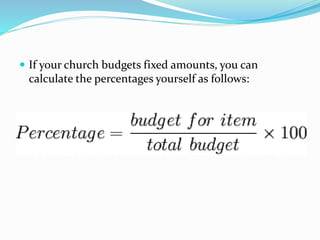
ď‚— If your church budgets fixed amounts, you can
calculate the percentages yourself as follows:
Write a report of an interview with
your pastor in which you asked him
the following questions:
ď‚— a. What is your daily routine like?
ď‚— b. What is your weekly routine like?
ď‚— c. What education is required to become a minister?
ď‚— d. What education outside of theology would
complement a minister?
ď‚— e. From what source is the pastor paid?
ď‚— f. What is the most rewarding part of your ministry?
ď‚— g. What is the hardest part of your ministry?
ď‚— h. What are beneficial vocations for a pastor's wife to
have?
ď‚— i. How did you know that God called you to the
ministry?
ď‚— j. How would I know if God were calling me to the
ministry?
ď‚— k. How do you do soul winning?
ď‚— l. How does evangelism enter into your soul winning?
ď‚— m. What advice would you give to someone who was
thinking about becoming a minister?
ď‚— If you are traveling with your pastor to meet
requirement 2, this would be an excellent time to ask
him these questions. Otherwise, you will need to set
up an appointment with him. Be sure to take notes
during your discussion so you can refer to them as you
write your report.
Do two of the following:
a. Participate in the presentation
of a youth evangelistic series.
ď‚— If your church is presenting a youth evangelistic series, volunteer
to help out. If not, perhaps you could organize a series yourself
or with other members of your Pathfinder club or AY Society.
ď‚— Participating in the presentation can mean leading out in front
of the congregation or working behind the scenes. Both are
important.
ď‚— Leading out
ď‚— This could be preaching, presenting special music, or providing
testimony about your own Christian experience.
ď‚— Behind the scenes
ď‚— This could be running the PA system, controlling a slide show,
operating a spot light, videotaping the program, or even
podcasting the series over the Internet.
b. Give two Bible studies.
ď‚— You can get materials for Bible studies from any of the
following:
ď‚— Amazing Facts
ď‚— It Is Written
ď‚— Voice of Prophecy
ď‚— Discover Online
c. Make four hospital visits, presenting a
devotional thought and prayer at each one.
ď‚— A well-functioning church publicly prays for
hospitalized members. Pay close attention to the
prayers in your church to find out who is sick. It is also
totally acceptable to visit non-church members who
are hospitalized.
ď‚— Talk to your pastor, an elder, a deacon, or a deaconess
in your church to find out if they are going on a
hospital visit and ask if you can come along. If they are
not going, offer to go yourself. If they do not think it
wise that you join them, respect their judgment.
ď‚— Do not arrive unannounced. It is better to call ahead.
Talk to either the patient or someone close to the
patient about scheduling your visit. Do not put the
visit off for too long either, as hospital stays are getting
shorter and shorter all the time. It is not unusual for a
patient to be sent home within two days of having
major surgery. For this reason it may be better to be on
the lookout for a person scheduled to be admitted to a
hospital rather than for someone who has already been
admitted. They could easily be discharged before you
can arrange a visit.
ď‚— When you get to the hospital you may need to turn off
your cell phone. Look for any notices to that effect and
comply with them.
ď‚— It is best to not bring a large number of people with
you when making a hospital visit. The rooms are small,
and the hospital will limit the number of visitors
allowed in the room. Furthermore, sick people are
often not comfortable visiting with a large crowd. Be
sure to obey any direction given to you by the hospital
staff. Do not make noise. Remember that there are
other patients there who need their rest.
ď‚— Keep the visit brief and be alert for any signs that the
patient wants you to leave. the patient may be too
polite to make such as wish known to you. If you detect
any hint that you should leave, do so graciously and do
not take offense. Hospitalization is not a pleasant
experience, and people frequently prefer to maintain
their privacy. The patient may also tire easily and not
be in a mood to visit. It is difficult to get a good night's
rest in a hospital, as it buzzes with activity 24 hours a
day, seven days a week.
ď‚— Because your visit may be short, it is best to begin
presenting your devotional thought as soon as you can.
Be polite and ask how the patient is doing before
diving in, but don't chit-chat for very long before
getting started. When the devotional is finished, close
with a prayer and leave while the presence of the Holy
Spirit still lingers. It is better to say your goodbyes
before having the prayer.
d. Give a sermon of at least 20
minutes in length.
ď‚— This can be done during any number of events
including:
ď‚— Pathfinder Sabbath
ď‚— Camp out
ď‚— Induction Ceremony
ď‚— Investiture Service
ď‚— Regular Sabbath worship service
ď‚— You can turn almost any Bible study into a sermon, as
they generally present a thought or an idea in an
organized manner. Make notes on index cards and
take them to the pulpit with you. If you are
uncomfortable, practice your sermon ahead of time.
ď‚— Open and close your sermon with a short prayer, and
pray with another person in private before taking the
pulpit. When citing Bible texts, give the congregation
time to find the passage - repeat the book, chapter,
and verse a couple of times. Speak clearly, with plenty
of volume, and enunciate your words.
ď‚— Remember that no one in the congregation is there
waiting for you to fail - they all want you to succeed!
They are on your side.
e. Give two evening and two
morning devotionals for a camp out.
ď‚— Make arrangements with your Club Director well in
advance of the camp out. If you can connect all four of
these devotionals with a common theme, all the better.
Consult a daily devotional book for ideas. Many are
available at the Adventist Book Center.
f. Give devotional worships for five
days at a school.
ď‚— This is an ideal option if you attend or live near an
Adventist school. These devotionals can be presented
to the entire school, to a single classroom, or to a small
group that meets before, during, or after school. They
need not last more than 10 or 15 minutes.
ď‚— Talk to the school principal or a teacher well ahead of
time. She may want to know exactly what you are
planning before approving it, so go in knowing what
you are going to say. Better yet, have an outline of your
program prepared ahead of time.
g. Earn the Pathfinder Evangelism
Award.
ď‚— These are the requirements for the Pathfinder
Evangelism Award:
ď‚— 1. Be a Pathfinder or Staff Member.
ď‚— 2. Attend at least ten meetings. (Evangelistic
meetings, Daniel or Revelation Seminars. If less
than 10 are conducted, attend at least two-thirds
of them.)
ď‚— 3. Participate at each of the meetings attended.
ď‚— 4. Wear your Pathfinder full-dress uniform
(including scarf & sash) while participating.
ď‚— 5. Participate in at least four of the following:
ď‚— a. Be an usher.
ď‚— b. Pick up the offering.
ď‚— c. Assist in the children's meetings.
ď‚— d. Have scripture or prayer
ď‚— e. Assist in the set-up/take-down of the
meeting hall.
ď‚— f. Hand out the evening programs, brochures,
etc.
ď‚— g. Give a testimony of what Jesus has done
recently for you.
ď‚— h. Be a greeter.
ď‚— i. Help operate a Pathfinder booth showing
what the church has for its young people.
ď‚— j. Invite a guest (non-SDA) to attend the
meetings and host him throughout the
evenings.
ď‚— k. Prepare a baked-goods table (breads, etc.)
to share as gifts or samples for the attendees.
ď‚— l. Contact at least ten (10) individuals by
phone or in person inviting them to attend the
meetings.
ď‚— m. Participate in at least two Bible studies
with at least one "interest."
ď‚— For your choice of the above, a thorough preparation is
needed. Where applicable, outlines or memorized
material should be used. A reading of the presentation
is not permitted.
Through Bible and the writings of
Ellen G. White study and learn
how Jesus treated crowds of
people in ministering to them.
ď‚— Read Matthew chapters 5-7, which cover the Sermon
on the Mount, and chapter 31 of The Desire of Ages
which contains Mrs. White's commentary on it. You
should also read Thoughts From the Mount of Blessing.
Show that you have a personal
daily devotional life for at least six
months.
ď‚— for at least six months.
ď‚— One way to show this is by keeping a devotional
journal. Summarize what you have read, making sure
to record any Bible verses or other reading material
studied. Be sure to record the date as well.
ď‚— If you like, you can record your journal on a blog so
that others may read it on the Internet. You may even
plant a seed this way without knowing it!

BIBLE EVANGELISM.pptx

  • 2.
    Be in atleast the eighth grade ď‚— This honor requires the maturity level of a typical 8th grade student. Please note that requirement 2 very closely coincides with an activity in the Voyager AY class. It would be good to follow this honor with the Personal Evangelism honor.
  • 3.
    Go on avisit with your pastor to a Bible study, a hospital visit, and a visit to a church member ď‚— Though your pastor is a very busy person, it is likely that he will welcome you as he visits others. Ask him well ahead of time so that he can choose the day when you may join him. Be patient - he may not have anything lined up right away. Trust his judgment - he is a professional. There is no need to make all of these visits on the same day - they can be spread out over multiple trips. Remember your manners during the visits, and that you are a representative of your club, your church, and your Savior. ď‚— Before you go, see the notes on requirement 6 and requirement 7c.
  • 4.
    Arrange with yourpastor to attend a church board meeting and a church business meeting. Make a written report of your visits to both meetings. ď‚— Church boards usually meet once per month. Again remember your manners and that you are representing your club. Be sure that you do make arrangements with your pastor to attend - do not just show up. Church boards often deal with sensitive, confidential matters, and you may be asked to dismiss yourself during part of the meeting. If this happens, handle yourself with grace.
  • 5.
    ď‚— Also keepin mind that unless you are a member of your church board, you will not be able to vote on any of the business that comes up during a church board meeting. If you are a baptized member of your church, however, you may (and should) vote during a church business meeting.
  • 6.
    List the stepsin church organization from the member to the General Conference and know their relationship to each other. ď‚— A person's membership in the Seventh-day Adventist Church is with a particular church, mission, or company. Sometimes, an individual's membership will be with the local conference rather than with a church (such is the case with conference employees and their families, for instance). The local church is an independent body invested with the authority to make most of its own decisions. The pastor of the local church, however, is
  • 7.
    ď‚— an employeeof the local conference, and will answer to the Conference President. The local church forwards all tithe money it collects to the conference, and these funds are used to pay the salaries of all pastors and conference administrative employees. School teachers are also conference employees, but their salaries are paid from tuition rather than from tithe. Conference officers (President, Vice Presidents, Treasurer, etc) are voted into office at a Conference Constituency meeting. Each church, mission, and company in a conference selects and sends its own delegates to the these meetings.
  • 8.
    ď‚— Several localconferences in a region make up a Union. Each Union has its own administrative staff and a slate of officers. Adventist colleges are usually associated with a Union and funded at the Union level.
  • 9.
    ď‚— Unions aregrouped into Divisions, and each Division also has its administrative staff and officers (President, Vice Presidents, Treasurer, etc). Again, the officers are voted into their positions at a constituency meeting. There are twelve Divisions in the Seventh-day Adventist Church, and together they form the General Conference. This is the highest level of government in the Adventist Church. Every five years the General Conference holds a constituency meeting to decide matters important to the denomination and to elect its officers (a President, several Vice Presidents, Treasurer, etc).
  • 10.
    Find out whatyour church spends money on and what percentage of the budget goes to what expenses. ď‚— You should be able to find this information by talking to your church treasurer. Any member of your church's Finance Committee (if your church has one) will also be able to help you with this. Some churches budget fixed percentages of their income for certain expenses, while others budget fixed amounts. Still others will use a combination of these two approaches, paying fixed costs first, and then budgeting the remainder by percentages.
  • 11.
    ď‚— If yourchurch budgets fixed amounts, you can calculate the percentages yourself as follows:
  • 12.
    Write a reportof an interview with your pastor in which you asked him the following questions: ď‚— a. What is your daily routine like? ď‚— b. What is your weekly routine like? ď‚— c. What education is required to become a minister? ď‚— d. What education outside of theology would complement a minister? ď‚— e. From what source is the pastor paid? ď‚— f. What is the most rewarding part of your ministry? ď‚— g. What is the hardest part of your ministry?
  • 13.
    ď‚— h. Whatare beneficial vocations for a pastor's wife to have? ď‚— i. How did you know that God called you to the ministry? ď‚— j. How would I know if God were calling me to the ministry? ď‚— k. How do you do soul winning? ď‚— l. How does evangelism enter into your soul winning? ď‚— m. What advice would you give to someone who was thinking about becoming a minister?
  • 14.
    ď‚— If youare traveling with your pastor to meet requirement 2, this would be an excellent time to ask him these questions. Otherwise, you will need to set up an appointment with him. Be sure to take notes during your discussion so you can refer to them as you write your report.
  • 15.
    Do two ofthe following:
  • 16.
    a. Participate inthe presentation of a youth evangelistic series. ď‚— If your church is presenting a youth evangelistic series, volunteer to help out. If not, perhaps you could organize a series yourself or with other members of your Pathfinder club or AY Society. ď‚— Participating in the presentation can mean leading out in front of the congregation or working behind the scenes. Both are important. ď‚— Leading out ď‚— This could be preaching, presenting special music, or providing testimony about your own Christian experience. ď‚— Behind the scenes ď‚— This could be running the PA system, controlling a slide show, operating a spot light, videotaping the program, or even podcasting the series over the Internet.
  • 17.
    b. Give twoBible studies. ď‚— You can get materials for Bible studies from any of the following: ď‚— Amazing Facts ď‚— It Is Written ď‚— Voice of Prophecy ď‚— Discover Online
  • 18.
    c. Make fourhospital visits, presenting a devotional thought and prayer at each one. ď‚— A well-functioning church publicly prays for hospitalized members. Pay close attention to the prayers in your church to find out who is sick. It is also totally acceptable to visit non-church members who are hospitalized. ď‚— Talk to your pastor, an elder, a deacon, or a deaconess in your church to find out if they are going on a hospital visit and ask if you can come along. If they are not going, offer to go yourself. If they do not think it wise that you join them, respect their judgment.
  • 19.
    ď‚— Do notarrive unannounced. It is better to call ahead. Talk to either the patient or someone close to the patient about scheduling your visit. Do not put the visit off for too long either, as hospital stays are getting shorter and shorter all the time. It is not unusual for a patient to be sent home within two days of having major surgery. For this reason it may be better to be on the lookout for a person scheduled to be admitted to a hospital rather than for someone who has already been admitted. They could easily be discharged before you can arrange a visit.
  • 20.
    ď‚— When youget to the hospital you may need to turn off your cell phone. Look for any notices to that effect and comply with them. ď‚— It is best to not bring a large number of people with you when making a hospital visit. The rooms are small, and the hospital will limit the number of visitors allowed in the room. Furthermore, sick people are often not comfortable visiting with a large crowd. Be sure to obey any direction given to you by the hospital staff. Do not make noise. Remember that there are other patients there who need their rest.
  • 21.
    ď‚— Keep thevisit brief and be alert for any signs that the patient wants you to leave. the patient may be too polite to make such as wish known to you. If you detect any hint that you should leave, do so graciously and do not take offense. Hospitalization is not a pleasant experience, and people frequently prefer to maintain their privacy. The patient may also tire easily and not be in a mood to visit. It is difficult to get a good night's rest in a hospital, as it buzzes with activity 24 hours a day, seven days a week.
  • 22.
    ď‚— Because yourvisit may be short, it is best to begin presenting your devotional thought as soon as you can. Be polite and ask how the patient is doing before diving in, but don't chit-chat for very long before getting started. When the devotional is finished, close with a prayer and leave while the presence of the Holy Spirit still lingers. It is better to say your goodbyes before having the prayer.
  • 23.
    d. Give asermon of at least 20 minutes in length. ď‚— This can be done during any number of events including: ď‚— Pathfinder Sabbath ď‚— Camp out ď‚— Induction Ceremony ď‚— Investiture Service ď‚— Regular Sabbath worship service
  • 24.
    ď‚— You canturn almost any Bible study into a sermon, as they generally present a thought or an idea in an organized manner. Make notes on index cards and take them to the pulpit with you. If you are uncomfortable, practice your sermon ahead of time. ď‚— Open and close your sermon with a short prayer, and pray with another person in private before taking the pulpit. When citing Bible texts, give the congregation time to find the passage - repeat the book, chapter, and verse a couple of times. Speak clearly, with plenty of volume, and enunciate your words. ď‚— Remember that no one in the congregation is there waiting for you to fail - they all want you to succeed! They are on your side.
  • 25.
    e. Give twoevening and two morning devotionals for a camp out. ď‚— Make arrangements with your Club Director well in advance of the camp out. If you can connect all four of these devotionals with a common theme, all the better. Consult a daily devotional book for ideas. Many are available at the Adventist Book Center.
  • 26.
    f. Give devotionalworships for five days at a school. ď‚— This is an ideal option if you attend or live near an Adventist school. These devotionals can be presented to the entire school, to a single classroom, or to a small group that meets before, during, or after school. They need not last more than 10 or 15 minutes. ď‚— Talk to the school principal or a teacher well ahead of time. She may want to know exactly what you are planning before approving it, so go in knowing what you are going to say. Better yet, have an outline of your program prepared ahead of time.
  • 27.
    g. Earn thePathfinder Evangelism Award. ď‚— These are the requirements for the Pathfinder Evangelism Award: ď‚— 1. Be a Pathfinder or Staff Member. ď‚— 2. Attend at least ten meetings. (Evangelistic meetings, Daniel or Revelation Seminars. If less than 10 are conducted, attend at least two-thirds of them.) ď‚— 3. Participate at each of the meetings attended.
  • 28.
    ď‚— 4. Wearyour Pathfinder full-dress uniform (including scarf & sash) while participating. ď‚— 5. Participate in at least four of the following: ď‚— a. Be an usher. ď‚— b. Pick up the offering. ď‚— c. Assist in the children's meetings. ď‚— d. Have scripture or prayer
  • 29.
    ď‚— e. Assistin the set-up/take-down of the meeting hall. ď‚— f. Hand out the evening programs, brochures, etc. ď‚— g. Give a testimony of what Jesus has done recently for you. ď‚— h. Be a greeter. ď‚— i. Help operate a Pathfinder booth showing what the church has for its young people.
  • 30.
    ď‚— j. Invitea guest (non-SDA) to attend the meetings and host him throughout the evenings. ď‚— k. Prepare a baked-goods table (breads, etc.) to share as gifts or samples for the attendees. ď‚— l. Contact at least ten (10) individuals by phone or in person inviting them to attend the meetings. ď‚— m. Participate in at least two Bible studies with at least one "interest."
  • 31.
    ď‚— For yourchoice of the above, a thorough preparation is needed. Where applicable, outlines or memorized material should be used. A reading of the presentation is not permitted.
  • 32.
    Through Bible andthe writings of Ellen G. White study and learn how Jesus treated crowds of people in ministering to them. ď‚— Read Matthew chapters 5-7, which cover the Sermon on the Mount, and chapter 31 of The Desire of Ages which contains Mrs. White's commentary on it. You should also read Thoughts From the Mount of Blessing.
  • 33.
    Show that youhave a personal daily devotional life for at least six months. ď‚— for at least six months. ď‚— One way to show this is by keeping a devotional journal. Summarize what you have read, making sure to record any Bible verses or other reading material studied. Be sure to record the date as well. ď‚— If you like, you can record your journal on a blog so that others may read it on the Internet. You may even plant a seed this way without knowing it!