• Hebrew words for Prophets
•Nabi- Navi- The Hebrew word for
“prophet” a spokesperson forYHWH who
delivered God’s judgment on
contemporary society and expressed God’s
intention on the world (Deuteronomy 13:1-
5:18:9-22;Amos 3:7).
•Ro’eh-“Diviner”.Associated Primarily with
with the figure Samuel. Someone who is
•Hozeh -“Seer” or Visionary. A person
who receives and reports visions
7:12). A seer transmitted to the
a vision, dream, or the proceedings
the divine council.
•Divine Council is “the assembly of
gods, over which the high G-D
In the Hebrew and Christian Bibles,
YHWH is described as the head of
divine council and prophets have
•Is ha elohim- Man of God. Prominent
in the stories about Elijah and Elisha,
particularly the latter. The literary
character of these stories
judgment that the “Man of God” can
be understood as a “Holy Man”, a
individual attested in numerous
traditions. Such persons possess the
power of the holy and hence are
dangerous, powerful, and due
appropriate respect. Unlike
visionaries, who occasionally engage
•Monotheism as presented in
classical Western Christian theology,
an intellectual claim that only one
presides over all existence. Yet the
articulates YHWH as a fully
deity marked by immense
and interiority that are
excluded in conventional rational
understandings of the one G-D
(Brueggemann, Reverberations of
•Brueggemann argued that “the biblical
question is not the number of gods [one!],
but the practice and character ofYHWH
YHWH in an assumed world of contested
contested polytheism, the ways in which
this G-D (among others) is known, and
and the ways in which Israel is related to
related to this G-D).
•This claim of “one G-D” is also to be
distinguished from henotheism, a
common assumption in the ancient
world that each god presides over his or
•The OldTestament, in its final form,
certainly ends up with an affirmation,
affirmation, thatYHWH alone is G-D.This
This affirmation is clearest in exilic Isaiah
(43:11; 48:12). That confession made in
in doxological form is not an intellectual or
rational confession; rather the assertion is
assertion is a faith confession with the
quite practical intent of permitting
Eighth and
Seventh Century
Prophets:
Context, Content,
and the usage of
literature to
inform and
influence the
•The Eighth Century Prophets, (Amos,
Hosea, Isaiah and Micah) all conveyed
conveyed messages that dealt with
land as it pertained to the promise of G-
D to Israel.
•Latifundialization, which is derived
from the term latifundia-large estates,
can be generally defined as the process
•Central to the process of
latifundialization is the accumulation of
land. However, there are multiple
dimensions and causative factors.
•1. Systems of Production- Nature and
Factors
•2. Distribution-Consumption and
Systems of exchange and distribution
The Process of Latifundialization
•1. Land
Accumulation
•2. Growth of
Urban Centers
•3. Militarization
•4. Extraction of
Surplus
•6. Trade and
Commerce
•7. Market
Condition
•8. Indebtedness of
the Peasants
•9. Role of
Creditors
Overview of Isaiah
Isaiah of Jerusalem lives
proclaims his message in
Jerusalem, the capital of
Judah during the Assyrian
Crisis.
Isaiah connects his message
to the reigns of Uzziah,
Jotham, Ahaz and
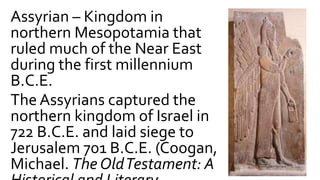
Assyrian – Kingdom in
northern Mesopotamia that
ruled much of the Near East
during the first millennium
B.C.E.
The Assyrians captured the
northern kingdom of Israel in
722 B.C.E. and laid siege to
Jerusalem 701 B.C.E. (Coogan,
Michael. The OldTestament: A
•During the first half of the eighth century
(i.e. the 700’s B.C.E), the Assyrians were
experiencing a period of weakness.
•Under Jeroboam II (786-746 B.C.E) Israel
was expanding and enjoying a time of
material prosperity (Amos will critique
this). (Hays, J. Daniel. The Message of the
Prophets: A Survey of the Prophetic and
and Apocalyptic Books of the Old
•Israel was larger and
more powerful than
Judah to the south, and
in the years following
the death of Jeroboam,
Israel under King Pekah
and Syria under King
Rezin partnered and
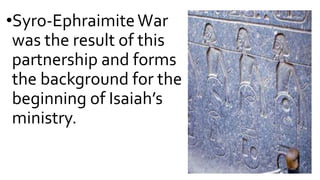
•Syro-EphraimiteWar
was the result of this
partnership and forms
the background for the
beginning of Isaiah’s
ministry.
•Geopolitics
•1 : a study of the influence of such
factors as geography, economics, and
demography on the politics and
especially the foreign policy of a state
•2 : a governmental policy guided by
geopolitics
•3 : a combination of political and
geographic factors relating to
Tiglath-pileser III- rose to
power and restored Assyria
to military prominence by
flexing imperial muscle.
King Ahaz appealed to
Tiglath-pilesar for
assistance and help during
the Syro-Ephramite war.
ShalmaneserV in 722
B.C.E destroyed the
capital city of Samaria
and scattered the
inhabitants of Israel.The
northern kingdom was
gone (Hays, J. Daniel.
The Message of the
Prophets: A Survey of the
the Prophetic and
Sennacherib (reigned 705-
681 BCE) was the second
king of the Sargonid
Dynasty of Assyria (founded
by his father Sargon II). He
is one of the most famous
Assyrian kings because of
the part he plays in
narratives in the biblical Old
•Isaiah is comprised of sixty-six
chapters.
•One of the longest books of the Bible.
•Until the late 19th century the entire
book was understood as being written
by the prophet Isaiah, son of Amoz.
•Isaiah son of Amoz was believed to
have lived in Jerusalem in the late
•Premodern Scholars including Rabbi
Ben Ibn Ezra in the twelfth century,
recognized some challenges to this
assumption.
•Work in the 18th and 19th centuries
culminated in the commentary on
Isaiah by German scholar Bernhard
Duhm who argued for three Isaiah’s.
•Abraham ben Meir ibn Ezra, (born
1092/93,Tudela, Emirate of Saragossa—
died 1167, Calahorra, Spain), poet,
grammarian, traveller, Neoplatonic
philosopher, and astronomer, best
known as a biblical exegete whose
commentaries contributed to the
Golden Age of Spanish Judaism.
•He travelled to North Africa and possibly to
Egypt. Primarily known as a scholar and
poet up to that point, in about 1140 Ibn
Ezra began a lifelong series of wanderings
throughout Europe, in the course of which
he produced distinguished works of biblical
exegesis and disseminated biblical lore.
•In about 1140 Ibn Ezra began a lifelong
series of wanderings throughout Europe, in
the course of which he produced
Bernhard Lauardus Duhm
(October 10, 1847 –
November 1, 1928) was a
German Lutheran
theologian born in Bingum,
today part of Leer, East
Frisia or (Lower Saxony).
He pioneered the theory
that their were multiple
authors of the book of Isaiah
•First Isaiah or Isaiah of Jerusalem---
Chapters 1 through 39---
•Deutero or Second Isaiah ---Chapters 40
through 55—dating to the sixth century
•Trito orThird Isaiah, Chapters 56-66, a
century or more later.
•Many scholars suggest it is the result of
a lengthy process of formation.
•The entire anthology shares a common
vocabulary, frequently referring to
YHWH as “the holy One of Israel” and
making repeated mention of justice
and righteousness, and is pervaded by
pervaded by the view that
Jerusalem/Zion is central toYHWH’s
plans.
•Think about
righteousness in
relationship to
covenant
agreements and
relationships and
concepts and
perceptions
•Biblical criticism is understood as a
discipline that studies textual,
compositional, and historical
questions surrounding the Old and
NewTestaments. It lays the
groundwork for meaningful and
credible interpretation of the Bible.
•Criticism in this sense means “to judge
•The presupposition and assumption is that
an eighth-century BCE prophet in
Jerusalem could not know about details
that would happen in the sixth century.
Events such as:
1. Fall of Jerusalem to the Babylonians in
586 B.C.E. (repeatedly mentioned in
Isaiah 40-55)
2. Rise to power of Cyrus the Great the
Persian king in 559 (Isaiah 44:28 and
•Because of the previous beliefs, many
scholars argue that the result of a
lengthy process of formation, which
began with the collection of oracles of
Isaiah of Jerusalem.
•To this nucleus later writings were
attached, and many additions were
made to earlier parts.
•Anthology means, a collection of selected
literary pieces or passages or works of art or
music.
•Marc Brettler, the Dora Golding Professor of
Biblical Studies at Brandeis University,
warns that “If there is one point that I
hope people will remember, it’s the
danger of saying, ‘The Bible says …’ and
and then filling in that sentence with just
just one single thought, because very,
very often, in almost anything that you
you could ask, the Bible has more than
•Beginning in the latter of the twentieth
century , some scholars have focused
more on the final form of the book of
Isaiah than on its hypothetical literary
history.
•This type of approach is called “canonical
criticism” which emphasizes the
traditional shape of the book and its
unifying themes rather than its
•This approach recognizes that
communities of faith from the late
biblical period onward viewed the book
as a single work containing a coherent
and divinely inspired message.
•It also understands the processes that
led to the final form of the book were
not just mechanical editing or a cut and
paste job but the result of a living
intellectual tradition (Both taken from
The School of Isaiah
Isaiah has several
references to Isaiah
writing down the
words of the prophet
(Isaiah 30:8)
Isaiah 8:1-3 and 8:16
also suggest disciples
responsible for the
writings and
•The School of Isaiah or Disciples of Isaiah
are presumably those responsible for
collecting and preserving the prophet’s
oracles like Jeremiah’s scribe Baruch a
century later.
•II Chronicles 26:22 also records that Isaiah
was a writer .
•Many scholars argue that Isaiah had
disciples like the sons of the prophet
(earlier tradition) and that during his time
•Isaiah’s three-point standard pre-exilic
message
1. You’ve broken the covenant (through
idolatry, social injustice, religious
ritualism). So repent!
2. No repentance?The judgment?
Judgment will also come on the nations.
3. Yes there is hope beyond the judgment
for a glorious future restoration both for
Judah/Israel and for the nations (J. Daniel
•Hays and Longman suggest:
1) Isaiah 1-39 focuses on judgment
also contains glimpses of
2) Isaiah 40-55 focuses on
and restoration through the
but also contains glimpses of
judgment
3) Isaiah 56-66 focuses on righteous
living by YHWH’s true
prophet/servants in the
Daniel Hays and Tremper Longman
•Isaiah 1-3---The Covenant Lawsuit
A. Isaiah launches into a scathing diatribe
against the people of Judah for their
repeated and blatant covenant violation
(especially of Deuteronomy).
B. YHWH states that “YHWH” has raised
children but they have not only rebelled
but no longer know this G-D.
C. ForsakenYHWH, implying a broken
relationship, spurnedYHWH, which
means despiseYHWH, turned their back

Bi 603 Isaiah

  • 2.
    • Hebrew wordsfor Prophets •Nabi- Navi- The Hebrew word for “prophet” a spokesperson forYHWH who delivered God’s judgment on contemporary society and expressed God’s intention on the world (Deuteronomy 13:1- 5:18:9-22;Amos 3:7). •Ro’eh-“Diviner”.Associated Primarily with with the figure Samuel. Someone who is
  • 3.
    •Hozeh -“Seer” orVisionary. A person who receives and reports visions 7:12). A seer transmitted to the a vision, dream, or the proceedings the divine council. •Divine Council is “the assembly of gods, over which the high G-D In the Hebrew and Christian Bibles, YHWH is described as the head of divine council and prophets have
  • 4.
    •Is ha elohim-Man of God. Prominent in the stories about Elijah and Elisha, particularly the latter. The literary character of these stories judgment that the “Man of God” can be understood as a “Holy Man”, a individual attested in numerous traditions. Such persons possess the power of the holy and hence are dangerous, powerful, and due appropriate respect. Unlike visionaries, who occasionally engage
  • 5.
    •Monotheism as presentedin classical Western Christian theology, an intellectual claim that only one presides over all existence. Yet the articulates YHWH as a fully deity marked by immense and interiority that are excluded in conventional rational understandings of the one G-D (Brueggemann, Reverberations of
  • 6.
    •Brueggemann argued that“the biblical question is not the number of gods [one!], but the practice and character ofYHWH YHWH in an assumed world of contested contested polytheism, the ways in which this G-D (among others) is known, and and the ways in which Israel is related to related to this G-D). •This claim of “one G-D” is also to be distinguished from henotheism, a common assumption in the ancient world that each god presides over his or
  • 7.
    •The OldTestament, inits final form, certainly ends up with an affirmation, affirmation, thatYHWH alone is G-D.This This affirmation is clearest in exilic Isaiah (43:11; 48:12). That confession made in in doxological form is not an intellectual or rational confession; rather the assertion is assertion is a faith confession with the quite practical intent of permitting
  • 8.
    Eighth and Seventh Century Prophets: Context,Content, and the usage of literature to inform and influence the
  • 9.
    •The Eighth CenturyProphets, (Amos, Hosea, Isaiah and Micah) all conveyed conveyed messages that dealt with land as it pertained to the promise of G- D to Israel. •Latifundialization, which is derived from the term latifundia-large estates, can be generally defined as the process
  • 10.
    •Central to theprocess of latifundialization is the accumulation of land. However, there are multiple dimensions and causative factors. •1. Systems of Production- Nature and Factors •2. Distribution-Consumption and Systems of exchange and distribution
  • 11.
    The Process ofLatifundialization •1. Land Accumulation •2. Growth of Urban Centers •3. Militarization •4. Extraction of Surplus •6. Trade and Commerce •7. Market Condition •8. Indebtedness of the Peasants •9. Role of Creditors
  • 12.
    Overview of Isaiah Isaiahof Jerusalem lives proclaims his message in Jerusalem, the capital of Judah during the Assyrian Crisis. Isaiah connects his message to the reigns of Uzziah, Jotham, Ahaz and
  • 13.
    Assyrian – Kingdomin northern Mesopotamia that ruled much of the Near East during the first millennium B.C.E. The Assyrians captured the northern kingdom of Israel in 722 B.C.E. and laid siege to Jerusalem 701 B.C.E. (Coogan, Michael. The OldTestament: A
  • 14.
    •During the firsthalf of the eighth century (i.e. the 700’s B.C.E), the Assyrians were experiencing a period of weakness. •Under Jeroboam II (786-746 B.C.E) Israel was expanding and enjoying a time of material prosperity (Amos will critique this). (Hays, J. Daniel. The Message of the Prophets: A Survey of the Prophetic and and Apocalyptic Books of the Old
  • 15.
    •Israel was largerand more powerful than Judah to the south, and in the years following the death of Jeroboam, Israel under King Pekah and Syria under King Rezin partnered and
  • 16.
    •Syro-EphraimiteWar was the resultof this partnership and forms the background for the beginning of Isaiah’s ministry.
  • 17.
    •Geopolitics •1 : astudy of the influence of such factors as geography, economics, and demography on the politics and especially the foreign policy of a state •2 : a governmental policy guided by geopolitics •3 : a combination of political and geographic factors relating to
  • 18.
    Tiglath-pileser III- roseto power and restored Assyria to military prominence by flexing imperial muscle. King Ahaz appealed to Tiglath-pilesar for assistance and help during the Syro-Ephramite war.
  • 19.
    ShalmaneserV in 722 B.C.Edestroyed the capital city of Samaria and scattered the inhabitants of Israel.The northern kingdom was gone (Hays, J. Daniel. The Message of the Prophets: A Survey of the the Prophetic and
  • 20.
    Sennacherib (reigned 705- 681BCE) was the second king of the Sargonid Dynasty of Assyria (founded by his father Sargon II). He is one of the most famous Assyrian kings because of the part he plays in narratives in the biblical Old
  • 21.
    •Isaiah is comprisedof sixty-six chapters. •One of the longest books of the Bible. •Until the late 19th century the entire book was understood as being written by the prophet Isaiah, son of Amoz. •Isaiah son of Amoz was believed to have lived in Jerusalem in the late
  • 22.
    •Premodern Scholars includingRabbi Ben Ibn Ezra in the twelfth century, recognized some challenges to this assumption. •Work in the 18th and 19th centuries culminated in the commentary on Isaiah by German scholar Bernhard Duhm who argued for three Isaiah’s.
  • 23.
    •Abraham ben Meiribn Ezra, (born 1092/93,Tudela, Emirate of Saragossa— died 1167, Calahorra, Spain), poet, grammarian, traveller, Neoplatonic philosopher, and astronomer, best known as a biblical exegete whose commentaries contributed to the Golden Age of Spanish Judaism.
  • 24.
    •He travelled toNorth Africa and possibly to Egypt. Primarily known as a scholar and poet up to that point, in about 1140 Ibn Ezra began a lifelong series of wanderings throughout Europe, in the course of which he produced distinguished works of biblical exegesis and disseminated biblical lore. •In about 1140 Ibn Ezra began a lifelong series of wanderings throughout Europe, in the course of which he produced
  • 25.
    Bernhard Lauardus Duhm (October10, 1847 – November 1, 1928) was a German Lutheran theologian born in Bingum, today part of Leer, East Frisia or (Lower Saxony). He pioneered the theory that their were multiple authors of the book of Isaiah
  • 26.
    •First Isaiah orIsaiah of Jerusalem--- Chapters 1 through 39--- •Deutero or Second Isaiah ---Chapters 40 through 55—dating to the sixth century •Trito orThird Isaiah, Chapters 56-66, a century or more later. •Many scholars suggest it is the result of a lengthy process of formation.
  • 27.
    •The entire anthologyshares a common vocabulary, frequently referring to YHWH as “the holy One of Israel” and making repeated mention of justice and righteousness, and is pervaded by pervaded by the view that Jerusalem/Zion is central toYHWH’s plans.
  • 28.
    •Think about righteousness in relationshipto covenant agreements and relationships and concepts and perceptions
  • 30.
    •Biblical criticism isunderstood as a discipline that studies textual, compositional, and historical questions surrounding the Old and NewTestaments. It lays the groundwork for meaningful and credible interpretation of the Bible. •Criticism in this sense means “to judge
  • 36.
    •The presupposition andassumption is that an eighth-century BCE prophet in Jerusalem could not know about details that would happen in the sixth century. Events such as: 1. Fall of Jerusalem to the Babylonians in 586 B.C.E. (repeatedly mentioned in Isaiah 40-55) 2. Rise to power of Cyrus the Great the Persian king in 559 (Isaiah 44:28 and
  • 37.
    •Because of theprevious beliefs, many scholars argue that the result of a lengthy process of formation, which began with the collection of oracles of Isaiah of Jerusalem. •To this nucleus later writings were attached, and many additions were made to earlier parts.
  • 38.
    •Anthology means, acollection of selected literary pieces or passages or works of art or music. •Marc Brettler, the Dora Golding Professor of Biblical Studies at Brandeis University, warns that “If there is one point that I hope people will remember, it’s the danger of saying, ‘The Bible says …’ and and then filling in that sentence with just just one single thought, because very, very often, in almost anything that you you could ask, the Bible has more than
  • 39.
    •Beginning in thelatter of the twentieth century , some scholars have focused more on the final form of the book of Isaiah than on its hypothetical literary history. •This type of approach is called “canonical criticism” which emphasizes the traditional shape of the book and its unifying themes rather than its
  • 40.
    •This approach recognizesthat communities of faith from the late biblical period onward viewed the book as a single work containing a coherent and divinely inspired message. •It also understands the processes that led to the final form of the book were not just mechanical editing or a cut and paste job but the result of a living intellectual tradition (Both taken from
  • 41.
    The School ofIsaiah Isaiah has several references to Isaiah writing down the words of the prophet (Isaiah 30:8) Isaiah 8:1-3 and 8:16 also suggest disciples responsible for the writings and
  • 42.
    •The School ofIsaiah or Disciples of Isaiah are presumably those responsible for collecting and preserving the prophet’s oracles like Jeremiah’s scribe Baruch a century later. •II Chronicles 26:22 also records that Isaiah was a writer . •Many scholars argue that Isaiah had disciples like the sons of the prophet (earlier tradition) and that during his time
  • 43.
    •Isaiah’s three-point standardpre-exilic message 1. You’ve broken the covenant (through idolatry, social injustice, religious ritualism). So repent! 2. No repentance?The judgment? Judgment will also come on the nations. 3. Yes there is hope beyond the judgment for a glorious future restoration both for Judah/Israel and for the nations (J. Daniel
  • 44.
    •Hays and Longmansuggest: 1) Isaiah 1-39 focuses on judgment also contains glimpses of 2) Isaiah 40-55 focuses on and restoration through the but also contains glimpses of judgment 3) Isaiah 56-66 focuses on righteous living by YHWH’s true prophet/servants in the Daniel Hays and Tremper Longman
  • 45.
    •Isaiah 1-3---The CovenantLawsuit A. Isaiah launches into a scathing diatribe against the people of Judah for their repeated and blatant covenant violation (especially of Deuteronomy). B. YHWH states that “YHWH” has raised children but they have not only rebelled but no longer know this G-D. C. ForsakenYHWH, implying a broken relationship, spurnedYHWH, which means despiseYHWH, turned their back