Creating Grassroots Professionals for
Livelihood Promotion
byby
1
________________________________________________________________________________________________________________________________________________________________________________________________________________________________________
Rethinking Livelihoods: Workshop on Innovations in Teaching Livelihoods
On 14th March 2013 at XIMB, Bhubaneswar, Odisha
byby
Prof. Premananda Panda, Director
Prof.S. Bheema Rao, PGCM Coordinator
HDF School of Management, Bhubaneswar
Plan of Presentation
2
Background
About livelihood management course
Course structure
PedagogyPedagogy
Course curriculum
Eligibility Criteria
Placement status
Issues and challenges
Way forward
Background
3
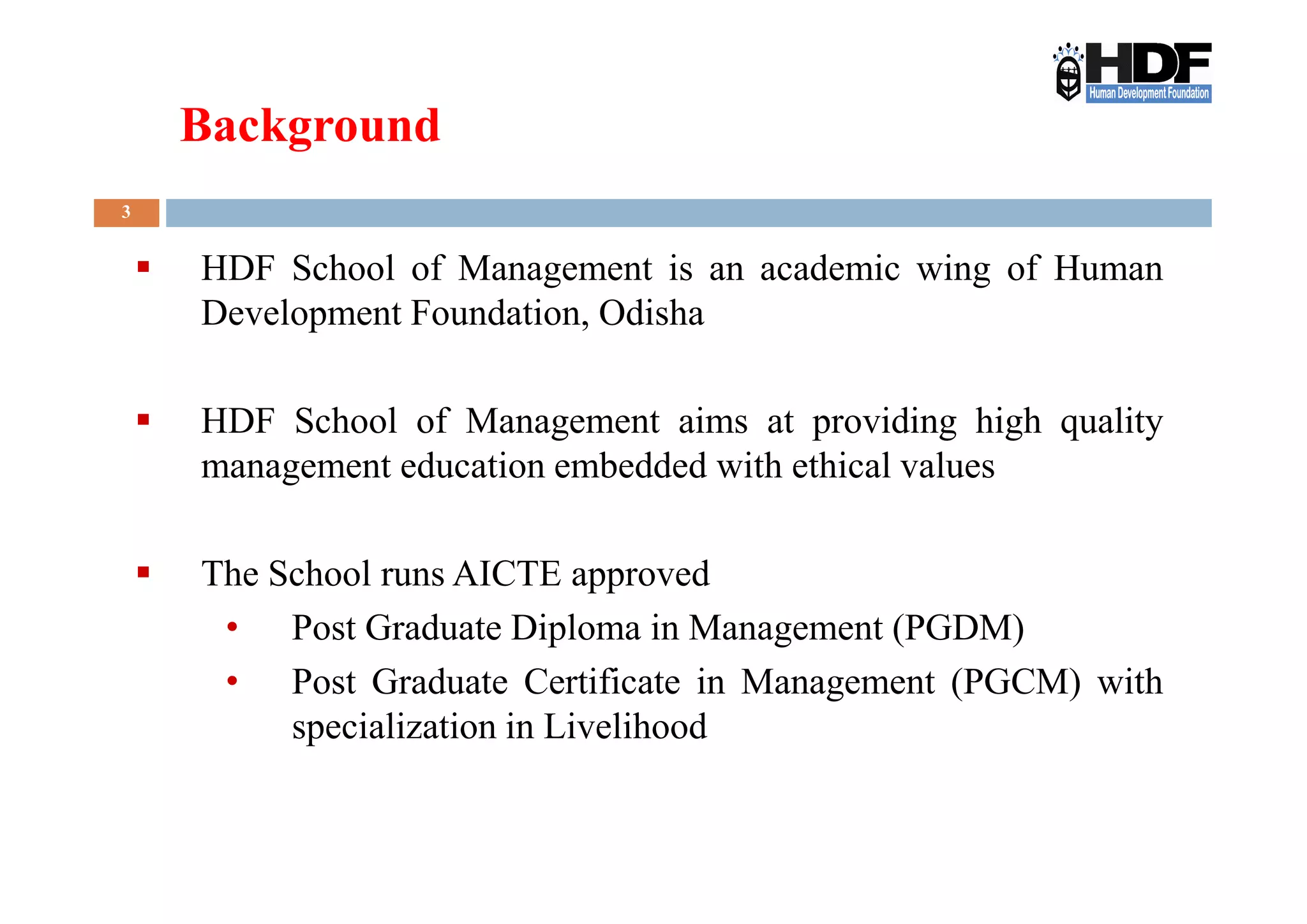
HDF School of Management is an academic wing of Human
Development Foundation, Odisha
HDF School of Management aims at providing high quality
management education embedded with ethical valuesmanagement education embedded with ethical values
The School runs AICTE approved
• Post Graduate Diploma in Management (PGDM)
• Post Graduate Certificate in Management (PGCM) with
specialization in Livelihood
4
Post Graduate Certificate in Management (Livelihood) is
one-year full time residential programme
Curriculum is designed with active input from civil society
organizations, microfinance institutions and academia to
create grassroots professionals for livelihood promoting
About Livelihood Management Course
create grassroots professionals for livelihood promoting
organizations
The curriculum aims at integrating theoretical understanding
in the classroom and experiential learning in the field.
Comprising of three terms of class-room segment and three
components of field segment
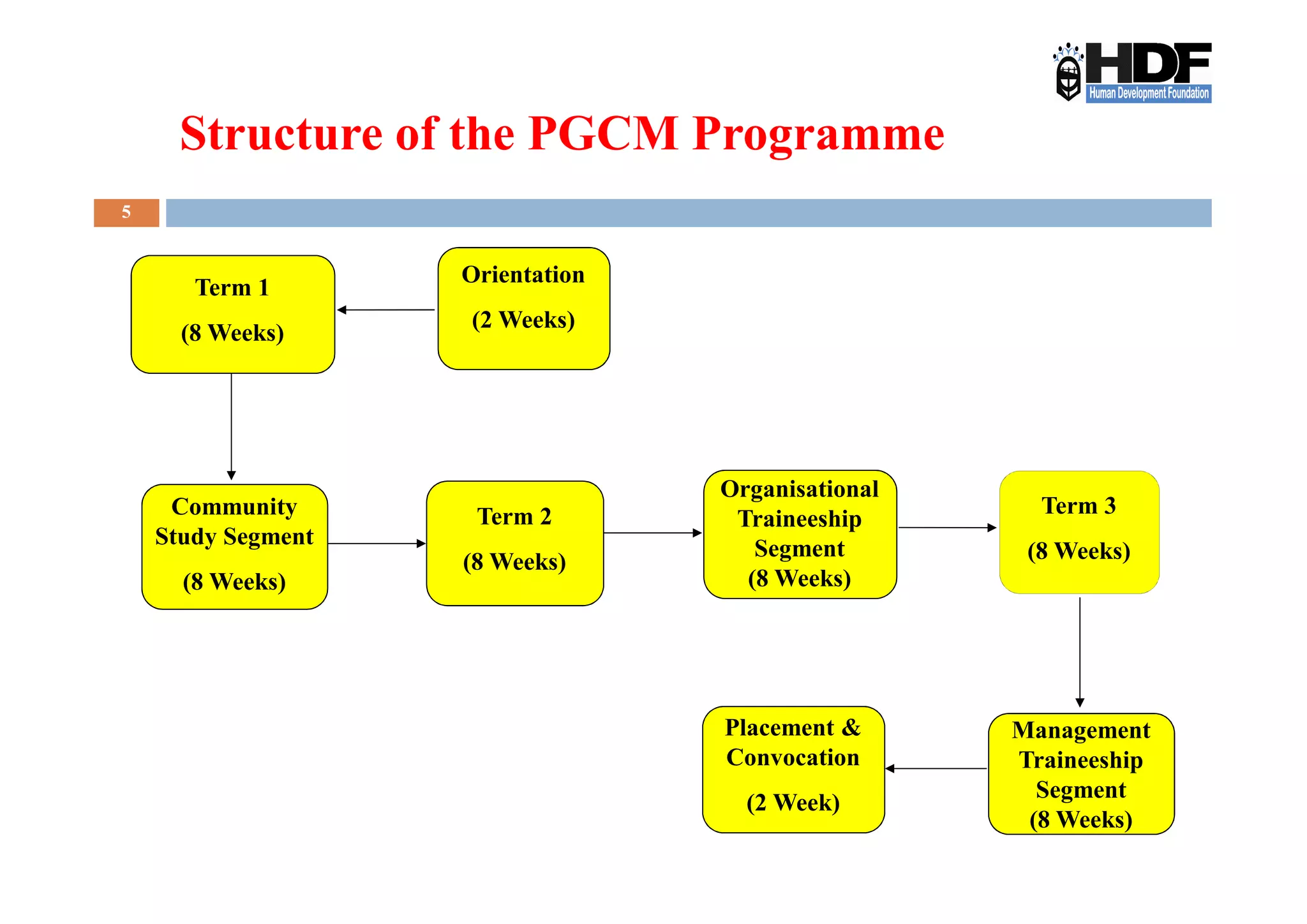
Structure of the PGCM Programme
5
Orientation
(2 Weeks)
Term 1
(8 Weeks)
Management
Traineeship
Segment
(8 Weeks)
Term 3
(8 Weeks)
Organisational
Traineeship
Segment
(8 Weeks)
Term 2
(8 Weeks)
Placement &
Convocation
(2 Week)
Community
Study Segment
(8 Weeks)
6
Class room segment consists of three terms of 8 weeks each
viz. Term 1, Term 2 and Term 3
A student has to undertake 18 credit course in each term
Three credit course is equivalent to 20 class room sessions of
Classroom Segment
Three credit course is equivalent to 20 class room sessions of
90 minutes each
The courses have been designed by integrating theories and
practices of management and development
Curriculum includes foundation courses, functional area of
management and development courses
Two sessions in each subjected conducted in workshop mode
by industry expert
7
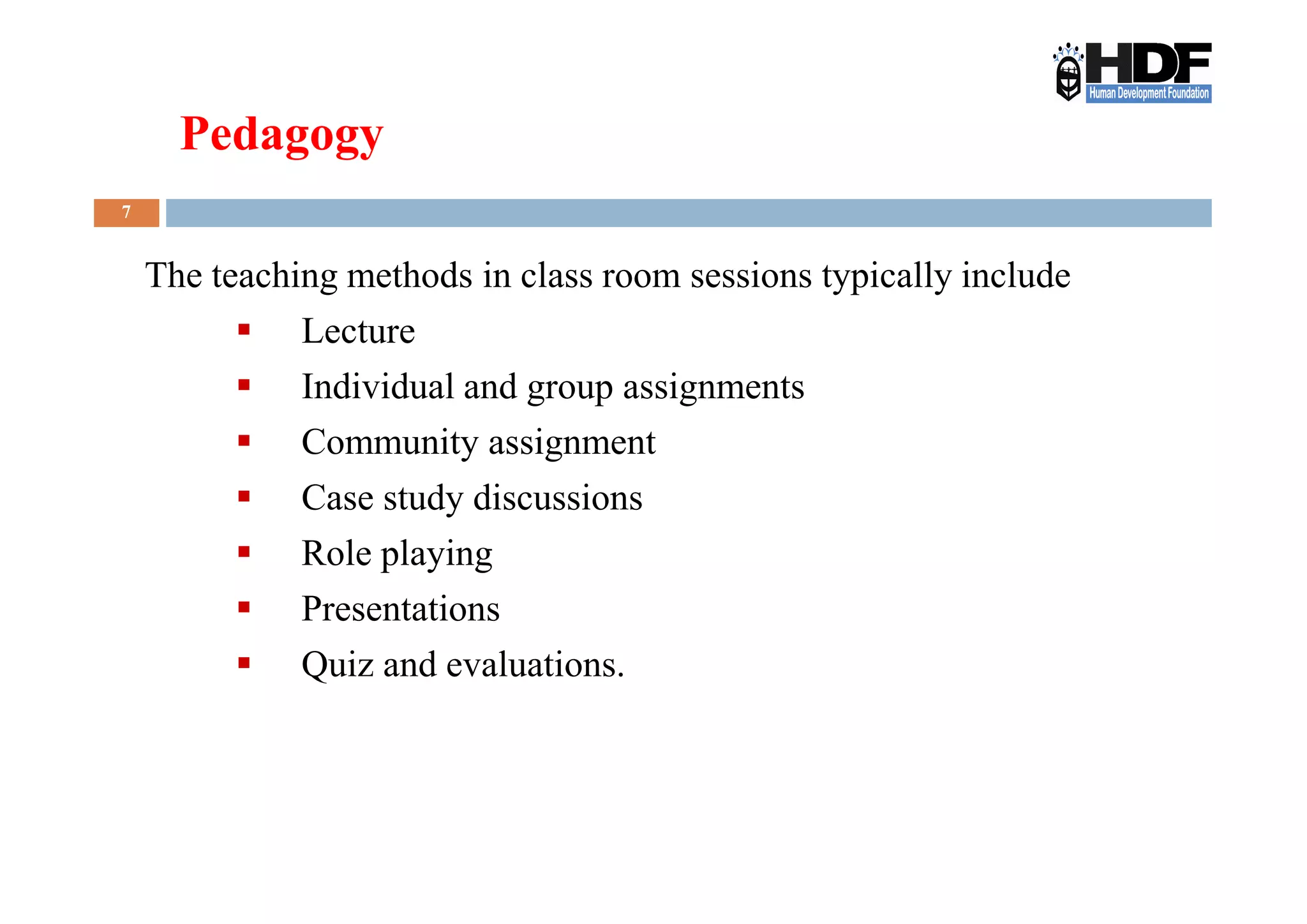
The teaching methods in class room sessions typically include
Lecture
Individual and group assignments
Community assignment
Pedagogy
Community assignment
Case study discussions
Role playing
Presentations
Quiz and evaluations.
8
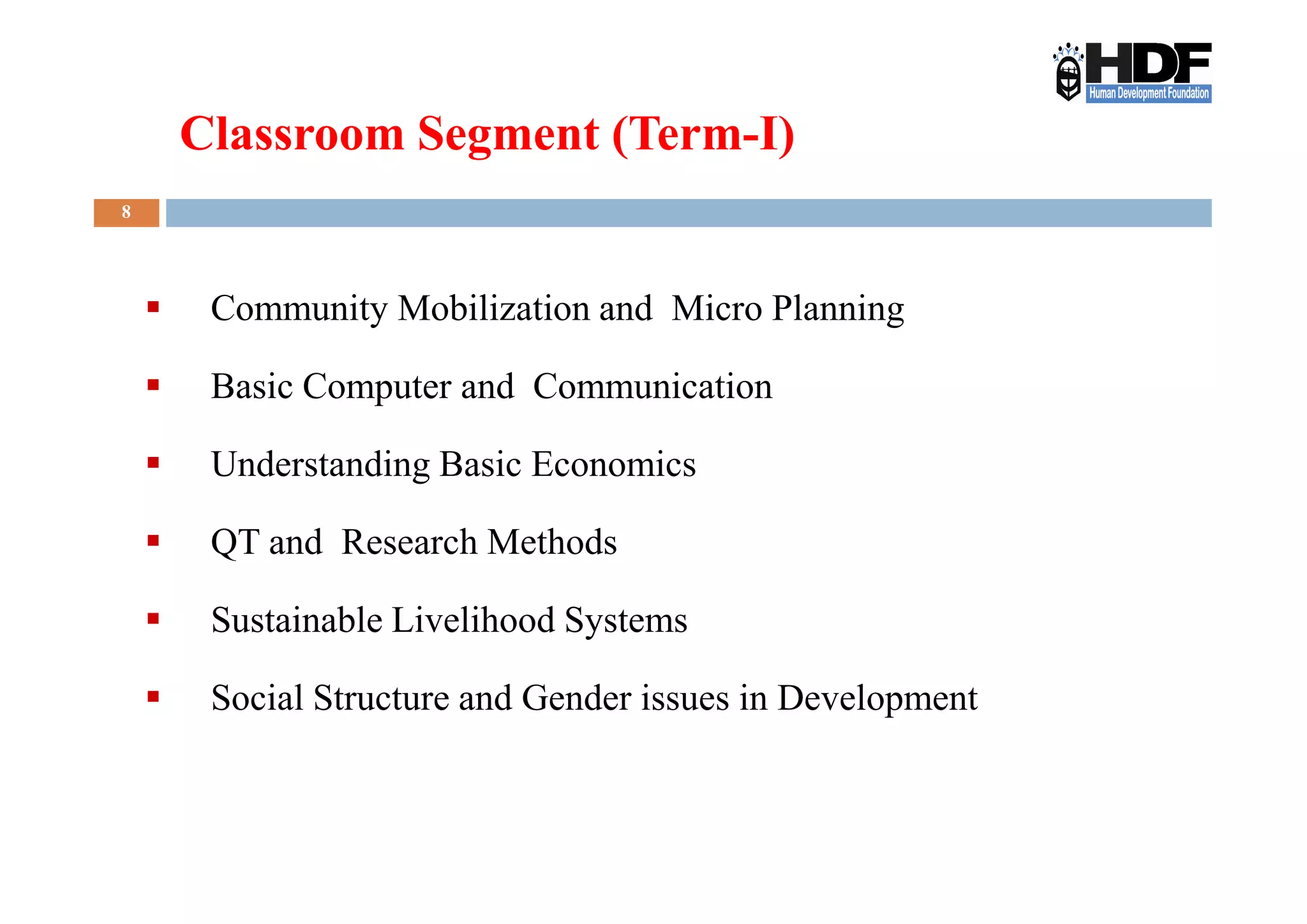
Community Mobilization and Micro Planning
Basic Computer and Communication
Understanding Basic Economics
Classroom Segment (Term-I)
Understanding Basic Economics
QT and Research Methods
Sustainable Livelihood Systems
Social Structure and Gender issues in Development
9
The 8 week community study segment will be commenced after
the first term of classroom segment
During CSS, the students will be exposed to the realities of life
of rural poor
Community Study Segment (CSS)
of rural poor
The students will be divided into groups of two and sent to rural
areas in different parts of the state
Each group will be attached to a local host organization and the
members of the group will stay in the selected villages
The CSS will have three components – community report
writing, theme paper writing and a community action
CSS have 6 credit loads
10
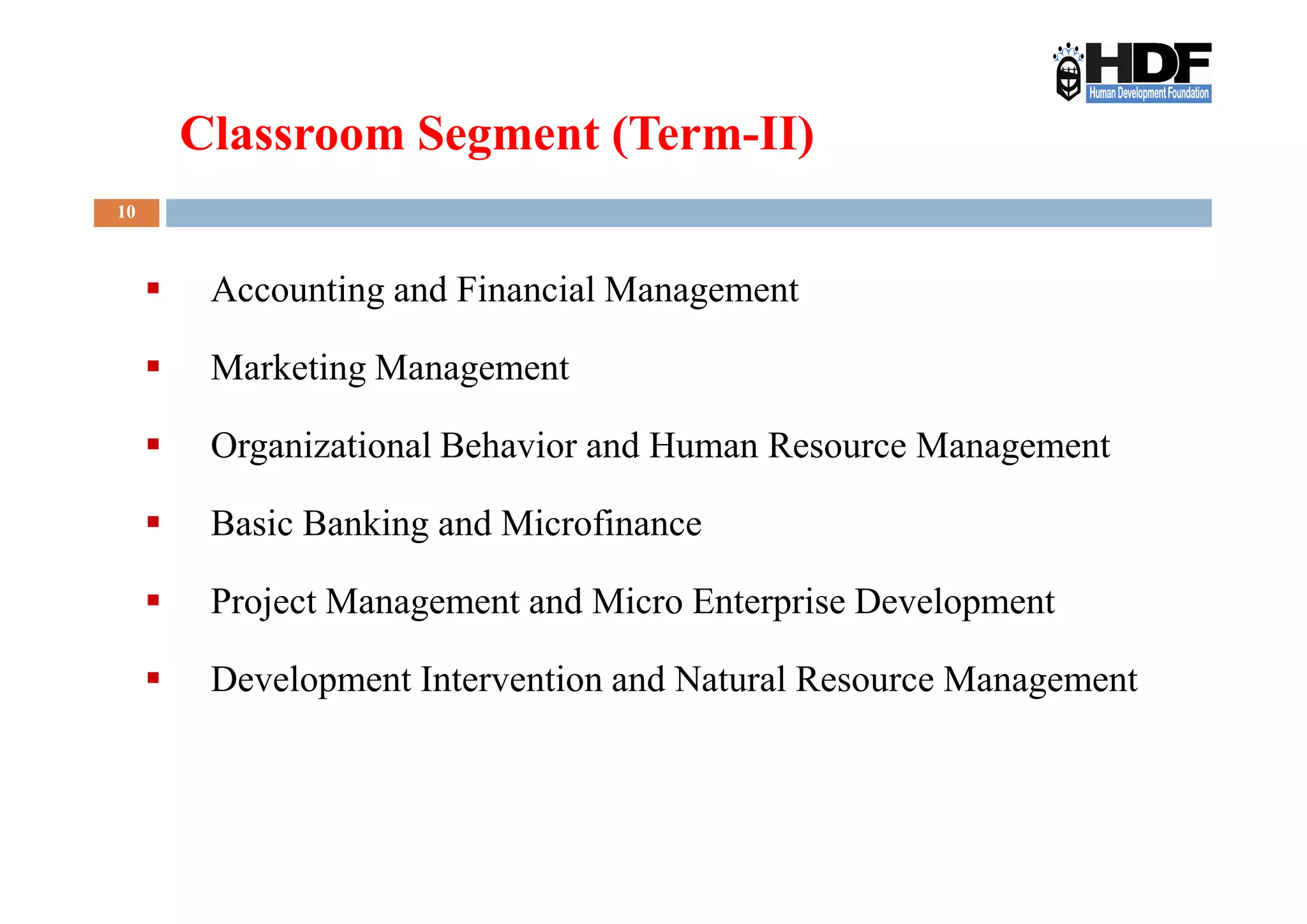
Accounting and Financial Management
Marketing Management
Organizational Behavior and Human Resource Management
Classroom Segment (Term-II)
Organizational Behavior and Human Resource Management
Basic Banking and Microfinance
Project Management and Micro Enterprise Development
Development Intervention and Natural Resource Management
Organizational Traineeship Segment (OTS)
11
The main objective of OTS is to study the organization
using different concepts taught in Term 1 and Term 2 and
execute a small project assigned by the organization
Understanding the works of functional departments likeUnderstanding the works of functional departments like
accounts and finance dept, HR dept, Program department
The duration of the segment is 8 weeks
Students will submit a report and make a presentation in
OTS seminars at the host organization and HDFSOM
OTS will have 6 credit loads
12
Saving and Credit Management
Food Security Management
Micro Insurance and Disaster Risk Management
Classroom Segment -Term-III
Legal aspects of Civil Society Organizations
Public System Management
Cooperative Management
Social Impact Assessment
Information Communication and Technology
Management Traineeship Segment (MTS))
13
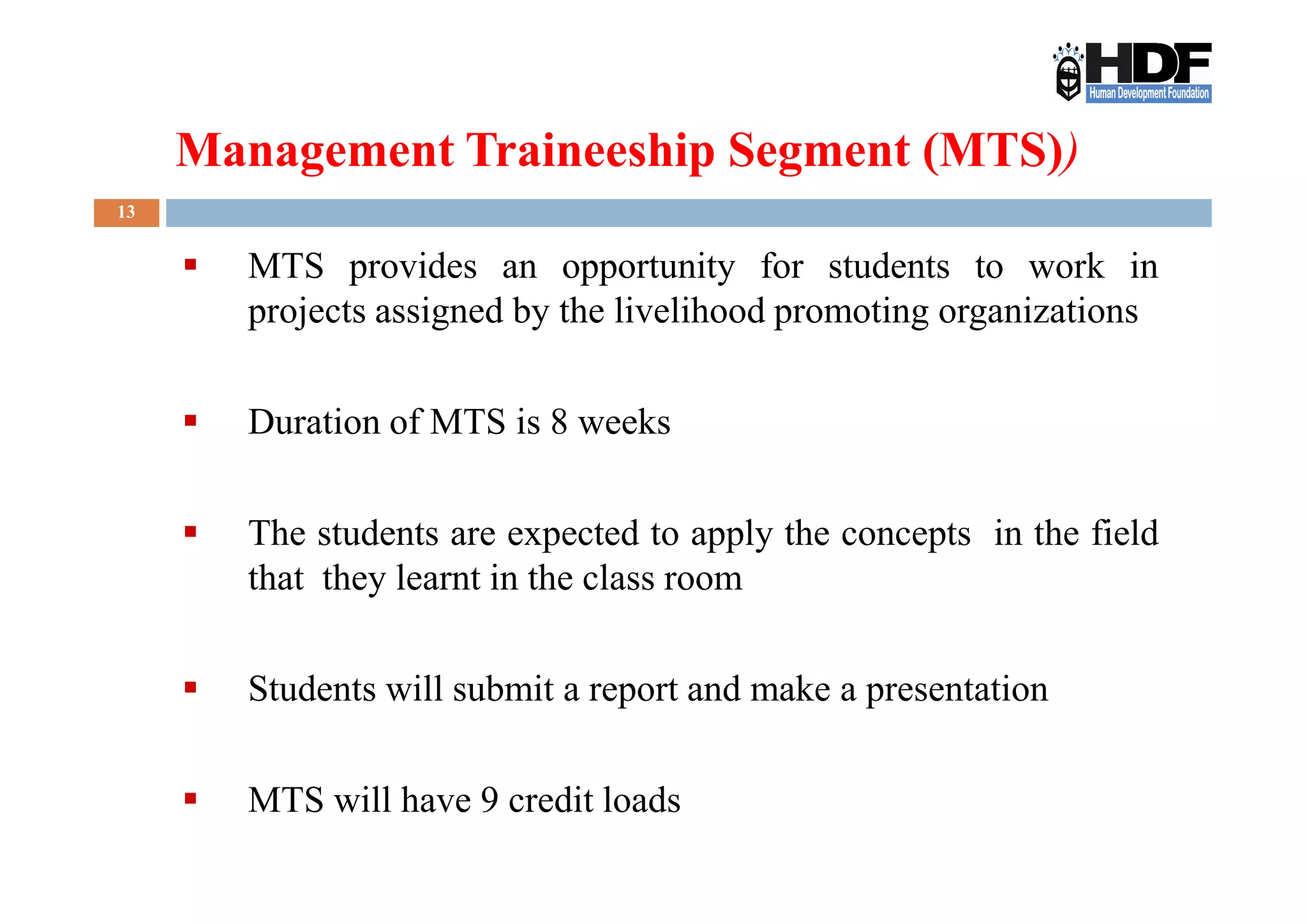
MTS provides an opportunity for students to work in
projects assigned by the livelihood promoting organizations
Duration of MTS is 8 weeks
The students are expected to apply the concepts in the field
that they learnt in the class room
Students will submit a report and make a presentation
MTS will have 9 credit loads
Eligibility Criteria
14
Graduate in any discipline
Entrance examination
Girl students and development professionals are encouraged
to apply
Stipend / Scholarship extended to SC/ST candidatesStipend / Scholarship extended to SC/ST candidates
The final selection will further be based on the combination of
following parameters
• Past academic performance
• Group discussion
• Personal interview
• Work experience, if any
Placement Status
15
55% Students placed in NGOs and Government funded
Projects in tribal areas
35 % students placed in microfinance institutions
Engaged in corporate sectors and other fellowships
Engaged as a middle level and grassroots professionals like
Project Coordinators, Branch Managers, Development
Executives and Community Organizers
Gross Salary package ranges from Rs. 8,500- Rs.15,000 per
month
Issues and Challenges
16
Poor recognition/ undervaluation of PGCM program at
policy and employer level
Difficult to raise study loan for PGCM course
Poor brandingPoor branding
Poor academic background of the students
Poor understanding on the type of field segments
Lack of technical skill-oriented subjects in course
curriculum (Agro-based, life-stock)
Poor industry -academic interface
Way forward
17
PGCM course to be recognised at policy and employer
level
Study loan to be provided timely to the poor students
Technical subjects on agriculture/livelihoods to beTechnical subjects on agriculture/livelihoods to be
incorporated in course curriculum
Interface between industry-academic institutions to be
strengthened
Grants / Other support to be provided to academic
institutions to promote livelihood course
18
Any QuestionsAny Questions
19
Thank youThank you

Bheema Rao

  • 1.
    Creating Grassroots Professionalsfor Livelihood Promotion byby 1 ________________________________________________________________________________________________________________________________________________________________________________________________________________________________________ Rethinking Livelihoods: Workshop on Innovations in Teaching Livelihoods On 14th March 2013 at XIMB, Bhubaneswar, Odisha byby Prof. Premananda Panda, Director Prof.S. Bheema Rao, PGCM Coordinator HDF School of Management, Bhubaneswar
  • 2.
    Plan of Presentation 2 Background Aboutlivelihood management course Course structure PedagogyPedagogy Course curriculum Eligibility Criteria Placement status Issues and challenges Way forward
  • 3.
    Background 3 HDF School ofManagement is an academic wing of Human Development Foundation, Odisha HDF School of Management aims at providing high quality management education embedded with ethical valuesmanagement education embedded with ethical values The School runs AICTE approved • Post Graduate Diploma in Management (PGDM) • Post Graduate Certificate in Management (PGCM) with specialization in Livelihood
  • 4.
    4 Post Graduate Certificatein Management (Livelihood) is one-year full time residential programme Curriculum is designed with active input from civil society organizations, microfinance institutions and academia to create grassroots professionals for livelihood promoting About Livelihood Management Course create grassroots professionals for livelihood promoting organizations The curriculum aims at integrating theoretical understanding in the classroom and experiential learning in the field. Comprising of three terms of class-room segment and three components of field segment
  • 5.
    Structure of thePGCM Programme 5 Orientation (2 Weeks) Term 1 (8 Weeks) Management Traineeship Segment (8 Weeks) Term 3 (8 Weeks) Organisational Traineeship Segment (8 Weeks) Term 2 (8 Weeks) Placement & Convocation (2 Week) Community Study Segment (8 Weeks)
  • 6.
    6 Class room segmentconsists of three terms of 8 weeks each viz. Term 1, Term 2 and Term 3 A student has to undertake 18 credit course in each term Three credit course is equivalent to 20 class room sessions of Classroom Segment Three credit course is equivalent to 20 class room sessions of 90 minutes each The courses have been designed by integrating theories and practices of management and development Curriculum includes foundation courses, functional area of management and development courses Two sessions in each subjected conducted in workshop mode by industry expert
  • 7.
    7 The teaching methodsin class room sessions typically include Lecture Individual and group assignments Community assignment Pedagogy Community assignment Case study discussions Role playing Presentations Quiz and evaluations.
  • 8.
    8 Community Mobilization andMicro Planning Basic Computer and Communication Understanding Basic Economics Classroom Segment (Term-I) Understanding Basic Economics QT and Research Methods Sustainable Livelihood Systems Social Structure and Gender issues in Development
  • 9.
    9 The 8 weekcommunity study segment will be commenced after the first term of classroom segment During CSS, the students will be exposed to the realities of life of rural poor Community Study Segment (CSS) of rural poor The students will be divided into groups of two and sent to rural areas in different parts of the state Each group will be attached to a local host organization and the members of the group will stay in the selected villages The CSS will have three components – community report writing, theme paper writing and a community action CSS have 6 credit loads
  • 10.
    10 Accounting and FinancialManagement Marketing Management Organizational Behavior and Human Resource Management Classroom Segment (Term-II) Organizational Behavior and Human Resource Management Basic Banking and Microfinance Project Management and Micro Enterprise Development Development Intervention and Natural Resource Management
  • 11.
    Organizational Traineeship Segment(OTS) 11 The main objective of OTS is to study the organization using different concepts taught in Term 1 and Term 2 and execute a small project assigned by the organization Understanding the works of functional departments likeUnderstanding the works of functional departments like accounts and finance dept, HR dept, Program department The duration of the segment is 8 weeks Students will submit a report and make a presentation in OTS seminars at the host organization and HDFSOM OTS will have 6 credit loads
  • 12.
    12 Saving and CreditManagement Food Security Management Micro Insurance and Disaster Risk Management Classroom Segment -Term-III Legal aspects of Civil Society Organizations Public System Management Cooperative Management Social Impact Assessment Information Communication and Technology
  • 13.
    Management Traineeship Segment(MTS)) 13 MTS provides an opportunity for students to work in projects assigned by the livelihood promoting organizations Duration of MTS is 8 weeks The students are expected to apply the concepts in the field that they learnt in the class room Students will submit a report and make a presentation MTS will have 9 credit loads
  • 14.
    Eligibility Criteria 14 Graduate inany discipline Entrance examination Girl students and development professionals are encouraged to apply Stipend / Scholarship extended to SC/ST candidatesStipend / Scholarship extended to SC/ST candidates The final selection will further be based on the combination of following parameters • Past academic performance • Group discussion • Personal interview • Work experience, if any
  • 15.
    Placement Status 15 55% Studentsplaced in NGOs and Government funded Projects in tribal areas 35 % students placed in microfinance institutions Engaged in corporate sectors and other fellowships Engaged as a middle level and grassroots professionals like Project Coordinators, Branch Managers, Development Executives and Community Organizers Gross Salary package ranges from Rs. 8,500- Rs.15,000 per month
  • 16.
    Issues and Challenges 16 Poorrecognition/ undervaluation of PGCM program at policy and employer level Difficult to raise study loan for PGCM course Poor brandingPoor branding Poor academic background of the students Poor understanding on the type of field segments Lack of technical skill-oriented subjects in course curriculum (Agro-based, life-stock) Poor industry -academic interface
  • 17.
    Way forward 17 PGCM courseto be recognised at policy and employer level Study loan to be provided timely to the poor students Technical subjects on agriculture/livelihoods to beTechnical subjects on agriculture/livelihoods to be incorporated in course curriculum Interface between industry-academic institutions to be strengthened Grants / Other support to be provided to academic institutions to promote livelihood course
  • 18.
  • 19.