12/11
#5
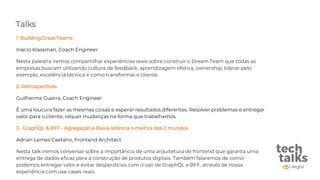
Talks
1. Building Great Teams
Inácio Klassman, Coach Engineer
Nesta palestra iremos compartilhar experiências reais sobre construir o Dream Team que todas as
empresas buscam utilizando cultura de feedback, aprendizagem efetiva, ownership, liderar pelo
exemplo, excelência técnica e como transformar o cliente.
2. Retrospectives
Guilherme Guerra, Coach Engineer
É uma loucura fazer as mesmas coisas e esperar resultados diferentes. Resolver problemas e entregar
valor para o cliente, requer mudanças na forma que trabalhamos.
3. GraphQL & BFF - Agregação e Baixa latência o melhor dos 2 mundos
Adrian Lemes Caetano, Frontend Architect
Nesta talk iremos conversar sobre a importância de uma arquitetura de frontend que garanta uma
entrega de dados eficaz para a construção de produtos digitais. Também falaremos de como
podemos entregar valor e evitar desperdícios com o uso de GraphQL e BFF, através de nossa
experiência com use cases reais.
GraphQL & BFF - Aggregation and low
latency, the best of 2 worlds
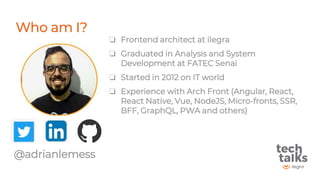
Who am I?
❏ Frontend architect at ilegra
❏ Graduated in Analysis and System
Development at FATEC Senai
❏ Started in 2012 on IT world
❏ Experience with Arch Front (Angular, React,
React Native, Vue, NodeJS, Micro-fronts, SSR,
BFF, GraphQL, PWA and others)
@adrianlemess
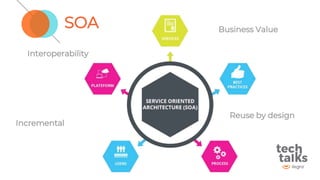
SOA
Interoperability
Business Value
Reuse by design
Incremental
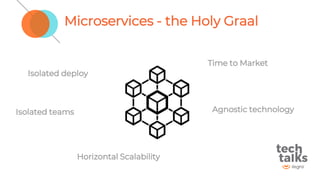
Microservices - the Holy Graal
Isolated deploy
Horizontal Scalability
Time to Market
Agnostic technologyIsolated teams
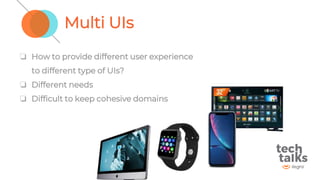
Multi UIs
❏ How to provide different user experience
to different type of UIs?
❏ Different needs
❏ Difficult to keep cohesive domains
Business Oriented
❏ Contracts shouldn't be related with specifs UI
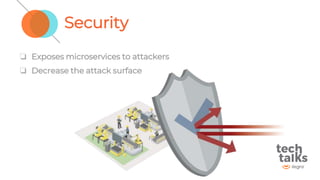
Security
❏ Exposes microservices to attackers
❏ Decrease the attack surface
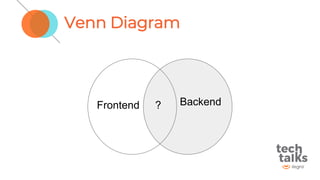
Venn Diagram
Frontend Backend?
BFF - Best Friend Forever
Backend for Frontend
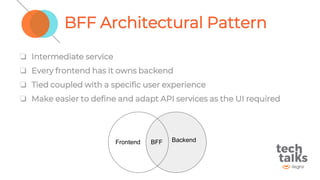
BFF Architectural Pattern
❏ Intermediate service
❏ Every frontend has it owns backend
❏ Tied coupled with a specific user experience
❏ Make easier to define and adapt API services as the UI required
Frontend BackendBFF
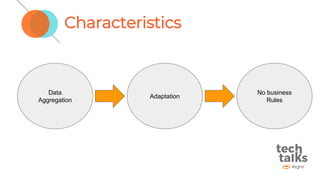
Characteristics
Data
Aggregation
Adaptation
No business
Rules
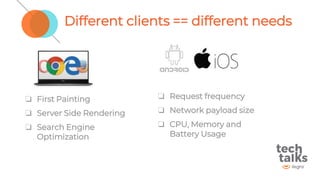
Different clients == different needs
❏ First Painting
❏ Server Side Rendering
❏ Search Engine
Optimization
❏ Request frequency
❏ Network payload size
❏ CPU, Memory and
Battery Usage
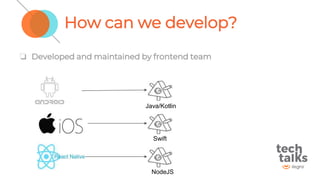
How can we develop?
❏ Developed and maintained by frontend team
Java/Kotlin
Swift
NodeJS
Advantages
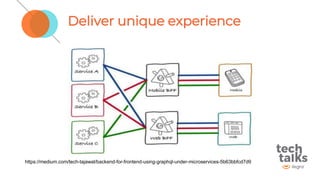
Deliver unique experience
https://medium.com/tech-tajawal/backend-for-frontend-using-graphql-under-microservices-5b63bbfcd7d9
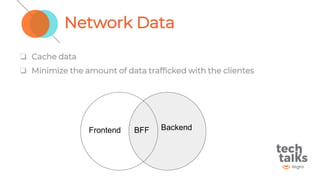
Network Data
❏ Cache data
❏ Minimize the amount of data trafficked with the clientes
Frontend BackendBFF
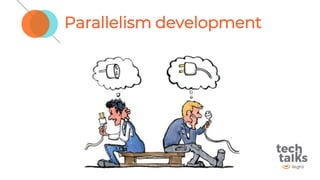
Parallelism development
Disadvantages
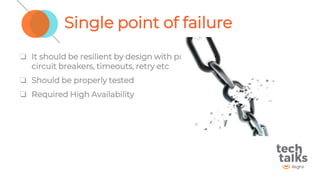
Single point of failure
❏ It should be resilient by design with proper implementation of
circuit breakers, timeouts, retry etc
❏ Should be properly tested
❏ Required High Availability
One more component...
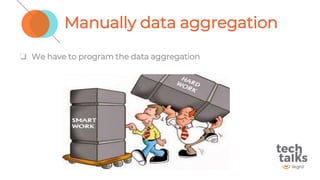
Manually data aggregation
❏ We have to program the data aggregation
GraphQL
What is?
“GraphQL is a query language for APIs and a runtime for fulfilling
those queries with your existing data.” https://graphql.org/
Who is using it
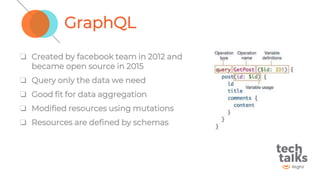
GraphQL
❏ Created by facebook team in 2012 and
became open source in 2015
❏ Query only the data we need
❏ Good fit for data aggregation
❏ Modified resources using mutations
❏ Resources are defined by schemas
Schema
type Company {
id: Int
name:
String
description:
String
users: [User]
}
type User {
id: Int
firstName:
String
age: Int
company:
Company
}
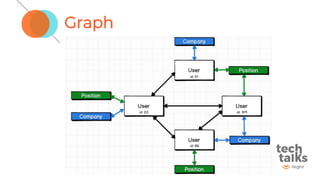
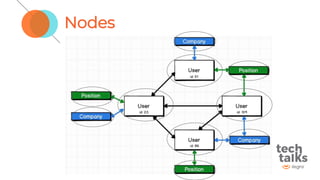
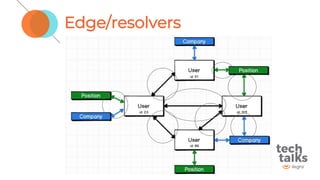
Graph
Nodes
Edge/resolvers
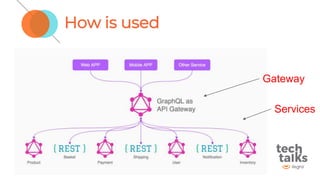
How is used
Gateway
Services
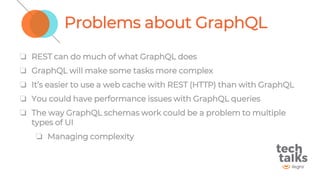
Problems about GraphQL
❏ REST can do much of what GraphQL does
❏ GraphQL will make some tasks more complex
❏ It’s easier to use a web cache with REST (HTTP) than with GraphQL
❏ You could have performance issues with GraphQL queries
❏ The way GraphQL schemas work could be a problem to multiple
types of UI
❏ Managing complexity
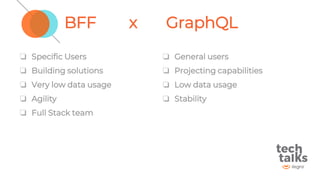
BFF x GraphQL
❏ Specific Users
❏ Building solutions
❏ Very low data usage
❏ Agility
❏ Full Stack team
❏ General users
❏ Projecting capabilities
❏ Low data usage
❏ Stability
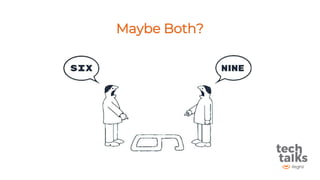
Maybe Both?
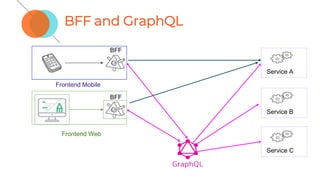
BFF and GraphQL
Service A
Service B
Service C
BFF
BFF
Frontend Web
Frontend Mobile
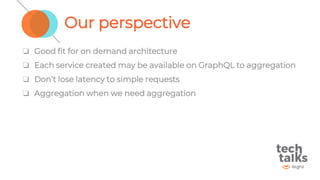
Our perspective
❏ Good fit for on demand architecture
❏ Each service created may be available on GraphQL to aggregation
❏ Don’t lose latency to simple requests
❏ Aggregation when we need aggregation
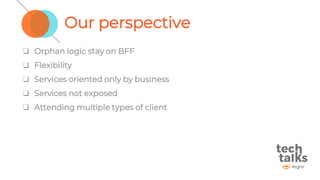
Our perspective
❏ Orphan logic stay on BFF
❏ Flexibility
❏ Services oriented only by business
❏ Services not exposed
❏ Attending multiple types of client
https://github.com/adrianlemess/bff-graphql
Bff and GraphQL

Bff and GraphQL

Editor's Notes

  • #6 Entregar valor ao negócio Interoperabilidade intrisseca, qualquer linguagem pode usar esse serviço Reuse by design e not accident mas o Mais importante é ser orientado a negócio Desenvolvimento incremental Servico com uma granularidade maior envolvendo mais de um domínio
  • #7 Um sabor de SOA Falar de cada ponto Por ser menor a granularidade podemos cair em algumas armadilhas
  • #13 Iniciado pela TW em
  • #15 Agregação de dados e chamar multiplos endpoints Adaptar algum contrato ou modelo de dado específico pra um cliente, uma mensagem de erro adaptada Regras de negócio ficam nos serviços e Lógicas órfans apenas
  • #16 Quando que o BFF torna-se necessário? Times de front não precisam depender diretamente do time de back Explicar o que e o first painting e que não e um problema do mobile porque eu ja tenho a UI ali e posso interagir com ela no momento que eu abrir o aplicativo Explicar search engine optimzation - podemos construir aplicacoes ricas e dinamicas com JavaScript, mas a estrutura dela e semantica e importante, pois os bots das Engine de busca precisam entender e interpretar nosso site pra rankear a pagina e isso e algo que no mobile não nos preocupamos
  • #21 Falar de DTA produtividade Definir contratos Times trabalham em paralelo
  • #28 different locations in the world Network would become the bottleneck then, probably. So you’d want to minimize the amount of data you send between the nodes. GraqhQL uses json by default, which is not as optimized as a custom binary protocol. for 3rd parties They would have to use GraphQL clients which is extra learning for the them if they haven’t used it before. node-to-node communication The main advantage of GraphQL, at least for me, is that it is somewhat future-proof, such that I can change the code on the backend, and my clients (iphone app) won’t need to be updated, their queries would still work. You probably won’t need that for node-to-node communications since you control the nodes’ code versions.
  • #30 Nesse exemplo claramente o usuário não é o Julius porque ele só pode ter 1 emprego
  • #31 different locations in the world Network would become the bottleneck then, probably. So you’d want to minimize the amount of data you send between the nodes. GraqhQL uses json by default, which is not as optimized as a custom binary protocol. for 3rd parties They would have to use GraphQL clients which is extra learning for the them if they haven’t used it before. node-to-node communication The main advantage of GraphQL, at least for me, is that it is somewhat future-proof, such that I can change the code on the backend, and my clients (iphone app) won’t need to be updated, their queries would still work. You probably won’t need that for node-to-node communications since you control the nodes’ code versions.
  • #32 Nossas entidades
  • #33 Como buscamo os dados
  • #35 different locations in the world Network would become the bottleneck then, probably. So you’d want to minimize the amount of data you send between the nodes. GraqhQL uses json by default, which is not as optimized as a custom binary protocol. for 3rd parties They would have to use GraphQL clients which is extra learning for the them if they haven’t used it before. node-to-node communication The main advantage of GraphQL, at least for me, is that it is somewhat future-proof, such that I can change the code on the backend, and my clients (iphone app) won’t need to be updated, their queries would still work. You probably won’t need that for node-to-node communications since you control the nodes’ code versions.
  • #36 Se formos analisar, parece que o graphQL ele é a solução ideal para tudo, parece ser mais completo que BFF. BFF Specif user entregando experiências únicas remodelando ou adaptando APIs Da autonomia ao time de frontend desenvolver soluções assertivas para cada experiência É a solução pra trafegar o menor dado possível, podemos ter um get sem nada que retorna exatamente o payload que queremos Agilidade pois o time de frontend não depende do time de backend pra certas coisas e o mock no BFF é mais fácil de alterar Habilita desenvolvimento full stack pois podemos escrever código em JS no front e no bff GraphQL GraphQL informamos quais recursos queremos disponibilizar e usa quem quer, é o oposto de fazer algo especifico pra um client GraphQL projetamos o que queremos disponibilizar através dos schemas Trafegamos apenas os dados que o usuário requisita e não precisa fazer N requests no front, porém diferente de uma simples request, tem um overhead, cada request vai ser maior porque temos que passar a query do graphql Usamos GraphQL pra recursos estáveis, queremos fornecer recursos pra serem usados e não ser orientado ao que o client necessita
  • #39 different locations in the world Network would become the bottleneck then, probably. So you’d want to minimize the amount of data you send between the nodes. GraqhQL uses json by default, which is not as optimized as a custom binary protocol. for 3rd parties They would have to use GraphQL clients which is extra learning for the them if they haven’t used it before. node-to-node communication The main advantage of GraphQL, at least for me, is that it is somewhat future-proof, such that I can change the code on the backend, and my clients (iphone app) won’t need to be updated, their queries would still work. You probably won’t need that for node-to-node communications since you control the nodes’ code versions.
  • #40 different locations in the world Network would become the bottleneck then, probably. So you’d want to minimize the amount of data you send between the nodes. GraqhQL uses json by default, which is not as optimized as a custom binary protocol. for 3rd parties They would have to use GraphQL clients which is extra learning for the them if they haven’t used it before. node-to-node communication The main advantage of GraphQL, at least for me, is that it is somewhat future-proof, such that I can change the code on the backend, and my clients (iphone app) won’t need to be updated, their queries would still work. You probably won’t need that for node-to-node communications since you control the nodes’ code versions.
  • #41 different locations in the world Network would become the bottleneck then, probably. So you’d want to minimize the amount of data you send between the nodes. GraqhQL uses json by default, which is not as optimized as a custom binary protocol. for 3rd parties They would have to use GraphQL clients which is extra learning for the them if they haven’t used it before. node-to-node communication The main advantage of GraphQL, at least for me, is that it is somewhat future-proof, such that I can change the code on the backend, and my clients (iphone app) won’t need to be updated, their queries would still work. You probably won’t need that for node-to-node communications since you control the nodes’ code versions.
  • #42 different locations in the world Network would become the bottleneck then, probably. So you’d want to minimize the amount of data you send between the nodes. GraqhQL uses json by default, which is not as optimized as a custom binary protocol. for 3rd parties They would have to use GraphQL clients which is extra learning for the them if they haven’t used it before. node-to-node communication The main advantage of GraphQL, at least for me, is that it is somewhat future-proof, such that I can change the code on the backend, and my clients (iphone app) won’t need to be updated, their queries would still work. You probably won’t need that for node-to-node communications since you control the nodes’ code versions.