BEST PRACTICES TOWARDS A WELL-POLISHED DEVSECOPS
ENVIRONMENT 
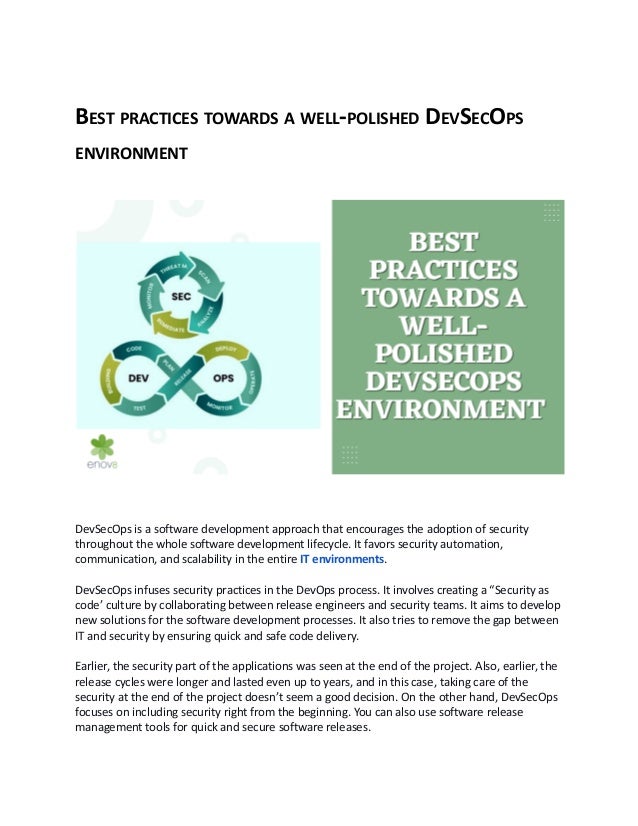
DevSecOps is a software development approach that encourages the adoption of security
throughout the whole software development lifecycle. It favors security automation,
communication, and scalability in the entire IT environments. 
DevSecOps infuses security practices in the DevOps process. It involves creating a “Security as
code’ culture by collaborating between release engineers and security teams. It aims to develop
new solutions for the software development processes. It also tries to remove the gap between
IT and security by ensuring quick and safe code delivery. 
Earlier, the security part of the applications was seen at the end of the project. Also, earlier, the
release cycles were longer and lasted even up to years, and in this case, taking care of the
security at the end of the project doesn’t seem a good decision. On the other hand, DevSecOps
focuses on including security right from the beginning. You can also use software release
management tools for quick and secure software releases.
DevSecOps not only adds security elements but infuses the entire security channel in the
process right from the beginning to the end. 
5 PRACTICES FOR A WELL-POLISHED DEVSECOPS PRACTICES
1. Keep the code simple.
If your code is complex, it may be more prone to security vulnerabilities. If the code is
simple and readable, it will be easy to collaborate. If one of the developers is not
available to check the code urgently, then the other developers must be able to look at
the code and understand it properly.
Developers seldom evaluate their code in open-source libraries or read the
documentation after they’ve finished working. Thus, it is important to have automated
processes that can handle the code dependency, as you know if your open-source
libraries are causing damage to the code. 
2. Automation is the key.
As far as DevSecOps is concerned, speed is the most important thing. And, achieving
speed without automation is almost impossible. It shows the importance of
automation. 
If you are concerned about security, you must take the help of automation. In the
traditional development model, the security automation used to run just before the
release of the code. However, things changed after the introduction of DevSecOps. Now,
automation has become necessary in each & every step of the development. 
In the current era, many automated testing tools are available. They handle everything
from source-code analysis through integration and post-deployment monitoring. 
3. Be careful while choosing the tools. 
You need to be careful while choosing the tools for building a good DevSecOps
environment. Before you buy the tool, remember that most of the technologies
necessary to integrate security into DevOps are still in development. Thus, you must
make informed decisions. 
             Here are some of the things that you need to keep in mind when you select the tools:
● The tools must integrate into the development pipeline and help in the collaboration
of the DevOps team and security team.
● Can make the scanning work easy for developers. 
● It should be accurate and be able to work quickly. 
● May be able to identify the risk and address it with concern. 
 
4. Train the developers.
Once you decide to implement the new culture in your company, then the first thing that
you must do is to train your developers and employees. Employees are the people who
will be working in the organization’s new culture, so you should make sure that the
employees understand everything in detail regarding the unique environment of the
organization. 
We have seen many developers are not aware that they are coding in an insecure way,
so in case vulnerability arises, they will not be able to know what is wrong. Thus, it is
important to teach them about integration cycles, IT release management, and
application security. It will aid in creating a healthy environment. 
Also read: Test Environment Management Explained
5. Focus on threat modeling.
The last thing that you need to care about is threat modeling. Threat modeling is not
easy, but it is crucial for achieving the environment for DevSecOps. 
Potential risks, such as structural vulnerabilities or the lack of appropriate protections,
can be discovered, listed, and mitigations prioritized using threat modeling. The major
purpose of threat modeling is to give defenders a systematic analysis of the control
procedures. It will be based on the profile of the attackers, likely attack vectors, and the
assets that the attacker desires. 
Threat modeling can answer the various problems like – where you are most vulnerable
to the attack? What are the most probable threats? What are the measures for
safeguarding the organization against threats? 
CONCLUSION
In conclusion, we would say that DevSecOps infuses a layer of security into the system. It helps
secure the organization’s processes and procedures against any potential vulnerabilities. And,
one must remember that the importance of DevSecOps is only going to rise in the upcoming
years, so the earlier you adapt to the model, the more it will be beneficial for you. 
Contact Us
Company Name: Enov8
Address: Level 2, 389 George St, Sydney 2000 NSW Australia
Phone(s) : +61 2 8916 6391
Fax : +61 2 9437 4214
Email id: enquiries@enov8.com
Website: https://www.enov8.com/

_Best practices towards a well-polished DevSecOps environment (1).pdf

  • 1.
    BEST PRACTICES TOWARDSA WELL-POLISHED DEVSECOPS ENVIRONMENT  DevSecOps is a software development approach that encourages the adoption of security throughout the whole software development lifecycle. It favors security automation, communication, and scalability in the entire IT environments.  DevSecOps infuses security practices in the DevOps process. It involves creating a “Security as code’ culture by collaborating between release engineers and security teams. It aims to develop new solutions for the software development processes. It also tries to remove the gap between IT and security by ensuring quick and safe code delivery.  Earlier, the security part of the applications was seen at the end of the project. Also, earlier, the release cycles were longer and lasted even up to years, and in this case, taking care of the security at the end of the project doesn’t seem a good decision. On the other hand, DevSecOps focuses on including security right from the beginning. You can also use software release management tools for quick and secure software releases.
  • 2.
    DevSecOps not onlyadds security elements but infuses the entire security channel in the process right from the beginning to the end.  5 PRACTICES FOR A WELL-POLISHED DEVSECOPS PRACTICES 1. Keep the code simple. If your code is complex, it may be more prone to security vulnerabilities. If the code is simple and readable, it will be easy to collaborate. If one of the developers is not available to check the code urgently, then the other developers must be able to look at the code and understand it properly. Developers seldom evaluate their code in open-source libraries or read the documentation after they’ve finished working. Thus, it is important to have automated processes that can handle the code dependency, as you know if your open-source libraries are causing damage to the code.  2. Automation is the key. As far as DevSecOps is concerned, speed is the most important thing. And, achieving speed without automation is almost impossible. It shows the importance of automation.  If you are concerned about security, you must take the help of automation. In the traditional development model, the security automation used to run just before the release of the code. However, things changed after the introduction of DevSecOps. Now, automation has become necessary in each & every step of the development.  In the current era, many automated testing tools are available. They handle everything from source-code analysis through integration and post-deployment monitoring.  3. Be careful while choosing the tools.  You need to be careful while choosing the tools for building a good DevSecOps environment. Before you buy the tool, remember that most of the technologies necessary to integrate security into DevOps are still in development. Thus, you must make informed decisions.               Here are some of the things that you need to keep in mind when you select the tools: ● The tools must integrate into the development pipeline and help in the collaboration of the DevOps team and security team. ● Can make the scanning work easy for developers.  ● It should be accurate and be able to work quickly.  ● May be able to identify the risk and address it with concern.    4. Train the developers.
  • 3.
    Once you decideto implement the new culture in your company, then the first thing that you must do is to train your developers and employees. Employees are the people who will be working in the organization’s new culture, so you should make sure that the employees understand everything in detail regarding the unique environment of the organization.  We have seen many developers are not aware that they are coding in an insecure way, so in case vulnerability arises, they will not be able to know what is wrong. Thus, it is important to teach them about integration cycles, IT release management, and application security. It will aid in creating a healthy environment.  Also read: Test Environment Management Explained 5. Focus on threat modeling. The last thing that you need to care about is threat modeling. Threat modeling is not easy, but it is crucial for achieving the environment for DevSecOps.  Potential risks, such as structural vulnerabilities or the lack of appropriate protections, can be discovered, listed, and mitigations prioritized using threat modeling. The major purpose of threat modeling is to give defenders a systematic analysis of the control procedures. It will be based on the profile of the attackers, likely attack vectors, and the assets that the attacker desires.  Threat modeling can answer the various problems like – where you are most vulnerable to the attack? What are the most probable threats? What are the measures for safeguarding the organization against threats?  CONCLUSION In conclusion, we would say that DevSecOps infuses a layer of security into the system. It helps secure the organization’s processes and procedures against any potential vulnerabilities. And, one must remember that the importance of DevSecOps is only going to rise in the upcoming years, so the earlier you adapt to the model, the more it will be beneficial for you. 
  • 4.
    Contact Us Company Name:Enov8 Address: Level 2, 389 George St, Sydney 2000 NSW Australia Phone(s) : +61 2 8916 6391 Fax : +61 2 9437 4214 Email id: enquiries@enov8.com Website: https://www.enov8.com/