
FINANCIAL EXCHANGES AND MARKETS
LILA BOUKACEM
BOUKACEM.LILA@COLLEGECANADA.COM
BE20B
K M SAD IMAM
ID 1163218
ANALYSIS OF THE BANK'S COMMERCIAL FUNCTIONS
• NAME : BANGLADESH BANK
• HEADQUARTER : MOTIJHIL, DHAKA, BANGLADESH
• ESTABLISHED : 16 DECEMBER 1971
• GOVERNOR : FAZLE KABIR
• RESERVES : US $ 30 BILLION
• WEBSITE : WWW.BB.ORG.BD
• MONOGRAM :
5 FACTS OF BANGLADESH BANK
• FIRST CENTRAL BANK IN THE WORLD WHO INTRODUCE A DEDICATED
• HOTLINE (16236) NO FOR GENERAL POPULATION TO COMPLAIN ANY
• BANKING RELATED PROBLEM.
• THE FORMER GOVERNOR DR. ATIUR RAHMAN WAS FIRST GREEN
• GOVERNOR IN THE BANKING WORLD.
• FIRST CENTRAL BANK IN THE WORLD TO ISSUE “GREEN BANKING
• POLICY”.
• “DRIDEX MALWARE” WAS USED FOR ONLINE ATTACK.
• IT WAS FORMER STATE BANK OF PAKISTAN.
FUNCTIONS AND SERVICES OF BANKS
1-HISTORY OF BANGLADESH BANK
• BANGLADESH IS A DEVELOPING COUNTRY WITH AN IMPOVERISHED BANKING SYSTEM,
PARTICULARLY IN TERMS OF THE SERVICES AND CUSTOMER CARE PROVIDED BY THE
GOVERNMENT RUN BANKS. IN RECENT TIMES, PRIVATE BANKS ARE TRYING TO IMITATE THE
BANKING STRUCTURE OF THE MORE DEVELOPED COUNTRIES, BUT THIS ATTEMPT IS OFTEN FOILED
BY INEXPERT OR POLITICALLY MOTIVATED GOVERNMENT POLICIES EXECUTED BY THE CENTRAL
BANK OF BANGLADESH, BANGLADESH BANK. THE OUTCOME IS A BANKING SYSTEM FOSTERING
CORRUPTION AND ILLEGAL MONETARY ACTIVITIES/LAUNDERING ETC. BY THE POLITICALLY
POWERFUL AND CRIMINALS, WHILE AT THE SAME TIME MAKING THE ATTAINMENT OF SERVICES OR
THE PERFORMANCE OF INTERNATIONAL TRANSACTIONS DIFFICULT FOR THE ORDINARY CITIZENS,
STUDENTS STUDYING ABROAD OR THROUGH DISTANCE LEARNING, GENERAL CUSTOMERS ETC.
• THE FIRST MODERN BANK HEADQUARTERED IN DHAKA WAS DACCA BANK, ESTABLISHED IN 1846.
IT DID A VERY LIMITED BUSINESS AND DID NOT ISSUE BANKNOTES. IT WAS PURCHASED
BY BANK OF BENGAL IN 1862. BANK OF BENGAL OPENED BRANCHES IN SIRAJGANJ AND
CHITTAGONG IN 1873, AND IN CHANDPUR IN 1900.
FUNCTIONS AND SERVICES OF BANKS
The major functional areas include :
•Formulation and implementation of monetary and credit policies.
•Regulation and supervision of banks and non-bank financial
institutions, promotion and development of domestic financial markets.
•Management of the country's international reserves.
•Issuance of currency notes.
HISTORY OF BANGLADESH BANK
• The banking system at independence (1971) consisted of two branch offices of the former State
Bank of Pakistan and seventeen large commercial banks, two of which were controlled
by Bangladeshi interests and three by foreigners other than West Pakistanis. There were fourteen
smaller commercial banks.
• Virtually all banking services were concentrated in urban areas. The newly independent
government immediately designated the Dhaka branch of the State Bank of Pakistan as the central
bank and renamed it the Bangladesh Bank. The bank was responsible for regulating currency,
controlling credit and monetary policy, and administering exchange control and the
official foreign exchange reserves. The Bangladesh government initially nationalized the entire
domestic banking system and proceeded to reorganize and rename the various banks. Foreign-
owned banks were permitted to continue doing business in Bangladesh. The insurance business
was also nationalized and became a source of potential investment funds. Cooperative credit
systems and postal savings offices handled service to small individual and rural accounts. The new
banking system succeeded in establishing reasonably efficient procedures for managing credit
and foreign exchange. The primary function of the credit system throughout the 1970s was to
finance trade and the public sector, which together absorbed 75 percent of total advances.
• After the liberation of Bangladesh, the twelve Banking companies who were doing business in
Bangladesh, were nationalized by the Government of the People's Republic of Bangladesh.
THE FUNCTIONS OF BANGLADESH BANK
BANGLADESH BANK PERFORMS ALL THE CORE FUNCTIONS OF A TYPICAL MONETARYAND FINANCIAL SECTOR REGULATOR, AND A
NUMBER OF OTHER NON CORE FUNCTIONS. THE MAJOR FUNCTIONAL AREAS INCLUDE :
• FORMULATION AND IMPLEMENTATION OF MONETARYAND CREDIT POLICIES.
• REGULATION AND SUPERVISION OF BANKS AND NON-BANK FINANCIAL INSTITUTIONS, PROMOTION AND DEVELOPMENT OF
DOMESTIC FINANCIAL MARKETS.
• MANAGEMENT OF THE COUNTRY'S INTERNATIONAL RESERVES.
• ISSUANCE OF CURRENCY NOTES.
• REGULATION AND SUPERVISION OF THE PAYMENT SYSTEM.
• ACTING AS BANKER TO THE GOVERNMENT .
• MONEY LAUNDERING PREVENTION.
• COLLECTION AND FURNISHING OF CREDIT INFORMATION.
• IMPLEMENTATION OF THE FOREIGN EXCHANGE REGULATION ACT.
• MANAGING A DEPOSIT INSURANCE SCHEME .
THE SERVICES AND PRODUCTS OF BANGLADESH BANK
Services for general public
Bangladesh Bank serves the people in many ways.
• The Bank issues banknotes with special security features so that owner knows the
money is genuine. View the security posters to know the features.
• If you have deposited your money in scheduled banks, and have not made transaction
for last ten years, you can check your account from 'Claim your money' link.
• Any client, person or agency having complaint(s) against a Scheduled
Bank/FI/Bangladesh Bank or related official may write down his/her complaint(s) in the
'Customer Complaint' link.
• Find out some important BB forms from 'BB Forms' link.
THE PRODUCTS OF BANGLADESH BANK
• Overview.
• Financial markets.
• Payment Systems.
• Govt securities.
• Deposit insurance.
• Regulators.
• Banks & FIs.
• Capital market.
BANGLADESH BANK IMPORTANCE IN THE
FINANCING OF THE ECONOMY
• BANGLADESH HAS COME A LONG WAY IN ITS ECONOMIC GROWTH. FROM A MEAGRE US$ 5.70
BILLION IN 1972, THE GROSS DOMESTIC PRODUCT (GDP) INCREASED TO US$ 285.82 BILLION IN
2018. THE BANGLADESH ECONOMY IS THE 42ND LARGEST IN THE WORLD IN NOMINAL TERMS AND
31ST LARGEST IN TERMS OF PURCHASING POWER PARITY (PPP). RECENTLY, BANGLADESH
GRADUATED FROM LEAST DEVELOPED COUNTRY (LDC) STATUS TO A LOWER MIDDLE INCOME
COUNTRY, AND HOPES TO BECOME A DEVELOPED COUNTRY BY 2041.
• FOUR DISTINCT GROWTH PHASES ARE DISCERNIBLE (AHMED 2012; KHUDA AND BARKAT 2017) IN
THE COUNTRY'S ECONOMIC JOURNEY. THE FIRST PHASE (1990-1996), ONE OF SUBDUED GROWTH
RATE EXPANSION, WITNESSED LESS THAN 4.0 PER CENT ANNUALLY IN AGGREGATE TERMS AND LESS
THAN 3.0 PER CENT IN PER CAPITA TERMS. THE SECOND PHASE (1996-2003) WITNESSED GROWTH
RATE FLUCTUATING BETWEEN 4.0 AND OVER 5.0 PER CENT AND AROUND 4.0 PER CENT PER CAPITA.
THE THIRD PHASE (2004-13) WITNESSED GROWTH RATE OF AROUND 6.0 PER CENT AND PER CAPITA
GROWTH OF AROUND 5.0 PER CENT. THE FOURTH PHASE (2013--) WITNESSED GROWTH RATE OF
OVER 6.0 PER CENT, AND REACHED OVER 7.0 PER CENT DURING THE LAST TWO FINANCIAL YEARS.
BANGLADESH BANK IMPORTANCE IN THE
FINANCING OF THE ECONOMY
Economic growth in Bangladesh has been helped
largely by export earnings from the ready-made
garments (RMG) sector; remittances sent by migrant
workers; growth in the agricultural sector; expansion
in Medium, Small and Micro Enterprises (MSMEs);
decline in the rate of population growth; and the
government's safety net programmed.
BANGLADESH DSE: TURNOVER: BANKS
Bangladesh’s DSE: Turnover: Banks data was
reported at 13,207.030 BDT mn in Nov 2020.
This records an increase from the previous
number of 10,307.380 BDT mn for Oct 2020.
Bangladesh’s DSE: Turnover: Banks data is
updated monthly, averaging 9,072.910 BDT
mn from Aug 2003 to Nov 2020, with 205
observations. The data reached an all-time
high of 183,519.730 BDT mn in Nov 2010 and
a record low of 167.530 BDT mn in Aug 2003.
Bangladesh’s DSE: Turnover: Banks data
remains active status in CEIC and is reported
by Dhaka Stock Exchange . The data is
categorized under Global Database’s
Bangladesh – Table BD.Z002: Dhaka Stock
Exchange: Turnover. No available data for
April and May 2020 due to temporary closure
SHARE IN THE NATIONAL MARKET MARKETS OF BANGLADESH BANK
• to formulate and implement monetary policy;
• to formulate and implement intervention
policies in the foreign exchange market;
• to give advice to the Government on the
interaction of monetary policy with fiscal and
exchange rate policy, on the impact of various
policy measures on the economy and to propose
legislative measures it considers necessary or
appropriate to attain its objectives and perform
its functions;
• to hold and manage the official foreign reserves
of Bangladesh;
• to promote, regulate and ensure a secure and
efficient payment system, including the issue of
bank notes;
• to regulate and supervise banking companies
and financial institutions.
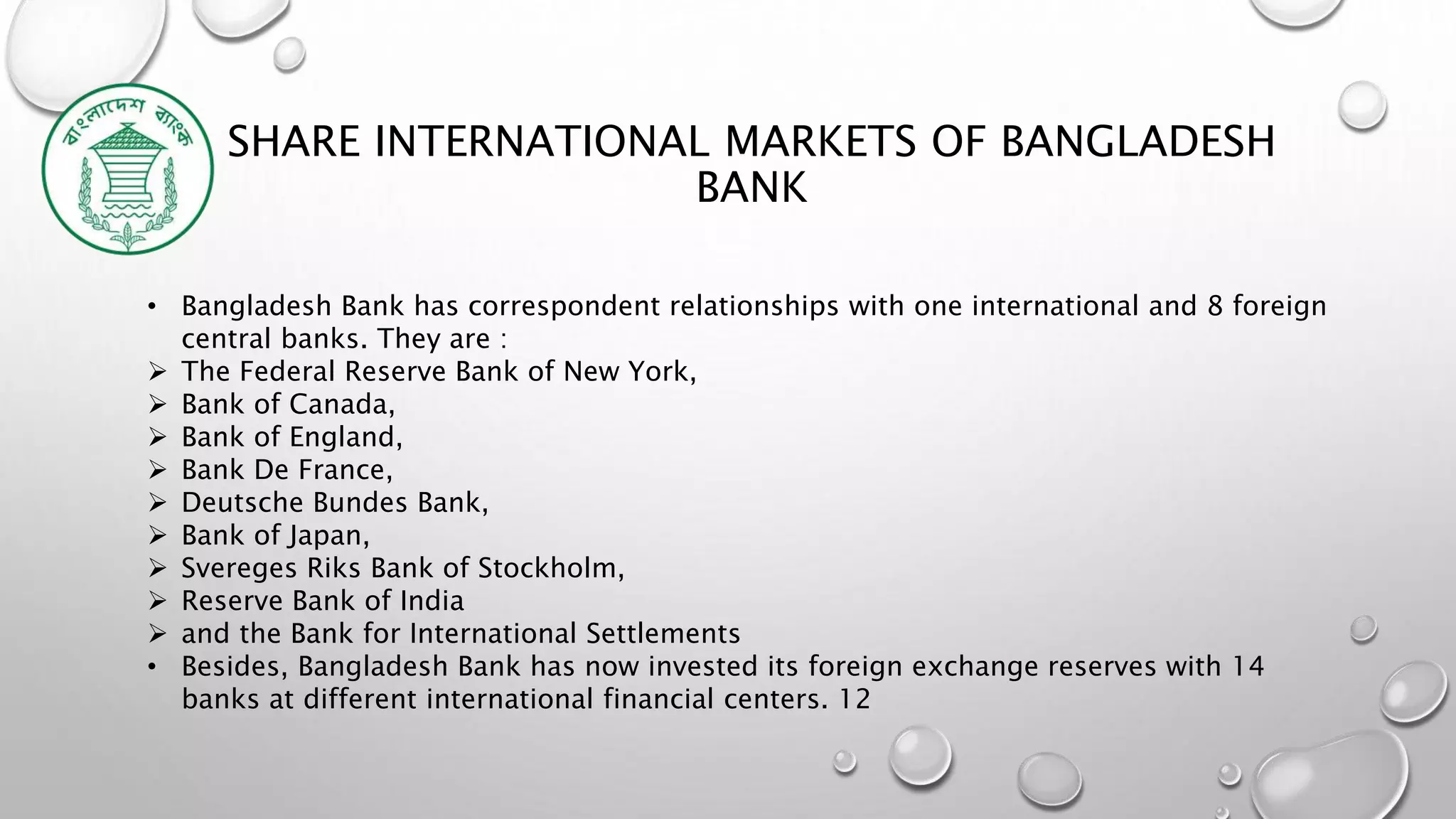
SHARE INTERNATIONAL MARKETS OF BANGLADESH
BANK
• Bangladesh Bank has correspondent relationships with one international and 8 foreign
central banks. They are :
 The Federal Reserve Bank of New York,
 Bank of Canada,
 Bank of England,
 Bank De France,
 Deutsche Bundes Bank,
 Bank of Japan,
 Svereges Riks Bank of Stockholm,
 Reserve Bank of India
 and the Bank for International Settlements
• Besides, Bangladesh Bank has now invested its foreign exchange reserves with 14
banks at different international financial centers. 12
STOCKS RISE AFTER BANGLADESH BANK
REDUCES REPO RATE
CONTACTS
EMAIL: BCRIZU@GMAIL.COM
WEBSITE: https://www.bb.org.bd
Z

Bd bank presentation

  • 1.
    FINANCIAL EXCHANGES ANDMARKETS LILA BOUKACEM BOUKACEM.LILA@COLLEGECANADA.COM BE20B K M SAD IMAM ID 1163218 ANALYSIS OF THE BANK'S COMMERCIAL FUNCTIONS
  • 2.
    • NAME :BANGLADESH BANK • HEADQUARTER : MOTIJHIL, DHAKA, BANGLADESH • ESTABLISHED : 16 DECEMBER 1971 • GOVERNOR : FAZLE KABIR • RESERVES : US $ 30 BILLION • WEBSITE : WWW.BB.ORG.BD • MONOGRAM :
  • 3.
    5 FACTS OFBANGLADESH BANK • FIRST CENTRAL BANK IN THE WORLD WHO INTRODUCE A DEDICATED • HOTLINE (16236) NO FOR GENERAL POPULATION TO COMPLAIN ANY • BANKING RELATED PROBLEM. • THE FORMER GOVERNOR DR. ATIUR RAHMAN WAS FIRST GREEN • GOVERNOR IN THE BANKING WORLD. • FIRST CENTRAL BANK IN THE WORLD TO ISSUE “GREEN BANKING • POLICY”. • “DRIDEX MALWARE” WAS USED FOR ONLINE ATTACK. • IT WAS FORMER STATE BANK OF PAKISTAN.
  • 4.
    FUNCTIONS AND SERVICESOF BANKS 1-HISTORY OF BANGLADESH BANK • BANGLADESH IS A DEVELOPING COUNTRY WITH AN IMPOVERISHED BANKING SYSTEM, PARTICULARLY IN TERMS OF THE SERVICES AND CUSTOMER CARE PROVIDED BY THE GOVERNMENT RUN BANKS. IN RECENT TIMES, PRIVATE BANKS ARE TRYING TO IMITATE THE BANKING STRUCTURE OF THE MORE DEVELOPED COUNTRIES, BUT THIS ATTEMPT IS OFTEN FOILED BY INEXPERT OR POLITICALLY MOTIVATED GOVERNMENT POLICIES EXECUTED BY THE CENTRAL BANK OF BANGLADESH, BANGLADESH BANK. THE OUTCOME IS A BANKING SYSTEM FOSTERING CORRUPTION AND ILLEGAL MONETARY ACTIVITIES/LAUNDERING ETC. BY THE POLITICALLY POWERFUL AND CRIMINALS, WHILE AT THE SAME TIME MAKING THE ATTAINMENT OF SERVICES OR THE PERFORMANCE OF INTERNATIONAL TRANSACTIONS DIFFICULT FOR THE ORDINARY CITIZENS, STUDENTS STUDYING ABROAD OR THROUGH DISTANCE LEARNING, GENERAL CUSTOMERS ETC. • THE FIRST MODERN BANK HEADQUARTERED IN DHAKA WAS DACCA BANK, ESTABLISHED IN 1846. IT DID A VERY LIMITED BUSINESS AND DID NOT ISSUE BANKNOTES. IT WAS PURCHASED BY BANK OF BENGAL IN 1862. BANK OF BENGAL OPENED BRANCHES IN SIRAJGANJ AND CHITTAGONG IN 1873, AND IN CHANDPUR IN 1900.
  • 5.
    FUNCTIONS AND SERVICESOF BANKS The major functional areas include : •Formulation and implementation of monetary and credit policies. •Regulation and supervision of banks and non-bank financial institutions, promotion and development of domestic financial markets. •Management of the country's international reserves. •Issuance of currency notes.
  • 6.
    HISTORY OF BANGLADESHBANK • The banking system at independence (1971) consisted of two branch offices of the former State Bank of Pakistan and seventeen large commercial banks, two of which were controlled by Bangladeshi interests and three by foreigners other than West Pakistanis. There were fourteen smaller commercial banks. • Virtually all banking services were concentrated in urban areas. The newly independent government immediately designated the Dhaka branch of the State Bank of Pakistan as the central bank and renamed it the Bangladesh Bank. The bank was responsible for regulating currency, controlling credit and monetary policy, and administering exchange control and the official foreign exchange reserves. The Bangladesh government initially nationalized the entire domestic banking system and proceeded to reorganize and rename the various banks. Foreign- owned banks were permitted to continue doing business in Bangladesh. The insurance business was also nationalized and became a source of potential investment funds. Cooperative credit systems and postal savings offices handled service to small individual and rural accounts. The new banking system succeeded in establishing reasonably efficient procedures for managing credit and foreign exchange. The primary function of the credit system throughout the 1970s was to finance trade and the public sector, which together absorbed 75 percent of total advances. • After the liberation of Bangladesh, the twelve Banking companies who were doing business in Bangladesh, were nationalized by the Government of the People's Republic of Bangladesh.
  • 7.
    THE FUNCTIONS OFBANGLADESH BANK BANGLADESH BANK PERFORMS ALL THE CORE FUNCTIONS OF A TYPICAL MONETARYAND FINANCIAL SECTOR REGULATOR, AND A NUMBER OF OTHER NON CORE FUNCTIONS. THE MAJOR FUNCTIONAL AREAS INCLUDE : • FORMULATION AND IMPLEMENTATION OF MONETARYAND CREDIT POLICIES. • REGULATION AND SUPERVISION OF BANKS AND NON-BANK FINANCIAL INSTITUTIONS, PROMOTION AND DEVELOPMENT OF DOMESTIC FINANCIAL MARKETS. • MANAGEMENT OF THE COUNTRY'S INTERNATIONAL RESERVES. • ISSUANCE OF CURRENCY NOTES. • REGULATION AND SUPERVISION OF THE PAYMENT SYSTEM. • ACTING AS BANKER TO THE GOVERNMENT . • MONEY LAUNDERING PREVENTION. • COLLECTION AND FURNISHING OF CREDIT INFORMATION. • IMPLEMENTATION OF THE FOREIGN EXCHANGE REGULATION ACT. • MANAGING A DEPOSIT INSURANCE SCHEME .
  • 8.
    THE SERVICES ANDPRODUCTS OF BANGLADESH BANK Services for general public Bangladesh Bank serves the people in many ways. • The Bank issues banknotes with special security features so that owner knows the money is genuine. View the security posters to know the features. • If you have deposited your money in scheduled banks, and have not made transaction for last ten years, you can check your account from 'Claim your money' link. • Any client, person or agency having complaint(s) against a Scheduled Bank/FI/Bangladesh Bank or related official may write down his/her complaint(s) in the 'Customer Complaint' link. • Find out some important BB forms from 'BB Forms' link.
  • 9.
    THE PRODUCTS OFBANGLADESH BANK • Overview. • Financial markets. • Payment Systems. • Govt securities. • Deposit insurance. • Regulators. • Banks & FIs. • Capital market.
  • 10.
    BANGLADESH BANK IMPORTANCEIN THE FINANCING OF THE ECONOMY • BANGLADESH HAS COME A LONG WAY IN ITS ECONOMIC GROWTH. FROM A MEAGRE US$ 5.70 BILLION IN 1972, THE GROSS DOMESTIC PRODUCT (GDP) INCREASED TO US$ 285.82 BILLION IN 2018. THE BANGLADESH ECONOMY IS THE 42ND LARGEST IN THE WORLD IN NOMINAL TERMS AND 31ST LARGEST IN TERMS OF PURCHASING POWER PARITY (PPP). RECENTLY, BANGLADESH GRADUATED FROM LEAST DEVELOPED COUNTRY (LDC) STATUS TO A LOWER MIDDLE INCOME COUNTRY, AND HOPES TO BECOME A DEVELOPED COUNTRY BY 2041. • FOUR DISTINCT GROWTH PHASES ARE DISCERNIBLE (AHMED 2012; KHUDA AND BARKAT 2017) IN THE COUNTRY'S ECONOMIC JOURNEY. THE FIRST PHASE (1990-1996), ONE OF SUBDUED GROWTH RATE EXPANSION, WITNESSED LESS THAN 4.0 PER CENT ANNUALLY IN AGGREGATE TERMS AND LESS THAN 3.0 PER CENT IN PER CAPITA TERMS. THE SECOND PHASE (1996-2003) WITNESSED GROWTH RATE FLUCTUATING BETWEEN 4.0 AND OVER 5.0 PER CENT AND AROUND 4.0 PER CENT PER CAPITA. THE THIRD PHASE (2004-13) WITNESSED GROWTH RATE OF AROUND 6.0 PER CENT AND PER CAPITA GROWTH OF AROUND 5.0 PER CENT. THE FOURTH PHASE (2013--) WITNESSED GROWTH RATE OF OVER 6.0 PER CENT, AND REACHED OVER 7.0 PER CENT DURING THE LAST TWO FINANCIAL YEARS.
  • 11.
    BANGLADESH BANK IMPORTANCEIN THE FINANCING OF THE ECONOMY Economic growth in Bangladesh has been helped largely by export earnings from the ready-made garments (RMG) sector; remittances sent by migrant workers; growth in the agricultural sector; expansion in Medium, Small and Micro Enterprises (MSMEs); decline in the rate of population growth; and the government's safety net programmed.
  • 12.
    BANGLADESH DSE: TURNOVER:BANKS Bangladesh’s DSE: Turnover: Banks data was reported at 13,207.030 BDT mn in Nov 2020. This records an increase from the previous number of 10,307.380 BDT mn for Oct 2020. Bangladesh’s DSE: Turnover: Banks data is updated monthly, averaging 9,072.910 BDT mn from Aug 2003 to Nov 2020, with 205 observations. The data reached an all-time high of 183,519.730 BDT mn in Nov 2010 and a record low of 167.530 BDT mn in Aug 2003. Bangladesh’s DSE: Turnover: Banks data remains active status in CEIC and is reported by Dhaka Stock Exchange . The data is categorized under Global Database’s Bangladesh – Table BD.Z002: Dhaka Stock Exchange: Turnover. No available data for April and May 2020 due to temporary closure
  • 13.
    SHARE IN THENATIONAL MARKET MARKETS OF BANGLADESH BANK • to formulate and implement monetary policy; • to formulate and implement intervention policies in the foreign exchange market; • to give advice to the Government on the interaction of monetary policy with fiscal and exchange rate policy, on the impact of various policy measures on the economy and to propose legislative measures it considers necessary or appropriate to attain its objectives and perform its functions; • to hold and manage the official foreign reserves of Bangladesh; • to promote, regulate and ensure a secure and efficient payment system, including the issue of bank notes; • to regulate and supervise banking companies and financial institutions.
  • 14.
    SHARE INTERNATIONAL MARKETSOF BANGLADESH BANK • Bangladesh Bank has correspondent relationships with one international and 8 foreign central banks. They are :  The Federal Reserve Bank of New York,  Bank of Canada,  Bank of England,  Bank De France,  Deutsche Bundes Bank,  Bank of Japan,  Svereges Riks Bank of Stockholm,  Reserve Bank of India  and the Bank for International Settlements • Besides, Bangladesh Bank has now invested its foreign exchange reserves with 14 banks at different international financial centers. 12
  • 15.
    STOCKS RISE AFTERBANGLADESH BANK REDUCES REPO RATE
  • 16.
  • 17.