Elementary Economics
Presented By:
Azizul Islam
ID: 222911001
Department of Law
Green University of
Bangladesh
Presented To:
Adv. Noyon Islam
Lecturer
Department of Law
Green University of
Bangladesh
The money & banking System of Bangladesh
TABLE OF CONTENTS
INTRODUCTION
01 MONEY
02
04
BANKING
03 MOBILE BANKING
INTRODUCTION (Money & Bank)
The currency for Bangladesh is the Bangladeshi
Taka (BDT). The Central Bank of Bangladesh controls the
right to issue the currency. The symbols used for the Taka
are Tk. The Taka is divided into smaller denominations of
100 poisha.
On the other hand, A bank is a financial institution that is
licensed to accept checking and savings deposits and make
loans.
What is money?
A medium of exchange that is centralized,
generally accepted, recognized, and
facilitates transactions of goods and services,
is known as money.
Money can be classified from various points of view. It is
discussed below: According to the components of making, money
can be classified in 2 types, like:
1) Metal coins and
2) Paper notes
Classification of Money
Metal Coins
The coin which is
made by metals and
used to conduct our
day-to-day transactions
is called a metal coin.
In Bangladesh, metal
coins of 5 taka, 2 taka,
1 taka and 50 paisa
are available.
Paper Notes
Paper Notes or Money The money which is
made of paper is called paper notes or
money. The value written on the note is the
monetary value of that note, which is
generally higher than its internal value. In
almost all the countries, paper money or
paper notes are introduced by the central
bank by the order of the government of
that country. The paper money of
Bangladesh includes the notes of 1 taka, 2
taka, 5 taka, 10 taka, 20 taka, 50 taka, 100
taka, 200 taka, 500 taka and 1000 taka.
Definition of Bank
Bank is a financial institution and intermediary, which collect
deposits through its different deposit mechanism and provide
loans and advances among the loan Clients or investors with
the view to earn profit. Thus a bank is a financial intermediary
and a dealer of loans and debts. In financial concept, banking
means safe custody of money and at the same time an
institution for money transaction.
The banking system at independence consisted of two branch offices
of the former State Bank of Pakistan and seventeen large commercial
banks, two of which were controlled by Bangladeshi interests and
three by foreigners other than West Pakistanis. There were fourteen
smaller commercial banks. Virtually all banking services were
concentrated in urban areas. The newly independent government
immediately designated the Dhaka branch of the State Bank of
Pakistan as the central bank and renamed it the Bangladesh Bank.
The bank was responsible for regulating currency, controlling credit
and monetary policy, and administering exchange control and the
official foreign exchange reserves. The Bangladesh government
initially nationalized the entire domestic banking system and
proceeded to reorganize and rename the various banks. Foreign-
owned banks were permitted to continue doing business in
Bangladesh.
HISTORY OF BANGLADESH BANK
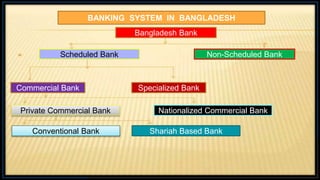
BANKING SYSTEM IN BANGLADESH
Bangladesh Bank
Scheduled Bank Non-Scheduled Bank
Commercial Bank Specialized Bank
Nationalized Commercial Bank
Private Commercial Bank
Conventional Bank Shariah Based Bank
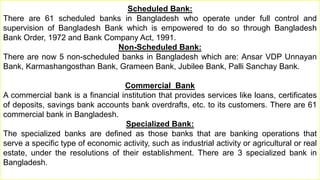
Scheduled Bank:
There are 61 scheduled banks in Bangladesh who operate under full control and
supervision of Bangladesh Bank which is empowered to do so through Bangladesh
Bank Order, 1972 and Bank Company Act, 1991.
Non-Scheduled Bank:
There are now 5 non-scheduled banks in Bangladesh which are: Ansar VDP Unnayan
Bank, Karmashangosthan Bank, Grameen Bank, Jubilee Bank, Palli Sanchay Bank.
Commercial Bank
A commercial bank is a financial institution that provides services like loans, certificates
of deposits, savings bank accounts bank overdrafts, etc. to its customers. There are 61
commercial bank in Bangladesh.
Specialized Bank:
The specialized banks are defined as those banks that are banking operations that
serve a specific type of economic activity, such as industrial activity or agricultural or real
estate, under the resolutions of their establishment. There are 3 specialized bank in
Bangladesh.
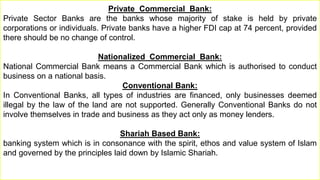
Private Commercial Bank:
Private Sector Banks are the banks whose majority of stake is held by private
corporations or individuals. Private banks have a higher FDI cap at 74 percent, provided
there should be no change of control.
Nationalized Commercial Bank:
National Commercial Bank means a Commercial Bank which is authorised to conduct
business on a national basis.
Conventional Bank:
In Conventional Banks, all types of industries are financed, only businesses deemed
illegal by the law of the land are not supported. Generally Conventional Banks do not
involve themselves in trade and business as they act only as money lenders.
Shariah Based Bank:
banking system which is in consonance with the spirit, ethos and value system of Islam
and governed by the principles laid down by Islamic Shariah.
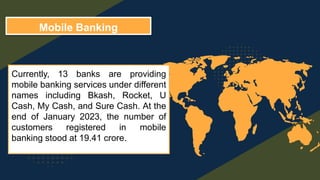
Mobile Banking
Currently, 13 banks are providing
mobile banking services under different
names including Bkash, Rocket, U
Cash, My Cash, and Sure Cash. At the
end of January 2023, the number of
customers registered in mobile
banking stood at 19.41 crore.
Thank
You

Elementary Economics ppt file.pptx

  • 1.
    Elementary Economics Presented By: AzizulIslam ID: 222911001 Department of Law Green University of Bangladesh Presented To: Adv. Noyon Islam Lecturer Department of Law Green University of Bangladesh The money & banking System of Bangladesh
  • 2.
    TABLE OF CONTENTS INTRODUCTION 01MONEY 02 04 BANKING 03 MOBILE BANKING
  • 3.
    INTRODUCTION (Money &Bank) The currency for Bangladesh is the Bangladeshi Taka (BDT). The Central Bank of Bangladesh controls the right to issue the currency. The symbols used for the Taka are Tk. The Taka is divided into smaller denominations of 100 poisha. On the other hand, A bank is a financial institution that is licensed to accept checking and savings deposits and make loans.
  • 4.
    What is money? Amedium of exchange that is centralized, generally accepted, recognized, and facilitates transactions of goods and services, is known as money.
  • 5.
    Money can beclassified from various points of view. It is discussed below: According to the components of making, money can be classified in 2 types, like: 1) Metal coins and 2) Paper notes Classification of Money
  • 6.
    Metal Coins The coinwhich is made by metals and used to conduct our day-to-day transactions is called a metal coin. In Bangladesh, metal coins of 5 taka, 2 taka, 1 taka and 50 paisa are available. Paper Notes Paper Notes or Money The money which is made of paper is called paper notes or money. The value written on the note is the monetary value of that note, which is generally higher than its internal value. In almost all the countries, paper money or paper notes are introduced by the central bank by the order of the government of that country. The paper money of Bangladesh includes the notes of 1 taka, 2 taka, 5 taka, 10 taka, 20 taka, 50 taka, 100 taka, 200 taka, 500 taka and 1000 taka.
  • 7.
    Definition of Bank Bankis a financial institution and intermediary, which collect deposits through its different deposit mechanism and provide loans and advances among the loan Clients or investors with the view to earn profit. Thus a bank is a financial intermediary and a dealer of loans and debts. In financial concept, banking means safe custody of money and at the same time an institution for money transaction.
  • 8.
    The banking systemat independence consisted of two branch offices of the former State Bank of Pakistan and seventeen large commercial banks, two of which were controlled by Bangladeshi interests and three by foreigners other than West Pakistanis. There were fourteen smaller commercial banks. Virtually all banking services were concentrated in urban areas. The newly independent government immediately designated the Dhaka branch of the State Bank of Pakistan as the central bank and renamed it the Bangladesh Bank. The bank was responsible for regulating currency, controlling credit and monetary policy, and administering exchange control and the official foreign exchange reserves. The Bangladesh government initially nationalized the entire domestic banking system and proceeded to reorganize and rename the various banks. Foreign- owned banks were permitted to continue doing business in Bangladesh. HISTORY OF BANGLADESH BANK
  • 9.
    BANKING SYSTEM INBANGLADESH Bangladesh Bank Scheduled Bank Non-Scheduled Bank Commercial Bank Specialized Bank Nationalized Commercial Bank Private Commercial Bank Conventional Bank Shariah Based Bank
  • 10.
    Scheduled Bank: There are61 scheduled banks in Bangladesh who operate under full control and supervision of Bangladesh Bank which is empowered to do so through Bangladesh Bank Order, 1972 and Bank Company Act, 1991. Non-Scheduled Bank: There are now 5 non-scheduled banks in Bangladesh which are: Ansar VDP Unnayan Bank, Karmashangosthan Bank, Grameen Bank, Jubilee Bank, Palli Sanchay Bank. Commercial Bank A commercial bank is a financial institution that provides services like loans, certificates of deposits, savings bank accounts bank overdrafts, etc. to its customers. There are 61 commercial bank in Bangladesh. Specialized Bank: The specialized banks are defined as those banks that are banking operations that serve a specific type of economic activity, such as industrial activity or agricultural or real estate, under the resolutions of their establishment. There are 3 specialized bank in Bangladesh.
  • 11.
    Private Commercial Bank: PrivateSector Banks are the banks whose majority of stake is held by private corporations or individuals. Private banks have a higher FDI cap at 74 percent, provided there should be no change of control. Nationalized Commercial Bank: National Commercial Bank means a Commercial Bank which is authorised to conduct business on a national basis. Conventional Bank: In Conventional Banks, all types of industries are financed, only businesses deemed illegal by the law of the land are not supported. Generally Conventional Banks do not involve themselves in trade and business as they act only as money lenders. Shariah Based Bank: banking system which is in consonance with the spirit, ethos and value system of Islam and governed by the principles laid down by Islamic Shariah.
  • 12.
    Mobile Banking Currently, 13banks are providing mobile banking services under different names including Bkash, Rocket, U Cash, My Cash, and Sure Cash. At the end of January 2023, the number of customers registered in mobile banking stood at 19.41 crore.
  • 13.