





Global Human Capital Trends 2016
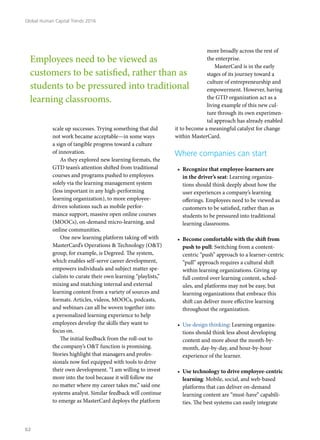
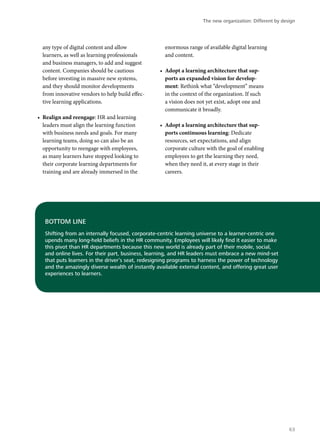
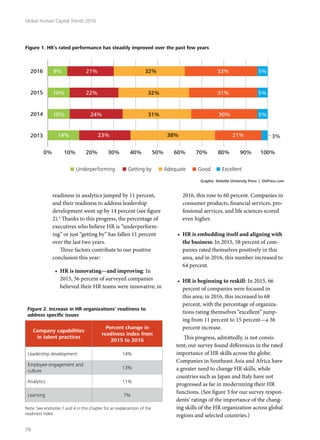
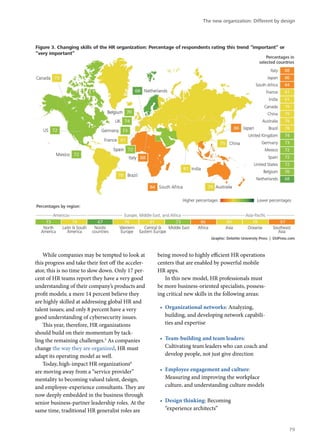
The new organization: Different by design
Deloitte’s Human Capital professionals leverage research, analytics,
and industry insights to help design and execute the HR, talent,
leadership, organization, and change programs that enable
business performance through people performance. Visit the
“Human Capital” area of www.deloitte.com to learn more.
Contents
Introduction: The new organization | 1
Different by design
Organizational design | 17
The rise of teams
Leadership awakened | 27
Generations, teams, science
Shape culture | 37
Drive strategy
Engagement | 47
Always on
Learning | 57
Employees take charge
Design thinking | 67
Crafting the employee experience
HR | 77
Growing momentum toward a new mandate
People analytics | 87
Gaining speed
Digital HR | 97
Revolution, not evolution
The gig economy | 105
Distraction or disruption?
The new organization: Different by design
Introduction
Sweeping global forces are reshaping the workplace, the workforce,
and work itself. To help organizations and their leaders understand
these changes, Deloitte presents the 2016 Global Human
Capital Trends report, based on more than 7,000 responses
to our survey in over 130 countries around the world.
THE theme of this year’s report—“The
new organization: Different by design”—
reflects a major finding: After three years of
struggling to drive employee engagement
and retention, improve leadership, and build
a meaningful culture, executives see a need
to redesign the organization itself, with 92
percent of survey participants rating this as
a critical priority. The “new organization,” as
we call it, is built around highly empowered
teams, driven by a new model
of management, and led by a
breed of younger, more globally
diverse leaders.
To lead this shift toward
the new organization, CEOs
and HR leaders are focused on
understanding and creating
a shared culture, designing a
work environment that engages
people, and constructing a new
model of leadership and career
development. In competition
for skilled people, organizations are vying for
top talent in a highly transparent job market
and becoming laser-focused on their external
employment brand. Executives are embrac-
ing digital technologies to reinvent the work-
place, focusing on diversity and inclusion as a
business strategy, and realizing that, without a
strong learning culture, they will not succeed.
Amidst these changes, the HR
function is taking on a new role as
the steward and designer of these new
people processes. The mission of the HR leader
is evolving from that of “chief talent execu-
tive” to “chief employee experience officer.” HR
is being asked to simplify its processes, help
employees manage the flood of information
at work, and build a culture of collaboration,
empowerment, and innovation. This means
that HR is redesigning almost everything it
does—from recruiting to performance man-
agement to onboarding to rewards systems.
To do this, our research suggests that HR
must upgrade its skills to include the areas
of design thinking, people analytics, and
behavioral economics.
The new organization
Different by design
After three years of struggling to drive
employee engagement and retention,
improve leadership, and build a
meaningful culture, executives see a need
to redesign the organization.
The new organization: Different by design
1
The forces of global change
What are the forces driving this demand to
reorganize and redesign institutions around
the world? We see a series of drivers coming
together to create disruptive change in the
talent landscape:
First, demographic upheavals have made the
workforce both younger and older, as well as
more diverse. Millennials now make up more
than half the workforce, and they bring high
expectations for a rewarding, purposeful work
experience, constant
learning and develop-
ment opportunities, and
dynamic career progres-
sion. At the same time,
Baby Boomers working
into their 70s and 80s are
being challenged to adapt
to new roles as men-
tors, coaches, and often
subordinates to junior
colleagues. Also, the
global nature of business
has made the workforce
more diverse, demanding a focus on inclusion
and shared beliefs to tie people together.
Second, digital technology is now every-
where, disrupting business models and radi-
cally changing the workplace and the way work
is done. Technologies such as mobile devices,
3D printing, sensors, cognitive computing,
and the Internet of Things are changing the
way companies design, manufacture, and
deliver almost every product and service, while
digital disruption and social networking have
changed the way organizations hire, manage,
and support people. Innovative companies are
figuring out how to simplify and improve the
work experience by applying the disciplines
of design thinking and behavioral economics,
embracing a new approach that we call “digital
HR.”
Third, the rate of change has accelerated.
Fifty years of operating under Moore’s Law—
the axiom that computing power doubles every
two years—have not only propelled technol-
ogy innovation forward but also significantly
increased the pace of change in business as
a whole, requiring organizations to be more
agile. Rapid business-model innovation from
companies such as Uber and Airbnb is forc-
ing organizations to respond and reposition
themselves quickly to meet new challenges.
In our highly connected, fast-changing world,
“black swan” events (those of low probability
and high impact) also seem to be more signifi-
cant, reinforcing the need
for agility.
Fourth, a new social
contract is developing
between companies and
workers, driving major
changes in the employer-
employee relationship.
The days when a majority
of workers could expect
to spend a career mov-
ing up the ladder at one
company are over. Young
people anticipate working
for many employers and demand an enriching
experience at every stage. This leads to expec-
tations for rapid career growth, a compelling
and flexible workplace, and a sense of mission
and purpose at work. Today, contingent, con-
tract, and part-time workers make up almost
one-third of the workforce,1
yet many compa-
nies lack the HR practices, culture, or leader-
ship support to manage this new workforce.
Our global research
Now in its fourth year, Deloitte’s 2016
Global Human Capital Trends report is one
of the largest longitudinal studies of talent,
leadership, and HR challenges and readiness
around the world. The research described in
this report involved surveys and interviews
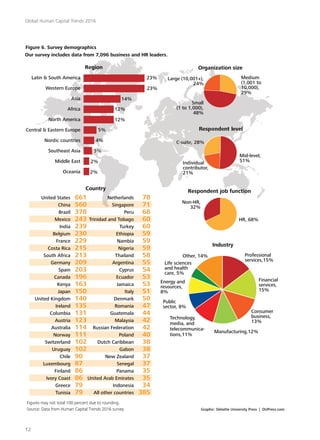
with more than 7,000 business and HR leaders
from 130 countries. (See the appendix to this
chapter for details on survey demographics.)
We see a series of
drivers coming
together to create
disruptive change in
the talent landscape.
Global Human Capital Trends 2016
2
The survey asked business and HR respondents
to assess the importance of specific talent chal-
lenges facing their organization.
The top 10 human capital
trends for 2016
In 2016, organizational design rocketed to
the top of the agenda among senior executives
and HR leaders worldwide, with 92 percent
rating it a key priority. Perennial issues such
as leadership, learning, and HR skills con-
tinue to rank high in importance, as they
have in each of the four years of this annual
study. Yet this year, a key shift is under way,
as corporate leaders turn a more focused eye
toward adapting their organization’s design to
compete successfully in today’s highly chal-
lenging business environment and competitive
talent market.
Culture and engagement are also a major
concern for the C-suite. This reflects, in part,
the rise of social networking tools and apps
that leave companies more transparent than
ever, whether they like it or not. Top executives
increasingly recognize the need for a conscious
strategy to shape their corporate culture,
rather than having it defined for them through
Glassdoor or Facebook.
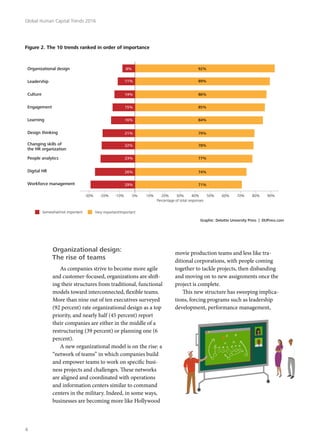
Figure 2 presents this year’s trends ranked
in order of their importance as rated by
survey respondents.
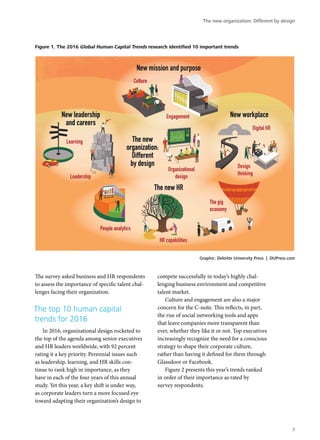
Figure 1. The 2016 Global Human Capital Trends research identified 10 important trends
Graphic: Deloitte University Press | DUPress.com
The new organization: Different by design
3
Organizational design:
The rise of teams
As companies strive to become more agile
and customer-focused, organizations are shift-
ing their structures from traditional, functional
models toward interconnected, flexible teams.
More than nine out of ten executives surveyed
(92 percent) rate organizational design as a top
priority, and nearly half (45 percent) report
their companies are either in the middle of a
restructuring (39 percent) or planning one (6
percent).
A new organizational model is on the rise: a
“network of teams” in which companies build
and empower teams to work on specific busi-
ness projects and challenges. These networks
are aligned and coordinated with operations
and information centers similar to command
centers in the military. Indeed, in some ways,
businesses are becoming more like Hollywood
movie production teams and less like tra-
ditional corporations, with people coming
together to tackle projects, then disbanding
and moving on to new assignments once the
project is complete.
This new structure has sweeping implica-
tions, forcing programs such as leadership
development, performance management,
Graphic: Deloitte University Press | DUPress.com
Figure 2. The 10 trends ranked in order of importance
Organizational design
0%-10%-20%-30% 10% 20% 30%
Percentage of total responses
Somewhat/not important Very important/important
40% 50% 60% 70% 80% 90%
Leadership
Culture
Engagement
Learning
Design thinking
Changing skills of
the HR organization
People analytics
Digital HR
Workforce management
8% 92%
11% 89%
14% 86%
15% 85%
16% 84%
21% 79%
22% 78%
23% 77%
26% 74%
29% 71%
Global Human Capital Trends 2016
4
learning, and career progression to adapt.
Challenges still remain: Only 14 percent of
executives believe their companies are ready to
effectively redesign their organizations; just 21
percent feel expert at building cross-functional
teams, and only 12 percent understand the way
their people work together in networks.
Leadership awakened:
Generations, teams, science
Fully 89 percent of executives in this year’s
survey rated the need to strengthen, reengi-
neer, and improve organizational leadership as
an important priority. The traditional pyramid-
shaped leadership development model is
simply not producing leaders fast enough to
keep up with the demands of business and the
pace of change.
More than half of surveyed executives (56
percent) report their companies are not ready
to meet leadership needs. Only 7 percent state
that their companies have accelerated leader-
ship programs for Millennials, although 44
percent report making progress—a jump from
33 percent last year. While investment in lead-
ership development has grown by 10 percent
since 2015, progress has been uneven. In fact,
more than one in five companies (21 percent)
have no leadership programs at all.2
Our findings suggest that organizations
need to raise the bar in terms of rigor, evi-
dence, and more structured and scientific
approaches to identifying, assessing, and devel-
oping leaders, and that this process needs to
start earlier in leaders’ careers. This is likely to
also involve teaching senior leaders to take on
new roles to make way for younger leaders.
Shape culture: Drive strategy
Last year, “culture and engagement”
ranked as the most important issue overall.
This year, we asked executives about culture
Graphic: Deloitte University Press | DUPress.com
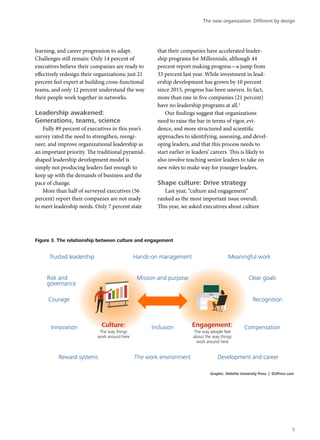
Figure 3. The relationship between culture and engagement
Culture:
The way things
work around here
Mission and purpose
Hands-on management
Inclusion
The work environment
Clear goals
Recognition
Meaningful work
Compensation
Development and career
Risk and
governance
Courage
Trusted leadership
Innovation
Reward systems
Engagement:
The way people feel
about the way things
work around here
The new organization: Different by design
5
and engagement separately—and both placed
near the top of the importance list, with 86
percent citing culture as an important or very
important issue.
Why the separate rankings? Both are
critical human capital issues today, and each
requires a CEO-level commitment and strong
support from HR if they are to be understood,
measured, and improved. However, they are
different concepts and need a different focus
and set of solutions. Culture describes “the
way things work around here,” while engage-
ment describes “how people feel about the way
things work around here.”
That said, culture and engagement are also
linked. When a company’s culture is aligned
with its values, it attracts those who feel com-
fortable in that culture, which in turn helps
companies to motivate people, leading to a
high level of engagement (see figure 3).
In this year’s survey, the percentage of
executives who believe their companies are
driving the “right culture” rose from 10 percent
to 12 percent—a small sign of progress. Yet
fewer than one in three executives (28 percent)
report that they understand their organiza-
tion’s culture.
Engagement: Always on
Employee engagement is a headline issue
throughout business and HR. An overwhelm-
ing majority of executives in this year’s survey
(85 percent) ranked engagement as a top prior-
ity (that is, important or very important).
Building a compelling and meaningful work
environment is a complex process.3
At the
same time, the world of employee engagement
and feedback is exploding. Annual engagement
surveys are being replaced by “employee listen-
ing” tools such as pulse surveys, anonymous
social tools, and regular feedback check-ins by
managers. All these new approaches and tools
have given rise to the “employee listening”
officer, an important new role for HR.
In terms of readiness, companies are mak-
ing progress. The percentage of executives who
believe their organizations are “very ready” to
deal with engagement issues increased from
10 percent in 2015 to 12 percent in 2016, while
those who feel they are “fully ready” rose from
31 percent to 34 percent. These are hope-
ful signs, but even with this increase,
only 46 percent of companies report
that they are prepared to tackle the
engagement challenge.
Learning: Employees
take charge
This year, 84 percent of executives
rated learning as important or very
important. This focus on learning
seems appropriate, as learning oppor-
tunities are among the largest drivers
of employee engagement and strong
workplace culture—they are part of the entire
employee value proposition, not merely a way
to build skills.
Compared to last year, companies appear to
be making strides in adopting new technolo-
gies and embracing new learning models. The
percentage of companies that feel comfortable
incorporating massive open online courses
(MOOCs) into their learning platforms rose to
43 percent from 30 percent last year, while the
percentage who said the same about advanced
video tripled from 5 percent to 15 percent.
These gains signal increasing recognition
among executives and HR leaders that learning
Culture describes “the way things
work around here,” while engagement
describes “how people feel about the
way things work around here.”
Global Human Capital Trends 2016
6
must adapt to a world where employees
demand continuous learning opportunities
through innovative platforms tailored to their
individual schedules. A new type of employee
learning is emerging that is more “consumer-
like” and that brings together design thinking,
content curation, and an integrated model
offering an end-to-end designed learning expe-
rience. However, companies still face tremen-
dous challenges in realizing this vision. Even
as spending on learning rose 10 percent last
year (to over $140 billion),4
only 37 percent of
companies believe their programs
are effective, and only 30
percent believe corporate
learning is the center of
learning today.5
Design thinking:
Crafting the
employee
experience
Design think-
ing is emerging as a
major new trend in
HR. Global Human
Capital Trends
highlighted the first
inklings of this issue
two years ago when we identified the “over-
whelmed employee” as a significant talent con-
cern, with employees struggling to deal with
a flood of emails and information, grappling
with demanding work assignments and being
on 24/7. Last year’s Global Human Capital
Trends report identified HR’s attempts to “sim-
plify” the work environment as a response to
the overwhelmed employee situation.
Now, innovative HR organizations are tak-
ing their efforts a step further by incorporating
design thinking into their approach to manag-
ing, supporting, and training people. Instead of
building “programs” and “processes,” lead-
ing HR organizations are studying people to
help develop interventions, apps, and tools
that help make employees less stressed and
more productive.
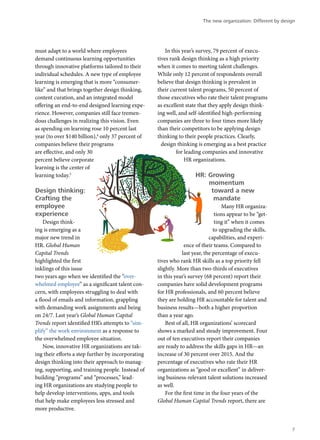
In this year’s survey, 79 percent of execu-
tives rank design thinking as a high priority
when it comes to meeting talent challenges.
While only 12 percent of respondents overall
believe that design thinking is prevalent in
their current talent programs, 50 percent of
those executives who rate their talent programs
as excellent state that they apply design think-
ing well, and self-identified high-performing
companies are three to four times more likely
than their competitors to be applying design
thinking to their people practices. Clearly,
design thinking is emerging as a best practice
for leading companies and innovative
HR organizations.
HR: Growing
momentum
toward a new
mandate
Many HR organiza-
tions appear to be “get-
ting it” when it comes
to upgrading the skills,
capabilities, and experi-
ence of their teams. Compared to
last year, the percentage of execu-
tives who rank HR skills as a top priority fell
slightly. More than two-thirds of executives
in this year’s survey (68 percent) report their
companies have solid development programs
for HR professionals, and 60 percent believe
they are holding HR accountable for talent and
business results—both a higher proportion
than a year ago.
Best of all, HR organizations’ scorecard
shows a marked and steady improvement. Four
out of ten executives report their companies
are ready to address the skills gaps in HR—an
increase of 30 percent over 2015. And the
percentage of executives who rate their HR
organizations as “good or excellent” in deliver-
ing business-relevant talent solutions increased
as well.
For the first time in the four years of the
Global Human Capital Trends report, there are
The new organization: Different by design
7
real signs of change and progress: HR teams
are learning to experiment with new ideas;
they are making significant steps to upgrade
skills; and a new generation of younger, more
business-savvy and technology-empowered
people is entering the profession.
People analytics: Gaining speed
As technology makes data-driven HR
decision making a possibility, 77 percent of
executives now rate people analytics as a key
priority, up slightly from last year. In response,
companies are building people analytics teams,
rapidly replacing legacy systems, and combin-
ing separate analytics groups within HR into
one strategic function. In 2016, 51 percent of
companies are now correlating business impact
to HR programs, up from 38 percent in 2015.
Forty-four percent are now using workforce
data to predict business performance, up from
29 percent last year.
One of the biggest new trends in people
analytics is also starting to accelerate: leverag-
ing external data—such as data from social
networking platforms, employment brand
data, data on hiring patterns, and external
turnover and demographic data—to predict
workforce trends and target top talent. Today,
29 percent of companies believe they are
performing well in this area, and 8 percent rate
themselves excellent.
A variety of new tools and data sources
have entered this domain. Employee feedback
and engagement systems, real-time narrative
analysis, and off-the-shelf predictive models
from almost every talent management
vendor are now available.
Companies are entering
a “golden age” of people
analytics—and progress
could accelerate.
Digital HR: Revolution,
not evolution
The all-digital world is changing how we
live and work, creating two major challenges.
First, how will HR help business leaders and
employees shift to a “digital mind-set”—a digi-
tal way of managing, organizing, and leading
change? Second, how will HR itself revolution-
ize HR processes, systems, and organizations
to adopt new digital platforms, apps, and ways
of delivering HR services?
This year’s chapter on digital HR focuses
on the second part of the challenge: how to
reimagine HR and the employee experience
in a digital world. Innovative HR organiza-
tions are integrating mobile and cloud tech-
nologies to build an app-based set of services
designed to incorporate HR programs into an
employee’s daily life. More than simply replac-
ing old HR systems, digital HR means creating
an entire platform of services built around ease
of use. By bringing together design thinking
and mobile technology, companies can now
develop their own custom apps to make work
easier, more productive, and more enjoyable.
This year, 74 percent of executives identified
digital HR as a top priority, and it will likely
be a major focus in 2016. The trend is moving
rapidly: 42 percent of companies are adapting
their existing HR systems for mobile, device-
delivered, just-in-time learning; 59 percent are
developing mobile apps that integrate back-
office systems for ease of use by employees;
and 51 percent are leveraging external social
networks in their own internal apps for recruit-
ment and employee profile management.
Companies are entering
a “golden age” of people
analytics—and progress
could accelerate.
Global Human Capital Trends 2016
8
The gig economy: Distraction
or disruption?
When it comes to meeting heightened
talent needs, top HR organizations must
increasingly learn to integrate and leverage
the part-time and contingent workforce. More
than seven out of ten executives and HR lead-
ers (71 percent) ranked the trend as important
or very important.
Operating effectively in the gig economy
poses a number of questions. How can com-
panies best use and schedule external staff to
improve the productivity of their own workers
and increase profitability? How can com-
panies leverage contingent work-
ers to access some of the most
talented and highly skilled
people in the workforce?
Many companies are
struggling with the chal-
lenge. Only 19 percent
of executives surveyed
believe their companies fully
understand the labor laws
that govern contingent workers,
and only 11 percent have com-
plete management processes for the
contingent part of the workforce. This
suggests that companies need to take a more
deliberate approach as the size and scope of
the contingent workforce continues to grow in
the coming years. Workforce management will
also have to address the tremendous growth in
cognitive computing and other smart tech-
nologies that are likely to eliminate jobs, create
new jobs, change the nature of work, and
disrupt the workforce.
A year of change and disruption
Taken together, the 2016 Global Human
Capital Trends report sketches out
a vast and varied series of
changes and challenges. As
the pace of change accel-
erates, business and
HR leaders who move
aggressively to address
these trends will likely
gain an advantage over
their competitors and
find themselves on the
winning side in the global
competition for talent.
The new organization: Different by design
9
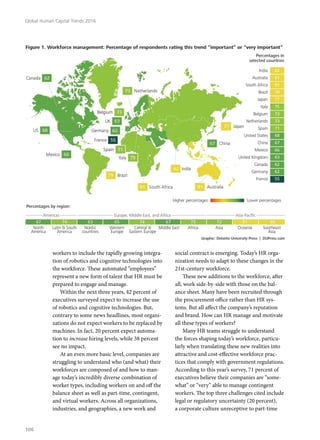
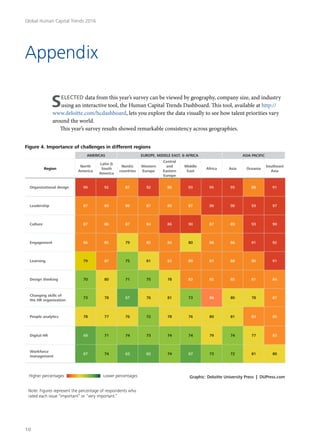
Figure 4. Importance of challenges in different regions
AMERICAS EUROPE, MIDDLE EAST, & AFRICA ASIA PACIFIC
Region
North
America
Latin &
South
America
Nordic
countries
Western
Europe
Central
and
Eastern
Europe
Middle
East
Africa Asia Oceania
Southeast
Asia
Organizational design 90 92 87 92 88 93 95 95 88 91
Leadership 87 89 89 87 89 87 90 90 93 97
Culture 87 86 87 84 86 90 87 89 93 90
Engagement 86 85 79 85 84 80 86 86 91 92
Learning 79 87 75 81 83 89 87 88 80 91
Design thinking 70 80 71 75 78 83 85 85 81 84
Changing skills of
the HR organization
73 78 67 76 81 73 86 80 78 87
People analytics 78 77 76 72 78 76 80 81 83 85
Digital HR 69 71 74 73 74 74 79 74 77 83
Workforce
management
67 74 63 65 74 67 73 72 81 80
Appendix
SELECTED data from this year’s survey can be viewed by geography, company size, and industry
using an interactive tool, the Human Capital Trends Dashboard. This tool, available at http://
www.deloitte.com/hcdashboard, lets you explore the data visually to see how talent priorities vary
around the world.
This year’s survey results showed remarkable consistency across geographies.
Graphic: Deloitte University Press | DUPress.com
87 Australia
95 Japan
97 China
91 India
ral &
Europe
Middle East Africa Asia Oceania
8 93 95 95 88
erlands
1 South Africa
China
Belgium
Japan
Brazil
Netherlands
Spain
United Kingdom
India
South Africa
France
Italy
United States
Canada
Australia
Mexico
Germany
Percentages in
selected countries
97
96
95
94
94
92
92
91
91
90
90
90
89
87
87
84
East, and Africa Asia-Pacific
Southeast
Asia
91
ondents rating this trend “important” or “very important”
Lower percentagesHigher percentages
Note: Figures represent the percentage of respondents who
rated each issue “important” or “very important.”
Global Human Capital Trends 2016
10
Figure 5. Importance of challenges in different industries
Industry
Consumer
business
Energy &
resources
Financial
services
Life
sciences &
health care
Manufacturing
Professional
services
Public
sector
Technology,
media, &
telecommuni-
cations
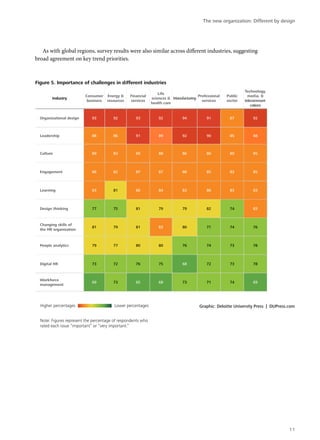
Organizational design 93 92 93 92 94 91 87 92
Leadership 88 86 91 89 92 90 85 88
Culture 89 83 89 88 86 86 80 85
Engagement 86 82 87 87 88 85 83 85
Learning 83 81 86 84 83 86 83 83
Design thinking 77 75 81 79 79 82 74 83
Changing skills of
the HR organization
81 79 81 83 80 71 74 76
People analytics 79 77 80 80 76 74 73 78
Digital HR 73 72 76 75 68 72 73 78
Workforce
management
69 73 65 68 73 71 74 69
Graphic: Deloitte University Press | DUPress.com
As with global regions, survey results were also similar across different industries, suggesting
broad agreement on key trend priorities.
Graphic: Deloitte University Press | DUPress.com
87 Australia
95 Japan
97 China
91 India
Central &
astern Europe
Middle East Africa Asia Oceania
88 93 95 95 88
90
Netherlands
91 South Africa
China
Belgium
Japan
Brazil
Netherlands
Spain
United Kingdom
India
South Africa
France
Italy
United States
Canada
Australia
Mexico
Germany
Percentages in
selected countries
97
96
95
94
94
92
92
91
91
90
90
90
89
87
87
84
Middle East, and Africa Asia-Pacific
Southeast
Asia
91
respondents rating this trend “important” or “very important”
Lower percentagesHigher percentages
Note: Figures represent the percentage of respondents who
rated each issue “important” or “very important.”
The new organization: Different by design
11
Graphic: Deloitte University Press | DUPress.com
Figures may not total 100 percent due to rounding.
Source: Data from Human Capital Trends 2016 survey.
Latin & South America
Western Europe
Asia
Africa
North America
Central & Eastern Europe
Nordic countries
Southeast Asia
Middle East
Oceania
United States
China
Brazil
Mexico
India
Belgium
France
Costa Rica
South Africa
Germany
Spain
Canada
Kenya
Japan
United Kingdom
Ireland
Columbia
Austria
Australia
Norway
Switzerland
Uruguay
Chile
Luxembourg
Finland
Ivory Coast
Greece
Tunisia
661
560
378
243
239
230
229
215
213
209
203
196
163
150
140
135
131
123
114
111
102
102
90
87
86
86
79
79
Netherlands
Singapore
Peru
Trinidad and Tobago
Turkey
Ethiopia
Nambia
Nigeria
Thailand
Argentina
Cyprus
Ecuador
Jamaica
Italy
Denmark
Romania
Guatemala
Malaysia
Russian Federation
Poland
Dutch Caribbean
Gabon
New Zealand
Senegal
Panama
United Arab Emirates
Indonesia
All other countries
78
71
68
60
60
59
59
59
58
55
54
53
53
51
50
47
44
42
42
40
38
38
37
37
35
35
34
385
Region
23%
23%
14%
12%
12%
5%
4%
3%
2%
2%
Country
Our survey includes data from 7,096 business and HR leaders.
Other, 14%
Life sciences
and health
care, 5%
Energy and
resources,
8%
Public
sector, 8%
Industry
Professional
services,15%
Financial
services,
15%
Consumer
business,
13%
Manufacturing,12%
Technology,
media, and
telecommunica-
tions,11%
Non-HR,
32%
HR, 68%
Respondent job function
Large (10,001+),
24%
Medium
(1,001 to
10,000),
29%
Small
(1 to 1,000),
48%
Organization size
Respondent level
C-suite, 28%
Individual
contributor,
21%
Mid-level,
51%
Figure 6. Survey demographics
Global Human Capital Trends 2016
12
Endnotes
1.	 Elaine Pofeldt, “Shocker: 40% of workers now
have ‘contingent’ jobs, says U.S. government,”
Forbes, May 25, 2015, www.forbes.com/sites/
elainepofeldt/2015/05/25/shocker-40-of-work-
ers-now-have-contingent-jobs-says-u-s-govern-
ment/.
2.	 Karen O’Leonard and Jennifer Krider, Leader-
ship development factbook 2014: Benchmarks
and trends in US leadership development, Bersin
by Deloitte, 2014, http://marketing.bersin.com/
leadership-development-factbook-2014.html.
3.	 Josh Bersin, “Becoming irresistible: A new
model for employee engagement,” Deloitte
Review 16, January 26, 2015, http://dupress.com/
articles/employee-engagement-strategies/.
4.	 Raju Singaraju, Ben Carroll, and Eunyun Park,
Corporate learning factbook 2015: Benchmarks,
trends, and analysis of the US training market,
Bersin by Deloitte, 2015, http://marketing.bersin.
com/corporate-learning-factbook-2015.html.
5.	 Ibid.
The new organization: Different by design
13
Authors
Josh Bersin, Bersin by Deloitte, Deloitte Consulting LLP | jbersin@deloitte.com
Josh Bersin founded Bersin & Associates, now Bersin by Deloitte, in 2001 to provide research and
advisory services focused on corporate learning. He is a frequent speaker at industry events and a popular
blogger. Bersin spent 25 years in product development, product management, marketing, and sales of
e-learning and other enterprise technologies. His education includes a BS in engineering from Cornell,
an MS in engineering from Stanford, and an MBA from the Haas School of Business at the University of
California, Berkeley.
Jason Geller, Deloitte Consulting LLP | jgeller@deloitte.com
Jason Geller is the national managing director for Deloitte Consulting LLP’s Human Capital consulting
practice in the United States. In this role, he is responsible for overall strategy, financial performance
and operations, talent recruitment and development, and service delivery. He is a member of the global
Human Capital executive committee and the US Deloitte Consulting management committee, and has
also served as a US Deloitte Consulting board member, Deloitte India board member, global and US
leader for HR Transformation, and US Human Capital chief strategy officer. Geller advises organizations
on their HR and talent transformations.
Nicky Wakefield, Deloitte Consulting Pte Ltd | nwakefield@deloitte.com
Nicky Wakefield is a partner and the leader of the Southeast Asia Human Capital consulting practice.
With over 20 years of business consulting experience with clients across the globe, she is recognized as
one of the leading strategic thinkers on complex organizational change and is admired by her clients as a
practical, hands-on advisor and implementer. Wakefield has spent her career focused on the execution of
business strategy and helping organizations make it real for their people.
Brett Walsh, Deloitte MCS Limited | bcwalsh@deloitte.co.uk
Brett Walsh leads Deloitte’s global Human Capital practice and also serves as the HR Transformation
practice leader for Deloitte UK. As a Deloitte UK partner, he consults with executives around the world
on HR strategy, merger integration, and major transformation and technology programs, including back-
office shared services and outsourcing. His particular expertise is in HR and change management. Walsh
has an MBA from Warwick University and is a fellow of the Institute of Business Consultants.
Global Human Capital Trends 2016
14
Fast-moving global markets and digital disruption have forced companies to
innovate rapidly, adapt their products and services, and stay closer than ever
to local customers. This has prompted a resurgence of interest in business
organization. Our findings in this area are startling: 92 percent of companies
believe that redesigning the organization is very important or important, making
it No. 1 in ranked importance among this year’s respondents. Companies
are decentralizing authority, moving toward product- and customer-centric
organizations, and forming dynamic networks of highly empowered teams
that communicate and coordinate activities in unique and powerful ways.
IN his book Team of Teams, General Stanley
McChrystal describes how the US mili-
tary’s hierarchical command and control
structure hindered operational success dur-
ing the early stages of the Iraq war.1
After
watching Al-Qaeda disrupt his army and win
battles, McChrystal’s solution was dramatic:
Decentralize authority to highly trained and
empowered teams and develop a real-time
information and operations group to cen-
tralize information and provide all teams
with real-time, accurate data about war
activities everywhere.
McChrystal did not change the formal
structure of the military. Rather, he created a
new structure that allowed for dynamism and
flexibility within the overall organizational
structure. This new structure enabled officers
to quickly move from their administrative
positions to mission-oriented projects for a set
purpose, knowing that they would once again
have a home to return to within the larger
organizational structure after the mission
was completed.
This new mode of organization—a
“network of teams” with a high degree of
Organizational design
The rise of teams
•	 Many companies have already moved away from functional structures: Only 38 percent
of all companies and 24 percent of large companies (>50,000 employees) are functionally
organized today.
•	 The growth of the Millennial demographic, the diversity of global teams, and the need to innovate
and work more closely with customers are driving a new organizational flexibility among high-
performing companies. They are operating as a network of teams alongside traditional structures,
with people moving from team to team rather than remaining in static formal configurations.
•	 Over 80 percent of respondents to this year’s global survey report that they are either currently
restructuring their organization or have recently completed the process. Only 7 percent say they
have no plans to restructure.
The new organization: Different by design
17
empowerment, strong communication, and
rapid information flow—is now sweeping busi-
nesses and governments around the world. It is
built on several fundamental principles:
•	 Move people into customer-, product-, or
market- and mission-focused teams, led
by team leaders who are experts in their
domain (not “professional managers”).
•	 Empower teams to set their own goals and
make their own decisions within the con-
text of an overarching strategy or business
plan, reversing the tradi-
tional structure of goal and
performance management.
•	 Replace silos with an
information and operations
center to share integrated
information and identify
connections between team
activities and desired results.
•	 Organize these teams around
mission, product, market, or
integrated customer needs
rather than business func-
tion. (For instance, a health
care company might have an “Orthopedic
and Rheumatology Institute” to bring
together orthopedic surgeons, rheumatolo-
gists, and counselors, rather than have them
siloed in functional groups.)2
•	 Teach and encourage people to work across
teams, using techniques like “liaison offi-
cers” (the US military), “hackathons,” open
office spaces that promote collaboration
(Apple Inc. and Cleveland Clinic), and job
rotation to give teams a common under-
standing of each other.3
•	 Enable people to move from team to team
as needed—similar to the way experts
come together on Hollywood movie sets
or in global consulting firms—and then
ensure that people have a home to return
to once a team-based project is done. This
changes the concept of a “job description”
to that of a “mission specialist” or “technical
specialist.”
•	 Shift senior leaders into roles focused on
planning, strategy, vision, culture, and
cross-team communication.
Examples of this new structure are appear-
ing throughout business and government, in
each case dramatically changing the effec-
tiveness of the organization. The Cleveland
Clinic reorganized its entire hospital network
around patient medical problems, moving
beyond traditional functional medical prac-
tices—which separated surgeons and medi-
cal specialists—to combine personnel into
patient-centric teams, dramatically improving
patient outcomes. Hospitals and health care
organizations around the world are similarly
reorganizing around patient needs and away
from traditional medical specialties.4
3M,
Nestlé, and other innovation- and service-
centric companies are decentralized and use
shared service centers and information centers
to help teams maintain productivity and
alignment with overall business strategy.5
And
companies like GE and IBM now post leaders
in regional centers of excellence, dispensing
This new mode of organization—a
“network of teams” with a
high degree of empowerment,
strong communication, and
rapid information flow—is
now sweeping businesses and
governments around the world.
Global Human Capital Trends 2016
18
with the notion that “leaders” only operate out
of corporate headquarters.6
This new type of organization, which we
call a “network of teams,” moves beyond the
concepts of the unwieldy 1960s-era matrix
organization. Integral to an effective network
of teams is to define the mission of each team
clearly, delegate responsibility, assign strong
team leadership, and build a shared culture and
set of information and communication tools
that help teams align with each other.
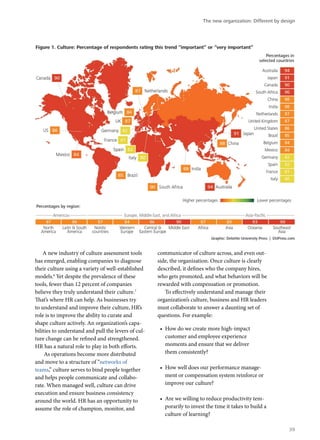
Why is this trend so prominent now, with
92 percent of our survey respondents rating
redesigning the organization very important
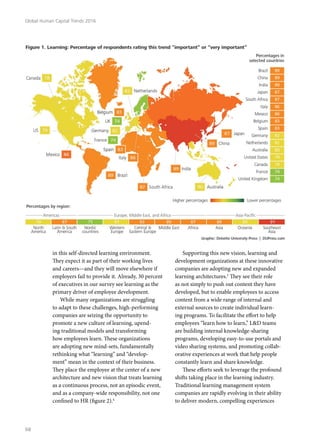
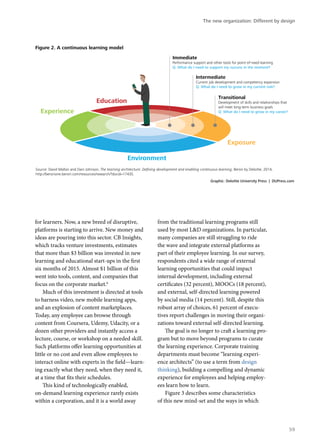
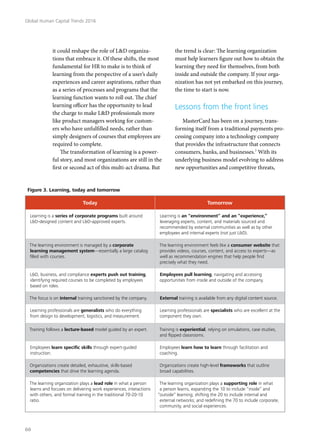
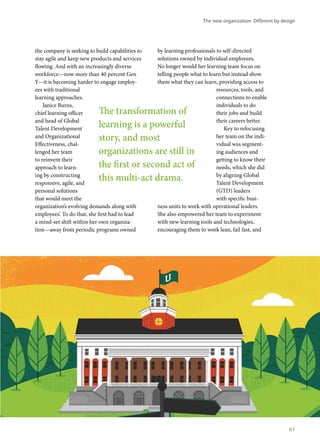
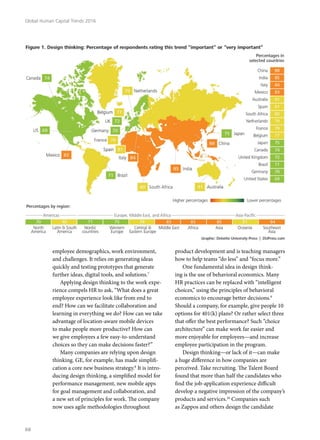
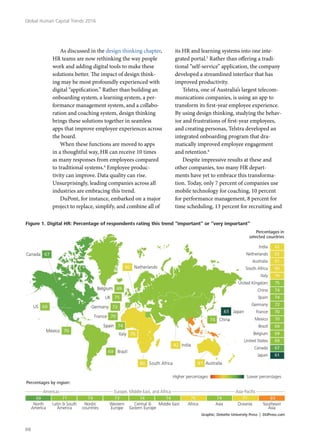
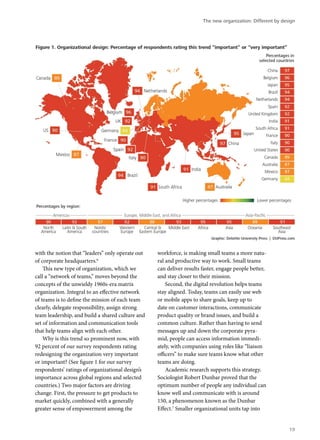
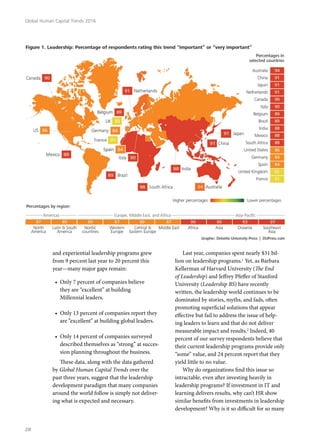
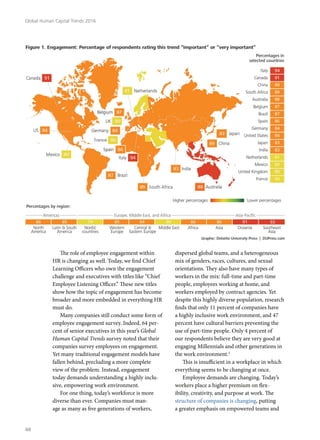
or important? (See figure 1 for our survey
respondents’ ratings of organizational design’s
importance across global regions and selected
countries.) Two major factors are driving
change. First, the pressure to get products to
market quickly, combined with a generally
greater sense of empowerment among the
workforce, is making small teams a more natu-
ral and productive way to work. Small teams
can deliver results faster, engage people better,
and stay closer to their mission.
Second, the digital revolution helps teams
stay aligned. Today, teams can easily use web
or mobile apps to share goals, keep up to
date on customer interactions, communicate
product quality or brand issues, and build a
common culture. Rather than having to send
messages up and down the corporate pyra-
mid, people can access information immedi-
ately, with companies using roles like “liaison
officers” to make sure teams know what other
teams are doing.
Academic research supports this strategy.
Sociologist Robert Dunbar proved that the
optimum number of people any individual can
know well and communicate with is around
150, a phenomenon known as the Dunbar
Effect.7
Smaller organizational units tap into
The new organization: Different by design
19
the human strengths of communication:
People simply know each other better. As Jeff
Bezos, CEO of Amazon, puts it, “If I see more
than two pizzas for lunch, the team is too big.”8
To prevent silos from impeding effective-
ness and to improve collective thinking, digital
information centers help teams share common
knowledge and see the relationships between
elements. In the Iraq war, McChrystal set up
an information center to monitor seemingly
random attacks by Al-Qaeda so he could
help teams see the patterns. Each team had a
“liaison officer” responsible for communicat-
ing with other teams when information was
needed quickly.
The same principle applies in business.
At Nestlé, a digital information center brings
together social network, TV, and news infor-
mation about all of Nestlé’s food brands
around the world to help product businesses
see where a brand is succeeding or failing
to gain traction. Corporate headquarters in
Switzerland serves as a clearinghouse and stra-
tegic planning center, distributing information
everywhere and empowering the businesses
to grow.9
A team-based organization structure
can itself enable rapid business disruption.
For example, in each new city into which
it expands, Uber relies on a three-pronged
leadership model consisting of a city general
manager, a community manager, and a driver
operations manager. The rest of the organiza-
tion is built out based on the unique needs of
the city.10
As organizations shift to this new model, so
must vendors and consultants who serve them.
One major health product and pharmaceutical
company is completely reorganizing its sales
force to sell integrated solutions to meet the
needs of its health care clients’ outcome-based
organizations.11
A major IT provider that sells
computers and servers is going through the
same transition to meet the integrated needs of
IT departments that are also now organized by
team rather than technology.12
Team-based operating practices are part of
a larger trend toward new models of manage-
ment. Hierarchically structured organizations
were designed around traditional management
thinking in which leaders “tell people what to
do, set goals, and create standards.”13
In con-
trast, in many new management models, goals
are set at the bottom, leaders are evaluated by
performance and not span
of control, and perfor-
mance management occurs
continuously rather than
once per year.14
(More than
two-thirds of the compa-
nies polled in our survey
this year are redesigning
their performance manage-
ment practices.)
Middle management is continuing to thin
out. Research shows that US companies today
have an average span of control—the number
of people reporting to a supervisor—of 9.7, ris-
ing as high as 11.4 at large companies.15
Despite the massive changes underway, in
this new world, formal and flexible structures
will continue to coexist. Perhaps ironically,
it still takes formal structure to ensure that a
structure of teams works effectively. Putting
this insight into practice, the ability to quickly
build, deploy, disband, and reform teams is a
critical skill for today’s organizations.
Functional organizations, then, are not
going away, but they are being supplemented
by “service centers” and “centers of excellence”
to provide scale and consolidate administrative
tasks. To enable this kind of operating model,
functions like IT, HR, and finance must all be
reorganized to support such teams locally.
Smaller organizational units tap into the
human strengths of communication: People
simply know each other better.
Global Human Capital Trends 2016
20
What does the “new organization” look like
in practice? We envision a management model
that draws clear distinctions between two
necessary roles and types of management: the
administrative or talent manager (reflecting
the traditional, formal structure) and the mis-
sion or project manager (representing the new,
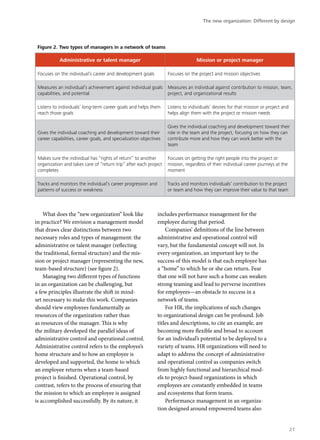
team-based structure) (see figure 2).
Managing two different types of functions
in an organization can be challenging, but
a few principles illustrate the shift in mind-
set necessary to make this work. Companies
should view employees fundamentally as
resources of the organization rather than
as resources of the manager. This is why
the military developed the parallel ideas of
administrative control and operational control.
Administrative control refers to the employee’s
home structure and to how an employee is
developed and supported, the home to which
an employee returns when a team-based
project is finished. Operational control, by
contrast, refers to the process of ensuring that
the mission to which an employee is assigned
is accomplished successfully. By its nature, it
includes performance management for the
employee during that period.
Companies’ definitions of the line between
administrative and operational control will
vary, but the fundamental concept will not. In
every organization, an important key to the
success of this model is that each employee has
a “home” to which he or she can return. Fear
that one will not have such a home can weaken
strong teaming and lead to perverse incentives
for employees—an obstacle to success in a
network of teams.
For HR, the implications of such changes
to organizational design can be profound. Job
titles and descriptions, to cite an example, are
becoming more flexible and broad to account
for an individual’s potential to be deployed to a
variety of teams. HR organizations will need to
adapt to address the concept of administrative
and operational control as companies switch
from highly functional and hierarchical mod-
els to project-based organizations in which
employees are constantly embedded in teams
and ecosystems that form teams.
Performance management in an organiza-
tion designed around empowered teams also
Figure 2. Two types of managers in a network of teams
Administrative or talent manager Mission or project manager
Focuses on the individual’s career and development goals Focuses on the project and mission objectives
Measures an individual’s achievement against individual goals
capabilities, and potential
Measures an individual against contribution to mission, team,
project, and organizational results
Listens to individuals’ long-term career goals and helps them
reach those goals
Listens to individuals’ desires for that mission or project and
helps align them with the project or mission needs
Gives the individual coaching and development toward their
career capabilities, career goals, and specialization objectives
Gives the individual coaching and development toward their
role in the team and the project, focusing on how they can
contribute more and how they can work better with the
team
Makes sure the individual has “rights of return” to another
organization and takes care of “return trip” after each project
completes
Focuses on getting the right people into the project or
mission, regardless of their individual career journeys at the
moment
Tracks and monitors the individual’s career progression and
patterns of success or weakness
Tracks and monitors individuals’ contribution to the project
or team and how they can improve their value to that team
The new organization: Different by design
21
looks significantly different. Traditionally,
managers rate employees with little input
from others, but this is not a sufficient test of
performance under a team-centric approach.
The critical question now, with all team
members invited to weigh in, is: “Would we
want this person on our team again?” It is
not, “Did you make your manager happy?”
In such an environment, engagement can
improve as well, because employees generally
feel more connected to their “team” than their
“organization.”16
Lessons from the front lines
Cisco, one of the world’s most successful
and enduring technology companies, sees a
team-based organizational model as fun-
damental to its strategy. According to John
Chambers, executive chairman and former
CEO, speed and time to market are central to
the company’s success: “We compete against
market transitions, not competitors. Product
transitions used to take five to seven years; now
they take one to two.”17
To address this continued disruption and
the highly competitive nature of its business,
Cisco has set up a new talent organization,
Leadership and Team Intelligence, focused
entirely on leadership and team development,
team leader selection, performance manage-
ment, and intelligence-gathering for Cisco
teams and their leaders around the world.
Ashley Goodall, the senior vice president who
runs this group, is leading a wide-ranging
redesign of Cisco’s talent practices and tech-
nologies to focus on the optimization of
team performance, team leaders, succession
management, and talent mobility between
teams. He plans to use real-time performance
conversations, ongoing pulse surveys, and text
analytics to monitor and benchmark team
performance. The intent is to build informa-
tion about how the best teams work together
and how they drive results, and then embed
these insights into the company with a direct
focus on employee engagement, strengths,
and empowerment.18
Global Human Capital Trends 2016
22
Where companies can start
•	 Revisit your organization’s design: Look
at ways to bring functional experts into
“mission-driven” teams focused on custom-
ers, markets, or products.
•	 Set up a real-time information network: A
successful network brings together dispa-
rate information on customers or products
to give team members integrated data on
performance in real time. Look at how
people seek and find information today
using design thinking.
•	 Eliminate organizational layers:
Departments whose mandate is to fix or
service other parts of the organization
should be converted to shared-service
groups. Question the role and the need for
middle managers.
•	 Rethink your rewards and goals: Optimize
performance management around “team
performance” and “team leadership” rather
than focusing solely on individual per-
formance and designating individuals as
leaders simply by virtue of their title or role.
Reward people for project results, collabo-
ration, and helping others.
•	 Adopt new team-based tools: Put in
place tools and measurement systems that
encourage people to move between teams,
and share information and collaborate with
other teams. Consider performing an orga-
nizational network analysis.
•	 Let teams set their own goals: Teams
should be held accountable for results—but
let them decide how to perform and social-
ize and communicate these goals among
the team.
•	 Communicate shared vision and values
from top leaders: Encourage senior leaders
to focus on strategy, vision, and direction,
and teach them how to empower teams to
deliver results.
BOTTOM LINE
The days of the top-down hierarchical organization are slowly coming to an end, but changing
the organization chart is only a small part of the transition to a network of teams. The larger,
more important, and more urgent part is to change how an organization actually works. Now,
more than ever, is the time to challenge traditional organizational structures, empower teams,
hold people accountable, and focus on building a culture of shared information, shared vision,
and shared direction.
The new organization: Different by design
23
1.	 General Stanley McChrystal et al., Team of
Teams: New Rules of Engagement for a Complex
World (New York: Penguin Publishing Group,
2015).
2.	 Gillian Tett, The Silo Effect: The Peril of Exper-
tise and the Promise of Breaking Down Barriers,
(New York: Simon & Schuster, 2015).
3.	 Ibid; McChrystal et al., Team of Teams.
4.	 Tett, The Silo Effect.
5.	“3M investments in Wroclaw,” November 2014,
http://www.wroclaw.pl/en/3m-investments-in-
wroclaw; Nestlé company executives, in meet-
ings with Josh Bersin and others, May 2014.
6.	 Raghu Krishnamoorthy, “The corporate HQ
is an anachronism,” Harvard Business Review,
March 13, 2015, https://hbr.org/2015/03/the-
corporate-hq-is-an-anachronism.
7.	 Drake Bennett, “The Dunbar number, from
the guru of social networks,” January 10, 2013,
Bloomberg Business, http://www.bloomberg.
com/bw/articles/2013-01-10/the-dunbar-num-
ber-from-the-guru-of-social-networks.
8.	 Vivian Giang, “The ‘two pizza rule’ is Jeff Bezos’
secret to productive meetings,” Business Insider,
October 30, 2013, http://www.businessinsider.
com/jeff-bezos-two-pizza-rule-for-productive-
meetings-2013-10.
9.	 Nestlé executives, in meetings with Josh Bersin
and others, May 2014.
10.	Gwen Moran, “How Uber changed the way they
hire,” Fast Company, April 1, 2014, http://www.
fastcompany.com/3028390/bottom-line/how-
uber-changed-the-way-they-hire.
11.	Company executives, in conversation with Josh
Bersin, October 2015.
12.	Company executives, in conversation with Josh
Bersin, October 2015.
13.	Stacia Sherman Garr, High-impact performance
management: Using goals to focus the 21st-cen-
tury workforce, Bersin by Deloitte, 2014, http://
marketing.bersin.com/high-impact-perfor-
mance-management.html.
14.	Ibid.
15.	Karen O’ Leonard and Jennifer Krider, Leader-
ship development factbook 2014: Benchmarks
and trends in U.S. leadership development (PPT),
Bersin by Deloitte, 2014, http://marketing.ber-
sin.com/leadership-development-factbook-2014.
html.
16.	Josh Bersin, “The five elements of a ‘simply
irresistible’ organization,” Forbes, April 4,
2014, http://www.forbes.com/sites/joshber-
sin/2014/04/04/the-five-elements-of-a-simply-
irresistible-organization/#5a26d70f4cf3.
17.	Krithika Krishnamurthy, “We compete against
market transitions not competitors: John Cham-
bers, Cisco,” The Economic Times, December 14,
2015, http://economictimes.indiatimes.com/
opinion/interviews/we-compete-against-mar-
ket-transitions-not-competitors-john-chambers-
cisco/articleshow/50168070.cms.
18.	Ashley Goodall, personal communication to the
authors, February 11, 2016.
Endnotes
Global Human Capital Trends 2016
24
Authors
Tiffany McDowell, Deloitte Consulting LLP | tmcdowell@deloitte.com
Tiffany McDowell is a principal in Deloitte Consulting LLP’s Human Capital practice and serves as the
national leader for the Organization Strategies practice. She has 16 years of business and consulting
experience, delivering operating model, organizational design, talent strategies, decision optimization,
and change management solutions. Her focus is on helping executives in health care effectively lead
their organizations through transformation. McDowell holds an MBA and a doctorate in industrial/
organizational psychology.
Dimple Agarwal, Deloitte MCS Limited | dagarwal@deloitte.com.uk
Dimple Agarwal is the global leader of Organizational Transformation and Talent for the Human
Capital practice. She consults at the C-suite level on operating model and organizational design, HR and
talent strategies, leadership strategies and development, merger integration, and major transformation
programs. Her 20-plus years of consulting experience includes working in the United Kingdom,
Netherlands, France, Switzerland, India, Malaysia, Nigeria, and the UAE.
Don Miller, Deloitte Consulting LLP | domiller@deloitte.com
Don Miller has more than 15 years of industry and consulting experience. In his current role, he
serves on the global leadership team of our Organization Strategies practice, which focuses on helping
clients improve performance by building organization structures to execute new capabilities through
their people and on aligning a business’s capabilities, metrics, processes, and culture with its structure,
leadership, roles, and talent. Miller also helps clients solve some of their top business challenges
by creating tailored workforce transition, strategic change management, talent, and leadership
development solutions.
Tsutomu Okamoto, Deloitte Tohmatsu Consulting LLC | tsokamoto@tohmatsu.jp
Tsutomu Okamoto has almost 20 years of consulting experience with Deloitte Tohmatsu Consulting
Human Capital. He leads the Talent Management and Workforce Planning and Analytics practice
in Japan and has delivered HR consulting services in areas including HR management and strategy
planning, headcount/labor cost management, talent management, organization design, restructuring,
and simplification.
Trevor Page, Deloitte Africa | trepage@deloitte.co.za
Trevor Page is the global leader of Organization Design for the Human Capital practice and is leading its
organization design methodology and global capability development. As a partner in Deloitte’s Human
Capital consulting practice in Africa, Page focuses on business transformation in large companies and
on improving the effectiveness at people at work. He has directed projects related to HR strategy, process,
and technology; strategic organizational change; and large-scale organizational redesign.
Contributors
Andrea Derler, Ben Dollar, Amir Rahnema, and Yves Van Durme
The new organization: Different by design
25
Leadership continues to be a pervasive concern among HR and business
leaders around the world, ranking higher in importance than it did in last
year’s global survey. As organizations become increasingly team-centric, the
workforce becomes both younger and older, technology catalyses faster change,
and business challenges grow more global and diverse, fresh challenges in
leadership development emerge. Organizations need to refocus on leadership
as a whole to build versatile leaders earlier in their careers, form leadership
teams that mix different generations and varieties of leaders, and develop
leaders deeper in the organization—all with a structured and evidence-
based foundation for leadership priorities, programs, and investments.
LEADERSHIP remains a top priority in
C-suites worldwide, ranking second in
overall importance in this year’s survey. (See
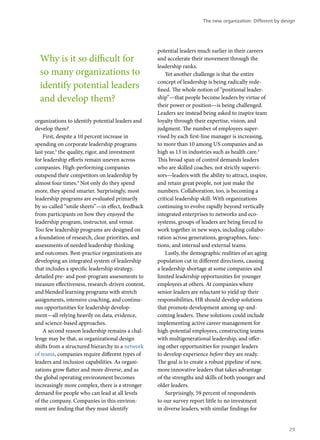
figure 1 for our survey respondents’ ratings of
leadership’s importance across global regions
and selected countries.) The percentage of
companies that rate this issue as important or
very important grew to extremely high lev-
els. Nor is this surprising, as the challenges
are immense.
Today, organizations need to explore new
approaches to leadership development. They
should seek to apply rigorous, structured,
scientific approaches to succession planning
and development, aiming to identify poten-
tial leaders earlier and fast-track them into
leadership positions. Also important is to find
ways to develop leaders who can collaborate
extensively, recognize the need for new leader-
ship skills (such as conceptual thinking), and
focus on new leadership cohorts (Millennials,
women, and diverse individuals). All of this
requires implementing a comprehensive cul-
ture around leadership to address the leader-
ship gap continuously and systemically.
While companies believe they are making
progress in some areas—for instance, the per-
centage of companies with strong role-based
Leadership awakened
Generations, teams, science
•	 The leadership challenge is urgent and growing in importance. In 2016, 89 percent of companies
see leadership as an important or very important issue (up from 87 percent in 2015), and 57 percent
cite leadership as very important (up from 50 percent).
•	 Twenty-eight percent of respondents reported weak or very weak leadership pipelines.
•	 The profile for top leaders is complex and evolving. Organizations need to develop fundamental
leadership capabilities among critical individuals and teams—capabilities that include the ability to
collaborate across boundaries, conceptualize new solutions, motivate diverse teams, and develop
the next generation of diverse and global leaders.
The new organization: Different by design
27
and experiential leadership programs grew
from 9 percent last year to 20 percent this
year—many major gaps remain:
•	 Only 7 percent of companies believe
they are “excellent” at building
Millennial leaders.
•	 Only 13 percent of companies report they
are “excellent” at building global leaders.
•	 Only 14 percent of companies surveyed
described themselves as “strong” at succes-
sion planning throughout the business.
These data, along with the data gathered
by Global Human Capital Trends over the
past three years, suggest that the leadership
development paradigm that many companies
around the world follow is simply not deliver-
ing what is expected and necessary.
Last year, companies spent nearly $31 bil-
lion on leadership programs.1
Yet, as Barbara
Kellerman of Harvard University (The End
of Leadership) and Jeffrey Pfeffer of Stanford
University (Leadership BS) have recently
written, the leadership world continues to be
dominated by stories, myths, and fads, often
promoting superficial solutions that appear
effective but fail to address the issue of help-
ing leaders to learn and that do not deliver
measurable impact and results.2
Indeed, 40
percent of our survey respondents believe that
their current leadership programs provide only
“some” value, and 24 percent report that they
yield little to no value.
Why do organizations find this issue so
intractable, even after investing heavily in
leadership programs? If investment in IT and
learning delivers results, why can’t HR show
similar benefits from investments in leadership
development? Why is it so difficult for so many
Global Human Capital Trends 2016
28
organizations to identify potential leaders and
develop them?
First, despite a 10 percent increase in
spending on corporate leadership programs
last year,3
the quality, rigor, and investment
for leadership efforts remain uneven across
companies. High-performing companies
outspend their competitors on leadership by
almost four times.4
Not only do they spend
more, they spend smarter. Surprisingly, most
leadership programs are evaluated primarily
by so-called “smile sheets”—in effect, feedback
from participants on how they enjoyed the
leadership program, instructor, and venue.
Too few leadership programs are designed on
a foundation of research, clear priorities, and
assessments of needed leadership thinking
and outcomes. Best-practice organizations are
developing an integrated system of leadership
that includes a specific leadership strategy,
detailed pre- and post-program assessments to
measure effectiveness, research-driven content,
and blended learning programs with stretch
assignments, intensive coaching, and continu-
ous opportunities for leadership develop-
ment—all relying heavily on data, evidence,
and science-based approaches.
A second reason leadership remains a chal-
lenge may be that, as organizational design
shifts from a structured hierarchy to a network
of teams, companies require different types of
leaders and inclusion capabilities. As organi-
zations grow flatter and more diverse, and as
the global operating environment becomes
increasingly more complex, there is a stronger
demand for people who can lead at all levels
of the company. Companies in this environ-
ment are finding that they must identify
potential leaders much earlier in their careers
and accelerate their movement through the
leadership ranks.
Yet another challenge is that the entire
concept of leadership is being radically rede-
fined. The whole notion of “positional leader-
ship”—that people become leaders by virtue of
their power or position—is being challenged.
Leaders are instead being asked to inspire team
loyalty through their expertise, vision, and
judgment. The number of employees super-
vised by each first-line manager is increasing,
to more than 10 among US companies and as
high as 13 in industries such as health care.5
This broad span of control demands leaders
who are skilled coaches, not strictly supervi-
sors—leaders with the ability to attract, inspire,
and retain great people, not just make the
numbers. Collaboration, too, is becoming a
critical leadership skill: With organizations
continuing to evolve rapidly beyond vertically
integrated enterprises to networks and eco-
systems, groups of leaders are being forced to
work together in new ways, including collabo-
ration across generations, geographies, func-
tions, and internal and external teams.
Lastly, the demographic realities of an aging
population cut in different directions, causing
a leadership shortage at some companies and
limited leadership opportunities for younger
employees at others. At companies where
senior leaders are reluctant to yield up their
responsibilities, HR should develop solutions
that promote development among up-and-
coming leaders. These solutions could include
implementing active career management for
high-potential employees, constructing teams
with multigenerational leadership, and offer-
ing other opportunities for younger leaders
to develop experience before they are ready.
The goal is to create a robust pipeline of new,
more innovative leaders that takes advantage
of the strengths and skills of both younger and
older leaders.
Surprisingly, 59 percent of respondents
to our survey report little to no investment
in diverse leaders, with similar findings for
Why is it so difficult for
so many organizations to
identify potential leaders
and develop them?
The new organization: Different by design
29
Millennials (59 percent) and women (49 per-
cent). Such investments, though, are extremely
important to allow companies to leverage the
strengths of Millennial leaders—often well-
suited to fast learning and conceptual think-
ing—and Baby Boomer leaders in their 50s and
60s—who often bring strengths in behavior
and influence along with valuable institutional
knowledge. The challenge is to combine and
build the strengths of leaders at all levels and of
all descriptions.
This leads to an important question: Are
companies ready for the new leaders who are
needed today? Many organizations may not
be prepared to accept a new generation of
leaders, or even to build an environment that
allows them to emerge. Yet consider some of
today’s leaders. Google’s Larry Page was 38 at
the time of his appointment; PetSmart’s David
Lenhardt, 43; GameStop’s J. Paul Raines, 46.
This new breed of CEOs is younger, more
global, and more digitally savvy than their pre-
decessors. They rose up from the ranks, often
leapfrogging incumbents to go on to transform
their businesses.6
At the same time, the impact of leaders is
too high to simply jettison one generation of
leaders for another. As organizations become
flatter and more dispersed, companies need
better strategies for developing leaders to
perform both as individuals and in teams—
to operate in dyads and triads as well as on
one’s own.
Important to this effort is to think system-
atically about leadership. A portfolio approach
that simply assembles a selection of offerings
from different vendors is unlikely to promote
consistency in leadership development or to
ensure that future leaders receive the train-
ing they need to direct today’s team-focused
organizations. Identifying and developing
exceptional leaders require a far more rigorous
process, including:
•	 The use of evidence and analytics to
identify game-changers who may be
going unnoticed
•	 Expanding the use of online tools to enable
organizations to identify high-potential
employees earlier in their careers and
potential leaders around the world
•	 Better use of leaders in the later stages of
their careers to team with, mentor, and
develop the next generation of leaders
•	 The development of a comprehensive
leadership system—not simply a collection
of training packages—that can effectively
assess talent across the organization; focus
training on high-potential employees; and
provide opportunities for younger leaders
to gain the skills, experiences, and insights
they need to thrive in leadership roles
Global Human Capital Trends 2016
30
Every aspect of leadership—from strategy
and assessment to leadership development
and program evaluation—should be executed
with a degree of rigor and the use of data
that is simply not part of most leadership
programs today.
Lessons from the front lines
In 2012, Macquarie Group Limited, a global
investment banking and diversified financial
services group, reevaluated its leadership
development programs.7
The company’s goal
was to ensure that leadership offerings contin-
ued to build capability
at the director level
in order to allow
Macquarie to identify
and take advantage of
new opportunities in
a complex and rap-
idly evolving market.
Macquarie aimed to
design and deploy a
best-in-class global
leadership develop-
ment experience. The
new program would
have a clear focus on fast-tracking leaders and
on further broadening its leaders’ perspectives.
The program needed to be highly practical
and business-focused, while also underpinned
by a strong scientific foundation and rigorous
learning methodology.
Following a six-month analysis and design
process, Macquarie launched a pilot program
in early 2014. Offered to a selection of associate
directors located in Macquarie’s major hub cit-
ies in Europe, Asia, Australia, and the United
States, the program consisted of two three-day
workshops delivered over a 12-month period,
supplemented with a series of one-on-one
coaching sessions, a 360-degree assessment,
and a skilled volunteering experience.
Recognizing that Macquarie staff lean
strongly toward intellectually challenging
and practical learning, the associate director
program provided Macquarie leaders with
a strong mental framework as well as easily
digestible and readily applicable tools for their
day-to-day work. The cornerstone of the pro-
gram’s success was to not give participants a set
of generic answers, but instead to teach leaders
a set of questions they could ask themselves to
help solve their own unique challenges. They
were not taught how to behave, but how to
think: The program’s catchphrase is “Think.
Lead. Act.” Built around six core capabilities
such as “setting direction,” “inspirational lead-
ership,” and “collaboration,” this flexible and
innovative approach to learning allowed the
content to be applied
easily across business
lines and geographies.
Since 2014, over
500 associate direc-
tors have enrolled
in the program.
Feedback from both
participants and the
business has been
overwhelmingly posi-
tive, indicating that
the program’s com-
mercially focused and
cognitive approach to development was much
more effective than more traditional, static
approaches. Participants reported the ability
to readily apply their newly gained knowledge
to their roles, enabling directors to thus focus
more on commercial priorities. In addition, in
Macquarie’s recent global staff survey, alumni
of the program were significantly more posi-
tive in their attitudes toward career progres-
sion and development opportunities than
their peers.
Based on the success of the associate direc-
tor program, Macquarie designed and piloted
a program at the division director level in
2015. This program builds upon the associate
director program’s highly practical approach
to broadening participants’ thinking through
simple and memorable concepts, while
integrating several new learning innovations.
Rigorous analysis
and evidence should
inform every step
of the leadership
development process.
The new organization: Different by design
31
These include a “lab-based” approach to learn-
ing in which participants work on challenges
as a group, supported by several coaches in the
room. The program also focuses on establish-
ing greater connections between participants,
giving them a more integrated understanding
of each arm of the business as well as help-
ing them identify commercial synergies and
potential client opportunities.
Where companies can start
•	 Take a fresh, hard look at leadership
development strategy: Many companies
find that this is the best place to start.
Nearly two in three of our respondents (61
percent) report that they have updated their
leadership strategy in the last year or are
currently doing so. Perhaps most impor-
tant is to challenge the current strategy: Is
it delivering the impact, results, leadership
pipeline, and caliber of leaders the business
needs now and in the future?
•	 Cast a wider and deeper leadership net:
Many organizations are trying to broaden
the definition of leaders and leadership, yet
too often that definition is still not broad
enough. The potential leadership pool
must expand teams and networks of teams
beyond organizational boundaries.
•	 Build leadership programs on a founda-
tion of evidence, data, and analytics:
Insights from data can help organizations
identify the DNA of successful leaders.
Rigorous analysis and evidence should
inform every step of the leadership devel-
opment process, including candidate
identification, development, coaching, and
career progression. Leadership programs
should be evaluated by their impact—
their ability to strengthen leaders and the
results they deliver—and rapidly move
beyond the edutainment focus of many of
today’s programs.
•	 Broaden and deepen leadership capabili-
ties: Today’s leaders need both traditional
leadership capabilities and new skills.
Rotational programs may be an effective
way to identify and develop future leaders.
Stretch programs across functions and busi-
nesses, as well as in nontraditional areas
(for example, the social and not-for-profit
sectors), can offer opportunities to develop
and test emerging leaders.
•	 Identify and foster teams of leaders: An
important goal for most organizations is to
develop new models of leadership teams,
combining leaders of different generations
and perspectives. For many organizations,
this is a new focus and will be critical in the
future, when organizations will need both
teams of leaders and leaders who can drive
and motivate teams.
•	 Focus on young, diverse leaders:
Identifying great leaders as early as possible
is an important way to deepen the leader-
ship bench and promote dramatic change.
•	 Rethink leadership investment: Simply
spending more money on leadership pro-
grams is unlikely to be enough. To deliver
a superior return on investment, leadership
spending must be far more focused on and
targeted at what works. Leading companies
both spend more and spend more wisely,
with a focus on evidence and results.
Global Human Capital Trends 2016
32
BOTTOM LINE
We have written in the past of the “overwhelmed employee.”8
Today, perhaps the theme should
be the “overwhelmed leader”—underscoring the need to identify new leaders early and develop
them appropriately.
Is the organization’s leadership strategy, pipeline, and programs up to the task? Our data on this
question over the past several years suggest not. To make progress on the perennial and pervasive
challenges of leadership, companies need to ask hard questions. Who in the organization is likely
to be a true game-changer? Does the organization tend to promote people who look and think
like current leaders? Do current leaders conduct deep analyses to identify and develop people with
potential, wherever and whomever they may be? How much time do leaders in the organization
spend on elevating team effectiveness? Are the strategy, focus, and rigor of leadership programs
up to the needs, skills, and challenges of the future? Only by answering such questions can
organizations find ways to effectively cultivate the leadership talent that they will need to
compete—today and in the future.
The new organization: Different by design
33
1.	 Karen O’Leonard and Jennifer Krider, Leader-
ship development factbook 2014: Benchmarks
and trends in U.S. leadership development, Bersin
by Deloitte, 2014, http://marketing.bersin.com/
leadership-development-factbook-2014.html.
2.	 Barbara Kellerman, The End of Leadership (New
York: HarperCollins, 2012); Jeffrey Pfeffer, Lead-
ership BS (New York: HarperCollins, 2015).
3.	 Raju Singaraju, Ben Carroll, and Eunyun Park,
Corporate learning factbook 2015: Benchmarks,
trends, and analysis of the US training market,
Bersin by Deloitte, 2015, http://bersinone.bersin.
com/resources/research/?docid=19202.
4.	 O’Leonard and Krider, Leadership development
factbook 2014.
5.	 Ibid.
6.	 Roselinde Torres, “The rise of the not-so-experi-
enced CEO,” Harvard Business Review, Decem-
ber 26, 2014, https://hbr.org/2014/12/the-rise-
of-the-not-so-experienced-ceo.
7.	 Murray Priestman (global head of talent, Mac-
quarie Group Limited), in conversation with
Juliet Bourke, January 2016.
8.	 Juliet Bourke, The overwhelmed employee: Sim-
plify the work environment, Deloitte, 2014, http://
www2.deloitte.com/au/en/pages/human-capital/
articles/overwhelmed-employee-simplify-envi-
ronment.html.
Endnotes
Global Human Capital Trends 2016
34
Authors
Nicky Wakefield, Deloitte Consulting Pte Ltd. | nwakefield@deloitte.com
Nicky Wakefield is a partner and the leader of the Southeast Asia Human Capital consulting practice.
With over 20 years of business consulting experience with clients across the globe, she is recognized as
one of the leading strategic thinkers on complex organizational change and is admired by her clients as a
practical, hands-on advisor and implementer. Wakefield has spent her career focused on the execution of
business strategy and helping organizations make it real for their people.
Anthony Abbatiello, Deloitte Consulting LLP | aabbatiello@deloitte.com
Anthony Abbatiello is a principal in Deloitte Consulting LLP’s Human Capital practice and the global
leader of Deloitte Leadership. He specializes in leadership development, culture transformation, and HR
strategy. Abbatiello has led industry and functional human capital practices, provided thought leadership,
and developed practitioners to deliver business results to clients. He serves global clients as a senior
advisor in leadership development, talent strategy, and digital HR.
Dimple Agarwal, Deloitte MCS Limited | dagarwal@deloitte.com.uk
Dimple Agarwal is the global leader of Organizational Transformation and Talent for the Human
Capital practice. She consults at the C-suite level on operating model and organizational design, HR and
talent strategies, leadership strategies and development, merger integration, and major transformation
programs. Her 20-plus years of consulting experience includes working in the United Kingdom,
Netherlands, France, Switzerland, India, Malaysia, Nigeria, and the UAE.
Karen Pastakia, Deloitte Canada | kapastakia@deloitte.ca
Karen Pastakia has over 15 years’ experience in the area of HR and talent consulting. Currently, she leads
the integrated Talent Management Strategies practice across Canada. She works with her clients to ensure
alignment between their talent objectives and investments and overall business strategy. Pastakia is also
one of Deloitte Canada’s marketplace inclusion leaders and has been intimately involved in the evolution
of Deloitte University globally.
Ardie van Berkel, Deloitte Consulting BV | avanberkel@deloitte.nl
Ardie van Berkel is Deloitte’s Human Capital practice leader for the Europe, Middle East, and Africa
(EMEA) region and a member of Deloitte’s global Human Capital executive committee. Van Berkel is
also a member of Deloitte’s supervisory board in the Netherlands, as well as an active market-facing client
service partner. She consults on merger integrations, organizational design, HR strategies, and change
management to support major transformation programs, primarily in the public sector.
Contributors
Juliet Bourke, John Crump, Andrea Derler, Marjorie Knight, Jeff Schwartz, and Yves Van Durme
The new organization: Different by design
35
Culture has become one of the most important business topics of 2016. CEOs
and HR leaders now recognize that culture drives people’s behavior, innovation,
and customer service: 82 percent of survey respondents believe that “culture
is a potential competitive advantage.” Knowing that leadership behavior
and reward systems directly impact organizational performance, customer
service, employee engagement, and retention, leading companies are using
data and behavioral information to manage and influence their culture.
FEW factors contribute more to business
success than culture—the system of values,
beliefs, and behaviors that shape how real work
gets done within an organization. Its close
connection to performance is not lost on HR
and business executives: Nearly nine in ten
(87 percent) of our survey respondents say
that culture is important, and 54 percent rate
it as very important, nine percentage points
more than last year. (See figure 1 for our survey
respondents’ ratings of culture’s importance
across global regions and selected countries.)
Culture brings together the implicit and
explicit reward systems that define how an
organization works in practice, no matter
what an organizational chart, business strat-
egy, or corporate mission statement may say.
A staggering number of companies—over
50 percent in this year’s survey—are cur-
rently attempting to change their culture
in response to shifting talent markets and
increased competition.
In an era in which bad news travels instan-
taneously and an organization’s culture is both
transparent and directly tied to its employment
brand, great companies consciously cultivate
and manage their culture, turning it into a
competitive advantage in the marketplace.
Have you ever wondered why certain compa-
nies hire great engineers, deliver seemingly
endless innovations, and generate consistent
growth, while others always seem to be rein-
venting themselves? A large part of the answer,
in one word, is culture.
Shape culture
Drive strategy
•	 Culture is a business issue, not merely an HR issue. The CEO and executive team should take
responsibility for an organization’s culture, with HR supporting that responsibility through
measurement, process, and infrastructure.
•	 While culture is widely viewed as important, it is still largely not well understood; many
organizations find it difficult to measure and even more difficult to manage. Only 28 percent of
survey respondents believe they understand their culture well, while only 19 percent believe they
have the “right culture.”
•	 Culture can determine success or failure during times of change: Mergers, acquisitions, growth,
and product cycles can either succeed or fail depending on the alignment of culture with the
business’s direction.
The new organization: Different by design
37
The importance of culture is readily appar-
ent when things go wrong. When two large
companies merged last year, for example, it
became clear that one company had a culture
of “low cost” while the other had a culture of
“quality service.” Employees received mixed
signals for months until the new management
team took the time to carefully diagnose and
redefine many business processes throughout
the company.
Given the importance of culture and the
consequences of cultural issues, many com-
panies are proactively defining culture and
issuing culture “manifestos.” The Netflix cul-
ture presentation,2
often used as an example,
has been downloaded more than 12 million
times since 2009.3
The presentation clearly
describes a culture that combines high expec-
tations with an engaging employee experience:
Generous corporate perks such as unlimited
vacation, flexible work schedules, and lim-
ited supervision balance a strong focus on
results with freedom and appreciation for the
expected achievement.4
The financial services industry, still restor-
ing its brand after the 2008 financial crisis, is
sharply focused on culture. One organization
is using a variety of initiatives to help employ-
ees understand “how the bank does business,”
including offering speaker series on topics such
as compensation packages, customer satisfac-
tion, and maintaining regulatory standards.
Citigroup has an entire committee focused
on ethics and culture and has implemented
a series of web-based videos detailing real
workplace ethical dilemmas. Bank of America
is focusing its corporate culture transformation
on encouraging employees to report and esca-
late issues or concerns, as well as incorporating
a risk “boot camp” into their current training.
Wells Fargo is increasing its efforts to gather
employee survey feedback to understand cur-
rent trends and potential areas of weakness in
its culture.5
This year, unlike in past reports, Global Human Capital Trends treats culture and engagement as two distinct
topics. Why? Because, while the two issues are intimately connected, the differences between them are significant,
and the importance of each has risen to justify a separate treatment and a separate, well-defined approach to
tackling it.
Culture describes “the way things work around here.” Specifically, it includes the values, beliefs, behaviors, artifacts,
and reward systems that influence people’s behavior on a day-to-day basis. It is driven by top leadership and
becomes deeply embedded in the company through a myriad of processes, reward systems, and behaviors. Culture
includes all the behaviors that may or may not improve business performance. Today, culture is a CEO-level issue
and something that can be measured and improved to drive strategy.
Engagement, in contrast, describes “how people feel about the way things work around here.” It is a way
of describing employees’ level of commitment to the company and to their work. According to our model,
engagement encompasses five broad areas: meaningful work and jobs, management practices and behaviors, the
work environment, opportunities for development and growth, and trust in leadership.1
When engagement is poor,
employees feel uneasy or uncommitted, resulting in high turnover, low performance, and low levels of innovation
and customer service. New tools are enabling companies to monitor engagement on a detailed, real-time basis,
delivering specific, actionable information to continuously improve the work environment.
The two are connected. When a company’s culture is clearly aligned with business strategy, it attracts people who
feel comfortable in it, which in turn should produce a high level of engagement. Conversely, programs to improve
engagement often discover cultural issues, forcing the company and its leadership to question and change its
values, incentives, programs, and structure. Both culture and engagement require CEO-level commitment and
strong support from HR to understand, measure, and improve.
Global Human Capital Trends 2016
38
A new industry of culture assessment tools
has emerged, enabling companies to diagnose
their culture using a variety of well-established
models.6
Yet despite the prevalence of these
tools, fewer than 12 percent of companies
believe they truly understand their culture.7
That’s where HR can help. As businesses try
to understand and improve their culture, HR’s
role is to improve the ability to curate and
shape culture actively. An organization’s capa-
bilities to understand and pull the levers of cul-
ture change can be refined and strengthened.
HR has a natural role to play in both efforts.
As operations become more distributed
and move to a structure of “networks of
teams,” culture serves to bind people together
and helps people communicate and collabo-
rate. When managed well, culture can drive
execution and ensure business consistency
around the world. HR has an opportunity to
assume the role of champion, monitor, and
communicator of culture across, and even out-
side, the organization. Once culture is clearly
described, it defines who the company hires,
who gets promoted, and what behaviors will be
rewarded with compensation or promotion.
To effectively understand and manage their
organization’s culture, business and HR leaders
must collaborate to answer a daunting set of
questions. For example:
•	 How do we create more high-impact
customer and employee experience
moments and ensure that we deliver
them consistently?
•	 How well does our performance manage-
ment or compensation system reinforce or
improve our culture?
•	 Are we willing to reduce productivity tem-
porarily to invest the time it takes to build a
culture of learning?
The new organization: Different by design
39
•	 What cultural issues lie behind problems
such as fraud, loss, or compliance issues?
Is punishing the offenders and reinforcing
good behavior enough, or does supporting
ethical conduct require changing cultural
norms that enable or even encourage
bad behavior?
•	 In M&A situations, how can cultural
barriers to integration be identified and
addressed before they become problematic?
•	 In today’s competitive talent environment,
how does our culture affect our employ-
ment brand and ability to attract, hire, and
retain top talent?
CEOs and senior business leaders should
work with HR to take a hands-on, data-driven
approach to managing culture. To monitor and
reinforce culture, companies must regularly
assess employee behavior and revisit reward
systems and business practices in all areas of
the company.
The good news is that there are many new
ways to research, measure, and monitor cul-
ture, enabling companies to approach the issue
rigorously and systematically. Just as employee
engagement is being transformed by internal
and external tools for feedback, corporate
culture is now transparent and open. Indeed,
many companies’ cultures are constantly being
discussed, shaped, and rated for the entire
world to see on social media platforms like
Glassdoor and LinkedIn.8
Some companies are taking action to
actively manage and change their culture:
•	Nordstrom has formed a People Lab
Science Team in an effort to define and
curate a culture that will attract top talent
and enable the retailer to compete with tech
companies such as Tableau and Microsoft.
The team takes a multidisciplinary
approach to designing programs to define
and reinforce Nordstrom’s culture.9
•	 Starbucks analyzed thousands of social
media entries to gain an objective view
of its culture through the eyes of its
employees and take specific actions to
reinforce its cultural strengths and address
cultural weaknesses.10
•	 Securitas Belgium has defined the behaviors
associated with its vision for culture, per-
formed an analysis of its current state, and
developed a detailed, measurable change
plan for 150 of its managers.11
•	 Software giant SAS was recently rated the
best place to work by the Great Place to
Work Institute. It is also highly successful,
with 37 consecutive years of record earn-
ings (it earned $2.8 billion in 2012). SAS
has identified trust as a critical cultural
attribute and regularly surveys its employ-
ees on elements of trust: communication,
respect, transparency, and being treated as a
human being.12
Once an organization develops a clear
understanding of its culture and decides on a
direction for cultural change, it is critical to
move rapidly from analysis to action. Moving
from talking to doing is the only way to build
momentum. For companies pondering a
cultural transformation, the time to start is
now—because many companies are already
way ahead.
Given the importance of culture
and the consequences of cultural
issues, many companies are
proactively defining culture and
issuing culture “manifestos.”
Global Human Capital Trends 2016
40
Lessons from the front lines
Culture is particularly important dur-
ing times of great change, such as mergers
and acquisitions or corporate divestitures,
which offer an opportunity for a fresh start
on culture.
Take the example of HP Inc., a global
technology company headquartered in Palo
Alto, CA, which began when Hewlett-Packard
Co. split into HP Inc. and Hewlett-Packard
Enterprise on November 1, 2015. The company
used the separation as a unique opportunity to
reinvent the sales culture and create an envi-
ronment that supports high-performing sales
organizational behaviors for the entire global
sales team of more than 6,500 employees. It
took a systematic approach, using a quantita-
tive tool to assess sales behaviors for all regions
and sales roles. Analyzing the complex inter-
section of sales behaviors, activities performed
by salespeople, sales competencies, and com-
pensation has provided insights that create
top-performing sales representatives, sales
managers, and teams. The findings from
this multifaceted analysis has enabled HP’s
top sales leaders to make “culture commit-
ments” at their global sales meeting in an
effort to begin to transform the company’s
sales culture.13
As another example, following its July
2015 spin-off of PayPal, eBay took the
opportunity to implement a deliberate
approach to redefining and actively manag-
ing its culture.14
eBay’s CEO has declared
himself to be “chief culture officer” to
emphasize his personal commitment to
driving change. On the first day of the new
company, he introduced a refreshed com-
pany purpose and five new values that are
intended to create a more brand-focused,
inventive, and bold work environment.
eBay is relying on new company values
to turn its culture aspiration into reality.
The value statements are being monitored
using a quantitative approach to measur-
ing and disseminating them: eBay’s team
of organizational development experts and
data scientists actively measures the strength
and adoption of these new values, regularly
surveying eBay employees on over 50 cultural
attributes that are mapped to the five recently
formulated values, and conducting employee
engagement surveys. This data is then com-
bined with operational metrics to assess the
extent to which compliance with cultural
values impacts the business.
To compare the internal view—that of
eBay’s employees—with an external view,
the analysts also conduct both thematic and
natural-language analysis on news articles
and Glassdoor content, to gain a data-driven
understanding of the ways that people discuss
eBay’s culture in the open market. This strong
effort has enabled eBay to quantify elements
of its culture and gain a more accurate under-
standing of how people both inside and outside
the company view it.
The new organization: Different by design
41
Where companies can start
•	 Culture cannot be delegated—it must be
on the CEO’s list of top priorities: C-suite
executives must clearly understand their
company’s cultural values, determine how
they relate to business strategy, and take
responsibility for shaping them, while also
analyzing whether their own behaviors
reinforce the desired culture.
•	 Understand both the current and the
desired culture: Business leaders should
closely examine current business processes
step by step to identify which practices are
aligned with the desired culture and which
are destructive and require change—which
begins by uncovering the values and behav-
iors that allowed those practices to develop.
While many HR organizations are building
teams to better communicate leaders’ vision
of the desired culture, these teams do not
always connect cultural change programs to
behaviors and business strategies.
•	 Examine the organization to determine
whether the targeted culture is taking
hold: Executives can drive permanent
cultural change throughout the organiza-
tion by reminding employees that culture
is a tangible set of attributes and behaviors
that can be clearly recognized at visible
“touchpoints” among employees and people
outside the firm.
•	 Measure culture: Use empirical tools to
understand employee attitudes and actions.
If measurement reveals that current behav-
iors conflict with desired cultural values,
refine the program to communicate and
model culture throughout the organization.
HR should take the lead in this effort.
BOTTOM LINE
Although HR has a distinct and proactive role to play in driving cultural change—one that leading
HR organizations have already embraced—the challenge of culture should be owned at the
highest level: by the leaders who are responsible for business strategy. Just as the CEO is ultimately
responsible for business strategy, the CEO is ultimately responsible for culture.
In short, leaders must understand that their beliefs and actions are the primary drivers of the
organization’s culture. In the “new organization,” senior leaders must drive cultural change
just as they do other cross-organization issues, reinforcing the behaviors necessary to support
the business strategy. Start by identifying the practices that need to change before any cultural
transformation can take hold, and then use the new tools available today to measure and manage
culture toward alignment with business goals.
Global Human Capital Trends 2016
42
Endnotes
1.	 Josh Bersin, “Becoming irresistible: A new
model for employee engagement,” Deloitte
Review 16, January 26, 2015, http://dupress.com/
articles/employee-engagement-strategies/.
2.	 Netflix, “Netflix culture: Freedom & respon-
sibility,” www.slideshare.net/reed2001/cul-
ture-1798664, accessed December 31, 2015.
3.	 Steve Henn, “How the architect of Netflix’s inno-
vative culture lost her job to the system,” Planet
Money, NPR, September 3, 2015, www.npr.
org/2015/09/03/437291792/how-the-architect-
of-netflixs-innovative-culture-lost-her-job-to-
the-system.
4.	 Patty McCord, “How Netflix reinvented HR,”
Harvard Business Review, January–February
2014, https://hbr.org/2014/01/how-netflix-
reinvented-hr.
5.	 Emily Glazer and Christina Rexrode, “What
banks are doing to improve their culture,” Wall
Street Journal, February 2, 2015, http://blogs.wsj.
com/moneybeat/2015/02/02/what-banks-are-
doing-to-improve-their-culture/.
6.	 Josh Bersin, “Feedback is the killer app: A
new market and management model emerges,”
Forbes.com, August 26, 2015, http://www.forbes.
com/sites/joshbersin/2015/08/26/employee-
feedback-is-the-killer-app-a-new-market-
emerges/#45b7a7286626.
7.	 Deloitte, Global Human Capital Trends 2015:
Leading in the New World of Work, 2015, http://
www2.deloitte.com/global/en/pages/human-
capital/articles/introduction-human-capital-
trends.html.
8.	 Glassdoor, “Top companies for culture and val-
ues,” www.glassdoor.com/Top-Companies-for-
Culture-and-Values-LST_KQ0,36.htm, accessed
December 11, 2015.
9.	 Nordstrom executives, interview with Josh Ber-
sin, December 2015.
10.	Jess Stein, Sophie Sakellariadis, and Alex Cole,
“Making sure the cup stays full at Starbucks,”
Monitor 360, http://monitor-360.com/ideas/
making-sure-the-cup-stays-full-at-starbucks,
accessed December 31, 2015.
11.	Securitas CEO, interview with Yves Van Durme,
May 2015.
12.	Mark Crowley, “How SAS became the world’s
best place to work,” Fast Company, January 22,
2013, www.fastcompany.com/3004953/how-sas-
became-worlds-best-place-work.
13.	Based on client work.
14.	Margarita Constantinides (senior director of tal-
ent analytics, eBay), interview with Ben Dollar,
December 28, 2015.
The new organization: Different by design
43
Authors
Marc Kaplan, Deloitte Consulting LLP | mkaplan@deloitte.com
Marc Kaplan is the US leader for Deloitte Consulting LLP’s Organization Transformation and Talent
practice. He has more than 16 years of experience in change management, talent management, training,
and organizational design. Kaplan has led the development and implementation of change management
and talent management solutions for business leaders across the C-suite. He specializes in serving life
sciences clients and has delivered large organizational transformations at many Fortune 500 companies.
Ben Dollar, Deloitte Consulting LLP | bdollar@deloitte.com
Ben Dollar is a principal in Deloitte Consulting LLP’s Human Capital practice. He focuses on
organizational design, talent management, and process improvement in manufacturing companies.
Dollar has helped some of Deloitte’s largest defense, automotive, and industrial products manufacturing
clients achieve tangible benefits through organizational design, process adoption, and human capital
management. He holds a BA from Vassar College and an MA from the University of Texas at Austin.
VerÓnica Melián, Deloitte SC | vmelian@deloitte.com
Verónica Melián is a consulting partner and the Human Capital practice leader for Deloitte LATCO.
She has over 20 years of industry and consulting experience, specializing in large-scale transformation
projects such as HR transformation and strategic change. Melián leads regional projects helping global
companies to implement their strategic initiatives in Latin America. She is a frequent speaker on HR
trends, organizational change, and culture.
Yves Van Durme, Deloitte Consulting | yvandurme@tohmatsu.be
Yves Van Durme is a partner in Deloitte’s Belgian consulting practice and the global leader of Strategic
Change for Deloitte’s Human Capital practice. He specializes in leadership and organizational
development and talent and HR strategy in business transformation contexts. Van Durme has over 17
years of experience as a consultant, project manager, and program developer on human capital projects
for multiple European, Japanese, American, and Belgian multinationals, family businesses, and small
and medium enterprises. His experience with high-performance coaching in sports gives Van Durme
a special affinity for leadership and organizational development work, focusing on the balance between
processes, structures, and systems on the one hand and cultural and people-related elements on the
other hand.
Jungle Wong, Deloitte Consulting (Shanghai) Co. Ltd. |
junglewong@deloitte.com.cn
Jungle Wong leads the Human Capital practice in Greater China and Asia Pacific. He has extensive
experience working with multinational enterprises located in China, as well as state-owned enterprises,
on solving talent and HR issues. He is a frequent speaker at HR conferences and an assessor for the
Chinese Business Leaders’ Awards. Wong is a regular writer for HR magazines in China.
Contributors
Anthony Abbatiello, Xu Bin, Sonny Chheng, David Mallon, Sonia Storr, and Haike van Dyck
Global Human Capital Trends 2016
44
Employee engagement continues to be a challenge for businesses, with 48
percent of this year’s survey respondents citing it as very important. The
demands and expectations of today’s diverse, multi-generational, mobile
workforce require a more flexible, employee-centric work environment, one
which companies are just beginning to learn to develop. This year will see
a strong focus on listening to employees, workforce health and well-being,
job redesign, and an enterprise-wide analysis of all dimensions of employee
engagement—all factors in what we call the “simply irresistible” organization.1
Employee engagement, like culture, has
become a CEO-level issue. Companies now
compete to win “best place to work” surveys
and monitor social media carefully. There is
an escalating war to design great workspaces,
provide flexible benefits, and create great
corporate cultures in an effort to drive higher
engagement. Nearly nine in ten executives (85
percent) in this year’s survey rated engagement
as an important (38 percent) or very important
(48 percent) priority for their companies. (See
figure 1 for our survey respondents’ ratings of
engagement’s importance across global regions
and selected countries.)
In the chapter on culture, we define both
the connections and the differences between
culture and engagement. Culture is the sense
of “how things are done around here”; engage-
ment is “how employees feel about how things
are done around here.” Engagement is an
aspect of workplace life that can—indeed,
should—be continuously monitored in a pro-
active way. It is about the future of an organiza-
tion; it is a measure of corporate health and a
key window into the potential for future issues
and workers’ support for change.
Three factors stand out as driving this focus
on engagement. First, there is intense competi-
tion for talented Millennials, many of whom
are less loyal to organizations than ever before.
Second, companies face a continued need to
attract workers with technological and other
specialized skills, as every company digitizes its
business. And third, an organization’s employ-
ment brand is now open and transparent, so
job candidates can easily see if a company is a
great place to work.
Engagement
Always on
•	 Employee engagement is a business imperative for leaders at all levels—above all, the CEO—and no
longer something to be measured just once a year by taking a look in the rear-view mirror.
•	 Despite the emergence of many tools for frequently evaluating employee sentiment, 64 percent of
organizations still only measure employee engagement annually.
•	 Managers and leaders are now accountable for engagement, but HR has to be proactive, implement
the right tools, and give business leaders a continuous stream of data with which to make future
decisions, promote a culture of listening, and ensure that reward systems are consistent with
engagement and retention goals.
The new organization: Different by design
47
The role of employee engagement within
HR is changing as well. Today, we find Chief
Learning Officers who own the engagement
challenge and executives with titles like “Chief
Employee Listening Officer.” These new titles
show how the topic of engagement has become
broader and more embedded in everything HR
must do.
Many companies still conduct some form of
employee engagement survey. Indeed, 64 per-
cent of senior executives in this year’s Global
Human Capital Trends survey noted that their
companies survey employees on engagement.
Yet many traditional engagement models have
fallen behind, precluding a more complete
view of the problem. Instead, engagement
today demands understanding a highly inclu-
sive, empowering work environment.
For one thing, today’s workforce is more
diverse than ever. Companies must man-
age as many as five generations of workers,
dispersed global teams, and a heterogeneous
mix of genders, races, cultures, and sexual
orientations. They also have many types of
workers in the mix: full-time and part-time
people, employees working at home, and
workers employed by contract agencies. Yet
despite this highly diverse population, research
finds that only 11 percent of companies have
a highly inclusive work environment, and 47
percent have cultural barriers preventing the
use of part-time people. Only 4 percent of
our respondents believe they are very good at
engaging Millennials and other generations in
the work environment.2
This is insufficient in a workplace in which
everything seems to be changing at once.
Employee demands are changing. Today’s
workers place a higher premium on flex-
ibility, creativity, and purpose at work. The
structure of companies is changing, putting
a greater emphasis on empowered teams and
Global Human Capital Trends 2016
48
team leadership. Companies are becoming
dependent on a new breed of empowering,
supportive, and open leaders at a time when
companies still struggle to find the leaders
they need.
The nature of careers is also changing.
Companies used to invest heavily in employees
with the intention of keeping them for decades
and seeing them grow and contribute for the
foreseeable future. Today, because employees
change jobs more rapidly, employers must pro-
vide development more quickly, move people
more regularly, provide continuous cycles of
promotion, and give employees more tools to
manage their own careers.
Engagement, in many ways, is the tempera-
ture gauge of a company’s ability to proactively
address all these issues on behalf of the work-
force. And research clearly shows that when
employees feel empowered and have a sense of
ownership for their jobs, their engagement is
significantly higher.3
Companies are just now beginning to adapt
to a new, implicit social contract between
employers and employees—one where people
can now easily explore new jobs or new
companies online. This new reality is pushing
employers to think of talent as “volunteers”
and constantly consider how they can make
work more meaningful and rewarding. After
all, in a world of social media recruiting sites
such as LinkedIn, employees are “always on”
the hunt for new possibilities.
Engagement likewise needs to adopt an
“always on” approach. Fortunately, new solu-
tions have emerged in the marketplace to
assess employee engagement. A new genera-
tion of “pulse” survey tools and open anony-
mous feedback systems can allow employees
to rate managers, executives, and just about
everything else at work on a near-real-time
basis. The thoughtful use of such tools can
create a true “listening environment” for
employees while giving leaders critical insight
into what’s working and what’s not working in
the company.4
The movement toward this “always on,”
feedback-based approach to engagement is
growing rapidly, disrupting traditional models
of measuring and managing employee engage-
ment. A number of companies are adapting to
more complex employee demands by listen-
ing more closely, trying new approaches, and
actively addressing operational problems:5
•	 A food retailer that operates coffee and food
services around the world began soliciting
anonymous employee feedback. Through
this feedback, the company found that the
drive-through window was chronically
understaffed, forcing teams to run back and
forth between different types of custom-
ers, which reduced quality while adding
stress and extra work. A store manager
implemented a dedicated drive-through
role, dramatically improving engagement
and productivity; the rest of the company
followed suit.
•	 One software executive pulses his sales
team every week and asks a simple ques-
tion: “How happy are you at work this week,
and what can we do to make things better?”
Employees offer suggestions about things
that he could be doing better, and he claims
that he can actually predict the following
week’s sales based on the feedback he gets
the Friday before.
Engagement, in many ways,
is the temperature gauge of a
company’s ability to proactively
address all these issues on behalf
of the workforce.
The new organization: Different by design
49
•	 An electric utility that suffered from a
major outage looked at employee feedback
and engagement data and discovered that
the outage could have been predicted (and
prevented) by more carefully monitoring
employee feedback. Now, the company uses
a real-time text analysis tool to monitor
open feedback from line workers around
the region.
As these examples show, just as companies
like Yelp, Glassdoor, and TripAdvisor offer
feedback everywhere in the outside world,
companies are also starting to offer open
feedback systems internally. Yet not all com-
panies are taking part in this transformation.
Surprisingly, nearly one in five executives
we surveyed (18 percent) reported that their
companies do not formally measure employee
engagement at all. Another 54 percent report
they are not fully ready to adopt an always-
on approach. And only 8 percent of the
executives we surveyed state that they measure
employee engagement on a monthly or more
frequent basis.
Nor is merely measuring engagement
the whole answer. Engagement, retention,
and employee productivity are complex and
multi-faceted problems. Employees today are
overwhelmed with too much work, manag-
ers are under pressure to build the right work
environment, HR is trying to build programs
for well-being and work-life balance, and the
business itself is trying to focus more heavily
on customers. The task around engagement,
then, is not simply to have an engagement
index but rather the far broader and more sig-
nificant challenge of building an “irresistible”
organization.6
Almost everything that happens at work has
a direct impact on employees’ commitment to
their work: how they are coached and evalu-
ated; the work environment and the tools with
which they work; their opportunities to grow
and develop; and, of course, their relation-
ships with managers and peers. Traditional
definitions of engagement, therefore, need to
be expanded to include five key elements that
drive engagement: meaningful work, hands-
on management, a positive work environ-
ment, opportunities for growth, and trust in
organizational leadership.
Finally, topics such as “mission,” “val-
ues,” and “contribution to society” are driv-
ing engagement more than ever.
Indeed, employees value “culture”
and “career growth” at almost
twice the rate at which they value
“compensation and benefits” when
selecting an employer.7
That is why
culture and work environment
have become the new drivers of
employment brand and employee
passion. The new model for “listen-
ing” must be coupled with a focus
on “vision” and “values” in lead-
ership as well. Engagement with
a mission has a magnetism no matter how
troubled an organization as a whole may be.
Lessons from the front lines
Quicken Loans, one of the United States’
largest providers of home loans with revenues
of more than $2.8 billion, operates in one of
the most traditional businesses in financial
services. Yet through a special combination
of leadership focus, employee programs, and
an innovative work environment, the com-
pany has been recognized as one of Fortune’s
100 best companies to work for in 2014,
Companies are just now beginning to
adapt to a new, implicit social contract
between employers and employees—one
where people can now easily explore new
jobs or new companies online.
Global Human Capital Trends 2016
50
2013, and 2012.8
How does Quicken Loans
accomplish this?
Quicken Loans looks at employee engage-
ment as core to its strategy of providing excel-
lent customer service. Its CEO, Bill Emerson, is
responsible for identifying engagement prob-
lems, creating solutions, and working with his
HR leadership to maintain the highest levels of
engagement in the industry.
One of Quicken Loans’ tools is a beautifully
written color book called The Quicken Loans
ISMs.9
ISMs are simple, easy-to-read principles
and examples, which the book illustrates with
pop art, that inform every business decision at
the company. Examples include, “Every client,
every time, no exception, no excuses”; “Obsess
with finding a better way”; “Yes before no”; and
“Ignore the noise.”10
These principles, coupled
with stories and examples, help employ-
ees feel empowered to do the right thing
for customers.
The company is located in Detroit, yet
its office feels like a high-tech startup. Open
offices, bright colors, and lots of flexible work
spaces help employees feel empowered, col-
laborative, and rewarded. The space is carefully
designed to feel like an outside street, with
minimal noise but lots of fun. Melissa Price,
Quicken Loans’ HR leader—as well as the CEO
of dPOP!, the design company that created the
office space—focuses heavily on feedback and
openness. “We want [workers’] feedback, and
then we immediately do something about it.
And that just encourages and promotes more
feedback and inclusion.”11
The company also offers child care, exer-
cise classes, snack food, and other amenities
not typically provided by many businesses.
Team members receive personal notes from
executives for anniversaries, birthdays, and
holidays—and the company gives away game
tickets, cash, and free trips when employ-
ees go the extra mile for customers. CEO
Emerson even gives employees his personal
phone number.12
The example of Quicken Loans clearly
shows that you don’t have to be a fast-growing
technology company located in Silicon Valley
to create an amazing, highly engaged place
to work.
Where companies can start
•	 Redefine engagement: Engagement is not
simply about turning an organization into a
great place to work. It also means reaching
down to the team and individual levels to
foster highly engaged teams of employees
doing work they love to do.
•	 Create a sense of passion, purpose, and
mission: Free food and ping-pong tables
are fun perks, but companies that succeed
in having highly engaged employees focus
intently on driving meaning, purpose, and
passion among workers.
•	 Focus on all three levels: Engagement must
be created, measured, and monitored at the
organization, team, and individual levels.
The new organization: Different by design
51
•	 Link compensation to engagement:
Managers must embrace engaging their
teams as one of their primary responsibili-
ties. Tying team leaders’ compensation to
their team members’ engagement sends
a powerful signal and drives a sense of
accountability about engagement efforts.
•	 Consider “stay” interviews: Many compa-
nies conduct “exit” interviews to find out
why employees are leaving. It is far better
to also use “stay” interviews to learn what
it would take for an employee to stay at
a company.
•	 Final check: Is your engagement effort
“always on”? Perhaps the biggest challenge
for HR in leading engagement programs is
shifting from a transactional, once-a-year
mind-set, to an “always on,” continuous lis-
tening approach to monitoring engagement.
BOTTOM LINE
Engagement is an issue not merely for HR but for the entire executive team. Leading companies
work proactively on engagement: They continuously ask themselves why their employees would
commit to working at the organization for any length of time and what they can do to make their
organization more attractive. Surveys may be important in determining levels of engagement, but
engagement fundamentally comes back to the question of exerting a continuous attraction for
workers in the open talent economy.
Engagement is not reactive but proactive. Efforts to build engagement should be “always on”
through extensive data use and analysis by business leaders. HR, too, must be proactive in
engagement efforts. Leading companies have made this their goal and are reaping the benefits;
all organizations that want a passionate workforce should follow suit.
Global Human Capital Trends 2016
52
Endnotes
1.	 Josh Bersin, “Becoming irresistible: A new
model for employee engagement,” Deloitte
Review, Deloitte University Press, January 2015,
http://dupress.com/articles/employee-engage-
ment-strategies/.
2.	 Stacia Sherman Garr, The diversity and inclu-
sion benchmarking report: An analysis of the
current landscape, Bersin by Deloitte, 2014,
http://bersinone.bersin.com/resources/
research/?docid=17320.
3.	 James B. Avey, Bruce Avolio, Craig Crossley, and
Fred Luthans, “Psychological ownership: Theo-
retical extensions, measurement, and relation
to work outcomes,” Journal of Organizational
Behavior 30 (2009): pp. 173–191, http://digitalc-
ommons.unl.edu/managementfacpub/18/.
4.	 Josh Bersin, “Feedback is the killer app: A
new market and management model emerges,”
Forbes.com, August 26, 2015, http://www.forbes.
com/sites/joshbersin/2015/08/26/employee-
feedback-is-the-killer-app-a-new-market-
emerges/#45b7a7286626.
5.	 Ibid.
6.	 Bersin, “Becoming irresistible: A new model for
employee engagement.”
7.	 Proprietary research by Glassdoor and Bersin by
Deloitte.
8.	 Rebecca L. Ray et al., The DNA of engagement:
How organizations create and sustain highly
engaging cultures, The Conference Board, Febru-
ary 2015, TCB_R-1564-14-RR, https://www.
conference-board.org/publications/publication-
detail.cfm?publicationid=2902.
9.	 “The Quicken Loans ISMs,” http://www.quicken-
loanscareers.com/about/culture/.
10.	Ray et al., The DNA of engagement.
11.	Ibid.
12.	Venessa Wong, “This CEO gives every employee
his cell number (seriously),” Bloomberg Business,
October 22, 2012, http://www.bloomberg.com/
bw/articles/2012-10-22/this-ceo-gives-every-
employee-his-cell-number-seriously.
The new organization: Different by design
53
Authors
David Brown, Deloitte Touche Tohmatsu | davidbrown@deloitte.com.au
David Brown, a consulting partner, leads the Human Capital practice in Australia. A member of the
global Human Capital practice leadership team, Brown has over 30 years’ experience in the human
capital space in both corporate HR and advisory roles. He has considerable international experience in
HR management across North America, Europe, and Asia, specializing in HR strategy and execution,
strategic change, workforce productivity/engagement, and talent management/development.
Josh Bersin, Bersin by Deloitte, Deloitte Consulting LLP | jbersin@deloitte.com
Josh Bersin founded Bersin & Associates, now Bersin by Deloitte, in 2001 to provide research and
advisory services focused on corporate learning. He is a frequent speaker at industry events and a popular
blogger. Bersin spent 25 years in product development, product management, marketing, and sales of
e-learning and other enterprise technologies. His education includes a BS in engineering from Cornell,
an MS in engineering from Stanford, and an MBA from the Haas School of Business at the University of
California, Berkeley.
Will Gosling, Deloitte UK | wgosling@deloitte.co.uk
Will Gosling leads the UK CHRO Transition and Development program. He advises private sector clients
in the areas of organization transformation, employee engagement, and HR effectiveness, specializing in
the technology, media, and telecommunications industry. Gosling also leads Deloitte’s digital leadership
research, and has founded a professional community for digital leaders and talent across the United
Kingdom. His work has received industry recognition, winning the MCA HR Consulting and CBI
Human Capital awards.
Nathan Sloan, Deloitte Consulting LLP | nsloan@deloitte.com
Nathan Sloan is a principal in Deloitte Consulting LLP’s Human Capital practice. Based in Charlotte, NC,
he works with global companies to determine the organizational structures, talent programs, and HR
priorities required to implement their business strategies. Sloan is the Human Capital leader for the retail
and wholesale distribution sector and also leads Deloitte’s National Talent Strategies practice, overseeing
the development of all talent management solutions.
Contributors
Dimple Agarwal, David Dye, Robin Erickson, Marc Kaplan, Robin Lissak,
Jeff Schwartz, Jaime Valenzuela, and David White
Global Human Capital Trends 2016
54
The pressure on organizations to improve learning and development continues
to intensify. Advances in technology, shifts in demographics, and the constant
competitive necessity to upgrade workforce skills are disrupting corporate learning.
These forces are pushing companies to develop new ways to put employees in
charge of the learning experience and foster a culture of learning throughout the
organization. This year, the big change is a shift beyond internal programs aimed at
developing people to innovative platforms that enable people to develop themselves.
LEARNING continues to be important to
HR and business executives worldwide as
they strive to adapt to the disruptive change
that is sweeping through corporate learning
and development organizations. (See figure 1
for our survey respondents’ ratings of learn-
ing’s importance across global regions and
selected countries.) Several factors are driving
the demand for change that has accelerated to
warp speed over the past year.
First, nearly every CEO and CHRO reports
that their companies are not developing skills
fast enough or leaders deeply enough.1
In
today’s highly competitive global economy and
intensely competitive talent market, the C-suite
clearly understands that companies that do
not constantly upgrade skills and rapidly
build leaders will not be able to execute their
business plans. In today’s business environ-
ment, learning is an essential tool for engaging
employees, attracting and retaining top talent,
and developing long-term leadership for
the company.
Second, the ubiquity of always-connected
mobile devices makes learning potentially
available everywhere and accessible to every-
one at any time. Employees can now take a
course on nearly any subject online, search for
an expert video or podcast to learn a quickly
needed skill, and even earn a college degree in
a new topic like data science without leaving
their desk—or a couch or coffee shop. This
new world of consumer-centric learning puts
employees, not L&D departments, in charge.
Third, employees at all levels now recog-
nize that “the learning curve is the earning
curve,”2
and they are demanding access to
dynamic learning opportunities that fit their
individual needs and schedules.3
Millennials
and other young employees have grown up
Learning
Employees take charge
•	 More than eight in ten executives (84 percent) in this year’s survey view learning as an important (40
percent) or very important (44 percent) issue.
•	 Employees at all levels expect dynamic, self-directed, continuous learning opportunities from
their employers.
•	 Despite the strong shift toward employee-centric learning, many learning and development
organizations are still struggling with internally focused and outdated platforms and static
learning approaches.
The new organization: Different by design
57
in this self-directed learning environment.
They expect it as part of their working lives
and careers—and they will move elsewhere if
employers fail to provide it. Already, 30 percent
of executives in our survey see learning as the
primary driver of employee development.
While many organizations are struggling
to adapt to these challenges, high-performing
companies are seizing the opportunity to
promote a new culture of learning, upend-
ing traditional models and transforming
how employees learn. These organizations
are adopting new mind-sets, fundamentally
rethinking what “learning” and “develop-
ment” mean in the context of their business.
They place the employee at the center of a new
architecture and new vision that treats learning
as a continuous process, not an episodic event,
and as a company-wide responsibility, not one
confined to HR (figure 2).4
Supporting this new vision, learning and
development organizations at these innovative
companies are adopting new and expanded
learning architectures.5
They see their role
as not simply to push out content they have
developed, but to enable employees to access
content from a wide range of internal and
external sources to create individual learn-
ing programs. To facilitate the effort to help
employees “learn how to learn,” L&D teams
are building internal knowledge-sharing
programs, developing easy-to-use portals and
video sharing systems, and promoting collab-
orative experiences at work that help people
constantly learn and share knowledge.
These efforts seek to leverage the profound
shifts taking place in the learning industry.
Traditional learning management system
companies are rapidly evolving in their ability
to deliver modern, compelling experiences
Global Human Capital Trends 2016
58
for learners. Now, a new breed of disruptive,
platforms is starting to arrive. New money and
ideas are pouring into this sector. CB Insights,
which tracks venture investments, estimates
that more than $3 billion was invested in new
learning and educational start-ups in the first
six months of 2015. Almost $1 billion of this
went into tools, content, and companies that
focus on the corporate market.6
Much of this investment is directed at tools
to harness video, new mobile learning apps,
and an explosion of content marketplaces.
Today, any employee can browse through
content from Coursera, Udemy, Udacity, or a
dozen other providers and instantly access a
lecture, course, or workshop on a needed skill.
Such platforms offer learning opportunities at
little or no cost and even allow employees to
interact online with experts in the field—learn-
ing exactly what they need, when they need it,
at a time that fits their schedules.
This kind of technologically enabled,
on-demand learning experience rarely exists
within a corporation, and it is a world away
from the traditional learning programs still
used by most L&D organizations. In particular,
many companies are still struggling to ride
the wave and integrate external platforms as
part of their employee learning. In our survey,
respondents cited a wide range of external
learning opportunities that could impact
internal development, including external
certificates (32 percent), MOOCs (18 percent),
and external, self-directed learning powered
by social media (14 percent). Still, despite this
robust array of choices, 61 percent of execu-
tives report challenges in moving their organi-
zations toward external self-directed learning.
The goal is no longer to craft a learning pro-
gram but to move beyond programs to curate
the learning experience. Corporate training
departments must become “learning experi-
ence architects” (to use a term from design
thinking), building a compelling and dynamic
experience for employees and helping employ-
ees learn how to learn.
Figure 3 describes some characteristics
of this new mind-set and the ways in which
Graphic: Deloitte University Press | DUPress.com
Source: David Mallon and Dani Johnson, The learning architecture: Defining development and enabling continuous learning, Bersin by Deloitte, 2014,
http://bersinone.bersin.com/resources/research/?docid=17435.
Immediate
Performance support and other tools for point-of-need learning
Q: What do I need to support my success in the moment?
Intermediate
Current job development and competency expansion
Q: What do I need to grow in my current role?
Transitional
Development of skills and relationships that
will meet long-term business goals
Q: What do I need to grow in my career?
Figure 2. A continuous learning model
Education
Environment
Exposure
Experience
The new organization: Different by design
59
it could reshape the role of L&D organiza-
tions that embrace it. Of these shifts, the most
fundamental for HR to make is to think of
learning from the perspective of a user’s daily
experiences and career aspirations, rather than
as a series of processes and programs that the
learning function wants to roll out. The chief
learning officer has the opportunity to lead
the charge to make L&D professionals more
like product managers working for custom-
ers who have unfulfilled needs, rather than
simply designers of courses that employees are
required to complete.
The transformation of learning is a power-
ful story, and most organizations are still in the
first or second act of this multi-act drama. But
the trend is clear: The learning organization
must help learners figure out how to obtain the
learning they need for themselves, from both
inside and outside the company. If your orga-
nization has not yet embarked on this journey,
the time to start is now.
Lessons from the front lines
MasterCard has been on a journey, trans-
forming itself from a traditional payments pro-
cessing company into a technology company
that provides the infrastructure that connects
consumers, banks, and businesses.7
With its
underlying business model evolving to address
new opportunities and competitive threats,
Figure 3. Learning, today and tomorrow
Today Tomorrow
Learning is a series of corporate programs built around
L&D-designed content and L&D-approved experts.
Learning is an “environment” and an “experience,”
leveraging experts, content, and materials sourced and
recommended by external communities as well as by other
employees and internal experts (not just L&D).
The learning environment is managed by a corporate
learning management system—essentially a large catalog
filled with courses.
The learning environment feels like a consumer website that
provides videos, courses, content, and access to experts—as
well as recommendation engines that help people find
precisely what they need.
L&D, business, and compliance experts push out training,
identifying required courses to be completed by employees
based on roles.
Employees pull learning, navigating and accessing
opportunities from inside and outside of the company.
The focus is on internal training sanctioned by the company. External training is available from any digital content source.
Learning professionals are generalists who do everything
from design to development, logistics, and measurement.
Learning professionals are specialists who are excellent at the
component they own.
Training follows a lecture-based model guided by an expert. Training is experiential, relying on simulations, case studies,
and flipped classrooms.
Employees learn specific skills through expert-guided
instruction.
Employees learn how to learn through facilitation and
coaching.
Organizations create detailed, exhaustive, skills-based
competencies that drive the learning agenda.
Organizations create high-level frameworks that outline
broad capabilities.
The learning organization plays a lead role in what a person
learns and focuses on delivering work experiences, interactions
with others, and formal training in the traditional 70-20-10
ratio.
The learning organization plays a supporting role in what
a person learns, expanding the 10 to include “inside” and
“outside” learning; shifting the 20 to include internal and
external networks; and redefining the 70 to include corporate,
community, and social experiences.
Global Human Capital Trends 2016
60
the company is seeking to build capabilities to
stay agile and keep new products and services
flowing. And with an increasingly diverse
workforce—now more than 40 percent Gen
Y—it is becoming harder to engage employ-
ees with traditional
learning approaches.
Janice Burns,
chief learning officer
and head of Global
Talent Development
and Organizational
Effectiveness, chal-
lenged her team
to reinvent their
approach to learn-
ing by constructing
responsive, agile, and
personal solutions
that would meet the
organization’s evolving demands along with
employees’. To do that, she first had to lead
a mind-set shift within her own organiza-
tion—away from periodic programs owned
by learning professionals to self-directed
solutions owned by individual employees.
No longer would her learning team focus on
telling people what to learn but instead show
them what they can learn, providing access to
resources, tools, and
connections to enable
individuals to do
their jobs and build
their careers better.
Key to refocusing
her team on the indi-
vidual was segment-
ing audiences and
getting to know their
needs, which she did
by aligning Global
Talent Development
(GTD) leaders
with specific busi-
ness units to work with operational leaders.
She also empowered her team to experiment
with new learning tools and technologies,
encouraging them to work lean, fail fast, and
The transformation of
learning is a powerful
story, and most
organizations are still in
the first or second act of
this multi-act drama.
The new organization: Different by design
61
scale up successes. Trying something that did
not work became acceptable—in some ways
a sign of tangible progress toward a culture
of innovation.
As they explored new learning formats, the
GTD team’s attention shifted from traditional
courses and programs pushed to employees
solely via the learning management system
(less important in any high-performing
learning organization), to more employee-
driven solutions such as mobile perfor-
mance support, massive open online courses
(MOOCs), on-demand micro-learning, and
online communities.
One new learning platform taking off with
MasterCard’s Operations & Technology (O&T)
group, for example, is Degreed. The system,
which enables self-serve career development,
empowers individuals and subject matter spe-
cialists to curate their own learning “playlists,”
mixing and matching internal and external
learning content from a variety of sources and
formats. Articles, videos, MOOCs, podcasts,
and webinars can all be woven together into
a personalized learning experience to help
employees develop the skills they want to
focus on.
The initial feedback from the roll-out to
the company’s O&T function is promising.
Stories highlight that managers and profes-
sionals now feel equipped with tools to drive
their own development. “I am willing to invest
more into the tool because it will follow me
no matter where my career takes me,” said one
systems analyst. Similar feedback will continue
to emerge as MasterCard deploys the platform
more broadly across the rest of
the enterprise.
MasterCard is in the early
stages of its journey toward a
culture of entrepreneurship and
empowerment. However, having
the GTD organization act as a
living example of this new cul-
ture through its own experimen-
tal approach has already enabled
it to become a meaningful catalyst for change
within MasterCard.
Where companies can start
•	 Recognize that employee-learners are
in the driver’s seat: Learning organiza-
tions should think deeply about how the
user experiences a company’s learning
offerings. Employees need to be viewed as
customers to be satisfied, rather than as
students to be pressured into traditional
learning classrooms.
•	 Become comfortable with the shift from
push to pull: Switching from a content-
centric “push” approach to a learner-centric
“pull” approach requires a cultural shift
within learning organizations. Giving up
full control over learning content, sched-
ules, and platforms may not be easy, but
learning organizations that embrace this
shift can deliver more effective learning
throughout the organization.
•	 Use design thinking: Learning organiza-
tions should think less about developing
content and more about the month-by-
month, day-by-day, and hour-by-hour
experience of the learner.
•	 Use technology to drive employee-centric
learning: Mobile, social, and web-based
platforms that can deliver on-demand
learning content are “must-have” capabili-
ties. The best systems can easily integrate
Employees need to be viewed as
customers to be satisfied, rather than as
students to be pressured into traditional
learning classrooms.
Global Human Capital Trends 2016
62
BOTTOM LINE
Shifting from an internally focused, corporate-centric learning universe to a learner-centric one
upends many long-held beliefs in the HR community. Employees will likely find it easier to make
this pivot than HR departments because this new world is already part of their mobile, social,
and online lives. For their part, business, learning, and HR leaders must embrace a new mind-set
that puts learners in the driver’s seat, redesigning programs to harness the power of technology
and the amazingly diverse wealth of instantly available external content, and offering great user
experiences to learners.
any type of digital content and allow
learners, as well as learning professionals
and business managers, to add and suggest
content. Companies should be cautious
before investing in massive new systems,
and they should monitor developments
from innovative vendors to help build effec-
tive learning applications.
•	 Realign and reengage: HR and learning
leaders must align the learning function
with business needs and goals. For many
learning teams, doing so can also be an
opportunity to reengage with employees,
as many learners have stopped looking to
their corporate learning departments for
training and are already immersed in the
enormous range of available digital learning
and content.
•	 Adopt a learning architecture that sup-
ports an expanded vision for develop-
ment: Rethink what “development” means
in the context of the organization. If such
a vision does not yet exist, adopt one and
communicate it broadly.
•	 Adopt a learning architecture that sup-
ports continuous learning: Dedicate
resources, set expectations, and align
corporate culture with the goal of enabling
employees to get the learning they need,
when they need it, at every stage in their
careers.
The new organization: Different by design
63
Endnotes
1.	 The Conference Board, “The Conference Board
CEO Challenge 2016,” https://www.conference-
board.org/publications/publicationdetail.
cfm?publicationid=6071.
2.	 Josh Bersin, “The use of MOOCs and online
education is exploding: Here’s why,” December
30, 2015, http://joshbersin.com/2015/12/the-
use-of-moocs-and-online-education-is-explod-
ing-heres-why/.
3.	 Josh Bersin, “Spending on corporate train-
ing soars: Employee capabilities now a pri-
ority,” Forbes, February 2014, http://www.
forbes.com/sites/joshbersin/2014/02/04/
the-recovery-arrives-corporate-training-spend-
skyrockets/#2bccf9de4ab7.
4.	 David Mallon and Dani Johnson, The learn-
ing architecture: Defining development and
enabling continuous learning, Bersin by Deloitte,
2014, http://bersinone.bersin.com/resources/
research/?docid=17435.
5.	 Bersin by Deloitte defines a learning architec-
ture as an organization’s unique map of agreed-
upon learning needs, learning strategies, and de-
livery strategies for all of its talent. This provides
both the L&D function and the business a clear
view of what types of problems the organization
will solve, how they will solve them, what tools
they need, and which approaches the organiza-
tion will take. It deliberately limits the orga-
nization’s options by deciding how and where
the L&D function will focus its efforts—and it
builds upon the organization’s culture and his-
tory of learning. (Source: Mallon and Johnson,
The learning architecture.)
6.	 Proprietary research by CB Insights, www.
cbinsights.com.
7.	 Based on client work at MasterCard.
Global Human Capital Trends 2016
64
Authors
Bill Pelster, Deloitte Consulting LLP | bpelster@deloitte.com
Bill Pelster has more than 20 years of industry and consulting experience. In his current role, he is
responsible for leading the Integrated Talent Management practice, which focuses on issues and trends in
the workplace. In his previous role as Deloitte’s chief learning officer, Pelster was responsible for the total
development experience of Deloitte professionals, including learning, leadership, high-potentials, and
career/life fit. Additionally, he was one of the key architects of Deloitte University and a US Consulting
board member.
Josh Haims, Deloitte Consulting LLP | jhaims@deloitte.com
Josh Haims is a principal with Deloitte Consulting LLP. He is a senior leader in Deloitte’s Learning
Solutions practice, co-founder of Deloitte’s Chief Learning Officer Forum, and sponsor of the Wall Street
Learning & Development Executive Roundtable. Dedicated to the discipline of learning, Haims’s career
spans more than 20 years in the field of corporate learning. He has supported Fortune 100 clients to help
them reimagine their learning strategies, enhance the learner experience, and improve the learning and
development function’s operational performance.
Jen Stempel, Deloitte Consulting LLP | jstempel@deloitte.com
Jen Stempel has more than 20 years of experience in corporate learning and leads Deloitte’s US Learning
Solutions practice. She works with large, complex global companies to optimize their learning functions
and help them realize value from their learning spend by improving their programs’ effectiveness,
operational efficiency, and alignment with business strategy. Stempel is a contributor to Deloitte’s Global
Human Capital Trends report and a frequent writer and speaker on learning and talent topics.
Bernard van der Vyver | bevandervyver@deloitte.nl
Bernard van der Vyver is a leading advisor on human capital matters, focusing on learning and
development. By merging his background in technology and its effective use with the development of
people, van der Vyver brings a unique strength to the HR domain. As Deloitte’s global learning solutions
leader, he aspires to grow and strengthen the global learning community by leveraging the organization’s
knowledge and expertise to deliver learning solutions that create unique value for clients.
Contributors
Jason Galea, Dani Johnson, Praveen Kaushik, and Jeff Schwartz
The new organization: Different by design
65
Employees are overwhelmed with technology, applications, and a constant flood
of information. Deloitte research shows that people collectively check their phones
more than 8 billion times each day,1
yet productivity is barely rising.2
To relieve
the overwhelmed employee and develop HR applications that can help manage
complexity, HR must adopt design thinking, which puts the employee experience
at the center.3
Design thinking moves HR’s focus beyond building programs
and processes to a new goal: designing a productive and meaningful employee
experience through solutions that are compelling, enjoyable, and simple.
TRADITIONAL HR solutions are typically
programs or processes to train people,
assess performance, ensure compliance, or
document a practice at work. Most were built
around forms, process steps, formal training,
or classroom events. While these strategies
work to a degree, today’s employees are already
overwhelmed with a flood of email, messages,
meetings, and other workplace distractions.
Two-thirds of companies now believe com-
plexity is an obstacle to business success and
a barrier to growth in business productivity.5
Perhaps this is one reason why 79 percent
of executives in this year’s Global Human
Capital Trends survey rated design thinking an
important or very important issue. (See figure
1 for our survey respondents’ ratings of design
thinking’s importance across global regions
and selected countries.)
Design thinking casts HR in a new role.6
It
transforms HR from a “process developer” to
an “experience architect.” It empowers HR to
reimagine every aspect of work: the physical
environment; how people meet and interact;
how managers spend their time; and how
companies select, train, engage, and evalu-
ate people. One CHRO calls herself the “chief
employee experience officer,” which effectively
summarizes this powerful new mandate.
Simply described, design thinking means
focusing on the person and the experience, not
the process. At its core, working as a designer
involves studying people at work, and develop-
ing “personas” and “profiles” to understand
Design thinking
Crafting the employee experience
•	 Design thinking provides a means to focus on the employee’s personal experience and to create
processes centered upon the worker. The result: new solutions and tools that directly contribute to
employee satisfaction, productivity, and enjoyment.
•	 HR departments should upgrade their skills to incorporate key design thinking concepts such as
digital design, mobile app design, user experience design, and behavioral economics.
•	 Design thinking is important, and it works. In this year’s survey, respondents at companies where HR
delivers the highest levels of value are almost five times more likely to be using design thinking in
their programs than their peers.4
employee demographics, work environment,
and challenges. It relies on generating ideas
quickly and testing prototypes that generate
further ideas, digital tools, and solutions.7
Applying design thinking to the work expe-
rience compels HR to ask, “What does a great
employee experience look like from end to
end? How can we facilitate collaboration and
learning in everything we do? How can we take
advantage of location-aware mobile devices
to make people more productive? How can
we give employees a few easy-to-understand
choices so they can make decisions faster?”
Many companies are relying upon design
thinking. GE, for example, has made simplifi-
cation a core new business strategy.8
It is intro-
ducing design thinking, a simplified model for
performance management, new mobile apps
for goal management and collaboration, and
a new set of principles for work. The company
now uses agile methodologies throughout
product development and is teaching managers
how to help teams “do less” and “focus more.”
One fundamental idea in design think-
ing is the use of behavioral economics. Many
HR practices can be replaced with “intelligent
choices,” using the principles of behavioral
economics to encourage better decisions.9
Should a company, for example, give people 10
options for 401(k) plans? Or rather select three
that offer the best performance? Such “choice
architecture” can make work far easier and
more enjoyable for employees—and increase
employee participation in the program.
Design thinking—or lack of it—can make
a huge difference in how companies are
perceived. Take recruiting. The Talent Board
found that more than half the candidates who
find the job-application experience difficult
develop a negative impression of the company’s
products and services.10
Companies such
as Zappos and others design the candidate
Global Human Capital Trends 2016
68
experience to attract high-performing people
and make it easy to find the right job and
apply quickly.11
Other companies are using design think-
ing to improve learning dramatically. Deckers
Brands,12
Nestlé,13
and Qualcomm14
have used
design thinking to develop highly intuitive,
experiential learning programs. Experiential
learning programs begin with the individual
and the context of an employee’s work rather
than a model in which the presenter is the
focus. They offer learning programs that are
much more stimulating and engaging and lead
to higher skills retention. In addition, they do
not depend on a learning management system
but can leverage new learning technologies to
promote continuous learning.
The data from our survey this year sug-
gest that the more importance an organization
places on design thinking and the more ready
it is to embrace it, the faster the organization
grows. Companies growing by 10 percent or
more per year are more than twice as likely
to report they are ready to incorporate design
thinking, compared to their counterparts that
are experiencing stagnant levels of growth.
Exciting new digital tools that employ
design thinking are also making routine HR
tasks more efficient and easy, while improv-
ing the employee experience. Australia and
New Zealand Banking Group developed an
easy-to-use mobile app that allows employees
to manage their time and attendance, benefits,
and vacation schedule, while also enabling
them to collaborate with colleagues.15
DuPont
completely redesigned its online HR portal
around the end user’s experience, dramatically
reducing the time employees spend on tradi-
tional HR management processes.16
Beyond
recruiting, learning, and other HR processes,
design thinking has been used to improve
performance management and coaching at
companies such as Adobe,17
and Autodesk,18
and New York Life.
Organizations are also starting to use
employee personas to understand the unique
needs of distinct employee segments. At one
Australian government agency, eight per-
sonas were considered as the agency was
designing a new HR portal. The organization
found that 27,000 of its 45,000 employees
were remote field workers who do not use
company-sponsored technology and function
independently. Through focus groups and a
survey, the agency uncovered surprising and
practical insights around communication, col-
laboration and knowledge management, and
self-service administration across all personas.
For example, the biggest frustration for these
remote employees was the inability to access
their work schedules, submit absence requests,
or order uniforms using their personal tech-
nology. These insights guided the systems
design. Today, the employee persona profiles
are a standard component of the agency’s
orientation program.19
With more companies embracing design
thinking, we see it connecting many of the
trends we highlight this year, including:
•	 Organizational design, which can incor-
porate design thinking when restructuring
roles or the organization itself
•	 Engagement, which research shows can be
driven by using design thinking to make
work easier, more efficient, more fulfilling,
and more rewarding
•	 Learning, in which new, self-directed learn-
ing experiences can be shaped by design
thinking’s central principle of putting the
user experience ahead of the process
Design thinking—or lack
of it—can make a huge
difference in how companies
are perceived.
The new organization: Different by design
69
•	 Analytics, in which data analysis and
design thinking can be linked to rec-
ommend better solutions directly to
the employee
•	 HR skills, which must be upgraded to
incorporate an understanding of digital
design, mobile application design, behav-
ioral economics, machine learning, and
user experience design
•	 Digital HR, where design thinking is criti-
cal in developing
new digital tools
that can make work
easier and better
Just as successful
companies continually
ask how to improve
customer experiences
and how those experi-
ences compare to their
competitors’, HR can
approach employee
experiences with the
same rigor. While
design thinking may
involve significant
changes to workplaces,
systems, processes,
and other business ele-
ments, its focus is on people.
As a recent Harvard Business Review article
by Jon Kolko noted, “People need their interac-
tions with technologies and other complex sys-
tems to be simple, intuitive, and pleasurable.”
Because “design is empathetic,” the article con-
tinues, “it implicitly drives a more thoughtful,
human approach to business”—one that makes
the workplace more attractive to both current
and prospective employees.20
Successful design thinking integrates an
understanding of human behavior. What
motivates people? How do they see them-
selves? What do they value? How do they
express those values in typical office behav-
ior? In seeking to answer these questions, HR
teams do not have to start from scratch—often,
they can look inside the organization for ideas
and inspiration.
Lessons from the front lines
Telstra is Australia’s leading telecommu-
nications and information services company,
offering a full range of communications
services and competing in all telecommunica-
tions markets. As with all telecommunications
companies, Telstra hires thousands of employ-
ees each year.21
New employees have to learn
a dizzying number
of systems, products,
pricing plans, and
ways of doing their
job, so turnover and
engagement are always
issues. To address this
strategic challenge,
Telstra used design
thinking to develop
a new “90-Day”
onboarding experi-
ence for all employees
as well as an indi-
vidualized executive
induction program.
The process
included:
•	 Focusing questions: “Discovery inter-
views” with leaders to frame the challenge
and set objectives for the program
•	 Ethnographic research: Interviews and
focus group sessions with employees, HR,
and managers to explore challenges and
needs across the first 90 days’ experience
•	 Synthesis: Comparing insights from the
ethnographic research with HR demo-
graphic and turnover data to identify key
transition points and work task areas that
could be dramatically improved to “delight”
employees
The data from our
survey this year
suggest that the
more importance an
organization places on
design thinking and
the more ready it is to
embrace it, the faster the
organization grows.
Global Human Capital Trends 2016
70
•	 Prototyping: Developing low-fidelity tools
and solutions that were tested and refined
multiple times to allow for “fast failure” and
the integration of lessons learned
•	 Visualisation: Using persona-based blue-
prints that describe the onboarding journey
in an engaging way, allowing leaders and
others to emulate the project team’s journey
and increase engagement in the design.
Through this design thinking process,
Telstra gained important insights into key pain
points, needs, and challenges of the current
onboarding process during the first 90 days.
The research proved that employees who
succeeded in the first 90-day period were far
more productive over the entire course of their
employment than those who struggled.
Using insights from this research, Telstra
designed the onboarding approach around
four elements:
•	 Join: Make the experience personal, but
also easy and clear on how to quickly
become part of the organization
•	 Learn: Provide time and space to allow
for key learning to happen as quickly
as possible
•	 Contribute: Provide guidance, support, and
coaching to foster productivity
•	 Grow: Provide acknowledgement and cel-
ebrate achievements to motivate continuous
growth in a new role
The result: Productivity rose, employees
became more committed and engaged, and
new hires became more quickly integrated into
the organization.
Now a huge fan of design thinking, Telstra
has applied the process to improve leadership
development, the HR services experience,
change management programs, and other
employee development programs.22
The new organization: Different by design
71
Where companies can start
•	 School HR in design thinking: HR
should move away from “process design”
to “human-centered design.” This means
studying what employees do, visiting their
workplaces, and observing their behavior.
Based on these insights, solutions and pro-
grams can be designed that improve pro-
ductivity, boost engagement, and increase
employee satisfaction while also providing
training or other HR services.
•	 Learn from design thinking in customer
service: Many companies use design think-
ing in developing their customer service
BOTTOM LINE
With its focus on people, HR leaders have an opportunity to be designers, creating a more
engaging and effective HR solution. Applied correctly, design thinking is a rigorous, disciplined
method of problem-solving. It represents an opportunity for HR to reshape how it works with
the organization and to redesign its own procedures, using technology to ensure positive
employee interactions.
Done well, design thinking promotes a virtuous cycle, generating higher levels of employee
satisfaction, greater engagement, and higher productivity for the company. In their new role
as designers, talent leaders should ask: How can HR take the lead in crafting and shaping the
employee experience? How can HR design overall experiences that engage employees at all
stages, from candidates through alumni? Equally important, how can HR help build and reinforce
design capabilities throughout the organization?
programs. To gain understanding, HR
should visit great retail stores, restaurants,
or universities. By examining satisfying
experiences outside of work, HR can use
these examples in HR design.
•	 Prototype, pilot, test, and learn: New
programs should be prototyped and then
piloted with a small group. By understand-
ing what this group loves and what it
dislikes, HR can improve the end-to-end
employee experience.
Global Human Capital Trends 2016
72
Endnotes
1.	 PR Newswire, “Deloitte survey: Americans look
at their smartphones in the aggregate more
than 8 billion times daily,” December 9, 2015,
www.prnewswire.com/news-releases/deloitte-
survey-americans-look-at-their-smartphones-
in-the-aggregate-more-than-8-billion-times-
daily-300190192.html.
2.	 Deloitte, Global mobile consumer survey: Rise
of the always-connected consumer, 2015, www2.
deloitte.com/us/en/pages/technology-media-
and-telecommunications/articles/global-mobile-
consumer-survey-us-edition.html.
3.	 James Guszcza, Josh Bersin, and Jeff Schwartz,
“HR for Humans: How behavioral economics
can reinvent HR,” Deloitte Review 18, January
25, 2016, http://dupress.com/articles/behavioral-
economics-evidence-based-hr-management/.
4.	 Among respondents who rated their HR per-
formance as “excellent” or “good,” 24 percent
said that the use of design thinking was “very
prevalent” at their organization. Among the
rest of the respondents (those who rated their
HR performance as “adequate,” “getting by,” or
“underperforming”), only 5 percent said that the
use of design thinking was “very prevalent.”
5.	 Ardie van Berkel and Jeff Schwartz, The over-
whelmed employee, Deloitte, 2014, http://dupress.
com/articles/hc-trends-2014-overwhelmed-
employee/.
6.	 Design thinking has been one of the most dis-
cussed topics in business over the past year. For
example, see Jon Kolko, “Design thinking comes
of age,” Harvard Business Review, September
2015, https://hbr.org/2015/09/design-thinking-
comes-of-age.
7.	 Robert I. Sutton and David Hoyt, “Better service,
faster: A design thinking case study,” Harvard
Business Review, January 6, 2016, https://hbr.
org/2016/01/better-service-faster-a-design-
thinking-case-study.
8.	 Raghu Krishnamoorthy, “GE’s culture challenge
after Welch and Immelt,” Harvard Business Re-
view, January 26, 2015, https://hbr.org/2015/01/
ges-culture-challenge-after-welch-and-immelt.
9.	 Guszcza, Bersin, and Schwartz, “HR for Hu-
mans.”
10.	Talent Board, CandE Awards, www.thetalent-
board.org/cande-awards/, accessed February 11,
2016.
11.	Andrew Greenberg, “How 4 top employers use
candidate experience for competitive advantage,”
Recruiting Division, January 6, 2015, www.
recruitingdivision.com/4-top-employers-use-
candidate-experience-competitive-advantage/.
12.	Dani Johnson, Giving learners what they want:
How Deckers Brands transformed its learning and
engagement organization to align with learner
needs and support business goals, Bersin by
Deloitte, December 8, 2015, www.bersin.com/
Practice/Detail.aspx?id=19396.
13.	Nestlé executives, interviews with Josh Bersin
and others.
14.	Kim Lamoreux, Fostering innovation through
Learning: Qualcomm builds culture of entrepre-
neurship, creativity and risk taking, Bersin & As-
sociates, December 15, 2009, www.bersin.com/
Practice/Detail.aspx?id=11859.
15.	New Zealand Trade and Enterprise, “Better by
design: Design thinking masterclass—interview
with Ross, ANZ,” March 27, 2014, https://youtu.
be/EqfINYA7l9k.
16.	Based on client work performed at DuPont.
17.	Stacia Sherman Garr, Reengineering for agility:
How Adobe eliminated performance appraisals,
Bersin by Deloitte, September 10, 2013, www.
bersin.com/Practice/Detail.aspx?id=16806.
18.	Stacia Sherman Garr and Candace Atamanik,
Evolving performance management series (part
2): How Autodesk redesigned its performance
management system, Bersin by Deloitte, August
27, 2015, www.bersin.com/Practice/Detail.
aspx?id=19245.
19.	Based on client work.
20.	Kolko, “Design thinking comes of age.”
21.	Telstra, Bigger Picture 2015 Sustainability Report,
page 18, www.telstra.com.au/content/dam/
tcom/about-us/community-environment/pdf-e/
bigger-picture-2015-sustainability-report.pdf,
accessed February 12, 2016.
22.	Based on client work performed at Telstra.
The new organization: Different by design
73
Authors
Josh Bersin, Bersin by Deloitte, Deloitte Consulting LLP | jbersin@deloitte.com
Josh Bersin founded Bersin & Associates, now Bersin by Deloitte, in 2001 to provide research and
advisory services focused on corporate learning. He is a frequent speaker at industry events and a
popular blogger. Bersin spent 25 years in product development, product management, marketing, and
sales of e-learning and other enterprise technologies. His education includes a BS in engineering from
Cornell, an MS in engineering from Stanford, and an MBA from the Haas School of Business at the
University of California, Berkeley.
Marc Solow, Deloitte Consulting LLP | msolow@deloitte.com
Marc Solow is a director in Deloitte Consulting LLP and responsible for leading Deloitte’s HR Shared
Services market offering in the United States. He has nearly 25 years of experience as a consultant and
HR practitioner. Solow has led the consulting services in support of several global HR transformation,
shared services, and outsourcing projects for large and complex clients in a variety of industries,
including insurance, health care, life sciences, consumer and industrial products, and energy.
Nicky Wakefield, Deloitte Consulting Pte Ltd. | nwakefield@deloitte.com
Nicky Wakefield is a partner and the leader of the Southeast Asia Human Capital consulting practice.
With over 20 years of business consulting experience with clients across the globe, she is recognized as
one of the leading strategic thinkers on complex organizational change and is admired by her clients as a
practical, hands-on advisor and implementer. Wakefield has spent her career focused on the execution of
business strategy and helping organizations make it real for their people.
Contributors
Garth Andrus, Mike Brinker, Ben Dollar, Leon Doyle, Peter Hughes,
Andy Peck, Ruth Schmidt, and Kate Sweeney
Global Human Capital Trends 2016
74
HR is under increasing pressure from business leaders to drive innovative
talent solutions, improve alignment with business imperatives, and turn
data into actionable insights. Is HR up to the task? Good news: This year’s
survey and other research show an improvement in the HR organization’s
skills, business alignment, and ability to innovate. While HR organizations
have significant work to do, HR leaders are adapting more quickly now
to changing business demands and stronger skills requirements.
OVER the last several years, a cottage
industry of business writers has made
headlines by sharply criticizing HR. Some
believe the HR function should be split in two.2
Others advocate doing away with it altogether.3
The typical complaint is that HR is too bureau-
cratic, too administrative, and not innovative
enough; HR professionals are not well-aligned
with the business and lack the analytical skills
to make data-driven decisions.
Last year, Deloitte was part of that cho-
rus. Our 2015 Global Human Capital Trends
report concluded that HR needed an “extreme
makeover.” We noted that HR skills were
weak, companies were not spending enough
on developing HR professionals, and HR itself
was too focused on service delivery and not
enough on building consulting skills.
While some of these complaints remain
valid, this year we take a contrary view. In fact,
we believe HR is turning the corner.
Our research shows that the percentage of
respondents rating HR’s performance “good” to
“excellent” has been trending upward over the
past few years (figure 1). There has been signif-
icant progress in the areas of employee engage-
ment, culture, analytics, and the adoption of
cloud-based HR technology. While HR teams
still face daunting challenges—particularly in
leveraging design thinking, digital HR, behav-
ioral economics, and real-time feedback—a
new generation of inspired HR leaders is enter-
ing the profession, and the progress is real.
HR teams are on the move. Organizations’
readiness to deal with employee engagement
and culture rose by 13 percent this year; their
HR
Growing momentum toward a new mandate
•	 HR’s role is expanding beyond its traditional focus on talent management, process, and
transactions. HR is becoming an innovative consultant with a broader responsibility to design,
simplify, and improve the entire employee and candidate experience.
•	 This year, HR teams are more focused on innovation, analytics, and the rapid adoption of cloud and
mobile technologies to make the work experience better.
•	 Respondents’ rated readiness in the area of HR skills has increased 14 percent since 2014,1
and
the percentage of respondents who rate their HR teams “good or excellent” has risen 6.2 percent.
Companies with leading HR practices are now celebrating them publicly, raising the bar for
organizations of all sizes.
The new organization: Different by design
77
readiness in analytics jumped by 11 percent,
and their readiness to address leadership
development went up by 14 percent (see figure
2).4
Thanks to this progress, the percentage of
executives who believe HR is “underperform-
ing” or just “getting by” has fallen 11 percent
over the last two years.
Three factors contribute to our positive
conclusion this year:
•	 HR is innovating—and improving: In
2015, 56 percent of surveyed companies
believed their HR teams were innovative; in
2016, this rose to 60 percent. Companies in
consumer products, financial services, pro-
fessional services, and life sciences scored
even higher.
•	 HR is embedding itself and aligning with
the business: In 2015, 58 percent of com-
panies rated themselves positively in this
area, and in 2016, this number increased to
64 percent.
•	 HR is beginning to reskill: In 2015, 66
percent of companies were focused in
this area; in 2016, this increased to 68
percent, with the percentage of organiza-
tions rating themselves “excellent” jump-
ing from 11 percent to 15 percent—a 36
percent increase.
This progress, admittedly, is not consis-
tent; our survey found differences in the rated
importance of HR skills across the globe.
Companies in Southeast Asia and Africa have
a greater need to change HR skills, while
countries such as Japan and Italy have not
progressed as far in modernizing their HR
functions. (See figure 3 for our survey respon-
dents’ ratings of the importance of the chang-
ing skills of the HR organization across global
regions and selected countries.)
Graphic: Deloitte University Press | DUPress.com
Figure 1. HR’s rated performance has steadily improved over the past few years
2016
2015
2014
2013
0%
Underperforming ExcellentGoodAdequateGetting by
10% 20% 30% 40% 50% 60% 70% 80% 90% 100%
9% 21% 33% 5%32%
10% 22% 31% 5%32%
10% 24% 30% 5%31%
14% 23% 21% 3%38%
Figure 2. Increase in HR organizations’ readiness to
address specific issues
Company capabilities
in talent practices
Percent change in
readiness index from
2015 to 2016
Leadership development 14%
Employee engagement and
culture
13%
Analytics 11%
Learning 7%
Note: See endnotes 1 and 4 in this chapter for an explanantion of the
readiness index.
Global Human Capital Trends 2016
78
While companies may be tempted to look at
this progress and take their feet off the acceler-
ator, this is no time to slow down. Only 17 per-
cent of HR teams report they have a very good
understanding of their company’s products and
profit models; a mere 14 percent believe they
are highly skilled at addressing global HR and
talent issues; and only 8 percent have a very
good understanding of cybersecurity issues.
This year, therefore, HR organizations
should build on their momentum by tack-
ling the remaining challenges.5
As companies
change the way they are organized, HR must
adapt its operating model as well.
Today, high-impact HR organizations6
are moving away from a “service provider”
mentality to becoming valued talent, design,
and employee-experience consultants. They are
now deeply embedded in the business through
senior business-partner leadership roles. At the
same time, traditional HR generalist roles are
being moved to highly efficient HR operations
centers that are enabled by powerful mobile
HR apps.
In this new model, HR professionals must
be more business-oriented specialists, possess-
ing critical new skills in the following areas:
•	 Organizational networks: Analyzing,
building, and developing network capabili-
ties and expertise
•	 Team-building and team leaders:
Cultivating team leaders who can coach and
develop people, not just give direction
•	 Employee engagement and culture:
Measuring and improving the workplace
culture, and understanding culture models
•	 Design thinking: Becoming
“experience architects”
The new organization: Different by design
79
•	 Analytics and statistics: Becoming evi-
dence-based leaders who embrace behav-
ioral economics and testing
•	 Digital: Moving beyond mobile and cloud
applications by building true digital HR
platforms and apps
•	 Employment experience and brand:
Crafting and communicating the company’s
value proposition
As HR makes this major shift from com-
pliance and service provider to steward and
champion of the total employee experience,
some companies are beginning to think about
HR in new ways.
Companies like Airbnb7
and Deckers
Brands8
are creating roles such as “chief culture
officer” and “chief employee experience officer”
to reflect HR’s new mandate. Following the
establishment of offshored shared services in
2010, one energy company introduced a head
of process center of excellence (CoE) to drive
simplification, and later introduced a new
head of HR analytics to drive better insights
alongside investments in learning systems
and training.9
Companies such as Philips and Nestlé are
changing their learning and development func-
tions to focus on “learning experience design.”
This shift encompasses not just delivering
learning programs, but creating innovative
new learning environments.10
Commonwealth Bank of Australia11
and
Telstra12
are focusing on “user-centric design”
and design thinking to build new apps and
new experiences for employees based on the
new disciplines of digital HR. And many
companies are switching to new “business-
embedded” HR roles, responsible for being the
“VPs of HR” for their organizations.
Part of this transformation includes HR
teams implementing talent management for
themselves. These development and leadership
efforts include:
•	 Job rotation programs, including mov-
ing HR people into the business and
businesspeople into HR. Companies
like Halliburton13
and Google14
now hire
businesspeople for HR roles and give them
aggressive rotational assignments so they
can learn the HR domain and gain experi-
ence advising business leaders at all levels.
•	 Developing internal certification pro-
grams, research groups, and developmental
assignments to find high-potential lead-
ers within HR and offer them breadth and
global experience. UnitedHealth Group15
and Halliburton16
have adopted similar
programs to speed up the development of
HR leaders.
•	 Attracting younger, Millennial HR profes-
sionals who intuitively understand the life,
needs, and expectations of the new genera-
tion of workers.
One CHRO tells HR leaders to “spend
their time where the company makes money.”
Another believes that “half of our HR profes-
sionals will have MBAs within the next five
years.” These stories reveal a quantum shift in
the redefinition and reinvention of HR.17
As a profession and as a function, HR is
turning the corner and is now accelerating in
the right direction. Despite this progress, the
speed of business change continues to increase,
and in 2016, HR organizations must adapt
faster than ever.
Today, high-impact HR
organizations are moving
away from a “service provider”
mentality to becoming
valued talent, design, and
employee-experience consultants.
Global Human Capital Trends 2016
80
Lessons from the front lines
EDF Energy is one of the United Kingdom’s
largest energy companies, employing more
than 14,000 people. The company serves 5
million residential and business custom-
ers and produces 20 percent of the United
Kingdom’s electricity.18
In an effort to optimize training, learning,
and development, EDF Energy is introducing a
sustainable framework for developing its cur-
rent and future workforce by building a series
of business line academies (BLAs) that provide
professional education, personal development,
and career development for employees in all
the company’s major functional areas (HR,
IT, finance, and other service functions). The
first such academy was the HR BLA, which
launched in May 2014.
EDF Energy’s HR BLA is supported by
senior business sponsors from across the busi-
ness and managed by a dedicated learning and
development team. The company used a sys-
tematic approach to build a curriculum, assess-
ments, and career models for the 500-plus HR
professionals—including health, safety, and
environment staff—employed throughout the
company. While the curriculum is based on the
competency model developed by the Chartered
Institute of Personnel and Development,19
which describes the skills and capabilities
needed for a wide range of HR roles, the con-
tent is specifically adapted to the needs of EDF
Energy. The BLA includes an online learning
platform, digital tools, competency self-
assessments, career maps, and formal train-
ing programs (for example, course schedules,
webinars, reading materials, and videos). The
company assigns senior learning and develop-
ment specialists to help subject matter experts
develop custom programs to make sure all
training investments are relevant to local busi-
ness priorities throughout EDF Energy.
Now 18 months old, EDF Energy’s HR
BLA has already saved EDF Energy significant
money in ad-hoc training and education costs.
It is an example of a new breed of HR profes-
sional programs starting to emerge that focus
on keeping HR professionals up to date, giving
them ongoing career guidance, encouraging
them to collaborate, and making the HR func-
tion fully aligned and skilled in its support of
business operations.20
The new organization: Different by design
81
BOTTOM LINE
HR is turning the corner. Highly regarded HR teams are now actively building expertise in design
thinking, new organizational structure and teams, and business-integrated HR. This is not a time
for complacency, however, but for continuing to look in the mirror and ask hard questions. Is HR
an exciting place to work? Is turnover declining relative to other functions in the business?
HR organizations and their leaders should invest further to build new capabilities. Without HR
pushing itself to develop the skills it needs, it will not happen. HR’s future lies in its ability to
evolve to improve culture and engagement, build a new generation of leaders, and leverage
technology to implement digital HR and design thinking. Only in this way can HR enhance the
employee experience and build the talent leaders the organization needs.
Where companies can start
•	 Understand HR’s changing mandate,
mission, and role: Some elements of the
mandate are new; others are consistent with
past work. Understand the differences and
act on them.
•	 Rethink the HR structure: Are enough
specialists and business partners embedded
in the business? Are HR centers evolving
from service centers to real-time operations
centers that are efficient and operationally
excellent? Is there a clear view on which
skills the HR organization will need in
the future?
•	 Upgrade technology: More than 40 per-
cent of all companies are embarking on a
replacement of core HR technology with
modern cloud systems. Is the organization
far enough down that path and pushing
mobile and app-enabled HR fast enough?
Continue to leverage technology as a way to
upgrade skills and move away from tradi-
tional HR transactional work.
•	 Reimagine HR capability development:
Companies should consider tailored devel-
opment programs specifically designed to
help HR professionals understand new roles
and grow their capabilities to meet height-
ened business expectations. Rotational
programs in both directions—from HR
to the business and from the business into
HR—are a critical part of this effort.
Global Human Capital Trends 2016
82
Endnotes
1.	 Respondents’ “readiness” in HR skills was as-
sessed using readiness index scores, which were
computed as follows: We asked survey respon-
dents to rate their organization’s readiness to ad-
dress each of several issues (including HR skills)
on a four-point scale: “not ready,” “somewhat
ready,” “ready,” and “very ready.” These ratings
were indexed on a 0–100 scale in which 0 rep-
resents the lowest possible degree of readiness
(“not ready”), and 100 represents the highest
possible degree of readiness (“very ready”). An
overall readiness index score was then calcu-
lated for each issue using these scores.
2.	 Ram Charan, “It’s time to split HR,” Harvard
Business Review, July–August 2014, https://hbr.
org/2014/07/its-time-to-split-hr.
3.	 Lauren Weber and Rachel Feintzeig, “Compa-
nies say no to having an HR department,” Wall
Street Journal, April 9, 2014, http://www.wsj.
com/articles/SB100014240527023048190045794
89603299910562.
4.	 Respondents’ “readiness” to address each area
was assessed using the readiness index scores
described in endnote 1. To obtain the 2016
readiness index score for “engagement and
culture,” since engagement and culture were
assessed separately in the 2016 survey, we took
the average of the readiness index scores for
engagement and for culture.
5.	 Josh Bersin, “Is there a HR skills crisis? Or does
HR have an identity crisis?” Inside HR, De-
cember 3, 2015, http://www.insidehr.com.au/
is-there-a-hr-skills-crisis/.
6.	 Josh Bersin, David Mallon, Brenda Kowske, and
Karen Shellenback, High-impact HR: Building
organizational performance from the ground up,
Bersin by Deloitte, 2014, http://bersinone.bersin.
com/resources/research/?docid=17743.
7.	 Airbnb, “Employee experience,” https://www.
airbnb.com/careers/departments/employee-
experience, accessed February 11, 2016.
8.	 Dani Johnson, Giving learners what they want:
How Deckers Brands transformed its learn-
ing and engagement organization to align with
learner needs and support business goals, Bersin
by Deloitte, 2015, http://bersinone.bersin.com/
resources/research/?docid=19396.
9.	 Based on client work.
10.	Based on client work performed at Philips and
Nestlé.
11.	Katherine Jones, Fostering change and driving
productivity: How the Commonwealth Bank
of Australia leveraged analytics and mobile
technology to spur efficiency, Bersin by Deloitte,
2015, http://bersinone.bersin.com/resources/
research/?docid=18735.
12.	Based on client work performed at Telstra. For
more on Telstra’s design thinking efforts, see
Erica Volini, Art Mazor, Frank Schaefer, Akio
Tsuchida, and Brett Walsh, “Design thinking:
Crafting the employee experience,” Global Hu-
man Capital Trends 2016, 2016, http://dupress.
com/articles/employee-experience-manage-
ment-design-thinking.
13.	Stacia Sherman Garr and Karen Shellen-
back, Energizing HR’s capability: Halliburton
drives scalable and sustainable business value
via its college of HR, Bersin by Deloitte, 2015,
http://bersinone.bersin.com/resources/
research/?docid=19304.
14.	Company executives, in conversations with Josh
Bersin, December 2015.
15.	Kim Lamoureux and Laci Loew, Twenty-five
best practices for building a multilevel leader-
ship development curriculum model, Bersin &
Associates, 2011, http://bersinone.bersin.com/
resources/research/?docid=13959.
16.	Garr and Shellenback, Energizing HR’s capabil-
ity: Halliburton drives scalable and sustainable
business value via its college of HR.
17.	Company executives, in conversations with Josh
Bersin, March 2015.
18.	EDF Energy, “What do we do?,” https://www.
edfenergy.com/about/how-we-operate, accessed
February 10, 2016.
19.	Chartered Institute of Personnel and Develop-
ment, “CIPD Profession Map,” http://www.cipd.
co.uk/cipd-hr-profession/profession-map/, ac-
cessed January 14, 2016.
20.	Company executives, in conversations with Josh
Bersin, February 2016.
The new organization: Different by design
83
Authors
Erica Volini, Deloitte Consulting LLP | evolini@deloitte.com
As the leader of Deloitte Consulting LLP’s HR Transformation practice, Erica Volini is responsible for the
overall strategy, financial performance, and delivery of HR Transformation services across the United
States. Throughout her career, Volini has worked with organizations to determine how best to deliver HR
services that enable global growth and drive enhanced profitability. Volini serves on Deloitte Consulting
LLP’s board of directors and on the Human Capital management committee, and also sits on the
governance committee for the firm’s campus recruiting efforts.
Art Mazor, Deloitte Consulting LLP | amazor@deloitte.com
Art Mazor is Deloitte’s global leader for HR Service Delivery and a thought leader in HR transformation
strategy. He collaborates with global clients to achieve business impact with a focus on transforming
human capital strategies, programs, and services. With a balance of strategic planning, operating model
and organizational design, process transformation, technology deployment, governance, and change
management, Mazor helps generate tangible results through innovative and pragmatic solutions.
Frank Schaefer, Deloitte Consulting GmbH | frschaefer@deloitte.de
Frank Schaefer leads Deloitte’s HR Transformation service line in Germany. With 20 years of human
capital consulting experience, he has a strong track record in various aspects of HR transformation,
including overall HR service delivery model/HR organization design, HR shared services design and
implementation, HR outsourcing, and retained HR/HR business partner organization design and
implementation. Schaefer is also the global Human Capital practice leader for the manufacturing industry.
Akio Tsuchida, Deloitte Tohmatsu Consulting Co., Ltd | akitsuchida@tohmatsu.co.jp
Akio Tsuchida is the Human Capital leader in Japan. With more than 15 years of human capital consulting
experience, he has rich expertise in total rewards and performance management, executive compensation,
workforce planning, and talent management. Tsuchida has led large-scale business transformation projects
related to cross-border mergers and acquisitions, post-merger integration, corporate restructuring,
and globalization. He has a master’s degree in labor relations and human resources from Michigan
State University.
Brett Walsh, Deloitte MCS Limited | bcwalsh@deloitte.co.uk
Brett Walsh leads Deloitte’s global Human Capital practice and also serves as the HR Transformation
practice leader for Deloitte UK. As a Deloitte UK partner, he consults with executives around the world on
HR strategy, merger integration, and major transformation and technology programs, including back-
office shared services and outsourcing. His particular expertise is in HR and change management. Walsh
has an MBA from Warwick University and is a fellow of the Institute of Business Consultants.
Contributors
Gary Johnsen, David Mallon, Pascal Occean, Amy Sobey, Michael Stephan,
Nicky Wakefield, and Roberta Yoshida
Global Human Capital Trends 2016
84
The people analytics revolution is gaining speed. While HR organizations have
been talking about building analytics teams for several years, in 2016 we see a
major leap forward in capabilities. Businesses have recognized they need data to
figure out what makes people join, perform well in, and stay with an organization;
who will likely be successful; who will make the best leaders; and what is required
to deliver the highest-quality customer service and innovation. All of this can be
directly informed by people analytics. Companies are hiring people analytics staff,
cleaning up their data, and developing models that help transform their businesses.
AFTER several years of discussing the
need for analytics within the HR func-
tion, last year’s Global Human Capital Trends
report concluded that the drive for analyt-
ics was “stuck in neutral.”1
Companies were
investing heavily in HR systems replacement
projects and talking about analytics, but few
were actually making progress in this vital new
business function.
This year, the situation has changed for the
better. Driven by competitive pressures and the
greater availability of more integrated systems,
organizations are aggressively building people
analytics teams, buying analytics offerings, and
developing analytics solutions. Fully 77 percent
of all organizations believe people analytics is
important. (See figure 1 for our survey respon-
dents’ ratings of people analytics’ importance
across global regions and selected countries.)
And more than half (52 percent) of the organi-
zations now rate themselves as excellent and 38
percent as adequate at conducting multi-year
workforce planning.
The name of this trend—“people analyt-
ics”—reflects the use of people-related data to
improve and inform all types of management,
business, and HR decisions throughout the
company. The focus areas vary based on indus-
try and specific business issues.
People analytics
Gaining speed
•	 This year, the percentage of companies that believe they are fully capable of developing predictive
models doubled, from 4 percent in 2015 to 8 percent in 2016. In 2015, only 24 percent of
companies felt ready or somewhat ready for analytics; this year, that number jumped by one-third,
to 32 percent.
•	 People analytics today brings together HR and business data from different parts of the business
and is now addressing a wide range of challenges: analyzing flight risk, selecting high-performing
job applicants, identifying characteristics of high-performing sales and service teams, predicting
compliance risks, analyzing engagement and culture, and identifying high-value career paths and
leadership candidates.
•	 Analytics technology is now available off the shelf, embedded in most ERP and talent management
systems, engagement tools, text and semantic analysis tools, and recruitment and learning platforms.
The new organization: Different by design
87
What are companies doing? Examples of
positive momentum can be found in a number
of different areas:
Sales performance and recruiting
•	 Insurance companies have analyzed the
profiles of top salespeople and now know
that screening candidates for grade point
average or academic pedigree is no longer
considered a strong indicator of future
sales performance.
•	 A high-tech company developed an ana-
lytics model that accurately predicts job
candidates who are likely to become “toxic
employees” (those who lie, cheat, or com-
mit crimes) and dramatically reduced this
population among its hires by scrutinizing
special parts of the interview process.
Productivity
•	 Software companies, retail banks, and man-
ufacturers are looking at the characteristics
of top salespeople, realizing that their per-
sonal networks, how they work internally,
and the time they spend with customers
predict results much more accurately than
the amount of sales training or experience.
•	 IT and HR departments are now looking
at email metadata to understand why some
people are more productive than others,
then reducing the number of internal meet-
ings to improve output.
•	 A large cosmetics manufacturer set up a
“sales productivity center of excellence” in
HR to study hiring patterns, training, com-
pensation, and other people practices in the
sales force to optimize productivity using
HR and people-related data.
Global Human Capital Trends 2016
88
•	 A UK retailer found that by linking retail
sales data to the recruitment of store
managers, analytics improved profitability
dramatically both at the store level and for
the organization as a whole. In short, the
data showed precisely how better leaders,
higher offer acceptance rates, and reduced
time to hire drove store profitability.
•	 Automobile companies are studying the
patterns of unplanned absences to predict
when people are likely to take a day off, pre-
scheduling extra staff to make up for known
periods of absence.
•	 The Ministry of Energy
of the Government
of Mexico is using a
predictive workforce
planning and analyt-
ics model to identify
current and future
talent and skills gaps
in critical oil and gas
occupations over a
10-year horizon.2
The
model leverages a number of adjustable
macroeconomic variables such as oil price
and exchange rates that correlate strongly
to the demand and supply of skilled labor.
Based on an understanding of these gaps in
critical skills, the ministry is able to work
proactively with multiple stakeholders to
address them. Building off from this initia-
tive, the ministry has expanded the use of
workforce planning and analytics to cover
other sectors it is responsible for, such as
renewable energy and sustainability.
Retention
•	 A pharmaceutical company and a software
company are now collecting data from
LinkedIn and other social networks to pre-
dict the “high-flight-risk” candidates among
their high-potential employees.
•	 Companies like Deloitte Canada are experi-
menting with smart badges, using them
to gather data suggesting that offices with
larger shared work rooms, more light, and
more inter-company collaboration have
higher retention and productivity.3
•	 MasterCard is developing predictive models
directed at improving the employee experi-
ence through a range of data sources. The
company is analyzing patterns in people
data that will allow decision makers to
assume accountability for issues such as
retention of high-potential employees and
predicting attrition.4
Compliance and risk
•	 Banks are studying patterns of fraud
and noncompliance, and can now pre-
dict behaviors that will likely result in
unethical behavior.
•	 A UK financial services company uses
analytics to evaluate individual employees,
spotting potential “rogue traders” and other
compliance breaches as a part of proactive
risk management.
•	 A large electric utility that recently had an
accident analyzed employee feedback and
engagement data and realized it could have
predicted some of the problems before they
occurred, and is now monitoring these data
more regularly.
Driven by competitive pressures and the
greater availability of more integrated
systems, organizations are aggressively
building people analytics teams.
The new organization: Different by design
89
Culture
•	 A team of organizational development
experts and data scientists from eBay
measures the strength and adoption of its
cultural values through a combination of
internal and external data metrics. To com-
pare eBay employees’ views with external
perspectives, the team also conducts the-
matic analysis and natural-language-based
analysis on news articles and Glassdoor to
get a view of the external market perspec-
tive of eBay’s culture.5
Each of these examples (and there are hun-
dreds more) reveals the opportunity to take
people data (some from HR, some from out-
side HR, and some external to the company) to
make better man-
agement decisions.
Google, Twitter,
and most other tech
firms have people
analytics teams.6
Today’s people
analytics teams
often call them-
selves the “employee
listening” depart-
ment. They
bring together data from a range of sources,
including core HR systems, employee engage-
ment data, survey data, external data (from
LinkedIn, Glassdoor, and other systems), and
text data from employee comments. Then they
analyze these data to understand company
culture, find opportunities to improve reten-
tion or performance, or diagnose management
weaknesses or other operational problems.
What is driving the upsurge in people
analytics adoption?
First, companies are now rapidly adopt-
ing more integrated cloud-based HR systems,
giving them an opportunity to look at their
HR data in an integrated way for the first time.
Nearly 40 percent of all global firms are either
replacing or plan to replace their core HR sys-
tems over the next two years.7
Second, people with analytics backgrounds
are coming into HR.8
Companies are now
bringing industrial and organizational psychol-
ogists, statisticians, and analysts from other
domains into HR; they are attracted to analyt-
ics because it is an exciting, new, and still-fluid
area. Data science careers are now hot profes-
sions for college graduates and more people are
coming to this profession than ever before.
Third, the vendor market is exploding.
Nearly every ERP vendor and talent manage-
ment provider now offers off-the-shelf analyt-
ics tools, and many include embedded models.
Some are starting to offer analytics services
that provide repeatable solutions across clients.
In addition, organizational data are more use-
ful than before: This year, 42 percent of survey
respondents said
the data supporting
HR analytics were
“good” or “very
good”; only 17 per-
cent still rated their
data as “poor.”
Fourth, there is
now a small army
of people science
experts, many of
whom were pio-
neers at some of the early adopters, available to
consult with large companies. They are sharing
ideas and bringing expertise to companies new
to the domain.
Finally, CEOs are reading about this topic
in the business press, so they are pressing their
CHROs to build this capability. For instance, a
CHRO of one of the largest health care insur-
ance providers is investing in a three-year,
multi-million-dollar program just to clean up
employee data, so the company can take a lead
in analytics within four to five years.
While there has been much progress, there
is much room for improvement. In this year’s
survey, 62 percent of organizations rate them-
selves as “weak” in using big data in recruiting.
Some 55 percent of organizations similarly
We expect the trend toward
analytics-driven HR to
continue gathering strength
over the coming year.
Global Human Capital Trends 2016
90
report being weak at using HR data to predict
workforce performance and improvement.
We expect the trend toward analytics-
driven HR to continue gathering strength over
the coming year. As this happens, analytics will
penetrate deeper within HR, extending beyond
talent acquisition to learning and development
and operations. In fact, the Global Human
Capital Trends survey data show us that HR
is now more convinced of people analytics’
importance than the business, with 82 percent
of HR respondents viewing it as important or
very important, compared to only 69 percent
of business people viewing it as important or
very important. HR has the opportunity to
show the value and ROI that investment in
analytics can bring, which will result in a will-
ingness to invest further and spur acceleration
in analytics capabilities.
Unsurprisingly, all this leads back to greater
investment in HR, generating a virtuous cycle
where higher ROI justifies greater analytics
investment. The success of analytics comes
down to measuring the value of people to an
organization—and analytics is key to unlock-
ing that value.
However, providing great data and insights
is only part of the solution. The real value is in
turning these insights into change that delivers
business value. The hardest part of people
analytics is implementing the changes recom-
mended by the models, which call for people
analytics to be accompanied by sound change
management practices. One large company
recently discovered it was underpaying its
high performers and overpaying its mid-level
performers. It took several years to teach
managers (and the organization itself) that it
makes business sense to offer a large raise for
high performance and a middling raise for fair
performance. The key is to invest simultane-
ously in analytical skills and in interpretative
and transformational skills to ensure that the
insights deliver value to the business.
Lessons from the front lines
In September 2015, GE brought together all
the digital and analytics capabilities across the
company into one organization, GE Digital.
At the same time, the organization put for-
ward the goal to be a top 10 software company
by 2020.9
Developing an integrated talent manage-
ment strategy was critical in making the move
from a center of excellence to a full-fledged
business with ambitious goals in a competitive
talent market. One of GE Digital’s initial focus
The new organization: Different by design
91
areas was strategic talent planning linked to
learning and recruiting; the unit gathered fresh
data in a rigorous process. This was combined
with other GE people data to assemble a data
set of more than 6,000,000 data points to use in
a variety of talent decisions.
GE Digital has been able to complete robust
talent planning by leveraging detailed informa-
tion on what success looks like in terms of skill
level, number, and location and by using pre-
dictive modeling to identify gaps. The organi-
zation’s strategies include recruiting as well as
targeted training (when recruitment will not be
able to meet needs), and these data have also
informed acquisition strategies to help acquire
specialized talent.
GE Digital has also developed a strong link
between talent planning and learning. It uses
data analysis and predictive models to support
organizational design to inform hiring prac-
tices, to identify reskilling needs, and to refash-
ion leadership development programs—all
areas of future focus for the GE Digital team.
The most critical success factors have been
business involvement and employee trans-
parency. The business has been instrumental
in defining key capabilities and identifying
learning requirements. Employees now under-
stand the critical skills required for success
in the organization and have been given tools
to identify gaps and strengths as well as to
develop needed skills, all of which have been
positively received.10
Where companies can start
•	 Stay focused on business priorities: Avoid
the problem of spending a great deal of
time on a problem only to find later that
it is not on the CEO’s agenda. Start with
problems the CEO or senior business lead-
ers care about, such as sales productivity,
product quality, risk, growth, or customer
retention. Spend time where the company
makes money, and people analytics projects
will rapidly pay for themselves.
•	 Build a single people analytics team: To
embark on this effort, companies must
recruit the right talent and/or integrate dis-
parate analytics efforts—that is, employee
engagement, recruitment analytics, learn-
ing analytics, compensation analytics, and
workforce planning. This is a key ingredient
of successful analytics projects.
•	 Build a team that can consult: Remember
that building a model alone will not solve
a business problem. The analytics team
should include people who also serve as a
business partner or consultant, so they can
engage directly with the business and help
apply the findings to real interventions or
management changes.
•	 Leverage analytics skills outside HR:
Enlist the support of IT, marketing analyt-
ics, and other analytics teams in the com-
pany. Many of them are ready to join in this
exciting effort.
•	 Join an external, industry-specific people
analytics working group: There are now
dozens of places HR professionals can meet
with other companies to learn and explore
this area.
•	 Explore new technologies: There are
many tools in the market to explore. Teams
should learn about new analytics vendors to
find the right tapestry of technologies.
The success of analytics comes
down to measuring the value of
people to an organization—and
analytics is key to unlocking
that value.
Global Human Capital Trends 2016
92
•	 Invest in cleaning data: Do not let data
management be your biggest barrier. The
highest value in analytics comes after the
company is running an integrated, valid,
and reliable database. This effort may take
time and involve IT, but it pays off.
•	 Focus on security, privacy, and anonym-
ity: Many leading organizations define
security policies as part of their people
analytics governance early in the process.
BOTTOM LINE
Companies are no longer “stuck in neutral” in their deployment of people analytics. As analytics
moves into the corporate mainstream, organizations that are still in the early stages of adopting
technology and building teams with data skills risk being left behind.
In the not-too-distant future, it will become impossible to make any HR decisions without
analytics. Indeed, analytics capabilities will be a fundamental requirement for the effective HR
business partner.
HR departments are well-served to under-
stand the complex issues surrounding data
security, privacy, and identity protection.
The new organization: Different by design
93
Endnotes
1.	 Carl Bennett and Laurence Collins, “People ana-
lytics: Stuck in neutral,” Global Human Capital
Trends 2015, February 27, 2015, http://dupress.
com/articles/people-and-hr-analytics-human-
capital-trends-2015/.
2.	 Case study based on client work performed for
the Ministry of Energy of the Government of
Mexico.
3.	 Josh Bersin, Predictions for 2016: A bold new
world of talent, learning, leadership, and HR
technology ahead, Bersin by Deloitte, 2016,
http://bersinone.bersin.com/resources/
research/?docid=19445.
4.	 Geetanjali Gamel (HR Workforce Analytics,
MasterCard), in conversation with Nicky Wake-
field, December 2015.
5.	 Margarita Constantinides (senior director, Tal-
ent Analytics, eBay), in conversation with Ben
Dollar, December 28, 2015.
6.	 Google and Twitter analytics teams, in conversa-
tions with Josh Bersin, May 2015.
7.	 Katherine Jones, The buyer’s guide to select-
ing HCM Software, Bersin by Deloitte, July 17,
2014, http://bersinone.bersin.com/resources/
research/?docid=17733.
8.	 Josh Bersin, “The geeks arrive in HR: People an-
alytics is here,” Forbes, February 1, 2015, http://
www.forbes.com/sites/joshbersin/2015/02/01/
geeks-arrive-in-hr-people-analytics-is-
here/#542b6d707db3.
9.	 Business Wire, “Creation of GE digital,” Sep-
tember 14, 2015, http://www.businesswire.com/
news/home/20150914006029/en/Creation-GE-
Digital#.Vfb33_nBzRY.
10.	Heather Whiteman (GE Digital executive), per-
sonal communication to the authors, February
16, 2016.
Global Human Capital Trends 2016
94
Authors
Josh Bersin, Bersin by Deloitte, Deloitte Consulting LLP | jbersin@deloitte.com
Josh Bersin founded Bersin & Associates, now Bersin by Deloitte, in 2001 to provide research and
advisory services focused on corporate learning. He is a frequent speaker at industry events and a
popular blogger. Bersin spent 25 years in product development, product management, marketing, and
sales of e-learning and other enterprise technologies. His education includes a BS in engineering from
Cornell, an MS in engineering from Stanford, and an MBA from the Haas School of Business at the
University of California, Berkeley.
Laurence Collins, Deloitte MCS Limited | lcollins@deloitte.co.uk
Laurence Collins leads Deloitte’s HR and Workforce Analytics practice in the United Kingdom. He
focuses on HR transformation, helping organizations develop measurement and analytic capabilities
that create business value. From predictive technologies for managing workforce risks to simulations of
process improvements, Collins helps organizations apply analytic approaches across the HR function
through a concept known as “HR Intralytics.” Collins’s work includes tracking the value of this capability
and linking the resulting business impacts back to HR performance improvement.
David Mallon, Bersin by Deloitte, Deloitte Consulting LLP | dmallon@deloitte.com
David Mallon is head of research for Bersin by Deloitte, setting strategy, ensuring high-quality efforts,
and driving continuous innovation for the organization’s research team. He is the former steward for
Bersin by Deloitte’s learning and development research practice and has been the primary force behind its
work in continuous learning, learning cultures, high-impact learning organization maturity, and learning
management systems. He is also central to developing thought leadership related to HR’s operating
models, governance, and the evolution of key roles such as the HR business partner.
Jeff Moir, Deloitte Canada | jmoir@deloitte.ca
Jeff Moir is a partner in Deloitte Canada’s Human Capital practice. With more than 20 years of financial
services experience in both business strategy and human resources, Moir focuses on operating model
design. He has assumed leadership roles on restructuring initiatives, enterprise and functional-level talent
strategy implementation, organizational cost reviews, and merger integrations.
Robert Straub, Deloitte Consulting LLP | rstraub@deloitte.com
Robert Straub is a director in Deloitte Consulting LLP’s Human Capital practice. Since joining
Deloitte more than 11 years ago, he has helped large global clients across various industries implement
technology-enabled programs that have transformed their human resources organizations. Straub has
led Deloitte’s HR Technology strategic planning practice, which is focused on connecting the latest HR
technology capabilities with strategic business objectives. He is also leading Deloitte’s efforts to deliver
workforce analytics solutions to clients.
Contributors
Carl Bennett, Jen Cowley, Stavros Demetriou, Dave Fineman, Nicky Wakefield, Juan Vargas, and
Van Zorbas
The new organization: Different by design
95
The all-digital world is changing how we live, how we work, and how business is
organized and conducted. For HR and business leaders, this digital transformation
poses two fundamental challenges. First, HR can help business leaders and
employees shift to a digital mind-set, a digital way of managing, organizing,
and leading change. Second, HR has the opportunity to revolutionize the
entire employee experience by transforming HR processes, systems, and the
HR organization via new digital platforms, apps, and ways of delivering HR
services. Our discussion of this trend focuses on the second part of the digital HR
challenge: how to reimagine HR and the employee experience in a digital world.
THE era of true digital disruption has
finally hit HR, transforming the way HR
delivers solutions to employees. With the
founding of Workday in 2005, the acquisition
of SuccessFactors by SAP in 2011, and the pur-
chase of Taleo by Oracle in 2012, HR remains
at the forefront of the move to digital and the
cloud in the workplace. The barriers between
work and personal life are dissolving through
the use of mobile devices. Mobile has become
the channel of preference for workers, giving
organizations an opportunity to drive adoption
of mobile HR technologies to an extent rarely
seen with traditional HR platforms.
Imagine integrated apps that can manage
time and attendance automatically; pinpoint
every appointment and meeting location;
deliver on-demand video learning to par-
ticipants in a new project; send messages to
a team when someone is running late for a
meeting; monitor stress levels and recom-
mend when it is time to take a break; and
even review 401(k) plans and offer intelligent
recommendations. This is the new vision for
digital HR—integrating SMAC technologies
to redefine the employee experience and make
work easier, real-time, more productive, and
more rewarding—while, we hope, improving
work-life balance.
Digital HR
Revolution, not evolution
•	 Today there are more than 7 billion mobile devices in the world,1
and more than 40 percent of
all Internet traffic is driven by these devices.2
Yet HR teams remain far behind in deploying mobile
solutions. Fewer than 20 percent of companies deploy their HR and employee productivity solutions
on mobile apps today.3
•	 Designing mobile apps and considering the end-to-end user experience are new disciplines for HR,
combining design thinking with apps, video, social, and mobile technologies.
•	 Digital HR, which brings together social, mobile, analytics, and cloud (SMAC) technologies,
represents a new platform for improving the employee and candidate experience. While vendors
are now delivering solutions, companies should build their own integrated digital HR strategies
and programs.
The new organization: Different by design
97
As discussed in the design thinking chapter,
HR teams are now rethinking the way people
work and adding digital tools to make these
solutions better. The impact of design think-
ing may be most profoundly experienced with
digital “appification.” Rather than building an
onboarding system, a learning system, a per-
formance management system, and a collabo-
ration and coaching system, design thinking
brings these solutions together in seamless
apps that improve employee experiences across
the board.
When these functions are moved to apps
in a thoughtful way, HR can receive 10 times
as many responses from employees compared
to traditional systems.4
Employee produc-
tivity can improve. Data quality can rise.
Unsurprisingly, leading companies across all
industries are embracing this trend.
DuPont, for instance, embarked on a major
project to replace, simplify, and combine all of
its HR and learning systems into one inte-
grated portal.5
Rather than offering a tradi-
tional “self-service” application, the company
developed a streamlined interface that has
improved productivity.
Telstra, one of Australia’s largest telecom-
munications companies, is using an app to
transform its first-year employee experience.
By using design thinking, studying the behav-
ior and frustrations of first-year employees,
and creating personas, Telstra developed an
integrated onboarding program that dra-
matically improved employee engagement
and retention.6
Despite impressive results at these and
other companies, too many HR depart-
ments have yet to embrace this transforma-
tion. Today, only 7 percent of companies use
mobile technology for coaching, 10 percent
for performance management, 8 percent for
time scheduling, 13 percent for recruiting and
Global Human Capital Trends 2016
98
candidate management, and 21 percent for
leave requests.7
The power of digital transfor-
mation is only beginning to emerge.
This new world of digital HR is arriving
fast, but, according to this year’s survey, only
38 percent of companies are even thinking
about it and only 9 percent are fully ready.
Nearly three-quarters of companies, or 72
percent, believe this is an important priority
and 32 percent define it as very important, so
it will be a major area of opportunity for HR in
2016. (See figure 1 for our survey respondents’
ratings of digital HR’s importance across global
regions and selected countries.)
Digital HR, however, is more than just
building apps. It encompasses developing a
new mobile platform with a wide range of
apps built with cloud and analytics technol-
ogy behind the scenes. This platform can be
used for hundreds of apps: from time and
attendance to employee wellness, to recruit-
ment, collaboration, goal-setting, and more.
The design is integrated, the user experience is
location-aware, and integrated data are used to
inform and make recommendations to users
throughout the day.
Consider the difference between current
HR service delivery models and digital HR,
illustrated in figure 2, to understand how
radical and profound the digital HR transfor-
mation will be.
This approach represents a completely new
way of thinking about HR solutions. While
the replacement of legacy systems into the
cloud is a major part of the transition, so is the
adoption of design thinking, integrated mobile
app design, and real-time HR operations. The
principles of behavioral economics, the use of
analytics, and constant iteration on design also
underpin these efforts. To succeed in this new
paradigm, HR teams will likely have to partner
with IT, adopt design thinking, use integrated
analytics, and analyze vendor solutions care-
fully. It represents a new world for HR technol-
ogy and design teams, one that will open up
new career opportunities and transform the
impact HR has on the business.
Lessons from the front lines
Reliance Jio, the 4G telecommunications
and digital services company headquartered
in Mumbai and owned by Reliance Industries,
began its employee launch of digital telecom
services in early 2016.8
The company’s vision is
to provide video-quality digital mobile Internet
service to 1.2 billion customers across all 29
states and 7 union territories within India.
Figure 2. Differences between current HR service delivery models and digital HR
Current HR delivery Digital HR
Transactions and processes Integrated HR platform (policy, process, systems, operations)
Systems with web browser access Mobile-first apps
Paper-based forms moved to web forms Digital design
Process-based design Human-centered, experience-driven design
SLAs (service level agreements) Real-time (once and done)
HR (and shared) service centers Operations centers
Periodic reports Real-time interactive dashboards
Analytics add-ons Integrated analytics platform and dashboards
The new organization: Different by design
99
For several years, the company’s focus was on
building out the network infrastructure; in late
2014, the focus turned to starting up the busi-
ness operations and recruiting and onboarding
employees across the country. As one of the
largest start-ups in the world, Jio’s leader-
ship crafted a strategy suited to the business’s
growth, scale, and the current state of HR tech-
nology by designing a mobile-first, cloud-first,
digital-powered approach to Jio’s HR strategy
and launch.
The business goals for Jio are to build a
national 4G network across 18,000 cities and
towns in India to serve hundreds of millions of
customers; deploy the largest start-up 4G net-
work in the world; hire
and manage a work-
force of 50,000; and
orchestrate a national
network of hundreds
of thousands of retail-
ers and distributors.
From the start, the
HR strategy was based
on an employee value
proposition to support
candidates, employees,
and business manag-
ers with an experience
that would be easy to
use, quick, and safe.
The HR program was
digital-first; it allowed
recruiters, candidates,
employees, business
managers, and HR
staff to complete HR tasks and reporting by
leveraging real-time apps and secure, cloud-
based services using mobile devices.
Second, all HR processes, policies, and
technologies (including SAP and a series
of cloud apps such as Salesforce.com) were
integrated into an HR platform to support the
apps, reporting, and HR operations.
Third, with the goal of end-
to-end digitization and real-time
HR, the company is challenging
itself to eliminate its shared ser-
vices organization. Core activities
were automated and streamlined
to be conducted, reviewed, and
approved in hours (in some
cases, minutes) and not days. The
HR platform is being run by an
HR operations center tasked with
clearing all inquiries and exceptions on the day
they are received while working with HR cen-
ters of excellence and HR IT to continuously
improve the platform.
Further, the HR platform and HR opera-
tions center have been designed and built
using an agile approach that included multiple
releases of both the systems and operations
center. This agile approach has enabled the HR
process, policy, HR IT, and business teams to
learn and build capabilities in the new digital
HR environment.
Where companies can start
•	 Challenge HR to start with a digital-first
HR strategy. The digital enterprise and
digital HR are a revolutionary leap forward,
not an incremental step. The combination
of mobile and cloud solutions and the per-
vasive access to smartphones as powerful
as laptops and desktop computers of just a
couple of years ago, are redefining how HR
processes are designed, delivered, accessed,
and operated. The shift to a mobile and
platform way of thinking is at the forefront
of this challenge.
The digital enterprise and digital HR
are a revolutionary leap forward, not an
incremental step.
Global Human Capital Trends 2016
100
•	 Embrace design thinking. Social, mobile,
analytics, and cloud tools are only useful if
employees adopt them. HR must begin with
employee needs and the user experience.
Incorporating design thinking throughout
the process will help companies maximize
the impact of new digital technologies.
•	 Leverage an agile approach integrating
HR, technology, employees, and business
leaders in the process. HR has the oppor-
tunity to use agile development—rapid
development by integrated teams deliver-
ing prototypes and solutions in succes-
sive releases and waves—as a new way of
operating in HR and supporting similar
programs across the company. Unlike the
traditional waterfall development process,
agile development requires HR special-
ists, system and app developers, designers,
employees, and business leaders to work
together as a team.
•	 Share digital strategies and experiences
across the company: HR has the oppor-
tunity to learn from early digital adopt-
ers in the company, generally customer
marketing and operations. A community
of practice can share digital experiences
and implementation learning across the
company. HR can learn from the digital
savvy across the company and, in turn, help
develop the enterprise’s digital mind-set
and capabilities.
•	 Imagine HR and the employee experience
in real time: One of the biggest changes
in moving to a digital HR strategy is the
focus on real-time access, decision-making,
and results. This involves a significant step
beyond many recent HR efforts, which have
focused on shared services and HR service
centers and SLAs (service level agreements).
Digital HR is also a call to automate many
areas of HR. With every employee having
a smartphone, HR teams can automate,
streamline, and adopt more real-time and
digital-first operations rather than process
forms and transactions.
•	 Integrate analytics and reporting as part
of the digital platform, not an add-on:
Most HR teams today have dedicated teams
that collect information from process and
transaction systems for basic HR reports
and analysis. Instead, HR management
information should be an automated part of
the HR digital platform. It should provide
managers with real-time information and
leaders with real-time analysis, decreasing
the time spent on reports and increasing
the time HR and business leaders spend
on analyzing data and solving problems.
Analytics and reports can be configured
and integrated into a business intelligence
layer of the HR platform, linking apps
directly to leadership reports and analysis.
BOTTOM LINE
HR’s digital transformation begins with a change of mind-set within the HR organization,
prioritizing connectivity, real-time operations, platforms, automation, and mobile-first. For many
organizations, both in HR and across the enterprise, this is a revolutionary opportunity. The
digital HR journey focusing on the employee and HR experience is one part of the larger digital
HR challenge: to answer the question, “How can HR play a role in developing the overall digital
enterprise strategy, organization, and culture?”
The new organization: Different by design
101
Endnotes
1.	 Jason Dorrier, “There are 7 billion mobile de-
vices on earth, almost one for each person,” Sin-
gularity Hub, Singularity University, February
18, 2014, http://singularityhub.com/2014/02/18/
there-are-7-billion-mobile-devices-on-earth-
almost-one-for-each-person.
2.	 Mary Meeker, “Internet trends 2015,” Kleiner
Perkins Caufield Byers, 2015, http://www.kpcb.
com/internet-trends.
3.	 Katherine Jones and Sally-Ann Cooke, Smart-
phone support in talent and HR applications
2015, Bersin by Deloitte, 2015, http://bersinone.
bersin.com/resources/research/?docid=18536.
4.	 Katherine Jones, Fostering change and driving
productivity: How the Commonwealth Bank
of Australia leveraged analytics and mobile
technology to spur efficiency, Bersin by Deloitte,
2015, http://bersinone.bersin.com/resources/
research/?docid=18735.
5.	 Based on client work performed at DuPont.
6.	 Louise Sporton (engagement lead, Telstra), per-
sonal communication, January 2016.
7.	 Jones and Cooke, Smartphone support in talent
and HR applications 2015.
8.	 Pankaj Doval, “Reliance Jio launches 4G for
employees,” Times of India, December 27, 2015,
http://timesofindia.indiatimes.com/tech/tech-
news/Reliance-Jio-launches-4G-service-for-
employees/articleshow/50345198.cms.
Global Human Capital Trends 2016
102
Authors
Michael Stephan, Deloitte Consulting LLP | mstephan@deloitte.com
Michael Stephan is the global leader for HR Transformation. A principal with Deloitte Consulting
LLP, Stephan develops and integrates HR service delivery models across the operations and technology
spectrum, with a targeted focus on optimizing the delivery of HR services. His global consulting
experience includes HR strategy, HR operating model design and implementation, HR business process
outsourcing (BPO), global technology deployment, and enterprise transition management.
Shinichiro Uzawa, Deloitte Tohmatsu Consulting LLC | suzawa@tohmatsu.co.jp
Shinichiro Uzawa leads the HR Transformation practice in Japan. With more than 15 years of HR-
related experience at both Deloitte and a major Japanese corporation, he has expertise in HR strategy,
HR transformation, change management, and digital HR consulting, and boasts extensive experience in
global HR transformation management and global HR cloud solution deployment. Uzawa also lectures
and publishes on HR-related topics; recent publications include Work style transformation and As one:
Individual action, collective power.
Erica Volini, Deloitte Consulting LLP | evolini@deloitte.com
As the leader of Deloitte Consulting LLP’s HR Transformation practice, Erica Volini is responsible for the
overall strategy, financial performance, and delivery of HR Transformation services across the United
States. Throughout her career, Volini has worked with organizations to determine how best to deliver HR
services that enable global growth and drive enhanced profitability. Volini serves on Deloitte Consulting
LLP’s board of directors and on the Human Capital management committee, and also sits on the
governance committee for the firm’s campus recruiting efforts.
Brett Walsh, Deloitte MCS Limited | bcwalsh@deloitte.co.uk
Brett Walsh leads Deloitte’s global Human Capital practice and also serves as the HR Transformation
practice leader for Deloitte UK. As a Deloitte UK partner, he consults with executives around the world
on HR strategy, merger integration, and major transformation and technology programs, including back-
office shared services and outsourcing. His particular expertise is in HR and change management. Walsh
has an MBA from Warwick University and is a fellow of the Institute of Business Consultants.
Roberta Yoshida, Deloitte Brazil | royoshida@deloitte.com
Roberta Yoshida is the Human Capital practice leader in Brazil and the Latin American leader for the HR
Transformation practice. She has more than 15 years of experience in HR and strategic transformation
consulting services, leading projects related to HR transformation and strategic compensation and talent
management. Yoshida holds a master’s degree in organizations and human resources from the Pontifical
Catholic University of São Paulo and studied business administration at the School of Economics,
Business, and Accounting of the University of São Paulo. She is a native Portuguese speaker and is also
fluent in English and Spanish.
Contributors
Pooja Bajpai, Michael Gretczko, Nicky Wakefield, and Jannine Zucker
The new organization: Different by design
103
From the increasing use of contingent freelance workers to the growing
role of robotics and smart machines, the corporate workforce is changing—
radically and rapidly. These changes are no longer simply a distraction;
they are now actively disrupting labor markets and the economy.
THREE years ago, Deloitte introduced
the concept of the open talent economy,
predicting that new labor models—on and off
the balance sheet—would become increasingly
important sources of talent.2
Today, they are.
Granted, respondents to this year’s survey
rated workforce management the least impor-
tant of the trends we explored. (See figure 1
for our survey respondents’ ratings of work-
force management’s importance across global
regions and selected countries.) Nonetheless,
rapid changes in the nature of the workforce,
through new labor markets and models and
through automation, present important chal-
lenges for business and HR leaders.
Today, more than one in three US workers
are freelancers—a figure expected to grow to
40 percent by 2020.3
This year’s survey con-
firms that the contingent workforce has gone
global. Fully 51 percent of executives in our
global survey plan to increase or significantly
increase the use of contingent workers in the
next three to five years, while only 16 percent
expect a decrease.
Companies such as Airbnb and Uber
embody this trend, but they are not the only
organizations profiting from the “gig economy.”
Companies in all sectors—from transportation
to business services—are tapping into freelance
workers as a regular, manageable part of their
workforces. Cost structure is one factor driving
this trend, with some companies opting to pay
purchase orders instead of salaries. The avail-
ability of talent is another factor; data scien-
tists, for example, may not be willing to move
to a company’s remote headquarters but could
be engaged remotely and temporarily.
In addition to broader economic and social
changes driven by the gig economy, new labor
models are expanding beyond contingent
The gig economy
Distraction or disruption?
•	 Almost half of the executives surveyed (42 percent) expect to increase or significantly increase the
use of contingent workers in the next three to five years; 43 percent anticipate greater deployment
of robotics and cognitive technologies. Three out of four executives (76 percent) surveyed expect
automation will require new skills in the workforce in the next one to three years.
•	 The concept of “contingent workforce management” is being reshaped by the “gig economy”—
networks of people who make a living working without any formal employment agreement—as
well as by the increased use of machines as talent.
•	 New regulations that mandate pay for overtime, increase the minimum wage, and tighten rules for
part-time status are becoming more important than ever, with a growing public policy debate over
how to regulate and measure new labor models.1
The new organization: Different by design
105
workers to include the rapidly growing integra-
tion of robotics and cognitive technologies into
the workforce. These automated “employees”
represent a new form of talent that HR must be
prepared to engage and manage.
Within the next three years, 42 percent of
executives surveyed expect to increase the use
of robotics and cognitive technologies. But,
contrary to some news headlines, most organi-
zations do not expect workers to be replaced by
machines. In fact, 20 percent expect automa-
tion to increase hiring levels, while 38 percent
see no impact.
At an even more basic level, companies are
struggling to understand who (and what) their
workforces are composed of and how to man-
age today’s incredibly diverse combination of
worker types, including workers on and off the
balance sheet as well as part-time, contingent,
and virtual workers. Across all organizations,
industries, and geographies, a new work and
social contract is emerging. Today’s HR orga-
nization needs to adapt to these changes in the
21st-century workforce.
These new additions to the workforce, after
all, work side-by-side with those on the bal-
ance sheet. Many have been recruited through
the procurement office rather than HR sys-
tems. But all affect the company’s reputation
and brand. How can HR manage and motivate
all these types of workers?
Many HR teams struggle to understand
the forces shaping today’s workforce, particu-
larly when translating these new realities into
attractive and cost-effective workforce prac-
tices that comply with government regulations.
According to this year’s survey, 71 percent of
executives believe their companies are “some-
what” or “very” able to manage contingent
workers. The top three challenges cited include
legal or regulatory uncertainty (20 percent),
a corporate culture unreceptive to part-time
Global Human Capital Trends 2016
106
and contingent staff (18 percent), and a lack of
understanding among leadership (18 percent).
The move toward automation, robotics,
and cognitive technology in the workforce also
poses significant challenges. Three out of four
executives in this year’s survey believe auto-
mation will require new skills over the next
several years. When asked about their organi-
zation’s capabilities to redesign work done by
computers to complement
talent, only 13 percent of
executives rated them “excel-
lent”—34 percent (1 out of 3)
described them as “weak.”
Consider some of the
challenges: One major tele-
com company measures its
workforce as either 18,000
(payroll), 30,000 (includ-
ing contractual workers),
or 57,000 (including those
who are building out its
network)—a huge vari-
ance, depending on how the
workforce is measured. Uber has three million
drivers under contracts that offer the company
tremendous flexibility. Are they part of its
workforce? And who will decide that ques-
tion—regulators or the business itself? Could
benefits for these workers be allocated through
micropayments, for instance?
These questions present a number of chal-
lenges. HR can modify policies and programs,
but when even a figure as simple as the
number of workers at an organization is open
to so much interpretation, HR’s task becomes
highly complex.
In short, leading organizations are explor-
ing how to make real the promise of the open
talent economy. Fundamental questions con-
front business and HR leaders:
•	 Who, where, and what is the workforce?
•	 How can HR, procurement, and IT col-
laborate to plan and manage the 21st-
century workforce?
•	 How can the best workers be attracted,
acquired, and engaged for an optimal
cost, no matter what type of work contract
they have?
•	 How can companies leverage automa-
tion and smart technologies to improve
productivity and create more meaningful
and engaging work where employees “race
with—not against—machines”?4
There is no simple formula to help compa-
nies figure out the optimal mix of talent, skills,
and type of worker. Resolving this challenge
remains a dream for the future, but that does
not relieve organizations of the responsibility
to understand and take control of this trend.
One approach is to address whether there
are ways in which a blended workforce may be
managed more consistently in the organiza-
tion. Perhaps this push itself will help orga-
nizations begin to understand and measure
their total workforce and labor costs, rather
than simply abandoning the task as HR focuses
only on the full-time workforce. And how
many people with responsibilities for tal-
ent acquisition are proactively working with
the CIO to ask if there are machines that can
perform jobs?
Today’s disparate time collection, labor
procurement, scheduling systems, and con-
tingent workforce management solutions do
not provide the necessary insights. Disjointed
and owned by separate business functions,
At an even more basic level, companies are
struggling to understand who (and what)
their workforces are composed of and
how to manage today’s incredibly diverse
combination of worker types.
The new organization: Different by design
107
these systems are tough to align with the new
programs needed for the new workforce. Many
of today’s applicant-tracking systems are in
some ways merely automated filing cabinets.
Without these insights, though, no one is truly
managing the workforce.
Companies face a new and far more subtle
competition for talent, especially as unem-
ployment falls in some markets and voluntary
turnover rises.5
Organizations will need new
technologies, new ways of measuring costs,
and even a new language of talent management
for the 21st century.
Lessons from the front lines
The gig economy poses significant ques-
tions and opportunities for companies and
their workforce talent strategies.
First, in a growing number of industries,
technology-enabled talent markets—operating
through platforms—are offering new sources
of competition. Consider Uber and Lyft for
transportation-for-hire services, Topcoder
for programming, Handy for household
repair projects, Tongal for ads and videos,
Hourlynerd for consulting projects, and
many others. Companies need to assess how
to compete with firms that use talent plat-
forms as their primary means of organizing
their workforce.
Second, and perhaps more important: How
can companies utilize and leverage gig econ-
omy markets to complement their talent and
workforce strategies?
One example is how companies are lever-
aging their creative teams and traditional
agencies with new, on-demand models. Tongal
advertises itself as “the world’s first studio on
demand,” and provides online markets and
contests to connect businesses with creative
talent around the world to produce ads, videos,
music videos, and other products.6
Tongal’s
corporate clients include some of the largest
companies in the world: Johnson and Johnson,
Dannon, LEGO, Ford, and Lenovo.7
To integrate models like Tongal will likely
require procurement, business, and HR man-
agers to work together to access and coordinate
new models—like on-demand talent markets
and crowdsourced competitions—with more
traditional in-house teams and outside adver-
tising and creative agencies.
A second example comes from Thomson
Reuters, the global information services
company. With 55,000 employees and 17,000
technologists, the company launched a crowd-
sourcing model inside the company. The
program posed technology challenges to the
company’s engineers to solve problems in other
Thomson Reuters divisions—breaking down
internal silos and leveraging the insights of the
company’s own internal network.8
Where companies can start
•	 Take a new view of 21st-century talent:
Organizations must understand the open
talent economy and their needs for different
Global Human Capital Trends 2016
108
types of workers and automation over the
medium term (3 to 5 years) and longer term
(5 to 10 years). The process starts with an
expansive workforce plan that proactively
incorporates on- and off-balance sheet
talent, as well as combinations of robot-
ics, thinking machines, and new labor/
technology collaborations.
•	 Designate a “white space” leadership team
for workforce and automation planning:
Workforce planning for the new work-
force is a “white space” exercise. Corporate
technology, procurement, and business
strategy teams should join HR to produce
robust plans for different types of labor and
technology combinations.
•	 Focus on acquisition—both of people and
machines: Once companies have a sense of
the specific outlines of their talent needs,
they can focus on acquiring and engaging
each segment of employees with the overall
plan in mind. Sources of talent should
include people that companies recruit and
engage in different ways. Technologies
and machines can be used to complement
employees on corporate payrolls.
•	 Broaden and sharpen the focus on pro-
ductivity: Productivity, and its flip side,
engagement, are being reimagined by new
workforce and automation opportunities.
These new workforce models and new
combinations of talent and technology are
critical for improving corporate productiv-
ity. New workforce planning approaches
integrating multiple workforce segments,
automation, and cognitive technologies
will enhance productivity and product and
service quality.
•	 Develop new workforce and automation
models that focus on engagement and the
skills of your critical workforce: Increasing
employee engagement is one of today’s
most important workforce challenges.
Companies today must learn how to use
new workforce segments and technologies
to improve the quality, meaning, and value
of the work of their employees.
BOTTOM LINE
The design of the 21st-century workforce will present new challenges to HR, technology, and
business leaders that require deeper levels of collaboration to develop solutions. The open talent
economy and the new workforce-machine age are coming into focus, redefining “talent” to
include people and machines working in different places under different contracts.9
This is not simply a distraction; it’s the beginning of a 21st-century workforce transformation.
Leading companies are tackling the questions that need to be answered to compete successfully
for talent in this new environment. Who and what will the workforce be composed of? How will it
be acquired? How can its productivity be measured? How can the organization optimize the new
mix of workers from different sources? Given that many segments of a workforce have an impact
on products and customers, what are the appropriate ways to engage all of those segments? And
who will lead these efforts?
The new organization: Different by design
109
1.	 Dennis M. Mulgrew, Jr., “DOL announces pro-
posed revisions to FLSA regulations doubling
the minimum salary requirement for exempt
employees,” National Law Review, July 2, 2015,
http://www.natlawreview.com/article/dol-an-
nounces-proposed-revisions-to-flsa-regulations-
doubling-minimum-salary-require.
2.	 Andrew Liakopoulos, Lisa Barry, and Jeff
Schwartz, The open talent economy: People and
work in a borderless workplace, Deloitte Devel-
opment LLC, 2013, http://www2.deloitte.com/
global/en/pages/human-capital/articles/open-
talent-economy1.html.
3.	 Lauren Weber, “One in three U.S. workers is
a freelancer,” Wall Street Journal, September 4,
2014, http://blogs.wsj.com/atwork/2014/09/04/
one-in-three-u-s-workers-is-a-freelancer/.
4.	 Erik Brynjolfsson and Andrew McAfee, Race
Against the Machine: How the Digital Revolution
is Accelerating Innovation, Driving Productivity,
and Irreversibly Transforming Employment and
the Economy (Lexington, Massachussets: Digital
Frontier Press, 2011).
5.	 Robin Erickson, Jeff Schwartz, and Josh Ensell,
“The talent paradox: Critical skills, recession, and
the illusion of plenitude,” Deloitte Review 16,
January 2012, http://dupress.com/articles/the-
talent-paradox/.
6.	 Tongal, “Facebook homepage,” https://www.
facebook.com/Tongalinc?_rdr=p, accessed Janu-
ary 14, 2016.
7.	 Tongal, “Current projects,” https://tongal.com/
project/, accessed January 12, 2016.
8.	 Nicole Laskowski, “Thomson Reuters uncovers
internal engineering talent with crowdsourcing,”
TechTarget, April 2014, http://searchcio.techtar-
get.com/opinion/Thomson-Reuters-flushes-out-
internal-engineering-talent-with-crowdsourcing.
9.	 David Schatsky and Jeff Schwartz, Machines as
talent: Collaboration, not competition, Deloitte,
February 27, 2015, http://dupress.com/articles/
cognitive-technology-in-hr-human-capital-
trends-2015/.
Endnotes
Global Human Capital Trends 2016
110
Authors
Jeff Schwartz, Deloitte Consulting LLP | jeffschwartz@deloitte.com
A principal with Deloitte Consulting LLP, Jeff Schwartz is the global leader for Human Capital Talent
Strategies and Marketing, Eminence, and Brand. A senior advisor to global companies, his recent
research focuses on talent in global and emerging markets. He is a frequent speaker and writer on issues
at the nexus of talent, human resources, and global business challenges.
Udo Bohdal-Spiegelhoff, Deloitte Consulting GmbH | ubohdal@deloitte.de
Udo Bohdal-Spiegelhoff is the Human Capital practice leader for Germany. He is recognized in the
market as a thought leader in change management, strategy execution, leadership, organizational
development, large-scale facilitation, and HR advisory capabilities. He has led many complex global
transformations such as large-scale reorganizations, HR and people strategy implementations, and post-
merger integrations for clients in a variety of industries.
Michael Gretczko, Deloitte Consulting LLP | mgretczko@deloitte.com
Michael Gretczko has more than 16 years of experience in business transformation and focuses on
leading global, multifunctional initiatives for Fortune 100 companies. His consulting experience includes
work on business strategy, cost reduction, service delivery and operating model transformation, shared
services, and outsourcing. He helps clients develop enabling strategies, create new operating models,
redesign processes, design and integrate enabling technologies, reduce operating costs, and improve
the effectiveness of business operations. He also helps clients manage the change, communications, and
training implications of business transformations.
Nathan Sloan, Deloitte Consulting LLP | nsloan@deloitte.com
Nathan Sloan is a principal in Deloitte Consulting LLP’s Human Capital practice. Based in Charlotte, NC,
he works with global companies to determine the organizational structures, talent programs, and HR
priorities required to implement their business strategies. Sloan is the Human Capital leader for the retail
and wholesale distribution sector and also leads Deloitte’s National Talent Strategies practice, overseeing
the development of all talent management solutions.
Contributors
Cathy Benko, Jen Cowley, Lisa Disselkamp, Robin Erickson, and Ina Gantcheva
The new organization: Different by design
111
Executive editors
Bill Pelster
Deloitte Consulting LLP
bpelster@deloitte.com
Bill Pelster has more than 20 years of industry and consulting experience. In his
current role, he is responsible for leading the Integrated Talent Management practice,
which focuses on issues and trends in the workplace. In his previous role as Deloitte’s
chief learning officer, Pelster was responsible for the total development experience
of Deloitte professionals, including learning, leadership, high-potentials, and career,
life fit. Additionally, he was one of the key architects of Deloitte University and a US
Consulting board member.
Jeff Schwartz
Deloitte Consulting LLP
jeffschwartz@deloitte.com
A principal with Deloitte Consulting LLP, Jeff Schwartz is the global leader for Human
Capital Talent Strategies and Marketing, Eminence, and Brand. A senior advisor
to global companies, his recent research focuses on talent in global and emerging
markets. He is a frequent speaker and writer on issues at the nexus of talent, human
resources, and global business challenges.
Global Human Capital Trends 2016
112
Bersin by Deloitte research team
David Mallon, vice president, head of research, Bersin by Deloitte, Deloitte Consulting LLP
David Mallon leads the Bersin by Deloitte research team. He has been the primary force behind much
of Bersin by Deloitte’s past work in learning and development, which has covered topics including
continuous learning, learning cultures, and high-impact learning organization maturity. He is also a key
contributor to Bersin by Deloitte’s thought leadership related to HR’s operating model, governance, and
the evolution of key roles such as the HR business partner. Mallon holds a BA in English literature from
Emory University and an MS in digital media from the Georgia Institute of Technology.
Sarah Andresen, vice president, benchmarking research and data
products, Bersin by Deloitte, Deloitte Consulting LLP
Sarah Andresen leads benchmarking research and the development of online tools, diagnostics, and
assessments that serve the corporate membership programs at Bersin by Deloitte. Andresen has a
broad background in product management, sales, marketing, research, and economics. She holds
a master’s degree in economics from the University of California, Santa Barbara, and bachelor’s
degrees in history and economics from California Polytechnic State University—San Luis Obispo.
Robin Erickson, vice president, engagement, retention, and acquisition
research, Bersin by Deloitte, Deloitte Consulting LLP
Robin Erickson, PhD, directs Bersin by Deloitte’s talent acquisition, engagement, and retention research
practice, where she draws on her deep experience in talent strategies consulting and related research
for Deloitte’s Human Capital practice. Erickson holds a doctorate from Northwestern University in
organizational communication and change, a master’s degree in communication from Northwestern
University, a master’s degree in theology from Northern Seminary, and a bachelor of arts degree from the
University of Chicago.
Stacia Sherman Garr, vice president, talent management
research, Bersin by Deloitte, Deloitte Consulting LLP
Stacia Sherman Garr leads Bersin by Deloitte’s talent and HR research practices. She is responsible
for Bersin by Deloitte’s research on human resources, talent strategy, integrated talent management,
performance management, career management, diversity and inclusion, employee recognition,
competencies, and workforce planning. Garr holds an MBA from the University of California, Berkeley,
a master’s degree from the London School of Economics, and bachelors’ degrees in history and political
science from Randolph-Macon Woman’s College.
Dani Johnson, vice president, learning and development
research, Bersin by Deloitte, Deloitte Consulting LLP
Dani Johnson is vice president of learning and development research at Bersin by Deloitte. She has
spent the majority of her career writing about, conducting research in, designing, and consulting on
human capital practices. Johnson led the Human Resource Competency Study with the University of
Michigan and six other professional organizations around the world, and co-authored the resulting
book, HR Competencies: Mastery at the Intersection of People and Business (Society for Human Resource
Management, 2008).
The new organization: Different by design
113
Candace Atamanik, research manager, performance management
research, Bersin by Deloitte, Deloitte Consulting LLP
Candace Atamanik is a research manager in Bersin by Deloitte’s talent management research practice. Her
research focuses on talent strategy, talent management, performance management, and competencies.
Atamanik’s work has been featured in Fast Company, The Atlantic, and Academic Leader as well as in
Leader to Leader and Organizational Dynamics. She has a BS in psychology from Pepperdine University
and an MS in industrial and organizational psychology from Florida International University, and was a
PhD candidate in industrial and organizational psychology at Florida International University.
Madhura Chakrabarti, research manager, people analytics
research, Bersin by Deloitte, Deloitte Consulting LLP
Madhura Chakrabarti, PhD, is a research manager at Bersin by Deloitte focused on talent
analytics. She has a bachelor’s degree in psychology from the University of Delhi and an MA
and PhD in industrial/organizational psychology from Wayne State University, Michigan.
Previously, Chakrabarti worked at Dell, Ford Motor Company, and Aon Hewitt in various
roles spanning people analytics, employee engagement, and pre-employment assessments.
Janet Clarey, research manager, learning and development
research, Bersin by Deloitte, Deloitte Consulting LLP
Janet Clarey is a manager focused on learning and development research at Bersin by Deloitte, where
she has done work in the areas of learning culture, high-impact learning organization maturity, and
learning technology. She holds a BA in communications from the State University of New York at
Oswego, a master’s degree in instructional design for online learning from Capella University, and has
completed coursework toward a doctorate from Syracuse University in instructional design, development,
and evaluation.
Andrea Derler, research manager, leadership research,
Bersin by Deloitte, Deloitte Consulting LLP
Andrea Derler, PhD, leads the leadership and succession management research practice for Bersin by
Deloitte. She holds a doctoral degree in economics (leadership and organization) and a master’s degree in
philosophy. Prior to joining Bersin by Deloitte, she collaborated closely with organizations in the United
States as well as Europe to conduct practice-oriented leadership research.
Denise Moulton, research manager, middle-market HR
research, Bersin by Deloitte, Deloitte Consulting LLP
Denise Moulton is a research manager in mid-market research at Bersin by Deloitte. She has several years
of practitioner experience, focusing on talent acquisition, talent management, and human resources
operations. Previously, Moulton was a talent acquisition leader at Hasbro, Inc., where she provided
recruitment management for global and commercial business units. She holds a bachelor of arts degree
from the University of Rhode Island and is a certified Internet recruiter.
Global Human Capital Trends 2016
114
Acknowledgements
Global Human Capital Trends 2016 is the result of the efforts of a global team working over the past
12 months, including hundreds of contributors from across the global Deloitte network as well as
the counsel and input of our clients.
Special thanks
Julie May for overall direction of the Global Human Capital Trends program throughout the year.
You guided us in handling the hundreds of details and decisions, including managing dozens of
country champions and an editorial team with a myrad of authors and contributors, that go into
delivering a global survey and report. We appreciate your focus on the myriad activities needed to
produce a global report of this scope and complexity. Your insights and editorial pen are evident in
every chapter of the report.
The core Global Human Capital Trends team: Josh Bersin, Ben Dollar, Nicky Wakefield, David
Mallon, Luke Monck, Jen Stempel, and Shrawini Vijay. Your dedication throughout the year,
involving many early mornings and late nights, made this project possible. Your probing analy-
sis and curiosity guided our thinking on this year’s trends, survey development and analysis, and
report writing.
Ina Gantcheva, Elizabeth Chodaczek, Rebecca Griffiths, Lana Koretsky, Sarthak Mittal, and
Antonio Romo Fragoso for leading the Global Human Capital Trends program management office.
Junko Kaji, Matthew Lennert, Sonya Vasilieff, Kevin Weier, and the remarkable Deloitte
University Press team, led by Jon Warshawsky, for their editorial and design skills. You con-
tinued to push us to sharpen our thinking and writing to produce (we hope) insightful and
actionable messages.
Katrina Drake Hudson and Andrea Sacasa for leading our integrated marketing program, devel-
oping a series of initiatives to share the global report and survey through a growing web of digital,
traditional marketing, and social media channels. Thanks as well to Melissa Doyle for managing the
public relations programs.
And last but not least, a special thank you to Brett Walsh and Jason Geller, the global and US lead-
ers of our Human Capital practices. We are grateful for your support and encouragement every step
of the way in producing this report.
Global survey and research team
Research leaders
Shrawini Vijay, Ankita Jain, Rahul Kolhe, Mankiran Kaur, and Ekta Khandelwal
Research team
Vasvi Aren, Alka Choudhury, Srishti Dayal, Rahat Dhir, Garima Tyagi Dubey, Mukta Goyal,
Shivank Gupta, Bhumija Jain, Ankita Khaneja, Archit Khare, Sukhmani Lamba, Maansi Pandey,
Gauri Paranjpe, Divya Patnaik, Deepika Sharma, Goral Shroff, Aparajita Sihag, Abhishek Tiwari
The new organization: Different by design
115
Global Human Capital leaders
Brett Walsh
Global Human Capital leader
Deloitte MCS Limited
bcwalsh@deloitte.co.uk
Dimple Agarwal
Global Organization Transformation &
Talent leader
Deloitte MCS Limited
dagarwal@deloitte.co.uk
Michael Stephan
Global HR Transformation leader
Deloitte Consulting LLP
mstephan@deloitte.com
David Foley
Global Actuarial, Rewards, and Analytics
leader
Deloitte Consulting LLP
dfoley@deloitte.com
Nichola Holt
Global Employment Services leader
Deloitte Tax LLP
nicholt@deloitte.com
Jeff Schwartz
Global Human Capital leader, Marketing,
Eminence, and Brand
Deloitte Consulting LLP
jeffschwartz@deloitte.com
Human Capital country leaders
Americas & Chile
Jaime Valenzuela
Deloitte Audit y Consult.
jvalenzuela@deloitte.com
United States
Jason Geller
Deloitte Consulting LLP
jgeller@deloitte.com
Canada
Heather Stockton
Deloitte Canada
hstockton@deloitte.ca
Mexico
Tomas Fernandez
Deloitte Consulting Mexico
tofernandez@deloittemx.com
Uruguay, LATCO
Verónica Melián
Deloitte SC
vmelian@deloitte.com
Argentina
Leonardo Pena
Deloitte & Co. S.A.
lepena@deloitte.com
Americas
Global Human Capital Trends 2016
116
Asia Pacific & China
Jungle Wong
Deloitte Consulting (Shanghai) Co. Ltd,
Beijing Branch
junglewong@deloitte.com.cn
Australia
David Brown
Deloitte Touche Tohmatsu
davidbrown@deloitte.com.au
India
Sanjay Behl
Deloitte India
sxbehl@deloitte.com
Japan
Akio Tsuchida
Deloitte Tohmatsu Consulting Co. Ltd
akitsuchida@tohmatsu.co.jp
Korea
Kihoon (Alex) Jo
Deloitte Consulting
kijo@deloitte.com
New Zealand
Hamish Wilson
Deloitte
hawilson@deloitte.co.nz
Southeast Asia
Nicky Wakefield
Deloitte Consulting Pte Ltd
nwakefield@deloitte.com
Asia Pacific
Brazil
Roberta Yoshida
Deloitte Consultores
royoshida@deloitte.com
Colombia
Beatriz Dager
Deloitte Ases. y Consulto
bhdager@deloitte.com
Costa Rica
Arturo Velasco
Deloitte & Touche S.A.
arvelasco@deloitte.com
Dutch Caribbean
Maghalie van der Bunt
Deloitte Dutch Caribbean
mvanderbunt@deloitte.com
Ecuador
Roberto Estrada
Andeanecuador Consultores
restrada@deloitte.com
Panama
Jessika Malek
Deloitte Consultores
jmalek@deloitte.com
Peru
Alejandra D’Agostino
Deloitte & Touche SRL
aldagostino@deloitte.com
Venezuela
Maira Freites
Lara Marambio & Asociados
mfreites@deloitte.com
Americas (cont.)
The new organization: Different by design
117
EMEA
Ardie Van Berkel
Deloitte Consulting BV
avanberkel@deloitte.nl
United Kingdom
Anne-Marie Malley
Deloitte MCS Limited
amalley@deloitte.co.uk
Africa
Werner Nieuwoudt
Deloitte Consulting Pty
wnieuwoudt@deloitte.co.za
Austria
Christian Havranek
Deloitte Austria
chavranek@deloitte.at
Belgium
Yves Van Durme
Deloitte Consulting
yvandurme@deloitte.com
Central Europe
Evzen Kordenko
Deloitte Advisory s.r.o.
ekordenko@deloittece.com
CIS
Christopher Armitage
CJSC Deloitte & Touche CIS
carmitage@deloitte.ru
Cyprus
George Pantelides
Deloitte Ltd
gpantelides@deloitte.com
Denmark
Helle Havgaard
Deloitte Denmark
hhavgaard@deloitte.dk
Finland
Kirsi Kemi
Deloitte Oy
kirsi.kemi@deloitte.fi
France
Philippe Burger
Deloitte Conseil
phburger@deloitte.fr
Guy Aguera
Deloitte Conseil
gaguera@deloitte.fr
Germany
Udo Bohdal-Spiegelhoff
Deloitte Consulting GmbH
ubohdal@deloitte.de
Greece
Petros Mihos
Deloitte Business Solutions S.A.
pmihos@deloitte.gr
Ireland
Cormac Hughes
Deloitte & Touche
cohughes@deloitte.ie
Israel
Zohar Yami
Brightman Almagor Zohar & Co.
zyami@deloitte.co.il
Italy
Lorenzo Manganini
Deloitte Consulting SRL
lmanganini@deloitte.it
Kenya
Kimani Njoroge
Deloitte Consulting Ltd
knjoroge@deloitte.co.ke
Europe, Middle East, and Africa
Global Human Capital Trends 2016
118
Luxembourg
Basil Sommerfeld
Deloitte Tax & Consulting
bsommerfeld@deloitte.lu
Middle East
Ghassan Turqieh
Deloitte & Touche (M.E.)
gturqieh@deloitte.com
Netherlands
Petra Tito
Deloitte Consulting BV
ptito@deloitte.nl
Nordics
Eva Tuominen
Deloitte Oy
eva.tuominen@deloitte.fi
Norway
Eva Gjovikli
Deloitte AS
egjovikli@deloitte.no
Poland
Magdalena Jonczak
Deloitte Business Consulting S.A.
mjonczak@deloittece.com
Portugal
João Vaz
Deloitte Consultores, S.A.
jvaz@deloitte.pt
Spain
Enrique de la Villa
Deloitte Advisory, S.L.
edelavilla@deloitte.es
Sweden
Jonas Malmlund
Deloitte Sweden
jmalmlund@deloitte.se
Switzerland
Sarah Kane
Deloitte Consulting Switzerland
sakane@deloitte.ch
Turkey
Tolga Yaveroglu
Deloitte Turkey
tyaveroglu@deloitte.com
Europe, Middle East, and Africa (cont.)
The new organization: Different by design
119
About Deloitte University Press
Deloitte University Press publishes original articles, reports and periodicals that provide insights for businesses, the public sector and
NGOs. Our goal is to draw upon research and experience from throughout our professional services organization, and that of coauthors in
academia and business, to advance the conversation on a broad spectrum of topics of interest to executives and government leaders.
Deloitte University Press is an imprint of Deloitte Development LLC.
About this publication
This publication contains general information only, and none of Deloitte Touche Tohmatsu Limited, its member firms, or its and their
affiliates are, by means of this publication, rendering accounting, business, financial, investment, legal, tax, or other professional advice
or services. This publication is not a substitute for such professional advice or services, nor should it be used as a basis for any decision or
action that may affect your finances or your business. Before making any decision or taking any action that may affect your finances or
your business, you should consult a qualified professional adviser.
None of Deloitte Touche Tohmatsu Limited, its member firms, or its and their respective affiliates shall be responsible for any loss
whatsoever sustained by any person who relies on this publication.
About Deloitte
Deloitte refers to one or more of Deloitte Touche Tohmatsu Limited, a UK private company limited by guarantee, and its network of
member firms, each of which is a legally separate and independent entity. Please see www.deloitte.com/about for a detailed description
of the legal structure of Deloitte Touche Tohmatsu Limited and its member firms. Please see www.deloitte.com/us/about for a detailed
description of the legal structure of Deloitte LLP and its subsidiaries. Certain services may not be available to attest clients under the rules
and regulations of public accounting.
Copyright © 2016 Deloitte Development LLC. All rights reserved.
Member of Deloitte Touche Tohmatsu Limited
Follow @DU_Press
Sign up for Deloitte University Press updates at DUPress.com.

Global Human Capital Trends 2016

  • 1.
    Global Human CapitalTrends 2016 The new organization: Different by design
  • 2.
    Deloitte’s Human Capitalprofessionals leverage research, analytics, and industry insights to help design and execute the HR, talent, leadership, organization, and change programs that enable business performance through people performance. Visit the “Human Capital” area of www.deloitte.com to learn more.
  • 3.
    Contents Introduction: The neworganization | 1 Different by design Organizational design | 17 The rise of teams Leadership awakened | 27 Generations, teams, science Shape culture | 37 Drive strategy Engagement | 47 Always on Learning | 57 Employees take charge Design thinking | 67 Crafting the employee experience HR | 77 Growing momentum toward a new mandate People analytics | 87 Gaining speed Digital HR | 97 Revolution, not evolution The gig economy | 105 Distraction or disruption? The new organization: Different by design
  • 4.
  • 5.
    Sweeping global forcesare reshaping the workplace, the workforce, and work itself. To help organizations and their leaders understand these changes, Deloitte presents the 2016 Global Human Capital Trends report, based on more than 7,000 responses to our survey in over 130 countries around the world. THE theme of this year’s report—“The new organization: Different by design”— reflects a major finding: After three years of struggling to drive employee engagement and retention, improve leadership, and build a meaningful culture, executives see a need to redesign the organization itself, with 92 percent of survey participants rating this as a critical priority. The “new organization,” as we call it, is built around highly empowered teams, driven by a new model of management, and led by a breed of younger, more globally diverse leaders. To lead this shift toward the new organization, CEOs and HR leaders are focused on understanding and creating a shared culture, designing a work environment that engages people, and constructing a new model of leadership and career development. In competition for skilled people, organizations are vying for top talent in a highly transparent job market and becoming laser-focused on their external employment brand. Executives are embrac- ing digital technologies to reinvent the work- place, focusing on diversity and inclusion as a business strategy, and realizing that, without a strong learning culture, they will not succeed. Amidst these changes, the HR function is taking on a new role as the steward and designer of these new people processes. The mission of the HR leader is evolving from that of “chief talent execu- tive” to “chief employee experience officer.” HR is being asked to simplify its processes, help employees manage the flood of information at work, and build a culture of collaboration, empowerment, and innovation. This means that HR is redesigning almost everything it does—from recruiting to performance man- agement to onboarding to rewards systems. To do this, our research suggests that HR must upgrade its skills to include the areas of design thinking, people analytics, and behavioral economics. The new organization Different by design After three years of struggling to drive employee engagement and retention, improve leadership, and build a meaningful culture, executives see a need to redesign the organization. The new organization: Different by design 1
  • 6.
    The forces ofglobal change What are the forces driving this demand to reorganize and redesign institutions around the world? We see a series of drivers coming together to create disruptive change in the talent landscape: First, demographic upheavals have made the workforce both younger and older, as well as more diverse. Millennials now make up more than half the workforce, and they bring high expectations for a rewarding, purposeful work experience, constant learning and develop- ment opportunities, and dynamic career progres- sion. At the same time, Baby Boomers working into their 70s and 80s are being challenged to adapt to new roles as men- tors, coaches, and often subordinates to junior colleagues. Also, the global nature of business has made the workforce more diverse, demanding a focus on inclusion and shared beliefs to tie people together. Second, digital technology is now every- where, disrupting business models and radi- cally changing the workplace and the way work is done. Technologies such as mobile devices, 3D printing, sensors, cognitive computing, and the Internet of Things are changing the way companies design, manufacture, and deliver almost every product and service, while digital disruption and social networking have changed the way organizations hire, manage, and support people. Innovative companies are figuring out how to simplify and improve the work experience by applying the disciplines of design thinking and behavioral economics, embracing a new approach that we call “digital HR.” Third, the rate of change has accelerated. Fifty years of operating under Moore’s Law— the axiom that computing power doubles every two years—have not only propelled technol- ogy innovation forward but also significantly increased the pace of change in business as a whole, requiring organizations to be more agile. Rapid business-model innovation from companies such as Uber and Airbnb is forc- ing organizations to respond and reposition themselves quickly to meet new challenges. In our highly connected, fast-changing world, “black swan” events (those of low probability and high impact) also seem to be more signifi- cant, reinforcing the need for agility. Fourth, a new social contract is developing between companies and workers, driving major changes in the employer- employee relationship. The days when a majority of workers could expect to spend a career mov- ing up the ladder at one company are over. Young people anticipate working for many employers and demand an enriching experience at every stage. This leads to expec- tations for rapid career growth, a compelling and flexible workplace, and a sense of mission and purpose at work. Today, contingent, con- tract, and part-time workers make up almost one-third of the workforce,1 yet many compa- nies lack the HR practices, culture, or leader- ship support to manage this new workforce. Our global research Now in its fourth year, Deloitte’s 2016 Global Human Capital Trends report is one of the largest longitudinal studies of talent, leadership, and HR challenges and readiness around the world. The research described in this report involved surveys and interviews with more than 7,000 business and HR leaders from 130 countries. (See the appendix to this chapter for details on survey demographics.) We see a series of drivers coming together to create disruptive change in the talent landscape. Global Human Capital Trends 2016 2
  • 7.
    The survey askedbusiness and HR respondents to assess the importance of specific talent chal- lenges facing their organization. The top 10 human capital trends for 2016 In 2016, organizational design rocketed to the top of the agenda among senior executives and HR leaders worldwide, with 92 percent rating it a key priority. Perennial issues such as leadership, learning, and HR skills con- tinue to rank high in importance, as they have in each of the four years of this annual study. Yet this year, a key shift is under way, as corporate leaders turn a more focused eye toward adapting their organization’s design to compete successfully in today’s highly chal- lenging business environment and competitive talent market. Culture and engagement are also a major concern for the C-suite. This reflects, in part, the rise of social networking tools and apps that leave companies more transparent than ever, whether they like it or not. Top executives increasingly recognize the need for a conscious strategy to shape their corporate culture, rather than having it defined for them through Glassdoor or Facebook. Figure 2 presents this year’s trends ranked in order of their importance as rated by survey respondents. Figure 1. The 2016 Global Human Capital Trends research identified 10 important trends Graphic: Deloitte University Press | DUPress.com The new organization: Different by design 3
  • 8.
    Organizational design: The riseof teams As companies strive to become more agile and customer-focused, organizations are shift- ing their structures from traditional, functional models toward interconnected, flexible teams. More than nine out of ten executives surveyed (92 percent) rate organizational design as a top priority, and nearly half (45 percent) report their companies are either in the middle of a restructuring (39 percent) or planning one (6 percent). A new organizational model is on the rise: a “network of teams” in which companies build and empower teams to work on specific busi- ness projects and challenges. These networks are aligned and coordinated with operations and information centers similar to command centers in the military. Indeed, in some ways, businesses are becoming more like Hollywood movie production teams and less like tra- ditional corporations, with people coming together to tackle projects, then disbanding and moving on to new assignments once the project is complete. This new structure has sweeping implica- tions, forcing programs such as leadership development, performance management, Graphic: Deloitte University Press | DUPress.com Figure 2. The 10 trends ranked in order of importance Organizational design 0%-10%-20%-30% 10% 20% 30% Percentage of total responses Somewhat/not important Very important/important 40% 50% 60% 70% 80% 90% Leadership Culture Engagement Learning Design thinking Changing skills of the HR organization People analytics Digital HR Workforce management 8% 92% 11% 89% 14% 86% 15% 85% 16% 84% 21% 79% 22% 78% 23% 77% 26% 74% 29% 71% Global Human Capital Trends 2016 4
  • 9.
    learning, and careerprogression to adapt. Challenges still remain: Only 14 percent of executives believe their companies are ready to effectively redesign their organizations; just 21 percent feel expert at building cross-functional teams, and only 12 percent understand the way their people work together in networks. Leadership awakened: Generations, teams, science Fully 89 percent of executives in this year’s survey rated the need to strengthen, reengi- neer, and improve organizational leadership as an important priority. The traditional pyramid- shaped leadership development model is simply not producing leaders fast enough to keep up with the demands of business and the pace of change. More than half of surveyed executives (56 percent) report their companies are not ready to meet leadership needs. Only 7 percent state that their companies have accelerated leader- ship programs for Millennials, although 44 percent report making progress—a jump from 33 percent last year. While investment in lead- ership development has grown by 10 percent since 2015, progress has been uneven. In fact, more than one in five companies (21 percent) have no leadership programs at all.2 Our findings suggest that organizations need to raise the bar in terms of rigor, evi- dence, and more structured and scientific approaches to identifying, assessing, and devel- oping leaders, and that this process needs to start earlier in leaders’ careers. This is likely to also involve teaching senior leaders to take on new roles to make way for younger leaders. Shape culture: Drive strategy Last year, “culture and engagement” ranked as the most important issue overall. This year, we asked executives about culture Graphic: Deloitte University Press | DUPress.com Figure 3. The relationship between culture and engagement Culture: The way things work around here Mission and purpose Hands-on management Inclusion The work environment Clear goals Recognition Meaningful work Compensation Development and career Risk and governance Courage Trusted leadership Innovation Reward systems Engagement: The way people feel about the way things work around here The new organization: Different by design 5
  • 10.
    and engagement separately—andboth placed near the top of the importance list, with 86 percent citing culture as an important or very important issue. Why the separate rankings? Both are critical human capital issues today, and each requires a CEO-level commitment and strong support from HR if they are to be understood, measured, and improved. However, they are different concepts and need a different focus and set of solutions. Culture describes “the way things work around here,” while engage- ment describes “how people feel about the way things work around here.” That said, culture and engagement are also linked. When a company’s culture is aligned with its values, it attracts those who feel com- fortable in that culture, which in turn helps companies to motivate people, leading to a high level of engagement (see figure 3). In this year’s survey, the percentage of executives who believe their companies are driving the “right culture” rose from 10 percent to 12 percent—a small sign of progress. Yet fewer than one in three executives (28 percent) report that they understand their organiza- tion’s culture. Engagement: Always on Employee engagement is a headline issue throughout business and HR. An overwhelm- ing majority of executives in this year’s survey (85 percent) ranked engagement as a top prior- ity (that is, important or very important). Building a compelling and meaningful work environment is a complex process.3 At the same time, the world of employee engagement and feedback is exploding. Annual engagement surveys are being replaced by “employee listen- ing” tools such as pulse surveys, anonymous social tools, and regular feedback check-ins by managers. All these new approaches and tools have given rise to the “employee listening” officer, an important new role for HR. In terms of readiness, companies are mak- ing progress. The percentage of executives who believe their organizations are “very ready” to deal with engagement issues increased from 10 percent in 2015 to 12 percent in 2016, while those who feel they are “fully ready” rose from 31 percent to 34 percent. These are hope- ful signs, but even with this increase, only 46 percent of companies report that they are prepared to tackle the engagement challenge. Learning: Employees take charge This year, 84 percent of executives rated learning as important or very important. This focus on learning seems appropriate, as learning oppor- tunities are among the largest drivers of employee engagement and strong workplace culture—they are part of the entire employee value proposition, not merely a way to build skills. Compared to last year, companies appear to be making strides in adopting new technolo- gies and embracing new learning models. The percentage of companies that feel comfortable incorporating massive open online courses (MOOCs) into their learning platforms rose to 43 percent from 30 percent last year, while the percentage who said the same about advanced video tripled from 5 percent to 15 percent. These gains signal increasing recognition among executives and HR leaders that learning Culture describes “the way things work around here,” while engagement describes “how people feel about the way things work around here.” Global Human Capital Trends 2016 6
  • 11.
    must adapt toa world where employees demand continuous learning opportunities through innovative platforms tailored to their individual schedules. A new type of employee learning is emerging that is more “consumer- like” and that brings together design thinking, content curation, and an integrated model offering an end-to-end designed learning expe- rience. However, companies still face tremen- dous challenges in realizing this vision. Even as spending on learning rose 10 percent last year (to over $140 billion),4 only 37 percent of companies believe their programs are effective, and only 30 percent believe corporate learning is the center of learning today.5 Design thinking: Crafting the employee experience Design think- ing is emerging as a major new trend in HR. Global Human Capital Trends highlighted the first inklings of this issue two years ago when we identified the “over- whelmed employee” as a significant talent con- cern, with employees struggling to deal with a flood of emails and information, grappling with demanding work assignments and being on 24/7. Last year’s Global Human Capital Trends report identified HR’s attempts to “sim- plify” the work environment as a response to the overwhelmed employee situation. Now, innovative HR organizations are tak- ing their efforts a step further by incorporating design thinking into their approach to manag- ing, supporting, and training people. Instead of building “programs” and “processes,” lead- ing HR organizations are studying people to help develop interventions, apps, and tools that help make employees less stressed and more productive. In this year’s survey, 79 percent of execu- tives rank design thinking as a high priority when it comes to meeting talent challenges. While only 12 percent of respondents overall believe that design thinking is prevalent in their current talent programs, 50 percent of those executives who rate their talent programs as excellent state that they apply design think- ing well, and self-identified high-performing companies are three to four times more likely than their competitors to be applying design thinking to their people practices. Clearly, design thinking is emerging as a best practice for leading companies and innovative HR organizations. HR: Growing momentum toward a new mandate Many HR organiza- tions appear to be “get- ting it” when it comes to upgrading the skills, capabilities, and experi- ence of their teams. Compared to last year, the percentage of execu- tives who rank HR skills as a top priority fell slightly. More than two-thirds of executives in this year’s survey (68 percent) report their companies have solid development programs for HR professionals, and 60 percent believe they are holding HR accountable for talent and business results—both a higher proportion than a year ago. Best of all, HR organizations’ scorecard shows a marked and steady improvement. Four out of ten executives report their companies are ready to address the skills gaps in HR—an increase of 30 percent over 2015. And the percentage of executives who rate their HR organizations as “good or excellent” in deliver- ing business-relevant talent solutions increased as well. For the first time in the four years of the Global Human Capital Trends report, there are The new organization: Different by design 7
  • 12.
    real signs ofchange and progress: HR teams are learning to experiment with new ideas; they are making significant steps to upgrade skills; and a new generation of younger, more business-savvy and technology-empowered people is entering the profession. People analytics: Gaining speed As technology makes data-driven HR decision making a possibility, 77 percent of executives now rate people analytics as a key priority, up slightly from last year. In response, companies are building people analytics teams, rapidly replacing legacy systems, and combin- ing separate analytics groups within HR into one strategic function. In 2016, 51 percent of companies are now correlating business impact to HR programs, up from 38 percent in 2015. Forty-four percent are now using workforce data to predict business performance, up from 29 percent last year. One of the biggest new trends in people analytics is also starting to accelerate: leverag- ing external data—such as data from social networking platforms, employment brand data, data on hiring patterns, and external turnover and demographic data—to predict workforce trends and target top talent. Today, 29 percent of companies believe they are performing well in this area, and 8 percent rate themselves excellent. A variety of new tools and data sources have entered this domain. Employee feedback and engagement systems, real-time narrative analysis, and off-the-shelf predictive models from almost every talent management vendor are now available. Companies are entering a “golden age” of people analytics—and progress could accelerate. Digital HR: Revolution, not evolution The all-digital world is changing how we live and work, creating two major challenges. First, how will HR help business leaders and employees shift to a “digital mind-set”—a digi- tal way of managing, organizing, and leading change? Second, how will HR itself revolution- ize HR processes, systems, and organizations to adopt new digital platforms, apps, and ways of delivering HR services? This year’s chapter on digital HR focuses on the second part of the challenge: how to reimagine HR and the employee experience in a digital world. Innovative HR organiza- tions are integrating mobile and cloud tech- nologies to build an app-based set of services designed to incorporate HR programs into an employee’s daily life. More than simply replac- ing old HR systems, digital HR means creating an entire platform of services built around ease of use. By bringing together design thinking and mobile technology, companies can now develop their own custom apps to make work easier, more productive, and more enjoyable. This year, 74 percent of executives identified digital HR as a top priority, and it will likely be a major focus in 2016. The trend is moving rapidly: 42 percent of companies are adapting their existing HR systems for mobile, device- delivered, just-in-time learning; 59 percent are developing mobile apps that integrate back- office systems for ease of use by employees; and 51 percent are leveraging external social networks in their own internal apps for recruit- ment and employee profile management. Companies are entering a “golden age” of people analytics—and progress could accelerate. Global Human Capital Trends 2016 8
  • 13.
    The gig economy:Distraction or disruption? When it comes to meeting heightened talent needs, top HR organizations must increasingly learn to integrate and leverage the part-time and contingent workforce. More than seven out of ten executives and HR lead- ers (71 percent) ranked the trend as important or very important. Operating effectively in the gig economy poses a number of questions. How can com- panies best use and schedule external staff to improve the productivity of their own workers and increase profitability? How can com- panies leverage contingent work- ers to access some of the most talented and highly skilled people in the workforce? Many companies are struggling with the chal- lenge. Only 19 percent of executives surveyed believe their companies fully understand the labor laws that govern contingent workers, and only 11 percent have com- plete management processes for the contingent part of the workforce. This suggests that companies need to take a more deliberate approach as the size and scope of the contingent workforce continues to grow in the coming years. Workforce management will also have to address the tremendous growth in cognitive computing and other smart tech- nologies that are likely to eliminate jobs, create new jobs, change the nature of work, and disrupt the workforce. A year of change and disruption Taken together, the 2016 Global Human Capital Trends report sketches out a vast and varied series of changes and challenges. As the pace of change accel- erates, business and HR leaders who move aggressively to address these trends will likely gain an advantage over their competitors and find themselves on the winning side in the global competition for talent. The new organization: Different by design 9
  • 14.
    Figure 4. Importanceof challenges in different regions AMERICAS EUROPE, MIDDLE EAST, & AFRICA ASIA PACIFIC Region North America Latin & South America Nordic countries Western Europe Central and Eastern Europe Middle East Africa Asia Oceania Southeast Asia Organizational design 90 92 87 92 88 93 95 95 88 91 Leadership 87 89 89 87 89 87 90 90 93 97 Culture 87 86 87 84 86 90 87 89 93 90 Engagement 86 85 79 85 84 80 86 86 91 92 Learning 79 87 75 81 83 89 87 88 80 91 Design thinking 70 80 71 75 78 83 85 85 81 84 Changing skills of the HR organization 73 78 67 76 81 73 86 80 78 87 People analytics 78 77 76 72 78 76 80 81 83 85 Digital HR 69 71 74 73 74 74 79 74 77 83 Workforce management 67 74 63 65 74 67 73 72 81 80 Appendix SELECTED data from this year’s survey can be viewed by geography, company size, and industry using an interactive tool, the Human Capital Trends Dashboard. This tool, available at http:// www.deloitte.com/hcdashboard, lets you explore the data visually to see how talent priorities vary around the world. This year’s survey results showed remarkable consistency across geographies. Graphic: Deloitte University Press | DUPress.com Graphic: Deloitte University Press | DUPress.com 87 Australia 95 Japan 97 China 91 India ral & Europe Middle East Africa Asia Oceania 8 93 95 95 88 erlands 1 South Africa China Belgium Japan Brazil Netherlands Spain United Kingdom India South Africa France Italy United States Canada Australia Mexico Germany Percentages in selected countries 97 96 95 94 94 92 92 91 91 90 90 90 89 87 87 84 East, and Africa Asia-Pacific Southeast Asia 91 ondents rating this trend “important” or “very important” Lower percentagesHigher percentages Note: Figures represent the percentage of respondents who rated each issue “important” or “very important.” Global Human Capital Trends 2016 10
  • 15.
    Figure 5. Importanceof challenges in different industries Industry Consumer business Energy & resources Financial services Life sciences & health care Manufacturing Professional services Public sector Technology, media, & telecommuni- cations Organizational design 93 92 93 92 94 91 87 92 Leadership 88 86 91 89 92 90 85 88 Culture 89 83 89 88 86 86 80 85 Engagement 86 82 87 87 88 85 83 85 Learning 83 81 86 84 83 86 83 83 Design thinking 77 75 81 79 79 82 74 83 Changing skills of the HR organization 81 79 81 83 80 71 74 76 People analytics 79 77 80 80 76 74 73 78 Digital HR 73 72 76 75 68 72 73 78 Workforce management 69 73 65 68 73 71 74 69 Graphic: Deloitte University Press | DUPress.com As with global regions, survey results were also similar across different industries, suggesting broad agreement on key trend priorities. Graphic: Deloitte University Press | DUPress.com 87 Australia 95 Japan 97 China 91 India Central & astern Europe Middle East Africa Asia Oceania 88 93 95 95 88 90 Netherlands 91 South Africa China Belgium Japan Brazil Netherlands Spain United Kingdom India South Africa France Italy United States Canada Australia Mexico Germany Percentages in selected countries 97 96 95 94 94 92 92 91 91 90 90 90 89 87 87 84 Middle East, and Africa Asia-Pacific Southeast Asia 91 respondents rating this trend “important” or “very important” Lower percentagesHigher percentages Note: Figures represent the percentage of respondents who rated each issue “important” or “very important.” The new organization: Different by design 11
  • 16.
    Graphic: Deloitte UniversityPress | DUPress.com Figures may not total 100 percent due to rounding. Source: Data from Human Capital Trends 2016 survey. Latin & South America Western Europe Asia Africa North America Central & Eastern Europe Nordic countries Southeast Asia Middle East Oceania United States China Brazil Mexico India Belgium France Costa Rica South Africa Germany Spain Canada Kenya Japan United Kingdom Ireland Columbia Austria Australia Norway Switzerland Uruguay Chile Luxembourg Finland Ivory Coast Greece Tunisia 661 560 378 243 239 230 229 215 213 209 203 196 163 150 140 135 131 123 114 111 102 102 90 87 86 86 79 79 Netherlands Singapore Peru Trinidad and Tobago Turkey Ethiopia Nambia Nigeria Thailand Argentina Cyprus Ecuador Jamaica Italy Denmark Romania Guatemala Malaysia Russian Federation Poland Dutch Caribbean Gabon New Zealand Senegal Panama United Arab Emirates Indonesia All other countries 78 71 68 60 60 59 59 59 58 55 54 53 53 51 50 47 44 42 42 40 38 38 37 37 35 35 34 385 Region 23% 23% 14% 12% 12% 5% 4% 3% 2% 2% Country Our survey includes data from 7,096 business and HR leaders. Other, 14% Life sciences and health care, 5% Energy and resources, 8% Public sector, 8% Industry Professional services,15% Financial services, 15% Consumer business, 13% Manufacturing,12% Technology, media, and telecommunica- tions,11% Non-HR, 32% HR, 68% Respondent job function Large (10,001+), 24% Medium (1,001 to 10,000), 29% Small (1 to 1,000), 48% Organization size Respondent level C-suite, 28% Individual contributor, 21% Mid-level, 51% Figure 6. Survey demographics Global Human Capital Trends 2016 12
  • 17.
    Endnotes 1. Elaine Pofeldt,“Shocker: 40% of workers now have ‘contingent’ jobs, says U.S. government,” Forbes, May 25, 2015, www.forbes.com/sites/ elainepofeldt/2015/05/25/shocker-40-of-work- ers-now-have-contingent-jobs-says-u-s-govern- ment/. 2. Karen O’Leonard and Jennifer Krider, Leader- ship development factbook 2014: Benchmarks and trends in US leadership development, Bersin by Deloitte, 2014, http://marketing.bersin.com/ leadership-development-factbook-2014.html. 3. Josh Bersin, “Becoming irresistible: A new model for employee engagement,” Deloitte Review 16, January 26, 2015, http://dupress.com/ articles/employee-engagement-strategies/. 4. Raju Singaraju, Ben Carroll, and Eunyun Park, Corporate learning factbook 2015: Benchmarks, trends, and analysis of the US training market, Bersin by Deloitte, 2015, http://marketing.bersin. com/corporate-learning-factbook-2015.html. 5. Ibid. The new organization: Different by design 13
  • 18.
    Authors Josh Bersin, Bersinby Deloitte, Deloitte Consulting LLP | jbersin@deloitte.com Josh Bersin founded Bersin & Associates, now Bersin by Deloitte, in 2001 to provide research and advisory services focused on corporate learning. He is a frequent speaker at industry events and a popular blogger. Bersin spent 25 years in product development, product management, marketing, and sales of e-learning and other enterprise technologies. His education includes a BS in engineering from Cornell, an MS in engineering from Stanford, and an MBA from the Haas School of Business at the University of California, Berkeley. Jason Geller, Deloitte Consulting LLP | jgeller@deloitte.com Jason Geller is the national managing director for Deloitte Consulting LLP’s Human Capital consulting practice in the United States. In this role, he is responsible for overall strategy, financial performance and operations, talent recruitment and development, and service delivery. He is a member of the global Human Capital executive committee and the US Deloitte Consulting management committee, and has also served as a US Deloitte Consulting board member, Deloitte India board member, global and US leader for HR Transformation, and US Human Capital chief strategy officer. Geller advises organizations on their HR and talent transformations. Nicky Wakefield, Deloitte Consulting Pte Ltd | nwakefield@deloitte.com Nicky Wakefield is a partner and the leader of the Southeast Asia Human Capital consulting practice. With over 20 years of business consulting experience with clients across the globe, she is recognized as one of the leading strategic thinkers on complex organizational change and is admired by her clients as a practical, hands-on advisor and implementer. Wakefield has spent her career focused on the execution of business strategy and helping organizations make it real for their people. Brett Walsh, Deloitte MCS Limited | bcwalsh@deloitte.co.uk Brett Walsh leads Deloitte’s global Human Capital practice and also serves as the HR Transformation practice leader for Deloitte UK. As a Deloitte UK partner, he consults with executives around the world on HR strategy, merger integration, and major transformation and technology programs, including back- office shared services and outsourcing. His particular expertise is in HR and change management. Walsh has an MBA from Warwick University and is a fellow of the Institute of Business Consultants. Global Human Capital Trends 2016 14
  • 21.
    Fast-moving global marketsand digital disruption have forced companies to innovate rapidly, adapt their products and services, and stay closer than ever to local customers. This has prompted a resurgence of interest in business organization. Our findings in this area are startling: 92 percent of companies believe that redesigning the organization is very important or important, making it No. 1 in ranked importance among this year’s respondents. Companies are decentralizing authority, moving toward product- and customer-centric organizations, and forming dynamic networks of highly empowered teams that communicate and coordinate activities in unique and powerful ways. IN his book Team of Teams, General Stanley McChrystal describes how the US mili- tary’s hierarchical command and control structure hindered operational success dur- ing the early stages of the Iraq war.1 After watching Al-Qaeda disrupt his army and win battles, McChrystal’s solution was dramatic: Decentralize authority to highly trained and empowered teams and develop a real-time information and operations group to cen- tralize information and provide all teams with real-time, accurate data about war activities everywhere. McChrystal did not change the formal structure of the military. Rather, he created a new structure that allowed for dynamism and flexibility within the overall organizational structure. This new structure enabled officers to quickly move from their administrative positions to mission-oriented projects for a set purpose, knowing that they would once again have a home to return to within the larger organizational structure after the mission was completed. This new mode of organization—a “network of teams” with a high degree of Organizational design The rise of teams • Many companies have already moved away from functional structures: Only 38 percent of all companies and 24 percent of large companies (>50,000 employees) are functionally organized today. • The growth of the Millennial demographic, the diversity of global teams, and the need to innovate and work more closely with customers are driving a new organizational flexibility among high- performing companies. They are operating as a network of teams alongside traditional structures, with people moving from team to team rather than remaining in static formal configurations. • Over 80 percent of respondents to this year’s global survey report that they are either currently restructuring their organization or have recently completed the process. Only 7 percent say they have no plans to restructure. The new organization: Different by design 17
  • 22.
    empowerment, strong communication,and rapid information flow—is now sweeping busi- nesses and governments around the world. It is built on several fundamental principles: • Move people into customer-, product-, or market- and mission-focused teams, led by team leaders who are experts in their domain (not “professional managers”). • Empower teams to set their own goals and make their own decisions within the con- text of an overarching strategy or business plan, reversing the tradi- tional structure of goal and performance management. • Replace silos with an information and operations center to share integrated information and identify connections between team activities and desired results. • Organize these teams around mission, product, market, or integrated customer needs rather than business func- tion. (For instance, a health care company might have an “Orthopedic and Rheumatology Institute” to bring together orthopedic surgeons, rheumatolo- gists, and counselors, rather than have them siloed in functional groups.)2 • Teach and encourage people to work across teams, using techniques like “liaison offi- cers” (the US military), “hackathons,” open office spaces that promote collaboration (Apple Inc. and Cleveland Clinic), and job rotation to give teams a common under- standing of each other.3 • Enable people to move from team to team as needed—similar to the way experts come together on Hollywood movie sets or in global consulting firms—and then ensure that people have a home to return to once a team-based project is done. This changes the concept of a “job description” to that of a “mission specialist” or “technical specialist.” • Shift senior leaders into roles focused on planning, strategy, vision, culture, and cross-team communication. Examples of this new structure are appear- ing throughout business and government, in each case dramatically changing the effec- tiveness of the organization. The Cleveland Clinic reorganized its entire hospital network around patient medical problems, moving beyond traditional functional medical prac- tices—which separated surgeons and medi- cal specialists—to combine personnel into patient-centric teams, dramatically improving patient outcomes. Hospitals and health care organizations around the world are similarly reorganizing around patient needs and away from traditional medical specialties.4 3M, Nestlé, and other innovation- and service- centric companies are decentralized and use shared service centers and information centers to help teams maintain productivity and alignment with overall business strategy.5 And companies like GE and IBM now post leaders in regional centers of excellence, dispensing This new mode of organization—a “network of teams” with a high degree of empowerment, strong communication, and rapid information flow—is now sweeping businesses and governments around the world. Global Human Capital Trends 2016 18
  • 23.
    with the notionthat “leaders” only operate out of corporate headquarters.6 This new type of organization, which we call a “network of teams,” moves beyond the concepts of the unwieldy 1960s-era matrix organization. Integral to an effective network of teams is to define the mission of each team clearly, delegate responsibility, assign strong team leadership, and build a shared culture and set of information and communication tools that help teams align with each other. Why is this trend so prominent now, with 92 percent of our survey respondents rating redesigning the organization very important or important? (See figure 1 for our survey respondents’ ratings of organizational design’s importance across global regions and selected countries.) Two major factors are driving change. First, the pressure to get products to market quickly, combined with a generally greater sense of empowerment among the workforce, is making small teams a more natu- ral and productive way to work. Small teams can deliver results faster, engage people better, and stay closer to their mission. Second, the digital revolution helps teams stay aligned. Today, teams can easily use web or mobile apps to share goals, keep up to date on customer interactions, communicate product quality or brand issues, and build a common culture. Rather than having to send messages up and down the corporate pyra- mid, people can access information immedi- ately, with companies using roles like “liaison officers” to make sure teams know what other teams are doing. Academic research supports this strategy. Sociologist Robert Dunbar proved that the optimum number of people any individual can know well and communicate with is around 150, a phenomenon known as the Dunbar Effect.7 Smaller organizational units tap into The new organization: Different by design 19
  • 24.
    the human strengthsof communication: People simply know each other better. As Jeff Bezos, CEO of Amazon, puts it, “If I see more than two pizzas for lunch, the team is too big.”8 To prevent silos from impeding effective- ness and to improve collective thinking, digital information centers help teams share common knowledge and see the relationships between elements. In the Iraq war, McChrystal set up an information center to monitor seemingly random attacks by Al-Qaeda so he could help teams see the patterns. Each team had a “liaison officer” responsible for communicat- ing with other teams when information was needed quickly. The same principle applies in business. At Nestlé, a digital information center brings together social network, TV, and news infor- mation about all of Nestlé’s food brands around the world to help product businesses see where a brand is succeeding or failing to gain traction. Corporate headquarters in Switzerland serves as a clearinghouse and stra- tegic planning center, distributing information everywhere and empowering the businesses to grow.9 A team-based organization structure can itself enable rapid business disruption. For example, in each new city into which it expands, Uber relies on a three-pronged leadership model consisting of a city general manager, a community manager, and a driver operations manager. The rest of the organiza- tion is built out based on the unique needs of the city.10 As organizations shift to this new model, so must vendors and consultants who serve them. One major health product and pharmaceutical company is completely reorganizing its sales force to sell integrated solutions to meet the needs of its health care clients’ outcome-based organizations.11 A major IT provider that sells computers and servers is going through the same transition to meet the integrated needs of IT departments that are also now organized by team rather than technology.12 Team-based operating practices are part of a larger trend toward new models of manage- ment. Hierarchically structured organizations were designed around traditional management thinking in which leaders “tell people what to do, set goals, and create standards.”13 In con- trast, in many new management models, goals are set at the bottom, leaders are evaluated by performance and not span of control, and perfor- mance management occurs continuously rather than once per year.14 (More than two-thirds of the compa- nies polled in our survey this year are redesigning their performance manage- ment practices.) Middle management is continuing to thin out. Research shows that US companies today have an average span of control—the number of people reporting to a supervisor—of 9.7, ris- ing as high as 11.4 at large companies.15 Despite the massive changes underway, in this new world, formal and flexible structures will continue to coexist. Perhaps ironically, it still takes formal structure to ensure that a structure of teams works effectively. Putting this insight into practice, the ability to quickly build, deploy, disband, and reform teams is a critical skill for today’s organizations. Functional organizations, then, are not going away, but they are being supplemented by “service centers” and “centers of excellence” to provide scale and consolidate administrative tasks. To enable this kind of operating model, functions like IT, HR, and finance must all be reorganized to support such teams locally. Smaller organizational units tap into the human strengths of communication: People simply know each other better. Global Human Capital Trends 2016 20
  • 25.
    What does the“new organization” look like in practice? We envision a management model that draws clear distinctions between two necessary roles and types of management: the administrative or talent manager (reflecting the traditional, formal structure) and the mis- sion or project manager (representing the new, team-based structure) (see figure 2). Managing two different types of functions in an organization can be challenging, but a few principles illustrate the shift in mind- set necessary to make this work. Companies should view employees fundamentally as resources of the organization rather than as resources of the manager. This is why the military developed the parallel ideas of administrative control and operational control. Administrative control refers to the employee’s home structure and to how an employee is developed and supported, the home to which an employee returns when a team-based project is finished. Operational control, by contrast, refers to the process of ensuring that the mission to which an employee is assigned is accomplished successfully. By its nature, it includes performance management for the employee during that period. Companies’ definitions of the line between administrative and operational control will vary, but the fundamental concept will not. In every organization, an important key to the success of this model is that each employee has a “home” to which he or she can return. Fear that one will not have such a home can weaken strong teaming and lead to perverse incentives for employees—an obstacle to success in a network of teams. For HR, the implications of such changes to organizational design can be profound. Job titles and descriptions, to cite an example, are becoming more flexible and broad to account for an individual’s potential to be deployed to a variety of teams. HR organizations will need to adapt to address the concept of administrative and operational control as companies switch from highly functional and hierarchical mod- els to project-based organizations in which employees are constantly embedded in teams and ecosystems that form teams. Performance management in an organiza- tion designed around empowered teams also Figure 2. Two types of managers in a network of teams Administrative or talent manager Mission or project manager Focuses on the individual’s career and development goals Focuses on the project and mission objectives Measures an individual’s achievement against individual goals capabilities, and potential Measures an individual against contribution to mission, team, project, and organizational results Listens to individuals’ long-term career goals and helps them reach those goals Listens to individuals’ desires for that mission or project and helps align them with the project or mission needs Gives the individual coaching and development toward their career capabilities, career goals, and specialization objectives Gives the individual coaching and development toward their role in the team and the project, focusing on how they can contribute more and how they can work better with the team Makes sure the individual has “rights of return” to another organization and takes care of “return trip” after each project completes Focuses on getting the right people into the project or mission, regardless of their individual career journeys at the moment Tracks and monitors the individual’s career progression and patterns of success or weakness Tracks and monitors individuals’ contribution to the project or team and how they can improve their value to that team The new organization: Different by design 21
  • 26.
    looks significantly different.Traditionally, managers rate employees with little input from others, but this is not a sufficient test of performance under a team-centric approach. The critical question now, with all team members invited to weigh in, is: “Would we want this person on our team again?” It is not, “Did you make your manager happy?” In such an environment, engagement can improve as well, because employees generally feel more connected to their “team” than their “organization.”16 Lessons from the front lines Cisco, one of the world’s most successful and enduring technology companies, sees a team-based organizational model as fun- damental to its strategy. According to John Chambers, executive chairman and former CEO, speed and time to market are central to the company’s success: “We compete against market transitions, not competitors. Product transitions used to take five to seven years; now they take one to two.”17 To address this continued disruption and the highly competitive nature of its business, Cisco has set up a new talent organization, Leadership and Team Intelligence, focused entirely on leadership and team development, team leader selection, performance manage- ment, and intelligence-gathering for Cisco teams and their leaders around the world. Ashley Goodall, the senior vice president who runs this group, is leading a wide-ranging redesign of Cisco’s talent practices and tech- nologies to focus on the optimization of team performance, team leaders, succession management, and talent mobility between teams. He plans to use real-time performance conversations, ongoing pulse surveys, and text analytics to monitor and benchmark team performance. The intent is to build informa- tion about how the best teams work together and how they drive results, and then embed these insights into the company with a direct focus on employee engagement, strengths, and empowerment.18 Global Human Capital Trends 2016 22
  • 27.
    Where companies canstart • Revisit your organization’s design: Look at ways to bring functional experts into “mission-driven” teams focused on custom- ers, markets, or products. • Set up a real-time information network: A successful network brings together dispa- rate information on customers or products to give team members integrated data on performance in real time. Look at how people seek and find information today using design thinking. • Eliminate organizational layers: Departments whose mandate is to fix or service other parts of the organization should be converted to shared-service groups. Question the role and the need for middle managers. • Rethink your rewards and goals: Optimize performance management around “team performance” and “team leadership” rather than focusing solely on individual per- formance and designating individuals as leaders simply by virtue of their title or role. Reward people for project results, collabo- ration, and helping others. • Adopt new team-based tools: Put in place tools and measurement systems that encourage people to move between teams, and share information and collaborate with other teams. Consider performing an orga- nizational network analysis. • Let teams set their own goals: Teams should be held accountable for results—but let them decide how to perform and social- ize and communicate these goals among the team. • Communicate shared vision and values from top leaders: Encourage senior leaders to focus on strategy, vision, and direction, and teach them how to empower teams to deliver results. BOTTOM LINE The days of the top-down hierarchical organization are slowly coming to an end, but changing the organization chart is only a small part of the transition to a network of teams. The larger, more important, and more urgent part is to change how an organization actually works. Now, more than ever, is the time to challenge traditional organizational structures, empower teams, hold people accountable, and focus on building a culture of shared information, shared vision, and shared direction. The new organization: Different by design 23
  • 28.
    1. General StanleyMcChrystal et al., Team of Teams: New Rules of Engagement for a Complex World (New York: Penguin Publishing Group, 2015). 2. Gillian Tett, The Silo Effect: The Peril of Exper- tise and the Promise of Breaking Down Barriers, (New York: Simon & Schuster, 2015). 3. Ibid; McChrystal et al., Team of Teams. 4. Tett, The Silo Effect. 5. “3M investments in Wroclaw,” November 2014, http://www.wroclaw.pl/en/3m-investments-in- wroclaw; Nestlé company executives, in meet- ings with Josh Bersin and others, May 2014. 6. Raghu Krishnamoorthy, “The corporate HQ is an anachronism,” Harvard Business Review, March 13, 2015, https://hbr.org/2015/03/the- corporate-hq-is-an-anachronism. 7. Drake Bennett, “The Dunbar number, from the guru of social networks,” January 10, 2013, Bloomberg Business, http://www.bloomberg. com/bw/articles/2013-01-10/the-dunbar-num- ber-from-the-guru-of-social-networks. 8. Vivian Giang, “The ‘two pizza rule’ is Jeff Bezos’ secret to productive meetings,” Business Insider, October 30, 2013, http://www.businessinsider. com/jeff-bezos-two-pizza-rule-for-productive- meetings-2013-10. 9. Nestlé executives, in meetings with Josh Bersin and others, May 2014. 10. Gwen Moran, “How Uber changed the way they hire,” Fast Company, April 1, 2014, http://www. fastcompany.com/3028390/bottom-line/how- uber-changed-the-way-they-hire. 11. Company executives, in conversation with Josh Bersin, October 2015. 12. Company executives, in conversation with Josh Bersin, October 2015. 13. Stacia Sherman Garr, High-impact performance management: Using goals to focus the 21st-cen- tury workforce, Bersin by Deloitte, 2014, http:// marketing.bersin.com/high-impact-perfor- mance-management.html. 14. Ibid. 15. Karen O’ Leonard and Jennifer Krider, Leader- ship development factbook 2014: Benchmarks and trends in U.S. leadership development (PPT), Bersin by Deloitte, 2014, http://marketing.ber- sin.com/leadership-development-factbook-2014. html. 16. Josh Bersin, “The five elements of a ‘simply irresistible’ organization,” Forbes, April 4, 2014, http://www.forbes.com/sites/joshber- sin/2014/04/04/the-five-elements-of-a-simply- irresistible-organization/#5a26d70f4cf3. 17. Krithika Krishnamurthy, “We compete against market transitions not competitors: John Cham- bers, Cisco,” The Economic Times, December 14, 2015, http://economictimes.indiatimes.com/ opinion/interviews/we-compete-against-mar- ket-transitions-not-competitors-john-chambers- cisco/articleshow/50168070.cms. 18. Ashley Goodall, personal communication to the authors, February 11, 2016. Endnotes Global Human Capital Trends 2016 24
  • 29.
    Authors Tiffany McDowell, DeloitteConsulting LLP | tmcdowell@deloitte.com Tiffany McDowell is a principal in Deloitte Consulting LLP’s Human Capital practice and serves as the national leader for the Organization Strategies practice. She has 16 years of business and consulting experience, delivering operating model, organizational design, talent strategies, decision optimization, and change management solutions. Her focus is on helping executives in health care effectively lead their organizations through transformation. McDowell holds an MBA and a doctorate in industrial/ organizational psychology. Dimple Agarwal, Deloitte MCS Limited | dagarwal@deloitte.com.uk Dimple Agarwal is the global leader of Organizational Transformation and Talent for the Human Capital practice. She consults at the C-suite level on operating model and organizational design, HR and talent strategies, leadership strategies and development, merger integration, and major transformation programs. Her 20-plus years of consulting experience includes working in the United Kingdom, Netherlands, France, Switzerland, India, Malaysia, Nigeria, and the UAE. Don Miller, Deloitte Consulting LLP | domiller@deloitte.com Don Miller has more than 15 years of industry and consulting experience. In his current role, he serves on the global leadership team of our Organization Strategies practice, which focuses on helping clients improve performance by building organization structures to execute new capabilities through their people and on aligning a business’s capabilities, metrics, processes, and culture with its structure, leadership, roles, and talent. Miller also helps clients solve some of their top business challenges by creating tailored workforce transition, strategic change management, talent, and leadership development solutions. Tsutomu Okamoto, Deloitte Tohmatsu Consulting LLC | tsokamoto@tohmatsu.jp Tsutomu Okamoto has almost 20 years of consulting experience with Deloitte Tohmatsu Consulting Human Capital. He leads the Talent Management and Workforce Planning and Analytics practice in Japan and has delivered HR consulting services in areas including HR management and strategy planning, headcount/labor cost management, talent management, organization design, restructuring, and simplification. Trevor Page, Deloitte Africa | trepage@deloitte.co.za Trevor Page is the global leader of Organization Design for the Human Capital practice and is leading its organization design methodology and global capability development. As a partner in Deloitte’s Human Capital consulting practice in Africa, Page focuses on business transformation in large companies and on improving the effectiveness at people at work. He has directed projects related to HR strategy, process, and technology; strategic organizational change; and large-scale organizational redesign. Contributors Andrea Derler, Ben Dollar, Amir Rahnema, and Yves Van Durme The new organization: Different by design 25
  • 31.
    Leadership continues tobe a pervasive concern among HR and business leaders around the world, ranking higher in importance than it did in last year’s global survey. As organizations become increasingly team-centric, the workforce becomes both younger and older, technology catalyses faster change, and business challenges grow more global and diverse, fresh challenges in leadership development emerge. Organizations need to refocus on leadership as a whole to build versatile leaders earlier in their careers, form leadership teams that mix different generations and varieties of leaders, and develop leaders deeper in the organization—all with a structured and evidence- based foundation for leadership priorities, programs, and investments. LEADERSHIP remains a top priority in C-suites worldwide, ranking second in overall importance in this year’s survey. (See figure 1 for our survey respondents’ ratings of leadership’s importance across global regions and selected countries.) The percentage of companies that rate this issue as important or very important grew to extremely high lev- els. Nor is this surprising, as the challenges are immense. Today, organizations need to explore new approaches to leadership development. They should seek to apply rigorous, structured, scientific approaches to succession planning and development, aiming to identify poten- tial leaders earlier and fast-track them into leadership positions. Also important is to find ways to develop leaders who can collaborate extensively, recognize the need for new leader- ship skills (such as conceptual thinking), and focus on new leadership cohorts (Millennials, women, and diverse individuals). All of this requires implementing a comprehensive cul- ture around leadership to address the leader- ship gap continuously and systemically. While companies believe they are making progress in some areas—for instance, the per- centage of companies with strong role-based Leadership awakened Generations, teams, science • The leadership challenge is urgent and growing in importance. In 2016, 89 percent of companies see leadership as an important or very important issue (up from 87 percent in 2015), and 57 percent cite leadership as very important (up from 50 percent). • Twenty-eight percent of respondents reported weak or very weak leadership pipelines. • The profile for top leaders is complex and evolving. Organizations need to develop fundamental leadership capabilities among critical individuals and teams—capabilities that include the ability to collaborate across boundaries, conceptualize new solutions, motivate diverse teams, and develop the next generation of diverse and global leaders. The new organization: Different by design 27
  • 32.
    and experiential leadershipprograms grew from 9 percent last year to 20 percent this year—many major gaps remain: • Only 7 percent of companies believe they are “excellent” at building Millennial leaders. • Only 13 percent of companies report they are “excellent” at building global leaders. • Only 14 percent of companies surveyed described themselves as “strong” at succes- sion planning throughout the business. These data, along with the data gathered by Global Human Capital Trends over the past three years, suggest that the leadership development paradigm that many companies around the world follow is simply not deliver- ing what is expected and necessary. Last year, companies spent nearly $31 bil- lion on leadership programs.1 Yet, as Barbara Kellerman of Harvard University (The End of Leadership) and Jeffrey Pfeffer of Stanford University (Leadership BS) have recently written, the leadership world continues to be dominated by stories, myths, and fads, often promoting superficial solutions that appear effective but fail to address the issue of help- ing leaders to learn and that do not deliver measurable impact and results.2 Indeed, 40 percent of our survey respondents believe that their current leadership programs provide only “some” value, and 24 percent report that they yield little to no value. Why do organizations find this issue so intractable, even after investing heavily in leadership programs? If investment in IT and learning delivers results, why can’t HR show similar benefits from investments in leadership development? Why is it so difficult for so many Global Human Capital Trends 2016 28
  • 33.
    organizations to identifypotential leaders and develop them? First, despite a 10 percent increase in spending on corporate leadership programs last year,3 the quality, rigor, and investment for leadership efforts remain uneven across companies. High-performing companies outspend their competitors on leadership by almost four times.4 Not only do they spend more, they spend smarter. Surprisingly, most leadership programs are evaluated primarily by so-called “smile sheets”—in effect, feedback from participants on how they enjoyed the leadership program, instructor, and venue. Too few leadership programs are designed on a foundation of research, clear priorities, and assessments of needed leadership thinking and outcomes. Best-practice organizations are developing an integrated system of leadership that includes a specific leadership strategy, detailed pre- and post-program assessments to measure effectiveness, research-driven content, and blended learning programs with stretch assignments, intensive coaching, and continu- ous opportunities for leadership develop- ment—all relying heavily on data, evidence, and science-based approaches. A second reason leadership remains a chal- lenge may be that, as organizational design shifts from a structured hierarchy to a network of teams, companies require different types of leaders and inclusion capabilities. As organi- zations grow flatter and more diverse, and as the global operating environment becomes increasingly more complex, there is a stronger demand for people who can lead at all levels of the company. Companies in this environ- ment are finding that they must identify potential leaders much earlier in their careers and accelerate their movement through the leadership ranks. Yet another challenge is that the entire concept of leadership is being radically rede- fined. The whole notion of “positional leader- ship”—that people become leaders by virtue of their power or position—is being challenged. Leaders are instead being asked to inspire team loyalty through their expertise, vision, and judgment. The number of employees super- vised by each first-line manager is increasing, to more than 10 among US companies and as high as 13 in industries such as health care.5 This broad span of control demands leaders who are skilled coaches, not strictly supervi- sors—leaders with the ability to attract, inspire, and retain great people, not just make the numbers. Collaboration, too, is becoming a critical leadership skill: With organizations continuing to evolve rapidly beyond vertically integrated enterprises to networks and eco- systems, groups of leaders are being forced to work together in new ways, including collabo- ration across generations, geographies, func- tions, and internal and external teams. Lastly, the demographic realities of an aging population cut in different directions, causing a leadership shortage at some companies and limited leadership opportunities for younger employees at others. At companies where senior leaders are reluctant to yield up their responsibilities, HR should develop solutions that promote development among up-and- coming leaders. These solutions could include implementing active career management for high-potential employees, constructing teams with multigenerational leadership, and offer- ing other opportunities for younger leaders to develop experience before they are ready. The goal is to create a robust pipeline of new, more innovative leaders that takes advantage of the strengths and skills of both younger and older leaders. Surprisingly, 59 percent of respondents to our survey report little to no investment in diverse leaders, with similar findings for Why is it so difficult for so many organizations to identify potential leaders and develop them? The new organization: Different by design 29
  • 34.
    Millennials (59 percent)and women (49 per- cent). Such investments, though, are extremely important to allow companies to leverage the strengths of Millennial leaders—often well- suited to fast learning and conceptual think- ing—and Baby Boomer leaders in their 50s and 60s—who often bring strengths in behavior and influence along with valuable institutional knowledge. The challenge is to combine and build the strengths of leaders at all levels and of all descriptions. This leads to an important question: Are companies ready for the new leaders who are needed today? Many organizations may not be prepared to accept a new generation of leaders, or even to build an environment that allows them to emerge. Yet consider some of today’s leaders. Google’s Larry Page was 38 at the time of his appointment; PetSmart’s David Lenhardt, 43; GameStop’s J. Paul Raines, 46. This new breed of CEOs is younger, more global, and more digitally savvy than their pre- decessors. They rose up from the ranks, often leapfrogging incumbents to go on to transform their businesses.6 At the same time, the impact of leaders is too high to simply jettison one generation of leaders for another. As organizations become flatter and more dispersed, companies need better strategies for developing leaders to perform both as individuals and in teams— to operate in dyads and triads as well as on one’s own. Important to this effort is to think system- atically about leadership. A portfolio approach that simply assembles a selection of offerings from different vendors is unlikely to promote consistency in leadership development or to ensure that future leaders receive the train- ing they need to direct today’s team-focused organizations. Identifying and developing exceptional leaders require a far more rigorous process, including: • The use of evidence and analytics to identify game-changers who may be going unnoticed • Expanding the use of online tools to enable organizations to identify high-potential employees earlier in their careers and potential leaders around the world • Better use of leaders in the later stages of their careers to team with, mentor, and develop the next generation of leaders • The development of a comprehensive leadership system—not simply a collection of training packages—that can effectively assess talent across the organization; focus training on high-potential employees; and provide opportunities for younger leaders to gain the skills, experiences, and insights they need to thrive in leadership roles Global Human Capital Trends 2016 30
  • 35.
    Every aspect ofleadership—from strategy and assessment to leadership development and program evaluation—should be executed with a degree of rigor and the use of data that is simply not part of most leadership programs today. Lessons from the front lines In 2012, Macquarie Group Limited, a global investment banking and diversified financial services group, reevaluated its leadership development programs.7 The company’s goal was to ensure that leadership offerings contin- ued to build capability at the director level in order to allow Macquarie to identify and take advantage of new opportunities in a complex and rap- idly evolving market. Macquarie aimed to design and deploy a best-in-class global leadership develop- ment experience. The new program would have a clear focus on fast-tracking leaders and on further broadening its leaders’ perspectives. The program needed to be highly practical and business-focused, while also underpinned by a strong scientific foundation and rigorous learning methodology. Following a six-month analysis and design process, Macquarie launched a pilot program in early 2014. Offered to a selection of associate directors located in Macquarie’s major hub cit- ies in Europe, Asia, Australia, and the United States, the program consisted of two three-day workshops delivered over a 12-month period, supplemented with a series of one-on-one coaching sessions, a 360-degree assessment, and a skilled volunteering experience. Recognizing that Macquarie staff lean strongly toward intellectually challenging and practical learning, the associate director program provided Macquarie leaders with a strong mental framework as well as easily digestible and readily applicable tools for their day-to-day work. The cornerstone of the pro- gram’s success was to not give participants a set of generic answers, but instead to teach leaders a set of questions they could ask themselves to help solve their own unique challenges. They were not taught how to behave, but how to think: The program’s catchphrase is “Think. Lead. Act.” Built around six core capabilities such as “setting direction,” “inspirational lead- ership,” and “collaboration,” this flexible and innovative approach to learning allowed the content to be applied easily across business lines and geographies. Since 2014, over 500 associate direc- tors have enrolled in the program. Feedback from both participants and the business has been overwhelmingly posi- tive, indicating that the program’s com- mercially focused and cognitive approach to development was much more effective than more traditional, static approaches. Participants reported the ability to readily apply their newly gained knowledge to their roles, enabling directors to thus focus more on commercial priorities. In addition, in Macquarie’s recent global staff survey, alumni of the program were significantly more posi- tive in their attitudes toward career progres- sion and development opportunities than their peers. Based on the success of the associate direc- tor program, Macquarie designed and piloted a program at the division director level in 2015. This program builds upon the associate director program’s highly practical approach to broadening participants’ thinking through simple and memorable concepts, while integrating several new learning innovations. Rigorous analysis and evidence should inform every step of the leadership development process. The new organization: Different by design 31
  • 36.
    These include a“lab-based” approach to learn- ing in which participants work on challenges as a group, supported by several coaches in the room. The program also focuses on establish- ing greater connections between participants, giving them a more integrated understanding of each arm of the business as well as help- ing them identify commercial synergies and potential client opportunities. Where companies can start • Take a fresh, hard look at leadership development strategy: Many companies find that this is the best place to start. Nearly two in three of our respondents (61 percent) report that they have updated their leadership strategy in the last year or are currently doing so. Perhaps most impor- tant is to challenge the current strategy: Is it delivering the impact, results, leadership pipeline, and caliber of leaders the business needs now and in the future? • Cast a wider and deeper leadership net: Many organizations are trying to broaden the definition of leaders and leadership, yet too often that definition is still not broad enough. The potential leadership pool must expand teams and networks of teams beyond organizational boundaries. • Build leadership programs on a founda- tion of evidence, data, and analytics: Insights from data can help organizations identify the DNA of successful leaders. Rigorous analysis and evidence should inform every step of the leadership devel- opment process, including candidate identification, development, coaching, and career progression. Leadership programs should be evaluated by their impact— their ability to strengthen leaders and the results they deliver—and rapidly move beyond the edutainment focus of many of today’s programs. • Broaden and deepen leadership capabili- ties: Today’s leaders need both traditional leadership capabilities and new skills. Rotational programs may be an effective way to identify and develop future leaders. Stretch programs across functions and busi- nesses, as well as in nontraditional areas (for example, the social and not-for-profit sectors), can offer opportunities to develop and test emerging leaders. • Identify and foster teams of leaders: An important goal for most organizations is to develop new models of leadership teams, combining leaders of different generations and perspectives. For many organizations, this is a new focus and will be critical in the future, when organizations will need both teams of leaders and leaders who can drive and motivate teams. • Focus on young, diverse leaders: Identifying great leaders as early as possible is an important way to deepen the leader- ship bench and promote dramatic change. • Rethink leadership investment: Simply spending more money on leadership pro- grams is unlikely to be enough. To deliver a superior return on investment, leadership spending must be far more focused on and targeted at what works. Leading companies both spend more and spend more wisely, with a focus on evidence and results. Global Human Capital Trends 2016 32
  • 37.
    BOTTOM LINE We havewritten in the past of the “overwhelmed employee.”8 Today, perhaps the theme should be the “overwhelmed leader”—underscoring the need to identify new leaders early and develop them appropriately. Is the organization’s leadership strategy, pipeline, and programs up to the task? Our data on this question over the past several years suggest not. To make progress on the perennial and pervasive challenges of leadership, companies need to ask hard questions. Who in the organization is likely to be a true game-changer? Does the organization tend to promote people who look and think like current leaders? Do current leaders conduct deep analyses to identify and develop people with potential, wherever and whomever they may be? How much time do leaders in the organization spend on elevating team effectiveness? Are the strategy, focus, and rigor of leadership programs up to the needs, skills, and challenges of the future? Only by answering such questions can organizations find ways to effectively cultivate the leadership talent that they will need to compete—today and in the future. The new organization: Different by design 33
  • 38.
    1. Karen O’Leonardand Jennifer Krider, Leader- ship development factbook 2014: Benchmarks and trends in U.S. leadership development, Bersin by Deloitte, 2014, http://marketing.bersin.com/ leadership-development-factbook-2014.html. 2. Barbara Kellerman, The End of Leadership (New York: HarperCollins, 2012); Jeffrey Pfeffer, Lead- ership BS (New York: HarperCollins, 2015). 3. Raju Singaraju, Ben Carroll, and Eunyun Park, Corporate learning factbook 2015: Benchmarks, trends, and analysis of the US training market, Bersin by Deloitte, 2015, http://bersinone.bersin. com/resources/research/?docid=19202. 4. O’Leonard and Krider, Leadership development factbook 2014. 5. Ibid. 6. Roselinde Torres, “The rise of the not-so-experi- enced CEO,” Harvard Business Review, Decem- ber 26, 2014, https://hbr.org/2014/12/the-rise- of-the-not-so-experienced-ceo. 7. Murray Priestman (global head of talent, Mac- quarie Group Limited), in conversation with Juliet Bourke, January 2016. 8. Juliet Bourke, The overwhelmed employee: Sim- plify the work environment, Deloitte, 2014, http:// www2.deloitte.com/au/en/pages/human-capital/ articles/overwhelmed-employee-simplify-envi- ronment.html. Endnotes Global Human Capital Trends 2016 34
  • 39.
    Authors Nicky Wakefield, DeloitteConsulting Pte Ltd. | nwakefield@deloitte.com Nicky Wakefield is a partner and the leader of the Southeast Asia Human Capital consulting practice. With over 20 years of business consulting experience with clients across the globe, she is recognized as one of the leading strategic thinkers on complex organizational change and is admired by her clients as a practical, hands-on advisor and implementer. Wakefield has spent her career focused on the execution of business strategy and helping organizations make it real for their people. Anthony Abbatiello, Deloitte Consulting LLP | aabbatiello@deloitte.com Anthony Abbatiello is a principal in Deloitte Consulting LLP’s Human Capital practice and the global leader of Deloitte Leadership. He specializes in leadership development, culture transformation, and HR strategy. Abbatiello has led industry and functional human capital practices, provided thought leadership, and developed practitioners to deliver business results to clients. He serves global clients as a senior advisor in leadership development, talent strategy, and digital HR. Dimple Agarwal, Deloitte MCS Limited | dagarwal@deloitte.com.uk Dimple Agarwal is the global leader of Organizational Transformation and Talent for the Human Capital practice. She consults at the C-suite level on operating model and organizational design, HR and talent strategies, leadership strategies and development, merger integration, and major transformation programs. Her 20-plus years of consulting experience includes working in the United Kingdom, Netherlands, France, Switzerland, India, Malaysia, Nigeria, and the UAE. Karen Pastakia, Deloitte Canada | kapastakia@deloitte.ca Karen Pastakia has over 15 years’ experience in the area of HR and talent consulting. Currently, she leads the integrated Talent Management Strategies practice across Canada. She works with her clients to ensure alignment between their talent objectives and investments and overall business strategy. Pastakia is also one of Deloitte Canada’s marketplace inclusion leaders and has been intimately involved in the evolution of Deloitte University globally. Ardie van Berkel, Deloitte Consulting BV | avanberkel@deloitte.nl Ardie van Berkel is Deloitte’s Human Capital practice leader for the Europe, Middle East, and Africa (EMEA) region and a member of Deloitte’s global Human Capital executive committee. Van Berkel is also a member of Deloitte’s supervisory board in the Netherlands, as well as an active market-facing client service partner. She consults on merger integrations, organizational design, HR strategies, and change management to support major transformation programs, primarily in the public sector. Contributors Juliet Bourke, John Crump, Andrea Derler, Marjorie Knight, Jeff Schwartz, and Yves Van Durme The new organization: Different by design 35
  • 41.
    Culture has becomeone of the most important business topics of 2016. CEOs and HR leaders now recognize that culture drives people’s behavior, innovation, and customer service: 82 percent of survey respondents believe that “culture is a potential competitive advantage.” Knowing that leadership behavior and reward systems directly impact organizational performance, customer service, employee engagement, and retention, leading companies are using data and behavioral information to manage and influence their culture. FEW factors contribute more to business success than culture—the system of values, beliefs, and behaviors that shape how real work gets done within an organization. Its close connection to performance is not lost on HR and business executives: Nearly nine in ten (87 percent) of our survey respondents say that culture is important, and 54 percent rate it as very important, nine percentage points more than last year. (See figure 1 for our survey respondents’ ratings of culture’s importance across global regions and selected countries.) Culture brings together the implicit and explicit reward systems that define how an organization works in practice, no matter what an organizational chart, business strat- egy, or corporate mission statement may say. A staggering number of companies—over 50 percent in this year’s survey—are cur- rently attempting to change their culture in response to shifting talent markets and increased competition. In an era in which bad news travels instan- taneously and an organization’s culture is both transparent and directly tied to its employment brand, great companies consciously cultivate and manage their culture, turning it into a competitive advantage in the marketplace. Have you ever wondered why certain compa- nies hire great engineers, deliver seemingly endless innovations, and generate consistent growth, while others always seem to be rein- venting themselves? A large part of the answer, in one word, is culture. Shape culture Drive strategy • Culture is a business issue, not merely an HR issue. The CEO and executive team should take responsibility for an organization’s culture, with HR supporting that responsibility through measurement, process, and infrastructure. • While culture is widely viewed as important, it is still largely not well understood; many organizations find it difficult to measure and even more difficult to manage. Only 28 percent of survey respondents believe they understand their culture well, while only 19 percent believe they have the “right culture.” • Culture can determine success or failure during times of change: Mergers, acquisitions, growth, and product cycles can either succeed or fail depending on the alignment of culture with the business’s direction. The new organization: Different by design 37
  • 42.
    The importance ofculture is readily appar- ent when things go wrong. When two large companies merged last year, for example, it became clear that one company had a culture of “low cost” while the other had a culture of “quality service.” Employees received mixed signals for months until the new management team took the time to carefully diagnose and redefine many business processes throughout the company. Given the importance of culture and the consequences of cultural issues, many com- panies are proactively defining culture and issuing culture “manifestos.” The Netflix cul- ture presentation,2 often used as an example, has been downloaded more than 12 million times since 2009.3 The presentation clearly describes a culture that combines high expec- tations with an engaging employee experience: Generous corporate perks such as unlimited vacation, flexible work schedules, and lim- ited supervision balance a strong focus on results with freedom and appreciation for the expected achievement.4 The financial services industry, still restor- ing its brand after the 2008 financial crisis, is sharply focused on culture. One organization is using a variety of initiatives to help employ- ees understand “how the bank does business,” including offering speaker series on topics such as compensation packages, customer satisfac- tion, and maintaining regulatory standards. Citigroup has an entire committee focused on ethics and culture and has implemented a series of web-based videos detailing real workplace ethical dilemmas. Bank of America is focusing its corporate culture transformation on encouraging employees to report and esca- late issues or concerns, as well as incorporating a risk “boot camp” into their current training. Wells Fargo is increasing its efforts to gather employee survey feedback to understand cur- rent trends and potential areas of weakness in its culture.5 This year, unlike in past reports, Global Human Capital Trends treats culture and engagement as two distinct topics. Why? Because, while the two issues are intimately connected, the differences between them are significant, and the importance of each has risen to justify a separate treatment and a separate, well-defined approach to tackling it. Culture describes “the way things work around here.” Specifically, it includes the values, beliefs, behaviors, artifacts, and reward systems that influence people’s behavior on a day-to-day basis. It is driven by top leadership and becomes deeply embedded in the company through a myriad of processes, reward systems, and behaviors. Culture includes all the behaviors that may or may not improve business performance. Today, culture is a CEO-level issue and something that can be measured and improved to drive strategy. Engagement, in contrast, describes “how people feel about the way things work around here.” It is a way of describing employees’ level of commitment to the company and to their work. According to our model, engagement encompasses five broad areas: meaningful work and jobs, management practices and behaviors, the work environment, opportunities for development and growth, and trust in leadership.1 When engagement is poor, employees feel uneasy or uncommitted, resulting in high turnover, low performance, and low levels of innovation and customer service. New tools are enabling companies to monitor engagement on a detailed, real-time basis, delivering specific, actionable information to continuously improve the work environment. The two are connected. When a company’s culture is clearly aligned with business strategy, it attracts people who feel comfortable in it, which in turn should produce a high level of engagement. Conversely, programs to improve engagement often discover cultural issues, forcing the company and its leadership to question and change its values, incentives, programs, and structure. Both culture and engagement require CEO-level commitment and strong support from HR to understand, measure, and improve. Global Human Capital Trends 2016 38
  • 43.
    A new industryof culture assessment tools has emerged, enabling companies to diagnose their culture using a variety of well-established models.6 Yet despite the prevalence of these tools, fewer than 12 percent of companies believe they truly understand their culture.7 That’s where HR can help. As businesses try to understand and improve their culture, HR’s role is to improve the ability to curate and shape culture actively. An organization’s capa- bilities to understand and pull the levers of cul- ture change can be refined and strengthened. HR has a natural role to play in both efforts. As operations become more distributed and move to a structure of “networks of teams,” culture serves to bind people together and helps people communicate and collabo- rate. When managed well, culture can drive execution and ensure business consistency around the world. HR has an opportunity to assume the role of champion, monitor, and communicator of culture across, and even out- side, the organization. Once culture is clearly described, it defines who the company hires, who gets promoted, and what behaviors will be rewarded with compensation or promotion. To effectively understand and manage their organization’s culture, business and HR leaders must collaborate to answer a daunting set of questions. For example: • How do we create more high-impact customer and employee experience moments and ensure that we deliver them consistently? • How well does our performance manage- ment or compensation system reinforce or improve our culture? • Are we willing to reduce productivity tem- porarily to invest the time it takes to build a culture of learning? The new organization: Different by design 39
  • 44.
    • What culturalissues lie behind problems such as fraud, loss, or compliance issues? Is punishing the offenders and reinforcing good behavior enough, or does supporting ethical conduct require changing cultural norms that enable or even encourage bad behavior? • In M&A situations, how can cultural barriers to integration be identified and addressed before they become problematic? • In today’s competitive talent environment, how does our culture affect our employ- ment brand and ability to attract, hire, and retain top talent? CEOs and senior business leaders should work with HR to take a hands-on, data-driven approach to managing culture. To monitor and reinforce culture, companies must regularly assess employee behavior and revisit reward systems and business practices in all areas of the company. The good news is that there are many new ways to research, measure, and monitor cul- ture, enabling companies to approach the issue rigorously and systematically. Just as employee engagement is being transformed by internal and external tools for feedback, corporate culture is now transparent and open. Indeed, many companies’ cultures are constantly being discussed, shaped, and rated for the entire world to see on social media platforms like Glassdoor and LinkedIn.8 Some companies are taking action to actively manage and change their culture: • Nordstrom has formed a People Lab Science Team in an effort to define and curate a culture that will attract top talent and enable the retailer to compete with tech companies such as Tableau and Microsoft. The team takes a multidisciplinary approach to designing programs to define and reinforce Nordstrom’s culture.9 • Starbucks analyzed thousands of social media entries to gain an objective view of its culture through the eyes of its employees and take specific actions to reinforce its cultural strengths and address cultural weaknesses.10 • Securitas Belgium has defined the behaviors associated with its vision for culture, per- formed an analysis of its current state, and developed a detailed, measurable change plan for 150 of its managers.11 • Software giant SAS was recently rated the best place to work by the Great Place to Work Institute. It is also highly successful, with 37 consecutive years of record earn- ings (it earned $2.8 billion in 2012). SAS has identified trust as a critical cultural attribute and regularly surveys its employ- ees on elements of trust: communication, respect, transparency, and being treated as a human being.12 Once an organization develops a clear understanding of its culture and decides on a direction for cultural change, it is critical to move rapidly from analysis to action. Moving from talking to doing is the only way to build momentum. For companies pondering a cultural transformation, the time to start is now—because many companies are already way ahead. Given the importance of culture and the consequences of cultural issues, many companies are proactively defining culture and issuing culture “manifestos.” Global Human Capital Trends 2016 40
  • 45.
    Lessons from thefront lines Culture is particularly important dur- ing times of great change, such as mergers and acquisitions or corporate divestitures, which offer an opportunity for a fresh start on culture. Take the example of HP Inc., a global technology company headquartered in Palo Alto, CA, which began when Hewlett-Packard Co. split into HP Inc. and Hewlett-Packard Enterprise on November 1, 2015. The company used the separation as a unique opportunity to reinvent the sales culture and create an envi- ronment that supports high-performing sales organizational behaviors for the entire global sales team of more than 6,500 employees. It took a systematic approach, using a quantita- tive tool to assess sales behaviors for all regions and sales roles. Analyzing the complex inter- section of sales behaviors, activities performed by salespeople, sales competencies, and com- pensation has provided insights that create top-performing sales representatives, sales managers, and teams. The findings from this multifaceted analysis has enabled HP’s top sales leaders to make “culture commit- ments” at their global sales meeting in an effort to begin to transform the company’s sales culture.13 As another example, following its July 2015 spin-off of PayPal, eBay took the opportunity to implement a deliberate approach to redefining and actively manag- ing its culture.14 eBay’s CEO has declared himself to be “chief culture officer” to emphasize his personal commitment to driving change. On the first day of the new company, he introduced a refreshed com- pany purpose and five new values that are intended to create a more brand-focused, inventive, and bold work environment. eBay is relying on new company values to turn its culture aspiration into reality. The value statements are being monitored using a quantitative approach to measur- ing and disseminating them: eBay’s team of organizational development experts and data scientists actively measures the strength and adoption of these new values, regularly surveying eBay employees on over 50 cultural attributes that are mapped to the five recently formulated values, and conducting employee engagement surveys. This data is then com- bined with operational metrics to assess the extent to which compliance with cultural values impacts the business. To compare the internal view—that of eBay’s employees—with an external view, the analysts also conduct both thematic and natural-language analysis on news articles and Glassdoor content, to gain a data-driven understanding of the ways that people discuss eBay’s culture in the open market. This strong effort has enabled eBay to quantify elements of its culture and gain a more accurate under- standing of how people both inside and outside the company view it. The new organization: Different by design 41
  • 46.
    Where companies canstart • Culture cannot be delegated—it must be on the CEO’s list of top priorities: C-suite executives must clearly understand their company’s cultural values, determine how they relate to business strategy, and take responsibility for shaping them, while also analyzing whether their own behaviors reinforce the desired culture. • Understand both the current and the desired culture: Business leaders should closely examine current business processes step by step to identify which practices are aligned with the desired culture and which are destructive and require change—which begins by uncovering the values and behav- iors that allowed those practices to develop. While many HR organizations are building teams to better communicate leaders’ vision of the desired culture, these teams do not always connect cultural change programs to behaviors and business strategies. • Examine the organization to determine whether the targeted culture is taking hold: Executives can drive permanent cultural change throughout the organiza- tion by reminding employees that culture is a tangible set of attributes and behaviors that can be clearly recognized at visible “touchpoints” among employees and people outside the firm. • Measure culture: Use empirical tools to understand employee attitudes and actions. If measurement reveals that current behav- iors conflict with desired cultural values, refine the program to communicate and model culture throughout the organization. HR should take the lead in this effort. BOTTOM LINE Although HR has a distinct and proactive role to play in driving cultural change—one that leading HR organizations have already embraced—the challenge of culture should be owned at the highest level: by the leaders who are responsible for business strategy. Just as the CEO is ultimately responsible for business strategy, the CEO is ultimately responsible for culture. In short, leaders must understand that their beliefs and actions are the primary drivers of the organization’s culture. In the “new organization,” senior leaders must drive cultural change just as they do other cross-organization issues, reinforcing the behaviors necessary to support the business strategy. Start by identifying the practices that need to change before any cultural transformation can take hold, and then use the new tools available today to measure and manage culture toward alignment with business goals. Global Human Capital Trends 2016 42
  • 47.
    Endnotes 1. Josh Bersin,“Becoming irresistible: A new model for employee engagement,” Deloitte Review 16, January 26, 2015, http://dupress.com/ articles/employee-engagement-strategies/. 2. Netflix, “Netflix culture: Freedom & respon- sibility,” www.slideshare.net/reed2001/cul- ture-1798664, accessed December 31, 2015. 3. Steve Henn, “How the architect of Netflix’s inno- vative culture lost her job to the system,” Planet Money, NPR, September 3, 2015, www.npr. org/2015/09/03/437291792/how-the-architect- of-netflixs-innovative-culture-lost-her-job-to- the-system. 4. Patty McCord, “How Netflix reinvented HR,” Harvard Business Review, January–February 2014, https://hbr.org/2014/01/how-netflix- reinvented-hr. 5. Emily Glazer and Christina Rexrode, “What banks are doing to improve their culture,” Wall Street Journal, February 2, 2015, http://blogs.wsj. com/moneybeat/2015/02/02/what-banks-are- doing-to-improve-their-culture/. 6. Josh Bersin, “Feedback is the killer app: A new market and management model emerges,” Forbes.com, August 26, 2015, http://www.forbes. com/sites/joshbersin/2015/08/26/employee- feedback-is-the-killer-app-a-new-market- emerges/#45b7a7286626. 7. Deloitte, Global Human Capital Trends 2015: Leading in the New World of Work, 2015, http:// www2.deloitte.com/global/en/pages/human- capital/articles/introduction-human-capital- trends.html. 8. Glassdoor, “Top companies for culture and val- ues,” www.glassdoor.com/Top-Companies-for- Culture-and-Values-LST_KQ0,36.htm, accessed December 11, 2015. 9. Nordstrom executives, interview with Josh Ber- sin, December 2015. 10. Jess Stein, Sophie Sakellariadis, and Alex Cole, “Making sure the cup stays full at Starbucks,” Monitor 360, http://monitor-360.com/ideas/ making-sure-the-cup-stays-full-at-starbucks, accessed December 31, 2015. 11. Securitas CEO, interview with Yves Van Durme, May 2015. 12. Mark Crowley, “How SAS became the world’s best place to work,” Fast Company, January 22, 2013, www.fastcompany.com/3004953/how-sas- became-worlds-best-place-work. 13. Based on client work. 14. Margarita Constantinides (senior director of tal- ent analytics, eBay), interview with Ben Dollar, December 28, 2015. The new organization: Different by design 43
  • 48.
    Authors Marc Kaplan, DeloitteConsulting LLP | mkaplan@deloitte.com Marc Kaplan is the US leader for Deloitte Consulting LLP’s Organization Transformation and Talent practice. He has more than 16 years of experience in change management, talent management, training, and organizational design. Kaplan has led the development and implementation of change management and talent management solutions for business leaders across the C-suite. He specializes in serving life sciences clients and has delivered large organizational transformations at many Fortune 500 companies. Ben Dollar, Deloitte Consulting LLP | bdollar@deloitte.com Ben Dollar is a principal in Deloitte Consulting LLP’s Human Capital practice. He focuses on organizational design, talent management, and process improvement in manufacturing companies. Dollar has helped some of Deloitte’s largest defense, automotive, and industrial products manufacturing clients achieve tangible benefits through organizational design, process adoption, and human capital management. He holds a BA from Vassar College and an MA from the University of Texas at Austin. VerÓnica Melián, Deloitte SC | vmelian@deloitte.com Verónica Melián is a consulting partner and the Human Capital practice leader for Deloitte LATCO. She has over 20 years of industry and consulting experience, specializing in large-scale transformation projects such as HR transformation and strategic change. Melián leads regional projects helping global companies to implement their strategic initiatives in Latin America. She is a frequent speaker on HR trends, organizational change, and culture. Yves Van Durme, Deloitte Consulting | yvandurme@tohmatsu.be Yves Van Durme is a partner in Deloitte’s Belgian consulting practice and the global leader of Strategic Change for Deloitte’s Human Capital practice. He specializes in leadership and organizational development and talent and HR strategy in business transformation contexts. Van Durme has over 17 years of experience as a consultant, project manager, and program developer on human capital projects for multiple European, Japanese, American, and Belgian multinationals, family businesses, and small and medium enterprises. His experience with high-performance coaching in sports gives Van Durme a special affinity for leadership and organizational development work, focusing on the balance between processes, structures, and systems on the one hand and cultural and people-related elements on the other hand. Jungle Wong, Deloitte Consulting (Shanghai) Co. Ltd. | junglewong@deloitte.com.cn Jungle Wong leads the Human Capital practice in Greater China and Asia Pacific. He has extensive experience working with multinational enterprises located in China, as well as state-owned enterprises, on solving talent and HR issues. He is a frequent speaker at HR conferences and an assessor for the Chinese Business Leaders’ Awards. Wong is a regular writer for HR magazines in China. Contributors Anthony Abbatiello, Xu Bin, Sonny Chheng, David Mallon, Sonia Storr, and Haike van Dyck Global Human Capital Trends 2016 44
  • 51.
    Employee engagement continuesto be a challenge for businesses, with 48 percent of this year’s survey respondents citing it as very important. The demands and expectations of today’s diverse, multi-generational, mobile workforce require a more flexible, employee-centric work environment, one which companies are just beginning to learn to develop. This year will see a strong focus on listening to employees, workforce health and well-being, job redesign, and an enterprise-wide analysis of all dimensions of employee engagement—all factors in what we call the “simply irresistible” organization.1 Employee engagement, like culture, has become a CEO-level issue. Companies now compete to win “best place to work” surveys and monitor social media carefully. There is an escalating war to design great workspaces, provide flexible benefits, and create great corporate cultures in an effort to drive higher engagement. Nearly nine in ten executives (85 percent) in this year’s survey rated engagement as an important (38 percent) or very important (48 percent) priority for their companies. (See figure 1 for our survey respondents’ ratings of engagement’s importance across global regions and selected countries.) In the chapter on culture, we define both the connections and the differences between culture and engagement. Culture is the sense of “how things are done around here”; engage- ment is “how employees feel about how things are done around here.” Engagement is an aspect of workplace life that can—indeed, should—be continuously monitored in a pro- active way. It is about the future of an organiza- tion; it is a measure of corporate health and a key window into the potential for future issues and workers’ support for change. Three factors stand out as driving this focus on engagement. First, there is intense competi- tion for talented Millennials, many of whom are less loyal to organizations than ever before. Second, companies face a continued need to attract workers with technological and other specialized skills, as every company digitizes its business. And third, an organization’s employ- ment brand is now open and transparent, so job candidates can easily see if a company is a great place to work. Engagement Always on • Employee engagement is a business imperative for leaders at all levels—above all, the CEO—and no longer something to be measured just once a year by taking a look in the rear-view mirror. • Despite the emergence of many tools for frequently evaluating employee sentiment, 64 percent of organizations still only measure employee engagement annually. • Managers and leaders are now accountable for engagement, but HR has to be proactive, implement the right tools, and give business leaders a continuous stream of data with which to make future decisions, promote a culture of listening, and ensure that reward systems are consistent with engagement and retention goals. The new organization: Different by design 47
  • 52.
    The role ofemployee engagement within HR is changing as well. Today, we find Chief Learning Officers who own the engagement challenge and executives with titles like “Chief Employee Listening Officer.” These new titles show how the topic of engagement has become broader and more embedded in everything HR must do. Many companies still conduct some form of employee engagement survey. Indeed, 64 per- cent of senior executives in this year’s Global Human Capital Trends survey noted that their companies survey employees on engagement. Yet many traditional engagement models have fallen behind, precluding a more complete view of the problem. Instead, engagement today demands understanding a highly inclu- sive, empowering work environment. For one thing, today’s workforce is more diverse than ever. Companies must man- age as many as five generations of workers, dispersed global teams, and a heterogeneous mix of genders, races, cultures, and sexual orientations. They also have many types of workers in the mix: full-time and part-time people, employees working at home, and workers employed by contract agencies. Yet despite this highly diverse population, research finds that only 11 percent of companies have a highly inclusive work environment, and 47 percent have cultural barriers preventing the use of part-time people. Only 4 percent of our respondents believe they are very good at engaging Millennials and other generations in the work environment.2 This is insufficient in a workplace in which everything seems to be changing at once. Employee demands are changing. Today’s workers place a higher premium on flex- ibility, creativity, and purpose at work. The structure of companies is changing, putting a greater emphasis on empowered teams and Global Human Capital Trends 2016 48
  • 53.
    team leadership. Companiesare becoming dependent on a new breed of empowering, supportive, and open leaders at a time when companies still struggle to find the leaders they need. The nature of careers is also changing. Companies used to invest heavily in employees with the intention of keeping them for decades and seeing them grow and contribute for the foreseeable future. Today, because employees change jobs more rapidly, employers must pro- vide development more quickly, move people more regularly, provide continuous cycles of promotion, and give employees more tools to manage their own careers. Engagement, in many ways, is the tempera- ture gauge of a company’s ability to proactively address all these issues on behalf of the work- force. And research clearly shows that when employees feel empowered and have a sense of ownership for their jobs, their engagement is significantly higher.3 Companies are just now beginning to adapt to a new, implicit social contract between employers and employees—one where people can now easily explore new jobs or new companies online. This new reality is pushing employers to think of talent as “volunteers” and constantly consider how they can make work more meaningful and rewarding. After all, in a world of social media recruiting sites such as LinkedIn, employees are “always on” the hunt for new possibilities. Engagement likewise needs to adopt an “always on” approach. Fortunately, new solu- tions have emerged in the marketplace to assess employee engagement. A new genera- tion of “pulse” survey tools and open anony- mous feedback systems can allow employees to rate managers, executives, and just about everything else at work on a near-real-time basis. The thoughtful use of such tools can create a true “listening environment” for employees while giving leaders critical insight into what’s working and what’s not working in the company.4 The movement toward this “always on,” feedback-based approach to engagement is growing rapidly, disrupting traditional models of measuring and managing employee engage- ment. A number of companies are adapting to more complex employee demands by listen- ing more closely, trying new approaches, and actively addressing operational problems:5 • A food retailer that operates coffee and food services around the world began soliciting anonymous employee feedback. Through this feedback, the company found that the drive-through window was chronically understaffed, forcing teams to run back and forth between different types of custom- ers, which reduced quality while adding stress and extra work. A store manager implemented a dedicated drive-through role, dramatically improving engagement and productivity; the rest of the company followed suit. • One software executive pulses his sales team every week and asks a simple ques- tion: “How happy are you at work this week, and what can we do to make things better?” Employees offer suggestions about things that he could be doing better, and he claims that he can actually predict the following week’s sales based on the feedback he gets the Friday before. Engagement, in many ways, is the temperature gauge of a company’s ability to proactively address all these issues on behalf of the workforce. The new organization: Different by design 49
  • 54.
    • An electricutility that suffered from a major outage looked at employee feedback and engagement data and discovered that the outage could have been predicted (and prevented) by more carefully monitoring employee feedback. Now, the company uses a real-time text analysis tool to monitor open feedback from line workers around the region. As these examples show, just as companies like Yelp, Glassdoor, and TripAdvisor offer feedback everywhere in the outside world, companies are also starting to offer open feedback systems internally. Yet not all com- panies are taking part in this transformation. Surprisingly, nearly one in five executives we surveyed (18 percent) reported that their companies do not formally measure employee engagement at all. Another 54 percent report they are not fully ready to adopt an always- on approach. And only 8 percent of the executives we surveyed state that they measure employee engagement on a monthly or more frequent basis. Nor is merely measuring engagement the whole answer. Engagement, retention, and employee productivity are complex and multi-faceted problems. Employees today are overwhelmed with too much work, manag- ers are under pressure to build the right work environment, HR is trying to build programs for well-being and work-life balance, and the business itself is trying to focus more heavily on customers. The task around engagement, then, is not simply to have an engagement index but rather the far broader and more sig- nificant challenge of building an “irresistible” organization.6 Almost everything that happens at work has a direct impact on employees’ commitment to their work: how they are coached and evalu- ated; the work environment and the tools with which they work; their opportunities to grow and develop; and, of course, their relation- ships with managers and peers. Traditional definitions of engagement, therefore, need to be expanded to include five key elements that drive engagement: meaningful work, hands- on management, a positive work environ- ment, opportunities for growth, and trust in organizational leadership. Finally, topics such as “mission,” “val- ues,” and “contribution to society” are driv- ing engagement more than ever. Indeed, employees value “culture” and “career growth” at almost twice the rate at which they value “compensation and benefits” when selecting an employer.7 That is why culture and work environment have become the new drivers of employment brand and employee passion. The new model for “listen- ing” must be coupled with a focus on “vision” and “values” in lead- ership as well. Engagement with a mission has a magnetism no matter how troubled an organization as a whole may be. Lessons from the front lines Quicken Loans, one of the United States’ largest providers of home loans with revenues of more than $2.8 billion, operates in one of the most traditional businesses in financial services. Yet through a special combination of leadership focus, employee programs, and an innovative work environment, the com- pany has been recognized as one of Fortune’s 100 best companies to work for in 2014, Companies are just now beginning to adapt to a new, implicit social contract between employers and employees—one where people can now easily explore new jobs or new companies online. Global Human Capital Trends 2016 50
  • 55.
    2013, and 2012.8 Howdoes Quicken Loans accomplish this? Quicken Loans looks at employee engage- ment as core to its strategy of providing excel- lent customer service. Its CEO, Bill Emerson, is responsible for identifying engagement prob- lems, creating solutions, and working with his HR leadership to maintain the highest levels of engagement in the industry. One of Quicken Loans’ tools is a beautifully written color book called The Quicken Loans ISMs.9 ISMs are simple, easy-to-read principles and examples, which the book illustrates with pop art, that inform every business decision at the company. Examples include, “Every client, every time, no exception, no excuses”; “Obsess with finding a better way”; “Yes before no”; and “Ignore the noise.”10 These principles, coupled with stories and examples, help employ- ees feel empowered to do the right thing for customers. The company is located in Detroit, yet its office feels like a high-tech startup. Open offices, bright colors, and lots of flexible work spaces help employees feel empowered, col- laborative, and rewarded. The space is carefully designed to feel like an outside street, with minimal noise but lots of fun. Melissa Price, Quicken Loans’ HR leader—as well as the CEO of dPOP!, the design company that created the office space—focuses heavily on feedback and openness. “We want [workers’] feedback, and then we immediately do something about it. And that just encourages and promotes more feedback and inclusion.”11 The company also offers child care, exer- cise classes, snack food, and other amenities not typically provided by many businesses. Team members receive personal notes from executives for anniversaries, birthdays, and holidays—and the company gives away game tickets, cash, and free trips when employ- ees go the extra mile for customers. CEO Emerson even gives employees his personal phone number.12 The example of Quicken Loans clearly shows that you don’t have to be a fast-growing technology company located in Silicon Valley to create an amazing, highly engaged place to work. Where companies can start • Redefine engagement: Engagement is not simply about turning an organization into a great place to work. It also means reaching down to the team and individual levels to foster highly engaged teams of employees doing work they love to do. • Create a sense of passion, purpose, and mission: Free food and ping-pong tables are fun perks, but companies that succeed in having highly engaged employees focus intently on driving meaning, purpose, and passion among workers. • Focus on all three levels: Engagement must be created, measured, and monitored at the organization, team, and individual levels. The new organization: Different by design 51
  • 56.
    • Link compensationto engagement: Managers must embrace engaging their teams as one of their primary responsibili- ties. Tying team leaders’ compensation to their team members’ engagement sends a powerful signal and drives a sense of accountability about engagement efforts. • Consider “stay” interviews: Many compa- nies conduct “exit” interviews to find out why employees are leaving. It is far better to also use “stay” interviews to learn what it would take for an employee to stay at a company. • Final check: Is your engagement effort “always on”? Perhaps the biggest challenge for HR in leading engagement programs is shifting from a transactional, once-a-year mind-set, to an “always on,” continuous lis- tening approach to monitoring engagement. BOTTOM LINE Engagement is an issue not merely for HR but for the entire executive team. Leading companies work proactively on engagement: They continuously ask themselves why their employees would commit to working at the organization for any length of time and what they can do to make their organization more attractive. Surveys may be important in determining levels of engagement, but engagement fundamentally comes back to the question of exerting a continuous attraction for workers in the open talent economy. Engagement is not reactive but proactive. Efforts to build engagement should be “always on” through extensive data use and analysis by business leaders. HR, too, must be proactive in engagement efforts. Leading companies have made this their goal and are reaping the benefits; all organizations that want a passionate workforce should follow suit. Global Human Capital Trends 2016 52
  • 57.
    Endnotes 1. Josh Bersin,“Becoming irresistible: A new model for employee engagement,” Deloitte Review, Deloitte University Press, January 2015, http://dupress.com/articles/employee-engage- ment-strategies/. 2. Stacia Sherman Garr, The diversity and inclu- sion benchmarking report: An analysis of the current landscape, Bersin by Deloitte, 2014, http://bersinone.bersin.com/resources/ research/?docid=17320. 3. James B. Avey, Bruce Avolio, Craig Crossley, and Fred Luthans, “Psychological ownership: Theo- retical extensions, measurement, and relation to work outcomes,” Journal of Organizational Behavior 30 (2009): pp. 173–191, http://digitalc- ommons.unl.edu/managementfacpub/18/. 4. Josh Bersin, “Feedback is the killer app: A new market and management model emerges,” Forbes.com, August 26, 2015, http://www.forbes. com/sites/joshbersin/2015/08/26/employee- feedback-is-the-killer-app-a-new-market- emerges/#45b7a7286626. 5. Ibid. 6. Bersin, “Becoming irresistible: A new model for employee engagement.” 7. Proprietary research by Glassdoor and Bersin by Deloitte. 8. Rebecca L. Ray et al., The DNA of engagement: How organizations create and sustain highly engaging cultures, The Conference Board, Febru- ary 2015, TCB_R-1564-14-RR, https://www. conference-board.org/publications/publication- detail.cfm?publicationid=2902. 9. “The Quicken Loans ISMs,” http://www.quicken- loanscareers.com/about/culture/. 10. Ray et al., The DNA of engagement. 11. Ibid. 12. Venessa Wong, “This CEO gives every employee his cell number (seriously),” Bloomberg Business, October 22, 2012, http://www.bloomberg.com/ bw/articles/2012-10-22/this-ceo-gives-every- employee-his-cell-number-seriously. The new organization: Different by design 53
  • 58.
    Authors David Brown, DeloitteTouche Tohmatsu | davidbrown@deloitte.com.au David Brown, a consulting partner, leads the Human Capital practice in Australia. A member of the global Human Capital practice leadership team, Brown has over 30 years’ experience in the human capital space in both corporate HR and advisory roles. He has considerable international experience in HR management across North America, Europe, and Asia, specializing in HR strategy and execution, strategic change, workforce productivity/engagement, and talent management/development. Josh Bersin, Bersin by Deloitte, Deloitte Consulting LLP | jbersin@deloitte.com Josh Bersin founded Bersin & Associates, now Bersin by Deloitte, in 2001 to provide research and advisory services focused on corporate learning. He is a frequent speaker at industry events and a popular blogger. Bersin spent 25 years in product development, product management, marketing, and sales of e-learning and other enterprise technologies. His education includes a BS in engineering from Cornell, an MS in engineering from Stanford, and an MBA from the Haas School of Business at the University of California, Berkeley. Will Gosling, Deloitte UK | wgosling@deloitte.co.uk Will Gosling leads the UK CHRO Transition and Development program. He advises private sector clients in the areas of organization transformation, employee engagement, and HR effectiveness, specializing in the technology, media, and telecommunications industry. Gosling also leads Deloitte’s digital leadership research, and has founded a professional community for digital leaders and talent across the United Kingdom. His work has received industry recognition, winning the MCA HR Consulting and CBI Human Capital awards. Nathan Sloan, Deloitte Consulting LLP | nsloan@deloitte.com Nathan Sloan is a principal in Deloitte Consulting LLP’s Human Capital practice. Based in Charlotte, NC, he works with global companies to determine the organizational structures, talent programs, and HR priorities required to implement their business strategies. Sloan is the Human Capital leader for the retail and wholesale distribution sector and also leads Deloitte’s National Talent Strategies practice, overseeing the development of all talent management solutions. Contributors Dimple Agarwal, David Dye, Robin Erickson, Marc Kaplan, Robin Lissak, Jeff Schwartz, Jaime Valenzuela, and David White Global Human Capital Trends 2016 54
  • 61.
    The pressure onorganizations to improve learning and development continues to intensify. Advances in technology, shifts in demographics, and the constant competitive necessity to upgrade workforce skills are disrupting corporate learning. These forces are pushing companies to develop new ways to put employees in charge of the learning experience and foster a culture of learning throughout the organization. This year, the big change is a shift beyond internal programs aimed at developing people to innovative platforms that enable people to develop themselves. LEARNING continues to be important to HR and business executives worldwide as they strive to adapt to the disruptive change that is sweeping through corporate learning and development organizations. (See figure 1 for our survey respondents’ ratings of learn- ing’s importance across global regions and selected countries.) Several factors are driving the demand for change that has accelerated to warp speed over the past year. First, nearly every CEO and CHRO reports that their companies are not developing skills fast enough or leaders deeply enough.1 In today’s highly competitive global economy and intensely competitive talent market, the C-suite clearly understands that companies that do not constantly upgrade skills and rapidly build leaders will not be able to execute their business plans. In today’s business environ- ment, learning is an essential tool for engaging employees, attracting and retaining top talent, and developing long-term leadership for the company. Second, the ubiquity of always-connected mobile devices makes learning potentially available everywhere and accessible to every- one at any time. Employees can now take a course on nearly any subject online, search for an expert video or podcast to learn a quickly needed skill, and even earn a college degree in a new topic like data science without leaving their desk—or a couch or coffee shop. This new world of consumer-centric learning puts employees, not L&D departments, in charge. Third, employees at all levels now recog- nize that “the learning curve is the earning curve,”2 and they are demanding access to dynamic learning opportunities that fit their individual needs and schedules.3 Millennials and other young employees have grown up Learning Employees take charge • More than eight in ten executives (84 percent) in this year’s survey view learning as an important (40 percent) or very important (44 percent) issue. • Employees at all levels expect dynamic, self-directed, continuous learning opportunities from their employers. • Despite the strong shift toward employee-centric learning, many learning and development organizations are still struggling with internally focused and outdated platforms and static learning approaches. The new organization: Different by design 57
  • 62.
    in this self-directedlearning environment. They expect it as part of their working lives and careers—and they will move elsewhere if employers fail to provide it. Already, 30 percent of executives in our survey see learning as the primary driver of employee development. While many organizations are struggling to adapt to these challenges, high-performing companies are seizing the opportunity to promote a new culture of learning, upend- ing traditional models and transforming how employees learn. These organizations are adopting new mind-sets, fundamentally rethinking what “learning” and “develop- ment” mean in the context of their business. They place the employee at the center of a new architecture and new vision that treats learning as a continuous process, not an episodic event, and as a company-wide responsibility, not one confined to HR (figure 2).4 Supporting this new vision, learning and development organizations at these innovative companies are adopting new and expanded learning architectures.5 They see their role as not simply to push out content they have developed, but to enable employees to access content from a wide range of internal and external sources to create individual learn- ing programs. To facilitate the effort to help employees “learn how to learn,” L&D teams are building internal knowledge-sharing programs, developing easy-to-use portals and video sharing systems, and promoting collab- orative experiences at work that help people constantly learn and share knowledge. These efforts seek to leverage the profound shifts taking place in the learning industry. Traditional learning management system companies are rapidly evolving in their ability to deliver modern, compelling experiences Global Human Capital Trends 2016 58
  • 63.
    for learners. Now,a new breed of disruptive, platforms is starting to arrive. New money and ideas are pouring into this sector. CB Insights, which tracks venture investments, estimates that more than $3 billion was invested in new learning and educational start-ups in the first six months of 2015. Almost $1 billion of this went into tools, content, and companies that focus on the corporate market.6 Much of this investment is directed at tools to harness video, new mobile learning apps, and an explosion of content marketplaces. Today, any employee can browse through content from Coursera, Udemy, Udacity, or a dozen other providers and instantly access a lecture, course, or workshop on a needed skill. Such platforms offer learning opportunities at little or no cost and even allow employees to interact online with experts in the field—learn- ing exactly what they need, when they need it, at a time that fits their schedules. This kind of technologically enabled, on-demand learning experience rarely exists within a corporation, and it is a world away from the traditional learning programs still used by most L&D organizations. In particular, many companies are still struggling to ride the wave and integrate external platforms as part of their employee learning. In our survey, respondents cited a wide range of external learning opportunities that could impact internal development, including external certificates (32 percent), MOOCs (18 percent), and external, self-directed learning powered by social media (14 percent). Still, despite this robust array of choices, 61 percent of execu- tives report challenges in moving their organi- zations toward external self-directed learning. The goal is no longer to craft a learning pro- gram but to move beyond programs to curate the learning experience. Corporate training departments must become “learning experi- ence architects” (to use a term from design thinking), building a compelling and dynamic experience for employees and helping employ- ees learn how to learn. Figure 3 describes some characteristics of this new mind-set and the ways in which Graphic: Deloitte University Press | DUPress.com Source: David Mallon and Dani Johnson, The learning architecture: Defining development and enabling continuous learning, Bersin by Deloitte, 2014, http://bersinone.bersin.com/resources/research/?docid=17435. Immediate Performance support and other tools for point-of-need learning Q: What do I need to support my success in the moment? Intermediate Current job development and competency expansion Q: What do I need to grow in my current role? Transitional Development of skills and relationships that will meet long-term business goals Q: What do I need to grow in my career? Figure 2. A continuous learning model Education Environment Exposure Experience The new organization: Different by design 59
  • 64.
    it could reshapethe role of L&D organiza- tions that embrace it. Of these shifts, the most fundamental for HR to make is to think of learning from the perspective of a user’s daily experiences and career aspirations, rather than as a series of processes and programs that the learning function wants to roll out. The chief learning officer has the opportunity to lead the charge to make L&D professionals more like product managers working for custom- ers who have unfulfilled needs, rather than simply designers of courses that employees are required to complete. The transformation of learning is a power- ful story, and most organizations are still in the first or second act of this multi-act drama. But the trend is clear: The learning organization must help learners figure out how to obtain the learning they need for themselves, from both inside and outside the company. If your orga- nization has not yet embarked on this journey, the time to start is now. Lessons from the front lines MasterCard has been on a journey, trans- forming itself from a traditional payments pro- cessing company into a technology company that provides the infrastructure that connects consumers, banks, and businesses.7 With its underlying business model evolving to address new opportunities and competitive threats, Figure 3. Learning, today and tomorrow Today Tomorrow Learning is a series of corporate programs built around L&D-designed content and L&D-approved experts. Learning is an “environment” and an “experience,” leveraging experts, content, and materials sourced and recommended by external communities as well as by other employees and internal experts (not just L&D). The learning environment is managed by a corporate learning management system—essentially a large catalog filled with courses. The learning environment feels like a consumer website that provides videos, courses, content, and access to experts—as well as recommendation engines that help people find precisely what they need. L&D, business, and compliance experts push out training, identifying required courses to be completed by employees based on roles. Employees pull learning, navigating and accessing opportunities from inside and outside of the company. The focus is on internal training sanctioned by the company. External training is available from any digital content source. Learning professionals are generalists who do everything from design to development, logistics, and measurement. Learning professionals are specialists who are excellent at the component they own. Training follows a lecture-based model guided by an expert. Training is experiential, relying on simulations, case studies, and flipped classrooms. Employees learn specific skills through expert-guided instruction. Employees learn how to learn through facilitation and coaching. Organizations create detailed, exhaustive, skills-based competencies that drive the learning agenda. Organizations create high-level frameworks that outline broad capabilities. The learning organization plays a lead role in what a person learns and focuses on delivering work experiences, interactions with others, and formal training in the traditional 70-20-10 ratio. The learning organization plays a supporting role in what a person learns, expanding the 10 to include “inside” and “outside” learning; shifting the 20 to include internal and external networks; and redefining the 70 to include corporate, community, and social experiences. Global Human Capital Trends 2016 60
  • 65.
    the company isseeking to build capabilities to stay agile and keep new products and services flowing. And with an increasingly diverse workforce—now more than 40 percent Gen Y—it is becoming harder to engage employ- ees with traditional learning approaches. Janice Burns, chief learning officer and head of Global Talent Development and Organizational Effectiveness, chal- lenged her team to reinvent their approach to learn- ing by constructing responsive, agile, and personal solutions that would meet the organization’s evolving demands along with employees’. To do that, she first had to lead a mind-set shift within her own organiza- tion—away from periodic programs owned by learning professionals to self-directed solutions owned by individual employees. No longer would her learning team focus on telling people what to learn but instead show them what they can learn, providing access to resources, tools, and connections to enable individuals to do their jobs and build their careers better. Key to refocusing her team on the indi- vidual was segment- ing audiences and getting to know their needs, which she did by aligning Global Talent Development (GTD) leaders with specific busi- ness units to work with operational leaders. She also empowered her team to experiment with new learning tools and technologies, encouraging them to work lean, fail fast, and The transformation of learning is a powerful story, and most organizations are still in the first or second act of this multi-act drama. The new organization: Different by design 61
  • 66.
    scale up successes.Trying something that did not work became acceptable—in some ways a sign of tangible progress toward a culture of innovation. As they explored new learning formats, the GTD team’s attention shifted from traditional courses and programs pushed to employees solely via the learning management system (less important in any high-performing learning organization), to more employee- driven solutions such as mobile perfor- mance support, massive open online courses (MOOCs), on-demand micro-learning, and online communities. One new learning platform taking off with MasterCard’s Operations & Technology (O&T) group, for example, is Degreed. The system, which enables self-serve career development, empowers individuals and subject matter spe- cialists to curate their own learning “playlists,” mixing and matching internal and external learning content from a variety of sources and formats. Articles, videos, MOOCs, podcasts, and webinars can all be woven together into a personalized learning experience to help employees develop the skills they want to focus on. The initial feedback from the roll-out to the company’s O&T function is promising. Stories highlight that managers and profes- sionals now feel equipped with tools to drive their own development. “I am willing to invest more into the tool because it will follow me no matter where my career takes me,” said one systems analyst. Similar feedback will continue to emerge as MasterCard deploys the platform more broadly across the rest of the enterprise. MasterCard is in the early stages of its journey toward a culture of entrepreneurship and empowerment. However, having the GTD organization act as a living example of this new cul- ture through its own experimen- tal approach has already enabled it to become a meaningful catalyst for change within MasterCard. Where companies can start • Recognize that employee-learners are in the driver’s seat: Learning organiza- tions should think deeply about how the user experiences a company’s learning offerings. Employees need to be viewed as customers to be satisfied, rather than as students to be pressured into traditional learning classrooms. • Become comfortable with the shift from push to pull: Switching from a content- centric “push” approach to a learner-centric “pull” approach requires a cultural shift within learning organizations. Giving up full control over learning content, sched- ules, and platforms may not be easy, but learning organizations that embrace this shift can deliver more effective learning throughout the organization. • Use design thinking: Learning organiza- tions should think less about developing content and more about the month-by- month, day-by-day, and hour-by-hour experience of the learner. • Use technology to drive employee-centric learning: Mobile, social, and web-based platforms that can deliver on-demand learning content are “must-have” capabili- ties. The best systems can easily integrate Employees need to be viewed as customers to be satisfied, rather than as students to be pressured into traditional learning classrooms. Global Human Capital Trends 2016 62
  • 67.
    BOTTOM LINE Shifting froman internally focused, corporate-centric learning universe to a learner-centric one upends many long-held beliefs in the HR community. Employees will likely find it easier to make this pivot than HR departments because this new world is already part of their mobile, social, and online lives. For their part, business, learning, and HR leaders must embrace a new mind-set that puts learners in the driver’s seat, redesigning programs to harness the power of technology and the amazingly diverse wealth of instantly available external content, and offering great user experiences to learners. any type of digital content and allow learners, as well as learning professionals and business managers, to add and suggest content. Companies should be cautious before investing in massive new systems, and they should monitor developments from innovative vendors to help build effec- tive learning applications. • Realign and reengage: HR and learning leaders must align the learning function with business needs and goals. For many learning teams, doing so can also be an opportunity to reengage with employees, as many learners have stopped looking to their corporate learning departments for training and are already immersed in the enormous range of available digital learning and content. • Adopt a learning architecture that sup- ports an expanded vision for develop- ment: Rethink what “development” means in the context of the organization. If such a vision does not yet exist, adopt one and communicate it broadly. • Adopt a learning architecture that sup- ports continuous learning: Dedicate resources, set expectations, and align corporate culture with the goal of enabling employees to get the learning they need, when they need it, at every stage in their careers. The new organization: Different by design 63
  • 68.
    Endnotes 1. The ConferenceBoard, “The Conference Board CEO Challenge 2016,” https://www.conference- board.org/publications/publicationdetail. cfm?publicationid=6071. 2. Josh Bersin, “The use of MOOCs and online education is exploding: Here’s why,” December 30, 2015, http://joshbersin.com/2015/12/the- use-of-moocs-and-online-education-is-explod- ing-heres-why/. 3. Josh Bersin, “Spending on corporate train- ing soars: Employee capabilities now a pri- ority,” Forbes, February 2014, http://www. forbes.com/sites/joshbersin/2014/02/04/ the-recovery-arrives-corporate-training-spend- skyrockets/#2bccf9de4ab7. 4. David Mallon and Dani Johnson, The learn- ing architecture: Defining development and enabling continuous learning, Bersin by Deloitte, 2014, http://bersinone.bersin.com/resources/ research/?docid=17435. 5. Bersin by Deloitte defines a learning architec- ture as an organization’s unique map of agreed- upon learning needs, learning strategies, and de- livery strategies for all of its talent. This provides both the L&D function and the business a clear view of what types of problems the organization will solve, how they will solve them, what tools they need, and which approaches the organiza- tion will take. It deliberately limits the orga- nization’s options by deciding how and where the L&D function will focus its efforts—and it builds upon the organization’s culture and his- tory of learning. (Source: Mallon and Johnson, The learning architecture.) 6. Proprietary research by CB Insights, www. cbinsights.com. 7. Based on client work at MasterCard. Global Human Capital Trends 2016 64
  • 69.
    Authors Bill Pelster, DeloitteConsulting LLP | bpelster@deloitte.com Bill Pelster has more than 20 years of industry and consulting experience. In his current role, he is responsible for leading the Integrated Talent Management practice, which focuses on issues and trends in the workplace. In his previous role as Deloitte’s chief learning officer, Pelster was responsible for the total development experience of Deloitte professionals, including learning, leadership, high-potentials, and career/life fit. Additionally, he was one of the key architects of Deloitte University and a US Consulting board member. Josh Haims, Deloitte Consulting LLP | jhaims@deloitte.com Josh Haims is a principal with Deloitte Consulting LLP. He is a senior leader in Deloitte’s Learning Solutions practice, co-founder of Deloitte’s Chief Learning Officer Forum, and sponsor of the Wall Street Learning & Development Executive Roundtable. Dedicated to the discipline of learning, Haims’s career spans more than 20 years in the field of corporate learning. He has supported Fortune 100 clients to help them reimagine their learning strategies, enhance the learner experience, and improve the learning and development function’s operational performance. Jen Stempel, Deloitte Consulting LLP | jstempel@deloitte.com Jen Stempel has more than 20 years of experience in corporate learning and leads Deloitte’s US Learning Solutions practice. She works with large, complex global companies to optimize their learning functions and help them realize value from their learning spend by improving their programs’ effectiveness, operational efficiency, and alignment with business strategy. Stempel is a contributor to Deloitte’s Global Human Capital Trends report and a frequent writer and speaker on learning and talent topics. Bernard van der Vyver | bevandervyver@deloitte.nl Bernard van der Vyver is a leading advisor on human capital matters, focusing on learning and development. By merging his background in technology and its effective use with the development of people, van der Vyver brings a unique strength to the HR domain. As Deloitte’s global learning solutions leader, he aspires to grow and strengthen the global learning community by leveraging the organization’s knowledge and expertise to deliver learning solutions that create unique value for clients. Contributors Jason Galea, Dani Johnson, Praveen Kaushik, and Jeff Schwartz The new organization: Different by design 65
  • 71.
    Employees are overwhelmedwith technology, applications, and a constant flood of information. Deloitte research shows that people collectively check their phones more than 8 billion times each day,1 yet productivity is barely rising.2 To relieve the overwhelmed employee and develop HR applications that can help manage complexity, HR must adopt design thinking, which puts the employee experience at the center.3 Design thinking moves HR’s focus beyond building programs and processes to a new goal: designing a productive and meaningful employee experience through solutions that are compelling, enjoyable, and simple. TRADITIONAL HR solutions are typically programs or processes to train people, assess performance, ensure compliance, or document a practice at work. Most were built around forms, process steps, formal training, or classroom events. While these strategies work to a degree, today’s employees are already overwhelmed with a flood of email, messages, meetings, and other workplace distractions. Two-thirds of companies now believe com- plexity is an obstacle to business success and a barrier to growth in business productivity.5 Perhaps this is one reason why 79 percent of executives in this year’s Global Human Capital Trends survey rated design thinking an important or very important issue. (See figure 1 for our survey respondents’ ratings of design thinking’s importance across global regions and selected countries.) Design thinking casts HR in a new role.6 It transforms HR from a “process developer” to an “experience architect.” It empowers HR to reimagine every aspect of work: the physical environment; how people meet and interact; how managers spend their time; and how companies select, train, engage, and evalu- ate people. One CHRO calls herself the “chief employee experience officer,” which effectively summarizes this powerful new mandate. Simply described, design thinking means focusing on the person and the experience, not the process. At its core, working as a designer involves studying people at work, and develop- ing “personas” and “profiles” to understand Design thinking Crafting the employee experience • Design thinking provides a means to focus on the employee’s personal experience and to create processes centered upon the worker. The result: new solutions and tools that directly contribute to employee satisfaction, productivity, and enjoyment. • HR departments should upgrade their skills to incorporate key design thinking concepts such as digital design, mobile app design, user experience design, and behavioral economics. • Design thinking is important, and it works. In this year’s survey, respondents at companies where HR delivers the highest levels of value are almost five times more likely to be using design thinking in their programs than their peers.4
  • 72.
    employee demographics, workenvironment, and challenges. It relies on generating ideas quickly and testing prototypes that generate further ideas, digital tools, and solutions.7 Applying design thinking to the work expe- rience compels HR to ask, “What does a great employee experience look like from end to end? How can we facilitate collaboration and learning in everything we do? How can we take advantage of location-aware mobile devices to make people more productive? How can we give employees a few easy-to-understand choices so they can make decisions faster?” Many companies are relying upon design thinking. GE, for example, has made simplifi- cation a core new business strategy.8 It is intro- ducing design thinking, a simplified model for performance management, new mobile apps for goal management and collaboration, and a new set of principles for work. The company now uses agile methodologies throughout product development and is teaching managers how to help teams “do less” and “focus more.” One fundamental idea in design think- ing is the use of behavioral economics. Many HR practices can be replaced with “intelligent choices,” using the principles of behavioral economics to encourage better decisions.9 Should a company, for example, give people 10 options for 401(k) plans? Or rather select three that offer the best performance? Such “choice architecture” can make work far easier and more enjoyable for employees—and increase employee participation in the program. Design thinking—or lack of it—can make a huge difference in how companies are perceived. Take recruiting. The Talent Board found that more than half the candidates who find the job-application experience difficult develop a negative impression of the company’s products and services.10 Companies such as Zappos and others design the candidate Global Human Capital Trends 2016 68
  • 73.
    experience to attracthigh-performing people and make it easy to find the right job and apply quickly.11 Other companies are using design think- ing to improve learning dramatically. Deckers Brands,12 Nestlé,13 and Qualcomm14 have used design thinking to develop highly intuitive, experiential learning programs. Experiential learning programs begin with the individual and the context of an employee’s work rather than a model in which the presenter is the focus. They offer learning programs that are much more stimulating and engaging and lead to higher skills retention. In addition, they do not depend on a learning management system but can leverage new learning technologies to promote continuous learning. The data from our survey this year sug- gest that the more importance an organization places on design thinking and the more ready it is to embrace it, the faster the organization grows. Companies growing by 10 percent or more per year are more than twice as likely to report they are ready to incorporate design thinking, compared to their counterparts that are experiencing stagnant levels of growth. Exciting new digital tools that employ design thinking are also making routine HR tasks more efficient and easy, while improv- ing the employee experience. Australia and New Zealand Banking Group developed an easy-to-use mobile app that allows employees to manage their time and attendance, benefits, and vacation schedule, while also enabling them to collaborate with colleagues.15 DuPont completely redesigned its online HR portal around the end user’s experience, dramatically reducing the time employees spend on tradi- tional HR management processes.16 Beyond recruiting, learning, and other HR processes, design thinking has been used to improve performance management and coaching at companies such as Adobe,17 and Autodesk,18 and New York Life. Organizations are also starting to use employee personas to understand the unique needs of distinct employee segments. At one Australian government agency, eight per- sonas were considered as the agency was designing a new HR portal. The organization found that 27,000 of its 45,000 employees were remote field workers who do not use company-sponsored technology and function independently. Through focus groups and a survey, the agency uncovered surprising and practical insights around communication, col- laboration and knowledge management, and self-service administration across all personas. For example, the biggest frustration for these remote employees was the inability to access their work schedules, submit absence requests, or order uniforms using their personal tech- nology. These insights guided the systems design. Today, the employee persona profiles are a standard component of the agency’s orientation program.19 With more companies embracing design thinking, we see it connecting many of the trends we highlight this year, including: • Organizational design, which can incor- porate design thinking when restructuring roles or the organization itself • Engagement, which research shows can be driven by using design thinking to make work easier, more efficient, more fulfilling, and more rewarding • Learning, in which new, self-directed learn- ing experiences can be shaped by design thinking’s central principle of putting the user experience ahead of the process Design thinking—or lack of it—can make a huge difference in how companies are perceived. The new organization: Different by design 69
  • 74.
    • Analytics, inwhich data analysis and design thinking can be linked to rec- ommend better solutions directly to the employee • HR skills, which must be upgraded to incorporate an understanding of digital design, mobile application design, behav- ioral economics, machine learning, and user experience design • Digital HR, where design thinking is criti- cal in developing new digital tools that can make work easier and better Just as successful companies continually ask how to improve customer experiences and how those experi- ences compare to their competitors’, HR can approach employee experiences with the same rigor. While design thinking may involve significant changes to workplaces, systems, processes, and other business ele- ments, its focus is on people. As a recent Harvard Business Review article by Jon Kolko noted, “People need their interac- tions with technologies and other complex sys- tems to be simple, intuitive, and pleasurable.” Because “design is empathetic,” the article con- tinues, “it implicitly drives a more thoughtful, human approach to business”—one that makes the workplace more attractive to both current and prospective employees.20 Successful design thinking integrates an understanding of human behavior. What motivates people? How do they see them- selves? What do they value? How do they express those values in typical office behav- ior? In seeking to answer these questions, HR teams do not have to start from scratch—often, they can look inside the organization for ideas and inspiration. Lessons from the front lines Telstra is Australia’s leading telecommu- nications and information services company, offering a full range of communications services and competing in all telecommunica- tions markets. As with all telecommunications companies, Telstra hires thousands of employ- ees each year.21 New employees have to learn a dizzying number of systems, products, pricing plans, and ways of doing their job, so turnover and engagement are always issues. To address this strategic challenge, Telstra used design thinking to develop a new “90-Day” onboarding experi- ence for all employees as well as an indi- vidualized executive induction program. The process included: • Focusing questions: “Discovery inter- views” with leaders to frame the challenge and set objectives for the program • Ethnographic research: Interviews and focus group sessions with employees, HR, and managers to explore challenges and needs across the first 90 days’ experience • Synthesis: Comparing insights from the ethnographic research with HR demo- graphic and turnover data to identify key transition points and work task areas that could be dramatically improved to “delight” employees The data from our survey this year suggest that the more importance an organization places on design thinking and the more ready it is to embrace it, the faster the organization grows. Global Human Capital Trends 2016 70
  • 75.
    • Prototyping: Developinglow-fidelity tools and solutions that were tested and refined multiple times to allow for “fast failure” and the integration of lessons learned • Visualisation: Using persona-based blue- prints that describe the onboarding journey in an engaging way, allowing leaders and others to emulate the project team’s journey and increase engagement in the design. Through this design thinking process, Telstra gained important insights into key pain points, needs, and challenges of the current onboarding process during the first 90 days. The research proved that employees who succeeded in the first 90-day period were far more productive over the entire course of their employment than those who struggled. Using insights from this research, Telstra designed the onboarding approach around four elements: • Join: Make the experience personal, but also easy and clear on how to quickly become part of the organization • Learn: Provide time and space to allow for key learning to happen as quickly as possible • Contribute: Provide guidance, support, and coaching to foster productivity • Grow: Provide acknowledgement and cel- ebrate achievements to motivate continuous growth in a new role The result: Productivity rose, employees became more committed and engaged, and new hires became more quickly integrated into the organization. Now a huge fan of design thinking, Telstra has applied the process to improve leadership development, the HR services experience, change management programs, and other employee development programs.22 The new organization: Different by design 71
  • 76.
    Where companies canstart • School HR in design thinking: HR should move away from “process design” to “human-centered design.” This means studying what employees do, visiting their workplaces, and observing their behavior. Based on these insights, solutions and pro- grams can be designed that improve pro- ductivity, boost engagement, and increase employee satisfaction while also providing training or other HR services. • Learn from design thinking in customer service: Many companies use design think- ing in developing their customer service BOTTOM LINE With its focus on people, HR leaders have an opportunity to be designers, creating a more engaging and effective HR solution. Applied correctly, design thinking is a rigorous, disciplined method of problem-solving. It represents an opportunity for HR to reshape how it works with the organization and to redesign its own procedures, using technology to ensure positive employee interactions. Done well, design thinking promotes a virtuous cycle, generating higher levels of employee satisfaction, greater engagement, and higher productivity for the company. In their new role as designers, talent leaders should ask: How can HR take the lead in crafting and shaping the employee experience? How can HR design overall experiences that engage employees at all stages, from candidates through alumni? Equally important, how can HR help build and reinforce design capabilities throughout the organization? programs. To gain understanding, HR should visit great retail stores, restaurants, or universities. By examining satisfying experiences outside of work, HR can use these examples in HR design. • Prototype, pilot, test, and learn: New programs should be prototyped and then piloted with a small group. By understand- ing what this group loves and what it dislikes, HR can improve the end-to-end employee experience. Global Human Capital Trends 2016 72
  • 77.
    Endnotes 1. PR Newswire,“Deloitte survey: Americans look at their smartphones in the aggregate more than 8 billion times daily,” December 9, 2015, www.prnewswire.com/news-releases/deloitte- survey-americans-look-at-their-smartphones- in-the-aggregate-more-than-8-billion-times- daily-300190192.html. 2. Deloitte, Global mobile consumer survey: Rise of the always-connected consumer, 2015, www2. deloitte.com/us/en/pages/technology-media- and-telecommunications/articles/global-mobile- consumer-survey-us-edition.html. 3. James Guszcza, Josh Bersin, and Jeff Schwartz, “HR for Humans: How behavioral economics can reinvent HR,” Deloitte Review 18, January 25, 2016, http://dupress.com/articles/behavioral- economics-evidence-based-hr-management/. 4. Among respondents who rated their HR per- formance as “excellent” or “good,” 24 percent said that the use of design thinking was “very prevalent” at their organization. Among the rest of the respondents (those who rated their HR performance as “adequate,” “getting by,” or “underperforming”), only 5 percent said that the use of design thinking was “very prevalent.” 5. Ardie van Berkel and Jeff Schwartz, The over- whelmed employee, Deloitte, 2014, http://dupress. com/articles/hc-trends-2014-overwhelmed- employee/. 6. Design thinking has been one of the most dis- cussed topics in business over the past year. For example, see Jon Kolko, “Design thinking comes of age,” Harvard Business Review, September 2015, https://hbr.org/2015/09/design-thinking- comes-of-age. 7. Robert I. Sutton and David Hoyt, “Better service, faster: A design thinking case study,” Harvard Business Review, January 6, 2016, https://hbr. org/2016/01/better-service-faster-a-design- thinking-case-study. 8. Raghu Krishnamoorthy, “GE’s culture challenge after Welch and Immelt,” Harvard Business Re- view, January 26, 2015, https://hbr.org/2015/01/ ges-culture-challenge-after-welch-and-immelt. 9. Guszcza, Bersin, and Schwartz, “HR for Hu- mans.” 10. Talent Board, CandE Awards, www.thetalent- board.org/cande-awards/, accessed February 11, 2016. 11. Andrew Greenberg, “How 4 top employers use candidate experience for competitive advantage,” Recruiting Division, January 6, 2015, www. recruitingdivision.com/4-top-employers-use- candidate-experience-competitive-advantage/. 12. Dani Johnson, Giving learners what they want: How Deckers Brands transformed its learning and engagement organization to align with learner needs and support business goals, Bersin by Deloitte, December 8, 2015, www.bersin.com/ Practice/Detail.aspx?id=19396. 13. Nestlé executives, interviews with Josh Bersin and others. 14. Kim Lamoreux, Fostering innovation through Learning: Qualcomm builds culture of entrepre- neurship, creativity and risk taking, Bersin & As- sociates, December 15, 2009, www.bersin.com/ Practice/Detail.aspx?id=11859. 15. New Zealand Trade and Enterprise, “Better by design: Design thinking masterclass—interview with Ross, ANZ,” March 27, 2014, https://youtu. be/EqfINYA7l9k. 16. Based on client work performed at DuPont. 17. Stacia Sherman Garr, Reengineering for agility: How Adobe eliminated performance appraisals, Bersin by Deloitte, September 10, 2013, www. bersin.com/Practice/Detail.aspx?id=16806. 18. Stacia Sherman Garr and Candace Atamanik, Evolving performance management series (part 2): How Autodesk redesigned its performance management system, Bersin by Deloitte, August 27, 2015, www.bersin.com/Practice/Detail. aspx?id=19245. 19. Based on client work. 20. Kolko, “Design thinking comes of age.” 21. Telstra, Bigger Picture 2015 Sustainability Report, page 18, www.telstra.com.au/content/dam/ tcom/about-us/community-environment/pdf-e/ bigger-picture-2015-sustainability-report.pdf, accessed February 12, 2016. 22. Based on client work performed at Telstra. The new organization: Different by design 73
  • 78.
    Authors Josh Bersin, Bersinby Deloitte, Deloitte Consulting LLP | jbersin@deloitte.com Josh Bersin founded Bersin & Associates, now Bersin by Deloitte, in 2001 to provide research and advisory services focused on corporate learning. He is a frequent speaker at industry events and a popular blogger. Bersin spent 25 years in product development, product management, marketing, and sales of e-learning and other enterprise technologies. His education includes a BS in engineering from Cornell, an MS in engineering from Stanford, and an MBA from the Haas School of Business at the University of California, Berkeley. Marc Solow, Deloitte Consulting LLP | msolow@deloitte.com Marc Solow is a director in Deloitte Consulting LLP and responsible for leading Deloitte’s HR Shared Services market offering in the United States. He has nearly 25 years of experience as a consultant and HR practitioner. Solow has led the consulting services in support of several global HR transformation, shared services, and outsourcing projects for large and complex clients in a variety of industries, including insurance, health care, life sciences, consumer and industrial products, and energy. Nicky Wakefield, Deloitte Consulting Pte Ltd. | nwakefield@deloitte.com Nicky Wakefield is a partner and the leader of the Southeast Asia Human Capital consulting practice. With over 20 years of business consulting experience with clients across the globe, she is recognized as one of the leading strategic thinkers on complex organizational change and is admired by her clients as a practical, hands-on advisor and implementer. Wakefield has spent her career focused on the execution of business strategy and helping organizations make it real for their people. Contributors Garth Andrus, Mike Brinker, Ben Dollar, Leon Doyle, Peter Hughes, Andy Peck, Ruth Schmidt, and Kate Sweeney Global Human Capital Trends 2016 74
  • 81.
    HR is underincreasing pressure from business leaders to drive innovative talent solutions, improve alignment with business imperatives, and turn data into actionable insights. Is HR up to the task? Good news: This year’s survey and other research show an improvement in the HR organization’s skills, business alignment, and ability to innovate. While HR organizations have significant work to do, HR leaders are adapting more quickly now to changing business demands and stronger skills requirements. OVER the last several years, a cottage industry of business writers has made headlines by sharply criticizing HR. Some believe the HR function should be split in two.2 Others advocate doing away with it altogether.3 The typical complaint is that HR is too bureau- cratic, too administrative, and not innovative enough; HR professionals are not well-aligned with the business and lack the analytical skills to make data-driven decisions. Last year, Deloitte was part of that cho- rus. Our 2015 Global Human Capital Trends report concluded that HR needed an “extreme makeover.” We noted that HR skills were weak, companies were not spending enough on developing HR professionals, and HR itself was too focused on service delivery and not enough on building consulting skills. While some of these complaints remain valid, this year we take a contrary view. In fact, we believe HR is turning the corner. Our research shows that the percentage of respondents rating HR’s performance “good” to “excellent” has been trending upward over the past few years (figure 1). There has been signif- icant progress in the areas of employee engage- ment, culture, analytics, and the adoption of cloud-based HR technology. While HR teams still face daunting challenges—particularly in leveraging design thinking, digital HR, behav- ioral economics, and real-time feedback—a new generation of inspired HR leaders is enter- ing the profession, and the progress is real. HR teams are on the move. Organizations’ readiness to deal with employee engagement and culture rose by 13 percent this year; their HR Growing momentum toward a new mandate • HR’s role is expanding beyond its traditional focus on talent management, process, and transactions. HR is becoming an innovative consultant with a broader responsibility to design, simplify, and improve the entire employee and candidate experience. • This year, HR teams are more focused on innovation, analytics, and the rapid adoption of cloud and mobile technologies to make the work experience better. • Respondents’ rated readiness in the area of HR skills has increased 14 percent since 2014,1 and the percentage of respondents who rate their HR teams “good or excellent” has risen 6.2 percent. Companies with leading HR practices are now celebrating them publicly, raising the bar for organizations of all sizes. The new organization: Different by design 77
  • 82.
    readiness in analyticsjumped by 11 percent, and their readiness to address leadership development went up by 14 percent (see figure 2).4 Thanks to this progress, the percentage of executives who believe HR is “underperform- ing” or just “getting by” has fallen 11 percent over the last two years. Three factors contribute to our positive conclusion this year: • HR is innovating—and improving: In 2015, 56 percent of surveyed companies believed their HR teams were innovative; in 2016, this rose to 60 percent. Companies in consumer products, financial services, pro- fessional services, and life sciences scored even higher. • HR is embedding itself and aligning with the business: In 2015, 58 percent of com- panies rated themselves positively in this area, and in 2016, this number increased to 64 percent. • HR is beginning to reskill: In 2015, 66 percent of companies were focused in this area; in 2016, this increased to 68 percent, with the percentage of organiza- tions rating themselves “excellent” jump- ing from 11 percent to 15 percent—a 36 percent increase. This progress, admittedly, is not consis- tent; our survey found differences in the rated importance of HR skills across the globe. Companies in Southeast Asia and Africa have a greater need to change HR skills, while countries such as Japan and Italy have not progressed as far in modernizing their HR functions. (See figure 3 for our survey respon- dents’ ratings of the importance of the chang- ing skills of the HR organization across global regions and selected countries.) Graphic: Deloitte University Press | DUPress.com Figure 1. HR’s rated performance has steadily improved over the past few years 2016 2015 2014 2013 0% Underperforming ExcellentGoodAdequateGetting by 10% 20% 30% 40% 50% 60% 70% 80% 90% 100% 9% 21% 33% 5%32% 10% 22% 31% 5%32% 10% 24% 30% 5%31% 14% 23% 21% 3%38% Figure 2. Increase in HR organizations’ readiness to address specific issues Company capabilities in talent practices Percent change in readiness index from 2015 to 2016 Leadership development 14% Employee engagement and culture 13% Analytics 11% Learning 7% Note: See endnotes 1 and 4 in this chapter for an explanantion of the readiness index. Global Human Capital Trends 2016 78
  • 83.
    While companies maybe tempted to look at this progress and take their feet off the acceler- ator, this is no time to slow down. Only 17 per- cent of HR teams report they have a very good understanding of their company’s products and profit models; a mere 14 percent believe they are highly skilled at addressing global HR and talent issues; and only 8 percent have a very good understanding of cybersecurity issues. This year, therefore, HR organizations should build on their momentum by tack- ling the remaining challenges.5 As companies change the way they are organized, HR must adapt its operating model as well. Today, high-impact HR organizations6 are moving away from a “service provider” mentality to becoming valued talent, design, and employee-experience consultants. They are now deeply embedded in the business through senior business-partner leadership roles. At the same time, traditional HR generalist roles are being moved to highly efficient HR operations centers that are enabled by powerful mobile HR apps. In this new model, HR professionals must be more business-oriented specialists, possess- ing critical new skills in the following areas: • Organizational networks: Analyzing, building, and developing network capabili- ties and expertise • Team-building and team leaders: Cultivating team leaders who can coach and develop people, not just give direction • Employee engagement and culture: Measuring and improving the workplace culture, and understanding culture models • Design thinking: Becoming “experience architects” The new organization: Different by design 79
  • 84.
    • Analytics andstatistics: Becoming evi- dence-based leaders who embrace behav- ioral economics and testing • Digital: Moving beyond mobile and cloud applications by building true digital HR platforms and apps • Employment experience and brand: Crafting and communicating the company’s value proposition As HR makes this major shift from com- pliance and service provider to steward and champion of the total employee experience, some companies are beginning to think about HR in new ways. Companies like Airbnb7 and Deckers Brands8 are creating roles such as “chief culture officer” and “chief employee experience officer” to reflect HR’s new mandate. Following the establishment of offshored shared services in 2010, one energy company introduced a head of process center of excellence (CoE) to drive simplification, and later introduced a new head of HR analytics to drive better insights alongside investments in learning systems and training.9 Companies such as Philips and Nestlé are changing their learning and development func- tions to focus on “learning experience design.” This shift encompasses not just delivering learning programs, but creating innovative new learning environments.10 Commonwealth Bank of Australia11 and Telstra12 are focusing on “user-centric design” and design thinking to build new apps and new experiences for employees based on the new disciplines of digital HR. And many companies are switching to new “business- embedded” HR roles, responsible for being the “VPs of HR” for their organizations. Part of this transformation includes HR teams implementing talent management for themselves. These development and leadership efforts include: • Job rotation programs, including mov- ing HR people into the business and businesspeople into HR. Companies like Halliburton13 and Google14 now hire businesspeople for HR roles and give them aggressive rotational assignments so they can learn the HR domain and gain experi- ence advising business leaders at all levels. • Developing internal certification pro- grams, research groups, and developmental assignments to find high-potential lead- ers within HR and offer them breadth and global experience. UnitedHealth Group15 and Halliburton16 have adopted similar programs to speed up the development of HR leaders. • Attracting younger, Millennial HR profes- sionals who intuitively understand the life, needs, and expectations of the new genera- tion of workers. One CHRO tells HR leaders to “spend their time where the company makes money.” Another believes that “half of our HR profes- sionals will have MBAs within the next five years.” These stories reveal a quantum shift in the redefinition and reinvention of HR.17 As a profession and as a function, HR is turning the corner and is now accelerating in the right direction. Despite this progress, the speed of business change continues to increase, and in 2016, HR organizations must adapt faster than ever. Today, high-impact HR organizations are moving away from a “service provider” mentality to becoming valued talent, design, and employee-experience consultants. Global Human Capital Trends 2016 80
  • 85.
    Lessons from thefront lines EDF Energy is one of the United Kingdom’s largest energy companies, employing more than 14,000 people. The company serves 5 million residential and business custom- ers and produces 20 percent of the United Kingdom’s electricity.18 In an effort to optimize training, learning, and development, EDF Energy is introducing a sustainable framework for developing its cur- rent and future workforce by building a series of business line academies (BLAs) that provide professional education, personal development, and career development for employees in all the company’s major functional areas (HR, IT, finance, and other service functions). The first such academy was the HR BLA, which launched in May 2014. EDF Energy’s HR BLA is supported by senior business sponsors from across the busi- ness and managed by a dedicated learning and development team. The company used a sys- tematic approach to build a curriculum, assess- ments, and career models for the 500-plus HR professionals—including health, safety, and environment staff—employed throughout the company. While the curriculum is based on the competency model developed by the Chartered Institute of Personnel and Development,19 which describes the skills and capabilities needed for a wide range of HR roles, the con- tent is specifically adapted to the needs of EDF Energy. The BLA includes an online learning platform, digital tools, competency self- assessments, career maps, and formal train- ing programs (for example, course schedules, webinars, reading materials, and videos). The company assigns senior learning and develop- ment specialists to help subject matter experts develop custom programs to make sure all training investments are relevant to local busi- ness priorities throughout EDF Energy. Now 18 months old, EDF Energy’s HR BLA has already saved EDF Energy significant money in ad-hoc training and education costs. It is an example of a new breed of HR profes- sional programs starting to emerge that focus on keeping HR professionals up to date, giving them ongoing career guidance, encouraging them to collaborate, and making the HR func- tion fully aligned and skilled in its support of business operations.20 The new organization: Different by design 81
  • 86.
    BOTTOM LINE HR isturning the corner. Highly regarded HR teams are now actively building expertise in design thinking, new organizational structure and teams, and business-integrated HR. This is not a time for complacency, however, but for continuing to look in the mirror and ask hard questions. Is HR an exciting place to work? Is turnover declining relative to other functions in the business? HR organizations and their leaders should invest further to build new capabilities. Without HR pushing itself to develop the skills it needs, it will not happen. HR’s future lies in its ability to evolve to improve culture and engagement, build a new generation of leaders, and leverage technology to implement digital HR and design thinking. Only in this way can HR enhance the employee experience and build the talent leaders the organization needs. Where companies can start • Understand HR’s changing mandate, mission, and role: Some elements of the mandate are new; others are consistent with past work. Understand the differences and act on them. • Rethink the HR structure: Are enough specialists and business partners embedded in the business? Are HR centers evolving from service centers to real-time operations centers that are efficient and operationally excellent? Is there a clear view on which skills the HR organization will need in the future? • Upgrade technology: More than 40 per- cent of all companies are embarking on a replacement of core HR technology with modern cloud systems. Is the organization far enough down that path and pushing mobile and app-enabled HR fast enough? Continue to leverage technology as a way to upgrade skills and move away from tradi- tional HR transactional work. • Reimagine HR capability development: Companies should consider tailored devel- opment programs specifically designed to help HR professionals understand new roles and grow their capabilities to meet height- ened business expectations. Rotational programs in both directions—from HR to the business and from the business into HR—are a critical part of this effort. Global Human Capital Trends 2016 82
  • 87.
    Endnotes 1. Respondents’ “readiness”in HR skills was as- sessed using readiness index scores, which were computed as follows: We asked survey respon- dents to rate their organization’s readiness to ad- dress each of several issues (including HR skills) on a four-point scale: “not ready,” “somewhat ready,” “ready,” and “very ready.” These ratings were indexed on a 0–100 scale in which 0 rep- resents the lowest possible degree of readiness (“not ready”), and 100 represents the highest possible degree of readiness (“very ready”). An overall readiness index score was then calcu- lated for each issue using these scores. 2. Ram Charan, “It’s time to split HR,” Harvard Business Review, July–August 2014, https://hbr. org/2014/07/its-time-to-split-hr. 3. Lauren Weber and Rachel Feintzeig, “Compa- nies say no to having an HR department,” Wall Street Journal, April 9, 2014, http://www.wsj. com/articles/SB100014240527023048190045794 89603299910562. 4. Respondents’ “readiness” to address each area was assessed using the readiness index scores described in endnote 1. To obtain the 2016 readiness index score for “engagement and culture,” since engagement and culture were assessed separately in the 2016 survey, we took the average of the readiness index scores for engagement and for culture. 5. Josh Bersin, “Is there a HR skills crisis? Or does HR have an identity crisis?” Inside HR, De- cember 3, 2015, http://www.insidehr.com.au/ is-there-a-hr-skills-crisis/. 6. Josh Bersin, David Mallon, Brenda Kowske, and Karen Shellenback, High-impact HR: Building organizational performance from the ground up, Bersin by Deloitte, 2014, http://bersinone.bersin. com/resources/research/?docid=17743. 7. Airbnb, “Employee experience,” https://www. airbnb.com/careers/departments/employee- experience, accessed February 11, 2016. 8. Dani Johnson, Giving learners what they want: How Deckers Brands transformed its learn- ing and engagement organization to align with learner needs and support business goals, Bersin by Deloitte, 2015, http://bersinone.bersin.com/ resources/research/?docid=19396. 9. Based on client work. 10. Based on client work performed at Philips and Nestlé. 11. Katherine Jones, Fostering change and driving productivity: How the Commonwealth Bank of Australia leveraged analytics and mobile technology to spur efficiency, Bersin by Deloitte, 2015, http://bersinone.bersin.com/resources/ research/?docid=18735. 12. Based on client work performed at Telstra. For more on Telstra’s design thinking efforts, see Erica Volini, Art Mazor, Frank Schaefer, Akio Tsuchida, and Brett Walsh, “Design thinking: Crafting the employee experience,” Global Hu- man Capital Trends 2016, 2016, http://dupress. com/articles/employee-experience-manage- ment-design-thinking. 13. Stacia Sherman Garr and Karen Shellen- back, Energizing HR’s capability: Halliburton drives scalable and sustainable business value via its college of HR, Bersin by Deloitte, 2015, http://bersinone.bersin.com/resources/ research/?docid=19304. 14. Company executives, in conversations with Josh Bersin, December 2015. 15. Kim Lamoureux and Laci Loew, Twenty-five best practices for building a multilevel leader- ship development curriculum model, Bersin & Associates, 2011, http://bersinone.bersin.com/ resources/research/?docid=13959. 16. Garr and Shellenback, Energizing HR’s capabil- ity: Halliburton drives scalable and sustainable business value via its college of HR. 17. Company executives, in conversations with Josh Bersin, March 2015. 18. EDF Energy, “What do we do?,” https://www. edfenergy.com/about/how-we-operate, accessed February 10, 2016. 19. Chartered Institute of Personnel and Develop- ment, “CIPD Profession Map,” http://www.cipd. co.uk/cipd-hr-profession/profession-map/, ac- cessed January 14, 2016. 20. Company executives, in conversations with Josh Bersin, February 2016. The new organization: Different by design 83
  • 88.
    Authors Erica Volini, DeloitteConsulting LLP | evolini@deloitte.com As the leader of Deloitte Consulting LLP’s HR Transformation practice, Erica Volini is responsible for the overall strategy, financial performance, and delivery of HR Transformation services across the United States. Throughout her career, Volini has worked with organizations to determine how best to deliver HR services that enable global growth and drive enhanced profitability. Volini serves on Deloitte Consulting LLP’s board of directors and on the Human Capital management committee, and also sits on the governance committee for the firm’s campus recruiting efforts. Art Mazor, Deloitte Consulting LLP | amazor@deloitte.com Art Mazor is Deloitte’s global leader for HR Service Delivery and a thought leader in HR transformation strategy. He collaborates with global clients to achieve business impact with a focus on transforming human capital strategies, programs, and services. With a balance of strategic planning, operating model and organizational design, process transformation, technology deployment, governance, and change management, Mazor helps generate tangible results through innovative and pragmatic solutions. Frank Schaefer, Deloitte Consulting GmbH | frschaefer@deloitte.de Frank Schaefer leads Deloitte’s HR Transformation service line in Germany. With 20 years of human capital consulting experience, he has a strong track record in various aspects of HR transformation, including overall HR service delivery model/HR organization design, HR shared services design and implementation, HR outsourcing, and retained HR/HR business partner organization design and implementation. Schaefer is also the global Human Capital practice leader for the manufacturing industry. Akio Tsuchida, Deloitte Tohmatsu Consulting Co., Ltd | akitsuchida@tohmatsu.co.jp Akio Tsuchida is the Human Capital leader in Japan. With more than 15 years of human capital consulting experience, he has rich expertise in total rewards and performance management, executive compensation, workforce planning, and talent management. Tsuchida has led large-scale business transformation projects related to cross-border mergers and acquisitions, post-merger integration, corporate restructuring, and globalization. He has a master’s degree in labor relations and human resources from Michigan State University. Brett Walsh, Deloitte MCS Limited | bcwalsh@deloitte.co.uk Brett Walsh leads Deloitte’s global Human Capital practice and also serves as the HR Transformation practice leader for Deloitte UK. As a Deloitte UK partner, he consults with executives around the world on HR strategy, merger integration, and major transformation and technology programs, including back- office shared services and outsourcing. His particular expertise is in HR and change management. Walsh has an MBA from Warwick University and is a fellow of the Institute of Business Consultants. Contributors Gary Johnsen, David Mallon, Pascal Occean, Amy Sobey, Michael Stephan, Nicky Wakefield, and Roberta Yoshida Global Human Capital Trends 2016 84
  • 91.
    The people analyticsrevolution is gaining speed. While HR organizations have been talking about building analytics teams for several years, in 2016 we see a major leap forward in capabilities. Businesses have recognized they need data to figure out what makes people join, perform well in, and stay with an organization; who will likely be successful; who will make the best leaders; and what is required to deliver the highest-quality customer service and innovation. All of this can be directly informed by people analytics. Companies are hiring people analytics staff, cleaning up their data, and developing models that help transform their businesses. AFTER several years of discussing the need for analytics within the HR func- tion, last year’s Global Human Capital Trends report concluded that the drive for analyt- ics was “stuck in neutral.”1 Companies were investing heavily in HR systems replacement projects and talking about analytics, but few were actually making progress in this vital new business function. This year, the situation has changed for the better. Driven by competitive pressures and the greater availability of more integrated systems, organizations are aggressively building people analytics teams, buying analytics offerings, and developing analytics solutions. Fully 77 percent of all organizations believe people analytics is important. (See figure 1 for our survey respon- dents’ ratings of people analytics’ importance across global regions and selected countries.) And more than half (52 percent) of the organi- zations now rate themselves as excellent and 38 percent as adequate at conducting multi-year workforce planning. The name of this trend—“people analyt- ics”—reflects the use of people-related data to improve and inform all types of management, business, and HR decisions throughout the company. The focus areas vary based on indus- try and specific business issues. People analytics Gaining speed • This year, the percentage of companies that believe they are fully capable of developing predictive models doubled, from 4 percent in 2015 to 8 percent in 2016. In 2015, only 24 percent of companies felt ready or somewhat ready for analytics; this year, that number jumped by one-third, to 32 percent. • People analytics today brings together HR and business data from different parts of the business and is now addressing a wide range of challenges: analyzing flight risk, selecting high-performing job applicants, identifying characteristics of high-performing sales and service teams, predicting compliance risks, analyzing engagement and culture, and identifying high-value career paths and leadership candidates. • Analytics technology is now available off the shelf, embedded in most ERP and talent management systems, engagement tools, text and semantic analysis tools, and recruitment and learning platforms. The new organization: Different by design 87
  • 92.
    What are companiesdoing? Examples of positive momentum can be found in a number of different areas: Sales performance and recruiting • Insurance companies have analyzed the profiles of top salespeople and now know that screening candidates for grade point average or academic pedigree is no longer considered a strong indicator of future sales performance. • A high-tech company developed an ana- lytics model that accurately predicts job candidates who are likely to become “toxic employees” (those who lie, cheat, or com- mit crimes) and dramatically reduced this population among its hires by scrutinizing special parts of the interview process. Productivity • Software companies, retail banks, and man- ufacturers are looking at the characteristics of top salespeople, realizing that their per- sonal networks, how they work internally, and the time they spend with customers predict results much more accurately than the amount of sales training or experience. • IT and HR departments are now looking at email metadata to understand why some people are more productive than others, then reducing the number of internal meet- ings to improve output. • A large cosmetics manufacturer set up a “sales productivity center of excellence” in HR to study hiring patterns, training, com- pensation, and other people practices in the sales force to optimize productivity using HR and people-related data. Global Human Capital Trends 2016 88
  • 93.
    • A UKretailer found that by linking retail sales data to the recruitment of store managers, analytics improved profitability dramatically both at the store level and for the organization as a whole. In short, the data showed precisely how better leaders, higher offer acceptance rates, and reduced time to hire drove store profitability. • Automobile companies are studying the patterns of unplanned absences to predict when people are likely to take a day off, pre- scheduling extra staff to make up for known periods of absence. • The Ministry of Energy of the Government of Mexico is using a predictive workforce planning and analyt- ics model to identify current and future talent and skills gaps in critical oil and gas occupations over a 10-year horizon.2 The model leverages a number of adjustable macroeconomic variables such as oil price and exchange rates that correlate strongly to the demand and supply of skilled labor. Based on an understanding of these gaps in critical skills, the ministry is able to work proactively with multiple stakeholders to address them. Building off from this initia- tive, the ministry has expanded the use of workforce planning and analytics to cover other sectors it is responsible for, such as renewable energy and sustainability. Retention • A pharmaceutical company and a software company are now collecting data from LinkedIn and other social networks to pre- dict the “high-flight-risk” candidates among their high-potential employees. • Companies like Deloitte Canada are experi- menting with smart badges, using them to gather data suggesting that offices with larger shared work rooms, more light, and more inter-company collaboration have higher retention and productivity.3 • MasterCard is developing predictive models directed at improving the employee experi- ence through a range of data sources. The company is analyzing patterns in people data that will allow decision makers to assume accountability for issues such as retention of high-potential employees and predicting attrition.4 Compliance and risk • Banks are studying patterns of fraud and noncompliance, and can now pre- dict behaviors that will likely result in unethical behavior. • A UK financial services company uses analytics to evaluate individual employees, spotting potential “rogue traders” and other compliance breaches as a part of proactive risk management. • A large electric utility that recently had an accident analyzed employee feedback and engagement data and realized it could have predicted some of the problems before they occurred, and is now monitoring these data more regularly. Driven by competitive pressures and the greater availability of more integrated systems, organizations are aggressively building people analytics teams. The new organization: Different by design 89
  • 94.
    Culture • A teamof organizational development experts and data scientists from eBay measures the strength and adoption of its cultural values through a combination of internal and external data metrics. To com- pare eBay employees’ views with external perspectives, the team also conducts the- matic analysis and natural-language-based analysis on news articles and Glassdoor to get a view of the external market perspec- tive of eBay’s culture.5 Each of these examples (and there are hun- dreds more) reveals the opportunity to take people data (some from HR, some from out- side HR, and some external to the company) to make better man- agement decisions. Google, Twitter, and most other tech firms have people analytics teams.6 Today’s people analytics teams often call them- selves the “employee listening” depart- ment. They bring together data from a range of sources, including core HR systems, employee engage- ment data, survey data, external data (from LinkedIn, Glassdoor, and other systems), and text data from employee comments. Then they analyze these data to understand company culture, find opportunities to improve reten- tion or performance, or diagnose management weaknesses or other operational problems. What is driving the upsurge in people analytics adoption? First, companies are now rapidly adopt- ing more integrated cloud-based HR systems, giving them an opportunity to look at their HR data in an integrated way for the first time. Nearly 40 percent of all global firms are either replacing or plan to replace their core HR sys- tems over the next two years.7 Second, people with analytics backgrounds are coming into HR.8 Companies are now bringing industrial and organizational psychol- ogists, statisticians, and analysts from other domains into HR; they are attracted to analyt- ics because it is an exciting, new, and still-fluid area. Data science careers are now hot profes- sions for college graduates and more people are coming to this profession than ever before. Third, the vendor market is exploding. Nearly every ERP vendor and talent manage- ment provider now offers off-the-shelf analyt- ics tools, and many include embedded models. Some are starting to offer analytics services that provide repeatable solutions across clients. In addition, organizational data are more use- ful than before: This year, 42 percent of survey respondents said the data supporting HR analytics were “good” or “very good”; only 17 per- cent still rated their data as “poor.” Fourth, there is now a small army of people science experts, many of whom were pio- neers at some of the early adopters, available to consult with large companies. They are sharing ideas and bringing expertise to companies new to the domain. Finally, CEOs are reading about this topic in the business press, so they are pressing their CHROs to build this capability. For instance, a CHRO of one of the largest health care insur- ance providers is investing in a three-year, multi-million-dollar program just to clean up employee data, so the company can take a lead in analytics within four to five years. While there has been much progress, there is much room for improvement. In this year’s survey, 62 percent of organizations rate them- selves as “weak” in using big data in recruiting. Some 55 percent of organizations similarly We expect the trend toward analytics-driven HR to continue gathering strength over the coming year. Global Human Capital Trends 2016 90
  • 95.
    report being weakat using HR data to predict workforce performance and improvement. We expect the trend toward analytics- driven HR to continue gathering strength over the coming year. As this happens, analytics will penetrate deeper within HR, extending beyond talent acquisition to learning and development and operations. In fact, the Global Human Capital Trends survey data show us that HR is now more convinced of people analytics’ importance than the business, with 82 percent of HR respondents viewing it as important or very important, compared to only 69 percent of business people viewing it as important or very important. HR has the opportunity to show the value and ROI that investment in analytics can bring, which will result in a will- ingness to invest further and spur acceleration in analytics capabilities. Unsurprisingly, all this leads back to greater investment in HR, generating a virtuous cycle where higher ROI justifies greater analytics investment. The success of analytics comes down to measuring the value of people to an organization—and analytics is key to unlock- ing that value. However, providing great data and insights is only part of the solution. The real value is in turning these insights into change that delivers business value. The hardest part of people analytics is implementing the changes recom- mended by the models, which call for people analytics to be accompanied by sound change management practices. One large company recently discovered it was underpaying its high performers and overpaying its mid-level performers. It took several years to teach managers (and the organization itself) that it makes business sense to offer a large raise for high performance and a middling raise for fair performance. The key is to invest simultane- ously in analytical skills and in interpretative and transformational skills to ensure that the insights deliver value to the business. Lessons from the front lines In September 2015, GE brought together all the digital and analytics capabilities across the company into one organization, GE Digital. At the same time, the organization put for- ward the goal to be a top 10 software company by 2020.9 Developing an integrated talent manage- ment strategy was critical in making the move from a center of excellence to a full-fledged business with ambitious goals in a competitive talent market. One of GE Digital’s initial focus The new organization: Different by design 91
  • 96.
    areas was strategictalent planning linked to learning and recruiting; the unit gathered fresh data in a rigorous process. This was combined with other GE people data to assemble a data set of more than 6,000,000 data points to use in a variety of talent decisions. GE Digital has been able to complete robust talent planning by leveraging detailed informa- tion on what success looks like in terms of skill level, number, and location and by using pre- dictive modeling to identify gaps. The organi- zation’s strategies include recruiting as well as targeted training (when recruitment will not be able to meet needs), and these data have also informed acquisition strategies to help acquire specialized talent. GE Digital has also developed a strong link between talent planning and learning. It uses data analysis and predictive models to support organizational design to inform hiring prac- tices, to identify reskilling needs, and to refash- ion leadership development programs—all areas of future focus for the GE Digital team. The most critical success factors have been business involvement and employee trans- parency. The business has been instrumental in defining key capabilities and identifying learning requirements. Employees now under- stand the critical skills required for success in the organization and have been given tools to identify gaps and strengths as well as to develop needed skills, all of which have been positively received.10 Where companies can start • Stay focused on business priorities: Avoid the problem of spending a great deal of time on a problem only to find later that it is not on the CEO’s agenda. Start with problems the CEO or senior business lead- ers care about, such as sales productivity, product quality, risk, growth, or customer retention. Spend time where the company makes money, and people analytics projects will rapidly pay for themselves. • Build a single people analytics team: To embark on this effort, companies must recruit the right talent and/or integrate dis- parate analytics efforts—that is, employee engagement, recruitment analytics, learn- ing analytics, compensation analytics, and workforce planning. This is a key ingredient of successful analytics projects. • Build a team that can consult: Remember that building a model alone will not solve a business problem. The analytics team should include people who also serve as a business partner or consultant, so they can engage directly with the business and help apply the findings to real interventions or management changes. • Leverage analytics skills outside HR: Enlist the support of IT, marketing analyt- ics, and other analytics teams in the com- pany. Many of them are ready to join in this exciting effort. • Join an external, industry-specific people analytics working group: There are now dozens of places HR professionals can meet with other companies to learn and explore this area. • Explore new technologies: There are many tools in the market to explore. Teams should learn about new analytics vendors to find the right tapestry of technologies. The success of analytics comes down to measuring the value of people to an organization—and analytics is key to unlocking that value. Global Human Capital Trends 2016 92
  • 97.
    • Invest incleaning data: Do not let data management be your biggest barrier. The highest value in analytics comes after the company is running an integrated, valid, and reliable database. This effort may take time and involve IT, but it pays off. • Focus on security, privacy, and anonym- ity: Many leading organizations define security policies as part of their people analytics governance early in the process. BOTTOM LINE Companies are no longer “stuck in neutral” in their deployment of people analytics. As analytics moves into the corporate mainstream, organizations that are still in the early stages of adopting technology and building teams with data skills risk being left behind. In the not-too-distant future, it will become impossible to make any HR decisions without analytics. Indeed, analytics capabilities will be a fundamental requirement for the effective HR business partner. HR departments are well-served to under- stand the complex issues surrounding data security, privacy, and identity protection. The new organization: Different by design 93
  • 98.
    Endnotes 1. Carl Bennettand Laurence Collins, “People ana- lytics: Stuck in neutral,” Global Human Capital Trends 2015, February 27, 2015, http://dupress. com/articles/people-and-hr-analytics-human- capital-trends-2015/. 2. Case study based on client work performed for the Ministry of Energy of the Government of Mexico. 3. Josh Bersin, Predictions for 2016: A bold new world of talent, learning, leadership, and HR technology ahead, Bersin by Deloitte, 2016, http://bersinone.bersin.com/resources/ research/?docid=19445. 4. Geetanjali Gamel (HR Workforce Analytics, MasterCard), in conversation with Nicky Wake- field, December 2015. 5. Margarita Constantinides (senior director, Tal- ent Analytics, eBay), in conversation with Ben Dollar, December 28, 2015. 6. Google and Twitter analytics teams, in conversa- tions with Josh Bersin, May 2015. 7. Katherine Jones, The buyer’s guide to select- ing HCM Software, Bersin by Deloitte, July 17, 2014, http://bersinone.bersin.com/resources/ research/?docid=17733. 8. Josh Bersin, “The geeks arrive in HR: People an- alytics is here,” Forbes, February 1, 2015, http:// www.forbes.com/sites/joshbersin/2015/02/01/ geeks-arrive-in-hr-people-analytics-is- here/#542b6d707db3. 9. Business Wire, “Creation of GE digital,” Sep- tember 14, 2015, http://www.businesswire.com/ news/home/20150914006029/en/Creation-GE- Digital#.Vfb33_nBzRY. 10. Heather Whiteman (GE Digital executive), per- sonal communication to the authors, February 16, 2016. Global Human Capital Trends 2016 94
  • 99.
    Authors Josh Bersin, Bersinby Deloitte, Deloitte Consulting LLP | jbersin@deloitte.com Josh Bersin founded Bersin & Associates, now Bersin by Deloitte, in 2001 to provide research and advisory services focused on corporate learning. He is a frequent speaker at industry events and a popular blogger. Bersin spent 25 years in product development, product management, marketing, and sales of e-learning and other enterprise technologies. His education includes a BS in engineering from Cornell, an MS in engineering from Stanford, and an MBA from the Haas School of Business at the University of California, Berkeley. Laurence Collins, Deloitte MCS Limited | lcollins@deloitte.co.uk Laurence Collins leads Deloitte’s HR and Workforce Analytics practice in the United Kingdom. He focuses on HR transformation, helping organizations develop measurement and analytic capabilities that create business value. From predictive technologies for managing workforce risks to simulations of process improvements, Collins helps organizations apply analytic approaches across the HR function through a concept known as “HR Intralytics.” Collins’s work includes tracking the value of this capability and linking the resulting business impacts back to HR performance improvement. David Mallon, Bersin by Deloitte, Deloitte Consulting LLP | dmallon@deloitte.com David Mallon is head of research for Bersin by Deloitte, setting strategy, ensuring high-quality efforts, and driving continuous innovation for the organization’s research team. He is the former steward for Bersin by Deloitte’s learning and development research practice and has been the primary force behind its work in continuous learning, learning cultures, high-impact learning organization maturity, and learning management systems. He is also central to developing thought leadership related to HR’s operating models, governance, and the evolution of key roles such as the HR business partner. Jeff Moir, Deloitte Canada | jmoir@deloitte.ca Jeff Moir is a partner in Deloitte Canada’s Human Capital practice. With more than 20 years of financial services experience in both business strategy and human resources, Moir focuses on operating model design. He has assumed leadership roles on restructuring initiatives, enterprise and functional-level talent strategy implementation, organizational cost reviews, and merger integrations. Robert Straub, Deloitte Consulting LLP | rstraub@deloitte.com Robert Straub is a director in Deloitte Consulting LLP’s Human Capital practice. Since joining Deloitte more than 11 years ago, he has helped large global clients across various industries implement technology-enabled programs that have transformed their human resources organizations. Straub has led Deloitte’s HR Technology strategic planning practice, which is focused on connecting the latest HR technology capabilities with strategic business objectives. He is also leading Deloitte’s efforts to deliver workforce analytics solutions to clients. Contributors Carl Bennett, Jen Cowley, Stavros Demetriou, Dave Fineman, Nicky Wakefield, Juan Vargas, and Van Zorbas The new organization: Different by design 95
  • 101.
    The all-digital worldis changing how we live, how we work, and how business is organized and conducted. For HR and business leaders, this digital transformation poses two fundamental challenges. First, HR can help business leaders and employees shift to a digital mind-set, a digital way of managing, organizing, and leading change. Second, HR has the opportunity to revolutionize the entire employee experience by transforming HR processes, systems, and the HR organization via new digital platforms, apps, and ways of delivering HR services. Our discussion of this trend focuses on the second part of the digital HR challenge: how to reimagine HR and the employee experience in a digital world. THE era of true digital disruption has finally hit HR, transforming the way HR delivers solutions to employees. With the founding of Workday in 2005, the acquisition of SuccessFactors by SAP in 2011, and the pur- chase of Taleo by Oracle in 2012, HR remains at the forefront of the move to digital and the cloud in the workplace. The barriers between work and personal life are dissolving through the use of mobile devices. Mobile has become the channel of preference for workers, giving organizations an opportunity to drive adoption of mobile HR technologies to an extent rarely seen with traditional HR platforms. Imagine integrated apps that can manage time and attendance automatically; pinpoint every appointment and meeting location; deliver on-demand video learning to par- ticipants in a new project; send messages to a team when someone is running late for a meeting; monitor stress levels and recom- mend when it is time to take a break; and even review 401(k) plans and offer intelligent recommendations. This is the new vision for digital HR—integrating SMAC technologies to redefine the employee experience and make work easier, real-time, more productive, and more rewarding—while, we hope, improving work-life balance. Digital HR Revolution, not evolution • Today there are more than 7 billion mobile devices in the world,1 and more than 40 percent of all Internet traffic is driven by these devices.2 Yet HR teams remain far behind in deploying mobile solutions. Fewer than 20 percent of companies deploy their HR and employee productivity solutions on mobile apps today.3 • Designing mobile apps and considering the end-to-end user experience are new disciplines for HR, combining design thinking with apps, video, social, and mobile technologies. • Digital HR, which brings together social, mobile, analytics, and cloud (SMAC) technologies, represents a new platform for improving the employee and candidate experience. While vendors are now delivering solutions, companies should build their own integrated digital HR strategies and programs. The new organization: Different by design 97
  • 102.
    As discussed inthe design thinking chapter, HR teams are now rethinking the way people work and adding digital tools to make these solutions better. The impact of design think- ing may be most profoundly experienced with digital “appification.” Rather than building an onboarding system, a learning system, a per- formance management system, and a collabo- ration and coaching system, design thinking brings these solutions together in seamless apps that improve employee experiences across the board. When these functions are moved to apps in a thoughtful way, HR can receive 10 times as many responses from employees compared to traditional systems.4 Employee produc- tivity can improve. Data quality can rise. Unsurprisingly, leading companies across all industries are embracing this trend. DuPont, for instance, embarked on a major project to replace, simplify, and combine all of its HR and learning systems into one inte- grated portal.5 Rather than offering a tradi- tional “self-service” application, the company developed a streamlined interface that has improved productivity. Telstra, one of Australia’s largest telecom- munications companies, is using an app to transform its first-year employee experience. By using design thinking, studying the behav- ior and frustrations of first-year employees, and creating personas, Telstra developed an integrated onboarding program that dra- matically improved employee engagement and retention.6 Despite impressive results at these and other companies, too many HR depart- ments have yet to embrace this transforma- tion. Today, only 7 percent of companies use mobile technology for coaching, 10 percent for performance management, 8 percent for time scheduling, 13 percent for recruiting and Global Human Capital Trends 2016 98
  • 103.
    candidate management, and21 percent for leave requests.7 The power of digital transfor- mation is only beginning to emerge. This new world of digital HR is arriving fast, but, according to this year’s survey, only 38 percent of companies are even thinking about it and only 9 percent are fully ready. Nearly three-quarters of companies, or 72 percent, believe this is an important priority and 32 percent define it as very important, so it will be a major area of opportunity for HR in 2016. (See figure 1 for our survey respondents’ ratings of digital HR’s importance across global regions and selected countries.) Digital HR, however, is more than just building apps. It encompasses developing a new mobile platform with a wide range of apps built with cloud and analytics technol- ogy behind the scenes. This platform can be used for hundreds of apps: from time and attendance to employee wellness, to recruit- ment, collaboration, goal-setting, and more. The design is integrated, the user experience is location-aware, and integrated data are used to inform and make recommendations to users throughout the day. Consider the difference between current HR service delivery models and digital HR, illustrated in figure 2, to understand how radical and profound the digital HR transfor- mation will be. This approach represents a completely new way of thinking about HR solutions. While the replacement of legacy systems into the cloud is a major part of the transition, so is the adoption of design thinking, integrated mobile app design, and real-time HR operations. The principles of behavioral economics, the use of analytics, and constant iteration on design also underpin these efforts. To succeed in this new paradigm, HR teams will likely have to partner with IT, adopt design thinking, use integrated analytics, and analyze vendor solutions care- fully. It represents a new world for HR technol- ogy and design teams, one that will open up new career opportunities and transform the impact HR has on the business. Lessons from the front lines Reliance Jio, the 4G telecommunications and digital services company headquartered in Mumbai and owned by Reliance Industries, began its employee launch of digital telecom services in early 2016.8 The company’s vision is to provide video-quality digital mobile Internet service to 1.2 billion customers across all 29 states and 7 union territories within India. Figure 2. Differences between current HR service delivery models and digital HR Current HR delivery Digital HR Transactions and processes Integrated HR platform (policy, process, systems, operations) Systems with web browser access Mobile-first apps Paper-based forms moved to web forms Digital design Process-based design Human-centered, experience-driven design SLAs (service level agreements) Real-time (once and done) HR (and shared) service centers Operations centers Periodic reports Real-time interactive dashboards Analytics add-ons Integrated analytics platform and dashboards The new organization: Different by design 99
  • 104.
    For several years,the company’s focus was on building out the network infrastructure; in late 2014, the focus turned to starting up the busi- ness operations and recruiting and onboarding employees across the country. As one of the largest start-ups in the world, Jio’s leader- ship crafted a strategy suited to the business’s growth, scale, and the current state of HR tech- nology by designing a mobile-first, cloud-first, digital-powered approach to Jio’s HR strategy and launch. The business goals for Jio are to build a national 4G network across 18,000 cities and towns in India to serve hundreds of millions of customers; deploy the largest start-up 4G net- work in the world; hire and manage a work- force of 50,000; and orchestrate a national network of hundreds of thousands of retail- ers and distributors. From the start, the HR strategy was based on an employee value proposition to support candidates, employees, and business manag- ers with an experience that would be easy to use, quick, and safe. The HR program was digital-first; it allowed recruiters, candidates, employees, business managers, and HR staff to complete HR tasks and reporting by leveraging real-time apps and secure, cloud- based services using mobile devices. Second, all HR processes, policies, and technologies (including SAP and a series of cloud apps such as Salesforce.com) were integrated into an HR platform to support the apps, reporting, and HR operations. Third, with the goal of end- to-end digitization and real-time HR, the company is challenging itself to eliminate its shared ser- vices organization. Core activities were automated and streamlined to be conducted, reviewed, and approved in hours (in some cases, minutes) and not days. The HR platform is being run by an HR operations center tasked with clearing all inquiries and exceptions on the day they are received while working with HR cen- ters of excellence and HR IT to continuously improve the platform. Further, the HR platform and HR opera- tions center have been designed and built using an agile approach that included multiple releases of both the systems and operations center. This agile approach has enabled the HR process, policy, HR IT, and business teams to learn and build capabilities in the new digital HR environment. Where companies can start • Challenge HR to start with a digital-first HR strategy. The digital enterprise and digital HR are a revolutionary leap forward, not an incremental step. The combination of mobile and cloud solutions and the per- vasive access to smartphones as powerful as laptops and desktop computers of just a couple of years ago, are redefining how HR processes are designed, delivered, accessed, and operated. The shift to a mobile and platform way of thinking is at the forefront of this challenge. The digital enterprise and digital HR are a revolutionary leap forward, not an incremental step. Global Human Capital Trends 2016 100
  • 105.
    • Embrace designthinking. Social, mobile, analytics, and cloud tools are only useful if employees adopt them. HR must begin with employee needs and the user experience. Incorporating design thinking throughout the process will help companies maximize the impact of new digital technologies. • Leverage an agile approach integrating HR, technology, employees, and business leaders in the process. HR has the oppor- tunity to use agile development—rapid development by integrated teams deliver- ing prototypes and solutions in succes- sive releases and waves—as a new way of operating in HR and supporting similar programs across the company. Unlike the traditional waterfall development process, agile development requires HR special- ists, system and app developers, designers, employees, and business leaders to work together as a team. • Share digital strategies and experiences across the company: HR has the oppor- tunity to learn from early digital adopt- ers in the company, generally customer marketing and operations. A community of practice can share digital experiences and implementation learning across the company. HR can learn from the digital savvy across the company and, in turn, help develop the enterprise’s digital mind-set and capabilities. • Imagine HR and the employee experience in real time: One of the biggest changes in moving to a digital HR strategy is the focus on real-time access, decision-making, and results. This involves a significant step beyond many recent HR efforts, which have focused on shared services and HR service centers and SLAs (service level agreements). Digital HR is also a call to automate many areas of HR. With every employee having a smartphone, HR teams can automate, streamline, and adopt more real-time and digital-first operations rather than process forms and transactions. • Integrate analytics and reporting as part of the digital platform, not an add-on: Most HR teams today have dedicated teams that collect information from process and transaction systems for basic HR reports and analysis. Instead, HR management information should be an automated part of the HR digital platform. It should provide managers with real-time information and leaders with real-time analysis, decreasing the time spent on reports and increasing the time HR and business leaders spend on analyzing data and solving problems. Analytics and reports can be configured and integrated into a business intelligence layer of the HR platform, linking apps directly to leadership reports and analysis. BOTTOM LINE HR’s digital transformation begins with a change of mind-set within the HR organization, prioritizing connectivity, real-time operations, platforms, automation, and mobile-first. For many organizations, both in HR and across the enterprise, this is a revolutionary opportunity. The digital HR journey focusing on the employee and HR experience is one part of the larger digital HR challenge: to answer the question, “How can HR play a role in developing the overall digital enterprise strategy, organization, and culture?” The new organization: Different by design 101
  • 106.
    Endnotes 1. Jason Dorrier,“There are 7 billion mobile de- vices on earth, almost one for each person,” Sin- gularity Hub, Singularity University, February 18, 2014, http://singularityhub.com/2014/02/18/ there-are-7-billion-mobile-devices-on-earth- almost-one-for-each-person. 2. Mary Meeker, “Internet trends 2015,” Kleiner Perkins Caufield Byers, 2015, http://www.kpcb. com/internet-trends. 3. Katherine Jones and Sally-Ann Cooke, Smart- phone support in talent and HR applications 2015, Bersin by Deloitte, 2015, http://bersinone. bersin.com/resources/research/?docid=18536. 4. Katherine Jones, Fostering change and driving productivity: How the Commonwealth Bank of Australia leveraged analytics and mobile technology to spur efficiency, Bersin by Deloitte, 2015, http://bersinone.bersin.com/resources/ research/?docid=18735. 5. Based on client work performed at DuPont. 6. Louise Sporton (engagement lead, Telstra), per- sonal communication, January 2016. 7. Jones and Cooke, Smartphone support in talent and HR applications 2015. 8. Pankaj Doval, “Reliance Jio launches 4G for employees,” Times of India, December 27, 2015, http://timesofindia.indiatimes.com/tech/tech- news/Reliance-Jio-launches-4G-service-for- employees/articleshow/50345198.cms. Global Human Capital Trends 2016 102
  • 107.
    Authors Michael Stephan, DeloitteConsulting LLP | mstephan@deloitte.com Michael Stephan is the global leader for HR Transformation. A principal with Deloitte Consulting LLP, Stephan develops and integrates HR service delivery models across the operations and technology spectrum, with a targeted focus on optimizing the delivery of HR services. His global consulting experience includes HR strategy, HR operating model design and implementation, HR business process outsourcing (BPO), global technology deployment, and enterprise transition management. Shinichiro Uzawa, Deloitte Tohmatsu Consulting LLC | suzawa@tohmatsu.co.jp Shinichiro Uzawa leads the HR Transformation practice in Japan. With more than 15 years of HR- related experience at both Deloitte and a major Japanese corporation, he has expertise in HR strategy, HR transformation, change management, and digital HR consulting, and boasts extensive experience in global HR transformation management and global HR cloud solution deployment. Uzawa also lectures and publishes on HR-related topics; recent publications include Work style transformation and As one: Individual action, collective power. Erica Volini, Deloitte Consulting LLP | evolini@deloitte.com As the leader of Deloitte Consulting LLP’s HR Transformation practice, Erica Volini is responsible for the overall strategy, financial performance, and delivery of HR Transformation services across the United States. Throughout her career, Volini has worked with organizations to determine how best to deliver HR services that enable global growth and drive enhanced profitability. Volini serves on Deloitte Consulting LLP’s board of directors and on the Human Capital management committee, and also sits on the governance committee for the firm’s campus recruiting efforts. Brett Walsh, Deloitte MCS Limited | bcwalsh@deloitte.co.uk Brett Walsh leads Deloitte’s global Human Capital practice and also serves as the HR Transformation practice leader for Deloitte UK. As a Deloitte UK partner, he consults with executives around the world on HR strategy, merger integration, and major transformation and technology programs, including back- office shared services and outsourcing. His particular expertise is in HR and change management. Walsh has an MBA from Warwick University and is a fellow of the Institute of Business Consultants. Roberta Yoshida, Deloitte Brazil | royoshida@deloitte.com Roberta Yoshida is the Human Capital practice leader in Brazil and the Latin American leader for the HR Transformation practice. She has more than 15 years of experience in HR and strategic transformation consulting services, leading projects related to HR transformation and strategic compensation and talent management. Yoshida holds a master’s degree in organizations and human resources from the Pontifical Catholic University of São Paulo and studied business administration at the School of Economics, Business, and Accounting of the University of São Paulo. She is a native Portuguese speaker and is also fluent in English and Spanish. Contributors Pooja Bajpai, Michael Gretczko, Nicky Wakefield, and Jannine Zucker The new organization: Different by design 103
  • 109.
    From the increasinguse of contingent freelance workers to the growing role of robotics and smart machines, the corporate workforce is changing— radically and rapidly. These changes are no longer simply a distraction; they are now actively disrupting labor markets and the economy. THREE years ago, Deloitte introduced the concept of the open talent economy, predicting that new labor models—on and off the balance sheet—would become increasingly important sources of talent.2 Today, they are. Granted, respondents to this year’s survey rated workforce management the least impor- tant of the trends we explored. (See figure 1 for our survey respondents’ ratings of work- force management’s importance across global regions and selected countries.) Nonetheless, rapid changes in the nature of the workforce, through new labor markets and models and through automation, present important chal- lenges for business and HR leaders. Today, more than one in three US workers are freelancers—a figure expected to grow to 40 percent by 2020.3 This year’s survey con- firms that the contingent workforce has gone global. Fully 51 percent of executives in our global survey plan to increase or significantly increase the use of contingent workers in the next three to five years, while only 16 percent expect a decrease. Companies such as Airbnb and Uber embody this trend, but they are not the only organizations profiting from the “gig economy.” Companies in all sectors—from transportation to business services—are tapping into freelance workers as a regular, manageable part of their workforces. Cost structure is one factor driving this trend, with some companies opting to pay purchase orders instead of salaries. The avail- ability of talent is another factor; data scien- tists, for example, may not be willing to move to a company’s remote headquarters but could be engaged remotely and temporarily. In addition to broader economic and social changes driven by the gig economy, new labor models are expanding beyond contingent The gig economy Distraction or disruption? • Almost half of the executives surveyed (42 percent) expect to increase or significantly increase the use of contingent workers in the next three to five years; 43 percent anticipate greater deployment of robotics and cognitive technologies. Three out of four executives (76 percent) surveyed expect automation will require new skills in the workforce in the next one to three years. • The concept of “contingent workforce management” is being reshaped by the “gig economy”— networks of people who make a living working without any formal employment agreement—as well as by the increased use of machines as talent. • New regulations that mandate pay for overtime, increase the minimum wage, and tighten rules for part-time status are becoming more important than ever, with a growing public policy debate over how to regulate and measure new labor models.1 The new organization: Different by design 105
  • 110.
    workers to includethe rapidly growing integra- tion of robotics and cognitive technologies into the workforce. These automated “employees” represent a new form of talent that HR must be prepared to engage and manage. Within the next three years, 42 percent of executives surveyed expect to increase the use of robotics and cognitive technologies. But, contrary to some news headlines, most organi- zations do not expect workers to be replaced by machines. In fact, 20 percent expect automa- tion to increase hiring levels, while 38 percent see no impact. At an even more basic level, companies are struggling to understand who (and what) their workforces are composed of and how to man- age today’s incredibly diverse combination of worker types, including workers on and off the balance sheet as well as part-time, contingent, and virtual workers. Across all organizations, industries, and geographies, a new work and social contract is emerging. Today’s HR orga- nization needs to adapt to these changes in the 21st-century workforce. These new additions to the workforce, after all, work side-by-side with those on the bal- ance sheet. Many have been recruited through the procurement office rather than HR sys- tems. But all affect the company’s reputation and brand. How can HR manage and motivate all these types of workers? Many HR teams struggle to understand the forces shaping today’s workforce, particu- larly when translating these new realities into attractive and cost-effective workforce prac- tices that comply with government regulations. According to this year’s survey, 71 percent of executives believe their companies are “some- what” or “very” able to manage contingent workers. The top three challenges cited include legal or regulatory uncertainty (20 percent), a corporate culture unreceptive to part-time Global Human Capital Trends 2016 106
  • 111.
    and contingent staff(18 percent), and a lack of understanding among leadership (18 percent). The move toward automation, robotics, and cognitive technology in the workforce also poses significant challenges. Three out of four executives in this year’s survey believe auto- mation will require new skills over the next several years. When asked about their organi- zation’s capabilities to redesign work done by computers to complement talent, only 13 percent of executives rated them “excel- lent”—34 percent (1 out of 3) described them as “weak.” Consider some of the challenges: One major tele- com company measures its workforce as either 18,000 (payroll), 30,000 (includ- ing contractual workers), or 57,000 (including those who are building out its network)—a huge vari- ance, depending on how the workforce is measured. Uber has three million drivers under contracts that offer the company tremendous flexibility. Are they part of its workforce? And who will decide that ques- tion—regulators or the business itself? Could benefits for these workers be allocated through micropayments, for instance? These questions present a number of chal- lenges. HR can modify policies and programs, but when even a figure as simple as the number of workers at an organization is open to so much interpretation, HR’s task becomes highly complex. In short, leading organizations are explor- ing how to make real the promise of the open talent economy. Fundamental questions con- front business and HR leaders: • Who, where, and what is the workforce? • How can HR, procurement, and IT col- laborate to plan and manage the 21st- century workforce? • How can the best workers be attracted, acquired, and engaged for an optimal cost, no matter what type of work contract they have? • How can companies leverage automa- tion and smart technologies to improve productivity and create more meaningful and engaging work where employees “race with—not against—machines”?4 There is no simple formula to help compa- nies figure out the optimal mix of talent, skills, and type of worker. Resolving this challenge remains a dream for the future, but that does not relieve organizations of the responsibility to understand and take control of this trend. One approach is to address whether there are ways in which a blended workforce may be managed more consistently in the organiza- tion. Perhaps this push itself will help orga- nizations begin to understand and measure their total workforce and labor costs, rather than simply abandoning the task as HR focuses only on the full-time workforce. And how many people with responsibilities for tal- ent acquisition are proactively working with the CIO to ask if there are machines that can perform jobs? Today’s disparate time collection, labor procurement, scheduling systems, and con- tingent workforce management solutions do not provide the necessary insights. Disjointed and owned by separate business functions, At an even more basic level, companies are struggling to understand who (and what) their workforces are composed of and how to manage today’s incredibly diverse combination of worker types. The new organization: Different by design 107
  • 112.
    these systems aretough to align with the new programs needed for the new workforce. Many of today’s applicant-tracking systems are in some ways merely automated filing cabinets. Without these insights, though, no one is truly managing the workforce. Companies face a new and far more subtle competition for talent, especially as unem- ployment falls in some markets and voluntary turnover rises.5 Organizations will need new technologies, new ways of measuring costs, and even a new language of talent management for the 21st century. Lessons from the front lines The gig economy poses significant ques- tions and opportunities for companies and their workforce talent strategies. First, in a growing number of industries, technology-enabled talent markets—operating through platforms—are offering new sources of competition. Consider Uber and Lyft for transportation-for-hire services, Topcoder for programming, Handy for household repair projects, Tongal for ads and videos, Hourlynerd for consulting projects, and many others. Companies need to assess how to compete with firms that use talent plat- forms as their primary means of organizing their workforce. Second, and perhaps more important: How can companies utilize and leverage gig econ- omy markets to complement their talent and workforce strategies? One example is how companies are lever- aging their creative teams and traditional agencies with new, on-demand models. Tongal advertises itself as “the world’s first studio on demand,” and provides online markets and contests to connect businesses with creative talent around the world to produce ads, videos, music videos, and other products.6 Tongal’s corporate clients include some of the largest companies in the world: Johnson and Johnson, Dannon, LEGO, Ford, and Lenovo.7 To integrate models like Tongal will likely require procurement, business, and HR man- agers to work together to access and coordinate new models—like on-demand talent markets and crowdsourced competitions—with more traditional in-house teams and outside adver- tising and creative agencies. A second example comes from Thomson Reuters, the global information services company. With 55,000 employees and 17,000 technologists, the company launched a crowd- sourcing model inside the company. The program posed technology challenges to the company’s engineers to solve problems in other Thomson Reuters divisions—breaking down internal silos and leveraging the insights of the company’s own internal network.8 Where companies can start • Take a new view of 21st-century talent: Organizations must understand the open talent economy and their needs for different Global Human Capital Trends 2016 108
  • 113.
    types of workersand automation over the medium term (3 to 5 years) and longer term (5 to 10 years). The process starts with an expansive workforce plan that proactively incorporates on- and off-balance sheet talent, as well as combinations of robot- ics, thinking machines, and new labor/ technology collaborations. • Designate a “white space” leadership team for workforce and automation planning: Workforce planning for the new work- force is a “white space” exercise. Corporate technology, procurement, and business strategy teams should join HR to produce robust plans for different types of labor and technology combinations. • Focus on acquisition—both of people and machines: Once companies have a sense of the specific outlines of their talent needs, they can focus on acquiring and engaging each segment of employees with the overall plan in mind. Sources of talent should include people that companies recruit and engage in different ways. Technologies and machines can be used to complement employees on corporate payrolls. • Broaden and sharpen the focus on pro- ductivity: Productivity, and its flip side, engagement, are being reimagined by new workforce and automation opportunities. These new workforce models and new combinations of talent and technology are critical for improving corporate productiv- ity. New workforce planning approaches integrating multiple workforce segments, automation, and cognitive technologies will enhance productivity and product and service quality. • Develop new workforce and automation models that focus on engagement and the skills of your critical workforce: Increasing employee engagement is one of today’s most important workforce challenges. Companies today must learn how to use new workforce segments and technologies to improve the quality, meaning, and value of the work of their employees. BOTTOM LINE The design of the 21st-century workforce will present new challenges to HR, technology, and business leaders that require deeper levels of collaboration to develop solutions. The open talent economy and the new workforce-machine age are coming into focus, redefining “talent” to include people and machines working in different places under different contracts.9 This is not simply a distraction; it’s the beginning of a 21st-century workforce transformation. Leading companies are tackling the questions that need to be answered to compete successfully for talent in this new environment. Who and what will the workforce be composed of? How will it be acquired? How can its productivity be measured? How can the organization optimize the new mix of workers from different sources? Given that many segments of a workforce have an impact on products and customers, what are the appropriate ways to engage all of those segments? And who will lead these efforts? The new organization: Different by design 109
  • 114.
    1. Dennis M.Mulgrew, Jr., “DOL announces pro- posed revisions to FLSA regulations doubling the minimum salary requirement for exempt employees,” National Law Review, July 2, 2015, http://www.natlawreview.com/article/dol-an- nounces-proposed-revisions-to-flsa-regulations- doubling-minimum-salary-require. 2. Andrew Liakopoulos, Lisa Barry, and Jeff Schwartz, The open talent economy: People and work in a borderless workplace, Deloitte Devel- opment LLC, 2013, http://www2.deloitte.com/ global/en/pages/human-capital/articles/open- talent-economy1.html. 3. Lauren Weber, “One in three U.S. workers is a freelancer,” Wall Street Journal, September 4, 2014, http://blogs.wsj.com/atwork/2014/09/04/ one-in-three-u-s-workers-is-a-freelancer/. 4. Erik Brynjolfsson and Andrew McAfee, Race Against the Machine: How the Digital Revolution is Accelerating Innovation, Driving Productivity, and Irreversibly Transforming Employment and the Economy (Lexington, Massachussets: Digital Frontier Press, 2011). 5. Robin Erickson, Jeff Schwartz, and Josh Ensell, “The talent paradox: Critical skills, recession, and the illusion of plenitude,” Deloitte Review 16, January 2012, http://dupress.com/articles/the- talent-paradox/. 6. Tongal, “Facebook homepage,” https://www. facebook.com/Tongalinc?_rdr=p, accessed Janu- ary 14, 2016. 7. Tongal, “Current projects,” https://tongal.com/ project/, accessed January 12, 2016. 8. Nicole Laskowski, “Thomson Reuters uncovers internal engineering talent with crowdsourcing,” TechTarget, April 2014, http://searchcio.techtar- get.com/opinion/Thomson-Reuters-flushes-out- internal-engineering-talent-with-crowdsourcing. 9. David Schatsky and Jeff Schwartz, Machines as talent: Collaboration, not competition, Deloitte, February 27, 2015, http://dupress.com/articles/ cognitive-technology-in-hr-human-capital- trends-2015/. Endnotes Global Human Capital Trends 2016 110
  • 115.
    Authors Jeff Schwartz, DeloitteConsulting LLP | jeffschwartz@deloitte.com A principal with Deloitte Consulting LLP, Jeff Schwartz is the global leader for Human Capital Talent Strategies and Marketing, Eminence, and Brand. A senior advisor to global companies, his recent research focuses on talent in global and emerging markets. He is a frequent speaker and writer on issues at the nexus of talent, human resources, and global business challenges. Udo Bohdal-Spiegelhoff, Deloitte Consulting GmbH | ubohdal@deloitte.de Udo Bohdal-Spiegelhoff is the Human Capital practice leader for Germany. He is recognized in the market as a thought leader in change management, strategy execution, leadership, organizational development, large-scale facilitation, and HR advisory capabilities. He has led many complex global transformations such as large-scale reorganizations, HR and people strategy implementations, and post- merger integrations for clients in a variety of industries. Michael Gretczko, Deloitte Consulting LLP | mgretczko@deloitte.com Michael Gretczko has more than 16 years of experience in business transformation and focuses on leading global, multifunctional initiatives for Fortune 100 companies. His consulting experience includes work on business strategy, cost reduction, service delivery and operating model transformation, shared services, and outsourcing. He helps clients develop enabling strategies, create new operating models, redesign processes, design and integrate enabling technologies, reduce operating costs, and improve the effectiveness of business operations. He also helps clients manage the change, communications, and training implications of business transformations. Nathan Sloan, Deloitte Consulting LLP | nsloan@deloitte.com Nathan Sloan is a principal in Deloitte Consulting LLP’s Human Capital practice. Based in Charlotte, NC, he works with global companies to determine the organizational structures, talent programs, and HR priorities required to implement their business strategies. Sloan is the Human Capital leader for the retail and wholesale distribution sector and also leads Deloitte’s National Talent Strategies practice, overseeing the development of all talent management solutions. Contributors Cathy Benko, Jen Cowley, Lisa Disselkamp, Robin Erickson, and Ina Gantcheva The new organization: Different by design 111
  • 116.
    Executive editors Bill Pelster DeloitteConsulting LLP bpelster@deloitte.com Bill Pelster has more than 20 years of industry and consulting experience. In his current role, he is responsible for leading the Integrated Talent Management practice, which focuses on issues and trends in the workplace. In his previous role as Deloitte’s chief learning officer, Pelster was responsible for the total development experience of Deloitte professionals, including learning, leadership, high-potentials, and career, life fit. Additionally, he was one of the key architects of Deloitte University and a US Consulting board member. Jeff Schwartz Deloitte Consulting LLP jeffschwartz@deloitte.com A principal with Deloitte Consulting LLP, Jeff Schwartz is the global leader for Human Capital Talent Strategies and Marketing, Eminence, and Brand. A senior advisor to global companies, his recent research focuses on talent in global and emerging markets. He is a frequent speaker and writer on issues at the nexus of talent, human resources, and global business challenges. Global Human Capital Trends 2016 112
  • 117.
    Bersin by Deloitteresearch team David Mallon, vice president, head of research, Bersin by Deloitte, Deloitte Consulting LLP David Mallon leads the Bersin by Deloitte research team. He has been the primary force behind much of Bersin by Deloitte’s past work in learning and development, which has covered topics including continuous learning, learning cultures, and high-impact learning organization maturity. He is also a key contributor to Bersin by Deloitte’s thought leadership related to HR’s operating model, governance, and the evolution of key roles such as the HR business partner. Mallon holds a BA in English literature from Emory University and an MS in digital media from the Georgia Institute of Technology. Sarah Andresen, vice president, benchmarking research and data products, Bersin by Deloitte, Deloitte Consulting LLP Sarah Andresen leads benchmarking research and the development of online tools, diagnostics, and assessments that serve the corporate membership programs at Bersin by Deloitte. Andresen has a broad background in product management, sales, marketing, research, and economics. She holds a master’s degree in economics from the University of California, Santa Barbara, and bachelor’s degrees in history and economics from California Polytechnic State University—San Luis Obispo. Robin Erickson, vice president, engagement, retention, and acquisition research, Bersin by Deloitte, Deloitte Consulting LLP Robin Erickson, PhD, directs Bersin by Deloitte’s talent acquisition, engagement, and retention research practice, where she draws on her deep experience in talent strategies consulting and related research for Deloitte’s Human Capital practice. Erickson holds a doctorate from Northwestern University in organizational communication and change, a master’s degree in communication from Northwestern University, a master’s degree in theology from Northern Seminary, and a bachelor of arts degree from the University of Chicago. Stacia Sherman Garr, vice president, talent management research, Bersin by Deloitte, Deloitte Consulting LLP Stacia Sherman Garr leads Bersin by Deloitte’s talent and HR research practices. She is responsible for Bersin by Deloitte’s research on human resources, talent strategy, integrated talent management, performance management, career management, diversity and inclusion, employee recognition, competencies, and workforce planning. Garr holds an MBA from the University of California, Berkeley, a master’s degree from the London School of Economics, and bachelors’ degrees in history and political science from Randolph-Macon Woman’s College. Dani Johnson, vice president, learning and development research, Bersin by Deloitte, Deloitte Consulting LLP Dani Johnson is vice president of learning and development research at Bersin by Deloitte. She has spent the majority of her career writing about, conducting research in, designing, and consulting on human capital practices. Johnson led the Human Resource Competency Study with the University of Michigan and six other professional organizations around the world, and co-authored the resulting book, HR Competencies: Mastery at the Intersection of People and Business (Society for Human Resource Management, 2008). The new organization: Different by design 113
  • 118.
    Candace Atamanik, researchmanager, performance management research, Bersin by Deloitte, Deloitte Consulting LLP Candace Atamanik is a research manager in Bersin by Deloitte’s talent management research practice. Her research focuses on talent strategy, talent management, performance management, and competencies. Atamanik’s work has been featured in Fast Company, The Atlantic, and Academic Leader as well as in Leader to Leader and Organizational Dynamics. She has a BS in psychology from Pepperdine University and an MS in industrial and organizational psychology from Florida International University, and was a PhD candidate in industrial and organizational psychology at Florida International University. Madhura Chakrabarti, research manager, people analytics research, Bersin by Deloitte, Deloitte Consulting LLP Madhura Chakrabarti, PhD, is a research manager at Bersin by Deloitte focused on talent analytics. She has a bachelor’s degree in psychology from the University of Delhi and an MA and PhD in industrial/organizational psychology from Wayne State University, Michigan. Previously, Chakrabarti worked at Dell, Ford Motor Company, and Aon Hewitt in various roles spanning people analytics, employee engagement, and pre-employment assessments. Janet Clarey, research manager, learning and development research, Bersin by Deloitte, Deloitte Consulting LLP Janet Clarey is a manager focused on learning and development research at Bersin by Deloitte, where she has done work in the areas of learning culture, high-impact learning organization maturity, and learning technology. She holds a BA in communications from the State University of New York at Oswego, a master’s degree in instructional design for online learning from Capella University, and has completed coursework toward a doctorate from Syracuse University in instructional design, development, and evaluation. Andrea Derler, research manager, leadership research, Bersin by Deloitte, Deloitte Consulting LLP Andrea Derler, PhD, leads the leadership and succession management research practice for Bersin by Deloitte. She holds a doctoral degree in economics (leadership and organization) and a master’s degree in philosophy. Prior to joining Bersin by Deloitte, she collaborated closely with organizations in the United States as well as Europe to conduct practice-oriented leadership research. Denise Moulton, research manager, middle-market HR research, Bersin by Deloitte, Deloitte Consulting LLP Denise Moulton is a research manager in mid-market research at Bersin by Deloitte. She has several years of practitioner experience, focusing on talent acquisition, talent management, and human resources operations. Previously, Moulton was a talent acquisition leader at Hasbro, Inc., where she provided recruitment management for global and commercial business units. She holds a bachelor of arts degree from the University of Rhode Island and is a certified Internet recruiter. Global Human Capital Trends 2016 114
  • 119.
    Acknowledgements Global Human CapitalTrends 2016 is the result of the efforts of a global team working over the past 12 months, including hundreds of contributors from across the global Deloitte network as well as the counsel and input of our clients. Special thanks Julie May for overall direction of the Global Human Capital Trends program throughout the year. You guided us in handling the hundreds of details and decisions, including managing dozens of country champions and an editorial team with a myrad of authors and contributors, that go into delivering a global survey and report. We appreciate your focus on the myriad activities needed to produce a global report of this scope and complexity. Your insights and editorial pen are evident in every chapter of the report. The core Global Human Capital Trends team: Josh Bersin, Ben Dollar, Nicky Wakefield, David Mallon, Luke Monck, Jen Stempel, and Shrawini Vijay. Your dedication throughout the year, involving many early mornings and late nights, made this project possible. Your probing analy- sis and curiosity guided our thinking on this year’s trends, survey development and analysis, and report writing. Ina Gantcheva, Elizabeth Chodaczek, Rebecca Griffiths, Lana Koretsky, Sarthak Mittal, and Antonio Romo Fragoso for leading the Global Human Capital Trends program management office. Junko Kaji, Matthew Lennert, Sonya Vasilieff, Kevin Weier, and the remarkable Deloitte University Press team, led by Jon Warshawsky, for their editorial and design skills. You con- tinued to push us to sharpen our thinking and writing to produce (we hope) insightful and actionable messages. Katrina Drake Hudson and Andrea Sacasa for leading our integrated marketing program, devel- oping a series of initiatives to share the global report and survey through a growing web of digital, traditional marketing, and social media channels. Thanks as well to Melissa Doyle for managing the public relations programs. And last but not least, a special thank you to Brett Walsh and Jason Geller, the global and US lead- ers of our Human Capital practices. We are grateful for your support and encouragement every step of the way in producing this report. Global survey and research team Research leaders Shrawini Vijay, Ankita Jain, Rahul Kolhe, Mankiran Kaur, and Ekta Khandelwal Research team Vasvi Aren, Alka Choudhury, Srishti Dayal, Rahat Dhir, Garima Tyagi Dubey, Mukta Goyal, Shivank Gupta, Bhumija Jain, Ankita Khaneja, Archit Khare, Sukhmani Lamba, Maansi Pandey, Gauri Paranjpe, Divya Patnaik, Deepika Sharma, Goral Shroff, Aparajita Sihag, Abhishek Tiwari The new organization: Different by design 115
  • 120.
    Global Human Capitalleaders Brett Walsh Global Human Capital leader Deloitte MCS Limited bcwalsh@deloitte.co.uk Dimple Agarwal Global Organization Transformation & Talent leader Deloitte MCS Limited dagarwal@deloitte.co.uk Michael Stephan Global HR Transformation leader Deloitte Consulting LLP mstephan@deloitte.com David Foley Global Actuarial, Rewards, and Analytics leader Deloitte Consulting LLP dfoley@deloitte.com Nichola Holt Global Employment Services leader Deloitte Tax LLP nicholt@deloitte.com Jeff Schwartz Global Human Capital leader, Marketing, Eminence, and Brand Deloitte Consulting LLP jeffschwartz@deloitte.com Human Capital country leaders Americas & Chile Jaime Valenzuela Deloitte Audit y Consult. jvalenzuela@deloitte.com United States Jason Geller Deloitte Consulting LLP jgeller@deloitte.com Canada Heather Stockton Deloitte Canada hstockton@deloitte.ca Mexico Tomas Fernandez Deloitte Consulting Mexico tofernandez@deloittemx.com Uruguay, LATCO Verónica Melián Deloitte SC vmelian@deloitte.com Argentina Leonardo Pena Deloitte & Co. S.A. lepena@deloitte.com Americas Global Human Capital Trends 2016 116
  • 121.
    Asia Pacific &China Jungle Wong Deloitte Consulting (Shanghai) Co. Ltd, Beijing Branch junglewong@deloitte.com.cn Australia David Brown Deloitte Touche Tohmatsu davidbrown@deloitte.com.au India Sanjay Behl Deloitte India sxbehl@deloitte.com Japan Akio Tsuchida Deloitte Tohmatsu Consulting Co. Ltd akitsuchida@tohmatsu.co.jp Korea Kihoon (Alex) Jo Deloitte Consulting kijo@deloitte.com New Zealand Hamish Wilson Deloitte hawilson@deloitte.co.nz Southeast Asia Nicky Wakefield Deloitte Consulting Pte Ltd nwakefield@deloitte.com Asia Pacific Brazil Roberta Yoshida Deloitte Consultores royoshida@deloitte.com Colombia Beatriz Dager Deloitte Ases. y Consulto bhdager@deloitte.com Costa Rica Arturo Velasco Deloitte & Touche S.A. arvelasco@deloitte.com Dutch Caribbean Maghalie van der Bunt Deloitte Dutch Caribbean mvanderbunt@deloitte.com Ecuador Roberto Estrada Andeanecuador Consultores restrada@deloitte.com Panama Jessika Malek Deloitte Consultores jmalek@deloitte.com Peru Alejandra D’Agostino Deloitte & Touche SRL aldagostino@deloitte.com Venezuela Maira Freites Lara Marambio & Asociados mfreites@deloitte.com Americas (cont.) The new organization: Different by design 117
  • 122.
    EMEA Ardie Van Berkel DeloitteConsulting BV avanberkel@deloitte.nl United Kingdom Anne-Marie Malley Deloitte MCS Limited amalley@deloitte.co.uk Africa Werner Nieuwoudt Deloitte Consulting Pty wnieuwoudt@deloitte.co.za Austria Christian Havranek Deloitte Austria chavranek@deloitte.at Belgium Yves Van Durme Deloitte Consulting yvandurme@deloitte.com Central Europe Evzen Kordenko Deloitte Advisory s.r.o. ekordenko@deloittece.com CIS Christopher Armitage CJSC Deloitte & Touche CIS carmitage@deloitte.ru Cyprus George Pantelides Deloitte Ltd gpantelides@deloitte.com Denmark Helle Havgaard Deloitte Denmark hhavgaard@deloitte.dk Finland Kirsi Kemi Deloitte Oy kirsi.kemi@deloitte.fi France Philippe Burger Deloitte Conseil phburger@deloitte.fr Guy Aguera Deloitte Conseil gaguera@deloitte.fr Germany Udo Bohdal-Spiegelhoff Deloitte Consulting GmbH ubohdal@deloitte.de Greece Petros Mihos Deloitte Business Solutions S.A. pmihos@deloitte.gr Ireland Cormac Hughes Deloitte & Touche cohughes@deloitte.ie Israel Zohar Yami Brightman Almagor Zohar & Co. zyami@deloitte.co.il Italy Lorenzo Manganini Deloitte Consulting SRL lmanganini@deloitte.it Kenya Kimani Njoroge Deloitte Consulting Ltd knjoroge@deloitte.co.ke Europe, Middle East, and Africa Global Human Capital Trends 2016 118
  • 123.
    Luxembourg Basil Sommerfeld Deloitte Tax& Consulting bsommerfeld@deloitte.lu Middle East Ghassan Turqieh Deloitte & Touche (M.E.) gturqieh@deloitte.com Netherlands Petra Tito Deloitte Consulting BV ptito@deloitte.nl Nordics Eva Tuominen Deloitte Oy eva.tuominen@deloitte.fi Norway Eva Gjovikli Deloitte AS egjovikli@deloitte.no Poland Magdalena Jonczak Deloitte Business Consulting S.A. mjonczak@deloittece.com Portugal João Vaz Deloitte Consultores, S.A. jvaz@deloitte.pt Spain Enrique de la Villa Deloitte Advisory, S.L. edelavilla@deloitte.es Sweden Jonas Malmlund Deloitte Sweden jmalmlund@deloitte.se Switzerland Sarah Kane Deloitte Consulting Switzerland sakane@deloitte.ch Turkey Tolga Yaveroglu Deloitte Turkey tyaveroglu@deloitte.com Europe, Middle East, and Africa (cont.) The new organization: Different by design 119
  • 124.
    About Deloitte UniversityPress Deloitte University Press publishes original articles, reports and periodicals that provide insights for businesses, the public sector and NGOs. Our goal is to draw upon research and experience from throughout our professional services organization, and that of coauthors in academia and business, to advance the conversation on a broad spectrum of topics of interest to executives and government leaders. Deloitte University Press is an imprint of Deloitte Development LLC. About this publication This publication contains general information only, and none of Deloitte Touche Tohmatsu Limited, its member firms, or its and their affiliates are, by means of this publication, rendering accounting, business, financial, investment, legal, tax, or other professional advice or services. This publication is not a substitute for such professional advice or services, nor should it be used as a basis for any decision or action that may affect your finances or your business. Before making any decision or taking any action that may affect your finances or your business, you should consult a qualified professional adviser. None of Deloitte Touche Tohmatsu Limited, its member firms, or its and their respective affiliates shall be responsible for any loss whatsoever sustained by any person who relies on this publication. About Deloitte Deloitte refers to one or more of Deloitte Touche Tohmatsu Limited, a UK private company limited by guarantee, and its network of member firms, each of which is a legally separate and independent entity. Please see www.deloitte.com/about for a detailed description of the legal structure of Deloitte Touche Tohmatsu Limited and its member firms. Please see www.deloitte.com/us/about for a detailed description of the legal structure of Deloitte LLP and its subsidiaries. Certain services may not be available to attest clients under the rules and regulations of public accounting. Copyright © 2016 Deloitte Development LLC. All rights reserved. Member of Deloitte Touche Tohmatsu Limited Follow @DU_Press Sign up for Deloitte University Press updates at DUPress.com.