Homicide among the young, Sweden
            Björn Bäckström, Susan Sprogøe-Jakobsen, Anders Eriksson 
            Department of Forensic Medicine, National Board of Forensic Medicine, PO Box 7616, SE-907 12 Umeå, Sweden

The annual number of homicides in Sweden has been fairly stable, ~100, during the last few decades. In only a                                           MATERIALS & METHODS
few percent of these homicides, the victims were under the age of 18. This is one reason why only limited                             All homicide victims <18 years of age during 1997-2010 were
research has been undertaken regarding homicide among the young in Sweden. The aim of this study was to                               collected from the database of The National Board of Forensic
present a survey of child homicide and thus provide more knowledge in the field. Of specific interest was the                         Medicine. Cases erroneously coded were excluded. Excluded was
relation to extended suicide.                                                                                                         also an unborn child.


                                                                                               RESULTS

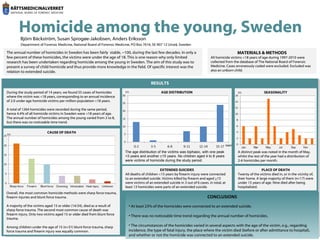
During the study period of 14 years, we found 55 cases of homicides         (n)                      AGE DISTRIBUTION                                   (n)               SEASONALITY
where the victim was <18 years, corresponding to an annual incidence
of 2.0 under age homicide victims per million population <18 years.

A total of 1264 homicides were recorded during the same period,
hence 4.4% of all homicide victims in Sweden were <18 years of age.
The annual number of homicides among the young varied from 2 to 8,
but there was no noticeable time trend.


(n)
                            CAUSE OF DEATH


        .                                                                                                                                       (age)

                                                                            The age distribution of the victims was biphasic, with one peak             A distinct peak was noted in the month of May,
                                                                            <3 years and another >15 years. No children aged 4 to 8 years               whilst the rest of the year had a distribution of
                                                                            were victims of homicide during the study period.                           2-6 homicides per month.

                                                                                                    EXTENDED SUICIDES                                                   PLACE OF DEATH
                                                                            All deaths of children <15 years by firearm injury were connected           Twenty of the victims died in, or in the vicinity of,
                                                                            to an extended suicide. Victims killed by firearm and aged >15              their home. A large majority of them (n=17) were
                                                                            were victims of an extended suicide in 3 out of 6 cases. In total, at       under 15 years of age. Nine died after being
                                                                            least 13 homicides were parts of an extended suicide.                       hospitalized.
Overall, the most common homicide methods were sharp force trauma,
firearm injuries and blunt force trauma.                                                                                            CONCLUSIONS
A majority of the victims aged 15 or older (14/24), died as a result of           • At least 23% of the homicides were connected to an extended suicide.
sharp force trauma. The second most common cause of death was
firearm injury. Only two victims aged 15 or older died from blunt force           • There was no noticeable time trend regarding the annual number of homicides.
trauma.

Among children under the age of 15 (n=31) blunt force trauma, sharp               • The circumstances of the homicides varied in several aspects with the age of the victim, e.g., regarding
force trauma and firearm injury was equally common.                               incidence, the type of fatal injury, the place where the victim died (before or after admittance to hospital),
                                                                                  and whether or not the homicide was connected to an extended suicide.

Bb 120510 rmv

  • 1.
    Homicide among theyoung, Sweden Björn Bäckström, Susan Sprogøe-Jakobsen, Anders Eriksson  Department of Forensic Medicine, National Board of Forensic Medicine, PO Box 7616, SE-907 12 Umeå, Sweden The annual number of homicides in Sweden has been fairly stable, ~100, during the last few decades. In only a MATERIALS & METHODS few percent of these homicides, the victims were under the age of 18. This is one reason why only limited All homicide victims <18 years of age during 1997-2010 were research has been undertaken regarding homicide among the young in Sweden. The aim of this study was to collected from the database of The National Board of Forensic present a survey of child homicide and thus provide more knowledge in the field. Of specific interest was the Medicine. Cases erroneously coded were excluded. Excluded was relation to extended suicide. also an unborn child. RESULTS During the study period of 14 years, we found 55 cases of homicides (n) AGE DISTRIBUTION (n) SEASONALITY where the victim was <18 years, corresponding to an annual incidence of 2.0 under age homicide victims per million population <18 years. A total of 1264 homicides were recorded during the same period, hence 4.4% of all homicide victims in Sweden were <18 years of age. The annual number of homicides among the young varied from 2 to 8, but there was no noticeable time trend. (n) CAUSE OF DEATH . (age) The age distribution of the victims was biphasic, with one peak A distinct peak was noted in the month of May, <3 years and another >15 years. No children aged 4 to 8 years whilst the rest of the year had a distribution of were victims of homicide during the study period. 2-6 homicides per month. EXTENDED SUICIDES PLACE OF DEATH All deaths of children <15 years by firearm injury were connected Twenty of the victims died in, or in the vicinity of, to an extended suicide. Victims killed by firearm and aged >15 their home. A large majority of them (n=17) were were victims of an extended suicide in 3 out of 6 cases. In total, at under 15 years of age. Nine died after being least 13 homicides were parts of an extended suicide. hospitalized. Overall, the most common homicide methods were sharp force trauma, firearm injuries and blunt force trauma. CONCLUSIONS A majority of the victims aged 15 or older (14/24), died as a result of • At least 23% of the homicides were connected to an extended suicide. sharp force trauma. The second most common cause of death was firearm injury. Only two victims aged 15 or older died from blunt force • There was no noticeable time trend regarding the annual number of homicides. trauma. Among children under the age of 15 (n=31) blunt force trauma, sharp • The circumstances of the homicides varied in several aspects with the age of the victim, e.g., regarding force trauma and firearm injury was equally common. incidence, the type of fatal injury, the place where the victim died (before or after admittance to hospital), and whether or not the homicide was connected to an extended suicide.