Battery Management System (BMS) Design & Simulation for EVs.pptx
1.
PES’s Modern Collegeof Engineering Shivajinagar, Pune -5
Department of Mechanical Engineering
Year: 2024-2025
Battery Management System (BMS) Design &
Simulation for EVs
NAME OF STUDENT Roll No. Name of Project Guide
Ganesh M Ballewar 48001 Prof . Dr .S.P. Nalawade
Progressive Education Society's Modern College Of Engineering, Pune
2.
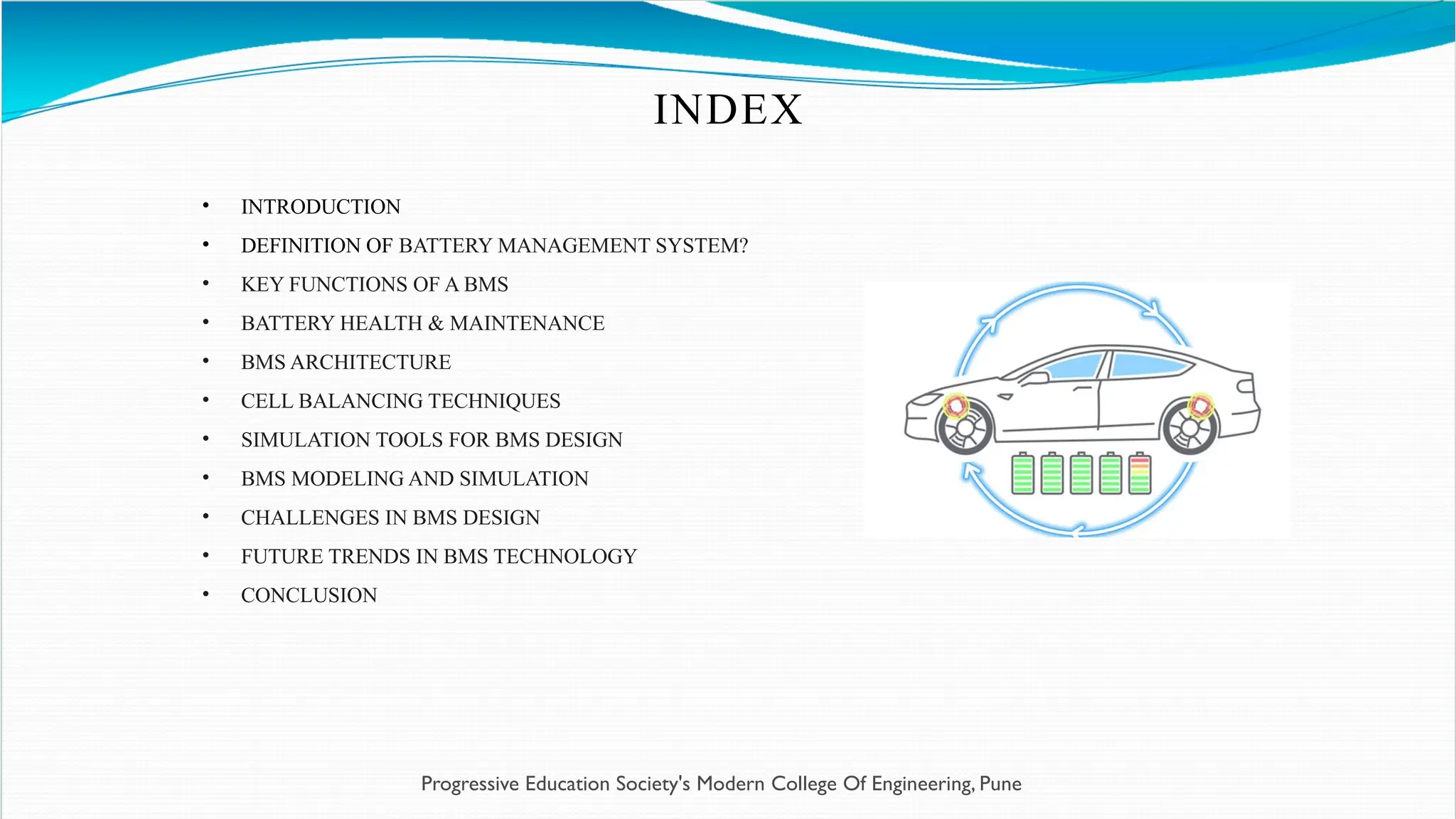
• INTRODUCTION
• DEFINITIONOF BATTERY MANAGEMENT SYSTEM?
• KEY FUNCTIONS OF A BMS
• BATTERY HEALTH & MAINTENANCE
• BMS ARCHITECTURE
• CELL BALANCING TECHNIQUES
• SIMULATION TOOLS FOR BMS DESIGN
• BMS MODELING AND SIMULATION
• CHALLENGES IN BMS DESIGN
• FUTURE TRENDS IN BMS TECHNOLOGY
• CONCLUSION
INDEX
Progressive Education Society's Modern College Of Engineering, Pune
3.
Introduction:-
The Battery ManagementSystem (BMS) is a critical
component in electric vehicles, ensuring safety,
performance, and battery longevity. It directly influences
driving range, charging time, and the lifespan of the
battery pack. With the electric vehicle market projected to
reach $800 billion by 2027, innovations in BMS design and
simulation are pivotal for the industry's growth.
This presentation explores the fundamentals,
architecture, and technological advancements of BMS,
providing insights into how simulation tools help optimize
their design for the future of electric mobility.
Progressive Education Society's Modern College Of Engineering, Pune
BATTERY MANAGEMENT SYSTEM (BMS)
DESIGN & SIMULATION FOR EVS
4.
WHAT IS ABATTERY MANAGEMENT
SYSTEM?
Progressive Education Society's Modern College Of Engineering, Pune
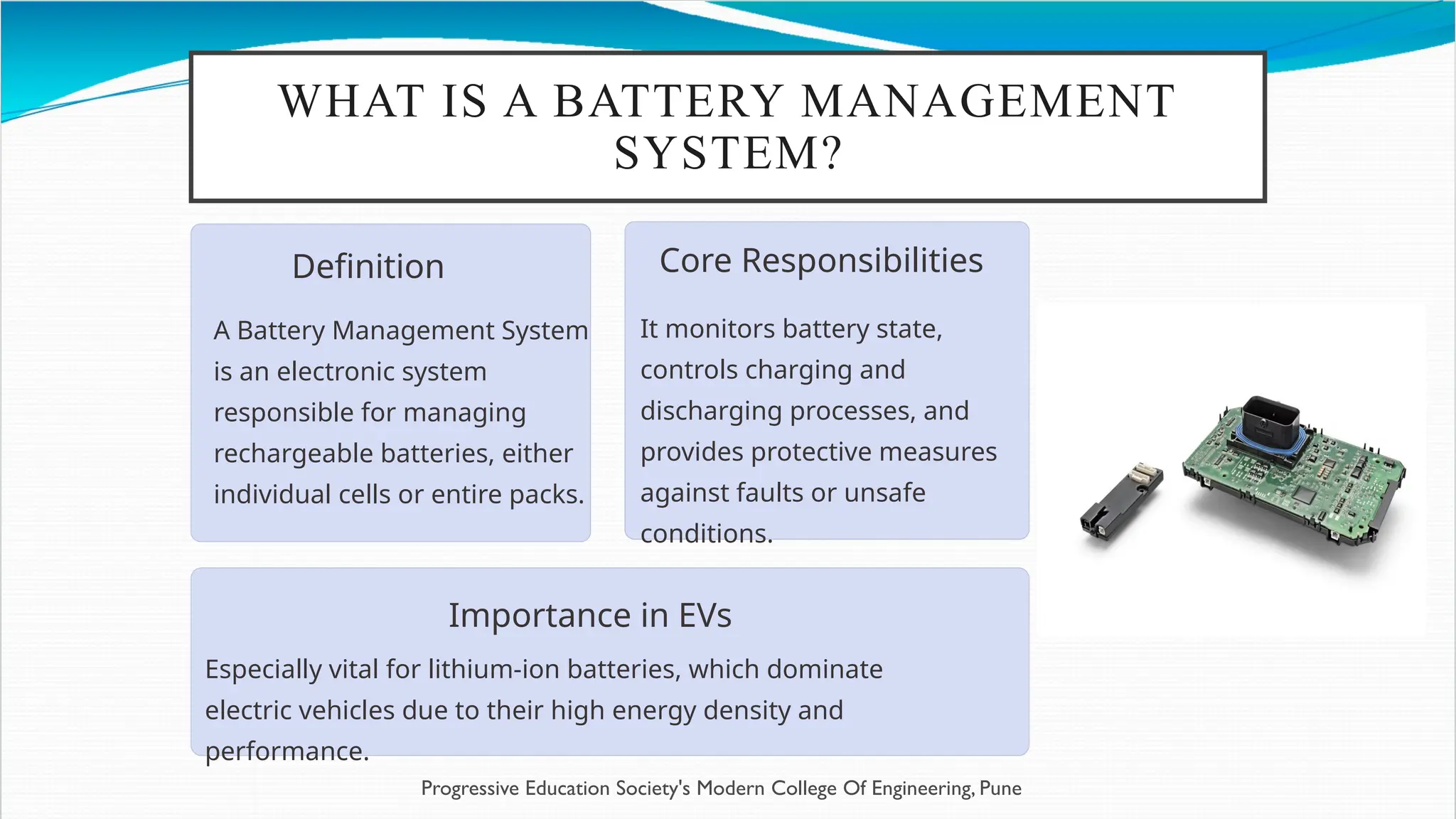
Definition
A Battery Management System
is an electronic system
responsible for managing
rechargeable batteries, either
individual cells or entire packs.
Core Responsibilities
It monitors battery state,
controls charging and
discharging processes, and
provides protective measures
against faults or unsafe
conditions.
Importance in EVs
Especially vital for lithium-ion batteries, which dominate
electric vehicles due to their high energy density and
performance.
5.
KEY FUNCTIONS OFA BMS
Progressive Education Society's Modern College Of Engineering, Pune
• Voltage Monitoring: Tracks individual cell voltages and
overall pack voltage to prevent overcharge or discharge.
• Temperature Monitoring: Detects thermal hotspots
to avoid thermal runaway, crucial for safety.
• Current Monitoring: Measures charge/discharge current,
detects short circuits.
Monitorin
g
6.
BATTERY HEALTH &MAINTENANCE
Progressive Education Society's Modern College Of Engineering, Pune
• State of Charge (SoC): Estimates remaining
battery capacity accurately for range
predictions.
• State of Health (SoH): Assesses battery
aging and performance degradation over
time.
• Cell Balancing: Equalizes cell voltages to
maximize usable pack capacity and lifespan.
Battery Health &
Maintenance
7.
B M SA R C H I T E C T U R E
Progressive Education Society's Modern College Of Engineering, Pune
Centralized
A single controller manages all cells; simple and cost-effective but less
flexible.
Distributed
Each cell has its own controller communicating to a master unit, offering
detailed monitoring and scalability.
Modular
Combines centralized and distributed architectures for flexible and
scalable designs suited to different EV applications.
Communication & Safety
Uses CAN bus networks and adheres to ISO 26262 functional safety
standards for reliable operation.
8.
CELL BALANCING TECHNIQUES
ProgressiveEducation Society's Modern College Of Engineering, Pune
• Passive Balancing
Dissipates excess charge from cells via
resistors, simple but less energy-
efficient.
• Active Balancing
Transfers charge between cells using
capacitive, inductive, or flyback
converter methods to maximize
capacity and efficiency.
• Impact
Research shows balancing can improve
usable pack capacity by 10-15%,
enhancing overall EV performance and
battery lifespan.
9.
SIMULATION TOOLS FORBMS
DESIGN
Progressive Education Society's Modern College Of Engineering, Pune
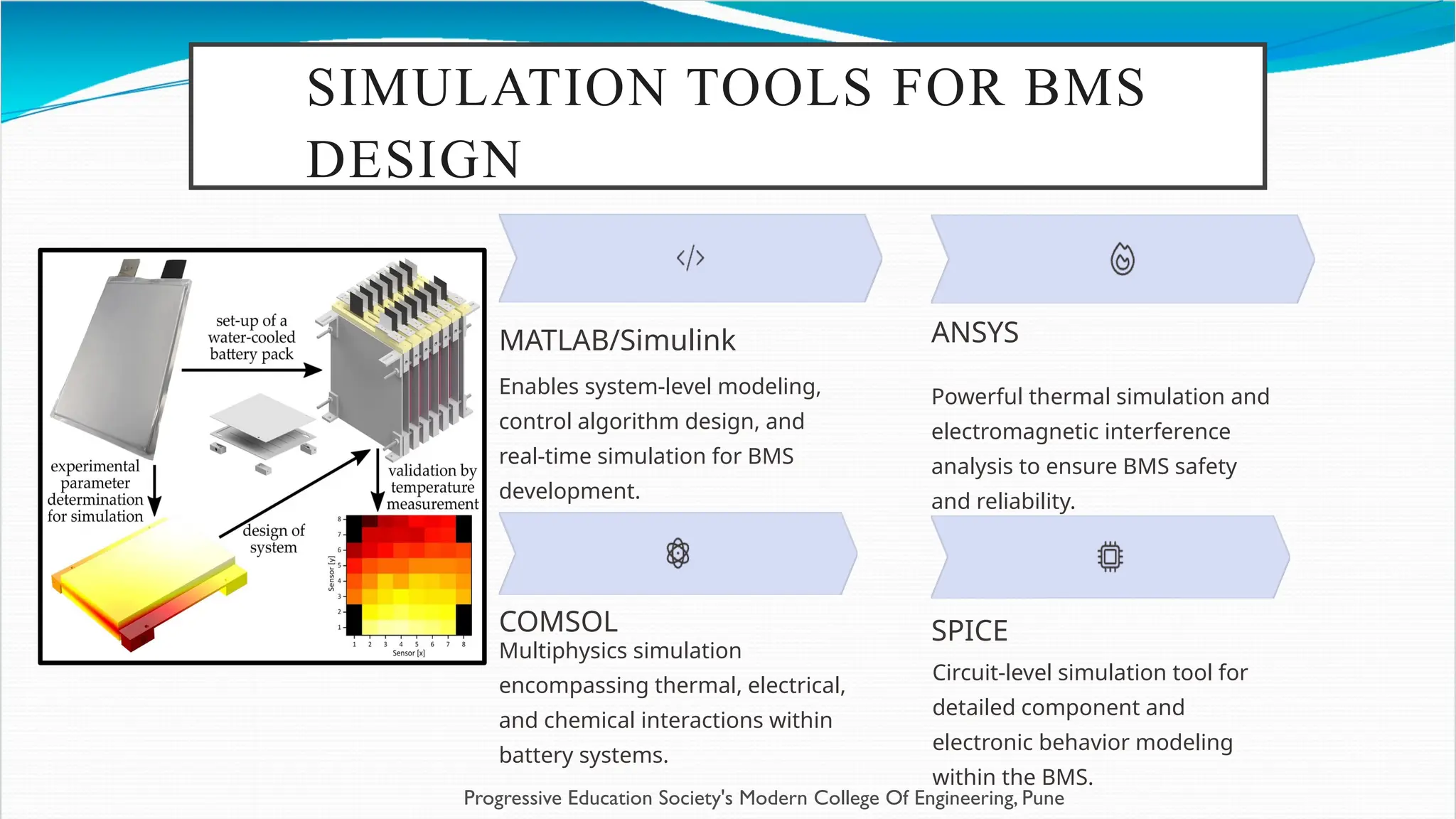
MATLAB/Simulink
Enables system-level modeling,
control algorithm design, and
real-time simulation for BMS
development.
ANSYS
Powerful thermal simulation and
electromagnetic interference
analysis to ensure BMS safety
and reliability.
COMSOL
Multiphysics simulation
encompassing thermal, electrical,
and chemical interactions within
battery systems.
SPICE
Circuit-level simulation tool for
detailed component and
electronic behavior modeling
within the BMS.
10.
BMS MODELING ANDSIMULATION
Progressive Education Society's Modern College Of Engineering, Pune
Equivalent Circuit Models (ECM)
Provide accurate representation of battery electrical behavior for algorithm
development.
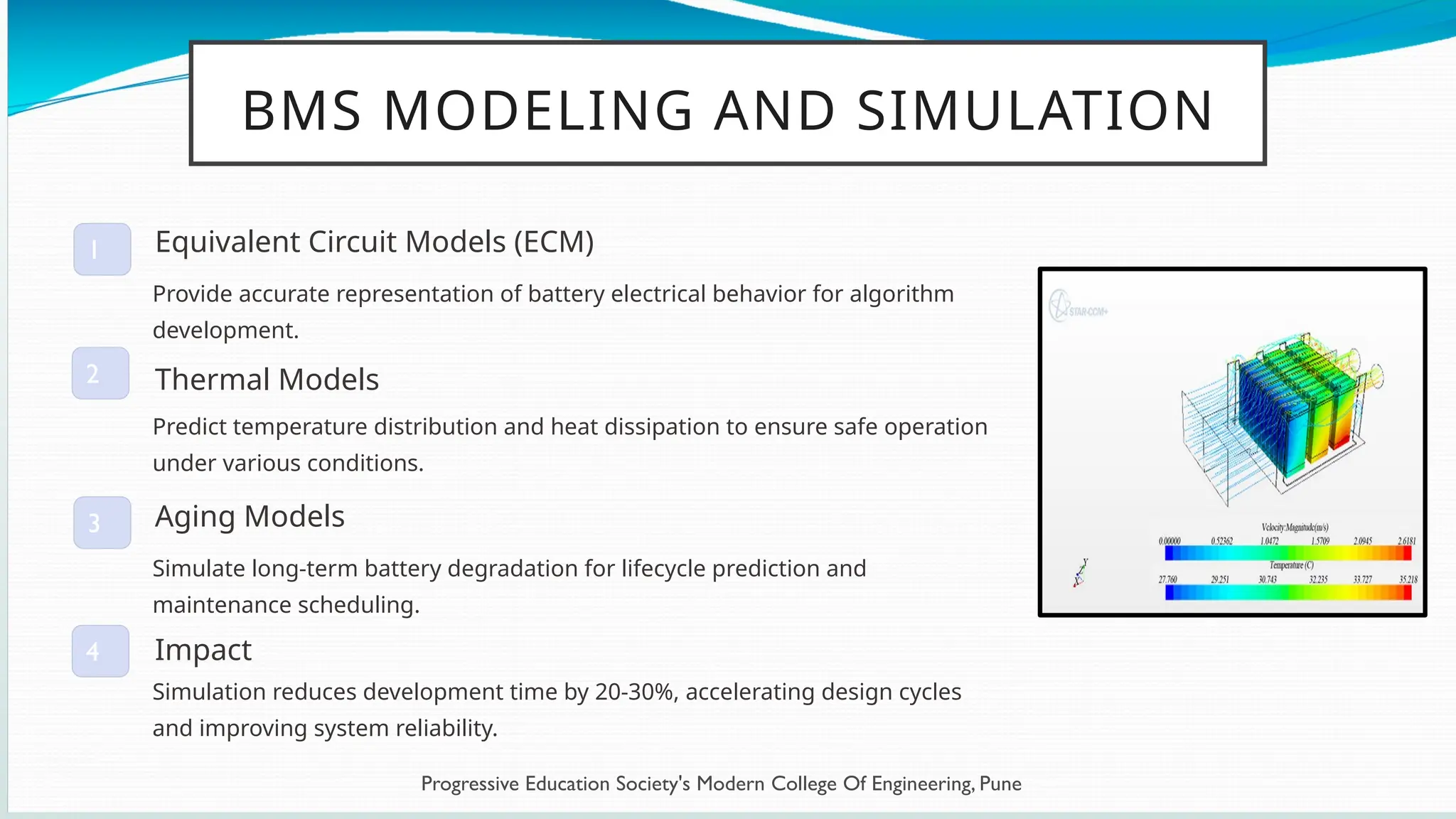
Thermal Models
Predict temperature distribution and heat dissipation to ensure safe operation
under various conditions.
Aging Models
Simulate long-term battery degradation for lifecycle prediction and
maintenance scheduling.
Impact
Simulation reduces development time by 20-30%, accelerating design cycles
and improving system reliability.
4
3
2
1
11.
CHALLENGES IN BMSDESIGN
Progressive Education Society's Modern College Of Engineering, Pune
Accurate Estimation
Complex algorithms are required for precise
State of Charge and State of Health
measurement.
Thermal Management
Preventing overheating and thermal runaway
remains a critical safety concern.
Cell Balancing
Optimizing balance efficiency and speed while
managing system complexity is difficult.
Functional Safety & Cybersecurity
Compliance with ISO 26262 and protection
against hacking threats are vital for reliability and
security.
12.
Progressive Education Society'sModern College Of Engineering, Pune
Future Trends in BMS Technology
Wireless BMS
Reduces complex wiring, increasing
system reliability and simplifying
manufacturing.
AI-Powered Systems
Enable predictive maintenance
and adaptive performance
optimization through machine
learning.
Solid-State Batteries
Introduce new balancing
strategies and require innovative
BMS solutions for their unique
chemistry.
Allows remote monitoring and data
analytics to improve maintenance and
user experience.
Cloud Connectivity
13.
CONCLUSION
Progressive Education Society'sModern College Of Engineering, Pune
Essential Role of BMS
BMS ensures the safe, efficient, and reliable operation of EV batteries,
critical for user confidence and performance.
Power of Simulation
Simulation tools accelerate design, testing, and optimization, reducing
costs and time to market.
Driving Innovation
Continuous technological advances, including AI and wireless systems,
are shaping the future of electric mobility.
Strategic Investment
Investing in BMS development is key to enhancing EV adoption and
meeting growing market demand.






![BMS_PPT_09_NOV[1][1].pptx](https://cdn.slidesharecdn.com/ss_thumbnails/bmsppt09nov11-230123170848-d6fa1ad3-thumbnail.jpg?width=640&height=640&fit=bounds)


