OBJECTIVES:
At the endof the lesson, the students should be able to:
a. recognize the background of basketball, its rules
which includes officiating, basic skills and drills of
basketball;
b. understand and appreciate the importance of
knowing the rules, and skills involved as an
intention of indulging oneself to sports activities;
c. Practice and execute the basic training drills
of basketball.
BASKETBALL HISTORY:
In contrasto the sports, basketball has
a clear origin. It is not the evolution from an
ancient game or other sport and the inventor
is well know: Dr. James Niasmith.
16.
Dr. James Naismith
Naismithwas born in 1861 in Ramsay
Township, Ontario, Canada. He graduated
as a physician at McGill university In
Montreal and was primarily interested in
sports physiology.
17.
1891
In 1891, whileworking as a physical
education teacher at the YMCA International
Training School (today, Springfield College)
in the united states, Naismith was faced with
the problem of finding in 14 days an indoor
game to provide “ athletic distraction” for the
students at the school for Christian Workers
( Naismith was also a Presbyterian minister).
18.
1936
The sport wasan instant success and
thanks to the initial impulse received by the
YMCA movement, basketballs popularity
quickly grew nationwide and was introduced
in many nations. Although Naismith never
saw the game develop into the spectacular
game we know theses days, he had the
honor to witness basketball become an
Olympic sport at the 1936 Games held in
Berlin.
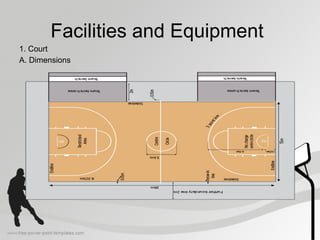
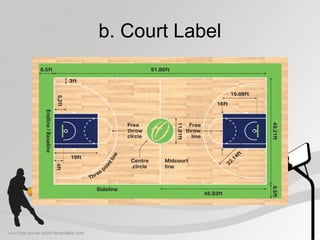
Court Dimension
Basketball courtcome in different sizes based on the
level and type of basketball being played. A professional
NBA court is 94 x 50 /28. 65 x 15.24m. Courts are
comprised of several foundation components: the basket,
the three- points arcs, free-throw (foul) lines and the half
court line. Indoor court are usually made with polished
wood (wooden maple), while outdoor courts are typically
made from paving, concrete, or asphalt.
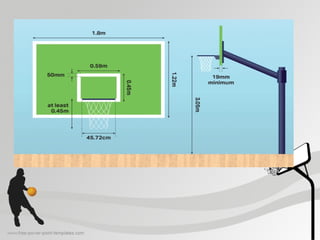
Backboard
A backboard isa piece of basketball
equipment. It is a raised vertical board with
an attached basket consisting of a net
suspended from a hoop. It is a flat, rigid
piece of, often Plexiglas or tempered glass
which also has the properties of safety glass
when accidentally shattered.
24.
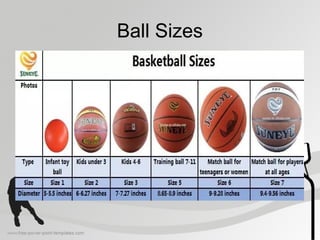
Balls
A basketball isa spherical ball used in
basketball games. Basketballs usually range
in size from very small promotion items that
are only a few inches (some centimeters) in
a diameter to extra large balls nearly 2 feet
(60cm) in diameter used in training
exercises.
Game Clock
The gameclock is the official clock
used for all games and referees can stop
play in order to change it or make sure it is
correct. The game clock is mainly stopped
through timeouts by coaches, players, or
referees, however, fouls or other stoppages
can occur that half the game clock.
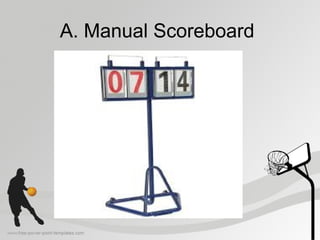
Manual Scoreboard
Scoreboard inthe past used a mechanical clock and
numerical cards to display the score. When a point was
made, a person would put the appropriate digits on a hook.
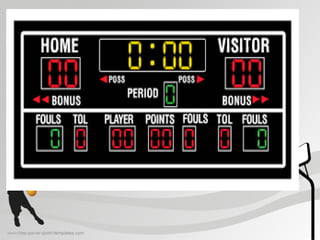
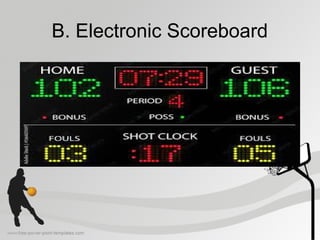
Electronic Scoreboard
Most modern scoreboards use electromechanical or
electronic means of displaying the score. In these, digits
are often composed of a large dot-matrix or seven-segment
displays made of incandescent bulbs, light-emitting diodes,
or electromechanical flip segments.
31.
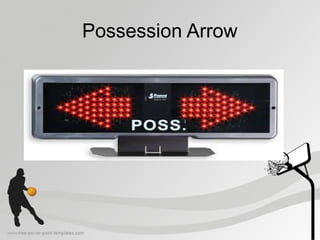
Possession Arrows
• Thefirst team that gets the
benefit of the arrow is whichever
team losses the jump ball. This
means that the next jump will
automatically give them
possession and will continue
switching back and forth.
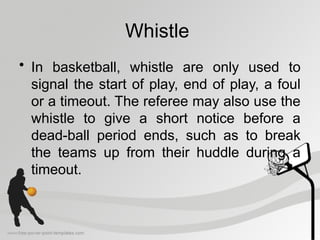
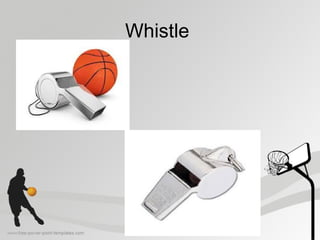
Whistle
• In basketball,whistle are only used to
signal the start of play, end of play, a foul
or a timeout. The referee may also use the
whistle to give a short notice before a
dead-ball period ends, such as to break
the teams up from their huddle during a
timeout.
• Many peoplethink that a player needs to excel in
shooting to play a better basketball game. Though
knowledge would tell us that if a player has the
ball, he/she may shoot, pass or dribble, a
challenging question would be; what else should a
player do if he/she is not holding the ball?
Essentially, everything begins with learning how to
move around the court, with or without the ball, and
learning how to have a better grip of the ball when
you want to shoot, pass or dribble.
37.
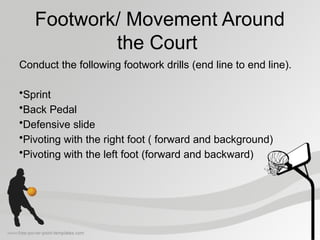
Footwork/ Movement Around
theCourt
Conduct the following footwork drills (end line to end line).
•Sprint
•Back Pedal
•Defensive slide
•Pivoting with the right foot ( forward and background)
•Pivoting with the left foot (forward and backward)
38.
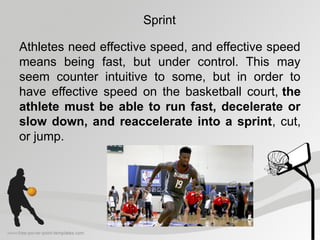
Sprint
Athletes need effectivespeed, and effective speed
means being fast, but under control. This may
seem counter intuitive to some, but in order to
have effective speed on the basketball court, the
athlete must be able to run fast, decelerate or
slow down, and reaccelerate into a sprint, cut,
or jump.
39.
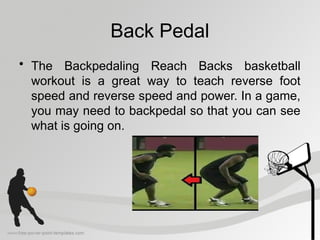
Back Pedal
• TheBackpedaling Reach Backs basketball
workout is a great way to teach reverse foot
speed and reverse speed and power. In a game,
you may need to backpedal so that you can see
what is going on.
40.
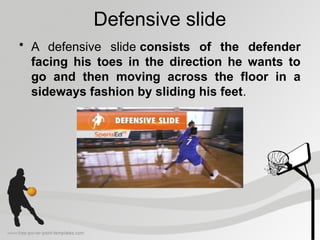
Defensive slide
• Adefensive slide consists of the defender
facing his toes in the direction he wants to
go and then moving across the floor in a
sideways fashion by sliding his feet.
41.
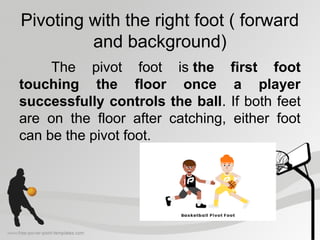
Pivoting with theright foot ( forward
and background)
The pivot foot is the first foot
touching the floor once a player
successfully controls the ball. If both feet
are on the floor after catching, either foot
can be the pivot foot.
42.
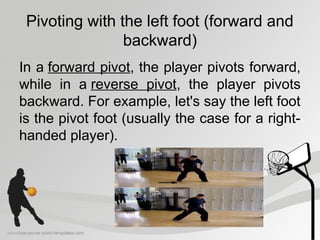
Pivoting with theleft foot (forward and
backward)
In a forward pivot, the player pivots forward,
while in a reverse pivot, the player pivots
backward. For example, let's say the left foot
is the pivot foot (usually the case for a right-
handed player).
43.
Ball Handling (stationary)
Demonstrate the following ball handling fingertip control
drills:
•In front of abdomen
•In front of chest
•Over the head
•Around the neck (clockwise and counterclockwise)
•Around the waist (clockwise and counterclockwise)
•Around the knees (clockwise and counterclockwise)
•Around the neck, waist and knees (continuous downward and
upward in a spiral movement)
•Figure-of-eight
44.
• The beautyand challenge of playing a
basketball game is in the manner by which
a player becomes knowledgeable in the
different skills needed in playing the sport.
Although a team sport, individual skills
play a major role in a collective effort of
executing plays that will allow for a team to
win at the end of the game.
45.
Passing Drills
The followingtypes of basketball passes.
a)Chest Pass
b)Bounce Pass
c)Overhead Pass
d)Baseball Pass
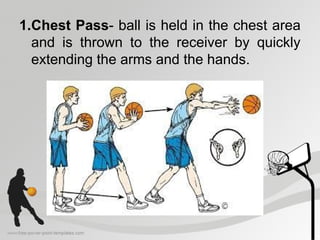
1.Chest Pass- ballis held in the chest area
and is thrown to the receiver by quickly
extending the arms and the hands.
48.
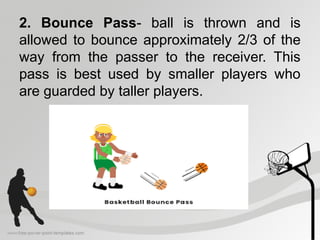
2. Bounce Pass-ball is thrown and is
allowed to bounce approximately 2/3 of the
way from the passer to the receiver. This
pass is best used by smaller players who
are guarded by taller players.
49.
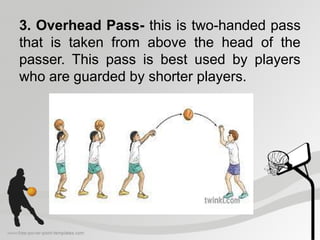
3. Overhead Pass-this is two-handed pass
that is taken from above the head of the
passer. This pass is best used by players
who are guarded by shorter players.
50.
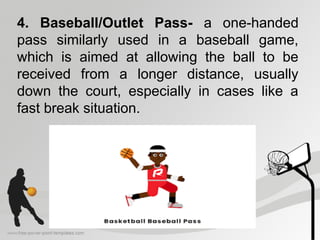
4. Baseball/Outlet Pass-a one-handed
pass similarly used in a baseball game,
which is aimed at allowing the ball to be
received from a longer distance, usually
down the court, especially in cases like a
fast break situation.
51.
DRIBBLING
The following arethe kinds of dribble:
A. Proactive
a)Right/Left hand front dribble
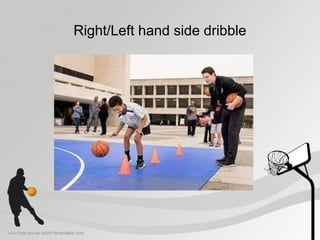
b)Right/Left hand side dribble
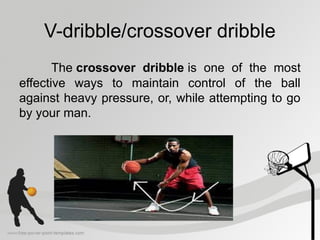
c)V-dribble/crossover dribble
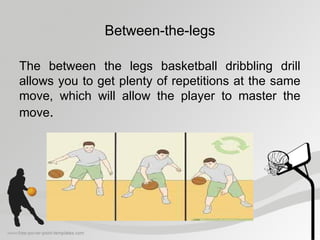
d)Between-the-legs
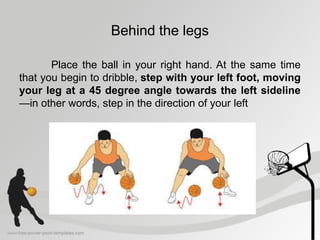
e)Behind the legs
f)Spin
52.
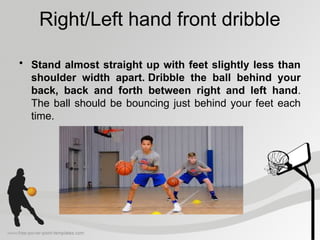
Right/Left hand frontdribble
• Stand almost straight up with feet slightly less than
shoulder width apart. Dribble the ball behind your
back, back and forth between right and left hand.
The ball should be bouncing just behind your feet each
time.
V-dribble/crossover dribble
The crossoverdribble is one of the most
effective ways to maintain control of the ball
against heavy pressure, or, while attempting to go
by your man.
55.
Between-the-legs
The between thelegs basketball dribbling drill
allows you to get plenty of repetitions at the same
move, which will allow the player to master the
move.
56.
Behind the legs
Placethe ball in your right hand. At the same time
that you begin to dribble, step with your left foot, moving
your leg at a 45 degree angle towards the left sideline
—in other words, step in the direction of your left
57.
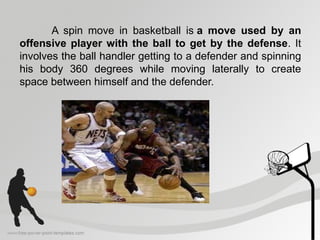
A spin movein basketball is a move used by an
offensive player with the ball to get by the defense. It
involves the ball handler getting to a defender and spinning
his body 360 degrees while moving laterally to create
space between himself and the defender.
58.
Tips in Dribblingthe Ball
Dribble or “Touch” the ball with your fingertips and
not with your palm.
Protective/Controlled
• Stance is important. Maintain an athletes
stance (knees bent and body low).
•Free hand (protective arm) is up to guard the ball.
•Head is up to see teammates, floor, etc.
•Ball is dribbled on the outer portion of the body
(ball-you-defender).
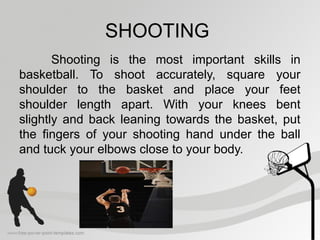
SHOOTING
Shooting is themost important skills in
basketball. To shoot accurately, square your
shoulder to the basket and place your feet
shoulder length apart. With your knees bent
slightly and back leaning towards the basket, put
the fingers of your shooting hand under the ball
and tuck your elbows close to your body.
61.
The following arethe kinds of shots:
a. Spot Shooting
b. Lay-up
c. Free throw
d. 3-point shot
62.
Spot Shooting
-Stay lowand shoot with your dominant hand while
keeping you dominant foot just a little farther from
your other. Keep your elbows tight, elevate up and
follow through.
b. Lay-up
-a lay-up is a shot near to the basketball,
usually off the backboard. For a lay-up, you run
towards one side of the basket, jump, and lay the
ball off the background into the hoop.
63.
free-throw
-an unhindered shotin basketball made
from behind a set line and awarded because
of a foul by an opponent.
3 point shot
-A 3 pointer in basketball is a shot scored
anywhere outside the three-point arc. A shot
made from anywhere outside the line to the
baseline on the other side of the court counts for
three points.
64.
Tips in Shootingthe Ball
• Feet should be shoulder-width apart for better balance.
• Feet almost parallel but with the shooting foot a little ahead.
• Toes of the feet pointing towards the direction of the ball.
• The air hole of the ball is positioned between the middle and index
fingers of the shooting hands.
• Make sure that the palm does not touch the ball (only the fingers
pads) and that the fingers are spread evenly for a better grip of the
ball.
• Non-shooting hand is touching the side of the ball for support and
balance only.
• Elbows not too close to the body for the better movement.
65.
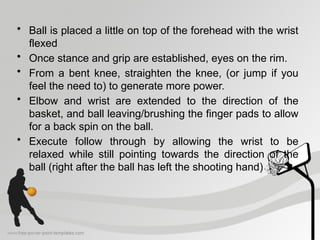
• Ball isplaced a little on top of the forehead with the wrist
flexed
• Once stance and grip are established, eyes on the rim.
• From a bent knee, straighten the knee, (or jump if you
feel the need to) to generate more power.
• Elbow and wrist are extended to the direction of the
basket, and ball leaving/brushing the finger pads to allow
for a back spin on the ball.
• Execute follow through by allowing the wrist to be
relaxed while still pointing towards the direction of the
ball (right after the ball has left the shooting hand)
BASIC BASKETBALL RULES
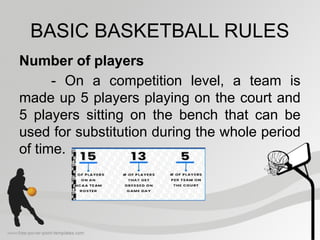
Numberof players
- On a competition level, a team is
made up 5 players playing on the court and
5 players sitting on the bench that can be
used for substitution during the whole period
of time.
68.
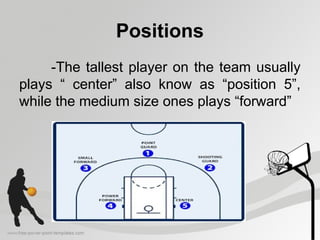
Positions
-The tallest playeron the team usually
plays “ center” also know as “position 5”,
while the medium size ones plays “forward”
69.
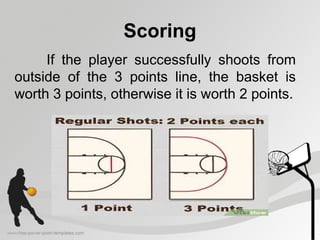
Scoring
If the playersuccessfully shoots from
outside of the 3 points line, the basket is
worth 3 points, otherwise it is worth 2 points.
70.
Violation
Occurs when theplayer breaks one of he
rules of basketball. It can also result from the
player taking more than 2 steps without bouncing
the balls on the floor. This is called TRAVELLING.
FOULS
A foul is an illegal action that can be
committed by a player from one team against a
player from the opposing team.
Defensive Fouls
-They occurwhen the offensive player
from the offensive player is being fouled by
the defender.
Offensive Foul
An offensive foul in basketball is a foul committed
by an offensive player whose team is in
possession of the ball. The offending player is
charged with a personal foul and their team is
charged with a team foul
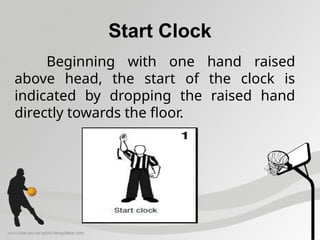
Start Clock
Beginning withone hand raised
above head, the start of the clock is
indicated by dropping the raised hand
directly towards the floor.
75.
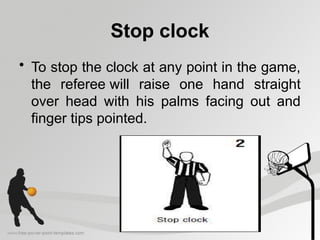
Stop clock
• Tostop the clock at any point in the game,
the referee will raise one hand straight
over head with his palms facing out and
finger tips pointed.
76.
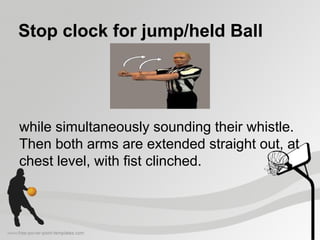
Stop clock forjump/held Ball
while simultaneously sounding their whistle.
Then both arms are extended straight out, at
chest level, with fist clinched.
77.
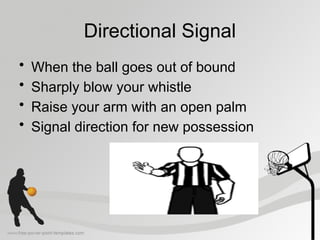
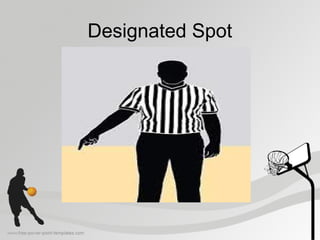
Directional Signal
• Whenthe ball goes out of bound
• Sharply blow your whistle
• Raise your arm with an open palm
• Signal direction for new possession
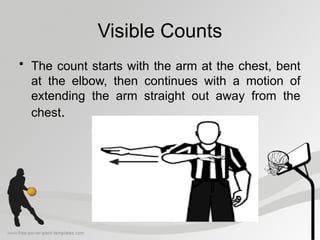
Visible Counts
• Thecount starts with the arm at the chest, bent
at the elbow, then continues with a motion of
extending the arm straight out away from the
chest.
80.
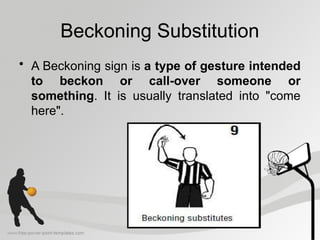
Beckoning Substitution
• ABeckoning sign is a type of gesture intended
to beckon or call-over someone or
something. It is usually translated into "come
here".
81.
TWO TYPES OFTIME-OUT
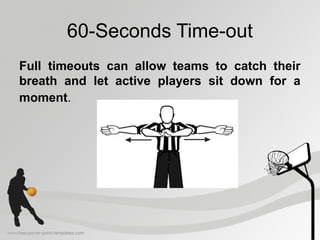
60-Seconds Time-out
30-Seconds Time-out
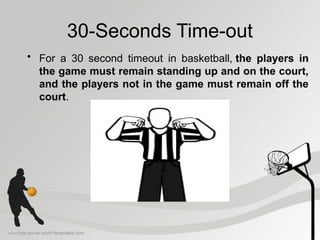
30-Seconds Time-out
• Fora 30 second timeout in basketball, the players in
the game must remain standing up and on the court,
and the players not in the game must remain off the
court.
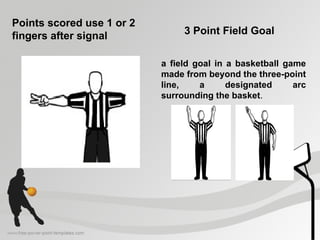
Points scored use1 or 2
fingers after signal 3 Point Field Goal
a field goal in a basketball game
made from beyond the three-point
line, a designated arc
surrounding the basket.
86.
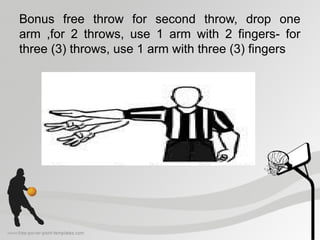
Bonus free throwfor second throw, drop one
arm ,for 2 throws, use 1 arm with 2 fingers- for
three (3) throws, use 1 arm with three (3) fingers
87.
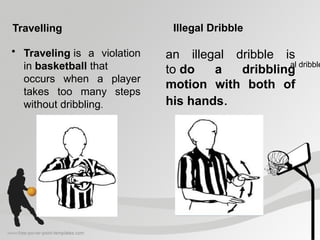
Travelling
• Traveling isa violation
in basketball that
occurs when a player
takes too many steps
without dribbling.
Illegal Dribble
an illegal dribble is
to do a dribbling
motion with both of
his hands.
al dribble
88.
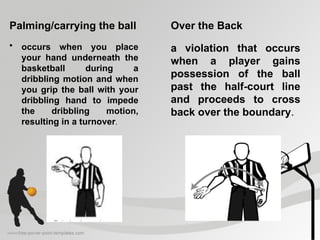
Palming/carrying the ball
•occurs when you place
your hand underneath the
basketball during a
dribbling motion and when
you grip the ball with your
dribbling hand to impede
the dribbling motion,
resulting in a turnover.
Over the Back
a violation that occurs
when a player gains
possession of the ball
past the half-court line
and proceeds to cross
back over the boundary.
89.
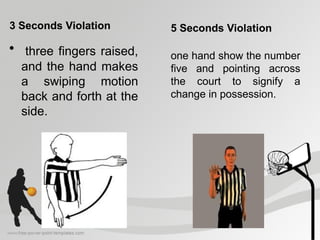
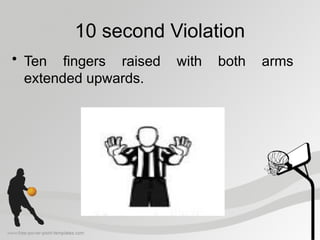
3 Seconds Violation
•three fingers raised,
and the hand makes
a swiping motion
back and forth at the
side.
5 Seconds Violation
one hand show the number
five and pointing across
the court to signify a
change in possession.
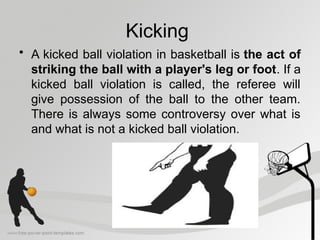
Kicking
• A kickedball violation in basketball is the act of
striking the ball with a player's leg or foot. If a
kicked ball violation is called, the referee will
give possession of the ball to the other team.
There is always some controversy over what is
and what is not a kicked ball violation.
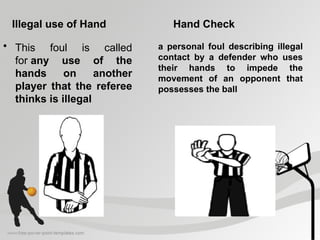
Illegal use ofHand
• This foul is called
for any use of the
hands on another
player that the referee
thinks is illegal
Hand Check
a personal foul describing illegal
contact by a defender who uses
their hands to impede the
movement of an opponent that
possesses the ball
95.
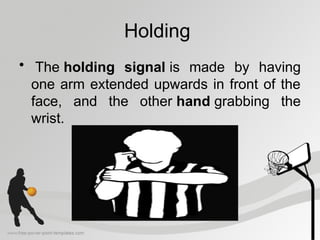
Holding
• The holdingsignal is made by having
one arm extended upwards in front of the
face, and the other hand grabbing the
wrist.
96.
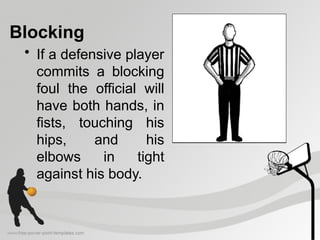
Blocking
• If adefensive player
commits a blocking
foul the official will
have both hands, in
fists, touching his
hips, and his
elbows in tight
against his body.
97.
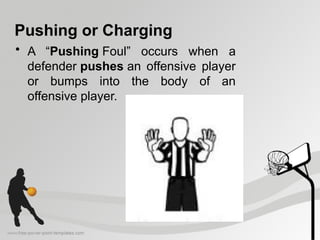
Pushing or Charging
•A “Pushing Foul” occurs when a
defender pushes an offensive player
or bumps into the body of an
offensive player.
98.
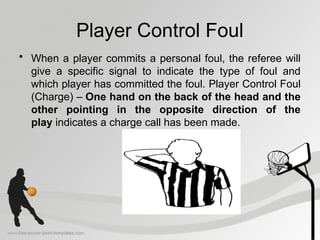
Player Control Foul
•When a player commits a personal foul, the referee will
give a specific signal to indicate the type of foul and
which player has committed the foul. Player Control Foul
(Charge) – One hand on the back of the head and the
other pointing in the opposite direction of the
play indicates a charge call has been made.
99.
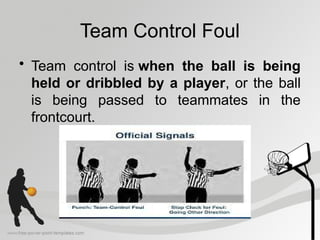
Team Control Foul
•Team control is when the ball is being
held or dribbled by a player, or the ball
is being passed to teammates in the
frontcourt.
100.
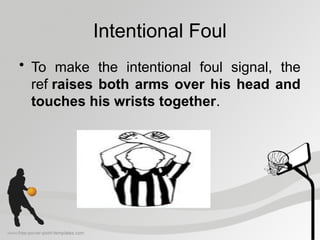
Intentional Foul
• Tomake the intentional foul signal, the
ref raises both arms over his head and
touches his wrists together.
101.
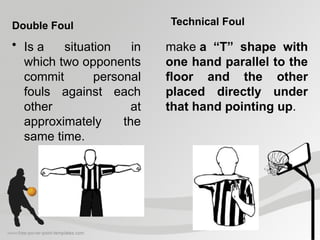
Double Foul
• Isa situation in
which two opponents
commit personal
fouls against each
other at
approximately the
same time.
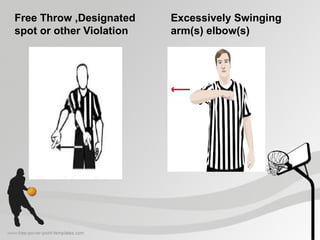
Technical Foul
make a “T” shape with
one hand parallel to the
floor and the other
placed directly under
that hand pointing up.
102.
Application:
• Make avideo of yourself while
demonstrating the Passing and Dribbling
drills in basketball. Make sure when you
take a video that the camera is in a
landscape position.
103.
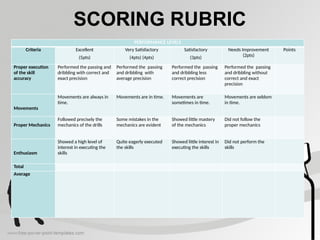
SCORING RUBRIC
PERFORMANCE LEVELS
CriteriaExcellent
(5pts)
Very Satisfactory
(4pts) (4pts)
Satisfactory
(3pts)
Needs Improvement
(2pts)
Points
Proper execution
of the skill
accuracy
Performed the passing and
dribbling with correct and
exact precision
Performed the passing
and dribbling with
average precision
Performed the passing
and dribbling less
correct precision
Performed the passing
and dribbling without
correct and exact
precision
Movements
Movements are always in
time.
Movements are in time. Movements are
sometimes in time.
Movements are seldom
in time.
Proper Mechanics
Followed precisely the
mechanics of the drills
Some mistakes in the
mechanics are evident
Showed little mastery
of the mechanics
Did not follow the
proper mechanics
Enthusiasm
Showed a high level of
interest in executing the
skills
Quite eagerly executed
the skills
Showed little interest in
executing the skills
Did not perform the
skills
Total
Average
104.
ASSIGNMENT:
1. In playingbasketball, is it important that
your body is in a good condition? Why?
2. What are the importance of practicing the
different basic skill drills in basketball?