Download to read offline

![ ARRAY IN C
• Arrays a kind of data structure that can store a fixed-size sequential collection of elements of the same type. An array is
used to store a collection of data, but it is often more useful to think of an array as a collection of variables of the same
type.
• Instead of declaring individual variables, such as number0, number1, ..., and number99, you declare one array variable
such as numbers and use numbers[0], numbers[1], and ..., numbers[99] to represent individual variables. A specific
element in an array is accessed by an index.
• All arrays consist of contiguous memory locations. The lowest address corresponds to the first element and the highest
address to the last element.](https://image.slidesharecdn.com/basicsofarray-220511170247-2c1333f0/85/Basics-of-array-pptx-2-320.jpg)
![ DECLARING ARRAYS
• To declare an array in C, a programmer specifies the type of the elements and the number of elements required by an
array as follows −
• Type arrayname [ arraysize ];
• This is called a single-dimensional array. The arraySize must be an integer constant greater than zero and type can be
any valid C data type. For example, to declare a 10-element array called balance of type double, use this statement −
• double balance [ 10 ] ;
• Here balance is a variable array which is sufficient to hold up to 10 double numbers.](https://image.slidesharecdn.com/basicsofarray-220511170247-2c1333f0/85/Basics-of-array-pptx-3-320.jpg)
![ INITIALIZING ARRAYS
• You can initialize an array in C either one by one or using a single statement as follows −
• double balance [5] = {1000.0, 2.0, 3.4, 7.0, 50.0};
• The number of values between braces { } cannot be larger than the number of elements that we declare for the array
between square brackets [ ].
• If you omit the size of the array, an array just big enough to hold the initialization is created. Therefore, if you write −
• double balance [] = {1000.0, 2.0, 3.4, 7.0, 50.0};
• You will create exactly the same array as you did in the previous example. Following is an example to assign a single
element of the array −
• Balance [4]= 50.0;](https://image.slidesharecdn.com/basicsofarray-220511170247-2c1333f0/85/Basics-of-array-pptx-4-320.jpg)
![ ACCESSING ARRAY ELEMENTS
• An element is accessed by indexing the array name. This is done by placing the index of the element within square
brackets after the name of the array. For example −
• double salary = balance [9];
• The above statement will take the 10th element from the array and assign the value to salary variable.](https://image.slidesharecdn.com/basicsofarray-220511170247-2c1333f0/85/Basics-of-array-pptx-5-320.jpg)
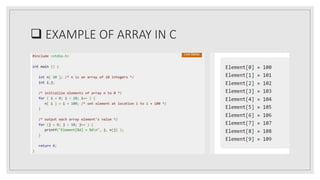


This document explains the concept of arrays in C, highlighting their nature as data structures that store fixed-size collections of elements of the same type. It covers how to declare, initialize, and access arrays, emphasizing the use of indexing to retrieve individual elements. An example of a single-dimensional array declaration and its initialization is provided to illustrate the key points.


![[ITP - Lecture 15] Arrays & its Types](https://cdn.slidesharecdn.com/ss_thumbnails/lecture-2223arraysitstypes-171215173139-thumbnail.jpg?width=640&height=640&fit=bounds)


![ict_presentation_final_final_final[1].pptx](https://cdn.slidesharecdn.com/ss_thumbnails/ictpresentationfinalfinalfinal1-251230145259-2b4839bd-thumbnail.jpg?width=640&height=640&fit=bounds)


