Basic Health and Safety for Fieldwork
Andrew Kurdziel
Health and Safety Adviser
What is Fieldwork?
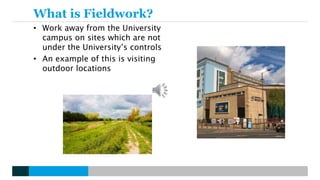
• Work away from the University
campus on sites which are not
under the University’s controls
• An example of this is visiting
outdoor locations
Which means
This means that the
University cannot
guarantee that all risks are
eliminated and additional
control may have to be
applied
Such as
• An example of
this is visiting
outdoor
locations
How is it managed?
Risk assessment:
 Identify the hazards
 Evaluate the risk of being hurt
 Select your optimum controls
 Record you findings and share them
 Make sure your controls are working
and update them as necessary
Selecting Controls
• Controls are then adopted
based on the foreseeable risks
that have be identified
• You should then be told of the
controls and YOU must follow
them
This Photo by Unknown Author is licensed under CC BY-ND
Terrain
Uneven ground,
It can be muddy or
slippery
Wear appropriate
footwear
Concealed and Man Made Hazards
Avoid danger areas such
as old mineshafts and
slurry pits
Beware of obstacles such
as fences (including
electrified fences).
Cliffs
• Cliffs are not stable
• They are constantly eroding
• Rockfalls are common
• Sometimes especially after rain
landslips occur
• Walking on scree-the loose
stones and rocks at the
bottom of the cliff
Weather and Climate-
Prepare for the weather that
day
It can become very hot or very
cold or very wet over a day.
There is also the risk posed
by thunderstorms.
Encountering Animals-
In the UK there are no larger wild animals that may
pose a risk
Encountering Animals-
But domesticated animals
can also pose a risk. On
average one person a year
is killed by cattle and
people have even been
attacked and killed by
sheep.
Diseases
• Animals can carry
various diseases and
you should avoid
contact with them
unless necessary.
• If you need to handle
animals wear
appropriate PPE.
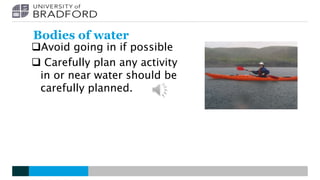
Bodies of water
Avoid going in if possible
 Carefully plan any activity
in or near water should be
carefully planned.
Hypothermia • Core body temperature
drops
• body functions
shutdown
• you can lose
consciousness
• you are unaware of
what is happening
• have a dry change of
clothes available
This Photo by Unknown Author is licensed under CC BY-SA
Weil’s Disease
Some water courses
are also contaminated
with Weil’s Disease
(Leptospirosis)
Avoid entering
unknown bodies of
water
Lone Working
If you encounter members
of the public take care.
 Make sure that you are in
contact with your base by
mobile phone.
If coverage is not available
establish a rendezvous
point where you can meet
up.
Plants Hazards
Bracken spores are a
known carcinogen.
Other plants have thorns
or contain poisonous
sap like the Yew tree
Cover Up
Always cover up to
protect yourself from
ticks and thorns etc.
Wear long trousers and
long sleeves
Time and Tide
• The British isles have some of
the highest tides in the world-
in some place the water level
can more than 10 m in a few
hours
• Check tide times
At high tide this whole beach is
underwater
Avoid being cut off by the tide
• Have escape routes planned
• Do not try to scramble up cliffs
• If you get into difficulties call
the Coast Guard on 999
To Summarise
Agree to a plan and
stick to the plan
Respect the area you are
working in: the terrain,
the weather, etc
Don’t interact with
animals
And have a back-up
plan

Basic+Fieldwork+-+Copy.pptx

  • 1.
    Basic Health andSafety for Fieldwork Andrew Kurdziel Health and Safety Adviser
  • 2.
    What is Fieldwork? •Work away from the University campus on sites which are not under the University’s controls • An example of this is visiting outdoor locations
  • 3.
    Which means This meansthat the University cannot guarantee that all risks are eliminated and additional control may have to be applied
  • 4.
    Such as • Anexample of this is visiting outdoor locations
  • 5.
    How is itmanaged? Risk assessment:  Identify the hazards  Evaluate the risk of being hurt  Select your optimum controls  Record you findings and share them  Make sure your controls are working and update them as necessary
  • 6.
    Selecting Controls • Controlsare then adopted based on the foreseeable risks that have be identified • You should then be told of the controls and YOU must follow them This Photo by Unknown Author is licensed under CC BY-ND
  • 7.
    Terrain Uneven ground, It canbe muddy or slippery Wear appropriate footwear
  • 8.
    Concealed and ManMade Hazards Avoid danger areas such as old mineshafts and slurry pits Beware of obstacles such as fences (including electrified fences).
  • 9.
    Cliffs • Cliffs arenot stable • They are constantly eroding • Rockfalls are common • Sometimes especially after rain landslips occur • Walking on scree-the loose stones and rocks at the bottom of the cliff
  • 10.
    Weather and Climate- Preparefor the weather that day It can become very hot or very cold or very wet over a day. There is also the risk posed by thunderstorms.
  • 11.
    Encountering Animals- In theUK there are no larger wild animals that may pose a risk
  • 12.
    Encountering Animals- But domesticatedanimals can also pose a risk. On average one person a year is killed by cattle and people have even been attacked and killed by sheep.
  • 13.
    Diseases • Animals cancarry various diseases and you should avoid contact with them unless necessary. • If you need to handle animals wear appropriate PPE.
  • 14.
    Bodies of water Avoidgoing in if possible  Carefully plan any activity in or near water should be carefully planned.
  • 15.
    Hypothermia • Corebody temperature drops • body functions shutdown • you can lose consciousness • you are unaware of what is happening • have a dry change of clothes available This Photo by Unknown Author is licensed under CC BY-SA
  • 16.
    Weil’s Disease Some watercourses are also contaminated with Weil’s Disease (Leptospirosis) Avoid entering unknown bodies of water
  • 17.
    Lone Working If youencounter members of the public take care.  Make sure that you are in contact with your base by mobile phone. If coverage is not available establish a rendezvous point where you can meet up.
  • 18.
    Plants Hazards Bracken sporesare a known carcinogen. Other plants have thorns or contain poisonous sap like the Yew tree
  • 19.
    Cover Up Always coverup to protect yourself from ticks and thorns etc. Wear long trousers and long sleeves
  • 20.
    Time and Tide •The British isles have some of the highest tides in the world- in some place the water level can more than 10 m in a few hours • Check tide times At high tide this whole beach is underwater
  • 21.
    Avoid being cutoff by the tide • Have escape routes planned • Do not try to scramble up cliffs • If you get into difficulties call the Coast Guard on 999
  • 22.
    To Summarise Agree toa plan and stick to the plan Respect the area you are working in: the terrain, the weather, etc Don’t interact with animals And have a back-up plan

Editor's Notes

  • #3 So what is fieldwork? Essentially it is any university activities that take place away from the campus Typically this will be activities in outdoor often rural or remote locations
  • #4 The issue with such location, off campus is that the university is no longer in fully in control of what happens there. So we need to make sure that any controls take that into account and if necessary additional controls are being applied, which you would not need to think about if this was taking place on campus.
  • #5 This looks like pretty seaside village but if you are carrying activities here you might be exposing yourself to additional hazards. The most obvious are water related hazards but look at the landscape: there are steep cliffs surrounding the village. If you need access to these that creates additional; risks to your H&S. The weather in the picture is pleasant but weather can turn can turn nasty very quickly and that can create additional hazards. This is a working fishing village so things like vehicles and boats moving about the narrow streets of the village can create an unexpected risk. So before you go on fieldwork you have to prepare yourself.
  • #6 As you are aware this process is known as risk assessment: The five steps of risk assessment are: Identify the hazards Evaluate the risk of someone being hurt Select your optimum controls Record you findings and share them Make sure your controls are working and update them as necessary
  • #7 Controls are then adopted based on the foreseeable risks that have be identified You should then be told of the controls and YOU must follow them
  • #8 First we are looking at terrain. If you are going out it is likely that you will be spending time away from surfaced roads and paths. The ground can be uneven, muddy or slippery. Taking all of these hazards in account it is important that you wear suitable foot wear
  • #9 There could be concealed hazards such as pits and even old mine shafts.
  • #12 In the UK there are no large dangerous wild animals
  • #14 Eg ticks can spread Lyme Disease
  • #16 If you get wet you are at greater risk hypothermia. Hypothermia is Medical condition where your body can no longer maintain it‘s core temperature of 38 degrees centigrade. As your body temperature drops various functions stop as well. In particular your faculties close down and you become confused and may lose consciousness. Often you our unaware of what is happening and it is common for people suffering hypothermia to feel hot rather than cold. for this reason it is recommended that you keep some spare dry clothes which you can change into if you fall into the water.
  • #17 Vials disease is caused bye a bacterium cold leptospirosis which enters water courses in animal urine. It’s main symptoms are headache aching limbs and a fever. It can be very debilitating. It is important to avoid entering unknown bodies of water or drinking water from unknown sources
  • #18 You may come across members the public. In most cases they will be friendly but inquisitive. Sometimes you may come across someone who is hostile or aggressive. Avoid any sort of confrontation. Leave the area rather than provoke them. Always Carrie your mobile phone so you can keep in touch report all incidents of threatening behaviour make sure you have a rendezvous or base where you can meet.
  • #19 Some plants can be surprisingly hazardous. For example bracken common Fern has spores which contain carcinogens many plants aww poisonous. Do not be tempted to eat plants or fungi no matter how attractive they look. Plants that grow on grazing land often have sharp thorns. In some cases farmers plant them specifically around fields. Thorns can produce serious deep wounds which can become infected .
  • #20 it is always advisable to cover up while going about fieldwork. Wear long trousers and long sleeves if possible wear a scarf around your neck.
  • #21 The British Isles have some of the highest tides in the world it is not uncommon for the sea level to rise 10 metres or more in a few hours. In some places tides advance faster than the person can run. It is very easy to find yourself cut off on a sand bar. Avoid situations where you might have to swim for it. Virtually every beach will have tide table which will tell you when it's high tide and low tide. The time of high tide and low tide change from day today that is why you need to check that days tide times.
  • #22 It's possible to be cut off at the base of a Cliff. Avoid having to scramble up the side of the Cliff. Note where there are clear safe path’s up the Cliff use those rather then climbing the Cliff itself. if you are trapped or any other sort of emergency on the shore contact the Coast Guard by dialling 999.
  • #23 When carrying out fieldwork it is important to agree to a plan you must respect the area you're working in particular the terrain the weather the tides et cetera. Avoid contact with animals And have a backup plan what to do when it goes wrong.