Genetic Engineering, Biotechnologyeasy notes lecture 2
Genetic Engineering:
Manipulation of genes or DNA by using or applying biological techniques, to get a desired
product in a pre-determined way refers to genetic engineering.
Basic Steps in Genetic Engineering:
There are 4 basic steps or principles of genetic engineering.
● Isolation of a nucleic acid
● Insertion of a vector and making recombinant DNA
● Introducing the rDNA into the cell
● Screening of the cell.
Now we will discuss these 4 steps briefly.
1. Isolation of a nucleic acid:
Genetic Engineering starts with the Isolation of nucleic acid. For isolation of a nucleic acid
(DNA/RNA) of the cell, the outer barriers should be destroyed first.
● In case of bacteria cell wall and cell membrane should be removed.
● in case of plant cell; cell wall, cell membrane and also nuclear membrane should be
removed
● in case of animal cell, cell membrane and nuclear membrane should be removed.
Now this destruction of cell barriers is done by two methods.
1. Physical method:
The cell from which we want to get the nucleic acid is crushed with pestle and the cell wall is
destructed. Plant cell is tough so we also use some liquid nitrogen for it's destruction.
2. Chemical Method:
● The chemical method used for the destruction of cellular barrier may be organic or
inorganic.
● In case of organic method, some organic substances like ammonium acetate are used.
● in case of inorganic method, different salts are used
2.
Gene of interestis free to access now. But we only need a targeted part of the full gene. So
there are two methods again to get the only targeted part of the gene.
1. Using Restriction Enzymes:
Restriction enzyme is used for cutting the DNA sequences to get the desired sequence. It is
obtained from bacteria E.Coli and is named as ECO R1 enzyme. The restriction sequence in
DNA present for Eco R1 is 5`-GAATC-3`. Now if this sequence is present, it will attach to the
sequence and cut the phosphodiester bonds and will give the specific gene that is required.
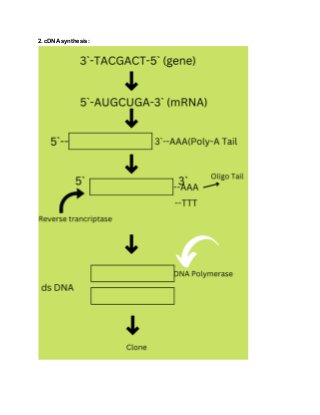
cDNA is theDNA synthesized by the single stranded RNA by the use of the enzyme, Reverse
Transcriptase. (mRNA reverse transcriptase
cDNA)
● Mature RNA is obtained after post transcriptional modification and have no introns.
● It is a template strand.
● The activity of reverse transcriptase requires a primer, which is poly(T) sequence.
● It can easily attach with poly A tail of mature RNA.
● After the action of reverse transcriptase we will get the single stranded cDNA which can
be amplify by DNA polymerase if required.
2. Insertion of a vector and making recombinant DNA:
The second step is making the recombinant DNA using the plasmid or a Vector.
Plasmid:
Plasmid is a small, extra chromosomal DNA, Found in bacteria. It is double stranded and has no
known function in the cell.
Characteristics of the plasmid:
1. A plasmid or vector must have an origin of replication. A specialized sequence of
nucleotides which allows transcription within a plasmid.
2. A plasmid must have a restriction site. A site that can be recognized by restriction
enzymes.
3. It must contain a selectable markers. Genes that confer resistance to various antibodies
are used as selective markers.
How gene of interest is inserted into plasmid:
● Restriction endonuclease enzyme is used to cut the plasmid DNA on the recognition
side.
● So space is formed for the gene of interest.
● The plasmid is cut in such a way that circular structure is converted to linear one.
How Both Are Ligated:
● Sequence of nucleotide with blunt ends can not be ligated.
● however, sticky ends are capable of ligation without any external source.
● For the ligation of blunt ends, Adapter or Linker DNA is used
● It is a chemically synthesized DNA either single or double strand that can be ligated to
other DNA or RNA molecules.
5.
3. Introduction ofrDNA into the cell:
Introduction of rDNA into the cells may occur in various ways.
1. Transformation:
It is the transfer of rDNA into host bacterial cell directly from outer environment. The recepient
cell must be in competence state for transformation. (The ability of the cell to alter it's genetic by
taking up naked DNA from outer Environment).
2. Transduction:
The process by which Foreign DNA is introduced into a cell by a viral vector. Bacteriophage is
used as a vector. It inserts it's DNA along with the foreign DNA into the host cell. The genome of
the virus along with gene of interest make their copies.
3. Conjugation:
It is the transfer of genetic Material b/w bacterial cells. It occurs by cell to cell contact or a bridge
like contact b/w two cells. This take place through a pilus. The process occurs b/w the two cells
of bacteria of the same specie having the F- Factor (in one of them). Bacteria having fertility
factor is F+ and it act as donor. Bacteria having no fertility factor is F- and act as a recepient.
4. Direct Introduction:
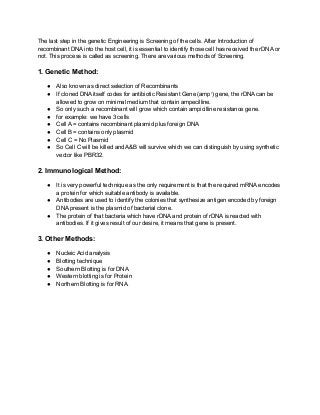
Gene Gun is used to directly introduce the rDNA into the cell. The gene of interest is usually
labeled with a gold particle; to make it heavier. So it then acts as a bullet.
4. Screening:
6.
The last stepin the genetic Engineering is Screening of the cells. After Introduction of
recombinant DNA into the host cell, it is essential to identify those cell has received the rDNA or
not. This process is called as screening. There are various methods of Screening.
1. Genetic Method:
● Also known as direct selection of Recombinants
● If cloned DNA itself codes for antibiotic Resistant Gene (ampr
) gene, the rDNA can be
allowed to grow on minimal medium that contain ampecilline.
● So only such a recombinant will grow which contain ampicilline resistance gene.
● for example: we have 3 cells
● Cell A = contains recombinant plasmid plus foreign DNA
● Cell B = contains only plasmid
● Cell C = No Plasmid
● So Cell C will be killed and A&B will survive which we can distinguish by using synthetic
vector like PBR32.
2. Immunological Method:
● It is very powerful technique as the only requirement is that the required mRNA encodes
a protein for which suitable antibody is available.
● Antibodies are used to identify the colonies that synthesize antigen encoded by foreign
DNA present is the plasmid of bacterial clone.
● The protein of that bacteria which have rDNA and protein of rDNA is reacted with
antibodies. If it gives result of our desire, it means that gene is present.
3. Other Methods:
● Nucleic Acid analysis
● Blotting technique
● Southern Blotting is for DNA
● Western blotting is for Protein
● Northern Blotting is for RNA.