Demonstrate the knowledge of medical
equipment in basic patient care
1. Types of health facility equipment and instruments
2. Functions of health facility equipment and instruments
3. Care and maintenance of health facility equipment and instruments
Types of health facility equipment and instruments
Equipment
anesthesia machine
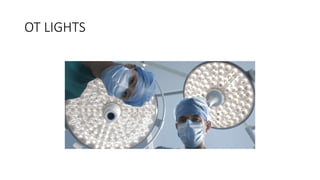
OT LIGHTS
OT TABLE
Sunction machine
Diathermy machine/ electrosurgical pencil
Autoclave machine
Theatre instruments
Instruments can be classified in many ways - but broadly speaking, there are five
kinds of instruments.
• Cutting and dissecting instruments:
• Scalpels, scissors, and saws are the most traditional
• Elevators can be both cutting and lifting/retracting
• Although the term dissection is broad, energy devices such as diathermy/cautery are
often used as more modern alternatives.
• Grasping or holding instruments:
• Classically this included forceps and clamps predominantly
• Roughly, forceps can be divided into traumatic (tissue crushing) and atraumatic (tissue
preserving, such as Debakey's)
• Numerous examples are available for different purposes by field
Theatre instruments
Haemostatic instruments:
• This includes instruments utilized for the cessation of bleeding
• Artery forceps are a classic example in which bleeding is halted by direct clamping of a vessel
• Sutures are often used, aided by a needle holder
• Cautery and related instruments are used with increasing frequency in high resource countries
• Retractors:
• Surgery is often considered to be largely about exposure
• A multitude of retractors exist to aid in exposing the body's cavities accessed during surgery
• These can broadly be hand held (often by a junior assistant) or self retaining
• Elevators can be both cutting and lifting/retracting
• Tissue unifying instruments and materials:
• This would include instruments that aid in tissue unification (such as needle holders or staple
applicators)
• And the materials themselves
Functions of health facility equipment and instruments
functions of Anaesthesia machine
The machine performs four essential functions:
(i) provides oxygen;
(ii) accurately mixes anaesthetic gases and vapours;
(iii) enables patient ventilation;
(iv) minimizes anaesthesia-related risks to patients and staff.
Functions of health facility equipment and
instruments
Function of operation theatre light
• The primary function of surgical lighting is to illuminate the operative
site on and/or within a patient for ideal visualization by OR staff
during a surgical procedure.
• With proper lighting, operating room staff can achieve a higher level
of efficacy during surgery and reduce the risk of complications
Functions of health facility equipment and
instruments
Functions of operation table
• A patient lies on the operating table during a surgical procedure.
• The purpose of a surgical table is to keep the patient in place while the
surgical team operates, and may move various parts of the body using
surgical table accessories for easier access to the surgical site.
• Countless procedures are performed on operating tables.
• These include cardiovascular, genecology, podiatric, orthopaedic, and
paediatric surgeries. Because of the variety of procedures and types of
surgical tables, weight and height restrictions are set to keep the
patient safe during surgery
Functions of health facility equipment and
instruments
Functions of a suction machine
It is specifically developed to remove substances such as saliva, blood,
and vomit from the person’s airway.
Functions of health facility equipment and
instruments
Function of diathermy machine
A diathermy machine is used to pass electric current of high frequency
(about 1–2 MHz) through the body to cause cutting and/or coagulation
by burning local tissue where the current density is high.
Functions of health facility equipment and
instruments
• Autoclaves provide a physical method for disinfection and sterilization.
• They work with a combination of steam, pressure and time. Autoclaves
operate at high temperature and pressure in order to kill
microorganisms and spores.
• They are used to decontaminate certain biological waste and sterilize
media, instruments and lab ware.
• Regulated medical waste that might contain bacteria, viruses and other
biological material are recommended to be inactivated by autoclaving
before disposal.
Functions of health facility equipment and
instruments
Therefore functions of health facility equipment and isntruments includes:
• Cutting
• Viewing
• Retracting
• Ligating
• Autoclaving
• Lighting
• Regulation & Administration of anesthetic agents
Functions of health facility equipment and
instruments
Different operation sets and functions
1. A.V fistula surgical instrument set
2. Abdominal hysterectomy instrument set
3. Abdominalplasty surgical instrument set
4. Amputation surgical instrument set
5. Anterior and posterior repair surgical instrument set
6. Bladder surgical instrument set
7. Blepharoplasty surgical instrument set
Functions of health facility equipment and
instruments
8. Breast augumentation instrument set
9. Breast reduction surgical instrument set
10. Cardiovascular surgical instrument set
11. Cast surgical instrument set
12. Cataract surgical instrument set
13. Caesarean section surgical instrument set
14. Chalazion surgical instrument set
15. Colposcopy surgical instrument set
Functions of health facility equipment and
instruments
16. Craniotomy surgical instrument set
17. D & C surgical instrument set
18. Delivery surgical instrument set
19. Dermal excision instrument set
20. Ear instrument set
21. Ear microsurgery mastoidectomy set
22. ENT basic instrument set
23. Foot and ankle surgical instrument set
24. Gastrointestinal instrument set
Functions of health facility equipment and
instruments
25. Glaucoma surgical instrument set
26. GYN exam set
27. Gynaecological surgical instrument set
28. Hand surgery instrument set
29. Hemmroidectomy instrument set
30. Hernia surgical instrument set
31. Hip replacement instrument set
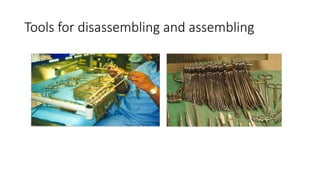
Tools for disassembling and assembling
Instrument containment devices come in all shapes, sizes and
configurations. Some instrument containers have graphic inserts in
which every instrument has a specific location for placement within the
tray.
Other containers provide customizable baskets or tray inserts that have
nesting capabilities that allow multiple tray inserts to be stacked on top
of one another, thereby, providing users with different options for
separating instruments.
Tools for disassembling and assembling
Customizable accessories can also facilitate sterilization by physically
separating instrumentation and holding instruments in place.
Most healthcare facilities use baskets in conjunction with a rigid
container system or basket/container that is subsequently wrapped
prior to sterilization.
this allows technicians to organize each tray by arranging
instrumentation within the tray to maximize space, while also creating
a layout that will facilitate the sterilization process
Tools for disassembling and assembling
How to assemble various parts of operation
theatre instruments and apparatus
Instrument assembly is a critical step in the process because it is the last
point in which the instrumentation will be handled prior to its use in the
OR
After the decontamination process, instruments are transferred to the
assembly area in the CSSD; this area is also commonly known as the
preparation and packaging area.
It is in the assembly area that the Certified Instrument Specialist (CIS) must
assemble instrumentation in a manner that will facilitate the sterilization
process and protect instruments from damage – and determine how best
to assemble instruments for use in the Operating Room
How to assemble various parts of operation
theatre instruments and apparatus
Several aspects of instrumentation assembly can result in a breach of
sterilization, if performed incorrectly.
One common assembly error is failure to disassemble multi-part
instruments.
Prior to cleaning, assembly and sterilization of any instrument,
technicians should read and understand the instrumentation’s
instructions for use (IFU).
How to assemble various parts of operation
theatre instruments and apparatus
When configuring instrumentation such as ringed instruments or
instruments with a ratchet, instruments should be sterilized in the
unlatched position (more commonly referred to as the “open position”)
Racks, pins, stringers, or other specifically designed devices can be used
to hold the instrument in the unlatched position.” Unlatching
instruments in the open position allows the sterilant to easily reach all
surfaces
How to assemble various parts of operation
theatre instruments and apparatus
It is also important to place all instruments in trays in a manner that
prevents air entrapment and water pooling or condensation during
the sterilization process
Concave instruments and long, wide and flat instruments, such
malleable retractors, should be placed on edge (not lying flat) to
prevent pooling and retained water.
Medicine cups should not be positioned upright, but in a manner that
allows for drainage, while also allowing the sterilant to come in contact
with all surfaces.
How to assemble various parts of operation
theatre instruments and apparatus
Instruments should be positioned in a tray large enough to permit equal
distribution of weight and metal mass, and to allow circulation of the sterilant.
When assembling instrumentation, heavier items like retractors and mallets
should be placed on the bottom of the tray.
Heavier items can damage more delicate items like thumb forceps.
Ringed or hinged instruments should be placed on a stringer in the unlatched
position and grouped together with similar instruments, from smaller to larger
sizes.
For example, smaller clamps such as mosquito forceps would be grouped
together with other hemostats like Crile, Kelly and Peon forceps
How to assemble various parts of operation
theatre instruments and apparatus
The curvature of the instruments should be facing in the same
direction.
Other straight ratcheting forceps like the Kocher, Allis, Babcock and
sponge forceps can be grouped together, followed by needle drivers
and scissors (with the same principles of smaller to larger sizes).
Knife handles, thumb forceps and Frazier-type suction tubes should also
be separated and protected because of the delicate nature of these
instruments
How to assemble various parts of operation
theatre instruments and apparatus
Instrument technicians should never attempt to assemble instrument
trays by memory.
The contents of the tray can change, technicians can become
distracted, or a technician can simply forget an item.
An instrument count sheet or recipe card should always be used,
regardless of whether the count sheet is used with a tracking system or
provided on paper.
How to assemble various parts of operation
theatre instruments and apparatus
The count sheet should include detailed instructions and list the
required instruments and placement for each tray.
Each instrument should be identified, inspected and verified against the
count sheet and placed in the proper location within the tray.
Care and maintenance of health facility equipment and
instruments
Identify malfunctioning equipment and instruments
1. Verify a Problem Actually Exists
2. Narrow Down the Problem’s Root Cause
3. Correcting the Cause of the Problem
4. Verify the Problem Is Corrected
5. Prevent Future Issues By Following Up
Care and maintenance of health facility
equipment and instruments
Reporting malfunctioning equipment and instruments
Defective Tool or Equipment Reporting
If you find that a tool is defective and that you are not qualified or assigned to repair
it, follow this procedure.
1. Obtain a defective OUT OF SERVICE tag from the foreman's office.
2. Set the defective tool aside by the Foreman office on the table designated for
damaged tools.
3. Do not return the tool back into the tool crib or the supply room or even your
toolbox.
An accident may occur if other people attempt to use a damaged tool.
4. Alert the shift foreman that the item is damaged.
Care and maintenance of health facility
equipment and instruments
Fill out the defective OUT OF SERVICE tag. Wire the tag to the
equipment around the shut off button.
Foreman will log the OUT OF SERVICE Tag into the maintenance
records. And the tool will be repaired or replaced
If repaired the Foreman will have the repair made and the tool
returned back to production minus the out of service tag.
Care and maintenance of health facility
equipment and instruments
Basic maintenance of malfunctioning equipment and instruments
• What is equipment maintenance and why it matters
• The best way to define equipment maintenance is to look at what it is
trying to achieve.
• The main goal of equipment maintenance is to keep equipment in
optimal working order.
• When proper regular maintenance is applied to a piece of equipment
it maximizes its production output and increases its useful life
Care and maintenance of health facility
equipment and instruments
Types of equipment maintenance
Run-to-failure strategy: Represents a reactive approach to
maintenance. Using this strategy, you consciously decide to use a piece
of equipment until it breaks down. It is suitable for equipment with low
repair costs and when equipment breakdown won’t cause big
operational issues (like production delays). Can be used on critical
equipment you plan to replace after the next breakdown
Care and maintenance of health facility
equipment and instruments
Preventive maintenance strategy: A good overall strategy for most
types of equipment. Easiest and cheapest proactive maintenance
strategy to implement and run.
Condition-based maintenance (CBM) strategy: When implementing
condition-based maintenance, you have to purchase and install
condition monitoring sensors on your equipment. These sensors give
you real-time insight into the health of your assets. This helps you
optimize your maintenance schedule by having a better idea of when a
piece of equipment should be serviced.
Care and maintenance of health facility
equipment and instruments
• Predictive maintenance (PdM) strategy: Predictive maintenance is
like an upgraded version of CBM (does the same thing, but better). It
involves using predictive analytics and algorithms (based on data
coming from condition monitoring sensors) to predict exactly when a
piece of equipment is expected to fail so you can schedule
maintenance just before that happens.
Care and maintenance of health facility
equipment and instruments
Total productive maintenance (TPM): Total productive maintenance is
a strategy predominantly used in the manufacturing sector. TPM
expands the equipment maintenance responsibility outside the
maintenance team. It represents a philosophy of continuous
improvement that requires the commitment and effort of the whole
organization.
Care and maintenance of health facility
equipment and instruments
• Segregate malfunctioning equpment from functioning ones

BASIC HOSPITAL PROCEDURES POWER POINT PRESENTATION

  • 1.
    Demonstrate the knowledgeof medical equipment in basic patient care 1. Types of health facility equipment and instruments 2. Functions of health facility equipment and instruments 3. Care and maintenance of health facility equipment and instruments
  • 2.
    Types of healthfacility equipment and instruments Equipment anesthesia machine
  • 3.
  • 4.
  • 5.
  • 6.
  • 7.
  • 8.
    Theatre instruments Instruments canbe classified in many ways - but broadly speaking, there are five kinds of instruments. • Cutting and dissecting instruments: • Scalpels, scissors, and saws are the most traditional • Elevators can be both cutting and lifting/retracting • Although the term dissection is broad, energy devices such as diathermy/cautery are often used as more modern alternatives. • Grasping or holding instruments: • Classically this included forceps and clamps predominantly • Roughly, forceps can be divided into traumatic (tissue crushing) and atraumatic (tissue preserving, such as Debakey's) • Numerous examples are available for different purposes by field
  • 9.
    Theatre instruments Haemostatic instruments: •This includes instruments utilized for the cessation of bleeding • Artery forceps are a classic example in which bleeding is halted by direct clamping of a vessel • Sutures are often used, aided by a needle holder • Cautery and related instruments are used with increasing frequency in high resource countries • Retractors: • Surgery is often considered to be largely about exposure • A multitude of retractors exist to aid in exposing the body's cavities accessed during surgery • These can broadly be hand held (often by a junior assistant) or self retaining • Elevators can be both cutting and lifting/retracting • Tissue unifying instruments and materials: • This would include instruments that aid in tissue unification (such as needle holders or staple applicators) • And the materials themselves
  • 10.
    Functions of healthfacility equipment and instruments functions of Anaesthesia machine The machine performs four essential functions: (i) provides oxygen; (ii) accurately mixes anaesthetic gases and vapours; (iii) enables patient ventilation; (iv) minimizes anaesthesia-related risks to patients and staff.
  • 11.
    Functions of healthfacility equipment and instruments Function of operation theatre light • The primary function of surgical lighting is to illuminate the operative site on and/or within a patient for ideal visualization by OR staff during a surgical procedure. • With proper lighting, operating room staff can achieve a higher level of efficacy during surgery and reduce the risk of complications
  • 12.
    Functions of healthfacility equipment and instruments Functions of operation table • A patient lies on the operating table during a surgical procedure. • The purpose of a surgical table is to keep the patient in place while the surgical team operates, and may move various parts of the body using surgical table accessories for easier access to the surgical site. • Countless procedures are performed on operating tables. • These include cardiovascular, genecology, podiatric, orthopaedic, and paediatric surgeries. Because of the variety of procedures and types of surgical tables, weight and height restrictions are set to keep the patient safe during surgery
  • 13.
    Functions of healthfacility equipment and instruments Functions of a suction machine It is specifically developed to remove substances such as saliva, blood, and vomit from the person’s airway.
  • 14.
    Functions of healthfacility equipment and instruments Function of diathermy machine A diathermy machine is used to pass electric current of high frequency (about 1–2 MHz) through the body to cause cutting and/or coagulation by burning local tissue where the current density is high.
  • 15.
    Functions of healthfacility equipment and instruments • Autoclaves provide a physical method for disinfection and sterilization. • They work with a combination of steam, pressure and time. Autoclaves operate at high temperature and pressure in order to kill microorganisms and spores. • They are used to decontaminate certain biological waste and sterilize media, instruments and lab ware. • Regulated medical waste that might contain bacteria, viruses and other biological material are recommended to be inactivated by autoclaving before disposal.
  • 16.
    Functions of healthfacility equipment and instruments Therefore functions of health facility equipment and isntruments includes: • Cutting • Viewing • Retracting • Ligating • Autoclaving • Lighting • Regulation & Administration of anesthetic agents
  • 17.
    Functions of healthfacility equipment and instruments Different operation sets and functions 1. A.V fistula surgical instrument set 2. Abdominal hysterectomy instrument set 3. Abdominalplasty surgical instrument set 4. Amputation surgical instrument set 5. Anterior and posterior repair surgical instrument set 6. Bladder surgical instrument set 7. Blepharoplasty surgical instrument set
  • 18.
    Functions of healthfacility equipment and instruments 8. Breast augumentation instrument set 9. Breast reduction surgical instrument set 10. Cardiovascular surgical instrument set 11. Cast surgical instrument set 12. Cataract surgical instrument set 13. Caesarean section surgical instrument set 14. Chalazion surgical instrument set 15. Colposcopy surgical instrument set
  • 19.
    Functions of healthfacility equipment and instruments 16. Craniotomy surgical instrument set 17. D & C surgical instrument set 18. Delivery surgical instrument set 19. Dermal excision instrument set 20. Ear instrument set 21. Ear microsurgery mastoidectomy set 22. ENT basic instrument set 23. Foot and ankle surgical instrument set 24. Gastrointestinal instrument set
  • 20.
    Functions of healthfacility equipment and instruments 25. Glaucoma surgical instrument set 26. GYN exam set 27. Gynaecological surgical instrument set 28. Hand surgery instrument set 29. Hemmroidectomy instrument set 30. Hernia surgical instrument set 31. Hip replacement instrument set
  • 21.
    Tools for disassemblingand assembling Instrument containment devices come in all shapes, sizes and configurations. Some instrument containers have graphic inserts in which every instrument has a specific location for placement within the tray. Other containers provide customizable baskets or tray inserts that have nesting capabilities that allow multiple tray inserts to be stacked on top of one another, thereby, providing users with different options for separating instruments.
  • 22.
    Tools for disassemblingand assembling Customizable accessories can also facilitate sterilization by physically separating instrumentation and holding instruments in place. Most healthcare facilities use baskets in conjunction with a rigid container system or basket/container that is subsequently wrapped prior to sterilization. this allows technicians to organize each tray by arranging instrumentation within the tray to maximize space, while also creating a layout that will facilitate the sterilization process
  • 23.
  • 24.
    How to assemblevarious parts of operation theatre instruments and apparatus Instrument assembly is a critical step in the process because it is the last point in which the instrumentation will be handled prior to its use in the OR After the decontamination process, instruments are transferred to the assembly area in the CSSD; this area is also commonly known as the preparation and packaging area. It is in the assembly area that the Certified Instrument Specialist (CIS) must assemble instrumentation in a manner that will facilitate the sterilization process and protect instruments from damage – and determine how best to assemble instruments for use in the Operating Room
  • 25.
    How to assemblevarious parts of operation theatre instruments and apparatus Several aspects of instrumentation assembly can result in a breach of sterilization, if performed incorrectly. One common assembly error is failure to disassemble multi-part instruments. Prior to cleaning, assembly and sterilization of any instrument, technicians should read and understand the instrumentation’s instructions for use (IFU).
  • 26.
    How to assemblevarious parts of operation theatre instruments and apparatus When configuring instrumentation such as ringed instruments or instruments with a ratchet, instruments should be sterilized in the unlatched position (more commonly referred to as the “open position”) Racks, pins, stringers, or other specifically designed devices can be used to hold the instrument in the unlatched position.” Unlatching instruments in the open position allows the sterilant to easily reach all surfaces
  • 27.
    How to assemblevarious parts of operation theatre instruments and apparatus It is also important to place all instruments in trays in a manner that prevents air entrapment and water pooling or condensation during the sterilization process Concave instruments and long, wide and flat instruments, such malleable retractors, should be placed on edge (not lying flat) to prevent pooling and retained water. Medicine cups should not be positioned upright, but in a manner that allows for drainage, while also allowing the sterilant to come in contact with all surfaces.
  • 28.
    How to assemblevarious parts of operation theatre instruments and apparatus Instruments should be positioned in a tray large enough to permit equal distribution of weight and metal mass, and to allow circulation of the sterilant. When assembling instrumentation, heavier items like retractors and mallets should be placed on the bottom of the tray. Heavier items can damage more delicate items like thumb forceps. Ringed or hinged instruments should be placed on a stringer in the unlatched position and grouped together with similar instruments, from smaller to larger sizes. For example, smaller clamps such as mosquito forceps would be grouped together with other hemostats like Crile, Kelly and Peon forceps
  • 29.
    How to assemblevarious parts of operation theatre instruments and apparatus The curvature of the instruments should be facing in the same direction. Other straight ratcheting forceps like the Kocher, Allis, Babcock and sponge forceps can be grouped together, followed by needle drivers and scissors (with the same principles of smaller to larger sizes). Knife handles, thumb forceps and Frazier-type suction tubes should also be separated and protected because of the delicate nature of these instruments
  • 30.
    How to assemblevarious parts of operation theatre instruments and apparatus Instrument technicians should never attempt to assemble instrument trays by memory. The contents of the tray can change, technicians can become distracted, or a technician can simply forget an item. An instrument count sheet or recipe card should always be used, regardless of whether the count sheet is used with a tracking system or provided on paper.
  • 31.
    How to assemblevarious parts of operation theatre instruments and apparatus The count sheet should include detailed instructions and list the required instruments and placement for each tray. Each instrument should be identified, inspected and verified against the count sheet and placed in the proper location within the tray.
  • 32.
    Care and maintenanceof health facility equipment and instruments Identify malfunctioning equipment and instruments 1. Verify a Problem Actually Exists 2. Narrow Down the Problem’s Root Cause 3. Correcting the Cause of the Problem 4. Verify the Problem Is Corrected 5. Prevent Future Issues By Following Up
  • 33.
    Care and maintenanceof health facility equipment and instruments Reporting malfunctioning equipment and instruments Defective Tool or Equipment Reporting If you find that a tool is defective and that you are not qualified or assigned to repair it, follow this procedure. 1. Obtain a defective OUT OF SERVICE tag from the foreman's office. 2. Set the defective tool aside by the Foreman office on the table designated for damaged tools. 3. Do not return the tool back into the tool crib or the supply room or even your toolbox. An accident may occur if other people attempt to use a damaged tool. 4. Alert the shift foreman that the item is damaged.
  • 34.
    Care and maintenanceof health facility equipment and instruments Fill out the defective OUT OF SERVICE tag. Wire the tag to the equipment around the shut off button. Foreman will log the OUT OF SERVICE Tag into the maintenance records. And the tool will be repaired or replaced If repaired the Foreman will have the repair made and the tool returned back to production minus the out of service tag.
  • 35.
    Care and maintenanceof health facility equipment and instruments Basic maintenance of malfunctioning equipment and instruments • What is equipment maintenance and why it matters • The best way to define equipment maintenance is to look at what it is trying to achieve. • The main goal of equipment maintenance is to keep equipment in optimal working order. • When proper regular maintenance is applied to a piece of equipment it maximizes its production output and increases its useful life
  • 36.
    Care and maintenanceof health facility equipment and instruments Types of equipment maintenance Run-to-failure strategy: Represents a reactive approach to maintenance. Using this strategy, you consciously decide to use a piece of equipment until it breaks down. It is suitable for equipment with low repair costs and when equipment breakdown won’t cause big operational issues (like production delays). Can be used on critical equipment you plan to replace after the next breakdown
  • 37.
    Care and maintenanceof health facility equipment and instruments Preventive maintenance strategy: A good overall strategy for most types of equipment. Easiest and cheapest proactive maintenance strategy to implement and run. Condition-based maintenance (CBM) strategy: When implementing condition-based maintenance, you have to purchase and install condition monitoring sensors on your equipment. These sensors give you real-time insight into the health of your assets. This helps you optimize your maintenance schedule by having a better idea of when a piece of equipment should be serviced.
  • 38.
    Care and maintenanceof health facility equipment and instruments • Predictive maintenance (PdM) strategy: Predictive maintenance is like an upgraded version of CBM (does the same thing, but better). It involves using predictive analytics and algorithms (based on data coming from condition monitoring sensors) to predict exactly when a piece of equipment is expected to fail so you can schedule maintenance just before that happens.
  • 39.
    Care and maintenanceof health facility equipment and instruments Total productive maintenance (TPM): Total productive maintenance is a strategy predominantly used in the manufacturing sector. TPM expands the equipment maintenance responsibility outside the maintenance team. It represents a philosophy of continuous improvement that requires the commitment and effort of the whole organization.
  • 40.
    Care and maintenanceof health facility equipment and instruments • Segregate malfunctioning equpment from functioning ones