BASIC
ECONOMIC
CONSEPTS
By: Jenny and
Rosel
INTRODUCTION
Economics is a social science that
studies how individuals, businesses,
governments, and societies make
choices about allocating resources.
It encompasses a wide range of
topics, including production,
consumption, distribution, and the
behavior of economic agents.
Objectives
1
2
3
Define key economic terms and concepts.
Explain the principles of supply and demand.
Discuss the role of markets and prices in an economy.
Objectives
4
5
6
Analyze the impact of government intervention in
economic activities.
Explore the concepts of opportunity cost and trade-offs.
Examine the different types of economic systems.
ECONOMIC TERMS
AND
CONCEPTS
Scarcity
The basic economic problem
that arises because resources
are limited while human wants
are unlimited. Scarcity forces
individuals and societies to
make choices about how to
allocate resources effectively.
Opportunity
Cost
The value of the next best
alternative that is forgone when
a choice is made. For example, if
a student chooses to spend time
studying instead of working a
part-time job, the opportunity
cost is the income they could
have earned during that time.
Market Equilibrium
The point at which the quantity
of a good or service demanded
by consumers equals the
quantity supplied by producers.
At this point, the market is said
to be in balance.
Elasticity
A measure of how much the
quantity demanded or supplied
of a good responds to changes in
price. Goods can be elastic
(sensitive to price changes) or
inelastic (not sensitive to price
changes).
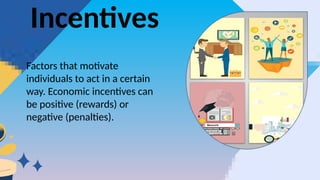
Incentives
Factors that motivate
individuals to act in a certain
way. Economic incentives can
be positive (rewards) or
negative (penalties).
Principles of Supply
and
Demand
Supply
Supply refers to the quantity of a good or
service that producers are willing and able
to sell at various prices. The law of supply
states that, all else being equal, an
increase in price results in an increase in
quantity supplied. This relationship can be
illustrated with a supply curve, which
typically slopes upward from left to right.
Demand
A measure of how much the
quantity demanded or supplied
of a good responds to changes in
price. Goods can be elastic
(sensitive to price changes) or
inelastic (not sensitive to price
changes).
Market Equilibrium
Market equilibrium occurs when
the quantity supplied equals the
quantity demanded. At this point,
the market price stabilizes, and
there is no tendency for it to
change unless an external factor
affects supply or demand.
Shifts in Supply
and Demand
Factors such as consumer
preferences, income levels, and
the prices of related goods can
cause shifts in the demand curve.
Similarly, changes in production
costs, technology, and the
number of suppliers can shift the
supply curve.
Price Controls
These include price ceilings
(maximum prices) and price
floors (minimum prices)
that can lead to shortages
or surpluses.
Taxes and Subsidies
Taxes can discourage
consumption of certain
goods, while subsidies
can encourage
production or
consumption.
Regulations
Governments may impose
regulations to protect
consumers, workers, and
the environment.
Opportunity Cost and Trade-offs
Every economic decision involves
trade-offs, as choosing one option
typically means giving up another.
Understanding opportunity cost is
crucial for making informed
decisions.
Types of
Economic Systems
Traditional Economy
An economy that relies
on customs and
traditions to make
economic decisions.
Production methods are
often passed down
through generations.
Command Economy
An economy where the
government makes all
economic decisions,
including what to produce,
how to produce it, and for
whom to produce.
Market Economy
An economy where
decisions are made based
on supply and demand,
with minimal government
intervention. Prices are
determined by the market.
Mixed Economy
An economy that
incorporates elements of
both market and
command economies.
Both private and public
sectors play a role in
economic decision-making.
THANK
YOU

Basic Economic Concepts…………………..:: .pptx

  • 1.
  • 2.
    INTRODUCTION Economics is asocial science that studies how individuals, businesses, governments, and societies make choices about allocating resources. It encompasses a wide range of topics, including production, consumption, distribution, and the behavior of economic agents.
  • 3.
    Objectives 1 2 3 Define key economicterms and concepts. Explain the principles of supply and demand. Discuss the role of markets and prices in an economy.
  • 4.
    Objectives 4 5 6 Analyze the impactof government intervention in economic activities. Explore the concepts of opportunity cost and trade-offs. Examine the different types of economic systems.
  • 5.
  • 6.
    Scarcity The basic economicproblem that arises because resources are limited while human wants are unlimited. Scarcity forces individuals and societies to make choices about how to allocate resources effectively.
  • 7.
    Opportunity Cost The value ofthe next best alternative that is forgone when a choice is made. For example, if a student chooses to spend time studying instead of working a part-time job, the opportunity cost is the income they could have earned during that time.
  • 8.
    Market Equilibrium The pointat which the quantity of a good or service demanded by consumers equals the quantity supplied by producers. At this point, the market is said to be in balance.
  • 9.
    Elasticity A measure ofhow much the quantity demanded or supplied of a good responds to changes in price. Goods can be elastic (sensitive to price changes) or inelastic (not sensitive to price changes).
  • 10.
    Incentives Factors that motivate individualsto act in a certain way. Economic incentives can be positive (rewards) or negative (penalties).
  • 11.
  • 12.
    Supply Supply refers tothe quantity of a good or service that producers are willing and able to sell at various prices. The law of supply states that, all else being equal, an increase in price results in an increase in quantity supplied. This relationship can be illustrated with a supply curve, which typically slopes upward from left to right.
  • 13.
    Demand A measure ofhow much the quantity demanded or supplied of a good responds to changes in price. Goods can be elastic (sensitive to price changes) or inelastic (not sensitive to price changes).
  • 14.
    Market Equilibrium Market equilibriumoccurs when the quantity supplied equals the quantity demanded. At this point, the market price stabilizes, and there is no tendency for it to change unless an external factor affects supply or demand.
  • 15.
    Shifts in Supply andDemand Factors such as consumer preferences, income levels, and the prices of related goods can cause shifts in the demand curve. Similarly, changes in production costs, technology, and the number of suppliers can shift the supply curve.
  • 17.
    Price Controls These includeprice ceilings (maximum prices) and price floors (minimum prices) that can lead to shortages or surpluses.
  • 18.
    Taxes and Subsidies Taxescan discourage consumption of certain goods, while subsidies can encourage production or consumption.
  • 19.
    Regulations Governments may impose regulationsto protect consumers, workers, and the environment.
  • 20.
    Opportunity Cost andTrade-offs Every economic decision involves trade-offs, as choosing one option typically means giving up another. Understanding opportunity cost is crucial for making informed decisions.
  • 21.
  • 22.
    Traditional Economy An economythat relies on customs and traditions to make economic decisions. Production methods are often passed down through generations.
  • 23.
    Command Economy An economywhere the government makes all economic decisions, including what to produce, how to produce it, and for whom to produce.
  • 24.
    Market Economy An economywhere decisions are made based on supply and demand, with minimal government intervention. Prices are determined by the market.
  • 25.
    Mixed Economy An economythat incorporates elements of both market and command economies. Both private and public sectors play a role in economic decision-making.
  • 26.