Introduction to Financial
Accounting : Study Notes
Prepared by: RMSRM
Learning Outcomes
At the end of this lesson, students will
be able to:
 Understanding what is accounting and
forms of business in Malaysia.
 Understanding the accounting
concepts and principles.
 Understanding the accounting
components.
 Understanding the accounting
equation.
What is Accounting
 Accounting is defined as the art of
identifying, recording, classifying,
analyzing, and reporting all the
business transaction in monetary
terms for preparation of Financial
Statements.
What is Bookeeping
 Bookkeeping is the recording, on a
day-to-day basis, of the financial
transactions and information
pertaining to a business.
 It ensures that records of the
individual financial transactions are
correct, up-to-date and
comprehensive.
 Accuracy is therefore vital to the
process
Differences between Accounting
& Bookeeping
BOOKEEPING ACCOUNTING
Definition Bookeeping is mainly related
to identifying, measuring and
recording financial transaction
Accounting is the process of
summarizing, interpreting, and
communicating financial
transactions which were
classified in the ledger account
Decision
making
Management can't take a
decision based on the data
provided by bookkeeping
Depending on the data provided
by the accountants, the
management can take critical
business decision
Objective The objective of bookkeeping
is to keep the records of all
financial transactions proper
and systematic
The objective of accounting is to
gauge the financial situation and
further communicate the
information to the relevant
authorities
Preparation
of Financial
Statements
Financial statements are not
prepared as a part of this
process
Financial statements are
prepared during the accounting
process
Differences between Accounting
& Bookeeping
BOOKEEPING ACCOUNTING
Skills
Required
Bookkeeping doesn't require
any special skill set
Accounting requires special
skills due to its analytical and
complex nature
Analysis The process of bookkeeping
does not require any analysis
Accounting uses bookkeeping
information to analyze and
interpret the data and then
compiles it into reports
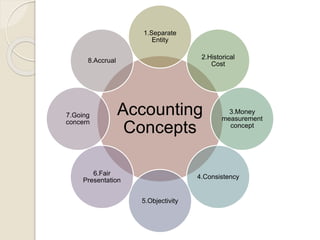
Accounting
Concepts
1.Separate
Entity
2.Historical
Cost
3.Money
measurement
concept
4.Consistency
5.Objectivity
6.Fair
Presentation
7.Going
concern
8.Accrual
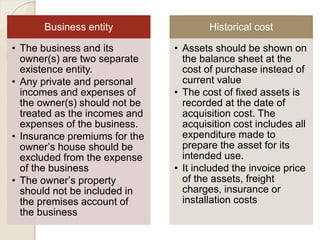
Business entity
• The business and its
owner(s) are two separate
existence entity.
• Any private and personal
incomes and expenses of
the owner(s) should not be
treated as the incomes and
expenses of the business.
• Insurance premiums for the
owner’s house should be
excluded from the expense
of the business
• The owner’s property
should not be included in
the premises account of
the business
Historical cost
• Assets should be shown on
the balance sheet at the
cost of purchase instead of
current value
• The cost of fixed assets is
recorded at the date of
acquisition cost. The
acquisition cost includes all
expenditure made to
prepare the asset for its
intended use.
• It included the invoice price
of the assets, freight
charges, insurance or
installation costs
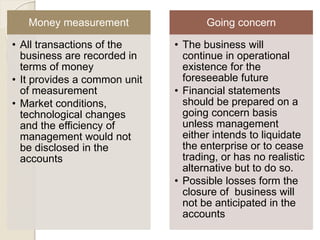
Money measurement
• All transactions of the
business are recorded in
terms of money
• It provides a common unit
of measurement
• Market conditions,
technological changes
and the efficiency of
management would not
be disclosed in the
accounts
Going concern
• The business will
continue in operational
existence for the
foreseeable future
• Financial statements
should be prepared on a
going concern basis
unless management
either intends to liquidate
the enterprise or to cease
trading, or has no realistic
alternative but to do so.
• Possible losses form the
closure of business will
not be anticipated in the
accounts
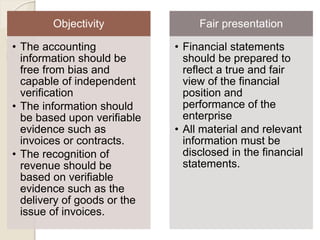
Objectivity
• The accounting
information should be
free from bias and
capable of independent
verification
• The information should
be based upon verifiable
evidence such as
invoices or contracts.
• The recognition of
revenue should be
based on verifiable
evidence such as the
delivery of goods or the
issue of invoices.
Fair presentation
• Financial statements
should be prepared to
reflect a true and fair
view of the financial
position and
performance of the
enterprise
• All material and relevant
information must be
disclosed in the financial
statements.
Consistency
• Companies should choose
the most suitable
accounting methods and
treatments, and
consistently apply them in
every period
• Changes are permitted
only when the new method
is considered better and
can reflect the true and fair
view of the financial
position of the company
• The change and its effect
on profits should be
disclosed in the financial
statements
Accrual
• Revenues are recognized
when they are earned, but
not when cash is received
• Expenses are recognized
as they are incurred, but
not when cash is paid
• The net income for the
period is determined by
subtracting expenses
incurred from revenues
earned.
• Expenses incurred but not
yet paid in current period
should be treated as
accrual/accrued expenses
under current liabilities
Users of Financial Position
Internal users- people inside the
organization
 Management
◦ Need information for planning, policy making and
evaluation
 Employees
◦ Interested in the stability of the business to provide
employment, fringe benefits and promotion opportunities
External users- people outside the
organization.
 Customers
◦ Interested in long-tem stability of the business and continuance
of the supply of particular products
 Public
◦ Need information about the trends and recent development
 Government
◦ Need information about various businesses for statistics and
formulation of economic plan
 Investors
◦ Need information about the profitability, dividend yield and price
earnings ratio in order to assess the quality and the price of
shares of a company
 Lenders
◦ Need information about the profitability and solvency of the
business in order to determine the risk and interest rate of loans
 Suppliers and trade creditors
◦ Need information about the liquidity of business in order to
access the ability to repay the amounts owed to them
Forms of business
organization
Proprietorship /
Sole trader
Partnership
Limited
Liability
Company
Aspects Proprietorship Partnership Limited Company
Definition
A type of business,
in which only one
person is the owner
as well as operator
of the business.
A business form in
which minimum 2 until
20 persons
(Professional
partnership , Ex
lawyer, Accountant,
max 50 persons)
which is agree to carry
on business .
Have 2 types.
1) Sendirian BHD
,minimum members
limit is 2 and maximum
is 50.
2) Berhad (BHD), the
minimum of members
(shareholders) are 2
and maximum of
unlimited amount of
members.
Governing
Act
Company Act 2016 Partnership Act 1961 Company Act 2016
Owner
Known as sole
trader or sole
proprietor.
Individually knows as
partners and
collectively known as
firm
Shareholder (provider of
fund)
Managem
ent &
Owner have a full
control and
management over
the business
Active partner take a
part in control &
management of
business. Silent
Shareholder, as a
owner have a full
control and
management over the
Aspects Proprietorship Partnership Company
Sources
of capital
Solely contribute by
the owner
Contribute by the
partners
Contribute by the
shareholder
Profit and
loss
Profit & loss are
borne solely by the
owner
Profit & loss are divide
among the partners
according to
agreement/ profit ratio.
Receive profit in term
of dividend paid,
restricted to amount
of share subscribe.
Duration
Uncertain Depend on desire and
capacity of the partners
Depend on desire and
capacity of the
management
Annual
General
Meeting
(AGM)
Not mandatory Not mandatory Mandatory
Tax Income tax Income tax Company tax
Liability
Unlimited liability. Unlimited liability Limited liability, either
limited by share or
limited by guarantee
Note
(Unlimited liability = The third parties, example lenders or creditors
have a right to claim owner’s property, if business unable to pay it)
Accounting’s components
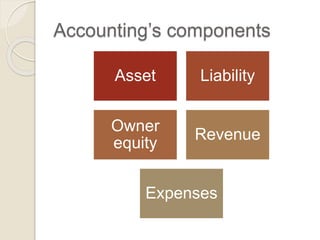
Asset Liability
Owner
equity
Revenue
Expenses
Assets
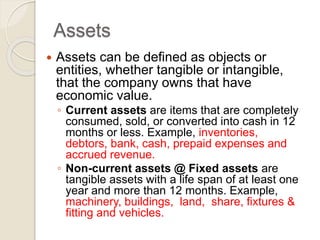
 Assets can be defined as objects or
entities, whether tangible or intangible,
that the company owns that have
economic value.
◦ Current assets are items that are completely
consumed, sold, or converted into cash in 12
months or less. Example, inventories,
debtors, bank, cash, prepaid expenses and
accrued revenue.
◦ Non-current assets @ Fixed assets are
tangible assets with a life span of at least one
year and more than 12 months. Example,
machinery, buildings, land, share, fixtures &
fitting and vehicles.
Liabilities
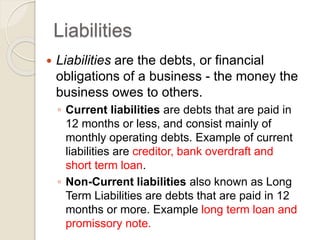
 Liabilities are the debts, or financial
obligations of a business - the money the
business owes to others.
◦ Current liabilities are debts that are paid in
12 months or less, and consist mainly of
monthly operating debts. Example of current
liabilities are creditor, bank overdraft and
short term loan.
◦ Non-Current liabilities also known as Long
Term Liabilities are debts that are paid in 12
months or more. Example long term loan and
promissory note.
Owner equity
 Owner's equity represents the owner's
investment or property in the
business.
 It is derived from total equity minus
the owner's draws or withdrawals from
the business plus the net income (or
minus the net loss) since the business
began.
 Example of owner equity is capital.
Revenue
 Revenue is a money the business
earns from selling a product or
service, generated from business
operation.
 Example of revenue are sales from
goods, commission received, rental
receives and interest on fixed deposit.
Expenses
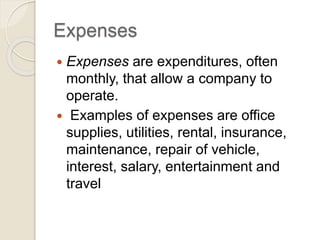
 Expenses are expenditures, often
monthly, that allow a company to
operate.
 Examples of expenses are office
supplies, utilities, rental, insurance,
maintenance, repair of vehicle,
interest, salary, entertainment and
travel
Accounting Equation
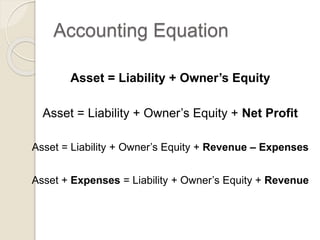
Asset = Liability + Owner’s Equity
Asset = Liability + Owner’s Equity + Net Profit
Asset = Liability + Owner’s Equity + Revenue – Expenses
Asset + Expenses = Liability + Owner’s Equity + Revenue
Journal
 In accounting and bookkeeping a journal
is a record of financial transactions in
order by date.
 A journal is often defined as the book of
original entry.
 All the transaction from sources
documents will record into journal.
 There 2 type of journal:
◦ General journal
◦ Special journal
General journal
 To record all the business transaction
which are unable to record into special
journal.
 Example of transaction such as:
1. Starting the business
2. Drawing from the owner.
3. Adjustment transaction.
4. Sale or purchase any non-current / fixed
assets through credit.
5. To record liquidation of business.
Special journal
 There are 6 types of special journal:
1. Sales journal – to record any transaction sales of
goods through credit.
2. Purchases journal – to record any transaction
purchases of goods through credit.
3. Sales return journal – to record any sales return
transaction from customers.
4. Purchases return journal – to record any
purchases return transaction to suppliers.
5. Cash receipts journal - to record any transaction
sale of goods or any receipts through cash or
bank.
6. Cash payment journal - to record any transaction
purchases of goods or any disbursements
through cash or bank.
Journal entries- General
journal
General journal
Date Particular
Debit (RM)
Credit
(RM)
2018
Jan 1 Dr Cash in hand 2000
Motor vehicles 3000
Cash in bank 5000
Cr Capital 10,000
(Start the business with the assets
above)
8 Dr Drawings 500
Cr Purchases 500
(Drawings of goods for personal
purpose)
Journal entries- Special
journal
Sales journal
Purchases journal
Date Particular Discount Allowed Total (RM)
2018
Jan 3 Ahmad - 2000
6 Fatimah - 3000
31 Sales account (Cr) - 5000
Date Particular Discount
Received
Total (RM)
2018
Jan 1 Mahmud Enterprise - 1000
6 Amirah Enterprise - 2000
31 Purchases account (Dr) - 3000
Journal entries- Special
journal
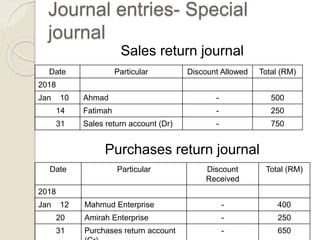
Sales return journal
Purchases return journal
Date Particular Discount Allowed Total (RM)
2018
Jan 10 Ahmad - 500
14 Fatimah - 250
31 Sales return account (Dr) - 750
Date Particular Discount
Received
Total (RM)
2018
Jan 12 Mahmud Enterprise - 400
20 Amirah Enterprise - 250
31 Purchases return account - 650
Journal entries- Special
journal
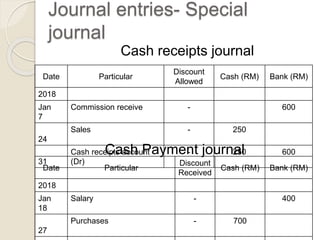
Cash receipts journal
Cash Payment journal
Date Particular
Discount
Allowed
Cash (RM) Bank (RM)
2018
Jan
7
Commission receive - 600
24
Sales - 250
31
Cash receipts account
(Dr)
- 250 600
Date Particular
Discount
Received
Cash (RM) Bank (RM)
2018
Jan
18
Salary - 400
27
Purchases - 700
NEXT :
 LEDGER & TRIAL BALANCE
THANK YOU
FOR YOUR
ATTENTION

Basic Accounting Concepts and Principles.pptx

  • 1.
    Introduction to Financial Accounting: Study Notes Prepared by: RMSRM
  • 2.
    Learning Outcomes At theend of this lesson, students will be able to:  Understanding what is accounting and forms of business in Malaysia.  Understanding the accounting concepts and principles.  Understanding the accounting components.  Understanding the accounting equation.
  • 3.
    What is Accounting Accounting is defined as the art of identifying, recording, classifying, analyzing, and reporting all the business transaction in monetary terms for preparation of Financial Statements.
  • 4.
    What is Bookeeping Bookkeeping is the recording, on a day-to-day basis, of the financial transactions and information pertaining to a business.  It ensures that records of the individual financial transactions are correct, up-to-date and comprehensive.  Accuracy is therefore vital to the process
  • 5.
    Differences between Accounting &Bookeeping BOOKEEPING ACCOUNTING Definition Bookeeping is mainly related to identifying, measuring and recording financial transaction Accounting is the process of summarizing, interpreting, and communicating financial transactions which were classified in the ledger account Decision making Management can't take a decision based on the data provided by bookkeeping Depending on the data provided by the accountants, the management can take critical business decision Objective The objective of bookkeeping is to keep the records of all financial transactions proper and systematic The objective of accounting is to gauge the financial situation and further communicate the information to the relevant authorities Preparation of Financial Statements Financial statements are not prepared as a part of this process Financial statements are prepared during the accounting process
  • 6.
    Differences between Accounting &Bookeeping BOOKEEPING ACCOUNTING Skills Required Bookkeeping doesn't require any special skill set Accounting requires special skills due to its analytical and complex nature Analysis The process of bookkeeping does not require any analysis Accounting uses bookkeeping information to analyze and interpret the data and then compiles it into reports
  • 7.
  • 8.
    Business entity • Thebusiness and its owner(s) are two separate existence entity. • Any private and personal incomes and expenses of the owner(s) should not be treated as the incomes and expenses of the business. • Insurance premiums for the owner’s house should be excluded from the expense of the business • The owner’s property should not be included in the premises account of the business Historical cost • Assets should be shown on the balance sheet at the cost of purchase instead of current value • The cost of fixed assets is recorded at the date of acquisition cost. The acquisition cost includes all expenditure made to prepare the asset for its intended use. • It included the invoice price of the assets, freight charges, insurance or installation costs
  • 9.
    Money measurement • Alltransactions of the business are recorded in terms of money • It provides a common unit of measurement • Market conditions, technological changes and the efficiency of management would not be disclosed in the accounts Going concern • The business will continue in operational existence for the foreseeable future • Financial statements should be prepared on a going concern basis unless management either intends to liquidate the enterprise or to cease trading, or has no realistic alternative but to do so. • Possible losses form the closure of business will not be anticipated in the accounts
  • 10.
    Objectivity • The accounting informationshould be free from bias and capable of independent verification • The information should be based upon verifiable evidence such as invoices or contracts. • The recognition of revenue should be based on verifiable evidence such as the delivery of goods or the issue of invoices. Fair presentation • Financial statements should be prepared to reflect a true and fair view of the financial position and performance of the enterprise • All material and relevant information must be disclosed in the financial statements.
  • 11.
    Consistency • Companies shouldchoose the most suitable accounting methods and treatments, and consistently apply them in every period • Changes are permitted only when the new method is considered better and can reflect the true and fair view of the financial position of the company • The change and its effect on profits should be disclosed in the financial statements Accrual • Revenues are recognized when they are earned, but not when cash is received • Expenses are recognized as they are incurred, but not when cash is paid • The net income for the period is determined by subtracting expenses incurred from revenues earned. • Expenses incurred but not yet paid in current period should be treated as accrual/accrued expenses under current liabilities
  • 12.
    Users of FinancialPosition Internal users- people inside the organization  Management ◦ Need information for planning, policy making and evaluation  Employees ◦ Interested in the stability of the business to provide employment, fringe benefits and promotion opportunities
  • 13.
    External users- peopleoutside the organization.  Customers ◦ Interested in long-tem stability of the business and continuance of the supply of particular products  Public ◦ Need information about the trends and recent development  Government ◦ Need information about various businesses for statistics and formulation of economic plan  Investors ◦ Need information about the profitability, dividend yield and price earnings ratio in order to assess the quality and the price of shares of a company  Lenders ◦ Need information about the profitability and solvency of the business in order to determine the risk and interest rate of loans  Suppliers and trade creditors ◦ Need information about the liquidity of business in order to access the ability to repay the amounts owed to them
  • 14.
    Forms of business organization Proprietorship/ Sole trader Partnership Limited Liability Company
  • 15.
    Aspects Proprietorship PartnershipLimited Company Definition A type of business, in which only one person is the owner as well as operator of the business. A business form in which minimum 2 until 20 persons (Professional partnership , Ex lawyer, Accountant, max 50 persons) which is agree to carry on business . Have 2 types. 1) Sendirian BHD ,minimum members limit is 2 and maximum is 50. 2) Berhad (BHD), the minimum of members (shareholders) are 2 and maximum of unlimited amount of members. Governing Act Company Act 2016 Partnership Act 1961 Company Act 2016 Owner Known as sole trader or sole proprietor. Individually knows as partners and collectively known as firm Shareholder (provider of fund) Managem ent & Owner have a full control and management over the business Active partner take a part in control & management of business. Silent Shareholder, as a owner have a full control and management over the
  • 16.
    Aspects Proprietorship PartnershipCompany Sources of capital Solely contribute by the owner Contribute by the partners Contribute by the shareholder Profit and loss Profit & loss are borne solely by the owner Profit & loss are divide among the partners according to agreement/ profit ratio. Receive profit in term of dividend paid, restricted to amount of share subscribe. Duration Uncertain Depend on desire and capacity of the partners Depend on desire and capacity of the management Annual General Meeting (AGM) Not mandatory Not mandatory Mandatory Tax Income tax Income tax Company tax Liability Unlimited liability. Unlimited liability Limited liability, either limited by share or limited by guarantee Note (Unlimited liability = The third parties, example lenders or creditors have a right to claim owner’s property, if business unable to pay it)
  • 17.
  • 18.
    Assets  Assets canbe defined as objects or entities, whether tangible or intangible, that the company owns that have economic value. ◦ Current assets are items that are completely consumed, sold, or converted into cash in 12 months or less. Example, inventories, debtors, bank, cash, prepaid expenses and accrued revenue. ◦ Non-current assets @ Fixed assets are tangible assets with a life span of at least one year and more than 12 months. Example, machinery, buildings, land, share, fixtures & fitting and vehicles.
  • 19.
    Liabilities  Liabilities arethe debts, or financial obligations of a business - the money the business owes to others. ◦ Current liabilities are debts that are paid in 12 months or less, and consist mainly of monthly operating debts. Example of current liabilities are creditor, bank overdraft and short term loan. ◦ Non-Current liabilities also known as Long Term Liabilities are debts that are paid in 12 months or more. Example long term loan and promissory note.
  • 20.
    Owner equity  Owner'sequity represents the owner's investment or property in the business.  It is derived from total equity minus the owner's draws or withdrawals from the business plus the net income (or minus the net loss) since the business began.  Example of owner equity is capital.
  • 21.
    Revenue  Revenue isa money the business earns from selling a product or service, generated from business operation.  Example of revenue are sales from goods, commission received, rental receives and interest on fixed deposit.
  • 22.
    Expenses  Expenses areexpenditures, often monthly, that allow a company to operate.  Examples of expenses are office supplies, utilities, rental, insurance, maintenance, repair of vehicle, interest, salary, entertainment and travel
  • 23.
    Accounting Equation Asset =Liability + Owner’s Equity Asset = Liability + Owner’s Equity + Net Profit Asset = Liability + Owner’s Equity + Revenue – Expenses Asset + Expenses = Liability + Owner’s Equity + Revenue
  • 24.
    Journal  In accountingand bookkeeping a journal is a record of financial transactions in order by date.  A journal is often defined as the book of original entry.  All the transaction from sources documents will record into journal.  There 2 type of journal: ◦ General journal ◦ Special journal
  • 25.
    General journal  Torecord all the business transaction which are unable to record into special journal.  Example of transaction such as: 1. Starting the business 2. Drawing from the owner. 3. Adjustment transaction. 4. Sale or purchase any non-current / fixed assets through credit. 5. To record liquidation of business.
  • 26.
    Special journal  Thereare 6 types of special journal: 1. Sales journal – to record any transaction sales of goods through credit. 2. Purchases journal – to record any transaction purchases of goods through credit. 3. Sales return journal – to record any sales return transaction from customers. 4. Purchases return journal – to record any purchases return transaction to suppliers. 5. Cash receipts journal - to record any transaction sale of goods or any receipts through cash or bank. 6. Cash payment journal - to record any transaction purchases of goods or any disbursements through cash or bank.
  • 27.
    Journal entries- General journal Generaljournal Date Particular Debit (RM) Credit (RM) 2018 Jan 1 Dr Cash in hand 2000 Motor vehicles 3000 Cash in bank 5000 Cr Capital 10,000 (Start the business with the assets above) 8 Dr Drawings 500 Cr Purchases 500 (Drawings of goods for personal purpose)
  • 28.
    Journal entries- Special journal Salesjournal Purchases journal Date Particular Discount Allowed Total (RM) 2018 Jan 3 Ahmad - 2000 6 Fatimah - 3000 31 Sales account (Cr) - 5000 Date Particular Discount Received Total (RM) 2018 Jan 1 Mahmud Enterprise - 1000 6 Amirah Enterprise - 2000 31 Purchases account (Dr) - 3000
  • 29.
    Journal entries- Special journal Salesreturn journal Purchases return journal Date Particular Discount Allowed Total (RM) 2018 Jan 10 Ahmad - 500 14 Fatimah - 250 31 Sales return account (Dr) - 750 Date Particular Discount Received Total (RM) 2018 Jan 12 Mahmud Enterprise - 400 20 Amirah Enterprise - 250 31 Purchases return account - 650
  • 30.
    Journal entries- Special journal Cashreceipts journal Cash Payment journal Date Particular Discount Allowed Cash (RM) Bank (RM) 2018 Jan 7 Commission receive - 600 24 Sales - 250 31 Cash receipts account (Dr) - 250 600 Date Particular Discount Received Cash (RM) Bank (RM) 2018 Jan 18 Salary - 400 27 Purchases - 700
  • 31.
    NEXT :  LEDGER& TRIAL BALANCE
  • 32.