www.connellfoley.com
Alliance of Hazardous Materials Professionals
New Jersey Chapter and American Society of
Safety Engineers New Jersey Chapter
October 27, 2015 Joint Meeting
Process Safety Management (PSM) Legal and Regulatory Update
Speaker: Steve Barnett, P.E., CIH, MSPH, Esq.; Partner, Law
Offices of Connell Foley LLP
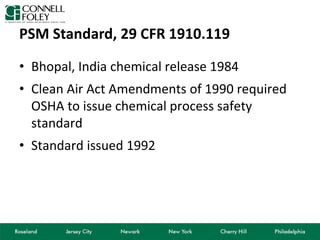
PSM Standard, 29 CFR 1910.119
• Bhopal, India chemical release 1984
• Clean Air Act Amendments of 1990 required
OSHA to issue chemical process safety
standard
• Standard issued 1992
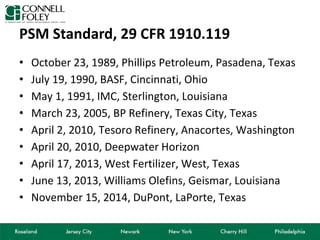
PSM Standard, 29 CFR 1910.119
• October 23, 1989, Phillips Petroleum, Pasadena, Texas
• July 19, 1990, BASF, Cincinnati, Ohio
• May 1, 1991, IMC, Sterlington, Louisiana
• March 23, 2005, BP Refinery, Texas City, Texas
• April 2, 2010, Tesoro Refinery, Anacortes, Washington
• April 20, 2010, Deepwater Horizon
• April 17, 2013, West Fertilizer, West, Texas
• June 13, 2013, Williams Olefins, Geismar, Louisiana
• November 15, 2014, DuPont, LaPorte, Texas
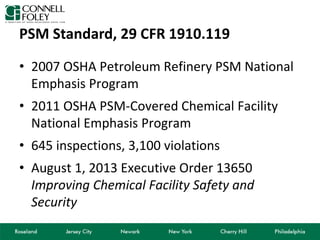
PSM Standard, 29 CFR 1910.119
• 2007 OSHA Petroleum Refinery PSM National
Emphasis Program
• 2011 OSHA PSM-Covered Chemical Facility
National Emphasis Program
• 645 inspections, 3,100 violations
• August 1, 2013 Executive Order 13650
Improving Chemical Facility Safety and
Security
PSM Standard, 29 CFR 1910.119
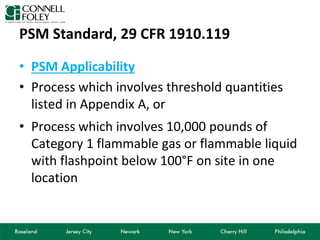
• PSM Applicability
• Process which involves threshold quantities
listed in Appendix A, or
• Process which involves 10,000 pounds of
Category 1 flammable gas or flammable liquid
with flashpoint below 100°F on site in one
location
PSM Standard, 29 CFR 1910.119
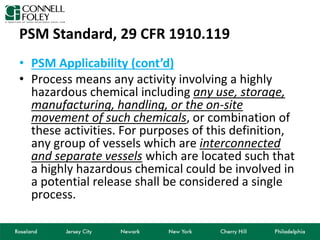
• PSM Applicability (cont’d)
• Process means any activity involving a highly
hazardous chemical including any use, storage,
manufacturing, handling, or the on-site
movement of such chemicals, or combination of
these activities. For purposes of this definition,
any group of vessels which are interconnected
and separate vessels which are located such that
a highly hazardous chemical could be involved in
a potential release shall be considered a single
process.
PSM Standard, 29 CFR 1910.119
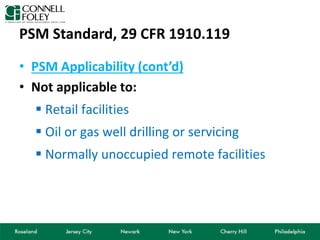
• PSM Applicability (cont’d)
• Not applicable to:
 Retail facilities
 Oil or gas well drilling or servicing
 Normally unoccupied remote facilities
PSM Standard, 29 CFR 1910.119
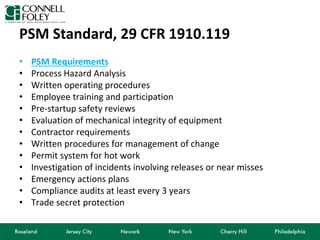
• PSM Requirements
• Process Hazard Analysis
• Written operating procedures
• Employee training and participation
• Pre-startup safety reviews
• Evaluation of mechanical integrity of equipment
• Contractor requirements
• Written procedures for management of change
• Permit system for hot work
• Investigation of incidents involving releases or near misses
• Emergency actions plans
• Compliance audits at least every 3 years
• Trade secret protection
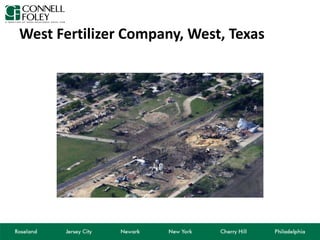
West Fertilizer Company, West, Texas
• April 17, 2013 fire and explosion
• PHSMA
– September 23, 2011 PHMSA inspection
– January 13, 2012 Notice of Probable Violation
• $5,600 offering for transportation anhydrous ammonia with ASME plate
illegible and missing NH3 and UN1005 placards
• $4,500 no security plan as per 172.800 for > 3000 kg in one packaging or
poisonous by inhalation
– June 12, 2012 Compromise Order and Agreement. Penalties reduced
to $5,000 and $250
West Fertilizer Company, West, Texas
• Chemical Safety Board investigation ongoing
• Reportedly last inspected by OSHA in 1985
• 2006 EPA fine of $2,300 for failure to timely file Risk
Management Plan (RMP) pursuant to EPA Clean Air Act
rules
• Current RMP listed anhydrous but not nitrate because not
required
• 400 lbs ammonium nitrate CFATS screening threshold not
reported to DHS
• Facility held certificate to handle ammonium nitrate from
Texas State Feed and Fertilizer Control Service
• Discussions of state and local fire codes, emergency plans,
communication of information between agencies
• August 1, 2013 Executive Order
West Fertilizer Company, West, Texas
• August 20, 2013 video safety message by CSB Chair
• “CSB has determined that ammonium nitrate storage
falls under a patchwork of U.S. standards and guidance,
which does not prohibit many of the conditions found
at the West facility. These include the use of
combustible wooden storage bins and buildings and a
lack of sprinkler systems in case of fire.”
• "The CSB believes it's past time for OSHA and EPA to
regulate reactive hazards – including ammonium
nitrate – under their process safety rules."
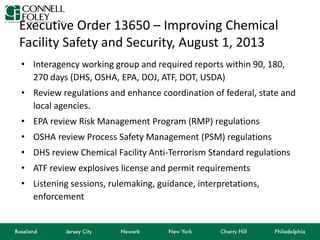
Executive Order 13650 – Improving Chemical
Facility Safety and Security, August 1, 2013
• Interagency working group and required reports within 90, 180,
270 days (DHS, OSHA, EPA, DOJ, ATF, DOT, USDA)
• Review regulations and enhance coordination of federal, state and
local agencies.
• EPA review Risk Management Program (RMP) regulations
• OSHA review Process Safety Management (PSM) regulations
• DHS review Chemical Facility Anti-Terrorism Standard regulations
• ATF review explosives license and permit requirements
• Listening sessions, rulemaking, guidance, interpretations,
enforcement
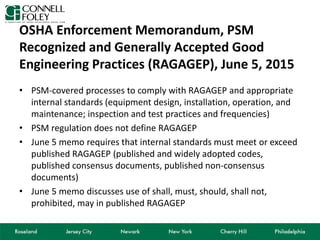
OSHA Enforcement Memorandum, PSM
Recognized and Generally Accepted Good
Engineering Practices (RAGAGEP), June 5, 2015
• PSM-covered processes to comply with RAGAGEP and appropriate
internal standards (equipment design, installation, operation, and
maintenance; inspection and test practices and frequencies)
• PSM regulation does not define RAGAGEP
• June 5 memo requires that internal standards must meet or exceed
published RAGAGEP (published and widely adopted codes,
published consensus documents, published non-consensus
documents)
• June 5 memo discusses use of shall, must, should, shall not,
prohibited, may in published RAGAGEP
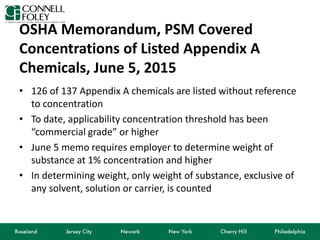
OSHA Memorandum, PSM Covered
Concentrations of Listed Appendix A
Chemicals, June 5, 2015
• 126 of 137 Appendix A chemicals are listed without reference
to concentration
• To date, applicability concentration threshold has been
“commercial grade” or higher
• June 5 memo requires employer to determine weight of
substance at 1% concentration and higher
• In determining weight, only weight of substance, exclusive of
any solvent, solution or carrier, is counted
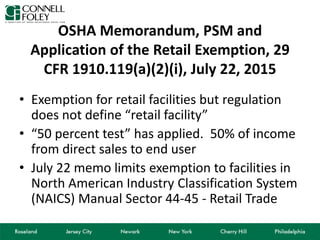
OSHA Memorandum, PSM and
Application of the Retail Exemption, 29
CFR 1910.119(a)(2)(i), July 22, 2015
• Exemption for retail facilities but regulation
does not define “retail facility”
• “50 percent test” has applied. 50% of income
from direct sales to end user
• July 22 memo limits exemption to facilities in
North American Industry Classification System
(NAICS) Manual Sector 44-45 - Retail Trade
American Petroleum Institute v. OSHA,
and American Chemistry Council v. OSHA
• Filed August 3, 2015 in United States Court of
Appeals for the District of Columbia, Case No.
15-1252 and 15-1253
• Requesting judicial review of OSHA RAGAGEP
memo & OSHA covered concentration memo
• Cases consolidated August 6
American Petroleum Institute v. OSHA,
and American Chemistry Council v. OSHA
• Violate Occupational Safety & Health Act
• Promulgated without notice, comment and
publication requirements of the
Administrative Procedure Act
• Arbitrary and capricious
• Unsupported by substantial evidence
• Inconsistent with reasoned decision-making
American Petroleum Institute v. OSHA,
and American Chemistry Council v. OSHA
• Court’s October 19, 2015 briefing schedule
– Petitioners’ Brief December 16, 2015
– Intervenor for Petitioners’ Brief January 4, 2016
– Respondents’ Brief February 3, 2016
– Intervenor for Petitioners’ Reply Brief February 17,
2016
– Petitioners’ Reply Brief February 17, 2016
– Deferred Appendix February 24, 2016
– Final Briefs March 9, 2016
OSHA Review of PSM regulation
• EPA RMP and OSHA PSM listening sessions,
Small Business Regulatory Enforcement
Fairness Act of 1996 (SBREFA) panels,
advanced notice of proposed rulemaking,
notice of proposed rulemaking, final
rulemaking
• OSHA will wait until January 2016 to convene
SBREFA panel, after EPA convenes its SBREFA
panel on RMP
OSHA Review of PSM regulation
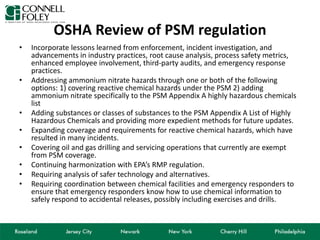
• Incorporate lessons learned from enforcement, incident investigation, and
advancements in industry practices, root cause analysis, process safety metrics,
enhanced employee involvement, third-party audits, and emergency response
practices.
• Addressing ammonium nitrate hazards through one or both of the following
options: 1) covering reactive chemical hazards under the PSM 2) adding
ammonium nitrate specifically to the PSM Appendix A highly hazardous chemicals
list
• Adding substances or classes of substances to the PSM Appendix A List of Highly
Hazardous Chemicals and providing more expedient methods for future updates.
• Expanding coverage and requirements for reactive chemical hazards, which have
resulted in many incidents.
• Covering oil and gas drilling and servicing operations that currently are exempt
from PSM coverage.
• Continuing harmonization with EPA’s RMP regulation.
• Requiring analysis of safer technology and alternatives.
• Requiring coordination between chemical facilities and emergency responders to
ensure that emergency responders know how to use chemical information to
safely respond to accidental releases, possibly including exercises and drills.

Barnett presentation 10-27-2015

  • 1.
    www.connellfoley.com Alliance of HazardousMaterials Professionals New Jersey Chapter and American Society of Safety Engineers New Jersey Chapter October 27, 2015 Joint Meeting Process Safety Management (PSM) Legal and Regulatory Update Speaker: Steve Barnett, P.E., CIH, MSPH, Esq.; Partner, Law Offices of Connell Foley LLP
  • 2.
    PSM Standard, 29CFR 1910.119 • Bhopal, India chemical release 1984 • Clean Air Act Amendments of 1990 required OSHA to issue chemical process safety standard • Standard issued 1992
  • 3.
    PSM Standard, 29CFR 1910.119 • October 23, 1989, Phillips Petroleum, Pasadena, Texas • July 19, 1990, BASF, Cincinnati, Ohio • May 1, 1991, IMC, Sterlington, Louisiana • March 23, 2005, BP Refinery, Texas City, Texas • April 2, 2010, Tesoro Refinery, Anacortes, Washington • April 20, 2010, Deepwater Horizon • April 17, 2013, West Fertilizer, West, Texas • June 13, 2013, Williams Olefins, Geismar, Louisiana • November 15, 2014, DuPont, LaPorte, Texas
  • 4.
    PSM Standard, 29CFR 1910.119 • 2007 OSHA Petroleum Refinery PSM National Emphasis Program • 2011 OSHA PSM-Covered Chemical Facility National Emphasis Program • 645 inspections, 3,100 violations • August 1, 2013 Executive Order 13650 Improving Chemical Facility Safety and Security
  • 5.
    PSM Standard, 29CFR 1910.119 • PSM Applicability • Process which involves threshold quantities listed in Appendix A, or • Process which involves 10,000 pounds of Category 1 flammable gas or flammable liquid with flashpoint below 100°F on site in one location
  • 6.
    PSM Standard, 29CFR 1910.119 • PSM Applicability (cont’d) • Process means any activity involving a highly hazardous chemical including any use, storage, manufacturing, handling, or the on-site movement of such chemicals, or combination of these activities. For purposes of this definition, any group of vessels which are interconnected and separate vessels which are located such that a highly hazardous chemical could be involved in a potential release shall be considered a single process.
  • 7.
    PSM Standard, 29CFR 1910.119 • PSM Applicability (cont’d) • Not applicable to:  Retail facilities  Oil or gas well drilling or servicing  Normally unoccupied remote facilities
  • 8.
    PSM Standard, 29CFR 1910.119 • PSM Requirements • Process Hazard Analysis • Written operating procedures • Employee training and participation • Pre-startup safety reviews • Evaluation of mechanical integrity of equipment • Contractor requirements • Written procedures for management of change • Permit system for hot work • Investigation of incidents involving releases or near misses • Emergency actions plans • Compliance audits at least every 3 years • Trade secret protection
  • 9.
  • 10.
    West Fertilizer Company,West, Texas • April 17, 2013 fire and explosion • PHSMA – September 23, 2011 PHMSA inspection – January 13, 2012 Notice of Probable Violation • $5,600 offering for transportation anhydrous ammonia with ASME plate illegible and missing NH3 and UN1005 placards • $4,500 no security plan as per 172.800 for > 3000 kg in one packaging or poisonous by inhalation – June 12, 2012 Compromise Order and Agreement. Penalties reduced to $5,000 and $250
  • 11.
    West Fertilizer Company,West, Texas • Chemical Safety Board investigation ongoing • Reportedly last inspected by OSHA in 1985 • 2006 EPA fine of $2,300 for failure to timely file Risk Management Plan (RMP) pursuant to EPA Clean Air Act rules • Current RMP listed anhydrous but not nitrate because not required • 400 lbs ammonium nitrate CFATS screening threshold not reported to DHS • Facility held certificate to handle ammonium nitrate from Texas State Feed and Fertilizer Control Service • Discussions of state and local fire codes, emergency plans, communication of information between agencies • August 1, 2013 Executive Order
  • 12.
    West Fertilizer Company,West, Texas • August 20, 2013 video safety message by CSB Chair • “CSB has determined that ammonium nitrate storage falls under a patchwork of U.S. standards and guidance, which does not prohibit many of the conditions found at the West facility. These include the use of combustible wooden storage bins and buildings and a lack of sprinkler systems in case of fire.” • "The CSB believes it's past time for OSHA and EPA to regulate reactive hazards – including ammonium nitrate – under their process safety rules."
  • 13.
    Executive Order 13650– Improving Chemical Facility Safety and Security, August 1, 2013 • Interagency working group and required reports within 90, 180, 270 days (DHS, OSHA, EPA, DOJ, ATF, DOT, USDA) • Review regulations and enhance coordination of federal, state and local agencies. • EPA review Risk Management Program (RMP) regulations • OSHA review Process Safety Management (PSM) regulations • DHS review Chemical Facility Anti-Terrorism Standard regulations • ATF review explosives license and permit requirements • Listening sessions, rulemaking, guidance, interpretations, enforcement
  • 14.
    OSHA Enforcement Memorandum,PSM Recognized and Generally Accepted Good Engineering Practices (RAGAGEP), June 5, 2015 • PSM-covered processes to comply with RAGAGEP and appropriate internal standards (equipment design, installation, operation, and maintenance; inspection and test practices and frequencies) • PSM regulation does not define RAGAGEP • June 5 memo requires that internal standards must meet or exceed published RAGAGEP (published and widely adopted codes, published consensus documents, published non-consensus documents) • June 5 memo discusses use of shall, must, should, shall not, prohibited, may in published RAGAGEP
  • 15.
    OSHA Memorandum, PSMCovered Concentrations of Listed Appendix A Chemicals, June 5, 2015 • 126 of 137 Appendix A chemicals are listed without reference to concentration • To date, applicability concentration threshold has been “commercial grade” or higher • June 5 memo requires employer to determine weight of substance at 1% concentration and higher • In determining weight, only weight of substance, exclusive of any solvent, solution or carrier, is counted
  • 16.
    OSHA Memorandum, PSMand Application of the Retail Exemption, 29 CFR 1910.119(a)(2)(i), July 22, 2015 • Exemption for retail facilities but regulation does not define “retail facility” • “50 percent test” has applied. 50% of income from direct sales to end user • July 22 memo limits exemption to facilities in North American Industry Classification System (NAICS) Manual Sector 44-45 - Retail Trade
  • 17.
    American Petroleum Institutev. OSHA, and American Chemistry Council v. OSHA • Filed August 3, 2015 in United States Court of Appeals for the District of Columbia, Case No. 15-1252 and 15-1253 • Requesting judicial review of OSHA RAGAGEP memo & OSHA covered concentration memo • Cases consolidated August 6
  • 18.
    American Petroleum Institutev. OSHA, and American Chemistry Council v. OSHA • Violate Occupational Safety & Health Act • Promulgated without notice, comment and publication requirements of the Administrative Procedure Act • Arbitrary and capricious • Unsupported by substantial evidence • Inconsistent with reasoned decision-making
  • 19.
    American Petroleum Institutev. OSHA, and American Chemistry Council v. OSHA • Court’s October 19, 2015 briefing schedule – Petitioners’ Brief December 16, 2015 – Intervenor for Petitioners’ Brief January 4, 2016 – Respondents’ Brief February 3, 2016 – Intervenor for Petitioners’ Reply Brief February 17, 2016 – Petitioners’ Reply Brief February 17, 2016 – Deferred Appendix February 24, 2016 – Final Briefs March 9, 2016
  • 20.
    OSHA Review ofPSM regulation • EPA RMP and OSHA PSM listening sessions, Small Business Regulatory Enforcement Fairness Act of 1996 (SBREFA) panels, advanced notice of proposed rulemaking, notice of proposed rulemaking, final rulemaking • OSHA will wait until January 2016 to convene SBREFA panel, after EPA convenes its SBREFA panel on RMP
  • 21.
    OSHA Review ofPSM regulation • Incorporate lessons learned from enforcement, incident investigation, and advancements in industry practices, root cause analysis, process safety metrics, enhanced employee involvement, third-party audits, and emergency response practices. • Addressing ammonium nitrate hazards through one or both of the following options: 1) covering reactive chemical hazards under the PSM 2) adding ammonium nitrate specifically to the PSM Appendix A highly hazardous chemicals list • Adding substances or classes of substances to the PSM Appendix A List of Highly Hazardous Chemicals and providing more expedient methods for future updates. • Expanding coverage and requirements for reactive chemical hazards, which have resulted in many incidents. • Covering oil and gas drilling and servicing operations that currently are exempt from PSM coverage. • Continuing harmonization with EPA’s RMP regulation. • Requiring analysis of safer technology and alternatives. • Requiring coordination between chemical facilities and emergency responders to ensure that emergency responders know how to use chemical information to safely respond to accidental releases, possibly including exercises and drills.