2
Process Safety Management
Required by the Environmental Protection Agency's (EPA)
Clean Air Act Amendments (CAAA),
Section 304
Promulgated - February 24, 1992
5 year implementation
Proactive identification, evaluation, and mitigation or
prevention of chemical releases that could occur as a result
of failures in processes, procedures, or equipment
130 highly hazardous chemicals (HHC’s)
3.
3
Process Safety Management
(continued)
10,000 lb. or more of flammable materials that are
used at or above their boiling points
Pyrotechnics and explosives manufacturers
More than 28,000 facilities affected
Exemptions:
fuels used for workplace consumption
Comfort heating
Gasoline for vehicles
4.
4
Risk Management Plan
Mandated by CAAA, Section 112 (r), 40 CFR
Part 68
Promulgated - May 24, 1996
Published Federal Register - June 20, 1996
More than 100,000 facilities affected
Designed to help reduce risk of accidental release of
hazardous substances
3 years to implement
5.
5
Risk Management Plan
(continued)
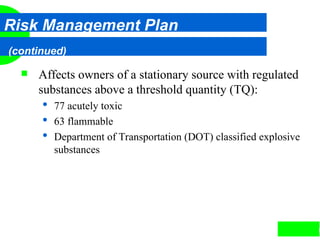
Affects owners of a stationary source with regulated
substances above a threshold quantity (TQ):
77 acutely toxic
63 flammable
Department of Transportation (DOT) classified explosive
substances
6.
6
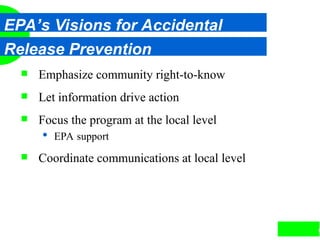
EPA’s Visions forAccidental
Release Prevention
Emphasize community right-to-know
Let information drive action
Focus the program at the local level
EPA support
Coordinate communications at local level
7.
7
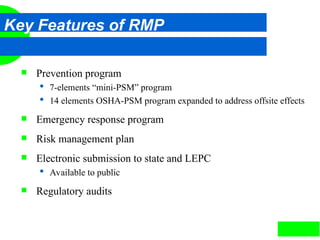
Key Features ofRMP
Prevention program
7-elements “mini-PSM” program
14 elements OSHA-PSM program expanded to address offsite effects
Emergency response program
Risk management plan
Electronic submission to state and LEPC
Available to public
Regulatory audits
8.
8
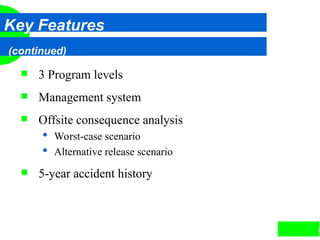
Key Features
(continued)
3Program levels
Management system
Offsite consequence analysis
Worst-case scenario
Alternative release scenario
5-year accident history
9.
9
Key Features
(continued)
Summarizeskey elements of the RMP program
Tells a story
Hazards at the site
Accident history
Potential offsite consequences
Prevention steps
Response program
10.
10
Exemptions to Threshold
Quantity
Articles
Laboratories
Uses:
Structural components
Janitorial maintenance
Foods, drugs, cosmetics, or other personal items
Present in process water or non-contact cooling water
Compressed air or as part of combustion
11.
11
EPA’s Regulatory Approach
Performance-based approach
Similar to OSHA’s PSM
Build on existing programs and standards
Scale the requirements to fit the risk
Coordinate with OSHA and DOT
12.
12
Requirements of 112(r)
Established a general duty clause to:
Identify hazards that may result from releases
Design and maintain a safe facility
Minimize the consequences or releases
13.
13
Requirements of 112(r)
(continued)
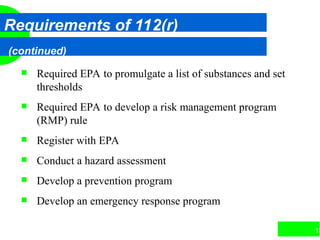
Required EPA to promulgate a list of substances and set
thresholds
Required EPA to develop a risk management program
(RMP) rule
Register with EPA
Conduct a hazard assessment
Develop a prevention program
Develop an emergency response program
14.
14
Requirements of 112(r)
(continued)
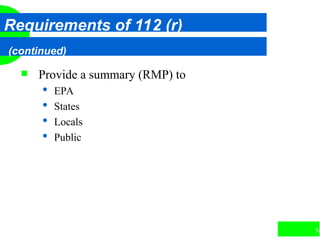
Provide a summary (RMP) to
EPA
States
Locals
Public
15.
15
Basic Principles
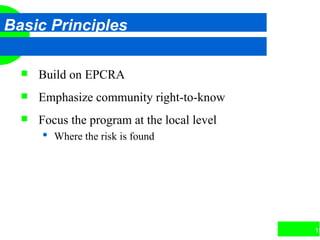
Buildon EPCRA
Emphasize community right-to-know
Focus the program at the local level
Where the risk is found
16.
16
Basic Principles
(continued)
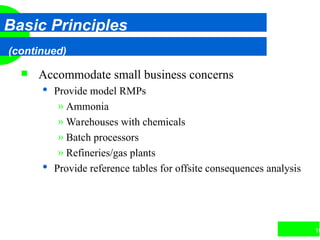
Accommodatesmall business concerns
Provide model RMPs
» Ammonia
» Warehouses with chemicals
» Batch processors
» Refineries/gas plants
Provide reference tables for offsite consequences analysis
21
Other Industries
Foodand Cold Storage
Propane Retail
Warehousing
Wholesalers
Federal sources
Military and Energy Installations
22.
22
PSM vs. RMPRequirements
PSM’s concern - potential hazard and protection of
employees inside a regulated area
RMP’s concern - potential incidents that may cause
environmental and health hazards outside facility
boundaries
Editorial changes to PSM to make text consistent
with the CAAA's language
23.
23
Hazard Assessment
Offsiteconsequence data
Population estimate
Public receptors
Environmental receptors
Every 5 years
Within 6 months of a change that increases or
decreased distance by a factor of 2 or more
24.
24
Overview Worst-Case Scenario
(WCS)
Greatest quantity from vessel or piping
May include administrative controls
Toxic gases
Quantity released in 10 minutes
Toxic liquids
Instantaneous spill to ground; volatilization; passive
mitigation
Toxic gases liquefied by refrigeration
25.
25
Worst-Case Scenario
(continued)
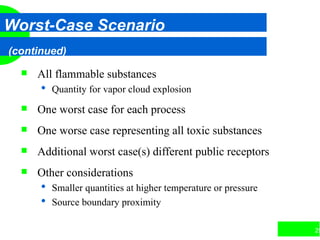
Allflammable substances
Quantity for vapor cloud explosion
One worst case for each process
One worse case representing all toxic substances
Additional worst case(s) different public receptors
Other considerations
Smaller quantities at higher temperature or pressure
Source boundary proximity
27
ARS Selection
Accidenthistory events
Process hazard analysis events
Worse case with mitigation
Example scenarios:
Piping or hose failures
Seal failures
Vessel overfilling or venting
28.
28
List of Substancesand
Thresholds
Focuses on lethal effects resulting from acute
exposures
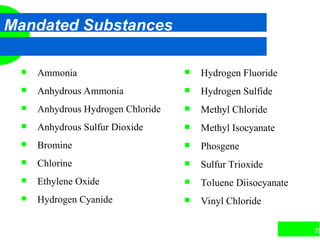
Includes mandated substances
30
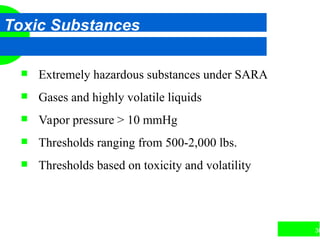
Toxic Substances
Extremelyhazardous substances under SARA
Gases and highly volatile liquids
Vapor pressure > 10 mmHg
Thresholds ranging from 500-2,000 lbs.
Thresholds based on toxicity and volatility
31.
31
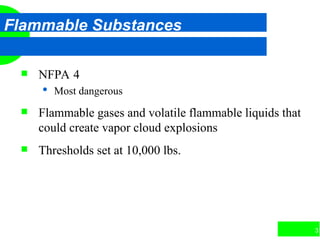
Flammable Substances
NFPA4
Most dangerous
Flammable gases and volatile flammable liquids that
could create vapor cloud explosions
Thresholds set at 10,000 lbs.
32.
32
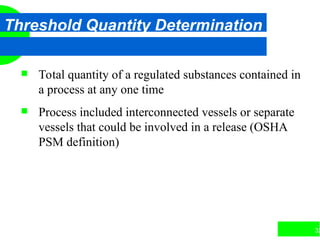
Threshold Quantity Determination
Total quantity of a regulated substances contained in
a process at any one time
Process included interconnected vessels or separate
vessels that could be involved in a release (OSHA
PSM definition)
33.
33
Offsite Consequence Analysis
Toxic endpoint
Flammable endpoints
Use appropriate models or guidance
Within circle, identify
Public receptors and population
Environmental receptors
34.
34
Registration and Submittal
Submit a comprehensive RMP to:
EPA
State Emergency Response Commission (SERC)
Local Emergency Planning Committee (LEPC)
The Chemical Safety and Hazard Investigation Board
35.
35
Registration and Submittal
(Continued)
Name, mailing address, telephone of stationary
source
CAS number of all regulated substances greater than
TQ
SIC code
Dun and Bradstreet number
Certification signed by owner or operator
38
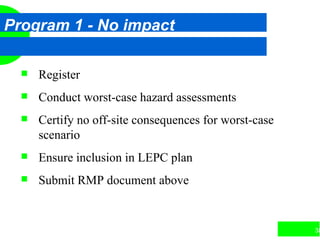
Program 1 -No impact
Register
Conduct worst-case hazard assessments
Certify no off-site consequences for worst-case
scenario
Ensure inclusion in LEPC plan
Submit RMP document above
39.
39
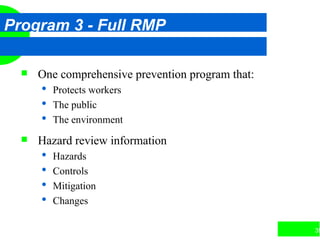
Program 3 -Full RMP
One comprehensive prevention program that:
Protects workers
The public
The environment
Hazard review information
Hazards
Controls
Mitigation
Changes
40.
40
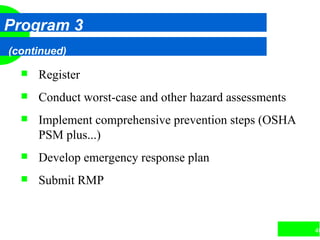
Program 3
(continued)
Register
Conduct worst-case and other hazard assessments
Implement comprehensive prevention steps (OSHA
PSM plus...)
Develop emergency response plan
Submit RMP
41.
41
Program 3
(continued)
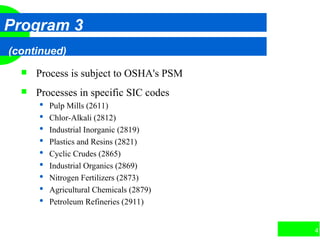
Processis subject to OSHA's PSM
Processes in specific SIC codes
Pulp Mills (2611)
Chlor-Alkali (2812)
Industrial Inorganic (2819)
Plastics and Resins (2821)
Cyclic Crudes (2865)
Industrial Organics (2869)
Nitrogen Fertilizers (2873)
Agricultural Chemicals (2879)
Petroleum Refineries (2911)
42.
42
Program 2 -Streamlined
Prevention Program
The process is not eligible for Program 1 or 3
44
Program 2
(continued)
Typesof sources:
Less complex; fewer changes
Ideal model program and plans
Capture good management practices from PSM but
less documentation
Take advantages of other rules and standards
Take advantages of equipment manufacturer or vendor
information
45.
45
Program 2
(continued)
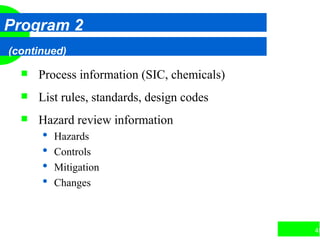
Processinformation (SIC, chemicals)
List rules, standards, design codes
Hazard review information
Hazards
Controls
Mitigation
Changes
46.
46
Program 2
(continued)
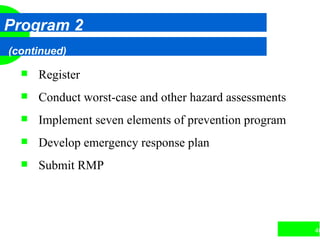
Register
Conduct worst-case and other hazard assessments
Implement seven elements of prevention program
Develop emergency response plan
Submit RMP
47.
47
Comparison of Program
Requirements
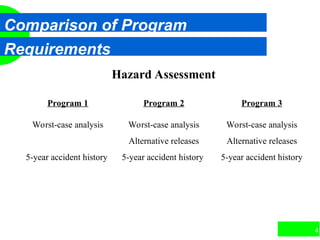
HazardAssessment
Program 1 Program 2 Program 3
Worst-case analysis Worst-case analysis Worst-case analysis
Alternative releases Alternative releases
5-year accident history 5-year accident history 5-year accident history
49
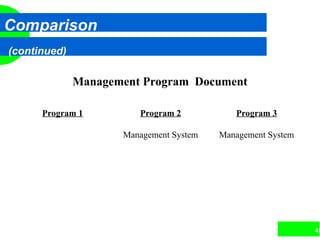
Comparison
(continued)
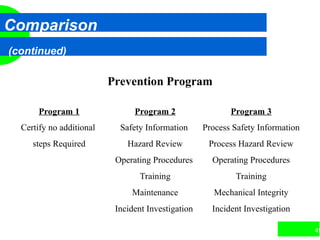
Prevention Program
Program 1Program 2 Program 3
Certify no additional Safety Information Process Safety Information
steps Required Hazard Review Process Hazard Review
Operating Procedures Operating Procedures
Training Training
Maintenance Mechanical Integrity
Incident Investigation Incident Investigation
52
Comparison
(continued)
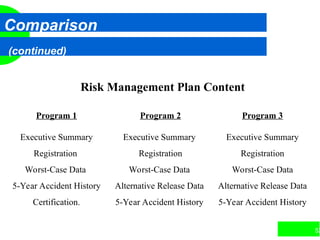
Risk Management PlanContent
Program 1 Program 2 Program 3
Executive Summary Executive Summary Executive Summary
Registration Registration Registration
Worst-Case Data Worst-Case Data Worst-Case Data
5-Year Accident History Alternative Release Data Alternative Release Data
Certification. 5-Year Accident History 5-Year Accident History
53.
53
Comparison
(continued)
Risk Management PlanContent (continued)
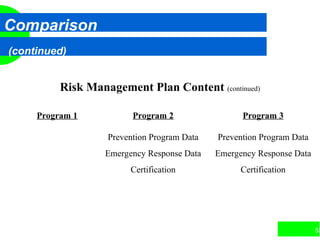
Program 1 Program 2 Program 3
Prevention Program Data Prevention Program Data
Emergency Response Data Emergency Response Data
Certification Certification
54.
54
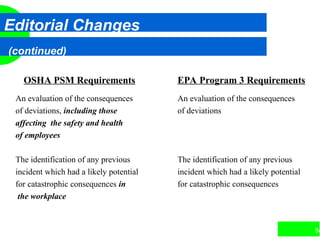
OSHA PSM RequirementsEPA Program 3 Requirements
An evaluation of the consequences An evaluation of the consequences
of deviations, including those of deviations
affecting the safety and health
of employees
The identification of any previous The identification of any previous
incident which had a likely potential incident which had a likely potential
for catastrophic consequences in for catastrophic consequences
the workplace
Editorial Changes
(continued)
55.
55
Editorial Changes
(continued)
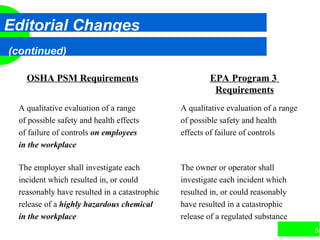
OSHA PSMRequirements EPA Program 3
Requirements
A qualitative evaluation of a range A qualitative evaluation of a range
of possible safety and health effects of possible safety and health
of failure of controls on employees effects of failure of controls
in the workplace
The employer shall investigate each The owner or operator shall
incident which resulted in, or could investigate each incident which
reasonably have resulted in a catastrophic resulted in, or could reasonably
release of a highly hazardous chemical have resulted in a catastrophic
in the workplace release of a regulated substance
56.
56
Language Comparison
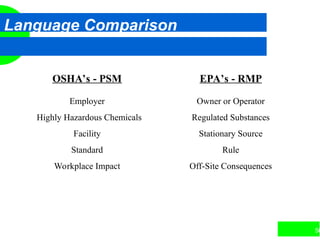
OSHA’s -PSM EPA’s - RMP
Employer Owner or Operator
Highly Hazardous Chemicals Regulated Substances
Facility Stationary Source
Standard Rule
Workplace Impact Off-Site Consequences
57.
57
Compliance Procedures
Developan inventory of substances used, stored,
manufactured, processed, handled or moved, or any
combination of the listed activities
Compare the inventory with the TQ, as required
58.
58
Management System
Developa management system to oversee the
implementation of the RMP elements
Identify single person or position who has overall
responsibility for:
Development
Implementation
Integration of the RMP
60
Process Safety Information
Block flow or process flow diagrams
Maximum intended inventory
Establish safe limits of the operating parameters
61.
61
Process Safety Information
(continued)
Evaluate consequences in deviations of process
conditions
Equipment information
Verify equipment design with regulatory
requirements/standard
62.
62
Process Hazard Analysis
Document hazard analysis:
Nature of the hazard
Cause of the hazard
Consequences of the hazard
Actions to be considered to further protect personnel
Document follow-up steps based on
recommendations
63.
63
Process Hazard Analysis
(continued)
Document previous incidents with the potential to
cause catastrophic conditions
Document hazards associated with human factors
and facility siting
64.
64
Operating Procedures
Developclear operating procedures addressing steps
for each process regarding
Safe operating limits of processes
Equipment
Provide precautionary instructions to prevent
exposure to hazards
65.
65
Operating Procedures
(continued)
Developoperating procedures for safety systems
Conduct annual review of operating procedures
Develop procedures for lockout/tagout, confined
space entry, etc.
66.
66
Employee Training
Documenttraining for personnel in the process,
operating procedures, and safe work practices
applicable to the job tasks
Maintain records of training indicating the means
used to verify that the employee understood the
training
67.
67
Maintenance
(Mechanical Integrity)
Providewritten procedures to maintain the structural
integrity of process equipment
Document training for employees involved in
maintenance of the process equipment
Verify inspections and testing of equipment and
deficiencies are corrected
Document that spare parts are suitable for the
appropriate application
68.
68
Incident Investigation
(Accident Investigation)
Incident reporting:
The date of the incident
Date of the investigation
Description of the incident
Factors contributing to the incident, and recommendations that
resulted
Verify that the recommendations in the incident report
were promptly addressed and resolved
Identify root causes as well as initiating events
69.
69
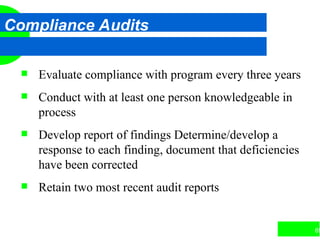
Compliance Audits
Evaluatecompliance with program every three years
Conduct with at least one person knowledgeable in
process
Develop report of findings Determine/develop a
response to each finding, document that deficiencies
have been corrected
Retain two most recent audit reports
70.
70
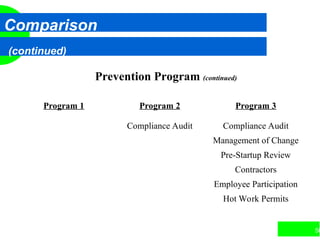
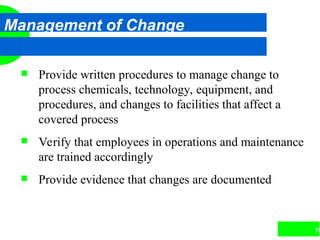
Management of Change
Provide written procedures to manage change to
process chemicals, technology, equipment, and
procedures, and changes to facilities that affect a
covered process
Verify that employees in operations and maintenance
are trained accordingly
Provide evidence that changes are documented
71.
71
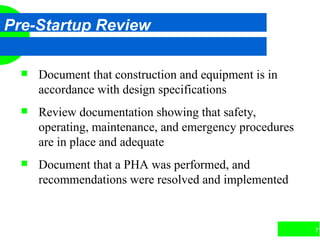
Pre-Startup Review
Documentthat construction and equipment is in
accordance with design specifications
Review documentation showing that safety,
operating, maintenance, and emergency procedures
are in place and adequate
Document that a PHA was performed, and
recommendations were resolved and implemented
73
Contractors
Must establisheda screening process when hiring
and use contractors
A site injury and illness log for contractors must be
maintained
The contractor must ensure that each contract
employee is trained in the work practices necessary
to safely perform his/her job
74.
74
Employee Participation
Mustdevelop a written plan of action regarding the
implementation of employee participation.
Required to train and educate employees and to
inform all affected employees of the findings from
any incident investigations.
75.
75
Employee Participation
(continued)
Mustconsult with employees and employee
representatives:
Development of PHA and other elements
Hazard assessments
The development of chemical accident prevention
Must provide access to these records.
76.
76
Permit Systems
Awork authorization notice or permit system should be
developed
To describe the steps the maintenance supervisor, contractor
representative or other person need to follow in order to obtain
the necessary clearance to get the job done.
These procedures need to address such issues as
Lockout/tagout procedures
Line breaking procedures
Confined space entry procedures
Hot work permits
77.
77
Permit Systems
(continued)
Proceduresmust provide clear steps to follow once
the job is completed to provide closure for those that
need to know the job is completed and equipment
can be returned to normal operations.
78.
78
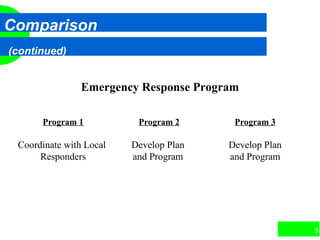
Emergency Planning and
Response
Document that an emergency plan has been established and
implemented in accordance with 29 CFR 1910.38 and
1910.120, as applicable
Emergency action plan that include procedures for handling
releases
Document specific actions to be taken in response to an
accidental release of a regulated substance to protect humans
and the environment
Conduct drills
Exercise to test plan
79.
79
Emergency Response Plan-
Basic Requirements
Emergency response plan
Procedures for use of emergency response equipment
and for it inspection, testing, and maintenance
Training for all employees in relevant procedures
Procedures to review and update of the plan to reflect
changes at the facility and ensure that employees are
informed of changes
80.
80
Elements - Legislative
Requirements
Procedures for informing the public and local emergency
response agencies
Documentation of proper first-aid and emergency medical
treatment necessary to treat accidental human exposures
Procedures and measures for emergency response after a
release
Written plan must comply with other federal regulations
Coordinate with local LEPC
81.
81
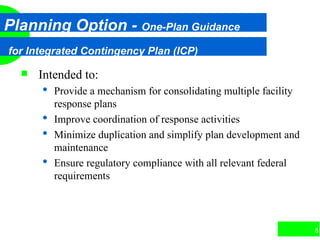
Planning Option -One-Plan Guidance
for Integrated Contingency Plan (ICP)
Intended to:
Provide a mechanism for consolidating multiple facility
response plans
Improve coordination of response activities
Minimize duplication and simplify plan development and
maintenance
Ensure regulatory compliance with all relevant federal
requirements
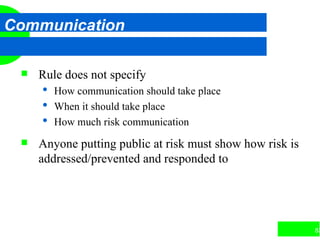
83
Communication
Rule doesnot specify
How communication should take place
When it should take place
How much risk communication
Anyone putting public at risk must show how risk is
addressed/prevented and responded to
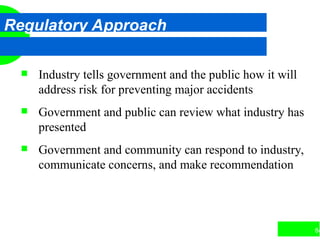
84.
84
Regulatory Approach
Industrytells government and the public how it will
address risk for preventing major accidents
Government and public can review what industry has
presented
Government and community can respond to industry,
communicate concerns, and make recommendation
85.
85
Communicating the RMP
Start now
Explain the program
Tell the public what to expect with your WCS and when to expect
it
Explain your WCS
Detail chemical(s) on site that can cause explosions,
environmental impacts, etc.
Explain why you can’t reduce your inventory of regulated
substances
86.
86
Community Outreach
Suggestions
Openhouse/plant tours
Local citizen groups/civic organization
High school programs
Community survey
What does the community think about you?
Neighborhood meetings
Plant newsletter
Community advisory panels
93
Implementation Strategy -
Technical(continued)
Implement/upgrade PSM program to consider offsite
effects
Review/upgrade emergency response activities and
plan
Prepare and submit the RMP
94.
94
Implementation Strategy -
Communication
Determine internal risk communication
capabilities/needs
Survey community outreach status
Establish/improve community outreach
Prepare communication plan
Improve internal risk communication capabilities
Communicate the RMP to the public
95.
95
Available Resources
ChemicalEmergency Preparedness and Prevention
Office (CEPPO)
Internet - (http://www.epa.gov/swercepp/acc-pre.html)
96.
96
Suggested Team Members
Health and safety Professionals
Program development and review
Chemical, electrical, and mechanical engineering
Process safety information and hazard analysis
development
Air Quality Specialist/Industrial Hygienist
Air modeling dispersion.
Identify acute health effects
97.
97
Suggested Team Members
(continued)
Risk Assessment Specialist
Population exposure and environmental effects
Communications Specialists
Communicating with the public
98.
98
Summary - FinalWord
PSM and RMP outlines requirements for facilities to
reduce risks associated with accidental releases
A good communications program will help reduce
misinformation, distrust, and build good community
relations
Reduction in inventory will result in a reduction of
the risk and potential for a catastrophic incident
99.
99
Summary - FinalWord
(continued)
Audits are to be comprehensive, involving
systematic assessment of all elements of the program