www.edusaathi.com
info@edusaathi.com Page 1
Data Interpretation: Bar Graphs
Total Time: 45 mins Practise Exercise no. 1 Total no. Of Qs: 23
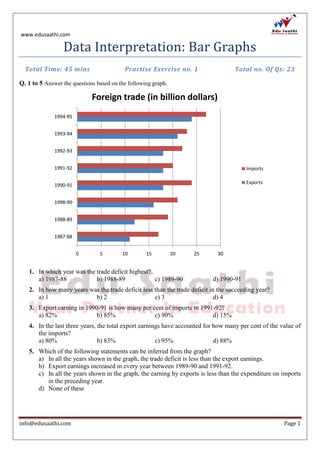
Q. 1 to 5 Answer the questions based on the following graph.
1. In which year was the trade deficit highest?
a) 1987-88 b) 1988-89 c) 1989-90 d) 1990-91
2. In how many years was the trade deficit less than the trade deficit in the succeeding year?
a) 1 b) 2 c) 3 d) 4
3. Export earning in 1990-91 is how many per cent of imports in 1991-92?
a) 82% b) 85% c) 90% d) 15%
4. In the last three years, the total export earnings have accounted for how many per cent of the value of
the imports?
a) 80% b) 83% c) 95% d) 88%
5. Which of the following statements can be inferred from the graph?
a) In all the years shown in the graph, the trade deficit is less than the export earnings.
b) Export earnings increased in every year between 1989-90 and 1991-92.
c) In all the years shown in the graph, the earning by exports is less than the expenditure on imports
in the preceding year.
d) None of these
0 5 10 15 20 25 30
1987-88
1988-89
1998-90
1990-91
1991-92
1992-93
1993-94
1994-95
Foreign trade (in billion dollars)
Imports
Exports
www.edusaathi.com
info@edusaathi.com Page 2
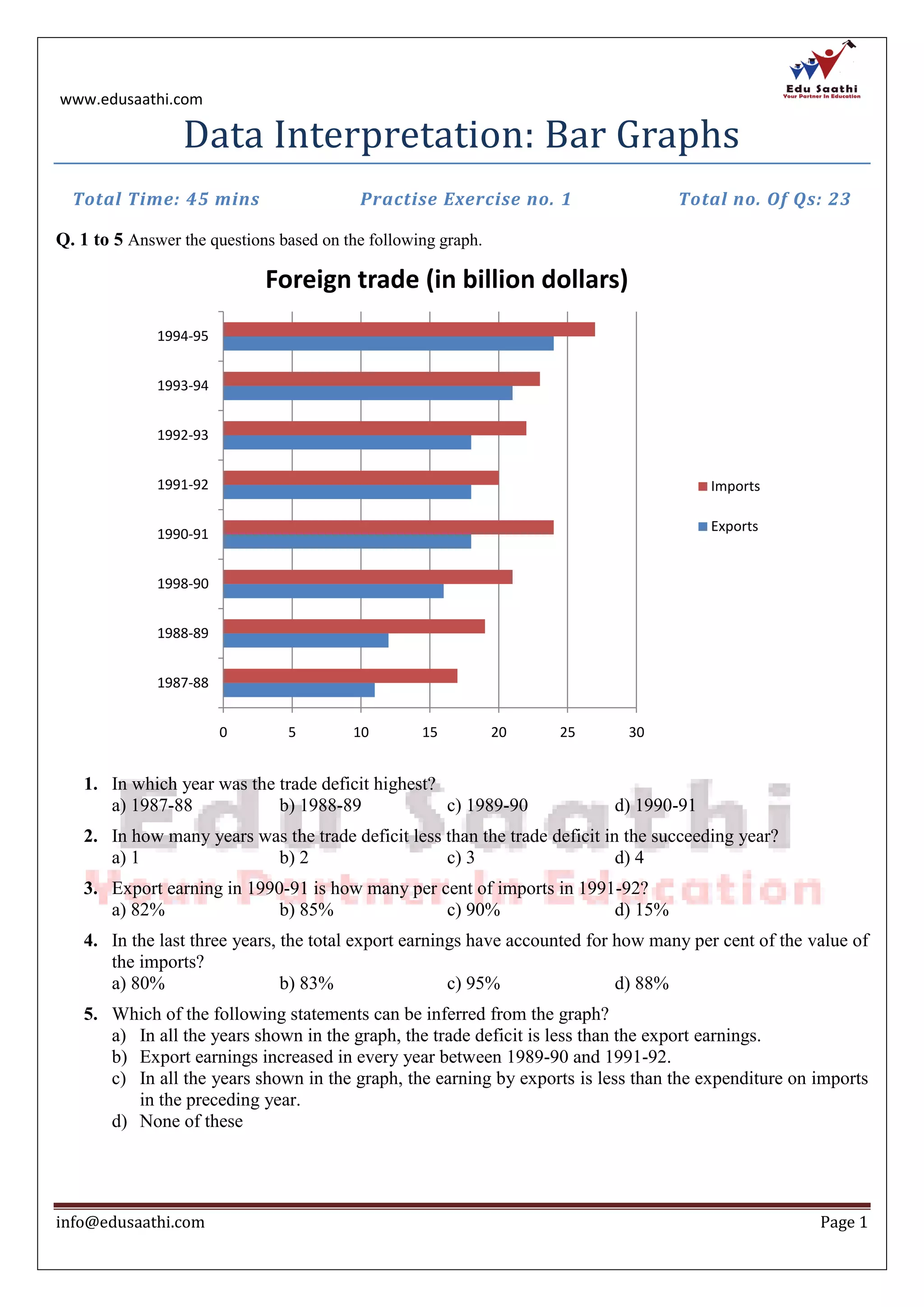
Q. 6 to 10 Answer the questions based on the following graph.
6. In which year the annual growth rate of total production (of all products) is highest?
a) 1991 b) 1992 c) 1993 d) 1995
7. If the stability of the production during 1990 to 1995 is defined as,
Average Production
Maximum Production −Minimum Production
then, which product is most stable?
a) Product P b) Product Q c) Product R d) Product S
8. If four products P, Q, R and S shown in the graph are sold at price of Rs.9, Rs.4, Rs.13 and Rs.3
respectively during 1990-1995, then the total revenue of the all the products is lowest in which year?
a) 1991 b) 1992 c) 1993 d) None of the above
9. Individual revenue of P, Q, R and S for the entire period (1990-1995) is calculated based on the price
of Rs.9, Rs.4, Rs.13 and Rs.3 respectively. Which product fetches the lowest revenue?
a) Product P b) Product Q c) Product R d) Product S
10. Four products P, Q, R and S shown in the graph are sold at price of Rs.9, Rs.4, Rs.13 and Rs.3
respectively during 1990-1995. Which of the following statements is TRUE?
a) Product R fetches second highest revenue across products in 1991.
b) Sum of revenue of P, Q and S is more than the revenue of R in 1994.
c) Cumulative revenue of P and Q is more than the revenue of S in 1993.
d) None of the above
0
10
20
30
40
50
60
70
80
90
100
110
120
130
140
150
160
170
1990 1991 1992 1993 1994 1995
ProductioninTonnes
Production of P, Q, R & S (1990-95)
P
Q
R
S
www.edusaathi.com
info@edusaathi.com Page 3
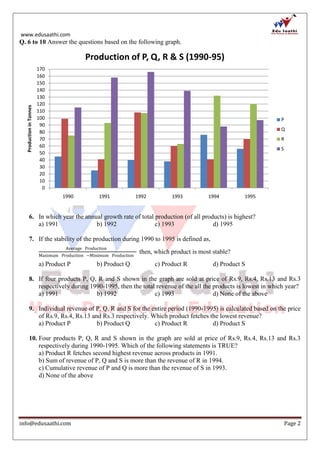
Q. 11 to 16 Answer the questions based on the following graphs
11. Which of the following year exhibited highest percentage decrease over the preceding year in the
automobile production?
a) 2005 b) 2006 c) 2007 d) 2008
300
450
600
750
900
1050
1200
1350
2004 2005 2006 2007 2008
Numberin‘000
Automobile Production Trends
Passanger Vehicles Commercial Vehicles Three Wheelers
150
300
450
600
750
900
1050
1200
2004 2005 2006 2007 2008
Numberin‘000
Automobile Domestic Sales Trends
www.edusaathi.com
info@edusaathi.com Page 4
12. Assuming whatever that is not sold domestically was exported, then which year has registered
highest growth in exports of automobiles?
a) 2005 b) 2006 c) 2007 d) 2008
13. If the ratio of the domestic sale price of a commercial vehicle, a passenger vehicle, and a three
wheeler is 5:3:2 then what percent of earnings (approximately) is contributed by commercial vehicle
segment to the overall earnings from domestic sales during the period 2004-2008?
a) 45% b) 43% c) 11% d) 27%
14. For which year were the domestic sales of automobiles closest to the average (2004-2008) domestic
sales of automobiles?
a) 2005 b) 2006 c) 2007 d) 2008
15. Which of the following years exhibited highest percentage increase over the preceding year in the
automobile sales?
a) 2005 b) 2006 c) 2007 d) 2008
16. The ratio between absolute increase in domestic sales over preceding year and absolute increase in
production over the preceding year is highest during which year?
a) 2005 b) 2006 c) 2007 d) 2008
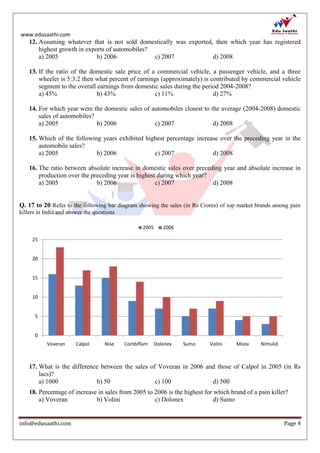
Q. 17 to 20 Refer to the following bar diagram showing the sales (in Rs Crores) of top market brands among pain
killers in India and answer the questions
17. What is the difference between the sales of Voveran in 2006 and those of Calpol in 2005 (in Rs
lacs)?
a) 1000 b) 50 c) 100 d) 500
18. Percentage of increase in sales from 2005 to 2006 is the highest for which brand of a pain killer?
a) Voveran b) Volini c) Dolonex d) Sumo
0
5
10
15
20
25
Voveran Calpol Nise Combiflam Dolonex Sumo Volini Moov Nimulid
2005 2006
www.edusaathi.com
info@edusaathi.com Page 5
19. Percentage increase in sales from 2005 to 2006 is the lowest for which brand of a pain killer?
a) Voveran b) Volini c) Moov d) Nise
20. What is the approximate percentage of increase in the sales of Voveran from 2005 to 2006?
a) 35% b) 40% c) 45% d) 50%
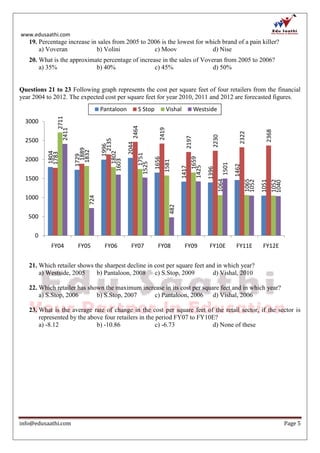
Questions 21 to 23 Following graph represents the cost per square feet of four retailers from the financial
year 2004 to 2012. The expected cost per square feet for year 2010, 2011 and 2012 are forecasted figures.
21. Which retailer shows the sharpest decline in cost per square feet and in which year?
a) Westside, 2005 b) Pantaloon, 2008 c) S.Stop, 2009 d) Vishal, 2010
22. Which retailer has shown the maximum increase in its cost per square feet and in which year?
a) S.Stop, 2006 b) S.Stop, 2007 c) Pantaloon, 2006 d) Vishal, 2006
23. What is the average rate of change in the cost per square feet of the retail sector, if the sector is
represented by the above four retailers in the period FY07 to FY10E?
a) -8.12 b) -10.86 c) -6.73 d) None of these
1804
1729
1996
2044
1656
1417
1396
1462
1051
1783
1889
2135
2464
2419
2197
2230
2322
2368
2711
1832
1802
1751
1581
1659
1064
1065
1052
2411
724
1603
1525
482
1425
1501
1052
1040
0
500
1000
1500
2000
2500
3000
FY04 FY05 FY06 FY07 FY08 FY09 FY10E FY11E FY12E
Pantaloon S Stop Vishal Westside
1. b) 21. d)
2. d) 22. b)
3. c) 23. d)
4. d)
5. a)
6. b)
7. d)
8. c)
9. b)
10. c)
11. d)
12. c)
13. a)
14. d)
15. b)
16. b)
17. a)
18. d)
19. d)
20. b)
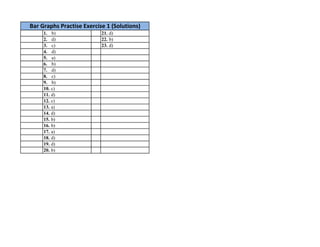
Bar Graphs Practise Exercise 1 (Solutions)

Bar graphs-practise-ex-1

  • 1.
    www.edusaathi.com info@edusaathi.com Page 1 DataInterpretation: Bar Graphs Total Time: 45 mins Practise Exercise no. 1 Total no. Of Qs: 23 Q. 1 to 5 Answer the questions based on the following graph. 1. In which year was the trade deficit highest? a) 1987-88 b) 1988-89 c) 1989-90 d) 1990-91 2. In how many years was the trade deficit less than the trade deficit in the succeeding year? a) 1 b) 2 c) 3 d) 4 3. Export earning in 1990-91 is how many per cent of imports in 1991-92? a) 82% b) 85% c) 90% d) 15% 4. In the last three years, the total export earnings have accounted for how many per cent of the value of the imports? a) 80% b) 83% c) 95% d) 88% 5. Which of the following statements can be inferred from the graph? a) In all the years shown in the graph, the trade deficit is less than the export earnings. b) Export earnings increased in every year between 1989-90 and 1991-92. c) In all the years shown in the graph, the earning by exports is less than the expenditure on imports in the preceding year. d) None of these 0 5 10 15 20 25 30 1987-88 1988-89 1998-90 1990-91 1991-92 1992-93 1993-94 1994-95 Foreign trade (in billion dollars) Imports Exports
  • 2.
    www.edusaathi.com info@edusaathi.com Page 2 Q.6 to 10 Answer the questions based on the following graph. 6. In which year the annual growth rate of total production (of all products) is highest? a) 1991 b) 1992 c) 1993 d) 1995 7. If the stability of the production during 1990 to 1995 is defined as, Average Production Maximum Production −Minimum Production then, which product is most stable? a) Product P b) Product Q c) Product R d) Product S 8. If four products P, Q, R and S shown in the graph are sold at price of Rs.9, Rs.4, Rs.13 and Rs.3 respectively during 1990-1995, then the total revenue of the all the products is lowest in which year? a) 1991 b) 1992 c) 1993 d) None of the above 9. Individual revenue of P, Q, R and S for the entire period (1990-1995) is calculated based on the price of Rs.9, Rs.4, Rs.13 and Rs.3 respectively. Which product fetches the lowest revenue? a) Product P b) Product Q c) Product R d) Product S 10. Four products P, Q, R and S shown in the graph are sold at price of Rs.9, Rs.4, Rs.13 and Rs.3 respectively during 1990-1995. Which of the following statements is TRUE? a) Product R fetches second highest revenue across products in 1991. b) Sum of revenue of P, Q and S is more than the revenue of R in 1994. c) Cumulative revenue of P and Q is more than the revenue of S in 1993. d) None of the above 0 10 20 30 40 50 60 70 80 90 100 110 120 130 140 150 160 170 1990 1991 1992 1993 1994 1995 ProductioninTonnes Production of P, Q, R & S (1990-95) P Q R S
  • 3.
    www.edusaathi.com info@edusaathi.com Page 3 Q.11 to 16 Answer the questions based on the following graphs 11. Which of the following year exhibited highest percentage decrease over the preceding year in the automobile production? a) 2005 b) 2006 c) 2007 d) 2008 300 450 600 750 900 1050 1200 1350 2004 2005 2006 2007 2008 Numberin‘000 Automobile Production Trends Passanger Vehicles Commercial Vehicles Three Wheelers 150 300 450 600 750 900 1050 1200 2004 2005 2006 2007 2008 Numberin‘000 Automobile Domestic Sales Trends
  • 4.
    www.edusaathi.com info@edusaathi.com Page 4 12.Assuming whatever that is not sold domestically was exported, then which year has registered highest growth in exports of automobiles? a) 2005 b) 2006 c) 2007 d) 2008 13. If the ratio of the domestic sale price of a commercial vehicle, a passenger vehicle, and a three wheeler is 5:3:2 then what percent of earnings (approximately) is contributed by commercial vehicle segment to the overall earnings from domestic sales during the period 2004-2008? a) 45% b) 43% c) 11% d) 27% 14. For which year were the domestic sales of automobiles closest to the average (2004-2008) domestic sales of automobiles? a) 2005 b) 2006 c) 2007 d) 2008 15. Which of the following years exhibited highest percentage increase over the preceding year in the automobile sales? a) 2005 b) 2006 c) 2007 d) 2008 16. The ratio between absolute increase in domestic sales over preceding year and absolute increase in production over the preceding year is highest during which year? a) 2005 b) 2006 c) 2007 d) 2008 Q. 17 to 20 Refer to the following bar diagram showing the sales (in Rs Crores) of top market brands among pain killers in India and answer the questions 17. What is the difference between the sales of Voveran in 2006 and those of Calpol in 2005 (in Rs lacs)? a) 1000 b) 50 c) 100 d) 500 18. Percentage of increase in sales from 2005 to 2006 is the highest for which brand of a pain killer? a) Voveran b) Volini c) Dolonex d) Sumo 0 5 10 15 20 25 Voveran Calpol Nise Combiflam Dolonex Sumo Volini Moov Nimulid 2005 2006
  • 5.
    www.edusaathi.com info@edusaathi.com Page 5 19.Percentage increase in sales from 2005 to 2006 is the lowest for which brand of a pain killer? a) Voveran b) Volini c) Moov d) Nise 20. What is the approximate percentage of increase in the sales of Voveran from 2005 to 2006? a) 35% b) 40% c) 45% d) 50% Questions 21 to 23 Following graph represents the cost per square feet of four retailers from the financial year 2004 to 2012. The expected cost per square feet for year 2010, 2011 and 2012 are forecasted figures. 21. Which retailer shows the sharpest decline in cost per square feet and in which year? a) Westside, 2005 b) Pantaloon, 2008 c) S.Stop, 2009 d) Vishal, 2010 22. Which retailer has shown the maximum increase in its cost per square feet and in which year? a) S.Stop, 2006 b) S.Stop, 2007 c) Pantaloon, 2006 d) Vishal, 2006 23. What is the average rate of change in the cost per square feet of the retail sector, if the sector is represented by the above four retailers in the period FY07 to FY10E? a) -8.12 b) -10.86 c) -6.73 d) None of these 1804 1729 1996 2044 1656 1417 1396 1462 1051 1783 1889 2135 2464 2419 2197 2230 2322 2368 2711 1832 1802 1751 1581 1659 1064 1065 1052 2411 724 1603 1525 482 1425 1501 1052 1040 0 500 1000 1500 2000 2500 3000 FY04 FY05 FY06 FY07 FY08 FY09 FY10E FY11E FY12E Pantaloon S Stop Vishal Westside
  • 6.
    1. b) 21.d) 2. d) 22. b) 3. c) 23. d) 4. d) 5. a) 6. b) 7. d) 8. c) 9. b) 10. c) 11. d) 12. c) 13. a) 14. d) 15. b) 16. b) 17. a) 18. d) 19. d) 20. b) Bar Graphs Practise Exercise 1 (Solutions)