David C. Wyld et al. (Eds): ARIA, SIPR, SOFEA, CSEN, DSML, NLP, EDTECH, NCWC - 2022
pp. 303-316, 2022. CS & IT - CSCP 2022 DOI: 10.5121/csit.2022.121524
BANTU SPELL CHECKER AND CORRECTOR
USING MODIFIED EDIT DISTANCE
ALGORITHM (MEDA)
Boago Okgetheng, Gabofetswe Malema,
Ariq Ahmer, Boemo Lenyibi and Ontiretse Ishmael
Department of Computer Science,
University of Botswana, Gaborone, Botswana
ABSTRACT
Automatic spelling correction for a language is critical since the current world is almost
entirely dependent on digital devices that employ electronic keyboards. Correct spelling adds to
textual document accessibility and readability. Many NLP applications, such as web search
engines, text summarization, sentiment analysis, and so on, rely on automatic spelling
correction. A few efforts on automatic spelling correction in Bantu languages have been
completed; however, the numbers are insufficient. We proposed a spell checker for typed words
based on the Modified minimum edit distance Algorithm (MEDA), and the Syllable Error
Detection Algorithm (SEDA). In this study, we adjusted the minimal edit distance Algorithm by
including a frequency score for letters and ordered operations. The SEDA identifies the
component of the word and the position of the letter which has an error. For this research, the
Setswana language was utilized for testing, and other languages related to Setswana will use
this spell checker. Setswana is a Bantu language spoken mostly in Botswana, South Africa, and
Namibia and its automatic spelling correction are still in its early stages. Setswana is
Botswana’s national language and is mostly utilized in schools and government offices. The
accuracy was measured in 2500 Setswana words for assessment. The SEDA discovered
incorrect Setswana words with 99% accuracy. When evaluating MEDA, the edit distance
algorithm was utilized as the baseline, and it generated an accuracy of 52%. In comparison, the
edit distance algorithm with ordered operations provided 64% accuracy, and MEDA produced
92% accuracy. The model failed in the closely related terms.
KEYWORDS
Bantu Spell Checker, Edit Distance algorithm, morphologically rich, Syllable Error Detection
Algorithm.
1. INTRODUCTION
The written form of a language is a significant aspect in communication. We do not need to know
right spelling of a word when speaking, and communications can be done even without proper
grammatical attention, but perfect spelling is critical when writing. Spelling errors are prevalent,
especially in a complex language especially in Bantu languages which are morphologically rich.
Most of Bantu languages are agglutinative with heavy use of affixes, suffixes, and prefixes. The
most notable aspects involving Bantu syllable structure, consonant/vowel inventories, and
phonological processes are firmly established throughout the Bantu region [1], despite the
enormous number of languages and vast geographic expanse that they span. The notion of what
constitutes a word is therefore different from European languages like English.
304 Computer Science & Information Technology (CS & IT)
Spelling mistakes are widespread in Bantu languages due to the difficult word formation.
Spelling mistakes are not necessarily caused by their complexity; they can also arise because of
rapid typing or a lack of expertise and some are generated from other close terms. Spelling errors
could be divided into two types: typographical errors and cognitive errors [2]. Cognitive errors
include phonetic errors as well as errors associated with homonyms, which can result in a valid
word that is incorrect in context. When developing a spell-checking tool, these two types of
errors must be considered.
Since spelling mistakes are so common, automatic spelling corrective systems are critical. The
practice of detecting improperly written words in a particular language is known as spell
checking [3]. The spell-checking process may also make suggestions for improperly misspelled
terms in the language. Many potential NLP applications, like text summarization, sentiment
analysis, and machine translation, require spelling correction. [4]. There has been a lot of
research on this area, although there aren't many significant publications on Spell checkers in
Bantu languages. Some studies employed the minimal edit distance approach in conjunction with
a considerably bigger dictionary/database.
We present a multilingual Bantu spell checker and corrector that employ a modified Edit distance
algorithm (MEDA) and Syllable error detection Algorithm (SEDA), with a focus on spell
application usability. The method employed SEDA to detect the error in the term and MEDA to
fix it. The MEDA scores the frequency of the letters in the word using a mathematical method.
The frequency approach calculates the likelihood of letter a being followed by letter b. MEDA
additionally incorporates the optimal operation ordering from the edit distance for efficient and
effective outcomes. This proposed paradigm was tested using Setswana, a Bantu language. This
study is divided into the following sections: literature review, methodology, implementation,
results, results analysis, and conclusions.
2. LITERATURE REVIEW
With the digitization of almost everything becoming the norm, in this case, text data, it is
important to have spell checker tools in word processors or software programs put in place to
validate and verify textual information. Although error detection and correction are the basis of a
professional spell checker, thorough investigations indicate that for the Bantu languages this has
not been conducted and is still in its primitive stages due to the languages’ rich morphology and
high agglutination. Spellchecking entails both error correction and detection. Text error
correction has mostly concentrated on three areas: non-word error detection, isolated-word error
detection, and context-dependent word correction. Error detection has been successfully
implemented; however, error repair is currently being worked on incrementally.
2.1. Existing Systems
There are some existing techniques that are used for spell checking. These include R-rule based
technique system – where a number of associated rules captures frequent spelling errors and
typos and uses them to on the misspelled words, Dictionary lookup – where the word is checked
against a dictionary and N-gram technique [5]. Other techniques include using Clustering
Algorithm (PAM) to identify errors in the spelling [6] and using statistical model to check for
spelling errors [7].
Computer Science & Information Technology (CS & IT) 305
2.2. Related Work
A study in the development of a Turkish spell-checking and error-correcting application by Ince
[8] also suggests that the development of a spell checker and error corrector for an agglutinative
language proves to be challenging and different. The author emphasizes that for this to take
place; mathematical preliminaries and morphological analysis are required for such languages.
Ince developed a spell checker and error corrector for the Turkish language using the n-gram and
edit distance algorithms using the C#.Net and Microsoft Visual Studio platform. An nZembrek
file was then used as the Turkish dictionary's sustainability of the word roots and compliance
with suffixes. The file contained a text file, a suffix file, a letter file, and an optional syllable
finder. Ince says the n-gram was used to learn the rules of the letters and the word sequences and
was dependent on the word length the user input. The n-gram was used to determine the distance
of a misspelled word as n, where (n-1) and (n-2) are the misspelled word's properties. The edit
distance algorithm was used to add the nearest 2 distance words to the suggestion list. The results
obtained showed an accuracy of 95% and a success rate of 95% for suggestions for spelling
errors.
Mjaria [9] conducted a study similar and came to the same conclusion that stated although it has
become a common norm for the use of spellcheckers due to the increasing usage of text-based
communication, be it at the workplace or on social media, it has been very gruesome when it
comes to support for spellchecking of Bantu languages. Spellcheckers are designed such that the
body consists of text representing the language, basically the "corpus", an error model, and a
language model. The language model is used for determining how frequently a word occurs in a
dictionary. The error model is just used for the modelling of spelling errors, whose accuracy is
liable to the corpus.
Bantu languages are mostly known to be ambiguous, thus making it difficult for error correction
when it comes to spell checking. Mashiane [10] pointed that there are yet efficient algorithms and
tools that are yet to be found when it comes to error correction of Bantu languages.in this work a
minimum edit distance algorithm was used for error detection, where the algorithm searches for
the smallest number of insertions or deletions of a word. The structure of African languages
differs significantly from that of the languages supported by conventional spell checker software.
It has been easier for non-word error detection compared to error correction. A binary spell
checker has been used to achieve this. Spelling errors in languages with complex morphology and
structure are common and could either be cognitive or typographical in nature, so error
corrections are required.
A discovery was made by Islam [11], who conducted research on the Bangla language, which
was prone to errors due to its complex structure. Islam created a model for correct word
prediction in Bangla using the fractional accuracy function for non-error words and the direct
dictionary method and edit distance algorithm to check correctness and word suggestions and
compute the accuracy. Islam further states that in handling the typographical non-word errors,
direct dictionary lookup was used to detect erroneous words, and if the typed word was not
available, it was an error. The edit distance algorithm was then used to correct the word with an
estimate of the similarity of its structure to the misspelled word and possible correct words. The
model produced an accuracy of 98.83% from a suggestion list of length 9 and an accuracy of
65.17% from a suggestion list of length 1. Contrary to the use of the edit distance algorithm, the
reverse edit distance algorithm may be used in spell checkers as it uses fewer word comparisons
and has proved to be efficient.
Iqbal [12], in his study of creating a spell checker for the Urdu language, used the reverse edit
distance algorithm. Iqbal indicated that the reverse edit distance algorithm minimized the
306 Computer Science & Information Technology (CS & IT)
comparisons between misspelled words and words in the dictionary for error correction. The
reverse edit distance proposed for the Urdu language uses the edit distance permutation, which is
generated and compared to the lexicon word in alphabetical order. With the Urdu language
comprised of 42 alphabets, a word length of n resulted in a total of 86n+41 comparisons. The edit
distance algorithm was then used on the generated permutation to avoid the occurrence of non-
word errors that resulted in a zero match in the lexicon Some of the difficulties faced in building
the Urdu spell checking model, according to Iqbal, were its complicated morphological structure,
diction problems, word separators, and loan words.
3. METHODOLOGY
Our method for spell Checker is to extend the existing edit distance algorithm to make it work for
Bantu languages, based on how words are formed or written. The proposed has been described in
this section.
3.1. Syllable Error Detection Algorithm (SEDA)
In our methodology, we first detect the dissimilarities between the words using our error
detection algorithm. We firstly input documents containing the words of that language in the
model. Then the model learns the different types of syllables present in the language and stores
them in a file. Then we take our input words and pass them through our SEDA. This model then
extracts the syllables and looks them up the file of syllables to look for any inconsistencies. An
inconsistency represents that the model detected an error in the word and then outputs that error
to the next phase.
3.2. Edit Distance Algorithm (EDA)
We now consider the Edit Distance Algorithm (EDA). This algorithm attempts to determine the
difference between two words and the fewest number of operations required to change one word
to another. [13]. The error that is identified from the SEDA is then passed to this phase of the
Edit Distance Algorithm. The EDA takes this error into account and performs its operations on
the word to be transformed. We propose a system of ordering of the fundamental operations of
EDA: insert, delete, substitute and transpose. The ordering of these operations is done to optimize
the discovery of the smallest number of operations needed to change the word. Section 3.3 shows
the orderings of the operations that are proposed for the transformation.
3.3. EDA with Ordering
In this step, take into account the order of operations that are available for the general EDA. We
run the proposed ordering of operations (as shown in below) and run each order against the EDA
to get a general performance of which ordering to take. An average score for each of the ordering
is calculated which gives the performance of the ordering. This score determines which
operations ordering will be used as we assume that this performs the best on average for every
word. We determine the average performance for each operation and then arrange the results
based on the scores. This is done to investigate how the ordering of operations affects the spell
checker in Bantu languages. The best operation ordering will then be used in our MEDA.
Insert Ordering
1. insert , replace , delete, transpose
2. insert, transpose, replace, delete
Computer Science & Information Technology (CS & IT) 307
3. insert, delete, transpose , replace
4. insert, replace, transpose, delete
5. insert, transpose , delete , replace
6. insert, delete, replace, transpose
Transpose Ordering
1. transpose, insert , delete, replace
2. transpose, insert, replace, delete
3. transpose, replace, delete, insert
4. transpose, replace, insert, delete
5. transpose, delete ,insert, replace
6. transpose, delete, replace, insert
Delete Ordering
1. delete, insert , transpose , replace
2. delete, insert, replace, transpose
3. delete, replace, transpose, insert
4. delete, replace, insert, transpose
5. delete, transpose, insert, replace
6. delete, transpose, replace, insert
Replace Ordering
1.replace , delete, transpose, insert
2.replace, delete, insert, transpose
3.replace, insert, delete, transpose
4.replace, insert, transpose, delete
5.replace, transpose, delete, insert
6.replace, transpose, insert, delete
3.4. Modified Edit Distance Algorithm (MEDA)
MEDA is a component of our suggested solution since it employs algorithms based on the
structure of Bantu languages. This algorithm incorporates operations ordering and a mathematical
model together with the general EDA. The mathematical model is used to find the score of each
alphabet in the given word relative to its position in that word. This allows us to find the probable
letter that may be the error in the word. Once this score is found, we employ the ordered
operations of the general EDA to the “incorrect” word to find the minimum number of operations
to be taken to transform the word. The operations of the EDA are ordered to explore which set of
operations are optimized for the error correction of any given word in time and to see whether
ordering said operations actually influences the final yield.
3.4.1. Mathematical Model
Let be the set of characters in a given word .
Let be the dictionary that consists of words
whose characters are denoted by of a word .
Let where a word in the dictionary is at any given time.
308 Computer Science & Information Technology (CS & IT)
Let be the set consisting of objects that hold the frequency of
each character of the word . Then the frequency of the characters relative to their position is
calculated as follows.
Where,
The function basically keeps track of how many times the letter appears in the position in
the set of words in . If there is a character that is common in that position, then a 1 is added to
and 0 if the characters don’t match. The figure is then normalized by taking the average of the
set over the total number of words in the dictionary and place it in the i-th position of set .
Note that the position of the elements in the set match with that of set and .
Figure 1. Proposed Solution
We start off by getting a word input. The word is then checked against a dictionary of known
words. If the word appears in the dictionary, we assume that it is accurate, therefore we display it
right away. In the case that it is not found, the word is passed through an error detector. If there
are no errors detected and we also know that the word is non-existent in the dictionary, then the
word is passed through the Edit Distance algorithm (EDA) in four passes. The operations in each
Computer Science & Information Technology (CS & IT) 309
pass are accounted for before passing to EDA. Each pass consists of an operation of the
following: Insert, Delete, Replace and Transpose. The operations are ordered such that the
optimized operation is performed on average. If, after executing the aforementioned operations,
the word is still not located in the dictionary, we conclude that it does not exist and display it
directly. However, if there is (are) error(s) detected after passing through the error detector, then
the word is passed to check if the said number of operations (as mentioned above) are done
before passing it to “Modified Edit Distant” algorithm (MEDA). In this method, the algorithm
detects where the error is and then splits the syllables and characters. Each character is then
evaluated with a frequency score (see section 3.4.1) relative to its position in the word. The
character with the least score is taken to be the anomaly. Then, the four standard operations are
applied to this character in an attempt to correct the word. After the operations are done, the word
is checked against the dictionary to see if it exists. If the word does not exist and we exceed the
number of operations, then we conclude that the word in non-existent and display it accordingly.
4. IMPLEMENTATION
4.1. Data Pre Processing
Test Data
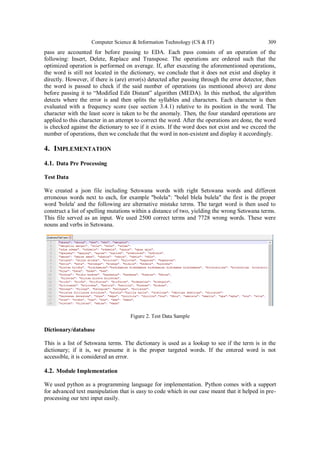
We created a json file including Setswana words with right Setswana words and different
erroneous words next to each, for example "bolela": "bolel blela bulela" the first is the proper
word 'bolela' and the following are alternative mistake terms. The target word is then used to
construct a list of spelling mutations within a distance of two, yielding the wrong Setswana terms.
This file served as an input. We used 2500 correct terms and 7728 wrong words. These were
nouns and verbs in Setswana.
Figure 2. Test Data Sample
Dictionary/database
This is a list of Setswana terms. The dictionary is used as a lookup to see if the term is in the
dictionary; if it is, we presume it is the proper targeted words. If the entered word is not
accessible, it is considered an error.
4.2. Module Implementation
We used python as a programming language for implementation. Python comes with a support
for advanced text manipulation that is easy to code which in our case meant that it helped in pre-
processing our text input easily.
310 Computer Science & Information Technology (CS & IT)
4.2.1. Frequency score Module
We require a corpus of words from a certain language that has most of the forms, or a method
that understands how to generate all of the forms of a word. We next performed our frequency
score method, which gave us the probability of specific alphabets following each other. To train
the model, we utilized a big dataset containing Setswana phrases to score our alphabets in
Setswana. Figure 3 illustrates the findings of the frequency score for the Setswana word
"bontshantse."
Figure 3. Frequency score
4.2.2. EDA, EDA by ordering and MEDA Modules
We implemented the three approaches, and they were all tested with the same dataset of 2500
Setswana words. The results of each approach were recoded as indicated in section 5.
5. RESULTS
A set of words with varying morphologies from a text were used as input to test the
performance of the three techniques. The accuracy was measured by comparing the correct
number of words to the total number of words provided, as shown in equation 1 below.
Equation 1. Accuracy [14]
To evaluate the spelling behaviour of Setswana words, the three methodologies were explored. In
this experiment, 2500 words were analysed, and the accuracy of each approach was measured.
Except for overlapping terms, the SEDA detector 99 percent accurate (Words which are wrong
but having correct syllables). The edit distance method by Levenstein has 52 percent accuracy in
correcting misspelled words, the edit distance algorithm by ordering has 64 percent accuracy, and
the modified edit distance algorithm has 92 percent accuracy. The failure causes are described in
the section on outcomes.
Edit Distance Algorithm by ordering
In our test input, we ordered the operations. In this case, we modified the Edit distance Algorithm
to avoid using the shortest distance and instead complete the processes in chronological order.
The key is I-Insert, R-Replace, T-Transpose, and D-Delete. We wanted to see the order in
which Setswana words may be corrected so that we determine the most prevalent Setswana word
error (it be swapping, omission or addition). The accuracy of all orders was calculated, as well as
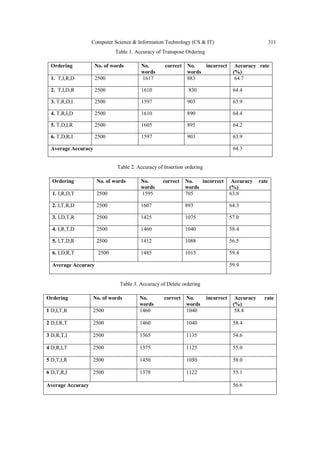
the average from each operation, as shown in tables 1, 2, 3, and 4. The average accuracy of the
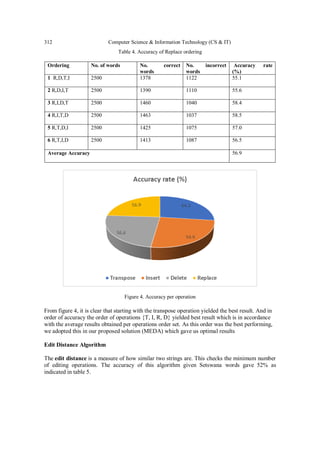
four operations is 64.3 percent for transpose, 59.9 percent for insert, and 56.9 percent for replace,
with delete being the least accurate at 56.6 percent. The precision is depicted in figure 4 below.
Computer Science & Information Technology (CS & IT) 311
Table 1. Accuracy of Transpose Ordering
Ordering No. of words No. correct
words
No. incorrect
words
Accuracy rate
(%)
1. T,I,R,D 2500 1617 883 64.7
2. T,I,D,R 2500 1610 830 64.4
3. T,R,D,I 2500 1597 903 63.9
4. T,R,I,D 2500 1610 890 64.4
5. T,D,I,R 2500 1605 895 64.2
6. T,D,R,I 2500 1597 903 63.9
Average Accuracy 64.3
Table 2. Accuracy of Insertion ordering
Ordering No. of words No. correct
words
No. incorrect
words
Accuracy rate
(%)
1. I,R,D,T 2500 1595 705 63.8
2. I,T,R,D 2500 1607 893 64.3
3. I,D,T,R 2500 1425 1075 57.0
4. I,R,T,D 2500 1460 1040 58.4
5. I,T,D,R 2500 1412 1088 56.5
6. I,D,R,T 2500 1485 1015 59.4
Average Accuracy 59.9
Table 3. Accuracy of Delete ordering
Ordering No. of words No. correct
words
No. incorrect
words
Accuracy rate
(%)
1 D,I,T,R 2500 1460 1040 58.4
2 D,I,R,T 2500 1460 1040 58.4
3 D,R,T,I 2500 1365 1135 54.6
4 D,R,I,T 2500 1375 1125 55.0
5 D,T,I,R 2500 1450 1050 58.0
6 D,T,R,I 2500 1378 1122 55.1
Average Accuracy 56.6
312 Computer Science & Information Technology (CS & IT)
Table 4. Accuracy of Replace ordering
Figure 4. Accuracy per operation
From figure 4, it is clear that starting with the transpose operation yielded the best result. And in
order of accuracy the order of operations {T, I, R, D} yielded best result which is in accordance
with the average results obtained per operations order set. As this order was the best performing,
we adopted this in our proposed solution (MEDA) which gave us optimal results
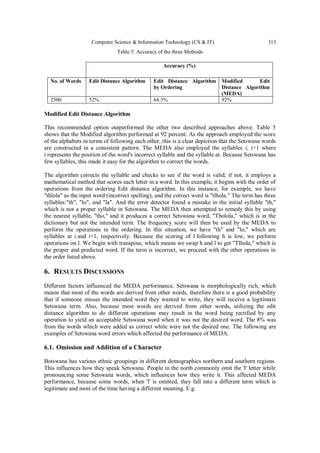
Edit Distance Algorithm
The edit distance is a measure of how similar two strings are. This checks the minimum number
of editing operations. The accuracy of this algorithm given Setswana words gave 52% as
indicated in table 5.
Ordering No. of words No. correct
words
No. incorrect
words
Accuracy rate
(%)
1 R,D,T,I 2500 1378 1122 55.1
2 R,D,I,T 2500 1390 1110 55.6
3 R,I,D,T 2500 1460 1040 58.4
4 R,I,T,D 2500 1463 1037 58.5
5 R,T,D,I 2500 1425 1075 57.0
6 R,T,I,D 2500 1413 1087 56.5
Average Accuracy 56.9
Computer Science & Information Technology (CS & IT) 313
Table 5. Accuracy of the three Methods
Accuracy (%)
No. of Words Edit Distance Algorithm Edit Distance Algorithm
by Ordering
Modified Edit
Distance Algorithm
(MEDA)
2500 52% 64.3% 92%
Modified Edit Distance Algorithm
This recommended option outperformed the other two described approaches above. Table 5
shows that the Modified algorithm performed at 92 percent. As the approach employed the score
of the alphabets in terms of following each other, this is a clear depiction that the Setswana words
are constructed in a consistent pattern. The MEDA also employed the syllables i, i+1 where
i represents the position of the word's incorrect syllable and the syllable at. Because Setswana has
few syllables, this made it easy for the algorithm to correct the words.
The algorithm corrects the syllable and checks to see if the word is valid; if not, it employs a
mathematical method that scores each letter in a word. In this example, it begins with the order of
operations from the ordering Edit distance algorithm. In this instance, for example, we have
"thlola" as the input word (incorrect spelling), and the correct word is "tlhola." The term has three
syllables:"th", "lo", and "la". And the error detector found a mistake in the initial syllable "th,"
which is not a proper syllable in Setswana. The MEDA then attempted to remedy this by using
the nearest syllable, "tho," and it produces a correct Setswana word, "Tholola," which is in the
dictionary but not the intended term. The frequency score will then be used by the MEDA to
perform the operations in the ordering. In this situation, we have "th" and "lo," which are
syllables at i and i+1, respectively. Because the scoring of l following h is low, we perform
operations on l. We begin with transpose, which means we swap h and l to get "Tlhola," which is
the proper and predicted word. If the term is incorrect, we proceed with the other operations in
the order listed above.
6. RESULTS DISCUSSIONS
Different factors influenced the MEDA performance. Setswana is morphologically rich, which
means that most of the words are derived from other words, therefore there is a good probability
that if someone misses the intended word they wanted to write, they will receive a legitimate
Setswana term. Also, because most words are derived from other words, utilizing the edit
distance algorithm to do different operations may result in the word being rectified by any
operation to yield an acceptable Setswana word when it was not the desired word. The 8% was
from the words which were added as correct while were not the desired one. The following are
examples of Setswana word errors which affected the performance of MEDA.
6.1. Omission and Addition of a Character
Botswana has various ethnic groupings in different demographics northern and southern regions.
This influences how they speak Setswana. People in the north commonly omit the 'l' letter while
pronouncing some Setswana words, which influences how they write it. This affected MEDA
performance, because some words, when 'l' is omitted, they fall into a different term which is
legitimate and most of the time having a different meaning. E.g.
314 Computer Science & Information Technology (CS & IT)
+beta 'beta' betla
+thapa 'thapa' tlhapa
+fapa 'fapa' fapha
+ikgantse 'ikgantse' ikgantshe
According to the examples above, 'beta' is an acceptable Setswana term, however some people
pronounce 'betla' as beta, and beta was found in the dictionary whereas we wanted it to give us
betla. The edit distance is the shortest distance and represents the number of operations required
in a word to produce a valid word. Then there could be 0 operations, indicating that the word was
already in the dictionary. As though we expected 'tlhapa' and the user typed 'thapa' because most
individuals who have a problem with this 'l' character sometimes add it when it is not supposed to
be included. And certain Setswana words have the letter 'l,' which will confirm the term as
correct. This can also happen with the character 'h,' as shown in the list above.
6.2. Swapping of characters
This is mainly a keyboard mistake; there are characters near to one other in the "QWERTY"
keyboard, and when one of them is used, it can result in a legitimate word. For example, u and I
are on the same row of the keyboard. We anticipated the term amusa in the example below, but
because the user made an error by inputting u, it becomes legal because amisa is a word in
Setswana.e.g
+amisa amisa amusa
6.3. Morphology
Morphology is the study of words, how they are formed, and their relationship to other words in
the same language. It analyzes the structure of words and parts of words, such as stems, root
words, prefixes, and suffixes. So, there are words in Setswana which has suffixes/ prefixes, which
when removed the remaining sub-string becomes valid.
For example if we perform delete operation, it affects most words which are coming from the
other ones, usually words starting with n,i,m in Setswana, when we delete the first character, it
gives us a valid Setswana word.
+ fitesa 'itesa' 'Fitisa'
+nkgakololo 'kgakololo' 'nkgakolole'
6.4. Closed Words
Since most words are closed to each other, and even though inserting ordering performing better,
it has bad effects. E.g., Setswana words are almost the same but not meaning the same thing, we
can say they are too close to each other. When we give insertion priority, we can end up in totally
different words. E.g., the word 'lametsa' was misspelled and expecting the word ‘lamatsa’ and
inserting with change the first letter with different letter and it will give us nametsa which is
correct.
+ lametsa 'nametsa' 'lamatsa'
+ deresewa 'keresega' 'dirisiwa'
Computer Science & Information Technology (CS & IT) 315
7. DISCUSSIONS
Due to the fact that the bulk of words in Setswana are loanwords, there is a high probability
of accidentally writing a term that is both acceptable and not the one intended. This study
revealed that all four edit distance operations are essential because they affect how prospective
words are mutated, but the findings also indicated that the order in which the operations are
carried out matters. MEDA is a morphologically rich language edit distance method. By utilizing
the syllable algorithm and the frequency score of each letter in the word, this technique
efficiently locates errors in words. The algorithm was tested in Setswana words and received a 92
percent, and it might be tested in additional languages which uses the same writing style.
REFERENCES
[1] Hyman, Larry M. , "Segmental Phonology" , in The Bantu Languages ed. Derek Nurse and
Gerard Philippson (Abingdon: Routledge, 03 Jul 2003 ), accessed 07 Jul 2022 , Routledge Handbooks
Online.
[2] F. J. Damerau, “A technique for computer detection and correction of spelling errors,” Common.
ACM, vol. 7, pp.171-176, 1964
[3] Walfish, M., Hachamovitch, & Andrew, F. (2000). Patent No 6047300. United States of America.
[4] Yonatan , B., and Yonatan B. (2017). Synthetic and natural noise both break neural machine
translation. arXiv preprint arXiv:1711.02173.
[5] Patil, C., Rodrigues, R., & Ron, R. (2020). Auto-Spelling Checker using Natural Language
Processing.
[6] Cordeiro De Amorim, R. and Zampieri, M., 2022. Effective Spell Checking Methods Using
Clustering Algorithms. [online] Uhra.herts.ac.uk. Available at:
<https://uhra.herts.ac.uk/handle/2299/16916> [Accessed 7 July 2022].
[7] M. S. Rasooli, O. Kahefi and B. Minaei-Bidgoli, "Effect of adaptive spell checking in Persian," 2011
7th International Conference on Natural Language Processing and Knowledge Engineering, 2011, pp.
161-164, doi: 10.1109/NLPKE.2011.6138186.
[8] İnce, E. Y. (2017). Spell checking and error correcting application for Turkish. International
Journal of Information and Electronics Engineering, 7(2), 68-71.
[9] Mjaria, F., & Keet, C. M. (2018, May). A statistical approach to error correction for isiZulu
spellcheckers. In 2018 IST-Africa Week Conference (IST-Africa) (pp. 1-of). IEEE.
[10] Mashiane, N. An overview of digitization of African languages, spellchecking techniques & the
progress of spellcheckers globally.
[11] Islam, M. I. K., Meem, R. I., Kasem, F. B. A., Rakshit, A., & Habib, M. T. (2019, May). Bangla spell
checking and correction using edit distance. In 2019 1st International Conference on Advances in
Science, Engineering and Robotics Technology (ICASERT) (pp. 1-4). IEEE
[12] Iqbal, S., Anwar, W., Bajwa, U. I., & Rehman, Z. (2013, October). Urdu spell checking: Reverse edit
distance approach. In Proceedings of the 4th workshop on south and southeast asian natural language
processing (pp. 58-65).
[13] Haldar, Rishin & Mukhopadhyay, Debajyoti. (2011). Levenshtein Distance Technique in Dictionary
Lookup Methods: An Improved Approach. Computing Research Repository - CORR
316 Computer Science & Information Technology (CS & IT)
AUTHORS
B. Okgetheng: MSc, BSc Computer Science.
G. Malema: PhD Computer Engineering, MS Electrical and Computer Science, BS
Computer Engineering.
Ariq Ahmer: Bsc Computer Science Student.
Boemo Lenyibi: Bsc Computing with Finance Student.
O. Ishmael: MSc Computer Science, BSc Computer Systems Engineering.
© 2022 By AIRCC Publishing Corporation. This article is published under the Creative Commons
Attribution (CC BY) license.

Bantu Spell Checker and Corrector using Modified Edit Distance Algorithm (MEDA)

  • 1.
    David C. Wyldet al. (Eds): ARIA, SIPR, SOFEA, CSEN, DSML, NLP, EDTECH, NCWC - 2022 pp. 303-316, 2022. CS & IT - CSCP 2022 DOI: 10.5121/csit.2022.121524 BANTU SPELL CHECKER AND CORRECTOR USING MODIFIED EDIT DISTANCE ALGORITHM (MEDA) Boago Okgetheng, Gabofetswe Malema, Ariq Ahmer, Boemo Lenyibi and Ontiretse Ishmael Department of Computer Science, University of Botswana, Gaborone, Botswana ABSTRACT Automatic spelling correction for a language is critical since the current world is almost entirely dependent on digital devices that employ electronic keyboards. Correct spelling adds to textual document accessibility and readability. Many NLP applications, such as web search engines, text summarization, sentiment analysis, and so on, rely on automatic spelling correction. A few efforts on automatic spelling correction in Bantu languages have been completed; however, the numbers are insufficient. We proposed a spell checker for typed words based on the Modified minimum edit distance Algorithm (MEDA), and the Syllable Error Detection Algorithm (SEDA). In this study, we adjusted the minimal edit distance Algorithm by including a frequency score for letters and ordered operations. The SEDA identifies the component of the word and the position of the letter which has an error. For this research, the Setswana language was utilized for testing, and other languages related to Setswana will use this spell checker. Setswana is a Bantu language spoken mostly in Botswana, South Africa, and Namibia and its automatic spelling correction are still in its early stages. Setswana is Botswana’s national language and is mostly utilized in schools and government offices. The accuracy was measured in 2500 Setswana words for assessment. The SEDA discovered incorrect Setswana words with 99% accuracy. When evaluating MEDA, the edit distance algorithm was utilized as the baseline, and it generated an accuracy of 52%. In comparison, the edit distance algorithm with ordered operations provided 64% accuracy, and MEDA produced 92% accuracy. The model failed in the closely related terms. KEYWORDS Bantu Spell Checker, Edit Distance algorithm, morphologically rich, Syllable Error Detection Algorithm. 1. INTRODUCTION The written form of a language is a significant aspect in communication. We do not need to know right spelling of a word when speaking, and communications can be done even without proper grammatical attention, but perfect spelling is critical when writing. Spelling errors are prevalent, especially in a complex language especially in Bantu languages which are morphologically rich. Most of Bantu languages are agglutinative with heavy use of affixes, suffixes, and prefixes. The most notable aspects involving Bantu syllable structure, consonant/vowel inventories, and phonological processes are firmly established throughout the Bantu region [1], despite the enormous number of languages and vast geographic expanse that they span. The notion of what constitutes a word is therefore different from European languages like English.
  • 2.
    304 Computer Science& Information Technology (CS & IT) Spelling mistakes are widespread in Bantu languages due to the difficult word formation. Spelling mistakes are not necessarily caused by their complexity; they can also arise because of rapid typing or a lack of expertise and some are generated from other close terms. Spelling errors could be divided into two types: typographical errors and cognitive errors [2]. Cognitive errors include phonetic errors as well as errors associated with homonyms, which can result in a valid word that is incorrect in context. When developing a spell-checking tool, these two types of errors must be considered. Since spelling mistakes are so common, automatic spelling corrective systems are critical. The practice of detecting improperly written words in a particular language is known as spell checking [3]. The spell-checking process may also make suggestions for improperly misspelled terms in the language. Many potential NLP applications, like text summarization, sentiment analysis, and machine translation, require spelling correction. [4]. There has been a lot of research on this area, although there aren't many significant publications on Spell checkers in Bantu languages. Some studies employed the minimal edit distance approach in conjunction with a considerably bigger dictionary/database. We present a multilingual Bantu spell checker and corrector that employ a modified Edit distance algorithm (MEDA) and Syllable error detection Algorithm (SEDA), with a focus on spell application usability. The method employed SEDA to detect the error in the term and MEDA to fix it. The MEDA scores the frequency of the letters in the word using a mathematical method. The frequency approach calculates the likelihood of letter a being followed by letter b. MEDA additionally incorporates the optimal operation ordering from the edit distance for efficient and effective outcomes. This proposed paradigm was tested using Setswana, a Bantu language. This study is divided into the following sections: literature review, methodology, implementation, results, results analysis, and conclusions. 2. LITERATURE REVIEW With the digitization of almost everything becoming the norm, in this case, text data, it is important to have spell checker tools in word processors or software programs put in place to validate and verify textual information. Although error detection and correction are the basis of a professional spell checker, thorough investigations indicate that for the Bantu languages this has not been conducted and is still in its primitive stages due to the languages’ rich morphology and high agglutination. Spellchecking entails both error correction and detection. Text error correction has mostly concentrated on three areas: non-word error detection, isolated-word error detection, and context-dependent word correction. Error detection has been successfully implemented; however, error repair is currently being worked on incrementally. 2.1. Existing Systems There are some existing techniques that are used for spell checking. These include R-rule based technique system – where a number of associated rules captures frequent spelling errors and typos and uses them to on the misspelled words, Dictionary lookup – where the word is checked against a dictionary and N-gram technique [5]. Other techniques include using Clustering Algorithm (PAM) to identify errors in the spelling [6] and using statistical model to check for spelling errors [7].
  • 3.
    Computer Science &Information Technology (CS & IT) 305 2.2. Related Work A study in the development of a Turkish spell-checking and error-correcting application by Ince [8] also suggests that the development of a spell checker and error corrector for an agglutinative language proves to be challenging and different. The author emphasizes that for this to take place; mathematical preliminaries and morphological analysis are required for such languages. Ince developed a spell checker and error corrector for the Turkish language using the n-gram and edit distance algorithms using the C#.Net and Microsoft Visual Studio platform. An nZembrek file was then used as the Turkish dictionary's sustainability of the word roots and compliance with suffixes. The file contained a text file, a suffix file, a letter file, and an optional syllable finder. Ince says the n-gram was used to learn the rules of the letters and the word sequences and was dependent on the word length the user input. The n-gram was used to determine the distance of a misspelled word as n, where (n-1) and (n-2) are the misspelled word's properties. The edit distance algorithm was used to add the nearest 2 distance words to the suggestion list. The results obtained showed an accuracy of 95% and a success rate of 95% for suggestions for spelling errors. Mjaria [9] conducted a study similar and came to the same conclusion that stated although it has become a common norm for the use of spellcheckers due to the increasing usage of text-based communication, be it at the workplace or on social media, it has been very gruesome when it comes to support for spellchecking of Bantu languages. Spellcheckers are designed such that the body consists of text representing the language, basically the "corpus", an error model, and a language model. The language model is used for determining how frequently a word occurs in a dictionary. The error model is just used for the modelling of spelling errors, whose accuracy is liable to the corpus. Bantu languages are mostly known to be ambiguous, thus making it difficult for error correction when it comes to spell checking. Mashiane [10] pointed that there are yet efficient algorithms and tools that are yet to be found when it comes to error correction of Bantu languages.in this work a minimum edit distance algorithm was used for error detection, where the algorithm searches for the smallest number of insertions or deletions of a word. The structure of African languages differs significantly from that of the languages supported by conventional spell checker software. It has been easier for non-word error detection compared to error correction. A binary spell checker has been used to achieve this. Spelling errors in languages with complex morphology and structure are common and could either be cognitive or typographical in nature, so error corrections are required. A discovery was made by Islam [11], who conducted research on the Bangla language, which was prone to errors due to its complex structure. Islam created a model for correct word prediction in Bangla using the fractional accuracy function for non-error words and the direct dictionary method and edit distance algorithm to check correctness and word suggestions and compute the accuracy. Islam further states that in handling the typographical non-word errors, direct dictionary lookup was used to detect erroneous words, and if the typed word was not available, it was an error. The edit distance algorithm was then used to correct the word with an estimate of the similarity of its structure to the misspelled word and possible correct words. The model produced an accuracy of 98.83% from a suggestion list of length 9 and an accuracy of 65.17% from a suggestion list of length 1. Contrary to the use of the edit distance algorithm, the reverse edit distance algorithm may be used in spell checkers as it uses fewer word comparisons and has proved to be efficient. Iqbal [12], in his study of creating a spell checker for the Urdu language, used the reverse edit distance algorithm. Iqbal indicated that the reverse edit distance algorithm minimized the
  • 4.
    306 Computer Science& Information Technology (CS & IT) comparisons between misspelled words and words in the dictionary for error correction. The reverse edit distance proposed for the Urdu language uses the edit distance permutation, which is generated and compared to the lexicon word in alphabetical order. With the Urdu language comprised of 42 alphabets, a word length of n resulted in a total of 86n+41 comparisons. The edit distance algorithm was then used on the generated permutation to avoid the occurrence of non- word errors that resulted in a zero match in the lexicon Some of the difficulties faced in building the Urdu spell checking model, according to Iqbal, were its complicated morphological structure, diction problems, word separators, and loan words. 3. METHODOLOGY Our method for spell Checker is to extend the existing edit distance algorithm to make it work for Bantu languages, based on how words are formed or written. The proposed has been described in this section. 3.1. Syllable Error Detection Algorithm (SEDA) In our methodology, we first detect the dissimilarities between the words using our error detection algorithm. We firstly input documents containing the words of that language in the model. Then the model learns the different types of syllables present in the language and stores them in a file. Then we take our input words and pass them through our SEDA. This model then extracts the syllables and looks them up the file of syllables to look for any inconsistencies. An inconsistency represents that the model detected an error in the word and then outputs that error to the next phase. 3.2. Edit Distance Algorithm (EDA) We now consider the Edit Distance Algorithm (EDA). This algorithm attempts to determine the difference between two words and the fewest number of operations required to change one word to another. [13]. The error that is identified from the SEDA is then passed to this phase of the Edit Distance Algorithm. The EDA takes this error into account and performs its operations on the word to be transformed. We propose a system of ordering of the fundamental operations of EDA: insert, delete, substitute and transpose. The ordering of these operations is done to optimize the discovery of the smallest number of operations needed to change the word. Section 3.3 shows the orderings of the operations that are proposed for the transformation. 3.3. EDA with Ordering In this step, take into account the order of operations that are available for the general EDA. We run the proposed ordering of operations (as shown in below) and run each order against the EDA to get a general performance of which ordering to take. An average score for each of the ordering is calculated which gives the performance of the ordering. This score determines which operations ordering will be used as we assume that this performs the best on average for every word. We determine the average performance for each operation and then arrange the results based on the scores. This is done to investigate how the ordering of operations affects the spell checker in Bantu languages. The best operation ordering will then be used in our MEDA. Insert Ordering 1. insert , replace , delete, transpose 2. insert, transpose, replace, delete
  • 5.
    Computer Science &Information Technology (CS & IT) 307 3. insert, delete, transpose , replace 4. insert, replace, transpose, delete 5. insert, transpose , delete , replace 6. insert, delete, replace, transpose Transpose Ordering 1. transpose, insert , delete, replace 2. transpose, insert, replace, delete 3. transpose, replace, delete, insert 4. transpose, replace, insert, delete 5. transpose, delete ,insert, replace 6. transpose, delete, replace, insert Delete Ordering 1. delete, insert , transpose , replace 2. delete, insert, replace, transpose 3. delete, replace, transpose, insert 4. delete, replace, insert, transpose 5. delete, transpose, insert, replace 6. delete, transpose, replace, insert Replace Ordering 1.replace , delete, transpose, insert 2.replace, delete, insert, transpose 3.replace, insert, delete, transpose 4.replace, insert, transpose, delete 5.replace, transpose, delete, insert 6.replace, transpose, insert, delete 3.4. Modified Edit Distance Algorithm (MEDA) MEDA is a component of our suggested solution since it employs algorithms based on the structure of Bantu languages. This algorithm incorporates operations ordering and a mathematical model together with the general EDA. The mathematical model is used to find the score of each alphabet in the given word relative to its position in that word. This allows us to find the probable letter that may be the error in the word. Once this score is found, we employ the ordered operations of the general EDA to the “incorrect” word to find the minimum number of operations to be taken to transform the word. The operations of the EDA are ordered to explore which set of operations are optimized for the error correction of any given word in time and to see whether ordering said operations actually influences the final yield. 3.4.1. Mathematical Model Let be the set of characters in a given word . Let be the dictionary that consists of words whose characters are denoted by of a word . Let where a word in the dictionary is at any given time.
  • 6.
    308 Computer Science& Information Technology (CS & IT) Let be the set consisting of objects that hold the frequency of each character of the word . Then the frequency of the characters relative to their position is calculated as follows. Where, The function basically keeps track of how many times the letter appears in the position in the set of words in . If there is a character that is common in that position, then a 1 is added to and 0 if the characters don’t match. The figure is then normalized by taking the average of the set over the total number of words in the dictionary and place it in the i-th position of set . Note that the position of the elements in the set match with that of set and . Figure 1. Proposed Solution We start off by getting a word input. The word is then checked against a dictionary of known words. If the word appears in the dictionary, we assume that it is accurate, therefore we display it right away. In the case that it is not found, the word is passed through an error detector. If there are no errors detected and we also know that the word is non-existent in the dictionary, then the word is passed through the Edit Distance algorithm (EDA) in four passes. The operations in each
  • 7.
    Computer Science &Information Technology (CS & IT) 309 pass are accounted for before passing to EDA. Each pass consists of an operation of the following: Insert, Delete, Replace and Transpose. The operations are ordered such that the optimized operation is performed on average. If, after executing the aforementioned operations, the word is still not located in the dictionary, we conclude that it does not exist and display it directly. However, if there is (are) error(s) detected after passing through the error detector, then the word is passed to check if the said number of operations (as mentioned above) are done before passing it to “Modified Edit Distant” algorithm (MEDA). In this method, the algorithm detects where the error is and then splits the syllables and characters. Each character is then evaluated with a frequency score (see section 3.4.1) relative to its position in the word. The character with the least score is taken to be the anomaly. Then, the four standard operations are applied to this character in an attempt to correct the word. After the operations are done, the word is checked against the dictionary to see if it exists. If the word does not exist and we exceed the number of operations, then we conclude that the word in non-existent and display it accordingly. 4. IMPLEMENTATION 4.1. Data Pre Processing Test Data We created a json file including Setswana words with right Setswana words and different erroneous words next to each, for example "bolela": "bolel blela bulela" the first is the proper word 'bolela' and the following are alternative mistake terms. The target word is then used to construct a list of spelling mutations within a distance of two, yielding the wrong Setswana terms. This file served as an input. We used 2500 correct terms and 7728 wrong words. These were nouns and verbs in Setswana. Figure 2. Test Data Sample Dictionary/database This is a list of Setswana terms. The dictionary is used as a lookup to see if the term is in the dictionary; if it is, we presume it is the proper targeted words. If the entered word is not accessible, it is considered an error. 4.2. Module Implementation We used python as a programming language for implementation. Python comes with a support for advanced text manipulation that is easy to code which in our case meant that it helped in pre- processing our text input easily.
  • 8.
    310 Computer Science& Information Technology (CS & IT) 4.2.1. Frequency score Module We require a corpus of words from a certain language that has most of the forms, or a method that understands how to generate all of the forms of a word. We next performed our frequency score method, which gave us the probability of specific alphabets following each other. To train the model, we utilized a big dataset containing Setswana phrases to score our alphabets in Setswana. Figure 3 illustrates the findings of the frequency score for the Setswana word "bontshantse." Figure 3. Frequency score 4.2.2. EDA, EDA by ordering and MEDA Modules We implemented the three approaches, and they were all tested with the same dataset of 2500 Setswana words. The results of each approach were recoded as indicated in section 5. 5. RESULTS A set of words with varying morphologies from a text were used as input to test the performance of the three techniques. The accuracy was measured by comparing the correct number of words to the total number of words provided, as shown in equation 1 below. Equation 1. Accuracy [14] To evaluate the spelling behaviour of Setswana words, the three methodologies were explored. In this experiment, 2500 words were analysed, and the accuracy of each approach was measured. Except for overlapping terms, the SEDA detector 99 percent accurate (Words which are wrong but having correct syllables). The edit distance method by Levenstein has 52 percent accuracy in correcting misspelled words, the edit distance algorithm by ordering has 64 percent accuracy, and the modified edit distance algorithm has 92 percent accuracy. The failure causes are described in the section on outcomes. Edit Distance Algorithm by ordering In our test input, we ordered the operations. In this case, we modified the Edit distance Algorithm to avoid using the shortest distance and instead complete the processes in chronological order. The key is I-Insert, R-Replace, T-Transpose, and D-Delete. We wanted to see the order in which Setswana words may be corrected so that we determine the most prevalent Setswana word error (it be swapping, omission or addition). The accuracy of all orders was calculated, as well as the average from each operation, as shown in tables 1, 2, 3, and 4. The average accuracy of the four operations is 64.3 percent for transpose, 59.9 percent for insert, and 56.9 percent for replace, with delete being the least accurate at 56.6 percent. The precision is depicted in figure 4 below.
  • 9.
    Computer Science &Information Technology (CS & IT) 311 Table 1. Accuracy of Transpose Ordering Ordering No. of words No. correct words No. incorrect words Accuracy rate (%) 1. T,I,R,D 2500 1617 883 64.7 2. T,I,D,R 2500 1610 830 64.4 3. T,R,D,I 2500 1597 903 63.9 4. T,R,I,D 2500 1610 890 64.4 5. T,D,I,R 2500 1605 895 64.2 6. T,D,R,I 2500 1597 903 63.9 Average Accuracy 64.3 Table 2. Accuracy of Insertion ordering Ordering No. of words No. correct words No. incorrect words Accuracy rate (%) 1. I,R,D,T 2500 1595 705 63.8 2. I,T,R,D 2500 1607 893 64.3 3. I,D,T,R 2500 1425 1075 57.0 4. I,R,T,D 2500 1460 1040 58.4 5. I,T,D,R 2500 1412 1088 56.5 6. I,D,R,T 2500 1485 1015 59.4 Average Accuracy 59.9 Table 3. Accuracy of Delete ordering Ordering No. of words No. correct words No. incorrect words Accuracy rate (%) 1 D,I,T,R 2500 1460 1040 58.4 2 D,I,R,T 2500 1460 1040 58.4 3 D,R,T,I 2500 1365 1135 54.6 4 D,R,I,T 2500 1375 1125 55.0 5 D,T,I,R 2500 1450 1050 58.0 6 D,T,R,I 2500 1378 1122 55.1 Average Accuracy 56.6
  • 10.
    312 Computer Science& Information Technology (CS & IT) Table 4. Accuracy of Replace ordering Figure 4. Accuracy per operation From figure 4, it is clear that starting with the transpose operation yielded the best result. And in order of accuracy the order of operations {T, I, R, D} yielded best result which is in accordance with the average results obtained per operations order set. As this order was the best performing, we adopted this in our proposed solution (MEDA) which gave us optimal results Edit Distance Algorithm The edit distance is a measure of how similar two strings are. This checks the minimum number of editing operations. The accuracy of this algorithm given Setswana words gave 52% as indicated in table 5. Ordering No. of words No. correct words No. incorrect words Accuracy rate (%) 1 R,D,T,I 2500 1378 1122 55.1 2 R,D,I,T 2500 1390 1110 55.6 3 R,I,D,T 2500 1460 1040 58.4 4 R,I,T,D 2500 1463 1037 58.5 5 R,T,D,I 2500 1425 1075 57.0 6 R,T,I,D 2500 1413 1087 56.5 Average Accuracy 56.9
  • 11.
    Computer Science &Information Technology (CS & IT) 313 Table 5. Accuracy of the three Methods Accuracy (%) No. of Words Edit Distance Algorithm Edit Distance Algorithm by Ordering Modified Edit Distance Algorithm (MEDA) 2500 52% 64.3% 92% Modified Edit Distance Algorithm This recommended option outperformed the other two described approaches above. Table 5 shows that the Modified algorithm performed at 92 percent. As the approach employed the score of the alphabets in terms of following each other, this is a clear depiction that the Setswana words are constructed in a consistent pattern. The MEDA also employed the syllables i, i+1 where i represents the position of the word's incorrect syllable and the syllable at. Because Setswana has few syllables, this made it easy for the algorithm to correct the words. The algorithm corrects the syllable and checks to see if the word is valid; if not, it employs a mathematical method that scores each letter in a word. In this example, it begins with the order of operations from the ordering Edit distance algorithm. In this instance, for example, we have "thlola" as the input word (incorrect spelling), and the correct word is "tlhola." The term has three syllables:"th", "lo", and "la". And the error detector found a mistake in the initial syllable "th," which is not a proper syllable in Setswana. The MEDA then attempted to remedy this by using the nearest syllable, "tho," and it produces a correct Setswana word, "Tholola," which is in the dictionary but not the intended term. The frequency score will then be used by the MEDA to perform the operations in the ordering. In this situation, we have "th" and "lo," which are syllables at i and i+1, respectively. Because the scoring of l following h is low, we perform operations on l. We begin with transpose, which means we swap h and l to get "Tlhola," which is the proper and predicted word. If the term is incorrect, we proceed with the other operations in the order listed above. 6. RESULTS DISCUSSIONS Different factors influenced the MEDA performance. Setswana is morphologically rich, which means that most of the words are derived from other words, therefore there is a good probability that if someone misses the intended word they wanted to write, they will receive a legitimate Setswana term. Also, because most words are derived from other words, utilizing the edit distance algorithm to do different operations may result in the word being rectified by any operation to yield an acceptable Setswana word when it was not the desired word. The 8% was from the words which were added as correct while were not the desired one. The following are examples of Setswana word errors which affected the performance of MEDA. 6.1. Omission and Addition of a Character Botswana has various ethnic groupings in different demographics northern and southern regions. This influences how they speak Setswana. People in the north commonly omit the 'l' letter while pronouncing some Setswana words, which influences how they write it. This affected MEDA performance, because some words, when 'l' is omitted, they fall into a different term which is legitimate and most of the time having a different meaning. E.g.
  • 12.
    314 Computer Science& Information Technology (CS & IT) +beta 'beta' betla +thapa 'thapa' tlhapa +fapa 'fapa' fapha +ikgantse 'ikgantse' ikgantshe According to the examples above, 'beta' is an acceptable Setswana term, however some people pronounce 'betla' as beta, and beta was found in the dictionary whereas we wanted it to give us betla. The edit distance is the shortest distance and represents the number of operations required in a word to produce a valid word. Then there could be 0 operations, indicating that the word was already in the dictionary. As though we expected 'tlhapa' and the user typed 'thapa' because most individuals who have a problem with this 'l' character sometimes add it when it is not supposed to be included. And certain Setswana words have the letter 'l,' which will confirm the term as correct. This can also happen with the character 'h,' as shown in the list above. 6.2. Swapping of characters This is mainly a keyboard mistake; there are characters near to one other in the "QWERTY" keyboard, and when one of them is used, it can result in a legitimate word. For example, u and I are on the same row of the keyboard. We anticipated the term amusa in the example below, but because the user made an error by inputting u, it becomes legal because amisa is a word in Setswana.e.g +amisa amisa amusa 6.3. Morphology Morphology is the study of words, how they are formed, and their relationship to other words in the same language. It analyzes the structure of words and parts of words, such as stems, root words, prefixes, and suffixes. So, there are words in Setswana which has suffixes/ prefixes, which when removed the remaining sub-string becomes valid. For example if we perform delete operation, it affects most words which are coming from the other ones, usually words starting with n,i,m in Setswana, when we delete the first character, it gives us a valid Setswana word. + fitesa 'itesa' 'Fitisa' +nkgakololo 'kgakololo' 'nkgakolole' 6.4. Closed Words Since most words are closed to each other, and even though inserting ordering performing better, it has bad effects. E.g., Setswana words are almost the same but not meaning the same thing, we can say they are too close to each other. When we give insertion priority, we can end up in totally different words. E.g., the word 'lametsa' was misspelled and expecting the word ‘lamatsa’ and inserting with change the first letter with different letter and it will give us nametsa which is correct. + lametsa 'nametsa' 'lamatsa' + deresewa 'keresega' 'dirisiwa'
  • 13.
    Computer Science &Information Technology (CS & IT) 315 7. DISCUSSIONS Due to the fact that the bulk of words in Setswana are loanwords, there is a high probability of accidentally writing a term that is both acceptable and not the one intended. This study revealed that all four edit distance operations are essential because they affect how prospective words are mutated, but the findings also indicated that the order in which the operations are carried out matters. MEDA is a morphologically rich language edit distance method. By utilizing the syllable algorithm and the frequency score of each letter in the word, this technique efficiently locates errors in words. The algorithm was tested in Setswana words and received a 92 percent, and it might be tested in additional languages which uses the same writing style. REFERENCES [1] Hyman, Larry M. , "Segmental Phonology" , in The Bantu Languages ed. Derek Nurse and Gerard Philippson (Abingdon: Routledge, 03 Jul 2003 ), accessed 07 Jul 2022 , Routledge Handbooks Online. [2] F. J. Damerau, “A technique for computer detection and correction of spelling errors,” Common. ACM, vol. 7, pp.171-176, 1964 [3] Walfish, M., Hachamovitch, & Andrew, F. (2000). Patent No 6047300. United States of America. [4] Yonatan , B., and Yonatan B. (2017). Synthetic and natural noise both break neural machine translation. arXiv preprint arXiv:1711.02173. [5] Patil, C., Rodrigues, R., & Ron, R. (2020). Auto-Spelling Checker using Natural Language Processing. [6] Cordeiro De Amorim, R. and Zampieri, M., 2022. Effective Spell Checking Methods Using Clustering Algorithms. [online] Uhra.herts.ac.uk. Available at: <https://uhra.herts.ac.uk/handle/2299/16916> [Accessed 7 July 2022]. [7] M. S. Rasooli, O. Kahefi and B. Minaei-Bidgoli, "Effect of adaptive spell checking in Persian," 2011 7th International Conference on Natural Language Processing and Knowledge Engineering, 2011, pp. 161-164, doi: 10.1109/NLPKE.2011.6138186. [8] İnce, E. Y. (2017). Spell checking and error correcting application for Turkish. International Journal of Information and Electronics Engineering, 7(2), 68-71. [9] Mjaria, F., & Keet, C. M. (2018, May). A statistical approach to error correction for isiZulu spellcheckers. In 2018 IST-Africa Week Conference (IST-Africa) (pp. 1-of). IEEE. [10] Mashiane, N. An overview of digitization of African languages, spellchecking techniques & the progress of spellcheckers globally. [11] Islam, M. I. K., Meem, R. I., Kasem, F. B. A., Rakshit, A., & Habib, M. T. (2019, May). Bangla spell checking and correction using edit distance. In 2019 1st International Conference on Advances in Science, Engineering and Robotics Technology (ICASERT) (pp. 1-4). IEEE [12] Iqbal, S., Anwar, W., Bajwa, U. I., & Rehman, Z. (2013, October). Urdu spell checking: Reverse edit distance approach. In Proceedings of the 4th workshop on south and southeast asian natural language processing (pp. 58-65). [13] Haldar, Rishin & Mukhopadhyay, Debajyoti. (2011). Levenshtein Distance Technique in Dictionary Lookup Methods: An Improved Approach. Computing Research Repository - CORR
  • 14.
    316 Computer Science& Information Technology (CS & IT) AUTHORS B. Okgetheng: MSc, BSc Computer Science. G. Malema: PhD Computer Engineering, MS Electrical and Computer Science, BS Computer Engineering. Ariq Ahmer: Bsc Computer Science Student. Boemo Lenyibi: Bsc Computing with Finance Student. O. Ishmael: MSc Computer Science, BSc Computer Systems Engineering. © 2022 By AIRCC Publishing Corporation. This article is published under the Creative Commons Attribution (CC BY) license.