Monday, March 10, 2014 | www.brecorder.com/br2013
Banking
Review2013
BANKING REVIEW 2013 | March 10, 2014
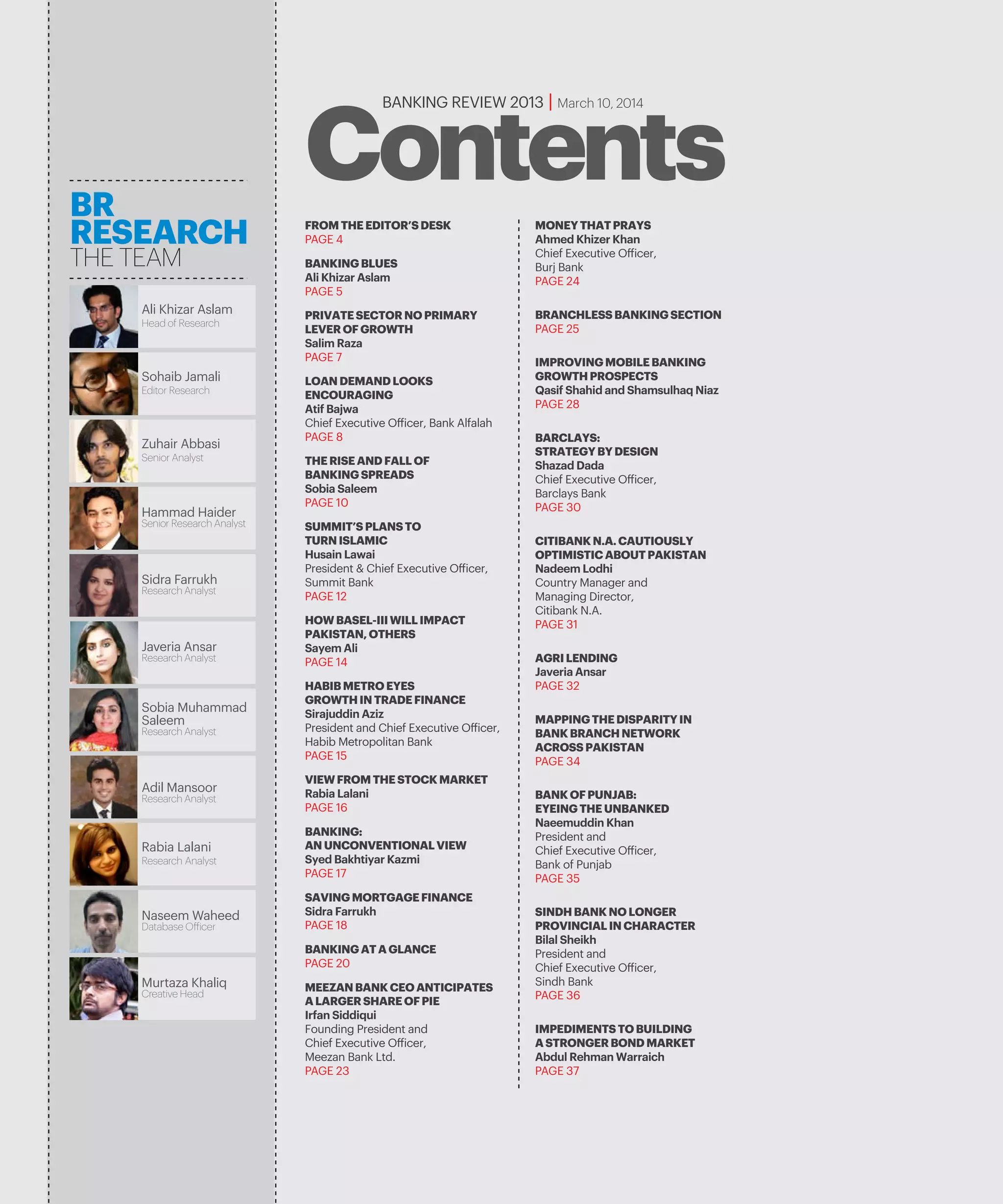
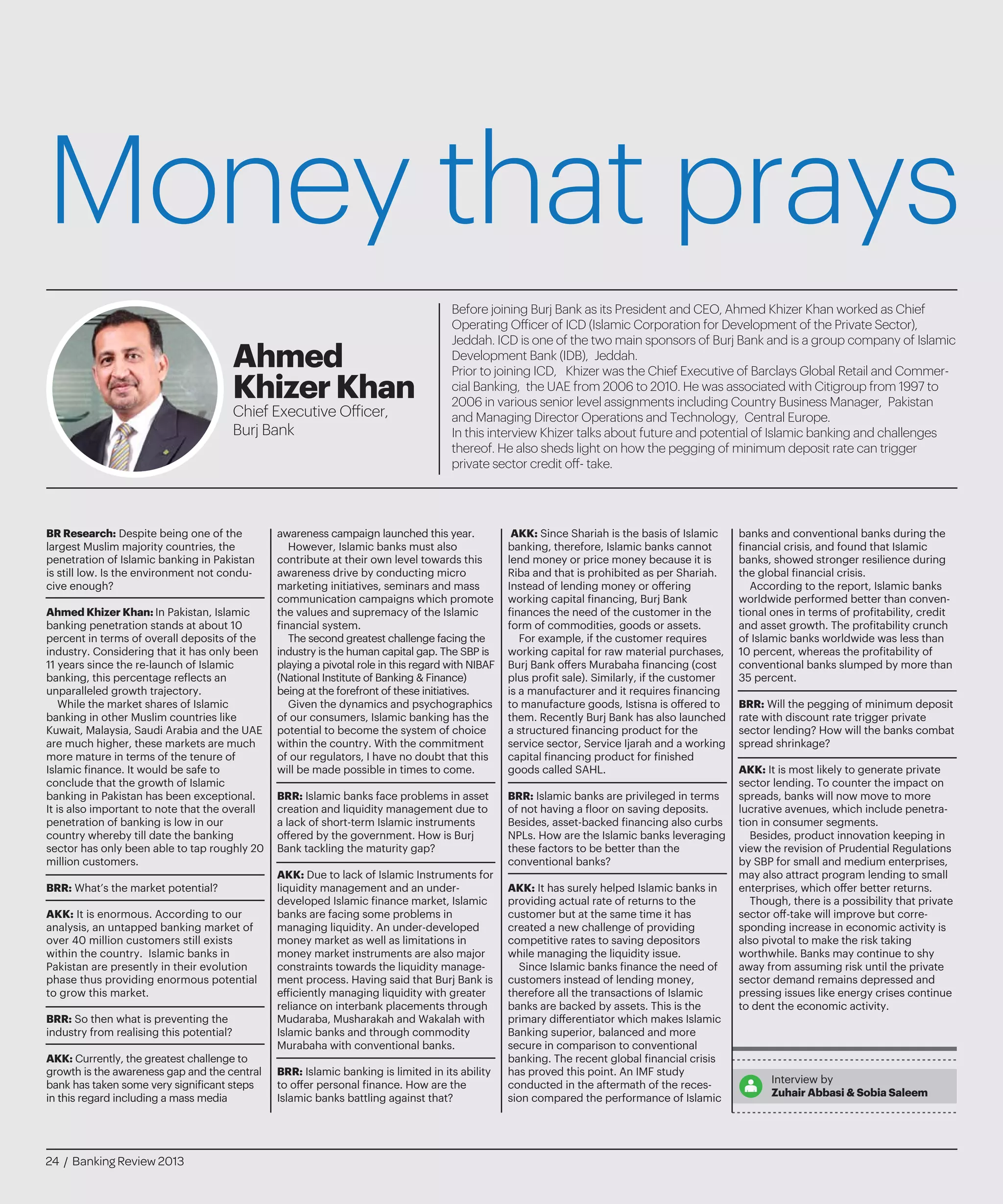
ContentsMONEYTHATPRAYS
Ahmed Khizer Khan
Chief Executive Officer,
Burj Bank
PAGE 24
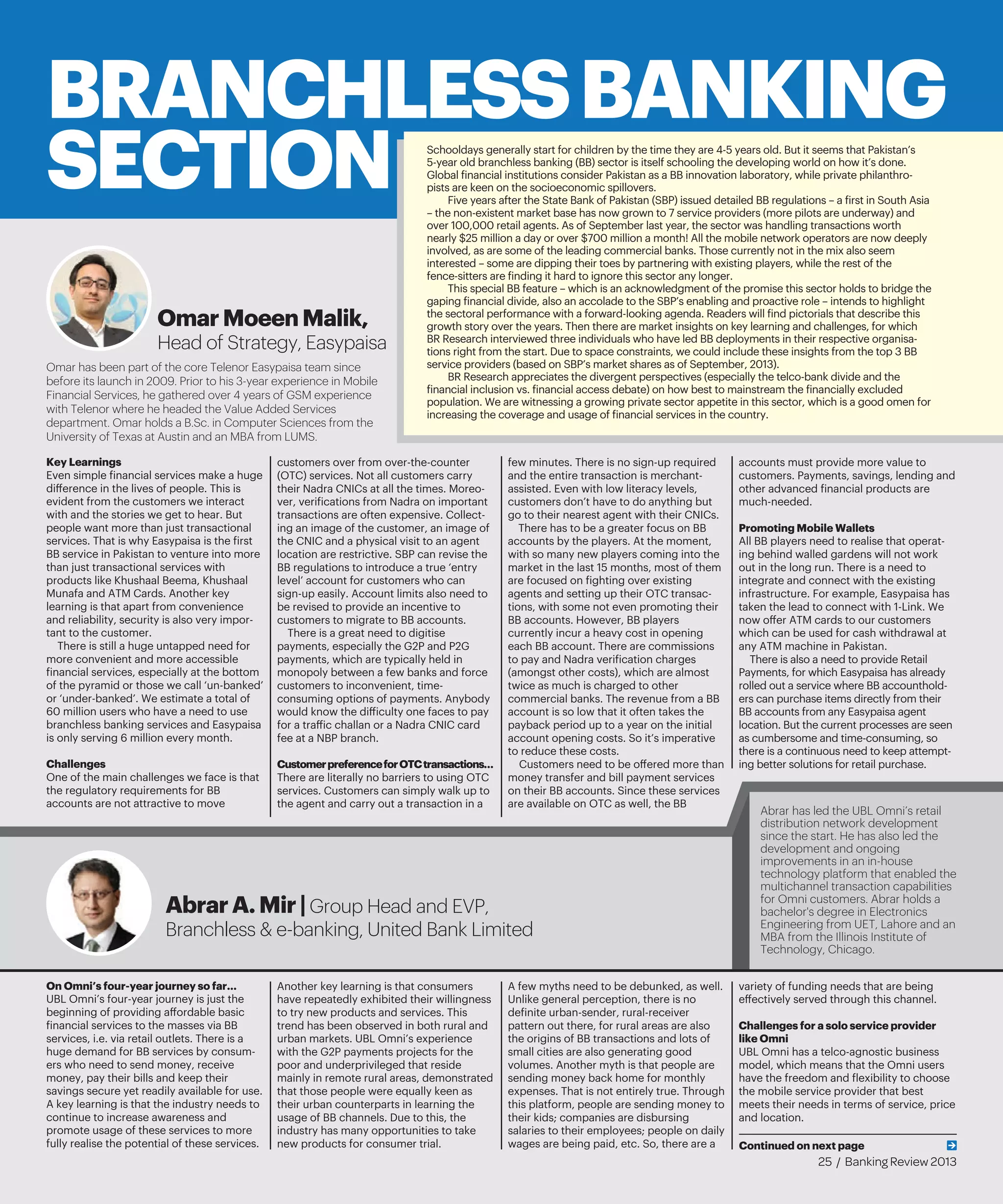
BRANCHLESSBANKINGSECTION
PAGE 25
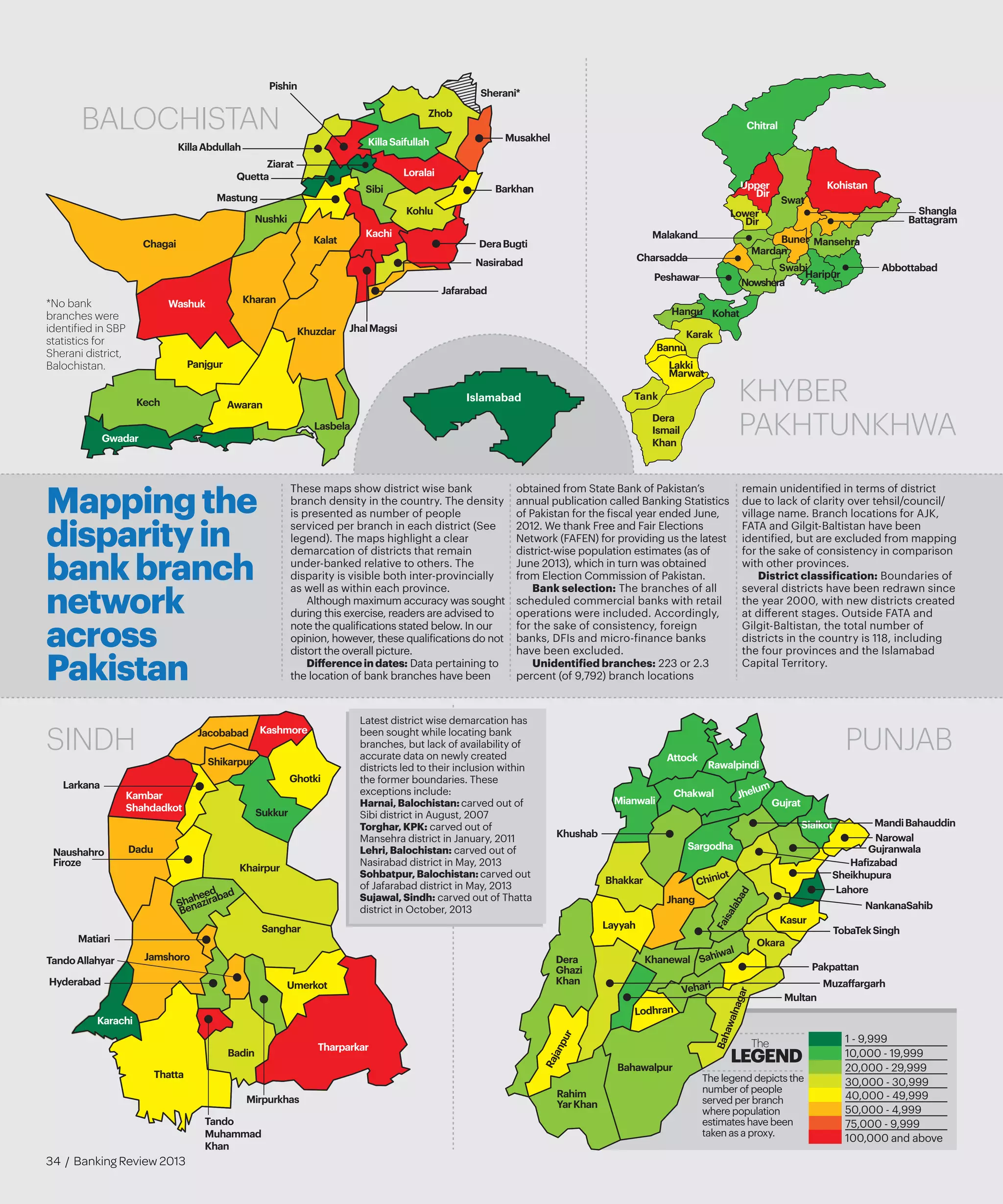
MAPPINGTHEDISPARITYIN
BANKBRANCHNETWORK
ACROSSPAKISTAN
PAGE 34
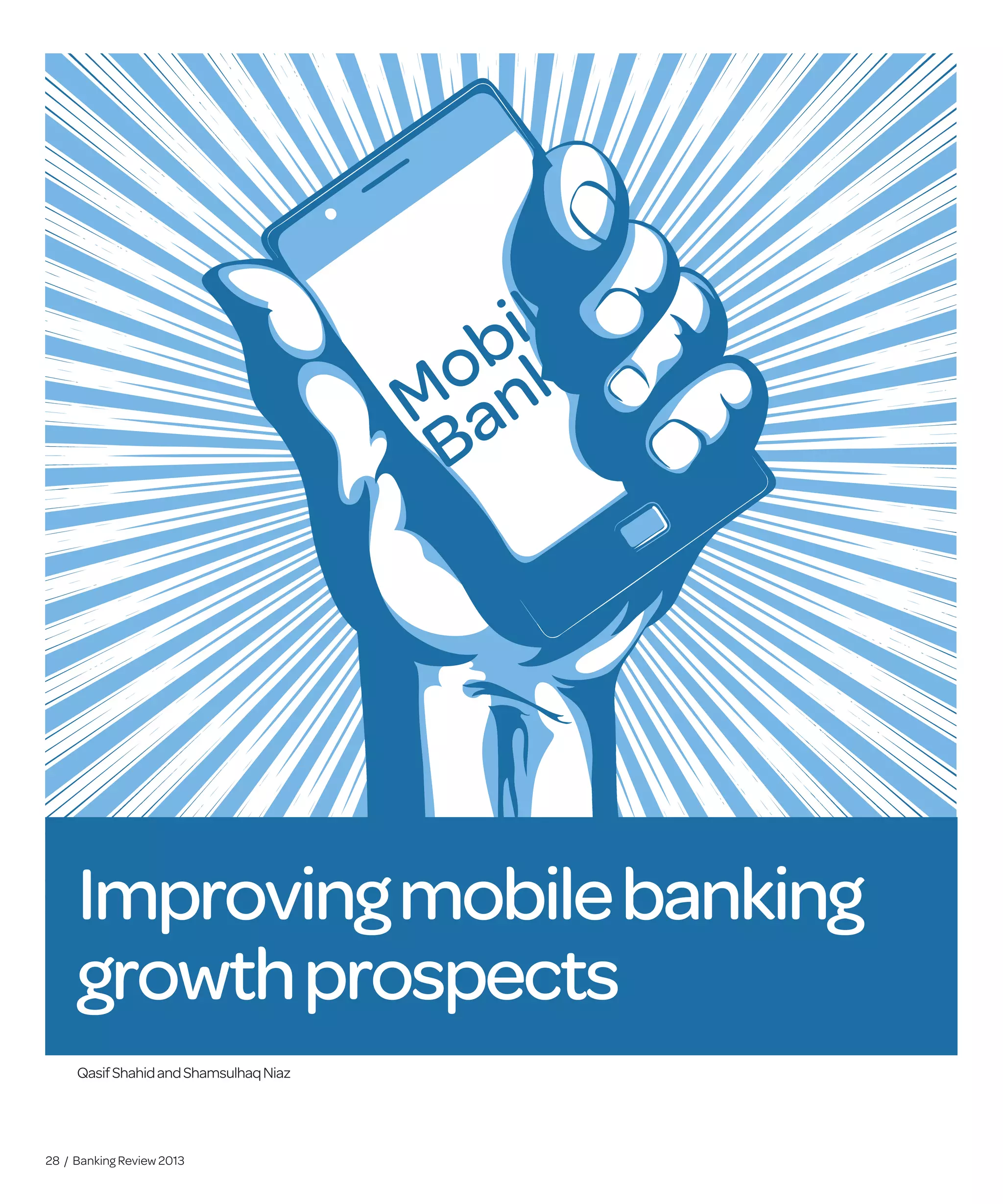
IMPROVINGMOBILEBANKING
GROWTHPROSPECTS
Qasif Shahid and Shamsulhaq Niaz
PAGE 28
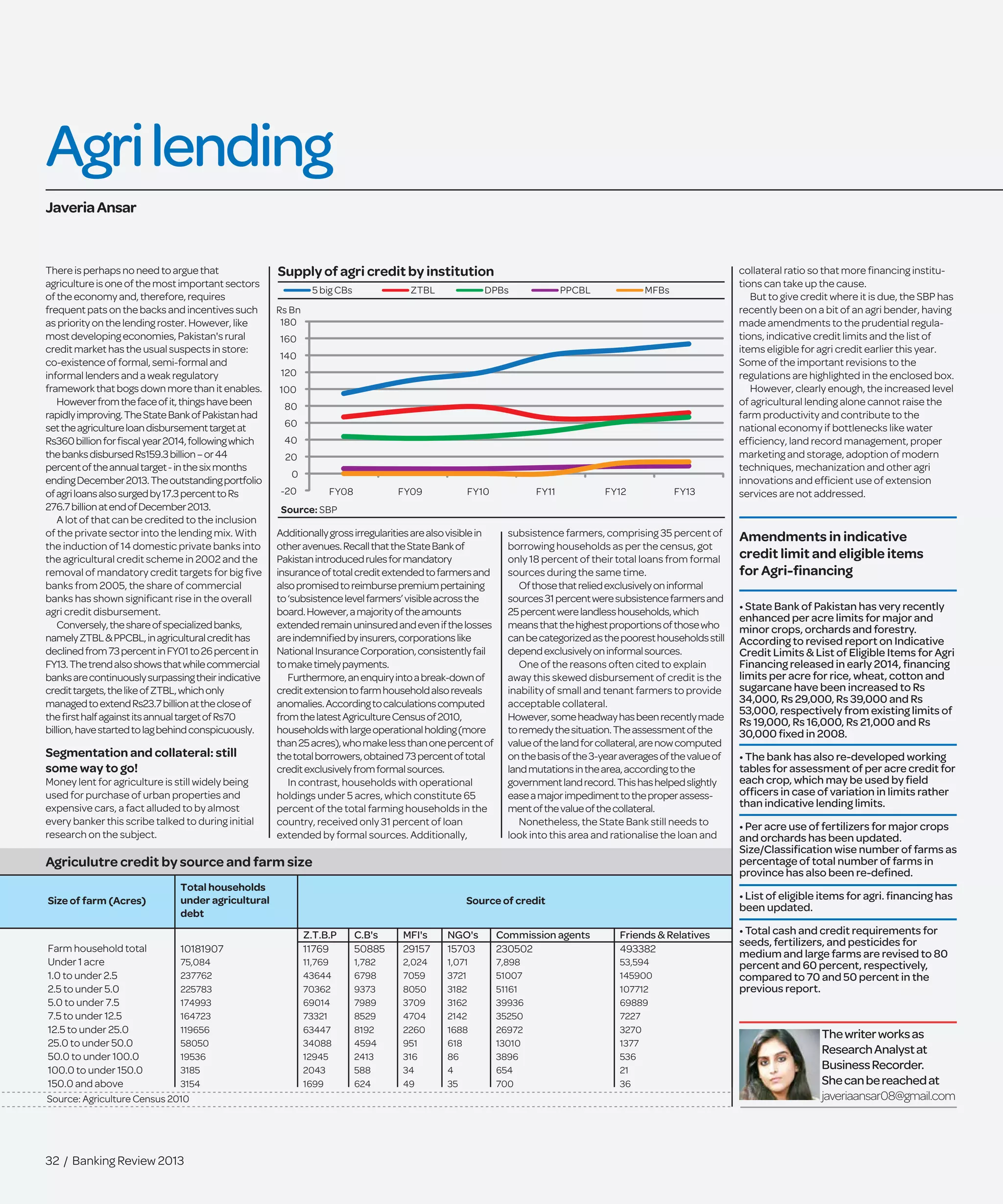
AGRILENDING
Javeria Ansar
PAGE 32
IMPEDIMENTSTOBUILDING
ASTRONGERBONDMARKET
Abdul Rehman Warraich
PAGE 37
BARCLAYS:
STRATEGYBYDESIGN
Shazad Dada
Chief Executive Officer,
Barclays Bank
PAGE 30
CITIBANKN.A.CAUTIOUSLY
OPTIMISTICABOUTPAKISTAN
Nadeem Lodhi
Country Manager and
Managing Director,
Citibank N.A.
PAGE 31
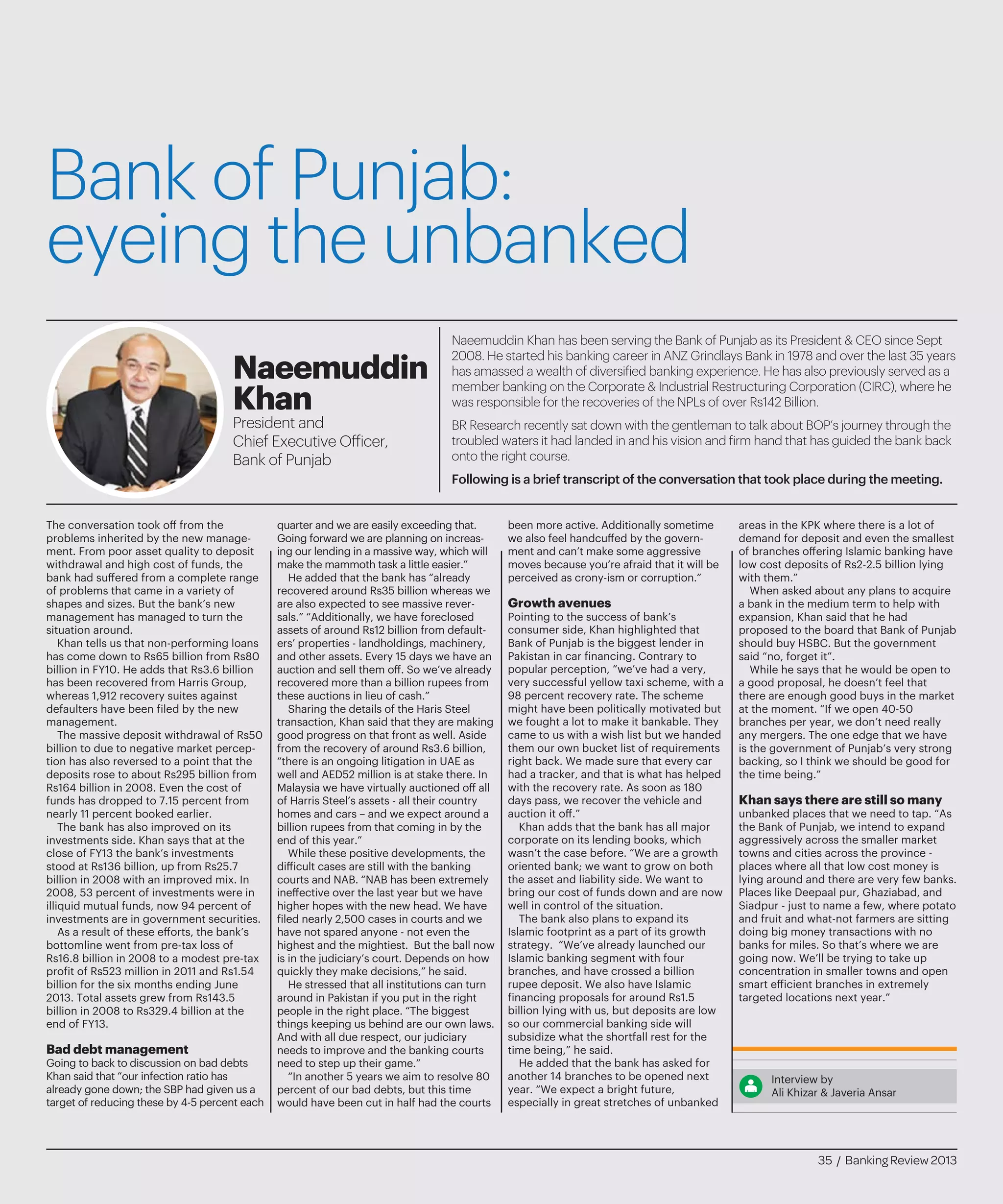
BANKOFPUNJAB:
EYEINGTHEUNBANKED
Naeemuddin Khan
President and
Chief Executive Officer,
Bank of Punjab
PAGE 35
SINDHBANKNOLONGER
PROVINCIALINCHARACTER
Bilal Sheikh
President and
Chief Executive Officer,
Sindh Bank
PAGE 36
FROMTHEEDITOR’SDESK
PAGE 4
BANKINGBLUES
Ali Khizar Aslam
PAGE 5
PRIVATESECTORNOPRIMARY
LEVEROFGROWTH
Salim Raza
PAGE 7
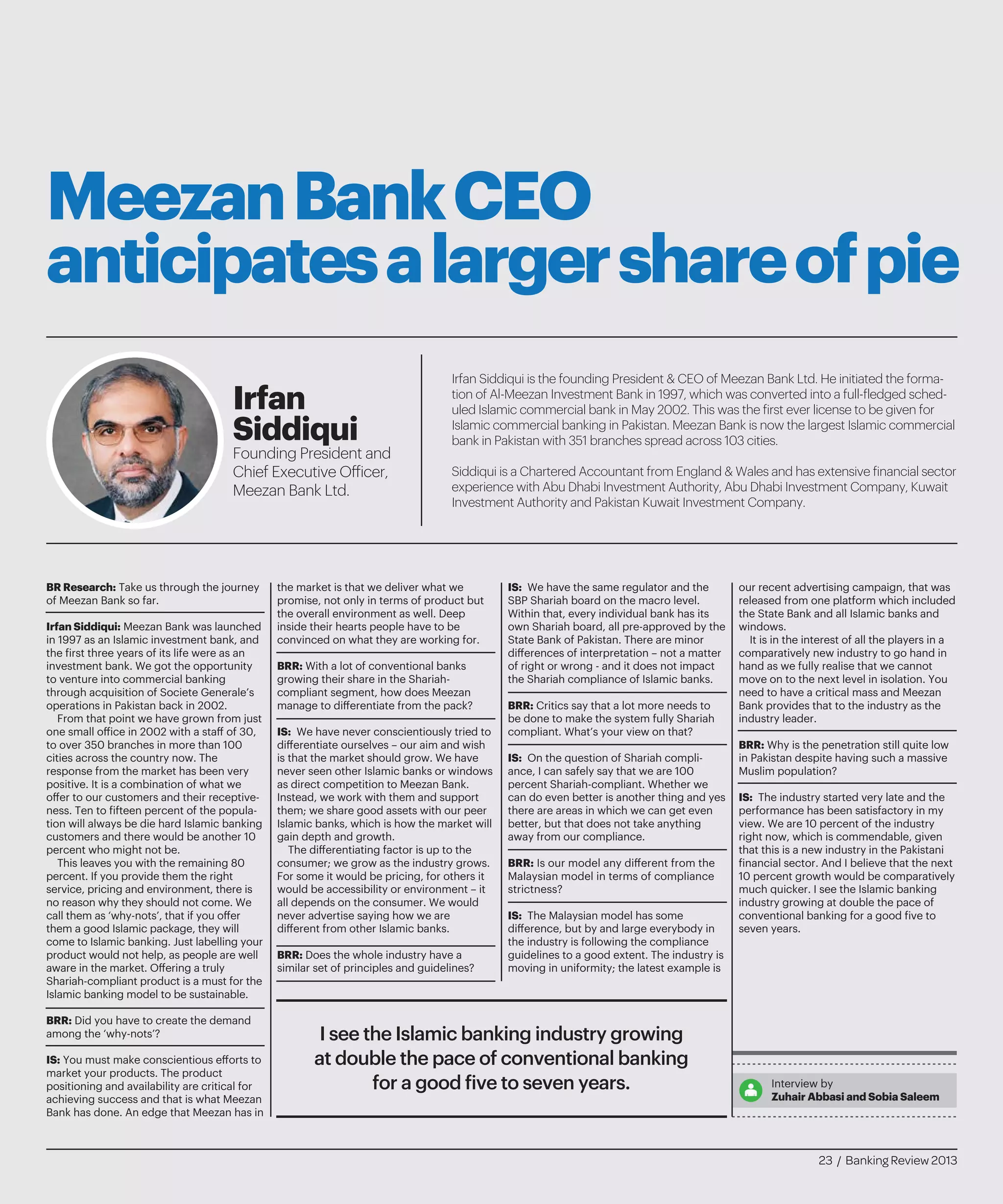
MEEZANBANKCEOANTICIPATES
ALARGERSHAREOFPIE
Irfan Siddiqui
Founding President and
Chief Executive Officer,
Meezan Bank Ltd.
PAGE 23
LOANDEMANDLOOKS
ENCOURAGING
Atif Bajwa
Chief Executive Officer, Bank Alfalah
PAGE 8
THERISEANDFALLOF
BANKINGSPREADS
Sobia Saleem
PAGE 10
SUMMIT’SPLANSTO
TURNISLAMIC
Husain Lawai
President & Chief Executive Officer,
Summit Bank
PAGE 12
HOWBASEL-IIIWILLIMPACT
PAKISTAN,OTHERS
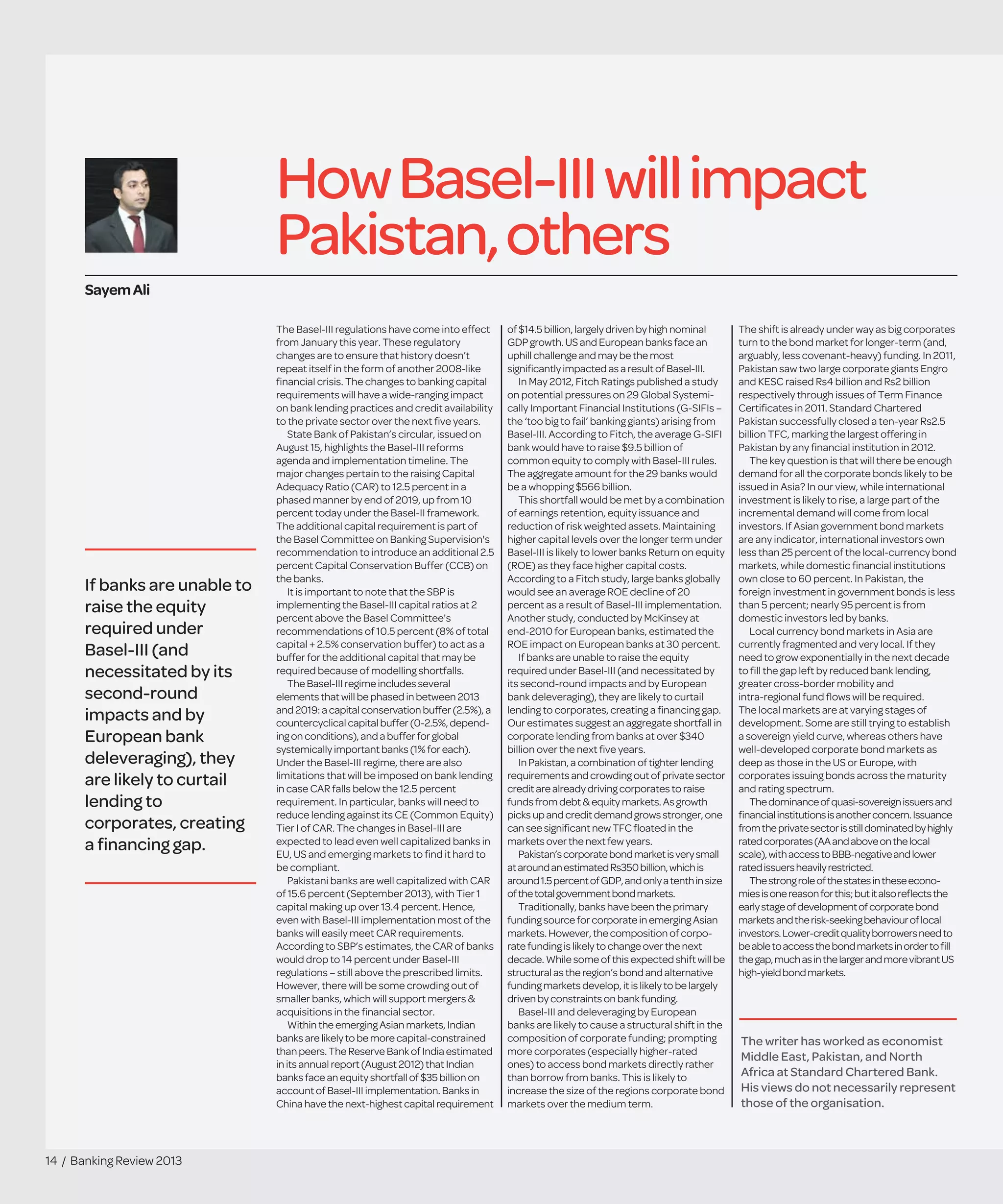
Sayem Ali
PAGE 14
VIEWFROMTHESTOCKMARKET
Rabia Lalani
PAGE 16
HABIBMETROEYES
GROWTHINTRADEFINANCE
Sirajuddin Aziz
President and Chief Executive Officer,
Habib Metropolitan Bank
PAGE 15
BANKING:
ANUNCONVENTIONALVIEW
Syed Bakhtiyar Kazmi
PAGE 17
SAVINGMORTGAGEFINANCE
Sidra Farrukh
PAGE 18
BANKINGATAGLANCE
PAGE 20
Zuhair Abbasi
Senior Research Analyst
Sijal Fawad
Research Analyst
BR
RESEARCH
THE TEAM
Sohaib Jamali
Editor Research
Rabia Lalani
Research Analyst
Ali Khizar Aslam
Head of Research
Murtaza Khaliq
Creative Head
Javeria Ansar
Research Analyst
Rabia Lalani
Research Analyst
Zuhair Abbasi
Senior Analyst
Hammad Haider
Senior Research Analyst
Sidra Farrukh
Research Analyst
Sobia Muhammad
Saleem
Research Analyst
Adil Mansoor
Research Analyst
Naseem Waheed
Bankingisalwaysimportant
Editor’snote
04 / Banking Review 2013
The publication of Business Recorder’s
Banking Review 2013 has interestingly
coincided with the release of State Bank
of Pakistan’s latest quarterly review of the
country’s economy that covers the period
July-September 2013. A fresh central
bank outlook, therefore, has thrown up an
opportunity for us to make a brief
comment on the banking sector in a more
cogent and meaningful manner. While
defending its decision of a hike policy in
rate by 50 basis points to 9.5 percent in
September 2013, SBP has argued that
policy tightening had become imperative
although monetary growth was already
subdued as the growth in broad money
supply (M2) during Q1-FY14 was only 0.2
percent, compared to 0.7 percent in the
corresponding quarter last year. “[T]his
trend can primarily be traced to a rise in
the external deficit, which reduced the
NFA of the banking system by 64.4
percent during the period,” according to
SBP. The SBP report, through a footnote,
explains that in absolute terms, “the NFA
of the banking system declined by Rs
173.2 billion in Q1-FY14, compared to an
increase of Rs 11.8 billion in Q1-FY13”.
Explaining why NDA, on the other hand,
posted an increase of 2.3 percent during
the quarter, the central bank holds high
budgetary borrowing from the banking
system and lower net retirement of
private sector credit responsible for the
rise. Through another footnote or an
additional piece of information printed at
the bottom of the page, the bank argues
why its decisions on interest rates are not
based on the previous data, but on the
forecast of macroeconomic variables. The
SBP report, indeed, gives one a bigger
picture of the country’s financial domain.
Having said that, one however needs to
admit the fact that a lot of water has flown
under the bridges since September 2013
and the present shape of macroeconomic
indicators amply explain why central bank
policies are sometimes not truly forward-
looking or perhaps, do not genuinely
provide for the future.
That our active financial institutions
deliver significant and unique value to
the country’s economy and businesses,
investors, and savers is a fact that has
found its best expression in the perfor-
mance of our banking sector particularly
since 2000. However, there exists a
flawed, albeit widely popular, argument
that well developed financial markets are
correlated with economic development
and that a sound and sophisticated
financial system promotes the efficiency
of investment and economic growth in
an economy by reducing the costs of
intermediation and by improving the
allocation of risk. Unfortunately,
however, in our country well-developed
financial markets are conspicuous by
their absence; nor do we witness any
robust investment and economic growth
any more. This argument, therefore,
leads to a profound question whether or
not the key regulator, i.e., State Bank of
Pakistan, has been efficiently monitoring
the functioning of the domestic market
with a view to evaluating its impact on
the economy. A readily available answer
could be that the central bank has been
performing its regulatory job towards
money market, the forex market as well
as the domestic financial market in an
efficient way. But this does not appear to
be the most plausible answer because
what people generally confront is a
reality that shows that the banking
sector has been demonstrating an
impressive performance but the
country’s economy has been witnessing
a sluggish growth particularly since
2007. The other question that keeps
gnawing one’s mind is that why the
banking sector has failed to effect in
recent years a generous distribution of
credit to support SMEs and regions with
a view to contributing towards efforts
aimed at broadening and building a
sound economic base. These two
profound questions have been
discerned from the write-ups in this
Review. The articles and interviews in
this publication address a number of
questions and issues relating to econom-
ics and finance such as finance, growth
and national integration; the rise and fall
of banking spreads; mortgage finance;
and an unconventional view on banking.
Last but not least, branchless banking
and Islamic banking seem to be the
buzzwords in the world of finance in
Pakistan. According to many, these may
be more of a solution than buzzwords.
Insofar as Islamic banking is concerned,
that has shown an impressive 10 percent
growth in a decade, this mode of
banking has become an important
segment of the global financial markets.
In Pakistan, we are witnessing the
operations of Islamic banking alongside
the conventional banking system.
Islamic banks have been anticipating a
bigger share of the pie and space in
coming months and years. They mainly
derive their confidence from Shariah-
compliant products that they offer to a
largely conservative Muslim society. The
other major reason behind their growing
optimism is the fact that already Islamic
financial institutions, in one form or
another, are operating in over 70
countries. Its huge success in Malaysia,
for example, is a strong case in point.
But what the proponents of Islamic
finance often overlook is the fact that
Islamic economics, as argued, for
example, by Muhammad Akram Khan in
his book What is Wrong with Islamic
Economics? Analyzing the Present State
and Future Agenda, has failed in part
because of its disproportionate focus on
issues of finance—both in terms of
providing Islamic financial products and
institutions to circumvent the perceived
prohibition of riba, and in terms of zakah
as a tool of public finance. Those who
strongly advocate Islamic banking as a
substitute for conventional banking are
required to make unstinted efforts
towards making Islamic finance a
coherent discipline and chart a way
forward for that discipline in the
country’s economic policymaking. In the
end, this newspaper wishes proponents
of both conventional banking and
Islamic banking a bright present and a
brighter future. Business Recorder will
always encourage a healthy competition
between these two modes of banking in
the larger interest of Pakistan, although
one must refrain from making a direct
comparison between Islamic banking
and conventional banking.
Banking ‘blues’Eversincetheglobalfinancialcrisisof2008
dawneduponus,Pakistan’sbankingindustry
seemedstuckinalimbo.Althoughthecountry’s
financialindustrywasn’tbigenoughtobeaffected
bytheglobalmeltdown,thegrowingtwindeficits
(fiscalandexternal)athomethrewupan
opportunityforbankstonarrowdownthechoice
ofbankingassetstogovernmentborrowing.
With the wiping out of some of the credit
extended to big ticket corporates and a virtual
demise of consumer lending in its nascent
stage, banks successfully ventured into
branchless banking and mobile banking in
collaboration with telecommunication giants.
However, the shocks of high toxic assets,
especially in SMEs and consumer sector, were
too much to be absorbed by technologically
advanced ways of banking.
Toensuresteadyprofits,bankswereforcedto
becomeefficientbybothreducingthemarkupand
administrativecosts.However,intheprocessthey
losttheprimefocusoffinancialintermediation.
The industry-wide advance-to-deposit ratio
(ADR) decreased from a peak of 75 percent in
December 2008 to less than 50 percent by
September 2013. The obvious reason behind
this decline was the government’s financing
needs that crowded out private credit as
investment-to-deposits ratio (IDR) (primarily
due to T-Bills) soared from 34 percent to 52
percent in the past five years.
Consideringthatdepositsbasealmostdoubled
since2007,theswingsinADRandIDRaretell-tale
signsontheirown;thoughrealeconomicgrowth
remainedsubduedintheperiod.Growthin
depositsappearsimpressiveasitpacedwitha
nominalGDPgrowthinahighinflationaryera,
whichisalsoattributedtoover-relianceoffiscal
borrowingonbankingsystem.
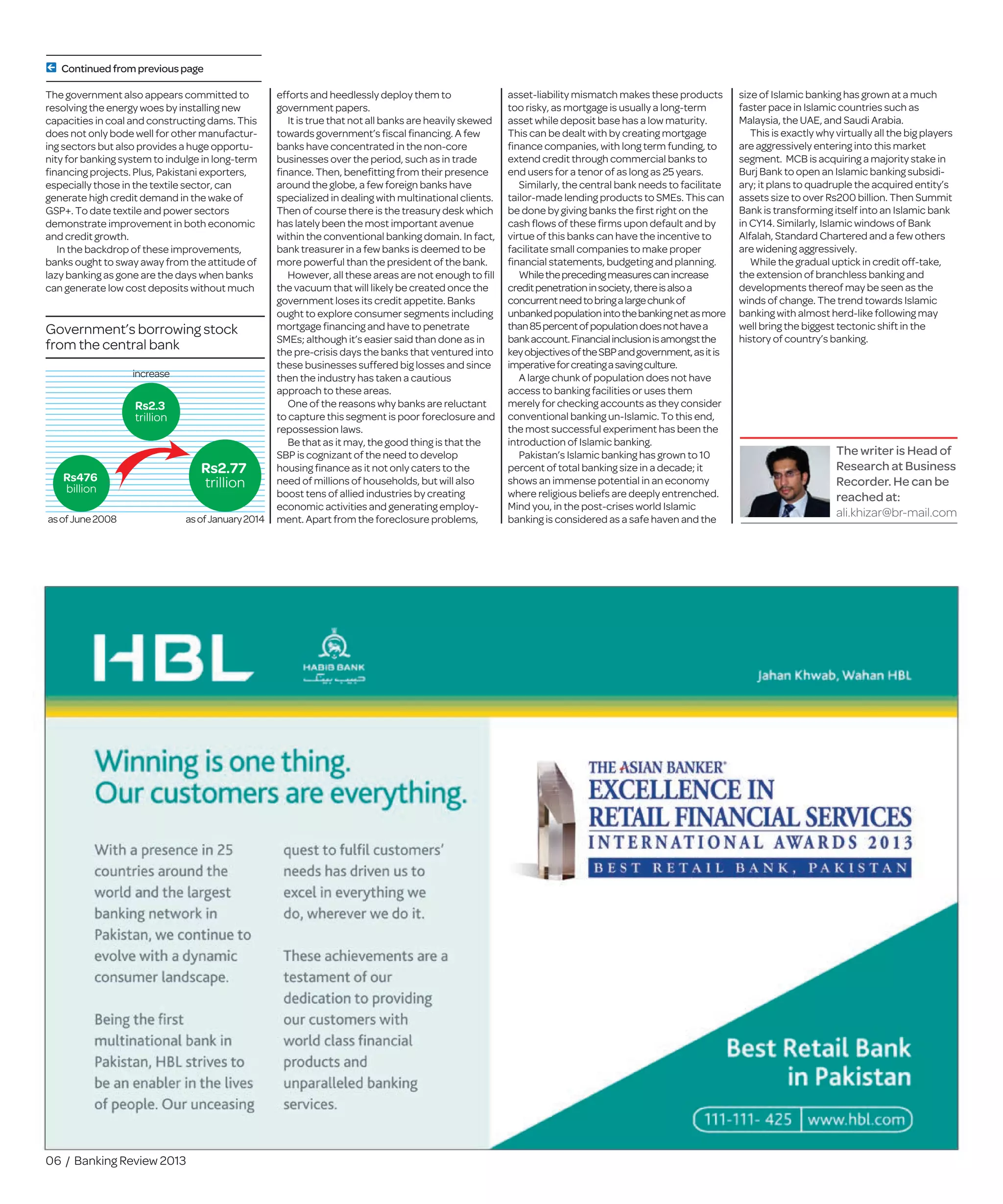
The government’s borrowing stock from the
central bank increased almost six fold - from
Rs476 billion as of June 2008 to Rs2.77 trillion -
as of January 2014. This increase of Rs2.3 trillion
explains a two-third increase in bank deposits.
Effectively, had it not been for such a huge
increase in federal government borrowings, the
profitability of commercial banks would have
stagnated in the last five years. From Rs73 billion
in CY07, commercial banks’ profits nose-dived
to Rs43 billion in CY08 before hitting Rs178
billion in CY12.
Despite these decent profits, bank penetra-
tion continues to remain low as less than 15
percent of people have bank deposits accounts
and those who have access to credit are even
smaller in number.
Even among those who have bank accounts,
there are many who have no incentive to
maintain their accounts as such. A majority of
bank account holders are getting abysmally low
return on their savings and the worrisome fact is
that the trend has worsened over the past five
years. The composition of CASA (current
account and saving account) increased from 58
percent in CY08 to 65 percent as of September
2013. That’s how banks maintained their high
spreads despite assets being skewed towards
low risk and low return government papers.
Higher spreads may have gotten bankers
good profits, but the approach has long term
repercussions for bankers as well as consumers.
The former are going to face an asset-liability
mismatch, once the fiscal house is in order and
the government has no dire need of financing
from the banking system. On the flipside, the
latter is restricted from long-term financing and
simultaneously depositor is not getting
adequate return on its savings. That partially
explains the fall of investment to GDP from 19
percent in FY07 to 14 percent in FY13 and
domestic savings to GDP from 12 percent to 8.7
percent in the past six years.
Recognizing these pitfalls, the central bank
had been pushing the banks to focus on
long-term deposits and to increase the return
on demand deposits (saving accounts).
First the SBP tried moral suasion. That, of
course, didn’t work. Then it fixed the minimum
deposit rate 5 percent, regardless of the fact
policy rate reached as high as 15 percent. But
commercial banks remained fixated with cost
efficiencies by increasing CASA, to which the
bonuses of liability managers were pegged.
Later the SBP increased the minimum rate on
saving accounts from 5 to 6 percent in 2007 but
that was not enough as well. Finally, the central
bank put its foot down and linked the deposit
rates to the interest rates corridor.
The linking of deposit rate is likely to compel
commercial banks to look for riskier high return
assets to maintain spreads. However, much
more is needed to be done to kick off private
sector lending. The government has to gradually
move away from banking system to give room to
private sector. Concurrently, macroeconomic
conditions need to be improved to encourage
bankers to lend to private sector and to whet a
credit appetite among corporates and SMEs.
Followingthechangeinpoliticalregime,the
temporary resolutionof circulardebtamida
gradualdeclineinnon-performingloansthat
already beganbeforePML-N took office,
confidencehasstartedtoreturntothecredit
marketandthereisanensuinguptick inprivate
creditoff-take.However,itssustainabilityis
contingentupontheresolutionof structural
impediments,suchasrelianceof fiscalfinancing
onbanks,energywoesandbleak lawandorder.
Thegoodomenisthatthegovernmentseems
focusedonimprovingoveralleconomic
conditions.Ithasaggressiveplansonprivatiza-
tionandcorporatizationof publicsectorentities.
Thatnotonlypromisestobringefficienciesinthe
systembutalsohasthepotentialtoslashfiscal
deficitby agoodmargin.
AliKhizar
05 / Banking Review 2013
Continued onnextpage
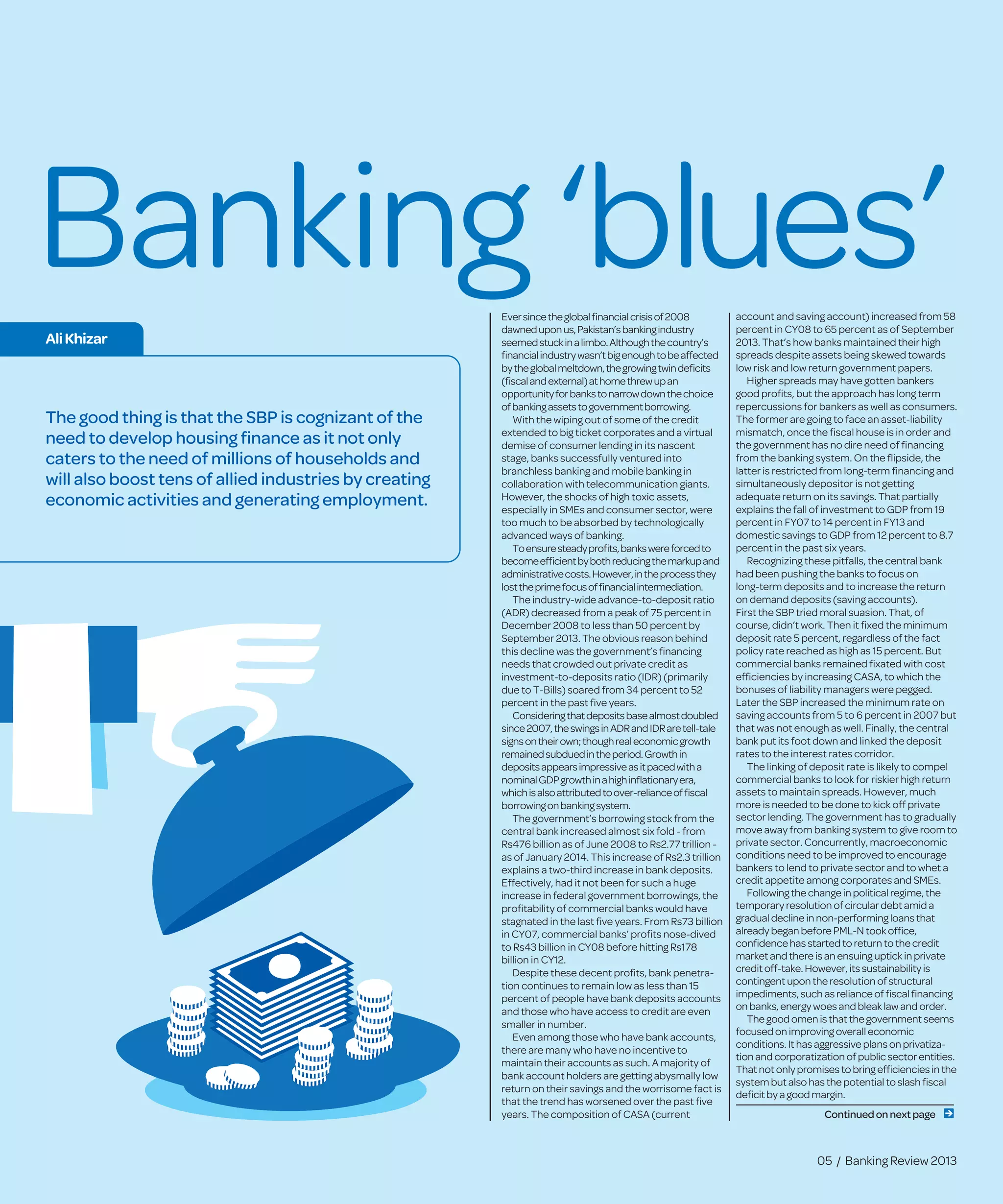
The good thing is that the SBP is cognizant of the
need to develop housing finance as it not only
caters to the need of millions of households and
will also boost tens of allied industries by creating
economic activities and generating employment.
06 / Banking Review 2013
The writer is Head of
Research at Business
Recorder. He can be
reached at:
ali.khizar@br-mail.com
Government’s borrowing stock
from the central bank
Rs476
billion
asofJune2008 asofJanuary2014
Rs2.77
trillion
Rs2.3
trillion
increase
The government also appears committed to
resolving the energy woes by installing new
capacities in coal and constructing dams. This
does not only bode well for other manufactur-
ing sectors but also provides a huge opportu-
nity for banking system to indulge in long-term
financing projects. Plus, Pakistani exporters,
especially those in the textile sector, can
generate high credit demand in the wake of
GSP+. To date textile and power sectors
demonstrate improvement in both economic
and credit growth.
In the backdrop of these improvements,
banks ought to sway away from the attitude of
lazy banking as gone are the days when banks
can generate low cost deposits without much
efforts and heedlessly deploy them to
government papers.
It is true that not all banks are heavily skewed
towards government’s fiscal financing. A few
banks have concentrated in the non-core
businesses over the period, such as in trade
finance. Then, benefitting from their presence
around the globe, a few foreign banks have
specialized in dealing with multinational clients.
Then of course there is the treasury desk which
has lately been the most important avenue
within the conventional banking domain. In fact,
bank treasurer in a few banks is deemed to be
more powerful than the president of the bank.
However, all these areas are not enough to fill
the vacuum that will likely be created once the
government loses its credit appetite. Banks
ought to explore consumer segments including
mortgage financing and have to penetrate
SMEs; although it’s easier said than done as in
the pre-crisis days the banks that ventured into
these businesses suffered big losses and since
then the industry has taken a cautious
approach to these areas.
One of the reasons why banks are reluctant
to capture this segment is poor foreclosure and
repossession laws.
Be that as it may, the good thing is that the
SBP is cognizant of the need to develop
housing finance as it not only caters to the
need of millions of households, but will also
boost tens of allied industries by creating
economic activities and generating employ-
ment. Apart from the foreclosure problems,
asset-liability mismatch makes these products
too risky, as mortgage is usually a long-term
asset while deposit base has a low maturity.
This can be dealt with by creating mortgage
finance companies, with long term funding, to
extend credit through commercial banks to
end users for a tenor of as long as 25 years.
Similarly, the central bank needs to facilitate
tailor-made lending products to SMEs. This can
be done by giving banks the first right on the
cash flows of these firms upon default and by
virtue of this banks can have the incentive to
facilitate small companies to make proper
financial statements, budgeting and planning.
Whiletheprecedingmeasurescanincrease
creditpenetrationinsociety,thereisalsoa
concurrentneedtobringalargechunkof
unbankedpopulationintothebankingnetasmore
than85percentofpopulationdoesnothavea
bankaccount.Financialinclusionisamongstthe
keyobjectivesoftheSBPandgovernment,asitis
imperativeforcreatingasavingculture.
A large chunk of population does not have
access to banking facilities or uses them
merely for checking accounts as they consider
conventional banking un-Islamic. To this end,
the most successful experiment has been the
introduction of Islamic banking.
Pakistan’s Islamic banking has grown to 10
percent of total banking size in a decade; it
shows an immense potential in an economy
where religious beliefs are deeply entrenched.
Mind you, in the post-crises world Islamic
banking is considered as a safe haven and the
size of Islamic banking has grown at a much
faster pace in Islamic countries such as
Malaysia, the UAE, and Saudi Arabia.
This is exactly why virtually all the big players
are aggressively entering into this market
segment. MCB is acquiring a majority stake in
Burj Bank to open an Islamic banking subsidi-
ary; it plans to quadruple the acquired entity’s
assets size to over Rs200 billion. Then Summit
Bank is transforming itself into an Islamic bank
in CY14. Similarly, Islamic windows of Bank
Alfalah, Standard Chartered and a few others
are widening aggressively.
While the gradual uptick in credit off-take,
the extension of branchless banking and
developments thereof may be seen as the
winds of change. The trend towards Islamic
banking with almost herd-like following may
well bring the biggest tectonic shift in the
history of country’s banking.
Continuedfromprevious page
07 / Banking Review 2013
Privatesectornoprimary
leverofgrowth
If Pakistan’s economy continues to grow at the
pace it has in the last five years, it will take the
country 80 long years to double its per capita
income. India, by comparison, will take 11 years,
Bangladesh, 14 years, and Sri Lanka, 12 years.
This begs the question as to what is the
prognosis for Pakistan recovering to the 7
percent GDP growth needed to match
Bangladesh’s pace for doubling GDP.
Our weakened growth capacity today is owed
to the deepening of policy and market failures
over time.Without addressing these, improve-
mentsin theexternal business environment –
such asremedying power shortages, and
stimulatingregional trade– cannot providethe
much needed growth dynamism.
Policy and market failure
The central ‘policy’ failure is fiscal, i.e., the
persistence of a state devouring public debt to
survive – owing to its distorted fiscal principles,
which ordain that ‘only the little people pay
taxes’ – the deeply embedded droit du
seigneur of our political culture. This can be
easily addressed, if the political will to challenge
powerful plutocratic interest exists.
‘Market’ failure lies in increasingly ineffective
economic governance. The state’s regulatory
institutions have been politically ‘enveloped’,
and development institutions, wound down. A
complacent belief persists that the primary
lever of growth will be the private sector. But
that belief has proved delusionary. Our LSM
and financial services sectors have, in effect,
jettisoned any ambition to take up the
leadership role in development.
The investment-to-GDP ratio has declined
to 13 percent. Within this, LSM has declined the
fastest, in current terms from Rs350 billion to
Rs 198 billion – or by 40 percent (or 60%, in
constant FY06 Rupees). The banking sector –
while it has greatly improved efficiency and
convenience - has not grown over the last
decade, relative to GDP: still stands around 33
percent. The private sector now takes only 48
percent (from 67% in FY06) of bank loans and
investments, with the government taking 52
percent. Crowding out is becoming as marked
as was under the government-owned banking
regime – when a basic rationale for banks’
privatization was that they would divert lending
to the private-sector.
Borrowing by the SMEs – the largest national
employer – is down to 6.5 percent of bank
credit, from 17 percent in FY06. And regional
participation in credit – essential for political
stability that is catalytic to growth – has
withered on the vine.
LoansbybanksinKhyberPakhtunkhwahave
slippedto9percentoftheirtotaldepositsinKP,
downfrom12percentinFY06;inBaluchistan,to7
percentfrom9percent;andthefigureforAJKhas
remainedataround4percent.Thecomparable
figuresforSindhandPunjabare66percentand51
percentrespectively(thereciprocalrepresents
investmentingovernmentsecurities).Invalue,
thiscomestoRs800bnbeingtransferredfrom
thesmallertothelargerprovinces.
Access to finance creates broad-based
growth. With general access constrained,
wealth creation in Pakistan has consolidated
around a small number of large business
houses, and in particular regions, mainly central
Punjab and Karachi. Inequality has grown
sharply, inimical alike to creating demand,
which is the other side of sustainable growth,
and to political stability.
Where we stand, until the state’s forfeited
role in institutionalizing growth is understood,
identified and powerfully vitalized, we will
continue to drift.
Focus on localized credit supply
Elsewhere, over history, the state has played a
strong role in building the economic base
through distribution of credit to support SMEs
and regions. During their development stage,
from the mid 19th century onwards, banking
systems in Europe and the US were tied
structurally into this objective.
Thus, banking licenses in the US restricted
banks to operations within individual states,
and sometimes, to single towns. The objective
was to mobilise local savings for job-creation
and growth within the communities. State
governments fostered SMEs by requiring that
state awarded contracts ensure a minimum
component of inputs from the SME, usually
25-40 percent. Where suitable, states invested
in small businesses, and guaranteed their loans.
At the federal level, the Washington-based
Small Business Association was created to
facilitate legal and operational issues pertaining
to SMEs, and to provide financial assistance by
guaranteeing part of their borrowings.
The German states (Landers) set up their
own banks, the ‘Landesbanken’ that financed
business and projects within the states, and are
the apex banks’ (the Sparkassens) regional
savings banks. Some 40 percent of Germany‘s
banking system falls within this structure even
today. Another strata of banks are the
cooperatives, spread across the country. The
original objective for all these institutions was
again redeployment of local savings within the
region. Regional banks were the funding
sources for Germany’s famed ‘Mittlestand’,
mainly family owned businesses that are today
the backbone of German industry.
In today’s leading emerging markets,thestate
has played thedistributional roleinadifferent
way. Whilebanking in most emergingmarkets
started with largemetropolitan banks,thestate
either retained ownership of thebanking
system, or directed lending to ensurethatSMEs
and theregions wereadequately supported.
Wherebanks aredominantly government-
owned, as in China(90%) and India (70%),the
statebanks operatealong strictly-defined
priorities for lending. In countries suchasBrazil
andTurkey,wheremorethan40%of the
commercialbankingsystemisgovernment-
owned,therearespecialgovernment-owned
developmentbanks,focusingonagriculture,
SME,andinfrastructurefinance.
Provinces must take the initiative
For Pakistan today, the ‘fast-track’ route to
galvanizing SME lending, which in itself is
regionally distributed, would be if the
provincial-owned banks (BOP, BOK, Sindh
Bank) were re-chartered to work exclusively on
the SME sector within their domain – the raison
d’être for provincial banks was regional
development, but all three provincial lenders
now mimic national business strategies of the
commercial banks.
With provincial banks dedicated to the SMEs,
SMEDA should be embedded into their
operations; cross-reference of experience and
information would make SMEDA a more
effective development organization. Legal,
bureaucratic and infrastructural impediments
faced by SMEs would be redressed faster by
provincial governments if remedial recommen-
dations were filtered through the provincial
banks and SMEDA – rather than put to
provincial governments directly by the myriad
small business associations.
Also, given the rapid job-creation that a
vibrantly growing SME segment brings, it is likely
that provincial governments will come to see
the provincial banks as important agencies for
their own political success, and ensure high
quality of professionalism and governance.
To support this momentum, the federal
government should set up a venture capital
fund, with the participation of major commer-
cial banks, to invest in individual SMEs with
innovative business plans. The board should
have a dominantly private sector composition,
and appoint the CEO. Venture capital funding,
and strategic and technical oversight should
help develop successful transactions,
highlighting the entrepreneurial potential latent
in SMEs. This should provide the SMEs more
reliable access to funding from banks.
Progressively, the opportunity will develop for
IPOs via the creation of a stock-market window
for small companies, such as Alternative
Investment Market for smaller growing
businesses in the UK.
Finally, another valuable support would be if
government project contracts required the
lead contractor subcontract or procure a
percentage of the project value, a minimum of
25 percent from regional SMEs, as is the case in
the US, and elsewhere.
In short, the state needs to play a much
stronger role in stimulating the development of
the broad-base of the national economic
pyramid. Together, the initiatives suggested will
stimulate smaller businesses across the
regions, create new jobs, and hasten national
economic integration.
SalimRaza
The writer is a former governor
of State Bank of Pakistan.
Whilebanking in most
emergingmarkets
started with large
metropolitan banks,
thestateeither
retainedownershipof
thebankingsystem, or
directed lending to
ensurethat SMEs and
theregions were
adequately supported
“Loandemandlooks
encouraging”
BR Research: How do you see the new
government’s performance so far and how
has it impacted overall confidence?
Atif Bajwa: We are optimistic about the
future. I believe that there is a plan, and,
hopefully, 2014 will move on a fast and
positive track.
The intention from the government is
right. On the power issue, we already see
improvements and I expect further
development in the near future. However,
I suspect that the bigger impact of
initiatives will take some time as supply
side bottlenecks have to be removed.
Businesses are willing to invest in capacity
and equipment modernisation.
The big concern in the short run,
though, is the balance-of-payments
situation. The government is looking to
raise sovereign bonds and trade finance
facilities, whilst also seeking support from
multilateral agencies. All of these efforts
will start bearing fruit hopefully in the first
half of this year.
BRR: Will these efforts and improvement in
business confidence help boost banking
sector income?
AB: As long as business confidence is
backed by improved economic fundamen-
tals and stability in the foreign exchange
environment, it will be very good for the
economy. It is not necessary that banks will
make money off these developments in the
short term. However, in the medium to
longer term, stability and growth will lead
to profitable results.
BRR: Has demand started pouring in from
the textile sector surrounding the GSP
Plus scenario?
AB: The numbers for loan demand are
looking slightly more encouraging, but
these may need to be adjusted for
cyclicality of borrowing needs. Some
clients are beginning to talk about expan-
sion. There is interest in power projects
and there are some enquiries about setting
up alternate biogas and coal plants. But
this will only translate into reality over the
next few quarters.
I wouldn’t say that there is a lot of activity
at the moment. A key development has
been that the bigger textile companies
de-leveraged over the years, helping them
in a volatile environment. As a result, these
companies are doing well and their
balance sheets are strong, and they are
well positioned now to take advantage of
lending facilities offered by banks.
BRR: The lending to SMEs has largely
been to the medium ones, with smaller
ones often neglected. Do you see the
trend shifting?
AB: SME is a slightly tricky area. The
banking sector’s exposure to SME has
indicated a tilt towards larger sized
enterprises. And that is only because a lot
of banks have had their fingers burnt in
SME lending in the past. Hence, it is only
fair that they will all be a little more
cautious.
However, at Bank Alfalah, we have
decided that we simply cannot ignore this
sector, despite the fact that it has led to
higher NPLs. That doesn’t mean we will
blindly start pursuing avenues of lending
in the SME arena. The fact is that the SME
sector has suffered from a chronic lack of
capacity. Their own understanding of
business management seems inadequate.
The sector has suffered from persistent
power outages and a lack of access to
markets as well, since Pakistan has
become somewhat of a pariah. These are
genuine issues that cannot be easily
dismissed or neglected.
Banks will have to abandon formula
lending and develop a well thought-out
model for SME Bbanking. At Bank Alfalah,
we are already working on this and have
restructured our SME approach with the
help of IFC’s advisory service.
We have developed a model that views
SME operations holistically, instead of
solely focusing on the lending part.
Everything from their cash flows to their
non-core operations will be thoroughly
explored and understood. We also intend
to help smaller businesses with their
capacity building by providing them
access to non-financial advisory services.
Seemingly small aspects are important,
such as how to manage accounts, how to
set up a basic supply chain, educating
them about requirements by banks, etc.
And a little handholding goes a long way
in improving compliance and performance
of smaller units. To this end, we are, in fact,
just launching an SME Toolkit in collabora-
tion with IFC - this is an online portal which
provides value-added resources including
business advice, local and global best
practices, opportunities and challenges to
both existing and potential SMEs in the
country. Such resources will play an
important role in the long term, sustainable
development of the SME sector.
BRR: Do you have any new consumer
products in the offing?
AB: We are looking to introduce new
products whilst refining some of our
existing product portfolio, increasing our
range of credit cards, introducing corpo-
rate cards and better defining the tailored
segmentation of products available for
individual customers. We remain the
largest issuer and acquirer of credit cards
in the country and these initiatives should
augment our efforts to retain that ranking.
In addition to our mainstream financial
solutions, we have also added a host of
doorstep banking options including
branchless, mobile and internet banking,
and cash management to our suite.
One of the key areas of focus for us this
year is wealth management – we are keen
to penetrate this domain but want to
ensure that we base it on a comprehensive
needs analysis of the market, so as to
provide bespoke solutions to this segment.
Not many banks have succeeded in
Pakistan with their priority banking model,
therefore, we want to take our time but try
and do it right.
BRR: How do you see CY14 in terms of
deposit growth?
AB: I wouldn’t forecast a dramatic
improvement. The industry average in
deposit growth is 13-15 percent, and that is
mainly driven by money supply growth.
The only real question is how much of that
can be deployed in fresh lending. If you
look at lending growth, the industry
average has typically hovered between 8-9
percent. While our bank outstripped the
market last year by growing at 18 percent,
at an industry level, deposit growth will
stay ahead of lending. We are hoping to
build upon this momentum and keep up
with last year’s performance.
BRR: What is the major impediment your
Islamic banking window faces?
AB: We are the second largest Islamic
offering in the country. Our Islamic
deposits currently comprise 16 percent of
the bank’s total deposits.
From an industry perspective, Islamic
banking is still the fastest growing area in
banking. However, whilst deposits keep
growing, the issue is more on the assets
side. Islamic assets are very difficult to find,
as there are not enough Sukuks or other
such Islamic products. If you look at Islamic
banks, their ADR is closer to 35 percent on
average – the key reason for this is that they
cannot find Sharia-compliant structured
assets. The government could help by
rolling out local and foreign currency
Shariah-compliant Sukuks.
BRR: Since you’ve been expanding with
such aggression, your cost-to-income
ratio is higher than your peers. How are
you going to manage the human resource
side of the expansion, whilst trying to
keep a lid on costs?
AB: Relative to the market, our staff-to-
branch ratio is high as the size of our
branches is bigger; hence the cost of
maintaining a branch is higher.Our future
growth strategy is robust; we are currently
at 574 branches and plan to continue
expanding our footprint by redeploying
employees from our existing talent pool.
Hence if you look at our figures, while our
branches have gone up in number over the
last 2-3 years, the head count remains flat.
This also helps our efforts to provide our
staff with cross-functional job rotations and
opportunities in new roles within the bank.
Interview by Ali Khizar
AtifBajwa
Chief Executive Officer,
Bank Alfalah
08 / Banking Review 2013
10 / Banking Review 2013
Theriseandfallofbankingspreads
Oneofthegravestproblemsnailedto Pakistan’s
bankingsystemsincetheinception offinancial
liberalizationreformsinearly1990sisthe fact
thatdepositorsarenotpaidan adequate return
ontheir savings.
The removal of the ceiling on lending rates in
March 1995, followed by the withdrawal of
SBP’s instructions on payment of returns to
investors and depositors in June 1998, had a
profound impact on the interest rate structure
of the financial sector.
Inearly1980s,bankswere advisedto declare
profitratesonsavingdepositsafter obtaining
clearancefromtheSBPon the proposedprofit
rates.However,afterthefinancialliberalization,
bankswereaskedtodetermine the returns
payableonfundsmobilized frominvestorsand
depositorsonthebasisofthe profitsandlosses
incurredbythem,andtherequirementto seek
approvalfromtheSBPonproposedprofitrates
wasdispensedwith.
Whilethelinkageoflendinganddepositrates
withthepolicyratewasabonafidemovethat
helpedtheobjectiveofmonetarytransmission,it
alsoledtoagradualincreaseinbankingspread.
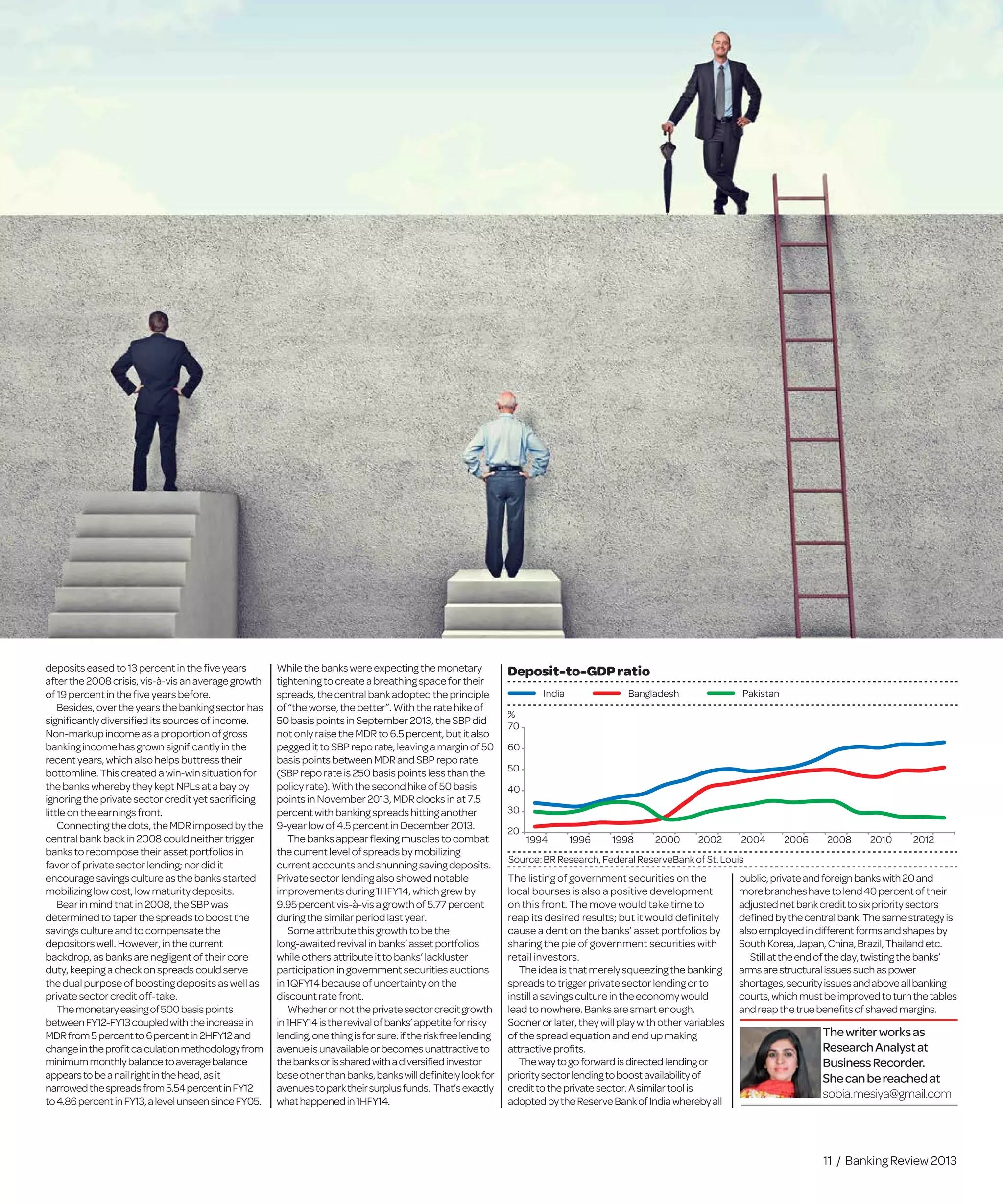
The movement of weighted average lending
and deposit rates of the banking system over
the years gives an obvious impression that
while the lending rates moved quite in tandem
with the policy rate, charging adequate risk
premium over and above, deposit rates lagged
far behind. The widened gap between savings
and deposit rates, also known as net interest
rate spreads, that discouraged savings culture
in the country on one hand, proved to be the
engine of banking sector’s robust financial
performance in the recent years.
Thefactthatthebankingsector didn’tshare
itsfortuneswiththedepositors,who are the
majorfinanciertothebanks,ledto a depressed
paceofdepositmobilization.Thisiswellevident
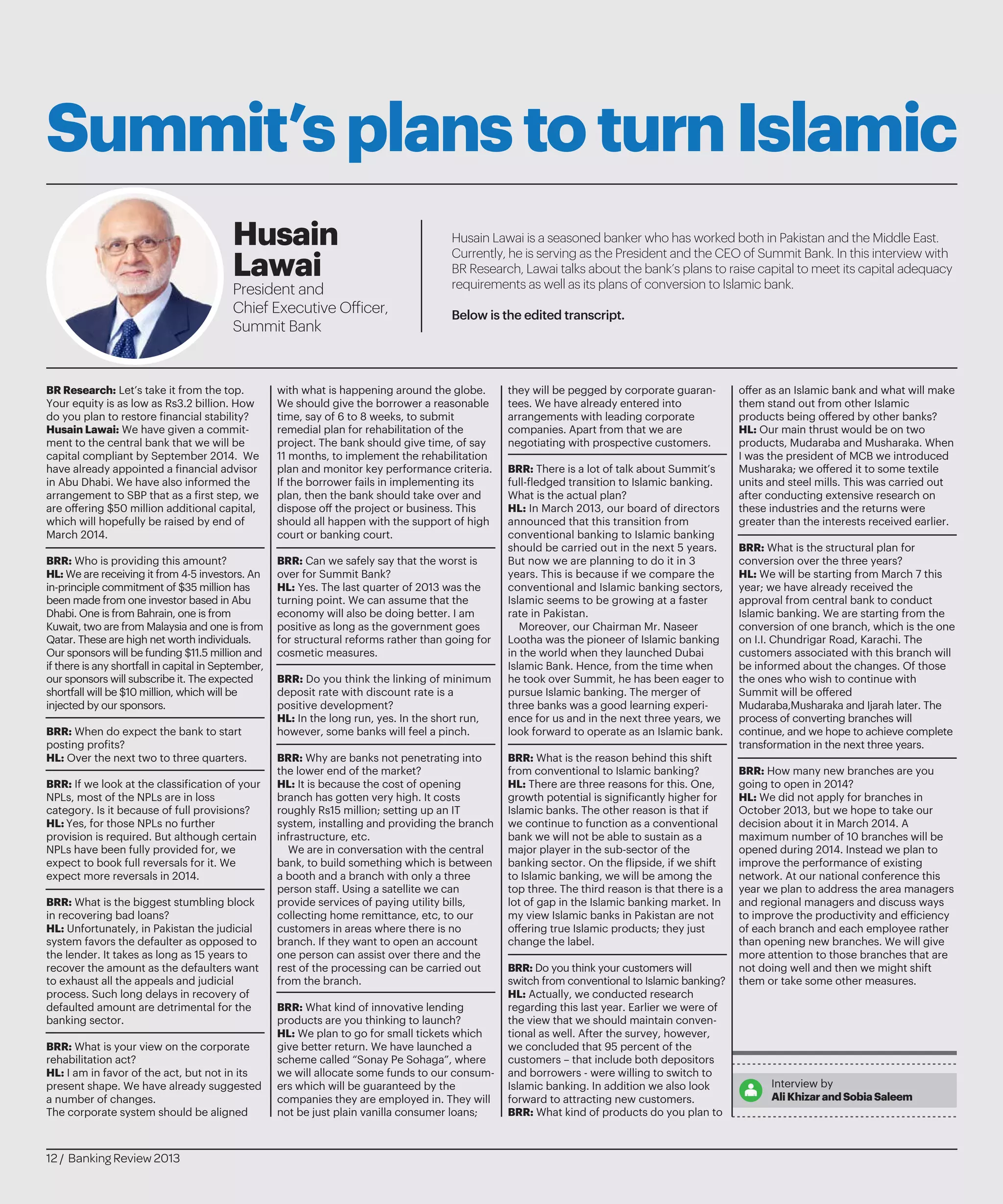
bythefactthatdepositsnosedivedto lessthan
27percentofGDPbyFY13comparedto over 60
percentinIndiaandaround52 percentin
Bangladesh.Incontrasttodeposits,the
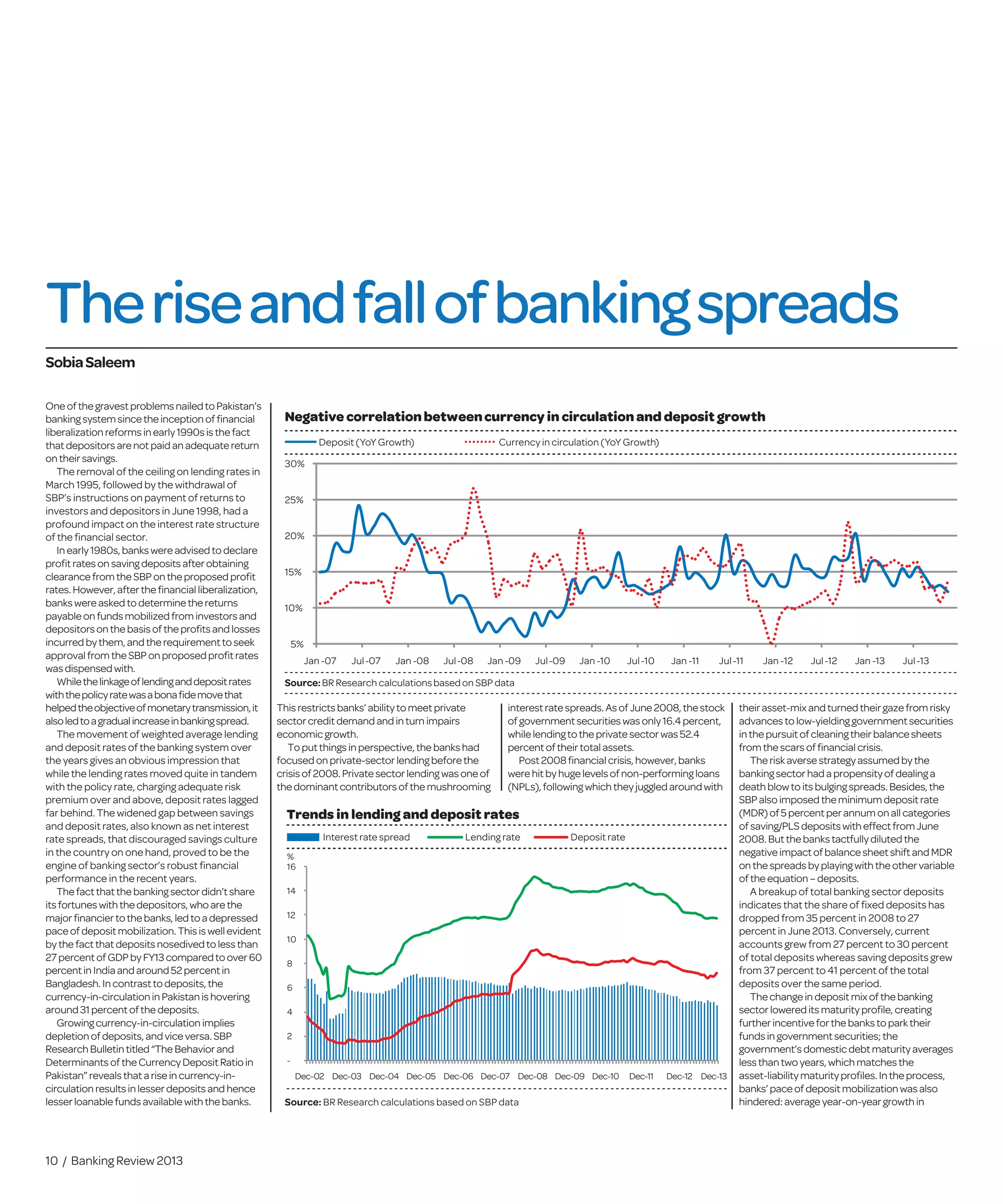
currency-in-circulationinPakistan ishovering
around31percentofthedeposits.
Growingcurrency-in-circulation implies
depletionofdeposits,and vice versa.SBP
ResearchBulletintitled“The Behavior and
DeterminantsoftheCurrencyDepositRatio in
Pakistan”revealsthatarisein currency-in-
circulationresultsinlesserdepositsandhence
lesser loanablefundsavailable with the banks.
Thisrestricts banks’ ability to meet private
sector credit demand and in turn impairs
economic growth.
To putthings in perspective, thebanks had
focusedon private-sector lending beforethe
crisisof2008. Privatesector lending was oneof
the dominant contributors of themushrooming
interest ratespreads. As of June2008,thestock
of government securities was only16.4 percent,
whilelending to theprivatesectorwas52.4
percent of their total assets.
Post 2008 financial crisis, however,banks
werehit by hugelevels of non-performingloans
(NPLs), following which they juggledaroundwith
theirasset-mixandturnedtheirgazefromrisky
advancestolow-yieldinggovernmentsecurities
inthepursuitof cleaningtheirbalancesheets
fromthescarsof financialcrisis.
Therisk aversestrategyassumedby the
bankingsectorhadapropensityof dealinga
deathblowtoitsbulgingspreads.Besides,the
SBPalsoimposedtheminimumdepositrate
(MDR)of 5percentperannumonallcategories
of saving/PLS depositswitheffectfromJune
2008.Butthebankstactfully dilutedthe
negativeimpactof balancesheetshiftandMDR
onthespreadsby playingwiththeothervariable
of theequation– deposits.
A breakup of total banking sector deposits
indicates that the share of fixed deposits has
dropped from 35 percent in 2008 to 27
percent in June 2013. Conversely, current
accounts grew from 27 percent to 30 percent
of total deposits whereas saving deposits grew
from 37 percent to 41 percent of the total
deposits over the same period.
Thechangeindepositmixof thebanking
sectorlowereditsmaturityprofile,creating
furtherincentiveforthebankstopark their
fundsingovernmentsecurities;the
government’sdomesticdebtmaturityaverages
lessthantwoyears,whichmatchesthe
asset-liabilitymaturity profiles.Intheprocess,
banks’paceof depositmobilizationwasalso
hindered:averageyear-on-yeargrowthin
SobiaSaleem
Interest rate spread Lending rate Deposit rate
Trends in lending and deposit rates
-
2
4
6
8
10
12
14
16
Dec-02 Dec-03 Dec-04 Dec-05 Dec-06 Dec-07 Dec-08 Dec-09 Dec-10 Dec-11 Dec-12 Dec-13
%
Source: BR Research calculations based on SBP data
Negative correlationbetweencurrency in circulation and deposit growth
5%
10%
15%
20%
25%
30%
Jan -07 Jul-07 Jan -08 Jul-08 Jan -09 Jul-09 Jan -10 Jul-10 Jan -11 Jul-11 Jan -12 Jul-12 Jan -13 Jul-13
Source:BR Research calculationsbasedon SBP data
Deposit (YoY Growth) Currency in circulation (YoY Growth)
11 / Banking Review 2013
depositseasedto13percentin the five years
after the2008crisis,vis-à-visan average growth
of19percentinthefiveyearsbefore.
Besides,overtheyearsthe bankingsector has
significantlydiversifieditssourcesofincome.
Non-markupincomeasaproportion ofgross
bankingincomehasgrownsignificantlyin the
recentyears,whichalsohelpsbuttresstheir
bottomline.Thiscreatedawin-win situation for
thebankswherebytheykeptNPLsata bayby
ignoringtheprivatesectorcredityetsacrificing
littleontheearningsfront.
Connectingthedots,theMDRimposedbythe
centralbankbackin2008couldneither trigger
bankstorecomposetheirassetportfoliosin
favorofprivatesectorlending;nor didit
encouragesavingscultureasthe banksstarted
mobilizinglowcost,lowmaturitydeposits.
Bearinmindthatin2008,the SBPwas
determinedtotaperthespreadsto boostthe
savingscultureandtocompensate the
depositorswell.However,inthe current
backdrop,asbanksarenegligentoftheir core
duty,keepingacheckonspreadscouldserve
thedualpurposeofboostingdepositsaswellas
privatesectorcreditoff-take.
Themonetaryeasingof500basispoints
betweenFY12-FY13coupledwiththeincreasein
MDRfrom5percentto6percentin2HFY12and
changeintheprofitcalculationmethodologyfrom
minimummonthlybalancetoaveragebalance
appearstobeanailrightinthehead,asit
narrowedthespreadsfrom5.54percentinFY12
to4.86percentinFY13,alevelunseensinceFY05.
While the banks wereexpecting themonetary
tighteningtocreateabreathing spacefor their
spreads,the central bank adopted theprinciple
of“the worse, thebetter”. With theratehikeof
50 basispoints in September 2013, theSBP did
notonlyraisetheMDR to 6.5 percent, but it also
peggedittoSBP repo rate, leaving amargin of 50
basispointsbetween MDR and SBP repo rate
(SBPrepo rateis 250 basis points less than the
policyrate).With thesecond hikeof 50 basis
pointsin November 2013, MDR clocks in at 7.5
percentwithbanking spreads hitting another
9-year lowof 4.5 percent in December 2013.
The banks appear flexing muscles to combat
the currentlevel of spreads by mobilizing
currentaccounts and shunning saving deposits.
Private sector lending also showed notable
improvements during 1HFY14, which grew by
9.95percent vis-à-vis agrowth of 5.77percent
duringthe similar period last year.
Some attributethis growth to bethe
long-awaited revival in banks‘ asset portfolios
while others attributeit to banks’ lackluster
participation in government securities auctions
in 1QFY14becauseof uncertainty on the
discountratefront.
Whetherornottheprivatesectorcreditgrowth
in1HFY14istherevivalofbanks’appetiteforrisky
lending,onethingisforsure:iftheriskfreelending
avenueisunavailableorbecomesunattractiveto
thebanksorissharedwithadiversifiedinvestor
baseotherthanbanks,bankswilldefinitelylookfor
avenuestoparktheirsurplusfunds. That’sexactly
whathappenedin1HFY14.
The listing of government securities on the
local bourses is also a positive development
on this front. The move would take time to
reap its desired results; but it would definitely
cause a dent on the banks’ asset portfolios by
sharing the pie of government securities with
retail investors.
Theideais that merely squeezingthebanking
spreads to trigger privatesector lendingorto
instill asavings culturein theeconomy would
lead to nowhere. Banks aresmart enough.
Sooner or later, they will play with othervariables
of thespread equation and end up making
attractiveprofits.
Thewaytogoforwardisdirectedlendingor
prioritysectorlendingtoboostavailabilityof
credittotheprivatesector.Asimilartoolis
adoptedbytheReserveBankofIndiawherebyall
public,privateandforeignbankswith20and
morebrancheshavetolend40percentoftheir
adjustednetbankcredittosixprioritysectors
definedbythecentralbank.Thesamestrategyis
alsoemployedindifferentformsandshapesby
SouthKorea,Japan,China,Brazil,Thailandetc.
Stillattheendoftheday,twistingthebanks’
armsarestructuralissuessuchaspower
shortages,securityissuesandaboveallbanking
courts,whichmustbeimprovedtoturnthetables
andreapthetruebenefitsofshavedmargins.
Thewriterworksas
ResearchAnalystat
BusinessRecorder.
Shecanbereachedat
sobia.mesiya@gmail.com
20
30
40
50
60
70
1994 1996 1998 2000 2002 2004 2006 2008 2010 2012
%
Source:BR Research, Federal ReserveBank of St. Louis
Deposit-to-GDPratio
India Bangladesh Pakistan
Summit’splanstoturnIslamic
Husain Lawai is a seasoned banker who has worked both in Pakistan and the Middle East.
Currently, he is serving as the President and the CEO of Summit Bank. In this interview with
BR Research, Lawai talks about the bank’s plans to raise capital to meet its capital adequacy
requirements as well as its plans of conversion to Islamic bank.
Below is the edited transcript.
Husain
Lawai
President and
Chief Executive Officer,
Summit Bank
BR Research: Let’s take it from the top.
Your equity is as low as Rs3.2 billion. How
do you plan to restore financial stability?
Husain Lawai: We have given a commit-
ment to the central bank that we will be
capital compliant by September 2014. We
have already appointed a financial advisor
in Abu Dhabi. We have also informed the
arrangement to SBP that as a first step, we
are offering $50 million additional capital,
which will hopefully be raised by end of
March 2014.
BRR: Who is providing this amount?
HL: We are receiving it from 4-5 investors. An
in-principle commitment of $35 million has
been made from one investor based in Abu
Dhabi. One is from Bahrain, one is from
Kuwait, two are from Malaysia and one is from
Qatar. These are high net worth individuals.
Our sponsors will be funding $11.5 million and
if there is any shortfall in capital in September,
our sponsors will subscribe it. The expected
shortfall will be $10 million, which will be
injected by our sponsors.
BRR: When do expect the bank to start
posting profits?
HL: Over the next two to three quarters.
BRR: If we look at the classification of your
NPLs, most of the NPLs are in loss
category. Is it because of full provisions?
HL: Yes, for those NPLs no further
provision is required. But although certain
NPLs have been fully provided for, we
expect to book full reversals for it. We
expect more reversals in 2014.
BRR: What is the biggest stumbling block
in recovering bad loans?
HL: Unfortunately, in Pakistan the judicial
system favors the defaulter as opposed to
the lender. It takes as long as 15 years to
recover the amount as the defaulters want
to exhaust all the appeals and judicial
process. Such long delays in recovery of
defaulted amount are detrimental for the
banking sector.
BRR: What is your view on the corporate
rehabilitation act?
HL: I am in favor of the act, but not in its
present shape. We have already suggested
a number of changes.
The corporate system should be aligned
with what is happening around the globe.
We should give the borrower a reasonable
time, say of 6 to 8 weeks, to submit
remedial plan for rehabilitation of the
project. The bank should give time, of say
11 months, to implement the rehabilitation
plan and monitor key performance criteria.
If the borrower fails in implementing its
plan, then the bank should take over and
dispose off the project or business. This
should all happen with the support of high
court or banking court.
BRR: Can we safely say that the worst is
over for Summit Bank?
HL: Yes. The last quarter of 2013 was the
turning point. We can assume that the
economy will also be doing better. I am
positive as long as the government goes
for structural reforms rather than going for
cosmetic measures.
BRR: Do you think the linking of minimum
deposit rate with discount rate is a
positive development?
HL: In the long run, yes. In the short run,
however, some banks will feel a pinch.
BRR: Why are banks not penetrating into
the lower end of the market?
HL: It is because the cost of opening
branch has gotten very high. It costs
roughly Rs15 million; setting up an IT
system, installing and providing the branch
infrastructure, etc.
We are in conversation with the central
bank, to build something which is between
a booth and a branch with only a three
person staff. Using a satellite we can
provide services of paying utility bills,
collecting home remittance, etc, to our
customers in areas where there is no
branch. If they want to open an account
one person can assist over there and the
rest of the processing can be carried out
from the branch.
BRR: What kind of innovative lending
products are you thinking to launch?
HL: We plan to go for small tickets which
give better return. We have launched a
scheme called “Sonay Pe Sohaga”, where
we will allocate some funds to our consum-
ers which will be guaranteed by the
companies they are employed in. They will
not be just plain vanilla consumer loans;
they will be pegged by corporate guaran-
tees. We have already entered into
arrangements with leading corporate
companies. Apart from that we are
negotiating with prospective customers.
BRR: There is a lot of talk about Summit’s
full-fledged transition to Islamic banking.
What is the actual plan?
HL: In March 2013, our board of directors
announced that this transition from
conventional banking to Islamic banking
should be carried out in the next 5 years.
But now we are planning to do it in 3
years. This is because if we compare the
conventional and Islamic banking sectors,
Islamic seems to be growing at a faster
rate in Pakistan.
Moreover, our Chairman Mr. Naseer
Lootha was the pioneer of Islamic banking
in the world when they launched Dubai
Islamic Bank. Hence, from the time when
he took over Summit, he has been eager to
pursue Islamic banking. The merger of
three banks was a good learning experi-
ence for us and in the next three years, we
look forward to operate as an Islamic bank.
BRR: What is the reason behind this shift
from conventional to Islamic banking?
HL: There are three reasons for this. One,
growth potential is significantly higher for
Islamic banks. The other reason is that if
we continue to function as a conventional
bank we will not be able to sustain as a
major player in the sub-sector of the
banking sector. On the flipside, if we shift
to Islamic banking, we will be among the
top three. The third reason is that there is a
lot of gap in the Islamic banking market. In
my view Islamic banks in Pakistan are not
offering true Islamic products; they just
change the label.
BRR: Do you think your customers will
switch from conventional to Islamic banking?
HL: Actually, we conducted research
regarding this last year. Earlier we were of
the view that we should maintain conven-
tional as well. After the survey, however,
we concluded that 95 percent of the
customers – that include both depositors
and borrowers - were willing to switch to
Islamic banking. In addition we also look
forward to attracting new customers.
BRR: What kind of products do you plan to
offer as an Islamic bank and what will make
them stand out from other Islamic
products being offered by other banks?
HL: Our main thrust would be on two
products, Mudaraba and Musharaka. When
I was the president of MCB we introduced
Musharaka; we offered it to some textile
units and steel mills. This was carried out
after conducting extensive research on
these industries and the returns were
greater than the interests received earlier.
BRR: What is the structural plan for
conversion over the three years?
HL: We will be starting from March 7 this
year; we have already received the
approval from central bank to conduct
Islamic banking. We are starting from the
conversion of one branch, which is the one
on I.I. Chundrigar Road, Karachi. The
customers associated with this branch will
be informed about the changes. Of those
the ones who wish to continue with
Summit will be offered
Mudaraba,Musharaka and Ijarah later. The
process of converting branches will
continue, and we hope to achieve complete
transformation in the next three years.
BRR: How many new branches are you
going to open in 2014?
HL: We did not apply for branches in
October 2013, but we hope to take our
decision about it in March 2014. A
maximum number of 10 branches will be
opened during 2014. Instead we plan to
improve the performance of existing
network. At our national conference this
year we plan to address the area managers
and regional managers and discuss ways
to improve the productivity and efficiency
of each branch and each employee rather
than opening new branches. We will give
more attention to those branches that are
not doing well and then we might shift
them or take some other measures.
Interview by
AliKhizarandSobiaSaleem
12 / Banking Review 2013
14 / Banking Review 2013
HowBasel-IIIwillimpact
Pakistan,others
The Basel-III regulations have come into effect
from January this year. These regulatory
changes are to ensure that history doesn’t
repeat itself in the form of another 2008-like
financial crisis. The changes to banking capital
requirements will have a wide-ranging impact
on bank lending practices and credit availability
to the private sector over the next five years.
State Bank of Pakistan’s circular, issued on
August 15, highlights the Basel-III reforms
agenda and implementation timeline. The
major changes pertain to the raising Capital
Adequacy Ratio (CAR) to 12.5 percent in a
phased manner by end of 2019, up from 10
percent today under the Basel-II framework.
The additional capital requirement is part of
the Basel Committee on Banking Supervision's
recommendation to introduce an additional 2.5
percent Capital Conservation Buffer (CCB) on
the banks.
It is important to note that the SBP is
implementing the Basel-III capital ratios at 2
percent above the Basel Committee's
recommendations of 10.5 percent (8% of total
capital + 2.5% conservation buffer) to act as a
buffer for the additional capital that may be
required because of modelling shortfalls.
The Basel-IIIregimeincludes several
elementsthat will bephased in between 2013
and2019:a capital conservation buffer (2.5%), a
countercyclical capital buffer (0-2.5%, depend-
ingon conditions), and abuffer for global
systemically important banks (1% for each).
Under the Basel-III regime, there are also
limitations that will be imposed on bank lending
in case CAR falls below the 12.5 percent
requirement. In particular, banks will need to
reduce lending against its CE (Common Equity)
Tier I of CAR. The changes in Basel-III are
expected to lead even well capitalized banks in
EU, US and emerging markets to find it hard to
be compliant.
Pakistani banks are well capitalized with CAR
of 15.6 percent (September 2013), with Tier 1
capital making up over 13.4 percent. Hence,
even with Basel-III implementation most of the
banks will easily meet CAR requirements.
According to SBP’s estimates, the CAR of banks
would drop to 14 percent under Basel-III
regulations – still above the prescribed limits.
However, there will be some crowding out of
smaller banks, which will support mergers &
acquisitions in the financial sector.
Within theemerging Asian markets, Indian
banksare likely to bemorecapital-constrained
than peers.TheReserveBank of Indiaestimated
in itsannualreport (August 2012) that Indian
banksface an equity shortfall of $35 billion on
accountofBasel-IIIimplementation. Banks in
China have thenext-highest capital requirement
of $14.5 billion, largely driven by highnominal
GDP growth. US and European banksfacean
uphill challengeand may bethemost
significantly impacted as aresult of Basel-III.
In May 2012, Fitch Ratings published a study
on potential pressures on 29 Global Systemi-
cally Important Financial Institutions (G-SIFIs –
the ‘too big to fail’ banking giants) arising from
Basel-III. According to Fitch, the average G-SIFI
bank would have to raise $9.5 billion of
common equity to comply with Basel-III rules.
The aggregate amount for the 29 banks would
be a whopping $566 billion.
This shortfall would be met by a combination
of earnings retention, equity issuance and
reduction of risk weighted assets. Maintaining
higher capital levels over the longer term under
Basel-III is likely to lower banks Return on equity
(ROE) as they face higher capital costs.
According to a Fitch study, large banks globally
would see an average ROE decline of 20
percent as a result of Basel-III implementation.
Another study, conducted by McKinsey at
end-2010 for European banks, estimated the
ROE impact on European banks at 30 percent.
If banks are unable to raise the equity
required under Basel-III (and necessitated by
its second-round impacts and by European
bank deleveraging), they are likely to curtail
lending to corporates, creating a financing gap.
Our estimates suggest an aggregate shortfall in
corporate lending from banks at over $340
billion over the next five years.
In Pakistan, acombination of tighterlending
requirements and crowding out ofprivatesector
credit arealready driving corporatestoraise
funds from debt & equity markets.Asgrowth
picks up and credit demand growsstronger,one
can seesignificant new TFCfloatedinthe
markets over thenext few years.
Pakistan’scorporatebondmarketisverysmall
ataroundanestimatedRs350billion,whichis
around1.5percentofGDP,andonlyatenthinsize
ofthetotalgovernmentbondmarkets.
Traditionally, banks havebeen theprimary
funding sourcefor corporatein emergingAsian
markets. However, thecompositionof corpo-
ratefunding is likely to changeoverthenext
decade. Whilesomeof this expectedshiftwillbe
structural as theregion’s bond and alternative
funding markets develop, it is likelytobelargely
driven by constraints on bank funding.
Basel-III and deleveraging by European
banks are likely to cause a structural shift in the
composition of corporate funding; prompting
more corporates (especially higher-rated
ones) to access bond markets directly rather
than borrow from banks. This is likely to
increase the size of the regions corporate bond
markets over the medium term.
The shift is already under way as big corporates
turn to the bond market for longer-term (and,
arguably, less covenant-heavy) funding. In 2011,
Pakistan saw two large corporate giants Engro
and KESC raised Rs4 billion and Rs2 billion
respectively through issues of Term Finance
Certificates in 2011. Standard Chartered
Pakistan successfully closed a ten-year Rs2.5
billion TFC, marking the largest offering in
Pakistan by any financial institution in 2012.
The key question is that will there be enough
demand for all the corporate bonds likely to be
issued in Asia? In our view, while international
investment is likely to rise, a large part of the
incremental demand will come from local
investors. If Asian government bond markets
are any indicator, international investors own
less than 25 percent of the local-currency bond
markets, while domestic financial institutions
own close to 60 percent. In Pakistan, the
foreign investment in government bonds is less
than 5 percent; nearly 95 percent is from
domestic investors led by banks.
Local currency bond markets in Asia are
currently fragmented and very local. If they
need to grow exponentially in the next decade
to fill the gap left by reduced bank lending,
greater cross-border mobility and
intra-regional fund flows will be required.
The local markets are at varying stages of
development. Some are still trying to establish
a sovereign yield curve, whereas others have
well-developed corporate bond markets as
deep as those in the US or Europe, with
corporates issuing bonds across the maturity
and rating spectrum.
Thedominanceofquasi-sovereignissuersand
financialinstitutionsisanotherconcern.Issuance
fromtheprivatesectorisstilldominatedbyhighly
ratedcorporates(AAandaboveonthelocal
scale),withaccesstoBBB-negativeandlower
ratedissuersheavilyrestricted.
Thestrongroleofthestatesintheseecono-
miesisonereasonforthis;butitalsoreflectsthe
earlystageofdevelopmentofcorporatebond
marketsandtherisk-seekingbehaviouroflocal
investors.Lower-creditqualityborrowersneedto
beabletoaccessthebondmarketsinordertofill
thegap,muchasinthelargerandmorevibrantUS
high-yieldbondmarkets.
SayemAli
The writer has worked as economist
Middle East, Pakistan, and North
Africa at Standard Chartered Bank.
His views do not necessarily represent
those of the organisation.
If banks are unable to
raise the equity
required under
Basel-III (and
necessitated by its
second-round
impacts and by
European bank
deleveraging), they
are likely to curtail
lending to
corporates, creating
a financing gap.
HabibMetro eyes
growth in trade finance
Sirajuddin Aziz is currently associated with Habib Metropolitan Bank as its President & CEO. During his 35-year banking
career with international as well as local banks, he held several senior management positions in various countries
including Pakistan, the UK, the UAE, Nigeria, Hong Kong and China.
During his career, Aziz has contributed to various professional bodies including Pakistan Banks’ Association as Chairman.
He has been a regular speaker on credit, trade and foreign exchange at “The Institute of Bankers Pakistan” and other
prestigious institutions. Aziz also frequently contributes articles to newspapers on various subjects.
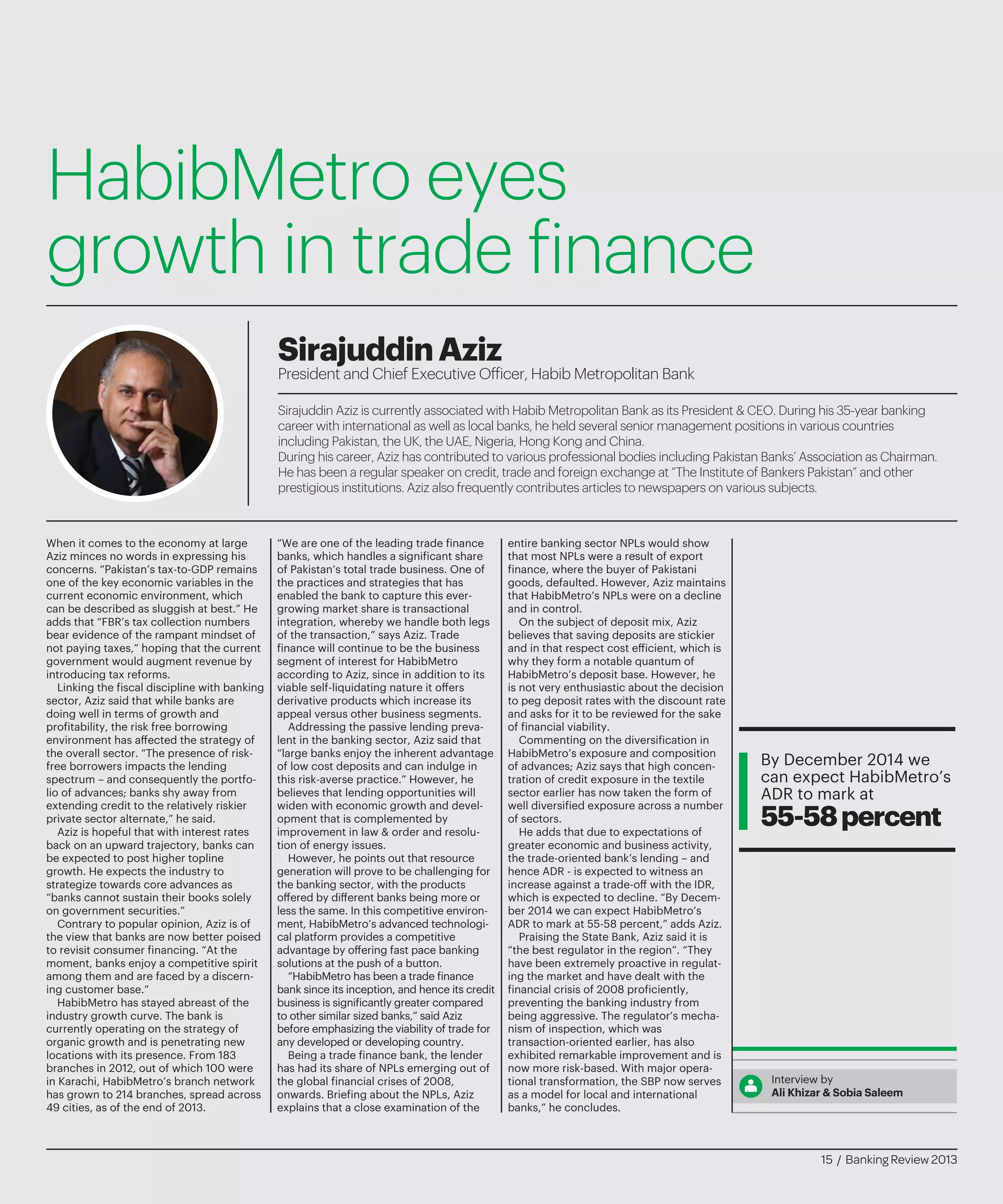
SirajuddinAziz
President and Chief Executive Officer, Habib Metropolitan Bank
When it comes to the economy at large
Aziz minces no words in expressing his
concerns. “Pakistan’s tax-to-GDP remains
one of the key economic variables in the
current economic environment, which
can be described as sluggish at best.” He
adds that “FBR’s tax collection numbers
bear evidence of the rampant mindset of
not paying taxes,” hoping that the current
government would augment revenue by
introducing tax reforms.
Linking the fiscal discipline with banking
sector, Aziz said that while banks are
doing well in terms of growth and
profitability, the risk free borrowing
environment has affected the strategy of
the overall sector. “The presence of risk-
free borrowers impacts the lending
spectrum – and consequently the portfo-
lio of advances; banks shy away from
extending credit to the relatively riskier
private sector alternate,” he said.
Aziz is hopeful that with interest rates
back on an upward trajectory, banks can
be expected to post higher topline
growth. He expects the industry to
strategize towards core advances as
“banks cannot sustain their books solely
on government securities.”
Contrary to popular opinion, Aziz is of
the view that banks are now better poised
to revisit consumer financing. “At the
moment, banks enjoy a competitive spirit
among them and are faced by a discern-
ing customer base.”
HabibMetro has stayed abreast of the
industry growth curve. The bank is
currently operating on the strategy of
organic growth and is penetrating new
locations with its presence. From 183
branches in 2012, out of which 100 were
in Karachi, HabibMetro’s branch network
has grown to 214 branches, spread across
49 cities, as of the end of 2013.
“We are one of the leading trade finance
banks, which handles a significant share
of Pakistan’s total trade business. One of
the practices and strategies that has
enabled the bank to capture this ever-
growing market share is transactional
integration, whereby we handle both legs
of the transaction,” says Aziz. Trade
finance will continue to be the business
segment of interest for HabibMetro
according to Aziz, since in addition to its
viable self-liquidating nature it offers
derivative products which increase its
appeal versus other business segments.
Addressing the passive lending preva-
lent in the banking sector, Aziz said that
“large banks enjoy the inherent advantage
of low cost deposits and can indulge in
this risk-averse practice.” However, he
believes that lending opportunities will
widen with economic growth and devel-
opment that is complemented by
improvement in law & order and resolu-
tion of energy issues.
However, he points out that resource
generation will prove to be challenging for
the banking sector, with the products
offered by different banks being more or
less the same. In this competitive environ-
ment, HabibMetro’s advanced technologi-
cal platform provides a competitive
advantage by offering fast pace banking
solutions at the push of a button.
“HabibMetro has been a trade finance
bank since its inception, and hence its credit
business is significantly greater compared
to other similar sized banks,” said Aziz
before emphasizing the viability of trade for
any developed or developing country.
Being a trade finance bank, the lender
has had its share of NPLs emerging out of
the global financial crises of 2008,
onwards. Briefing about the NPLs, Aziz
explains that a close examination of the
entire banking sector NPLs would show
that most NPLs were a result of export
finance, where the buyer of Pakistani
goods, defaulted. However, Aziz maintains
that HabibMetro’s NPLs were on a decline
and in control.
On the subject of deposit mix, Aziz
believes that saving deposits are stickier
and in that respect cost efficient, which is
why they form a notable quantum of
HabibMetro’s deposit base. However, he
is not very enthusiastic about the decision
to peg deposit rates with the discount rate
and asks for it to be reviewed for the sake
of financial viability.
Commenting on the diversification in
HabibMetro’s exposure and composition
of advances; Aziz says that high concen-
tration of credit exposure in the textile
sector earlier has now taken the form of
well diversified exposure across a number
of sectors.
He adds that due to expectations of
greater economic and business activity,
the trade-oriented bank’s lending – and
hence ADR - is expected to witness an
increase against a trade-off with the IDR,
which is expected to decline. “By Decem-
ber 2014 we can expect HabibMetro’s
ADR to mark at 55-58 percent,” adds Aziz.
Praising the State Bank, Aziz said it is
“the best regulator in the region”. “They
have been extremely proactive in regulat-
ing the market and have dealt with the
financial crisis of 2008 proficiently,
preventing the banking industry from
being aggressive. The regulator’s mecha-
nism of inspection, which was
transaction-oriented earlier, has also
exhibited remarkable improvement and is
now more risk-based. With major opera-
tional transformation, the SBP now serves
as a model for local and international
banks,” he concludes.
Interview by
Ali Khizar & Sobia Saleem
By December 2014 we
can expect HabibMetro’s
ADR to mark at
55-58percent
15 / Banking Review 2013
16 / Banking Review 2013
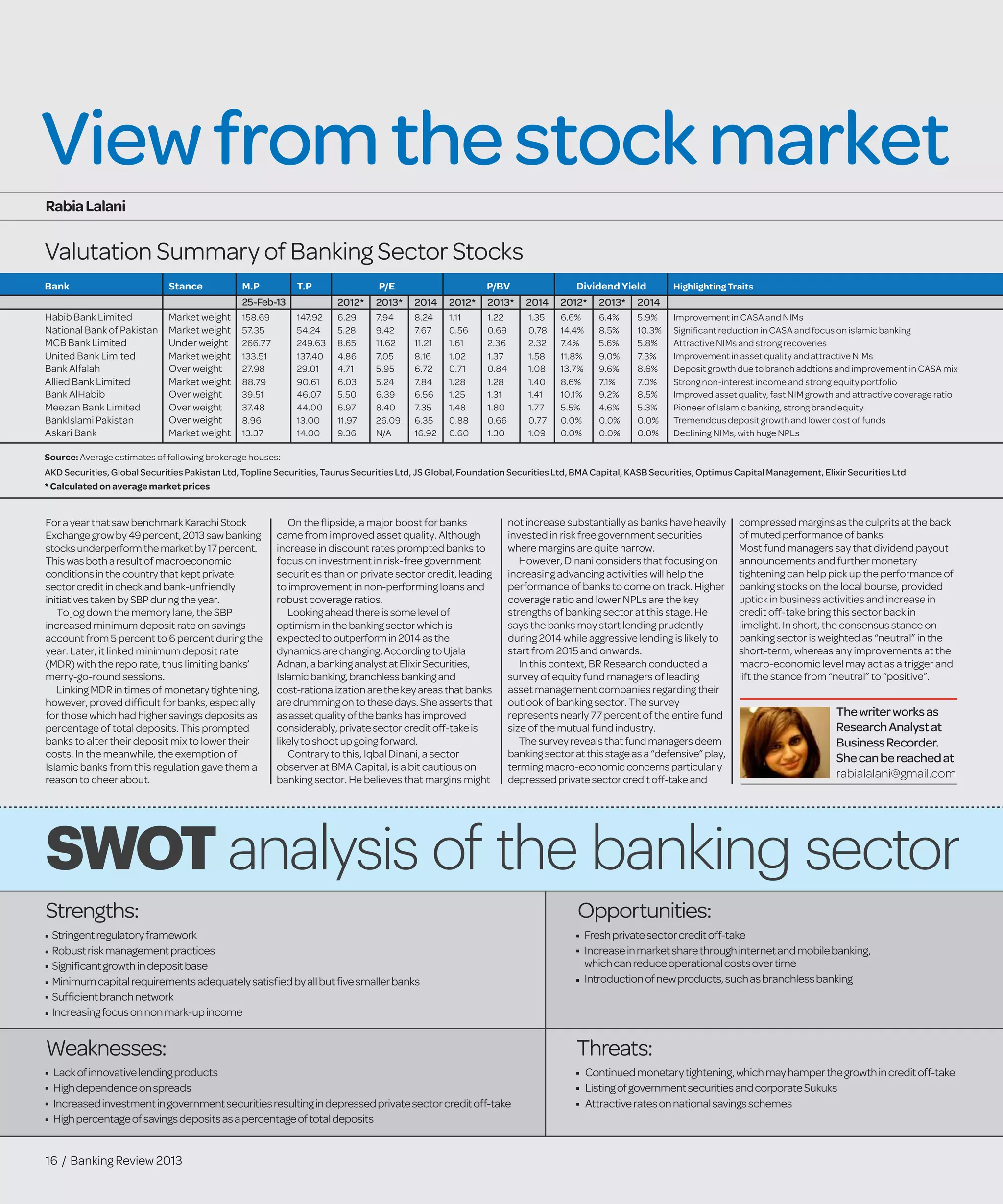
RabiaLalani
Viewfromthestockmarket
ForayearthatsawbenchmarkKarachiStock
Exchangegrowby49percent,2013 sawbanking
stocksunderperformthemarketby17 percent.
Thiswasbotharesultofmacroeconomic
conditionsinthecountrythatkeptprivate
sectorcreditincheckandbank-unfriendly
initiativestakenbySBPduringthe year.
To jog down the memory lane, the SBP
increased minimum deposit rate on savings
account from 5 percent to 6 percent during the
year. Later, it linked minimum deposit rate
(MDR) with the repo rate, thus limiting banks’
merry-go-round sessions.
Linking MDR in times of monetary tightening,
however, proved difficult for banks, especially
for those which had higher savings deposits as
percentage of total deposits. This prompted
banks to alter their deposit mix to lower their
costs. In the meanwhile, the exemption of
Islamic banks from this regulation gave them a
reason to cheer about.
On the flipside, a major boost for banks
came from improved asset quality. Although
increase in discount rates prompted banks to
focus on investment in risk-free government
securities than on private sector credit, leading
to improvement in non-performing loans and
robust coverage ratios.
Lookingahead thereis somelevel of
optimismin thebanking sector which is
expectedto outperform in 2014 as the
dynamicsarechanging. According to Ujala
Adnan,a banking analyst at Elixir Securities,
Islamic banking, branchless banking and
cost-rationalization arethekey areas that banks
are drumming on to thesedays. Sheasserts that
asassetquality of thebanks has improved
considerably, privatesector credit off-takeis
likelyto shoot up going forward.
Contrary to this, Iqbal Dinani, a sector
observer at BMA Capital, is a bit cautious on
banking sector. He believes that margins might
not increase substantially as banks have heavily
invested in risk free government securities
where margins are quite narrow.
However, Dinani considers that focusing on
increasing advancing activities will help the
performance of banks to come on track. Higher
coverage ratio and lower NPLs are the key
strengths of banking sector at this stage. He
says the banks may start lending prudently
during 2014 while aggressive lending is likely to
start from 2015 and onwards.
In this context, BR Research conducted a
survey of equity fund managers of leading
asset management companies regarding their
outlook of banking sector. The survey
represents nearly 77 percent of the entire fund
size of the mutual fund industry.
Thesurvey reveals that fund managersdeem
banking sector at this stageas a“defensive”play,
terming macro-economicconcernsparticularly
depressed privatesector credit off-takeand
compressedmarginsastheculpritsattheback
of mutedperformanceof banks.
Most fund managers say that dividend payout
announcements and further monetary
tightening can help pick up the performance of
banking stocks on the local bourse, provided
uptick in business activities and increase in
credit off-take bring this sector back in
limelight. In short, the consensus stance on
banking sector is weighted as “neutral” in the
short-term, whereas any improvements at the
macro-economic level may act as a trigger and
lift the stance from “neutral” to “positive”.
Thewriterworksas
ResearchAnalystat
BusinessRecorder.
Shecanbereachedat
rabialalani@gmail.com
Bank
Habib Bank Limited
National Bank of Pakistan
MCB Bank Limited
United Bank Limited
Bank Alfalah
Allied Bank Limited
Bank AlHabib
Meezan Bank Limited
BankIslami Pakistan
Askari Bank
Stance
Market weight
Market weight
Under weight
Market weight
Over weight
Market weight
Over weight
Over weight
Over weight
Market weight
M.P
25-Feb-13
158.69
57.35
266.77
133.51
27.98
88.79
39.51
37.48
8.96
13.37
T.P
147.92
54.24
249.63
137.40
29.01
90.61
46.07
44.00
13.00
14.00
Highlighting Traits
Improvement in CASA and NIMs
Significant reduction in CASA and focus on islamic banking
Attractive NIMs and strong recoveries
Improvement in asset quality and attractive NIMs
Deposit growth due to branch addtions and improvement in CASA mix
Strong non-interest income and strong equity portfolio
Improved asset quality, fast NIM growth and attractive coverage ratio
Pioneer of Islamic banking, strong brand equity
Tremendous deposit growth and lower cost of funds
Declining NIMs, with huge NPLs
* Calculated on average market prices
Valutation Summary of Banking Sector Stocks
Source: Average estimates of following brokerage houses:
AKD Securities, Global Securities Pakistan Ltd, Topline Securities, Taurus Securities Ltd, JS Global, Foundation Securities Ltd, BMA Capital, KASB Securities, Optimus Capital Management, Elixir Securities Ltd
2012*
6.29
5.28
8.65
4.86
4.71
6.03
5.50
6.97
11.97
9.36
2013*
7.94
9.42
11.62
7.05
5.95
5.24
6.39
8.40
26.09
N/A
2014
8.24
7.67
11.21
8.16
6.72
7.84
6.56
7.35
6.35
16.92
P/E
2012*
1.11
0.56
1.61
1.02
0.71
1.28
1.25
1.48
0.88
0.60
2013*
1.22
0.69
2.36
1.37
0.84
1.28
1.31
1.80
0.66
1.30
2014
1.35
0.78
2.32
1.58
1.08
1.40
1.41
1.77
0.77
1.09
P/BV
2012*
6.6%
14.4%
7.4%
11.8%
13.7%
8.6%
10.1%
5.5%
0.0%
0.0%
2013*
6.4%
8.5%
5.6%
9.0%
9.6%
7.1%
9.2%
4.6%
0.0%
0.0%
2014
5.9%
10.3%
5.8%
7.3%
8.6%
7.0%
8.5%
5.3%
0.0%
0.0%
Dividend Yield
SWOT analysis of the banking sector
Strengths:
Stringentregulatoryframework
Robustriskmanagementpractices
Significantgrowthindepositbase
Minimumcapitalrequirementsadequatelysatisfiedbyallbutfivesmallerbanks
Sufficientbranchnetwork
Increasingfocusonnonmark-upincome
Weaknesses:
Lackofinnovativelendingproducts
Highdependenceonspreads
Increasedinvestmentingovernmentsecuritiesresultingindepressedprivatesectorcreditoff-take
Highpercentageofsavingsdepositsasapercentageoftotaldeposits
Continuedmonetarytightening,whichmayhamperthegrowthincreditoff-take
ListingofgovernmentsecuritiesandcorporateSukuks
Attractiveratesonnationalsavingsschemes
Freshprivatesectorcreditoff-take
Increaseinmarketsharethroughinternetandmobilebanking,
whichcanreduceoperationalcostsovertime
Introductionofnewproducts,suchasbranchlessbanking
Opportunities:
Threats:
17 / Banking Review 2013
Banking:
Anunconventionalview
Banks are the overseers of a nation’s premier
asset, its savings deposits; unless of course
that nation is blessed with surplus oil reserves
in which case the government could care less
about monetary shenanigans.
Frankly, oil rich autocracies, which are the
rule by the way, need neither indulge in
brilliance of conception nor excellence of
execution, petrodollars buy everything.
Economists, the forbearers of doom, have
even managed to showcase oil wealth as a
disease and coined a phrase for it. Still, all
nations dream of being compared with the
Dutch, and for good reason too. Empirical
evidence clearly establishes that booms are
sweeter for oil rich nations and recessions
avoid them like the plague!
Pakistan’s dreams for oil elephants are far
from fruition; accordingly the nation, by
default, has to ensure efficient utilization of all
other resources, if it ever expects to be
elevated to the ranks of developed nations.
The standard formula for development of an
agricultural economy is through an industrial
revolution, which requires investment of its
savings in projects that create employment
and increase productivity. Banks can play a
pivotal role in channelling precious resources
either towards self sustainability or funding
wasteful consumer choices leading to abject
dependence; or worse.
The evolution of banking remains dependent
on the mischief of money and ever since the
invention of fiat money, the business of
banking is potentially riskier than an invasion
force armed to the teeth with WMD; sub-prime
and euro debt crises are proof of the carnage
and chaos banks are capable off.
For a long time preceding the crises, it was
actually believed that money and its ilk had
actually moderated, or was it tamed, the
business cycle; a clever idea down the drain.
Business cycles rule supreme, unchallenged;
what fools these mortals be!
Governments were always cognizant of
these associated hazards, if not their ferocity,
and have endeavoured to establish a foolproof
regulatory regime for banking; unfortunately
never succeeding. The events of 2008 have
effectively exposed the inability of the latest
banking standards established under the Basel
Accord to identify a storm, let alone prevent it.
If Basel-II had been remotely effective, the
double jeopardy should have been prevented,
so why invest in Basel-III? Rationally, prescient
and sincere legislation would have kept banking
simple; why approve complex derivatives
contracts in the garb of innovation, which
nobody understands, not even their inventors.
Nonetheless, and irrespectiveof thetenacity
ofthe fraudsters to dream up innovativeand
unfathomableschemes to regularly and
repeatedlydefraud thepublicout of their
deposits,banking remains theonly vehicleto
mediate between savers and investors. So while
the catandmousegamecontinues between the
bankersand their regulators, what matters most
isthe scorecard. Has thebanking sector of the
nation succeeded in efficiently deploying the
monetaryresources of thenation?
Notice that the profitability of individual
banks or profitability of the banking sector as a
whole were not included in the scorecard
statement, in fact they don’t even merit a
footnote. Surprised?
Conventional wisdom dictates that a strong
and growing banking sector is a barometer of a
nation’s economic prosperity. As of now, all the
banks in Pakistan are profitable, and in fact
some are doing exceptionally well for a number
of years. This prosperity, if the idea had been
on the money, should have translated into, a
booming national economy, a strengthening
rupee, low inflation, a reducing trade
imbalance, increasing foreign reserves, a
depleting national debt and full employment;
which obviously it hasn’t. Another clever idea
down the drain!
A small clarification at this point; this is
neither the forum nor is there sufficient space
to get into a protracted critique of western
dogmas; logical conclusions will have to suffice.
On the other hand the simplicity of the
preceding deductions stands witness to their
authenticity, if the objective had been deceit
and fabrication, complex and muddled
articulation would have been the preferred
option. Frankly, the propensity of domestic
intelligentsia to readily accept any theory
stamped “Made by Gora”, without independent
thought, is remarkable.
Onceagain,whereisPakistanonthescorecard?
The economy is hardly booming, sectors in
desperate need of funding are seemingly
denied credit. Other than debatable power
projects there has been hardly any project
investment that merits a special mention,
unemployment has reached epidemic
proportions and the situation of the rupee,
foreign currency reserves, trade deficit and
rising national debt are regular “breaking news”
on the electronic media. Except that the banks
are making money!
Ignoring that the “spread”, the difference
between interest rates, which the banks pay
their depositors and what they charge their
lenders, is quite judicious in Pakistan, if the real
economy is reeling, why are the banks allowed
to make money? Puzzling indeed!
Don’t forget the foundations of banking
business are built upon monopoly rent and
banks are protected by stringent entry barriers;
establishing a bank requires a government
license which is not easily forthcoming.
Apparently banks are lending the savings of
the nation back to the government and earn a
spread thereon, and there is nothing illegal
about that. Admittedly, the big banks were
privatized to circumvent government
hegemony on banking credit, but in an
uncertain and highly-charged environment, the
banks cannot be blamed for choosing the less-
risky option, lending to the government rather
than to the private sector, especially when the
spread remains high.
Another avenue for deployment of banks’
funds is the equity market. Considering the
frequent debacles, it is a wonder that like direct
investment in property, stock are not on the
regulator’s restricted list. Especially when funds
diverted towards equities cannot be utilized for
projects in the real economy. Once again,
theories on the importance of the stock market
are sidestepped; the dotcom of the late 90s
should be sufficient evidence of their veracity.
“It is said that the world is in a state of
bankruptcy, that the world owes the world
more than the world can pay,” Ralph Waldo
Emerson. Brilliant articulation which can easily
be broken down into its sub-sets, simply
substitute the word “World” with “Pakistan”, or
most any nation today, for that matter!
Globally, banks were bailed out and remain
hugely profitable, the stock markets are again
booming, property prices are again reaching
bubbling heights, governments continue to
borrow unfettered and all this courtesy central
banks, who continue to ease money supply.
Everyone making money is fine but what about
the populace?
Before moving towards a conclusion, a few
statistics, which the editor informs, are
apparently necessary to establish credibility;
which is rather amazing since hardly anyone
understands them.
Broad money, M2, increased from Rs8.39
trillion in May 2013 to Rs8.93 trillion in Novem-
ber 2013, which establishes that easing is
progressing with ease. Most of this money
ended up in the form of deposits with banks
that at December 2013 have invested or lent
Rs4.1 trillion to the government as compared to
Rs3.1 trillion to the private sector, although
there is an increase in private sector credit
since June 2013. How much exposure that
banks have in the stock market requires an in
depth analysis, which would hardly improve the
basic premise, and hence the particular
enterprise was not embarked upon.
With that out of the way, it is fashionable to
be a Keynesian again! Even more curiously
nudging investment towards growth sector by
governments is not considered a taboo
anymore. Will wonders never cease?
Inconclusionitisimperativethatthe
governmentutilizesthenation’ssavingsin
projectsofnationalimportance,whichare
necessaryforeconomicgrowth,creationof
employmentandexportsubstitution;even,if
required,throughprovisionofcheapercredit.
Unlesstherealeconomythrives,prosperity
withinthefinancialsectorwillremainatriskand
willlargelybeamirage.
Ahealthybankingsectorandahealthyindustrial
sectorarebothequallyimportant.
SyedBakhtiyarKazmi
The writer is a Chartered Accountant
based in Islamabad.
18 / Banking Review 2013
Savingmortgagefinance
Home ownership is often used as a proxy for
achieving prosperity like that in the US. While
living an American dream might not be a
priority for Pakistanis, owning a house is a
major component of social infrastructure in
the country.
Theneedforahousingpolicyisquiteapparent
givenitssocio-economicbenefitsanditsimpact
ontherealsectorandtherebyonmacro-
economicvariables.Cognizantofthisfact,the
StateBankofPakistanhastimeandagainalso
emphasizeditsfiscalbenefitsforthegovernment.
Yet the country continues to face a dearth of
housing units especially for low and middle
income groups. Today, with a rising population,
the country is fraught with limited access to
housing and mortgage loans characterised by
absent long-term finance and property rights.
The underdeveloped house finance market
contributes less than one percent to the
country’s GDP as per the latest available SBP
data, while elsewhere in the world, mortgage
loans make up a sizeable chunk of the
economic output.
Take for instance India,which is way ahead
when it comes to financial maturity. Not only is
house finance a priority sector in India due to
rapid urbanisation and economic growth,
mortgages are also the largest components of
its banking sector’s retail side.
Amajor growth driver for housefinancein the
South Asiangoliath is its National Housing Bank;
the regulatory body provides institutional
frameworkand long term loans to low and
middle incomesegments. Though, House
BuildingFinanceCompany is onespecialized
housingbank in Pakistan with amandateto
provide loans lower-middleand alow-income
group,itssharein total housefinancehas
reducedin absoluteterms over theyears. House
finance hasbecomeexpensivein Pakistan and is
stillrestricted to higher-incomepopulations.
Challenges
One could easily overestimate the maturity of
mortgage lending in the country after going
through the strategic goals for house finance
by the Infrastructure and Housing Finance
Department of SBP. The reality is still far behind
from what’s on paper. Of the major challenges
that shroud the domestic mortgage based
financing, experts speak of the lack of a
regulatory framework, absence of secondary
mortgage market and long-term fixed interest
rates as the prime ones.
Also,the reluctancein mortgagelending by
the bankingsector is dueto poor tenancy,
possessionand foreclosurelaws and weak
enforcement. This can indeed beseen from the
decliningtrend in real estateexposureby the
banks in thetotal credit to thenon-government
sector. Theaverageannual cumulativereal
estateexposureof thebanking sectorhas
toppled from an already miniscule5.6percentin
CY08 to adreary 3.9 percent in CY13.
Then, of course, theunprecedentedrisein
property prices, driven primarily bytherising
demand, cost of land and constructionmaterial,
urbanisation and speculativeactivity inreal
estate, has continued to impair affordability for
thoseseeking housing. This has adversely
impacted themortgagefinancinginthecountry.
Experts reckon that when it comes to
financing solutions for the middle and low
income segments, the awareness and
acceptability of the products are marred by
mistrust and uncertainty. And let’s not forget,
the acceptability of an interest-based financial
system has been a restricting factor for the
conventional banking industry.
Islamicbankingindustrycantaketheleadhere,
especiallyinthesignificantlyuntappedlower-
middleclasssegment,whichisindireneedof
shelter.Already,Islamicbankinghasmadestrides
intothemortgagemarketwitharound25percent
shareinthecountry’shousefinance.
According to theSBP data, theformal
financial sector accounts for onlyonetotwo
percent of total housing transactionsinthe
country, whiletheinformal lending catersto
around 10 to 12percent of thetotal.Whereas,
therest of thehousing financeis arranged
through personal resources, showingatiny
shareof mortgage-based lending inthecountry.
What needs to be done?
First things first, market oriented housing
reforms are the need of the hour. Though, the
law for property registration and transfers
exists, inefficiencies within the system make
the process cumbersome.The key lies in
strengthening the institutional framework
which includes land administrative procedures,
property titling and legal provisions.
Improvement in house finance is also
contingent upon the introduction and
enforcement of foreclosure laws to ensure
effective recovery of loans from the defaulters.
Also, introducing new housing development
and finance-related products is mandatory
that caters to the needs of the neglected: the
middle and low income segment.
While the recent cap on real estate exposure
by SBP might be seen as a restrictive attempt
by some, others call it secondary to the main
challenges like the lack of foreclosure and
tenancy laws. The argument holds weight as it
will take some time for the financial sectors’
exposure in mortgage financing to shoot from a
dismal three percent to 10 percent.
However, reformist attempts are crucial
especially after the apex court‘s decision to
strike down Section 15 of the Financial
Institutions Ordinance 2001, which empow-
ered financial institutions to sell mortgaged
property without recourse to the court. Though
a step in the right direction that gave lenders
undue power over the borrowers, experts also
fear the decision will not only increase banks’
resistance to extend mortgage loans but also
make them hold back lending to private
businesses in future.
Allinall,theworktosalvagehousefinance
shouldpickupimmediatelybyimprovingthe
regulatoryenvironment,beforetherisinginterest
ratescenarioandrisingpropertypricesdoaway
withwhat’sleftofmortgage-basedlending.
SidraFarrukh
Source: SBP, House Finance Review 2005-11
80%
86%
India
China
Korea
1%
2%
3%
7%
12%
17%
26%
29%
32%
41%
Mortgageasa percentageof GDP
Pakistan
Indonesia
Bangladesh
Thailand
Malaysia
Singapore
Hong Kong
USA
UK
Declining real estate exposure in total credit to non-govt sector
Total Credit to Non Govt.Sector (LHS) Share of Real estate exposure (RHS)
Source: SBP, Economic Data
1%
2%
3%
4%
5%
6%
7%
500
1,000
1,500
2,000
2,500
3,000
3,500
4,000
Rs(bn)
Jun
06
Feb
07
Oct
07
Oct
09
Oct
11
Oct
13
Jun
08
Jun
09
Jun
12
Feb
09
Feb
11
Feb
13
Thewriterworksas
ResearchAnalystat
BusinessRecorder.
Shecanbereachedat
sidra.farrukh@br-mail.com
900
2,100
3,300
4,500
5,700
6,900
50%
55%
60%
65%
70%
CY08 CY09 CY10 CY11 CY12 Jun-13
Rs(bn)
Improving CASA
Deposits (RHS) CASA
20
25
30
35
40
130
150
170
190
210
CY08 CY09 CY10 CY11 CY12 Jun-13
(mn)Rs('000)
Average deposit per bank account
No. of bank accounts Average deposit size (L.H.S)
30%
41%
1%
27%
0.25%
Current accounts Saving deposits
Call deposits Fixed deposits
Other deposit accounts
Deposit mix
0 1,000 2,000 3,000 4,000 5,000 6,000 7,000 8,000
Rs(bn)
Breakup of Industry deposits by account type
Current accounts Saving deposits Call deposits
Fixed deposits Other deposit accounts
CY08
CY10
CY11
CY12
Jun-13
CY09
4,000
5,000
6,000
7,000
8,000
9,000
10,000
20%
30%
40%
50%
60%
70%
80%
CY08 CY09 CY10 CY11 CY12 Sep-13
Rs(bn)
Banking sector assets growing in favour of investments
Total assets (R.H.S) IDR ADR
Segment-wise advances & infection ratio (Sep-13)
Staff loans Corporate sector
Consumer financeAgriculture
SME
Commodity finance
0% 15% 30% 45% 60% 75% 90% 105%
Top 5 banks
6-10 banks
11-20 banks
21-28 banks
Foreign Banks
Specialized Banks
Lending split of different banking tiers (Sep-13)
Top-10sectors(intermsoflending)&theirinfectionratio(Sep-13)
20 / Banking Review 2013
Corporate
SME
Agriculture
Consumer finanace
Commodity financeStaff loans
0%
10%
20%
30%
40%
50%
0 500 1000 1500 2000 2500 3000
Advances Rs(bn)
Infectionratio
Agriculture
Transportation
Cement
ChemicalsFinancial
Individuals
Energy
Electronic
Sugar
Textile
0%
10%
20%
30%
40%
50%
0 100 200 300 400 500 600 700 800
Advances Rs(bn)
Infectionratio
400
550
700
850
Breakupof
industry
depositsby
depositor
type
(June-13)
Foreign constituents
Government
Non-financial PSEs
NBFCs
Prviate sector enterprises
Trust funds & non-profit organizations
Personal
Others
3,000
3,200
3,400
3,600
3,800
4,000
9%
11%
13%
15%
17%
19%
CY08 CY09 CY10 CY11 CY12 Sep-13
Rs(bn)
Industry infection ratio
Advances (R.H.S) Infection ratio
150
250
350
450
550
650
CY08 CY09 CY10 CY11 CY12 Sep-13
Rs(bn)
NPLs Loan Coverage
NPLs and coverage
0
5
10
15
20
25
30
35
CY08 CY09 CY10 CY11 CY12 Sep-13
%
Category-wise NPLs to total loans
Public sector commercial banks
Local private banks
Foreign banks
Specialized banks
Category-wise coverage ratio
45
55
65
75
85
95
105
CY08 CY09 CY10 CY11 CY12 Sep-13
%
Public sector commercial banks
Local private banks
Foreign banks
Specialized banks
4%
5%
6%
7%
8%
9%
10%
200
350
500
650
800
950
1100
CY08 CY09 CY10 CY11 CY12 Sep-13
Rs(bn)
Islamic banking growth
Islamic industry assets (L.H.S) Share in banking industry
Financing
mix of
Islamic
banking
industry
Musharaka
Mudaraba
Istisna
Ijarah
Salam
Murabaha
Diminishing
Musharaka
Others Islamic banking infection ratio
2%
6%
10%
14%
18%
22%
CY08 CY09 CY10 CY11 CY12 Sep-13
Infection ratio-Islamic banking
Infection ratio-industry
(6)
(3)
0
3
6
9
12
15
18
CY08 CY09 CY10 CY11 CY12 Sep-13
Category-wise ROE
Public sector commercial banks
Local private banks Foreign banks
Category-wise ROA
(0.5)
0.0
0.5
1.0
1.5
2.0
CY08 CY09 CY10 CY11 CY12 Sep-13
%
Public sector commercial banks Foreign banks
Local private banksSpecialized banks
1000
1150
CY08 CY09 CY10 CY11 CY12 Sep-13
300
400
500
600
700
Rs(mn)
No. of branches (L.H.S)
Average deposit per branch
Islamic branch network
21 / Banking Review 2013
143.53 (Rs. mn) 99.97 (Rs. mn) 97.92 (Rs. mn) 83.16 (Rs. mn) 82.13 (Rs. mn)
Top5BanksintermsofCEOremuneration(Data based on annual reports -2012)
15%
20%
25%
30%
35%
40%
45%
50%
KASB BOP NIB Summit Askari
Bankswiththehighestinfectionratio
2%
5%
8%
11%
BIPL MEBL BAFL ABL BAHL
Bankswiththelowestinfectionratio
Industryaverageof
listedcommercialbanks
(As of Sep-13)
ADR 52%
IDR 51%
Infection ratio 16%
Coverage ratio 79%
CASA 59%
Spread ratio 38%
Non-funded income to total income 15%
Saving deposit to total deposit ratio 34%
60%
65%
70%
75%
80%
85%
90%
MCB HBL BAFL BAHL AKBL
Top5banksintermsofCASA (As of Sep'13)
40%
50%
60%
70%
80%
NIB Silk Bank Faysal Bank Samba NBP
Top5banksintermsofADR(As of Sep'13)
40%
55%
70%
85%
100%
115%
130%
Samba MCB MEBL BAHL JS
Top5 banks intermsofIDR(As of Sep'13)
35%
40%
45%
50%
55%
60%
65%
SCB MCB UBL
Top5 banksintermsofspreadratio
HBLMEBL
80%
100%
120%
140%
160%
180%
NBP ABL BAHL MEBL SAMBA
Bankswiththehighestcoverageratio
22 / Banking Review 2013
MeezanBankCEO
anticipatesalargershareofpie
Irfan Siddiqui is the founding President & CEO of Meezan Bank Ltd. He initiated the forma-
tion of Al-Meezan Investment Bank in 1997, which was converted into a full-fledged sched-
uled Islamic commercial bank in May 2002. This was the first ever license to be given for
Islamic commercial banking in Pakistan. Meezan Bank is now the largest Islamic commercial
bank in Pakistan with 351 branches spread across 103 cities.
Siddiqui is a Chartered Accountant from England & Wales and has extensive financial sector
experience with Abu Dhabi Investment Authority, Abu Dhabi Investment Company, Kuwait
Investment Authority and Pakistan Kuwait Investment Company.
Irfan
Siddiqui
Founding President and
Chief Executive Officer,
Meezan Bank Ltd.
BR Research: Take us through the journey
of Meezan Bank so far.
Irfan Siddiqui: Meezan Bank was launched
in 1997 as an Islamic investment bank, and
the first three years of its life were as an
investment bank. We got the opportunity
to venture into commercial banking
through acquisition of Societe Generale’s
operations in Pakistan back in 2002.
From that point we have grown from just
one small office in 2002 with a staff of 30,
to over 350 branches in more than 100
cities across the country now. The
response from the market has been very
positive. It is a combination of what we
offer to our customers and their receptive-
ness. Ten to fifteen percent of the popula-
tion will always be die hard Islamic banking
customers and there would be another 10
percent who might not be.
This leaves you with the remaining 80
percent. If you provide them the right
service, pricing and environment, there is
no reason why they should not come. We
call them as ‘why-nots’, that if you offer
them a good Islamic package, they will
come to Islamic banking. Just labelling your
product would not help, as people are well
aware in the market. Offering a truly
Shariah-compliant product is a must for the
Islamic banking model to be sustainable.
BRR: Did you have to create the demand
among the ‘why-nots’?
IS: You must make conscientious efforts to
market your products. The product
positioning and availability are critical for
achieving success and that is what Meezan
Bank has done. An edge that Meezan has in
the market is that we deliver what we
promise, not only in terms of product but
the overall environment as well. Deep
inside their hearts people have to be
convinced on what they are working for.
BRR: With a lot of conventional banks
growing their share in the Shariah-
compliant segment, how does Meezan
manage to differentiate from the pack?
IS: We have never conscientiously tried to
differentiate ourselves – our aim and wish
is that the market should grow. We have
never seen other Islamic banks or windows
as direct competition to Meezan Bank.
Instead, we work with them and support
them; we share good assets with our peer
Islamic banks, which is how the market will
gain depth and growth.
The differentiating factor is up to the
consumer; we grow as the industry grows.
For some it would be pricing, for others it
would be accessibility or environment – it
all depends on the consumer. We would
never advertise saying how we are
different from other Islamic banks.
BRR: Does the whole industry have a
similar set of principles and guidelines?
IS: We have the same regulator and the
SBP Shariah board on the macro level.
Within that, every individual bank has its
own Shariah board, all pre-approved by the
State Bank of Pakistan. There are minor
differences of interpretation – not a matter
of right or wrong - and it does not impact
the Shariah compliance of Islamic banks.
BRR: Critics say that a lot more needs to
be done to make the system fully Shariah
compliant. What’s your view on that?
IS: On the question of Shariah compli-
ance, I can safely say that we are 100
percent Shariah-compliant. Whether we
can do even better is another thing and yes
there are areas in which we can get even
better, but that does not take anything
away from our compliance.
BRR: Is our model any different from the
Malaysian model in terms of compliance
strictness?
IS: The Malaysian model has some
difference, but by and large everybody in
the industry is following the compliance
guidelines to a good extent. The industry is
moving in uniformity; the latest example is
our recent advertising campaign, that was
released from one platform which included
the State Bank and all Islamic banks and
windows.
It is in the interest of all the players in a
comparatively new industry to go hand in
hand as we fully realise that we cannot
move on to the next level in isolation. You
need to have a critical mass and Meezan
Bank provides that to the industry as the
industry leader.
BRR: Why is the penetration still quite low
in Pakistan despite having such a massive
Muslim population?
IS: The industry started very late and the
performance has been satisfactory in my
view. We are 10 percent of the industry
right now, which is commendable, given
that this is a new industry in the Pakistani
financial sector. And I believe that the next
10 percent growth would be comparatively
much quicker. I see the Islamic banking
industry growing at double the pace of
conventional banking for a good five to
seven years.
Interview by
Zuhair Abbasi and Sobia Saleem
I see the Islamic banking industry growing
at double the pace of conventional banking
for a good five to seven years.
23 / Banking Review 2013
Money that prays
Before joining Burj Bank as its President and CEO, Ahmed Khizer Khan worked as Chief
Operating Officer of ICD (Islamic Corporation for Development of the Private Sector),
Jeddah. ICD is one of the two main sponsors of Burj Bank and is a group company of Islamic
Development Bank (IDB), Jeddah.
Prior to joining ICD, Khizer was the Chief Executive of Barclays Global Retail and Commer-
cial Banking, the UAE from 2006 to 2010. He was associated with Citigroup from 1997 to
2006 in various senior level assignments including Country Business Manager, Pakistan
and Managing Director Operations and Technology, Central Europe.
In this interview Khizer talks about future and potential of Islamic banking and challenges
thereof. He also sheds light on how the pegging of minimum deposit rate can trigger
private sector credit off- take.
Ahmed
KhizerKhan
Chief Executive Officer,
Burj Bank
BR Research: Despite being one of the
largest Muslim majority countries, the
penetration of Islamic banking in Pakistan
is still low. Is the environment not condu-
cive enough?
Ahmed Khizer Khan: In Pakistan, Islamic
banking penetration stands at about 10
percent in terms of overall deposits of the
industry. Considering that it has only been
11 years since the re-launch of Islamic
banking, this percentage reflects an
unparalleled growth trajectory.
While the market shares of Islamic
banking in other Muslim countries like
Kuwait, Malaysia, Saudi Arabia and the UAE
are much higher, these markets are much
more mature in terms of the tenure of
Islamic finance. It would be safe to
conclude that the growth of Islamic
banking in Pakistan has been exceptional.
It is also important to note that the overall
penetration of banking is low in our
country whereby till date the banking
sector has only been able to tap roughly 20
million customers.
BRR: What’s the market potential?
AKK: It is enormous. According to our
analysis, an untapped banking market of
over 40 million customers still exists
within the country. Islamic banks in
Pakistan are presently in their evolution
phase thus providing enormous potential
to grow this market.
BRR: So then what is preventing the
industry from realising this potential?
AKK: Currently, the greatest challenge to
growth is the awareness gap and the central
bank has taken some very significant steps
in this regard including a mass media
awareness campaign launched this year.
However, Islamic banks must also
contribute at their own level towards this
awareness drive by conducting micro
marketing initiatives, seminars and mass
communication campaigns which promote
the values and supremacy of the Islamic
financial system.
The second greatest challenge facing the
industry is the human capital gap. The SBP is
playing a pivotal role in this regard with NIBAF
(National Institute of Banking & Finance)
being at the forefront of these initiatives.
Given the dynamics and psychographics
of our consumers, Islamic banking has the
potential to become the system of choice
within the country. With the commitment
of our regulators, I have no doubt that this
will be made possible in times to come.
BRR: Islamic banks face problems in asset
creation and liquidity management due to
a lack of short-term Islamic instruments
offered by the government. How is Burj
Bank tackling the maturity gap?
AKK: Due to lack of Islamic Instruments for
liquidity management and an under-
developed Islamic finance market, Islamic
banks are facing some problems in
managing liquidity. An under-developed
money market as well as limitations in
money market instruments are also major
constraints towards the liquidity manage-
ment process. Having said that Burj Bank is
efficiently managing liquidity with greater
reliance on interbank placements through
Mudaraba, Musharakah and Wakalah with
Islamic banks and through commodity
Murabaha with conventional banks.
BRR: Islamic banking is limited in its ability
to offer personal finance. How are the
Islamic banks battling against that?
AKK: Since Shariah is the basis of Islamic
banking, therefore, Islamic banks cannot
lend money or price money because it is
Riba and that is prohibited as per Shariah.
Instead of lending money or offering
working capital financing, Burj Bank
finances the need of the customer in the
form of commodities, goods or assets.
For example, if the customer requires
working capital for raw material purchases,
Burj Bank offers Murabaha financing (cost
plus profit sale). Similarly, if the customer
is a manufacturer and it requires financing
to manufacture goods, Istisna is offered to
them. Recently Burj Bank has also launched
a structured financing product for the
service sector, Service Ijarah and a working
capital financing product for finished
goods called SAHL.
BRR: Islamic banks are privileged in terms
of not having a floor on saving deposits.
Besides, asset-backed financing also curbs
NPLs. How are the Islamic banks leveraging
these factors to be better than the
conventional banks?
AKK: It has surely helped Islamic banks in
providing actual rate of returns to the
customer but at the same time it has
created a new challenge of providing
competitive rates to saving depositors
while managing the liquidity issue.
Since Islamic banks finance the need of
customers instead of lending money,
therefore all the transactions of Islamic
banks are backed by assets. This is the
primary differentiator which makes Islamic
Banking superior, balanced and more
secure in comparison to conventional
banking. The recent global financial crisis
has proved this point. An IMF study
conducted in the aftermath of the reces-
sion compared the performance of Islamic
banks and conventional banks during the
financial crisis, and found that Islamic
banks, showed stronger resilience during
the global financial crisis.
According to the report, Islamic banks
worldwide performed better than conven-
tional ones in terms of profitability, credit
and asset growth. The profitability crunch
of Islamic banks worldwide was less than
10 percent, whereas the profitability of
conventional banks slumped by more than
35 percent.
BRR: Will the pegging of minimum deposit
rate with discount rate trigger private
sector lending? How will the banks combat
spread shrinkage?
AKK: It is most likely to generate private
sector lending. To counter the impact on
spreads, banks will now move to more
lucrative avenues, which include penetra-
tion in consumer segments.
Besides, product innovation keeping in
view the revision of Prudential Regulations
by SBP for small and medium enterprises,
may also attract program lending to small
enterprises, which offer better returns.
Though, there is a possibility that private
sector off-take will improve but corre-
sponding increase in economic activity is
also pivotal to make the risk taking
worthwhile. Banks may continue to shy
away from assuming risk until the private
sector demand remains depressed and
pressing issues like energy crises continue
to dent the economic activity.
Interview by
Zuhair Abbasi & Sobia Saleem
24 / Banking Review 2013
Schooldays generally start for children by the time they are 4-5 years old. But it seems that Pakistan’s
5-year old branchless banking (BB) sector is itself schooling the developing world on how it’s done.
Global financial institutions consider Pakistan as a BB innovation laboratory, while private philanthro-
pists are keen on the socioeconomic spillovers.
Five years after the State Bank of Pakistan (SBP) issued detailed BB regulations – a first in South Asia
– the non-existent market base has now grown to 7 service providers (more pilots are underway) and
over 100,000 retail agents. As of September last year, the sector was handling transactions worth
nearly $25 million a day or over $700 million a month! All the mobile network operators are now deeply
involved, as are some of the leading commercial banks. Those currently not in the mix also seem
interested – some are dipping their toes by partnering with existing players, while the rest of the
fence-sitters are finding it hard to ignore this sector any longer.
This special BB feature – which is an acknowledgment of the promise this sector holds to bridge the
gaping financial divide, also an accolade to the SBP’s enabling and proactive role – intends to highlight
the sectoral performance with a forward-looking agenda. Readers will find pictorials that describe this
growth story over the years. Then there are market insights on key learning and challenges, for which
BR Research interviewed three individuals who have led BB deployments in their respective organisa-
tions right from the start. Due to space constraints, we could include these insights from the top 3 BB
service providers (based on SBP’s market shares as of September, 2013).
BR Research appreciates the divergent perspectives (especially the telco-bank divide and the
financial inclusion vs. financial access debate) on how best to mainstream the financially excluded
population. We are witnessing a growing private sector appetite in this sector, which is a good omen for
increasing the coverage and usage of financial services in the country.
Key Learnings
Even simple financial services make a huge
difference in the lives of people. This is
evident from the customers we interact
with and the stories we get to hear. But
people want more than just transactional
services. That is why Easypaisa is the first
BB service in Pakistan to venture into more
than just transactional services with
products like Khushaal Beema, Khushaal
Munafa and ATM Cards. Another key
learning is that apart from convenience
and reliability, security is also very impor-
tant to the customer.
There is still a huge untapped need for
more convenient and more accessible
financial services, especially at the bottom
of the pyramid or those we call ‘un-banked’
or ‘under-banked’. We estimate a total of
60 million users who have a need to use
branchless banking services and Easypaisa
is only serving 6 million every month.
Challenges
One of the main challenges we face is that
the regulatory requirements for BB
accounts are not attractive to move
customers over from over-the-counter
(OTC) services. Not all customers carry
their Nadra CNICs at all the times. Moreo-
ver, verifications from Nadra on important
transactions are often expensive. Collect-
ing an image of the customer, an image of
the CNIC and a physical visit to an agent
location are restrictive. SBP can revise the
BB regulations to introduce a true ‘entry
level’ account for customers who can
sign-up easily. Account limits also need to
be revised to provide an incentive to
customers to migrate to BB accounts.
There is a great need to digitise
payments, especially the G2P and P2G
payments, which are typically held in
monopoly between a few banks and force
customers to inconvenient, time-
consuming options of payments. Anybody
would know the difficulty one faces to pay
for a traffic challan or a Nadra CNIC card
fee at a NBP branch.
CustomerpreferenceforOTCtransactions…
There are literally no barriers to using OTC
services. Customers can simply walk up to
the agent and carry out a transaction in a
few minutes. There is no sign-up required
and the entire transaction is merchant-
assisted. Even with low literacy levels,
customers don’t have to do anything but
go to their nearest agent with their CNICs.
There has to be a greater focus on BB
accounts by the players. At the moment,
with so many new players coming into the
market in the last 15 months, most of them
are focused on fighting over existing
agents and setting up their OTC transac-
tions, with some not even promoting their
BB accounts. However, BB players
currently incur a heavy cost in opening
each BB account. There are commissions
to pay and Nadra verification charges
(amongst other costs), which are almost
twice as much is charged to other
commercial banks. The revenue from a BB
account is so low that it often takes the
payback period up to a year on the initial
account opening costs. So it’s imperative
to reduce these costs.
Customers need to be offered more than
money transfer and bill payment services
on their BB accounts. Since these services
are available on OTC as well, the BB
accounts must provide more value to
customers. Payments, savings, lending and
other advanced financial products are
much-needed.
Promoting Mobile Wallets
All BB players need to realise that operat-
ing behind walled gardens will not work
out in the long run. There is a need to
integrate and connect with the existing
infrastructure. For example, Easypaisa has
taken the lead to connect with 1-Link. We
now offer ATM cards to our customers
which can be used for cash withdrawal at
any ATM machine in Pakistan.
There is also a need to provide Retail
Payments, for which Easypaisa has already
rolled out a service where BB accounthold-
ers can purchase items directly from their
BB accounts from any Easypaisa agent
location. But the current processes are seen
as cumbersome and time-consuming, so
there is a continuous need to keep attempt-
ing better solutions for retail purchase.
On Omni’s four-year journey so far…
UBL Omni’s four-year journey is just the
beginning of providing affordable basic
financial services to the masses via BB
services, i.e. via retail outlets. There is a
huge demand for BB services by consum-
ers who need to send money, receive
money, pay their bills and keep their
savings secure yet readily available for use.
A key learning is that the industry needs to
continue to increase awareness and
promote usage of these services to more
fully realise the potential of these services.
Another key learning is that consumers
have repeatedly exhibited their willingness
to try new products and services. This
trend has been observed in both rural and
urban markets. UBL Omni’s experience
with the G2P payments projects for the
poor and underprivileged that reside
mainly in remote rural areas, demonstrated
that those people were equally keen as
their urban counterparts in learning the
usage of BB channels. Due to this, the
industry has many opportunities to take
new products for consumer trial.
A few myths need to be debunked, as well.
Unlike general perception, there is no
definite urban-sender, rural-receiver
pattern out there, for rural areas are also
the origins of BB transactions and lots of
small cities are also generating good
volumes. Another myth is that people are
sending money back home for monthly
expenses. That is not entirely true. Through
this platform, people are sending money to
their kids; companies are disbursing
salaries to their employees; people on daily
wages are being paid, etc. So, there are a
variety of funding needs that are being
effectively served through this channel.
Challenges for a solo service provider
like Omni
UBL Omni has a telco-agnostic business
model, which means that the Omni users
have the freedom and flexibility to choose
the mobile service provider that best
meets their needs in terms of service, price
and location.
BRANCHLESSBANKING
SECTION
OmarMoeenMalik,
Head of Strategy, Easypaisa
Omar has been part of the core Telenor Easypaisa team since
before its launch in 2009. Prior to his 3-year experience in Mobile
Financial Services, he gathered over 4 years of GSM experience
with Telenor where he headed the Value Added Services
department. Omar holds a B.Sc. in Computer Sciences from the
University of Texas at Austin and an MBA from LUMS.
Abrar has led the UBL Omni’s retail
distribution network development
since the start. He has also led the
development and ongoing
improvements in an in-house
technology platform that enabled the
multichannel transaction capabilities
for Omni customers. Abrar holds a
bachelor's degree in Electronics
Engineering from UET, Lahore and an
MBA from the Illinois Institute of
Technology, Chicago.
AbrarA.Mir|Group Head and EVP,
Branchless & e-banking, United Bank Limited
Continued on next page
25 / Banking Review 2013
-
10
20
30
40
50
60
-
50
100
150
200
250
1QFY12 2QFY12 3QFY12 4QFY12 1QFY13 2QFY13 3QFY13 4QFY13 1QFY14
Branchlessbanking transaction mix
Value Rs (bn) Volume (mn)
-
20,000
40,000
60,000
80,000
100,000
120,000
1QFY12 2QFY12 3QFY12 4QFY12 1QFY13 2QFY13 3QFY13 4QFY13 1QFY14
Numberofagents
1,492,639
1,028,775
26,897
94,630
Level 0
Level 1
Level 2
Level 3
CompositionofBBaccounts(as of June 30, 2013)
- 0.5 1 1.5 2 2.5 3 3.5
1QFY12
2QFY12
3QFY12
4QFY12
1QFY13
2QFY13
3QFY13
4QFY13
1QFY14
Numberofaccounts(mn)
-
500
1,000
1,500
2,000
2,500
3,000
1QFY12 2QFY12 3QFY12 4QFY12 1QFY13 2QFY13 3QFY13 4QFY13 1QFY14
DepositsRs (mn)
7
15
33
41
31
38
26
34
Rural Urban
Adultswith anaccount ataformalfinancialinstitution(%)
Pakistan India South Asia Lower Middle Income (countries’ average)
- 50 100 150 200 250
1QFY12
2QFY12
3QFY12
4QFY12
1QFY13
2QFY13
3QFY13
4QFY13
1QFY14
Total Loan repayment, bulk payments and others
Bill Payments & Top-ups Deposits & Withdrawals
Funds Transfer
ValueoftransactionsRs(bn)
17
3
44
26
41
25
34
23
Male Female
Adultswithanaccountataformalfinancialinstitution(%)
Pakistan India South Asia Lower Middle Income (countries’ average)
- 5 10 15 20 25
1QFY12
2QFY12
3QFY12
4QFY12
1QFY13
2QFY13
3QFY13
4QFY13
1QFY14
Numberoftransactions(mn)
Bill Payments & Top-ups Deposits & Withdrawals
Loan repayment, bulk payments and others Funds Transfer
OTCvolume mix
(Jul-Sep 2013)
P2P Fund Transfer
G2P Pensions and salaries
Withdrawal through G2P Cards
Bills payment and Mobile top-ups
Loan repayments and others
M-walletvolume mix
(Jul-Sep 2013)
Fund Transfer
G2P Pensions and salaries
Cash Deposit in MW
Cash withdrawal from MW
Bills payment and Mobile top-ups
Sources: SBP quarterly newsletters on Branchless Banking | Global Findex Database
26 / Banking Review 2013
The original concerns that many people
had were around UBL’s capability and
capacity to build a retail agent distribution
structure as compared to the perceived
advantage of the telco service providers
who already had a massive distribution
footprint.
However, selling financial services is a
different line of business and requires a
different level of retailer engagement. As a
full-services bank, UBL was aware of the
level of engagement required to ensure the
provision of quality banking services
delivery from agent locations, which only
comes through retailer training and
education. Today, the industry with 6-7
active service providers boasts a sum total
agent network of over 100,000 retailers,
but a probable estimate of unique outlets is
just 30,000 to 35,000. Meanwhile, Omni is
available at over 15,000 active locations
and continues to grow its market share.
The key challenges that we face are
sector-related, which are common to all
service providers. They include expanding
the agent network, creating customer
awareness, and enriching the customer
experience. Being part of a large commer-
cial bank has provided numerous benefits.
We were very particular about our internal
controls, risk management, and product
definition right from the very beginning.
That has enabled us to run the business in
a very controlled manner with an emphasis
on consumer service quality.
OTC: An unforeseen trap…
Currently, the market is dominated by the
OTC money transfer business, which does
not offer the same features of BB account
services, such as higher transaction limits,
instantaneous ATM/Debit card issuance
from retail outlets, usage of countrywide
ATMs, mobile and SMS transaction
functionality and lower charges than OTC.
Thus, there is an unrealised opportunity for
consumers to benefit tremendously by
using BB accounts. In the last 2 years, UBL
Omni has been aggressively promoting
account proposition in its advertising,
customer communication and investment
in account product innovations.
Unfortunately, we as an industry have
fallen into a short-term revenue generation
trap whereby we have made our business
models OTC-centric at the expense of
accounts’ growth, the cost savings,
customer convenience and the long-term
benefits to industry. I am sure as the
business models mature, as consumers
become more demanding, and as new
products are rolled out, the market will
move away from being predominantly
OTC-centric.
The way forward…
The future is extremely exciting and offers
huge opportunities to transform the retail,
G2P, B2B and C2B payments in Pakistan.”
We are fortunate to have SBP as our
regulator in that they are extremely
forward-looking and work very closely with
the industry to support the evolution of
new business models around this
structure. However, one of the most critical
enablers for that revolution to happen will
be widespread availability of retail agent
locations that are providing these services
to customers across Pakistan.
It is about time that the industry agreed
on a code of conduct whereby the service
providers refrain from signing the same
shared agents. The industry needs to work
towards expanding the agent base, maybe
with selected geographies and interoper-
able networks. Multiple sharing of agents
results in liquidity and management
challenges at the retail location which
ultimately can translate into a poor
customer service.
Waseela’s year-long experiences
A year after operations, our basic assump-
tion – that there is a large market of
unserved people for sending and receiving
money, paying utility bills, etc. – stands
validated. Currently, Mobicash is handling 1
million transactions a month (mostly
urban-to-rural domestic transfers) worth a
total of Rs4 billion in transaction value. The
number of BB customers and volumes
have been picking up rapidly. We are
confident that in the long run, the growth
rate will be even faster as we’ll be able to
use the synergies with Mobilink and
promote the usage of mobile wallets (or
m-wallets).
Our target market is those 100 million+
individuals who have a cell phone but no
bank account. We understand that
bringing them on board is the first step,
which has to be followed by the broaden-
ing of services menu. The channel is new
and therefore cannot handle very sophisti-
cated financial products at this time.
It’s a big market, and more number of
players will help the market in expanding
its outreach. After mobile operators,
commercial banks are also trying their
hand in this sector. It will be interesting to
see the competition in the sector.
We also understand the importance of
expanding our microfinance footprint as
much as our branchless banking network.
We have been able to position ourselves in
core micro business of small deposits and
micro loans. The microfinance bank is
firmly established, with about 30
fully-functional branches, 5000 individual
borrowers and Rs180 million in loan
portfolio.
Challenges facing Mobicash
One of the main challenges is to manage
the large number of agents. Mobicash has
about 27,000 retail agents located all over
the country, a footprint we are targeting to
expand to 40,000 locations by the end of
this year. Now these outlets are the
simplest possible versions of bank
branches, but they are absolutely new to
the world of financial business. It’s a
challenge for all the market players to
adequately train their agents to comply
with the BB regulations for functions like
money management and KYC, as well as
for consumer aspects like speed, quality
and delivery of the service.
Currently, we are catching up in terms of
building capacity and experience relative to
our competitors. Ultimately, it’s the people
that make the difference and drive business.
We are trying to keep the best possible
people in this venture. In terms of business,
in five years’ time, our ambition is to be the
market leader, which requires us to find a
way to surpass the challenges.
The OTC dilemma is a hard one…
Agents are well-educated in the process of
registering m-wallets. But the dilemma is
that if an agent puts efforts into registering
m-wallet users (for which he is being
incentivised), he starts losing his OTC-
related commission and fees as the
sending customer is enabled to perform
transactions on his own instead of going to
the agent. We need to find a way to
surpass this challenge.
Another issue is that customers are not
aware of the benefits of usage of m-wallets.
Similarly the fact that the OTC channel is
neutral to both users and non-users of a
particular service provider is also fueling its
usage. In addition, receivers, which are
found more on the rural side, have natural
preference for OTC.
The reality is that OTC is serving well in
developing the market; it’s growing agent
business; and it’s convenient for low-income
end users. The SBP data shows that OTC
uptake is increasing every quarter, which
means that there is a need for it.
Migration to m-wallets
The m-wallet uptake is increasing, and the
number of their subscribers now exceeds
2.8 million. But this number is small
compared to the potential size of the
market. A lot more consultation has to take
place to promote m-wallet usage. The
regulator and the industry are trying to
encourage m-wallet usage. But there are
several impediments, including agent
incentivisation and customer awareness.
On our part, our ads are particularly
designed to make people aware of the
benefits of m-wallets. We are also coming
up with an ATM card for our m-wallet users
to give them an added incentive like a bank
account does.
But this is a challenge for the entire
industry and the regulator, because there
are other issues involved here. There are
many retailers who do not want to
document their transactions, meaning they
cannot partner with the BB service
providers for payment settlement. It will
take at least 5 years for a major shift
towards m-wallet adoption. Market players
would need to seriously invest more
money in technology and awareness
campaigns. Over in Bangladesh, there is a
good usage of m-wallet, thanks to the 50
million+ customer base of microfinance
banks. Therefore, growth of domestic
microfinance sector will also help.
BB services and the Payment Ecosystem
It’s a question of connecting small and big
retailers to this payment platform. The
sooner outlets like small grocery stores and
vegetable shops are able to settle their
payments through this system; the better it
will be for m-wallet usage. It’s also a
question of education and time. People will
get sensitised over time. We can take the
cue from the adoption of debit cards in
Pakistan. I foresee a time where any
institution which will remain out of this
payment platform will lose out.
Continued from previous page
Ghazanfar helped launch Waseela and Mobilink’s joint BB
deployment, Mobicash in November 2012. He has previously
served as the President and CEO of Kashf Microfinance Bank. He
is an MBA from the University of Punjab, Lahore, and has attended
executive education and leadership programmes at LUMS, Penn
State University, and the Harvard Business School.
GhazanfarAzzam
President and CEO,
Waseela Microfinance Bank
Interviews by
HammadHaider
27 / Banking Review 2013
28 / Banking Review 2013
QasifShahidandShamsulhaqNiaz
Improvingmobilebanking
growthprospects
Mobile
Bank
Mobilebankingtakesbankingrelationshipto a
wholenewlevel.Customersgetthe conveni-
enceofbankingfromtheirhomes,while
branchesenjoydecongestion astheyno longer
needtoprocesslow-valuetransactionsandcan
focusonbetterservicetohigh-value customers.
Asmanyaselevencommercialbanksare
currentlyofferingthisservice in Pakistan.The
commercialbanksthatare notofferingmobile
phonebankingareeitherinthe processof
developingthechannelortheyare public sector
banks.Otherbankssittingoutside the mobile
phonebankingmarketaredoingso because
theyarenichemarketplayerswhere the size and
natureofthecustomerbase doesnotjustifya
decentreturnoninvestmentor theyare simple
notprofitableenough.
Though still in its infancy, mobile phone
banking continues to see a healthy quarterly
growth. While the number of transactions from
1QFY11 to 1QFY14 has grown at a CAGR of 26
percent, the volume of transactions has grown
at a CAGR of 99 percent.
Partofthiscanbeexplainedbyinflation
(particularlyinutilitybills),butitisalso likelythat
consumershavegainedenough trustin the
systemtocarryouthighervalue transactions
throughthischannel.Accordingto the central
bank’sPaymentSystemsReviewof1QFY14
transactionsunderthissegmentprimarilyfall
intopaymentofutilitybillsandaccount-to-
accountfundstransfer.
Aside from these two factors there are
three macro trends that are driving mobile
banking in Pakistan.
First,isthegrowinguseofsmartphonesand
internetinthecountry.Smartphonepenetration
isaround10percentwithfeaturephones
comprising75percentofallphonesinthe
country.Nowadaysvirtuallyeverynewphone
beingsoldisasmartphone;Chinese
smartphonesareavailableinthemarketoffering
animpressivearrayoffeaturesforverylowprices.
Becauseofsmartphones,internetconnectivityis
alsofastbecomingawayoflifefortheordinary
person.Mostupscaleormediumscale
supermarket/restaurant/publicareaofferWi-Fi
hotspots.Besides,3Gnetworktechnologyisalso
expectedtoberolledoutthisyear.Soon,eventhe
mostoutoftouchwillbebrought–voluntarilyor
otherwise–intotheconnectivityfold.
Thesecondfactoristhegrowingimportance
ofAlternateDistributionChannels(ADCs)for
commercialbanks.Thereisnodebateonthe
valueofADCsinthebankingindustry.Bankswant
tostayintouchwiththeircustomersasmuchas
possibleinaday,whichiswhyovertheyears
we’veseenbranchtimingsincreasedto5pm
(endevenbeyond)from1pm.Similarly,theATM
networkisspreadacrossthecountry.Moreso,
brandeddebitcardshavenowbecomevirtuallya
mandatoryrequirementforaccountholders.
Thethirddriverhasbeentheintroductionof
MobileFinancialServices(branchlessbanking)by
mobilenetworkoperators(MNOs).Thereis
alreadyaveryhighpenetrationofmobilephones
inthepopulationandtheMNOsareseeking
revenuegrowthfromthis‘Value-AddedService’.
Theyhavemadephenomenalstridestoglobal
acclaimandhaveblurredindustrylines.Nowany
mobilephoneusercaneasilyopenabranchless
accountwithhis/herserviceproviderwithout
havingtofilloutlengthyformsandwaitafewdays.
Theattentiontheyhavereceivedisdisquieting
banksbecausetheyneedtooffersomething
aboveandbeyondthebranchlessbankingmenu
toconventionalbankingcustomers.
Apayment ecosystem
Currently,mobilebanking primarily provides
relativelybasictransactions and facilities to the
customers,such as balanceinquiry, onlinefunds
transfer,mobiletop-ups and bill payments. Bill
paymentsarelimited to utilities and cellular
post-paidbills, and arepretty much similar for
mostofthe banks. In thenear future, the
direction we arelikely to seeis all theplayers
attemptingto createpayment ecosystems to
tryandring-fencetheir customers by keeping
their moneywithin aclosed loop. An example
couldbe of:
“A bankofferssalary accountsto the
employeesof a corporate clientA. These
employeesreceive their salariesandspend
themin variouswayssuchasusing their debit
cards topay for groceriesata hypermarket
which is also a corporate customer. Inturn, the
hypermarketwouldpay itssupplier online
which happensto be corporate clientA, thus
completingthe loop.”
To do that, atwo-pronged approach will be
required.Firstly, alliances and loyalty programs
shouldbe offered to theconsumer. Secondly,
institutional solutions – including salary
processing,cash management/collections, etc.
–mustbe provided.
At themoment, thenumber of onlinebillersis
very limited becauseit is cumbersomeforbanks
to bring each biller on board. Bringingthem
onboard requires negotiations and draftinglegal
agreements, which takes timein bureaucratic
environments. Theway forward isthroughbilling
aggregators – third parties which signupbulk
billers and merchants and provideasingle
interfaceto thebank whilehandlingthebackend
processing. This is already happening,whichis
why we’ll beseeing non-utility billingoptionson
themenu such as train tickets, schoolfee
payment and later on, maybeevengovernment
payments such as trafficviolationfines,etc.
DigitalWallets
When MCB launched its mobilebankingservice
in 2009, wewereoneof thefirst banksinthe
industry. Till date, wehavehad over10million
transactions worth morethan Rs40billion
performed on our mobilebankingplatform.We
haveused insights gained from ourexperiences
to develop adigital wallet – therecently
launched MCB Lite– in our bid to stayaheadof
thecompetition in themobilepaymentsspace.
Webelievedigital wallets arethenextbigthingin
mobilepayments and will drivethe payments
landscapeinto awholenew stratum.Traditional
mobilebanking is encumbered bytheunderlying
corebanking systems. A digital wallet,onthe
other hand, offers endless possibilitiesfor
innovation in payments solutions becauseit
leverages mobiletechnology, socialconnectivity
and thepower of cloud computing.
Awarenessandfinancialliteracy
Lack of awareness is really what iskeeping
customers from using mobilebankingdespite
thefact that alot of timeand moneycanbe
saved through mobilebanking. Withtoday’s
petrol prices, even asmall trip to thebank can
cost morethan ahundred rupees,soanyone
with theawareness would do themathand
chooseto transact onlinegiven theopportunity.
However, wedon’t feel this is goingtoremaina
major issueas peoplearecatchingonfastand
whichever banks can go out and educate
consumers and offer thesimplestormost
convenient solutions will bewell positionedto
lead themarket.
With smartphoneusageon therise,weexpect
alot of players developing mobileappsfor
mobilebanking. Such apps may offerimproved
interfacesforcarryingouttransactionsand
offeringvariousutilitiessuchasGPS-based
loyaltyprograms,complaintlogging/tracking,
directionstothenearestbranch/ATMthrough
GPS,etc.
Technologicallimitations
Perhapsoneof thegreatestlimitationsforlack
of innovativeproductsinmobilebankingis
technologicalinnature,especiallyforbanks.
Theirlegacy corebankingplatformsarerickety
anddonotprovideflexibility orscalability.Itis
verydifficultandexpensivetoupgradethemor
toaddinnovativefeaturestothem.Thereisalso
considerablecostinvolvedwithscalingupin
termsof manpowerandinfrastructure.
Bankscanlearnfromthetelecomindustryin
Pakistanwhichhasdiscoveredthatitmakesmore
economicsensetoshareinfrastructurewith
competitors.Thepolicymakersmightbeableto
enablesuchthinkingiftheyrelaxframeworksto
allowcollaborationsuchasinfrastructuresharing.
Thatwillrelievethebanksoftheburdenof
continuouslyupgradingandmaintainingtheir
infrastructureandtheywillactuallypaymore
attentiontoinnovationanddesign.
Despitetheselimitations,mobilebankinghas
outpacedinternetbanking.Internetbankinghas
beenaroundsince2003,butmobilebanking,
whichwasintroducedaround2009,alreadyhas
moreregisteredusers(1.4 millionvs.1.3million).
Thoughinternetbankingprovidesaricher
experiencewithmorefeatures,thetrendis
explainedby thefactthatitrequiresusersto
haveemailaddresseswhilemobilebanking
usersareregisteredthroughtheirphones.
In the longer run, however, we feel that if
banks can drive uptake of mobile banking
successfully, this will create a second wave of
internet banking. It is important that banks
don’t try to price transactions on both
channels, as this will do more harm than good –
discouraging large scale uptake and not
generating much income.
29 / Banking Review 2013
The writers are members of the Digital
Banking team at MCB Bank Ltd.
Mobile phone bank-
ing continues to see
healthy quarterly
growth. While the
number of transac-
tions from 1QFY11 to
1QFY14 has grown at
a CAGR of 26%, the
volume of transac-
tions has grown at a
CAGR of 99%.
Barclays:
Strategybydesign
Shazad Dada joined Barclays Bank Pakistan as the Chief Executive Officer in October 2010,
with overall responsibility of managing all business operations in the region including
corporate and retail banking. He started his banking career in the USA, joining Bankers Trust
in 1990, which was acquired in 1999 by Deutsche Bank AG, before becoming Chief Country
Officer and Head of Global Banking Deutsche Bank. Prior to taking up his role with Barclays,
Shazad was a Managing Director in the Mergers, Acquisitions and Corporate Advisory
Group at Deutsche Bank Securities.
In this interview with BR Research Shazad, who is also the Chairman of Pakistan Banking
Association, talks about the bank’s strategy to increase advances, the pegging of deposit
rates to discount rate and his views on the draft Corporate Rehabilitation Act.
ShazadDada
Chief Executive Officer,
Barclays Bank
BR Research: What has been the overarch-
ing theme behind Barclays Pakistan?
Shazad Dada: Our clients and customers
are at the center of what we do. Across our
business, we are innovating and redesign-
ing our services around them, while also
reaping the benefits of greater efficiency
and control. While this will be an ongoing
process, some of the results are already
apparent. If you look at the numbers, we
had realignment in 2012, intending to
refurbish and reshape our business, which
certainly has yielded good dividends.
We want to play our local and global
strengths and become the ‘Go-To’ bank for
multinational and large local corporations,
financial institutions, high net-worth
individuals and development
organizations/foreign missions.
The year 2013 was a testament to our
value-driven strategy’s popularity where we
continued to take market share and with the
support of our clients, we have seen both
our deposits and assets grow steadily.
BRR: We have seen the administrative
expenses coming down by Rs750 million;
however, the topline seems to be suffering.
Why is that so?
SD: It’s by design. We have leveraged our
products, capital, networks and expertise
to drive sustainable progress; however,
there were some clients who we cannot
service effectively. We have to pick our
ground in which to be competitive. We
decided to let go of some clientele
because of their domestic focus. Gener-
ally, they do not have FX or cash manage-
ment needs, so we took a revenue shortfall
with the resulting greater cost reduction.
By concentrating on targeted segments
we are better able to provide a higher level
of service, understand clients’ needs in
greater depth and tailor products and
solutions accordingly. Working with one
large enterprise client on their financing
solutions can lead us to provide similar but
tailored solutions to other clients in the
same sector.
BRR: Do you plan on expanding your
branch network?
SD: Currently, we have no plans to
expand our branch network. Our existing
branches are state of the art in the design
and geographically well placed to our
targeted client needs with a capacity to
scale up if required. Furthermore, making
use of the technology we are working
towards branchless banking covering
geographies, which are required to
service our target clients.
BRR: Why have your advances stagnated?
SD:Our overall advances are stagnated,
compared to last year. However, if we go into
details, the advances to our existing clients
have actually increased. As I mentioned
earlier, it is by design that we have exited
some non-core relationship which caused a
decline, but that was offset by an increase in
advances to our target clients.
BRR: Do you see your ADR getting higher
than IDR anytime soon?
SD: Mostly likely yes. Our clients are again
in an expansionary mode and trade
volumes are likely to be higher. Both of
these key indicators suggest that our
advances should increase in 2014.
BRR: What are your views on opportunity
for Pakistani businesses in Africa?
SD: For many exporters Africa is the final
frontier. The vast and diverse nature of the
continent and its people makes trading
with Africa seem simply too much of a
challenge. However, the infrastructure
across many of Africa’s largest economies
is improving rapidly and I encourage all
Pakistani businesses to view Africa as a fast
growing new market to be explored.
With more than 50,000 employees on
the ground in Africa, we know very well the
challenges that businesses face, but also
the success stories of so many of our
clients who have started business relations
with African companies. This is the ‘ground
floor’ for many African economies, in which
Pakistani exporters have the opportunity to
build their brand in Africa at a time when a
growing middle class is beginning to make
long term brand decisions. Pakistan should
not be missing out.
BRR: Being the Chairman of PBA, what are
your views on the State Bank’s decision to
peg deposit rate with discount rate?
SD: By pegging the deposit rate to
discount rate, the spreads have been fixed,
with the result that banking sector cost of
deposit has increased, however, varying
between banks.
The hardest hit category is basic saving
accounts which are generally in Pakistan
used as normal transaction accounts with
all the features of checking accounts.
Therefore by capping the saving account
spreads and considering the cost associ-
ated in servicing these accounts the
deposits become very expensive.
Personally, I believe banks should have
the freedom to determine their own rates
based on their cost structure and funding
requirements. In a free market depositors
should be the ultimate winners.
BRR: Has there been any progress with the
Corporate Rehabilitation Act after the
recent meeting with the SECP?
SD: The banking community is clearly in
favour of enhancing the current law or
enact a new law that provides interim
relief to debtors in case of genuine
challenges they may face in meeting their
financial commitments.
Having said that, we are also concerned
if the act is not drafted properly, it will be
misused by willful defaulters and cause an
increase in NPLs. As for the draft of
Corporate Rehabilitation Act, which was
initiated in 2008, banks reviewed the draft
individually, and through the platform of
PBA proposed certain changes in the draft
act. These suggestions are yet to be
incorporated in the draft, and based on the
recent feedback from all the stakeholders,
it has been indicated that the SECP is
reviewing the draft act afresh.
Interview by
Ali Khizar and Zuhair Abbasi
30 / Banking Review 2013
Citibank N.A. cautiously
optimistic about Pakistan
Meet Nadeem Lodhi, who rejoined Citibank N.A Pakistan as its Country Manager and
Managing Director in 2012. Prior to that, Nadeem was associated with Abraaj Capital where
he was heading the business for sub-Saharan Africa. During his earlier tenure at Citi,
Nadeem held various roles in Pakistan and Africa including the CEO for Uganda.
Belowistheeditedtranscriptofarecentsit-downwithBRResearch.
NadeemLodhi
Country Manager and Managing Director, Citibank N.A.
Nadeem kicks off the discussion by
explaining the business strategy of the
bank. “Globally, Citibank N.A. classifies
its banking business into two major
domains: consumer banking and institu-
tional banking. The institutional business
of the bank primarily comprises treasury
& trade services, advisory & investment
banking and corporate banking, which
forms the core essence of Citi’s opera-
tions worldwide.”
He explains that the bank remains at the
forefront of taking clients in Pakistan to
international capital markets and introduc-
ing new products from other geographies
by adapting them to local needs.
Recalling Citi’s feats, Nadeem says that
“fundamentally, Citi Pakistan is now a
wholesale bank serving its corporate and
institutional clients – all their other
offerings are designed to facilitate the
delivery of services to such clients. Some
of our most significant transactions include
Government of Pakistan’s first foreign
currency Sukuk, first local currency Sukuk,
first oil hedge in Pakistan and so on. We
have also been involved with the govern-
ment as Joint Arranger on three Eurobond
issues in 2005, 2006 and 2007 and the
OGDCL GDR issue in 2005.”
He emphasizes on how Citi’s business
model is different from other banks
operating in Pakistan and also explains the
rationale behind the bank’s limited market
presence - having just three corporate
branches in the country.
“Citi’s primary focus is to serve top tier
Pakistani corporates and public sector
entities as well as MNC clients present in
various locations across the globe with
heavy presence in the country. In Pakistan
we are uniquely positioned with a
well-entrenched franchise and continue to
successfully deliver value-added solutions
to this niche client base from areas of
structured financing, M&A advisory,
electronic payment solutions, export credit
agency supported financing, working
capital management and risk management.
Just to give you an example, we handle
over 50 percent of the total MNC trade
volume in the country,” he said.
Some of the most recent and significant
achievements of Citi include, jointly
arranging $130 million syndicated foreign
currency Islamic facility for Pakistan
International Airline (PIA) in October 2013
which was the second biggest transaction
in the last 2 years. The bank also arranged
$70 million FMO & OPIC supported
financing for Pakistan Mobile Communica-
tion Limited (Mobilink) in 2012.
On the investment banking front, the
bank holds a leading position in the
market. “We’ve recently advised Unilever
on share buy-back of Unilever Pakistan and
delisting from the Pakistani exchanges
which contributed to be the single largest
FDI in the recent history of Pakistan. The
bank also advised on AkzoNobel's sale of
its controlling stake in ICI Pakistan, and
acquisition of 35 percent stake of Pakistan
International Container Terminal by ICTSI.”
Among all the categories of institutional
banking, Lodhi terms trade and cash
business to be the anchor of the bank’s
business and the single most important
area that pours in flow into the bank, while
on the treasury front, Citi also provides
hedging and derivative to its clients
besides FX sales.
As part of its commitment to the
country, Citibank N.A. has been conduct-
ing road shows since last year to show-
case the potential of the Pakistani market.
In collaboration with the US State Depart-
ment, the bank also hosted an investment
conference in Dubai in June last year,
providing an opportunity to Pakistani
companies to highlight the multiple
opportunities available in the country to
US investors.
The bank is already Basel-III compliant
while other banks are likely to achieve the
same level in 2018, as per the plan
chalked out by the regulator. Further-
more, Citi is pioneering efforts to imple-
ment state-of-the-art technological
systems in line with a regulatory push to
automate banks’ operations.
Commenting on the ‘banking float’,
which is the duplicate money present in
the banking system between the time
when a deposit is made and when the
funds become available in an account,
Nadeem says that the State Bank of
Pakistan wants to reduce the banking float,
which “could be achieved through a
technology engine called Real-Time Gross
Settlement (RTGS). Citibank N.A. is
expected to be the first bank automated on
RTGS with the SBP in the first quarter of
CY14.”
When asked about the economic
backdrop, Lodhi said the bank remains
bullish about the Pakistani market in the
CY14. “Our niche clientele, mainly MNCs,
consider Pakistan to be in their top ten
growth markets. If they do well, it reflects
positively on our performance,”
comments Lodhi.
He believes that the energy sector is the
key area that will turn around economic
growth in the coming years and bring a
revival in the fiscal system. “The decision
to tackle the three Es [energy, economy
and extremism] is the correct formula
employed by the government and will
bear fruits soon.”
Interview by
Zuhair Abbasi & Sobia Saleem
“We’ve recently advised
Unilever on share
buy-back of Unilever
Pakistan and delisting
from the Pakistani
exchanges which
contributed to be the
single largest FDI in the
recent history of
Pakistan.”
31 / Banking Review 2013
32 / Banking Review 2013
Agrilending
Thereisperhapsnoneedto argue that
agricultureisoneofthemostimportantsectors
oftheeconomyand,therefore,requires
frequentpatsonthebacksandincentivessuch
aspriorityonthelendingroster.However,like
mostdevelopingeconomies,Pakistan'srural
creditmarkethastheusualsuspectsin store:
co-existenceofformal,semi-formaland
informallendersandaweakregulatory
frameworkthatbogsdown more than itenables.
Howeverfromthefaceofit,thingshavebeen
rapidlyimproving.TheStateBankofPakistanhad
settheagricultureloandisbursementtargetat
Rs360billionforfiscalyear2014,followingwhich
thebanksdisbursedRs159.3billion–or44
percentoftheannualtarget-inthesixmonths
endingDecember2013.Theoutstandingportfolio
ofagriloansalsosurgedby17.3percenttoRs
276.7billionatendofDecember2013.
A lot of that can be credited to the inclusion
of the private sector into the lending mix. With
the induction of 14 domestic private banks into
the agricultural credit scheme in 2002 and the
removal of mandatory credit targets for big five
banks from 2005, the share of commercial
banks has shown significant rise in the overall
agri credit disbursement.
Conversely,theshareofspecializedbanks,
namelyZTBL&PPCBL,inagriculturalcredithas
declinedfrom73percentinFY01to26percentin
FY13.Thetrendalsoshowsthatwhilecommercial
banksarecontinuouslysurpassingtheirindicative
credittargets,thelikeofZTBL,whichonly
managedtoextendRs23.7billionatthecloseof
thefirsthalfagainstitsannualtargetofRs70
billion,havestartedtolagbehindconspicuously.
Segmentation and collateral: still
some way to go!
Money lent for agriculture is still widely being
used for purchase of urban properties and
expensive cars, a fact alluded to by almost
every banker this scribe talked to during initial
research on the subject.
Additionallygrossirregularitiesarealsovisiblein
otheravenues.RecallthattheStateBankof
Pakistanintroducedrulesformandatory
insuranceoftotalcreditextendedtofarmersand
alsopromisedtoreimbursepremiumpertaining
to‘subsistencelevelfarmers’visibleacrossthe
board.However,amajorityoftheamounts
extendedremainuninsuredandevenifthelosses
areindemnifiedbyinsurers,corporationslike
NationalInsuranceCorporation,consistentlyfail
tomaketimelypayments.
Furthermore,anenquiryintoabreak-downof
creditextensiontofarmhouseholdalsoreveals
anomalies.Accordingtocalculationscomputed
fromthelatestAgricultureCensusof2010,
householdswithlargeoperationalholding(more
than25acres),whomakelessthanonepercentof
thetotalborrowers,obtained73percentoftotal
creditexclusivelyfromformalsources.
In contrast, households with operational
holdings under 5 acres, which constitute 65
percent of the total farming households in the
country, received only 31 percent of loan
extended by formal sources. Additionally,
subsistence farmers, comprising 35 percent of
borrowing households as per the census, got
only 18 percent of their total loans from formal
sources during the same time.
Ofthosethatreliedexclusivelyoninformal
sources31percentweresubsistencefarmersand
25percentwerelandlesshouseholds,which
meansthatthehighestproportionsofthosewho
canbecategorizedasthepooresthouseholdsstill
dependexclusivelyoninformalsources.
One of the reasons often cited to explain
away this skewed disbursement of credit is the
inability of small and tenant farmers to provide
acceptable collateral.
However,someheadwayhasbeenrecentlymade
toremedythesituation.Theassessmentofthe
valueofthelandforcollateral,arenowcomputed
onthebasisofthe3-yearaveragesofthevalueof
landmutationsinthearea,accordingtothe
governmentlandrecord.Thishashelpedslightly
easeamajorimpedimenttotheproperassess-
mentofthevalueofthecollateral.
Nonetheless, the State Bank still needs to
look into this area and rationalise the loan and
collateral ratio so that more financing institu-
tions can take up the cause.
But to give credit where it is due, the SBP has
recently been on a bit of an agri bender, having
made amendments to the prudential regula-
tions, indicative credit limits and the list of
items eligible for agri credit earlier this year.
Some of the important revisions to the
regulations are highlighted in the enclosed box.
However, clearly enough, the increased level
of agricultural lending alone cannot raise the
farm productivity and contribute to the
national economy if bottlenecks like water
efficiency, land record management, proper
marketing and storage, adoption of modern
techniques, mechanization and other agri
innovations and efficient use of extension
services are not addressed.
JaveriaAnsar
Source: Agriculture Census 2010
Agriculutre credit by source and farm size
Supply of agri credit by institution
Z.T.B.P
11769
11,769
43644
70362
69014
73321
63447
34088
12945
2043
1699
C.B's
50885
1,782
6798
9373
7989
8529
8192
4594
2413
588
624
MFI's
29157
2,024
7059
8050
3709
4704
2260
951
316
34
49
NGO's
15703
1,071
3721
3182
3162
2142
1688
618
86
4
35
Commission agents
230502
7,898
51007
51161
39936
35250
26972
13010
3896
654
700
Friends & Relatives
493382
53,594
145900
107712
69889
7227
3270
1377
536
21
36
Source of credit
10181907
75,084
237762
225783
174993
164723
119656
58050
19536
3185
3154
Total households
under agricultural
debt
Farm household total
Under 1 acre
1.0 to under 2.5
2.5 to under 5.0
5.0 to under 7.5
7.5 to under 12.5
12.5 to under 25.0
25.0 to under 50.0
50.0 to under 100.0
100.0 to under 150.0
150.0 and above
Size of farm (Acres)
• State Bank of Pakistan has very recently
enhanced per acre limits for major and
minor crops, orchards and forestry.
According to revised report on Indicative
Credit Limits & List of Eligible Items for Agri
Financing released in early 2014, financing
limits per acre for rice, wheat, cotton and
sugarcane have been increased to Rs
34,000, Rs 29,000, Rs 39,000 and Rs
53,000, respectively from existing limits of
Rs 19,000, Rs 16,000, Rs 21,000 and Rs
30,000 fixed in 2008.
• The bank has also re-developed working
tables for assessment of per acre credit for
each crop, which may be used by field
officers in case of variation in limits rather
than indicative lending limits.
• Per acre use of fertilizers for major crops
and orchards has been updated.
Size/Classification wise number of farms as
percentage of total number of farms in
province has also been re-defined.
• List of eligible items for agri. financing has
been updated.
• Total cash and credit requirements for
seeds, fertilizers, and pesticides for
medium and large farms are revised to 80
percent and 60 percent, respectively,
compared to 70 and 50 percent in the
previous report.
Amendments in indicative
credit limit and eligible items
for Agri-financing
Thewriterworksas
ResearchAnalystat
BusinessRecorder.
Shecanbereachedat
javeriaansar08@gmail.com
-20
0
20
40
60
80
100
120
140
160
180
FY08 FY09 FY10 FY11 FY12 FY13
Rs Bn
5 big CBs ZTBL DPBs PPCBL MFBs
Source: SBP
Attock
Bahawalpur
Bahawalnagar
Bhakkar
Chakwal
Chiniot
Dera
Ghazi
Khan
Faisalabad
Gujranwala
Gujrat
Hafizabad
Jhang
Jhelum
Kasur
Khanewal
Khushab
Lahore
Layyah
Lodhran
MandiBahauddin
Mianwali
Multan
Muzaffargarh
Narowal
NankanaSahib
Okara
Pakpattan
Rahim
YarKhan
Rajanpur
Rawalpindi
Sahiwal
Sargodha
Sheikhupura
Sialkot
TobaTekSingh
Vehari
PUNJAB
Abbottabad
Battagram
Buner
Charsadda
Chitral
Hangu
Haripur
Karak
Kohat
Kohistan
Lakki
Marwat
Malakand
Mansehra
Mardan
Nowshera
Peshawar
Shangla
Swabi
Swat
Upper
Dir
Lower
Dir
Bannu
Tank
Dera
Ismail
Khan
KHYBER
PAKHTUNKHWA
Thatta
Karachi
Badin
Tando
Muhammad
Khan
Mirpurkhas
Tharparkar
Umerkot
Jamshoro
Hyderabad
TandoAllahyar
Sanghar
Matiari
Shaheed
Benazirabad
Khairpur
Sukkur
Ghotki
KashmoreJacobabad
Shikarpur
Kambar
Shahdadkot
Naushahro
Firoze
Dadu
Larkana
Awaran
Barkhan
Kachi
Chagai DeraBugti
Gwadar
Jafarabad
JhalMagsi
Kalat
Kech
Kharan
Kohlu
Khuzdar
KillaAbdullah
KillaSaifullah
Lasbela
Loralai
Mastung
Musakhel
Nasirabad
Nushki
Sibi
Panjgur
Pishin
Quetta
Sherani*
Washuk
Zhob
Ziarat
SINDH
BALOCHISTAN
These maps show district wise bank
branch density in the country. The density
is presented as number of people
serviced per branch in each district (See
legend). The maps highlight a clear
demarcation of districts that remain
under-banked relative to others. The
disparity is visible both inter-provincially
as well as within each province.
Although maximum accuracy was sought
during this exercise, readers are advised to
note the qualifications stated below. In our
opinion, however, these qualifications do not
distort the overall picture.
Differenceindates: Data pertaining to
the location of bank branches have been
obtained from State Bank of Pakistan’s
annual publication called Banking Statistics
of Pakistan for the fiscal year ended June,
2012. We thank Free and Fair Elections
Network (FAFEN) for providing us the latest
district-wise population estimates (as of
June 2013), which in turn was obtained
from Election Commission of Pakistan.
Bank selection: The branches of all
scheduled commercial banks with retail
operations were included. Accordingly,
for the sake of consistency, foreign
banks, DFIs and micro-finance banks
have been excluded.
Unidentified branches: 223 or 2.3
percent (of 9,792) branch locations
remain unidentified in terms of district
due to lack of clarity over tehsil/council/
village name. Branch locations for AJK,
FATA and Gilgit-Baltistan have been
identified, but are excluded from mapping
for the sake of consistency in comparison
with other provinces.
District classification: Boundaries of
several districts have been redrawn since
the year 2000, with new districts created
at different stages. Outside FATA and
Gilgit-Baltistan, the total number of
districts in the country is 118, including
the four provinces and the Islamabad
Capital Territory.
Mappingthe
disparityin
bankbranch
network
across
Pakistan
Islamabad
*No bank
branches were
identified in SBP
statistics for
Sherani district,
Balochistan.
Latest district wise demarcation has
been sought while locating bank
branches, but lack of availability of
accurate data on newly created
districts led to their inclusion within
the former boundaries. These
exceptions include:
Harnai,Balochistan:carved out of
Sibi district in August, 2007
Torghar,KPK: carved out of
Mansehra district in January, 2011
Lehri,Balochistan: carved out of
Nasirabad district in May, 2013
Sohbatpur,Balochistan:carved out
of Jafarabad district in May, 2013
Sujawal,Sindh: carved out of Thatta
district in October, 2013
1 - 9,999
10,000 - 19,999
20,000 - 29,999
30,000 - 30,999
40,000 - 49,999
50,000 - 4,999
75,000 - 9,999
100,000 and above
The legend depicts the
number of people
served per branch
where population
estimates have been
taken as a proxy.
LEGEND
The
34 / Banking Review 2013
Bank of Punjab:
eyeing the unbanked
The conversation took off from the
problems inherited by the new manage-
ment. From poor asset quality to deposit
withdrawal and high cost of funds, the
bank had suffered from a complete range
of problems that came in a variety of
shapes and sizes. But the bank’s new
management has managed to turn the
situation around.
Khan tells us that non-performing loans
has come down to Rs65 billion from Rs80
billion in FY10. He adds that Rs3.6 billion
has been recovered from Harris Group,
whereas 1,912 recovery suites against
defaulters have been filed by the new
management.
The massive deposit withdrawal of Rs50
billion to due to negative market percep-
tion has also reversed to a point that the
deposits rose to about Rs295 billion from
Rs164 billion in 2008. Even the cost of
funds has dropped to 7.15 percent from
nearly 11 percent booked earlier.
The bank has also improved on its
investments side. Khan says that at the
close of FY13 the bank’s investments
stood at Rs136 billion, up from Rs25.7
billion in 2008 with an improved mix. In
2008, 53 percent of investments were in
illiquid mutual funds, now 94 percent of
investments are in government securities.
As a result of these efforts, the bank’s
bottomline went from pre-tax loss of
Rs16.8 billion in 2008 to a modest pre-tax
profit of Rs523 million in 2011 and Rs1.54
billion for the six months ending June
2013. Total assets grew from Rs143.5
billion in 2008 to Rs329.4 billion at the
end of FY13.
Bad debt management
Going to back to discussion on bad debts
Khan said that “our infection ratio has
already gone down; the SBP had given us a
target of reducing these by 4-5 percent each
quarter and we are easily exceeding that.
Going forward we are planning on increas-
ing our lending in a massive way, which will
make the mammoth task a little easier.”
He added that the bank has “already
recovered around Rs35 billion whereas we
are also expected to see massive rever-
sals.” “Additionally, we have foreclosed
assets of around Rs12 billion from default-
ers’ properties - landholdings, machinery,
and other assets. Every 15 days we have an
auction and sell them off. So we’ve already
recovered more than a billion rupees from
these auctions in lieu of cash.”
Sharing the details of the Haris Steel
transaction, Khan said that they are making
good progress on that front as well. Aside
from the recovery of around Rs3.6 billion,
“there is an ongoing litigation in UAE as
well and AED52 million is at stake there. In
Malaysia we have virtually auctioned off all
of Harris Steel’s assets - all their country
homes and cars – and we expect around a
billion rupees from that coming in by the
end of this year.”
While these positive developments, the
difficult cases are still with the banking
courts and NAB. “NAB has been extremely
ineffective over the last year but we have
higher hopes with the new head. We have
filed nearly 2,500 cases in courts and we
have not spared anyone - not even the
highest and the mightiest. But the ball now
is in the judiciary’s court. Depends on how
quickly they make decisions,” he said.
He stressed that all institutions can turn
around in Pakistan if you put in the right
people in the right place. “The biggest
things keeping us behind are our own laws.
And with all due respect, our judiciary
needs to improve and the banking courts
need to step up their game.”
“In another 5 years we aim to resolve 80
percent of our bad debts, but this time
would have been cut in half had the courts
been more active. Additionally sometime
we also feel handcuffed by the govern-
ment and can’t make some aggressive
moves because you’re afraid that it will be
perceived as crony-ism or corruption.”
Growth avenues
Pointing to the success of bank’s
consumer side, Khan highlighted that
Bank of Punjab is the biggest lender in
Pakistan in car financing. Contrary to
popular perception, “we’ve had a very,
very successful yellow taxi scheme, with a
98 percent recovery rate. The scheme
might have been politically motivated but
we fought a lot to make it bankable. They
came to us with a wish list but we handed
them our own bucket list of requirements
right back. We made sure that every car
had a tracker, and that is what has helped
with the recovery rate. As soon as 180
days pass, we recover the vehicle and
auction it off.”
Khan adds that the bank has all major
corporate on its lending books, which
wasn’t the case before. “We are a growth
oriented bank; we want to grow on both
the asset and liability side. We want to
bring our cost of funds down and are now
well in control of the situation.
The bank also plans to expand its
Islamic footprint as a part of its growth
strategy. “We’ve already launched our
Islamic banking segment with four
branches, and have crossed a billion
rupee deposit. We also have Islamic
financing proposals for around Rs1.5
billion lying with us, but deposits are low
so our commercial banking side will
subsidize what the shortfall rest for the
time being,” he said.
He added that the bank has asked for
another 14 branches to be opened next
year. “We expect a bright future,
especially in great stretches of unbanked
areas in the KPK where there is a lot of
demand for deposit and even the smallest
of branches offering Islamic banking have
low cost deposits of Rs2-2.5 billion lying
with them.”
When asked about any plans to acquire
a bank in the medium term to help with
expansion, Khan said that he had
proposed to the board that Bank of Punjab
should buy HSBC. But the government
said “no, forget it”.
While he says that he would be open to
a good proposal, he doesn’t feel that
there are enough good buys in the market
at the moment. “If we open 40-50
branches per year, we don’t need really
any mergers. The one edge that we have
is the government of Punjab’s very strong
backing, so I think we should be good for
the time being.”
Khan says there are still so many
unbanked places that we need to tap. “As
the Bank of Punjab, we intend to expand
aggressively across the smaller market
towns and cities across the province -
places where all that low cost money is
lying around and there are very few banks.
Places like Deepaal pur, Ghaziabad, and
Siadpur - just to name a few, where potato
and fruit and what-not farmers are sitting
doing big money transactions with no
banks for miles. So that’s where we are
going now. We’ll be trying to take up
concentration in smaller towns and open
smart efficient branches in extremely
targeted locations next year.”
Interview by
Ali Khizar & Javeria Ansar
Naeemuddin Khan has been serving the Bank of Punjab as its President & CEO since Sept
2008. He started his banking career in ANZ Grindlays Bank in 1978 and over the last 35 years
has amassed a wealth of diversified banking experience. He has also previously served as a
member banking on the Corporate & Industrial Restructuring Corporation (CIRC), where he
was responsible for the recoveries of the NPLs of over Rs142 Billion.
BR Research recently sat down with the gentleman to talk about BOP’s journey through the
troubled waters it had landed in and his vision and firm hand that has guided the bank back
onto the right course.
Following is a brief transcript of the conversation that took place during the meeting.
Naeemuddin
Khan
President and
Chief Executive Officer,
Bank of Punjab
35 / Banking Review 2013
Sindh Bank no longer
provincial in character
Bilal Sheikh assumed the charge of President & CEO of Sindh Bank in November 2010. Sheikh is a seasoned banker with
over 45 years of diversified experience in banking. His last assignment before joining Sindh Bank Limited was that of
President & Chief Executive Officer, Mybank Limited. Prior to that, he served as President & CEO, PICIC Commercial
Bank Ltd, Chairman National Development Finance Corporation (NDFC) and Deputy Managing Director PICIC Limited.
Below are the edited transcripts.
BilalSheikh
President and Chief Executive Officer, Sindh Bank
Sindh Bank has grown fast. Like really fast.
Following the permission to commence
full-fledged business in April 2011 when it
had only one branch, as of December
2013 the bank had expanded its network
to 200 branches spread over 104 cities,
towns and villages across all the four
provinces and Azad Jammu & Kashmir.
Commenting on this performance, Sheikh
says that this is an all-time record as no other
scheduled commercial bank has grown with
such a speed. However, he adds, now the
bank plans to consolidate and during the
current year, only 25 Branches including 5
dedicated Islamic banking branches will be
added to the network.
But the bank has not grown in terms of
branch coverage alone. Sheikh highlights
how Sindh Bank has demonstrated
amazing results in all key performance
areas. By December 2013, its deposits
stood at Rs46 billon with Government of
Sindh’s deposits of Rs8 billion and the
remaining 83 percent of the deposits
being placed by corporate sector and
general public. “This speaks of volumes of
trust and confidence reposed by the
general public in Sindh Bank,” he says.
Sheikh expresses the hope that in the
times to come, the share of government
deposits will reduce as branches will be
able to generate more deposits locally.
“Islamic banking branches would also
become functional during second half of
the current year and the growth would
gain further momentum achieving a
deposit base of Rs65 billion by December,
2014,” he says.
Commenting on advances, Sheikh says
that lessons from the experience of banks
and DFIs he had served and the industry at
large, Sindh Bank has adopted a cautious
approach towards lending. Its board has
taken a policy decision not to extend
long-term loans on stand-alone basis. The
bank, however, has been participating in
syndicated loans according to its size and
risk appetite, thus sharing risks and rewards
with the syndicate.
He adds that working capital financing
is being allowed on secured basis, mostly
against pledge of commodities with
guaranteed annual clean up. “Other than
pledge, such working capital loans were
secured by mortgage of properties
located in up-scale areas of DHA, Clifton,
and KDA & CDA with minimum risk of fake
titles and price fluctuation,” he said.
This policy, according to Sheikh, had
proved very successful and during the first
three years, there were no bad loans requiring
classification or provisioning. Thus Sindh
Bank could claim to be the only commercial
bank of the country with zero NPLs.
By December 2013, Sheikh said the
bank’s advances stood at Rs27 billion
including Rs5 billion given to the Govern-
ment of Sindh for procurement of wheat
under commodity operations programme
guaranteed by the federal government.
Like deposits, the ratio of advances to
private-public sector was also calculated
as 83:17. Sheikh hopes that the bank’s
advances will grow to Rs40 billion by the
end of current calendar year.
Coming to the bottomline, Sheikh
highlight that from the very inception,
Sindh Bank has been showing profit and
during the first three years of operations
ending December 2013, the cumulative
profit was over Rs3 billion. This too, claims
Sheikh is a record as no other bank, be in
public or private sector, has earned this
much profit during its infancy.
Sheikh is confident to earn much higher
profits in days to come as branches opened
during 2013 will be able to generate enough
deposits to offset the expenses incurred on
their establishment and also the recurring
ones. The economy is also moving in right
direction and the private sector’s demand
for credit is on the rise. Moreover, the bank
is diversifying its credit portfolio by enlisting
more remunerative new relationships
engaged in power, fuel, construction and
beverage businesses.
Although increase in the discount rate had
off-set the mandatory higher rate of return
on saving deposits, to augment its income
stream, the bank is focusing on fee based
exchange business, says Sheikh.
Sheikh says that being a wholly owned
government bank, Sindh Bank is quite
zealously allowing agricultural loans in all
forms like production loans, tractor loans,
growers loans and non-farm loans for
dairy, livestock and poultry, etc.
Another item in Sindh Bank’s list of firsts
is the fact that it is the only bank which had
surpassed its annual disbursement target
within the first six months of the financial
year 2013-14. In addition to its core
business, Sindh Bank is also an active
participant of Benazir Income Support
Program. It is offering free of cost services
to Hajj pilgrims. Lately, Sindh Government
has appointed the bank as the executing
agency for granting loans for revival of sick
industrial units of rural Sindh.
Moreover, prompted by the success
story of Sindh Bank, the Government of
Sindh decided to launch three more
companies in the financial sector, i.e.
Sindh Leasing Company Ltd., Sindh
Modaraba Management Ltd. and Sindh
Insurance Ltd.
Interview by
Ali Khizar & Sobia Saleem
“Islamic banking
branches would also
become functional
during second half of
the current year and the
growth would gain
further momentum
achieving a deposit
base of Rs65 billion by
December, 2014”
36 / Banking Review 2013
37 / Banking Review 2013
Impedimentstobuilding
astrongerbondmarket
Itisa sadreality that bond market in Pakistan has
notbeen ableto evolveas avibrant, sizeableand
liquidmarket that can serveas an engineof
economic growth for thecountry. Thesizeof
Pakistan’sbond market - measured as percent-
age ofGDP-dwarfs in comparison to its money
market.Thisarticlesurveys ahost of reasons
behindthe inadequacy of bond markets.
One of the main impediments to growth and
development of bond market is high volatility in
inflation and interest rates, which discourages
borrowers and lenders from taking a long-term
view on the economy and making long-term
decisions/commitments.
Investors in fixed rate bonds feel betrayed if
inflation and interest rates increase signifi-
cantly over short periods of time. Even in the
case of floating rates on private sector bonds,
investors may be seriously discouraged if sharp
increases in inflation and interest rates result in
defaults by businesses. Memories from the
large scale defaults in 2008 and 2009 are still
afresh in the mind of investors.
Bond investors also typically feel more
vulnerable as the collaterals underlying the
private sector bonds are usually weak and the
number of investors in long-term bonds is
usually quite large. In case of default by the
issuer, coordination and agreement between
the lenders is difficult to achieve.
In order to mitigate some of these predica-
ments, Pakistan needs to start targeting
inflation. Inflation targeting has become a
widely accepted policy throughout the world as
it provides an anchor to all market participants
including savers, intermediaries and spenders
and allows them to make long-term saving and
investment decisions with greater confidence.
On that note, the government should also grant
autonomy to the central bank in order for it to
stick to the target.
Institutional void
The second stumbling block in the develop-
ment of the bond market is the shortage of
institutions that have a genuine need for
investment in bonds.
Given longer maturity and higher risk of bonds,
only investors with long-term horizons and/or
higher risk tolerances can potentially invest in
bonds. Such investors mainly include DFIs,
pension funds, insurance companies and a few
categories of mutual funds.
The trouble is that due to various reasons,
the growth of these institutions and their
demand for bonds has remained limited. For
instance, DFIs have been unable to raise
long-term funds at competitive rates. Similarly,
public sector pension funds are unfunded in
most cases and therefore, unable to invest in
bonds. Those in the private sector have been
mostly converted into Defined Contribution
Plans which do not use an asset-liability
management framework to manage their
assets. These plans are being managed on the
basis of an asset-only philosophy which, based
on their low risk tolerance, leads to a low
allocation to bonds.
In this vein, it is pertinent to highlight that the
biggest pension liabilities are owed by the
government itself but there is no explicit policy
to fund the pension plans of federal, provincial
and district governments most of which are
managed on a pay-go basis i.e. the pension
liabilities are paid out of taxes. This has not only
resulted in poor financial management but has
also deprived the capital markets of precious
money that could be invested in long-term
bonds. Federal, provincial and district
governments must adopt explicit funding
targets for their pension plans.
Even in case of public or private sector
entities with partially or fully funded defined
benefit pension plans, professional manage-
ment, that can understand and apply the
concept of asset-liability management to the
investment portfolios, is mostly absent. As a
result, their pension plans investment
portfolios have much smaller exposures to
long-term bonds.
A related part of the problem lies in
inadequate insurance sector. Pakistan has one
of the lowest insurance penetration in the
world. Low per capita income and lack of an
insurance culture, partly due to strong religious
beliefs, have been major impediments to the
development of insurance sector. With the
advent of Takaful, however, it can be expected
that the industry may grow at a higher rate in
future. Still, the government needs to adopt
explicit policies to promote a culture of
insurance in the country. This may include
compulsory motor vehicle insurance and life
insurance by all individuals earning income
above a certain threshold. Income tax rebates
recently granted to individuals on payment of
life insurance premiums are a welcome
development. Tax rebates may also be offered
to insurance/Takaful companies for creating
awareness regarding the benefits of insurance
through print and electronic media.
Mortgage bond market
Despitethefactthathousingandcommercial
constructionsectorhasimmensepotentialto
jumpstartPakistan’sGDPgrowthatahighratefor
alongperiodoftime,arobustfinancialsystemto
supportthissectorismissingfromaction.
Such a financial system would consist of
banks and housing finance companies on the
one hand, which issue mortgage loans and, on
the other hand, of mortgage companies which
raise money from the market through
mortgage bonds and invest the money raised
through such bonds in mortgage loans.
This will enablethebanks and housingfinance
companies to convert their long-termilliquid
assets (mortgageloans) into cashbyselling
thoseloans and relend that moneyfornew
construction projects. Themortgagecompanies
will buy thosemortgageloans withthemoney
borrowed from individuals and corporate
entities.Thissystemwillalsohelptochannelthe
savingsof individualsandcorporatesinto
housingandconstructionsector.
To achieve this end, there is a need to
develop mortgage market. Federal and
provincial governments should develop the
legal framework to encourage/establish
business entities that issue mortgage backed
securities and invest the money raised through
such securities in mortgage loans. This model
has been successfully used by the US for many
decades – though of course lessons should be
learnt from the 2008 crisis to ensure that we
only adopt the good aspects of the model.
Munis, Munis
Pakistandoesnothaveamarketforinfrastructure
bondsusingwhichfederal,provincialorlocal
governmentscanborrowforspecificpurposeof
investmentininfrastructureprojects.Such
projectsaredesignedinawaythattheycanearn
enoughmoneyovertheirlifetimetoearnan
attractivereturnoninvestmentrequiredto
establishandrunthoseprojects.
Federal government should adopt an explicit
policy that borrowings through long-term
bonds will only be utilised to finance infrastruc-
ture projects. This will ensure that the money
raised through long-term bonds will not be
spent on short-term expenses and will
contribute to higher future GDP growth and
employment generation.
The future of national development depends
on higher devolution and enabling city/district
governments to raise money from capital
markets and invest it in infrastructure projects.
This requires making requisite amendments in
federal and provincial laws relating to the
financial powers of local governments.
It may take a few years to build the capacity
of local government and to create the
institutions for effective oversight of the
financial activities of local governments but it
will eventually create huge opportunities to
mobilize resources through capital market
securities (mainly long-term bonds).
Bear in mind that federal and provincial
governments have already passed laws relating
to public private partnership laying the
foundations of attracting private capital and
management to the infrastructure sector.
The next step is to strengthen the provincial
planning and development departments so
that they can provide the necessary technical
and financial support to the government
departments/agencies for developing and
structuring infrastructure projects that are
attractive enough so that private investors can
raise part of the finances by issuing capital
market securities.
AbdulRehmanWarraich
The writer works as Chief
Investment Officer at UBL
Fund Manager. His views do
not necessarily represent
those of his organization.
The future of
national
development
depends on higher
devolution and
enabling city/district
governments to
raise money from
capital markets and
invest it in
infrastructure
projects.
38 / Banking Review 2013
First Women Bank Ltd. is proud to be the first
bank for women in the region. FWBL both a
commercial bank and DFI designed, managed
and run by women, for women, was set up in
1989 by the Islamic world’s first woman Prime
Minister Benazir Bhutto (Shaheed) who
envisioned a bank that would meet the special
needs of women entrepreneurs. Recently, the
Finance Division, Government of Pakistan has
given the additional charge of President of the
Bank to Ms. Charmaine Hidayatullah, the senior
most EVP of the Bank.
The FWBL model caters to women at all
levels of economic activity – micro, small,
medium and corporate. Most importantly, the
Bank provides women with the support
services required to navigate the obstacles to
the development of business. By doing so,
FWBL is helping them emerge as key players in
the national and global economy.
The Bank has always looked at its micro-
finance borrowers as potential SME and
Corporate clients. The Bank’s unique credit
policies promote asset ownership for women,
by providing financing to business entities:
• Where women have 50% shareholding
• Where a woman is the Managing Director
• Where women employees are 50% or more
However, the Bank seeks deposits from and
provides services to both genders.
In 1992, an ILO Geneva Study recognized
First Women Bank Ltd. as a major innovation in
Pakistan, along with Edhi Trust and Lahore
University of Management Sciences (LUMS). In
1994, Euromoney awarded FWBL the Best
Bank in Pakistan for its low administrative cost.
FWBL was the first Commercial Bank to launch
Micro-Credit in Pakistan. In 2001, Women’s
World Banking in its Global Directory profiled
FWBL for Banking Innovation in Micro-Finance,
and acknowledged that FWBL features among
the world’s micro-finance leaders.
To combat child labor in the carpet weaving
industry, FWBL collaborated with ILO and
directly financed women micro-borrowers in
rural areas. The Bank disbursed micro-credit to
2921 women living below the poverty line in 162
villages, with 100% recovery rate. Under this
project, 5842 children were weaned out from
child labor and educated through non-formal
educational centers.
The Asian Banking Award 2005 awarded First
Women Bank Limited, FWBL / ILO – IPEC
Micro-Credit Program as Runners-Up in its
Micro-Finance Program category. Under this
project, one of the borrowers received the
Global Micro-Entrepreneurship Award
(Runners-up) organized by the UN Capital
Development Fund in collaboration with CITI
Group Foundation, Harvard Business School
and Pakistan Poverty Alleviation Fund.
FWBL initiatives for the empowerment of
women were recognized at all levels and the
Bank received the “Brands of the Year Award
(2010 & 2011) for the second consecutive year.
Recently theBank was conferredwiththe8th
Consumers ChoiceAward. This wasinacknowl-
edgement of FWBL’s contributiontowardsthe
promotion of women banking in thecountry.
In Pakistan, when compared with other
countries of the world, female entrepreneur-
ship is amongst the lowest in the world. With
very low female participation in the economy of
the country, the percentage of female
employers is even less than one percent.
FWBL is committed to the goal of realizing
the potential of women who require assistance
in enhancing their access to entrepreneurial
activities and forward employment. Realizing
the importance of women’s entrepreneurial
activity and its linkage to loan facilities,
Women’s Entrepreneurship Development
Division has been created with the objective of
Capacity Building and Skill Development of
existing and potential women entrepreneurs
and their facilitation to Business Development
and Financial Services provision. Three
Business Development & Training Centres are
functioning in Karachi, Lahore & Islamabad
under this Division.
To enhance women’s entrepreneurial
capability, FWBL has partnered with SMEDA,
Department of Youth Affairs, Government of
Sindh, UNIDO, Allama Iqbal Open University
Islamabad, Women Chamber of Commerce
and Industry and AF USAID. Under the
FWBL-Gender Equity Program (GEP),
supported by AF USAID, 640 women have
successfully participated in the trainings
offered at BD & TC Karachi and Lahore
Centres.
Recently the Government of Pakistan
launched a credit scheme for youth aged
between 21 to 45 years at a concessionary
mark-up of 8%, with 50% special quota for
women. Under the scheme all FWBL branches
are providing loans to women.
The Account facilitates families to do
business from a single point. It offers many
benefits for free, including a special one where
the higher the balance in the account, the
higher the number of free transactions.
First Women Bank Limited (FWBL) and State
Life Insurance Corporation (SLIC) have
entered into a strategic partnership to sell
insurance products under Bancassurance. The
three product plans Endowment Plan, Three
Payment Plan and Sada Bahar Plan are being
offered under the partnership.
In order to provide multiple benefits to
customers, the Bank has collaborated with top
brands such as Oxford University Press, Stile,
and Singer. Now FWBL ATM card holders can
get discounts on their purchases.
FWBL wasformedwithshareholdingsfromall
thelargepublicsectorbanks.Overtime,these
bankswereprivatized;however,theirsharesin
FWBL werenottransferredtothepublicsector.
In2009,theGovernmentof Pakistandecidedto
keepFirstWomenBank Ltd.(FWBL)inthe
publicsectorbypurchasingthesharesof private
shareholderbanksi.e.MCB,HBL,ABL andUBL
throughStateBank of Pakistan.Nowthemajority
of sharesareownedby theMinistryof Finance,
Governmentof Pakistan.
The Government of Pakistan vides its letter
No. F. 4(1) –DS (BR-II)/ 2000-556 dated
November 4, 2011, has exempted FWBL from
the application of the Office Memorandum No.
F.4. (1)/2000-BR-II, dated 12 November, 2002.
Under the said Office Memo, the Government
laid down certain requirements to be complied
with by public sector enterprises and
local/autonomous bodies while depositing
their working balances for their operations with
any public or private bank.
FWBL has always looked out for the best
interest of the women of Pakistan. From
economic empowerment to financial
assistance, FWBL has always put women at the
forefront of their efforts. Taking another step
towards the wellbeing of the women of
Pakistan, FWBL has joined hands with Pink
Ribbon Pakistan to promote the noble
objective of Pink Ribbon Pakistan in providing
cancer awareness among women.
The Bank is also live on SWIFT to transfer
funds internationally. At present, the Bank has a
network of 41 branches in 24 cities of Pakistan.
Today, FWBL’s mission for empowering
women remains unmatched.
“Totransformthestatusof
womenfrompassive
beneficiariesofsocial
servicestodynamicagents
ofchange.”
First Women Bank Ltd.
Giving Women The Power To Succeed
Advertorial
Celebrating
25yearsof
Empowering
Women
Banking Review 2013 (Final print edition)

Banking Review 2013 (Final print edition)

  • 1.
    Monday, March 10,2014 | www.brecorder.com/br2013 Banking Review2013
  • 3.
    BANKING REVIEW 2013| March 10, 2014 ContentsMONEYTHATPRAYS Ahmed Khizer Khan Chief Executive Officer, Burj Bank PAGE 24 BRANCHLESSBANKINGSECTION PAGE 25 MAPPINGTHEDISPARITYIN BANKBRANCHNETWORK ACROSSPAKISTAN PAGE 34 IMPROVINGMOBILEBANKING GROWTHPROSPECTS Qasif Shahid and Shamsulhaq Niaz PAGE 28 AGRILENDING Javeria Ansar PAGE 32 IMPEDIMENTSTOBUILDING ASTRONGERBONDMARKET Abdul Rehman Warraich PAGE 37 BARCLAYS: STRATEGYBYDESIGN Shazad Dada Chief Executive Officer, Barclays Bank PAGE 30 CITIBANKN.A.CAUTIOUSLY OPTIMISTICABOUTPAKISTAN Nadeem Lodhi Country Manager and Managing Director, Citibank N.A. PAGE 31 BANKOFPUNJAB: EYEINGTHEUNBANKED Naeemuddin Khan President and Chief Executive Officer, Bank of Punjab PAGE 35 SINDHBANKNOLONGER PROVINCIALINCHARACTER Bilal Sheikh President and Chief Executive Officer, Sindh Bank PAGE 36 FROMTHEEDITOR’SDESK PAGE 4 BANKINGBLUES Ali Khizar Aslam PAGE 5 PRIVATESECTORNOPRIMARY LEVEROFGROWTH Salim Raza PAGE 7 MEEZANBANKCEOANTICIPATES ALARGERSHAREOFPIE Irfan Siddiqui Founding President and Chief Executive Officer, Meezan Bank Ltd. PAGE 23 LOANDEMANDLOOKS ENCOURAGING Atif Bajwa Chief Executive Officer, Bank Alfalah PAGE 8 THERISEANDFALLOF BANKINGSPREADS Sobia Saleem PAGE 10 SUMMIT’SPLANSTO TURNISLAMIC Husain Lawai President & Chief Executive Officer, Summit Bank PAGE 12 HOWBASEL-IIIWILLIMPACT PAKISTAN,OTHERS Sayem Ali PAGE 14 VIEWFROMTHESTOCKMARKET Rabia Lalani PAGE 16 HABIBMETROEYES GROWTHINTRADEFINANCE Sirajuddin Aziz President and Chief Executive Officer, Habib Metropolitan Bank PAGE 15 BANKING: ANUNCONVENTIONALVIEW Syed Bakhtiyar Kazmi PAGE 17 SAVINGMORTGAGEFINANCE Sidra Farrukh PAGE 18 BANKINGATAGLANCE PAGE 20 Zuhair Abbasi Senior Research Analyst Sijal Fawad Research Analyst BR RESEARCH THE TEAM Sohaib Jamali Editor Research Rabia Lalani Research Analyst Ali Khizar Aslam Head of Research Murtaza Khaliq Creative Head Javeria Ansar Research Analyst Rabia Lalani Research Analyst Zuhair Abbasi Senior Analyst Hammad Haider Senior Research Analyst Sidra Farrukh Research Analyst Sobia Muhammad Saleem Research Analyst Adil Mansoor Research Analyst Naseem Waheed
  • 4.
    Bankingisalwaysimportant Editor’snote 04 / BankingReview 2013 The publication of Business Recorder’s Banking Review 2013 has interestingly coincided with the release of State Bank of Pakistan’s latest quarterly review of the country’s economy that covers the period July-September 2013. A fresh central bank outlook, therefore, has thrown up an opportunity for us to make a brief comment on the banking sector in a more cogent and meaningful manner. While defending its decision of a hike policy in rate by 50 basis points to 9.5 percent in September 2013, SBP has argued that policy tightening had become imperative although monetary growth was already subdued as the growth in broad money supply (M2) during Q1-FY14 was only 0.2 percent, compared to 0.7 percent in the corresponding quarter last year. “[T]his trend can primarily be traced to a rise in the external deficit, which reduced the NFA of the banking system by 64.4 percent during the period,” according to SBP. The SBP report, through a footnote, explains that in absolute terms, “the NFA of the banking system declined by Rs 173.2 billion in Q1-FY14, compared to an increase of Rs 11.8 billion in Q1-FY13”. Explaining why NDA, on the other hand, posted an increase of 2.3 percent during the quarter, the central bank holds high budgetary borrowing from the banking system and lower net retirement of private sector credit responsible for the rise. Through another footnote or an additional piece of information printed at the bottom of the page, the bank argues why its decisions on interest rates are not based on the previous data, but on the forecast of macroeconomic variables. The SBP report, indeed, gives one a bigger picture of the country’s financial domain. Having said that, one however needs to admit the fact that a lot of water has flown under the bridges since September 2013 and the present shape of macroeconomic indicators amply explain why central bank policies are sometimes not truly forward- looking or perhaps, do not genuinely provide for the future. That our active financial institutions deliver significant and unique value to the country’s economy and businesses, investors, and savers is a fact that has found its best expression in the perfor- mance of our banking sector particularly since 2000. However, there exists a flawed, albeit widely popular, argument that well developed financial markets are correlated with economic development and that a sound and sophisticated financial system promotes the efficiency of investment and economic growth in an economy by reducing the costs of intermediation and by improving the allocation of risk. Unfortunately, however, in our country well-developed financial markets are conspicuous by their absence; nor do we witness any robust investment and economic growth any more. This argument, therefore, leads to a profound question whether or not the key regulator, i.e., State Bank of Pakistan, has been efficiently monitoring the functioning of the domestic market with a view to evaluating its impact on the economy. A readily available answer could be that the central bank has been performing its regulatory job towards money market, the forex market as well as the domestic financial market in an efficient way. But this does not appear to be the most plausible answer because what people generally confront is a reality that shows that the banking sector has been demonstrating an impressive performance but the country’s economy has been witnessing a sluggish growth particularly since 2007. The other question that keeps gnawing one’s mind is that why the banking sector has failed to effect in recent years a generous distribution of credit to support SMEs and regions with a view to contributing towards efforts aimed at broadening and building a sound economic base. These two profound questions have been discerned from the write-ups in this Review. The articles and interviews in this publication address a number of questions and issues relating to econom- ics and finance such as finance, growth and national integration; the rise and fall of banking spreads; mortgage finance; and an unconventional view on banking. Last but not least, branchless banking and Islamic banking seem to be the buzzwords in the world of finance in Pakistan. According to many, these may be more of a solution than buzzwords. Insofar as Islamic banking is concerned, that has shown an impressive 10 percent growth in a decade, this mode of banking has become an important segment of the global financial markets. In Pakistan, we are witnessing the operations of Islamic banking alongside the conventional banking system. Islamic banks have been anticipating a bigger share of the pie and space in coming months and years. They mainly derive their confidence from Shariah- compliant products that they offer to a largely conservative Muslim society. The other major reason behind their growing optimism is the fact that already Islamic financial institutions, in one form or another, are operating in over 70 countries. Its huge success in Malaysia, for example, is a strong case in point. But what the proponents of Islamic finance often overlook is the fact that Islamic economics, as argued, for example, by Muhammad Akram Khan in his book What is Wrong with Islamic Economics? Analyzing the Present State and Future Agenda, has failed in part because of its disproportionate focus on issues of finance—both in terms of providing Islamic financial products and institutions to circumvent the perceived prohibition of riba, and in terms of zakah as a tool of public finance. Those who strongly advocate Islamic banking as a substitute for conventional banking are required to make unstinted efforts towards making Islamic finance a coherent discipline and chart a way forward for that discipline in the country’s economic policymaking. In the end, this newspaper wishes proponents of both conventional banking and Islamic banking a bright present and a brighter future. Business Recorder will always encourage a healthy competition between these two modes of banking in the larger interest of Pakistan, although one must refrain from making a direct comparison between Islamic banking and conventional banking.
  • 5.
    Banking ‘blues’Eversincetheglobalfinancialcrisisof2008 dawneduponus,Pakistan’sbankingindustry seemedstuckinalimbo.Althoughthecountry’s financialindustrywasn’tbigenoughtobeaffected bytheglobalmeltdown,thegrowingtwindeficits (fiscalandexternal)athomethrewupan opportunityforbankstonarrowdownthechoice ofbankingassetstogovernmentborrowing. With thewiping out of some of the credit extended to big ticket corporates and a virtual demise of consumer lending in its nascent stage, banks successfully ventured into branchless banking and mobile banking in collaboration with telecommunication giants. However, the shocks of high toxic assets, especially in SMEs and consumer sector, were too much to be absorbed by technologically advanced ways of banking. Toensuresteadyprofits,bankswereforcedto becomeefficientbybothreducingthemarkupand administrativecosts.However,intheprocessthey losttheprimefocusoffinancialintermediation. The industry-wide advance-to-deposit ratio (ADR) decreased from a peak of 75 percent in December 2008 to less than 50 percent by September 2013. The obvious reason behind this decline was the government’s financing needs that crowded out private credit as investment-to-deposits ratio (IDR) (primarily due to T-Bills) soared from 34 percent to 52 percent in the past five years. Consideringthatdepositsbasealmostdoubled since2007,theswingsinADRandIDRaretell-tale signsontheirown;thoughrealeconomicgrowth remainedsubduedintheperiod.Growthin depositsappearsimpressiveasitpacedwitha nominalGDPgrowthinahighinflationaryera, whichisalsoattributedtoover-relianceoffiscal borrowingonbankingsystem. The government’s borrowing stock from the central bank increased almost six fold - from Rs476 billion as of June 2008 to Rs2.77 trillion - as of January 2014. This increase of Rs2.3 trillion explains a two-third increase in bank deposits. Effectively, had it not been for such a huge increase in federal government borrowings, the profitability of commercial banks would have stagnated in the last five years. From Rs73 billion in CY07, commercial banks’ profits nose-dived to Rs43 billion in CY08 before hitting Rs178 billion in CY12. Despite these decent profits, bank penetra- tion continues to remain low as less than 15 percent of people have bank deposits accounts and those who have access to credit are even smaller in number. Even among those who have bank accounts, there are many who have no incentive to maintain their accounts as such. A majority of bank account holders are getting abysmally low return on their savings and the worrisome fact is that the trend has worsened over the past five years. The composition of CASA (current account and saving account) increased from 58 percent in CY08 to 65 percent as of September 2013. That’s how banks maintained their high spreads despite assets being skewed towards low risk and low return government papers. Higher spreads may have gotten bankers good profits, but the approach has long term repercussions for bankers as well as consumers. The former are going to face an asset-liability mismatch, once the fiscal house is in order and the government has no dire need of financing from the banking system. On the flipside, the latter is restricted from long-term financing and simultaneously depositor is not getting adequate return on its savings. That partially explains the fall of investment to GDP from 19 percent in FY07 to 14 percent in FY13 and domestic savings to GDP from 12 percent to 8.7 percent in the past six years. Recognizing these pitfalls, the central bank had been pushing the banks to focus on long-term deposits and to increase the return on demand deposits (saving accounts). First the SBP tried moral suasion. That, of course, didn’t work. Then it fixed the minimum deposit rate 5 percent, regardless of the fact policy rate reached as high as 15 percent. But commercial banks remained fixated with cost efficiencies by increasing CASA, to which the bonuses of liability managers were pegged. Later the SBP increased the minimum rate on saving accounts from 5 to 6 percent in 2007 but that was not enough as well. Finally, the central bank put its foot down and linked the deposit rates to the interest rates corridor. The linking of deposit rate is likely to compel commercial banks to look for riskier high return assets to maintain spreads. However, much more is needed to be done to kick off private sector lending. The government has to gradually move away from banking system to give room to private sector. Concurrently, macroeconomic conditions need to be improved to encourage bankers to lend to private sector and to whet a credit appetite among corporates and SMEs. Followingthechangeinpoliticalregime,the temporary resolutionof circulardebtamida gradualdeclineinnon-performingloansthat already beganbeforePML-N took office, confidencehasstartedtoreturntothecredit marketandthereisanensuinguptick inprivate creditoff-take.However,itssustainabilityis contingentupontheresolutionof structural impediments,suchasrelianceof fiscalfinancing onbanks,energywoesandbleak lawandorder. Thegoodomenisthatthegovernmentseems focusedonimprovingoveralleconomic conditions.Ithasaggressiveplansonprivatiza- tionandcorporatizationof publicsectorentities. Thatnotonlypromisestobringefficienciesinthe systembutalsohasthepotentialtoslashfiscal deficitby agoodmargin. AliKhizar 05 / Banking Review 2013 Continued onnextpage The good thing is that the SBP is cognizant of the need to develop housing finance as it not only caters to the need of millions of households and will also boost tens of allied industries by creating economic activities and generating employment.
  • 6.
    06 / BankingReview 2013 The writer is Head of Research at Business Recorder. He can be reached at: ali.khizar@br-mail.com Government’s borrowing stock from the central bank Rs476 billion asofJune2008 asofJanuary2014 Rs2.77 trillion Rs2.3 trillion increase The government also appears committed to resolving the energy woes by installing new capacities in coal and constructing dams. This does not only bode well for other manufactur- ing sectors but also provides a huge opportu- nity for banking system to indulge in long-term financing projects. Plus, Pakistani exporters, especially those in the textile sector, can generate high credit demand in the wake of GSP+. To date textile and power sectors demonstrate improvement in both economic and credit growth. In the backdrop of these improvements, banks ought to sway away from the attitude of lazy banking as gone are the days when banks can generate low cost deposits without much efforts and heedlessly deploy them to government papers. It is true that not all banks are heavily skewed towards government’s fiscal financing. A few banks have concentrated in the non-core businesses over the period, such as in trade finance. Then, benefitting from their presence around the globe, a few foreign banks have specialized in dealing with multinational clients. Then of course there is the treasury desk which has lately been the most important avenue within the conventional banking domain. In fact, bank treasurer in a few banks is deemed to be more powerful than the president of the bank. However, all these areas are not enough to fill the vacuum that will likely be created once the government loses its credit appetite. Banks ought to explore consumer segments including mortgage financing and have to penetrate SMEs; although it’s easier said than done as in the pre-crisis days the banks that ventured into these businesses suffered big losses and since then the industry has taken a cautious approach to these areas. One of the reasons why banks are reluctant to capture this segment is poor foreclosure and repossession laws. Be that as it may, the good thing is that the SBP is cognizant of the need to develop housing finance as it not only caters to the need of millions of households, but will also boost tens of allied industries by creating economic activities and generating employ- ment. Apart from the foreclosure problems, asset-liability mismatch makes these products too risky, as mortgage is usually a long-term asset while deposit base has a low maturity. This can be dealt with by creating mortgage finance companies, with long term funding, to extend credit through commercial banks to end users for a tenor of as long as 25 years. Similarly, the central bank needs to facilitate tailor-made lending products to SMEs. This can be done by giving banks the first right on the cash flows of these firms upon default and by virtue of this banks can have the incentive to facilitate small companies to make proper financial statements, budgeting and planning. Whiletheprecedingmeasurescanincrease creditpenetrationinsociety,thereisalsoa concurrentneedtobringalargechunkof unbankedpopulationintothebankingnetasmore than85percentofpopulationdoesnothavea bankaccount.Financialinclusionisamongstthe keyobjectivesoftheSBPandgovernment,asitis imperativeforcreatingasavingculture. A large chunk of population does not have access to banking facilities or uses them merely for checking accounts as they consider conventional banking un-Islamic. To this end, the most successful experiment has been the introduction of Islamic banking. Pakistan’s Islamic banking has grown to 10 percent of total banking size in a decade; it shows an immense potential in an economy where religious beliefs are deeply entrenched. Mind you, in the post-crises world Islamic banking is considered as a safe haven and the size of Islamic banking has grown at a much faster pace in Islamic countries such as Malaysia, the UAE, and Saudi Arabia. This is exactly why virtually all the big players are aggressively entering into this market segment. MCB is acquiring a majority stake in Burj Bank to open an Islamic banking subsidi- ary; it plans to quadruple the acquired entity’s assets size to over Rs200 billion. Then Summit Bank is transforming itself into an Islamic bank in CY14. Similarly, Islamic windows of Bank Alfalah, Standard Chartered and a few others are widening aggressively. While the gradual uptick in credit off-take, the extension of branchless banking and developments thereof may be seen as the winds of change. The trend towards Islamic banking with almost herd-like following may well bring the biggest tectonic shift in the history of country’s banking. Continuedfromprevious page
  • 7.
    07 / BankingReview 2013 Privatesectornoprimary leverofgrowth If Pakistan’s economy continues to grow at the pace it has in the last five years, it will take the country 80 long years to double its per capita income. India, by comparison, will take 11 years, Bangladesh, 14 years, and Sri Lanka, 12 years. This begs the question as to what is the prognosis for Pakistan recovering to the 7 percent GDP growth needed to match Bangladesh’s pace for doubling GDP. Our weakened growth capacity today is owed to the deepening of policy and market failures over time.Without addressing these, improve- mentsin theexternal business environment – such asremedying power shortages, and stimulatingregional trade– cannot providethe much needed growth dynamism. Policy and market failure The central ‘policy’ failure is fiscal, i.e., the persistence of a state devouring public debt to survive – owing to its distorted fiscal principles, which ordain that ‘only the little people pay taxes’ – the deeply embedded droit du seigneur of our political culture. This can be easily addressed, if the political will to challenge powerful plutocratic interest exists. ‘Market’ failure lies in increasingly ineffective economic governance. The state’s regulatory institutions have been politically ‘enveloped’, and development institutions, wound down. A complacent belief persists that the primary lever of growth will be the private sector. But that belief has proved delusionary. Our LSM and financial services sectors have, in effect, jettisoned any ambition to take up the leadership role in development. The investment-to-GDP ratio has declined to 13 percent. Within this, LSM has declined the fastest, in current terms from Rs350 billion to Rs 198 billion – or by 40 percent (or 60%, in constant FY06 Rupees). The banking sector – while it has greatly improved efficiency and convenience - has not grown over the last decade, relative to GDP: still stands around 33 percent. The private sector now takes only 48 percent (from 67% in FY06) of bank loans and investments, with the government taking 52 percent. Crowding out is becoming as marked as was under the government-owned banking regime – when a basic rationale for banks’ privatization was that they would divert lending to the private-sector. Borrowing by the SMEs – the largest national employer – is down to 6.5 percent of bank credit, from 17 percent in FY06. And regional participation in credit – essential for political stability that is catalytic to growth – has withered on the vine. LoansbybanksinKhyberPakhtunkhwahave slippedto9percentoftheirtotaldepositsinKP, downfrom12percentinFY06;inBaluchistan,to7 percentfrom9percent;andthefigureforAJKhas remainedataround4percent.Thecomparable figuresforSindhandPunjabare66percentand51 percentrespectively(thereciprocalrepresents investmentingovernmentsecurities).Invalue, thiscomestoRs800bnbeingtransferredfrom thesmallertothelargerprovinces. Access to finance creates broad-based growth. With general access constrained, wealth creation in Pakistan has consolidated around a small number of large business houses, and in particular regions, mainly central Punjab and Karachi. Inequality has grown sharply, inimical alike to creating demand, which is the other side of sustainable growth, and to political stability. Where we stand, until the state’s forfeited role in institutionalizing growth is understood, identified and powerfully vitalized, we will continue to drift. Focus on localized credit supply Elsewhere, over history, the state has played a strong role in building the economic base through distribution of credit to support SMEs and regions. During their development stage, from the mid 19th century onwards, banking systems in Europe and the US were tied structurally into this objective. Thus, banking licenses in the US restricted banks to operations within individual states, and sometimes, to single towns. The objective was to mobilise local savings for job-creation and growth within the communities. State governments fostered SMEs by requiring that state awarded contracts ensure a minimum component of inputs from the SME, usually 25-40 percent. Where suitable, states invested in small businesses, and guaranteed their loans. At the federal level, the Washington-based Small Business Association was created to facilitate legal and operational issues pertaining to SMEs, and to provide financial assistance by guaranteeing part of their borrowings. The German states (Landers) set up their own banks, the ‘Landesbanken’ that financed business and projects within the states, and are the apex banks’ (the Sparkassens) regional savings banks. Some 40 percent of Germany‘s banking system falls within this structure even today. Another strata of banks are the cooperatives, spread across the country. The original objective for all these institutions was again redeployment of local savings within the region. Regional banks were the funding sources for Germany’s famed ‘Mittlestand’, mainly family owned businesses that are today the backbone of German industry. In today’s leading emerging markets,thestate has played thedistributional roleinadifferent way. Whilebanking in most emergingmarkets started with largemetropolitan banks,thestate either retained ownership of thebanking system, or directed lending to ensurethatSMEs and theregions wereadequately supported. Wherebanks aredominantly government- owned, as in China(90%) and India (70%),the statebanks operatealong strictly-defined priorities for lending. In countries suchasBrazil andTurkey,wheremorethan40%of the commercialbankingsystemisgovernment- owned,therearespecialgovernment-owned developmentbanks,focusingonagriculture, SME,andinfrastructurefinance. Provinces must take the initiative For Pakistan today, the ‘fast-track’ route to galvanizing SME lending, which in itself is regionally distributed, would be if the provincial-owned banks (BOP, BOK, Sindh Bank) were re-chartered to work exclusively on the SME sector within their domain – the raison d’être for provincial banks was regional development, but all three provincial lenders now mimic national business strategies of the commercial banks. With provincial banks dedicated to the SMEs, SMEDA should be embedded into their operations; cross-reference of experience and information would make SMEDA a more effective development organization. Legal, bureaucratic and infrastructural impediments faced by SMEs would be redressed faster by provincial governments if remedial recommen- dations were filtered through the provincial banks and SMEDA – rather than put to provincial governments directly by the myriad small business associations. Also, given the rapid job-creation that a vibrantly growing SME segment brings, it is likely that provincial governments will come to see the provincial banks as important agencies for their own political success, and ensure high quality of professionalism and governance. To support this momentum, the federal government should set up a venture capital fund, with the participation of major commer- cial banks, to invest in individual SMEs with innovative business plans. The board should have a dominantly private sector composition, and appoint the CEO. Venture capital funding, and strategic and technical oversight should help develop successful transactions, highlighting the entrepreneurial potential latent in SMEs. This should provide the SMEs more reliable access to funding from banks. Progressively, the opportunity will develop for IPOs via the creation of a stock-market window for small companies, such as Alternative Investment Market for smaller growing businesses in the UK. Finally, another valuable support would be if government project contracts required the lead contractor subcontract or procure a percentage of the project value, a minimum of 25 percent from regional SMEs, as is the case in the US, and elsewhere. In short, the state needs to play a much stronger role in stimulating the development of the broad-base of the national economic pyramid. Together, the initiatives suggested will stimulate smaller businesses across the regions, create new jobs, and hasten national economic integration. SalimRaza The writer is a former governor of State Bank of Pakistan. Whilebanking in most emergingmarkets started with large metropolitan banks, thestateeither retainedownershipof thebankingsystem, or directed lending to ensurethat SMEs and theregions were adequately supported
  • 8.
    “Loandemandlooks encouraging” BR Research: Howdo you see the new government’s performance so far and how has it impacted overall confidence? Atif Bajwa: We are optimistic about the future. I believe that there is a plan, and, hopefully, 2014 will move on a fast and positive track. The intention from the government is right. On the power issue, we already see improvements and I expect further development in the near future. However, I suspect that the bigger impact of initiatives will take some time as supply side bottlenecks have to be removed. Businesses are willing to invest in capacity and equipment modernisation. The big concern in the short run, though, is the balance-of-payments situation. The government is looking to raise sovereign bonds and trade finance facilities, whilst also seeking support from multilateral agencies. All of these efforts will start bearing fruit hopefully in the first half of this year. BRR: Will these efforts and improvement in business confidence help boost banking sector income? AB: As long as business confidence is backed by improved economic fundamen- tals and stability in the foreign exchange environment, it will be very good for the economy. It is not necessary that banks will make money off these developments in the short term. However, in the medium to longer term, stability and growth will lead to profitable results. BRR: Has demand started pouring in from the textile sector surrounding the GSP Plus scenario? AB: The numbers for loan demand are looking slightly more encouraging, but these may need to be adjusted for cyclicality of borrowing needs. Some clients are beginning to talk about expan- sion. There is interest in power projects and there are some enquiries about setting up alternate biogas and coal plants. But this will only translate into reality over the next few quarters. I wouldn’t say that there is a lot of activity at the moment. A key development has been that the bigger textile companies de-leveraged over the years, helping them in a volatile environment. As a result, these companies are doing well and their balance sheets are strong, and they are well positioned now to take advantage of lending facilities offered by banks. BRR: The lending to SMEs has largely been to the medium ones, with smaller ones often neglected. Do you see the trend shifting? AB: SME is a slightly tricky area. The banking sector’s exposure to SME has indicated a tilt towards larger sized enterprises. And that is only because a lot of banks have had their fingers burnt in SME lending in the past. Hence, it is only fair that they will all be a little more cautious. However, at Bank Alfalah, we have decided that we simply cannot ignore this sector, despite the fact that it has led to higher NPLs. That doesn’t mean we will blindly start pursuing avenues of lending in the SME arena. The fact is that the SME sector has suffered from a chronic lack of capacity. Their own understanding of business management seems inadequate. The sector has suffered from persistent power outages and a lack of access to markets as well, since Pakistan has become somewhat of a pariah. These are genuine issues that cannot be easily dismissed or neglected. Banks will have to abandon formula lending and develop a well thought-out model for SME Bbanking. At Bank Alfalah, we are already working on this and have restructured our SME approach with the help of IFC’s advisory service. We have developed a model that views SME operations holistically, instead of solely focusing on the lending part. Everything from their cash flows to their non-core operations will be thoroughly explored and understood. We also intend to help smaller businesses with their capacity building by providing them access to non-financial advisory services. Seemingly small aspects are important, such as how to manage accounts, how to set up a basic supply chain, educating them about requirements by banks, etc. And a little handholding goes a long way in improving compliance and performance of smaller units. To this end, we are, in fact, just launching an SME Toolkit in collabora- tion with IFC - this is an online portal which provides value-added resources including business advice, local and global best practices, opportunities and challenges to both existing and potential SMEs in the country. Such resources will play an important role in the long term, sustainable development of the SME sector. BRR: Do you have any new consumer products in the offing? AB: We are looking to introduce new products whilst refining some of our existing product portfolio, increasing our range of credit cards, introducing corpo- rate cards and better defining the tailored segmentation of products available for individual customers. We remain the largest issuer and acquirer of credit cards in the country and these initiatives should augment our efforts to retain that ranking. In addition to our mainstream financial solutions, we have also added a host of doorstep banking options including branchless, mobile and internet banking, and cash management to our suite. One of the key areas of focus for us this year is wealth management – we are keen to penetrate this domain but want to ensure that we base it on a comprehensive needs analysis of the market, so as to provide bespoke solutions to this segment. Not many banks have succeeded in Pakistan with their priority banking model, therefore, we want to take our time but try and do it right. BRR: How do you see CY14 in terms of deposit growth? AB: I wouldn’t forecast a dramatic improvement. The industry average in deposit growth is 13-15 percent, and that is mainly driven by money supply growth. The only real question is how much of that can be deployed in fresh lending. If you look at lending growth, the industry average has typically hovered between 8-9 percent. While our bank outstripped the market last year by growing at 18 percent, at an industry level, deposit growth will stay ahead of lending. We are hoping to build upon this momentum and keep up with last year’s performance. BRR: What is the major impediment your Islamic banking window faces? AB: We are the second largest Islamic offering in the country. Our Islamic deposits currently comprise 16 percent of the bank’s total deposits. From an industry perspective, Islamic banking is still the fastest growing area in banking. However, whilst deposits keep growing, the issue is more on the assets side. Islamic assets are very difficult to find, as there are not enough Sukuks or other such Islamic products. If you look at Islamic banks, their ADR is closer to 35 percent on average – the key reason for this is that they cannot find Sharia-compliant structured assets. The government could help by rolling out local and foreign currency Shariah-compliant Sukuks. BRR: Since you’ve been expanding with such aggression, your cost-to-income ratio is higher than your peers. How are you going to manage the human resource side of the expansion, whilst trying to keep a lid on costs? AB: Relative to the market, our staff-to- branch ratio is high as the size of our branches is bigger; hence the cost of maintaining a branch is higher.Our future growth strategy is robust; we are currently at 574 branches and plan to continue expanding our footprint by redeploying employees from our existing talent pool. Hence if you look at our figures, while our branches have gone up in number over the last 2-3 years, the head count remains flat. This also helps our efforts to provide our staff with cross-functional job rotations and opportunities in new roles within the bank. Interview by Ali Khizar AtifBajwa Chief Executive Officer, Bank Alfalah 08 / Banking Review 2013
  • 10.
    10 / BankingReview 2013 Theriseandfallofbankingspreads Oneofthegravestproblemsnailedto Pakistan’s bankingsystemsincetheinception offinancial liberalizationreformsinearly1990sisthe fact thatdepositorsarenotpaidan adequate return ontheir savings. The removal of the ceiling on lending rates in March 1995, followed by the withdrawal of SBP’s instructions on payment of returns to investors and depositors in June 1998, had a profound impact on the interest rate structure of the financial sector. Inearly1980s,bankswere advisedto declare profitratesonsavingdepositsafter obtaining clearancefromtheSBPon the proposedprofit rates.However,afterthefinancialliberalization, bankswereaskedtodetermine the returns payableonfundsmobilized frominvestorsand depositorsonthebasisofthe profitsandlosses incurredbythem,andtherequirementto seek approvalfromtheSBPonproposedprofitrates wasdispensedwith. Whilethelinkageoflendinganddepositrates withthepolicyratewasabonafidemovethat helpedtheobjectiveofmonetarytransmission,it alsoledtoagradualincreaseinbankingspread. The movement of weighted average lending and deposit rates of the banking system over the years gives an obvious impression that while the lending rates moved quite in tandem with the policy rate, charging adequate risk premium over and above, deposit rates lagged far behind. The widened gap between savings and deposit rates, also known as net interest rate spreads, that discouraged savings culture in the country on one hand, proved to be the engine of banking sector’s robust financial performance in the recent years. Thefactthatthebankingsector didn’tshare itsfortuneswiththedepositors,who are the majorfinanciertothebanks,ledto a depressed paceofdepositmobilization.Thisiswellevident bythefactthatdepositsnosedivedto lessthan 27percentofGDPbyFY13comparedto over 60 percentinIndiaandaround52 percentin Bangladesh.Incontrasttodeposits,the currency-in-circulationinPakistan ishovering around31percentofthedeposits. Growingcurrency-in-circulation implies depletionofdeposits,and vice versa.SBP ResearchBulletintitled“The Behavior and DeterminantsoftheCurrencyDepositRatio in Pakistan”revealsthatarisein currency-in- circulationresultsinlesserdepositsandhence lesser loanablefundsavailable with the banks. Thisrestricts banks’ ability to meet private sector credit demand and in turn impairs economic growth. To putthings in perspective, thebanks had focusedon private-sector lending beforethe crisisof2008. Privatesector lending was oneof the dominant contributors of themushrooming interest ratespreads. As of June2008,thestock of government securities was only16.4 percent, whilelending to theprivatesectorwas52.4 percent of their total assets. Post 2008 financial crisis, however,banks werehit by hugelevels of non-performingloans (NPLs), following which they juggledaroundwith theirasset-mixandturnedtheirgazefromrisky advancestolow-yieldinggovernmentsecurities inthepursuitof cleaningtheirbalancesheets fromthescarsof financialcrisis. Therisk aversestrategyassumedby the bankingsectorhadapropensityof dealinga deathblowtoitsbulgingspreads.Besides,the SBPalsoimposedtheminimumdepositrate (MDR)of 5percentperannumonallcategories of saving/PLS depositswitheffectfromJune 2008.Butthebankstactfully dilutedthe negativeimpactof balancesheetshiftandMDR onthespreadsby playingwiththeothervariable of theequation– deposits. A breakup of total banking sector deposits indicates that the share of fixed deposits has dropped from 35 percent in 2008 to 27 percent in June 2013. Conversely, current accounts grew from 27 percent to 30 percent of total deposits whereas saving deposits grew from 37 percent to 41 percent of the total deposits over the same period. Thechangeindepositmixof thebanking sectorlowereditsmaturityprofile,creating furtherincentiveforthebankstopark their fundsingovernmentsecurities;the government’sdomesticdebtmaturityaverages lessthantwoyears,whichmatchesthe asset-liabilitymaturity profiles.Intheprocess, banks’paceof depositmobilizationwasalso hindered:averageyear-on-yeargrowthin SobiaSaleem Interest rate spread Lending rate Deposit rate Trends in lending and deposit rates - 2 4 6 8 10 12 14 16 Dec-02 Dec-03 Dec-04 Dec-05 Dec-06 Dec-07 Dec-08 Dec-09 Dec-10 Dec-11 Dec-12 Dec-13 % Source: BR Research calculations based on SBP data Negative correlationbetweencurrency in circulation and deposit growth 5% 10% 15% 20% 25% 30% Jan -07 Jul-07 Jan -08 Jul-08 Jan -09 Jul-09 Jan -10 Jul-10 Jan -11 Jul-11 Jan -12 Jul-12 Jan -13 Jul-13 Source:BR Research calculationsbasedon SBP data Deposit (YoY Growth) Currency in circulation (YoY Growth)
  • 11.
    11 / BankingReview 2013 depositseasedto13percentin the five years after the2008crisis,vis-à-visan average growth of19percentinthefiveyearsbefore. Besides,overtheyearsthe bankingsector has significantlydiversifieditssourcesofincome. Non-markupincomeasaproportion ofgross bankingincomehasgrownsignificantlyin the recentyears,whichalsohelpsbuttresstheir bottomline.Thiscreatedawin-win situation for thebankswherebytheykeptNPLsata bayby ignoringtheprivatesectorcredityetsacrificing littleontheearningsfront. Connectingthedots,theMDRimposedbythe centralbankbackin2008couldneither trigger bankstorecomposetheirassetportfoliosin favorofprivatesectorlending;nor didit encouragesavingscultureasthe banksstarted mobilizinglowcost,lowmaturitydeposits. Bearinmindthatin2008,the SBPwas determinedtotaperthespreadsto boostthe savingscultureandtocompensate the depositorswell.However,inthe current backdrop,asbanksarenegligentoftheir core duty,keepingacheckonspreadscouldserve thedualpurposeofboostingdepositsaswellas privatesectorcreditoff-take. Themonetaryeasingof500basispoints betweenFY12-FY13coupledwiththeincreasein MDRfrom5percentto6percentin2HFY12and changeintheprofitcalculationmethodologyfrom minimummonthlybalancetoaveragebalance appearstobeanailrightinthehead,asit narrowedthespreadsfrom5.54percentinFY12 to4.86percentinFY13,alevelunseensinceFY05. While the banks wereexpecting themonetary tighteningtocreateabreathing spacefor their spreads,the central bank adopted theprinciple of“the worse, thebetter”. With theratehikeof 50 basispoints in September 2013, theSBP did notonlyraisetheMDR to 6.5 percent, but it also peggedittoSBP repo rate, leaving amargin of 50 basispointsbetween MDR and SBP repo rate (SBPrepo rateis 250 basis points less than the policyrate).With thesecond hikeof 50 basis pointsin November 2013, MDR clocks in at 7.5 percentwithbanking spreads hitting another 9-year lowof 4.5 percent in December 2013. The banks appear flexing muscles to combat the currentlevel of spreads by mobilizing currentaccounts and shunning saving deposits. Private sector lending also showed notable improvements during 1HFY14, which grew by 9.95percent vis-à-vis agrowth of 5.77percent duringthe similar period last year. Some attributethis growth to bethe long-awaited revival in banks‘ asset portfolios while others attributeit to banks’ lackluster participation in government securities auctions in 1QFY14becauseof uncertainty on the discountratefront. Whetherornottheprivatesectorcreditgrowth in1HFY14istherevivalofbanks’appetiteforrisky lending,onethingisforsure:iftheriskfreelending avenueisunavailableorbecomesunattractiveto thebanksorissharedwithadiversifiedinvestor baseotherthanbanks,bankswilldefinitelylookfor avenuestoparktheirsurplusfunds. That’sexactly whathappenedin1HFY14. The listing of government securities on the local bourses is also a positive development on this front. The move would take time to reap its desired results; but it would definitely cause a dent on the banks’ asset portfolios by sharing the pie of government securities with retail investors. Theideais that merely squeezingthebanking spreads to trigger privatesector lendingorto instill asavings culturein theeconomy would lead to nowhere. Banks aresmart enough. Sooner or later, they will play with othervariables of thespread equation and end up making attractiveprofits. Thewaytogoforwardisdirectedlendingor prioritysectorlendingtoboostavailabilityof credittotheprivatesector.Asimilartoolis adoptedbytheReserveBankofIndiawherebyall public,privateandforeignbankswith20and morebrancheshavetolend40percentoftheir adjustednetbankcredittosixprioritysectors definedbythecentralbank.Thesamestrategyis alsoemployedindifferentformsandshapesby SouthKorea,Japan,China,Brazil,Thailandetc. Stillattheendoftheday,twistingthebanks’ armsarestructuralissuessuchaspower shortages,securityissuesandaboveallbanking courts,whichmustbeimprovedtoturnthetables andreapthetruebenefitsofshavedmargins. Thewriterworksas ResearchAnalystat BusinessRecorder. Shecanbereachedat sobia.mesiya@gmail.com 20 30 40 50 60 70 1994 1996 1998 2000 2002 2004 2006 2008 2010 2012 % Source:BR Research, Federal ReserveBank of St. Louis Deposit-to-GDPratio India Bangladesh Pakistan
  • 12.
    Summit’splanstoturnIslamic Husain Lawai isa seasoned banker who has worked both in Pakistan and the Middle East. Currently, he is serving as the President and the CEO of Summit Bank. In this interview with BR Research, Lawai talks about the bank’s plans to raise capital to meet its capital adequacy requirements as well as its plans of conversion to Islamic bank. Below is the edited transcript. Husain Lawai President and Chief Executive Officer, Summit Bank BR Research: Let’s take it from the top. Your equity is as low as Rs3.2 billion. How do you plan to restore financial stability? Husain Lawai: We have given a commit- ment to the central bank that we will be capital compliant by September 2014. We have already appointed a financial advisor in Abu Dhabi. We have also informed the arrangement to SBP that as a first step, we are offering $50 million additional capital, which will hopefully be raised by end of March 2014. BRR: Who is providing this amount? HL: We are receiving it from 4-5 investors. An in-principle commitment of $35 million has been made from one investor based in Abu Dhabi. One is from Bahrain, one is from Kuwait, two are from Malaysia and one is from Qatar. These are high net worth individuals. Our sponsors will be funding $11.5 million and if there is any shortfall in capital in September, our sponsors will subscribe it. The expected shortfall will be $10 million, which will be injected by our sponsors. BRR: When do expect the bank to start posting profits? HL: Over the next two to three quarters. BRR: If we look at the classification of your NPLs, most of the NPLs are in loss category. Is it because of full provisions? HL: Yes, for those NPLs no further provision is required. But although certain NPLs have been fully provided for, we expect to book full reversals for it. We expect more reversals in 2014. BRR: What is the biggest stumbling block in recovering bad loans? HL: Unfortunately, in Pakistan the judicial system favors the defaulter as opposed to the lender. It takes as long as 15 years to recover the amount as the defaulters want to exhaust all the appeals and judicial process. Such long delays in recovery of defaulted amount are detrimental for the banking sector. BRR: What is your view on the corporate rehabilitation act? HL: I am in favor of the act, but not in its present shape. We have already suggested a number of changes. The corporate system should be aligned with what is happening around the globe. We should give the borrower a reasonable time, say of 6 to 8 weeks, to submit remedial plan for rehabilitation of the project. The bank should give time, of say 11 months, to implement the rehabilitation plan and monitor key performance criteria. If the borrower fails in implementing its plan, then the bank should take over and dispose off the project or business. This should all happen with the support of high court or banking court. BRR: Can we safely say that the worst is over for Summit Bank? HL: Yes. The last quarter of 2013 was the turning point. We can assume that the economy will also be doing better. I am positive as long as the government goes for structural reforms rather than going for cosmetic measures. BRR: Do you think the linking of minimum deposit rate with discount rate is a positive development? HL: In the long run, yes. In the short run, however, some banks will feel a pinch. BRR: Why are banks not penetrating into the lower end of the market? HL: It is because the cost of opening branch has gotten very high. It costs roughly Rs15 million; setting up an IT system, installing and providing the branch infrastructure, etc. We are in conversation with the central bank, to build something which is between a booth and a branch with only a three person staff. Using a satellite we can provide services of paying utility bills, collecting home remittance, etc, to our customers in areas where there is no branch. If they want to open an account one person can assist over there and the rest of the processing can be carried out from the branch. BRR: What kind of innovative lending products are you thinking to launch? HL: We plan to go for small tickets which give better return. We have launched a scheme called “Sonay Pe Sohaga”, where we will allocate some funds to our consum- ers which will be guaranteed by the companies they are employed in. They will not be just plain vanilla consumer loans; they will be pegged by corporate guaran- tees. We have already entered into arrangements with leading corporate companies. Apart from that we are negotiating with prospective customers. BRR: There is a lot of talk about Summit’s full-fledged transition to Islamic banking. What is the actual plan? HL: In March 2013, our board of directors announced that this transition from conventional banking to Islamic banking should be carried out in the next 5 years. But now we are planning to do it in 3 years. This is because if we compare the conventional and Islamic banking sectors, Islamic seems to be growing at a faster rate in Pakistan. Moreover, our Chairman Mr. Naseer Lootha was the pioneer of Islamic banking in the world when they launched Dubai Islamic Bank. Hence, from the time when he took over Summit, he has been eager to pursue Islamic banking. The merger of three banks was a good learning experi- ence for us and in the next three years, we look forward to operate as an Islamic bank. BRR: What is the reason behind this shift from conventional to Islamic banking? HL: There are three reasons for this. One, growth potential is significantly higher for Islamic banks. The other reason is that if we continue to function as a conventional bank we will not be able to sustain as a major player in the sub-sector of the banking sector. On the flipside, if we shift to Islamic banking, we will be among the top three. The third reason is that there is a lot of gap in the Islamic banking market. In my view Islamic banks in Pakistan are not offering true Islamic products; they just change the label. BRR: Do you think your customers will switch from conventional to Islamic banking? HL: Actually, we conducted research regarding this last year. Earlier we were of the view that we should maintain conven- tional as well. After the survey, however, we concluded that 95 percent of the customers – that include both depositors and borrowers - were willing to switch to Islamic banking. In addition we also look forward to attracting new customers. BRR: What kind of products do you plan to offer as an Islamic bank and what will make them stand out from other Islamic products being offered by other banks? HL: Our main thrust would be on two products, Mudaraba and Musharaka. When I was the president of MCB we introduced Musharaka; we offered it to some textile units and steel mills. This was carried out after conducting extensive research on these industries and the returns were greater than the interests received earlier. BRR: What is the structural plan for conversion over the three years? HL: We will be starting from March 7 this year; we have already received the approval from central bank to conduct Islamic banking. We are starting from the conversion of one branch, which is the one on I.I. Chundrigar Road, Karachi. The customers associated with this branch will be informed about the changes. Of those the ones who wish to continue with Summit will be offered Mudaraba,Musharaka and Ijarah later. The process of converting branches will continue, and we hope to achieve complete transformation in the next three years. BRR: How many new branches are you going to open in 2014? HL: We did not apply for branches in October 2013, but we hope to take our decision about it in March 2014. A maximum number of 10 branches will be opened during 2014. Instead we plan to improve the performance of existing network. At our national conference this year we plan to address the area managers and regional managers and discuss ways to improve the productivity and efficiency of each branch and each employee rather than opening new branches. We will give more attention to those branches that are not doing well and then we might shift them or take some other measures. Interview by AliKhizarandSobiaSaleem 12 / Banking Review 2013
  • 14.
    14 / BankingReview 2013 HowBasel-IIIwillimpact Pakistan,others The Basel-III regulations have come into effect from January this year. These regulatory changes are to ensure that history doesn’t repeat itself in the form of another 2008-like financial crisis. The changes to banking capital requirements will have a wide-ranging impact on bank lending practices and credit availability to the private sector over the next five years. State Bank of Pakistan’s circular, issued on August 15, highlights the Basel-III reforms agenda and implementation timeline. The major changes pertain to the raising Capital Adequacy Ratio (CAR) to 12.5 percent in a phased manner by end of 2019, up from 10 percent today under the Basel-II framework. The additional capital requirement is part of the Basel Committee on Banking Supervision's recommendation to introduce an additional 2.5 percent Capital Conservation Buffer (CCB) on the banks. It is important to note that the SBP is implementing the Basel-III capital ratios at 2 percent above the Basel Committee's recommendations of 10.5 percent (8% of total capital + 2.5% conservation buffer) to act as a buffer for the additional capital that may be required because of modelling shortfalls. The Basel-IIIregimeincludes several elementsthat will bephased in between 2013 and2019:a capital conservation buffer (2.5%), a countercyclical capital buffer (0-2.5%, depend- ingon conditions), and abuffer for global systemically important banks (1% for each). Under the Basel-III regime, there are also limitations that will be imposed on bank lending in case CAR falls below the 12.5 percent requirement. In particular, banks will need to reduce lending against its CE (Common Equity) Tier I of CAR. The changes in Basel-III are expected to lead even well capitalized banks in EU, US and emerging markets to find it hard to be compliant. Pakistani banks are well capitalized with CAR of 15.6 percent (September 2013), with Tier 1 capital making up over 13.4 percent. Hence, even with Basel-III implementation most of the banks will easily meet CAR requirements. According to SBP’s estimates, the CAR of banks would drop to 14 percent under Basel-III regulations – still above the prescribed limits. However, there will be some crowding out of smaller banks, which will support mergers & acquisitions in the financial sector. Within theemerging Asian markets, Indian banksare likely to bemorecapital-constrained than peers.TheReserveBank of Indiaestimated in itsannualreport (August 2012) that Indian banksface an equity shortfall of $35 billion on accountofBasel-IIIimplementation. Banks in China have thenext-highest capital requirement of $14.5 billion, largely driven by highnominal GDP growth. US and European banksfacean uphill challengeand may bethemost significantly impacted as aresult of Basel-III. In May 2012, Fitch Ratings published a study on potential pressures on 29 Global Systemi- cally Important Financial Institutions (G-SIFIs – the ‘too big to fail’ banking giants) arising from Basel-III. According to Fitch, the average G-SIFI bank would have to raise $9.5 billion of common equity to comply with Basel-III rules. The aggregate amount for the 29 banks would be a whopping $566 billion. This shortfall would be met by a combination of earnings retention, equity issuance and reduction of risk weighted assets. Maintaining higher capital levels over the longer term under Basel-III is likely to lower banks Return on equity (ROE) as they face higher capital costs. According to a Fitch study, large banks globally would see an average ROE decline of 20 percent as a result of Basel-III implementation. Another study, conducted by McKinsey at end-2010 for European banks, estimated the ROE impact on European banks at 30 percent. If banks are unable to raise the equity required under Basel-III (and necessitated by its second-round impacts and by European bank deleveraging), they are likely to curtail lending to corporates, creating a financing gap. Our estimates suggest an aggregate shortfall in corporate lending from banks at over $340 billion over the next five years. In Pakistan, acombination of tighterlending requirements and crowding out ofprivatesector credit arealready driving corporatestoraise funds from debt & equity markets.Asgrowth picks up and credit demand growsstronger,one can seesignificant new TFCfloatedinthe markets over thenext few years. Pakistan’scorporatebondmarketisverysmall ataroundanestimatedRs350billion,whichis around1.5percentofGDP,andonlyatenthinsize ofthetotalgovernmentbondmarkets. Traditionally, banks havebeen theprimary funding sourcefor corporatein emergingAsian markets. However, thecompositionof corpo- ratefunding is likely to changeoverthenext decade. Whilesomeof this expectedshiftwillbe structural as theregion’s bond and alternative funding markets develop, it is likelytobelargely driven by constraints on bank funding. Basel-III and deleveraging by European banks are likely to cause a structural shift in the composition of corporate funding; prompting more corporates (especially higher-rated ones) to access bond markets directly rather than borrow from banks. This is likely to increase the size of the regions corporate bond markets over the medium term. The shift is already under way as big corporates turn to the bond market for longer-term (and, arguably, less covenant-heavy) funding. In 2011, Pakistan saw two large corporate giants Engro and KESC raised Rs4 billion and Rs2 billion respectively through issues of Term Finance Certificates in 2011. Standard Chartered Pakistan successfully closed a ten-year Rs2.5 billion TFC, marking the largest offering in Pakistan by any financial institution in 2012. The key question is that will there be enough demand for all the corporate bonds likely to be issued in Asia? In our view, while international investment is likely to rise, a large part of the incremental demand will come from local investors. If Asian government bond markets are any indicator, international investors own less than 25 percent of the local-currency bond markets, while domestic financial institutions own close to 60 percent. In Pakistan, the foreign investment in government bonds is less than 5 percent; nearly 95 percent is from domestic investors led by banks. Local currency bond markets in Asia are currently fragmented and very local. If they need to grow exponentially in the next decade to fill the gap left by reduced bank lending, greater cross-border mobility and intra-regional fund flows will be required. The local markets are at varying stages of development. Some are still trying to establish a sovereign yield curve, whereas others have well-developed corporate bond markets as deep as those in the US or Europe, with corporates issuing bonds across the maturity and rating spectrum. Thedominanceofquasi-sovereignissuersand financialinstitutionsisanotherconcern.Issuance fromtheprivatesectorisstilldominatedbyhighly ratedcorporates(AAandaboveonthelocal scale),withaccesstoBBB-negativeandlower ratedissuersheavilyrestricted. Thestrongroleofthestatesintheseecono- miesisonereasonforthis;butitalsoreflectsthe earlystageofdevelopmentofcorporatebond marketsandtherisk-seekingbehaviouroflocal investors.Lower-creditqualityborrowersneedto beabletoaccessthebondmarketsinordertofill thegap,muchasinthelargerandmorevibrantUS high-yieldbondmarkets. SayemAli The writer has worked as economist Middle East, Pakistan, and North Africa at Standard Chartered Bank. His views do not necessarily represent those of the organisation. If banks are unable to raise the equity required under Basel-III (and necessitated by its second-round impacts and by European bank deleveraging), they are likely to curtail lending to corporates, creating a financing gap.
  • 15.
    HabibMetro eyes growth intrade finance Sirajuddin Aziz is currently associated with Habib Metropolitan Bank as its President & CEO. During his 35-year banking career with international as well as local banks, he held several senior management positions in various countries including Pakistan, the UK, the UAE, Nigeria, Hong Kong and China. During his career, Aziz has contributed to various professional bodies including Pakistan Banks’ Association as Chairman. He has been a regular speaker on credit, trade and foreign exchange at “The Institute of Bankers Pakistan” and other prestigious institutions. Aziz also frequently contributes articles to newspapers on various subjects. SirajuddinAziz President and Chief Executive Officer, Habib Metropolitan Bank When it comes to the economy at large Aziz minces no words in expressing his concerns. “Pakistan’s tax-to-GDP remains one of the key economic variables in the current economic environment, which can be described as sluggish at best.” He adds that “FBR’s tax collection numbers bear evidence of the rampant mindset of not paying taxes,” hoping that the current government would augment revenue by introducing tax reforms. Linking the fiscal discipline with banking sector, Aziz said that while banks are doing well in terms of growth and profitability, the risk free borrowing environment has affected the strategy of the overall sector. “The presence of risk- free borrowers impacts the lending spectrum – and consequently the portfo- lio of advances; banks shy away from extending credit to the relatively riskier private sector alternate,” he said. Aziz is hopeful that with interest rates back on an upward trajectory, banks can be expected to post higher topline growth. He expects the industry to strategize towards core advances as “banks cannot sustain their books solely on government securities.” Contrary to popular opinion, Aziz is of the view that banks are now better poised to revisit consumer financing. “At the moment, banks enjoy a competitive spirit among them and are faced by a discern- ing customer base.” HabibMetro has stayed abreast of the industry growth curve. The bank is currently operating on the strategy of organic growth and is penetrating new locations with its presence. From 183 branches in 2012, out of which 100 were in Karachi, HabibMetro’s branch network has grown to 214 branches, spread across 49 cities, as of the end of 2013. “We are one of the leading trade finance banks, which handles a significant share of Pakistan’s total trade business. One of the practices and strategies that has enabled the bank to capture this ever- growing market share is transactional integration, whereby we handle both legs of the transaction,” says Aziz. Trade finance will continue to be the business segment of interest for HabibMetro according to Aziz, since in addition to its viable self-liquidating nature it offers derivative products which increase its appeal versus other business segments. Addressing the passive lending preva- lent in the banking sector, Aziz said that “large banks enjoy the inherent advantage of low cost deposits and can indulge in this risk-averse practice.” However, he believes that lending opportunities will widen with economic growth and devel- opment that is complemented by improvement in law & order and resolu- tion of energy issues. However, he points out that resource generation will prove to be challenging for the banking sector, with the products offered by different banks being more or less the same. In this competitive environ- ment, HabibMetro’s advanced technologi- cal platform provides a competitive advantage by offering fast pace banking solutions at the push of a button. “HabibMetro has been a trade finance bank since its inception, and hence its credit business is significantly greater compared to other similar sized banks,” said Aziz before emphasizing the viability of trade for any developed or developing country. Being a trade finance bank, the lender has had its share of NPLs emerging out of the global financial crises of 2008, onwards. Briefing about the NPLs, Aziz explains that a close examination of the entire banking sector NPLs would show that most NPLs were a result of export finance, where the buyer of Pakistani goods, defaulted. However, Aziz maintains that HabibMetro’s NPLs were on a decline and in control. On the subject of deposit mix, Aziz believes that saving deposits are stickier and in that respect cost efficient, which is why they form a notable quantum of HabibMetro’s deposit base. However, he is not very enthusiastic about the decision to peg deposit rates with the discount rate and asks for it to be reviewed for the sake of financial viability. Commenting on the diversification in HabibMetro’s exposure and composition of advances; Aziz says that high concen- tration of credit exposure in the textile sector earlier has now taken the form of well diversified exposure across a number of sectors. He adds that due to expectations of greater economic and business activity, the trade-oriented bank’s lending – and hence ADR - is expected to witness an increase against a trade-off with the IDR, which is expected to decline. “By Decem- ber 2014 we can expect HabibMetro’s ADR to mark at 55-58 percent,” adds Aziz. Praising the State Bank, Aziz said it is “the best regulator in the region”. “They have been extremely proactive in regulat- ing the market and have dealt with the financial crisis of 2008 proficiently, preventing the banking industry from being aggressive. The regulator’s mecha- nism of inspection, which was transaction-oriented earlier, has also exhibited remarkable improvement and is now more risk-based. With major opera- tional transformation, the SBP now serves as a model for local and international banks,” he concludes. Interview by Ali Khizar & Sobia Saleem By December 2014 we can expect HabibMetro’s ADR to mark at 55-58percent 15 / Banking Review 2013
  • 16.
    16 / BankingReview 2013 RabiaLalani Viewfromthestockmarket ForayearthatsawbenchmarkKarachiStock Exchangegrowby49percent,2013 sawbanking stocksunderperformthemarketby17 percent. Thiswasbotharesultofmacroeconomic conditionsinthecountrythatkeptprivate sectorcreditincheckandbank-unfriendly initiativestakenbySBPduringthe year. To jog down the memory lane, the SBP increased minimum deposit rate on savings account from 5 percent to 6 percent during the year. Later, it linked minimum deposit rate (MDR) with the repo rate, thus limiting banks’ merry-go-round sessions. Linking MDR in times of monetary tightening, however, proved difficult for banks, especially for those which had higher savings deposits as percentage of total deposits. This prompted banks to alter their deposit mix to lower their costs. In the meanwhile, the exemption of Islamic banks from this regulation gave them a reason to cheer about. On the flipside, a major boost for banks came from improved asset quality. Although increase in discount rates prompted banks to focus on investment in risk-free government securities than on private sector credit, leading to improvement in non-performing loans and robust coverage ratios. Lookingahead thereis somelevel of optimismin thebanking sector which is expectedto outperform in 2014 as the dynamicsarechanging. According to Ujala Adnan,a banking analyst at Elixir Securities, Islamic banking, branchless banking and cost-rationalization arethekey areas that banks are drumming on to thesedays. Sheasserts that asassetquality of thebanks has improved considerably, privatesector credit off-takeis likelyto shoot up going forward. Contrary to this, Iqbal Dinani, a sector observer at BMA Capital, is a bit cautious on banking sector. He believes that margins might not increase substantially as banks have heavily invested in risk free government securities where margins are quite narrow. However, Dinani considers that focusing on increasing advancing activities will help the performance of banks to come on track. Higher coverage ratio and lower NPLs are the key strengths of banking sector at this stage. He says the banks may start lending prudently during 2014 while aggressive lending is likely to start from 2015 and onwards. In this context, BR Research conducted a survey of equity fund managers of leading asset management companies regarding their outlook of banking sector. The survey represents nearly 77 percent of the entire fund size of the mutual fund industry. Thesurvey reveals that fund managersdeem banking sector at this stageas a“defensive”play, terming macro-economicconcernsparticularly depressed privatesector credit off-takeand compressedmarginsastheculpritsattheback of mutedperformanceof banks. Most fund managers say that dividend payout announcements and further monetary tightening can help pick up the performance of banking stocks on the local bourse, provided uptick in business activities and increase in credit off-take bring this sector back in limelight. In short, the consensus stance on banking sector is weighted as “neutral” in the short-term, whereas any improvements at the macro-economic level may act as a trigger and lift the stance from “neutral” to “positive”. Thewriterworksas ResearchAnalystat BusinessRecorder. Shecanbereachedat rabialalani@gmail.com Bank Habib Bank Limited National Bank of Pakistan MCB Bank Limited United Bank Limited Bank Alfalah Allied Bank Limited Bank AlHabib Meezan Bank Limited BankIslami Pakistan Askari Bank Stance Market weight Market weight Under weight Market weight Over weight Market weight Over weight Over weight Over weight Market weight M.P 25-Feb-13 158.69 57.35 266.77 133.51 27.98 88.79 39.51 37.48 8.96 13.37 T.P 147.92 54.24 249.63 137.40 29.01 90.61 46.07 44.00 13.00 14.00 Highlighting Traits Improvement in CASA and NIMs Significant reduction in CASA and focus on islamic banking Attractive NIMs and strong recoveries Improvement in asset quality and attractive NIMs Deposit growth due to branch addtions and improvement in CASA mix Strong non-interest income and strong equity portfolio Improved asset quality, fast NIM growth and attractive coverage ratio Pioneer of Islamic banking, strong brand equity Tremendous deposit growth and lower cost of funds Declining NIMs, with huge NPLs * Calculated on average market prices Valutation Summary of Banking Sector Stocks Source: Average estimates of following brokerage houses: AKD Securities, Global Securities Pakistan Ltd, Topline Securities, Taurus Securities Ltd, JS Global, Foundation Securities Ltd, BMA Capital, KASB Securities, Optimus Capital Management, Elixir Securities Ltd 2012* 6.29 5.28 8.65 4.86 4.71 6.03 5.50 6.97 11.97 9.36 2013* 7.94 9.42 11.62 7.05 5.95 5.24 6.39 8.40 26.09 N/A 2014 8.24 7.67 11.21 8.16 6.72 7.84 6.56 7.35 6.35 16.92 P/E 2012* 1.11 0.56 1.61 1.02 0.71 1.28 1.25 1.48 0.88 0.60 2013* 1.22 0.69 2.36 1.37 0.84 1.28 1.31 1.80 0.66 1.30 2014 1.35 0.78 2.32 1.58 1.08 1.40 1.41 1.77 0.77 1.09 P/BV 2012* 6.6% 14.4% 7.4% 11.8% 13.7% 8.6% 10.1% 5.5% 0.0% 0.0% 2013* 6.4% 8.5% 5.6% 9.0% 9.6% 7.1% 9.2% 4.6% 0.0% 0.0% 2014 5.9% 10.3% 5.8% 7.3% 8.6% 7.0% 8.5% 5.3% 0.0% 0.0% Dividend Yield SWOT analysis of the banking sector Strengths: Stringentregulatoryframework Robustriskmanagementpractices Significantgrowthindepositbase Minimumcapitalrequirementsadequatelysatisfiedbyallbutfivesmallerbanks Sufficientbranchnetwork Increasingfocusonnonmark-upincome Weaknesses: Lackofinnovativelendingproducts Highdependenceonspreads Increasedinvestmentingovernmentsecuritiesresultingindepressedprivatesectorcreditoff-take Highpercentageofsavingsdepositsasapercentageoftotaldeposits Continuedmonetarytightening,whichmayhamperthegrowthincreditoff-take ListingofgovernmentsecuritiesandcorporateSukuks Attractiveratesonnationalsavingsschemes Freshprivatesectorcreditoff-take Increaseinmarketsharethroughinternetandmobilebanking, whichcanreduceoperationalcostsovertime Introductionofnewproducts,suchasbranchlessbanking Opportunities: Threats:
  • 17.
    17 / BankingReview 2013 Banking: Anunconventionalview Banks are the overseers of a nation’s premier asset, its savings deposits; unless of course that nation is blessed with surplus oil reserves in which case the government could care less about monetary shenanigans. Frankly, oil rich autocracies, which are the rule by the way, need neither indulge in brilliance of conception nor excellence of execution, petrodollars buy everything. Economists, the forbearers of doom, have even managed to showcase oil wealth as a disease and coined a phrase for it. Still, all nations dream of being compared with the Dutch, and for good reason too. Empirical evidence clearly establishes that booms are sweeter for oil rich nations and recessions avoid them like the plague! Pakistan’s dreams for oil elephants are far from fruition; accordingly the nation, by default, has to ensure efficient utilization of all other resources, if it ever expects to be elevated to the ranks of developed nations. The standard formula for development of an agricultural economy is through an industrial revolution, which requires investment of its savings in projects that create employment and increase productivity. Banks can play a pivotal role in channelling precious resources either towards self sustainability or funding wasteful consumer choices leading to abject dependence; or worse. The evolution of banking remains dependent on the mischief of money and ever since the invention of fiat money, the business of banking is potentially riskier than an invasion force armed to the teeth with WMD; sub-prime and euro debt crises are proof of the carnage and chaos banks are capable off. For a long time preceding the crises, it was actually believed that money and its ilk had actually moderated, or was it tamed, the business cycle; a clever idea down the drain. Business cycles rule supreme, unchallenged; what fools these mortals be! Governments were always cognizant of these associated hazards, if not their ferocity, and have endeavoured to establish a foolproof regulatory regime for banking; unfortunately never succeeding. The events of 2008 have effectively exposed the inability of the latest banking standards established under the Basel Accord to identify a storm, let alone prevent it. If Basel-II had been remotely effective, the double jeopardy should have been prevented, so why invest in Basel-III? Rationally, prescient and sincere legislation would have kept banking simple; why approve complex derivatives contracts in the garb of innovation, which nobody understands, not even their inventors. Nonetheless, and irrespectiveof thetenacity ofthe fraudsters to dream up innovativeand unfathomableschemes to regularly and repeatedlydefraud thepublicout of their deposits,banking remains theonly vehicleto mediate between savers and investors. So while the catandmousegamecontinues between the bankersand their regulators, what matters most isthe scorecard. Has thebanking sector of the nation succeeded in efficiently deploying the monetaryresources of thenation? Notice that the profitability of individual banks or profitability of the banking sector as a whole were not included in the scorecard statement, in fact they don’t even merit a footnote. Surprised? Conventional wisdom dictates that a strong and growing banking sector is a barometer of a nation’s economic prosperity. As of now, all the banks in Pakistan are profitable, and in fact some are doing exceptionally well for a number of years. This prosperity, if the idea had been on the money, should have translated into, a booming national economy, a strengthening rupee, low inflation, a reducing trade imbalance, increasing foreign reserves, a depleting national debt and full employment; which obviously it hasn’t. Another clever idea down the drain! A small clarification at this point; this is neither the forum nor is there sufficient space to get into a protracted critique of western dogmas; logical conclusions will have to suffice. On the other hand the simplicity of the preceding deductions stands witness to their authenticity, if the objective had been deceit and fabrication, complex and muddled articulation would have been the preferred option. Frankly, the propensity of domestic intelligentsia to readily accept any theory stamped “Made by Gora”, without independent thought, is remarkable. Onceagain,whereisPakistanonthescorecard? The economy is hardly booming, sectors in desperate need of funding are seemingly denied credit. Other than debatable power projects there has been hardly any project investment that merits a special mention, unemployment has reached epidemic proportions and the situation of the rupee, foreign currency reserves, trade deficit and rising national debt are regular “breaking news” on the electronic media. Except that the banks are making money! Ignoring that the “spread”, the difference between interest rates, which the banks pay their depositors and what they charge their lenders, is quite judicious in Pakistan, if the real economy is reeling, why are the banks allowed to make money? Puzzling indeed! Don’t forget the foundations of banking business are built upon monopoly rent and banks are protected by stringent entry barriers; establishing a bank requires a government license which is not easily forthcoming. Apparently banks are lending the savings of the nation back to the government and earn a spread thereon, and there is nothing illegal about that. Admittedly, the big banks were privatized to circumvent government hegemony on banking credit, but in an uncertain and highly-charged environment, the banks cannot be blamed for choosing the less- risky option, lending to the government rather than to the private sector, especially when the spread remains high. Another avenue for deployment of banks’ funds is the equity market. Considering the frequent debacles, it is a wonder that like direct investment in property, stock are not on the regulator’s restricted list. Especially when funds diverted towards equities cannot be utilized for projects in the real economy. Once again, theories on the importance of the stock market are sidestepped; the dotcom of the late 90s should be sufficient evidence of their veracity. “It is said that the world is in a state of bankruptcy, that the world owes the world more than the world can pay,” Ralph Waldo Emerson. Brilliant articulation which can easily be broken down into its sub-sets, simply substitute the word “World” with “Pakistan”, or most any nation today, for that matter! Globally, banks were bailed out and remain hugely profitable, the stock markets are again booming, property prices are again reaching bubbling heights, governments continue to borrow unfettered and all this courtesy central banks, who continue to ease money supply. Everyone making money is fine but what about the populace? Before moving towards a conclusion, a few statistics, which the editor informs, are apparently necessary to establish credibility; which is rather amazing since hardly anyone understands them. Broad money, M2, increased from Rs8.39 trillion in May 2013 to Rs8.93 trillion in Novem- ber 2013, which establishes that easing is progressing with ease. Most of this money ended up in the form of deposits with banks that at December 2013 have invested or lent Rs4.1 trillion to the government as compared to Rs3.1 trillion to the private sector, although there is an increase in private sector credit since June 2013. How much exposure that banks have in the stock market requires an in depth analysis, which would hardly improve the basic premise, and hence the particular enterprise was not embarked upon. With that out of the way, it is fashionable to be a Keynesian again! Even more curiously nudging investment towards growth sector by governments is not considered a taboo anymore. Will wonders never cease? Inconclusionitisimperativethatthe governmentutilizesthenation’ssavingsin projectsofnationalimportance,whichare necessaryforeconomicgrowth,creationof employmentandexportsubstitution;even,if required,throughprovisionofcheapercredit. Unlesstherealeconomythrives,prosperity withinthefinancialsectorwillremainatriskand willlargelybeamirage. Ahealthybankingsectorandahealthyindustrial sectorarebothequallyimportant. SyedBakhtiyarKazmi The writer is a Chartered Accountant based in Islamabad.
  • 18.
    18 / BankingReview 2013 Savingmortgagefinance Home ownership is often used as a proxy for achieving prosperity like that in the US. While living an American dream might not be a priority for Pakistanis, owning a house is a major component of social infrastructure in the country. Theneedforahousingpolicyisquiteapparent givenitssocio-economicbenefitsanditsimpact ontherealsectorandtherebyonmacro- economicvariables.Cognizantofthisfact,the StateBankofPakistanhastimeandagainalso emphasizeditsfiscalbenefitsforthegovernment. Yet the country continues to face a dearth of housing units especially for low and middle income groups. Today, with a rising population, the country is fraught with limited access to housing and mortgage loans characterised by absent long-term finance and property rights. The underdeveloped house finance market contributes less than one percent to the country’s GDP as per the latest available SBP data, while elsewhere in the world, mortgage loans make up a sizeable chunk of the economic output. Take for instance India,which is way ahead when it comes to financial maturity. Not only is house finance a priority sector in India due to rapid urbanisation and economic growth, mortgages are also the largest components of its banking sector’s retail side. Amajor growth driver for housefinancein the South Asiangoliath is its National Housing Bank; the regulatory body provides institutional frameworkand long term loans to low and middle incomesegments. Though, House BuildingFinanceCompany is onespecialized housingbank in Pakistan with amandateto provide loans lower-middleand alow-income group,itssharein total housefinancehas reducedin absoluteterms over theyears. House finance hasbecomeexpensivein Pakistan and is stillrestricted to higher-incomepopulations. Challenges One could easily overestimate the maturity of mortgage lending in the country after going through the strategic goals for house finance by the Infrastructure and Housing Finance Department of SBP. The reality is still far behind from what’s on paper. Of the major challenges that shroud the domestic mortgage based financing, experts speak of the lack of a regulatory framework, absence of secondary mortgage market and long-term fixed interest rates as the prime ones. Also,the reluctancein mortgagelending by the bankingsector is dueto poor tenancy, possessionand foreclosurelaws and weak enforcement. This can indeed beseen from the decliningtrend in real estateexposureby the banks in thetotal credit to thenon-government sector. Theaverageannual cumulativereal estateexposureof thebanking sectorhas toppled from an already miniscule5.6percentin CY08 to adreary 3.9 percent in CY13. Then, of course, theunprecedentedrisein property prices, driven primarily bytherising demand, cost of land and constructionmaterial, urbanisation and speculativeactivity inreal estate, has continued to impair affordability for thoseseeking housing. This has adversely impacted themortgagefinancinginthecountry. Experts reckon that when it comes to financing solutions for the middle and low income segments, the awareness and acceptability of the products are marred by mistrust and uncertainty. And let’s not forget, the acceptability of an interest-based financial system has been a restricting factor for the conventional banking industry. Islamicbankingindustrycantaketheleadhere, especiallyinthesignificantlyuntappedlower- middleclasssegment,whichisindireneedof shelter.Already,Islamicbankinghasmadestrides intothemortgagemarketwitharound25percent shareinthecountry’shousefinance. According to theSBP data, theformal financial sector accounts for onlyonetotwo percent of total housing transactionsinthe country, whiletheinformal lending catersto around 10 to 12percent of thetotal.Whereas, therest of thehousing financeis arranged through personal resources, showingatiny shareof mortgage-based lending inthecountry. What needs to be done? First things first, market oriented housing reforms are the need of the hour. Though, the law for property registration and transfers exists, inefficiencies within the system make the process cumbersome.The key lies in strengthening the institutional framework which includes land administrative procedures, property titling and legal provisions. Improvement in house finance is also contingent upon the introduction and enforcement of foreclosure laws to ensure effective recovery of loans from the defaulters. Also, introducing new housing development and finance-related products is mandatory that caters to the needs of the neglected: the middle and low income segment. While the recent cap on real estate exposure by SBP might be seen as a restrictive attempt by some, others call it secondary to the main challenges like the lack of foreclosure and tenancy laws. The argument holds weight as it will take some time for the financial sectors’ exposure in mortgage financing to shoot from a dismal three percent to 10 percent. However, reformist attempts are crucial especially after the apex court‘s decision to strike down Section 15 of the Financial Institutions Ordinance 2001, which empow- ered financial institutions to sell mortgaged property without recourse to the court. Though a step in the right direction that gave lenders undue power over the borrowers, experts also fear the decision will not only increase banks’ resistance to extend mortgage loans but also make them hold back lending to private businesses in future. Allinall,theworktosalvagehousefinance shouldpickupimmediatelybyimprovingthe regulatoryenvironment,beforetherisinginterest ratescenarioandrisingpropertypricesdoaway withwhat’sleftofmortgage-basedlending. SidraFarrukh Source: SBP, House Finance Review 2005-11 80% 86% India China Korea 1% 2% 3% 7% 12% 17% 26% 29% 32% 41% Mortgageasa percentageof GDP Pakistan Indonesia Bangladesh Thailand Malaysia Singapore Hong Kong USA UK Declining real estate exposure in total credit to non-govt sector Total Credit to Non Govt.Sector (LHS) Share of Real estate exposure (RHS) Source: SBP, Economic Data 1% 2% 3% 4% 5% 6% 7% 500 1,000 1,500 2,000 2,500 3,000 3,500 4,000 Rs(bn) Jun 06 Feb 07 Oct 07 Oct 09 Oct 11 Oct 13 Jun 08 Jun 09 Jun 12 Feb 09 Feb 11 Feb 13 Thewriterworksas ResearchAnalystat BusinessRecorder. Shecanbereachedat sidra.farrukh@br-mail.com
  • 20.
    900 2,100 3,300 4,500 5,700 6,900 50% 55% 60% 65% 70% CY08 CY09 CY10CY11 CY12 Jun-13 Rs(bn) Improving CASA Deposits (RHS) CASA 20 25 30 35 40 130 150 170 190 210 CY08 CY09 CY10 CY11 CY12 Jun-13 (mn)Rs('000) Average deposit per bank account No. of bank accounts Average deposit size (L.H.S) 30% 41% 1% 27% 0.25% Current accounts Saving deposits Call deposits Fixed deposits Other deposit accounts Deposit mix 0 1,000 2,000 3,000 4,000 5,000 6,000 7,000 8,000 Rs(bn) Breakup of Industry deposits by account type Current accounts Saving deposits Call deposits Fixed deposits Other deposit accounts CY08 CY10 CY11 CY12 Jun-13 CY09 4,000 5,000 6,000 7,000 8,000 9,000 10,000 20% 30% 40% 50% 60% 70% 80% CY08 CY09 CY10 CY11 CY12 Sep-13 Rs(bn) Banking sector assets growing in favour of investments Total assets (R.H.S) IDR ADR Segment-wise advances & infection ratio (Sep-13) Staff loans Corporate sector Consumer financeAgriculture SME Commodity finance 0% 15% 30% 45% 60% 75% 90% 105% Top 5 banks 6-10 banks 11-20 banks 21-28 banks Foreign Banks Specialized Banks Lending split of different banking tiers (Sep-13) Top-10sectors(intermsoflending)&theirinfectionratio(Sep-13) 20 / Banking Review 2013 Corporate SME Agriculture Consumer finanace Commodity financeStaff loans 0% 10% 20% 30% 40% 50% 0 500 1000 1500 2000 2500 3000 Advances Rs(bn) Infectionratio Agriculture Transportation Cement ChemicalsFinancial Individuals Energy Electronic Sugar Textile 0% 10% 20% 30% 40% 50% 0 100 200 300 400 500 600 700 800 Advances Rs(bn) Infectionratio
  • 21.
    400 550 700 850 Breakupof industry depositsby depositor type (June-13) Foreign constituents Government Non-financial PSEs NBFCs Prviatesector enterprises Trust funds & non-profit organizations Personal Others 3,000 3,200 3,400 3,600 3,800 4,000 9% 11% 13% 15% 17% 19% CY08 CY09 CY10 CY11 CY12 Sep-13 Rs(bn) Industry infection ratio Advances (R.H.S) Infection ratio 150 250 350 450 550 650 CY08 CY09 CY10 CY11 CY12 Sep-13 Rs(bn) NPLs Loan Coverage NPLs and coverage 0 5 10 15 20 25 30 35 CY08 CY09 CY10 CY11 CY12 Sep-13 % Category-wise NPLs to total loans Public sector commercial banks Local private banks Foreign banks Specialized banks Category-wise coverage ratio 45 55 65 75 85 95 105 CY08 CY09 CY10 CY11 CY12 Sep-13 % Public sector commercial banks Local private banks Foreign banks Specialized banks 4% 5% 6% 7% 8% 9% 10% 200 350 500 650 800 950 1100 CY08 CY09 CY10 CY11 CY12 Sep-13 Rs(bn) Islamic banking growth Islamic industry assets (L.H.S) Share in banking industry Financing mix of Islamic banking industry Musharaka Mudaraba Istisna Ijarah Salam Murabaha Diminishing Musharaka Others Islamic banking infection ratio 2% 6% 10% 14% 18% 22% CY08 CY09 CY10 CY11 CY12 Sep-13 Infection ratio-Islamic banking Infection ratio-industry (6) (3) 0 3 6 9 12 15 18 CY08 CY09 CY10 CY11 CY12 Sep-13 Category-wise ROE Public sector commercial banks Local private banks Foreign banks Category-wise ROA (0.5) 0.0 0.5 1.0 1.5 2.0 CY08 CY09 CY10 CY11 CY12 Sep-13 % Public sector commercial banks Foreign banks Local private banksSpecialized banks 1000 1150 CY08 CY09 CY10 CY11 CY12 Sep-13 300 400 500 600 700 Rs(mn) No. of branches (L.H.S) Average deposit per branch Islamic branch network 21 / Banking Review 2013
  • 22.
    143.53 (Rs. mn)99.97 (Rs. mn) 97.92 (Rs. mn) 83.16 (Rs. mn) 82.13 (Rs. mn) Top5BanksintermsofCEOremuneration(Data based on annual reports -2012) 15% 20% 25% 30% 35% 40% 45% 50% KASB BOP NIB Summit Askari Bankswiththehighestinfectionratio 2% 5% 8% 11% BIPL MEBL BAFL ABL BAHL Bankswiththelowestinfectionratio Industryaverageof listedcommercialbanks (As of Sep-13) ADR 52% IDR 51% Infection ratio 16% Coverage ratio 79% CASA 59% Spread ratio 38% Non-funded income to total income 15% Saving deposit to total deposit ratio 34% 60% 65% 70% 75% 80% 85% 90% MCB HBL BAFL BAHL AKBL Top5banksintermsofCASA (As of Sep'13) 40% 50% 60% 70% 80% NIB Silk Bank Faysal Bank Samba NBP Top5banksintermsofADR(As of Sep'13) 40% 55% 70% 85% 100% 115% 130% Samba MCB MEBL BAHL JS Top5 banks intermsofIDR(As of Sep'13) 35% 40% 45% 50% 55% 60% 65% SCB MCB UBL Top5 banksintermsofspreadratio HBLMEBL 80% 100% 120% 140% 160% 180% NBP ABL BAHL MEBL SAMBA Bankswiththehighestcoverageratio 22 / Banking Review 2013
  • 23.
    MeezanBankCEO anticipatesalargershareofpie Irfan Siddiqui isthe founding President & CEO of Meezan Bank Ltd. He initiated the forma- tion of Al-Meezan Investment Bank in 1997, which was converted into a full-fledged sched- uled Islamic commercial bank in May 2002. This was the first ever license to be given for Islamic commercial banking in Pakistan. Meezan Bank is now the largest Islamic commercial bank in Pakistan with 351 branches spread across 103 cities. Siddiqui is a Chartered Accountant from England & Wales and has extensive financial sector experience with Abu Dhabi Investment Authority, Abu Dhabi Investment Company, Kuwait Investment Authority and Pakistan Kuwait Investment Company. Irfan Siddiqui Founding President and Chief Executive Officer, Meezan Bank Ltd. BR Research: Take us through the journey of Meezan Bank so far. Irfan Siddiqui: Meezan Bank was launched in 1997 as an Islamic investment bank, and the first three years of its life were as an investment bank. We got the opportunity to venture into commercial banking through acquisition of Societe Generale’s operations in Pakistan back in 2002. From that point we have grown from just one small office in 2002 with a staff of 30, to over 350 branches in more than 100 cities across the country now. The response from the market has been very positive. It is a combination of what we offer to our customers and their receptive- ness. Ten to fifteen percent of the popula- tion will always be die hard Islamic banking customers and there would be another 10 percent who might not be. This leaves you with the remaining 80 percent. If you provide them the right service, pricing and environment, there is no reason why they should not come. We call them as ‘why-nots’, that if you offer them a good Islamic package, they will come to Islamic banking. Just labelling your product would not help, as people are well aware in the market. Offering a truly Shariah-compliant product is a must for the Islamic banking model to be sustainable. BRR: Did you have to create the demand among the ‘why-nots’? IS: You must make conscientious efforts to market your products. The product positioning and availability are critical for achieving success and that is what Meezan Bank has done. An edge that Meezan has in the market is that we deliver what we promise, not only in terms of product but the overall environment as well. Deep inside their hearts people have to be convinced on what they are working for. BRR: With a lot of conventional banks growing their share in the Shariah- compliant segment, how does Meezan manage to differentiate from the pack? IS: We have never conscientiously tried to differentiate ourselves – our aim and wish is that the market should grow. We have never seen other Islamic banks or windows as direct competition to Meezan Bank. Instead, we work with them and support them; we share good assets with our peer Islamic banks, which is how the market will gain depth and growth. The differentiating factor is up to the consumer; we grow as the industry grows. For some it would be pricing, for others it would be accessibility or environment – it all depends on the consumer. We would never advertise saying how we are different from other Islamic banks. BRR: Does the whole industry have a similar set of principles and guidelines? IS: We have the same regulator and the SBP Shariah board on the macro level. Within that, every individual bank has its own Shariah board, all pre-approved by the State Bank of Pakistan. There are minor differences of interpretation – not a matter of right or wrong - and it does not impact the Shariah compliance of Islamic banks. BRR: Critics say that a lot more needs to be done to make the system fully Shariah compliant. What’s your view on that? IS: On the question of Shariah compli- ance, I can safely say that we are 100 percent Shariah-compliant. Whether we can do even better is another thing and yes there are areas in which we can get even better, but that does not take anything away from our compliance. BRR: Is our model any different from the Malaysian model in terms of compliance strictness? IS: The Malaysian model has some difference, but by and large everybody in the industry is following the compliance guidelines to a good extent. The industry is moving in uniformity; the latest example is our recent advertising campaign, that was released from one platform which included the State Bank and all Islamic banks and windows. It is in the interest of all the players in a comparatively new industry to go hand in hand as we fully realise that we cannot move on to the next level in isolation. You need to have a critical mass and Meezan Bank provides that to the industry as the industry leader. BRR: Why is the penetration still quite low in Pakistan despite having such a massive Muslim population? IS: The industry started very late and the performance has been satisfactory in my view. We are 10 percent of the industry right now, which is commendable, given that this is a new industry in the Pakistani financial sector. And I believe that the next 10 percent growth would be comparatively much quicker. I see the Islamic banking industry growing at double the pace of conventional banking for a good five to seven years. Interview by Zuhair Abbasi and Sobia Saleem I see the Islamic banking industry growing at double the pace of conventional banking for a good five to seven years. 23 / Banking Review 2013
  • 24.
    Money that prays Beforejoining Burj Bank as its President and CEO, Ahmed Khizer Khan worked as Chief Operating Officer of ICD (Islamic Corporation for Development of the Private Sector), Jeddah. ICD is one of the two main sponsors of Burj Bank and is a group company of Islamic Development Bank (IDB), Jeddah. Prior to joining ICD, Khizer was the Chief Executive of Barclays Global Retail and Commer- cial Banking, the UAE from 2006 to 2010. He was associated with Citigroup from 1997 to 2006 in various senior level assignments including Country Business Manager, Pakistan and Managing Director Operations and Technology, Central Europe. In this interview Khizer talks about future and potential of Islamic banking and challenges thereof. He also sheds light on how the pegging of minimum deposit rate can trigger private sector credit off- take. Ahmed KhizerKhan Chief Executive Officer, Burj Bank BR Research: Despite being one of the largest Muslim majority countries, the penetration of Islamic banking in Pakistan is still low. Is the environment not condu- cive enough? Ahmed Khizer Khan: In Pakistan, Islamic banking penetration stands at about 10 percent in terms of overall deposits of the industry. Considering that it has only been 11 years since the re-launch of Islamic banking, this percentage reflects an unparalleled growth trajectory. While the market shares of Islamic banking in other Muslim countries like Kuwait, Malaysia, Saudi Arabia and the UAE are much higher, these markets are much more mature in terms of the tenure of Islamic finance. It would be safe to conclude that the growth of Islamic banking in Pakistan has been exceptional. It is also important to note that the overall penetration of banking is low in our country whereby till date the banking sector has only been able to tap roughly 20 million customers. BRR: What’s the market potential? AKK: It is enormous. According to our analysis, an untapped banking market of over 40 million customers still exists within the country. Islamic banks in Pakistan are presently in their evolution phase thus providing enormous potential to grow this market. BRR: So then what is preventing the industry from realising this potential? AKK: Currently, the greatest challenge to growth is the awareness gap and the central bank has taken some very significant steps in this regard including a mass media awareness campaign launched this year. However, Islamic banks must also contribute at their own level towards this awareness drive by conducting micro marketing initiatives, seminars and mass communication campaigns which promote the values and supremacy of the Islamic financial system. The second greatest challenge facing the industry is the human capital gap. The SBP is playing a pivotal role in this regard with NIBAF (National Institute of Banking & Finance) being at the forefront of these initiatives. Given the dynamics and psychographics of our consumers, Islamic banking has the potential to become the system of choice within the country. With the commitment of our regulators, I have no doubt that this will be made possible in times to come. BRR: Islamic banks face problems in asset creation and liquidity management due to a lack of short-term Islamic instruments offered by the government. How is Burj Bank tackling the maturity gap? AKK: Due to lack of Islamic Instruments for liquidity management and an under- developed Islamic finance market, Islamic banks are facing some problems in managing liquidity. An under-developed money market as well as limitations in money market instruments are also major constraints towards the liquidity manage- ment process. Having said that Burj Bank is efficiently managing liquidity with greater reliance on interbank placements through Mudaraba, Musharakah and Wakalah with Islamic banks and through commodity Murabaha with conventional banks. BRR: Islamic banking is limited in its ability to offer personal finance. How are the Islamic banks battling against that? AKK: Since Shariah is the basis of Islamic banking, therefore, Islamic banks cannot lend money or price money because it is Riba and that is prohibited as per Shariah. Instead of lending money or offering working capital financing, Burj Bank finances the need of the customer in the form of commodities, goods or assets. For example, if the customer requires working capital for raw material purchases, Burj Bank offers Murabaha financing (cost plus profit sale). Similarly, if the customer is a manufacturer and it requires financing to manufacture goods, Istisna is offered to them. Recently Burj Bank has also launched a structured financing product for the service sector, Service Ijarah and a working capital financing product for finished goods called SAHL. BRR: Islamic banks are privileged in terms of not having a floor on saving deposits. Besides, asset-backed financing also curbs NPLs. How are the Islamic banks leveraging these factors to be better than the conventional banks? AKK: It has surely helped Islamic banks in providing actual rate of returns to the customer but at the same time it has created a new challenge of providing competitive rates to saving depositors while managing the liquidity issue. Since Islamic banks finance the need of customers instead of lending money, therefore all the transactions of Islamic banks are backed by assets. This is the primary differentiator which makes Islamic Banking superior, balanced and more secure in comparison to conventional banking. The recent global financial crisis has proved this point. An IMF study conducted in the aftermath of the reces- sion compared the performance of Islamic banks and conventional banks during the financial crisis, and found that Islamic banks, showed stronger resilience during the global financial crisis. According to the report, Islamic banks worldwide performed better than conven- tional ones in terms of profitability, credit and asset growth. The profitability crunch of Islamic banks worldwide was less than 10 percent, whereas the profitability of conventional banks slumped by more than 35 percent. BRR: Will the pegging of minimum deposit rate with discount rate trigger private sector lending? How will the banks combat spread shrinkage? AKK: It is most likely to generate private sector lending. To counter the impact on spreads, banks will now move to more lucrative avenues, which include penetra- tion in consumer segments. Besides, product innovation keeping in view the revision of Prudential Regulations by SBP for small and medium enterprises, may also attract program lending to small enterprises, which offer better returns. Though, there is a possibility that private sector off-take will improve but corre- sponding increase in economic activity is also pivotal to make the risk taking worthwhile. Banks may continue to shy away from assuming risk until the private sector demand remains depressed and pressing issues like energy crises continue to dent the economic activity. Interview by Zuhair Abbasi & Sobia Saleem 24 / Banking Review 2013
  • 25.
    Schooldays generally startfor children by the time they are 4-5 years old. But it seems that Pakistan’s 5-year old branchless banking (BB) sector is itself schooling the developing world on how it’s done. Global financial institutions consider Pakistan as a BB innovation laboratory, while private philanthro- pists are keen on the socioeconomic spillovers. Five years after the State Bank of Pakistan (SBP) issued detailed BB regulations – a first in South Asia – the non-existent market base has now grown to 7 service providers (more pilots are underway) and over 100,000 retail agents. As of September last year, the sector was handling transactions worth nearly $25 million a day or over $700 million a month! All the mobile network operators are now deeply involved, as are some of the leading commercial banks. Those currently not in the mix also seem interested – some are dipping their toes by partnering with existing players, while the rest of the fence-sitters are finding it hard to ignore this sector any longer. This special BB feature – which is an acknowledgment of the promise this sector holds to bridge the gaping financial divide, also an accolade to the SBP’s enabling and proactive role – intends to highlight the sectoral performance with a forward-looking agenda. Readers will find pictorials that describe this growth story over the years. Then there are market insights on key learning and challenges, for which BR Research interviewed three individuals who have led BB deployments in their respective organisa- tions right from the start. Due to space constraints, we could include these insights from the top 3 BB service providers (based on SBP’s market shares as of September, 2013). BR Research appreciates the divergent perspectives (especially the telco-bank divide and the financial inclusion vs. financial access debate) on how best to mainstream the financially excluded population. We are witnessing a growing private sector appetite in this sector, which is a good omen for increasing the coverage and usage of financial services in the country. Key Learnings Even simple financial services make a huge difference in the lives of people. This is evident from the customers we interact with and the stories we get to hear. But people want more than just transactional services. That is why Easypaisa is the first BB service in Pakistan to venture into more than just transactional services with products like Khushaal Beema, Khushaal Munafa and ATM Cards. Another key learning is that apart from convenience and reliability, security is also very impor- tant to the customer. There is still a huge untapped need for more convenient and more accessible financial services, especially at the bottom of the pyramid or those we call ‘un-banked’ or ‘under-banked’. We estimate a total of 60 million users who have a need to use branchless banking services and Easypaisa is only serving 6 million every month. Challenges One of the main challenges we face is that the regulatory requirements for BB accounts are not attractive to move customers over from over-the-counter (OTC) services. Not all customers carry their Nadra CNICs at all the times. Moreo- ver, verifications from Nadra on important transactions are often expensive. Collect- ing an image of the customer, an image of the CNIC and a physical visit to an agent location are restrictive. SBP can revise the BB regulations to introduce a true ‘entry level’ account for customers who can sign-up easily. Account limits also need to be revised to provide an incentive to customers to migrate to BB accounts. There is a great need to digitise payments, especially the G2P and P2G payments, which are typically held in monopoly between a few banks and force customers to inconvenient, time- consuming options of payments. Anybody would know the difficulty one faces to pay for a traffic challan or a Nadra CNIC card fee at a NBP branch. CustomerpreferenceforOTCtransactions… There are literally no barriers to using OTC services. Customers can simply walk up to the agent and carry out a transaction in a few minutes. There is no sign-up required and the entire transaction is merchant- assisted. Even with low literacy levels, customers don’t have to do anything but go to their nearest agent with their CNICs. There has to be a greater focus on BB accounts by the players. At the moment, with so many new players coming into the market in the last 15 months, most of them are focused on fighting over existing agents and setting up their OTC transac- tions, with some not even promoting their BB accounts. However, BB players currently incur a heavy cost in opening each BB account. There are commissions to pay and Nadra verification charges (amongst other costs), which are almost twice as much is charged to other commercial banks. The revenue from a BB account is so low that it often takes the payback period up to a year on the initial account opening costs. So it’s imperative to reduce these costs. Customers need to be offered more than money transfer and bill payment services on their BB accounts. Since these services are available on OTC as well, the BB accounts must provide more value to customers. Payments, savings, lending and other advanced financial products are much-needed. Promoting Mobile Wallets All BB players need to realise that operat- ing behind walled gardens will not work out in the long run. There is a need to integrate and connect with the existing infrastructure. For example, Easypaisa has taken the lead to connect with 1-Link. We now offer ATM cards to our customers which can be used for cash withdrawal at any ATM machine in Pakistan. There is also a need to provide Retail Payments, for which Easypaisa has already rolled out a service where BB accounthold- ers can purchase items directly from their BB accounts from any Easypaisa agent location. But the current processes are seen as cumbersome and time-consuming, so there is a continuous need to keep attempt- ing better solutions for retail purchase. On Omni’s four-year journey so far… UBL Omni’s four-year journey is just the beginning of providing affordable basic financial services to the masses via BB services, i.e. via retail outlets. There is a huge demand for BB services by consum- ers who need to send money, receive money, pay their bills and keep their savings secure yet readily available for use. A key learning is that the industry needs to continue to increase awareness and promote usage of these services to more fully realise the potential of these services. Another key learning is that consumers have repeatedly exhibited their willingness to try new products and services. This trend has been observed in both rural and urban markets. UBL Omni’s experience with the G2P payments projects for the poor and underprivileged that reside mainly in remote rural areas, demonstrated that those people were equally keen as their urban counterparts in learning the usage of BB channels. Due to this, the industry has many opportunities to take new products for consumer trial. A few myths need to be debunked, as well. Unlike general perception, there is no definite urban-sender, rural-receiver pattern out there, for rural areas are also the origins of BB transactions and lots of small cities are also generating good volumes. Another myth is that people are sending money back home for monthly expenses. That is not entirely true. Through this platform, people are sending money to their kids; companies are disbursing salaries to their employees; people on daily wages are being paid, etc. So, there are a variety of funding needs that are being effectively served through this channel. Challenges for a solo service provider like Omni UBL Omni has a telco-agnostic business model, which means that the Omni users have the freedom and flexibility to choose the mobile service provider that best meets their needs in terms of service, price and location. BRANCHLESSBANKING SECTION OmarMoeenMalik, Head of Strategy, Easypaisa Omar has been part of the core Telenor Easypaisa team since before its launch in 2009. Prior to his 3-year experience in Mobile Financial Services, he gathered over 4 years of GSM experience with Telenor where he headed the Value Added Services department. Omar holds a B.Sc. in Computer Sciences from the University of Texas at Austin and an MBA from LUMS. Abrar has led the UBL Omni’s retail distribution network development since the start. He has also led the development and ongoing improvements in an in-house technology platform that enabled the multichannel transaction capabilities for Omni customers. Abrar holds a bachelor's degree in Electronics Engineering from UET, Lahore and an MBA from the Illinois Institute of Technology, Chicago. AbrarA.Mir|Group Head and EVP, Branchless & e-banking, United Bank Limited Continued on next page 25 / Banking Review 2013
  • 26.
    - 10 20 30 40 50 60 - 50 100 150 200 250 1QFY12 2QFY12 3QFY124QFY12 1QFY13 2QFY13 3QFY13 4QFY13 1QFY14 Branchlessbanking transaction mix Value Rs (bn) Volume (mn) - 20,000 40,000 60,000 80,000 100,000 120,000 1QFY12 2QFY12 3QFY12 4QFY12 1QFY13 2QFY13 3QFY13 4QFY13 1QFY14 Numberofagents 1,492,639 1,028,775 26,897 94,630 Level 0 Level 1 Level 2 Level 3 CompositionofBBaccounts(as of June 30, 2013) - 0.5 1 1.5 2 2.5 3 3.5 1QFY12 2QFY12 3QFY12 4QFY12 1QFY13 2QFY13 3QFY13 4QFY13 1QFY14 Numberofaccounts(mn) - 500 1,000 1,500 2,000 2,500 3,000 1QFY12 2QFY12 3QFY12 4QFY12 1QFY13 2QFY13 3QFY13 4QFY13 1QFY14 DepositsRs (mn) 7 15 33 41 31 38 26 34 Rural Urban Adultswith anaccount ataformalfinancialinstitution(%) Pakistan India South Asia Lower Middle Income (countries’ average) - 50 100 150 200 250 1QFY12 2QFY12 3QFY12 4QFY12 1QFY13 2QFY13 3QFY13 4QFY13 1QFY14 Total Loan repayment, bulk payments and others Bill Payments & Top-ups Deposits & Withdrawals Funds Transfer ValueoftransactionsRs(bn) 17 3 44 26 41 25 34 23 Male Female Adultswithanaccountataformalfinancialinstitution(%) Pakistan India South Asia Lower Middle Income (countries’ average) - 5 10 15 20 25 1QFY12 2QFY12 3QFY12 4QFY12 1QFY13 2QFY13 3QFY13 4QFY13 1QFY14 Numberoftransactions(mn) Bill Payments & Top-ups Deposits & Withdrawals Loan repayment, bulk payments and others Funds Transfer OTCvolume mix (Jul-Sep 2013) P2P Fund Transfer G2P Pensions and salaries Withdrawal through G2P Cards Bills payment and Mobile top-ups Loan repayments and others M-walletvolume mix (Jul-Sep 2013) Fund Transfer G2P Pensions and salaries Cash Deposit in MW Cash withdrawal from MW Bills payment and Mobile top-ups Sources: SBP quarterly newsletters on Branchless Banking | Global Findex Database 26 / Banking Review 2013
  • 27.
    The original concernsthat many people had were around UBL’s capability and capacity to build a retail agent distribution structure as compared to the perceived advantage of the telco service providers who already had a massive distribution footprint. However, selling financial services is a different line of business and requires a different level of retailer engagement. As a full-services bank, UBL was aware of the level of engagement required to ensure the provision of quality banking services delivery from agent locations, which only comes through retailer training and education. Today, the industry with 6-7 active service providers boasts a sum total agent network of over 100,000 retailers, but a probable estimate of unique outlets is just 30,000 to 35,000. Meanwhile, Omni is available at over 15,000 active locations and continues to grow its market share. The key challenges that we face are sector-related, which are common to all service providers. They include expanding the agent network, creating customer awareness, and enriching the customer experience. Being part of a large commer- cial bank has provided numerous benefits. We were very particular about our internal controls, risk management, and product definition right from the very beginning. That has enabled us to run the business in a very controlled manner with an emphasis on consumer service quality. OTC: An unforeseen trap… Currently, the market is dominated by the OTC money transfer business, which does not offer the same features of BB account services, such as higher transaction limits, instantaneous ATM/Debit card issuance from retail outlets, usage of countrywide ATMs, mobile and SMS transaction functionality and lower charges than OTC. Thus, there is an unrealised opportunity for consumers to benefit tremendously by using BB accounts. In the last 2 years, UBL Omni has been aggressively promoting account proposition in its advertising, customer communication and investment in account product innovations. Unfortunately, we as an industry have fallen into a short-term revenue generation trap whereby we have made our business models OTC-centric at the expense of accounts’ growth, the cost savings, customer convenience and the long-term benefits to industry. I am sure as the business models mature, as consumers become more demanding, and as new products are rolled out, the market will move away from being predominantly OTC-centric. The way forward… The future is extremely exciting and offers huge opportunities to transform the retail, G2P, B2B and C2B payments in Pakistan.” We are fortunate to have SBP as our regulator in that they are extremely forward-looking and work very closely with the industry to support the evolution of new business models around this structure. However, one of the most critical enablers for that revolution to happen will be widespread availability of retail agent locations that are providing these services to customers across Pakistan. It is about time that the industry agreed on a code of conduct whereby the service providers refrain from signing the same shared agents. The industry needs to work towards expanding the agent base, maybe with selected geographies and interoper- able networks. Multiple sharing of agents results in liquidity and management challenges at the retail location which ultimately can translate into a poor customer service. Waseela’s year-long experiences A year after operations, our basic assump- tion – that there is a large market of unserved people for sending and receiving money, paying utility bills, etc. – stands validated. Currently, Mobicash is handling 1 million transactions a month (mostly urban-to-rural domestic transfers) worth a total of Rs4 billion in transaction value. The number of BB customers and volumes have been picking up rapidly. We are confident that in the long run, the growth rate will be even faster as we’ll be able to use the synergies with Mobilink and promote the usage of mobile wallets (or m-wallets). Our target market is those 100 million+ individuals who have a cell phone but no bank account. We understand that bringing them on board is the first step, which has to be followed by the broaden- ing of services menu. The channel is new and therefore cannot handle very sophisti- cated financial products at this time. It’s a big market, and more number of players will help the market in expanding its outreach. After mobile operators, commercial banks are also trying their hand in this sector. It will be interesting to see the competition in the sector. We also understand the importance of expanding our microfinance footprint as much as our branchless banking network. We have been able to position ourselves in core micro business of small deposits and micro loans. The microfinance bank is firmly established, with about 30 fully-functional branches, 5000 individual borrowers and Rs180 million in loan portfolio. Challenges facing Mobicash One of the main challenges is to manage the large number of agents. Mobicash has about 27,000 retail agents located all over the country, a footprint we are targeting to expand to 40,000 locations by the end of this year. Now these outlets are the simplest possible versions of bank branches, but they are absolutely new to the world of financial business. It’s a challenge for all the market players to adequately train their agents to comply with the BB regulations for functions like money management and KYC, as well as for consumer aspects like speed, quality and delivery of the service. Currently, we are catching up in terms of building capacity and experience relative to our competitors. Ultimately, it’s the people that make the difference and drive business. We are trying to keep the best possible people in this venture. In terms of business, in five years’ time, our ambition is to be the market leader, which requires us to find a way to surpass the challenges. The OTC dilemma is a hard one… Agents are well-educated in the process of registering m-wallets. But the dilemma is that if an agent puts efforts into registering m-wallet users (for which he is being incentivised), he starts losing his OTC- related commission and fees as the sending customer is enabled to perform transactions on his own instead of going to the agent. We need to find a way to surpass this challenge. Another issue is that customers are not aware of the benefits of usage of m-wallets. Similarly the fact that the OTC channel is neutral to both users and non-users of a particular service provider is also fueling its usage. In addition, receivers, which are found more on the rural side, have natural preference for OTC. The reality is that OTC is serving well in developing the market; it’s growing agent business; and it’s convenient for low-income end users. The SBP data shows that OTC uptake is increasing every quarter, which means that there is a need for it. Migration to m-wallets The m-wallet uptake is increasing, and the number of their subscribers now exceeds 2.8 million. But this number is small compared to the potential size of the market. A lot more consultation has to take place to promote m-wallet usage. The regulator and the industry are trying to encourage m-wallet usage. But there are several impediments, including agent incentivisation and customer awareness. On our part, our ads are particularly designed to make people aware of the benefits of m-wallets. We are also coming up with an ATM card for our m-wallet users to give them an added incentive like a bank account does. But this is a challenge for the entire industry and the regulator, because there are other issues involved here. There are many retailers who do not want to document their transactions, meaning they cannot partner with the BB service providers for payment settlement. It will take at least 5 years for a major shift towards m-wallet adoption. Market players would need to seriously invest more money in technology and awareness campaigns. Over in Bangladesh, there is a good usage of m-wallet, thanks to the 50 million+ customer base of microfinance banks. Therefore, growth of domestic microfinance sector will also help. BB services and the Payment Ecosystem It’s a question of connecting small and big retailers to this payment platform. The sooner outlets like small grocery stores and vegetable shops are able to settle their payments through this system; the better it will be for m-wallet usage. It’s also a question of education and time. People will get sensitised over time. We can take the cue from the adoption of debit cards in Pakistan. I foresee a time where any institution which will remain out of this payment platform will lose out. Continued from previous page Ghazanfar helped launch Waseela and Mobilink’s joint BB deployment, Mobicash in November 2012. He has previously served as the President and CEO of Kashf Microfinance Bank. He is an MBA from the University of Punjab, Lahore, and has attended executive education and leadership programmes at LUMS, Penn State University, and the Harvard Business School. GhazanfarAzzam President and CEO, Waseela Microfinance Bank Interviews by HammadHaider 27 / Banking Review 2013
  • 28.
    28 / BankingReview 2013 QasifShahidandShamsulhaqNiaz Improvingmobilebanking growthprospects Mobile Bank
  • 29.
    Mobilebankingtakesbankingrelationshipto a wholenewlevel.Customersgetthe conveni- enceofbankingfromtheirhomes,while branchesenjoydecongestionastheyno longer needtoprocesslow-valuetransactionsandcan focusonbetterservicetohigh-value customers. Asmanyaselevencommercialbanksare currentlyofferingthisservice in Pakistan.The commercialbanksthatare notofferingmobile phonebankingareeitherinthe processof developingthechannelortheyare public sector banks.Otherbankssittingoutside the mobile phonebankingmarketaredoingso because theyarenichemarketplayerswhere the size and natureofthecustomerbase doesnotjustifya decentreturnoninvestmentor theyare simple notprofitableenough. Though still in its infancy, mobile phone banking continues to see a healthy quarterly growth. While the number of transactions from 1QFY11 to 1QFY14 has grown at a CAGR of 26 percent, the volume of transactions has grown at a CAGR of 99 percent. Partofthiscanbeexplainedbyinflation (particularlyinutilitybills),butitisalso likelythat consumershavegainedenough trustin the systemtocarryouthighervalue transactions throughthischannel.Accordingto the central bank’sPaymentSystemsReviewof1QFY14 transactionsunderthissegmentprimarilyfall intopaymentofutilitybillsandaccount-to- accountfundstransfer. Aside from these two factors there are three macro trends that are driving mobile banking in Pakistan. First,isthegrowinguseofsmartphonesand internetinthecountry.Smartphonepenetration isaround10percentwithfeaturephones comprising75percentofallphonesinthe country.Nowadaysvirtuallyeverynewphone beingsoldisasmartphone;Chinese smartphonesareavailableinthemarketoffering animpressivearrayoffeaturesforverylowprices. Becauseofsmartphones,internetconnectivityis alsofastbecomingawayoflifefortheordinary person.Mostupscaleormediumscale supermarket/restaurant/publicareaofferWi-Fi hotspots.Besides,3Gnetworktechnologyisalso expectedtoberolledoutthisyear.Soon,eventhe mostoutoftouchwillbebrought–voluntarilyor otherwise–intotheconnectivityfold. Thesecondfactoristhegrowingimportance ofAlternateDistributionChannels(ADCs)for commercialbanks.Thereisnodebateonthe valueofADCsinthebankingindustry.Bankswant tostayintouchwiththeircustomersasmuchas possibleinaday,whichiswhyovertheyears we’veseenbranchtimingsincreasedto5pm (endevenbeyond)from1pm.Similarly,theATM networkisspreadacrossthecountry.Moreso, brandeddebitcardshavenowbecomevirtuallya mandatoryrequirementforaccountholders. Thethirddriverhasbeentheintroductionof MobileFinancialServices(branchlessbanking)by mobilenetworkoperators(MNOs).Thereis alreadyaveryhighpenetrationofmobilephones inthepopulationandtheMNOsareseeking revenuegrowthfromthis‘Value-AddedService’. Theyhavemadephenomenalstridestoglobal acclaimandhaveblurredindustrylines.Nowany mobilephoneusercaneasilyopenabranchless accountwithhis/herserviceproviderwithout havingtofilloutlengthyformsandwaitafewdays. Theattentiontheyhavereceivedisdisquieting banksbecausetheyneedtooffersomething aboveandbeyondthebranchlessbankingmenu toconventionalbankingcustomers. Apayment ecosystem Currently,mobilebanking primarily provides relativelybasictransactions and facilities to the customers,such as balanceinquiry, onlinefunds transfer,mobiletop-ups and bill payments. Bill paymentsarelimited to utilities and cellular post-paidbills, and arepretty much similar for mostofthe banks. In thenear future, the direction we arelikely to seeis all theplayers attemptingto createpayment ecosystems to tryandring-fencetheir customers by keeping their moneywithin aclosed loop. An example couldbe of: “A bankofferssalary accountsto the employeesof a corporate clientA. These employeesreceive their salariesandspend themin variouswayssuchasusing their debit cards topay for groceriesata hypermarket which is also a corporate customer. Inturn, the hypermarketwouldpay itssupplier online which happensto be corporate clientA, thus completingthe loop.” To do that, atwo-pronged approach will be required.Firstly, alliances and loyalty programs shouldbe offered to theconsumer. Secondly, institutional solutions – including salary processing,cash management/collections, etc. –mustbe provided. At themoment, thenumber of onlinebillersis very limited becauseit is cumbersomeforbanks to bring each biller on board. Bringingthem onboard requires negotiations and draftinglegal agreements, which takes timein bureaucratic environments. Theway forward isthroughbilling aggregators – third parties which signupbulk billers and merchants and provideasingle interfaceto thebank whilehandlingthebackend processing. This is already happening,whichis why we’ll beseeing non-utility billingoptionson themenu such as train tickets, schoolfee payment and later on, maybeevengovernment payments such as trafficviolationfines,etc. DigitalWallets When MCB launched its mobilebankingservice in 2009, wewereoneof thefirst banksinthe industry. Till date, wehavehad over10million transactions worth morethan Rs40billion performed on our mobilebankingplatform.We haveused insights gained from ourexperiences to develop adigital wallet – therecently launched MCB Lite– in our bid to stayaheadof thecompetition in themobilepaymentsspace. Webelievedigital wallets arethenextbigthingin mobilepayments and will drivethe payments landscapeinto awholenew stratum.Traditional mobilebanking is encumbered bytheunderlying corebanking systems. A digital wallet,onthe other hand, offers endless possibilitiesfor innovation in payments solutions becauseit leverages mobiletechnology, socialconnectivity and thepower of cloud computing. Awarenessandfinancialliteracy Lack of awareness is really what iskeeping customers from using mobilebankingdespite thefact that alot of timeand moneycanbe saved through mobilebanking. Withtoday’s petrol prices, even asmall trip to thebank can cost morethan ahundred rupees,soanyone with theawareness would do themathand chooseto transact onlinegiven theopportunity. However, wedon’t feel this is goingtoremaina major issueas peoplearecatchingonfastand whichever banks can go out and educate consumers and offer thesimplestormost convenient solutions will bewell positionedto lead themarket. With smartphoneusageon therise,weexpect alot of players developing mobileappsfor mobilebanking. Such apps may offerimproved interfacesforcarryingouttransactionsand offeringvariousutilitiessuchasGPS-based loyaltyprograms,complaintlogging/tracking, directionstothenearestbranch/ATMthrough GPS,etc. Technologicallimitations Perhapsoneof thegreatestlimitationsforlack of innovativeproductsinmobilebankingis technologicalinnature,especiallyforbanks. Theirlegacy corebankingplatformsarerickety anddonotprovideflexibility orscalability.Itis verydifficultandexpensivetoupgradethemor toaddinnovativefeaturestothem.Thereisalso considerablecostinvolvedwithscalingupin termsof manpowerandinfrastructure. Bankscanlearnfromthetelecomindustryin Pakistanwhichhasdiscoveredthatitmakesmore economicsensetoshareinfrastructurewith competitors.Thepolicymakersmightbeableto enablesuchthinkingiftheyrelaxframeworksto allowcollaborationsuchasinfrastructuresharing. Thatwillrelievethebanksoftheburdenof continuouslyupgradingandmaintainingtheir infrastructureandtheywillactuallypaymore attentiontoinnovationanddesign. Despitetheselimitations,mobilebankinghas outpacedinternetbanking.Internetbankinghas beenaroundsince2003,butmobilebanking, whichwasintroducedaround2009,alreadyhas moreregisteredusers(1.4 millionvs.1.3million). Thoughinternetbankingprovidesaricher experiencewithmorefeatures,thetrendis explainedby thefactthatitrequiresusersto haveemailaddresseswhilemobilebanking usersareregisteredthroughtheirphones. In the longer run, however, we feel that if banks can drive uptake of mobile banking successfully, this will create a second wave of internet banking. It is important that banks don’t try to price transactions on both channels, as this will do more harm than good – discouraging large scale uptake and not generating much income. 29 / Banking Review 2013 The writers are members of the Digital Banking team at MCB Bank Ltd. Mobile phone bank- ing continues to see healthy quarterly growth. While the number of transac- tions from 1QFY11 to 1QFY14 has grown at a CAGR of 26%, the volume of transac- tions has grown at a CAGR of 99%.
  • 30.
    Barclays: Strategybydesign Shazad Dada joinedBarclays Bank Pakistan as the Chief Executive Officer in October 2010, with overall responsibility of managing all business operations in the region including corporate and retail banking. He started his banking career in the USA, joining Bankers Trust in 1990, which was acquired in 1999 by Deutsche Bank AG, before becoming Chief Country Officer and Head of Global Banking Deutsche Bank. Prior to taking up his role with Barclays, Shazad was a Managing Director in the Mergers, Acquisitions and Corporate Advisory Group at Deutsche Bank Securities. In this interview with BR Research Shazad, who is also the Chairman of Pakistan Banking Association, talks about the bank’s strategy to increase advances, the pegging of deposit rates to discount rate and his views on the draft Corporate Rehabilitation Act. ShazadDada Chief Executive Officer, Barclays Bank BR Research: What has been the overarch- ing theme behind Barclays Pakistan? Shazad Dada: Our clients and customers are at the center of what we do. Across our business, we are innovating and redesign- ing our services around them, while also reaping the benefits of greater efficiency and control. While this will be an ongoing process, some of the results are already apparent. If you look at the numbers, we had realignment in 2012, intending to refurbish and reshape our business, which certainly has yielded good dividends. We want to play our local and global strengths and become the ‘Go-To’ bank for multinational and large local corporations, financial institutions, high net-worth individuals and development organizations/foreign missions. The year 2013 was a testament to our value-driven strategy’s popularity where we continued to take market share and with the support of our clients, we have seen both our deposits and assets grow steadily. BRR: We have seen the administrative expenses coming down by Rs750 million; however, the topline seems to be suffering. Why is that so? SD: It’s by design. We have leveraged our products, capital, networks and expertise to drive sustainable progress; however, there were some clients who we cannot service effectively. We have to pick our ground in which to be competitive. We decided to let go of some clientele because of their domestic focus. Gener- ally, they do not have FX or cash manage- ment needs, so we took a revenue shortfall with the resulting greater cost reduction. By concentrating on targeted segments we are better able to provide a higher level of service, understand clients’ needs in greater depth and tailor products and solutions accordingly. Working with one large enterprise client on their financing solutions can lead us to provide similar but tailored solutions to other clients in the same sector. BRR: Do you plan on expanding your branch network? SD: Currently, we have no plans to expand our branch network. Our existing branches are state of the art in the design and geographically well placed to our targeted client needs with a capacity to scale up if required. Furthermore, making use of the technology we are working towards branchless banking covering geographies, which are required to service our target clients. BRR: Why have your advances stagnated? SD:Our overall advances are stagnated, compared to last year. However, if we go into details, the advances to our existing clients have actually increased. As I mentioned earlier, it is by design that we have exited some non-core relationship which caused a decline, but that was offset by an increase in advances to our target clients. BRR: Do you see your ADR getting higher than IDR anytime soon? SD: Mostly likely yes. Our clients are again in an expansionary mode and trade volumes are likely to be higher. Both of these key indicators suggest that our advances should increase in 2014. BRR: What are your views on opportunity for Pakistani businesses in Africa? SD: For many exporters Africa is the final frontier. The vast and diverse nature of the continent and its people makes trading with Africa seem simply too much of a challenge. However, the infrastructure across many of Africa’s largest economies is improving rapidly and I encourage all Pakistani businesses to view Africa as a fast growing new market to be explored. With more than 50,000 employees on the ground in Africa, we know very well the challenges that businesses face, but also the success stories of so many of our clients who have started business relations with African companies. This is the ‘ground floor’ for many African economies, in which Pakistani exporters have the opportunity to build their brand in Africa at a time when a growing middle class is beginning to make long term brand decisions. Pakistan should not be missing out. BRR: Being the Chairman of PBA, what are your views on the State Bank’s decision to peg deposit rate with discount rate? SD: By pegging the deposit rate to discount rate, the spreads have been fixed, with the result that banking sector cost of deposit has increased, however, varying between banks. The hardest hit category is basic saving accounts which are generally in Pakistan used as normal transaction accounts with all the features of checking accounts. Therefore by capping the saving account spreads and considering the cost associ- ated in servicing these accounts the deposits become very expensive. Personally, I believe banks should have the freedom to determine their own rates based on their cost structure and funding requirements. In a free market depositors should be the ultimate winners. BRR: Has there been any progress with the Corporate Rehabilitation Act after the recent meeting with the SECP? SD: The banking community is clearly in favour of enhancing the current law or enact a new law that provides interim relief to debtors in case of genuine challenges they may face in meeting their financial commitments. Having said that, we are also concerned if the act is not drafted properly, it will be misused by willful defaulters and cause an increase in NPLs. As for the draft of Corporate Rehabilitation Act, which was initiated in 2008, banks reviewed the draft individually, and through the platform of PBA proposed certain changes in the draft act. These suggestions are yet to be incorporated in the draft, and based on the recent feedback from all the stakeholders, it has been indicated that the SECP is reviewing the draft act afresh. Interview by Ali Khizar and Zuhair Abbasi 30 / Banking Review 2013
  • 31.
    Citibank N.A. cautiously optimisticabout Pakistan Meet Nadeem Lodhi, who rejoined Citibank N.A Pakistan as its Country Manager and Managing Director in 2012. Prior to that, Nadeem was associated with Abraaj Capital where he was heading the business for sub-Saharan Africa. During his earlier tenure at Citi, Nadeem held various roles in Pakistan and Africa including the CEO for Uganda. Belowistheeditedtranscriptofarecentsit-downwithBRResearch. NadeemLodhi Country Manager and Managing Director, Citibank N.A. Nadeem kicks off the discussion by explaining the business strategy of the bank. “Globally, Citibank N.A. classifies its banking business into two major domains: consumer banking and institu- tional banking. The institutional business of the bank primarily comprises treasury & trade services, advisory & investment banking and corporate banking, which forms the core essence of Citi’s opera- tions worldwide.” He explains that the bank remains at the forefront of taking clients in Pakistan to international capital markets and introduc- ing new products from other geographies by adapting them to local needs. Recalling Citi’s feats, Nadeem says that “fundamentally, Citi Pakistan is now a wholesale bank serving its corporate and institutional clients – all their other offerings are designed to facilitate the delivery of services to such clients. Some of our most significant transactions include Government of Pakistan’s first foreign currency Sukuk, first local currency Sukuk, first oil hedge in Pakistan and so on. We have also been involved with the govern- ment as Joint Arranger on three Eurobond issues in 2005, 2006 and 2007 and the OGDCL GDR issue in 2005.” He emphasizes on how Citi’s business model is different from other banks operating in Pakistan and also explains the rationale behind the bank’s limited market presence - having just three corporate branches in the country. “Citi’s primary focus is to serve top tier Pakistani corporates and public sector entities as well as MNC clients present in various locations across the globe with heavy presence in the country. In Pakistan we are uniquely positioned with a well-entrenched franchise and continue to successfully deliver value-added solutions to this niche client base from areas of structured financing, M&A advisory, electronic payment solutions, export credit agency supported financing, working capital management and risk management. Just to give you an example, we handle over 50 percent of the total MNC trade volume in the country,” he said. Some of the most recent and significant achievements of Citi include, jointly arranging $130 million syndicated foreign currency Islamic facility for Pakistan International Airline (PIA) in October 2013 which was the second biggest transaction in the last 2 years. The bank also arranged $70 million FMO & OPIC supported financing for Pakistan Mobile Communica- tion Limited (Mobilink) in 2012. On the investment banking front, the bank holds a leading position in the market. “We’ve recently advised Unilever on share buy-back of Unilever Pakistan and delisting from the Pakistani exchanges which contributed to be the single largest FDI in the recent history of Pakistan. The bank also advised on AkzoNobel's sale of its controlling stake in ICI Pakistan, and acquisition of 35 percent stake of Pakistan International Container Terminal by ICTSI.” Among all the categories of institutional banking, Lodhi terms trade and cash business to be the anchor of the bank’s business and the single most important area that pours in flow into the bank, while on the treasury front, Citi also provides hedging and derivative to its clients besides FX sales. As part of its commitment to the country, Citibank N.A. has been conduct- ing road shows since last year to show- case the potential of the Pakistani market. In collaboration with the US State Depart- ment, the bank also hosted an investment conference in Dubai in June last year, providing an opportunity to Pakistani companies to highlight the multiple opportunities available in the country to US investors. The bank is already Basel-III compliant while other banks are likely to achieve the same level in 2018, as per the plan chalked out by the regulator. Further- more, Citi is pioneering efforts to imple- ment state-of-the-art technological systems in line with a regulatory push to automate banks’ operations. Commenting on the ‘banking float’, which is the duplicate money present in the banking system between the time when a deposit is made and when the funds become available in an account, Nadeem says that the State Bank of Pakistan wants to reduce the banking float, which “could be achieved through a technology engine called Real-Time Gross Settlement (RTGS). Citibank N.A. is expected to be the first bank automated on RTGS with the SBP in the first quarter of CY14.” When asked about the economic backdrop, Lodhi said the bank remains bullish about the Pakistani market in the CY14. “Our niche clientele, mainly MNCs, consider Pakistan to be in their top ten growth markets. If they do well, it reflects positively on our performance,” comments Lodhi. He believes that the energy sector is the key area that will turn around economic growth in the coming years and bring a revival in the fiscal system. “The decision to tackle the three Es [energy, economy and extremism] is the correct formula employed by the government and will bear fruits soon.” Interview by Zuhair Abbasi & Sobia Saleem “We’ve recently advised Unilever on share buy-back of Unilever Pakistan and delisting from the Pakistani exchanges which contributed to be the single largest FDI in the recent history of Pakistan.” 31 / Banking Review 2013
  • 32.
    32 / BankingReview 2013 Agrilending Thereisperhapsnoneedto argue that agricultureisoneofthemostimportantsectors oftheeconomyand,therefore,requires frequentpatsonthebacksandincentivessuch aspriorityonthelendingroster.However,like mostdevelopingeconomies,Pakistan'srural creditmarkethastheusualsuspectsin store: co-existenceofformal,semi-formaland informallendersandaweakregulatory frameworkthatbogsdown more than itenables. Howeverfromthefaceofit,thingshavebeen rapidlyimproving.TheStateBankofPakistanhad settheagricultureloandisbursementtargetat Rs360billionforfiscalyear2014,followingwhich thebanksdisbursedRs159.3billion–or44 percentoftheannualtarget-inthesixmonths endingDecember2013.Theoutstandingportfolio ofagriloansalsosurgedby17.3percenttoRs 276.7billionatendofDecember2013. A lot of that can be credited to the inclusion of the private sector into the lending mix. With the induction of 14 domestic private banks into the agricultural credit scheme in 2002 and the removal of mandatory credit targets for big five banks from 2005, the share of commercial banks has shown significant rise in the overall agri credit disbursement. Conversely,theshareofspecializedbanks, namelyZTBL&PPCBL,inagriculturalcredithas declinedfrom73percentinFY01to26percentin FY13.Thetrendalsoshowsthatwhilecommercial banksarecontinuouslysurpassingtheirindicative credittargets,thelikeofZTBL,whichonly managedtoextendRs23.7billionatthecloseof thefirsthalfagainstitsannualtargetofRs70 billion,havestartedtolagbehindconspicuously. Segmentation and collateral: still some way to go! Money lent for agriculture is still widely being used for purchase of urban properties and expensive cars, a fact alluded to by almost every banker this scribe talked to during initial research on the subject. Additionallygrossirregularitiesarealsovisiblein otheravenues.RecallthattheStateBankof Pakistanintroducedrulesformandatory insuranceoftotalcreditextendedtofarmersand alsopromisedtoreimbursepremiumpertaining to‘subsistencelevelfarmers’visibleacrossthe board.However,amajorityoftheamounts extendedremainuninsuredandevenifthelosses areindemnifiedbyinsurers,corporationslike NationalInsuranceCorporation,consistentlyfail tomaketimelypayments. Furthermore,anenquiryintoabreak-downof creditextensiontofarmhouseholdalsoreveals anomalies.Accordingtocalculationscomputed fromthelatestAgricultureCensusof2010, householdswithlargeoperationalholding(more than25acres),whomakelessthanonepercentof thetotalborrowers,obtained73percentoftotal creditexclusivelyfromformalsources. In contrast, households with operational holdings under 5 acres, which constitute 65 percent of the total farming households in the country, received only 31 percent of loan extended by formal sources. Additionally, subsistence farmers, comprising 35 percent of borrowing households as per the census, got only 18 percent of their total loans from formal sources during the same time. Ofthosethatreliedexclusivelyoninformal sources31percentweresubsistencefarmersand 25percentwerelandlesshouseholds,which meansthatthehighestproportionsofthosewho canbecategorizedasthepooresthouseholdsstill dependexclusivelyoninformalsources. One of the reasons often cited to explain away this skewed disbursement of credit is the inability of small and tenant farmers to provide acceptable collateral. However,someheadwayhasbeenrecentlymade toremedythesituation.Theassessmentofthe valueofthelandforcollateral,arenowcomputed onthebasisofthe3-yearaveragesofthevalueof landmutationsinthearea,accordingtothe governmentlandrecord.Thishashelpedslightly easeamajorimpedimenttotheproperassess- mentofthevalueofthecollateral. Nonetheless, the State Bank still needs to look into this area and rationalise the loan and collateral ratio so that more financing institu- tions can take up the cause. But to give credit where it is due, the SBP has recently been on a bit of an agri bender, having made amendments to the prudential regula- tions, indicative credit limits and the list of items eligible for agri credit earlier this year. Some of the important revisions to the regulations are highlighted in the enclosed box. However, clearly enough, the increased level of agricultural lending alone cannot raise the farm productivity and contribute to the national economy if bottlenecks like water efficiency, land record management, proper marketing and storage, adoption of modern techniques, mechanization and other agri innovations and efficient use of extension services are not addressed. JaveriaAnsar Source: Agriculture Census 2010 Agriculutre credit by source and farm size Supply of agri credit by institution Z.T.B.P 11769 11,769 43644 70362 69014 73321 63447 34088 12945 2043 1699 C.B's 50885 1,782 6798 9373 7989 8529 8192 4594 2413 588 624 MFI's 29157 2,024 7059 8050 3709 4704 2260 951 316 34 49 NGO's 15703 1,071 3721 3182 3162 2142 1688 618 86 4 35 Commission agents 230502 7,898 51007 51161 39936 35250 26972 13010 3896 654 700 Friends & Relatives 493382 53,594 145900 107712 69889 7227 3270 1377 536 21 36 Source of credit 10181907 75,084 237762 225783 174993 164723 119656 58050 19536 3185 3154 Total households under agricultural debt Farm household total Under 1 acre 1.0 to under 2.5 2.5 to under 5.0 5.0 to under 7.5 7.5 to under 12.5 12.5 to under 25.0 25.0 to under 50.0 50.0 to under 100.0 100.0 to under 150.0 150.0 and above Size of farm (Acres) • State Bank of Pakistan has very recently enhanced per acre limits for major and minor crops, orchards and forestry. According to revised report on Indicative Credit Limits & List of Eligible Items for Agri Financing released in early 2014, financing limits per acre for rice, wheat, cotton and sugarcane have been increased to Rs 34,000, Rs 29,000, Rs 39,000 and Rs 53,000, respectively from existing limits of Rs 19,000, Rs 16,000, Rs 21,000 and Rs 30,000 fixed in 2008. • The bank has also re-developed working tables for assessment of per acre credit for each crop, which may be used by field officers in case of variation in limits rather than indicative lending limits. • Per acre use of fertilizers for major crops and orchards has been updated. Size/Classification wise number of farms as percentage of total number of farms in province has also been re-defined. • List of eligible items for agri. financing has been updated. • Total cash and credit requirements for seeds, fertilizers, and pesticides for medium and large farms are revised to 80 percent and 60 percent, respectively, compared to 70 and 50 percent in the previous report. Amendments in indicative credit limit and eligible items for Agri-financing Thewriterworksas ResearchAnalystat BusinessRecorder. Shecanbereachedat javeriaansar08@gmail.com -20 0 20 40 60 80 100 120 140 160 180 FY08 FY09 FY10 FY11 FY12 FY13 Rs Bn 5 big CBs ZTBL DPBs PPCBL MFBs Source: SBP
  • 34.
    Attock Bahawalpur Bahawalnagar Bhakkar Chakwal Chiniot Dera Ghazi Khan Faisalabad Gujranwala Gujrat Hafizabad Jhang Jhelum Kasur Khanewal Khushab Lahore Layyah Lodhran MandiBahauddin Mianwali Multan Muzaffargarh Narowal NankanaSahib Okara Pakpattan Rahim YarKhan Rajanpur Rawalpindi Sahiwal Sargodha Sheikhupura Sialkot TobaTekSingh Vehari PUNJAB Abbottabad Battagram Buner Charsadda Chitral Hangu Haripur Karak Kohat Kohistan Lakki Marwat Malakand Mansehra Mardan Nowshera Peshawar Shangla Swabi Swat Upper Dir Lower Dir Bannu Tank Dera Ismail Khan KHYBER PAKHTUNKHWA Thatta Karachi Badin Tando Muhammad Khan Mirpurkhas Tharparkar Umerkot Jamshoro Hyderabad TandoAllahyar Sanghar Matiari Shaheed Benazirabad Khairpur Sukkur Ghotki KashmoreJacobabad Shikarpur Kambar Shahdadkot Naushahro Firoze Dadu Larkana Awaran Barkhan Kachi Chagai DeraBugti Gwadar Jafarabad JhalMagsi Kalat Kech Kharan Kohlu Khuzdar KillaAbdullah KillaSaifullah Lasbela Loralai Mastung Musakhel Nasirabad Nushki Sibi Panjgur Pishin Quetta Sherani* Washuk Zhob Ziarat SINDH BALOCHISTAN These mapsshow district wise bank branch density in the country. The density is presented as number of people serviced per branch in each district (See legend). The maps highlight a clear demarcation of districts that remain under-banked relative to others. The disparity is visible both inter-provincially as well as within each province. Although maximum accuracy was sought during this exercise, readers are advised to note the qualifications stated below. In our opinion, however, these qualifications do not distort the overall picture. Differenceindates: Data pertaining to the location of bank branches have been obtained from State Bank of Pakistan’s annual publication called Banking Statistics of Pakistan for the fiscal year ended June, 2012. We thank Free and Fair Elections Network (FAFEN) for providing us the latest district-wise population estimates (as of June 2013), which in turn was obtained from Election Commission of Pakistan. Bank selection: The branches of all scheduled commercial banks with retail operations were included. Accordingly, for the sake of consistency, foreign banks, DFIs and micro-finance banks have been excluded. Unidentified branches: 223 or 2.3 percent (of 9,792) branch locations remain unidentified in terms of district due to lack of clarity over tehsil/council/ village name. Branch locations for AJK, FATA and Gilgit-Baltistan have been identified, but are excluded from mapping for the sake of consistency in comparison with other provinces. District classification: Boundaries of several districts have been redrawn since the year 2000, with new districts created at different stages. Outside FATA and Gilgit-Baltistan, the total number of districts in the country is 118, including the four provinces and the Islamabad Capital Territory. Mappingthe disparityin bankbranch network across Pakistan Islamabad *No bank branches were identified in SBP statistics for Sherani district, Balochistan. Latest district wise demarcation has been sought while locating bank branches, but lack of availability of accurate data on newly created districts led to their inclusion within the former boundaries. These exceptions include: Harnai,Balochistan:carved out of Sibi district in August, 2007 Torghar,KPK: carved out of Mansehra district in January, 2011 Lehri,Balochistan: carved out of Nasirabad district in May, 2013 Sohbatpur,Balochistan:carved out of Jafarabad district in May, 2013 Sujawal,Sindh: carved out of Thatta district in October, 2013 1 - 9,999 10,000 - 19,999 20,000 - 29,999 30,000 - 30,999 40,000 - 49,999 50,000 - 4,999 75,000 - 9,999 100,000 and above The legend depicts the number of people served per branch where population estimates have been taken as a proxy. LEGEND The 34 / Banking Review 2013
  • 35.
    Bank of Punjab: eyeingthe unbanked The conversation took off from the problems inherited by the new manage- ment. From poor asset quality to deposit withdrawal and high cost of funds, the bank had suffered from a complete range of problems that came in a variety of shapes and sizes. But the bank’s new management has managed to turn the situation around. Khan tells us that non-performing loans has come down to Rs65 billion from Rs80 billion in FY10. He adds that Rs3.6 billion has been recovered from Harris Group, whereas 1,912 recovery suites against defaulters have been filed by the new management. The massive deposit withdrawal of Rs50 billion to due to negative market percep- tion has also reversed to a point that the deposits rose to about Rs295 billion from Rs164 billion in 2008. Even the cost of funds has dropped to 7.15 percent from nearly 11 percent booked earlier. The bank has also improved on its investments side. Khan says that at the close of FY13 the bank’s investments stood at Rs136 billion, up from Rs25.7 billion in 2008 with an improved mix. In 2008, 53 percent of investments were in illiquid mutual funds, now 94 percent of investments are in government securities. As a result of these efforts, the bank’s bottomline went from pre-tax loss of Rs16.8 billion in 2008 to a modest pre-tax profit of Rs523 million in 2011 and Rs1.54 billion for the six months ending June 2013. Total assets grew from Rs143.5 billion in 2008 to Rs329.4 billion at the end of FY13. Bad debt management Going to back to discussion on bad debts Khan said that “our infection ratio has already gone down; the SBP had given us a target of reducing these by 4-5 percent each quarter and we are easily exceeding that. Going forward we are planning on increas- ing our lending in a massive way, which will make the mammoth task a little easier.” He added that the bank has “already recovered around Rs35 billion whereas we are also expected to see massive rever- sals.” “Additionally, we have foreclosed assets of around Rs12 billion from default- ers’ properties - landholdings, machinery, and other assets. Every 15 days we have an auction and sell them off. So we’ve already recovered more than a billion rupees from these auctions in lieu of cash.” Sharing the details of the Haris Steel transaction, Khan said that they are making good progress on that front as well. Aside from the recovery of around Rs3.6 billion, “there is an ongoing litigation in UAE as well and AED52 million is at stake there. In Malaysia we have virtually auctioned off all of Harris Steel’s assets - all their country homes and cars – and we expect around a billion rupees from that coming in by the end of this year.” While these positive developments, the difficult cases are still with the banking courts and NAB. “NAB has been extremely ineffective over the last year but we have higher hopes with the new head. We have filed nearly 2,500 cases in courts and we have not spared anyone - not even the highest and the mightiest. But the ball now is in the judiciary’s court. Depends on how quickly they make decisions,” he said. He stressed that all institutions can turn around in Pakistan if you put in the right people in the right place. “The biggest things keeping us behind are our own laws. And with all due respect, our judiciary needs to improve and the banking courts need to step up their game.” “In another 5 years we aim to resolve 80 percent of our bad debts, but this time would have been cut in half had the courts been more active. Additionally sometime we also feel handcuffed by the govern- ment and can’t make some aggressive moves because you’re afraid that it will be perceived as crony-ism or corruption.” Growth avenues Pointing to the success of bank’s consumer side, Khan highlighted that Bank of Punjab is the biggest lender in Pakistan in car financing. Contrary to popular perception, “we’ve had a very, very successful yellow taxi scheme, with a 98 percent recovery rate. The scheme might have been politically motivated but we fought a lot to make it bankable. They came to us with a wish list but we handed them our own bucket list of requirements right back. We made sure that every car had a tracker, and that is what has helped with the recovery rate. As soon as 180 days pass, we recover the vehicle and auction it off.” Khan adds that the bank has all major corporate on its lending books, which wasn’t the case before. “We are a growth oriented bank; we want to grow on both the asset and liability side. We want to bring our cost of funds down and are now well in control of the situation. The bank also plans to expand its Islamic footprint as a part of its growth strategy. “We’ve already launched our Islamic banking segment with four branches, and have crossed a billion rupee deposit. We also have Islamic financing proposals for around Rs1.5 billion lying with us, but deposits are low so our commercial banking side will subsidize what the shortfall rest for the time being,” he said. He added that the bank has asked for another 14 branches to be opened next year. “We expect a bright future, especially in great stretches of unbanked areas in the KPK where there is a lot of demand for deposit and even the smallest of branches offering Islamic banking have low cost deposits of Rs2-2.5 billion lying with them.” When asked about any plans to acquire a bank in the medium term to help with expansion, Khan said that he had proposed to the board that Bank of Punjab should buy HSBC. But the government said “no, forget it”. While he says that he would be open to a good proposal, he doesn’t feel that there are enough good buys in the market at the moment. “If we open 40-50 branches per year, we don’t need really any mergers. The one edge that we have is the government of Punjab’s very strong backing, so I think we should be good for the time being.” Khan says there are still so many unbanked places that we need to tap. “As the Bank of Punjab, we intend to expand aggressively across the smaller market towns and cities across the province - places where all that low cost money is lying around and there are very few banks. Places like Deepaal pur, Ghaziabad, and Siadpur - just to name a few, where potato and fruit and what-not farmers are sitting doing big money transactions with no banks for miles. So that’s where we are going now. We’ll be trying to take up concentration in smaller towns and open smart efficient branches in extremely targeted locations next year.” Interview by Ali Khizar & Javeria Ansar Naeemuddin Khan has been serving the Bank of Punjab as its President & CEO since Sept 2008. He started his banking career in ANZ Grindlays Bank in 1978 and over the last 35 years has amassed a wealth of diversified banking experience. He has also previously served as a member banking on the Corporate & Industrial Restructuring Corporation (CIRC), where he was responsible for the recoveries of the NPLs of over Rs142 Billion. BR Research recently sat down with the gentleman to talk about BOP’s journey through the troubled waters it had landed in and his vision and firm hand that has guided the bank back onto the right course. Following is a brief transcript of the conversation that took place during the meeting. Naeemuddin Khan President and Chief Executive Officer, Bank of Punjab 35 / Banking Review 2013
  • 36.
    Sindh Bank nolonger provincial in character Bilal Sheikh assumed the charge of President & CEO of Sindh Bank in November 2010. Sheikh is a seasoned banker with over 45 years of diversified experience in banking. His last assignment before joining Sindh Bank Limited was that of President & Chief Executive Officer, Mybank Limited. Prior to that, he served as President & CEO, PICIC Commercial Bank Ltd, Chairman National Development Finance Corporation (NDFC) and Deputy Managing Director PICIC Limited. Below are the edited transcripts. BilalSheikh President and Chief Executive Officer, Sindh Bank Sindh Bank has grown fast. Like really fast. Following the permission to commence full-fledged business in April 2011 when it had only one branch, as of December 2013 the bank had expanded its network to 200 branches spread over 104 cities, towns and villages across all the four provinces and Azad Jammu & Kashmir. Commenting on this performance, Sheikh says that this is an all-time record as no other scheduled commercial bank has grown with such a speed. However, he adds, now the bank plans to consolidate and during the current year, only 25 Branches including 5 dedicated Islamic banking branches will be added to the network. But the bank has not grown in terms of branch coverage alone. Sheikh highlights how Sindh Bank has demonstrated amazing results in all key performance areas. By December 2013, its deposits stood at Rs46 billon with Government of Sindh’s deposits of Rs8 billion and the remaining 83 percent of the deposits being placed by corporate sector and general public. “This speaks of volumes of trust and confidence reposed by the general public in Sindh Bank,” he says. Sheikh expresses the hope that in the times to come, the share of government deposits will reduce as branches will be able to generate more deposits locally. “Islamic banking branches would also become functional during second half of the current year and the growth would gain further momentum achieving a deposit base of Rs65 billion by December, 2014,” he says. Commenting on advances, Sheikh says that lessons from the experience of banks and DFIs he had served and the industry at large, Sindh Bank has adopted a cautious approach towards lending. Its board has taken a policy decision not to extend long-term loans on stand-alone basis. The bank, however, has been participating in syndicated loans according to its size and risk appetite, thus sharing risks and rewards with the syndicate. He adds that working capital financing is being allowed on secured basis, mostly against pledge of commodities with guaranteed annual clean up. “Other than pledge, such working capital loans were secured by mortgage of properties located in up-scale areas of DHA, Clifton, and KDA & CDA with minimum risk of fake titles and price fluctuation,” he said. This policy, according to Sheikh, had proved very successful and during the first three years, there were no bad loans requiring classification or provisioning. Thus Sindh Bank could claim to be the only commercial bank of the country with zero NPLs. By December 2013, Sheikh said the bank’s advances stood at Rs27 billion including Rs5 billion given to the Govern- ment of Sindh for procurement of wheat under commodity operations programme guaranteed by the federal government. Like deposits, the ratio of advances to private-public sector was also calculated as 83:17. Sheikh hopes that the bank’s advances will grow to Rs40 billion by the end of current calendar year. Coming to the bottomline, Sheikh highlight that from the very inception, Sindh Bank has been showing profit and during the first three years of operations ending December 2013, the cumulative profit was over Rs3 billion. This too, claims Sheikh is a record as no other bank, be in public or private sector, has earned this much profit during its infancy. Sheikh is confident to earn much higher profits in days to come as branches opened during 2013 will be able to generate enough deposits to offset the expenses incurred on their establishment and also the recurring ones. The economy is also moving in right direction and the private sector’s demand for credit is on the rise. Moreover, the bank is diversifying its credit portfolio by enlisting more remunerative new relationships engaged in power, fuel, construction and beverage businesses. Although increase in the discount rate had off-set the mandatory higher rate of return on saving deposits, to augment its income stream, the bank is focusing on fee based exchange business, says Sheikh. Sheikh says that being a wholly owned government bank, Sindh Bank is quite zealously allowing agricultural loans in all forms like production loans, tractor loans, growers loans and non-farm loans for dairy, livestock and poultry, etc. Another item in Sindh Bank’s list of firsts is the fact that it is the only bank which had surpassed its annual disbursement target within the first six months of the financial year 2013-14. In addition to its core business, Sindh Bank is also an active participant of Benazir Income Support Program. It is offering free of cost services to Hajj pilgrims. Lately, Sindh Government has appointed the bank as the executing agency for granting loans for revival of sick industrial units of rural Sindh. Moreover, prompted by the success story of Sindh Bank, the Government of Sindh decided to launch three more companies in the financial sector, i.e. Sindh Leasing Company Ltd., Sindh Modaraba Management Ltd. and Sindh Insurance Ltd. Interview by Ali Khizar & Sobia Saleem “Islamic banking branches would also become functional during second half of the current year and the growth would gain further momentum achieving a deposit base of Rs65 billion by December, 2014” 36 / Banking Review 2013
  • 37.
    37 / BankingReview 2013 Impedimentstobuilding astrongerbondmarket Itisa sadreality that bond market in Pakistan has notbeen ableto evolveas avibrant, sizeableand liquidmarket that can serveas an engineof economic growth for thecountry. Thesizeof Pakistan’sbond market - measured as percent- age ofGDP-dwarfs in comparison to its money market.Thisarticlesurveys ahost of reasons behindthe inadequacy of bond markets. One of the main impediments to growth and development of bond market is high volatility in inflation and interest rates, which discourages borrowers and lenders from taking a long-term view on the economy and making long-term decisions/commitments. Investors in fixed rate bonds feel betrayed if inflation and interest rates increase signifi- cantly over short periods of time. Even in the case of floating rates on private sector bonds, investors may be seriously discouraged if sharp increases in inflation and interest rates result in defaults by businesses. Memories from the large scale defaults in 2008 and 2009 are still afresh in the mind of investors. Bond investors also typically feel more vulnerable as the collaterals underlying the private sector bonds are usually weak and the number of investors in long-term bonds is usually quite large. In case of default by the issuer, coordination and agreement between the lenders is difficult to achieve. In order to mitigate some of these predica- ments, Pakistan needs to start targeting inflation. Inflation targeting has become a widely accepted policy throughout the world as it provides an anchor to all market participants including savers, intermediaries and spenders and allows them to make long-term saving and investment decisions with greater confidence. On that note, the government should also grant autonomy to the central bank in order for it to stick to the target. Institutional void The second stumbling block in the develop- ment of the bond market is the shortage of institutions that have a genuine need for investment in bonds. Given longer maturity and higher risk of bonds, only investors with long-term horizons and/or higher risk tolerances can potentially invest in bonds. Such investors mainly include DFIs, pension funds, insurance companies and a few categories of mutual funds. The trouble is that due to various reasons, the growth of these institutions and their demand for bonds has remained limited. For instance, DFIs have been unable to raise long-term funds at competitive rates. Similarly, public sector pension funds are unfunded in most cases and therefore, unable to invest in bonds. Those in the private sector have been mostly converted into Defined Contribution Plans which do not use an asset-liability management framework to manage their assets. These plans are being managed on the basis of an asset-only philosophy which, based on their low risk tolerance, leads to a low allocation to bonds. In this vein, it is pertinent to highlight that the biggest pension liabilities are owed by the government itself but there is no explicit policy to fund the pension plans of federal, provincial and district governments most of which are managed on a pay-go basis i.e. the pension liabilities are paid out of taxes. This has not only resulted in poor financial management but has also deprived the capital markets of precious money that could be invested in long-term bonds. Federal, provincial and district governments must adopt explicit funding targets for their pension plans. Even in case of public or private sector entities with partially or fully funded defined benefit pension plans, professional manage- ment, that can understand and apply the concept of asset-liability management to the investment portfolios, is mostly absent. As a result, their pension plans investment portfolios have much smaller exposures to long-term bonds. A related part of the problem lies in inadequate insurance sector. Pakistan has one of the lowest insurance penetration in the world. Low per capita income and lack of an insurance culture, partly due to strong religious beliefs, have been major impediments to the development of insurance sector. With the advent of Takaful, however, it can be expected that the industry may grow at a higher rate in future. Still, the government needs to adopt explicit policies to promote a culture of insurance in the country. This may include compulsory motor vehicle insurance and life insurance by all individuals earning income above a certain threshold. Income tax rebates recently granted to individuals on payment of life insurance premiums are a welcome development. Tax rebates may also be offered to insurance/Takaful companies for creating awareness regarding the benefits of insurance through print and electronic media. Mortgage bond market Despitethefactthathousingandcommercial constructionsectorhasimmensepotentialto jumpstartPakistan’sGDPgrowthatahighratefor alongperiodoftime,arobustfinancialsystemto supportthissectorismissingfromaction. Such a financial system would consist of banks and housing finance companies on the one hand, which issue mortgage loans and, on the other hand, of mortgage companies which raise money from the market through mortgage bonds and invest the money raised through such bonds in mortgage loans. This will enablethebanks and housingfinance companies to convert their long-termilliquid assets (mortgageloans) into cashbyselling thoseloans and relend that moneyfornew construction projects. Themortgagecompanies will buy thosemortgageloans withthemoney borrowed from individuals and corporate entities.Thissystemwillalsohelptochannelthe savingsof individualsandcorporatesinto housingandconstructionsector. To achieve this end, there is a need to develop mortgage market. Federal and provincial governments should develop the legal framework to encourage/establish business entities that issue mortgage backed securities and invest the money raised through such securities in mortgage loans. This model has been successfully used by the US for many decades – though of course lessons should be learnt from the 2008 crisis to ensure that we only adopt the good aspects of the model. Munis, Munis Pakistandoesnothaveamarketforinfrastructure bondsusingwhichfederal,provincialorlocal governmentscanborrowforspecificpurposeof investmentininfrastructureprojects.Such projectsaredesignedinawaythattheycanearn enoughmoneyovertheirlifetimetoearnan attractivereturnoninvestmentrequiredto establishandrunthoseprojects. Federal government should adopt an explicit policy that borrowings through long-term bonds will only be utilised to finance infrastruc- ture projects. This will ensure that the money raised through long-term bonds will not be spent on short-term expenses and will contribute to higher future GDP growth and employment generation. The future of national development depends on higher devolution and enabling city/district governments to raise money from capital markets and invest it in infrastructure projects. This requires making requisite amendments in federal and provincial laws relating to the financial powers of local governments. It may take a few years to build the capacity of local government and to create the institutions for effective oversight of the financial activities of local governments but it will eventually create huge opportunities to mobilize resources through capital market securities (mainly long-term bonds). Bear in mind that federal and provincial governments have already passed laws relating to public private partnership laying the foundations of attracting private capital and management to the infrastructure sector. The next step is to strengthen the provincial planning and development departments so that they can provide the necessary technical and financial support to the government departments/agencies for developing and structuring infrastructure projects that are attractive enough so that private investors can raise part of the finances by issuing capital market securities. AbdulRehmanWarraich The writer works as Chief Investment Officer at UBL Fund Manager. His views do not necessarily represent those of his organization. The future of national development depends on higher devolution and enabling city/district governments to raise money from capital markets and invest it in infrastructure projects.
  • 38.
    38 / BankingReview 2013 First Women Bank Ltd. is proud to be the first bank for women in the region. FWBL both a commercial bank and DFI designed, managed and run by women, for women, was set up in 1989 by the Islamic world’s first woman Prime Minister Benazir Bhutto (Shaheed) who envisioned a bank that would meet the special needs of women entrepreneurs. Recently, the Finance Division, Government of Pakistan has given the additional charge of President of the Bank to Ms. Charmaine Hidayatullah, the senior most EVP of the Bank. The FWBL model caters to women at all levels of economic activity – micro, small, medium and corporate. Most importantly, the Bank provides women with the support services required to navigate the obstacles to the development of business. By doing so, FWBL is helping them emerge as key players in the national and global economy. The Bank has always looked at its micro- finance borrowers as potential SME and Corporate clients. The Bank’s unique credit policies promote asset ownership for women, by providing financing to business entities: • Where women have 50% shareholding • Where a woman is the Managing Director • Where women employees are 50% or more However, the Bank seeks deposits from and provides services to both genders. In 1992, an ILO Geneva Study recognized First Women Bank Ltd. as a major innovation in Pakistan, along with Edhi Trust and Lahore University of Management Sciences (LUMS). In 1994, Euromoney awarded FWBL the Best Bank in Pakistan for its low administrative cost. FWBL was the first Commercial Bank to launch Micro-Credit in Pakistan. In 2001, Women’s World Banking in its Global Directory profiled FWBL for Banking Innovation in Micro-Finance, and acknowledged that FWBL features among the world’s micro-finance leaders. To combat child labor in the carpet weaving industry, FWBL collaborated with ILO and directly financed women micro-borrowers in rural areas. The Bank disbursed micro-credit to 2921 women living below the poverty line in 162 villages, with 100% recovery rate. Under this project, 5842 children were weaned out from child labor and educated through non-formal educational centers. The Asian Banking Award 2005 awarded First Women Bank Limited, FWBL / ILO – IPEC Micro-Credit Program as Runners-Up in its Micro-Finance Program category. Under this project, one of the borrowers received the Global Micro-Entrepreneurship Award (Runners-up) organized by the UN Capital Development Fund in collaboration with CITI Group Foundation, Harvard Business School and Pakistan Poverty Alleviation Fund. FWBL initiatives for the empowerment of women were recognized at all levels and the Bank received the “Brands of the Year Award (2010 & 2011) for the second consecutive year. Recently theBank was conferredwiththe8th Consumers ChoiceAward. This wasinacknowl- edgement of FWBL’s contributiontowardsthe promotion of women banking in thecountry. In Pakistan, when compared with other countries of the world, female entrepreneur- ship is amongst the lowest in the world. With very low female participation in the economy of the country, the percentage of female employers is even less than one percent. FWBL is committed to the goal of realizing the potential of women who require assistance in enhancing their access to entrepreneurial activities and forward employment. Realizing the importance of women’s entrepreneurial activity and its linkage to loan facilities, Women’s Entrepreneurship Development Division has been created with the objective of Capacity Building and Skill Development of existing and potential women entrepreneurs and their facilitation to Business Development and Financial Services provision. Three Business Development & Training Centres are functioning in Karachi, Lahore & Islamabad under this Division. To enhance women’s entrepreneurial capability, FWBL has partnered with SMEDA, Department of Youth Affairs, Government of Sindh, UNIDO, Allama Iqbal Open University Islamabad, Women Chamber of Commerce and Industry and AF USAID. Under the FWBL-Gender Equity Program (GEP), supported by AF USAID, 640 women have successfully participated in the trainings offered at BD & TC Karachi and Lahore Centres. Recently the Government of Pakistan launched a credit scheme for youth aged between 21 to 45 years at a concessionary mark-up of 8%, with 50% special quota for women. Under the scheme all FWBL branches are providing loans to women. The Account facilitates families to do business from a single point. It offers many benefits for free, including a special one where the higher the balance in the account, the higher the number of free transactions. First Women Bank Limited (FWBL) and State Life Insurance Corporation (SLIC) have entered into a strategic partnership to sell insurance products under Bancassurance. The three product plans Endowment Plan, Three Payment Plan and Sada Bahar Plan are being offered under the partnership. In order to provide multiple benefits to customers, the Bank has collaborated with top brands such as Oxford University Press, Stile, and Singer. Now FWBL ATM card holders can get discounts on their purchases. FWBL wasformedwithshareholdingsfromall thelargepublicsectorbanks.Overtime,these bankswereprivatized;however,theirsharesin FWBL werenottransferredtothepublicsector. In2009,theGovernmentof Pakistandecidedto keepFirstWomenBank Ltd.(FWBL)inthe publicsectorbypurchasingthesharesof private shareholderbanksi.e.MCB,HBL,ABL andUBL throughStateBank of Pakistan.Nowthemajority of sharesareownedby theMinistryof Finance, Governmentof Pakistan. The Government of Pakistan vides its letter No. F. 4(1) –DS (BR-II)/ 2000-556 dated November 4, 2011, has exempted FWBL from the application of the Office Memorandum No. F.4. (1)/2000-BR-II, dated 12 November, 2002. Under the said Office Memo, the Government laid down certain requirements to be complied with by public sector enterprises and local/autonomous bodies while depositing their working balances for their operations with any public or private bank. FWBL has always looked out for the best interest of the women of Pakistan. From economic empowerment to financial assistance, FWBL has always put women at the forefront of their efforts. Taking another step towards the wellbeing of the women of Pakistan, FWBL has joined hands with Pink Ribbon Pakistan to promote the noble objective of Pink Ribbon Pakistan in providing cancer awareness among women. The Bank is also live on SWIFT to transfer funds internationally. At present, the Bank has a network of 41 branches in 24 cities of Pakistan. Today, FWBL’s mission for empowering women remains unmatched. “Totransformthestatusof womenfrompassive beneficiariesofsocial servicestodynamicagents ofchange.” First Women Bank Ltd. Giving Women The Power To Succeed Advertorial Celebrating 25yearsof Empowering Women