BANKING & FINANCIAL SERVICES
BM/SOM/E-403-F-7
UNIT 2 – BANK & CUSTOMER
WHO IS A ‘CUSTOMER’ ?
• A person who buys goods or services from a shop or a business entity is
known as the customer.
• The term customer in banking context is not defined by any act .
• Thus in banking a person/company/entity who has an account with a bank is a
customer.
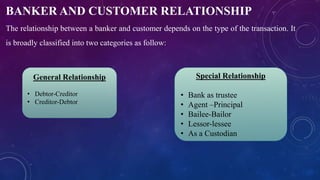
BANKER AND CUSTOMER RELATIONSHIP
The relationship between a banker and customer depends on the type of the transaction. It
is broadly classified into two categories as follow:
General Relationship
• Debtor-Creditor
• Creditor-Debtor
Special Relationship
• Bank as trustee
• Agent –Principal
• Bailee-Bailor
• Lessor-lessee
• As a Custodian
DEBTOR- CREDITOR RELATIONSHIP
• The relationship between the customer having deposit account and the bank is creditor
and debtor. Depositor is the lender and the banker is the borrower thus the customer is
creditor of the bank as money deposited in the bank is debt for the bank.
• The relationship between the customer taken loan from the bank and the bank is the
debtor and creditor. Loan provider is the lender and the customer is the borrower thus the
customer is the debtor of the bank is money taken as loan is debt for the customer.
BANK AS TRUSTEE RELATIONSHIP
• As per Sec. 3 of Indian trust act 1882: A trust is an obligation annexed to the ownership
of property and arising out of a confidence reposed in and accepted by the owner, or
declared and accepted by him, for the benefit of another and the owner.
• Thus trustee is the holder of the property on the behalf of the beneficiary.
• A banker become trustee when a customer deposits securities and other valuables with
the baker for the safe custody.
AGENT – PRINCIPAL RELATIONSHIP
• Sec. 182 of The Indian Contract Act 1872, defines “an agent” as a person employed to do
any act for another or to represent another in dealing with third person. The person for
whom such act is done or who is so represented is called “the principal”.
• Banks act as agent of customer as it collects cheques, bills, dividends, interest, securities
etc. and makes payment to various authorities such as rent, telephone bills, insurance
premium, EMIs etc. on the behalf of the customer.
BAILEE – BAILOR RELATIONSHIP
• Sec. 148 of Indian Contract Act 1872: A “bailment” is the delivery of goods by one person to
another for some purpose, upon a contract that they shall, when the purpose is accomplished,
be returned or otherwise disposed of according to the direction of the person delivering them.
• The person delivering the goods is called the “bailor” whereas to who, goods are delivered is
called the “bailee”.
• Banks secure their advances/loans by obtaining tangible securities. In some cases physical
possession of securities goods, valuables, bonds etc. are taken.
LESSOR – LESSEE RELATIONSHIP
• Sec. 105 of Transfer of Property Act 1882: A lease of immovable property is a transfer of a
right to enjoy such property, made for a certain time, express or implied, or in perpetuity,
in consideration of the price paid or promised, or of money or any other thig of value to
the transferor by the transferee, who accepts the transfer on such terms.
• The bank provides safe deposit lockers to the customers who hire them on lease basis. The
bank lease out the assets to the clients for their use on lease the customer become lessor
and bank become lessee.
AS A CUSTODIAN RELATIONSHIP
• A custodian is a person who act as caretaker of something. Bank take the legal
responsibilities for the customer’s deposits.
• Bank also take responsibilities for customer’s securities while opening demat
account bank become a custodian.
RIGHT OF A CUSTOMER
• A customer who has deposited money can draw cheque on his account up to the extent of
his credit balance or according to overdrawing limit sanctioned by the bank.
• A customer has the right to receive statement of accounts from the bank.
• A customer has right to sue bank for compensation of a wrongful dishonor of cheque.
• A customer has a right to sue and demand compensation if the bank fails to maintain the
secrecy of his account.
• A customer has right to claim for and receive the profit/return on his deposits as promised
by bank.
DUTIES OF A CUSTOMER
• It is the duty of the customer to present cheques and other negotiable instrument during the
business hour of the bank.
• The instruments of credit should be presented by the customer with in due time from their
dates of issue.
• A customer must keep the cheque books issued by the bank in safe custody. In case of the
theft or loss, it is the duty of customer to report the matter immediately to the bank.
• A customer should fill the cheques with utmost care.
• If a customer find any forgery in the amount of the Cheques issued by him. It should then
immediately be reported to the bank.
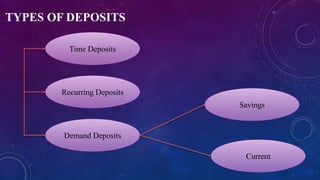
TYPES OF DEPOSITS
Time Deposits
Recurring Deposits
Demand Deposits
Current
Savings
TIME DEPOSITS
A Time Deposit also known as a Term Deposit is a deposit which has a fixed tenure and earns interest for
the customer. The tenure varies for each instrument and may even change from bank to bank. The most
widely used name for time deposits is Fixed Deposits. The common feature among all Time deposits is
that they cannot be withdrawn prematurely. One should thus plan their deposits according to their
requirement for money going forward. The more the money resides in the bank of a term deposit the
more interest it earns. Banks pay higher interest in longer-term deposits than on shorter ones
RECURRING DEPOSITS
In this case, a fixed amount, as decided by the depositor, is deposited at regular intervals till the end of
the tenure. The accumulated interest and the principal is given back to the depositor at the end of the
tenure. The tenure of a recurring deposit can be anything from six months to 120 months.
DEMAND DEPOSITS
As the name suggested, you can withdraw this deposit on demand. Such funds are held in accounts
where it is easier to withdraw money either by going to the bank or an ATM. Savings and Current
accounts are the two types of commonly used Demand Deposits account, In such type of deposits, the
risk is low but so is the return. However, there is one more factor that this type of deposit has and that
is liquidity since money can be withdrawn at a moment’s notice.
The reason for the existence of such accounts is to provide the customer convenience of meeting his
daily requirement of funds. It does not serve the purpose of ‘investment’ or ‘wealth creation’.
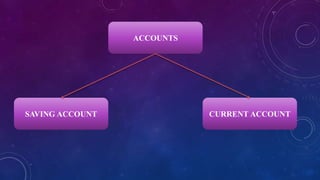
ACCOUNTS
CURRENT ACCOUNT
SAVING ACCOUNT
• SAVINGS ACCOUNT
These are interest-bearing accounts where the rate of interest depends on the bank where it is deposited. Further,
there are restrictions in terms of the number of times money can be withdrawn from this account. These
restrictions are also imposed by the bank and may vary between two banks. The depositor can withdraw his
money by going to the bank and use the withdrawal slip or use his cheque book or go to an ATM and use his card.
Money can also be transferred to someone else by using the cheque facility or using an electronic mode of
transfer.
• CURRENT ACCOUNT
This type of account is generally operated by companies and firms. These are the non-interest-bearing deposit and
serve the purpose of providing liquidity. Since there are many transactions in these accounts, the cost of managing
them is high. Hence banks ask the depositors to maintain a minimum deposit. Current accounts have overdraft
facility which the banks provide the customers to meet their short-term liquidity mismatch.
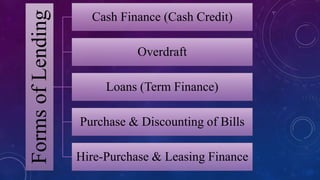
Forms
of
Lending
Cash Finance (Cash Credit)
Overdraft
Loans (Term Finance)
Purchase & Discounting of Bills
Hire-Purchase & Leasing Finance
CASH FINANCE (CASH CREDIT)
• A Cash credit is a very common form of borrowing by commercial and
industrial concerns, and it is made available either pledge or hypothecation of
goods.
• In cash finance, a borrower is allowed to borrow money up to a certain limit,
either at once or as and when required.
• The borrower prefer this form of lending due to the facility of paying markup or
service charges only on the amount he actually utilizes.
OVERDRAFT
• When a customer requires temporary adjustment, he may be allowed to overdraw his
current account. This arrangement like the cash credit is advantageous as he is required to
pay interest on the amount actually used by him.
• The main difference between cash credit & overdraft is the latter is supposed to be a form
of bank credit to be made use of occasionally & the former is used for long term by
commercial & industrial concerns doing regular business.
LOANS
• In case of loan, the banker advances a lump sum for a certain period at an agreed rate of
interest. The entire amount is paid on an occasion either in cash or by credit in his current
account which he can draw at any time.
• The interest is charged for the full amount sanctioned whether he withdraws the money from
his account or not. The loan may be repaid in installment or at the expiry of a certain period.
The loan may be made with or without security.
• A loan once repaid in full or in part cannot be withdrawn again by the customer. In case a
borrower wants further loan, he has to arrange for a fresh loan.
TWO CATEGORIES OF LOAN
UNSECURED
Those loans which are not covered by the
security of tangible assets. Such loans are
granted to firms/institution against the
personal security of the owner, manager or
director.
SECURED
Those loans which are granted against
the security of tangible assets, like stock
in trade and immovable property. Thus,
while granting loan against the security
of some assets, a charge is created over
the assets of the borrower in the favor of
bank.
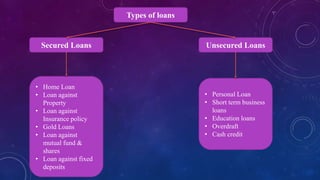
Types of loans
Unsecured Loans
Secured Loans
• Personal Loan
• Short term business
loans
• Education loans
• Overdraft
• Cash credit
• Home Loan
• Loan against
Property
• Loan against
Insurance policy
• Gold Loans
• Loan against
mutual fund &
shares
• Loan against fixed
deposits
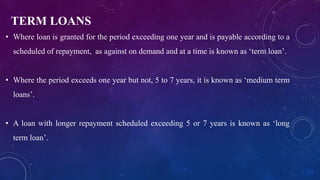
TERM LOANS
• Where loan is granted for the period exceeding one year and is payable according to a
scheduled of repayment, as against on demand and at a time is known as ‘term loan’.
• Where the period exceeds one year but not, 5 to 7 years, it is known as ‘medium term
loans’.
• A loan with longer repayment scheduled exceeding 5 or 7 years is known as ‘long
term loan’.
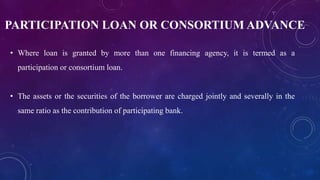
PARTICIPATION LOAN OR CONSORTIUM ADVANCE
• Where loan is granted by more than one financing agency, it is termed as a
participation or consortium loan.
• The assets or the securities of the borrower are charged jointly and severally in the
same ratio as the contribution of participating bank.
PURCHASE AND DISCOUNTING OF BILLS
• The banker advances money on the security of bill of exchange after
deducting a certain percentage, technically known as ‘discount’ from the face
value of the bill.
• When discounting, the banks deducts amount at mentioned discount rate and
balance is paid to the party.
HIRE-PURCHASE AND LEASING FINANCE
• Sometimes an intending purchaser has no money sufficient to purchase
a certain transport vehicle, machinery, computers or the other durable
consumer goods.
• Therefore, banks provide finance to hire purchase or lease the needed
goods.
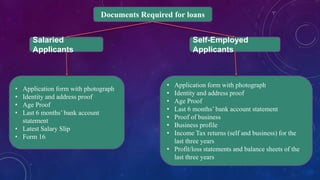
Documents Required for loans
Self-Employed
Applicants
Salaried
Applicants
• Application form with photograph
• Identity and address proof
• Age Proof
• Last 6 months’ bank account statement
• Proof of business
• Business profile
• Income Tax returns (self and business) for the
last three years
• Profit/loss statements and balance sheets of the
last three years
• Application form with photograph
• Identity and address proof
• Age Proof
• Last 6 months’ bank account
statement
• Latest Salary Slip
• Form 16
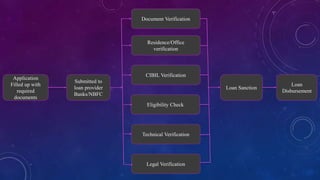
Application
Filled up with
required
documents
Submitted to
loan provider
Banks/NBFC
Loan Sanction
Loan
Disbursement
Document Verification
Residence/Office
verification
Legal Verification
Technical Verification
CIBIL Verification
Eligibility Check
ALM (ASSETS LIABILITY MANAGEMENT)
• Asset/liability management is the process of managing the use of assets and cash flows to
reduce the firm’s risk of loss from not paying a liability on time. Well-managed assets
and liabilities increase business profits.
• Asset and liability management (ALM) is a practice used by financial institutions to
mitigate financial risks resulting from a mismatch of assets and liabilities. ALM
strategies employ a combination of risk management and financial planning and are often
used by organizations to manage long-term risks that can arise due to changing
circumstances.
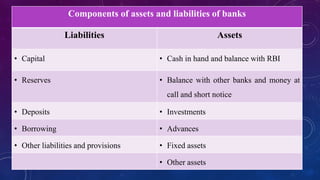
Components of assets and liabilities of banks
Liabilities Assets
• Capital • Cash in hand and balance with RBI
• Reserves • Balance with other banks and money at
call and short notice
• Deposits • Investments
• Borrowing • Advances
• Other liabilities and provisions • Fixed assets
• Other assets
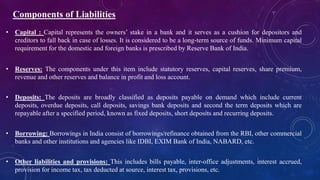
• Capital : Capital represents the owners’ stake in a bank and it serves as a cushion for depositors and
creditors to fall back in case of losses. It is considered to be a long-term source of funds. Minimum capital
requirement for the domestic and foreign banks is prescribed by Reserve Bank of India.
• Reserves: The components under this item include statutory reserves, capital reserves, share premium,
revenue and other reserves and balance in profit and loss account.
• Deposits: The deposits are broadly classified as deposits payable on demand which include current
deposits, overdue deposits, call deposits, savings bank deposits and second the term deposits which are
repayable after a specified period, known as fixed deposits, short deposits and recurring deposits.
• Borrowing: Borrowings in India consist of borrowings/refinance obtained from the RBI, other commercial
banks and other institutions and agencies like IDBI, EXIM Bank of India, NABARD, etc.
• Other liabilities and provisions: This includes bills payable, inter-office adjustments, interest accrued,
provision for income tax, tax deducted at source, interest tax, provisions, etc.
Components of Liabilities
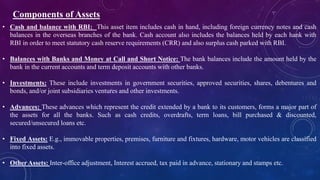
Components of Assets
• Cash and balance with RBI: This asset item includes cash in hand, including foreign currency notes and cash
balances in the overseas branches of the bank. Cash account also includes the balances held by each hank with
RBI in order to meet statutory cash reserve requirements (CRR) and also surplus cash parked with RBI.
• Balances with Banks and Money at Call and Short Notice: The bank balances include the amount held by the
bank in the current accounts and term deposit accounts with other banks.
• Investments: These include investments in government securities, approved securities, shares, debentures and
bonds, and/or joint subsidiaries ventures and other investments.
• Advances: These advances which represent the credit extended by a bank to its customers, forms a major part of
the assets for all the banks. Such as cash credits, overdrafts, term loans, bill purchased & discounted,
secured/unsecured loans etc.
• Fixed Assets: E.g., immovable properties, premises, furniture and fixtures, hardware, motor vehicles are classified
into fixed assets.
• Other Assets: Inter-office adjustment, Interest accrued, tax paid in advance, stationary and stamps etc.
OBJECTIVE OF ALM
• Meet financial goals
A primary function of ALM is generating earnings. Financial institutions have very specific financial goals.
Key profitability outputs ALM measures include net interest income, return on assets, and return on equity.
Within those outputs are metrics like yield on earning assets, cost of funds, non-interest income, and non-
interest expense that drive bottom-line profitability figures. An effective ALM process will consider different
strategies and approaches and measure the potential impact on profitability.
• Maintain safety and soundness.
Bank and credit union leaders are also acutely aware of regulatory expectations in terms of providing
assurances of the long-term viability and solvency of the institution. Usually expressed in the form of
regulatory capital ratios, these ratios ensure institutions have enough capital to withstand adverse financial or
economic scenarios. After the great recession in the late 2000s, regulatory expectations of capital levels are
higher than ever, which can lead institutions to be conservative in terms of risk-taking. ALM combined with
an effective capital planning process can help ensure that an institution’s strategies don’t jeopardize capital
levels and lead to regulatory pressure that can further constrain the institution’s operations.
• Manage risks
where there’s potential return, there is always potential risk, and banking is no different. Risk in the
context of ALM is the difference between expected cash flows versus and actual cash flows. The
logical example here is credit risk. When making an auto loan with an 8% interest rate, an institution
expects to collect all the cash flows from principal and interest, but that isn’t always what happens.
Sometimes the borrower defaults, and the institution never collects all that it’s owed and expected to
collect. That loss of yield on earning assets has an impact on financial goals like margin, ROA, and
ROE. An effective ALM model will help measure the level of potential risk in different market
conditions to help decision-makers discern which strategies show the opportunity to create enough
return to meet desired goals while also actively managing risks that could jeopardize the safety and
soundness of the institution.
Three main risks institutions face:
• Credit risk
• Interest rate risk
• Liquidity risk
SIGNIFICANCE OFASSETS LIABILITY MANAGEMENT
• Volatility: Deregulation of financial system changed the dynamics of financial markets. The vagaries of such
free economic environment are reflected in interest rate structures, money supply and the overall credit
position of the market, the exchange rates and price levels.
• Product Innovation: The second reason for growing importance of ALM is the rapid innovations taking
place in the financial products of the bank. While there were some innovations that came as passing fads,
others have received tremendous response. Whatever may be features of the products, most of them have an
impact on the risk profile of the bank thereby enhancing the need for ALM.
• Regulatory Environment: At the international level, Bank for International Settlements (BIS) provides a
framework for banks to tackle the market risks that may arise due to rate fluctuations and excessive credit
risk. Central Banks in various countries (including Reserve Bank of India) have issued frameworks and
guidelines for banks to develop Asset Liability Management policies.
• Management Recognition: All the above-mentioned aspects forced bank managements to give a serious
thought to effective management of assets and liabilities. The managements have realized that it is just not
sufficient to have a very good franchise for credit disbursement, nor is it enough to have just a very good
retail deposit base. In addition to these, a bank should be in a position to relate and link the asset side with the
liability side. And this calls for efficient asset-liability management.
BANKING INSTRUMENTS
• Cheque
• Bank Draft
• Debit Card
• Credit Card
CHEQUE
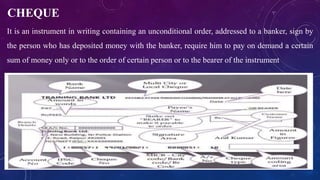
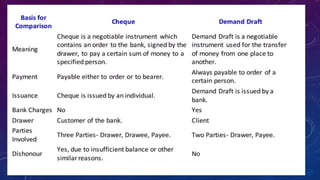
It is an instrument in writing containing an unconditional order, addressed to a banker, sign by
the person who has deposited money with the banker, require him to pay on demand a certain
sum of money only or to the order of certain person or to the bearer of the instrument
TYPES OF CHEQUES
• Bearer Cheque/ Open Cheque
When the words “or bearer” appearing on the face of the cheque are not cancelled, the
cheque is called a bearer cheque. The bearer cheque is payable to the person specified
therein or to any other else who present it to the bank for payment.
• Order Cheques
When the word “bearer” appearing on the face of the cheque is cancelled and when in its
place the word “or order” is written on the face of the cheque, the cheque is called an
order, such cheque is payable to a specified person only.
TYPES OF CHEQUES
• Crossed Cheque
Crossing of cheque means drawing two parallel lines on the face of the cheques with
or without additional word like “& CO” or “Account Payee” or “not negotiable”. A
crossed cheque cannot be uncashed at the cash counter of a bank but it can only be
credited to the payee’s account
• Traveller’s Cheque
Traveller’s cheques are often used by the individuals who are travelling on vacation to
the different states or foreign countries. The cheque were first introduced by American
Express back in 1891.
DEMAND DRAFT
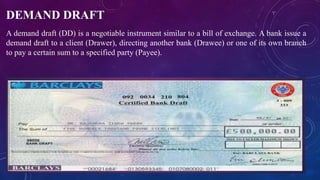
A demand draft (DD) is a negotiable instrument similar to a bill of exchange. A bank issue a
demand draft to a client (Drawer), directing another bank (Drawee) or one of its own branch
to pay a certain sum to a specified party (Payee).
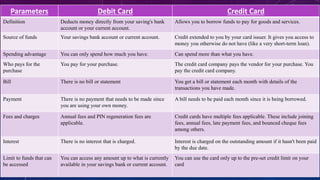
Parameters Debit Card Credit Card
Definition Deducts money directly from your saving's bank
account or your current account.
Allows you to borrow funds to pay for goods and services.
Source of funds Your savings bank account or current account. Credit extended to you by your card issuer. It gives you access to
money you otherwise do not have (like a very short-term loan).
Spending advantage You can only spend how much you have. Can spend more than what you have.
Who pays for the
purchase
You pay for your purchase. The credit card company pays the vendor for your purchase. You
pay the credit card company.
Bill There is no bill or statement You get a bill or statement each month with details of the
transactions you have made.
Payment There is no payment that needs to be made since
you are using your own money.
A bill needs to be paid each month since it is being borrowed.
Fees and charges Annual fees and PIN regeneration fees are
applicable.
Credit cards have multiple fees applicable. These include joining
fees, annual fees, late payment fees, and bounced cheque fees
among others.
Interest There is no interest that is charged. Interest is charged on the outstanding amount if it hasn't been paid
by the due date.
Limit to funds that can
be accessed
You can access any amount up to what is currently
available in your savings bank or current account.
You can use the card only up to the pre-set credit limit on your
card
UNIVERSAL BANKING
• Universal banking can be defined as a banking system that offers a wide range of banking
and financial services (like insurance, development banking, investment banking,
commercial banking, and other financial services) in comparison to traditional banking
institutions.
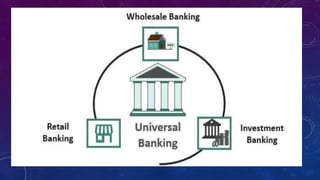
• In simple terms, it can also be understood as a combination of all three services that is
retail banking, investment banking, and wholesale banking. This system offers asset
management, deposits, payment processing, investment advisory, underwriting, securities
transactions, financial analysis, merchant banking, factoring, mutual funds, credit cards,
auto loans, insurance, housing finance, retail loans, etc.
Advantages of Universal Banking
Investors’ faith-: Banking companies, operating as universal banks, hold equity shares of many entities. It enables
them to gain investors from the companies in which they hold stakes. The investors will show a lot of trust and
faith in these banks and transact with them.
Optimum utilization-: of resources- Universal banks ensure that there is the optimal utilization of all the
resources. These banks evaluate the customers’ ability to take risks and accordingly use their resources. For a
customer capable of dealing with high risks, the bank will suggest an investment with a risky portfolio. If a
customer is not capable of dealing with high risks, then the bank will suggest to them an investment with decent
and moderate risks.
Other benefits-: Such banks even offer other advantages like diversification of risks, easy marketing, and a huge
range of services under one roof.
Bank and Customer.pptx

Bank and Customer.pptx

  • 1.
    BANKING & FINANCIALSERVICES BM/SOM/E-403-F-7 UNIT 2 – BANK & CUSTOMER
  • 2.
    WHO IS A‘CUSTOMER’ ? • A person who buys goods or services from a shop or a business entity is known as the customer. • The term customer in banking context is not defined by any act . • Thus in banking a person/company/entity who has an account with a bank is a customer.
  • 3.
    BANKER AND CUSTOMERRELATIONSHIP The relationship between a banker and customer depends on the type of the transaction. It is broadly classified into two categories as follow: General Relationship • Debtor-Creditor • Creditor-Debtor Special Relationship • Bank as trustee • Agent –Principal • Bailee-Bailor • Lessor-lessee • As a Custodian
  • 4.
    DEBTOR- CREDITOR RELATIONSHIP •The relationship between the customer having deposit account and the bank is creditor and debtor. Depositor is the lender and the banker is the borrower thus the customer is creditor of the bank as money deposited in the bank is debt for the bank. • The relationship between the customer taken loan from the bank and the bank is the debtor and creditor. Loan provider is the lender and the customer is the borrower thus the customer is the debtor of the bank is money taken as loan is debt for the customer.
  • 5.
    BANK AS TRUSTEERELATIONSHIP • As per Sec. 3 of Indian trust act 1882: A trust is an obligation annexed to the ownership of property and arising out of a confidence reposed in and accepted by the owner, or declared and accepted by him, for the benefit of another and the owner. • Thus trustee is the holder of the property on the behalf of the beneficiary. • A banker become trustee when a customer deposits securities and other valuables with the baker for the safe custody.
  • 6.
    AGENT – PRINCIPALRELATIONSHIP • Sec. 182 of The Indian Contract Act 1872, defines “an agent” as a person employed to do any act for another or to represent another in dealing with third person. The person for whom such act is done or who is so represented is called “the principal”. • Banks act as agent of customer as it collects cheques, bills, dividends, interest, securities etc. and makes payment to various authorities such as rent, telephone bills, insurance premium, EMIs etc. on the behalf of the customer.
  • 7.
    BAILEE – BAILORRELATIONSHIP • Sec. 148 of Indian Contract Act 1872: A “bailment” is the delivery of goods by one person to another for some purpose, upon a contract that they shall, when the purpose is accomplished, be returned or otherwise disposed of according to the direction of the person delivering them. • The person delivering the goods is called the “bailor” whereas to who, goods are delivered is called the “bailee”. • Banks secure their advances/loans by obtaining tangible securities. In some cases physical possession of securities goods, valuables, bonds etc. are taken.
  • 8.
    LESSOR – LESSEERELATIONSHIP • Sec. 105 of Transfer of Property Act 1882: A lease of immovable property is a transfer of a right to enjoy such property, made for a certain time, express or implied, or in perpetuity, in consideration of the price paid or promised, or of money or any other thig of value to the transferor by the transferee, who accepts the transfer on such terms. • The bank provides safe deposit lockers to the customers who hire them on lease basis. The bank lease out the assets to the clients for their use on lease the customer become lessor and bank become lessee.
  • 9.
    AS A CUSTODIANRELATIONSHIP • A custodian is a person who act as caretaker of something. Bank take the legal responsibilities for the customer’s deposits. • Bank also take responsibilities for customer’s securities while opening demat account bank become a custodian.
  • 10.
    RIGHT OF ACUSTOMER • A customer who has deposited money can draw cheque on his account up to the extent of his credit balance or according to overdrawing limit sanctioned by the bank. • A customer has the right to receive statement of accounts from the bank. • A customer has right to sue bank for compensation of a wrongful dishonor of cheque. • A customer has a right to sue and demand compensation if the bank fails to maintain the secrecy of his account. • A customer has right to claim for and receive the profit/return on his deposits as promised by bank.
  • 11.
    DUTIES OF ACUSTOMER • It is the duty of the customer to present cheques and other negotiable instrument during the business hour of the bank. • The instruments of credit should be presented by the customer with in due time from their dates of issue. • A customer must keep the cheque books issued by the bank in safe custody. In case of the theft or loss, it is the duty of customer to report the matter immediately to the bank. • A customer should fill the cheques with utmost care. • If a customer find any forgery in the amount of the Cheques issued by him. It should then immediately be reported to the bank.
  • 12.
    TYPES OF DEPOSITS TimeDeposits Recurring Deposits Demand Deposits Current Savings
  • 13.
    TIME DEPOSITS A TimeDeposit also known as a Term Deposit is a deposit which has a fixed tenure and earns interest for the customer. The tenure varies for each instrument and may even change from bank to bank. The most widely used name for time deposits is Fixed Deposits. The common feature among all Time deposits is that they cannot be withdrawn prematurely. One should thus plan their deposits according to their requirement for money going forward. The more the money resides in the bank of a term deposit the more interest it earns. Banks pay higher interest in longer-term deposits than on shorter ones RECURRING DEPOSITS In this case, a fixed amount, as decided by the depositor, is deposited at regular intervals till the end of the tenure. The accumulated interest and the principal is given back to the depositor at the end of the tenure. The tenure of a recurring deposit can be anything from six months to 120 months.
  • 14.
    DEMAND DEPOSITS As thename suggested, you can withdraw this deposit on demand. Such funds are held in accounts where it is easier to withdraw money either by going to the bank or an ATM. Savings and Current accounts are the two types of commonly used Demand Deposits account, In such type of deposits, the risk is low but so is the return. However, there is one more factor that this type of deposit has and that is liquidity since money can be withdrawn at a moment’s notice. The reason for the existence of such accounts is to provide the customer convenience of meeting his daily requirement of funds. It does not serve the purpose of ‘investment’ or ‘wealth creation’.
  • 15.
  • 16.
    • SAVINGS ACCOUNT Theseare interest-bearing accounts where the rate of interest depends on the bank where it is deposited. Further, there are restrictions in terms of the number of times money can be withdrawn from this account. These restrictions are also imposed by the bank and may vary between two banks. The depositor can withdraw his money by going to the bank and use the withdrawal slip or use his cheque book or go to an ATM and use his card. Money can also be transferred to someone else by using the cheque facility or using an electronic mode of transfer. • CURRENT ACCOUNT This type of account is generally operated by companies and firms. These are the non-interest-bearing deposit and serve the purpose of providing liquidity. Since there are many transactions in these accounts, the cost of managing them is high. Hence banks ask the depositors to maintain a minimum deposit. Current accounts have overdraft facility which the banks provide the customers to meet their short-term liquidity mismatch.
  • 17.
    Forms of Lending Cash Finance (CashCredit) Overdraft Loans (Term Finance) Purchase & Discounting of Bills Hire-Purchase & Leasing Finance
  • 18.
    CASH FINANCE (CASHCREDIT) • A Cash credit is a very common form of borrowing by commercial and industrial concerns, and it is made available either pledge or hypothecation of goods. • In cash finance, a borrower is allowed to borrow money up to a certain limit, either at once or as and when required. • The borrower prefer this form of lending due to the facility of paying markup or service charges only on the amount he actually utilizes.
  • 19.
    OVERDRAFT • When acustomer requires temporary adjustment, he may be allowed to overdraw his current account. This arrangement like the cash credit is advantageous as he is required to pay interest on the amount actually used by him. • The main difference between cash credit & overdraft is the latter is supposed to be a form of bank credit to be made use of occasionally & the former is used for long term by commercial & industrial concerns doing regular business.
  • 20.
    LOANS • In caseof loan, the banker advances a lump sum for a certain period at an agreed rate of interest. The entire amount is paid on an occasion either in cash or by credit in his current account which he can draw at any time. • The interest is charged for the full amount sanctioned whether he withdraws the money from his account or not. The loan may be repaid in installment or at the expiry of a certain period. The loan may be made with or without security. • A loan once repaid in full or in part cannot be withdrawn again by the customer. In case a borrower wants further loan, he has to arrange for a fresh loan.
  • 21.
    TWO CATEGORIES OFLOAN UNSECURED Those loans which are not covered by the security of tangible assets. Such loans are granted to firms/institution against the personal security of the owner, manager or director. SECURED Those loans which are granted against the security of tangible assets, like stock in trade and immovable property. Thus, while granting loan against the security of some assets, a charge is created over the assets of the borrower in the favor of bank.
  • 22.
    Types of loans UnsecuredLoans Secured Loans • Personal Loan • Short term business loans • Education loans • Overdraft • Cash credit • Home Loan • Loan against Property • Loan against Insurance policy • Gold Loans • Loan against mutual fund & shares • Loan against fixed deposits
  • 23.
    TERM LOANS • Whereloan is granted for the period exceeding one year and is payable according to a scheduled of repayment, as against on demand and at a time is known as ‘term loan’. • Where the period exceeds one year but not, 5 to 7 years, it is known as ‘medium term loans’. • A loan with longer repayment scheduled exceeding 5 or 7 years is known as ‘long term loan’.
  • 24.
    PARTICIPATION LOAN ORCONSORTIUM ADVANCE • Where loan is granted by more than one financing agency, it is termed as a participation or consortium loan. • The assets or the securities of the borrower are charged jointly and severally in the same ratio as the contribution of participating bank.
  • 25.
    PURCHASE AND DISCOUNTINGOF BILLS • The banker advances money on the security of bill of exchange after deducting a certain percentage, technically known as ‘discount’ from the face value of the bill. • When discounting, the banks deducts amount at mentioned discount rate and balance is paid to the party.
  • 26.
    HIRE-PURCHASE AND LEASINGFINANCE • Sometimes an intending purchaser has no money sufficient to purchase a certain transport vehicle, machinery, computers or the other durable consumer goods. • Therefore, banks provide finance to hire purchase or lease the needed goods.
  • 27.
    Documents Required forloans Self-Employed Applicants Salaried Applicants • Application form with photograph • Identity and address proof • Age Proof • Last 6 months’ bank account statement • Proof of business • Business profile • Income Tax returns (self and business) for the last three years • Profit/loss statements and balance sheets of the last three years • Application form with photograph • Identity and address proof • Age Proof • Last 6 months’ bank account statement • Latest Salary Slip • Form 16
  • 28.
    Application Filled up with required documents Submittedto loan provider Banks/NBFC Loan Sanction Loan Disbursement Document Verification Residence/Office verification Legal Verification Technical Verification CIBIL Verification Eligibility Check
  • 29.
    ALM (ASSETS LIABILITYMANAGEMENT) • Asset/liability management is the process of managing the use of assets and cash flows to reduce the firm’s risk of loss from not paying a liability on time. Well-managed assets and liabilities increase business profits. • Asset and liability management (ALM) is a practice used by financial institutions to mitigate financial risks resulting from a mismatch of assets and liabilities. ALM strategies employ a combination of risk management and financial planning and are often used by organizations to manage long-term risks that can arise due to changing circumstances.
  • 30.
    Components of assetsand liabilities of banks Liabilities Assets • Capital • Cash in hand and balance with RBI • Reserves • Balance with other banks and money at call and short notice • Deposits • Investments • Borrowing • Advances • Other liabilities and provisions • Fixed assets • Other assets
  • 31.
    • Capital :Capital represents the owners’ stake in a bank and it serves as a cushion for depositors and creditors to fall back in case of losses. It is considered to be a long-term source of funds. Minimum capital requirement for the domestic and foreign banks is prescribed by Reserve Bank of India. • Reserves: The components under this item include statutory reserves, capital reserves, share premium, revenue and other reserves and balance in profit and loss account. • Deposits: The deposits are broadly classified as deposits payable on demand which include current deposits, overdue deposits, call deposits, savings bank deposits and second the term deposits which are repayable after a specified period, known as fixed deposits, short deposits and recurring deposits. • Borrowing: Borrowings in India consist of borrowings/refinance obtained from the RBI, other commercial banks and other institutions and agencies like IDBI, EXIM Bank of India, NABARD, etc. • Other liabilities and provisions: This includes bills payable, inter-office adjustments, interest accrued, provision for income tax, tax deducted at source, interest tax, provisions, etc. Components of Liabilities
  • 32.
    Components of Assets •Cash and balance with RBI: This asset item includes cash in hand, including foreign currency notes and cash balances in the overseas branches of the bank. Cash account also includes the balances held by each hank with RBI in order to meet statutory cash reserve requirements (CRR) and also surplus cash parked with RBI. • Balances with Banks and Money at Call and Short Notice: The bank balances include the amount held by the bank in the current accounts and term deposit accounts with other banks. • Investments: These include investments in government securities, approved securities, shares, debentures and bonds, and/or joint subsidiaries ventures and other investments. • Advances: These advances which represent the credit extended by a bank to its customers, forms a major part of the assets for all the banks. Such as cash credits, overdrafts, term loans, bill purchased & discounted, secured/unsecured loans etc. • Fixed Assets: E.g., immovable properties, premises, furniture and fixtures, hardware, motor vehicles are classified into fixed assets. • Other Assets: Inter-office adjustment, Interest accrued, tax paid in advance, stationary and stamps etc.
  • 33.
    OBJECTIVE OF ALM •Meet financial goals A primary function of ALM is generating earnings. Financial institutions have very specific financial goals. Key profitability outputs ALM measures include net interest income, return on assets, and return on equity. Within those outputs are metrics like yield on earning assets, cost of funds, non-interest income, and non- interest expense that drive bottom-line profitability figures. An effective ALM process will consider different strategies and approaches and measure the potential impact on profitability. • Maintain safety and soundness. Bank and credit union leaders are also acutely aware of regulatory expectations in terms of providing assurances of the long-term viability and solvency of the institution. Usually expressed in the form of regulatory capital ratios, these ratios ensure institutions have enough capital to withstand adverse financial or economic scenarios. After the great recession in the late 2000s, regulatory expectations of capital levels are higher than ever, which can lead institutions to be conservative in terms of risk-taking. ALM combined with an effective capital planning process can help ensure that an institution’s strategies don’t jeopardize capital levels and lead to regulatory pressure that can further constrain the institution’s operations.
  • 34.
    • Manage risks wherethere’s potential return, there is always potential risk, and banking is no different. Risk in the context of ALM is the difference between expected cash flows versus and actual cash flows. The logical example here is credit risk. When making an auto loan with an 8% interest rate, an institution expects to collect all the cash flows from principal and interest, but that isn’t always what happens. Sometimes the borrower defaults, and the institution never collects all that it’s owed and expected to collect. That loss of yield on earning assets has an impact on financial goals like margin, ROA, and ROE. An effective ALM model will help measure the level of potential risk in different market conditions to help decision-makers discern which strategies show the opportunity to create enough return to meet desired goals while also actively managing risks that could jeopardize the safety and soundness of the institution. Three main risks institutions face: • Credit risk • Interest rate risk • Liquidity risk


  • 35.
    SIGNIFICANCE OFASSETS LIABILITYMANAGEMENT • Volatility: Deregulation of financial system changed the dynamics of financial markets. The vagaries of such free economic environment are reflected in interest rate structures, money supply and the overall credit position of the market, the exchange rates and price levels. • Product Innovation: The second reason for growing importance of ALM is the rapid innovations taking place in the financial products of the bank. While there were some innovations that came as passing fads, others have received tremendous response. Whatever may be features of the products, most of them have an impact on the risk profile of the bank thereby enhancing the need for ALM. • Regulatory Environment: At the international level, Bank for International Settlements (BIS) provides a framework for banks to tackle the market risks that may arise due to rate fluctuations and excessive credit risk. Central Banks in various countries (including Reserve Bank of India) have issued frameworks and guidelines for banks to develop Asset Liability Management policies. • Management Recognition: All the above-mentioned aspects forced bank managements to give a serious thought to effective management of assets and liabilities. The managements have realized that it is just not sufficient to have a very good franchise for credit disbursement, nor is it enough to have just a very good retail deposit base. In addition to these, a bank should be in a position to relate and link the asset side with the liability side. And this calls for efficient asset-liability management.
  • 36.
    BANKING INSTRUMENTS • Cheque •Bank Draft • Debit Card • Credit Card
  • 37.
    CHEQUE It is aninstrument in writing containing an unconditional order, addressed to a banker, sign by the person who has deposited money with the banker, require him to pay on demand a certain sum of money only or to the order of certain person or to the bearer of the instrument
  • 38.
    TYPES OF CHEQUES •Bearer Cheque/ Open Cheque When the words “or bearer” appearing on the face of the cheque are not cancelled, the cheque is called a bearer cheque. The bearer cheque is payable to the person specified therein or to any other else who present it to the bank for payment. • Order Cheques When the word “bearer” appearing on the face of the cheque is cancelled and when in its place the word “or order” is written on the face of the cheque, the cheque is called an order, such cheque is payable to a specified person only.
  • 39.
    TYPES OF CHEQUES •Crossed Cheque Crossing of cheque means drawing two parallel lines on the face of the cheques with or without additional word like “& CO” or “Account Payee” or “not negotiable”. A crossed cheque cannot be uncashed at the cash counter of a bank but it can only be credited to the payee’s account • Traveller’s Cheque Traveller’s cheques are often used by the individuals who are travelling on vacation to the different states or foreign countries. The cheque were first introduced by American Express back in 1891.
  • 40.
    DEMAND DRAFT A demanddraft (DD) is a negotiable instrument similar to a bill of exchange. A bank issue a demand draft to a client (Drawer), directing another bank (Drawee) or one of its own branch to pay a certain sum to a specified party (Payee).
  • 42.
    Parameters Debit CardCredit Card Definition Deducts money directly from your saving's bank account or your current account. Allows you to borrow funds to pay for goods and services. Source of funds Your savings bank account or current account. Credit extended to you by your card issuer. It gives you access to money you otherwise do not have (like a very short-term loan). Spending advantage You can only spend how much you have. Can spend more than what you have. Who pays for the purchase You pay for your purchase. The credit card company pays the vendor for your purchase. You pay the credit card company. Bill There is no bill or statement You get a bill or statement each month with details of the transactions you have made. Payment There is no payment that needs to be made since you are using your own money. A bill needs to be paid each month since it is being borrowed. Fees and charges Annual fees and PIN regeneration fees are applicable. Credit cards have multiple fees applicable. These include joining fees, annual fees, late payment fees, and bounced cheque fees among others. Interest There is no interest that is charged. Interest is charged on the outstanding amount if it hasn't been paid by the due date. Limit to funds that can be accessed You can access any amount up to what is currently available in your savings bank or current account. You can use the card only up to the pre-set credit limit on your card
  • 43.
    UNIVERSAL BANKING • Universalbanking can be defined as a banking system that offers a wide range of banking and financial services (like insurance, development banking, investment banking, commercial banking, and other financial services) in comparison to traditional banking institutions. • In simple terms, it can also be understood as a combination of all three services that is retail banking, investment banking, and wholesale banking. This system offers asset management, deposits, payment processing, investment advisory, underwriting, securities transactions, financial analysis, merchant banking, factoring, mutual funds, credit cards, auto loans, insurance, housing finance, retail loans, etc.
  • 45.
    Advantages of UniversalBanking Investors’ faith-: Banking companies, operating as universal banks, hold equity shares of many entities. It enables them to gain investors from the companies in which they hold stakes. The investors will show a lot of trust and faith in these banks and transact with them. Optimum utilization-: of resources- Universal banks ensure that there is the optimal utilization of all the resources. These banks evaluate the customers’ ability to take risks and accordingly use their resources. For a customer capable of dealing with high risks, the bank will suggest an investment with a risky portfolio. If a customer is not capable of dealing with high risks, then the bank will suggest to them an investment with decent and moderate risks. Other benefits-: Such banks even offer other advantages like diversification of risks, easy marketing, and a huge range of services under one roof.