Executive Roundtable: The impact of IFRS on the Banking industry   Bangkok , 21 April 2009   European view on IFRS   Roger Kaiser  European Banking Federation
Agenda • The EU strategy towards a single set of accounting rules • The EU endorsement procedure for IFRS • The positions of European industry on the major issues related to IFRS  • Conclusive Remarks
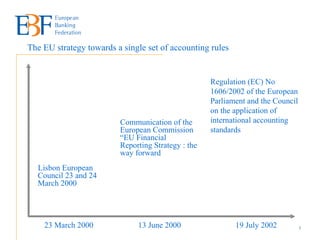
Lisbon European Council 23 and 24 March 2000  Communication of the European Commission “EU Financial Reporting Strategy : the way forward Regulation (EC) No 1606/2002 of the European Parliament and the Council on the application of international accounting standards 23 March 2000 13 June 2000 19 July 2002 The EU strategy towards a single set of accounting rules
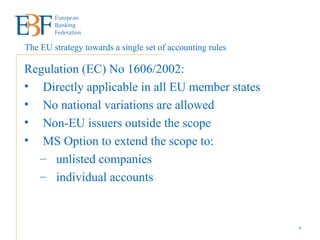
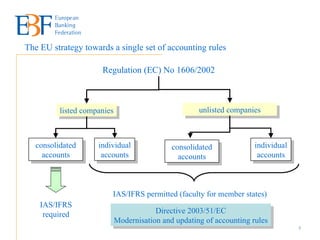
Regulation (EC) No 1606/2002:  Directly applicable in all EU member states No national variations are allowed Non-EU issuers outside the scope  MS Option to extend the scope to: unlisted companies  individual accounts The EU strategy   towards a single set of accounting rules
listed companies unlisted companies consolidated accounts individual accounts IAS/IFRS required individual accounts IAS/IFRS permitted (faculty for member states) Regulation (EC) No 1606/2002 The EU strategy   towards a single set of accounting rules consolidated accounts Directive 2003/51/EC Modernisation and updating of accounting rules
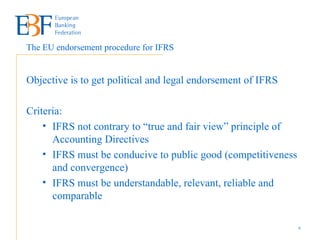
Objective is to get political and legal endorsement of IFRS Criteria: IFRS not contrary to “true and fair view” principle of Accounting Directives IFRS must be conducive to public good (competitiveness and convergence) IFRS must be understandable, relevant, reliable and comparable The EU endorsement procedure for IFRS
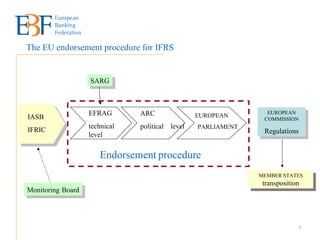
IASB IFRIC EFRAG technical level ARC political  level Endorsement   procedure   EUROPEAN  PARLIAMENT MEMBER STATES transposition EUROPEAN COMMISSION Regulations The EU endorsement procedure for IFRS SARG Monitoring   Board
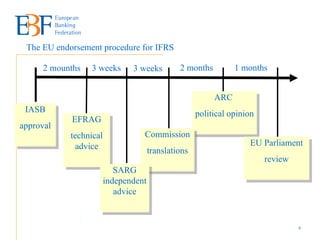
IASB approval EFRAG technical advice ARC  political opinion EU Parliament review 2 mounths 3 weeks Commission translations SARG independent advice The EU endorsement procedure for IFRS 3 weeks 2 months 1 months
At the moment, all IAS/IFRS and SIC/IFRIC were endorsed without problems, except some provisions of IAS 39 on: hedge accounting  Fair Value Option Endorsed IAS/IFRS and SIC/IFRIC published in full in all official languages of the Community in the Official Journal The EU endorsement procedure for IFRS
The positions of European industry on the major issues related to IFRS  Support for a rapid convergence of IFRS and US GAAP Neutrality of IAS/IFRS versus firms’ business models IFRS should serve multi-tier purposes Mixed model of valuation is the only model that is able to take into account the complexity of the banking business The governance and membership of the IASB must be reviewed as a key priority
The EU supports worldwide use of IFRS IFRS has speeded up accounting reforms in major markets  IFRS often integrated into national GAAPs The issue of ”equivalence” according to the Prospectus and Transparency Directives Mutual recognition in the US 4. Conclusive Remarks

Bangkok, April 2009

  • 1.
    Executive Roundtable: Theimpact of IFRS on the Banking industry Bangkok , 21 April 2009 European view on IFRS Roger Kaiser European Banking Federation
  • 2.
    Agenda • TheEU strategy towards a single set of accounting rules • The EU endorsement procedure for IFRS • The positions of European industry on the major issues related to IFRS • Conclusive Remarks
  • 3.
    Lisbon European Council23 and 24 March 2000 Communication of the European Commission “EU Financial Reporting Strategy : the way forward Regulation (EC) No 1606/2002 of the European Parliament and the Council on the application of international accounting standards 23 March 2000 13 June 2000 19 July 2002 The EU strategy towards a single set of accounting rules
  • 4.
    Regulation (EC) No1606/2002: Directly applicable in all EU member states No national variations are allowed Non-EU issuers outside the scope MS Option to extend the scope to: unlisted companies individual accounts The EU strategy towards a single set of accounting rules
  • 5.
    listed companies unlistedcompanies consolidated accounts individual accounts IAS/IFRS required individual accounts IAS/IFRS permitted (faculty for member states) Regulation (EC) No 1606/2002 The EU strategy towards a single set of accounting rules consolidated accounts Directive 2003/51/EC Modernisation and updating of accounting rules
  • 6.
    Objective is toget political and legal endorsement of IFRS Criteria: IFRS not contrary to “true and fair view” principle of Accounting Directives IFRS must be conducive to public good (competitiveness and convergence) IFRS must be understandable, relevant, reliable and comparable The EU endorsement procedure for IFRS
  • 7.
    IASB IFRIC EFRAGtechnical level ARC political level Endorsement procedure EUROPEAN PARLIAMENT MEMBER STATES transposition EUROPEAN COMMISSION Regulations The EU endorsement procedure for IFRS SARG Monitoring Board
  • 8.
    IASB approval EFRAGtechnical advice ARC political opinion EU Parliament review 2 mounths 3 weeks Commission translations SARG independent advice The EU endorsement procedure for IFRS 3 weeks 2 months 1 months
  • 9.
    At the moment,all IAS/IFRS and SIC/IFRIC were endorsed without problems, except some provisions of IAS 39 on: hedge accounting Fair Value Option Endorsed IAS/IFRS and SIC/IFRIC published in full in all official languages of the Community in the Official Journal The EU endorsement procedure for IFRS
  • 10.
    The positions ofEuropean industry on the major issues related to IFRS Support for a rapid convergence of IFRS and US GAAP Neutrality of IAS/IFRS versus firms’ business models IFRS should serve multi-tier purposes Mixed model of valuation is the only model that is able to take into account the complexity of the banking business The governance and membership of the IASB must be reviewed as a key priority
  • 11.
    The EU supportsworldwide use of IFRS IFRS has speeded up accounting reforms in major markets IFRS often integrated into national GAAPs The issue of ”equivalence” according to the Prospectus and Transparency Directives Mutual recognition in the US 4. Conclusive Remarks