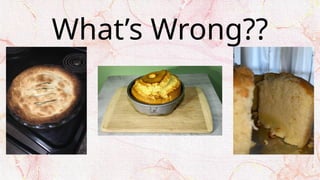
What’s Wrong??
Basic Steps in Baking
Lesson 4
1. Read the recipe
carefully to know if you
have all the ingredients
and the utensils needed
and if you understand the
entire procedure.
2. Check all the necessary
ingredients gather and
arrange them according to
the sequence of their
preparation.
3. Prepare all the utensils
needed for measuring,
mixing, and baking.
4. Preheat the oven. Set
the oven knob at the
desired temperature.
5. Prepare the pan/pans needed;
make sure to use the correct pan
size.
If it needs greasing, brushing
the pan bottom with a little
shortening.
For baking purposes, don’t use
butter or margarine for greasing
because these easily burn and will
produce a very brown crust.
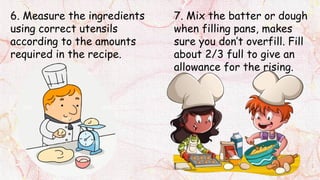
6. Measure the ingredients
using correct utensils
according to the amounts
required in the recipe.
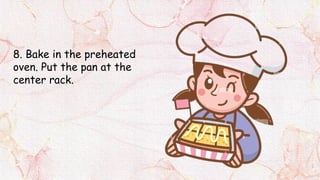
7. Mix the batter or dough
when filling pans, makes
sure you don’t overfill. Fill
about 2/3 full to give an
allowance for the rising.
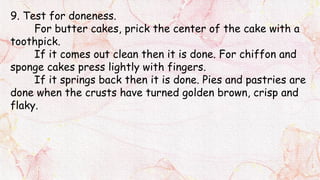
8. Bake in the preheated
oven. Put the pan at the
center rack.
9. Test for doneness.
For butter cakes, prick the center of the cake with a
toothpick.
If it comes out clean then it is done. For chiffon and
sponge cakes press lightly with fingers.
If it springs back then it is done. Pies and pastries are
done when the crusts have turned golden brown, crisp and
flaky.
10. Cool the baked products.
For butter cakes, put the pan on a wire rack and leave
to cool for 10 minutes.
Afterwards, invert pan to remove the cake and cool it
completely.
For sponge and chiffon cakes, invert pans at once in
wire racks. Then, decorate.
Baking guidelines:
1. Preheat oven to desired/prescribed temperature.
2. Check oven racks are properly placed.
3. Arrange baking pans of similar shapes inside the oven
one inch apart from all sides.
4. Follow correct oven temperature prescribed by the
recipe. Incorrect oven temperature results to poor
volume, texture, form and color.
5. Avoid opening the oven while baking.
6. Cool cakes by using a cake rack. To remove cakes from
the pan, slide a spatula around the pan and turn upside
down.
Testing for Doneness
1. Use a cake tester to determine doneness of a cake by
inserting at the center of the cake. When the cake
tester comes out clean, the cake is baked.
2. The cake springs back on top and sides when pressed.
3. The cake shrinks away from the sides of the pan
Common Cake
Problems and its
Causes
Lesson 5
What are the common causes of having
a failure cake?
Do you know how to fix a bad cake?
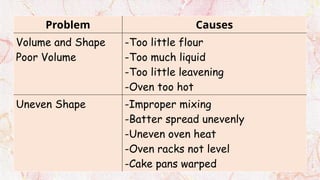
Problem Causes
Volume and Shape
Poor Volume
-Too little flour
-Too much liquid
-Too little leavening
-Oven too hot
Uneven Shape -Improper mixing
-Batter spread unevenly
-Uneven oven heat
-Oven racks not level
-Cake pans warped
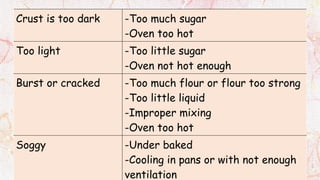
Crust is too dark -Too much sugar
-Oven too hot
Too light -Too little sugar
-Oven not hot enough
Burst or cracked -Too much flour or flour too strong
-Too little liquid
-Improper mixing
-Oven too hot
Soggy -Under baked
-Cooling in pans or with not enough
ventilation
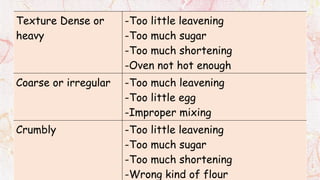
Texture Dense or
heavy
-Too little leavening
-Too much sugar
-Too much shortening
-Oven not hot enough
Coarse or irregular -Too much leavening
-Too little egg
-Improper mixing
Crumbly -Too little leavening
-Too much sugar
-Too much shortening
-Wrong kind of flour
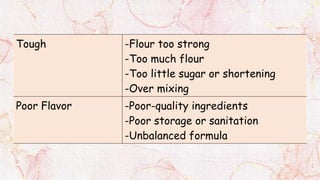
Tough -Flour too strong
-Too much flour
-Too little sugar or shortening
-Over mixing
Poor Flavor -Poor-quality ingredients
-Poor storage or sanitation
-Unbalanced formula
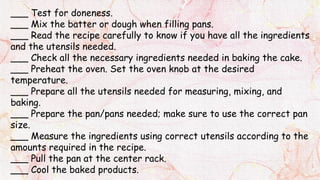
___ Test for doneness.
___ Mix the batter or dough when filling pans.
___ Read the recipe carefully to know if you have all the ingredients
and the utensils needed.
___ Check all the necessary ingredients needed in baking the cake.
___ Preheat the oven. Set the oven knob at the desired
temperature.
___ Prepare all the utensils needed for measuring, mixing, and
baking.
___ Prepare the pan/pans needed; make sure to use the correct pan
size.
___ Measure the ingredients using correct utensils according to the
amounts required in the recipe.
___ Pull the pan at the center rack.
___ Cool the baked products.
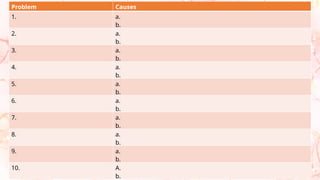
List down 10 problems in baking with 2 causes.
Problem Causes
1. a.
b.
2. a.
b.
3. a.
b.
4. a.
b.
5. a.
b.
6. a.
b.
7. a.
b.
8. a.
b.
9. a.
b.
10. A.
b.

Baking Problems and Solution in Bread and Pastry Production NC2

  • 1.
  • 2.
    Basic Steps inBaking Lesson 4
  • 3.
    1. Read therecipe carefully to know if you have all the ingredients and the utensils needed and if you understand the entire procedure. 2. Check all the necessary ingredients gather and arrange them according to the sequence of their preparation.
  • 4.
    3. Prepare allthe utensils needed for measuring, mixing, and baking. 4. Preheat the oven. Set the oven knob at the desired temperature.
  • 5.
    5. Prepare thepan/pans needed; make sure to use the correct pan size. If it needs greasing, brushing the pan bottom with a little shortening. For baking purposes, don’t use butter or margarine for greasing because these easily burn and will produce a very brown crust.
  • 6.
    6. Measure theingredients using correct utensils according to the amounts required in the recipe. 7. Mix the batter or dough when filling pans, makes sure you don’t overfill. Fill about 2/3 full to give an allowance for the rising.
  • 7.
    8. Bake inthe preheated oven. Put the pan at the center rack.
  • 8.
    9. Test fordoneness. For butter cakes, prick the center of the cake with a toothpick. If it comes out clean then it is done. For chiffon and sponge cakes press lightly with fingers. If it springs back then it is done. Pies and pastries are done when the crusts have turned golden brown, crisp and flaky.
  • 9.
    10. Cool thebaked products. For butter cakes, put the pan on a wire rack and leave to cool for 10 minutes. Afterwards, invert pan to remove the cake and cool it completely. For sponge and chiffon cakes, invert pans at once in wire racks. Then, decorate.
  • 10.
    Baking guidelines: 1. Preheatoven to desired/prescribed temperature. 2. Check oven racks are properly placed. 3. Arrange baking pans of similar shapes inside the oven one inch apart from all sides. 4. Follow correct oven temperature prescribed by the recipe. Incorrect oven temperature results to poor volume, texture, form and color. 5. Avoid opening the oven while baking. 6. Cool cakes by using a cake rack. To remove cakes from the pan, slide a spatula around the pan and turn upside down.
  • 11.
    Testing for Doneness 1.Use a cake tester to determine doneness of a cake by inserting at the center of the cake. When the cake tester comes out clean, the cake is baked. 2. The cake springs back on top and sides when pressed. 3. The cake shrinks away from the sides of the pan
  • 12.
    Common Cake Problems andits Causes Lesson 5
  • 13.
    What are thecommon causes of having a failure cake? Do you know how to fix a bad cake?
  • 14.
    Problem Causes Volume andShape Poor Volume -Too little flour -Too much liquid -Too little leavening -Oven too hot Uneven Shape -Improper mixing -Batter spread unevenly -Uneven oven heat -Oven racks not level -Cake pans warped
  • 15.
    Crust is toodark -Too much sugar -Oven too hot Too light -Too little sugar -Oven not hot enough Burst or cracked -Too much flour or flour too strong -Too little liquid -Improper mixing -Oven too hot Soggy -Under baked -Cooling in pans or with not enough ventilation
  • 16.
    Texture Dense or heavy -Toolittle leavening -Too much sugar -Too much shortening -Oven not hot enough Coarse or irregular -Too much leavening -Too little egg -Improper mixing Crumbly -Too little leavening -Too much sugar -Too much shortening -Wrong kind of flour
  • 17.
    Tough -Flour toostrong -Too much flour -Too little sugar or shortening -Over mixing Poor Flavor -Poor-quality ingredients -Poor storage or sanitation -Unbalanced formula
  • 18.
    ___ Test fordoneness. ___ Mix the batter or dough when filling pans. ___ Read the recipe carefully to know if you have all the ingredients and the utensils needed. ___ Check all the necessary ingredients needed in baking the cake. ___ Preheat the oven. Set the oven knob at the desired temperature. ___ Prepare all the utensils needed for measuring, mixing, and baking. ___ Prepare the pan/pans needed; make sure to use the correct pan size. ___ Measure the ingredients using correct utensils according to the amounts required in the recipe. ___ Pull the pan at the center rack. ___ Cool the baked products.
  • 19.
    List down 10problems in baking with 2 causes. Problem Causes 1. a. b. 2. a. b. 3. a. b. 4. a. b. 5. a. b. 6. a. b. 7. a. b. 8. a. b. 9. a. b. 10. A. b.