Building Citizen Science:
   A Natural History Badge Ecosystem


Jon Rosewell, iSpot, The Open University   Jeff Holmes, EOL, Harvard University
Building Citizen Science


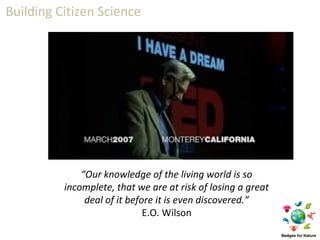
              “Our knowledge of the living world is so
          incomplete, that we are at risk of losing a great
               deal of it before it is even discovered.”
                              E.O. Wilson
Building Citizen Science
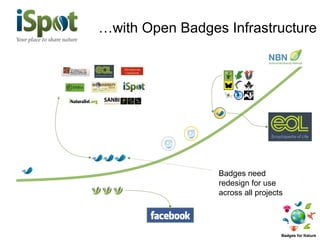
…with Open Badges Infrastructure


                 Badges need
                 redesign for use
                 across all projects
Issues!
• How to design a coherent badge system
  to cover varying:
  – Skills
  – Biological group
  – Geographical region
  – Level
  – Issuer
Skills

• Identification skills
• Data contributor
• Science skills
• Eco-tourism, environmental policies
• Content curation
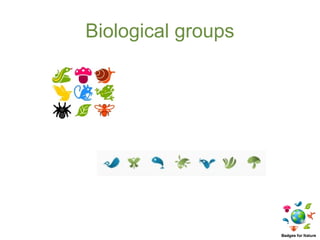
Biological groups
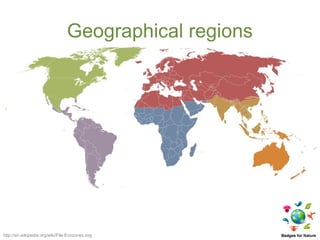
Geographical regions


http://en.wikipedia.org/wiki/File:Ecozones.svg
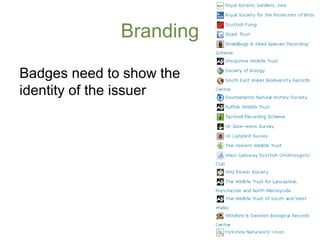
Branding

Badges need to show the
identity of the issuer
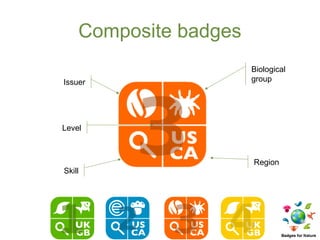
Composite badges
                       Biological
Issuer                 group


Level


                       Region
Skill
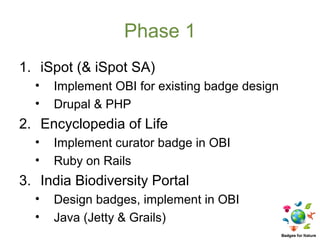
Phase 1
1. iSpot (& iSpot SA)
  •   Implement OBI for existing badge design
  •   Drupal & PHP
2. Encyclopedia of Life
  •   Implement curator badge in OBI
  •   Ruby on Rails
3. India Biodiversity Portal
  •   Design badges, implement in OBI
  •   Java (Jetty & Grails)
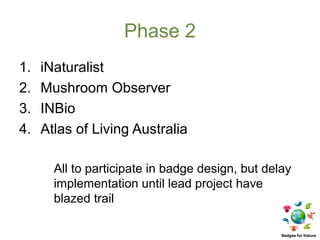
Phase 2
1.   iNaturalist
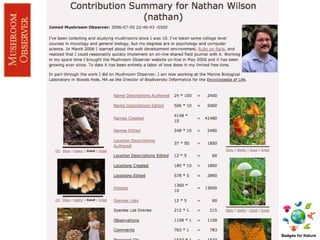
2.   Mushroom Observer
3.   INBio
4.   Atlas of Living Australia

       All to participate in badge design, but delay
       implementation until lead project have
       blazed trail
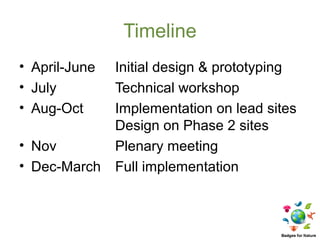
Timeline
• April-June   Initial design & prototyping
• July         Technical workshop
• Aug-Oct      Implementation on lead sites
               Design on Phase 2 sites
• Nov          Plenary meeting
• Dec-March    Full implementation
Building Citizen Science:
A Natural History Badge Ecosystem
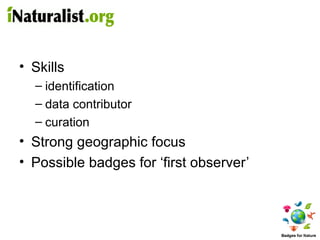
• Skills
  – identification
  – data contributor
  – curation
• Strong geographic focus
• Possible badges for ‘first observer’
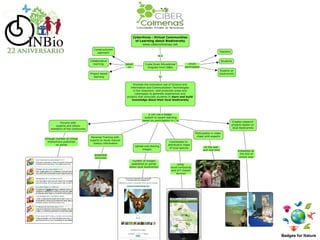
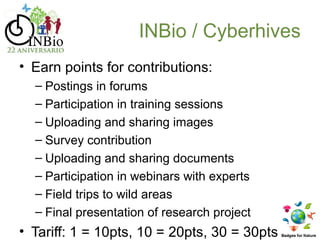
INBio / Cyberhives
• Earn points for contributions:
  – Postings in forums
  – Participation in training sessions
  – Uploading and sharing images
  – Survey contribution
  – Uploading and sharing documents
  – Participation in webinars with experts
  – Field trips to wild areas
  – Final presentation of research project
• Tariff: 1 = 10pts, 10 = 20pts, 30 = 30pts
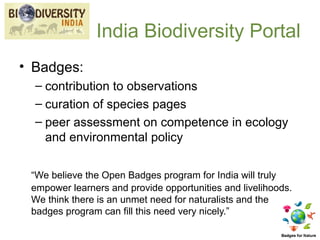
India Biodiversity Portal
• Badges:
  – contribution to observations
  – curation of species pages
  – peer assessment on competence in ecology
    and environmental policy

 “We believe the Open Badges program for India will truly
 empower learners and provide opportunities and livelihoods.
 We think there is an unmet need for naturalists and the
 badges program can fill this need very nicely.”
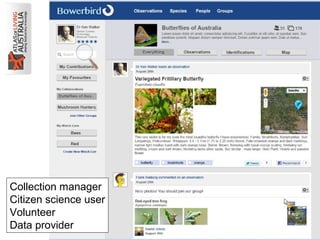
Collection manager
Citizen science user
Volunteer
Data provider

Badges for Nature (HASTAC/DML proposal)

  • 1.
    Building Citizen Science: A Natural History Badge Ecosystem Jon Rosewell, iSpot, The Open University Jeff Holmes, EOL, Harvard University
  • 2.
    Building Citizen Science “Our knowledge of the living world is so incomplete, that we are at risk of losing a great deal of it before it is even discovered.” E.O. Wilson
  • 3.
  • 4.
  • 5.
  • 6.
  • 7.
  • 13.
    …with Open BadgesInfrastructure Badges need redesign for use across all projects
  • 15.
    Issues! • How todesign a coherent badge system to cover varying: – Skills – Biological group – Geographical region – Level – Issuer
  • 16.
    Skills • Identification skills •Data contributor • Science skills • Eco-tourism, environmental policies • Content curation
  • 17.
  • 18.
  • 19.
    Branding Badges need toshow the identity of the issuer
  • 20.
    Composite badges Biological Issuer group Level Region Skill
  • 21.
    Phase 1 1. iSpot(& iSpot SA) • Implement OBI for existing badge design • Drupal & PHP 2. Encyclopedia of Life • Implement curator badge in OBI • Ruby on Rails 3. India Biodiversity Portal • Design badges, implement in OBI • Java (Jetty & Grails)
  • 22.
    Phase 2 1. iNaturalist 2. Mushroom Observer 3. INBio 4. Atlas of Living Australia All to participate in badge design, but delay implementation until lead project have blazed trail
  • 23.
    Timeline • April-June Initial design & prototyping • July Technical workshop • Aug-Oct Implementation on lead sites Design on Phase 2 sites • Nov Plenary meeting • Dec-March Full implementation
  • 24.
    Building Citizen Science: ANatural History Badge Ecosystem
  • 26.
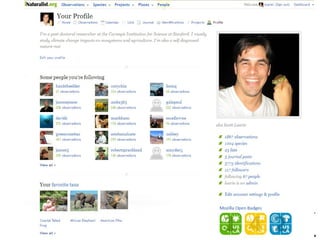
    • Skills – identification – data contributor – curation • Strong geographic focus • Possible badges for ‘first observer’
  • 28.
    INBio / Cyberhives •Earn points for contributions: – Postings in forums – Participation in training sessions – Uploading and sharing images – Survey contribution – Uploading and sharing documents – Participation in webinars with experts – Field trips to wild areas – Final presentation of research project • Tariff: 1 = 10pts, 10 = 20pts, 30 = 30pts
  • 29.
    India Biodiversity Portal •Badges: – contribution to observations – curation of species pages – peer assessment on competence in ecology and environmental policy “We believe the Open Badges program for India will truly empower learners and provide opportunities and livelihoods. We think there is an unmet need for naturalists and the badges program can fill this need very nicely.”
  • 31.
    Collection manager Citizen scienceuser Volunteer Data provider

Editor's Notes

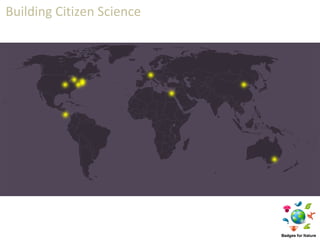
  • #2 Good morning, my name is Jeff Holmes from the Encyclopedia of Life project and I’m here with Jon Rosewell, from the iSpot, based out of the Open University in the UK. We’re here to make a pitch for Building Citizen Science through the use of badges.
  • #3 In his 2007 TED Prize talk, the biologist E.O. Wilson made it clear that our need for better knowledge of the world’s biodiversity is pressing. He lamented this fact that, “our knowledge of the living world is so incomplete, that we are at risk of losing a great deal of it before it is even discovered.”
  • #4 Out of his TED wish, the Encyclopedia of Life was born with a goal to aggregate and make freely available knowledge about all species
  • #5 Over the last five years, EOL has grown to almost 1 million species pages and from the original 5 cornerstone institutions, now includes regional partners in 5 locations around the world.
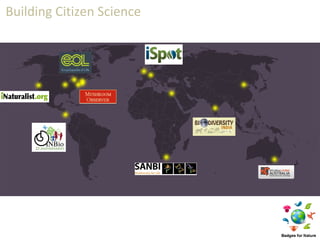
  • #6 Over this same period, other ambitious projects were starting up with an aim to support and strengthen the efforts of citizen scientists and… In 2011, the Encyclopedia of Life, iSpot, and 6 other organizations from around the world met at the Open University to begin a collaboration around building citizen science.
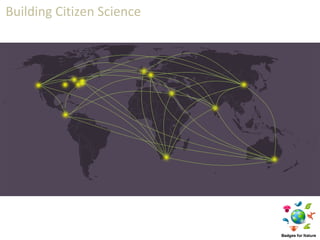
  • #7 A key challenge to citizen science is that making it fun and motivating requires regional localization or grassroots efforts At the same time, there needs to be incentive for people to contribute to small projects at the local level We see badges as an important mechanism to motivate users, and help validate data through the recognition of “informal expertise” Badges for learning would reward participation and engagement and allow users to carry their skills from one project to another, encouraging wider participation and the building of truly global data sets.
  • #8 I’m going to turn it over to Jon Rosewell, from iSpot, who will show how an aspiring young naturalist named Alice takes a learning journey that will deepen her knowledge about life on Earth and our understanding of global biodiversity.
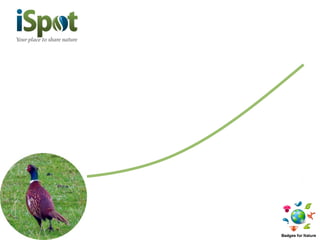
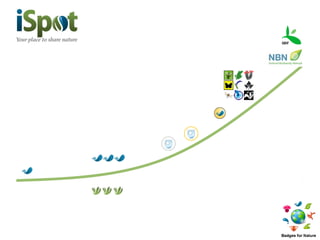
  • #9 I’m going to start by showing how one of our projects, iSpot, which already has a well developed badge system, encourages people like Alice. Alice has spotted a bird she doesn’t recognise and taken a photograph of it.
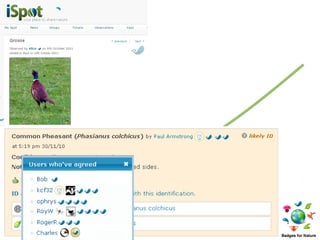
  • #10 She uploads her photograph to create an observation on iSpot. If she can, Alice adds an initial identification, others in the community can suggest an alternative. But how does Alice know which identification to trust? At this point badges come into play. Every iSpot member is accompanied by badges which reflect their expertise. In this case several people have agreed with the identification. Bob is a beginner – shown by a single bird icon; others have more icons showing more expertise. Charlie is special – he is an expert member – his gold badge is vouched for by a natural history society. So you can judge the quality of the identification by the badges of those who support it.
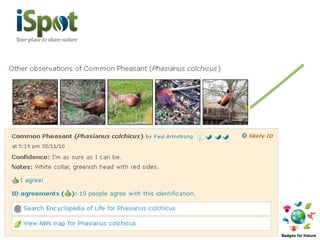
  • #11 Alice now has a reliable name for her plant/animal; this is the key that unlocks learning about that species and its ecology. On iSpot it provides other observations of the same species; and creates links to information elsewhere on the web such as the Encyclopedia of Life or distribution data from the UK National Biodiversity Network. Alice can now take her first steps on a learning journey.
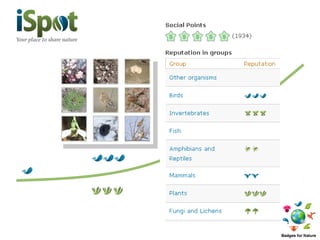
  • #12 As Alice makes identifications that the community agree with, her expertise grows and this is reflected in additional badges as she passes milestones. She can offer agreements and identifications to other users, and engage in comment and discussion around observations. These contributions are also reflected in badges. Alice may also start to collect observations of plants; but Alice’s new expertise in identifying birds doesn’t mean she is an expert in plants. iSpot therefore tracks expertise separately in eight different biological groups: plants, birds, invertebrates and so on.
  • #13 iSpot is an informal learning community but we do recognize people’s achievements in more formal learning. For example, students on some Open University modules get a distinctive badge on iSpot We’ve seen expert badges. They are vouched for by one of our partner natural history societies, and the affiliation badges link back to the society’s web site. We hope that some iSpot members will be encouraged to join these natural history societies and become part of the community of amateur naturalists. In the UK especially, our knowledge of national biodiversity is largely provided by expert amateurs. So iSpot supports people as they embark on learning journey about natural history, helping to foster a new generation of naturalists. I know that the same vision underpins all the projects who are collaborating in this bid.
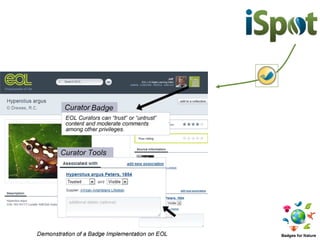
  • #14 This describes what we currently have on iSpot – we’d now like to move iSpot and our collaborator sites to the Mozilla Open Badge Infrastructure. Firstly, our badges become portable – users can start displaying them on Facebook and other social networking sites. It also means that a user who is active on both iNaturalist and iSpot can display their iNat badges on their iSpot profile and vice versa; and the same for our other collaborators. To make sense of that, we need to redesign our badges so that there is coherence and consistency across our projects – we want them to make sense to anyone viewing them. It also opens opportunities for badge exchange. Currently we issue iSpot expert badges on behalf of natural history societies – in the long term they could be responsible for issuing badges; we would just accept them. Equally, badges issued on iSpot could have value elsewhere. EOL (Encyclopedia of Life) have a curator role which will be badged. EOL are planning to accept iSpot expert badges as equivalent: an iSpot expert will get curator privileges on EOL.
  • #15 This shows how EOL will accept an iSpot expert badge and use it to give curator privileges.
  • #16 This isn’t going to be easy! There isn’t going to be a single badge for ‘Natural History’ because that covers too much ground. We are going to need a set of badges – and they will need to be coherent and make sense to users while still matching the different activities in our projects. I’m going to unpick these in some more detail.
  • #17 The collaborators in our proposal all share the theme of citizen science for biodiversity – but they focus on and reward a range of different skills.
  • #18 Also, we’ve seen that skill in identification is restricted by biological group.
  • #19 We may also need to issue badges for some defined area – perhaps continents or bio-geographical regions.
  • #20 We also know from experience that we need to retain strong branding for the issuer. These are the partner badges you can already see on iSpot which recognise the hugely import contribution of our expert community who volunteer on behalf of their natural history societies. The badges we issue will need to retain a strong branding – we think that this is really important to maintain the social dynamic of our sites.
  • #21 Given all this variation, our badges will have to be designed as composites. This means we can have many different badges but they are easily understood. We still need some professional graphic design! They’ll have a difficult job. I’ve said that our badges must still be branded by the issuer But on the other hand we want some consistency across our collaborators so that there is some common understanding of levels and domains, so some common elements of design are also required. And they need to be small enough to work in crowded interfaces!
  • #22 Our plan of work is to initially focus implementation work on three projects which cover on a range of technologies: iSpot has an existing badge design which can be reimplmented in OBI EOL requires some badge design and provides a use-case for badge exchange IBP requires extensive badge design and implementation.
  • #23 Our remaining projects will participate in badge design but will hang back from implementation – they share some technology with leaders so should be able to follow the bleeding edge.
  • #24 This gives an outline of how we plan to carry this out. We are planning one early workshop among the lead sites focussing on technical issues. We will hold a meeting for all project participants about half way through – that will share experience and finalise badge design before full roll out in remaining months of project. We will maintain a project blog to share progress and we will keep the project moving by weekly email / Skype discussion.
  • #25 This is an exciting time, a renaissance of citizen science. Badges for learning would reward participation and engagement, and our international collaboration will allow our users to carry their skills from one project to another, encouraging a global community of citizen scientists. Thank you.