BABY STEPS
IN
VALUE INVESTING
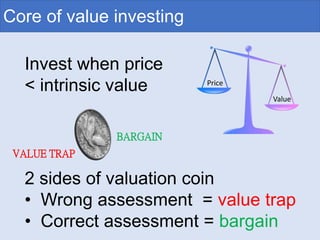
Core of value investing
Invest when price
< intrinsic value Price
Value
BARGAIN
VALUE TRAP
2 sides of valuation coin
• Wrong assessment = value trap
• Correct assessment = bargain
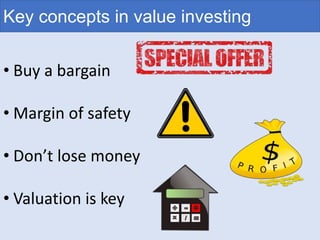
Key concepts in value investing
• Buy a bargain
• Margin of safety
• Don’t lose money
• Valuation is key
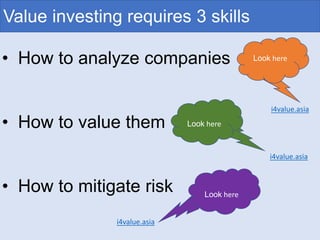
Value investing requires 3 skills
• How to analyze companies
• How to value them
• How to mitigate risk
Look here
Look here
Look here
i4value.asia
i4value.asia
i4value.asia
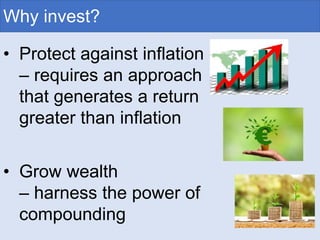
Why invest?
• Protect against inflation
– requires an approach
that generates a return
greater than inflation
• Grow wealth
– harness the power of
compounding
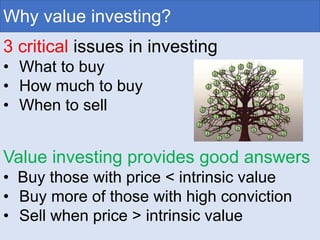
Why value investing?
3 critical issues in investing
• What to buy
• How much to buy
• When to sell
Value investing provides good answers
• Buy those with price < intrinsic value
• Buy more of those with high conviction
• Sell when price > intrinsic value
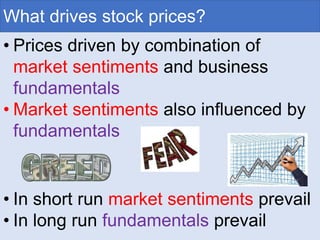
What drives stock prices?
• Prices driven by combination of
market sentiments and business
fundamentals
• Market sentiments also influenced by
fundamentals
• In short run market sentiments prevail
• In long run fundamentals prevail
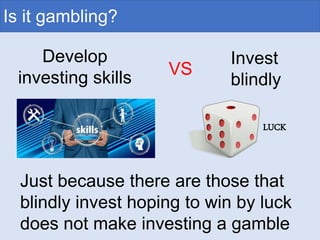
Is it gambling?
VS
LUCK
Invest
blindly
Develop
investing skills
Just because there are those that
blindly invest hoping to win by luck
does not make investing a gamble
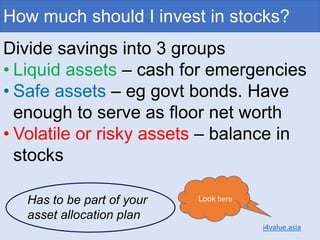
How much should I invest in stocks?
Divide savings into 3 groups
• Liquid assets – cash for emergencies
• Safe assets – eg govt bonds. Have
enough to serve as floor net worth
• Volatile or risky assets – balance in
stocks
Look here
i4value.asia
Has to be part of your
asset allocation plan
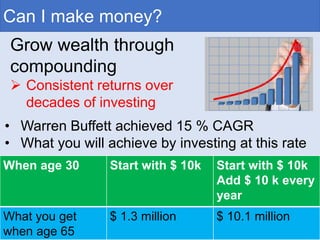
Can I make money?
• Warren Buffett achieved 15 % CAGR
• What you will achieve by investing at this rate
When age 30 Start with $ 10k Start with $ 10k
Add $ 10 k every
year
What you get
when age 65
$ 1.3 million $ 10.1 million
Grow wealth through
compounding
 Consistent returns over
decades of investing
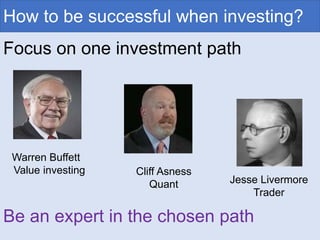
How to be successful when investing?
Focus on one investment path
Warren Buffett
Value investing Cliff Asness
Quant Jesse Livermore
Trader
Be an expert in the chosen path
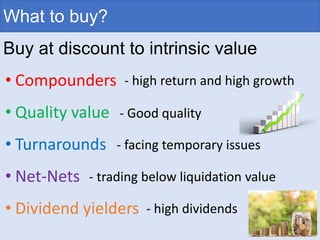
What to buy?
Buy at discount to intrinsic value
• Compounders
• Quality value
• Turnarounds
• Net-Nets
• Dividend yielders
- high return and high growth
- Good quality
- facing temporary issues
- trading below liquidation value
- high dividends
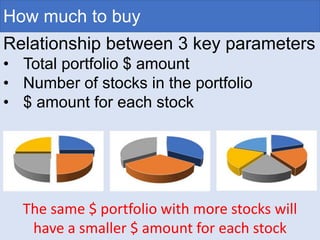
How much to buy
Relationship between 3 key parameters
• Total portfolio $ amount
• Number of stocks in the portfolio
• $ amount for each stock
The same $ portfolio with more stocks will
have a smaller $ amount for each stock
How much to buy – equal amount
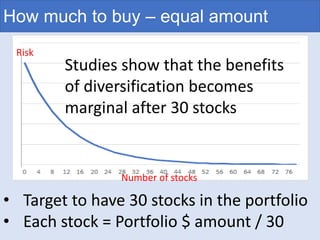
Studies show that the benefits
of diversification becomes
marginal after 30 stocks
• Target to have 30 stocks in the portfolio
• Each stock = Portfolio $ amount / 30
Risk
Number of stocks
How much to buy – alternative amount
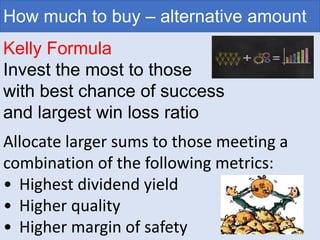
Kelly Formula
Invest the most to those
with best chance of success
and largest win loss ratio
Allocate larger sums to those meeting a
combination of the following metrics:
• Highest dividend yield
• Higher quality
• Higher margin of safety
How to execute?
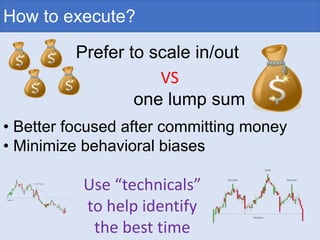
Prefer to scale in/out
one lump sum
• Better focused after committing money
• Minimize behavioral biases
VS
Use “technicals”
to help identify
the best time
When to sell?
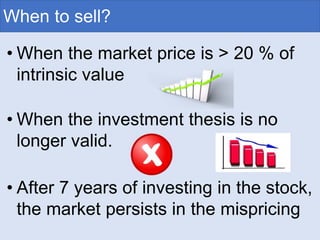
• When the market price is > 20 % of
intrinsic value
• When the investment thesis is no
longer valid.
• After 7 years of investing in the stock,
the market persists in the mispricing
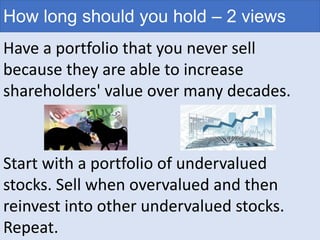
How long should you hold – 2 views
Have a portfolio that you never sell
because they are able to increase
shareholders' value over many decades.
Start with a portfolio of undervalued
stocks. Sell when overvalued and then
reinvest into other undervalued stocks.
Repeat.
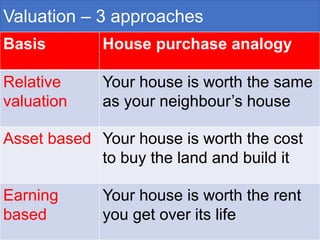
Valuation – 3 approaches
Basis House purchase analogy
Relative
valuation
Your house is worth the same
as your neighbour’s house
Asset based Your house is worth the cost
to buy the land and build it
Earning
based
Your house is worth the rent
you get over its life
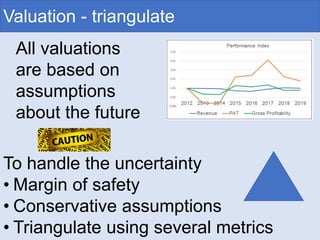
Valuation - triangulate
All valuations
are based on
assumptions
about the future
To handle the uncertainty
• Margin of safety
• Conservative assumptions
• Triangulate using several metrics
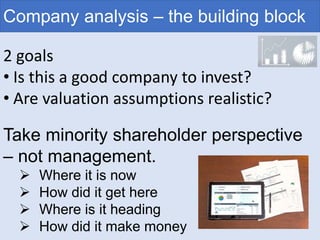
Company analysis – the building block
2 goals
• Is this a good company to invest?
• Are valuation assumptions realistic?
Take minority shareholder perspective
– not management.
 Where it is now
 How did it get here
 Where is it heading
 How did it make money
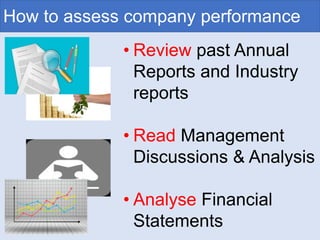
• Review past Annual
Reports and Industry
reports
• Read Management
Discussions & Analysis
• Analyse Financial
Statements
How to assess company performance
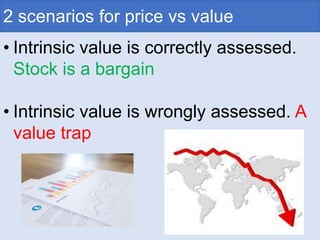
• Intrinsic value is correctly assessed.
Stock is a bargain
• Intrinsic value is wrongly assessed. A
value trap
2 scenarios for price vs value
Not Volatility but Permanent Loss of
Capital
Risk Mitigation
• Identify causes of the loss of capital
• Assess its impact and likelihood of
occurring
• Adopt host of mitigation measures
Risk mitigation
Summary
• What is value investing
• Why value investing
• Key concepts
• What to buy
• How much to buy
• When to sell
• Company analysis
• Valuation - value traps
• Risk mitigation
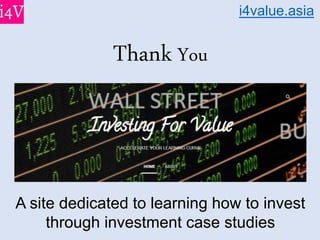
A site dedicated to learning how to invest
through investment case studies
i4value.asia
Thank You

Baby steps in value investing

  • 1.
  • 2.
    Core of valueinvesting Invest when price < intrinsic value Price Value BARGAIN VALUE TRAP 2 sides of valuation coin • Wrong assessment = value trap • Correct assessment = bargain
  • 3.
    Key concepts invalue investing • Buy a bargain • Margin of safety • Don’t lose money • Valuation is key
  • 4.
    Value investing requires3 skills • How to analyze companies • How to value them • How to mitigate risk Look here Look here Look here i4value.asia i4value.asia i4value.asia
  • 5.
    Why invest? • Protectagainst inflation – requires an approach that generates a return greater than inflation • Grow wealth – harness the power of compounding
  • 6.
    Why value investing? 3critical issues in investing • What to buy • How much to buy • When to sell Value investing provides good answers • Buy those with price < intrinsic value • Buy more of those with high conviction • Sell when price > intrinsic value
  • 7.
    What drives stockprices? • Prices driven by combination of market sentiments and business fundamentals • Market sentiments also influenced by fundamentals • In short run market sentiments prevail • In long run fundamentals prevail
  • 8.
    Is it gambling? VS LUCK Invest blindly Develop investingskills Just because there are those that blindly invest hoping to win by luck does not make investing a gamble
  • 9.
    How much shouldI invest in stocks? Divide savings into 3 groups • Liquid assets – cash for emergencies • Safe assets – eg govt bonds. Have enough to serve as floor net worth • Volatile or risky assets – balance in stocks Look here i4value.asia Has to be part of your asset allocation plan
  • 10.
    Can I makemoney? • Warren Buffett achieved 15 % CAGR • What you will achieve by investing at this rate When age 30 Start with $ 10k Start with $ 10k Add $ 10 k every year What you get when age 65 $ 1.3 million $ 10.1 million Grow wealth through compounding  Consistent returns over decades of investing
  • 11.
    How to besuccessful when investing? Focus on one investment path Warren Buffett Value investing Cliff Asness Quant Jesse Livermore Trader Be an expert in the chosen path
  • 12.
    What to buy? Buyat discount to intrinsic value • Compounders • Quality value • Turnarounds • Net-Nets • Dividend yielders - high return and high growth - Good quality - facing temporary issues - trading below liquidation value - high dividends
  • 13.
    How much tobuy Relationship between 3 key parameters • Total portfolio $ amount • Number of stocks in the portfolio • $ amount for each stock The same $ portfolio with more stocks will have a smaller $ amount for each stock
  • 14.
    How much tobuy – equal amount Studies show that the benefits of diversification becomes marginal after 30 stocks • Target to have 30 stocks in the portfolio • Each stock = Portfolio $ amount / 30 Risk Number of stocks
  • 15.
    How much tobuy – alternative amount Kelly Formula Invest the most to those with best chance of success and largest win loss ratio Allocate larger sums to those meeting a combination of the following metrics: • Highest dividend yield • Higher quality • Higher margin of safety
  • 16.
    How to execute? Preferto scale in/out one lump sum • Better focused after committing money • Minimize behavioral biases VS Use “technicals” to help identify the best time
  • 17.
    When to sell? •When the market price is > 20 % of intrinsic value • When the investment thesis is no longer valid. • After 7 years of investing in the stock, the market persists in the mispricing
  • 18.
    How long shouldyou hold – 2 views Have a portfolio that you never sell because they are able to increase shareholders' value over many decades. Start with a portfolio of undervalued stocks. Sell when overvalued and then reinvest into other undervalued stocks. Repeat.
  • 19.
    Valuation – 3approaches Basis House purchase analogy Relative valuation Your house is worth the same as your neighbour’s house Asset based Your house is worth the cost to buy the land and build it Earning based Your house is worth the rent you get over its life
  • 20.
    Valuation - triangulate Allvaluations are based on assumptions about the future To handle the uncertainty • Margin of safety • Conservative assumptions • Triangulate using several metrics
  • 21.
    Company analysis –the building block 2 goals • Is this a good company to invest? • Are valuation assumptions realistic? Take minority shareholder perspective – not management.  Where it is now  How did it get here  Where is it heading  How did it make money
  • 22.
    • Review pastAnnual Reports and Industry reports • Read Management Discussions & Analysis • Analyse Financial Statements How to assess company performance
  • 23.
    • Intrinsic valueis correctly assessed. Stock is a bargain • Intrinsic value is wrongly assessed. A value trap 2 scenarios for price vs value
  • 24.
    Not Volatility butPermanent Loss of Capital Risk Mitigation • Identify causes of the loss of capital • Assess its impact and likelihood of occurring • Adopt host of mitigation measures Risk mitigation
  • 25.
    Summary • What isvalue investing • Why value investing • Key concepts • What to buy • How much to buy • When to sell • Company analysis • Valuation - value traps • Risk mitigation
  • 26.
    A site dedicatedto learning how to invest through investment case studies i4value.asia Thank You