GolfLogix :  Measuring the Game  of Golf
GolfLogix : Measuring the Game of Golf GolfLogix was founded in May 1999  Using GPS to aid golfers in playing golf GolfLogix product consisted of a customized, handheld GPS receiver, called an “xCaddie”
GolfLogix’s system can indicate distance and record a golfer’s progress around the course.  At the end of the round, he could download this data and receive printout mapping his progress GolfLogix : Measuring the Game of Golf
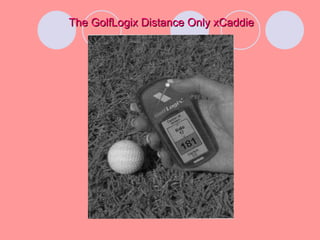
The GolfLogix Distance Only xCaddie
The Game of Golf Invented in Scotland in the 15 th  century and brought to the United States in the late 19 th  century. Use wooden or metal clubs to hit a small, hard ball into  a cup on each of 18 different holes on a golf course. Each swing a golfer took was called a stroke and counted toward his or her total score. The number of strokes a player took through an entire round was the player’s score, with the lowest score winning. The typical golfer used as many as 14 different clubs during a single round, including several woods, a series of irons, several wedges and a putter. Each club was used to hit the ball a particular distance.
The GolfLogix Solution The concept for   GolfLogix came in 1998 during a round of golf between Todd Kuta and Scott Lambrecht. Lambrecht asked Kuta to estimate distance to the green and advise him on what club to hit for that distance. Kuta noted that there ought to be a way to measure distance to the green. Lambrecht suggested that GPS can help a golfer know the distance to the green. They thought that it could do much more. It could record a golfer’s progress around the course with a detailed record of his round.
A Typical Three-Page Printout Following the Use of the Complete System
The   Company Lambrecht and Kuta feel doubtful that “Under the rules of golf, is such a system legal?” The USGA indicated that a GPS device couldn’t be used during tournament play. They formally incorporated GolfLogix in May 1999. In its short existence, GolfLogix had raised about $2million and taken on moderate debt.
The Company The company expected to incur operating expenses of about $50,000 to $75,000 per month, which it hoped to support out of operating revenues. The task of selling the xCaddie systems had largely fallen to Pete Charleston, GolfLogix’s executive vice president of sales, and CEO Saltz. Over time, the company planned to take on an increasing number of distributors.
The Underlying Technology The core technology for the GolfLogix solution was GPS, originally use in military. GPS was gradually made available for civilian use, beginning in the 1980s. By 2000 roughly 1 million GPS receivers per year were being manufactured for commercial use. The GPS receiver employed by GolfLogix was manufactured by Garmin International.
Making the Solution Operational The Distance Only System The Complete System -  ขอบเขตของ   tee box,fairway and green. -touch screen and printer -GolfLogix website
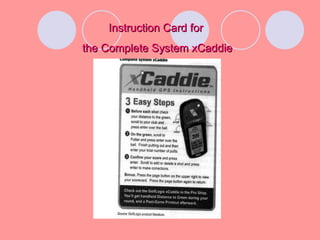
Playing Golf with the GolfLogix Systems The Distance Only System A golfer scrolled to the hole that he was playing, stood over or near his ball, and read the yardage to the green on the xCaddie’s digital readout. The Complete System Before each shot check the distance to the green, select the club and press enter over the ball. On the green, scroll to Putter and press enter over the ball. Finish putting out and then enter the total number of putts. Comfirm or edit the score and press enter to make corrections.
Instruction Card for  the Complete System xCaddie
The U.S. Golf Market In 2000, 26.7 million Americans played 586 million rounds on just over 17,000 public and private courses around the United States. Each year about 2 million new golfers began playing the sport, resulting in a net growth of 200,000 to 400,000 golfers per year. Recently, the game had attracted more women and younger golfers through much of the 1980s and 1990s. Nevertheless, the prototypical golfer was still male, over 40 years old and with a household income over $70,000.
The Golfer Golfers could be segmented in many different ways. One basis was frequency of play. A second basis was expertise, typically measured by a golfer’s handicap that was a historical average of how many strokes a golfer took for an entire round. A third basis was based on the courses they played-public versus private.
Golf Courses As of   2000, there were slightly over 17,000 golf courses in the United States, most of which fell into one of four categories : Municipal and lower-end public courses   represented the backbone of golf in the United States.   High-end public courses  offered more of a challenge than municipal courses, and attracted more avid and accomplished golfers.
Golf Courses Resort courses  often gave preference to those staying at the resort. They tended to be of high quality. Private courses   represented the aspiration of many golfers. The quality of these courses tended to be very high, and members were charged accordingly.  New courses were being built in the United States at a rate of about 300 to 400 per year. The vast majority were higher-end public, resort, and private courses.
The Golf Professional The person responsible for running the golf-related activities at a course was the head professional. He might be assisted by several employees and assistant pros. The third responsibility was giving lessons. A final responsibility and constant headache for pro shop personnel was managing the pace of play on the course.
Selling the GolfLogix solution About 80 percent of golfers are satisfied Traditional sport and sensitive to adopt  a new thing Find the courses that are forward thinking
Distance only system’s benefits Better golf Improve pace by play Affordability Portability Ease of use Ease of installation
Complete System’s benefits Game history Performance Statistics Personalized Web site An aid to teaching
Competitions Distance;Low-tech solutions -Yardage markers -Sprinkler Heads -Yardage Booklets -Rangefinders Distance;High-tech solutions -Cart-moounted system -PDA based system
An Example of the Information  Contained in a Yardage Booklet
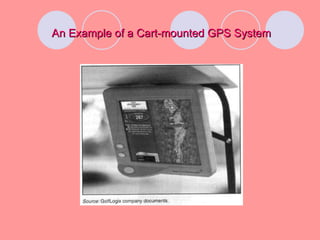
An Example of a Cart-mounted GPS System
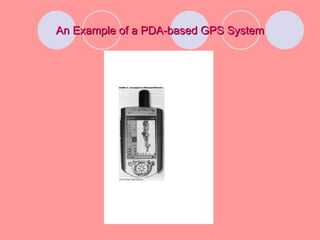
An Example of a PDA-based GPS System
Performance Tracking Manual Records in Booklets Software package for PDAs What parts of their game were good And what parts needed work?
Going Straight to Consumers After very limited sales in 2001, 2002 was showing lots of promise. Over a dozen new courses had adopted either the Distance Only or Complete System. Most courses that had agreed to a trial had subsequently signed lease agreement. The units would retail for approximately $300 with  a 50 percent to 60 percent gross margin, depending on volume. But a device could capture 1 percent to 2 percent of veteran golfers.

BA401 case 3-4 GolfLogix

  • 1.
    GolfLogix : Measuring the Game of Golf
  • 2.
    GolfLogix : Measuringthe Game of Golf GolfLogix was founded in May 1999 Using GPS to aid golfers in playing golf GolfLogix product consisted of a customized, handheld GPS receiver, called an “xCaddie”
  • 3.
    GolfLogix’s system canindicate distance and record a golfer’s progress around the course. At the end of the round, he could download this data and receive printout mapping his progress GolfLogix : Measuring the Game of Golf
  • 4.
  • 5.
    The Game ofGolf Invented in Scotland in the 15 th century and brought to the United States in the late 19 th century. Use wooden or metal clubs to hit a small, hard ball into a cup on each of 18 different holes on a golf course. Each swing a golfer took was called a stroke and counted toward his or her total score. The number of strokes a player took through an entire round was the player’s score, with the lowest score winning. The typical golfer used as many as 14 different clubs during a single round, including several woods, a series of irons, several wedges and a putter. Each club was used to hit the ball a particular distance.
  • 6.
    The GolfLogix SolutionThe concept for GolfLogix came in 1998 during a round of golf between Todd Kuta and Scott Lambrecht. Lambrecht asked Kuta to estimate distance to the green and advise him on what club to hit for that distance. Kuta noted that there ought to be a way to measure distance to the green. Lambrecht suggested that GPS can help a golfer know the distance to the green. They thought that it could do much more. It could record a golfer’s progress around the course with a detailed record of his round.
  • 7.
    A Typical Three-PagePrintout Following the Use of the Complete System
  • 8.
    The Company Lambrecht and Kuta feel doubtful that “Under the rules of golf, is such a system legal?” The USGA indicated that a GPS device couldn’t be used during tournament play. They formally incorporated GolfLogix in May 1999. In its short existence, GolfLogix had raised about $2million and taken on moderate debt.
  • 9.
    The Company Thecompany expected to incur operating expenses of about $50,000 to $75,000 per month, which it hoped to support out of operating revenues. The task of selling the xCaddie systems had largely fallen to Pete Charleston, GolfLogix’s executive vice president of sales, and CEO Saltz. Over time, the company planned to take on an increasing number of distributors.
  • 10.
    The Underlying TechnologyThe core technology for the GolfLogix solution was GPS, originally use in military. GPS was gradually made available for civilian use, beginning in the 1980s. By 2000 roughly 1 million GPS receivers per year were being manufactured for commercial use. The GPS receiver employed by GolfLogix was manufactured by Garmin International.
  • 11.
    Making the SolutionOperational The Distance Only System The Complete System - ขอบเขตของ tee box,fairway and green. -touch screen and printer -GolfLogix website
  • 12.
    Playing Golf withthe GolfLogix Systems The Distance Only System A golfer scrolled to the hole that he was playing, stood over or near his ball, and read the yardage to the green on the xCaddie’s digital readout. The Complete System Before each shot check the distance to the green, select the club and press enter over the ball. On the green, scroll to Putter and press enter over the ball. Finish putting out and then enter the total number of putts. Comfirm or edit the score and press enter to make corrections.
  • 13.
    Instruction Card for the Complete System xCaddie
  • 14.
    The U.S. GolfMarket In 2000, 26.7 million Americans played 586 million rounds on just over 17,000 public and private courses around the United States. Each year about 2 million new golfers began playing the sport, resulting in a net growth of 200,000 to 400,000 golfers per year. Recently, the game had attracted more women and younger golfers through much of the 1980s and 1990s. Nevertheless, the prototypical golfer was still male, over 40 years old and with a household income over $70,000.
  • 15.
    The Golfer Golferscould be segmented in many different ways. One basis was frequency of play. A second basis was expertise, typically measured by a golfer’s handicap that was a historical average of how many strokes a golfer took for an entire round. A third basis was based on the courses they played-public versus private.
  • 16.
    Golf Courses Asof 2000, there were slightly over 17,000 golf courses in the United States, most of which fell into one of four categories : Municipal and lower-end public courses represented the backbone of golf in the United States. High-end public courses offered more of a challenge than municipal courses, and attracted more avid and accomplished golfers.
  • 17.
    Golf Courses Resortcourses often gave preference to those staying at the resort. They tended to be of high quality. Private courses represented the aspiration of many golfers. The quality of these courses tended to be very high, and members were charged accordingly. New courses were being built in the United States at a rate of about 300 to 400 per year. The vast majority were higher-end public, resort, and private courses.
  • 18.
    The Golf ProfessionalThe person responsible for running the golf-related activities at a course was the head professional. He might be assisted by several employees and assistant pros. The third responsibility was giving lessons. A final responsibility and constant headache for pro shop personnel was managing the pace of play on the course.
  • 19.
    Selling the GolfLogixsolution About 80 percent of golfers are satisfied Traditional sport and sensitive to adopt a new thing Find the courses that are forward thinking
  • 20.
    Distance only system’sbenefits Better golf Improve pace by play Affordability Portability Ease of use Ease of installation
  • 21.
    Complete System’s benefitsGame history Performance Statistics Personalized Web site An aid to teaching
  • 22.
    Competitions Distance;Low-tech solutions-Yardage markers -Sprinkler Heads -Yardage Booklets -Rangefinders Distance;High-tech solutions -Cart-moounted system -PDA based system
  • 23.
    An Example ofthe Information Contained in a Yardage Booklet
  • 24.
    An Example ofa Cart-mounted GPS System
  • 25.
    An Example ofa PDA-based GPS System
  • 26.
    Performance Tracking ManualRecords in Booklets Software package for PDAs What parts of their game were good And what parts needed work?
  • 27.
    Going Straight toConsumers After very limited sales in 2001, 2002 was showing lots of promise. Over a dozen new courses had adopted either the Distance Only or Complete System. Most courses that had agreed to a trial had subsequently signed lease agreement. The units would retail for approximately $300 with a 50 percent to 60 percent gross margin, depending on volume. But a device could capture 1 percent to 2 percent of veteran golfers.