The Search for the Axion Particle
Zachary Short| Mentor: Dipangkar Dutta(1) Advisor: Kris Madsen(1)| (1) Department of Physics and Astronomy, Mississippi State University, Mississippi State, MS
INTRODUCTION
With the development of the Strong CP problem in
quantum chromodynamics (QCD), many solutions arose as
to answer this problem in the idea of CP symmetry. Not a
single likely answer was reached until 1977, when Roberto
Peccei and Helen Quinn developed the Peccei-Quinn theory
as a solution, and thus theorized to the world a new
particle known as an Axion.
THE EXPERIMENT
The Mississippi State Axion Search (MASS) is an attempt to
improve the limit on the mass coupling parameter of the
Axion by using a version of the Light Shining Through a Wall
(LSW) Technique. The design features a sealed cavity
partitioned by a lead wall with which radio power is
channeled through; an antenna is located on the other end
of the cavity to function as a receiver. All data signaled to
the antenna is fed through to a data acquisition system.
Based upon the theory of the Primakoff Effect, the Axions
should supposedly be produced from and return to being
photons in the presence of a strong magnetic field (which is
present in one side of the cavity), leading to the basis of the
LSW experiment.
METHODS
Before experimentation can take place, the validity of the
cavity in design has had to have been addressed before
hand. This means making sure that both antennas are able
to operate optimally within the cavity, that absolutely zero
noise outside the cavity would effect the data (or at least
make it so that the noise would be accounted for), and
make sure that the proper DAQ information was known for
the cavity (otherwise the Axions would not be able to be
compared and found). Having the maximum voltage known,
the data should show that the Axions would appear as data
excess. The range in which the Axions would be sought for
would be 10-100meV.
RESULTS
Based upon multiple readjustments to the cavity, the
experimental search for the axion has yet to begun. As of
most recently, complications with the recently chosen
antenna have resulted in the decision to lengthen the cavity
as a whole. As for the results of my personal work, multiple
voltage dividers and a band-pass filter have been created
for the sake of data analysis. Also, a large amount of data
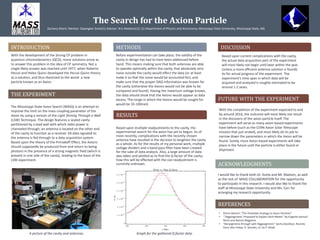
was taken and plotted as to find the Q factor of the cavity;
how this will be effected with the size readjustment is
currently unknown.
DISCUSSION
ACKNOWLEDGMENTS
I would like to thank both Dr. Dutta and Mr. Madsen, as well
as the rest of MASS COLLABORATION for the opportunity
to participate in this research. I would also like to thank the
staff at Mississippi State University and Ms. Carr for
arranging my research opportunity.
FUTURE WITH THE EXPERIMENT
A picture of the cavity and antennas. Graph for the gathered Q factor data.
Based upon current complications with the cavity,
the actual data acquisition part of the experiment
will most likely not begin until later within the year
(unless a more efficient antenna solution is found).
As for actual progress of the experiment. The
experiment’s time span in which data will be
acquired and analyzed is roughly estimated to be
around 1-2 years.
With the completion of the experiment expected to end
by around 2016, the outcome will most likely not result
in the discovery of the axion particle itself. The
experiment will serve as many axion-based experiments
have before (such as the CERN Axion Solar Telescope
mission that just ended), and most likely do its job to
narrow down the parameters in which the Axion will be
found. Surely, more Axion-based experiments will take
place in the future until the particle is either found or
disproven.
REFERENCES
• Pierre Sikivie’s “The Pooltable Analogy to Axion Particles”
• “’Higgsogenesis’ Proposed to Explain Dark Matter” By Eugenie Samuel
Reich and Nature Magazine
• “Baryogenesis through split Higgsogenesis” Sacha Davidson, Ricardo
Gonz´alez Felipe, H. Serodio, Jo˜ao P. Silvab

[Axion]Research Poster

  • 1.
    The Search forthe Axion Particle Zachary Short| Mentor: Dipangkar Dutta(1) Advisor: Kris Madsen(1)| (1) Department of Physics and Astronomy, Mississippi State University, Mississippi State, MS INTRODUCTION With the development of the Strong CP problem in quantum chromodynamics (QCD), many solutions arose as to answer this problem in the idea of CP symmetry. Not a single likely answer was reached until 1977, when Roberto Peccei and Helen Quinn developed the Peccei-Quinn theory as a solution, and thus theorized to the world a new particle known as an Axion. THE EXPERIMENT The Mississippi State Axion Search (MASS) is an attempt to improve the limit on the mass coupling parameter of the Axion by using a version of the Light Shining Through a Wall (LSW) Technique. The design features a sealed cavity partitioned by a lead wall with which radio power is channeled through; an antenna is located on the other end of the cavity to function as a receiver. All data signaled to the antenna is fed through to a data acquisition system. Based upon the theory of the Primakoff Effect, the Axions should supposedly be produced from and return to being photons in the presence of a strong magnetic field (which is present in one side of the cavity), leading to the basis of the LSW experiment. METHODS Before experimentation can take place, the validity of the cavity in design has had to have been addressed before hand. This means making sure that both antennas are able to operate optimally within the cavity, that absolutely zero noise outside the cavity would effect the data (or at least make it so that the noise would be accounted for), and make sure that the proper DAQ information was known for the cavity (otherwise the Axions would not be able to be compared and found). Having the maximum voltage known, the data should show that the Axions would appear as data excess. The range in which the Axions would be sought for would be 10-100meV. RESULTS Based upon multiple readjustments to the cavity, the experimental search for the axion has yet to begun. As of most recently, complications with the recently chosen antenna have resulted in the decision to lengthen the cavity as a whole. As for the results of my personal work, multiple voltage dividers and a band-pass filter have been created for the sake of data analysis. Also, a large amount of data was taken and plotted as to find the Q factor of the cavity; how this will be effected with the size readjustment is currently unknown. DISCUSSION ACKNOWLEDGMENTS I would like to thank both Dr. Dutta and Mr. Madsen, as well as the rest of MASS COLLABORATION for the opportunity to participate in this research. I would also like to thank the staff at Mississippi State University and Ms. Carr for arranging my research opportunity. FUTURE WITH THE EXPERIMENT A picture of the cavity and antennas. Graph for the gathered Q factor data. Based upon current complications with the cavity, the actual data acquisition part of the experiment will most likely not begin until later within the year (unless a more efficient antenna solution is found). As for actual progress of the experiment. The experiment’s time span in which data will be acquired and analyzed is roughly estimated to be around 1-2 years. With the completion of the experiment expected to end by around 2016, the outcome will most likely not result in the discovery of the axion particle itself. The experiment will serve as many axion-based experiments have before (such as the CERN Axion Solar Telescope mission that just ended), and most likely do its job to narrow down the parameters in which the Axion will be found. Surely, more Axion-based experiments will take place in the future until the particle is either found or disproven. REFERENCES • Pierre Sikivie’s “The Pooltable Analogy to Axion Particles” • “’Higgsogenesis’ Proposed to Explain Dark Matter” By Eugenie Samuel Reich and Nature Magazine • “Baryogenesis through split Higgsogenesis” Sacha Davidson, Ricardo Gonz´alez Felipe, H. Serodio, Jo˜ao P. Silvab