Testing large-scale, serverless
and asynchronous systems
Matt Fellows
@matthewfellows
...without end-to-end integrated tests! #AWSAgility
2
Why Serverless?
https://aws.amazon.com/retail/data-analytics/
WHAT WE ARE KNOWN FOR
3
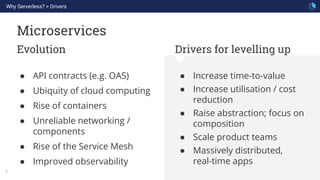
Microservices
Evolution Drivers for levelling up
● Increase time-to-value
● Increase utilisation / cost
reduction
● Raise abstraction; focus on
composition
● Scale product teams
● Massively distributed,
real-time apps
● API contracts (e.g. OAS)
● Ubiquity of cloud computing
● Rise of containers
● Unreliable networking /
components
● Rise of the Service Mesh
● Improved observability
Why Serverless? > Drivers
Trends
5
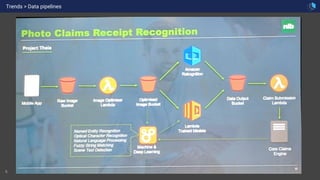
Data Pipelines
Trends > Data pipelines
6
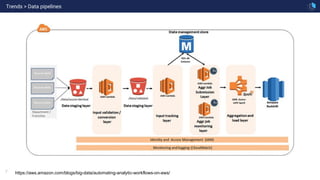
Trends > Data pipelines
7 https://aws.amazon.com/blogs/big-data/automating-analytic-workflows-on-aws/
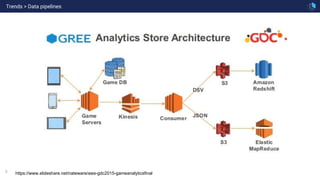
Trends > Data pipelines
8 https://www.slideshare.net/nateware/aws-gdc2015-gameanalyticsfinal
Trends > Data pipelines
9
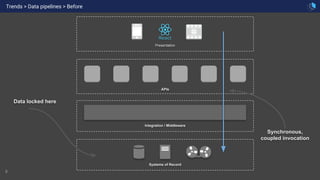
Trends > Data pipelines > Before
Systems of Record
Integration / Middleware
APIs
Presentation
Synchronous,
coupled invocation
Data locked here
10
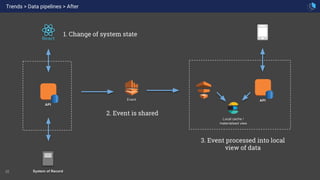
Trends > Data pipelines > After
System of Record
Event
API
Local cache /
materialised view
API
3. Event processed into local
view of data
1. Change of system state
2. Event is shared
Observations
Architecture > Microservices
● Democratisation of data
○ “Everyone gets a data”
● Hollywood Principle
● Pipelines are the new batch
● Prerequisite for AI/ML
● Composition and enrichment
● Lambda to “glue” steps together
12
IT Ops. Automation
Trends > IT Ops Automation
Before...
● Ad-hoc
● Cron jobs running on instances
● Scripts > code
● Shared “Job” machines, with broad
security permissions and “all-the-tools”
● Lots of manual “glue” and orchestration
Trends > IT Ops Automation
14
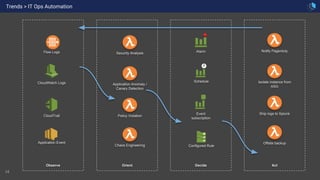
Trends > IT Ops Automation
Decide
Alarm
Schedule
Event
subscription
Notify Pagerduty
Act
Isolate instance from
ASG
Ship logs to Splunk
Offsite backup
Orient
Security Analysis
Application Anomaly /
Canary Detection
Policy Violation
Chaos Engineering
Observe
Flow Logs
CloudTrail
CloudWatch Logs
Application Event
Configured Rule
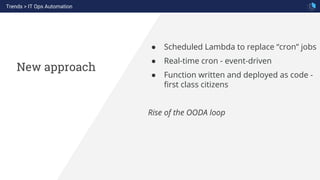
New approach
● Scheduled Lambda to replace “cron” jobs
● Real-time cron - event-driven
● Function written and deployed as code -
first class citizens
Rise of the OODA loop
Trends > IT Ops Automation
16
The new uService
Trends > Microservices
17
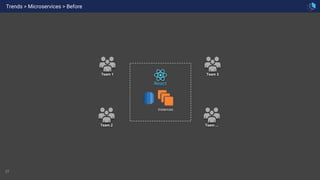
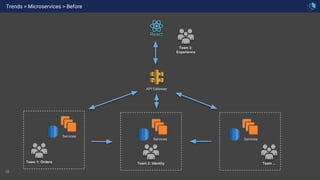
Trends > Microservices > Before
Instances
Team 1
Team 2
Team 3
Team ...
18
API Gateway
Trends > Microservices > Before
Services
Services
Team 1: Orders Team 2: Identity
Services
Team ...
Team 3:
Experience
19
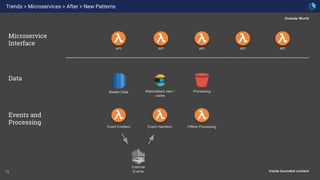
Trends > Microservices > After > New Patterns
API
External
Events
API
Outside World
Microservice
Interface
API
Master Data
API
Inside bounded context
Event Emitters
API
Materialised view /
cache
Events and
Processing
Data
Event Handlers
Processing
Offline Processing
20
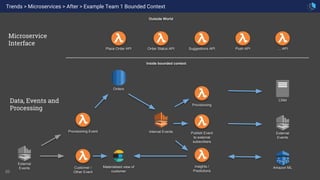
Provisioning
Amazon ML
Trends > Microservices > After > Example Team 1 Bounded Context
Place Order API
External
Events
Order Status API
Outside World
Internal Events
Microservice
Interface
Data, Events and
Processing
Suggestions API
Publish Event
to external
subscribers
Insights /
Predictions
Customer /
Other Event
Orders
Push API
Inside bounded context
CRM
Materialised view of
customer
Provisioning Event
External
Events
… API
21
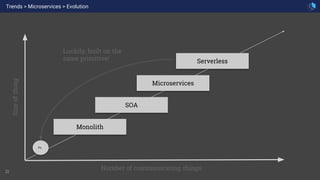
Trends > Microservices > Evolution
Sizeofthing
Number of communicating things
Monolith
SOA
Serverless
Microservices
Fn
Luckily, built on the
same primitive!
Observations
Architecture > Microservices
● Microservices still a thing
○ ..but are now just the interface of the
iceberg
● Further decomposition of services into
smaller functions
● Event-driven + asynchronous >
synchronous invocation
● Lambda and managed services as “glue”
● Architectural composition
BUT - More things to manage
Summary
Architecture > Microservices
● Serverless as a higher-order system
○ Composition
● IT Operations Automation
○ Better discipline (OODA)
○ Everything as code
● Microservices still a thing, new designs
emerging
○ Event-driven and loosely coupled
○ “Iceberg” patterns
24
Much Compose! So speed!
Architecture > Functions + Serverless (Cloud Native)Architecture > Functions + Serverless (Cloud Native)
25
New challenges
Architecture > Functions + Serverless (Cloud Native)
26
If you can’t build a good monolith you
shouldn’t be doing microservices
Architecture > Microservices
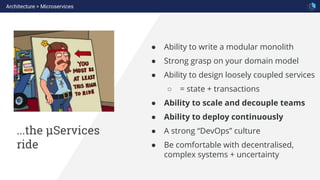
...the µServices
ride
● Ability to write a modular monolith
● Strong grasp on your domain model
● Ability to design loosely coupled services
○ = state + transactions
● Ability to scale and decouple teams
● Ability to deploy continuously
● A strong “DevOps” culture
● Be comfortable with decentralised,
complex systems + uncertainty
Architecture > Microservices
28
If you can’t build good microservices
you shouldn’t be doing serverless
Architecture > Functions + Serverless (Cloud Native)
29
What practices do we need in this
new world?
Architecture > Functions + Serverless (Cloud Native)
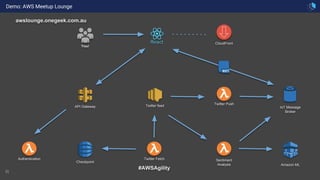
Serverless Lounge
31
Demo: AWS Meetup Lounge
CloudFront
API Gateway
Authentication
You!
awslounge.onegeek.com.au
Twitter Fetch
Twitter feed
Twitter Push
IoT Message
Broker
Sentiment
Analysis
Checkpoint
Amazon ML
#AWSAgility
32
Demo: AWS Meetup Lounge
Demo
Challenges
Blasphemy!
34
Smaller functions = more things!
Challenges > Async
WHAT WE ARE KNOWN FOR
35
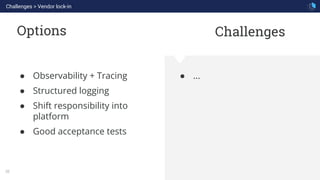
Options
● ...
Challenges
● Observability + Tracing
● Structured logging
● Shift responsibility into
platform
● Good acceptance tests
Challenges > Vendor lock-in
36
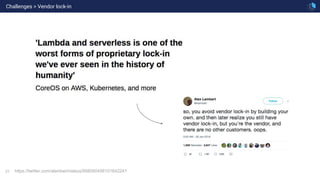
Vendor lock-in
Challenges > Vendor lock-in
37 https://twitter.com/alambert/status/958050456101642241
Challenges > Vendor lock-in
WHAT WE ARE KNOWN FOR
38
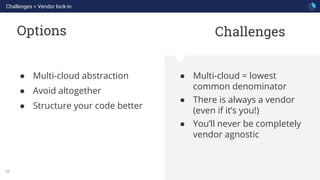
Options
● Multi-cloud = lowest
common denominator
● There is always a vendor
(even if it’s you!)
● You’ll never be completely
vendor agnostic
● Multi-cloud abstraction
● Avoid altogether
● Structure your code better
Challenges
Challenges > Vendor lock-in
WHAT WE ARE KNOWN FOR
39
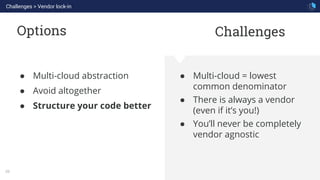
Options
● Multi-cloud = lowest
common denominator
● There is always a vendor
(even if it’s you!)
● You’ll never be completely
vendor agnostic
● Multi-cloud abstraction
● Avoid altogether
● Structure your code better
Challenges
Challenges > Vendor lock-in
Lambda
Handler
Challenges > Vendor lock-in > Lambda Anti-pattern
{
"Records": [
{
"EventVersion": "1.0",
"EventSubscriptionArn": "somearn",
"EventSource": "aws:sns",
"Sns": {
...
}
}
]
}
{
"Success": true
}
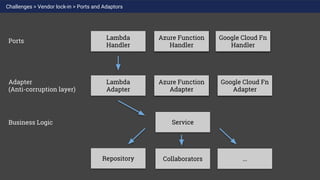
MQ Handler
WebSocket
handler
MQ Adapter WS Adapter
Azure Function
Adapter
Google Cloud Fn
Adapter
Azure Function
Handler
Google Cloud Fn
Handler
Lambda
Handler
Lambda
Adapter
Service
Repository
Adapter
(Anti-corruption layer)
Ports
Business Logic
Collaborators ...
Challenges > Vendor lock-in > Ports and Adaptors
42
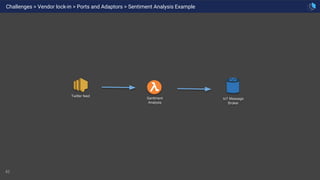
Challenges > Vendor lock-in > Ports and Adaptors > Sentiment Analysis Example
Twitter feed
Sentiment
Analysis
IoT Message
Broker
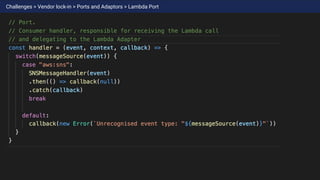
Challenges > Vendor lock-in > Ports and Adaptors > Lambda Port
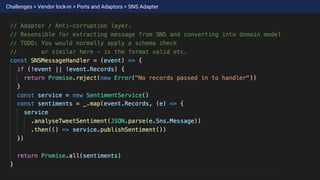
Challenges > Vendor lock-in > Ports and Adaptors > SNS Adapter
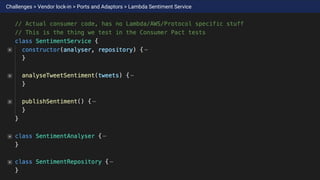
Challenges > Vendor lock-in > Ports and Adaptors > Lambda Sentiment Service
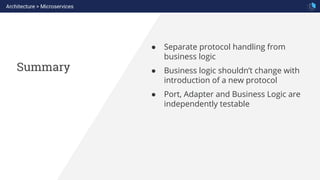
Summary
Architecture > Microservices
● Separate protocol handling from
business logic
● Business logic shouldn’t change with
introduction of a new protocol
● Port, Adapter and Business Logic are
independently testable
47
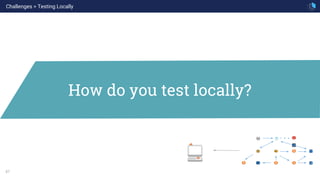
How do you test locally?
Challenges > Testing Locally
WHAT WE ARE KNOWN FOR
48
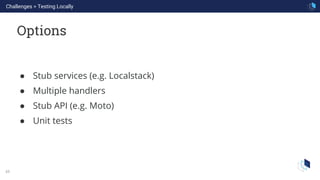
Options
Challenges > Testing Locally
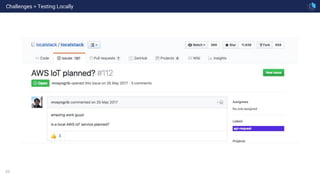
● Stub services (e.g. Localstack)
● Multiple handlers
● Stub API (e.g. Moto)
● Unit tests
49
Challenges > Testing Locally
WHAT WE ARE KNOWN FOR
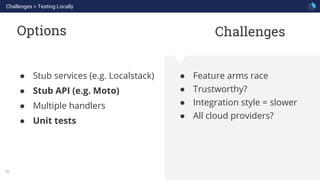
50
Options
● Feature arms race
● Trustworthy?
● Integration style = slower
● All cloud providers?
● Stub services (e.g. Localstack)
● Stub API (e.g. Moto)
● Multiple handlers
● Unit tests
Challenges > Testing Locally
Challenges
WHAT WE ARE KNOWN FOR
51
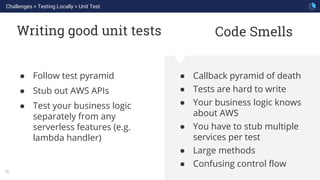
Writing good unit tests
● Follow test pyramid
● Stub out AWS APIs
● Test your business logic
separately from any
serverless features (e.g.
lambda handler)
● Callback pyramid of death
● Tests are hard to write
● Your business logic knows
about AWS
● You have to stub multiple
services per test
● Large methods
● Confusing control flow
Challenges > Testing Locally > Unit Test
Code Smells
52
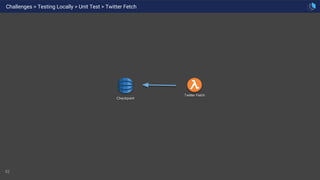
Challenges > Testing Locally > Unit Test > Twitter Fetch
Checkpoint
Twitter Fetch
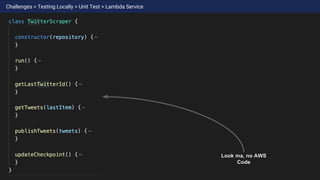
Challenges > Testing Locally > Unit Test > Lambda Service
Look ma, no AWS
Code
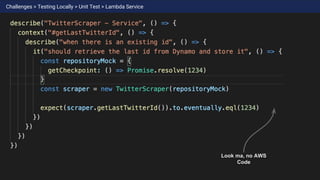
Challenges > Testing Locally > Unit Test > Lambda Service
Look ma, no AWS
Code
55
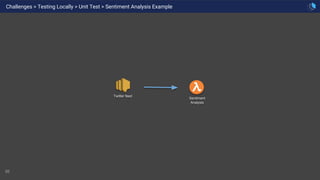
Challenges > Testing Locally > Unit Test > Sentiment Analysis Example
Twitter feed
Sentiment
Analysis
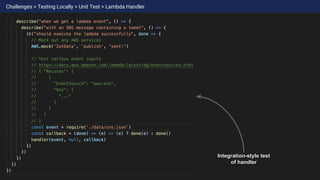
Integration-style test
of handler
Challenges > Testing Locally > Unit Test > Lambda Handler
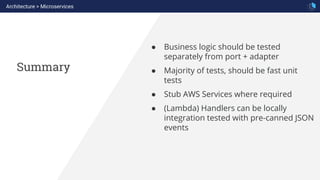
Summary
Architecture > Microservices
● Business logic should be tested
separately from port + adapter
● Majority of tests, should be fast unit
tests
● Stub AWS Services where required
● (Lambda) Handlers can be locally
integration tested with pre-canned JSON
events
58
Async - who is my consumer?
Challenges > Async
59
Async - delay in feedback
Challenges > Async
WHAT WE ARE KNOWN FOR
60
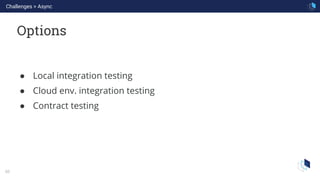
Options
● Local integration testing
● Cloud env. integration testing
● Contract testing
Challenges > Async
WHAT WE ARE KNOWN FOR
61
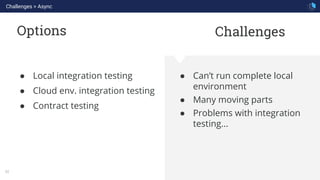
Options
● Can’t run complete local
environment
● Many moving parts
● Problems with integration
testing...
● Local integration testing
● Cloud env. integration testing
● Contract testing
Challenges
Challenges > Async
WHAT WE ARE KNOWN FOR
62
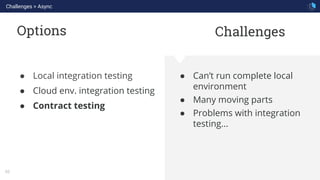
Options
● Can’t run complete local
environment
● Many moving parts
● Problems with integration
testing...
● Local integration testing
● Cloud env. integration testing
● Contract testing
Challenges
Challenges > Async
63
Contract tests
Challenges > Async
64
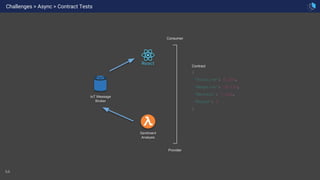
IoT Message
Broker
Sentiment
Analysis
Contract
{
'Positive': 0.234,
'Negative': 10.123,
'Neutral': 7.334,
'Mixed': 0
}
Consumer
Provider
Challenges > Async > Contract Tests
65
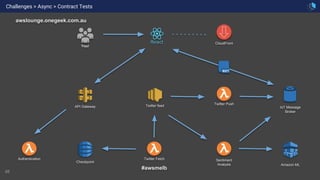
CloudFront
API Gateway
Authentication
You!
awslounge.onegeek.com.au
Twitter Fetch
Twitter feed
Twitter Push
IoT Message
Broker
Sentiment
Analysis
Checkpoint
Amazon ML
#awsmelb
Challenges > Async > Contract Tests
66
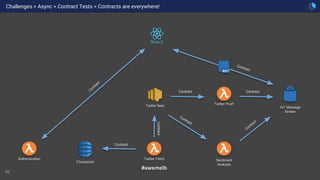
Authentication Twitter Fetch
Twitter feed
Twitter Push
IoT Message
Broker
Sentiment
Analysis
Checkpoint
#awsmelb
Challenges > Async > Contract Tests > Contracts are everywhere!
Contract
Contract
Contract
Contract
Contract
Contract
Contract
Contract
WHAT WE ARE KNOWN FOR
67
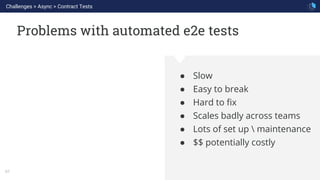
Problems with automated e2e tests
● Slow
● Easy to break
● Hard to fix
● Scales badly across teams
● Lots of set up  maintenance
● $$ potentially costly
Challenges > Async > Contract Tests
68
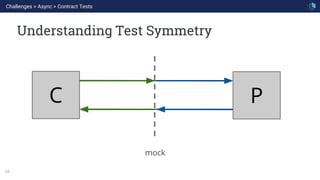
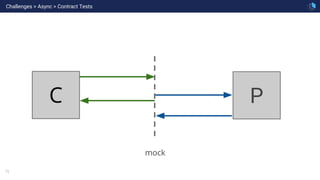
C P
mock
Challenges > Async > Contract Tests
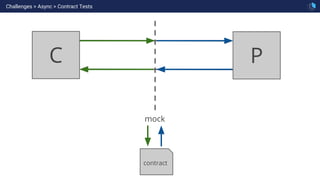
Understanding Test Symmetry
WHAT WE ARE KNOWN FOR
69
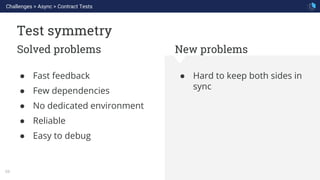
Test symmetry
Solved problems New problems
● Hard to keep both sides in
sync
● Fast feedback
● Few dependencies
● No dedicated environment
● Reliable
● Easy to debug
Challenges > Async > Contract Tests
70
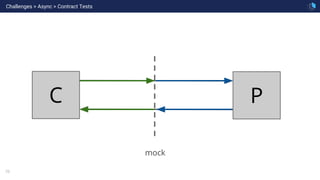
C P
mock
Challenges > Async > Contract Tests
71
C P
mock
Challenges > Async > Contract Tests
PPCC
mock
contract
Challenges > Async > Contract Tests
Bug turnaround -
minutes
Contracts tests
Challenges > Async > Contract Tests
Know before you
commit
Contracts tests
Challenges > Async > Contract Tests
Make changes with
speed and confidence
Contracts tests
Challenges > Async > Contract Tests
Deploy independently
Contracts tests
Challenges > Async > Contract Tests
Better API design
(Consumer)
Contracts tests
Challenges > Async > Contract Tests
78
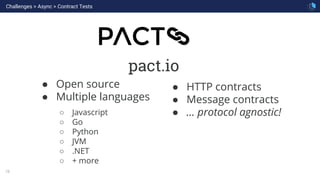
● Open source
● Multiple languages
○ Javascript
○ Go
○ Python
○ JVM
○ .NET
○ + more
pact.io
● HTTP contracts
● Message contracts
● … protocol agnostic!
Challenges > Async > Contract Tests
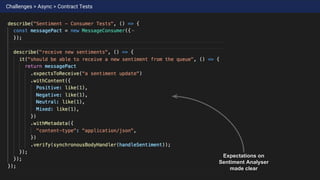
Expectations on
Sentiment Analyser
made clear
80
Acceptance Tests vs Canary Release
Challenges > Async
Summary
81
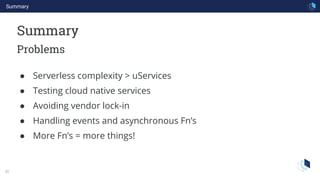
Summary
Problems
● Serverless complexity > uServices
● Testing cloud native services
● Avoiding vendor lock-in
● Handling events and asynchronous Fn’s
● More Fn’s = more things!
Summary
82
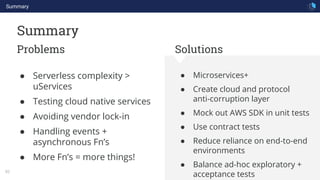
Summary
Problems Solutions
● Microservices+
● Create cloud and protocol
anti-corruption layer
● Mock out AWS SDK in unit tests
● Use contract tests
● Reduce reliance on end-to-end
environments
● Balance ad-hoc exploratory +
acceptance tests
● Serverless complexity >
uServices
● Testing cloud native services
● Avoiding vendor lock-in
● Handling events +
asynchronous Fn’s
● More Fn’s = more things!
Testing large-scale, serverless
and asynchronous systems
Matt Fellows
@matthewfellows
...without end-to-end integrated tests!

Trends and development practices in Serverless architectures

  • 1.
    Testing large-scale, serverless andasynchronous systems Matt Fellows @matthewfellows ...without end-to-end integrated tests! #AWSAgility
  • 2.
  • 3.
    WHAT WE AREKNOWN FOR 3 Microservices Evolution Drivers for levelling up ● Increase time-to-value ● Increase utilisation / cost reduction ● Raise abstraction; focus on composition ● Scale product teams ● Massively distributed, real-time apps ● API contracts (e.g. OAS) ● Ubiquity of cloud computing ● Rise of containers ● Unreliable networking / components ● Rise of the Service Mesh ● Improved observability Why Serverless? > Drivers
  • 4.
  • 5.
  • 6.
    6 Trends > Datapipelines
  • 7.
  • 8.
  • 9.
    9 Trends > Datapipelines > Before Systems of Record Integration / Middleware APIs Presentation Synchronous, coupled invocation Data locked here
  • 10.
    10 Trends > Datapipelines > After System of Record Event API Local cache / materialised view API 3. Event processed into local view of data 1. Change of system state 2. Event is shared
  • 11.
    Observations Architecture > Microservices ●Democratisation of data ○ “Everyone gets a data” ● Hollywood Principle ● Pipelines are the new batch ● Prerequisite for AI/ML ● Composition and enrichment ● Lambda to “glue” steps together
  • 12.
    12 IT Ops. Automation Trends> IT Ops Automation
  • 13.
    Before... ● Ad-hoc ● Cronjobs running on instances ● Scripts > code ● Shared “Job” machines, with broad security permissions and “all-the-tools” ● Lots of manual “glue” and orchestration Trends > IT Ops Automation
  • 14.
    14 Trends > ITOps Automation Decide Alarm Schedule Event subscription Notify Pagerduty Act Isolate instance from ASG Ship logs to Splunk Offsite backup Orient Security Analysis Application Anomaly / Canary Detection Policy Violation Chaos Engineering Observe Flow Logs CloudTrail CloudWatch Logs Application Event Configured Rule
  • 15.
    New approach ● ScheduledLambda to replace “cron” jobs ● Real-time cron - event-driven ● Function written and deployed as code - first class citizens Rise of the OODA loop Trends > IT Ops Automation
  • 16.
  • 17.
    17 Trends > Microservices> Before Instances Team 1 Team 2 Team 3 Team ...
  • 18.
    18 API Gateway Trends >Microservices > Before Services Services Team 1: Orders Team 2: Identity Services Team ... Team 3: Experience
  • 19.
    19 Trends > Microservices> After > New Patterns API External Events API Outside World Microservice Interface API Master Data API Inside bounded context Event Emitters API Materialised view / cache Events and Processing Data Event Handlers Processing Offline Processing
  • 20.
    20 Provisioning Amazon ML Trends >Microservices > After > Example Team 1 Bounded Context Place Order API External Events Order Status API Outside World Internal Events Microservice Interface Data, Events and Processing Suggestions API Publish Event to external subscribers Insights / Predictions Customer / Other Event Orders Push API Inside bounded context CRM Materialised view of customer Provisioning Event External Events … API
  • 21.
    21 Trends > Microservices> Evolution Sizeofthing Number of communicating things Monolith SOA Serverless Microservices Fn Luckily, built on the same primitive!
  • 22.
    Observations Architecture > Microservices ●Microservices still a thing ○ ..but are now just the interface of the iceberg ● Further decomposition of services into smaller functions ● Event-driven + asynchronous > synchronous invocation ● Lambda and managed services as “glue” ● Architectural composition BUT - More things to manage
  • 23.
    Summary Architecture > Microservices ●Serverless as a higher-order system ○ Composition ● IT Operations Automation ○ Better discipline (OODA) ○ Everything as code ● Microservices still a thing, new designs emerging ○ Event-driven and loosely coupled ○ “Iceberg” patterns
  • 24.
    24 Much Compose! Sospeed! Architecture > Functions + Serverless (Cloud Native)Architecture > Functions + Serverless (Cloud Native)
  • 25.
    25 New challenges Architecture >Functions + Serverless (Cloud Native)
  • 26.
    26 If you can’tbuild a good monolith you shouldn’t be doing microservices Architecture > Microservices
  • 27.
    ...the µServices ride ● Abilityto write a modular monolith ● Strong grasp on your domain model ● Ability to design loosely coupled services ○ = state + transactions ● Ability to scale and decouple teams ● Ability to deploy continuously ● A strong “DevOps” culture ● Be comfortable with decentralised, complex systems + uncertainty Architecture > Microservices
  • 28.
    28 If you can’tbuild good microservices you shouldn’t be doing serverless Architecture > Functions + Serverless (Cloud Native)
  • 29.
    29 What practices dowe need in this new world? Architecture > Functions + Serverless (Cloud Native)
  • 30.
  • 31.
    31 Demo: AWS MeetupLounge CloudFront API Gateway Authentication You! awslounge.onegeek.com.au Twitter Fetch Twitter feed Twitter Push IoT Message Broker Sentiment Analysis Checkpoint Amazon ML #AWSAgility
  • 32.
  • 33.
  • 34.
    34 Smaller functions =more things! Challenges > Async
  • 35.
    WHAT WE AREKNOWN FOR 35 Options ● ... Challenges ● Observability + Tracing ● Structured logging ● Shift responsibility into platform ● Good acceptance tests Challenges > Vendor lock-in
  • 36.
  • 37.
  • 38.
    WHAT WE AREKNOWN FOR 38 Options ● Multi-cloud = lowest common denominator ● There is always a vendor (even if it’s you!) ● You’ll never be completely vendor agnostic ● Multi-cloud abstraction ● Avoid altogether ● Structure your code better Challenges Challenges > Vendor lock-in
  • 39.
    WHAT WE AREKNOWN FOR 39 Options ● Multi-cloud = lowest common denominator ● There is always a vendor (even if it’s you!) ● You’ll never be completely vendor agnostic ● Multi-cloud abstraction ● Avoid altogether ● Structure your code better Challenges Challenges > Vendor lock-in
  • 40.
    Lambda Handler Challenges > Vendorlock-in > Lambda Anti-pattern { "Records": [ { "EventVersion": "1.0", "EventSubscriptionArn": "somearn", "EventSource": "aws:sns", "Sns": { ... } } ] } { "Success": true }
  • 41.
    MQ Handler WebSocket handler MQ AdapterWS Adapter Azure Function Adapter Google Cloud Fn Adapter Azure Function Handler Google Cloud Fn Handler Lambda Handler Lambda Adapter Service Repository Adapter (Anti-corruption layer) Ports Business Logic Collaborators ... Challenges > Vendor lock-in > Ports and Adaptors
  • 42.
    42 Challenges > Vendorlock-in > Ports and Adaptors > Sentiment Analysis Example Twitter feed Sentiment Analysis IoT Message Broker
  • 43.
    Challenges > Vendorlock-in > Ports and Adaptors > Lambda Port
  • 44.
    Challenges > Vendorlock-in > Ports and Adaptors > SNS Adapter
  • 45.
    Challenges > Vendorlock-in > Ports and Adaptors > Lambda Sentiment Service
  • 46.
    Summary Architecture > Microservices ●Separate protocol handling from business logic ● Business logic shouldn’t change with introduction of a new protocol ● Port, Adapter and Business Logic are independently testable
  • 47.
    47 How do youtest locally? Challenges > Testing Locally
  • 48.
    WHAT WE AREKNOWN FOR 48 Options Challenges > Testing Locally ● Stub services (e.g. Localstack) ● Multiple handlers ● Stub API (e.g. Moto) ● Unit tests
  • 49.
  • 50.
    WHAT WE AREKNOWN FOR 50 Options ● Feature arms race ● Trustworthy? ● Integration style = slower ● All cloud providers? ● Stub services (e.g. Localstack) ● Stub API (e.g. Moto) ● Multiple handlers ● Unit tests Challenges > Testing Locally Challenges
  • 51.
    WHAT WE AREKNOWN FOR 51 Writing good unit tests ● Follow test pyramid ● Stub out AWS APIs ● Test your business logic separately from any serverless features (e.g. lambda handler) ● Callback pyramid of death ● Tests are hard to write ● Your business logic knows about AWS ● You have to stub multiple services per test ● Large methods ● Confusing control flow Challenges > Testing Locally > Unit Test Code Smells
  • 52.
    52 Challenges > TestingLocally > Unit Test > Twitter Fetch Checkpoint Twitter Fetch
  • 53.
    Challenges > TestingLocally > Unit Test > Lambda Service Look ma, no AWS Code
  • 54.
    Challenges > TestingLocally > Unit Test > Lambda Service Look ma, no AWS Code
  • 55.
    55 Challenges > TestingLocally > Unit Test > Sentiment Analysis Example Twitter feed Sentiment Analysis
  • 56.
    Integration-style test of handler Challenges> Testing Locally > Unit Test > Lambda Handler
  • 57.
    Summary Architecture > Microservices ●Business logic should be tested separately from port + adapter ● Majority of tests, should be fast unit tests ● Stub AWS Services where required ● (Lambda) Handlers can be locally integration tested with pre-canned JSON events
  • 58.
    58 Async - whois my consumer? Challenges > Async
  • 59.
    59 Async - delayin feedback Challenges > Async
  • 60.
    WHAT WE AREKNOWN FOR 60 Options ● Local integration testing ● Cloud env. integration testing ● Contract testing Challenges > Async
  • 61.
    WHAT WE AREKNOWN FOR 61 Options ● Can’t run complete local environment ● Many moving parts ● Problems with integration testing... ● Local integration testing ● Cloud env. integration testing ● Contract testing Challenges Challenges > Async
  • 62.
    WHAT WE AREKNOWN FOR 62 Options ● Can’t run complete local environment ● Many moving parts ● Problems with integration testing... ● Local integration testing ● Cloud env. integration testing ● Contract testing Challenges Challenges > Async
  • 63.
  • 64.
    64 IoT Message Broker Sentiment Analysis Contract { 'Positive': 0.234, 'Negative':10.123, 'Neutral': 7.334, 'Mixed': 0 } Consumer Provider Challenges > Async > Contract Tests
  • 65.
    65 CloudFront API Gateway Authentication You! awslounge.onegeek.com.au Twitter Fetch Twitterfeed Twitter Push IoT Message Broker Sentiment Analysis Checkpoint Amazon ML #awsmelb Challenges > Async > Contract Tests
  • 66.
    66 Authentication Twitter Fetch Twitterfeed Twitter Push IoT Message Broker Sentiment Analysis Checkpoint #awsmelb Challenges > Async > Contract Tests > Contracts are everywhere! Contract Contract Contract Contract Contract Contract Contract Contract
  • 67.
    WHAT WE AREKNOWN FOR 67 Problems with automated e2e tests ● Slow ● Easy to break ● Hard to fix ● Scales badly across teams ● Lots of set up maintenance ● $$ potentially costly Challenges > Async > Contract Tests
  • 68.
    68 C P mock Challenges >Async > Contract Tests Understanding Test Symmetry
  • 69.
    WHAT WE AREKNOWN FOR 69 Test symmetry Solved problems New problems ● Hard to keep both sides in sync ● Fast feedback ● Few dependencies ● No dedicated environment ● Reliable ● Easy to debug Challenges > Async > Contract Tests
  • 70.
    70 C P mock Challenges >Async > Contract Tests
  • 71.
    71 C P mock Challenges >Async > Contract Tests
  • 72.
  • 73.
    Bug turnaround - minutes Contractstests Challenges > Async > Contract Tests
  • 74.
    Know before you commit Contractstests Challenges > Async > Contract Tests
  • 75.
    Make changes with speedand confidence Contracts tests Challenges > Async > Contract Tests
  • 76.
  • 77.
    Better API design (Consumer) Contractstests Challenges > Async > Contract Tests
  • 78.
    78 ● Open source ●Multiple languages ○ Javascript ○ Go ○ Python ○ JVM ○ .NET ○ + more pact.io ● HTTP contracts ● Message contracts ● … protocol agnostic! Challenges > Async > Contract Tests
  • 79.
    Challenges > Async> Contract Tests Expectations on Sentiment Analyser made clear
  • 80.
    80 Acceptance Tests vsCanary Release Challenges > Async
  • 81.
    Summary 81 Summary Problems ● Serverless complexity> uServices ● Testing cloud native services ● Avoiding vendor lock-in ● Handling events and asynchronous Fn’s ● More Fn’s = more things!
  • 82.
    Summary 82 Summary Problems Solutions ● Microservices+ ●Create cloud and protocol anti-corruption layer ● Mock out AWS SDK in unit tests ● Use contract tests ● Reduce reliance on end-to-end environments ● Balance ad-hoc exploratory + acceptance tests ● Serverless complexity > uServices ● Testing cloud native services ● Avoiding vendor lock-in ● Handling events + asynchronous Fn’s ● More Fn’s = more things!
  • 83.
    Testing large-scale, serverless andasynchronous systems Matt Fellows @matthewfellows ...without end-to-end integrated tests!